
Back to Journals » Clinical Ophthalmology » Volume 20
Genotype Association of VEGF Polymorphism rs2010963 with Strabismus in a Pakistani Cohort: A Case-Control Study
Authors Khalid MA, Amin NUA, Nehal C, Nadeem S  , Woo KM, Jamil MU , Azam M
Received 6 August 2025
Accepted for publication 8 January 2026
Published 2 February 2026 Volume 2026:20 558601
DOI https://doi.org/10.2147/OPTH.S558601
Checked for plagiarism Yes
Review by Single anonymous peer review
Peer reviewer comments 2
Editor who approved publication: Dr Scott Fraser
Muhammad Ahmad Khalid,1 Noor-ul-Ain Amin,2 Conain Nehal,2 Sana Nadeem,3 Kwang Min Woo,4 Muhammad Usman Jamil,4 Maleeha Azam2
1Department of Science, Buckingham Browne and Nichols School, Cambridge, MA, USA; 2Department of Biosciences, COMSATS University Islamabad, Islamabad, Pakistan; 3Department of Ophthalmology, Foundation University Medical College, Foundation University Islamabad, Islamabad, Pakistan; 4Department of Ophthalmology, New England Eye Center, Boston, MA, USA
Correspondence: Maleeha Azam, Department of Biosciences, COMSATS University Islamabad, Pakistan, Shahzad, COMSATS University Islamabad-Main Campus, Tarlai Kalan, Park Road, Chak, Islamabad, 45550, Pakistan, Email [email protected]
Purpose: This study was conducted to investigate the associations between specific genetic variation in VEGF and the prevalence of strabismus, with particular focus on VEGF polymorphism rs2010963 and whether presence of GG phenotype increases the odds of strabismus compared to GC or CC allele in a Pakistani cohort.
Patients and Methods: Blood samples from 43 strabismus patients and 170 non-diabetic healthy normal controls from a previously published study from our group were used for comparison. Genotyping of the selected single nucleotide polymorphism (SNP) was carried out using polymerase chain reaction restriction fragment length polymorphism (PCR-RFLP) for 43 samples of strabismus. Genotype and allele frequencies were then computed for all patients. Logistic regression was used to evaluate the association between the rs2010963 genotype and the risk of strabismus. A p-value of < 0.05 was considered statistically significant.
Results: Of the 43 strabismus patients, 27 (66%) had exotropia, followed by esotropia in 14 patients (34%). Their genotype frequency included 24 (56%) patients with the GG genotype, 14 (33%) with the GC genotype, and 5 (12%) with the CC genotype. Among the 170 normal controls, 50 (29%) had the GG genotype, 60 (35%) had the GC genotype, and 60 (35%) had the CC genotype. Individuals with the GG phenotype had significantly higher odds of having strabismus compared to those with CC genotype (OR = 5.76, 95% CI [2.05– 16.20], p = 0.0009). GG phenotype was also associated with higher odds to those with GC phenotype, but the result was not statistically significant (OR = 2.06 [0.96– 4.39], p = 0.062).
Conclusion: This study explored the association of VEGFA polymorphism rs2010963 and strabismus in a Pakistani cohort. The GG genotype was more frequent in strabismus cases than in controls (56% vs 29%), and a significant association was found between rs2010963 and strabismus which should be confirmed in larger, preferably age-matched cohorts.
Keywords: VEGF, strabismus, Pakistani, genotype, South Asian
Introduction
Strabismus, defined as a misalignment of the eyes, is among the most prevalent pediatric ocular disorders, affecting approximately 2–4% of the global population, with similar or higher rates reported in Pakistani children.1,2 This condition can lead to amblyopia, reduced stereopsis, and, in severe cases, permanent vision loss.3,4 Beyond visual consequences, strabismus has been shown to negatively affect psychosocial well-being, self-esteem, and quality of life.2,5,6 The pathophysiology of strabismus is complex, encompassing disruptions in extraocular muscle function, anomalies in orbital connective tissues, and neural control deficits.3,7 While environmental factors such as premature birth, low birth weight, and perinatal insults contribute to risk, a substantial heritable component is well documented.4,8
Genetic studies have highlighted the polygenic and heterogeneous nature of strabismus. Twin and family studies suggest a heritability of up to 70% in monozygotic twins and 30–40% in dizygotic twins, with several candidate loci, such as the STBMS1 locus, implicated in familial cases.3,5 Advances in exome sequencing and linkage analyses have identified a spectrum of genes related to ocular muscle development, cranial nerve innervation, and cortical visual processing pathways.4,8 However, the molecular mechanisms linking these genetic variants to strabismus remain incompletely understood.
Among the genes of interest, vascular endothelial growth factor A (VEGFA) has attracted attention for its role in angiogenesis, myogenesis, and neuroprotection.9 VEGFA is a key cytokine regulating vascular permeability, endothelial cell proliferation, and extracellular matrix remodeling, all processes relevant to the development and maintenance of extraocular muscles.10 Importantly, differential expression of VEGFA and its receptors has been observed in strabismic extraocular muscles, suggesting a role in altered muscle or nerve remodeling.11,12
Single-nucleotide polymorphisms (SNP) in the VEGFA gene, including rs2010963 commonly referred to as +405G>C or −634G>C, have been shown to influence VEGFA expression levels in retinal and other vascular tissues.10 The rs2010963 polymorphism has been linked to several angiogenesis-related diseases such as diabetic retinopathy, retinopathy of prematurity, and coronary artery disease, suggesting its functional relevance.9,13 Given VEGFA’s importance in extraocular muscle physiology and neurovascular interactions, VEGFA polymorphisms may represent plausible genetic contributors to strabismus risk.
To date, little is known about the association between VEGFA genetic variants and strabismus in South Asian populations, including Pakistan, where the genetic and environmental profiles may differ from previously studied cohorts. Therefore, this study aimed to investigate the association between the VEGFA rs2010963 polymorphism and strabismus in a Pakistani cohort. Understanding whether specific VEGFA variants, such as rs2010963, are associated with an increased risk of strabismus could help in better understanding its genetic etiology.
Materials and Methods
In this case-control study, a total of 43 patients with strabismus were recruited, and blood samples were collected for analysis. For the control group, genotype data from 170 non-diabetic healthy individuals from a previous study by our group in the Pakistani population were used as population controls.11 These controls were recruited from an older cohort, were not individually age- or sex-matched to the strabismus cases, and none had documented strabismus or manifest ocular misalignment on routine clinical examination.
The genotypes of the selected SNP, rs2010963, were determined using PCR-RFLP, where the amplified products were digested with the BsmFI restriction enzyme. This enzyme cuts the DNA in a way that allows a clear distinction between the GG, GC, and CC genotypes based on the resulting fragment sizes observed on agarose gel (Figure 1).
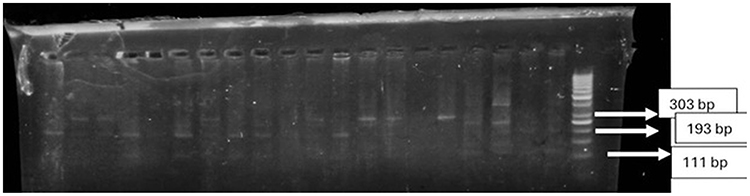 |
Figure 1 The gel shows the results of RFLP digestion. The presence of 111 bp and 193 bp bands indicates the GG genotype, resulting from successful restriction enzyme digestion. In contrast, the presence of an uncut 303 bp band corresponds to the CC genotype, indicating no restriction site for the enzyme. When all three are present, this represents a GC genotype (such as the one marked on the right of the gel). |
The study adhered to the principles of the Declaration of Helsinki and was approved by the Ethics Review Board of the Department of Biosciences, COMSATS University Islamabad (CUI-Reg/Notif-452/20/526). Written informed consent was obtained from all participants or participant’s legal guardians/parents if less than 18 years of age.
Statistical Analysis
Genotype and allele frequencies were calculated for cases and controls, and associations between VEGFA rs2010963 genotypes and strabismus were evaluated using logistic regression, with odds ratios (OR) and 95% confidence intervals (CI). A p-value of <0.05 was considered statistically significant. Hardy–Weinberg equilibrium (HWE) for rs2010963 was assessed separately in cases and controls using a chi-square goodness-of-fit test. The analyses were performed in Python (version 3.11).
Results
Genotype Distribution
A total of 43 patients with strabismus and 170 healthy controls were included in the analysis. Table 1 includes the demographic data of the patients and controls sampled. Out of the 43 strabismus patients, 41 had information on the specific type of strabismus they had. Among these, Exotropia was the most common type, seen in 27 patients (66%), followed by Esotropia in 14 patients (34%). The genotype distribution of VEGFA rs2010963 in strabismus patients was as follows: 24 individuals (56%) had the GG genotype, 14 individuals (33%) had the GC genotype, and 5 individuals (12%) had the CC genotype. In contrast, among the 170 controls, 50 individuals (29%) were GG, 60 (35%) were GC, and 60 (35%) were CC genotype carriers.
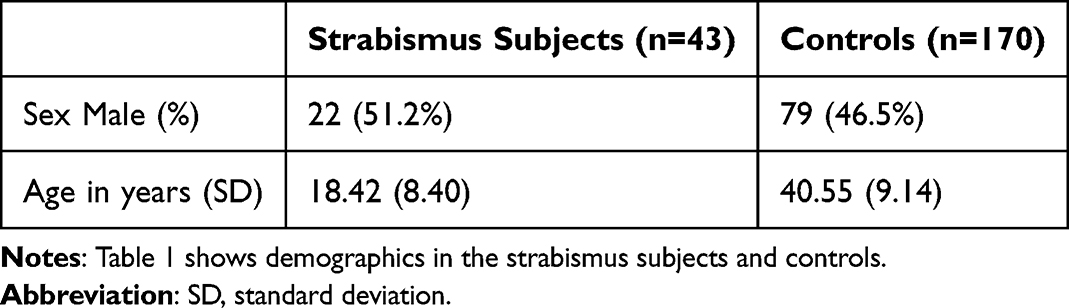 |
Table 1 Demographic Data and Descriptive Features |
Genotype-Based Association
Logistic regression analysis revealed that individuals with the GG genotype had significantly higher odds of developing strabismus compared to those with the CC genotype (OR = 5.76, 95% CI 2.05–16.20, p = 0.0009). The relatively wide confidence interval reflects some uncertainty about the exact magnitude of this effect, as expected in a study with a modest number of cases. When comparing the GG genotype to the GC genotype, the odds ratio was 2.06 (95% CI 0.96–4.39), though this association did not reach statistical significance (p = 0.062). No statistically significant difference was observed between the GC and CC genotypes (OR = 1.23, 95% CI 0.44–3.44, p = 0.68) (Table 2).
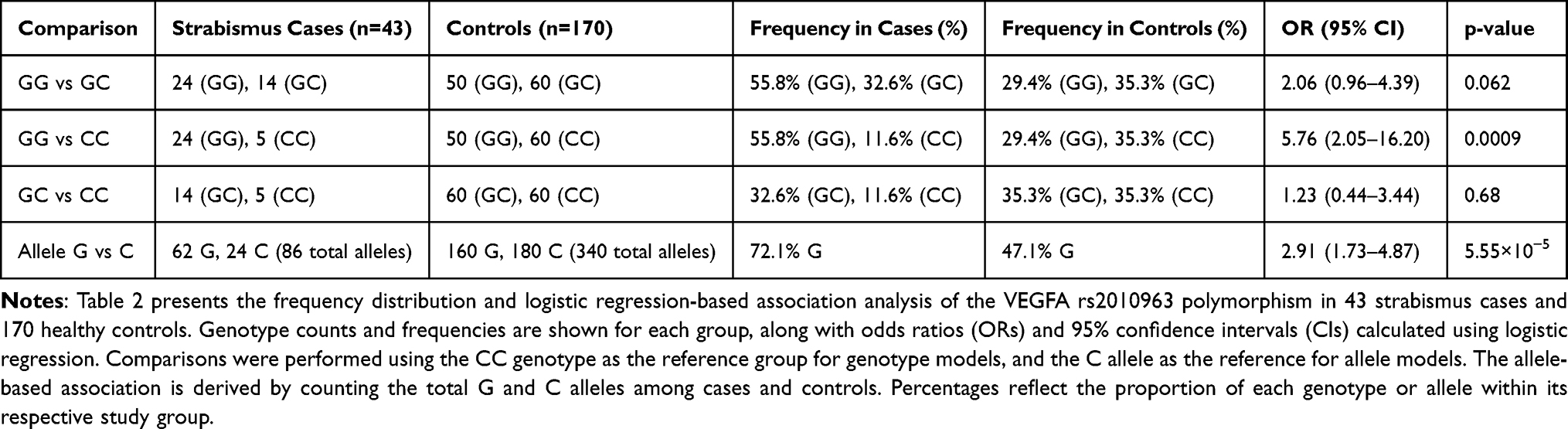 |
Table 2 Frequency Distribution and Logistic Regression Analysis of VEGFA rs2010963 Genotypes and Alleles in Strabismus Cases and Controls |
Allele-Based Association
An allelic association analysis was performed to further evaluate risk, considering 86 alleles from cases and 340 alleles from controls. The frequency of the G allele was 72.1% among strabismus patients compared to 47.1% among controls. Pearson’s chi-square test (1 df) yielded a value of χ2 = 16.25, corresponding to an allelic OR of 2.91 (95% CI 1.73–4.87) (p = 5.55 × 10⁻⁵) (Table 2). This significant enrichment of the G allele in strabismus cases supports the genotype-based finding of an increased risk associated with the rs2010963-G variant.
Hardy–Weinberg equilibrium analysis for rs2010963 is summarized in Supplementary Table 1. The genotype distribution in the strabismus group was consistent with HWE (χ2=1.57, p=0.21), whereas the control group showed a significant deviation from HWE (χ2=14.46, p=1.4×10⁻⁴). This deviation indicates that the healthy control cohort, recruited in a previous genetics study, may not fully represent a population-based sample of the underlying population.
Discussion
In this small pilot study, we investigated the association between the VEGFA rs2010963 polymorphism and strabismus in a Pakistani cohort. Our findings demonstrate that the GG genotype of rs2010963 has significantly higher odds of contributing to strabismus compared to healthy controls, leading to more than five-fold increased risk of strabismus relative to the CC genotype. Although this effect size is larger than many reported for common variants in complex eye diseases, the wide confidence interval suggests that the exact magnitude should be interpreted with some caution and is likely to be refined in larger, well-matched cohorts. Furthermore, allelic analysis revealed a significantly higher frequency of the G allele among cases, consistent with its potential role as a risk allele. In our analysis, three genotype comparisons and one allelic comparison were performed; both the GG-versus-CC genotype association and the allelic association remained statistically significant after applying a conservative Bonferroni-adjusted threshold (α=0.0125), although, together with the modest sample size, these multiple tests argue for some caution when interpreting the precise size of the effect. rs2010963 is a common VEGFA polymorphism in public reference datasets such as gnomAD and dbSNP, and the G-allele frequency observed in our controls (47.1%) lies within the broad range reported for non-European populations, which helps to contextualize the enrichment seen in strabismus cases.
These observations are noteworthy given the established role of VEGFA in angiogenesis, myogenesis, and neurovascular development.9 VEGFA has been implicated in the physiology of extraocular muscles and their vascular supply.10 The altered VEGFA expression could plausibly affect muscle contractility or remodeling, predisposing individuals to strabismus.9,10 Prior studies have reported downregulation of VEGFA signaling components in strabismic extraocular muscles, suggesting a pathogenic link between vascular growth factor pathways and ocular alignment disorders.1,14,15
The rs2010963 polymorphism has previously been studied in relation to other vascular-related ocular conditions, including diabetic retinopathy, retinopathy of prematurity, and age-related macular degeneration.9,11,13 Experimental studies have shown that this SNP influences VEGFA gene expression levels in various tissues, including the retina, where the C allele is generally associated with higher expression.10 In contrast, the lack of VEGFA expression associated with the G allele could lead to reduced VEGFA signaling.10 As the VEGFA is necessary for the neurogenic development of the extraocular muscles12 reduced signaling could plausibly contribute to increased susceptibility to strabismus, although our association data alone do not prove a direct causal link. These findings are consistent with the possibility that rs2010963 influences VEGFA expression and isoform balance in ocular tissues and may interact with other genes involved in ocular motility and RAS–MAPK signaling; however, such functional and gene–gene interaction studies were beyond the scope of this study.
Overall, strabismus has a complex genetic background, with several genes described in the literature reflecting the functional heterogeneity and multifactorial nature of the disorder.3,8 However, confirming these findings across studies has been challenging due to differences in clinical presentation and genetic architecture among populations.3,8 Our results suggest that VEGFA could be an important genetic factor in strabismus, especially in South Asian populations, where unique genetic and environmental backgrounds may influence disease risk. Since VEGFA polymorphism frequencies can vary among different ethnic groups, larger studies involving more diverse populations are needed to validate and confirm these observations.16
Limitations of our study include the use of older, non–age-matched controls from a prior study, a relatively small sample size, and the significant deviation from HWE observed in the control group; together, these factors may introduce demographic confounding, limit the precision of our estimates, and contribute to inflation of the odds ratios. Second, our study was limited to a single SNP for analysis, and other VEGFA variants or haplotypes, in combination with environmental or epigenetic factors, could also influence the strabismus phenotype. Larger and more diverse studies, along with lab research on VEGFA in eye muscles, are needed to better understand these results and guide future treatments.
Conclusion
Our study is the first to report a significant association between VEGFA rs2010963 and strabismus in a Pakistani population, with the GG genotype more frequent among cases than controls. Both genotype and allele results suggest that VEGFA may contribute to genetic susceptibility to this condition and are consistent with a role for angiogenic pathways in strabismus. Given the modest number of strabismus cases and the use of older, non–age-matched controls, these findings should be confirmed in larger, preferably multi-center, age-matched cohorts, and are not yet sufficient to justify routine clinical screening based on rs2010963 alone.
Acknowledgments
The abstract of this paper was presented at the Association for Research in Vision and Ophthalmology (ARVO) Annual Meeting 2025 as a poster presentation with interim findings. The poster’s abstract was published in “Poster Abstracts” in the Investigative Ophthalmology and Visual Science Journal. This paper has been uploaded to medrxiv.org as a preprint: https://www.medrxiv.org/content/10.1101/2025.10.23.25338643v1
Disclosure
The authors report no conflicts of interest in this work.
References
1. Ye XC, van der Lee R, Wasserman WW. Curation and bioinformatic analysis of strabismus genes supports functional heterogeneity and proposes candidate genes with connections to RASopathies. Gene. 2019;697:213–6. doi:10.1016/j.gene.2019.02.020
2. Hutchinson AK, Morse CL, Hercinovic A, et al. Pediatric eye evaluations preferred practice pattern. Ophthalmology. 2023;130(3):P222–P270. doi:10.1016/j.ophtha.2022.10.030
3. Ye XC, Pegado V, Patel MS, Wasserman WW. Strabismus genetics across a spectrum of eye misalignment disorders. Clin Genet. 2014;86(2):103–111. doi:10.1111/CGE.12367
4. Sprunger DT, Lambert SR, Hercinovic A, et al. Esotropia and exotropia preferred practice pattern®. Ophthalmology. 2023;130(3):P179–P221. doi:10.1016/j.ophtha.2022.11.002
5. Maconachie GDE, Gottlob I, McLean RJ. Risk factors and genetics in common comitant strabismus: a systematic review of the literature. JAMA Ophthalmol. 2013;131(9):1179–1186. doi:10.1001/JAMAOPHTHALMOL.2013.4001
6. Hatt SR, Leske DA, Castañeda YS, et al. Association of strabismus with functional vision and eye-related quality of life in children. JAMA Ophthalmol. 2020;138(5):528–535. doi:10.1001/JAMAOPHTHALMOL.2020.0539
7. Sunyer-Grau B, Quevedo L, Rodríguez-Vallejo M, Argilés M. Comitant strabismus etiology: extraocular muscle integrity and central nervous system involvement—a narrative review. Graefes Arch Clin Exp Ophthalmol. 2023;261(7):1781–1792. doi:10.1007/S00417-022-05935-9
8. An JY, Jung JH, Choi L, Wieben ED, Mohney BG. Identification of possible risk variants of familial strabismus using exome sequencing analysis. Genes. 2021;12(1):75. doi:10.3390/GENES12010075
9. Ma WQ, Wang Y, Han XQ, Zhu Y, Liu NF. Association of genetic polymorphisms in vascular endothelial growth factor with susceptibility to coronary artery disease: a meta-analysis. BMC Med Genet. 2018;19(1):1–12. doi:10.1186/S12881-018-0628-3/FIGURES/3
10. Vailati FB, Crispim D, Sortica DA, Souza BM, Brondani LA, Canani LH. The C allele of −634G/C polymorphism in the VEGFA gene is associated with increased VEGFA gene expression in human retinal tissue. Invest Ophthalmol Vis Sci. 2012;53(10):6411–6415. doi:10.1167/IOVS.12-9727
11. Khan N, Paterson AD, Roshandel D, et al. Association of IGF1 and VEGFA polymorphisms with diabetic retinopathy in Pakistani population. Acta Diabetol. 2020;57(2):237–245. doi:10.1007/S00592-019-01407-5
12. Calvo PM, Hernández RG, De La Cruz RR, Pastor AM. VEGF is an essential retrograde trophic factor for motoneurons. Proc Natl Acad Sci U S A. 2022;119(26). doi:10.1073/PNAS.2202912119
13. Kalmeh ZA, Azarpira N, Mosallaei M, Hosseini H, Malekpour Z. Genetic polymorphisms of vascular endothelial growth factor and risk for retinopathy of prematurity in South of Iran. Mol Biol Rep. 2013;40(7):4613–4618. doi:10.1007/S11033-013-2554-Y
14. Altick AL, Feng CY, Schlauch K, Alan Johnson L, von Bartheld CS. Differences in gene expression between strabismic and normal human extraocular muscles. Invest Ophthalmol Vis Sci. 2012;53(9):5168–5177. doi:10.1167/IOVS.12-9785
15. Agarwal AB, Feng CY, Altick AL, et al. Altered protein composition and gene expression in strabismic human extraocular muscles and tendons. Invest Ophthalmol Vis Sci. 2016;57(13):5576–5585. doi:10.1167/IOVS.16-20294
16. Muniz JJ, Izidoro-Toledo TC, Metzger IF, Sandrim VC, Tanus-Santos JE. Interethnic differences in the distribution of clinically relevant vascular endothelial growth factor genetic polymorphisms. DNA Cell Biol. 2009;28(11):567–572. doi:10.1089/DNA.2009.0925
 © 2026 The Author(s). This work is published and licensed by Dove Medical Press Limited. The
full terms of this license are available at https://www.dovepress.com/terms
and incorporate the Creative Commons Attribution
- Non Commercial (unported, 4.0) License.
By accessing the work you hereby accept the Terms. Non-commercial uses of the work are permitted
without any further permission from Dove Medical Press Limited, provided the work is properly
attributed. For permission for commercial use of this work, please see paragraphs 4.2 and 5 of our Terms.
© 2026 The Author(s). This work is published and licensed by Dove Medical Press Limited. The
full terms of this license are available at https://www.dovepress.com/terms
and incorporate the Creative Commons Attribution
- Non Commercial (unported, 4.0) License.
By accessing the work you hereby accept the Terms. Non-commercial uses of the work are permitted
without any further permission from Dove Medical Press Limited, provided the work is properly
attributed. For permission for commercial use of this work, please see paragraphs 4.2 and 5 of our Terms.