
Back to Journals » Infection and Drug Resistance » Volume 19
Genetic and Molecular Epidemiological Characterization of ESBL-Producing Escherichia coli Isolated from University Students in Japan
Authors Matsumura M, Matsumura S, Ito Y, Ohshima A, Hiramoto S, Takikawa H
Received 19 September 2025
Accepted for publication 29 December 2025
Published 8 January 2026 Volume 2026:19 568296
DOI https://doi.org/10.2147/IDR.S568296
Checked for plagiarism Yes
Review by Single anonymous peer review
Peer reviewer comments 3
Editor who approved publication: Dr Hazrat Bilal
Mitsuru Matsumura,1 Seika Matsumura,1 Yuma Ito,1 Akane Ohshima,1 Suguru Hiramoto,2 Hajime Takikawa1
1Department of Clinical Laboratory Science, Faculty of Medical Technology, Teikyo University, Tokyo, Japan; 2Clinical Laboratory, Gunma University Hospital, Maebashi, Gunma, Japan
Correspondence: Mitsuru Matsumura, Email [email protected]
Background: Extended-spectrum β-lactamase (ESBL)-producing Escherichia coli are major contributors to global antimicrobial resistance. Colonization in healthy individuals represents a silent reservoir that links community and healthcare settings. Determining the prevalence and molecular characteristics of ESBL-producing strains in community populations is essential for effective infection control.
Methods: We enrolled 96 healthy third-year students and collected perianal swabs to detect ESBL-producing E. coli. Antimicrobial susceptibility testing, ESBL genotyping, phylogrouping, and POT-based molecular epidemiological typing were performed to characterize the isolates and identify ST131 and its H30 subclone.
Results: ESBL-producing E. coli were detected in 7.3% of students (7/96; 95% CI: 3.0– 14.4%). All isolates harbored CTX-M–type ESBL genes, and the high-risk clone ST131/H30 was frequently identified. POT-based molecular typing revealed distinct patterns for all isolates, indicating independent acquisition rather than clonal transmission within the cohort.
Conclusion: The detection of multidrug-resistant ST131-H30 in healthy young adults highlights the potential role of community carriers in introducing high-risk clones into healthcare settings. Strengthened surveillance and integrated One Health–based approaches are needed to curb the spread of antimicrobial resistance.
Keywords: ESBL-producing Escherichia coli, CTX-M, phylogroup, ST131/H30 subclone, POT typing, antimicrobial resistance
Introduction
Extended-spectrum β-lactamase (ESBL)-producing Enterobacteriaceae are resistant to third-generation cephalosporins and monobactams and are recognized globally as major causes of healthcare- and community-associated infections. Their increasing detection in community settings raises concern that healthy individuals may serve as silent reservoirs for dissemination. In Japan, fecal carriage among healthy adults has been estimated at 6–9%, with CTX-M-type enzymes predominating. Potential sources include companion animals, food products, and environmental water, emphasizing the importance of a One Health perspective.
Among Escherichia coli lineages, sequence type 131 (ST131) combines multidrug resistance with enhanced virulence and is a leading cause of extraintestinal infections such as urinary tract infection and sepsis. The H30 subclone is notable for high-level fluoroquinolone resistance and its frequent association with CTX-M-15, and it has emerged as a globally disseminated pandemic lineage. Although ST131 has been extensively studied in clinical isolates, its prevalence and characteristics among healthy community members remain incompletely understood.
University students represent a socially active cohort of healthy young adults who may facilitate transmission between community and healthcare environments. Previous studies from Europe and Asia have reported variable ESBL carriage rates in this population, but comparative data from Japan are limited. To address this gap, we investigated ESBL-producing E. coli among healthy university students in Japan. Our objectives were to determine carriage prevalence, characterize ESBL genotypes, define phylogenetic groups, assess clonal relatedness by POT-based typing, and identify the distribution of ST131 and its H30 subclone. By focusing on this community cohort, our study aims to support risk assessment and prevention strategies within a One Health framework.1–9
Methods
Participants
We enrolled 96 healthy third-year students in the Department of Clinical Laboratory Science at Teikyo University during the 2023 academic year. Perianal swab specimens were collected using Cary–Blair transport medium (BD).
Ethics Statement
This study was conducted in accordance with the Declaration of Helsinki.
Participation was entirely voluntary, and the purpose of the study was explained verbally to all participants prior to sample collection.
Written informed consent was obtained from all participants.
No personal identifiers or clinical information were collected, and all samples were anonymized.
According to the Ethics Committee of Teikyo University, formal institutional review board approval was not required for this study, as confirmed by the Chair of the Ethics Committee.
Culture, Species Identification, and Antimicrobial Susceptibility Testing
Presumptive ESBL-producing Enterobacterales were isolated on CHROMagar ESBL (Kanto Chemical) after incubation at 35 °C for 18 hours. Seven isolates confirmed as ESBL producers were included for analysis. Species identification was performed using the MALDI Biotyper Sirius system (Bruker Daltonics).
Antimicrobial susceptibility testing was conducted with the MicroScan WalkAway system (Beckman Coulter; panel NMIC3.31E) and interpreted according to CLSI guidelines. The following antimicrobial agents were evaluated: piperacillin (PIPC), cefmetazole (CMZ), ceftriaxone (CTRX), ceftazidime (CAZ), cefotaxime (CTX), cefepime (CFPM), meropenem (MEPM), aztreonam (AZT), cefpodoxime (CPDX), levofloxacin (LVFX), and ciprofloxacin (CPFX).
ESBL production was confirmed by a ≥3 twofold dilution decrease in the MIC of CAZ or CTX in the presence of clavulanic acid compared with the MIC of the respective agent alone.
ESBL Genotyping and Phylogrouping
ESBL genotyping was performed using the Cica Geneus ESBL Genotype Detection Kit II (Kanto Chemical, Japan), according to the manufacturer’s validated protocol.
Phylogrouping was conducted using the triplex PCR method described by Clermont et al,10 classifying isolates into phylogenetic groups A, B1, B2, or D. The primer sets used were as follows:
- ChuA (279 bp): ChuA.1 (5′-GACGAACCAACGGTCAGGAT-3′) / ChuA.2 (5′-TGCCGCCAGTACCAAAGACA-3′)
- YjaA (211 bp): YjaA.1 (5′-TGAAGTGTCAGGAGACGCTG-3′) / YjaA.2 (5′-ATGGAGAATGCGTTCCTCAAC-3′)
- TsE4C2 (152 bp): TspE4C2.1 (5′-GAGTAATGTCGGGGCATTCA-3′) / TspE4C2.2 (5′-CGCGCCAACAAAGTATTACG-3′).
PCR conditions were as follows: initial denaturation at 94 °C for 4 min; 30 cycles of 94 °C for 5 s and 59 °C for 10 min; and a final extension at 72 °C for 5 min. Three microliters of bacterial suspension or a small portion of a colony was used as template DNA.
POT-Based Typing and Clone Identification
Clonal relatedness and ST131 identification were assessed using the Cica Geneus POT1 Molecular Epidemiology Kit for E. coli (Kanto Chemical, Japan), with all procedures performed according to the manufacturer’s validated protocol. The H30 subclone within ST131 was further confirmed by PCR following the method described by Colpan et al,11 using the primer sets and cycling conditions reported in the original publication.
Results
Detection of ESBL-Producing E. coli and Antimicrobial Susceptibility
Among 96 specimens, seven (7.3%) yielded ESBL-producing Escherichia coli. In antimicrobial susceptibility testing, all isolates were resistant to piperacillin (PIPC), ceftriaxone (CTRX), cefotaxime (CTX), and cefpodoxime (CPDX). Susceptibility to ceftazidime (CAZ) varied, consistent with a CTX-M phenotype. Four isolates were susceptible to levofloxacin (LVFX), whereas three were resistant. All isolates remained susceptible to meropenem (MEPM) and cefmetazole (CMZ) (Table 1).
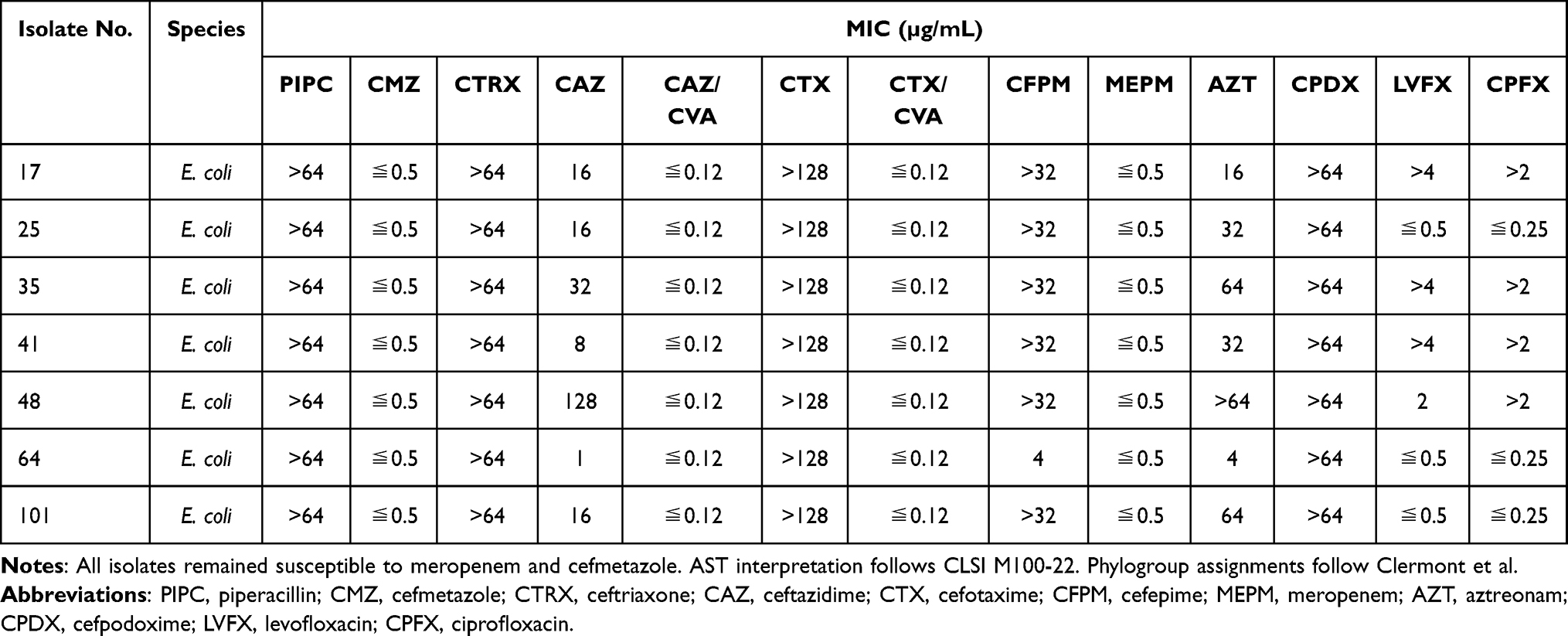 |
Table 1 Antimicrobial Susceptibility results of ESBL-Producing Escherichia coli Isolates |
ESBL production was confirmed in all isolates by a ≥3 twofold dilution decrease in the MIC of CTX in the presence of clavulanic acid compared with CTX alone.
ESBL Genotypes and Phylogroups
Multiplex PCR detected blaCTX-M in all isolates, yielding four patterns: CTX-M-1 group in 2 isolates (28.6%); CTX-M-1 group plus blaTEM in 1 (14.3%); CTX-M-9 group in 3 (42.9%); and CTX-M-9 group plus blaTEM in 1 (14.3%) (Table 2).
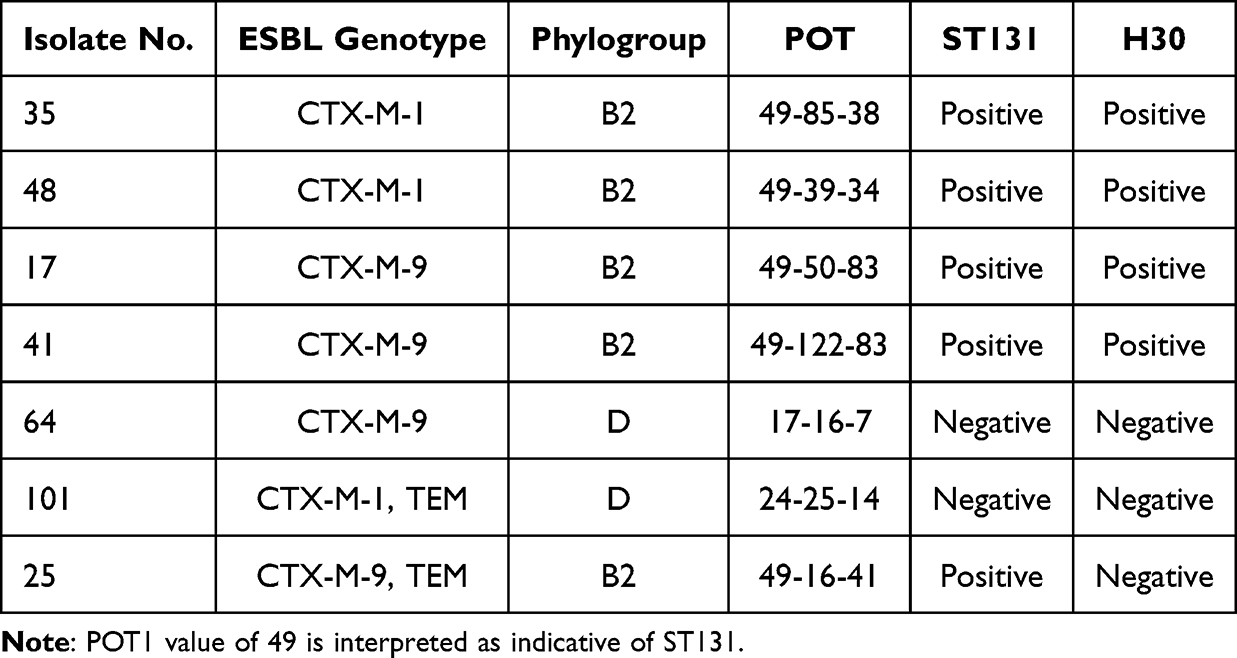 |
Table 2 Summary of ESBL Genotypes, Phylogroups, POT Types, and ST131/H30 Subclone Status of Escherichia coli Isolates |
Phylogrouping assigned five isolates to phylogroup B2 and two to phylogroup D, with the predominance of virulent lineages among clinical strains.12
POT-Based Typing and ST131/H30 Subclone
POT-based typing showed distinct profiles for all seven isolates (Figure 1), indicating the absence of clonal transmission and suggesting individual acquisition routes. Of the seven isolates, five belonged to ST131, and four of those were classified as the H30 subclone.11
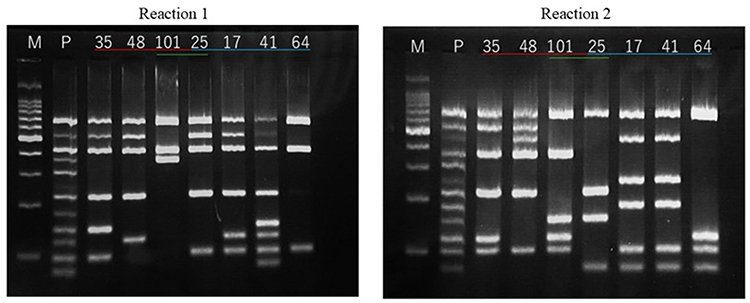 |
Figure 1 POT electrophoresis profiles of Escherichia coli isolates. The left (Reaction 1) and right (Reaction 2) panels show the POT banding patterns of the seven ESBL-producing E. coli isolates. M: 100 bp DNA ladder; P: positive control. Each lane represents a distinct isolate, and all isolates exhibited different POT profiles, indicating independent acquisition (non-clonal origin). Color bars indicate the detected ESBL genotypes: red, CTX-M-1 group; blue, CTX-M-9 group; green, TEM. |
ST131 is widely recognized as a high-virulence, multidrug-resistant lineage, and H30 is associated with fluoroquinolone resistance.11
Details of ESBL genotypes, phylogroups, POT types, and ST131/H30 status are summarized in Table 2.11,12
Discussion
The present study revealed that 7.3% of healthy university students carried ESBL-producing Escherichia coli, with the majority belonging to the globally disseminated ST131 lineage, particularly the H30 subclone. This finding is of clinical importance because colonization among young, socially active individuals may serve as a hidden reservoir that facilitates the introduction of multidrug-resistant strains into healthcare environments.
The prevalence observed in this study is comparable to previous reports from Japan (6–9%)1 and falls within the lower to mid-range of global estimates. In European cohorts, fecal carriage among healthy young adults has been reported at 5–12%2,12 whereas rates in certain Asian countries exceed 20%.3,4 The predominance of CTX-M-type enzymes and the frequent detection of ST131/H30 in our cohort are consistent with international trends. These findings underscore the global spread of high-risk clones and indicate that Japan is not exempt from these dynamics.
The detection of high-virulence, multidrug-resistant ST131-H30 in community carriers raises important infection control. University students frequently engage in social, educational, and healthcare-related activities, increasing the potential for dissemination. The introduction of such strains into clinical settings may compromise treatment options, particularly for urinary tract infections and sepsis. The observation that each isolate exhibited a distinct POT type further suggests independent acquisition events rather than clonal transmission, highlighting the complexity of community reservoirs.
ESBL-producing E. coli have been reported in companion animals, livestock, food products, and environmental water sources.1,5 Genetic similarities between isolates from humans and animals support the possibility of interspecies exchange. Our findings contribute to growing evidence that human carriers form part of a broader One Health network facilitating the dissemination of antimicrobial resistance. Future studies should incorporate human, animal, and environmental surveillance to more precisely identify transmission pathways.
Several limitations should be acknowledged. First, the sample size was small and derived from a single university cohort, which may restrict the generalizability of the findings. Second, epidemiological information such as recent antibiotic exposure, international travel, dietary habits, and contact with animals or healthcare environments was not collected, limiting assessment of potential risk factors for ESBL carriage. Third, although PCR-based genotyping was performed, higher-resolution approaches such as whole-genome sequencing (WGS) were not utilized, limiting detailed analysis of resistance determinants, plasmid content, and clonal relationships. Finally, the cross-sectional study design does not allow evaluation of persistence, acquisition dynamics, or temporal variation in ESBL colonization.
Despite these limitations, this study provides novel insights into the prevalence and molecular characteristics of ESBL-producing E. coli among healthy young adults in Japan. Future research should include multi-institutional and nationwide surveillance with larger sample sizes, combined with advanced genomic approaches such as WGS to track clonal dissemination and plasmid transfer. Linking community carriage data with clinical infection databases will further clarify the contribution of asymptomatic carriers to hospital outbreaks. International collaborations will also be essential to compare trends across regions and to develop coordinated strategies. At the policy level, our findings reinforce the importance of antimicrobial stewardship, infection prevention measures in both community and hospital settings, and integrated One Health frameworks to curb the spread of antimicrobial resistance.5–11,13
Conclusion
ESBL-producing Escherichia coli were identified in 7.3% of healthy university students, with most isolates belonging to high-virulence, multidrug-resistant lineages such as ST131, particularly the H30 subclone. POT genotyping indicated independent acquisition rather than clonal transmission.
These findings highlight the diversity and clinical relevance of ESBL-producing E. coli carriage in the community and underscore the importance of strengthening surveillance and risk assessment to mitigate the dissemination of antimicrobial resistance.
Acknowledgments
We thank the students who participated in this study for their cooperation. We also express our gratitude to the staff of the Bacteriology Laboratory at Teikyo University Hospital for their assistance with sample collection and laboratory procedures. We further thank the Chair of the Teikyo University Ethics Committee for confirming that formal ethical approval was not required for this study.
Disclosure
The authors declare no conflicts of interest related to this study.
References
1. Madec JY, et al. One Health approach to tackle extended-spectrum β-lactamase-producing Escherichia coli. Future Microbiol. 2017;12:1–6. doi:10.2217/fmb-2016-0193
2. Woerther PL, Burdet C, Chachaty E, Andremont A. Trends in human fecal carriage of extended-spectrum β-lactamases in the community: toward the globalization of CTX-M. Clin Microbiol Rev. 2013;26:744–758. doi:10.1128/CMR.00023-13
3. Cantón R, Coque TM. The CTX-M β-lactamase pandemic. Curr Opin Microbiol. 2006;9:466–475. doi:10.1016/j.mib.2006.08.011
4. Ruppé E, Armand-Lefèvre L, Estellat C, et al. High rate of acquisition but short duration of carriage of multidrug-resistant Enterobacteriaceae after travel to the tropics. Clin Infect Dis. 2015;61:593–600. doi:10.1093/cid/civ333
5. Woerther PL, Andremont A, Kantele A. Travel-acquired ESBL-producing Enterobacteriaceae: impact of colonization at individual and community level. J Travel Med. 2017;24(suppl_1):S29–S34. doi:10.1093/jtm/taw101
6. Karanika S, Karantanos T, Arvanitis M, et al. Fecal colonization with extended-spectrum β-lactamase-producing enterobacteriaceae and risk factors among healthy individuals: a systematic review and meta-analysis. Clin Infect Dis. 2016;63(3):310–318. doi:10.1093/cid/ciw283
7. Nicolas-Chanoine MH, Bertrand X, Madec JY. Escherichia coli ST131, an intriguing clonal group. Clin Microbiol Rev. 2014;27(3):543–574. doi:10.1128/CMR.00125-13
8. Johnson JR, Porter S, Thuras P, Castanheira M. The pandemic H30 subclone of sequence type 131 as the leading cause of multidrug-resistant Escherichia coli infections in the United States. Clin Infect Dis. 2017;65(10):169–180.
9. Mathers AJ, Peirano G, Pitout JD. The role of epidemic resistance plasmids and international high-risk clones in the spread of multidrug-resistant Enterobacteriaceae. Clin Microbiol Rev. 2015;28(3):565–591. doi:10.1128/CMR.00116-14
10. Tamada Y, et al. Fecal carriage of extended-spectrum β-lactamase-producing Enterobacteriaceae in healthy Japanese adults. J Infect Chemother. 2012;18:460–466.
11. Matsumura Y, Pitout JDD, Gomi R, et al. Global Escherichia coli sequence type 131 clade with blaCTX-M-27 gene. Emerg Infect Dis. 2016;22:1900–1907. doi:10.3201/eid2211.160519
12. Clermont O, Bonacorsi S, Bingen E, et al. Rapid and simple determination of the Escherichia coli phylogenetic group. Appl Environ Microbiol. 2000;66:4555–4558. doi:10.1128/AEM.66.10.4555-4558.2000
13. Rodríguez-Baño J, Gutiérrez-Gutiérrez B, Machuva I, Pascual A. Treatment of infections caused by extended-spectrum β-lactamase-, AmpC-, and carbapenemase-producing Enterobacteriaceae. Clin Microbiol Rev. 2018;31(2):e00079–17. doi:10.1128/CMR.00079-17
 © 2026 The Author(s). This work is published and licensed by Dove Medical Press Limited. The
full terms of this license are available at https://www.dovepress.com/terms
and incorporate the Creative Commons Attribution
- Non Commercial (unported, 4.0) License.
By accessing the work you hereby accept the Terms. Non-commercial uses of the work are permitted
without any further permission from Dove Medical Press Limited, provided the work is properly
attributed. For permission for commercial use of this work, please see paragraphs 4.2 and 5 of our Terms.
© 2026 The Author(s). This work is published and licensed by Dove Medical Press Limited. The
full terms of this license are available at https://www.dovepress.com/terms
and incorporate the Creative Commons Attribution
- Non Commercial (unported, 4.0) License.
By accessing the work you hereby accept the Terms. Non-commercial uses of the work are permitted
without any further permission from Dove Medical Press Limited, provided the work is properly
attributed. For permission for commercial use of this work, please see paragraphs 4.2 and 5 of our Terms.