
Back to Journals » Journal of Multidisciplinary Healthcare » Volume 19
From Hospital to Home: Enhancing Family Support with MIGYN (Mitra Interaktif Ginekologi), an AI-Based Discharge Planning Chatbot
Authors Maryati I  , Ermiati E , Natasya W, Hasanah A , Irmala N , Susanti S, Atikah A, Yulianti DEF, Abdullah KL
Received 12 December 2025
Accepted for publication 27 May 2026
Published 11 June 2026 Volume 2026:19 588471
DOI https://doi.org/10.2147/JMDH.S588471
Checked for plagiarism Yes
Review by Single anonymous peer review
Peer reviewer comments 2
Editor who approved publication: Professor Charles V Pollack
Ida Maryati,1 Ermiati Ermiati,1 Windy Natasya,2 Anisa Hasanah,3 Novi Irmala,3 Santi Susanti,3 Atikah Atikah,3 Dyana Eka Fuzi Yulianti,3 Khatijah Lim Abdullah4
1Department of Maternity and Pediatric Nursing, Faculty of Nursing, Universitas Padjadjaran, Sumedang, West Java, Indonesia; 2Department of Nursing, Dr. Hasan Sadikin General Hospital, Bandung, Indonesia; 3Master of Nursing Program, Faculty of Nursing, Universitas Padjadjaran, Sumedang, West Java, Indonesia; 4School of Nursing, Faculty of Medical and Life Sciences, Sunway University, Petaling Jaya, Selangor, Malaysia
Correspondence: Ida Maryati, Department of Maternity and Pediatric Nursing, Faculty of Nursing, Universitas Padjadjaran, Sumedang, West Java, 45363, Indonesia, Tel +628122109363, Fax +6222-7795596, Email [email protected]
Background: Postoperative gynecological patients often experience challenges during the transition from hospital to home due to suboptimal discharge planning. Family involvement plays an important role in supporting postoperative recovery; however, caregiver support and education are frequently unstructured and inconsistent.
Objective: To evaluate the effectiveness of MIGYN (Mitra Interaktif Ginekologi), a family-based interactive chatbot, in improving family support and caregiver knowledge among postoperative gynecological patients.
Methods: A quasi-experimental pre–post test study was conducted involving 34 caregivers of postoperative gynecological patients at Dr. Hasan Sadikin General Hospital, Bandung. Participants were divided into intervention and control groups (n = 17 each). Family support was measured using the Family Support Scale (FSS), while caregiver knowledge was assessed using a structured questionnaire. Data were analyzed using the Wilcoxon signed-rank test and Mann–Whitney U-test.
Results: Both groups demonstrated improvements in family support and caregiver knowledge following the intervention period. Within-group analysis showed significant increases in family support and caregiver knowledge scores in both groups (p < 0.05). However, between-group analysis demonstrated a statistically significant difference only in caregiver knowledge (p = 0.003), with the intervention group showing greater improvement and a moderate effect size (r = 0.51). In contrast, family support did not differ significantly between groups (p = 0.447), with a small effect size (r = 0.13).
Conclusion: MIGYN was associated with significant improvements in caregiver knowledge among postoperative gynecological patients, while improvements in family support were relatively comparable between groups. These findings suggest that MIGYN may serve as a digital discharge planning approach to support caregiver education and family involvement during postoperative recovery.
Keywords: caregiver knowledge, discharge planning, family support, gynecology, health chatbot, MIGYN
Introduction
Postoperative gynecology patients often face multiple challenges, including physical, psychological, and social issues, which may significantly affect their recovery process and overall quality of life. Postoperative gynecological patients are also at risk of developing procedure-related complications, including postoperative urinary retention, which may further complicate recovery and increase the need for structured postoperative monitoring and discharge support.1 The transition from hospital to home is a critical period that frequently causes anxiety and uncertainty, particularly when discharge planning is not carried out optimally.2 Limited communication and inadequate education during discharge preparation are associated with low patient readiness, increased risk of complications, and higher readmission rates following gynecological surgery.3
Ideally, discharge planning should involve effective communication among healthcare providers, patients, and families regarding continued care instructions, medications, diet, physical activity, warning signs, and follow-up schedules.4 However, in practice, family involvement is often passive, unstructured, and restricted to brief verbal instructions before hospital discharge. This condition leads to poor treatment adherence, inadequate recognition of warning signs, and a higher risk of complications resulting in readmission.5
Family support is one of the key determinants of successful postoperative recovery. House (1981) classified family support into four dimensions: emotional, informational, instrumental, and appraisal support. Emotional support helps reduce anxiety and improve psychological well-being; informational support facilitates patients’ understanding of care instructions; instrumental support provides daily practical assistance; while appraisal support offers motivation and constructive feedback.6,7 Previous studies have consistently shown that optimal family involvement is associated with better psychosocial adaptation and postoperative recovery outcomes.8,9
Despite its importance, few systems consistently facilitate family engagement in discharge planning. Most hospitals still rely on conventional approaches such as brief face-to-face counseling, which are easily forgotten, difficult to monitor, and unable to provide continuous support. In contrast, the rapid advancement of digital health technology (e-health and m-health) offers opportunities to enhance discharge planning effectiveness. Mobile applications and digital platforms have been shown to improve access to health information, treatment adherence, and patient-family engagement.10,11 Previous studies have also demonstrated that messaging-based educational interventions delivered through platforms such as LINE and WhatsApp can improve reproductive health knowledge, attitudes, and health-related behaviors, highlighting the potential of digital communication platforms for patient education and engagement.12
One of the latest innovations is the use of artificial intelligence (AI)-based health chatbots. Chatbots can deliver interactive education, provide medication reminders, and respond to patient inquiries in real time.13 Studies have demonstrated that medical chatbots can generate accurate and understandable discharge instructions and even improve medication adherence among elderly patients through automated reminders.14,15
Despite the growing use of digital health technologies, there is still limited evidence regarding the application of chatbot-based discharge planning specifically for postoperative gynecological patients. Most existing studies have focused on general patient education or single-user digital applications that primarily target patients without actively involving family members in the care process. This highlights an important gap, as postoperative recovery particularly in gynecological patients requires substantial and sustained family support during the transition from hospital to home. Furthermore, although digital innovations have strong potential to strengthen family roles in discharge planning, their application in this specific clinical context remains limited.
The existing gap also lies in the fact that, although discharge planning plays a vital role in recovery, current practices often fail to ensure active and sustainable family engagement. Education is frequently brief, unstructured, and limited to verbal instructions before discharge, leaving patients and families underprepared for self-care at home. This creates a mismatch between the need for a comprehensive, family-centered discharge planning system and the conventional approaches still commonly used in hospitals. In addition, the increasing readiness of patients and families to use smartphones and internet-based health applications provides a strong rationale for integrating digital solutions into discharge planning, as mobile technology enables continuous access to health information and supports ongoing communication beyond the hospital setting.
To address this gap, this study developed MIGYN (Mitra Interaktif Ginekologi), a multi-user chatbot designed to strengthen family involvement in discharge planning for postoperative gynecology patients. Unlike conventional discharge education or single-user digital applications, MIGYN simultaneously engages both patients and caregivers through structured educational modules, automated reminders, and real-time interactive Q&A sessions. By providing continuous, accessible, and interactive support beyond the hospital setting, MIGYN facilitates better understanding of postoperative care, encourages active family participation, and promotes adherence to treatment recommendations. Through these integrated features, MIGYN is expected to enhance family support, improve patient and caregiver knowledge, and support more optimal recovery outcomes, including the potential to reduce complications and prevent avoidable readmissions.
Therefore, this study aims to evaluate the effectiveness of MIGYN in improving family support and caregiver knowledge among postoperative gynecology patients.
Methods
Study Design
This study employed a quasi-experimental two-group pretest–posttest design to evaluate the effectiveness of MIGYN (Mitra Interaktif Ginekologi) in improving family support and caregiver knowledge among postoperative gynecological patients. The study involved an intervention group and a control group, allowing the assessment of changes before and after the intervention as well as comparisons between groups.
Participants and Setting
The study was conducted at the Gynecology Inpatient Unit of Dr. Hasan Sadikin General Hospital (RSHS), Bandung, Indonesia, from May 3 to May 27, 2025. The study was carried out as part of a clinical field practice program undertaken by postgraduate nursing students from Universitas Padjadjaran at Dr. Hasan Sadikin General Hospital. All research activities, including data collection and implementation of the intervention, were conducted within the hospital setting under institutional supervision and approval. Therefore, ethical approval was obtained from the Health Research Ethics Committee of Dr. Hasan Sadikin General Hospital for the implementation of this study.
The study population consisted of caregivers of postoperative gynecological patients at RSHS. Sample size was calculated based on medium effect size assumptions (α = 0.05, power = 0.80, Cohen’s d = 0.50), requiring a minimum of 34 participants. A total of 34 caregivers were recruited using accidental sampling and divided into intervention and control groups (n = 17 each). Accidental sampling was used considering the limited study period and the availability of eligible caregivers during the data collection process.
Inclusion criteria for caregivers were: aged ≥18 years, identified as the primary caregiver during hospitalization and after discharge, able to use a smartphone and access the internet, and willing to participate by signing informed consent. Caregivers of patients undergoing elective gynecological surgery were included in the study. Exclusion criteria included severe cognitive or psychiatric disorders interfering with communication, inability to independently use digital media, and caregivers of patients requiring prolonged intensive postoperative care.
The intervention used in this study was MIGYN (Mitra Interaktif Ginekologi), a family-based multi-user chatbot developed through the Telegram platform based on the Intervention Mapping framework and guided by House’s Social Support Theory (1981).16 MIGYN provided structured educational content related to postoperative gynecological care, including nutrition, mobilization, wound care, medication, warning signs, and postoperative care instructions. The platform also included interactive communication features, automated educational reminders, and support for caregiver involvement during the postoperative recovery process. Prior to discharge, caregivers in the intervention group received individual bedside training from nurse educators for approximately 15–20 minutes per session regarding platform navigation and access to educational features. The intervention sessions were delivered 2–3 times during hospitalization to ensure caregiver understanding and familiarity with the platform and were continued after discharge to support continuity of postoperative care at home.
Ethical Considerations
This study was conducted in accordance with the ethical principles outlined in the Declaration of Helsinki. Ethical approval was obtained from the Health Research Ethics Committee of Dr. Hasan Sadikin General Hospital, Bandung (Approval No. DP.04.03/D.XIV.4.4/2045/2025). Research permission was granted by the Director of Human Resources, Education, and Research at RSHS. Written informed consent was obtained from all postoperative gynecological patients and their caregivers prior to participation. Caregivers served as the primary respondents for questionnaire assessments. Confidentiality, anonymity, and voluntary participation were strictly maintained.
Data Collection
The intervention involved the use of MIGYN, a Telegram-based family-centered multi-user chatbot designed as a digital discharge planning assistant. Its features included: 1) structured educational content on postoperative gynecological care, including nutrition, mobilization, wound care, medication, warning signs, and postoperative care instructions; 2) interactive communication and real-time Q&A features; and 3) automated educational reminders and support for caregiver involvement in postoperative care. Prior to the intervention, caregivers in the intervention group received individual bedside training from nurse educators for approximately 15–20 minutes per session regarding platform navigation and access to educational features. The intervention sessions were delivered 2–3 times during hospitalization to ensure caregiver understanding and familiarity with the platform and were continued after discharge for a two-week intervention period.
The instruments used in this study included: 1) the Family Support Scale (FSS), a 20-item Likert scale assessing emotional, informational, instrumental, and appraisal support (score range 20–80, with higher scores indicating stronger family support);8 and 2) a researcher-developed knowledge questionnaire validated by three experts to assess caregiver knowledge regarding postoperative gynecological care.
The study procedures included: 1) participant recruitment and informed consent; 2) pretest assessment using the FSS and caregiver knowledge questionnaire; 3) implementation of the two-week MIGYN intervention for the intervention group and routine discharge education for the control group; 4) posttest assessment at the end of the intervention period using the same instruments; and 5) data entry and quality control through supervisor cross-checking of 10% of the collected data.
Data Analysis
Descriptive statistics were used to summarize participant demographic characteristics. The Shapiro–Wilk test was performed to assess data normality. Because several variables were not normally distributed (p < 0.05), non-parametric tests were applied for further analysis. Within-group differences between pretest and posttest scores were analyzed using the Wilcoxon signed-rank test, while between-group differences were analyzed using the Mann–Whitney U-test. A significance level of p < 0.05 was considered statistically significant.
Reliability and Validity
Several strategies were implemented to ensure the reliability and validity of the study instruments and data collection process. Family support was measured using the Family Support Scale (FSS), which underwent validity and reliability testing prior to use. Validity testing conducted on 17 respondents showed that all 20 items had r-count values greater than the r-table value of 0.482 at a significance level of 5%, indicating that all items met the minimum validity criterion and were considered valid. Reliability testing demonstrated a Cronbach’s alpha value of 0.947, which exceeded the minimum acceptable reliability threshold of 0.70 and indicated excellent internal consistency.
The caregiver knowledge questionnaire consisted of 10 items and was developed by the researchers and validated by three experts prior to data collection. Validity testing showed that all items had r-count values greater than the r-table value of 0.482, indicating that all items met the minimum validity criterion and were considered valid. Reliability testing demonstrated a Cronbach’s alpha value of 0.814, which exceeded the acceptable reliability threshold of 0.70 and indicated good internal consistency. Reliability of the data collection process was further strengthened through supervisor cross-checking of 10% of the collected data to ensure data accuracy and consistency. Ethical rigor was maintained throughout the study through written informed consent, confidentiality, anonymity, and voluntary participation.
Results
Based on the Table 1, the demographic characteristics of caregivers in both groups (n = 17 per group) were broadly comparable across age, occupation, marital status, relationship with the patient, and caregiver education, although some differences in distribution were observed. The control group was predominantly aged 36–45 years (7; 41.2%), whereas the intervention group was mainly aged 56–65 years (7; 41.2%), indicating a relatively older caregiver profile in the intervention group. In terms of occupation, most caregivers were housewives (control: 13; 76.5%; intervention: 16; 94.1%). Regarding marital status, the majority were married (control: 16; 94.1%; intervention: 12; 70.6%). The caregiver–patient relationship was primarily spouses (control: 14; 82.4%; intervention: 12; 70.6%), followed by children, parents, and siblings. For caregiver education, the control group was largely composed of senior high school graduates (9; 52.9%) and those with higher education (7; 41.2%), whereas the intervention group was dominated by senior high school graduates (12; 70.6%) with fewer having higher education (2; 11.8%). Overall, both groups showed a relatively comparable distribution of characteristics, supporting further analysis.
 |
Table 1 Demographic Characteristics (N = 34) |
Table 2 presents the changes in family support (FSS) and caregiver knowledge scores between the pre-test and post-test assessments in both the control and intervention groups. Descriptive analysis indicated that both groups experienced increases in family support (FSS) and caregiver knowledge scores from pre-test to post-test. For family support, the intervention group increased from 73.88 ± 6.25 to 79.35 ± 0.70, with the median rising from 76 to 79 and the score range narrowing from 60–80 to 78–80, indicating more consistent post-test scores. The control group also showed an increase from 70.94 ± 5.58 to 76.71 ± 6.02, with the median increasing from 72 to 78 and the range slightly widening from 54–78 to 55–80. In terms of magnitude, the mean increase in family support was comparable between groups (intervention: +5.47; control: +5.77).
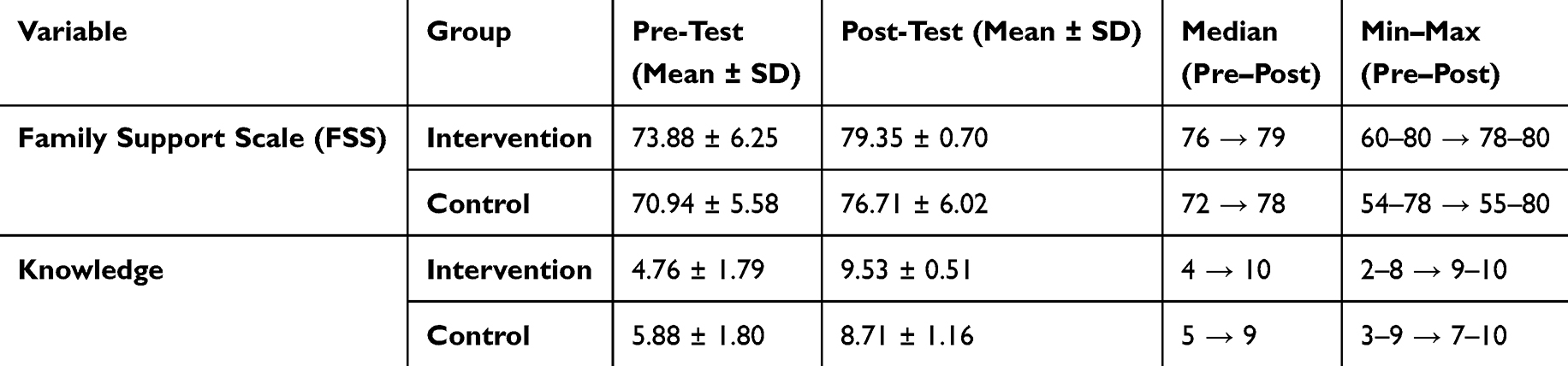 |
Table 2 Description of Family Support Scale (FSS) and Knowledge Scores by Group |
Similarly, caregiver knowledge scores improved in both groups, with a more pronounced increase observed in the intervention group. The intervention group increased from 4.76 ± 1.79 to 9.53 ± 0.51, with the median rising from 4 to 10 and the score range shifting from 2–8 to 9–10, indicating higher and more homogeneous post-test scores. In contrast, the control group increased from 5.88 ± 1.80 to 8.71 ± 1.16, with the median increasing from 5 to 9 and the range from 3–9 to 7–10. The magnitude of change in knowledge was greater in the intervention group (+4.77) compared to the control group (+2.83).
Normality testing using the Shapiro–Wilk test showed that several variables were not normally distributed (p < 0.05). Specifically, changes in FSS scores in the intervention group were not normally distributed (p = 0.015), whereas the control group showed normal distribution (p = 0.708). For caregiver knowledge, the intervention group demonstrated normal distribution (p = 0.086), while the control group did not meet the assumption of normality (p = 0.046). Because the assumption of normality was not consistently fulfilled across all variables and groups, non-parametric tests were applied for subsequent analyses.
Overall, both groups demonstrated improvements in family support and caregiver knowledge; however, the intervention group showed a more substantial and consistent increase in knowledge, while improvements in family support were relatively similar between groups.
Table 3 shows the within-group comparison of pre-test and post-test scores using the Wilcoxon signed-rank test. Significant improvements were observed in both family support (FSS) and caregiver knowledge scores in the control and intervention groups (p < 0.05).
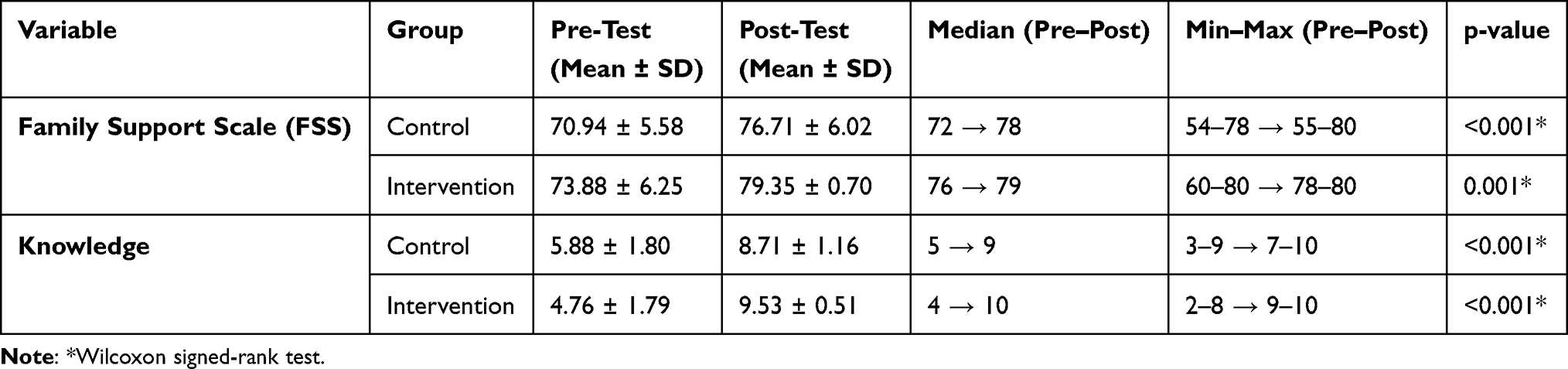 |
Table 3 Comparison of Pre-Test and Post-Test Scores Within Groups |
For family support, both groups demonstrated statistically significant increases between pre-test and post-test scores (control: p < 0.001; intervention: p = 0.001). Similarly, caregiver knowledge scores significantly improved in both the control and intervention groups (both p < 0.001).
Although significant improvements occurred in both groups, the intervention group demonstrated a greater increase and more consistent post-test scores in caregiver knowledge compared to the control group.
Table 4 presents the between-group comparison of change scores in family support (FSS) and caregiver knowledge using the Mann–Whitney U-test. For family support, the intervention group showed a median change score of 4.00 (IQR = 7.50) with a mean rank of 16.21, while the control group demonstrated a median change score of 6.00 (IQR = 7.00) and a mean rank of 18.79. The difference between groups was not statistically significant (p = 0.447), with a small effect size (r = 0.13), indicating relatively similar changes in family support between the two groups.
 |
Table 4 Between-Group Comparison (Change Scores) |
In contrast, caregiver knowledge showed a statistically significant difference between groups (p = 0.003). The intervention group had a higher median change score of 5.00 (IQR = 2.50) and a higher mean rank (22.53) compared to the control group, which showed a median change score of 3.00 (IQR = 2.50) and a mean rank of 12.47. The effect size for knowledge was moderate (r = 0.51), indicating a meaningful effect of the intervention on improving caregiver knowledge.
These findings suggest that the intervention had a significant effect on improving caregiver knowledge because the p-value was less than 0.05 (p = 0.003), indicating a statistically significant difference between the intervention and control groups. The moderate effect size (r = 0.51) further suggests that the intervention had a clinically meaningful impact on knowledge improvement, with a strength of effect categorized as moderate. The higher median change score and mean rank in the intervention group also support the greater improvement in knowledge outcomes following the intervention. In contrast, family support did not show a statistically significant difference because the p-value was greater than 0.05 (p = 0.447), suggesting that changes in FSS scores were relatively comparable between groups. Additionally, the small effect size for family support (r = 0.13) indicates that the intervention had only a weak effect on improving family support during the study period.
This study contributes to the existing literature by integrating family support and caregiver knowledge within a single digital discharge planning intervention for postoperative gynecological patients. Unlike previous studies that have generally examined these variables independently, the present study evaluated both outcomes simultaneously within the context of postoperative gynecological care, an area that remains relatively underexplored. The findings demonstrated that the MIGYN-based intervention was associated with a greater and statistically significant improvement in caregiver knowledge compared to the control group, whereas improvements in family support were observed in both groups without a statistically significant between-group difference.
The novelty of this study lies in the implementation of MIGYN as a family-based, multi-user chatbot that simultaneously engages patients and caregivers during the discharge planning process. Unlike conventional discharge education or single-user digital applications, MIGYN provides continuous, interactive, and accessible educational support beyond the hospital setting. This approach allows caregivers to access more consistent information and reinforces caregiver involvement throughout the patient recovery period.
Furthermore, this study provides empirical evidence regarding the potential of AI-based chatbot interventions in strengthening caregiver engagement during the transition from hospital to home care. The findings suggest that digital health technology may be particularly effective in improving caregiver knowledge, as reflected by the significant increase observed in the intervention of family-centered and technology-based discharge planning models in postoperative gynecological care.
Discussion
The findings of this study suggest that the MIGYN (Mitra Interaktif Ginekologi) intervention may contribute to enhancing family support and improving caregiver knowledge among postoperative gynecological patients, thereby facilitating more effective postoperative care and recovery support at home. However, the between-group analysis demonstrated a statistically significant difference only in caregiver knowledge, while no significant difference was observed in family support between the groups. Given the quasi-experimental design, these findings should be interpreted with caution, as causal relationships cannot be definitively established. Nevertheless, the results indicate that digital-based discharge planning, such as the MIGYN intervention, has the potential to enhance caregiver education and promote active caregiver involvement during the transition from hospital to home care.
It is also important to note that the control group demonstrated improvements in both family support and caregiver knowledge. This finding indicates that factors beyond the intervention, such as routine discharge education, hospitalization experiences, repeated exposure to health information, or natural adaptation during the recovery period, may also have contributed to the observed changes. Therefore, although MIGYN was associated with greater improvement in caregiver knowledge, the observed improvements cannot be attributed solely to the intervention.
Improvement in Family Support
Family support scores increased in both the control and intervention groups throughout the study period. In the intervention group, the improvement in Family Support Scale (FSS) scores may indicate the potential contribution of MIGYN in enhancing caregiver involvement through structured, interactive, and easily accessible discharge education. The chatbot-based platform enabled caregivers to repeatedly access postoperative care information at their convenience, which may have strengthened communication, reinforced understanding, and promoted greater engagement during the patient’s recovery process.
However, the between-group analysis showed that the difference in family support was not statistically significant (p = 0.447), with a small effect size (r = 0.13). This finding suggests that the improvement in family support was relatively comparable between groups and may not be attributable solely to the intervention. Routine discharge education, caregiver participation during hospitalization, and repeated exposure to health information may also have contributed to the observed improvements in both groups.
These findings remain relevant to House’s Social Support Theory (1981), which emphasizes the importance of emotional, informational, instrumental, and appraisal support during recovery.16 In the context of the present study, informational support may be reflected through the educational content and postoperative care information provided by MIGYN. Instrumental support may be represented by reminder features and practical care guidance that assist caregivers in monitoring patient recovery. Emotional support may be facilitated through continuous access to information and interactive communication features that help caregivers feel more involved during the recovery process. In addition, appraisal support may be reflected in the ability of caregivers to better understand patient conditions and evaluate postoperative care needs through repeated and accessible education delivered by the platform. Previous studies have also shown that strong social support is associated with better psychosocial outcomes among gynecological patients.6 In addition, structured discharge planning and ongoing support systems have been reported to facilitate continuity of care and strengthen family involvement during the recovery process.17 Although the present study did not specifically evaluate each dimension of social support separately, MIGYN may support caregiver involvement by providing accessible informational support and facilitating communication during the transition from hospital to home care.
Enhancement of Caregiver Knowledge
The significant improvement in caregiver knowledge observed in the intervention group suggests that repeated, structured, and easily accessible health information delivered through MIGYN may enhance caregiver understanding during postoperative recovery. The between-group analysis demonstrated a statistically significant difference in knowledge scores (p = 0.003) with a moderate effect size (r = 0.51), indicating a meaningful impact of the intervention on caregiver knowledge outcomes. In addition, the intervention group showed more homogeneous post-test scores, suggesting more consistent knowledge acquisition among caregivers.
These findings are consistent with previous studies reporting that inadequate discharge education is associated with increased risks of postoperative complications and hospital readmissions.2,3 The chatbot feature in MIGYN enables educational information to be accessed repeatedly and delivered in a more flexible and personalized manner according to caregiver needs. This finding supports previous evidence by Barish et al (2024), who reported that chatbot-based discharge instructions were more comprehensible than standard discharge education.14,18,19
Although both groups demonstrated improvements in knowledge scores, the greater increase observed in the intervention group suggests that digital discharge planning may provide additional benefits beyond routine discharge education alone. Improved caregiver knowledge may also support caregiver participation in postoperative care and decision-making processes.20 Furthermore, previous systematic reviews have shown that discharge planning that is tailored and reinforced after discharge may contribute to better continuity of care and improved recovery outcomes.21
Role of Digital Support in Postoperative Care
Although the present study did not directly evaluate treatment adherence or readmission outcomes, the findings suggest that MIGYN may support continuity of postoperative care through accessible educational content and reminder-based features. The digital platform enabled caregivers to repeatedly access postoperative care information, which may facilitate caregiver engagement during the recovery process. Previous studies have reported that chatbot-based and reminder-supported interventions can improve patient engagement and support self-management behaviors in healthcare settings.22
The role of caregiver involvement in postoperative recovery is also supported by previous literature emphasizing the importance of continuity of care and structured discharge planning in improving recovery outcomes and reducing healthcare burden.23–26 In this study, the intervention group demonstrated significantly greater improvement in caregiver knowledge, suggesting that digital discharge planning may strengthen caregiver preparedness during the transition from hospital to home care.
In addition, the potential role of MIGYN may be interpreted through House’s Social Support Theory (1981). Informational support may be reflected through structured educational content, while instrumental support may be represented by reminder features and accessible postoperative guidance. Emotional and appraisal support may also be facilitated through continuous access to information and interactive communication features that help caregivers remain involved throughout the recovery process. Although the present study did not evaluate each support dimension separately, the findings suggest that MIGYN may support multiple aspects of caregiver involvement within a digital discharge planning approach.
Theoretical and Practical Implications
Theoretically, these findings support House’s Social Support Theory (1981) by suggesting that digital health interventions may facilitate multiple dimensions of social support during postoperative recovery, particularly informational and instrumental support. The findings are also consistent with Orem’s Self-Care Deficit Theory, which emphasizes the important role of family members and caregivers in supporting patient self-care following surgery.27,28 Although the present study did not specifically evaluate each dimension of social support separately, the results suggest that structured digital education may enhance caregiver involvement during the transition from hospital to home care.
Practically, MIGYN represents a potential digital discharge planning tool that may be integrated into hospital services to support postoperative education and caregiver engagement. The platform provides accessible and repeated educational information, which may help standardize discharge education and support continuity of care after hospital discharge. Previous studies have reported that digital discharge interventions may reduce healthcare workload and improve care coordination and patient safety.29–32
In addition, prior evidence suggests that structured discharge planning programs contribute to better continuity of care and improved recovery outcomes.17,21,26,33 The present study extends these findings by demonstrating that a family-based, multi-user chatbot intervention was associated with significantly greater improvement in caregiver knowledge among postoperative gynecological patients. These findings suggest that digital and family-centered discharge planning approaches may provide additional support during postoperative recovery.
Study Limitations
This study has several limitations. First, the single-center design with a relatively small sample size may limit the generalizability of the findings. Second, the intervention period was relatively short, limiting the ability to evaluate the long-term sustainability of improvements in family support and caregiver knowledge following discharge. Third, variations in digital literacy and internet accessibility among caregivers may have influenced the utilization of the MIGYN platform during the study period. Fourth, the use of accidental sampling may have introduced selection bias and limited the representativeness of the study population.
In addition, differences in baseline characteristics, particularly caregiver age and education level, may have acted as potential confounding variables. Improvements observed in the control group also suggest that external factors, such as routine discharge education, caregiver involvement during hospitalization, and repeated exposure to health information, may have contributed to the observed changes. Furthermore, the possibility of a testing effect due to repeated measurements cannot be excluded, as participants may have become more familiar with the assessment instruments over time. Finally, although the intervention group demonstrated greater improvements in caregiver knowledge, the quasi-experimental design and the improvements observed in the control group mean that the observed changes cannot be attributed solely to the intervention. Therefore, the findings should be interpreted cautiously, as other uncontrolled factors may also have influenced the study outcomes.
Recommendations for Future Research
Future studies are recommended to use randomized controlled trial designs, larger sample sizes, multicenter settings, and longer follow-up periods to strengthen the evidence regarding the effectiveness of MIGYN. Further research may also evaluate additional outcomes related to postoperative recovery and caregiver involvement. In addition, the development of adaptive features, such as voice-based interaction and integration with electronic medical record systems, may improve the wider implementation of MIGYN in clinical practice.
Conclusion
This study demonstrated that the MIGYN (Mitra Interaktif Ginekologi) intervention was associated with improvements in family support and caregiver knowledge among postoperative gynecological patients. Although both groups showed significant improvements, between-group analysis demonstrated a statistically significant difference only in caregiver knowledge (p = 0.003), whereas family support did not differ significantly between groups (p = 0.447). These findings suggest that MIGYN may support caregiver education and family involvement through structured digital discharge planning, consistent with House’s Social Support Theory. Practically, MIGYN has the potential to support continuity of postoperative care and caregiver preparedness. However, because the study used a quasi-experimental design and improvements were also observed in the control group, the findings should be interpreted cautiously. Further studies with randomized designs, larger sample sizes, and longer follow-up periods are recommended.
Acknowledgments
The authors sincerely thank Dr. Hasan Sadikin General Hospital for their support and facilitation, and the patients and families for their participation. Appreciation is also extended to Universitas Padjadjaran mentors and colleagues for their guidance and constructive feedback, which greatly contributed to this study.
Disclosure
The authors report no conflicts of interest in this work.
References
1. Hasanah A, Maryati I, Ermiati E. Incidence and risk factors of postoperative urinary retention in gynecologic surgery: a systematic review and meta-analysis. Clin Epidemiol. 2026;18:595297. doi:10.2147/CLEP.S595297
2. Butler J, Petrie MC, Bains M, et al. Challenges and opportunities for increasing patient involvement in heart failure self-care programs and self-care in the post–hospital discharge period. Res Involv Engagem. 2023;9(1):1–12. doi:10.1186/S40900-023-00412-X/TABLES/1
3. You H, Lei A, Li X, Liao X, Chang J. Discharge teaching, patient-reported discharge readiness and postsurgical outcomes in gynecologic patients undergoing day surgery: a generalized estimating equation. BMC Surg. 2022;22(1). doi:10.1186/S12893-022-01607-X
4. Rosya E, Kep M, Vera N, et al. Discharge planning (Perencaan Pasien Pulang) Di Rumah Sakit. 2020.
5. Wong EL, Yam CH, Cheung AW, et al. Barriers to effective discharge planning: a qualitative study investigating the perspectives of frontline healthcare professionals. BMC Health Serv Res. 2011;11(1):1–10. doi:10.1186/1472-6963-11-242/TABLES/2
6. Mandato VD, Paterlini M, Torricelli F, Rabitti E, Mastrofilippo V, Aguzzoli L. Perceived social support and quality of life in endometrial cancer patients: a longitudinal study. Front Oncol. 2024;14. doi:10.3389/FONC.2024.1447644/PDF
7. Kamaryati NP, Malathum P. Family support: a concept analysis. Pacific Rim Int J Nurs Res. 2020;24(3):403–411.
8. Dunst CJ. Systematic review and meta-analysis of the relationships between family social support and parenting stress, burden, beliefs and practices. Int J Heal Psychol Res. 2022;10(4):1–22. doi:10.37745/IJHPR.13/VOL10N4122
9. Manne SL, Kashy DA, Virtue S, et al. Acceptance, social support, benefit-finding, and depression in women with gynecological cancer. Qual Life Res. 2018;27(11):2991–3002. doi:10.1007/S11136-018-1953-X/METRICS
10. Kuwabara A, Su S, Krauss J. Utilizing digital health technologies for patient education in lifestyle medicine. Am J Lifestyle Med. 2020;14(2):137–142. doi:10.1177/1559827619892547
11. Wang Y, Wen Y, Wu X, Wang L, Cai H. Assessing the role of adaptive digital platforms in personalized nutrition and chronic disease management. World J Innov Mod Technol. 2025;8(1):24–31. doi:10.53469/WJIMT.2025.08(01).05
12. Kosasih CE, Solehati T, Maryati I. Comparing the effect of LINE-based and WHATSAPP-based educational interventions on reproductive health knowledge, attitudes, and behaviors among triad adolescents: a quasi-experimental study. Belitung Nurs J. 2024;10(1):87–95. doi:10.33546/bnj.3033
13. Adamopoulou E, Moussiades L. Chatbots: history, technology, and applications. Mach Learn With Appl. 2020;2:100006. doi:10.1016/J.MLWA.2020.100006
14. Barish P, Murray S, Hubbard CC. Quality and accuracy of chatbot generated patient discharge instructions. J Hosp Med. 2025;20(7):727–730. doi:10.1002/jhm.13574
15. Babel A, Taneja R, Mondello Malvestiti F, Monaco A, Donde S. Artificial Intelligence Solutions to Increase Medication Adherence in Patients With Non-communicable Diseases. Front Digit Heal. 2021;3:669869. doi:10.3389/FDGTH.2021.669869
16. House JS. Social Support and Social Structure. Sociol Forum. 1987;2(1):135–146. doi:10.1007/BF01107897
17. Lin FOY, Luk JKH, Chan TC, Mok WWY, Chan FHW. Effectiveness of a discharge planning and community support programme in preventing readmission of high-risk older patients. Hong Kong Med J. 2015;21(3):208–216. doi:10.12809/HKMJ144304
18. Huang T, Safranek C, Socrates V, et al. Patient-representing population’s perceptions of GPT-generated versus standard emergency department discharge instructions: randomized blind survey assessment. J Med Internet Res. 2024;26:e60336. doi:10.2196/60336
19. Halaseh FF, Yang JS, Danza CN, Halaseh R, Spiegelman L. ChatGPT’s role in improving education among patients seeking emergency medical treatment. West J Emerg Med. 2024;25(5):845. doi:10.5811/WESTJEM.18650
20. Masruroh N, Pangastuti A, Melizza N, Kurnia A. Level of knowledge and family support toward medication adherence among patient with diabetes mellitus in Malang, Indonesia. Indian J Forensic Med Toxicol. 2021;15:1406–1412.
21. Hunt-O’Connor C, Moore Z, Patton D, Nugent L, Avsar P, O’Connor T. The effect of discharge planning on length of stay and readmission rates of older adults in acute hospitals: a systematic review and meta-analysis of systematic reviews. J Nurs Manag. 2021;29(8):2697–2706. doi:10.1111/JONM.13409
22. Gudala M, Ross MET, Mogalla S, Lyons M, Ramaswamy P, Roberts K. Benefits of, barriers to, and needs for an artificial intelligence–powered medication information voice chatbot for older adults: interview study with geriatrics experts. JMIR Aging. 2022;5(2):e32169. doi:10.2196/32169
23. Religioni U, Barrios-Rodríguez R, Requena P, Borowska M, Ostrowski J. Enhancing therapy adherence: impact on clinical outcomes, healthcare costs, and patient quality of life. Medicina. 2025;61(1):153. doi:10.3390/MEDICINA61010153
24. Dhaliwal JS, Dang AK. Reducing hospital readmissions. 2024. Available from: https://www.ncbi.nlm.nih.gov/books/NBK606114/.
25. Aremu TO, Oluwole OE, Adeyinka KO, Schommer JC. Medication adherence and compliance: recipe for improving patient outcomes. Pharm J Pharm Educ Pract. 2022;10(5):106. doi:10.3390/PHARMACY10050106
26. Wang YC, Lee WY, Chou MY, et al. Cost and effectiveness of long-term care following integrated discharge planning: a prospective cohort study. Healthc. 2021;9(11):1413. doi:10.3390/HEALTHCARE9111413/S1
27. Khademian Z, Kazemi Ara F, Gholamzadeh S. The effect of self care education based on orem’s nursing theory on quality of life and self-efficacy in patients with hypertension: a quasi-experimental study. Int J Community Based Nurs Midwifery. 2020;8(2):140. doi:10.30476/IJCBNM.2020.81690.0
28. Mohammadpour A, Rahmati Sharghi N, Khosravan S, Alami A, Akhond M. The effect of a supportive educational intervention developed based on the Orem’s self-care theory on the self-care ability of patients with myocardial infarction: a randomised controlled trial. J Clin Nurs. 2015;24(11–12):1686–1692. doi:10.1111/JOCN.12775
29. Galiano MA, Moreno Fergusson ME, Guerrero WJ, et al. Technological innovation for workload allocation in nursing care management: an integrative review. F1000Research. 2024;12:104. doi:10.12688/F1000RESEARCH.125421.3
30. Huter K, Krick T, Domhoff D, Seibert K, Wolf-Ostermann K, Rothgang H. Effectiveness of digital technologies to support nursing care: results of a scoping review. J Multidiscip Healthc. 2020;13:1905. doi:10.2147/JMDH.S286193
31. Chester W, Romano CA. Utilizing a virtual discharge nurse to help decrease patient length of stay and improve earlier discharge times. 2025. Available from: https://digitalcommons.wcupa.edu/all_doctoral.
32. Balasundaram M, Porter M, Miller S, Sivakumar D, Fleming A, McCallie K. Increasing parent satisfaction with discharge planning an improvement project using technology in a level 3 NICU. Adv Neonatal Care. 2022;22(2):108–118. doi:10.1097/ANC.0000000000000841
33. Hesselink G, Zegers M, Vernooij-Dassen M, et al. Improving patient discharge and reducing hospital readmissions by using intervention mapping. BMC Health Serv Res. 2014;14(1):1–11. doi:10.1186/1472-6963-14-389/TABLES/3
 © 2026 The Author(s). This work is published and licensed by Dove Medical Press Limited. The
full terms of this license are available at https://www.dovepress.com/terms
and incorporate the Creative Commons Attribution
- Non Commercial (unported, 4.0) License.
By accessing the work you hereby accept the Terms. Non-commercial uses of the work are permitted
without any further permission from Dove Medical Press Limited, provided the work is properly
attributed. For permission for commercial use of this work, please see paragraphs 4.2 and 5 of our Terms.
© 2026 The Author(s). This work is published and licensed by Dove Medical Press Limited. The
full terms of this license are available at https://www.dovepress.com/terms
and incorporate the Creative Commons Attribution
- Non Commercial (unported, 4.0) License.
By accessing the work you hereby accept the Terms. Non-commercial uses of the work are permitted
without any further permission from Dove Medical Press Limited, provided the work is properly
attributed. For permission for commercial use of this work, please see paragraphs 4.2 and 5 of our Terms.