
Back to Journals » Advances in Medical Education and Practice » Volume 17
Five-Year Outcomes of an Undergraduate General-Education First Aid Course: A Ten-Semester Multi-Domain Evaluation of Knowledge, Skills, and Readiness
Authors Zheng Z  , Ye J, Luo J, Cai R, Liao J
Received 5 February 2026
Accepted for publication 1 April 2026
Published 13 April 2026 Volume 2026:17 598721
DOI https://doi.org/10.2147/AMEP.S598721
Checked for plagiarism Yes
Review by Single anonymous peer review
Peer reviewer comments 2
Editor who approved publication: Dr Md Anwarul Azim Majumder
Ziyu Zheng,1,* Jialin Ye,2,* Jieyu Luo,1 Ruibin Cai,1 Jinli Liao1
1Department of Emergency Medicine, The First Affiliated Hospital of Sun Yat-sen University, Guangzhou, Guangdong, People’s Republic of China; 2Department of Pediatrics, The First Affiliated Hospital of Sun Yat-sen University, Guangzhou, Guangdong, People’s Republic of China
*These authors contributed equally to this work
Correspondence: Ziyu Zheng, Email [email protected] Jinli Liao, Email [email protected]
Background: University students are a scalable population for strengthening community first-aid capacity, but evaluations beyond CPR/AED outcomes remain limited. We assessed a general-education first-aid course using knowledge, observed skills, self-efficacy, and readiness-to-act outcomes.
Methods: We conducted a repeated-cohort, single-group pre–post evaluation of an undergraduate elective course at Sun Yat-sen University (Guangzhou, China) across 10 consecutive semesters (2021– 2025). Outcomes included pre/post theoretical knowledge (0– 100), end-of-course four-station OSCE performance rated on a DOPS-based 1– 5 scale, self-efficacy (five 1– 5 Likert items; composite as mean), and willingness/intention (paired yes/no items). Pre/post changes were analyzed using paired tests appropriate to outcome type.
Results: Among 446 undergraduates (51.8% men; 28.0% medical-related majors), knowledge increased from 36.9 (SD 6.5) to 80.9 (SD 4.3) (mean difference 44.0, 95% CI 43.3– 44.7; p < 0.001), with consistent gains across all five domains (all p < 0.001). Overall observed skills were satisfactory: the composite OSCE score was 3.52 (SD 0.42) and 77.8% passed all four stations. Station competence rates were 71.7%– 80.7%, whereas completion of all critical actions was lower (58.3– 74.0%). Self-efficacy increased from 2.3 (SD 0.4) to 4.0 (SD 0.3) (mean difference 1.8, 95% CI 1.7– 1.8; p < 0.001). Willingness and intention also improved, including willingness to perform CPR on a stranger, use an AED if available, and prepare a home first-aid kit within 1 month (all p < 0.001).
Conclusion: This university general-education first-aid course was associated with substantial end-of-course gains in knowledge, satisfactory observed competence, and improved confidence and readiness to act. These findings support embedding multi-domain first-aid training beyond CPR/AED within university general education as a scalable approach to strengthen community emergency preparedness.
Keywords: first aid education, undergraduate students, self-efficacy, willingness to act
Introduction
Timely first aid by lay responders can be decisive in time-critical emergencies, particularly out-of-hospital cardiac arrest (OHCA). Survival after OHCA declines with each minute without defibrillation, and early automated external defibrillator (AED) use (within 5 minutes) is associated with substantially higher survival in observational cohorts and systematic analyses.1,2 Yet bystander participation in cardiopulmonary resuscitation (CPR) and AED use remains inconsistent. Synthesized evidence indicates that willingness to intervene is shaped by modifiable factors such as prior training, perceived competence, and confidence,3,4 and a recent study reported that willingness to perform bystander resuscitation is associated with higher first-aid knowledge/skills and previous exposure to first-aid training.5
Modern first-aid education extends beyond resuscitation alone. The 2021 European Resuscitation Council (ERC) First Aid Guidelines provide evidence-informed recommendations across a wide range of acute medical emergencies and traumatic injuries, supporting comprehensive curricula that address both illness- and injury-related scenarios.6 University undergraduates are a particularly relevant target population because they represent a large, reachable, and educable group who can serve as potential responders on campus, at home, and in the wider community. However, evaluating first-aid education remains challenging. A Cochrane review concluded that training probably improves short-term knowledge, practical skills, and self-efficacy, while evidence for downstream outcomes such as real-world helping behavior is limited.7 Reviews also note that evaluation often focuses narrowly on CPR/AED performance, with less standardized assessment of other first-aid skills and human-factor outcomes.8
A plausible mechanism linking training to readiness to act is that structured instruction improves knowledge and observed performance while also increasing self-efficacy, perceived capability, and confidence, all of which may lower hesitation in emergencies and strengthen intention to intervene.9–11 To strengthen evaluation, knowledge measures can be paired with performance-based assessment. Objective structured clinical examinations (OSCEs) and written examinations capture overlapping yet distinct dimensions of competence,12 while direct observation tools such as DOPS can provide structured assessment with validity evidence and educational impact when feedback is integrated.13,14 Although OSCEs and DOPS are widely used in health-professions education, their use as part of a multi-domain assessment framework in lay first-aid training remains uncommon and represents an important innovation in this context.
Against this background, the present study makes a distinct contribution by evaluating a comprehensive undergraduate general education first-aid course across ten consecutive semesters using a multi-domain framework that includes theoretical knowledge, observed skills, self-efficacy, and willingness/intention outcomes. We developed a general education course, Basic Knowledge and Skills of First Aid, at Sun Yat-sen University and conducted a five-year repeated-cohort evaluation (2021–2025). The aim of this study was to assess whether participation in this course was associated with improvements in first-aid knowledge, practical competence, self-efficacy, and readiness to act among undergraduate students.
Materials and Methods
Study Design and Setting
We conducted a repeated-cohort, single-group pre–post evaluation of an undergraduate general education elective course, “Basic Knowledge and Skills of First Aid” delivered at Sun Yat-sen University (Guangzhou, China) across ten consecutive semesters (2021–2025). De-identified assessment data were compiled from routine course evaluations.
Course Description
Each semester consisted of 18 contact hours (45 minutes per hour). The curriculum covered five modules: (1) first-aid fundamentals (basic principles, how to call “120,” and preparation of a home first-aid kit); (2) first aid for common medical emergencies; (3) outdoor emergencies; (4) trauma and injury first aid; and (5) accidental injuries and poisoning. Practical training focused on core skills aligned with the end-of-course OSCE stations, which included adult CPR, choking/airway foreign-body obstruction (AFBO), bleeding control and bandaging, and burns/scalds first aid.
Participants and Baseline Characteristics
Participants were first- and second-year undergraduates enrolled in the elective course. Baseline characteristics collected at course entry included sex, year level, academic background (medical-related vs non-medical majors), and prior first-aid training.
Outcome Measures
Theoretical Knowledge
Knowledge was assessed before and after the course using a structured test spanning five domains: basic first aid principles, common medical emergencies, outdoor emergencies, trauma/injury first aid, and accidental injuries/poisoning. Each domain subscore ranged from 0 to 20 points, and the total knowledge score (0–100) was calculated as the sum of the five domain subscores.
Skills Performance
Skills performance was assessed at course completion using a four-station OSCE. Stations were delivered using standardized scenarios, equipment, and written prompts. Each station lasted 5 minutes, with brief transitions between stations.
Each station was rated using a DOPS-based global rating form on a 1–5 scale by two independent examiners. Both examiners were emergency physicians who served as course instructors and had experience in first-aid training and emergency care. To enhance scoring consistency, examiners completed a brief calibration session before the OSCE to review station instructions, rating anchors (with 3 indicating “meets expectations”), and operational definitions of critical errors and critical actions. Examiners rated independently and were not provided with students’ written test scores or questionnaire responses at the time of OSCE scoring; ratings were recorded separately without discussion.
For each student, the final station score was the mean of the two examiner ratings. A score ≥4 was used to indicate high performance. In addition to global ratings, station-specific checklists documented completion of prespecified critical actions. “Competent” indicated meeting the station passing standard without critical errors, and “All critical actions completed” indicated completion of all prespecified critical actions on the checklist. A composite OSCE score was calculated as the mean of the four station scores. “Pass all four OSCE stations” was defined using a score-based criterion: achieving a DOPS global rating ≥3 in each station.
Self-Efficacy
Self-efficacy was measured before and after the course using five 1–5 Likert-scale items (higher scores indicating greater confidence): calling “120” and providing key information, performing adult CPR, managing choking/AFBO, controlling bleeding with a pressure bandage, and burns/scalds first aid. A self-efficacy composite score was calculated as the mean of the five items.
Willingness to Act and Intention
Willingness and intention outcomes were measured before and after the course as paired binary (Yes/No) items: willingness to perform CPR on a stranger, willingness to perform CPR on a family member/friend, willingness to use an AED if available, willingness to perform bleeding control for a stranger, and intention to prepare a home first-aid kit within one month.
Statistical Analysis
Continuous variables are reported as mean (SD) and categorical variables as n (%). Pre-course and post-course knowledge scores (total and domain subscores) and self-efficacy scores were compared using paired-samples t tests, with mean differences (post–pre) and 95% confidence intervals. Paired binary willingness/intention outcomes were compared using McNemar’s test; absolute change was expressed as risk difference (RD = post–pre proportion). Subgroup comparisons (medical-related vs non-medical majors) used chi-square tests with odds ratios (OR) and 95% confidence intervals for categorical outcomes and Welch’s t-tests with mean differences (Δ) and 95% confidence intervals for continuous outcomes. All tests were two-sided, with p < 0.05 considered statistically significant. Analyses were performed using IBM SPSS Statistics (version 28.0; IBM Corp., Armonk, NY, USA). Analyses were conducted using complete paired observations for each outcome; observations with missing pre- or post-course values were excluded on an outcome-by-outcome basis, and no imputation was performed.
Results
Across 10 semesters (2021–2025), 446 undergraduates participated (Table 1). Overall, 231 (51.8%) were men and 125 (28.0%) were medical-related majors; 35 (7.8%) reported prior first-aid training.
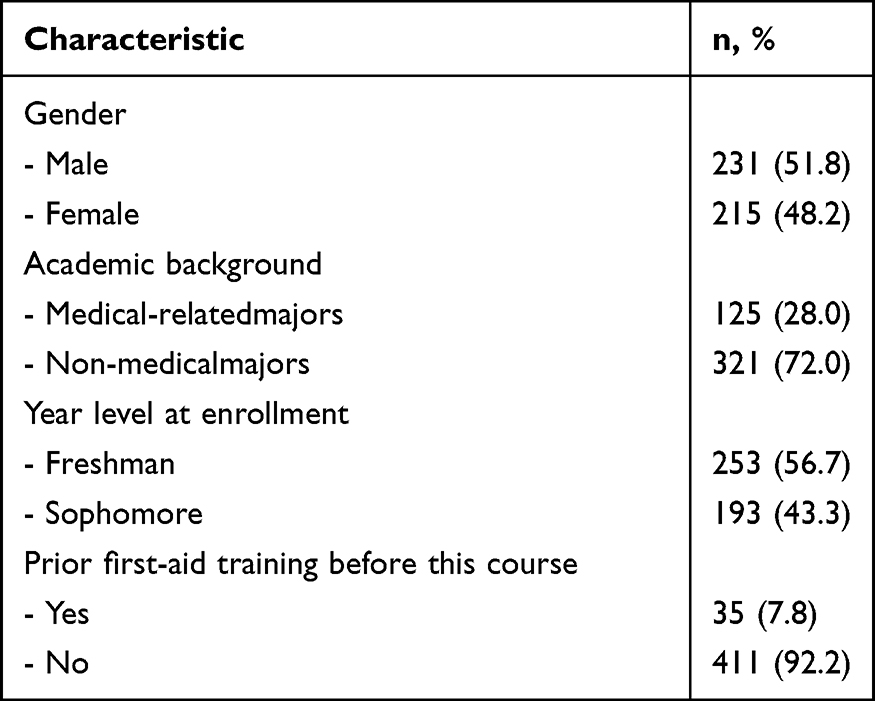 |
Table 1 Participant Characteristics |
Theoretical knowledge improved markedly after the course (Table 2). Total scores increased from 36.9 (SD 6.5) to 80.9 (SD 4.3), with a mean difference of 44.0 points (95% CI 43.3–44.7; p < 0.001). All five domain subscores increased consistently, with mean gains ranging from 8.6 to 9.0 points (all p < 0.001).
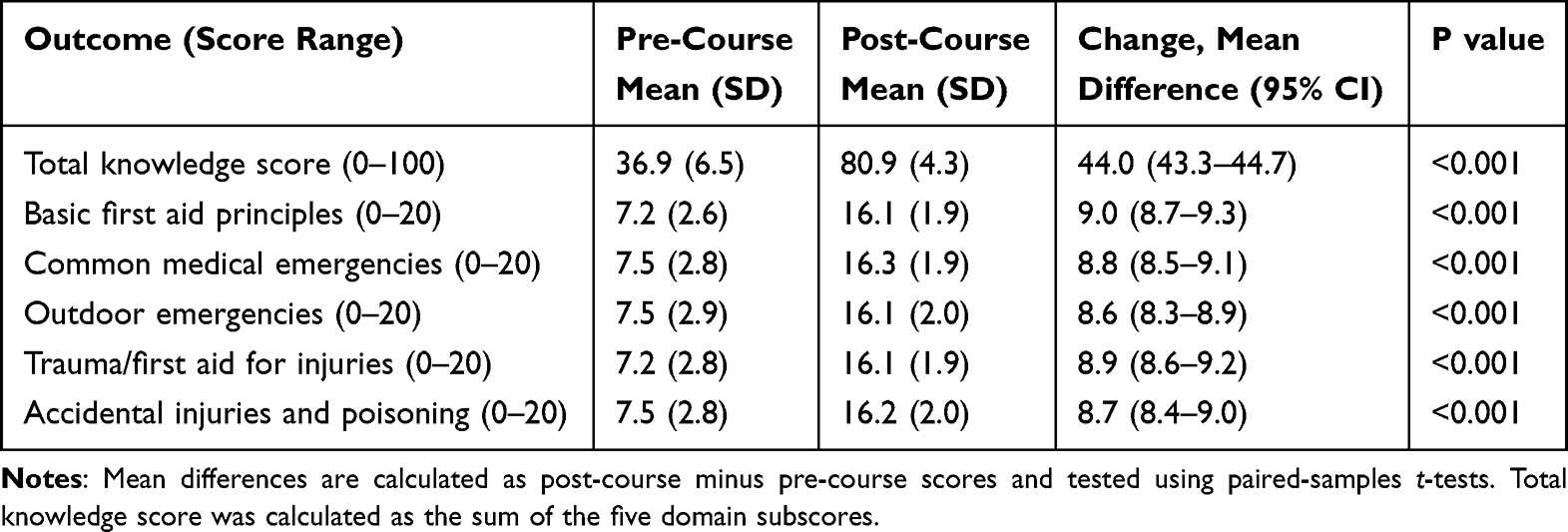 |
Table 2 Changes in Theoretical First-Aid Knowledge Across Domains Before and After the Course |
At course completion, OSCE performance was moderate to high (Table 3). Mean station scores ranged from 3.48 to 3.55 (SD 0.72–0.85) on the 1–5 DOPS scale, with 44.2–51.6% achieving scores ≥4. Competence rates (meeting the station standard without critical errors) ranged from 71.7% to 80.7%, and completion of all prespecified critical actions ranged from 58.3% to 74.0%. The composite OSCE score was 3.52 (SD 0.42), and 347 (77.8%) students passed all four stations using a score-based criterion (DOPS ≥3 in each station).
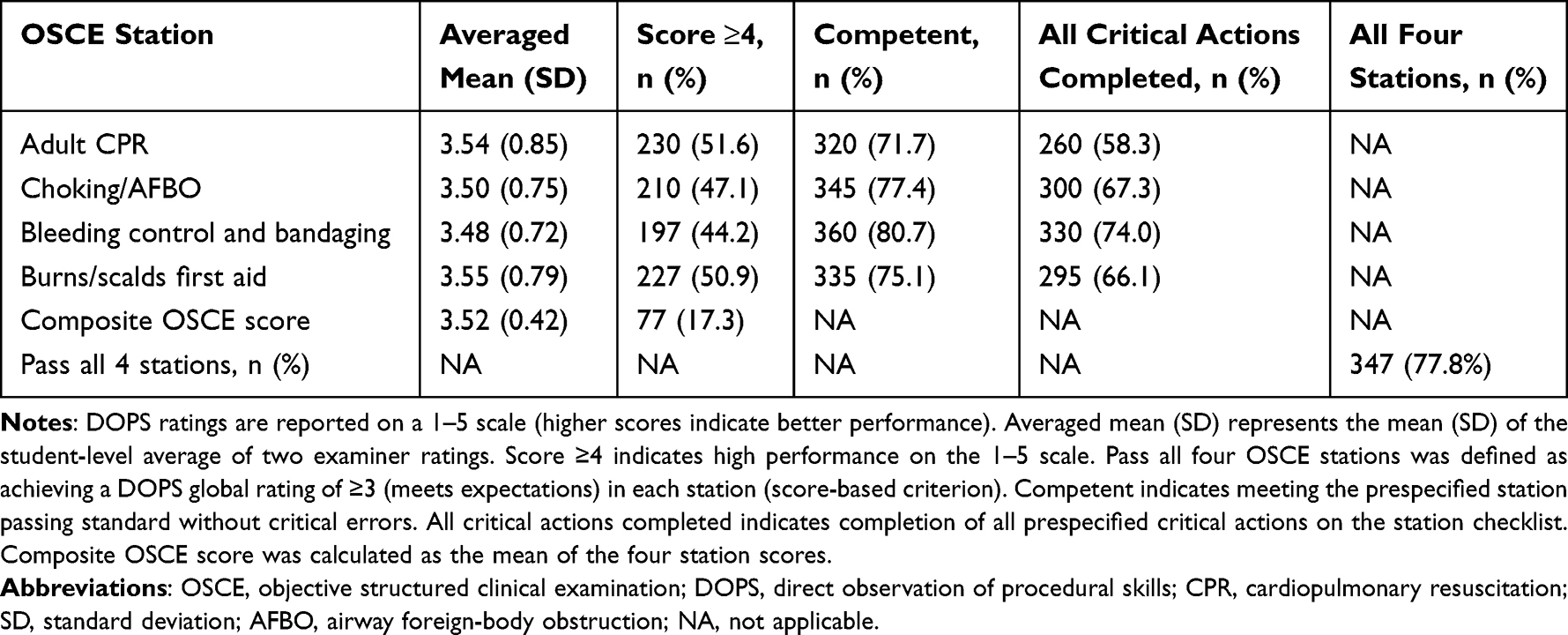 |
Table 3 OSCE Performance Outcomes Assessed Using a DOPS-Based Approach |
Self-efficacy increased across all five items (Table 4). Item-level improvements ranged from 1.7 to 1.9 points (all p < 0.001). The self-efficacy composite score rose from 2.3 (SD 0.4) to 4.0 (SD 0.3) (mean difference 1.8, 95% CI 1.7–1.8; p < 0.001).
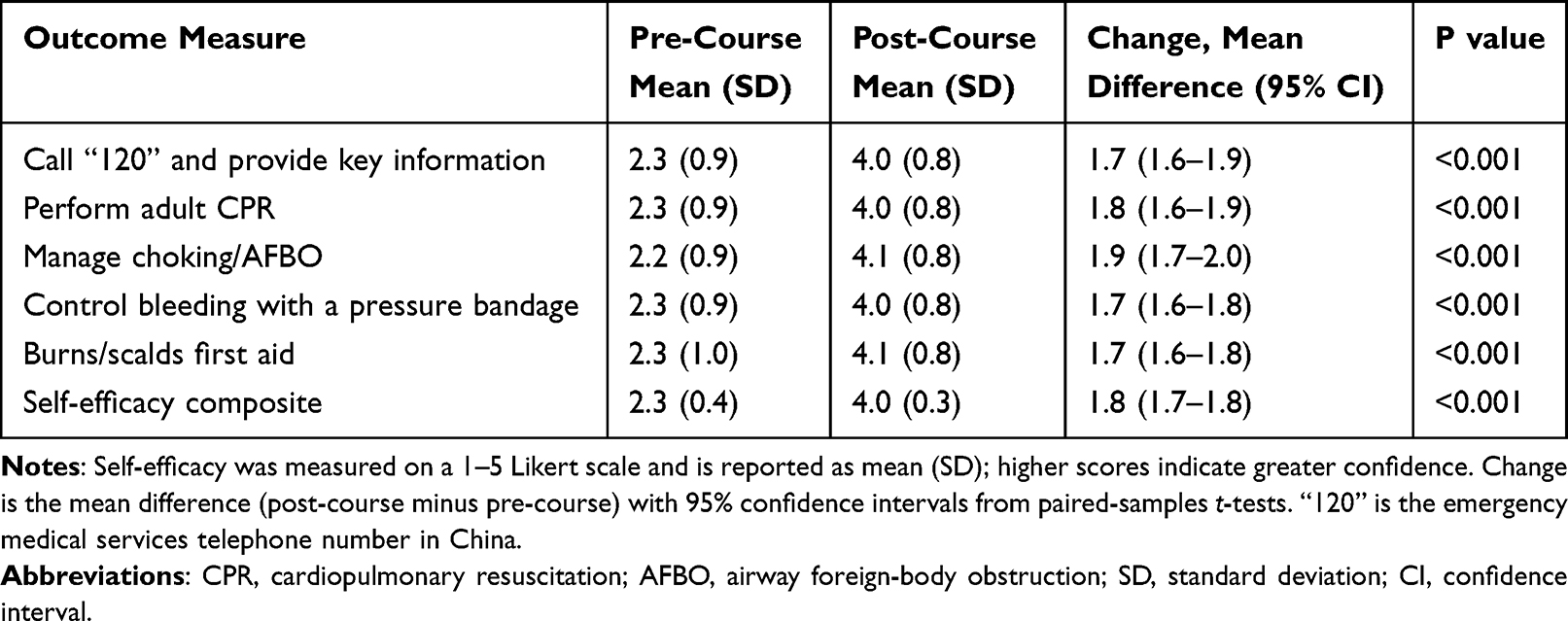 |
Table 4 Changes in Self-Efficacy Before and After the Course |
Willingness to act and intention outcomes also increased (Table 5). Willingness to perform CPR increased for both a stranger (51.6% to 62.8%; RD = 0.112; p < 0.001) and a family member/friend (71.7% to 83.0%; RD = 0.112; p < 0.001). Willingness to use an AED if available increased from 42.6% to 56.1% (RD = 0.135; p < 0.001), and willingness to control bleeding for a stranger increased from 60.5% to 74.0% (RD = 0.135; p < 0.001). Intention to prepare a home first-aid kit within one month increased from 26.9% to 42.6% (RD = 0.157; p < 0.001).
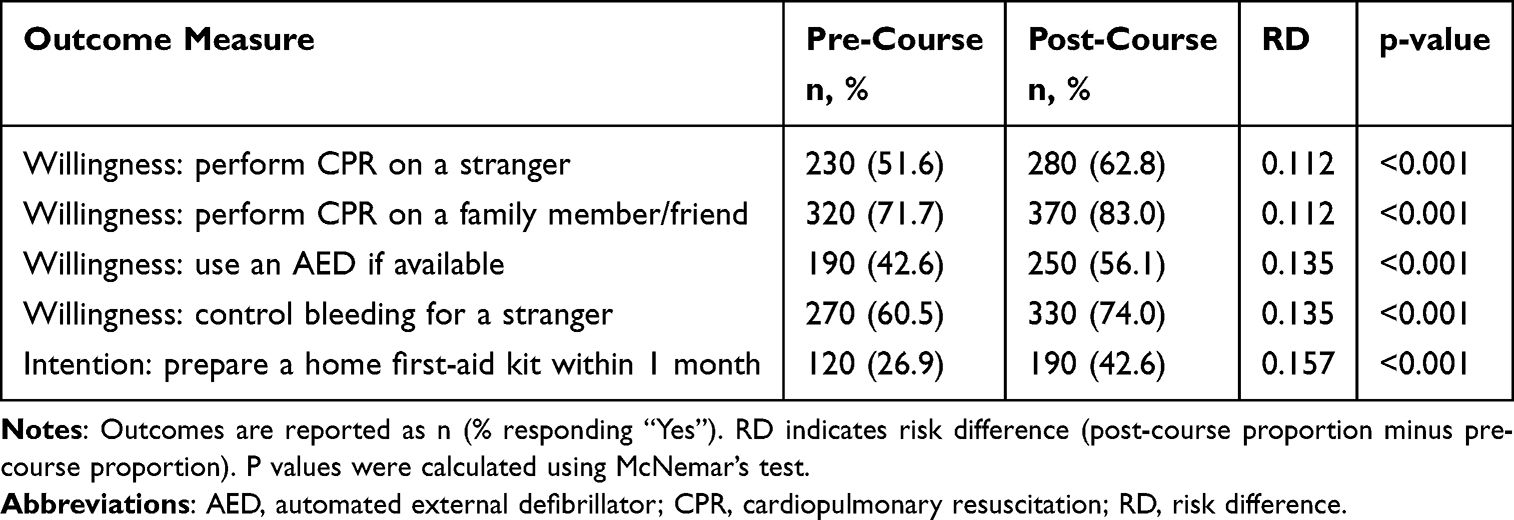 |
Table 5 Changes in Willingness to Act, and Intention Before and After the Course |
In subgroup analyses by academic background (Table 6), there was no significant difference between medical-related and non-medical majors in passing all four OSCE stations (76.0% vs 78.5%; OR = 0.87, 95% CI 0.53–1.41; p = 0.568) or in composite DOPS ratings (3.56 [SD 0.40] vs 3.50 [SD 0.43]; Δ = 0.06, 95% CI −0.02 to 0.15; p = 0.153). Medical-related majors showed higher competence in the adult CPR station (84.0% vs 67.0%; OR = 1.79, 95% CI 1.10–2.91; p = 0.012) and higher post-course willingness to perform CPR on a stranger (76.0% vs 57.6%; OR = 1.57, 95% CI 1.01–2.44; p = 0.026). Baseline self-efficacy composite scores were slightly lower among medical-related majors (2.21 [SD 0.41] vs 2.31 [SD 0.42]; Δ = −0.10, 95% CI −0.18 to −0.01; p = 0.028), whereas post-course self-efficacy did not differ significantly (4.00 [SD 0.33] vs 4.05 [SD 0.35]; p = 0.127).
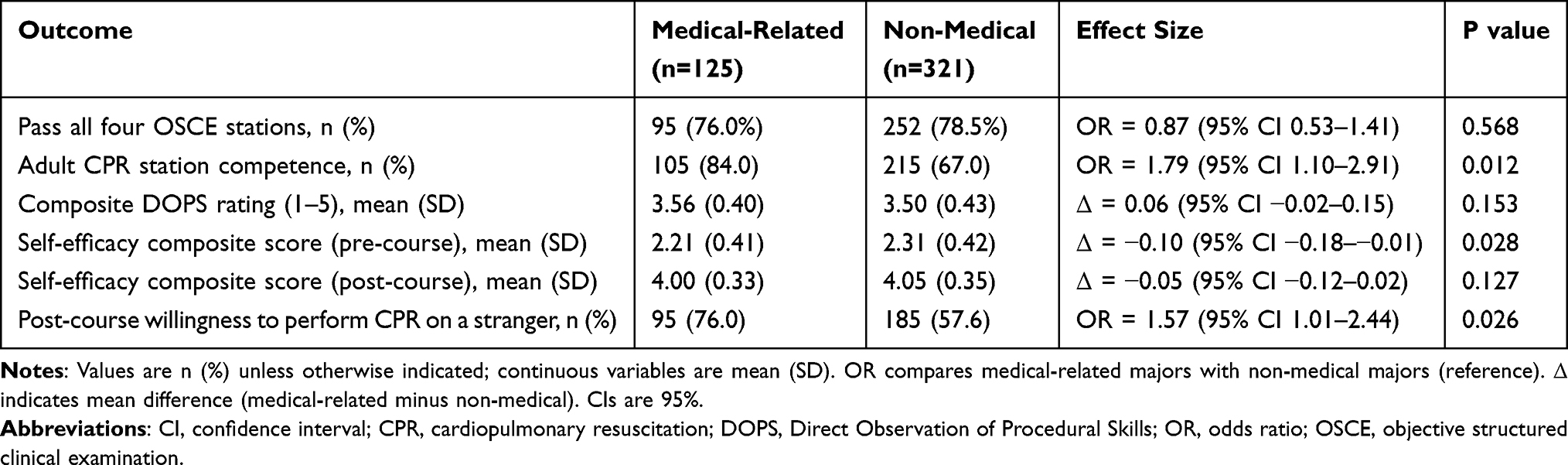 |
Table 6 Subgroup Comparisons by Academic Background (Medical-Related vs Non-Medical Majors) |
Discussion
This five-year evaluation across ten consecutive semesters suggests that a general education first-aid course may improve undergraduate students’ preparedness for common emergencies across several outcome domains. Given that the effectiveness of first-aid training is already well described, the key contribution of this work is the demonstrated ten-semester consistency of a scalable, general-education model and its multi-domain evaluation beyond CPR, including evidence that non-medical majors can achieve overall OSCE/DOPS performance comparable to medical-related majors. We observed marked gains in theoretical knowledge (mean total score 36.9 to 80.9), acceptable end-of-course OSCE performance assessed using a DOPS-based approach, and higher self-efficacy together with increased willingness and intention to act. These findings are broadly in line with Kendall et al, who concluded that first-aid training for laypeople probably improves short-term knowledge, practical skills, and self-efficacy, while evidence for downstream outcomes such as real-world helping behavior and patient outcomes remains limited or uncertain7 Previous reviews have also pointed out that the field often focuses on CPR/AED outcomes and uses less standardized methods for non-CPR first-aid skills and human-factor outcomes such as confidence and willingness.8 In this context, the multi-domain assessment used here not only documents change but also helps identify areas that may still need attention in routine educational delivery.15
The size and consistency of the knowledge gains across all five domains likely reflects good alignment between course content and the structured, domain-based assessment. The curriculum also extended beyond resuscitation to include first-aid actions for acute illness and injury, which fits contemporary guideline priorities.6 At the same time, post-course testing was done immediately, so longer-term retention may be overestimated. Delayed follow-up would help clarify retention and transfer, which remains an important gap in lay first-aid education research.7,8
Observed skills performance provided information that complements written testing. OSCE station scores were generally in the mid-to-high range of the 1–5 global rating scale, and most learners met the score-based criterion for passing all four stations. This approach is consistent with established assessment frameworks. OSCEs were designed to support standardized observation of performance,16 and Miller’s framework emphasizes what learners can demonstrate rather than what they know alone.17 Importantly, we reported both global ratings and checklist-based indicators, including competence without critical errors and completion of critical actions. Completion of all critical actions was lower than global ratings, especially for adult CPR (only 58.3% completed all critical actions). This pattern may indicate that some students performed reasonably well overall but still missed safety-critical steps under time pressure, so checklist data can be useful for targeted feedback rather than relying only on overall scores.16,17
The use of a DOPS-based approach is supported by evidence that direct observation tools can show acceptable validity and reliability when rating anchors are clear and assessors share expectations.13 Studies also suggest that formative observation paired with feedback can improve procedural competence.14 This is relevant for first-aid skills, where both quality and safety matter. The gap between global ratings and critical-action completion points to practical targets for improvement. Future iterations could place more emphasis on deliberate practice of key steps, structured debriefing focused on common omissions, and brief booster sessions for high-risk actions.
The increases in self-efficacy and willingness/intention outcomes are consistent with plausible mechanisms for behavior change. Self-efficacy reflects perceived capability and can influence whether people initiate and persist in challenging behaviors.10 Intention is also shaped by attitudes, perceived norms, and perceived behavioral control.11 Controlled studies in lay first-aid education have shown that realistic practice opportunities can improve knowledge, skills, and self-efficacy.9 Evidence syntheses similarly suggest that willingness to intervene is associated with training exposure, perceived competence, and confidence.3,5 In our cohort, willingness to perform CPR on a stranger and willingness to use an AED increased after the course but did not become universal, which is expected given persistent barriers such as fear of causing harm, legal concerns, uncertainty in real emergencies, and lower confidence under stress.3 These findings suggest that training may benefit from explicitly addressing hesitation and barriers, not only procedural steps, through scenario practice and clear guidance on safe actions and AED use.
Subgroup analyses support the feasibility of offering first-aid training as a general education course. Pass-all OSCE rates were similar between medical-related and non-medical majors (76.0% vs 78.5%), and composite DOPS ratings were also comparable, which suggests that students without medical backgrounds can reach comparable performance when training and assessment are structured. Differences in adult CPR competence and baseline self-efficacy may reflect prior exposure or differences in self-appraisal rather than differences in trainability. This interpretation is consistent with studies among Chinese university students showing that training exposure and competence are associated with willingness to perform bystander CPR.4,5 From a curriculum perspective, an inclusive design seems appropriate, with targeted support for high-stakes skills where gaps are more likely to appear.
The results may also have public health relevance because timely intervention is critical in out-of-hospital cardiac arrest. Public-access defibrillation has been linked with better survival, and national initiatives combining training and system strengthening have been associated with higher bystander intervention rates and improved survival.18,19 Programmatic evidence supports the value of PAD programs,2 and observational analyses show improved outcomes when defibrillation occurs earlier.1 This evaluation was not designed to measure clinical outcomes. However, improved knowledge, observable skills, confidence, and willingness in a scalable university setting could contribute to broader community preparedness when combined with enabling infrastructure such as visible AED placement and supportive policies.
Several limitations should be considered. First, the single-group pre–post design limits causal inference and may be influenced by testing effects or secular trends. Second, outcomes were measured immediately after the course, and long-term retention was not assessed. Prior randomized and longitudinal studies show that CPR/AED knowledge and skills decline over time and that retraining intervals affect performance, supporting delayed assessment and planned refreshers.20,21 Scalable approaches such as self-instruction with feedback-enabled manikins have demonstrated effectiveness and may help sustain skills between in-person sessions.22 Comparative studies also suggest that training design can influence AED/PAD learning outcomes.23 Third, willingness and intention were self-reported and may be influenced by social desirability bias, and may not translate into real-world helping behavior. Evidence for behavior change exists but remains limited, so future studies should include behavioral measures and longer follow-up.7,24 Fourth, we did not calculate formal inter-rater reliability coefficients, provide detailed assessment artifacts as supplementary material, or perform semester-specific stability analyses. These steps would further strengthen the credibility, reproducibility, and longitudinal consistency of the findings in future work.
In summary, this ten-semester, multi-domain evaluation suggests that a university general-education first-aid course can produce substantial end-of-course gains in knowledge, satisfactory overall observed competence, and improved self-efficacy and readiness to act among undergraduates. At the same time, lower completion of safety-critical actions indicates the need for more targeted practice. As a scalable model extending beyond CPR/AED, this approach may help strengthen community emergency preparedness. Future work should measure retention, test booster strategies, and include behavior-oriented outcomes to better connect educational gains with real-world first-aid actions and to clarify how the intervention works across learner subgroups.8,15
Data Sharing Statement
The data that support the findings of this study are available from Ziyu Zheng upon reasonable request.
Ethics Approval and Informed Consent
This study analyzed de-identified data collected as part of routine educational evaluation of an undergraduate course using standard teaching and assessment methods. According to institutional policy at Sun Yat-sen University, ethics committee approval and informed consent were waived for studies involving anonymized data from routine educational activities that pose minimal risk to participants.
Disclosure
The authors report no conflicts of interest in this work.
References
1. Lee SGW, Park JH, Ro YS, Hong KJ, Song KJ, Shin SD. Time to first defibrillation and survival outcomes of out-of-hospital cardiac arrest with refractory ventricular fibrillation. Am J Emerg Med. 2021;40:96–9. doi:10.1016/j.ajem.2020.12.019
2. Valdes SO. Public access defibrillation programs: improving outcomes worldwide. J Am Heart Assoc. 2015;4(10):e002631. doi:10.1161/JAHA.115.002631
3. Daud A, Nawi AM, Aizuddin AN, Yahya MF. Factors and barriers on cardiopulmonary resuscitation and automated external defibrillator willingness to use among the community: a 2016–2021 systematic review and data synthesis. Glob Heart. 2023;18(1):46. doi:10.5334/gh.1255
4. Mao J, Chen F, Xing D, Zhou H, Jia L, Zhang Y. Knowledge, training and willingness to perform bystander cardiopulmonary resuscitation among university students in Chongqing, China: a cross-sectional study. BMJ Open. 2021;11(6):e046694. doi:10.1136/bmjopen-2020-046694
5. Cheng Y, Zhang C, Chen L, Liu H, He W, Shi Z. Public participation willingness in out-of-hospital cardiopulmonary resuscitation: a systematic review and meta-analysis. Int J Nurs Sci. 2025;12(2):192–199. doi:10.1016/j.ijnss.2025.02.012
6. Zideman DA, Singletary EM, Borra V, et al. European resuscitation council guidelines 2021: first aid. Resuscitation. 2021;161:270–290. doi:10.1016/j.resuscitation.2021.02.013
7. Kendall IA-O, Laermans J, D’Aes T, et al. First aid training for laypeople. Cochrane Database Syst Rev. 2025;8:1469–1493X. doi:10.1002/14651858.CD015538.pub2
8. Minna S, Leena H, Tommi K. How to evaluate first aid skills after training: a systematic review. Scand J Trauma Resusc Emerg Med. 2022;30(1):56. doi:10.1186/s13049-022-01043-z
9. Avau B, Vanhove AC, Scheers H, et al. Impact of the use of simulated patients in basic first aid training on laypeople knowledge, skills, and self-efficacy: a controlled experimental study. Simul Healthc. 2022;17(4):213–219. doi:10.1097/SIH.0000000000000657
10. Bandura A. Self-efficacy: toward a unifying theory of behavioral change. Psychol Rev. 1977;84(2):191–215. doi:10.1037/0033-295X.84.2.191
11. Bosnjak M, Ajzen I, Schmidt P. The Theory of planned behavior: selected recent advances and applications. Eur J Psychol. 2020;16(3):352–356. doi:10.5964/ejop.v16i3.3107
12. Lebdai S, Bouvard B, Martin L, Annweiler C, Lerolle N, Rineau E. Objective structured clinical examination versus traditional written examinations: a prospective observational study. BMC Med Educ. 2023;23(1):69. doi:10.1186/s12909-023-04050-5
13. Barton JR, Corbett S, van der Vleuten CP; English Bowel Cancer Screening P, Endoscopy UKJAGfG. The validity and reliability of a Direct Observation Of Procedural Skills assessment tool: assessing colonoscopic skills of senior endoscopists. Gastrointest Endosc. 2012;75(3):591–597. doi:10.1016/j.gie.2011.09.053
14. Kumar N, Singh NK, Rudra S, Pathak S. Effect of formative evaluation using direct observation of procedural skills in assessment of postgraduate students of obstetrics and gynecology: prospective study. J Adv Med Educ Prof. 2017;5(1):1–5.
15. Haji F, Morin MP, Parker K. Rethinking programme evaluation in health professions education: beyond ‘did it work?’. Med Educ. 2013;47(4):342–351. doi:10.1111/medu.12091
16. Harden RM, Gleeson FA. Assessment of clinical competence using an objective structured clinical examination (OSCE). Med Educ. 1979;13(1):41–54. doi:10.1111/j.1365-2923.1979.tb00918.x
17. Miller GE. The assessment of clinical skills/competence/performance. Acad Med. 1990;65(9 Suppl):S63–S67. doi:10.1097/00001888-199009000-00045
18. Hallstrom AP, Ornato JP, Weisfeldt M, et al. Public-access defibrillation and survival after out-of-hospital cardiac arrest. N Engl J Med. 2004;351(7):637–646. doi:10.1056/NEJMoa040566
19. Wissenberg M, Lippert FK, Folke F, et al. Association of national initiatives to improve cardiac arrest management with rates of bystander intervention and patient survival after out-of-hospital cardiac arrest. JAMA. 2013;310(13):1377–1384. doi:10.1001/jama.2013.278483
20. Hsieh MJ, Chiang WC, Jan CF, Lin HY, Yang CW, Ma MH. The effect of different retraining intervals on the skill performance of cardiopulmonary resuscitation in laypeople-A three-armed randomized control study. Resuscitation. 2018;128:151–157. doi:10.1016/j.resuscitation.2018.05.010
21. Nishiyama C, Iwami T, Kitamura T, et al. Long-term retention of cardiopulmonary resuscitation skills after shortened chest compression-only training and conventional training: a randomized controlled trial. Acad Emerg Med. 2014;21(1):47–54. doi:10.1111/acem.12293
22. Ko YC, Yang CW, Lin HY, Chiang WC, Hsieh MJ, Ma MH. A non-inferiority randomised controlled trial comparing self-instruction with instructor-led method in training of layperson cardiopulmonary resuscitation. Sci Rep. 2021;11(1):991. doi:10.1038/s41598-020-79626-y
23. Castren M, Nurmi J, Laakso JP, Kinnunen A, Backman R, Niemi-Murola L. Teaching public access defibrillation to lay volunteers--a professional health care provider is not a more effective instructor than a trained lay person. Resuscitation. 2004;63(3):305–310. doi:10.1016/j.resuscitation.2004.06.011
24. Van de Velde S, Roex A, Vangronsveld K, et al. Can training improve laypersons helping behaviour in first aid? A randomised controlled deception trial. Emerg Med J. 2013;30(4):292–297. doi:10.1136/emermed-2012-201128
 © 2026 The Author(s). This work is published and licensed by Dove Medical Press Limited. The
full terms of this license are available at https://www.dovepress.com/terms
and incorporate the Creative Commons Attribution
- Non Commercial (unported, 4.0) License.
By accessing the work you hereby accept the Terms. Non-commercial uses of the work are permitted
without any further permission from Dove Medical Press Limited, provided the work is properly
attributed. For permission for commercial use of this work, please see paragraphs 4.2 and 5 of our Terms.
© 2026 The Author(s). This work is published and licensed by Dove Medical Press Limited. The
full terms of this license are available at https://www.dovepress.com/terms
and incorporate the Creative Commons Attribution
- Non Commercial (unported, 4.0) License.
By accessing the work you hereby accept the Terms. Non-commercial uses of the work are permitted
without any further permission from Dove Medical Press Limited, provided the work is properly
attributed. For permission for commercial use of this work, please see paragraphs 4.2 and 5 of our Terms.