
Back to Journals » Infection and Drug Resistance » Volume 19
First Study on Antimicrobial Susceptibility and Molecular Epidemiology of Neisseria gonorrhoeae Isolates from Infertile Women
Authors Huang Y, Hu J, Ji H, He X, Liu J, Wu T, Wang J  , Liu G
Received 2 December 2025
Accepted for publication 24 March 2026
Published 9 April 2026 Volume 2026:19 574484
DOI https://doi.org/10.2147/IDR.S574484
Checked for plagiarism Yes
Review by Single anonymous peer review
Peer reviewer comments 2
Editor who approved publication: Dr Sandip Patil
Yifei Huang,1,2,* Jian Hu,1,2,* Hongyan Ji,3 Xiujing He,1,2 Jiayu Liu,1,2 Teng Wu,1,2 Jian Wang,1,2 Gang Liu1,2
1NHC Key Laboratory of Hunan Stem Cell and Reproductive Engineering, Xiangya School of Basic Medical Sciences, Central South University, Changsha, Hunan, People’s Republic of China; 2Clinical Research Center for Reproduction and Genetics in Hunan Province, Reproductive & Genetic Hospital of CITIC-Xiangya, Changsha, Hunan, People’s Republic of China; 3Department of Ultrasonic Medicine, Hunan Aerospace Hospital, Changsha, Hunan, People’s Republic of China
*These authors contributed equally to this work
Correspondence: Gang Liu, NHC Key Laboratory of Hunan Stem Cell and Reproductive Engineering, Xiangya School of Basic Medical Sciences, Central South University, 88 Xiangya Road, Changsha, Hunan, 410008, People’s Republic of China, Email [email protected]
Purpose: The growing antimicrobial resistance in Neisseria gonorrhoeae (N. gonorrhoeae) complicates the elimination of gonococcal infections and increases the risk of female infertility. In this study, we investigated the antimicrobial susceptibility and molecular epidemiology of N. gonorrhoeae isolates obtained from infertile women in China.
Methods: One hundred and six clinical isolates of N. gonorrhoeae were collected from infertile women between January 2018 and September 2022. The susceptibility of all isolates to six antibiotics (penicillin, ceftriaxone, tetracycline, azithromycin, ciprofloxacin, and spectinomycin) was determined using the agar dilution method. The molecular epidemiology of the isolates was further analyzed using N. gonorrhoeae multiantigen sequence typing (NG-MAST).
Results: Isolates were resistant to ciprofloxacin (100%), tetracycline (98.1%), penicillin (79.3%), and azithromycin (19.8%). In addition, 16.0% showed decreased susceptibility to ceftriaxone and 2.8% were resistant to ceftriaxone. Notably, 2.8% of the isolates displayed both azithromycin resistance and decreased susceptibility to ceftriaxone. NG-MAST identified 83 sequence types (STs), with ST5061 and ST4539 being the most common.
Conclusion: Ceftriaxone monotherapy, rather than ceftriaxone–azithromycin dual therapy, may be an appropriate option for gonorrhea treatment in infertile women. Sustained surveillance of gonococcal antimicrobial resistance in infertile populations is warranted.
Keywords: Neisseria gonorrhoeae, infertility, ceftriaxone, antimicrobial resistance
Introduction
Gonorrhea poses a major threat to female reproductive health globally.1 According to the World Health Organization (WHO), there were an estimated 82.4 million new cases of gonorrhea globally in 2020,2 with a prevalence of 0.9% among women.3 While gonorrhea in women can manifest as cervicitis or urethritis, nearly 50% are asymptomatic.4 Without effective treatment, Neisseria gonorrhoeae can ascend from the ectocervix to the fallopian tubes, thereby causing pelvic inflammatory disease, which may lead to serious reproductive complications such as infertility and ectopic pregnancy.5–8
Effective treatment of gonorrhea is increasingly complicated by the growing antimicrobial resistance in N. gonorrhoeae.9 Owing to the widespread resistance in N. gonorrhoeae to all previously recommended antibiotics and the absence of new therapeutic alternatives, the cephalosporin ceftriaxone now serves as the cornerstone for first-line gonorrhea treatment in most countries.10 Unfortunately, the utility of this option is now being compromised by growing documentation of ceftriaxone-resistant N. gonorrhoeae strains on a global scale.11–15 Moreover, clinical cases of treatment failures with ceftriaxone monotherapy and ceftriaxone–azithromycin dual therapy have been reported in several countries.16–20 Collectively, these threats are raising concerns that gonorrhea may evolve into an prolonged or even incurable infection, thereby heightening the risk of long-term reproductive complications such as female infertility.21 Antimicrobial resistance surveillance in N. gonorrhoeae is essential to guide effective recommendations for gonorrhea treatment.22 Although gonorrhea prevalence is considerably higher among infertile populations than among the general population (global estimate: 2.2% vs 0.8%, respectively),3,23 data regarding the antimicrobial resistance profiles of N. gonorrhoeae isolates from infertile populations remain scarce.
This study aimed to characterize the antimicrobial resistance profiles and analyze the molecular epidemiology of clinical isolates of N. gonorrhoeae obtained from infertile women in China between 2018 and 2022. The clinical characteristics of infertile women with gonorrhea are also described.
Materials and Methods
Study Population and N. gonorrhoeae Isolates
From January 2018 to September 2022, infertile women seeking reproductive treatment at the Reproductive and Genetic Hospital of CITIC-Xiangya were enrolled. Infertility was clinically defined as the absence of conception after regular unprotected sexual intercourse over a period of at least 12 months.24 All infertile women were routinely screened for sexually transmitted infections (STIs), including gonorrhea. In brief, endocervical swabs from infertile women were inoculated into a selective gonococcal agar medium and cultured at 35–37°C in 4–6% CO2 for 24 h. Presumptive gonococcal colonies were initially characterized using Gram staining and oxidase tests. Definitive confirmation was subsequently achieved using the VITEK NH system (BioMerieux). Verified isolates were preserved in MicrobankTM (Pro-Lab Diagnostics, Canada) and stored at –80°C until use.
Antimicrobial Susceptibility Testing
The United States Pharmacopeia (USP) reference standard powders of penicillin, ceftriaxone, tetracycline, azithromycin, ciprofloxacin, and spectinomycin were provided by the China Gonococcal Resistance Surveillance Program (China-GRSP). Antimicrobial susceptibility testing (agar dilution method) for N. gonorrhoeae isolates was performed according to WHO guidelines.25 The MIC was determined as the minimum concentration at which no visible growth was observed. Interpretative criteria were based on EUCAST v. 13.1, except for decreased susceptibility to ceftriaxone and resistance to azithromycin, which were adopted from WHO criteria.25 According to EUCAST, ceftriaxone resistance was defined as MIC >0.125 mg/L. In addition, following WHO criteria for surveillance purposes, decreased susceptibility to ceftriaxone was defined as MIC ≥0.125 mg/L (including resistant isolates). The specific breakpoints (in mg/L) for other antibiotics were as follows: azithromycin resistant (≥1), ciprofloxacin resistant (>0.06), tetracycline resistant (>1), penicillin resistant (>1), and spectinomycin resistant (>64). Reference strains (WHO P, G, and K) were included in each batch for quality control. β-Lactamase-producing N. gonorrhoeae (PPNG) was identified using the nitrocefin paper test (Oxoid, UK).
Molecular Typing
NG-MAST was employed for the molecular typing of N. gonorrhoeae isolates, which defines the sequence type (ST) number according to specific combinations of porB and tbpB alleles. In brief, genomic DNA was extracted from the isolates using a commercial kit (TAKARA Bio). Amplification and sequencing of porB and tbpB allele was conducted using previously published primers and conditions.26 STs of isolates were determined by submitting the sequences of porB and tbpB allele into the NG-MAST database v. 2.0 (http://pubmlst.org/neisseria/).
Results
Clinical Characteristics of Infertile Women with Gonorrhea
Between January 2018 and September 2022, a total of 145,168 infertile women screened for N. gonorrhoeae, and 106 (0.07%) infertile women had culture-verified gonorrhea (annual distribution: 30/38,527 in 2018, 26/34,132 in 2019, 17/25,999 in 2020, 20/27,127 in 2021, and 13/19,383 in 2022). The median patient age was 30 years (IQR 26–34 years) (Table 1). Among them, 87 (82.1%) were asymptomatic, whereas 19 (17.9%) showed symptoms of gonorrhea, such as mucopurulent cervicitis or vaginal discharge. The primary cause of infertility was tubal-factor infertility (49.1%), followed by mixed or unexplained causes (31.1%) and male-factor infertility (7.5%).
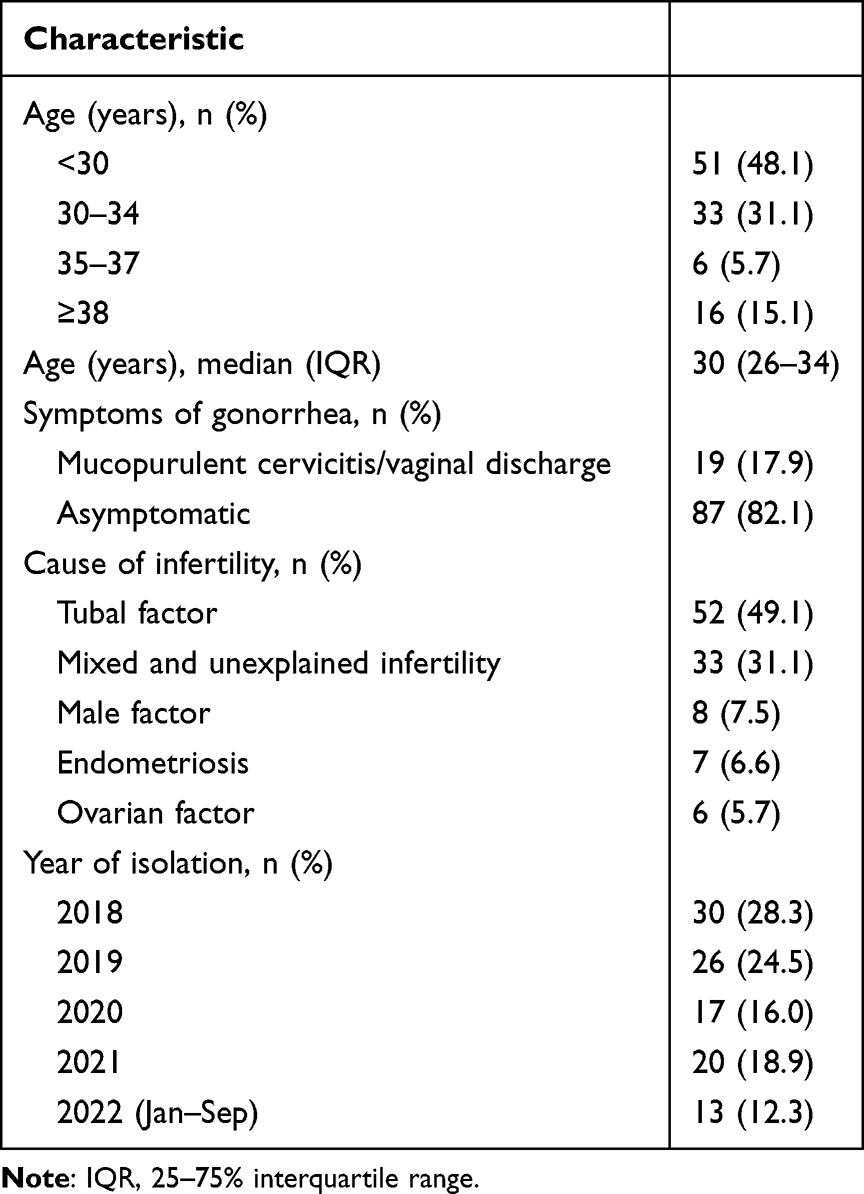 |
Table 1 Clinical Characteristics of Infertile Women with Gonorrhea (n=106) |
Antimicrobial Susceptibility of N. gonorrhoeae Isolates
Table 2 presents antimicrobial susceptibility profiles of the 106 N. gonorrhoeae isolates from 106 infertile women (one isolate per patient). For ceftriaxone, the observed MIC range was 0.008–0.25 mg/L, with the MIC50 and MIC90 recorded at 0.03 mg/L and 0.125 mg/L, respectively. According to resistance criteria, 2.8% (3/106) of the isolates demonstrated resistance to ceftriaxone (MIC >0.125 mg/L), while 16.0% (17/106) exhibited decreased susceptibility to ceftriaxone (defined as MIC ≥0.125 mg/L). Regarding azithromycin, the MIC distribution ranged from 0.06 to >8 mg/L, with MIC50 and MIC90 values of 0.5 mg/L and 1 mg/L. Resistance to azithromycin (MIC ≥1 mg/L) occurred in 19.8% (21/106) of isolates. Notably, 2.8% (3/106) of the isolates displayed a combined phenotype of decreased susceptibility to ceftriaxone and resistance to azithromycin. In addition, widespread resistance to other antibiotics was observed, with all isolates (100%) being resistant to ciprofloxacin, 98.1% to tetracycline, and 79.3% to penicillin, of which 32.7% were lactamase-producing N. gonorrhoeae. Consequently, resistance to three or more antibiotics was observed in 83 isolates (78.3%): one isolate was resistant to five antibiotics, 17 were resistant to four antibiotics, and 65 to three antibiotics. All isolates were susceptible to spectinomycin.
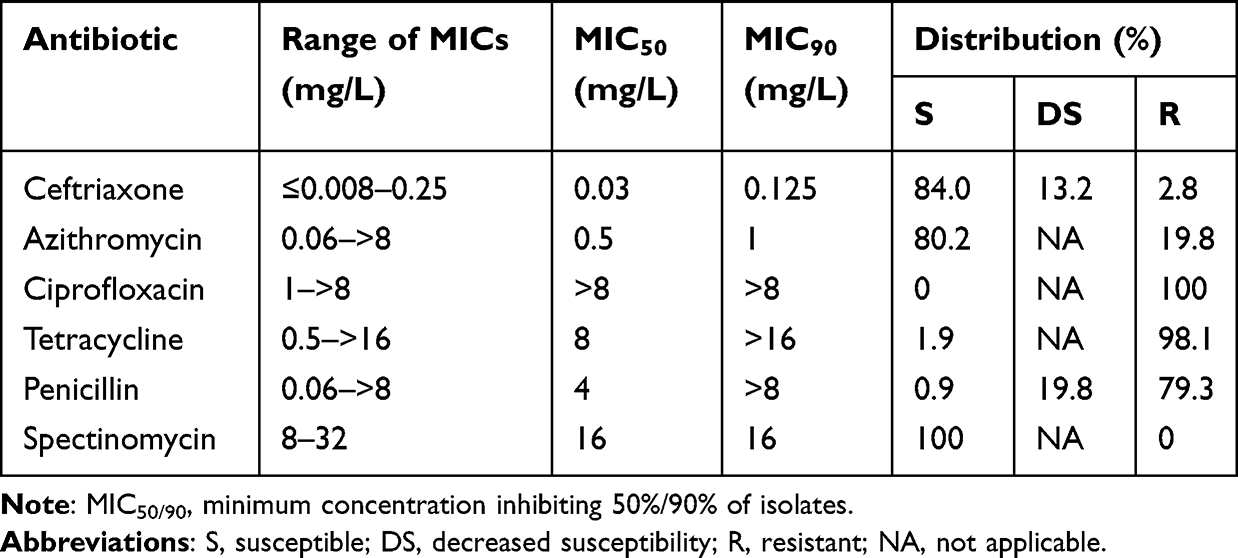 |
Table 2 MICs of 106 Neisseria gonorrhoeae Isolates from Infertile Women to Six Antibiotics |
Molecular Typing of N. gonorrhoeae Isolates
Among the 106 N. gonorrhoeae isolates, 83 distinct STs were identified by NG-MAST analysis, including 36 new STs that had not been previously recorded. The most prevalent STs were ST5061 (six isolates), followed by ST4539 (five isolates), with ST1791, ST11123, and ST17105 each comprising three isolates. In addition, eight STs contained two isolates, and 70 STs were represented by a single isolate (Table 3). The 17 isolates with decreased susceptibility to ceftriaxone were classified into 17 distinct STs, including six new STs. Similarly, the 21 azithromycin-resistant isolates were classified into 20 distinct STs (including 11 new STs), with only ST5061 containing two isolates. Overall, molecular typing revealed no clear association between specific STs and resistance patterns.
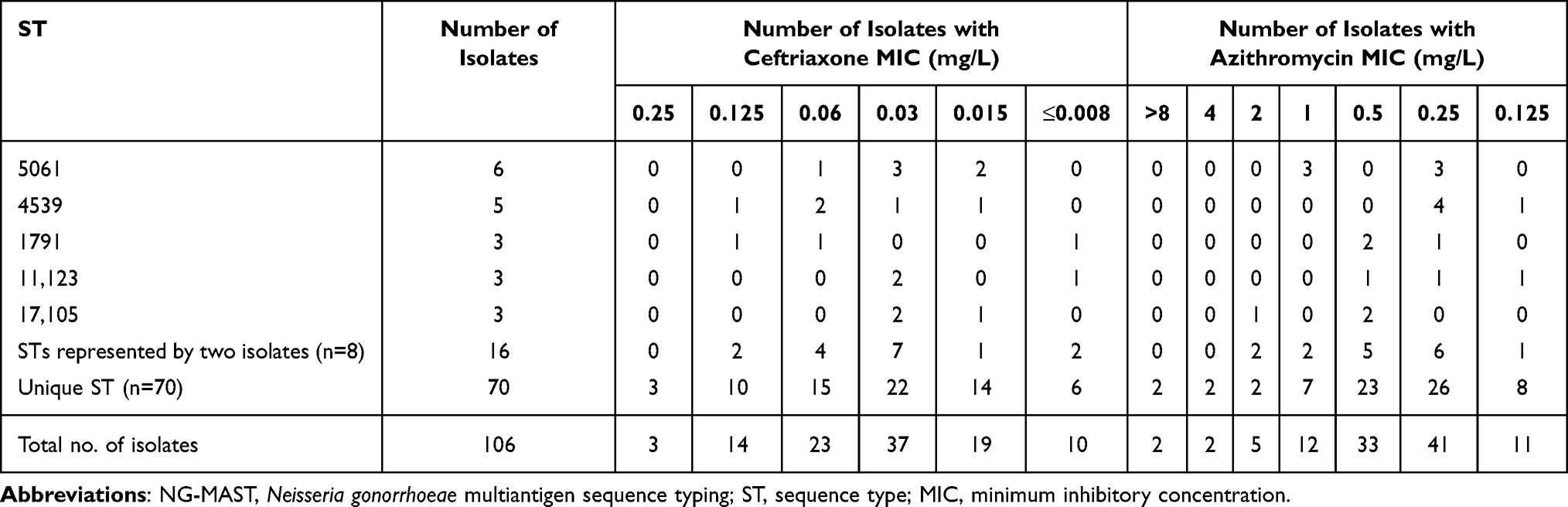 |
Table 3 NG-MAST ST and Ceftriaxone/Azithromycin MIC for 106 Neisseria gonorrhoeae Isolates from Infertile Women |
Discussion
The updated WHO Bacterial Priority Pathogens List (2024) retained antibiotic-resistant N. gonorrhoeae in the “high” priority group, underscoring its global public-health urgency.27 The surveillance of antimicrobial resistance in N. gonorrhoeae is essential for curbing transmission of resistant strains and reducing long-term gonococcal complications.5 To our knowledge, this study represents the first characterization of antimicrobial resistance in N. gonorrhoeae isolates from infertile women in China, conducted as part of the China-GRSP (2019–2022).
The Western Pacific Region, including China, faces persistent challenges with antimicrobial resistance to N. gonorrhoeae, particularly to ceftriaxone.11,28–31 During the study period, a total of 106 N. gonorrhoeae isolates were obtained from 145,168 infertile women screened, and antimicrobial susceptibility testing was performed on all isolates. The prevalence of ceftriaxone resistance was 2.8%, remaining below the WHO 5% threshold for first-line empirical therapy,1,10 and supporting the continued application of ceftriaxone monotherapy (1 g intravenous or intramuscular) in this population. Besides, this study observed a 16% rate of decreased susceptibility to ceftriaxone among N. gonorrhoeae isolates from infertile women, which underscores the need for sustained resistance surveillance in this specific population. Following the emergence of N. gonorrhoeae strains with high-level ceftriaxone resistance a decade ago,15,32 ceftriaxone–azithromycin dual therapy has become the first-line treatment for gonorrhea in many countries.10,33,34 However, we found azithromycin resistance in 19.8% of the isolates, with 2.8% exhibiting resistance to azithromycin and decreased susceptibility to ceftriaxone, suggesting that ceftriaxone–azithromycin dual therapy is unsuitable for gonorrhea treatment in this population. Indeed, in line with the rapidly growing gonococcal azithromycin resistance in recent years,35 the USA and UK have returned to ceftriaxone monotherapy for first-line gonorrhea treatment.36–38 Finally, the prevalence of penicillin, tetracycline, and ciprofloxacin resistance has reached 79.3%, 98.1%, and 100%, respectively, indicating that these antibiotics are not effective for gonorrhea treatment.10
An ascending infection of N. gonorrhoeae from the lower to the upper female reproductive tract may lead to infertility.8 The growing antimicrobial resistance in N. gonorrhoeae may exacerbate this process by increasing the risk of treatment failure and persistent infection.10,39 Therefore, we hypothesized that N. gonorrhoeae isolates from infertile women might exhibit a higher prevalence of ceftriaxone resistance. However, because isolates in our study were collected only from the cervix without assessment of ascending infection, and information on co-infections or prior STI history (both known contributors to infertility) were not systematically collected, our study was not designed to establish causality between current gonococcal infection and infertility. Unexpectedly, the prevalence of ceftriaxone-resistant N. gonorrhoeae isolates among infertile women in our study (2.8%, 3/106, 2018–2022) was lower than that reported a contemporaneous study from the same geographic region (Changsha, China) among the general population (7.8%, 8/103, 2018–2021).40 Several factors may account for this difference. First, most women in our cohort were asymptomatic (82.1%) and thus less likely to have used antibiotics before sample collection, potentially reducing selective pressure for resistance.41 Second, male sex has been associated with higher ceftriaxone MIC values,42 and the general population study likely included a larger proportion of male patients, whereas our study exclusively enrolled women. Third, the small number of ceftriaxone-resistant isolates in our study (n=3) limits the precision of the resistance estimate and warrants cautious interpretation.
NG-MAST is widely used for the molecular typing of N. gonorrhoeae.43,44 Among the 106 isolates, NG-MAST identified 83 distinct sequence types, indicating a high level of genetic heterogeneity. All 17 isolates demonstrating decreased susceptibility or resistance to ceftriaxone were widely distributed across different STs (including six new STs) rather than clustered in a dominant lineage. This pattern suggests multiple independent origins of ceftriaxone resistance in N. gonorrhoeae, consistent with other China-GRSP studies.45
Conclusion
In summary, this study provides the first characterization of antimicrobial resistance in N. gonorrhoeae isolates obtained from infertile Chinese women. We found a lower prevalence of resistance to ceftriaxone (2.8%), but a high prevalence of resistance to azithromycin (19.8%) and decreased susceptibility to ceftriaxone (16%), providing compelling evidence for recommending ceftriaxone monotherapy over ceftriaxone–azithromycin dual therapy for gonorrhea treatment in an infertile female population. These findings underscore the need for sustained gonococcal antimicrobial resistance surveillance targeting the general female population to curb the transmission of N. gonorrhoeae-resistant strains and protect female reproductive health.
Acknowledgment
This study was approved by the Ethics Committee of the Reproductive and Genetic Hospital of CITIC-Xiangya (No. LL-SC-2018-002), and adhered to the tenets of the Declaration of Helsinki. Prior to enrollment, written informed consent was obtained from all participants following a full explanation of the study.
Funding
This research was supported by a research grant of CITIC-Xiangya (YNXM-201803) and the Science and Technology Project of the Health Family Planning Commission of Hunan Province (No. C20180921).
Disclosure
The authors report no conflicts of interest in this work.
References
1. Unemo M, Seifert HS, Hook EW, et al. Gonorrhoea. Nat Rev Dis Primers. 2019;5(1):79. doi:10.1038/s41572-019-0128-6
2. WHO. Global progress report on HIV, viral hepatitis and sexually transmitted infections, 2021. World Health Organization. Available from: https://www.who.int/publications/i/item/9789240027077.
3. Rowley J, Vander Hoorn S, Korenromp E, et al. Chlamydia, gonorrhoea, trichomoniasis and syphilis: global prevalence and incidence estimates, 2016. Bull World Health Organ. 2019;97(8):548–7. doi:10.2471/BLT.18.228486
4. Kenyon C, Herrmann B, Hughes G, et al. Management of asymptomatic sexually transmitted infections in Europe: towards a differentiated, evidence-based approach. Lancet Reg Health Eur. 2023;34:100743. doi:10.1016/j.lanepe.2023.100743
5. Van Gerwen OT, Muzny CA, Marrazzo JM. Sexually transmitted infections and female reproductive health. Nat Microbiol. 2022;7(8):1116–1126. doi:10.1038/s41564-022-01177-x
6. Darville T. Pelvic inflammatory disease due to neisseria gonorrhoeae and Chlamydia trachomatis: immune evasion mechanisms and pathogenic disease pathways. J Infect Dis. 2021;224(12 Suppl 2):S39–s46. doi:10.1093/infdis/jiab031
7. Reekie J, Donovan B, Guy R, et al. Risk of pelvic inflammatory disease in relation to chlamydia and gonorrhea testing, repeat testing, and positivity: a population-based cohort study. Clin Infect Dis. 2018;66(3):437–443. doi:10.1093/cid/cix769
8. Reekie J, Donovan B, Guy R, et al. Risk of ectopic pregnancy and tubal infertility following gonorrhea and chlamydia infections. Clin Infect Dis. 2019;69(9):1621–1623. doi:10.1093/cid/ciz145
9. Unemo M, Shafer WM. Antimicrobial resistance in Neisseria gonorrhoeae in the 21st century: past, evolution, and future. Clin Microbiol Rev. 2014;27(3):587–613. doi:10.1128/CMR.00010-14
10. Jensen JS, Unemo M. Antimicrobial treatment and resistance in sexually transmitted bacterial infections. Nat Rev Microbiol. 2024;22(7):435–450. doi:10.1038/s41579-024-01023-3
11. Unemo M, Lahra MM, Escher M, et al. WHO global antimicrobial resistance surveillance for Neisseria gonorrhoeae 2017-18: a retrospective observational study. Lancet Microbe. 2021;2(11):e627–e636. doi:10.1016/S2666-5247(21)00171-3
12. Unemo M, Lahra MM, Cole M, et al. World Health Organization Global Gonococcal Antimicrobial Surveillance Program (WHO GASP): review of new data and evidence to inform international collaborative actions and research efforts. Sex Health. 2019;16(5):412–425. doi:10.1071/SH19023
13. Alhusseini LB, Hasani B, Jaafar FN, et al. Temporal and geographic trends in extended-spectrum cephalosporins resistance among Neisseria gonorrhoeae isolates worldwide: a systematic review and meta-analysis. BMC Infect Dis. 2025;25(1):1175. doi:10.1186/s12879-025-11601-2
14. Zhang C, Yang Y, Zhu B, et al. Emergence, evolution and temporal spread of ceftriaxone-resistant Neisseria gonorrhoeae in China from 2002 to 2022: a retrospective genomic surveillance study. Emerg Microbes Infect. 2025;14(1):2579397. doi:10.1080/22221751.2025.2579397
15. Ohnishi M, Golparian D, Shimuta K, et al. Is Neisseria gonorrhoeae initiating a future era of untreatable gonorrhea?: detailed characterization of the first strain with high-level resistance to ceftriaxone. Antimicrob Agents Chemother. 2011;55(7):3538–3545. doi:10.1128/AAC.00325-11
16. Fagan L, Alexander S, Fifer H. The invisible tide of Neisseria gonorrhoeae treatment failures: a review and commentary. Clin Infect Dis. 2026;81(Supplement_5):S223–s230. doi:10.1093/cid/ciaf532
17. Fifer H, Natarajan U, Jones L, et al. Failure of dual antimicrobial therapy in treatment of gonorrhea. N Engl J Med. 2016;374(25):2504–2506. doi:10.1056/NEJMc1512757
18. Poncin T, Fouere S, Braille A, et al. Multidrug-resistant Neisseria gonorrhoeae failing treatment with ceftriaxone and doxycycline in France, November 2017. Euro Surveill. 2018;23(27):1800323. doi:10.2807/1560-7917.ES.2018.23.21.1800264
19. Eyre DW, Sanderson ND, Lord E, et al. Gonorrhoea treatment failure caused by a Neisseria gonorrhoeae strain with combined ceftriaxone and high-level azithromycin resistance, England, February 2018. Euro Surveill. 2018;23(27):1800323. doi:10.2807/1560-7917.ES.2018.23.27.1800323
20. Golparian D, Ohlsson A, Janson H, et al. Four treatment failures of pharyngeal gonorrhoea with ceftriaxone (500 mg) or cefotaxime (500 mg), Sweden, 2013 and 2014. Euro Surveill. 2014;19(30). doi:10.2807/1560-7917.ES2014.19.30.20862
21. Tsevat DG, Wiesenfeld HC, Parks C, Peipert JF. Sexually transmitted diseases and infertility. Am J Obstet Gynecol. 2017;216(1):1–9. doi:10.1016/j.ajog.2016.08.008
22. Wi T, Lahra MM, Ndowa F, et al. Antimicrobial resistance in Neisseria gonorrhoeae: global surveillance and a call for international collaborative action. PLoS Med. 2017;14(7):e1002344. doi:10.1371/journal.pmed.1002344
23. Chemaitelly H, Majed A, Abu-Hijleh F, et al. Global epidemiology of Neisseria gonorrhoeae in infertile populations: systematic review, meta-analysis and metaregression. Sex Transm Infect. 2021;97(2):157–169. doi:10.1136/sextrans-2020-054515
24. Zegers-Hochschild F, Adamson GD, Dyer S, et al. The international glossary on infertility and fertility care, 2017. Fertil Steril. 2017;108(3):393–406. doi:10.1016/j.fertnstert.2017.06.005
25. Unemo M, Ballard R, Ison C, et al. Laboratory diagnosis of sexually transmitted infections, including human immunodeficiency virus. 2013. Available from: http://www.who.int/reproductivehealth/publications/rtis/9789241505840/en/.
26. Martin IM, Ison CA, Aanensen DM, et al. Rapid sequence-based identification of gonococcal transmission clusters in a large metropolitan area. J Infect Dis. 2004;189(8):1497–1505. doi:10.1086/383047
27. Sati H, Carrara E, Savoldi A, et al. The WHO bacterial priority pathogens list 2024: a prioritisation study to guide research, development, and public health strategies against antimicrobial resistance. Lancet Infect Dis. 2025;25(9):1033–1043. doi:10.1016/S1473-3099(25)00118-5
28. Zhu X, Xi Y, Gong X, et al. Ceftriaxone-Resistant Gonorrhea - China, 2022. MMWR Morb Mortal Wkly Rep. 2024;73(12):255–259. doi:10.15585/mmwr.mm7312a2
29. Chen SC, Yuan LF, Zhu XY, et al. Sustained transmission of the ceftriaxone-resistant Neisseria gonorrhoeae FC428 clone in China. J Antimicrob Chemother. 2020;75(9):2499–2502. doi:10.1093/jac/dkaa196
30. Laumen JGE, Hieu VN, Nhung PH. High prevalence of ceftriaxone-resistant Neisseria gonorrhoeae in Hanoi, Vietnam, 2023–2024. J Infect Dis. 2025;232(1):e73–e77. doi:10.1093/infdis/jiaf071
31. George CR, Enriquez RP, Gatus BJ, et al. Systematic review and survey of Neisseria gonorrhoeae ceftriaxone and azithromycin susceptibility data in the Asia Pacific, 2011 to 2016. PLoS One. 2019;14(4):e0213312. doi:10.1371/journal.pone.0213312
32. Unemo M, Nicholas RA. Emergence of multidrug-resistant, extensively drug-resistant and untreatable gonorrhea. Future Microbiol. 2012;7(12):1401–1422. doi:10.2217/fmb.12.117
33. Bignell C, Fitzgerald M. UK national guideline for the management of gonorrhoea in adults, 2011. Int J STD AIDS. 2011;22(10):541–547. doi:10.1258/ijsa.2011.011267
34. Bignell C, Unemo M, Radcliffe K. 2012 European guideline on the diagnosis and treatment of gonorrhoea in adults. Int J STD AIDS. 2013;24(2):85–92. doi:10.1177/0956462412472837
35. Fifer H, Cole M, Hughes G, et al. Sustained transmission of high-level azithromycin-resistant Neisseria gonorrhoeae in England: an observational study. Lancet Infect Dis. 2018;18(5):573–581. doi:10.1016/S1473-3099(18)30122-1
36. Workowski KA. Sexually transmitted infections treatment guidelines, 2021. MMWR Recomm Rep. 2021;70(4):1–187.
37. Fifer H, Saunders J, Soni S, et al. 2018 UK national guideline for the management of infection with Neisseria gonorrhoeae. Int J STD AIDS. 2020;31(1):4–15. doi:10.1177/0956462419886775
38. Hazra A, Collison MW, Davis AM. CDC sexually transmitted infections treatment guidelines, 2021. JAMA. 2022;327(9):870–871. doi:10.1001/jama.2022.1246
39. Pyle A, Garner L, Wallace Huff C. Gonorrhea and chlamydia infections in women. Clin Obstet Gynecol. 2025;68(2):164–169. doi:10.1097/GRF.0000000000000931
40. Yuan Q, Shi S, Dai Y, et al. Surveillance of the antimicrobial susceptibility and molecular characteristics of Neisseria gonorrhoeae isolates collected in Changsha, China from 2016 to 2021. Jpn J Infect Dis. 2023;76(3):167–173. doi:10.7883/yoken.JJID.2022.532
41. Andersson DI, Hughes D. Antibiotic resistance and its cost: is it possible to reverse resistance? Nat Rev Microbiol. 2010;8(4):260–271. doi:10.1038/nrmicro2319
42. Trecker MA, Waldner C, Jolly A, et al. Behavioral and socioeconomic risk factors associated with probable resistance to ceftriaxone and resistance to penicillin and tetracycline in Neisseria gonorrhoeae in Shanghai. PLoS One. 2014;9(2):e89458. doi:10.1371/journal.pone.0089458
43. Chen S-C, Yin Y-P, Dai X-Q, Unemo M, Chen X-S. First nationwide study regarding ceftriaxone resistance and molecular epidemiology of Neisseria gonorrhoeae in China. J Antimicrob Chemother. 2016;71(1):92–99. doi:10.1093/jac/dkv321
44. Carannante A, Vacca P, Fontana S, et al. Seven years of culture collection of Neisseria gonorrhoeae: antimicrobial resistance and molecular epidemiology. Microb Drug Resist. 2023;29(3):85–95. doi:10.1089/mdr.2021.0483
45. Yan J, Xue J, Chen Y, et al. Increasing prevalence of Neisseria gonorrhoeae with decreased susceptibility to ceftriaxone and resistance to azithromycin in Hangzhou, China (2015-17). J Antimicrob Chemother. 2019;74(1):29–37. doi:10.1093/jac/dky412
 © 2026 The Author(s). This work is published and licensed by Dove Medical Press Limited. The
full terms of this license are available at https://www.dovepress.com/terms
and incorporate the Creative Commons Attribution
- Non Commercial (unported, 4.0) License.
By accessing the work you hereby accept the Terms. Non-commercial uses of the work are permitted
without any further permission from Dove Medical Press Limited, provided the work is properly
attributed. For permission for commercial use of this work, please see paragraphs 4.2 and 5 of our Terms.
© 2026 The Author(s). This work is published and licensed by Dove Medical Press Limited. The
full terms of this license are available at https://www.dovepress.com/terms
and incorporate the Creative Commons Attribution
- Non Commercial (unported, 4.0) License.
By accessing the work you hereby accept the Terms. Non-commercial uses of the work are permitted
without any further permission from Dove Medical Press Limited, provided the work is properly
attributed. For permission for commercial use of this work, please see paragraphs 4.2 and 5 of our Terms.
Recommended articles

Evaluation of Neisseria gonorrhoeae Isolates Susceptibility to Antibiotics in Zhejiang Province Since 2007
Zhang Y, Hu LH, Huang J, Lu MQ, Zeng FR, Chen SC
Infection and Drug Resistance 2023, 16:1441-1448
Published Date: 14 March 2023
Safety Aspects and Rational Use of Single Intramuscular Dose Ceftriaxone: Clinical Insights on the Management of Uncomplicated Gonococcal Infections
Allen GP, Morrill HL
Drug, Healthcare and Patient Safety 2023, 15:159-170
Published Date: 3 November 2023
Resistance Mechanisms and Molecular Epidemiology of Neisseria gonorrhoeae with Low Susceptibility/Resistance to Azithromycin or Cephalosporins
Chen S, Xia F
Infection and Drug Resistance 2026, 19:566264
Published Date: 8 January 2026