
Back to Journals » Advances in Medical Education and Practice » Volume 17
Factors Shaping Learning Enthusiasm of the Medical Students: A Comparative Study of Eight-Year and Five-Year Programs
Authors Kang J, Duan B, Wang Z, Len W, Peng L, Tu C, Hu Z 
Received 21 August 2025
Accepted for publication 10 January 2026
Published 20 January 2026 Volume 2026:17 562230
DOI https://doi.org/10.2147/AMEP.S562230
Checked for plagiarism Yes
Review by Single anonymous peer review
Peer reviewer comments 4
Editor who approved publication: Dr Sateesh Arja
Jin Kang,1,2 Bin Duan,3 Zhao Wang,4 Wenjie Len,5 Lele Peng,6 Chao Tu,7 Zhaolan Hu8,9
1Department of Rheumatology and Immunology, The Second Xiangya Hospital of Central South University, Changsha, 410011, People’s Republic of China; 2Clinical Medical Research Center for Systemic Autoimmune Diseases in Hunan Province, Changsha, Hunan, 410011, People’s Republic of China; 3Department of Intensive Care Unit, The Second Xiangya Hospital of Central South University, Changsha, Hunan, People’s Republic of China; 4Department of Urinary Surgery, the Xiangya Hospital, Central South University, Changsha, Hunan, 410008, People’s Republic of China; 5Department of Radiology, The Third Xiangya Hospital, Central South University, Changsha, Hunan, 410013, People’s Republic of China; 6Department of Endocrine and Metabolic, Want Want Hospital, Changsha, Hunan, 410016, People’s Republic of China; 7Department of Orthopedics, The Second Xiangya Hospital of Central South University, Changsha, Hunan, 410011, People’s Republic of China; 8Department of Anesthesiology, The Second Xiangya Hospital, Central South University, Changsha, Hunan, 410011, People’s Republic of China; 9Anesthesia Medical Research Center, Central South University, Changsha, Hunan, 410011, People’s Republic of China
Correspondence: Zhaolan Hu, Email [email protected]
Background: Understanding the drivers of medical students’ learning enthusiasm is crucial amid concerns about the physician workforce. This study compares China’s five-year and eight-year medical programs, focusing on curriculum design and the effectiveness of assignments.
Objective: To compare learning enthusiasm between the two programs and analyze how assignment design and curriculum influence active learning and critical thinking.
Methods: A cross-sectional study surveyed 504 medical students (98 eight-year, 406 five-year) using the Self-Assessment Scale for Active Learning and Critical Thinking (SSACT).
Results: Significant differences emerged between five-year and eight-year students in geographical origin (χ2 = 22.11, P < 0.001, Cramer’s V = 0.209) and program preference (χ2 = 67.26, P < 0.001, Cramer’s V = 0.366). Eight-year students were more often from provincial capitals (39.80% vs 17.98%) and had chosen their program as a first preference (88.78% vs 68.23%), with stronger clinical career commitment (57.14% vs 36.45%). Lecture engagement was higher in the eight-year cohort. The assignment evaluation showed that both groups invested more than 5 hours per week. Review writing showed differences between the two groups (χ2 = 22.49, P < 0.001, Cramer’s V = 0.212), but eight-year students found it more meaningful (49.49% vs 28.07%). Using the reliable SSACT (Cronbach’s α = 0.892), eight-year students scored higher in active learning (managing study, P = 0.037; summarizing discussions, P = 0.025) and critical thinking (formulating questions, P = 0.034; generating solutions, P = 0.014; connecting knowledge, P = 0.018; developing hypotheses, P = 0.004).
Conclusion: Assignment overload and limited self-study time in the current model may undermine critical thinking and active learning. Reforms should balance task quality with volume to better support educational goals.
Keywords: learning enthusiasm, medical and clinical students education, curriculum design, problem-based learning, critical thinking, SSACT evaluated learning enthusiasm
Introduction
A study published in “The Lancet” analyzed health yearbooks from China’s Health and Family Planning Commission covering the period from 2005 to 2014.1 The study found that, over the course of ten years, 4.7 million medical students graduated in China, yet the number of practicing doctors increased by only 750,000. Further analysis revealed a decrease in the proportion of doctors aged 25–34 years from 31.3% to 22.6%, alongside an increase in doctors aged over 60 years from 2.5% to 11.6%. These trends indicate that the physician shortage is mainly due to young graduates’ waning interest in clinical careers. Addressing this attrition requires a focus on the educational experience, underscoring the urgent need to understand and foster “learning enthusiasm” among medical students, which we define as a state of deep engagement, intrinsic motivation, and sustained interest in the learning process.2,3
In China, there are two primary clinical medicine programs: the five-year undergraduate program and the eight-year undergraduate program.4 Since 2001, 18 leading medical colleges have introduced the eight-year program, designed to train highly skilled healthcare professionals.5 Graduates of this program earn a Doctor of Medicine (MD) degree and are often positioned to work at top hospitals across China. The eight-year program builds on the traditional five-year curriculum by adding one to two years of general coursework and two to three years of scientific research training. This extended program aims to produce clinicians with a robust foundation in clinical practice as well as significant research expertise. Despite differences in duration, the clinical teaching stages of both the five-year and eight-year programs share many similarities.
The development and refinement of medical school curricula require incorporating active learning and ongoing quality improvement strategies.6,7 Active learning, characterized by student-centered approaches that encourage reflection and problem-solving rather than passive reception of information, is increasingly recognized as vital for medical education.8 Critical thinking is also crucial to learning and professional practice.9 Critical thinking involves the objective analysis and evaluation of information to form a judgment, a skill indispensable for medical professionals in complex clinical environments.10 Problem-Based Learning (PBL), a pedagogical approach that engages students in solving real-world problems, has proven effective in fostering both active learning and critical thinking in medical curricula worldwide.10 Identifying factors related to medical student satisfaction and learning enthusiasm is essential, as these factors impact overall well-being and academic performance.11–13 However, while the importance of learning enthusiasm is well-recognized, few comparative analyses have examined how it differs between extended, research-intensive medical programs and standard, shorter-term tracks.14,15
Our study addresses these gaps by focusing on two key dimensions: (1) a localized comparison of learning enthusiasm between China’s five-year and eight-year medical programs, and (2) an analysis of how assignment design and time demands impact critical thinking and active learning. The results will offer insights to optimize pedagogical strategies in diverse medical education systems.
This study employed a purpose-designed questionnaire to survey medical students at a large hospital in central China, including 98 students from the eight-year program and 406 from the five-year program. First, we highlight how geographical disparities in student backgrounds (eg, urban vs rural origins) intersect with program choice, a factor rarely examined in global studies. Second, we reveal how assignment overload, particularly in time-intensive tasks like case writing, disproportionately affects students in the five-year program. Conversely, the eight-year program’s emphasis on autonomous learning and research fosters higher engagement, speculating that curriculum scaffolding is critical in sustaining motivation. Finally, by employing the Self-Assessment Scale for Active Learning and Critical Thinking (SSACT), a validated instrument designed to measure students’ learning enthusiasm of their active learning behaviors and critical thinking skills in an educational context.9,16 We provide empirical evidence of differences between the two cohorts’ active learning and critical thinking.
The aim was to assess the students’ learning enthusiasm and analyze the factors influencing it, particularly from their perspective. By understanding students’ assessments and expectations regarding assignments, this study aims to provide a practical foundation for educational reforms in medical institutions. By examining differences in organized programs, how well assignments work, and local cultural factors, this study improves the understanding of creating strong and motivated medical professionals in changing healthcare environments.
Methods
Research Objective and Participants
The objective of our study was to evaluate the learning enthusiasm of medical students and analyze the factors influencing it, with a particular focus on the perspectives of students. We employed a cross-sectional study design. Due to the specific context of medical education programs in China and the accessibility of participants, a convenience sampling strategy was utilized to recruit probationary medical students from a large teaching hospital in central China. This study employed a cluster sampling method. Given the institutional setting, this study can considered a cluster-based convenience sample. All clinical probationary medical students at a large teaching hospital in Central China were treated as a single sampling cluster, with all eligible students enrolled in both the eight-year and five-year programs within this cluster being included in the study. The sample comprised 504 medical students, with 98 enrolled in the eight-year program and 406 in the five-year program. All eligible probationary students at the institution were invited to participate, resulting in a 100% response rate for the questionnaires.
This study adhered to the Declaration of Helsinki (1989) and received approval from the Ethics Committee of Xiangya Hospital, with the research trial registration number 202201003. After providing a detailed verbal explanation of the experimental procedures, each participant provided written consent to join the study. Trained researchers administered the questionnaires, ensuring voluntary and anonymous participation and informing participants of the purpose of the study.
Instruments and Measures
The surveys were conducted between August and December 2023. The comprehensive questionnaire was structured into four main sections to capture various aspects influencing learning enthusiasm:
General Situation and Working Environment Impact on Learning: This section gathered demographic information and assessed students’ perceptions of broader factors such as doctor-patient relationships, physician remuneration, and research-related stress on their learning enthusiasm (Table 1). Lecture Quality Evaluation: This section assessed students’ satisfaction with and engagement during on-campus lectures (Table 2). Assignment Assessment and Expectations: This section focused on students’ experiences and opinions regarding the type, time commitment, and perceived meaningfulness of various academic assignments (Table 3). The SSACT is a 14-item instrument designed to assess students’ perceptions of their active learning and critical thinking skills across two distinct domains (Table 4).9,16 The SSACT was originally developed and validated in a medical education context to measure students’ self-perceived ability to engage actively in learning processes and apply critical thinking in problem-solving scenarios. Students were evaluated using a five-point Likert scale questionnaire, where responses ranged from 1 (strongly disagree) to 5 (strongly agree).
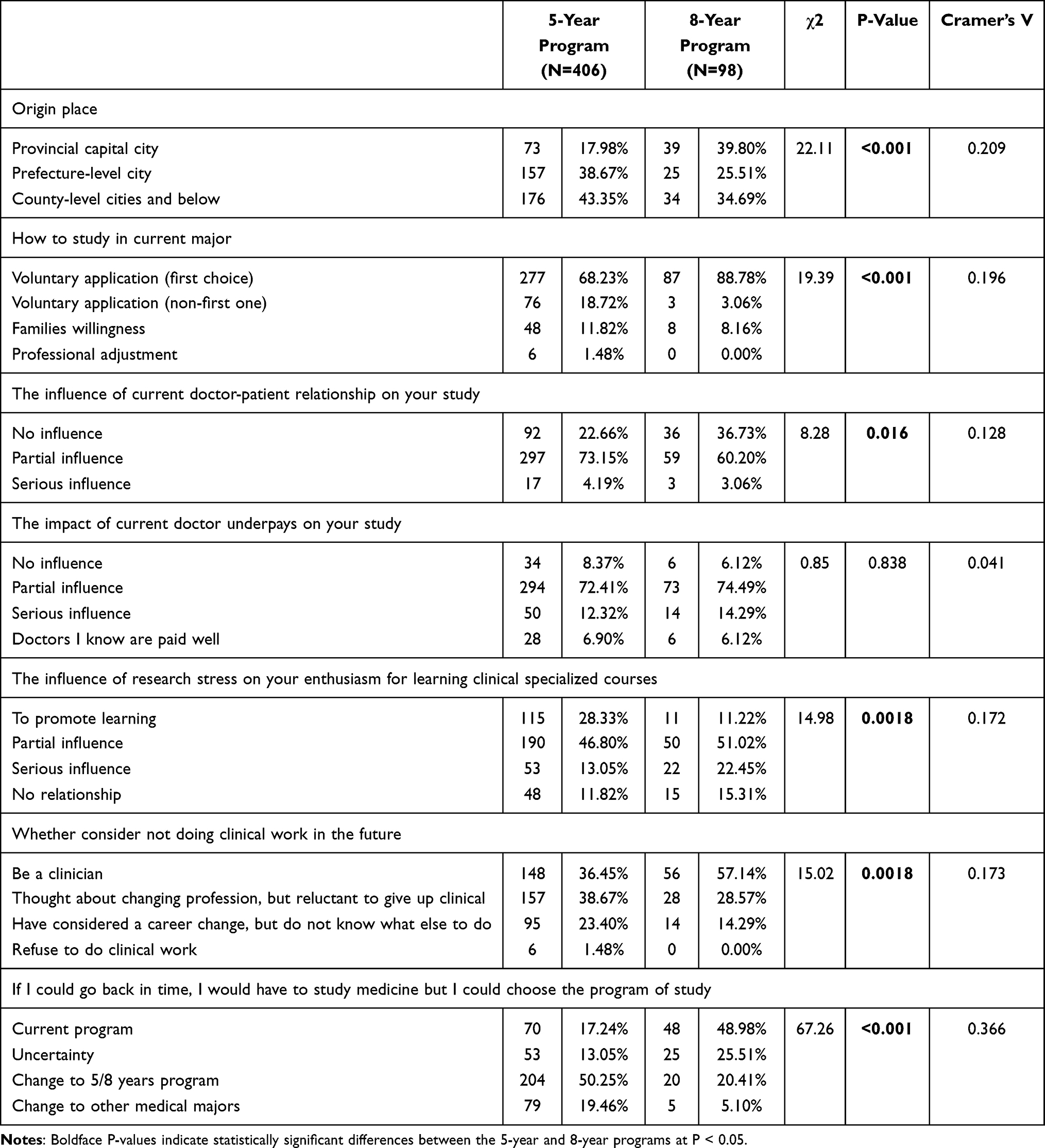 |
Table 1 Influence of General Situation and Working Environment on Learning |
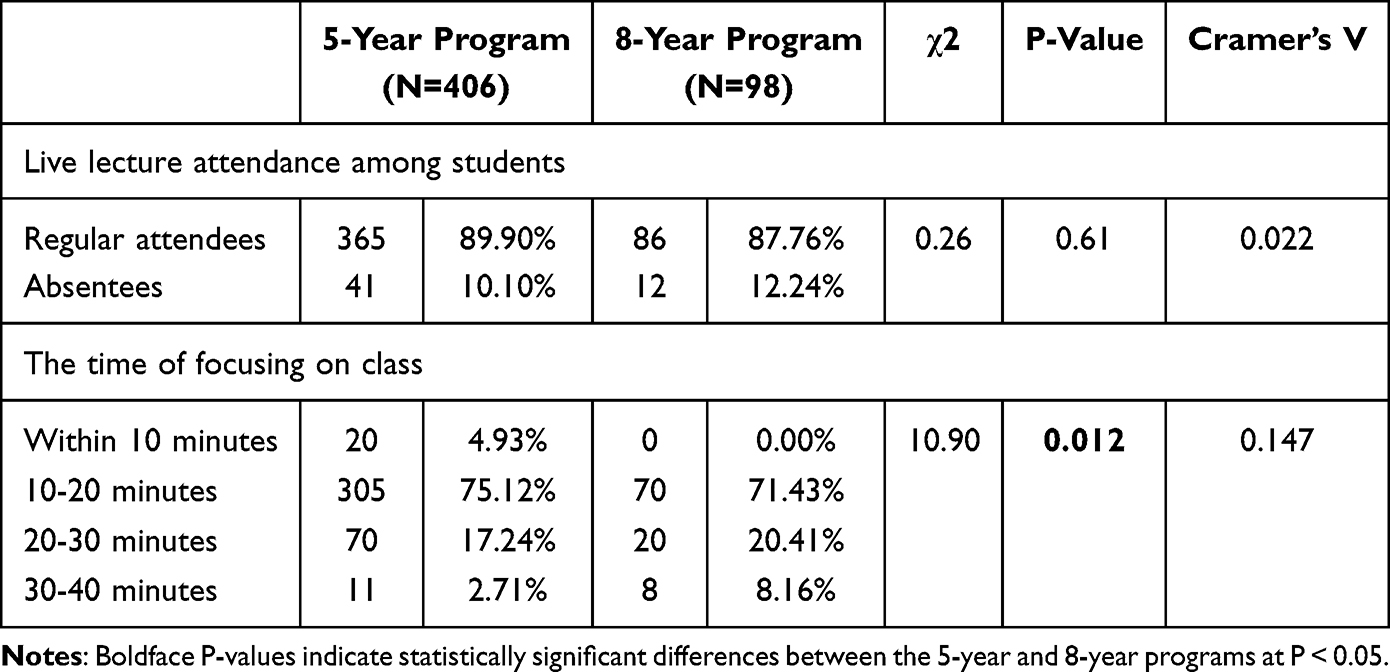 |
Table 2 Evaluation of Lecture Quality |
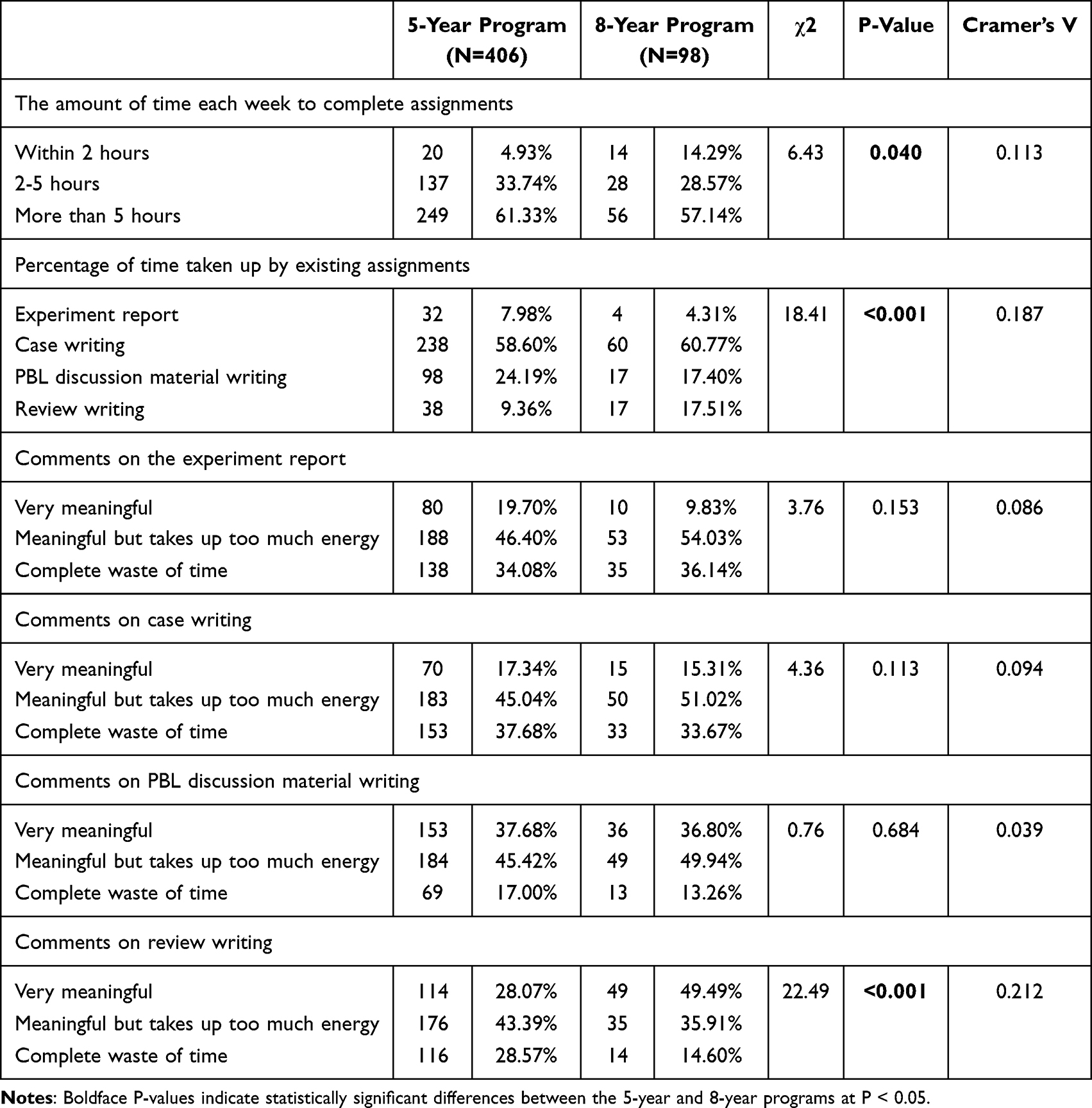 |
Table 3 Evaluation of Assignments |
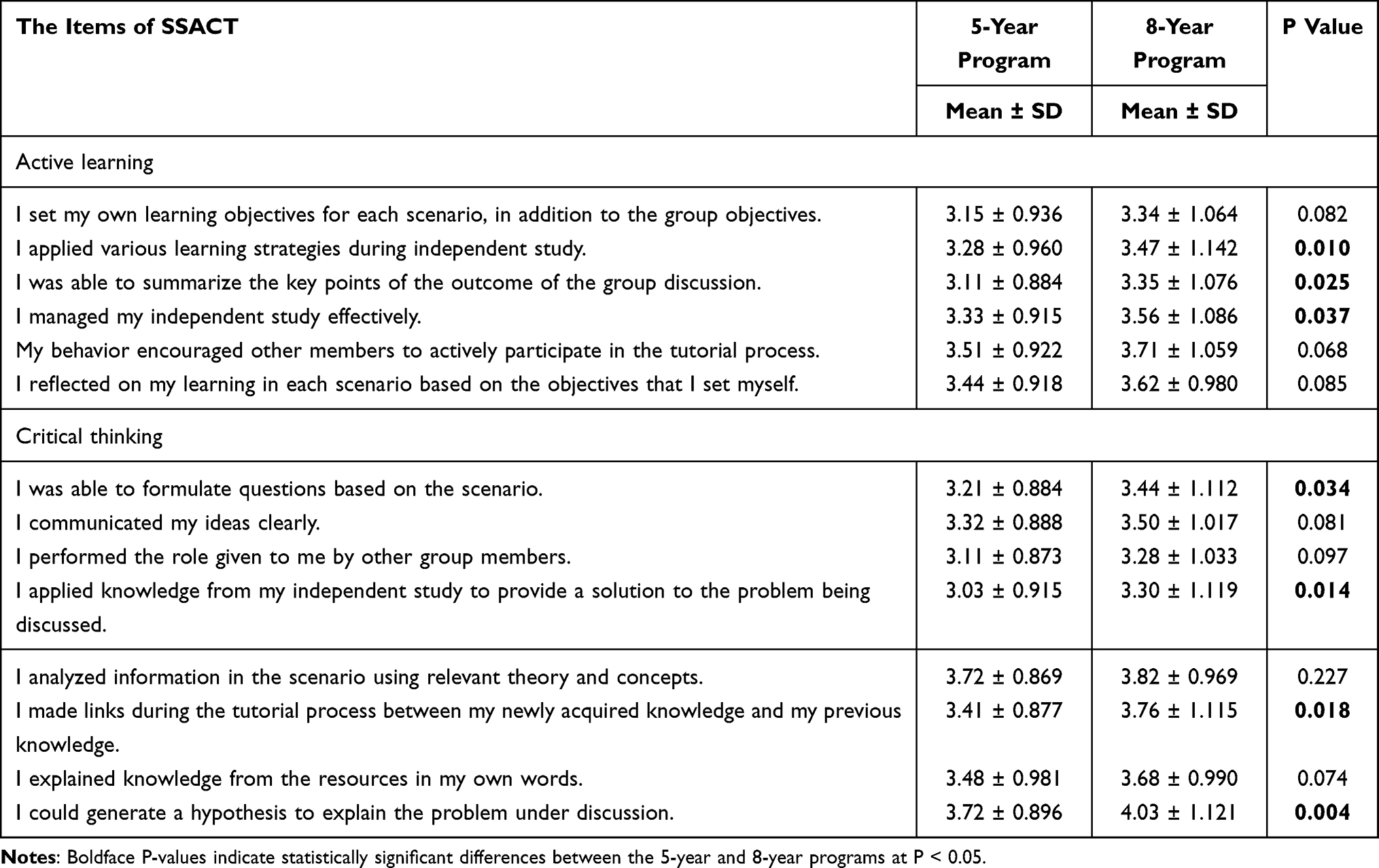 |
Table 4 Comparison of Learning Enthusiasm Between Two Groups Students |
The questionnaire underwent a rigorous translation and adaptation process. It was translated from English to Mandarin and back-translated by independent bilingual experts. A pilot test with 20 students ensured clarity and cultural relevance. Content validity was confirmed by a panel of medical education specialists and psychologists.
Statistical Analysis
This study employed a descriptive approach to data analysis. Statistical calculations were performed using IBM SPSS Statistics for Windows (version 24.0; IBM Corp., Armonk, NY, USA). A P-value <0.05 was considered statistically significant. Descriptive statistics summarized continuous variables as mean ± standard deviation and categorical variables as frequencies and percentages. Group comparisons between the five-year and eight-year programs on SSACT scores were performed using independent samples t-tests.
For analyses of associations between categorical variables (via chi-square tests), Cramer’s V (the effect size metric for chi-square tests) was added to quantify the strength of associations. Cramer’s V is calculated as  where n denotes the total sample size and k represents the smaller value of the number of rows or columns in the contingency table The interpretation of Cramer’s V follows established benchmarks: 0.00–0.10 indicates a very weak association (with negligible practical significance), 0.10–0.30 indicates a weak association, 0.30–0.50 indicates a moderate association, and values > 0.50 indicate a strong association.
We used the psych package in R (version 4.5.1) to calculate Cronbach’s α to assess the SSACT scale’s internal consistency.
Results
The Impact of General Situations and Working Environments on Learning
We collected 504 valid questionnaires from 406 fourth-year medical students in the five-year program and 98 probationary students in the eight-year program. Differences were firstly observed between the two groups in geographical background, program selection, professional perceptions, and career intentions (Table 1).
Geographical Origin and Program Choice
The proportion of students from provincial cities was approximately twice as high in the eight-year program (39.80%) compared to the five-year program (17.98%), highlighting a geographical disparity. Additionally, a higher percentage of students in the eight-year program (88.78%) selected their principal field of study as their first choice compared to 68.23% of students in the five-year program. These differences were statistically significant, with moderate associations for geographical origin (χ2 = 22.11, P < 0.001, Cramer’s V = 0.209) and program selection (χ2 = 19.39, P < 0.001, Cramer’s V = 0.196).
Perceptions of Medical Profession Challenges
Approximately 70% of students in both programs believe that issues such as the current state of the doctor-patient relationship and doctor underpayment could partially affect their studies. Perceptions of doctor-patient relationships showed a mild intergroup difference (χ2 = 8.28, P = 0.016, Cramer’s V = 0.128), whereas views on underpayment did not differ significantly (χ2 = 0.85, P = 0.838, Cramer’s V = 0.041).
The Influence of Research Stress on Learning Enthusiasm
A significantly lower proportion of eight-year program students reported that research stress promoted their learning (11.22% vs 28.33% in the five-year program), while a higher proportion indicated it seriously affected their enthusiasm (22.45% vs 13.05% in the five-year program). These differences were statistically significant (χ2 = 14.98, P = 0.0018, Cramer’s V = 0.172).
Future Career Plans and Program Preference
A stronger commitment to a clinical career was observed in the eight-year program, with 57.14% intending to remain clinicians, compared to only 36.45% in the five-year program. More students in the five-year program considered changing careers, with 38.67% reluctant to abandon clinical work and 23.40% uncertain about their career direction, compared to 28.57% and 14.29% in the eight-year program, respectively. In response to questions about program preferences, 48.98% of students in the eight-year program indicated that they would choose their current program again if given the option, while only 17.24% of students in the five-year program felt the same. Conversely, 50.25% of students in the five-year program expressed a preference to switch to the eight-year program. These differences were significant for career intention (χ2 = 15.02, P = 0.0018, Cramer’s V = 0.173) and program preference (χ2 = 67.26, P < 0.001, Cramer’s V = 0.366), the latter indicating a moderate association.
These findings indicate that the eight-year program attracts students with stronger urban backgrounds and initial commitment, likely influenced by its integrated research training and perceived professional advantages. These factors appear to contribute to higher baseline learning enthusiasm and career alignment among eight-year program students.
Quality Evaluation of Lectures
Lecture attendance and focus were compared between the five-year and eight-year programs (Table 2). Although most students in both programs attended live lectures (five-year: 89.90%; eight-year: 87.76%), attendance rates did not differ significantly (χ2 = 0.26, P = 0.61, Cramer’s V = 0.022). However, the ability to maintain focus during lectures varied between groups. Only 2.71% of five-year students remained focused for 30–40 minutes, compared to 8.16% in the eight-year program, while 4.93% of five-year students reported focusing for less than 10 minutes—a proportion not observed in the eight-year cohort. This difference in focus duration was statistically significant (χ2 = 10.90, P = 0.012, Cramer’s V = 0.147). These results indicate that while lecture attendance is generally high across both programs, sustained attentiveness remains limited, particularly among five-year medical students.
Evaluation and Expectations of Assignments
Students’ time investment and perceptions of academic assignments are summarized in Table 3. The majority of participants in both programs dedicated over five hours weekly to assignments (five-year: 61.33%; eight-year: 57.14%), with a statistically significant lack of association in weekly time allocation between the programs (χ2 = 6.43, P = 0.040, Cramer’s V = 0.113). Case writing was the most time-consuming task in both cohorts (five-year: 58.60%; eight-year: 60.77%). However, the distribution of time across assignment types differed significantly between programs (χ2 = 18.41, P < 0.001, Cramer’s V = 0.187), with eight-year students dedicating more time to review writing (17.51% vs 9.36%).
Regarding perceived meaningfulness, nearly 45% of students in both groups considered assignments meaningful but overly time-intensive. Over one-third viewed case writing (five-year: 37.68%; eight-year: 33.67%) and experimental reports (five-year: 34.08%; eight-year: 36.14%) as overly formalized and unproductive. In contrast, review writing was rated as “very meaningful” by significantly more eight-year students (49.49% vs 28.07%; χ2 = 22.49, P < 0.001, Cramer’s V = 0.212). Perceptions of case writing (χ2 = 4.36, P = 0.113) and PBL materials (χ2 = 0.76, P = 0.684) did not differ significantly.
These findings reflect distinct curricular emphases between the two programs. The eight-year program’s research-integrated model appears to foster greater recognition of the value of research-oriented tasks such as review writing, whereas both groups shared concerns about the utility of routine assignments like case reports.
Comparison of Learning Enthusiasm Between Students in the Five-Year and Eight-Year Program
Prior to group comparisons, the validity and reliability of the SSACT were established. We used the psych package in R to calculate the scale’s Cronbach’s α, and the result demonstrated excellent internal consistency (Cronbach’s α = 0.892).
SSACT results revealed that eight-year program students exhibited significantly higher overall learning enthusiasm than their five-year program counterparts (Table 4). In the active learning domain, eight-year students scored significantly higher in employing diverse learning strategies (3.47 ± 1.142 vs 3.28 ± 0.960, P = 0.010), summarizing group discussion points (3.35 ± 1.076 vs 3.11 ± 0.884, P = 0.025), and managing independent study (3.56 ± 1.086 vs 3.33 ± 0.922, P = 0.037).
In critical thinking, eight-year medical students demonstrated superior performance across multiple indicators: formulating scenario-based questions (3.44 ± 1.112 vs 3.21 ± 0.884, P = 0.034), generating problem-solving solutions (3.30 ± 1.119 vs 3.03 ± 0.915, P = 0.014), connecting new and existing knowledge (3.76 ± 1.115 vs 3.41 ± 0.877, P = 0.018), and developing explanatory hypotheses (4.03 ± 1.121 vs 3.72 ± 0.896, P = 0.004).
These findings indicate that the eight-year program’s research-integrated curriculum and emphasis on autonomous learning are associated with enhanced active learning behaviors and critical thinking skills, reflecting a more robust learning enthusiasm profile among its students.
Discussion
This study demonstrates that medical students’ learning enthusiasm is significantly influenced by their background, program structure, and perception of the professional environment. Eight-year program students, who more often came from provincial capitals and actively chose their program, showed stronger motivation. Their research-oriented curriculum and emphasis on independent learning were associated with higher levels of active learning and critical thinking. In contrast, five-year students reported greater dissatisfaction, with many viewing assignments such as case writing as overly formalized and unproductive. The current educational model, perceived as burdened by excessive assignments and insufficient self-study time, risks undermining the critical thinking and active learning it aims to promote. These findings highlight the need to balance assignment quantity with quality, redesigning tasks as engaging learning tools rather than routine requirements.
Medical Education Program Trajectories and Student Enthusiasm
Our findings reveal distinct profiles between the five-year and eight-year programs, significantly influencing student enthusiasm and career trajectories. The eight-year program attracted students with stronger urban backgrounds and clearer initial commitment, as evidenced by a higher proportion selecting their program as a first choice. This cohort also demonstrated a stronger commitment to long-term clinical careers and a greater willingness to re-enroll in their current program. However, this program also presents challenges, including stringent graduation requirements and intensive research demands that can contribute to academic pressure, and potentially limit career adaptability post-graduation.17–19
The stronger clinical commitment among eight-year medical program students is likely fostered by early and deeper research immersion, aligning with their educational trajectory and future aspiration.20 This sustained engagement illustrates “learning enthusiasm” as a construct deeply influenced by curriculum design and perceived career benefits.21 Curriculum reform should, therefore, focus on providing robust mentorship and research support, specifically during the critical clinical transition years, when enthusiasm is most vulnerable to burnout.22 However, the reported research-related stress within the eight-year program underscores the complexity of balancing rigorous academic demands with effective training, a challenge mirrored in global medical education contexts that integrate research early in the curriculum.19,23 These findings emphasize the need for curricula that harmonize clinical competency, research literacy, and career adaptability in China’s evolving medical education system.
Professional Environment and Its Impact on Learning Enthusiasm
Financial and non-financial factors significantly influence the career choices of the medical students, including the working environment, workplace conditions, and opportunities for career advancement.24–26 Consistent with global concerns, our data confirm that perceptions of the professional environment significantly affect medical students’ motivation. While views on doctor-patient relationships showed a mild intergroup difference, perceptions of physician underpayment were similarly concerning across both cohorts, with approximately 85% of all students considering doctors’ salaries inadequate. This underscores salary as a critical extrinsic factor potentially dampening learning enthusiasm. In Western countries, the high cost of medical education often results in educational debt, which drives medical students to pursue higher-paying careers after graduation.27 This highlights how external professional conditions influence the construct of learning enthusiasm, as medical students’ perceptions of future compensation can affect their current engagement and motivation.28
Furthermore, eight-year students reported greater research-related stress, reflecting the dual competency demands of modern medical practice. Advanced medical degrees increasingly demand dual proficiency in clinical practice and scientific inquiry, requiring graduates to critically evaluate medical literature and translate findings into patient care improvements. This dual competency standard aligns with international benchmarks, exemplified by the UK General Medical Council guidelines in Tomorrow’s Doctors.29 A key consideration is whether students’ motivation to engage in scientific research is driven by mandatory requirements or a genuine desire for more profound knowledge.30 Therefore, educational administrators should cultivate well-rounded clinicians actively engaged in scientific research by igniting students’ intrinsic motivation and aligning the curriculum with the learning and research environment.31,32 Although this study did not examine gender-specific differences, future work should investigate how socialization and academic stress contribute to variations in enthusiasm and career paths across demographic groups,33 thereby enabling the creation of tailored support strategies.
Evaluation of Lecture Quality and Assignment Effectiveness
Our analysis identified a disconnect between lecture attendance and engagement. Although attendance rates were high and similar between groups, sustained focus during lectures was significantly poorer among five-year students. This disengagement might stem from the demanding curriculum, where extensive clinical work and numerous theoretical courses create a heavy learning load, often exacerbated by exam pressure.34 Potential solutions include adjusting teaching materials, improving time management, and enhancing classroom efficiency through more interactive and concise sessions.35 Effective lecture delivery and content are vital to nurturing the construct of learning enthusiasm, as passive learning environments may diminish student engagement.36,37
Regarding assignments, both cohorts invested substantial time, with case writing being the most time-consuming yet least appreciated task. Over one-third of students in both programs perceived it as overly formalized and unproductive. Eight-year medical students, in stark contrast, perceived review writing as significantly more meaningful. This divergence highlights the critical role of aligning assignment design with program goals. Integrating more PBL tasks for five-year students could enhance clinical integration, while maintaining a focus on research-oriented reviews for eight-year students supports their analytical skill development. This dissatisfaction often stems from clinicians’ limited capacity to provide constructive feedback, leading students to view it as a perfunctory exercise that undermines its educational value and engagement.38 In contrast, students generally rated PBL positively, appreciating its ability to integrate theoretical knowledge with practical application.39 Increasing the number of PBL assignments for five-year students could help them fit in better with clinical practice and make them more excited about learning.10,40 For eight-year students, a greater emphasis on summarization and critical review writing aligns with their research-oriented interests. It fosters higher-level analytical skills crucial to their learning enthusiasm.41
SSACT-Evaluated Learning Enthusiasm
Our study demonstrates the SSACT proved to be a highly reliable instrument in this context (Cronbach’s α = 0.892), confirming its two-factor structure. The findings also show that students in the eight-year program are better at critical thinking than students in the five-year program. Specifically, they show superior effectiveness in managing independent study, summarizing key points from group discussions, and employing multiple learning strategies in autonomous learning. These results are consistent with the principles of effective medical education, where active learning methodologies are increasingly integrated to foster deeper understanding and skill development.6,42 This higher engagement and skill development in the eight-year program may be manifestations of a more robust learning enthusiasm construct.43
Critical thinking is vital for a health professional, underpinning accurate assessment, diagnosis, patient care, and influencing clinical placement learning, written feedback, and professional practice expectations.44,45 Studies have also correlated critical thinking with academic success, including learning enthusiasm and performance in PBL.46–48 Our data further support that eight-year program students demonstrated superior critical thinking skills, excelling in formulating questions, generating solutions, connecting new knowledge with existing knowledge, and hypothesizing explanations for problems. These advanced cognitive behaviors are intrinsically linked to higher learning enthusiasm, suggesting that a curriculum designed to foster such skills simultaneously cultivates more profound engagement.49 Future research could explore how such factors might intersect with critical thinking development and learning enthusiasm.
Conclusion
In conclusion, this study identifies personal interest, perceived salary, program structure, and the professional environment as central determinants of medical students’ learning enthusiasm. SSACT assessments confirmed that eight-year program students exhibited superior active learning and critical thinking skills. These findings should be interpreted as associative rather than causal. However, the prevalent educational model, burdened by assignment overload and insufficient self-directed learning time, risks undermining these essential competencies. Curriculum reform must therefore move beyond a one-size-fits-all approach by aligning assignments with program objectives, increasing PBL for five-year students to enhance clinical integration, and emphasizing critical reviews for eight-year students to support research training. Additionally, reform should prioritize sustaining enthusiasm during demanding clinical transitions and address specific demographic stressors. By fostering more focused, high-quality, and supportive learning environments, educators can better cultivate the motivated and resilient physicians of the future.
This study has several limitations that warrant consideration when interpreting its findings. First, the sample was drawn from a single center and a specific cohort of medical students, which limits the generalizability of the findings across different regions or cultural contexts and precludes longitudinal comparisons. Second, from a methodological standpoint, the use of parametric statistics treats the ordinal Likert-scale data as interval, which is a common but not uncontroversial practice; future studies could employ alternative statistical methods tailored for ordinal data. Third, the reliance on quantitative self-reported data may lack the depth and nuance needed to fully capture students’ subjective learning experiences. Additionally, the sample consists solely of students, which may introduce self-report bias and limit the perspective; input from faculty or other stakeholders could provide a more balanced view of the educational factors influencing learning enthusiasm. Finally, the study did not conduct gender-specific analyses of learning experiences or career outcomes, nor did it examine the long-term effects of academic workload on career retention or burnout. Future research should adopt mixed-methods approaches, incorporate multi-stakeholder perspectives, and pursue multi-center collaborations to enhance the validity and generalizability of the findings.
Research Implementation Declaration
The datasets generated or analyzed in this study are included in this published article. The raw dataset can be provided upon request from the corresponding author.
Ethics Compliance Statement
This work was carried out by the Central South University Xiangya Hospital Ethics Review Committee, which approved the study (number 202201003). No harm to participants arose from this work, and their anonymity is guaranteed. Informed consent was obtained from participants. The authors declare that they have no roles in student admissions or program administration that could potentially influence the objectivity of this research.
Author Contributions
All authors made a significant contribution to the work reported, whether that is in the conception, study design, execution, acquisition of data, analysis and interpretation, or in all these areas; took part in drafting, revising or critically reviewing the article; gave final approval of the version to be published; have agreed on the journal to which the article has been submitted; and agree to be accountable for all aspects of the work.
Funding
This project is supported by the Research Project of Teaching Reform in Colleges and Universities of Hunan Province (2024JGYB028 to ZLH, HNJG-2023-0121 to JK), and the Central South University Postgraduate Education and Teaching Reform Research Project (2024JGB007 to ZLH).
Disclosure
The authors report no conflicts of interest in this work.
References
1. Lien SS, Kosik RO, Fan AP, et al. 10-year trends in the production and attrition of Chinese medical graduates: an analysis of nationwide data. Lancet. 2016;388:S11. doi:10.1016/S0140-6736(16)31938-9
2. Chao PP, Hill AG, Koea JB, Srinivasa S. Promoting Residents’ Motivation to Develop Laparoscopic Skills Through Simulation. J Surg Educ. 2025;82(9):103617. doi:10.1016/j.jsurg.2025.103617
3. Ovid D, Rose Acosta-Parra A, Alemayehu A, Francisco Gomez J, Tran D, Tripp B. “All of us are capable, and all of us can be scientists.” The impact of Scientist Spotlight assignments with undergraduates in physiology courses. Adv Physiol Educ. 2024;48(4):770–13. doi:10.1152/advan.00116.2024
4. Zhang Q, Lee L, Gruppen LD, Ba D. Medical education: changes and perspectives. Med Teach. 2013;35(8):621–627. doi:10.3109/0142159x.2013.789495
5. Wang Z, Yin Z, Wei YB, Liu LF, Yang JR. The expansion of 8-year medical training programs in China: a status report. Med Educ Online. 2015;20:25890. doi:10.3402/meo.v20.25890
6. Graffam B. Active learning in medical education: strategies for beginning implementation. Med Teach. 2007;29(1):38–42. doi:10.1080/01421590601176398
7. Blouin D, Tekian A. Accreditation of Medical Education Programs: moving From Student Outcomes to Continuous Quality Improvement Measures. Acad Med. 2018;93(3):377–383. doi:10.1097/acm.0000000000001835
8. Heng W, Ho MH, Mah XH, et al. Exploring pre-clinical medical students’ perception of and participation in active learning: a mixed-methods transnational study. Med Educ. 2025;59(6):615–629. doi:10.1111/medu.15611
9. Yang W, Zhang X, Chen X, Lu J, Tian F. Based case based learning and flipped classroom as a means to improve international students’ active learning and critical thinking ability. BMC Med Educ. 2024;24(1):759. doi:10.1186/s12909-024-05758-8
10. Ge WL, Zhu XY, Lin JB, et al. Critical thinking and clinical skills by problem-based learning educational methods: an umbrella systematic review. BMC Med Educ. 2025;25(1):455. doi:10.1186/s12909-025-06951-z
11. Voltmer E, Kötter T, Spahn C. Perceived medical school stress and the development of behavior and experience patterns in German medical students. Med Teach. 2012;34(10):840–847. doi:10.3109/0142159x.2012.706339
12. Ponnet K, Wouters E, Walrave M, Heirman W, Van Hal G. Predicting students’ intention to use stimulants for academic performance enhancement. Subst Use Misuse. 2015;50(3):275–282. doi:10.3109/10826084.2014.952446
13. Voltmer E, Obst K, Kötter T. Study-related behavior patterns of medical students compared to students of science, technology, engineering and mathematics (STEM): a three-year longitudinal study. BMC Med Educ. 2019;19(1):262. doi:10.1186/s12909-019-1696-6
14. Tang X, Li A, Xu L, Cai R, Zhou S. Implementing Undergraduate Medical Education Reform to Enhance Problem-Solving and Practical Skills. Adv Med Educ Pract. 2025;16:1469–1480. doi:10.2147/amep.S535339
15. Bordbar S, Mirzaei S, Bahmaei J, Atashbahar O, Yusefi AR. Predicting students’ academic performance based on academic identity, academic excitement, and academic enthusiasm: evidence from a cross-sectional study in a developing country. BMC Med Educ. 2025;25(1):768. doi:10.1186/s12909-025-07374-6
16. Khoiriyah U, Roberts C, Jorm C, Van der Vleuten CP. Enhancing students’ learning in problem based learning: validation of a self-assessment scale for active learning and critical thinking. BMC Med Educ. 2015;15:140. doi:10.1186/s12909-015-0422-2
17. Rabeeah Z, Carreno JG, Kinney JS, Inglehart MR. Career motivation and satisfaction of dental hygiene students in associate versus bachelor degree programs: a national survey. J Dent Educ. 2022;86(6):649–660. doi:10.1002/jdd.12878
18. Li D, Xu H, Kang M, Ma S. Empathy in Chinese eight-year medical program students: differences by school year, educational stage, and future career preference. BMC Med Educ. 2018;18(1):241. doi:10.1186/s12909-018-1348-2
19. Yi JJ, Xu WW, Ma C, et al. The “4+4” Medical Doctor (MD) Pilot Program at PUMC: implementation, Performance, and Prospects. Chin Med Sci J. 2024;39(2):144–148. doi:10.24920/004378
20. Yu Y, Ding Y, Paulus YM, Jiang H. Attitudes toward ophthalmology as a prospective career among pre-clinical medical students in China. BMC Med Educ. 2023;23(1):539. doi:10.1186/s12909-023-04518-4
21. Grijpma JW, Mak-van der Vossen M, Kusurkar RA, Meeter M, de la Croix A. Medical student engagement in small-group active learning: a stimulated recall study. Med Educ. 2022;56(4):432–443. doi:10.1111/medu.14710
22. Ha MT, Siddiqui ZS. Understanding medical students’ transition to clinical training: a qualitative study of transformative learning and professional identity formation. BMJ Open. 2025;15(6):e098675. doi:10.1136/bmjopen-2024-098675
23. Wang T, Liang L, Zheng MH. Application of formative evaluation and teaching feedback in PBL teaching of Medical Genetics. Yi Chuan. 2020;42(8):810–816. doi:10.16288/j.yczz.20-068
24. Bao M, Huang C. Job preferences of medical and nursing students seeking employment in rural China: a discrete choice experiment. BMC Med Educ. 2021;21(1):146. doi:10.1186/s12909-021-02573-3
25. Liu T, Li S, Yang R, Liu S, Chen G. Job preferences of undergraduate nursing students in eastern China: a discrete choice experiment. Hum Resour Health. 2019;17(1):1. doi:10.1186/s12960-018-0335-3
26. Liu S, Li S, Yang R, Liu T, Chen G. Job preferences for medical students in China: a discrete choice experiment. Medicine. 2018;97(38):e12358. doi:10.1097/md.0000000000012358
27. Pisaniello MS, Asahina AT, Bacchi S, et al. Effect of medical student debt on mental health, academic performance and specialty choice: a systematic review. BMJ Open. 2019;9(7):e029980. doi:10.1136/bmjopen-2019-029980
28. Li X, Zhang Y, Han Y. The substitution effect of financial and non-financial incentives at different income levels in physician recruitment: evidence from medical students in China. BMC Med Educ. 2024;24(1):503. doi:10.1186/s12909-024-05374-6
29. General Medical Council. Tomorrow’s Doctors: outcomes and standards for undergraduate medical education. 2009. Available from: https://www.gmc-uk.org/education/undergraduate/standards.
30. Mahalingam J, Khatri C, Fitzgerald JE. Pressure of academic publishing for medical students: a student’s perspective. Postgrad Med J. 2018;94(1112):367–368. doi:10.1136/postgradmedj-2017-135440
31. Houpy JC, Lee WW, Woodruff JN, Pincavage AT. Medical student resilience and stressful clinical events during clinical training. Med Educ Online. 2017;22(1):1320187. doi:10.1080/10872981.2017.1320187
32. Bansal S, Pagidas K. Strength of motivation and academic performance of medical students: a longitudinal study. BMC Med Educ. 2025;25(1):1154. doi:10.1186/s12909-025-07733-3
33. Picker-Roesch C, Lang J. Stress and career aspirations: a longitudinal study with medical students. Front Psychol. 2024;15:1449111. doi:10.3389/fpsyg.2024.1449111
34. Emahiser J, Nguyen J, Vanier C, Sadik A. Study of Live Lecture Attendance, Student Perceptions and Expectations. Med Sci Educ. 2021;31(2):697–707. doi:10.1007/s40670-021-01236-8
35. Khoshhal KI, Khairy GA, Guraya SY, Guraya SS. Exam anxiety in the undergraduate medical students of Taibah University. Med Teach. 2017;39(sup1):S22–S26. doi:10.1080/0142159x.2016.1254749
36. Steiner-Hofbauer V, Capan Melser M, Holzinger A. Focus gender - medical students’ gender-specific perception and attitudes towards the burdens of everyday student life. GMS J Med Educ. 2020;37(2):Doc15. doi:10.3205/zma001308
37. Wu H, Li S, Zheng J, Guo J. Medical students’ motivation and academic performance: the mediating roles of self-efficacy and learning engagement. Med Educ Online. 2020;25(1):1742964. doi:10.1080/10872981.2020.1742964
38. Tibbetts Y, Himmelberger ZM, Barron KE, Speicher MR, Hulleman CS. Learning Mindsets and Well-Being and Ill-Being Among Osteopathic Medical Students. JAMA Netw Open. 2024;7(6):e2418090. doi:10.1001/jamanetworkopen.2024.18090
39. Stentoft D. Problem-based projects in medical education: extending PBL practices and broadening learning perspectives. Adv Health Sci Educ Theory Pract. Advances in Health Sciences Education: Theory and Practice. 2019;24(5):959–969. doi:10.1007/s10459-019-09917-1
40. Ba H, Xu L, Gu Y, et al. Comparative Study of Problem-Based Learning and Traditional Teaching Methods on Medical Students’ Outcomes in Pediatrics Clerkships. Adv Med Educ Pract. 2025;16:615–624. doi:10.2147/amep.S515527
41. Wan M, Liu S, Zhu J, et al. Challenges of senior 8-year-program medical students’ scientific research in China: a multicenter questionnaire-based study. Medicine. 2022;101(10):e29026. doi:10.1097/md.0000000000029026
42. McCoy L, Pettit RK, Kellar C, Morgan C. Tracking Active Learning in the Medical School Curriculum: a Learning-Centered Approach. J Med Educ Curric Dev. 2018;5:2382120518765135. doi:10.1177/2382120518765135
43. Lu Y, Tong K, Wen M, Gong Y, Zhuang D, Zhu H. Professional Commitment of 8-Year Medical Doctoral Degree Program Students in China: the Mediating Role of Self-Efficacy, Learning Engagement, and Academic Performance. J Med Educ Curric Dev. 2024;11:23821205241288035. doi:10.1177/23821205241288035
44. Core Committee. Global minimum essential requirements in medical education. Med Teach Mar. 2002;24(2):130–135. doi:10.1080/01421590220120731
45. Ramlaul A, Duncan D, Alltree J. The meaning of critical thinking in diagnostic radiography. Radiography. 2021;27(4):1166–1171. doi:10.1016/j.radi.2021.06.009
46. Ghazivakili Z, Norouzi Nia R, Panahi F, Karimi M, Gholsorkhi H, Ahmadi Z. The role of critical thinking skills and learning styles of university students in their academic performance. J Adv Med Educ Prof. 2014;2(3):95–102. doi:10.2139/ssrn.976741
47. Pu D, Ni J, Song D, et al. Influence of critical thinking disposition on the learning efficiency of problem-based learning in undergraduate medical students. BMC Med Educ. 2019;19(1):1. doi:10.1186/s12909-018-1418-5
48. Arizo-Luque V, Ramirez-Baena L, Pujalte-Jesús MJ, et al. Does Self-Directed Learning with Simulation Improve Critical Thinking and Motivation of Nursing Students? A Pre-Post Intervention Study with the MAES© Methodology. Healthcare. 2022;10(5):927. doi:10.3390/healthcare10050927
49. Stavropoulou G, Daniilidou A, Nerantzaki K. Exploring the Interplay of Motivation, Self-Efficacy, Critical Thinking, and Self-Regulation in Predicting Academic Achievement Among University Students. F1000Res. 2025;14:344. doi:10.12688/f1000research.161821.2
 © 2026 The Author(s). This work is published and licensed by Dove Medical Press Limited. The
full terms of this license are available at https://www.dovepress.com/terms
and incorporate the Creative Commons Attribution
- Non Commercial (unported, 4.0) License.
By accessing the work you hereby accept the Terms. Non-commercial uses of the work are permitted
without any further permission from Dove Medical Press Limited, provided the work is properly
attributed. For permission for commercial use of this work, please see paragraphs 4.2 and 5 of our Terms.
© 2026 The Author(s). This work is published and licensed by Dove Medical Press Limited. The
full terms of this license are available at https://www.dovepress.com/terms
and incorporate the Creative Commons Attribution
- Non Commercial (unported, 4.0) License.
By accessing the work you hereby accept the Terms. Non-commercial uses of the work are permitted
without any further permission from Dove Medical Press Limited, provided the work is properly
attributed. For permission for commercial use of this work, please see paragraphs 4.2 and 5 of our Terms.