
Back to Journals » Patient Preference and Adherence » Volume 20
Factors Influencing Acceptance of Biologics and Small Molecule Targeted Drugs Among Patients with Chronic Spontaneous Urticaria: A Cross-Sectional Study
Authors Yang Y  , Gao C, Fei X, Wang R , Jiang W
Received 6 August 2025
Accepted for publication 26 December 2025
Published 8 January 2026 Volume 2026:20 558796
DOI https://doi.org/10.2147/PPA.S558796
Checked for plagiarism Yes
Review by Single anonymous peer review
Peer reviewer comments 2
Editor who approved publication: Dr Ramón Morillo-Verdugo
Yang Yang,* Chunjie Gao,* Xiaoya Fei, Ruiping Wang, Wencheng Jiang
Department of Dermatology, Shanghai Skin Disease Hospital, School of Medicine, Tongji University, Shanghai, 200443, People’s Republic of China
*These authors contributed equally to this work
Correspondence: Ruiping Wang, Department of Dermatology, Shanghai Skin Disease Hospital, School of medicine, Tongji University, Shanghai, 200443, People’s Republic of China, Email [email protected] Wencheng Jiang, Department of Dermatology, Shanghai Skin Disease Hospital, School of Medicine, Tongji University, Shanghai, 200443, People’s Republic of China, Email [email protected]
Objective: This study aimed to investigate CSU patients’ awareness, attitudes, and acceptance of biologics and small-molecule targeted drugs (SMTD).
Materials and Methods: We conducted a single-center cross-sectional survey using a structured questionnaire to collect clinical and demographic data from 711 patients with CSU, along with information on their knowledge of and attitudes toward biologics and SMTD. Multivariable logistic regression analysis was performed to estimate odds ratios (OR) and 95% confidence intervals (CI) to identify factors associated with patients’ acceptance of biologics and SMTD.
Results: Among all participants, 53.02% were aware of biologics and SMTD, and 47.81% expressed willingness to use these therapies. Higher education level (college and above; OR = 5.44, 95% CI: 1.09– 27.08), marital status (married; OR = 3.79, 95% CI: 1.29– 11.17), and family history (OR = 5.97, 95% CI: 2.75– 12.95) were positively associated with acceptance. Conversely, alcohol consumption showed an independent negative association (OR = 0.37, 95% CI: 0.15– 0.88). Patients’ awareness of biologics and SMTD (OR = 3.66, 95% CI: 1.85– 7.24), perceived safety (OR = 3.70, 95% CI: 2.16– 6.34) and perceived efficacy (OR = 11.86, 95% CI: 6.79– 20.72) were also strongly associated with willingness to adopt these therapies.
Conclusion: This study found that higher educational attainment, marital status, abstinence from alcohol, and a family history of CSU were associated with greater willingness to accept biologics and SMTD, while awareness of these therapies and perceptions of their safety and efficacy were the most influential determinants of treatment acceptance. These findings highlight the importance of improving patient awareness and providing clear, culturally tailored communication to support informed decision-making and facilitate the integration of biologics and SMTD into CSU management in China.
Keywords: chronic spontaneous urticaria, CSU, cross-sectional study, biologics, small molecule targeted drugs, SMTD
Introduction
Chronic spontaneous urticaria (CSU) is a debilitating skin disorder characterized by recurrent wheals and/or angioedema that occurs spontaneously for periods exceeding six weeks.1,2 Its chronic and unpredictable course substantially impairs the quality of life of affected individuals—estimated to comprise 0.5% to 1% of the general population—and imposes a considerable economic burden on healthcare systems due to persistent symptoms and frequent healthcare utilization.3–7 The pathogenesis of CSU is complex, involving mast cell activation and potential autoimmune mechanisms, including the presence of autoantibodies directed against the high-affinity IgE receptor.8–10 Current treatment strategies primarily include the use of antihistamines and immunomodulatory therapies, yet a substantial proportion of patients remain inadequately controlled, experiencing persistent symptoms or adverse effects.11–13 These limitations highlights an urgent need for innovative therapeutic approaches capable of addressing both symptom burden and the underlying pathophysiological mechanisms.14
Recent advancements in our understanding of the immunological basis of CSU have led to the exploration of biologic agents and small molecule targeted drugs (SMTD) as potential treatment options.15–17 Research has indicated that these therapies may offer substantial benefits in managing CSU, particularly in patients who do not respond adequately to conventional treatments. The role of biologics, such as omalizumab, in modulating immune responses has shown promise in clinical settings.18 However, most existing studies have focused primarily on the clinical efficacy, safety, and therapeutic outcomes of these agents.19,20 Far fewer have examined patients’ acceptance of these therapies or the factors shaping their willingness to adopt them—an issue that is critical for the successful translation of these emerging treatments into real-world practice.
In China, cultural tendencies toward more conservative treatment choices may further hinder the uptake of novel therapies, yet research exploring how Chinese CSU patients perceive and evaluate biologics and SMTD remains extremely limited.21,22 Only a small number of studies have reported on awareness and acceptance of these therapies among Chinese patients, and even fewer have investigated the underlying reasons that influence treatment decisions.23 Prior research suggests that patient knowledge, educational attainment, socioeconomic characteristics, and cultural beliefs may profoundly affect therapeutic choices, but these determinants have not been sufficiently explored in the context of CSU management.24–26
To address this gap, the present study aimed to assess Chinese CSU patients’ awareness, perceptions, and acceptance of biologics and SMTD, and to quantify the demographic and psychosocial factors associated with treatment acceptance. By elucidating the determinants of willingness to adopt these emerging therapies, our study provides new insights into patient decision-making in CSU care and may support more effective clinical integration of biologics and SMTD treatments in China.
Materials and Methods
Participants
This cross-sectional study selected 711 patients with CSU who received treatment at the Urticaria Specialist Clinic of Shanghai Dermatology Hospital from September 2024 to May 2025. Participants were recruited using a convenience sampling strategy, comprising adult patients with CSU who attended the outpatient clinic during the study period and completed the questionnaire. Participants were eligible for inclusion if they met the following criteria: (1) a diagnosis of CSU, defined as the presence of daily or nearly daily itchy wheals for at least six weeks, with individual lesions lasting less than 24 hours; (2) age greater than 18 years; (3) ability to complete the questionnaire independently or with assistance from study investigators; and (4) provision of written informed consent. Patients with urticaria attributable to physical, allergic, infectious, drug-induced, or vasculitic causes were excluded. Individuals with pseudoallergic or autoreactive urticaria, identified by a positive autologous serum skin test (ASST), were also excluded, as this subtype reflects distinct autoimmune mechanisms and may respond differently to biologic or targeted therapies. Inclusion of ASST-positive patients could introduce heterogeneity and confound the assessment of factors influencing treatment acceptance in typical CSU populations. ASST positivity was determined using standardized intradermal testing procedures, with a wheal response ≥1.5 mm larger than the saline control considered positive. This study was performed in accordance with the Helsinki Declaration. Ethical approval was obtained from Ethics Committee for Clinical Trials, Shanghai Dermatology Hospital (The ethical approval no. 2024–35).
Measurement
The researchers used the questionnaire that consisted of two parts: demographic and clinical characteristic, and related opinions on biologics and SMTD. It was developed by the research team based on relevant literature and refined through expert review by dermatologists. Before its formal implementation, a pilot test was conducted in 20 patients with CSU to improve clarity and reliability. Based on the feedback obtained, several items—including the Likert-type scales assessing perceived safety and efficacy—were revised to ensure consistent understanding and ease of use.
Demographic and Clinical Characteristic
Data regarding age, sex, body mass index (BMI; World Health Organization classification), education, residency status, marital status, smoking status, drinking status, disease duration, and family history were obtained from each participant.
Biologics and SMTD
This part of the questionnaire comprised five items. The first item, “Are you aware of biologics and small molecule targeted drugs?” had two response options: “aware” and “not aware”, and was used to assess patients’ knowledge of these therapies. The second item evaluated dermatologist recommendation, asking “Has your doctor ever recommended biologics and small molecule targeted drugs to you?”, with “yes” and “no” as response options. The third item assessed patients’ concerns about the safety of these therapies: “Are you concerned about the safety of biologics and small molecule targeted drugs?”, with response options including “very concerned”, “somewhat concerned”, “slightly concerned”, and “not concerned at all”. These responses were scored from 1 to 4, with higher scores indicating greater perceived safety. The fourth item evaluated perceived efficacy: “How confident are you in the effectiveness of biologics and small molecule targeted drugs?”, with four options— “not at all confident”, “not very confident”, “somewhat confident”, and “very confident”—scored from 1 to 4. We intentionally selected a 4-point Likert scale to minimize central tendency bias and to encourage respondents to make a directional judgment. Pilot testing indicated that this simplified format improved clarity and response reliability, particularly among older adults and participants with lower educational levels. Prior research has shown that 4-point Likert scales do not differ significantly from 5-, 6-, or 11-point formats in terms of validity or reliability,27,28 and similar 4-point scales have been widely used in patient-reported outcome and preference studies in CSU to balance sensitivity with ease of interpretation.29–31 Higher scores reflected greater perceived efficacy. The final item measured willingness to use biologics and small molecule targeted drugs, asking “Are you willing to use biologics and small molecule targeted drugs?”, with “yes” or “no” as response options.
Statistical Analysis
Statistical analyses were conducted using R version 4.3.2 (http://www.R-project.org). Continuous variables were reported as medians with interquartile ranges (IQRs), and categorical variables as counts and percentages. Between-group comparisons were performed using the Wilcoxon rank-sum test or Chi-square test, as appropriate. To identify factors associated with the acceptance of biologics and SMTD among CIU patients, multivariable logistic regression was used to estimate odds ratios (OR) and corresponding 95% confidence intervals (CI). To evaluate potential multicollinearity among predictors, we calculated variance inflation factor (VIF) values for all independent variables, using a threshold of >10 to indicate concern. Model performance was further examined using McFadden’s pseudo-R2 and Nagelkerke pseudo-R2. A two-sided P value of < 0.05 was considered statistically significant.
Results
A total of 711 CSU patients were included in the final analysis. Demographic and clinical characteristics are summarized in Table 1. The median age was 51 years (IQR 35–65), and the majority were female (61.60%). Most participants had a normal BMI (68.50%), 84.25% were married, 64.98% had been diagnosed within the past five years, and 28.55% reported a family history of CSU. Among all participants, 53.02% were aware of biologics and SMTD, and 58.37% had received a dermatologist’s recommendation to use these therapies. The mean perceived safety score was 2.47 ± 0.66, and the mean perceived efficacy score was 2.72 ± 0.75. Overall, 47.81% of patients expressed willingness to use biologics and SMTD. Acceptance of biologics and SMTD varied significantly by age (P < 0.001), BMI (P = 0.012), education level (P = 0.012), marital status (P < 0.001), disease duration (P < 0.001), family history (P < 0.001), awareness of the therapies (P < 0.001), dermatologist recommendation (P < 0.001), perceived safety (P < 0.001), and perceived efficacy (P < 0.001).
 |
Table 1 The Baseline Characteristics of Patients with CSU in China |
Results from the logistic regression analysis indicated that higher education level (college or above; OR = 5.44, 95% CI: 1.09–27.08), marital status (married; OR = 3.79, 95% CI: 1.29–11.17), and a family history of the disease (OR = 5.97, 95% CI: 2.75–12.95) were significantly associated with greater acceptance of biologics and SMTD (Table 2). Compared to non-drinkers, individuals who reported alcohol consumption were less likely to accept biologics and SMTD (OR = 0.37, 95% CI: 0.15–0.88). Patients’ awareness of biologics and SMTD (OR = 3.66, 95% CI: 1.85–7.24), perceived safety (OR = 3.70, 95% CI: 2.16–6.34), and perceived efficacy (OR = 11.86, 95% CI: 6.79–20.72) were all positively associated with treatment acceptance. Meanwhile, dermatologist recommendations were not significantly associated with patients’ acceptance of biologics and SMTD (OR = 1.51, 95% CI: 0.73–3.09). The model showed good fit, with a McFadden’s pseudo-R2 of 0.64 and a Nagelkerke pseudo-R2 of 0.78. As shown in Table 2, all VIF values were below 10, providing no evidence of problematic multicollinearity.
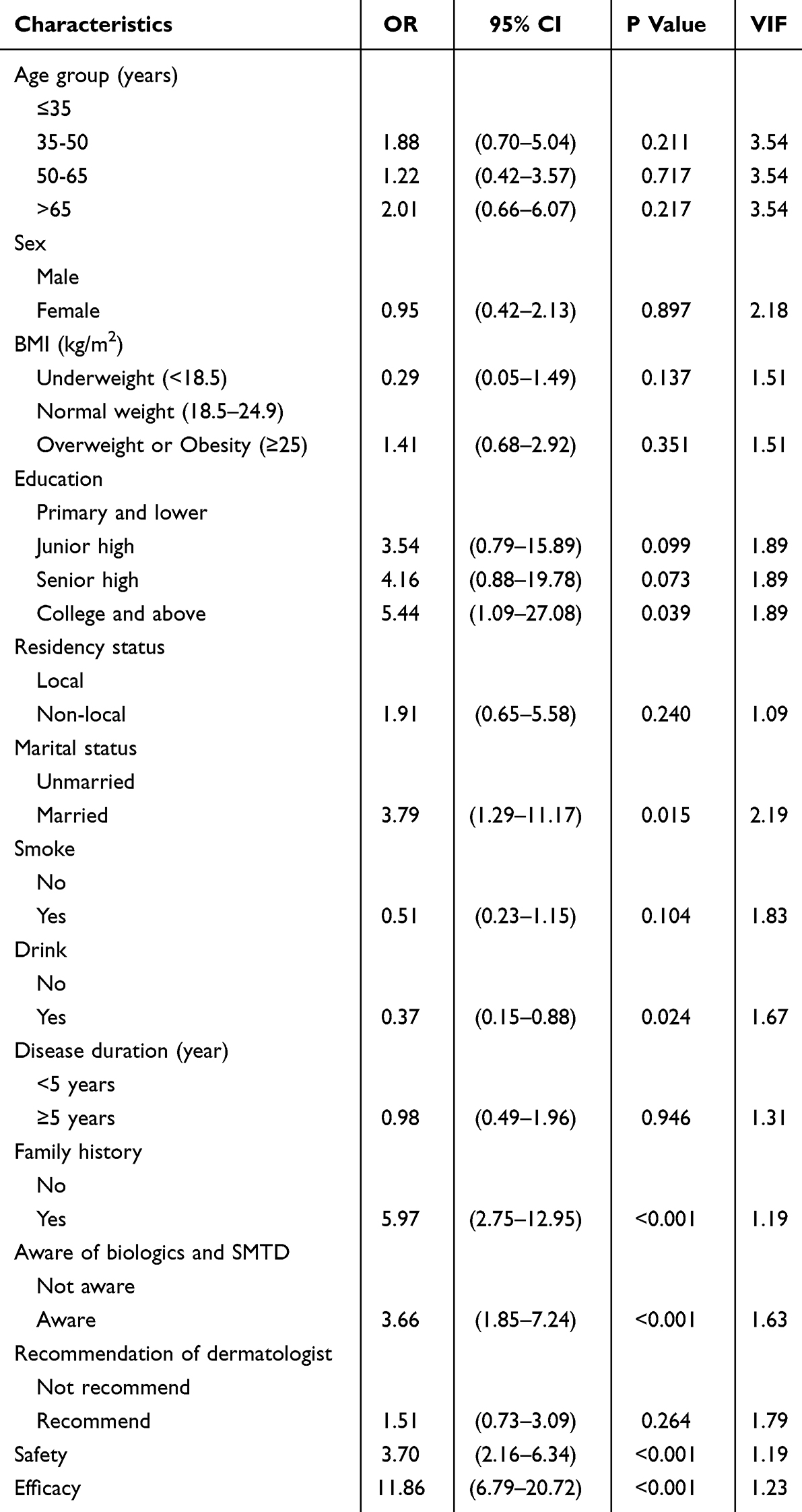 |
Table 2 The Treatment Acceptance Rate of Biologics and SMTD Among Patients with CSU in China |
Discussion
This study aims to comprehensively assess the recognition, perceptions, and acceptance of biologics and SMTD among CSU patients in China. By conducting a cross-sectional survey involving 711 patients, we investigated the factors influencing their willingness to adopt biologics and SMTD. Our findings indicate that higher educational attainment, marital status, non-drinking status, and a family history of CSU were positively associated with patients’ willingness to accept biologics and SMTD.32 These associations underscore the influence of sociodemographic factors in shaping treatment preferences and suggest that clinicians may consider more actively recommending these emerging therapies to patients who exhibit such characteristics, as they may be more receptive to novel treatment options. Consistent with previous research, individuals with higher levels of health literacy may have greater confidence in newly developed therapies and therefore show a stronger willingness to adopt them.33–35 This highlights the importance of strengthening patient education and improving public awareness regarding biologics and SMTD to support informed decision-making and facilitate broader clinical adoption of these treatments.36,37
Our findings also demonstrate that patients’ perceived safety and efficacy were significantly associated with their willingness to accept biologics and SMTD.23,38 This aligns with evidence from patient-centered decision-making research, which emphasizes that confidence in therapeutic benefits and an accurate understanding of potential risks strongly influence willingness to adopt novel treatment modalities.39 These results underscore the importance of clear, evidence-based communication regarding safety profiles and expected therapeutic outcomes, which may be essential for clinicians seeking to enhance patient acceptance of biologics and SMTD therapies.40
In this study, we observed several apparent discrepancies between the bivariate analyses and the multivariable regression results. Alcohol use was not statistically significant in the crude comparison but became significant after adjustment, whereas the associations for disease duration and dermatologist recommendation attenuated and became non-significant in the multivariable model. These findings illustrate the expected divergence between unadjusted and adjusted analyses when confounding structures are present. Crude associations may be inflated or obscured by correlated predictors, whereas multivariable models estimate the independent contribution of each variable.41,42 The emergence of alcohol use as a significant predictor in the adjusted model suggests that its effect was obscured in the bivariate comparison by confounding factors, whereas the attenuation of disease duration likely reflects shared variance with variables such as age, family history, and awareness. An interesting finding of our analysis was that dermatologist recommendation, despite being significant in univariate analyses, did not retain significance in the multivariable model. One possible explanation is that physician recommendation may indirectly affect acceptance through heightened awareness, improved understanding of efficacy, and reassurance about safety. Importantly, model diagnostics support the stability and interpretability of these results: all VIF values were well below 10, indicating no concerning multicollinearity, and the model demonstrated strong fit (McFadden’s pseudo-R2 = 0.64; Nagelkerke pseudo-R2 = 0.78). These discrepancies therefore represent the expected consequences of confounding adjustment rather than statistical instability.
Cultural factors specific to the Chinese population may also influence treatment acceptance. Compared with Western populations, Chinese patients may place greater emphasis on cost considerations, long-term safety, and familiarity with established or traditional therapies. Although trust in physicians is generally high, patients may adopt a cautious stance toward newer treatments because of perceived uncertainty. These conservative sociocultural tendencies highlight the importance of tailored counseling and educational strategies when introducing novel therapies, ensuring that information is conveyed in a culturally responsive manner that supports informed decision-making.43–45
The limitations of this study warrant careful consideration. This research is designed as a cross-sectional study, which inherently limits the ability to establish causal relationships between the identified factors and the acceptance of new treatment modalities. The absence of a longitudinal follow-up restricts the capacity to monitor changes in patient attitudes and treatment acceptance over time, ultimately hindering the ability to draw definitive conclusions regarding the efficacy of the interventions assessed. Furthermore, the reliance on self-reported data, particularly regarding lifestyle factors such as alcohol consumption, introduces the possibility of information bias, as patients may underreport or misrepresent their behaviors. Third, the use of convenience sampling may introduce selection bias, as patients seeking outpatient care or willing to participate in surveys may differ from those who do not, potentially limiting generalizability. In addition, this was a single-center study conducted at a specialized dermatology hospital. Although such a setting may impose geographic constraints, Shanghai’s role as an international metropolis allows the hospital to draw a substantial number of patients from other provinces, partially mitigating this limitation. At the same time, specialized centers may disproportionately attract patients with more severe or treatment-refractory disease. While this setting ensured diagnostic accuracy and standardized clinical assessment, the findings may not be fully generalizable to CSU populations managed in primary or general healthcare settings. Finally, the lack of correlation analysis between perceived efficacy and actual clinical outcomes further limits the validation of patients’ perceptions, leaving a gap in understanding how subjective beliefs align with objective therapeutic results.
Conclusions
This study found that higher educational attainment, marital status, abstinence from alcohol, and a family history of CSU were positively associated with willingness to adopt these therapies, whereas awareness of biologics and SMTD, along with patients’ perceptions of their safety and efficacy, emerged as the most influential determinants of treatment acceptance. These findings underscore the importance of improving patient understanding of emerging therapies through clear, evidence-based communication and culturally tailored educational strategies. Enhancing awareness and addressing concerns regarding safety and expected benefits may facilitate more informed and confident decision-making, ultimately supporting the broader integration of biologics and SMTD into CSU management in China. Future research should incorporate longitudinal designs to examine changes in patient perceptions over time, investigate the effectiveness of structured patient education interventions, and explore multicenter or cross-cultural differences in treatment acceptance. Linking perceived treatment characteristics with objective therapeutic outcomes may further support the development of individualized and evidence-based treatment strategies for CSU patients.
Data Sharing Statement
The datasets used to support the findings of this study are available from the corresponding author on reasonable request.
Ethics Approval and Informed Consent
Ethical approval was obtained from Ethics Committee for Clinical Trials, Shanghai Dermatology Hospital (The ethical approval no. 2024-35).
Funding
No funding was secured for this study.
Disclosure
The authors report no conflicts of interest in this work.
References
1. Friedman A, Kwatra SG, Yosipovitch G. A practical approach to diagnosing and managing chronic spontaneous urticaria. Dermatol Ther. 2024;14(6):1371–9. doi:10.1007/s13555-024-01173-5
2. Yosipovitch G, Soares GB, Mahmoud O. Current and emerging therapies for chronic spontaneous urticaria: a narrative review. Dermatol Ther. 2023;13(8):1647–1660. doi:10.1007/s13555-023-00972-6
3. Curto-Barredo L, Silvestre J, Gimenez-Arnau A. Update on the treatment of chronic urticaria. Actas Dermo-Sifiliográficas. 2014;105(5):469–482. doi:10.1016/j.adengl.2014.04.006
4. Goncalo M, Gimenez-Arnau A, Al-Ahmad M, et al. The global burden of chronic urticaria for the patient and society. Br J Dermatol. 2021;184(2):226–236. doi:10.1111/bjd.19561
5. Keller L, Stitt J. Chronic spontaneous urticaria: quality of life and economic impacts. Immunol Allergy Clin. 2024;44(3):453–467.
6. Sánchez-Díaz M, Salazar-Nievas MC, Molina-Leyva A, Arias-Santiago S. Risk factors of quality-of-life and sexual function impairment in chronic spontaneous urticaria patients: cross-sectional study. Dermatology. 2023;239(4):601–608. doi:10.1159/000530518
7. Liu X, Cao Y, Wang W. Burden of and trends in urticaria globally, regionally, and nationally from 1990 to 2019: systematic analysis. JMIR Public Health Surveillance. 2023;9:e50114. doi:10.2196/50114
8. Larenas-Linnemann D. Biomarkers of autoimmune chronic spontaneous urticaria. Curr Allergy Asthma Reports. 2023;23(12):655–664. doi:10.1007/s11882-023-01117-7
9. Bracken SJ, Abraham S, MacLeod AS. Autoimmune theories of chronic spontaneous urticaria. Front Immunol. 2019;10:627. doi:10.3389/fimmu.2019.00627
10. Giménez‐Arnau AM, Ribas‐Llauradó C, Mohammad‐Porras N, Deza G, Pujol RM, Gimeno R. IgE and high‐affinity IgE receptor in chronic inducible urticaria, pathogenic, and management relevance. Clin Transl Allergy. 2022;12(2):e12117. doi:10.1002/clt2.12117
11. Saini SS, Kaplan AP. Chronic spontaneous urticaria: the devil’s itch. J Allergy Clin Immunol Pract. 2018;6(4):1097–1106. doi:10.1016/j.jaip.2018.04.013
12. Maurer M, Kolkhir P, Pereira MP, et al. Disease modification in chronic spontaneous urticaria. Allergy. 2024;79(9):2396–2413. doi:10.1111/all.16243
13. Kolkhir P, Altrichter S, Munoz M, Hawro T, Maurer M. New treatments for chronic urticaria. Ann Allergy Asthma Immunol. 2020;124(1):2–12. doi:10.1016/j.anai.2019.08.014
14. Curto-Barredo L, Pujol RM, Roura-Vives G, Gimenez-Arnau AM. Chronic urticaria phenotypes: clinical differences regarding triggers, activity, prognosis and therapeutic response. Eur J Dermatol. 2019;29(6):627–635. doi:10.1684/ejd.2019.3674
15. Gimenez-Arnau AM, Salman A. Targeted therapy for chronic spontaneous urticaria: rationale and recent progress. Drugs. 2020;80(16):1617–1634. doi:10.1007/s40265-020-01387-9
16. Licari A, Manti S, Leonardi S, et al. Biologic drugs in chronic spontaneous urticaria. Acta Bio Medica. 2021;92(Suppl 7):e2021527. doi:10.23750/abm.v92iS7.12415
17. Bernstein JS, Bernstein JA, Lang DM. Chronic spontaneous urticaria: current and emerging biologic agents. Immunol Allergy Clin. 2024;79. doi:10.1016/j.clinsp.2024.100495
18. Damiani G, Diani M, Conic RR, et al. Omalizumab in chronic urticaria: an Italian survey. Int Arch Allergy Immunol. 2019;178(1):45–49. doi:10.1159/000492532
19. Kocatürk E. Role of biologics and future perspectives in the treatment of urticaria. Curr Treatm Options Allergy. 2017;4(4):428–437. doi:10.1007/s40521-017-0145-1
20. Zhao Z, Zheng Y, Song X, et al. Biological and target synthetic treatments for chronic spontaneous urticaria: a systematic review and network meta‐analysis. Clin Transl Allergy. 2025;15(5):e70052. doi:10.1002/clt2.70052
21. Gong N, Du Q, Lou H, et al. Treatment decision-making for older adults with cancer: a qualitative study. Nurs Ethics. 2021;28(2):242–252. doi:10.1177/0969733020945752
22. Zhang R, Lu X, Wu W, Shang X. Why do patients follow physicians’ advice? The influence of patients’ regulatory focus on adherence: an empirical study in China. BMC Health Serv Res. 2019;19(1):301. doi:10.1186/s12913-019-4127-9
23. Ma S, Wang Z, Zhang Y, Jiang G. Analysis of quality of life and economic burden in patients with chronic urticaria: a comparative study of spontaneous and induced urticaria and its effects on cognition of biologics. J Dermatological Treat. 2025;36(1):2506672. doi:10.1080/09546634.2025.2506672
24. Shahin W, Kennedy GA, Stupans I. The impact of personal and cultural beliefs on medication adherence of patients with chronic illnesses: a systematic review. Patient Preference Adherence. 2019;Volume 13:1019–1035. doi:10.2147/PPA.S212046
25. Li Q, Xia C, Chen C, et al. Knowledge, and attitude, and decisional conflict regarding biologics among patients with inflammatory bowel disease: a cross-sectional study. Front Med. 2025;12:1604851. doi:10.3389/fmed.2025.1604851
26. Xu X, Du M, Lai P, et al. Knowledge, attitudes, and practices toward biologics among systemic lupus erythematosus patients: a cross-sectional study. Front Public Health. 2025;13:1445576. doi:10.3389/fpubh.2025.1445576
27. Chang L. A psychometric evaluation of 4-point and 6-point Likert-type scales in relation to reliability and validity. Applied Psychol Measurement. 1994;18(3):205–215. doi:10.1177/014662169401800302
28. Leung S-O. A comparison of psychometric properties and normality in 4-, 5-, 6-, and 11-point Likert scales. J Social Serv Res. 2011;37(4):412–421. doi:10.1080/01488376.2011.580697
29. Zheng H, Xiao X-J, Shi Y-Z, et al. Efficacy of acupuncture for chronic spontaneous urticaria: a randomized controlled trial. Ann Internal Med. 2023;176(12):1617–1624. doi:10.7326/M23-1043
30. Zheng Q, Zheng H, Zhou S, et al. Efficacy of acupuncture treatment for chronic spontaneous urticaria: study protocol for a randomised controlled trial. BMJ open. 2022;12(2):e045027. doi:10.1136/bmjopen-2020-045027
31. Tawil S, Irani C, Kfoury R, et al. Association of chronic urticaria with psychological distress: a multicentre cross-sectional study. Acta Dermato-Venereologica. 2023;103:2939. doi:10.2340/actadv.v102.2939
32. Yuan Y, Xiao Y, Chen X, Li J, Shen M. A systematic review and meta-analysis of health utility estimates in chronic spontaneous urticaria. Front Med. 2020;7:543290. doi:10.3389/fmed.2020.543290
33. Yang M, Rao H-Y, Feng B, Wu E, Wei L, Lok AS. Patient education improves patient knowledge and acceptance on antiviral therapy of hepatitis C in rural China. Chinese Med J. 2017;130(22):2750–2751. doi:10.4103/0366-6999.218023
34. Chazova IY, Ageev F, Fofanova T, et al. Education and self-education of the patients is an important step towards increasing patients acceptance of therapy. Systemic Hypertension. 2014;11(3):7–10. doi:10.26442/SG29023
35. Liam C, Lim K, Wong C, Tang B. Attitudes and knowledge of newly diagnosed tuberculosis patients regarding the disease, and factors affecting treatment compliance. Int J Tuberc Lung Dis. 1999;3(4):300–309.
36. Farres M, Refaat M, Melek N, Ahmed E, Shamseldine M, Arafa N. Activation of coagulation in chronic urticaria in relation to disease severity and activity. Allergologia et Immunopathologia. 2015;43(2):162–167. doi:10.1016/j.aller.2014.04.002
37. Sánchez‐Borges M, Caballero‐Fonseca F, Capriles‐Hulett A, González‐Aveledo L, Maurer M. Factors linked to disease severity and time to remission in patients with chronic spontaneous urticaria. J Eur Acad Dermatol Venereol. 2017;31(6):964–971. doi:10.1111/jdv.14221
38. Rubeiz CJ, Asero R, Betschel S, et al. Analysis of questionnaire survey to determine worldwide trends in prescriptions of biologics for the treatment of unresponsive chronic urticaria. World Allergy Organ J. 2024;17(1):100858. doi:10.1016/j.waojou.2023.100858
39. Chu X, Mubasher J, Chen L, et al. Patient values and preferences in chronic urticaria treatment: a systematic review. JAMA Dermatol. 2025;161(12):1264. doi:10.1001/jamadermatol.2025.3663
40. Kolkhir P, Muñoz M, Asero R, et al. Autoimmune chronic spontaneous urticaria. J Allergy Clin Immunol. 2022;149(6):1819–1831. doi:10.1016/j.jaci.2022.04.010
41. Varady NH, Pareek A, Eckhardt CM, et al. Multivariable regression: understanding one of medicine’s most fundamental statistical tools. Knee Surg Sports Traumatol Arthrosc. 2023;31(1):7–11. doi:10.1007/s00167-022-07215-9
42. Ioannidis JP. Why most discovered true associations are inflated. Epidemiology. 2008;19(5):640–648. doi:10.1097/EDE.0b013e31818131e7
43. Weller K, Winders T, McCarthy J, et al. Urticaria voices: real-world experience of patients living with chronic spontaneous urticaria. Dermatol Ther. 2025;15(1):1–15. doi:10.1007/s13555-024-01322-w
44. Cherrez‐Ojeda I, Thomsen SF, Gimenez‐Arnau AM, et al. Exploring the impact of chronic urticaria profile as a key predictor of alexithymia: a cross‐sectional study. Clin Transl Allergy. 2025;15(7):e70075. doi:10.1002/clt2.70075
45. Matano Y, Morita T, Ito M, et al. Dietary habits in Japanese patients with chronic spontaneous urticaria. Australas J Dermatol. 2020;61(3):e333–e338. doi:10.1111/ajd.13283
 © 2026 The Author(s). This work is published and licensed by Dove Medical Press Limited. The
full terms of this license are available at https://www.dovepress.com/terms
and incorporate the Creative Commons Attribution
- Non Commercial (unported, 4.0) License.
By accessing the work you hereby accept the Terms. Non-commercial uses of the work are permitted
without any further permission from Dove Medical Press Limited, provided the work is properly
attributed. For permission for commercial use of this work, please see paragraphs 4.2 and 5 of our Terms.
© 2026 The Author(s). This work is published and licensed by Dove Medical Press Limited. The
full terms of this license are available at https://www.dovepress.com/terms
and incorporate the Creative Commons Attribution
- Non Commercial (unported, 4.0) License.
By accessing the work you hereby accept the Terms. Non-commercial uses of the work are permitted
without any further permission from Dove Medical Press Limited, provided the work is properly
attributed. For permission for commercial use of this work, please see paragraphs 4.2 and 5 of our Terms.