
Back to Journals » International Journal of Chronic Obstructive Pulmonary Disease » Volume 20
Factors Associated with Exertional Desaturation in Patients with Chronic Obstructive Pulmonary Disease
Authors Kim S, Rhee CK  , Lee CY , Kim DK , Um SJ , Lim SY , Park YB , Yoon HK , Yoo KH , Lee WY
Received 8 March 2025
Accepted for publication 2 August 2025
Published 13 August 2025 Volume 2025:20 Pages 2847—2852
DOI https://doi.org/10.2147/COPD.S522341
Checked for plagiarism Yes
Review by Single anonymous peer review
Peer reviewer comments 3
Editor who approved publication: Professor Min Zhang
Seungju Kim,1,* Chin Kook Rhee,1,* Chang Youl Lee,2 Deog Kyeom Kim,3 Soo-Jung Um,4 Seong Yong Lim,5 Yong Bum Park,6 Hyoung Kyu Yoon,7 Kwang Ha Yoo,8 Won-Yeon Lee9 On behalf of the KOCOSS cohort and the Korean Pulmonary Rehabilitation Study Group
1Division of Pulmonary and Critical Care Medicine, Department of Internal Medicine, Seoul St. Mary’s Hospital, College of Medicine, The Catholic University of Korea, Seoul, South Korea; 2Division of Pulmonary, Allergy and Critical Care Medicine, Department of Internal Medicine, Hallym University Chuncheon Sacred Heart Hospital, Chuncheon, South Korea; 3Division of Pulmonary and Critical Care Medicine, Department of Internal Medicine, Seoul Metropolitan Government-Seoul National University Boramae Medical Center, Seoul National University College of Medicine, Seoul, South Korea; 4Department of Internal Medicine, Pulmonology Division, Dong-A University Hospital, College of Medicine, Dong-A University, Busan, South Korea; 5Department of Medicine, Division of Pulmonary and Critical Care Medicine, Kangbuk Samsung Hospital, Sungkyunkwan University School of Medicine, Seoul, South Korea; 6Division of Pulmonary, Allergy and Critical Care Medicine, Department of Internal Medicine, Hallym University Kangdong Sacred Heart Hospital, Seoul, South Korea; 7Division of Pulmonology, Critical Care and Sleep Medicine, Department of Internal Medicine, Yeouido St. Mary’s Hospital, College of Medicine, The Catholic University of Korea, Seoul, South Korea; 8Division of Pulmonary, Allergy and Critical Care Medicine, Department of Internal Medicine, Konkuk University Medical Center, Konkuk University School of Medicine, Seoul, South Korea; 9Division of Pulmonary, Allergy, and Critical Care Medicine, Department of Internal Medicine, Yonsei University Wonju Severance Christian Hospital, Yonsei University Wonju College of Medicine, Wonju, South Korea
*These authors contributed equally to this work
Correspondence: Won-Yeon Lee, Division of Pulmonary, Allergy, and Critical Care Medicine, Department of Internal Medicine, Yonsei University Wonju Severance Christian Hospital, Yonsei University Wonju College of Medicine, 20, Ilsan- ro, Wonju, Gangwon-do, 26426, South Korea, Tel +82-33-741-0541, Fax +82-33-0928, Email [email protected]
Abstract: The six minute walk test (6MWT) has a prognostic role in patients with chronic obstructive pulmonary disease (COPD). The aim of this study was to determine the factors associated with desaturation during the 6MWT in patients with COPD. This study utilized data from the prospective KOrea COPD Subgroup Study (KOCOSS) cohort. The results of the 6MWT performed at enrollment were analyzed in this study. A total of 1789 participants performed the 6MWT. Among them, 185 (10.3%) experienced desaturation during 6MWT. Old age, ex-smoker, low forced expiratory volume in one second (%), and high COPD assessment test score were significantly associated with exertional desaturation.
Keywords: COPD, desaturation, six minute walk test
Introduction
Chronic obstructive pulmonary disease (COPD) is a progressive disease characterized by dyspnea, cough, and sputum. Although the burden of COPD varies from country to country, overall the burden is high globally.1 The six minute walk test (6MWT) has a prognostic role in patients with COPD. The 6MWT can provide valuable information, especially regarding exercise capacity. In addition to lung function, the 6MWT result is an important component of the body mass index, airflow obstruction, dyspnea, and exercise performance (BODE) index.2 Moreover, patients who experienced desaturation during the 6MWT had a worse prognosis.3 Thus, it is clinically important to identify patients with desaturation using the 6MWT. However, the 6MWT is not readily available in routine clinical practice. It requires trained personnel. Moreover, patients may have difficulty cooperating with the test. Additionally, there is a risk of adverse events during the test. Thus, it is desirable that the physician predicts patients who are likely to experience desaturation during 6MWT and selectively perform the test. Decreased exercise capacity in COPD is highly complex, involving a wide range of contributing factors.4 Reduced exercise capacity is usually associated with a decline in lung function. However, in addition to significant airflow limitations, the degree of emphysema, depressed mood, and perception of dyspnea symptoms were also related to a decreased exercise capacity.5 Moreover, little has been known regarding the factors associated with exertional desaturation. The aim of this study was to determine the factors associated with desaturation during the 6MWT in patients with COPD.
Methods
Study Population
This study utilized data from the prospective COPD cohort. The KOrea COPD Subgroup Study (KOCOSS) is a nationwide, multicenter, prospective cohort study involving patients with COPD recruited from 58 tertiary referral hospitals in South Korea. This cohort has been used for numerous studies since 2012. Patients with post bronchodilator forced expiratory volume in one second (FEV1)/force vital capacity (FVC) < 0.7 and a history of ≥ 10 pack years smoking were defined as COPD. All hospitals involved in the study obtained approval from their respective institutional review board committees, and informed consent was obtained from all patients. The study was performed in accordance with the Declaration of Helsinki.
Six Minute Walk Test
The results of the 6MWT performed at enrollment were analyzed in this study. The 6MWT was performed according to the American Thoracic Society guideline.6 Oxygen saturation was measured before and immediately after the test. Desaturation was defined as a ≥ 4% reduction between pre and post and post-test oxygen saturation < 90%.7
Statistical Analysis
Differences between groups were assessed using the chi-square or Fisher’s exact test for categorical variables and Student’s t-test or Wilcoxon Rank-Sum Test for continuous variables. Binary logistic regression was performed to find factors associated with exertional desaturation. P values less than 0.05 were considered significant. All statistical analyses were performed with R software (version 4.4.0; R Foundation for Statistical Computing, Vienna, Austria).
Results
A total of 1789 participants performed the 6MWT. Among them, 185 (10.3%) experienced desaturation during the 6MWT. Baseline characteristics of the patients were shown in Table 1. The desaturation group was significantly older compared to the no desaturation group (P = 0.010). The desaturation group had a lower body mass index (BMI) (22.1 vs 23.1, P < 0.001). Current smokers were significantly less frequent in the desaturation group (15.7% vs 31.0%, P < 0.001). The desaturation group had a significantly lower saturation of partial pressure oxygen before and after the test. However, the total walking distance did not differ significantly between two groups. All measured lung function parameters, including FEV1, FVC, FEV1/FVC, and diffusion capacity of the lung for carbon monoxide were significantly lower in the desaturation group. The desaturation group reported worse dyspnea scores on the modified Medical Research Council and a poorer quality of life on the COPD assessment test (CAT) score and St. George’s Respiratory Questionnaire-COPD. The percentage of patients with a previous history of exacerbation in the last year was significantly higher in the desaturation group (28.8% vs 19.5%, P < 0.001).
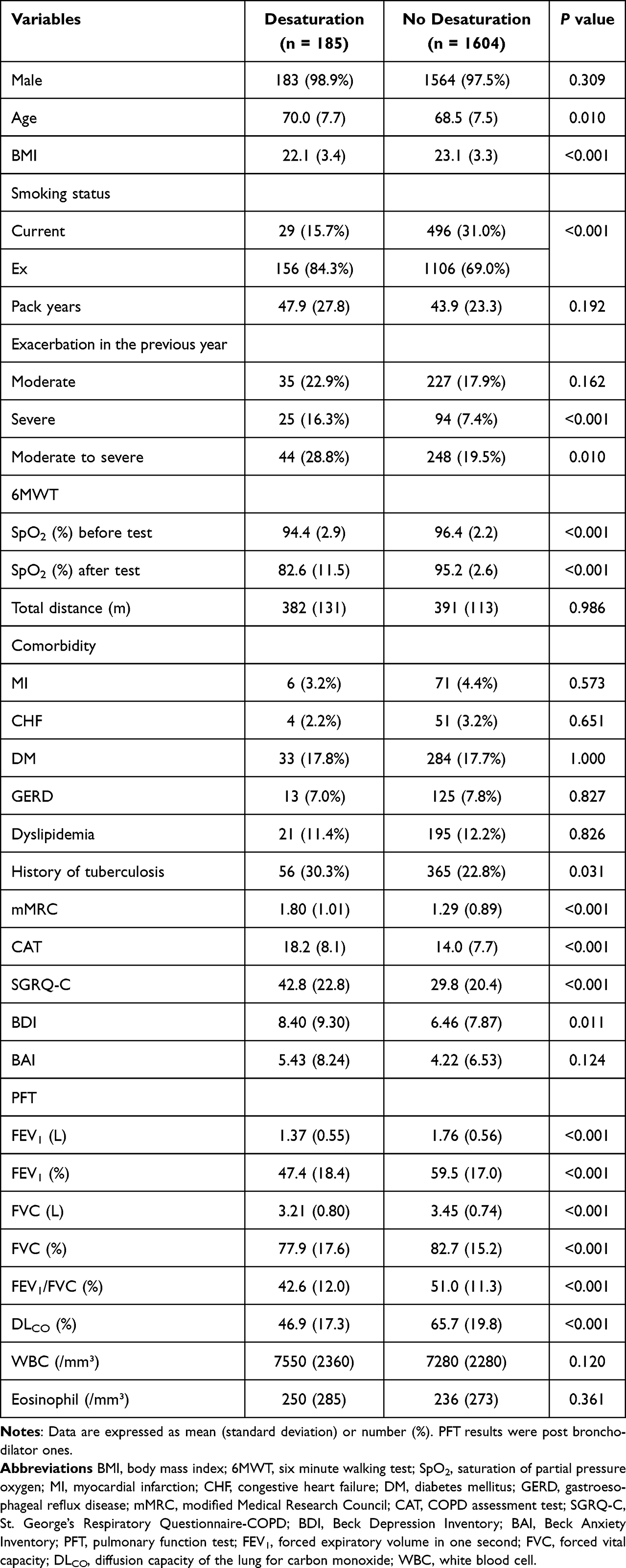 |
Table 1 Comparison Between Patients with Desaturation and No Desaturation |
For multivariable analysis, age, BMI, smoking status, history of tuberculosis, FEV1 (%), CAT score, and exacerbation in the previous year were used. Table 2 showed the results of logistic regression analysis. Among the variables, age, smoking status, FEV1 (%), and CAT score were significantly associated with exertional desaturation.
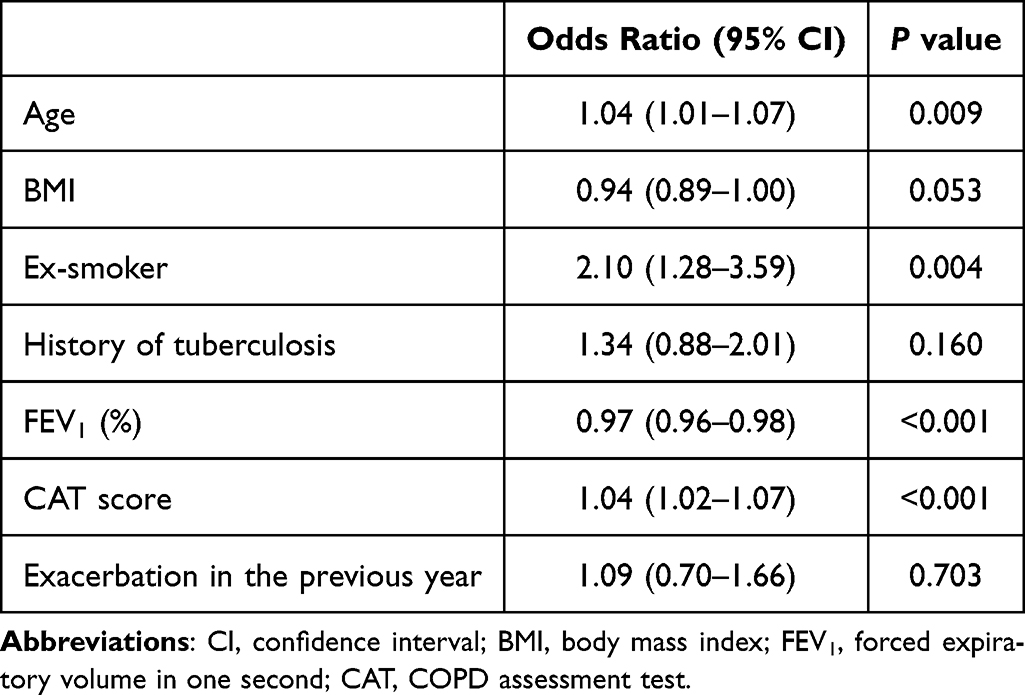 |
Table 2 Factors Associated with Desaturation |
Discussion
The results of the KOCOSS cohort study showed that the 6MWT was associated with variable factors. To the best of our knowledge, this is the first study that identified factors associated with exertional desaturation during the 6MWT. It is ideal to perform the 6MWT in every COPD patient. However, due to limited resources, it is necessary to select patients with a high probability of desaturation. Thus, our results can provide valuable information regarding potential candidates for the 6MWT in real clinical practice.
The clinical importance of desaturation during the 6MWT has been reported in a few studies. Takigawa et al showed that oxygen desaturation was an independent risk factor of death.8 Casanova et al also found that oxygen desaturation predicted mortality (relative risk, 2.63).9 Waatevik et al showed that patients with desaturation had a 50% increased risk for experiencing later exacerbation.3 Kim et al suggested that exertional desaturation may be a predictor of rapid decline in lung function.10
In this study, we found that approximately 10% of COPD patients experienced desaturation during the 6MWT. These patients are at high risk of desaturation during pulmonary rehabilitation or exercise. Thus, it is reasonable to provide supplemental oxygen to these patients during pulmonary rehabilitation or exercise. Since the COVID-19 pandemic, home-based pulmonary rehabilitation has been implemented in many institutions. Additionally, regular physical activity and exercise are recommended for all COPD patients. However, in these patients, exertional desaturation may be underdiagnosed since the 6MWT is not routinely performed in clinical practice. Thus, our study results can guide the indication for 6MWT and identify potential exertional desaturators in routine clinical practice.
Conclusion
In conclusion, several factors differed significantly between desaturation and no desaturation groups. Old age, ex-smoker, low FEV1 (%), and a high CAT score were independently associated with desaturation. Physicians may predominantly perform the 6MWT in patients with these risk factors.
Abbreviations
6MWT, Six minute walk test; BAI, Beck Anxiety Inventory; BDI, Beck Depression Inventory; BMI, body mass index; BODE, body mass index, airflow obstruction, dyspnea, exercise performance; COPD, chronic obstructive pulmonary disease; CAT, COPD assessment test; CI, confidence interval; CHF, congestive heart failure; DLCO, diffusion capacity of the lung for carbon monoxide; DM, diabetes mellitus; FEV1, forced expiratory volume in one second; FVC, force vital capacity; GERD, gastroesophageal reflux disease; KOCOSS, The KOrea COPD Subgroup Study; MI, myocardial infarction; mMRC, modified Medical Research Council; PFT, pulmonary function test; SGRQ-C, St. George’s Respiratory Questionnaire-COPD; SpO2, saturation of partial pressure oxygen; WBC, white blood cell.
Acknowledgments
The following members of The KOCOSS cohort and the Korean Pulmonary Rehabilitation Study Group are listed as authors on the manuscript: Chin Kook Rhee, Chang Youl Lee, Deog Kyeom Kim, Soo-Jung Um, Seong Yong Lim, Yong Bum Park, Hyoung Kyu Yoon, Kwang Ha Yoo, and Won-Yeon Lee.
Further members of The KOCOSS cohort and the Korean Pulmonary Rehabilitation Study Group are as follows: Ji Ye Jung, Yong Il Hwang, Jin Woo Song, Won-Il Choi, Ki Uk Kim, Yu-Il Kim, Tae-Hyung Kim, Seong Ju Park, Kyeong-Cheol Shin, Ah Young Leem, and Ji-Yong Moon.
Author Contributions
All authors made a significant contribution to the work reported, whether that is in the conception, study design, execution, acquisition of data, analysis and interpretation, or in all these areas; took part in drafting, revising or critically reviewing the article; gave final approval of the version to be published; have agreed on the journal to which the article has been submitted; and agree to be accountable for all aspects of the work.
Funding
This study was supported by grants from the Korean Environment Industry and Technology Institute through the Core Technology Development Project for Environmental Disease Prevention and Management, funded by the Korean Ministry of Environment (Grant number 2022003310008). This work was also supported by the Research Program funded Korea National Institute of Health (Fund CODE 2016ER670100, 2016ER670101, 2016ER670102, 2018ER67100, 2018ER67101, 2018ER67102, 2021ER120500, 2021ER120501, 2021ER120502, 2024ER120500, and 2024ER120501).
Disclosure
CK Rhee received consulting/lecture fees from MSD, AstraZeneca, GSK, Novartis, Takeda, Mundipharma, Boehringer-Ingelheim, Teva, Sanofi, Organon, Roche, and Bayer. The authors report no other conflicts of interest in this work.
References
1. Pham HQ, Pham KHT, Ha GH, et al. Economic burden of chronic obstructive pulmonary disease: a systematic review. Tuberc Respir Dis. 2024;87(3):234–251. doi:10.4046/trd.2023.0100
2. Celli BR, Cote CG, Marin JM, et al. The body-mass index, airflow obstruction, dyspnea, and exercise capacity index in chronic obstructive pulmonary disease. N Engl J Med. 2004;350(10):1005–1012. doi:10.1056/NEJMoa021322
3. Waatevik M, Johannessen A, Gomez Real F, et al. Oxygen desaturation in 6-min walk test is a risk factor for adverse outcomes in COPD. Eur Respir J. 2016;48(1):82–91. doi:10.1183/13993003.00975-2015
4. Kim TH, Heo IR, Kim NY, et al. Factors associated with the discrepancy between exercise capacity and airflow limitation in patients with chronic obstructive pulmonary disease. Tuberc Respir Dis. 2024;87(2):155–164. doi:10.4046/trd.2023.0068
5. Spruit MA, Watkins ML, Edwards LD, et al. Determinants of poor 6-min walking distance in patients with COPD: the ECLIPSE cohort. Respir Med. 2010;104(6):849–857. doi:10.1016/j.rmed.2009.12.007
6. ATS Committee on Proficiency Standards for Clinical Pulmonary Function Laboratories. ATS statement: guidelines for the six-minute walk test. Am J Respir Crit Care Med. 2002;166(1):111–117. doi:10.1164/ajrccm.166.1.at1102
7. Wedzicha JA. Domiciliary oxygen therapy services: clinical guidelines and advice for prescribers. Summary of a report of the Royal College of Physicians. J R Coll Physicians Lond. 1999;33(5):445–447.
8. Takigawa N, Tada A, Soda R, et al. Distance and oxygen desaturation in 6-min walk test predict prognosis in COPD patients. Respir Med. 2007;101(3):561–567. doi:10.1016/j.rmed.2006.06.017
9. Casanova C, Cote C, Marin JM, et al. Distance and oxygen desaturation during the 6-min walk test as predictors of long-term mortality in patients with COPD. Chest. 2008;134(4):746–752. doi:10.1378/chest.08-0520
10. Kim C, Seo JB, Lee SM, et al. Exertional desaturation as a predictor of rapid lung function decline in COPD. Respiration. 2013;86(2):109–116. doi:10.1159/000342891
 © 2025 The Author(s). This work is published and licensed by Dove Medical Press Limited. The
full terms of this license are available at https://www.dovepress.com/terms
and incorporate the Creative Commons Attribution
- Non Commercial (unported, 4.0) License.
By accessing the work you hereby accept the Terms. Non-commercial uses of the work are permitted
without any further permission from Dove Medical Press Limited, provided the work is properly
attributed. For permission for commercial use of this work, please see paragraphs 4.2 and 5 of our Terms.
© 2025 The Author(s). This work is published and licensed by Dove Medical Press Limited. The
full terms of this license are available at https://www.dovepress.com/terms
and incorporate the Creative Commons Attribution
- Non Commercial (unported, 4.0) License.
By accessing the work you hereby accept the Terms. Non-commercial uses of the work are permitted
without any further permission from Dove Medical Press Limited, provided the work is properly
attributed. For permission for commercial use of this work, please see paragraphs 4.2 and 5 of our Terms.