
Back to Journals » International Journal of Women's Health » Volume 17
Experience of Contraceptive Denial, Perceived Ease of Future Access to Contraception, and Adverse Mental Health Outcomes in Polish Women
Authors Jade M  , Mijas ME , Jasienska G, Galbarczyk A
Received 20 May 2024
Accepted for publication 15 November 2024
Published 6 January 2025 Volume 2025:17 Pages 9—19
DOI https://doi.org/10.2147/IJWH.S478652
Checked for plagiarism Yes
Review by Single anonymous peer review
Peer reviewer comments 2
Editor who approved publication: Professor Elie Al-Chaer
Morgan Jade,1 Magdalena Ewa Mijas,2 Grazyna Jasienska,2 Andrzej Galbarczyk2,3
1School of Health and Related Research, University of Sheffield, Sheffield, UK; 2Department of Environmental Health, Faculty of Health Sciences, Jagiellonian University Medical College, Krakow, Poland; 3Department of Human Behavior, Ecology and Culture, Max Planck Institute for Evolutionary Anthropology, Leipzig, Germany
Correspondence: Andrzej Galbarczyk, Department of Environmental Health, Jagiellonian University Medical College, 8 Skawinska St., Krakow, 31-066, Poland, Tel +48 693 02 55 27, Fax +48 12 632 48 81, Email [email protected]
Purpose: While several studies demonstrate an association between reproductive coercion or a lack of reproductive autonomy and decreased mental health in women, little is known about potential mental health impacts when women are denied prescription contraceptives. The aim of this research was to explore associations between prescription contraceptive denial and perceived ease of future access to contraception, and self-assessed mental health.
Patients and Methods: Polish women (N=424) completed an anonymous online survey with demographic questions; perceived stress (PSS-10), state anxiety (STAI-X1), and depression (CESD-R) assessments, and contraceptive access questions.
Results: Eighty-eight participants (21%) had experienced at least one episode of prescription contraceptive denial from a doctor or pharmacist. There were no differences in stress, anxiety, and depression scores between women who had and had not ever experienced denial. However, women who had experienced contraceptive denial within the last six months, had higher depression scores. In addition, women who perceived future access as very easy had the lowest stress, anxiety and depression scores.
Conclusion: These results suggest that experiences and attitudes related to contraceptive access are related to perceived stress, anxiety, and depression. Contraceptive denial and other access barriers constitute a significant public health issue that may impact the health of women.
Keywords: conscientious objection, reproductive autonomy, sexual health, reproductive coercion
Introduction
Reproductive autonomy is defined as “having the power to decide and control contraceptive use, pregnancy, and childbearing”.1 A broad term, one’s reproductive autonomy can be influenced by many factors that involve the individual, government, culture, and society.2 Conversely, “reproductive coercion” describes behavior that interferes with the autonomous reproductive health decision-making of a woman.3 While typically defined as perpetration by a male intimate partner, reproductive coercion can be carried out by other family members.4 For the purposes of our research, it is critical to mention that reproductive coercion is also carried out in the structural domain through drivers that create an enabling environment, such as government and legislative policies.5 For example, this has taken the form of coercive sterilization and contraception programs targeting certain demographic groups of women.6,7 “Contraceptive coercion” is a manifestation of reproductive coercion, referring to “any attempt to influence or control someone’s access or ability to use or not use contraception as they wish”.7
There is a growing body of research on various forms of reproductive coercion--or lack of reproductive autonomy--and decreased mental health in women.8–11 Some of these studies focus on the effects of reproductive coercion influenced by legislation. In a study of US women, Liu et al8 found that those living in States with “very hostile” abortion restrictions had higher odds of frequent mental health distress than those who lived in States that were supportive of abortion access. The longitudinal Turnaway Study assessed mental health in women who successfully obtained an abortion, compared with those who were denied due to being past the legal gestational age to terminate a pregnancy.9 Participants who were denied had increased anxiety compared to those in the “near-limit” group (women who obtained abortions who were just under the gestational age limit) in the first week after denial; and self-esteem and life satisfaction were significantly lower in the women denied abortions than those in the near-limit group.9
Other studies have focused on the relationship between reproductive coercion in interpersonal relationships and mental health. In Fay and Yee,10 women affected by reproductive coercion who carried the pregnancy to term were more likely to report anxiety, ambivalence about the pregnancy, and other forms of intimate partner violence in their relationships. In a study of women in Côte d’Ivoire, the odds of having probable PTSD were 2.3 times greater for those who had experienced reproductive coercion than for those who had not.11
The concepts of reproductive autonomy, reproductive coercion, and contraceptive coercion, and how they impact health, are topics of critical relevance in Poland. Poland has some of the most restrictive abortion laws in Europe12 as the procedure is legal in only two circumstances: when the pregnancy poses a severe risk to the life or health of the pregnant woman, or when the pregnancy is the result of a crime.13
In 2019 (at the time of data collection), Poland scored last out of 46 countries on the European Contraception Policy Atlas- which marks the countries on access to modern contraception--and was named one of two “worst performing” countries, and one of two “most declined” countries since 2018, and has remained in the bottom spot of the atlas for the last four years.14 Only two types of contraceptive pills are reimbursed by Poland’s national health fund12 and there are no special reimbursements for youth or disadvantaged women.14 Women cannot access emergency contraception (EC), without a prescription, and doctors cannot prescribe it to a woman under age 18 without parental consent.15 Long-Acting Reversible Contraception (LARC) is unaffordable, ranging from 120–250 EUR for a hormonal Intrauterine Device (IUD), and 250–325 EUR for an implant.12 With an average gross monthly wage of 1187 EUR a Polish woman could spend over a quarter of her monthly salary on an implant.16 Voluntary sterilization is illegal for women, while vasectomy is available for men in the private sector.12 In Poland, doctors can legally refuse to perform an abortion by citing conscientious objection,17 which can also be invoked by nurses, obstetric nurses;17 and midwives.12 Some Polish doctors also cite conscientious objection to deny prescriptions for contraceptives.12 At present, pharmacists do not have the lawful right to conscientious objection, but in a study of Polish community pharmacists, 15% indicated that if permitted by law, they would exercise the right.17
While mental health has been examined related to restrictions on reproductive rights and abortion access,8 and denial or obtainment of abortion,9 to our knowledge there are no studies related to denial or obtainment of contraceptives, and mental health. The aim of this study was to explore associations between reproductive coercion exercised by health care professionals, namely women’s contraceptive prescription experiences, and their self-assessed mental health (stress, anxiety, and depression). We hypothesize that (i) being denied prescription contraceptives will negatively affect mental health, (ii) perceiving future access to prescription contraception as “hard” will negatively affect mental health.
Materials and Methods
Procedure
We used a cross sectional analytical study design with primary data collection consisting of a one-time, anonymous, online questionnaire per participant. We wrote the questionnaire in English and one of the authors, a native Polish speaker, translated it into Polish upon receiving ethical approval. We also included the Polish adaptations of three mental health assessments, discussed in detail below. We then built the questionnaire on LimeSurvey – an online survey tool for research institutes and universities -and pilot-tested it with five Polish women. Inclusion criteria for participation in the study consisted of identifying as a Polish woman, at least 18 years of age and not older than 50 years.
For the purposes of this research, the definition of contraceptives is expanded from Hubacher and Trussell’s definition of “modern contraceptives” as “A product or medical procedure that interferes with reproduction from acts of sexual intercourse” (pg. 420), to include their use for regulation of menstruation and other health concerns.18 “Contraceptives” includes, but is not limited to, intrauterine device, contraceptive pills (birth control pills), hormone shot or patch, upper arm implant, EC, or other contraceptives prescribed by a doctor. Barrier methods like condoms are not included as they do not require a prescription and are available for purchase over the counter.
We designed the questionnaire to capture experiences, thoughts, and beliefs from both women who had and had never sought contraceptives, and included three components: demographic questions, mental health assessments, and experience questions. Within the experience questions, the survey captured (i) whether the respondent had ever been denied contraceptives (“yes” or “no”), (ii) the time passed since their most recent experience of contraceptive denial (up to 6 months vs over 6 months), (iii) perceived ease of future access. In the survey questions related to contraceptive denial, we ask about both doctors and pharmacists (ie “Have you ever tried to get contraceptives but been denied them by a doctor or pharmacist?”) due to anecdotal evidence that some women in Poland are denied by pharmacists. The 6-month cutoff was chosen to enable a direct comparison between recent experiences and those that occurred further in the past. We captured perceived ease of future access by asking a question: “In the future if you want to get a prescription for birth control, how easy do you think it will be for you to get?”, on a 5-point Likert scale (with 1 being “very easy”, and 5 being “very difficult”).
To avoid bias, we presented the mental health questionnaires before the experience questions related to seeking contraceptives, as recalling an experience accessing contraceptives could have impacted the way a participant responded to the mental health questionnaires. Data analysis for the results presented in this paper only include participants who had ever tried to access contraceptives.
Once the questionnaire was active online, participants could self-select into the study. We posted an invitation to participate on Facebook groups and webpages including Jagiellonian University; Polska Sieć Kobiet Nauki (Polish Women Scientists Network); Centrum Praw Kobiet (Women’s Rights Centre); Lekarze Kobietom (Doctors for Women); and Ogólnopolski Strajk Kobiet (Nationwide Women’s Strike). We chose these groups based on anticipated acceptance of the research topic, in addition to having a wide audience with whom to share the survey. As the survey was based on womens’ personal experiences, anyone who identified as a Polish woman, aged 18 years and older was invited to participate in the study.
The study was performed in accordance with the Declaration of Helsinki. The project was approved by the University Research Ethics Committee (UREC) at the University of Sheffield. We obtained informed consent from all participants at the start of the survey. Participants were informed that due to the sensitivity of the topic, no personal identifiable information would be collected, and they would not be able to be identified in published results. Participants who were under the age of 18 were blocked from participation. At the end of the survey, we included four resources on reproductive and sexual rights and psychological support services in Poland.
Mental Health Assessments (MHA)
The survey included three short mental health assessments: Perceived Stress Scale (PSS-10), State Trait Anxiety Inventory (STAI-X1) and Center for Epidemiological Studies Depression Scale – Revised (CESD-R). PSS-10 by Cohen et al consists of 10 questions that pertain to thoughts and feelings associated with stress within the past month, assessed on 5-point Likert type scale.19 The Polish adaptation of PSS-10 is characterized by good psychometric properties.20 State Trait Anxiety Inventory (STAI-X1) by Spielberger et al was used to measure the current state anxiety in the studied women, asking how respondents feel “right now”, and consists of 20 items rated on a 4-point scale.21 The Polish translation showed good reliability and validity.22 Finally, CESD-R by Eaton et al consisting of 20 items was used to capture depressiveness over the last two weeks in the studied sample.23 The Polish translation of this questionnaire is also characterized by high validity and reliability.24
Data Analysis
First, we compared MHA among women who had and had not experienced contraceptive denial using Student t tests. Next, we compared MHA among women who had and had not experienced contraceptive denial and women who experienced contraceptive denial within the last 6 months vs over 6 months using General Linear Models (GLMs) and controlling for participants age (years) and self-perceived monthly income sufficiency (sufficient to cover their basic needs/not sufficient). To avoid unequal sample sizes, perceived ease of future access was classified for the analyses into three categories: “very easy”, “easy”, and “not easy”, with participants reporting any other answers. In other words, we combined participants who perceived ease of access to contraception as “3- neither easy nor difficult”, “4 – difficult”, and “5 – very difficult” into one category, labeled as “not easy”. MHA were compared across participants’ perceived ease of future access to contraception in General Linear Models (GLMs) adjusted for participants’ age and self-perceived income sufficiency. All analyses were performed using Statistica 13.0. For all analyses we adopted the significance level of p<0.05.
Results
Participants
Eight hundred and fourteen Polish women who met the criteria of being aged at least 18 and not older than 50 years participated in the study, with 519 (64%) full surveys submitted. We filtered the full surveys based on whether the participant had ever tried to access prescription contraceptives ; 424 participants had ever tried to access contraceptives. The range of ages for participants was 18 to 50 (Mean = 28.7, Standard Deviation 6.34). At least one participant responded from all 16 voivodeships (provinces) except for Opolskie, and six participants were Polish women who lived abroad.
Demographic data are presented in Table 1. A majority of study participants (n=194, 45.8%) lived in large Polish cities (>500,000 inhabitants). The majority of participants (n=307, 72.4%) had a higher education level. One hundred eighty-four participants (43.4%) indicated that their monthly income was sufficient to cover their basic needs.
 |
Table 1 Sociodemographic and Health Characteristics of Respondents of a Survey of Polish Women on Contraceptive Access and Mental Health (N=424) |
Experiences of Denial and Perceived Accessibility of Contraception
Eighty-eight (20.8%) women had ever experienced denial from a doctor or pharmacist; thirty women had experienced denial more than once. There was no statistically significant difference in age and mean mental health assessment scores between women who had ever experienced denial from a doctor or pharmacist and those who had not (Table 2). Comparisons were made using the Student t test. The proportion of women who reported being denied from a doctor or pharmacist did not differ by education level, place of residence, nor by income (Table 2). There was also no statistically significant difference in stress (F(1, 420)=1.28, p=0.26, ηp2=0.003), anxiety (F(1, 420)=0.61, p=0.43, ηp2=0.001), and depression (F(1, 420)=0.12, p=0.73, ηp2<0.001) scores between women who had ever experienced denial and those who had not, after controlling for participants age and self-perceived income sufficiency.
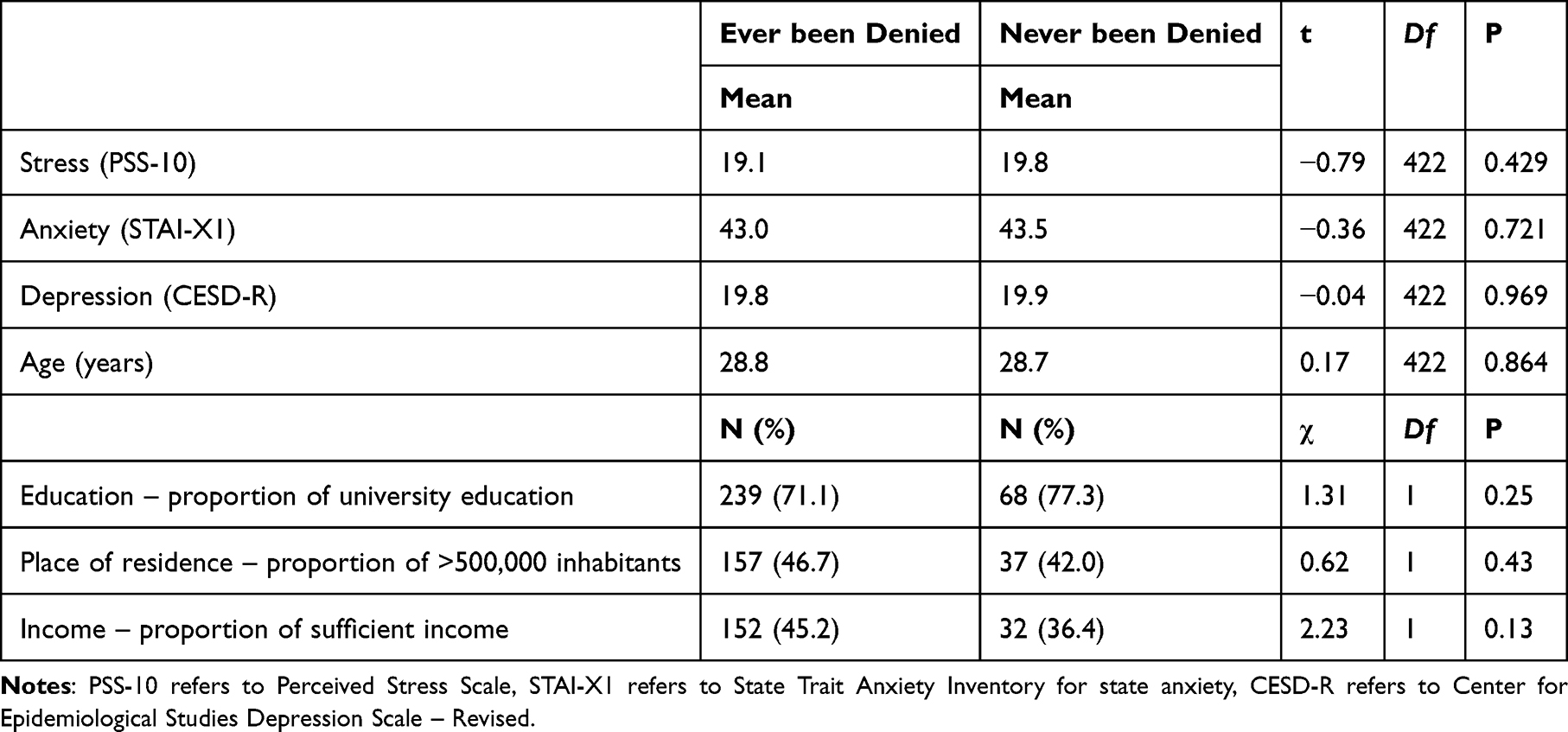 |
Table 2 Comparison of Mean Stress, Anxiety, and Depression Scores and Sociodemographic Characteristics Between Survey Respondent Groups Based on Experience of Contraceptive Denial |
Among women who had ever experienced contraceptive denial 12.0% (n=10) had experienced this in the last 6 months. Women who had experienced contraceptive denial in the last 6 months obtained the higher depression (CESD-R) scores than women who had experienced contraceptive denial over 6 months ago, after including women’s age and monthly income as covariates. We observed no statistically significant higher stress (PSS-10) and anxiety (STAI-X1) scores among women who recently experienced contraceptive denial (Table 3).
 |
Table 3 Comparison of Mean Stress, Anxiety, and Depression Scores and Sociodemographic Characteristics Between Survey Respondent Groups Based on Time Since the Last Experience of Contraceptive Denial, After Controlling for Participants Age and Self-Perceived Income Sufficiency |
The majority of participants perceived future ease of access to contraception as “very easy” (n=131, 30.9%) or “easy” (n=143, 33.7%). There was a significant relationship between perceived future ease of access to contraception and stress (Figure 1), anxiety (Figure 2) and depression (Figure 3) scores, after controlling for participants age and self-perceived income sufficiency. Women who perceived future access to contraception as very easy had lowest MHA scores, and women who perceived future access to contraception as not easy had the highest scores (Table 4).
 |
Table 4 Comparison of Mean Stress, Anxiety, and Depression Scores and Sociodemographic Characteristics Between Survey Respondent Groups Based on Perceived Ease of Future Access to Contraception, After Controlling for Participants Age and Self-Perceived Income Sufficiency |
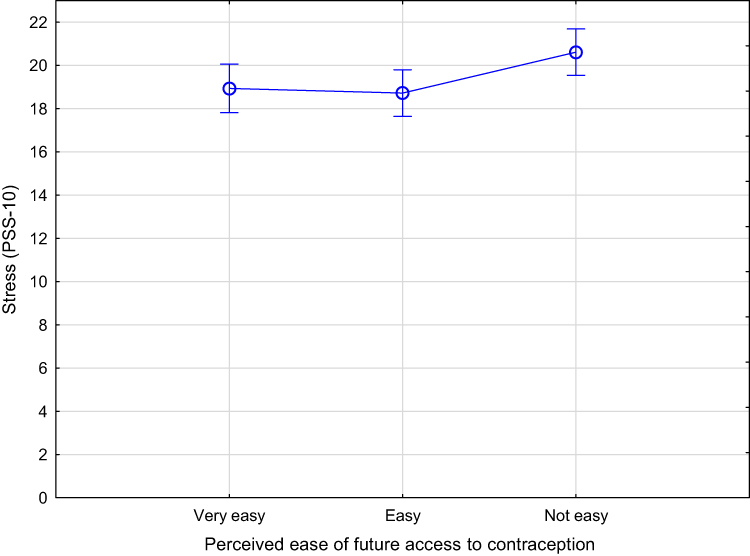 |
Figure 1 Relationship between perceived ease of future access to contraception and Stress (PSS-10) among study participants, after controlling for participants age and self-perceived income sufficiency. Note: PSS-10 refers to Perceived Stress Scale. |
 |
Figure 2 Relationship between perceived ease of future access to contraception and Anxiety (STAI-X1) among study participants, after controlling for participants age and self-perceived income sufficiency. Note: STAI-X1 refers to State Trait Anxiety Inventory for state anxiety. |
 |
Figure 3 Relationship between perceived ease of future access to contraception and Depression (CESD-R) among study participants, after controlling for participants age and self-perceived income sufficiency. Note: CESD-R refers to Center for Epidemiological Studies Depression Scale – Revised. |
Discussion
This was a cross sectional analytical study to explore women’s perceived stress, anxiety and depression related to prescription contraceptives experiences. We observed that twenty one percent of participants who had ever sought prescription contraceptives had experienced at least one episode of denial. This suggests that Polish women are denied contraceptives that should be easily accessible, per the recommendations of the WHO in the Model List of Essential Medicines. Even more concerning is the fact that the medications listed are designated as those required for a “basic health system”.25 Although we have not observed any differences in MHA scores between women who had ever experienced denial from a doctor or pharmacist and those who had not, we have shown that recent experience of denial might be related to the level of depression.
This finding suggests that experiences related to being denied contraceptives (especially those in the recent past which are fresher in the minds of participants) may have an impact on the well-being of women. Being denied access to basic human rights such as control over one’s reproductive freedom, or reproductive autonomy, similarly to any other type of discrimination, may contribute to decreased mental well-being and adverse health effects.26 Moreover, we have shown that women who perceived future access to contraception as very easy had the lowest MHA scores, and women who perceived future access to contraception as not easy had the highest scores.
It is viable that women with increased levels of depression and anxiety perceived future access to contraception as more difficult as a result of biased cognitive processing associated with depression which includes a negative view of the world and the future.27 There is also a possibility that the increased depressive symptoms in participants facilitated better recall of distressing past experiences such as being denied contraceptives. If this was the case, however, this effect should apply equally to events before and during the last 6 months preceding the survey. In our study we observed increased depression levels only in women who experienced contraceptive denial during the last 6 months as compared to women whose last unsuccessful attempt happened earlier than that. Future studies should explore these effects from a longitudinal perspective and in more detail, including how women cope with denial and what actions they take to successfully obtain contraception.
To the best of our knowledge, this is the first attempt to measure a potential relationship between prescription contraceptive access and mental health. Contraceptive denial remains one of the least studied topics of reproductive health care. While mental health has been examined related to denial or obtainment of abortion9 we have not found literature related to conscientious objection or contraceptive denial, and mental health. We have also not found studies related to perceived contraceptive access and mental health.
Strengths and Weaknesses
This study had several strengths, the first of which is that it covered a topic that normally takes a backseat to abortion denial. By surveying women specifically about accessing prescription contraceptives, we got an initial sense of emotional reactions experienced. Another strength is the anonymous, online survey format which gave women an opportunity to share their thoughts on a highly charged and stigmatized topic in Poland.
This study had several limitations, the first being that the design of the study makes it impossible to always infer causality. Women who perceived future access to contraception as “very easy” had significantly decreased stress, anxiety and depressiveness compared to women who perceived their future access to contraception as “not easy”. These findings indicate a relationship and warrant further study, though the results should be interpreted with caution.
In addition, the study only controlled for age and self-perceived income sufficiency, and did not control for factors such as mental health history, medication use, or resilience and coping with stress. The survey did not control for other potential personal and structural aspects involved in one’s experience of contraceptive denial or access, such as the type of health system the participant engaged with (ie public vs private services), more accurate measures of one’s socioeconomic status, or other factors related to a participant’s social and obstetrical profile. To ensure anonymity, participants could not save the survey and continued it later, so participants were required to complete it in one session. As a result, some participants may have navigated through the survey quickly, or had other environmental factors at play, potentially affecting the nature of their responses.
Given the small and relatively homogenous study sample (N=423), the results cannot be generalizable to Polish women as a whole and warrant further study with a more representative sample. The surveyed population consisted primarily of women who self-selected into the study from links posted on social media, who were assumedly interested and engaged in the topics of contraceptive access and reproductive health. The majority had a higher education level, which meant that we did not reach a population that likely has greater difficulty accessing contraception. Participation was also centered in a few voivodeships. We collected primary data online, which did not allow for the researchers to ask clarifying questions or respond to questions from participants. In-person interviews or group interviews may have provided more context, but consideration for the sensitivity of the topic and the anticipated desire of some participants to remain anonymous resulted in the decision to survey online. Recall bias is a consideration as we asked survey participants to recount experiences that may have occurred in the distant past.
Practical and Policy Implications
We believe the results of our study make a case for further research on the mental health consequences of contraceptive denial. To ameliorate this situation for women who face the possibility of conscientious objection, we recommend the following policy considerations.
- Use social media to promote the availability and use of apps and telehealth to access services including contraceptives and mental health care.
- Build online forums for women to safely discuss how to access contraceptives, including barrier methods.
- At the legislative level:
- Promote health policy that integrates mental health with reproductive health.
- Advocate for the availability of over-the-counter contraceptives and emergency contraception that do not require a prescription or parental consent.
This research can begin to fill a gap in the study of the potential interplay between mental health and prescription contraceptive access, and makes a case for “going to the source” by involving the populations most impacted. Conscientious objection in Poland has garnered significant attention in the recent past, and this focus is a strength to be drawn upon.
Recommendations for Further Research
Several questions have emerged from this study and warrant further research. Additional research to explore ease of contraceptive access and mental health in women from smaller Polish cities and villages, and of varying income levels is needed. The perspectives and experiences of women who have not participated in higher education is also largely missing and should be studied.
Future research should study effects of the contraceptive denial from a longitudinal perspective and in more detail, including how women cope with denial and the actions they take to successfully obtain contraceptives. Future studies should also explore why contraceptive denial seems to affect one aspect, and not another aspect (ie depression, but not stress or anxiety), of mental well-being. In addition, the generation of these themes included data only from women who had ever sought contraceptives, thus an important perspective is missing. It is also critical to determine if women are denied as a “matter of conscience” when seeking contraceptives to treat other health conditions. In this study, women who were denied were not asked about the primary purpose of accessing contraceptives in the last occasion of denial. Many women use contraception not primarily for birth control but to regulate their menstrual cycles or alleviate dysmenorrhea. The mental health consequences of limited access to contraceptives can vary depending on the specific reason for its use. It is also important to explore, outside of conscientious objection, the various reasons doctors and pharmacists deny contraceptives such as postponement for service reasons or not prescribed due to medical contraindication.
Given the restrictions placed on accessing emergency contraception (EC) in Poland, similar research on the mental health considerations of ease of EC access with a representative sample should be studied. When taken within five days after unprotected intercourse–- which may include contraceptive failure, or sexual assault - EC can prevent over 95% of pregnancies; with increasing effectiveness the sooner it is taken.28 The inaccessibility of EC for Polish women during this five-day window of opportunity has the potential to be more devastating and stressful than difficulties accessing other types of contraceptives. This is a critical issue that needs additional research.
Conclusion
This research indicates a potential relationship between experiences and attitudes towards contraceptive access, and higher self-assessed stress, anxiety, and depression. Contraceptive denial and other barriers to access directly affect the autonomy and health of women in Poland. Reproductive rights are an integral component of human rights, including the right to life, the right to physical integrity, and the right to the highest attainable standard of physical and mental health.29 The untapped issue of contraceptive denial and mental health outcomes warrants additional research in Poland, and beyond.
Acknowledgments
The authors thank all participants involved in the study.
Funding
Publication of this article was funded by the Faculty of Health Sciences, Jagiellonian University Medical College (N43/DBS/000003).
Disclosure
The authors declare that the research was conducted in the absence of any commercial or financial relationships that could be construed as a potential conflict of interest.
References
1. Bixby Center for Global Reproductive Health [Internet]. San Francisco: c2023. Measuring women’s reproductive autonomy; 2014 Mar 17, [cited October 15, 2023]. Available from: https://bixbycenter.ucsf.edu/news/measuring-women%E2%80%99s-reproductive-autonomy.
2. Grace KT, Anderson JC. Reproductive Coercion: a systematic review. Trauma Violence Abuse. 2018;19(4):371–390. doi:10.1177/1524838016663935
3. Saldanha S, LaGrappe D, Botfield JR, et al. Risk factors and health consequences of experiencing reproductive coercion: a scoping review protocol. BMJ Open. 2023;13:e073326. doi:10.1136/bmjopen-2023-073326
4. Tarzia L, Hegarty K. A conceptual re-evaluation of reproductive coercion: centring intent, fear and control. Reprod Health. 2021;18(87). doi:10.1186/s12978-021-01143-6
5. Marie Stopes Australia (Marie Stopes International) [Internet]. Melbourne VIC: c2020. Hidden forces: a white paper on reproductive coercion in contexts of family and domestic violence, second edition; 2020 [cited December 18, 2023]. Available from: https://resources.msiaustralia.org.au/Hidden-Forces-Second-Edition.pdf.
6. McKenzie HA, Varcoe C, Nason D, et al. Indigenous women’s resistance of colonial policies, practices, and reproductive coercion. Qual Health Res. 2022;32(7):1031–1054. doi:10.1177/10497323221087526
7. American Public Health Association [Internet]. Washington DC: c2023. Opposing coercion in contraceptive access and care to promote reproductive health equity; October 6, 2021 [cited November 1, 2023]. Available from: https://apha.org/Policies-and-Advocacy/Public-Health-Policy-Statements/Policy-Database/2022/01/07/Opposing-Coercion-in-Contraceptive-Access-and-Care-to-Promote-Reproductive-Health-Equity.
8. Liu SY, Benny C, Grinshteyn E, Ehntholt A, Cook D, Pabayo R. The association between reproductive rights and access to abortion services and mental health among US women. SSM Popul Health. 2023;23:101428. doi:10.1016/j.ssmph.2023.101428
9. Biggs MA, Upadhyay UD, McCulloch CE, et al. Women’s mental health and well-being 5 years after receiving OR being denied an abortion a prospective, longitudinal cohort study. JAMA Psychiatry. 2017;74(2):169–178. doi:10.1001/jamapsychiatry.2016.3478
10. Fay KE, Yee LM. Birth outcomes among women affected by reproductive coercion. J Midwifery & Women’s Health. 2020;6(5):627–633. doi:10.1111/jmwh.13107
11. McCauley HL, Falb KL, Streich-Tilles T, Kpebo D, Gupta J. Mental health impacts of reproductive coercion among women in Côte d’Ivoire. Int J Gynaecol Obstet. 2014;127(1):55–59. doi:10.1016/j.ijgo.2014.04.011
12. ASTRA Network. The Fight Hidden in Plain Sight: Sexual and Reproductive Health and Rights in Central and Eastern Europe and Central Asia. Warsaw: ASTRA Network Secretariat; 2020.
13. Poland [Internet]. The Family Planning, Human Embryo Protection and Conditions of Permissibility of Abortion Act of 7 January 1993; 1993 [cited March 3, 2019]. Available from: https://maps.reproductiverights.org/sites/default/files/documents/Polish%20abortion%20act--English%20translation.pdf.
14. European Parliamentary Forum for Sexual and Reproductive Rights [Internet]. Brussels (BE): c2020. Contraception Atlas 2019; 2020 Jan 25, [cited October 1, 2021]. Available from: https://www.contraceptioninfo.eu/node/72.
15. European Consortium for Emergency Contraception [Internet]. Tirgu Mures (RO): c2022. Poland; 2017 [cited October 1, 2021]. Available from: https://www.ec-ec.org/emergency-contraception-in-europe/country-by-country-information-2/poland/.
16. Statista: average monthly gross wages and salaries in the national economy of Poland from 1995 to 2021 [Internet]. Hamburg (Germany); 2022 Feb [cited July 18, 2022]; [about 1 screen]. Available from: https://www.statista.com/statistics/962795/poland-average-monthly-gross-wages/.
17. Piecuch A, Gryka M, Kozłowska-Wojciechowska M. Attitudes towards conscientious objection among community pharmacists in Poland. Int J Clin Pharm. 2013;36(2):310–315. doi:10.1007/s11096-013-9878-5
18. Hubacher D, Trussell J. A definition of modern contraceptive methods. Contraception. 2015;92(5):420–421. doi:10.1016/j.contraception.2015.08.008
19. Cohen S, Kamarch T, Mermelstein R. A global measure of perceived stress. J Health and Soc. Behav. 1983;24(4):385–396. doi:10.2307/2136404
20. Juczyński Z, Ogińska-Bulik N Narzędzia pomiaru stresu i radzenia sobie ze stresem [Tools for measuring stress and coping with stress]. Pracownia Testów Psychologicznych; [cited March 3, 2019]. Available from: https://en.practest.com.pl/node/28934.
21. Spielberger CD, Gorsuch RL, Lushene R, et al. Manual for the State-Trait Anxiety Inventory. Consulting Psychologists Press; 1983.
22. Pracownia Testów Psychologicznych Polskiego Towarzystwa Psychologicznego [Internet]. Warsaw: c2011. STAI. State-trait anxiety inventory: Polish adaptation [Inwentarz Stanu i Cechy Lęku STAI. Polska adaptacja STAI]; 2002 [cited April 3, 2019]. Available from: https://en.practest.com.pl/node/28934.
23. Eaton WW, Muntaner C, Smith C, et al. Center for epidemiologic studies depression scale: review and revision (CESD and CESD-R). In: The Use of Psychological Testing for Treatment Planning and Outcomes Assessment.
24. Koziara K. Assessment of depressiveness in population: psychometric evaluation of the Polish version of the CESD-R. Psychiatria Polska. 2016;50(6):1109–1117. doi:10.12740/PP/61614
25. World Health Organization [Internet]. Geneva: c2021. WHO model list of essential medicines: 22nd list; 2021 Sep. 30, [cited December 15, 2021]. Available from: https://www.who.int/publications/i/item/WHO-MHP-HPS-EML-2021.02.
26. Clark A, Stenholm S, Pentti J, et al. Workplace discrimination as risk factor for long-term sickness absence: longitudinal analyses of onset and changes in workplace adversity. PLoS One. 2021;16(8):e0255697. doi:10.1371/journal.pone.0255697
27. Gotlib IH, Joormann J. Cognition and depression: current status and future directions. Annu Rev Clin Psychol. 2010;6:285–312. doi:10.1146/annurev.clinpsy.121208.131305
28. World Health Organization [Internet]. Geneva (CH): c2022. Emergency contraception; 2021 Nov. 9, [cited February 13, 2022]. Available from: https://www.who.int/news-room/fact-sheets/detail/emergency-contraception.
29. Anedda L, Arora L, Favero L, et al. Sexual and reproductive health rights and the implication of conscientious objection. European Parliament, Policy Department for Citizens’ Rights and Constitutional Affairs (PE 604.969). Brussels (BE); 2018. Available from: https://www.europarl.europa.eu/RegData/etudes/STUD/2018/604969/IPOL_STU(2018)604969_EN.pdf.
 © 2025 The Author(s). This work is published and licensed by Dove Medical Press Limited. The
full terms of this license are available at https://www.dovepress.com/terms
and incorporate the Creative Commons Attribution
- Non Commercial (unported, 3.0) License.
By accessing the work you hereby accept the Terms. Non-commercial uses of the work are permitted
without any further permission from Dove Medical Press Limited, provided the work is properly
attributed. For permission for commercial use of this work, please see paragraphs 4.2 and 5 of our Terms.
© 2025 The Author(s). This work is published and licensed by Dove Medical Press Limited. The
full terms of this license are available at https://www.dovepress.com/terms
and incorporate the Creative Commons Attribution
- Non Commercial (unported, 3.0) License.
By accessing the work you hereby accept the Terms. Non-commercial uses of the work are permitted
without any further permission from Dove Medical Press Limited, provided the work is properly
attributed. For permission for commercial use of this work, please see paragraphs 4.2 and 5 of our Terms.