
Back to Journals » Journal of Healthcare Leadership » Volume 17

Examining Canadian Hospitals’ Support for Planetary Health Through the Implementation of Green Teams and Sustainability Offices
Authors Kalogirou MR  , Baumbusch J
Received 15 January 2025
Accepted for publication 19 May 2025
Published 11 June 2025 Volume 2025:17 Pages 269—284
DOI https://doi.org/10.2147/JHL.S517669
Checked for plagiarism Yes
Review by Single anonymous peer review
Peer reviewer comments 3
Editor who approved publication: Professor Zhanming Liang
Maya R Kalogirou, Jennifer Baumbusch
School of Nursing, University of British Columbia, Vancouver, BC, Canada
Correspondence: Maya R Kalogirou, University of Alberta, College of Health Sciences, Faculty of Nursing, Edmonton Clinic Health Academy (ECHA), 11405 87 Avenue NW, Edmonton, AB, T6G 1C9, Canada, Email [email protected]
Purpose: Planetary health is the idea that human health and the health of our planet are inextricably linked. The healthcare sector promotes human health but has a significant impact on our natural world. In Canada, some hospitals are leading the way towards promoting planetary health in an increasingly challenging context. The purpose of this study was to understand how Canadian hospitals support planetary health, specifically through green teams and sustainability offices.
Patients and Methods: People working in Canadian hospitals, either in sustainability offices or green teams, were invited to participate in this study. Participants completed an online survey and indicated if they would like to take part in a semi-structured interview via Zoom. Twenty-nine participants were interviewed and asked about how they supported planetary health and how their teams were integrated into the hospital setting. Interview transcripts were analyzed and data were summarized using thematic analysis. Demographic information was collected through the survey.
Results: Three main themes were: 1) From grassroots to corporate: Green teams and sustainability offices. This theme defined, compared, and contrasted teams and offices; 2) Operationalizing this work: Five green team exemplars. The five teams were: 1) the single-person green team; 2) the health profession-specific green team; 3) the green team pilot project; 4) external partners supporting green teams; and 5) the “bottom up” meets “top down” green team; and 3) Paving the path forward and tracking success. This theme explored how teams used metrics and other broader indicators to understand success.
Conclusion: This study examined the work of Canadian sustainability offices and green teams in the hospital setting. The former promoted planetary health from a “top-down” perspective while the latter did so from a “bottom-up” perspective. Teams that integrated both approaches were the most effective in promoting planetary health.
Plain Language Summary: The health sector is harming the planet’s natural systems, and now there is a need for it to start promoting planetary health. Planetary health is the idea that human health and the health of our natural systems are inseparable, and promoting planetary health means delivering health services in a way that also reduces climate change, pollution, and biosphere integrity issues. Hospitals have responded by creating sustainability offices. Hospital employees have responded by striking up green teams. The work these offices and teams are doing are well-documented in some healthcare systems, but in Canada, not much is known. This study was done so that we could better understand how Canadian hospitals support planetary health, specifically through green teams and sustainability offices.
We sent out surveys that collected preliminary information on participants; anyone working in a sustainability office or on a green team in a Canadian hospital. We then conducted interviews, and from those data, we identified three themes:From grassroots to corporate: Green teams and sustainability officesOperationalizing this work: Five green team exemplarsPaving the path forward and tracking success
Overall, there are good reasons for Canadian hospitals to have both a sustainability office and a green team as they focus on slightly different planetary health initiatives. It is also a strength to have a “top-down” meets “bottom-up” approach to planetary health promotion, because when sustainability offices work together with green teams, or when leaders themselves are part of teams, they can target larger-scale, more impactful planetary health initiatives.
Keywords: planetary health, hospitals, climate change, environmental sustainability, net zero
Introduction
Planetary health, a concept rooted in Indigenous Knowledges, is the notion that human health and the health of our natural world are inseparable.1,2 We are currently facing a triple planetary crisis, also known as “the triple threats”, which is a set of three interconnected issues: climate change, pollution, and biodiversity loss.3 In terms of human health impacts, the triple threats are exacerbating energy, food, and water insecurity as well as increasing the risk of disease, death, mental health issues, displacement, and conflict.4 By now, human influence on these crises is an established fact,5 and if healthcare systems are to maintain high levels of human health in this global context, they must consider their impact on the natural world and demonstrate planetary health leadership.
Research has found that when health organizations anchor their decarbonization efforts with a strong culture of iterative quality improvement, they make substantial progress.6 In fact, Mortimer et al7 state that healthcare must consider sustainability as a domain of quality,
Extending the responsibility of health services to patients not just of today but of the future. (p. 88)
In this light, sustainability should be addressed as a critical component of quality improvement.8,9 Doing so exhibits the type of leadership hospitals must demonstrate in today’s world, and furthermore, it encourages healthcare professionals and organizations to go beyond simply focusing on clinical outcomes. When hospital leaders view sustainability as part of quality improvement, it further encourages the healthcare sector to adopt a more holistic view on desirable healthcare outcomes, such as the importance and value of good resource stewardship and consideration of healthcare’s social and environmental impacts.9 This approach is also aligned with planetary health, which not only focuses on the reductions of GHG emissions but also reductions of waste, energy usage, and healthcare’s overall environmental impact. Planetary health also advocates for sustainable environmental and resource stewardship and is closely linked with climate justice.4,10
According to the World Health Organization,11 93 countries have made formal commitments around building climate resilient health systems, developing sustainable low carbon health systems, presented official net zero commitments, or some combination of all the above. One notable leader includes the National Health System (NHS) in the United Kingdom. The NHS has made explicit commitments to integrate sustainability throughout their services, to become net zero for the emissions direct within its control by 2040, and to improve the resiliency of their organization against increasingly common climate hazards.12,13 The organization has outlined several direct interventions that support decarbonising, including estate and facilities, travel and transport, supply chain, medicines, and research, innovation, and offsetting.13 The NHS has also identified a plan to deliver net zero health services, which includes tactics such as: new and sustainable models of care, workforce and leadership, and funding and financial mechanisms.13
Workforce buy-in and leadership are essential in achieving sustainability goals, and there is already a broad level of support for this work among NHS staff. An internal survey found that 98% of survey respondents believed it was important for healthcare systems to operate in ways that support the environment, improve resource efficiency, and reduce emissions and waste, and 93% agreed that supporting the environment was important to do at work.14 It is understood that all NHS staff will need to be supported in learning, innovating, and embedding sustainable practices into everyday actions.13
Around the world, resources supporting both hospitals in becoming planetary health leaders themselves, as well as promoting and developing planetary health leadership amongst hospital employees, are becoming more readily available.15–17 One popular strategy that helps advance and develop employee leadership is to create green teams, which are teams of hospital employees, often front-line healthcare staff, that come together to reduce waste, energy usage, and GHG emissions.18,19 Another strategy hospitals specifically use to manage energy usage, reduce greenhouse gas emissions, and increase efficiency is through sustainability offices, which are embedded into the organization intentionally by leadership and are typically comprised of energy specialists, consultants, and other non-health professionals.20,21 Although challenges in developing green teams and sustainability offices are limited, research shows that the main barriers in implementing and sustaining hospital-based healthcare interventions include: training staff and capacity building, workload pressures, complexity of the issue being addressed, lack of strong leaders/champions, staff shortages and high turnover, lack of organizational support, external socioeconomic and/or political barriers.22
While there is no mention of formal green teams within the NHS, employees are clearly stepping up to the challenge and playing an important leadership role in supporting the NHS in its sustainability goals.23 In New Zealand, intensive care units seeking accreditation are asked by the College of Intensive Care of Australia and New Zealand if they have a green team.18 Although this is not mandatory to achieve accreditation, it is an important first step and previous work identified green teams in 65% of 20 New Zealand intensive care units, and 40% of 153 Australian intensive care units.24 In Canada, both green teams and sustainability offices are becoming more popular within the hospital setting, and while there are non-academic resources on how to create such teams,25 academic literature and research on actual Canadian hospital green teams, sustainability offices, and the interactions between the two is limited. A project carried out by a non-governmental organization identified 13 different green teams located in Canadian hospitals and provided a brief picture on their activities.26 However, not much else is known about Canadian green teams in the hospital setting, nor sustainability offices. As such, the purpose of this work was to understand how Canadian hospitals support planetary health, specifically through green teams and sustainability offices.
Methods
Design
Interpretive description was used to address the research aim. Interpretive description is a qualitative research framework that, when addressing clinical or applied concerns, focuses researchers towards pragmatic and applicable findings as opposed to theoretical ones.27 This inherent focus on application and everyday practical problems supported the decision for an inductive approach to this study, forgoing the application of a theoretical framework or predefined themes at the start.27
Setting
Canada, the setting for the study, has 1017 hospitals.28 Hospitals are covered under the Canada Health Act,29 which funds necessary medical services through federal government financial transfers to the provinces/territories. At the time of writing, there are no policies, regulations, mandates, or accreditation standards in Canada that compel hospitals and provincial/territorial governments to promote planetary health within their health systems.
Recruitment and Inclusion Criteria
Recruitment was open to individuals employed at Canadian hospitals who were part of a green team or sustainability office. Previous work identified 13 hospitals with green teams,26 and these sites were initially approached for recruitment. Eight of the sites had publicly available contact information. Invitations to participate were sent via Email to those eight sites, as well as to the memberships of five non-governmental organizations focused on environmental sustainability in healthcare. As well, recruitment posters were shared at the Canadian Healthcare Engineering Society 2024 National Conference. From those initial strategies, snowball sampling was utilized, and participants were asked to share information about the study within their professional networks.
Between April and July 2024, 43 people filled out an online survey (n = 43). From those, six were screened out for not meeting inclusion criteria. This left 37 participants in this study. From these, 31 participants volunteered to be interviewed (n = 31). Two participants indicated a desire to be interviewed but did not respond to emails or provide contact information to follow up with (n = 29). One interview was conducted but had to be omitted from analysis due to not meeting screening criteria (n = 28). One person who did not fill out a survey was interviewed, bringing the final total of interview participants to 29 (n = 29). From those who participated, four informants learned about the study from a newsletter, 14 learned about the study from a colleague/friend, 10 informants listed “other” as their source, and one informant left the question unanswered.
Data Collection
Data were collected through a cross-sectional online survey, followed by semi-structured interviews. First, potential participants expressed interest via an online survey (Qualtrics, University of British Columbia). The survey determined participants’ eligibility and collected demographic information as well as some preliminary information about their work around planetary health. Second, participants were asked if they would like to take part in a one-on-one interview to explore their work further. An interview guide (Appendix 1) was used to explore the history of the green team/sustainability office, the professional makeup of team/office members, and how teams/offices were structured, made decisions, and were integrated into the hospital setting. Participants were also asked to describe the initiatives undertaken by their teams/offices to promote environmental sustainability in the workplace.
Interviews were conducted online via Zoom (ver. 6.0.11, USA) and lasted ~45–60 min and multi-person interviews lasted ~90 min. Average interview length was 60 min. Twenty-six interviews were conducted one-on-one, and two interviews were multi-person interviews, with two participants present. The first author, who identifies as a woman, possesses her doctorate in nursing, and at the time of writing was employed as a Post Doctoral Fellow with the second author, conducted the interviews. With participant consent, interviews were recorded and transcribed verbatim.
Data Analysis and Reporting
Participant demographics were summarized using Excel (ver. 2408, Microsoft). Transcripts from audio-visual recordings were reviewed for accuracy, deidentified, and imported into NVivo (ver. 14.23.3(61), Lumivera) for thematic analysis using a reflexive approach.30 Three transcripts were independently analysed by the first two authors of this paper. Themes and codes were derived inductively and compared until consensus was reached and a coding framework developed. The first author completed the coding for the rest of the transcripts, and when completed, the team met again to discuss codes, collapse them into categories, and develop themes that describe the phenomenon of interest.31
Credibility was strengthened through two main actions: First, the creation and maintenance of a coding framework, and second, the thick descriptions from participants. Dependability of the findings was promoted through a transparent analytical decision trail and the rigorous discussions among the research team members. Clear descriptions of participants, data collection, and analysis all contributed to the transferability of the findings.31
Member checking was not conducted. Interpretive Description prioritizes the researcher’s role in interpreting patterns across individual accounts to develop conceptual insights that inform applied practice.27 Participants contribute rich descriptions of their experiences; however, they are not expected to serve as arbiters of research-level abstractions derived from cross-case analysis. As Thorne cautions, member checking may provide a false sense of validation or mistakenly imply that participant agreement is necessary for methodological integrity.27 Instead, we uphold rigour through reflexive practice, peer debriefing, transparent audit trails, and thoughtful engagement with the data, in alignment with the principles of Interpretive Description.
Results
Sample Characteristics
Based on survey demographics, interview participants consisted of nurses (n = 2), pharmacists (n = 3), doctors (n = 4), occupational therapists (n = 2), hospital managers/leaders (n = 8), people working in facilities (n = 2), clinical research coordinator (n = 1), Sustainability Specialist/Lead/Coordinator/Practitioners (n = 4), quality improvement consultants (n = 1), energy management specialists (n = 1), operations portfolio manager (n = 1). Twenty participants were on green teams, four participants worked in sustainability offices, three participants stated they were part of both a green team and a sustainability office, and two stated “other”. Of the 19 unique green teams that were included in this reporting, most were formed within the last five years or earlier (n = 16), two teams were established within the last 10 years, and only one team was over 16 years old. Two participants stated their sustainability offices were created less than one year ago, one participant stated their sustainability offices was five years old, and another participant did not know how old their office was. Participant demographics are further summarized in Table 1.
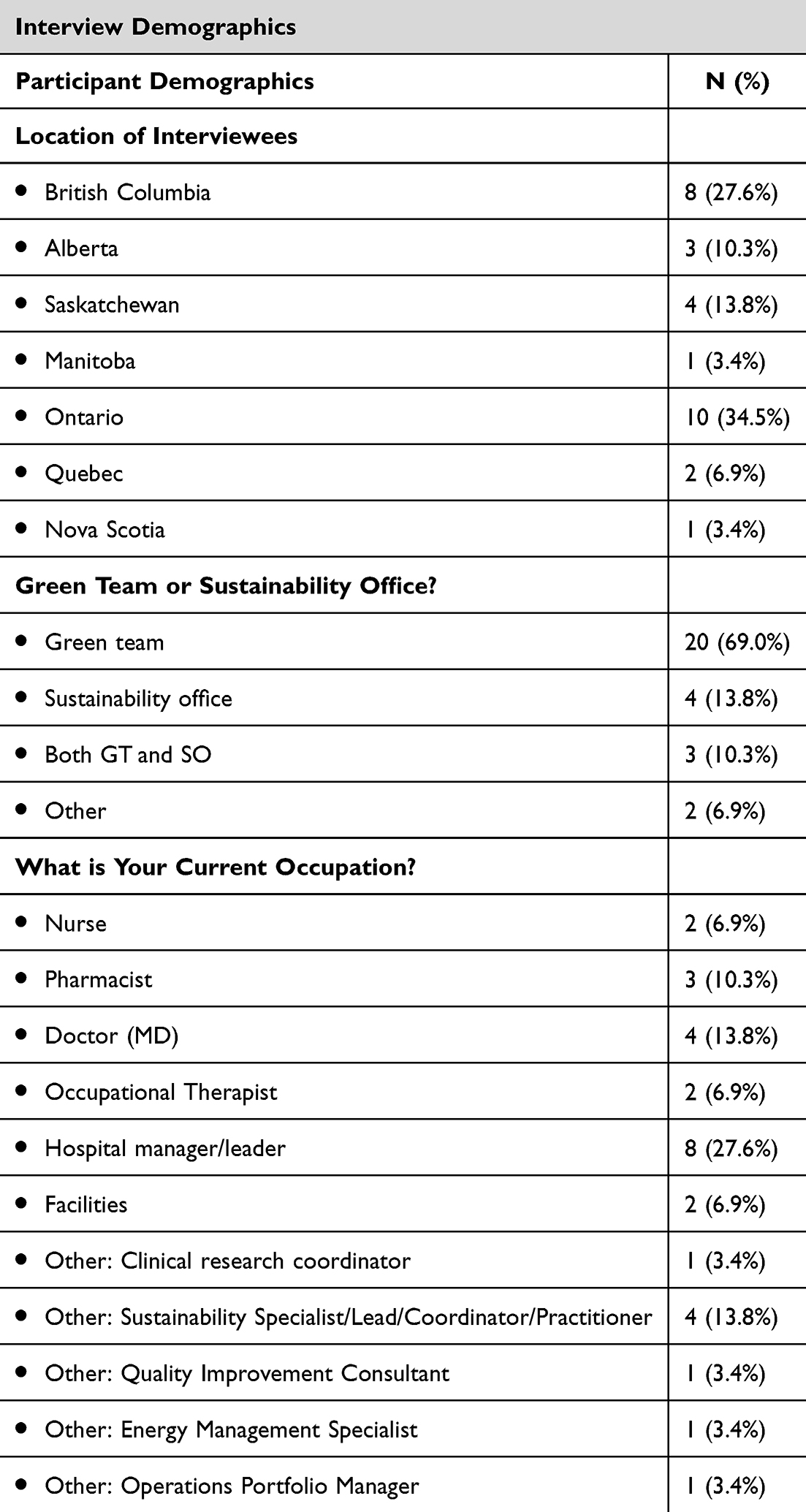 |
Table 1 Participant Demographics |
Thematic Findings
Three themes were identified: 1) From grassroots to corporate: Green teams and sustainability offices; 2) Operationalizing this work: Five green team exemplars; and 3) Paving the path forward and tracking success. Participants have been assigned pseudonyms, and when first introduced, they are identified as either being members of a green team (GT member), a sustainability (SO member), both (GT and SO member) or other (Other).
From Grassroots to Corporate: Green Teams and Sustainability Offices
Defining Green Teams
Green teams were deemed to be a collection of individuals, usually volunteers, who joined from all hospital departments. Their purpose was to reduce the hospital’s waste, greenhouse gas emissions, and overall environmental impact. While there was often a specific focus on the inclusion of healthcare professionals, membership was frequently broad and even hospital- or organization-wide. Green team work was regularly viewed as “off the side of the desk” type work, meant to be done in addition to green team members’ existing workload.
According to Talia (GT member),
A green team to me would be a committee that has prioritized sustainability initiatives or environmental sustainability looking at ways to both adapt to and mitigate climate change.
While Finn (GT member) commented:
Generally, I found green teams are more like a grassroots type of organization, with a lot of volunteers from the hospital. No one’s really getting paid to do any of the work… And no real formal endorsement I suppose.
No two green teams were exactly alike; some were specific to certain areas of the hospital, such as pharmacy or the operating rooms, while others worked across the hospital and were more interdisciplinary.
Nova (Other) described her green team, which was very interdisciplinary:
So anaesthesiologists by far are the most engaged physicians that I’ve ever come across. I don’t know why. And then everybody else. A ton of admins. Lots of [physical therapists, respiratory therapists, occupational therapists.] We had a nutrition green team.
Alternatively, Noor (GT member) had a green team comprised mainly of pharmacists:
We have a Pharmacy-specific Green Team within… MAJOR CITY area. So, within our Pharmacy Department, we’ve identified a need for this Green Team… [and] it’s comprised of volunteers of Pharmacists and Pharmacy technicians.
Like Noor, Juno (GT member) described area-specific green teams, such as one for the operating room, and commented on how the team was interdisciplinary:
The green teams that we have are—there is the [operating room] green team. So there are the anaesthetists and surgeons and so on and nurses in that area.
Finally, Sarai (GT and SO member) also had an interdisciplinary green team, and hers included members of leadership as well:
…People can join the green team from all levels. So you could be very much frontline staff. You could be in management or leadership.
Defining Sustainability Offices
Alternatively, sustainability offices were seen as more formal structures that were intentionally embedded into the hospital and more readily recognized and supported by organizational leadership. According to participants, sustainability offices tended to have a more top-down perspective on waste and emissions reductions, and often supported initiatives at a much more macro level than green teams. There was less emphasis on the inclusion of healthcare professionals within sustainability offices and more of a focus on specialized sustainability practitioners and/or energy experts.
According to Oliver (SO member):
When I hear green team I think volunteer and I think “side of the desk”. When I hear office, I think part of the structure of the organization. And you will always have the ear of the organization, better from within than from without.
Ella (GT member) supported this perspective when she said
In our organization, the Sustainability Office is mostly centred around building an infrastructure versus clinical…it’s not really health-care professional-based… [but more like] Building and Operations.
Finally, Charlie (GT member) stated:
I think a sustainability office is when you actually have a dedicated team that you have budgeted resources for, that specifically focus on green initiatives.
Interestingly, unlike green teams, sustainability offices did not typically have planetary health as the main driver of activities. The few participants who were part of sustainability offices discussed how they often had to juggle greenhouse gas reductions and financial sustainability. For example, Cora (GT and SO member) said:
I recently completed a review of a business case that would actually reduce the carbon emissions for that particular hospital by 70–80%. Problem is—up-front cost is very high, and we have to sign a thirty-year contract, [so] there’s actually no save. Basically, a case with zero payback is not gonna fly. [It] just will never happen.
Similarly, Oliver stated:
… I also have to think of the bigger view of the office. If I get tied to a one-off [project] in [CITY NAME], [like] putting solar panels on a roof, that’s all this office is gonna do for a year, for six months… And the ROI on it I can tell you now is not good… So yes, there’s a benefit to the environment… [but] do you save money in the long run? You do not.
Operationalizing This Work: Five Green Team Exemplars
Sustainability offices tended to have more homogenous structures as they were embedded into the hospitals in similar ways. However, green teams, being more of a grassroots movement, presented themselves in several forms and structures. As such, in this section, five different green team structures are explored: 1) the single-person green team; 2) the health profession-specific green team; 3) the green team pilot project; 4) external partners supporting green teams; and 5) the “bottom up” meets “top down” green team.
The Single-Person Green Team
The “Single-Person Green Team” refers to the green team that is organized and operated mainly through the efforts of a single workplace champion. Harper (GT member) provided an example of how she took on this role at her workplace with her main focus being reducing waste and recycling workplace materials:
For the green team that I have at work, it is me doing it. But then I have lots of people who participate, but I will do all of the work.
In Harper’s case, she set the agenda for initiatives, carried out tasks, and provided reports back to the unit. Although her co-workers would support her by bringing in their recycling, it was up to Harper to dispose of it and record her own metrics. With little outside support, Harper found it extremely challenging to enact change in her workplace. An example she provided was around certain equipment found in sterile trays; they would normally get thrown out, but Harper found a way to recycle the items. She tried to get support from management as well as from the companies who produced the trays:
So the roadblock was managers ghosted me. I could not get anyone to return my calls… And on the other side… companies wouldn’t return [my calls]. They were, like, you have to talk to corporate.
Despite the many challenges Harper faced, she was determined to continue with her work and keep doing her best to make a difference in her workplace.
The Health Profession-Specific Green Team
The “Health Profession-Specific Green Team” refers to a green team composed exclusively of members from a particular healthcare profession. Their goals are tailored to advance planetary health within their related field of practice. Noor and Talia were co-chairs of a city-wide green team of pharmacists. According to Noor, the team mainly focused on sustainability initiatives that were within their practice space:
Part of our mission is to be mindful of what’s within our control… so we were really trying to focus on Pharmacy-specific stuff.
Talia also discussed how the green team would set their own goals, but would solicit input and feedback from the pharmacy department as a whole:
We use the committee as the brainstorming group. Then we send [a survey] out yearly… to the department to see if they like the goals, what goals they would rather have us work on, and do the updates at that time.
Noor described that, in addition to pharmacists, there were also two managers on the team:
We do have two Managers on our committee… [one] is particularly helpful… The downfall is that she’s only responsible for one hospital, and so, maintaining those same initiatives at the other hospitals has been less effective. And, then, one Manager… is very involved—more so as a participant and less so from a leadership perspective.
When asked if having the managers on the team supported the green team’s ability to enact change, she said:
I think it does add some credibility to our committee. But, I don’t know if the initiatives that we’ve done to date—I don’t know if the Managers—I don’t know. [laughs]
The Green Team Pilot Project
The “Green Team Pilot Project” refers to a very specific example of green team structuring that arose from the data. Amir (SO member) supported green teams through a different structure. His office consisted of four people; two sustainability coordinators, one student, and one manager. While not a green team themselves, their purpose was to oversee and support the piloting of two green teams at two different locations. If successful, the health organization planned to implement green teams at all major care sites. While the green teams at Amir’s workplace were tasked with tackling environmental sustainability as they saw fit, Amir’s team provided supports in a few different ways. He shared:
… It is kind of hit or miss in terms of having the leadership skills and capacities to do that work… Just basic sustainability education [too]. People care, but that doesn’t mean they necessarily understand the biggest [sustainability] drivers.
Amir’s team also provided
… The official structure in the program and resources. Things like [slide decks], one-pagers…, written materials that they could just reuse or customize or tailor so that… they’re using the hours that they have available on stuff that we can’t do. (Amir)
Amir’s team did not include members from leadership, but they reported back to them on the pilot project’s progress.
Ariella (GT member) was the lead of one of the green teams included in Amir’s pilot study, and she appreciated the support Amir’s team offered:
It helps me stay accountable to my goals. You know, now, it’s more like—“Okay, I’m meeting with COORDINATOR NAME every two weeks and I have to report back on what I’m doing…” Also, like, he’s creating these posters, with Canva(s), I’m like, “Oh, great—I don’t have to do that”.
Ariella also described how, despite having support from Amir’s team, she did not receive a lot of outside support:
People are very interested in… the projects that we’re doing. They’re very curious. They’re not interested in putting a lot of time.
As such, Ariella found herself predominantly focusing on recycling and waste-reduction initiatives that she was personally passionate about.
External Partners Supporting Green Teams
This structure of green team demonstrates how, at times, some green teams within a hospital receive support from partners existing outside that setting and work in partnership with these external groups. At Aurora’s (GT member) workplace, there were two green teams that were being supported through outside partners. She explained:
[PROVINCIAL QI GROUP] started a planetary health collaborative in which they were trying to roll out teams within hospitals… [One]was the perioperative space and the other would be respiratory and mitigating MDI use…
In Aurora’s case, the external partner acted as a consultant and helped the green team orient itself. The partners offered advice on what was feasible in terms of initiatives, suggestions on where to start, and formal structures that could support their goals.
Similarly, Juno’s green team received outside support. Juno was the chair of the green team for some time and happened to be well-connected to a provincial, physicians-based environmental advocacy group. This physicians’ group acted as an outside support for Juno’s green team, as well as other green teams in the province.
So not a single green team to my knowledge was formed because of [PROVINCIAL PHYSICIAN GROUP]. But [through the physician’s group] we bring [green teams] together and we strengthen each other and encourage each other…. (Juno)
Although the external partner did not make decisions for Juno’s green team, they were seen to be a strong resource that helped guide the decision-making processes. The outside partner also acted as a connecting point for external resources and other green teams.
“Bottom-Up” Meets “Top-Down” Green Teams
This final green team structure illustrates how some of the most functional teams bring the grass-roots level passion and desire for action together with relevant organizational leadership who can leverage their positions to support planetary health action. Some teams did an excellent job of harnessing the excitement, energy, idea-generating capacity, and implementation abilities of the ground-level employees (“bottom-up”) to enact change, while simultaneously bringing in hospital managers and leaders who could use their positions of power to provide feedback and facilitate the initiatives (“top-down”). Charlie and Sarai worked in two different hospitals and the green teams in their hospitals/health organizations provided examples of this type of structure. Both Charlie and Sarai worked on teams that, while not part of the green team specifically, acted as a bridge between hospital leadership and the green team. Moreover, both participants were employed in leadership positions themselves and had other members of leadership on their green teams. As part of their teams’ work, they offered direct and clear support for green team initiatives. Charlie described how her team sent out a survey throughout the hospital, asking for volunteers to participate in her green team and for ideas on what the green team should be working on. From there, members of the team were encouraged to select items they were passionate about and champion those ideas.
So that’s kind of what started to create what we call our think tank… We started off by talking through those ideas, and we really promoted the team to champion the ideas… It was kind of, like, “hey green team, which ideas would you like to kind of lead”, right? Because, you know, at the end of the day when people have ownership over ideas, they’re more likely to be more engaged.
Charlie believed that her green team’s success came from the fact that members were empowered to select and lead their own initiatives, and from her own ideal positioning with:
[We’ve] had four green team meetings so far. And the energy has been very positive, and I think it’s because we are empowering people to lead their own initiatives. But we’re acting as a support for them, right. And that’s where I actually find it helpful that I wear the hat of environmental services, food services and supply chain… So I find because I wear those different hats, I’m actually able to support the green team pretty much on any initiative they want to look into, because most of those departments are mine.
Charlie’s team supported the green team by organizing meetings, keeping track of decisions, collecting data, assessing feasibility of initiatives, following up with champions about what they have been working on, and reporting back to leadership on green team activities. Due to this structure, Charlie’s team could target initiatives in any area of the hospital, as long as someone was willing to champion it.
Sarai was also on a team that worked directly with the organization-wide green team, which included members of leadership, frontline staff, and all sectors in the hospital. Sarai explained:
… [The green team] is all a volunteer, an above and beyond element that naturally fits in some people’s titles or portfolios and doesn’t as much for others. But we absolutely invite everyone to join. We currently have around 700 or so staff that are part of this green team…
Like Charlie, Sarai’s team’s main role was to support the green team in achieving their goals by connecting them with the right people and resources. Sarai’s team provided resources to help develop knowledge on sustainability among hospital employees, helped the green team organize and stay connected, and supported communications on green team activities to the broader hospital and leadership.
I’ll help and be a resource to the team. And we’ll try and put forth very specific things that relate to what that team is doing… I find that this is where the magic happens. Because teams know exactly what it is that they are doing, and they can see if we do training sessions together, we try and give them more of a sort of a guiding principles of sustainability. Because a lot of people sort of start off with the, “oh, I want to join the green team ‘cause I want to get rid of straws’”… Like, that’s the tiniest little thing in this role of sustainability and let’s get to base principles of what climate change is and where it’s coming from and the idea of fossil fuels and the idea of greenhouse gas emissions. And so we can arm people with a little bit more knowledge to be able to work on things that are very useful.
Ultimately, green teams decided what they wanted to work on, and Sarai and her team provided resources and connections that would lead to success.
Paving the Path Forward and Tracking Progress
Most participants understood the importance of metrics and measuring the impact of their work, especially as it related to reducing greenhouse gas emissions. However, there was also a broader discussion about team success that included things like achieving high levels of staff engagement.
Metrics
When it came to tracking progress, sustainability offices tended to be more concerned with tracking energy use and associated emissions and, as stated earlier, the return of investment associated with initiatives. In some senses, this made tracking more straightforward as tracking energy use is a more linear process. According to Morgan (GT member),
…Energy is a little bit different, in that the energy team has been doing that for a long time, now, and it’s pretty easy to track and report… we have to report on that at the provincial and federal levels.
Oliver, who worked in a sustainability office, discussed how his main priority was to create a data management system that would support the collection of data on energy usage:
We have procured a data management system (DMS)… which will [identify] which buildings are worse per square foot and the carbon emissions of those buildings.
What was unique about Oliver’s DMS system, however, was that it was also being built to track emissions associated with waste and supply chain.
On the other hand, green teams tackled sustainability through a wider net of initiatives, with varying impacts on overall planetary health promotion. Green team members understood the importance of tracking metrics in relation to assessing the green team’s ability to reduce energy use and greenhouse gas emissions, but other metrics were also discussed, like overall waste reductions, waste diversion, uptake of plant-based foods, impact on patient satisfaction and care, and cost savings. These metrics were more challenging to capture, and different teams were at varying states of metric tracking. Additionally, various teams prioritized metrics differently. As a result, there was a large variability between: 1) how metrics were being tracked, and 2) which metrics teams were being measured.
All teams had some plan in place to either start or continue keeping track of certain metrics. Some teams were already tracking metrics but wanted to expand. Few teams had a good head start on this process and were continuously evolving it to meet the needs of their organization. Participant quotes related to green team metrics may be found in Table 2. For specific green team and sustainability office planetary health initiatives, see Table 3.
 |
Table 2 Green Team Member Quotes on Metrics |
 |
Table 3 Planetary Health Initiatives |
Finding the Quick Wins
Most green teams were new and addressing environmental sustainability in the hospital setting remained a somewhat novel idea. As such, many participants discussed how they did not necessarily have a blueprint for action, rather, they were figuring things out as they went. Charlie stated:
… Getting started in these things is always the hardest part. And even me, I was kind of, like, “oh my god, what am I doing, right? What am I getting into?” “Cause what do I know?”
Niko (GT member) also discussed this when he said:
We’re definitely not experts. So we are learning and listening a lot to some of those national partners who are more experienced… some of it’s trial and error. You know, we’re taking shots at different things.
However, this absence of a paved road ahead did not stop teams from action. Many teams instead focused on achieving “quick wins” or tackling “low hanging fruit”, with the hope that these would eventually lead to greater, more impactful initiatives as the team grew and stabilized. Celeste (GT and SO member) captured this best when she said:
Recycling is kind of a quick win. It’s not expensive. It’s easy to do. We all do it at home. Why can’t we do it in the workplace if we’re ready to do it of course? But— so yesterday morning I presented to another OR in another hospital that asked to me, “you’re doing this in your hospital. Can you tell us how you build the thing and how we can bring it to our hospital?” I’m not gonna tell them, you know, “forget about the recycling”. That’s not the most—that’s not the thing that’s gonna give you a big difference [but] I’m doing it because I think that once you get there, you will want more. Like we did, you will want more.
Chance (Other) also suggested that tackling quick wins helps support team morale and engagement:
… It’s really important [to] these groups—to have quick wins. People have to feel like they’re making a difference cause they’re volunteering their lunch hour, they’re calling in on their days off to attend the meeting… [We] needed to have quick wins, so that’s really important—otherwise, it loses steam instantly… [If] you don’t do something, it’s gonna die, and it’s gonna become pointless, and people will just drift away.
Finally, Petra (GT and SO member) also affirmed:
Like, a lot of the little waste diversion improvement projects, like, low impact, high feasibility and also, like, high visibility. So those—you know, they’re not too high up or not too, like, low either. But it’s realistic that those are some of the things that will probably be some of the first. [things we do]
Essentially, teams of all structures and compositions found it useful to navigate the challenging space of environmental sustainability within the hospital by first tackling the quick wins. By prioritizing feasibility over environmental impact, green teams were able to engage those around them and increase team morale.
Discussion
The purpose of this study was to understand how Canadian hospitals support planetary health, specifically through green teams and sustainability offices. Sustainability offices provide a “top-down” perspective to promoting planetary health; intentionally embedded into the organization, they specifically focus on reducing both energy usage and associated costs across the entire hospital. Sustainability offices include paid positions for energy management experts and will sometimes work with green teams on certain initiatives. In contrast, hospital green teams represent the “bottom-up” approach to planetary health, and they come in a variety of forms; some include only health professionals, while many are inter-sectoral, interdisciplinary, and include hospital leadership. Green teams’ areas of focus are much broader than sustainability offices, however, their ability to enact change ranges; their impact may be limited to a single hospital unit, a single area of practice, the entire hospital, or even the health organization. Hospitals that had both a sustainability office that worked together with and supported a strong, interdisciplinary, inter-sectoral green team that included leadership in its membership appeared to be the most effective at implementing planetary health initiatives that reduced the hospital’s overall environmental impact and mitigated its climate impact.
The results demonstrate how the health sector can, and already is, taking a leadership role in promoting planetary health. According to several sources, this leadership is essential in achieving a health system that does not harm the planet and is sustainable for years to come.11,32 Moreover, it is known that healthcare organizational leaders represent an essential component needed to advance and change the healthcare system. Health organizations require visionary leaders who can establish organizational commitments to advance planetary health, allocate resources to the cause, and promote the culture shift necessary to adopt wide-scale change.6 Results from this study demonstrate how impactful organizational leaders can be when it comes to promoting planetary health in their hospitals. The data show that when leaders are part of the green teams and provide a supportive bridge between the bottom-up and top-down approaches to planetary health, teams can target larger-scale, more impactful planetary health initiatives. Furthermore, they can potentially initiate actions that span across larger parts of the organization. These are important considerations for any hospital leader who is looking to start or support a green team within their workplace, as they demonstrate a crucial need for connection between top level leaders and green teams and sustainability offices.
Another interesting finding relates to how green teams and sustainability offices can work together to advance planetary health and go beyond just mitigating climate change. It is not uncommon for people, communities, and organizations to solely focus on greenhouse gas emissions reductions.33 While this narrow view supports climate action and is essential to stop the harmful effects of climate change, it obfuscates the larger picture of promoting planetary health and the importance of protecting our natural world by reducing our resource consumption and all types of pollution (air, water, soil, etc).10,33,34 Results from this study demonstrate the value of having both a focus on greenhouse gas emissions reductions, primarily seen at the sustainability office level, as well as the need for broader and wide-ranging planetary health initiatives that are often undertaken by the green team. They also demonstrate how, when a green team is not well supported by either leadership or a sustainability office, they can get stuck in lower levels of planetary health action such as waste reduction or diversion. While these actions are important, it is essential that hospitals support green teams in engaging with higher levels of planetary health action as well. When hospitals have a sustainability office and a green team that work together and are supported by visionary leaders, the hospital setting becomes well-positioned to become a significant planetary health leader and engage in high level planetary health promotion activities.
Finally, it is widely understood that healthcare professionals specifically must be at the front lines of advancing planetary health.32 Planetary health education continues to remain a priority, whereby health professionals must receive education on the topic and be prepared to deliver healthcare services in a rapidly changing environment.35–37 This study makes clear that there is no paved path or clear-cut roadmap forward, yet, for how hospitals promote planetary health and deliver truly environmentally sustainable healthcare services. Green team and sustainability office members are moving forward on initiatives despite not necessarily being experts in these areas or having any standardized metrics available to them.33 The benefit of green teams is that, as part of their initiatives, they are creating a culture shift within their organization. Teams are providing education on planetary health to patients, colleagues, and one another, and are mobilizing the sector from within to promote planetary health. Although many of the green teams and sustainability offices in this study were established less than five years ago, their optimistic beginnings and early successes show that, when working collaboratively and structured effectively, they can create a critical bottom-up and top-down feedback loop. This loop generates the necessary momentum to position hospitals as essential leaders in planetary health, a role they are increasingly being called to fulfill.
Strengths and Limitations
There are several strengths to this study. First, it is one of the first in Canada to look at how green teams and sustainability offices are working together in the hospital setting to promote planetary health. Despite a growing desire from healthcare professionals to address planetary health within their workplaces, often through participation in green teams, academic literature has not kept up to date on how best to support them.38,39 Previous work has also not looked at green teams and sustainability offices together. Another strength is that almost every Canadian province, as well as various health disciplines and sectors all found in hospitals, were represented. While it is unlikely that all Canadian hospital green teams were captured, teams in some of the largest health systems in the country were included. The main limitations to this work are that it only included Canadian hospitals, it did not include other care settings, and it had a limited sample size. Additionally, it is lacking long-term outcome data on green team success. This is because this data, at this point in time, does not exist. The final limitation relates to the fact that there are high rates of variability among green team structures across hospitals. As a result of these limitations, transferability of findings may be reduced.
Implication for Policy, Practice, and Research
Specific implications derived from this study relate to policy, practice, and research. One health-system-level policy recommendation that may be derived from this study is for healthcare organizations to start developing accreditation standards that guide hospitals towards promoting planetary health. For example, one standard could be that accredited hospitals have planetary health promotion as part of their mission, vision, and strategic goals/plans. Another hospital-level policy recommendation is to mandate the creation of both a sustainability office and green teams within all hospitals. One practice recommendation includes the creation of new, and greater utilization of existing, toolkits that assist hospitals in creating, leading, and organizing green teams and their associated activities.40–42 A second practice recommendation is to examine and address systemic barriers that exist in the creation of green teams within hospitals. Finally, the most significant research recommendation is for future studies to define what green team success actually looks like. Once the concept of success is understood, research could further develop and assess metrics that measure associated factors. Ultimately, this research would help add value to green team work.
Conclusion
The purpose of this study was to understand how Canadian hospitals support planetary health, specifically through green teams and sustainability offices. It identified the differences between the two and the important and unique role each group plays. This work also provided examples for five different structures of green teams, ranging from the single-person green team to the bottom-up meets top-down structure. Overall, this latter structure was seen to be the strongest integration of green teams into the hospital setting, as they work closely with sustainability offices to promote planetary health. A discussion on metrics and measuring progress is also provided. Future work should review specific factors that foster team success as well as barriers in supporting planetary health in the hospital setting.
Data Sharing Statement
Data not available–participant consent. The participants of this study did not give written consent for their data to be shared beyond being presented in academic manuscripts and presentations, so due to this, supporting data is not available.
Ethics Approval and Consent to Participate
All study procedures were approved by the UBC Human Ethics Review Board. Informed consent to participate in the research was obtained by all study participants prior to commencement of data collection, including consent to publish anonymized responses (Ethics ID: H24-00342).
Acknowledgement
We would like to thank Emma Pascale Blakey for her contributions to this work.
Funding
There is no funding to report.
Disclosure
The authors report no conflicts of interest in this work.
References
1. Prescott SL, Logan AC, Albrecht G, et al. The Canmore declaration: statement of principles for planetary health. Challenges. 2018;9(2):31. doi:10.3390/challe9020031
2. Redvers N, Yellow Bird M, Quinn D, Yunkaporta T, Arabena K. Molecular decolonization: an indigenous microcosm perspective of planetary health. Int J Environ Res Public Health. 2020;17:4586. doi:10.3390/ijerph17124586
3. United Nations Framework Convention on Climate Change. What is the triple planetary crisis? UNFCCC; 2022. Available from: https://unfccc.int/news/what-is-the-triple-planetary-crisis.
4. Gupta J, Bai X, Liverman DM, et al. A just world on a safe planet: a lancet planetary health–earth commission report on earth-system boundaries, translations, and transformations. Lancet Planet Health. 2024;8(10):e813–e873. doi:10.1016/S2542-5196(24)00042-1
5. Intergovernmental Panel on Climate Change. Technical summary. In: Climate Change 2021 – The Physical Science Basis: Working Group I Contribution to the Sixth Assessment Report of the Intergovernmental Panel on Climate Change. Cambridge University Press; 2023:35–144.
6. Lakatos K, Teherani A, Thottathil SE, Gandhi S, Weiser SD, Brindis CD. A race to net zero—early lessons from healthcare’s decarbonization marathon. Health Aff Scholar. 2023;1(1):1–10. doi:10.1093/haschl/qxad006
7. Mortimer F, Isherwood J, Wilkinson A, Vaux E. Sustainability in quality improvement: redefining value. Future Healthc J. 2018;5(2):88–93. doi:10.7861/futurehosp.5-2-88
8. Ritcey G, Burra T, Byers E, et al. Training for better health outcomes: integrating sustainability into healthcare quality improvement education. CASCADES; 2023. Available from: https://cascadescanada.ca/resources/integrating-sustainability-into-healthcare-quality-improvement-education-playbook/Training.
9. Mortimer F, Isherwood J, Pearce M, Kenward C, Vaux E. Sustainability in quality improvement: measuring impact. Future Healthc J. 2018;5(2):94–97. doi:10.7861/futurehosp.5-2-94
10. Whitmee S, Haines A, Beyrer C, et al. The Rockefeller foundation-lancet commission on planetary health: safeguarding human health in the anthropocene epoch. Lancet. 2015;386:1973–2028. doi:10.1016/S0140-6736(15)60901-1
11. World Health Organization. Alliance for transformative action on climate and health: commitment. Available from: https://www.who.int/initiatives/alliance-for-transformative-action-on-climate-and-health/commitments.
12. Issa R, Baker C, Morgan M, et al. Sustainability is critical for future proofing the NHS. BMJ. 2024;385:e079259. doi:10.1136/bmj-2024-079259
13. National Health Service. Delivering a Net Zero NHS. NHS England; 2022. Available from: https://www.england.nhs.uk/greenernhs/wp-content/uploads/sites/51/2022/07/B1728-delivering-a-net-zero-nhs-july-2022.pdf.
14. National Health Service. Sustainability and the NHS Staff Survey 2017. NHS England; 2017. Available from: https://www.england.nhs.uk/greenernhs/wp-content/uploads/sites/51/2021/02/Sustainability-and-the-NHS-Staff-survey-2017.pdf.
15. Global Green and Healthy Hospitals. Acting together for environmental health. Available from: https://greenhospitals.org/.
16. Health Care Without Harm. Leading the global movement for sustainable health care. Available from: https://noharm.org/.
17. Practice Greenhealth. Sustainability solutions for health care. Available from: https://practicegreenhealth.org/.
18. Bhonagiri D, Grimes C, Damm E, et al. A beginners guide to: green teams in the ICU. Intensive Care Society; 2024. Available from: https://ics.ac.uk/resource/green-teams.html.
19. Lilienfeld E, Nicholas PK, Breakey S, Corless IB. Addressing climate change through a nursing lens within the framework of the United Nations Sustainable Development Goals. Nurs Outlook. 2018;66(5):482–494. doi:10.1016/j.outlook.2018.06.010
20. The John Hopkins Hospital. Office of sustainability. Available from: https://www.hopkinsmedicine.org/the-johns-hopkins-hospital/sustainability.
21. Stanford Medicine. Sustainability program office. Available from: https://stanfordhealthcare.org/sustainability-program-office/sustainability-program-office.html.
22. Cowie J, Nicoll A, Dimova E, Campbell P, Duncan E. The barriers and facilitators influencing the sustainability of hospital-based interventions: a systematic review. BMC Health Serv Res. 2020;20(588):1–27. doi:10.1186/s12913-020-05434-9
23. Frost J. Greener allied health professions: delivering high-quality, low-carbon care in the right place, at the right time, with the right skills. NHS England; 2023. Available from: https://www.england.nhs.uk/greenernhs/2023/10/blog-greener-allied-health-professions-delivering-high-quality-low-carbon-care-in-the-right-place-at-the-right-time-with-the-right-skills/.
24. Trent L, Law J, Grimaldi D. Create intensive care green teams, there is no time to waste. Intensive Care Med. 2023;49(4):440–443. doi:10.1007/s00134-023-07015-w
25. Waddington K. Starting a green team: the catalyst to climate change resiliency. 2016. Available from: https://greenhealthcare.ca/wp-content/uploads/2020/11/Green-Teams-GTA_November_2016_proof3.pdf.
26. Law J. Health care green teams in Canada: a national picture. Canadian Coalition for Green Health Care; 2021. Available from: https://greenhealthcare.ca/clinics/greenteam/.
27. Thorne S. Interpretive Description: Qualitative Research for Applied Practice.
28. Government of Canada. Summary - Canadian industry statistics. Available from: https://ised-isde.canada.ca/app/ixb/cis/summary-sommaire/622.
29. Government of Canada. Canada Health Act. Available from: https://www.canada.ca/en/health-canada/services/health-care-system/canada-health-care-system-medicare/canada-health-act.html.
30. Clarke V, Braun V. Thematic analysis. J Posit Psychol. 2017;12(3):297–298. doi:10.1080/17439760.2016.1262613
31. Graneheim UH, Lundman B. Qualitative content analysis in nursing research: concepts, procedures and measure to achieve trustworthiness. Nurse Educ Today. 2004;24:105–112. doi:10.1016/j.nedt.2003.10.001
32. Romanello M, Di Napoli C, Green C, et al. The 2023 report of the Lancet Countdown on health and climate change. Lancet. 2023;402(10419):2346–2394. doi:10.1016/S0140-6736(23)01859-7
33. Padget M, Devadason A, Blom I, et al. Measuring environmentally sustainable health care: a scoping review. Lancet Planet Health. 2024;8:e675–e683. doi:10.1016/S2542-5196(24)00162-1
34. Lenzen M, Malik A, Li M, et al. The environmental footprint of health care: a global assessment. Lancet Planet Health. 2020;4:e271–e279. doi:10.1016/S2542-5196(20)30121-2
35. Berry P, Enright P, Varangu L, et al. Adaptation and health system resilience. In: Berry P, Schnitter R, editors. Health of Canadians in a Changing Climate: Advancing Our Knowledge for Action. Government of Canada; 2022:668–742.
36. Kalogirou MR, Dahlke S, Davidson S, Yamamoto S. Nurses’ perspectives on climate change, health and nursing practice. J Clin Nurs. 2020;29(23/24). doi:10.1111/jocn.15519
37. Rosa WE, Upvall MJ. The case for a paradigm shift: from global to planetary nursing. Nurs Forum. 2019;54:165–170. doi:10.1111/nuf.12310
38. McDermott-Levy R. The nurse’s role on green teams: an environmental health opportunity. PA Nurse. 2011;66(1):17–21.
39. Mejia EA, Sattler B. Starting a health care system green team. AORN J. 2009;90(1):33–40. doi:10.1016/j.aorn.2009.03.001
40. Alberta College of Family Physicians. Green healthcare toolkit: primary health care updates, resource centre. 2023. Available from: https://acfp.ca/green-health-care-toolkit/.
41. The Canadian Coalition for Green Health Care. Green office toolkit: for clinicians and office managers. 2023. Available from: https://greenhealthcare.ca/green-office-toolkit/.
42. Practice Green Health. A guide for creating effective green teams in health care. 2008. Available from: https://practicegreenhealth.org/sites/default/files/pubs/epp/GuideGreenTeams.pdf.
 © 2025 The Author(s). This work is published and licensed by Dove Medical Press Limited. The
full terms of this license are available at https://www.dovepress.com/terms
and incorporate the Creative Commons Attribution
- Non Commercial (unported, 4.0) License.
By accessing the work you hereby accept the Terms. Non-commercial uses of the work are permitted
without any further permission from Dove Medical Press Limited, provided the work is properly
attributed. For permission for commercial use of this work, please see paragraphs 4.2 and 5 of our Terms.
© 2025 The Author(s). This work is published and licensed by Dove Medical Press Limited. The
full terms of this license are available at https://www.dovepress.com/terms
and incorporate the Creative Commons Attribution
- Non Commercial (unported, 4.0) License.
By accessing the work you hereby accept the Terms. Non-commercial uses of the work are permitted
without any further permission from Dove Medical Press Limited, provided the work is properly
attributed. For permission for commercial use of this work, please see paragraphs 4.2 and 5 of our Terms.