
Back to Journals » Advances in Medical Education and Practice » Volume 17
Evaluation of the Metaverse for Teaching and Learning Pharmacology: A Mixed-Method Study
Authors Alhusban A, Alzoubi KH 
Received 24 October 2025
Accepted for publication 10 January 2026
Published 3 March 2026 Volume 2026:17 572198
DOI https://doi.org/10.2147/AMEP.S572198
Checked for plagiarism Yes
Review by Single anonymous peer review
Peer reviewer comments 2
Editor who approved publication: Dr Sateesh Arja
Ahmed Alhusban,1,2 Karem H Alzoubi3
1Department of Pharmacy Practice and Therapeutics, College of Pharmacy, University of Sharjah, Sharjah, United Arab Emirates; 2Department of Clinical Pharmacy, Faculty of Pharmacy, Jordan University of Science and Technology, Irbid, Jordan; 3Department of Pharmaceutical Sciences, College of Pharmacy, QU Health, Qatar University, Doha, Qatar
Correspondence: Karem H Alzoubi, Email [email protected]
Objective: To assess the utility of metaverse and virtual reality as an educational platform for teaching pharmacology.
Methods: An experimental mixed-method study was conducted, in which participants were allocated to either metaverse-based or conventional teaching. The metaverse group included a 3D animated model of opioid receptors. To evaluate the effect of the teaching method, a knowledge retention test was performed within 24 hours of the session, and the scores, and time to complete the test were compared between the two groups. The metaverse group was asked to complete a survey that measured their satisfaction and attitude and to provide feedback using open-ended questions.
Results: Ninety-eight students were included in the study. Forty-eight students (48.9%) were allocated to the metaverse group. Participants in the metaverse group scored higher in the knowledge retention test (3.3 vs 2.6; p < 0.0001) and required less time to complete the test (4.8 vs 5.3; p=0.034). Students in the metaverse group reported a positive attitude and comfort with the teaching platform.
Conclusion: Metaverse-based pharmacology teaching may offer an effective tool to enhance the learning experience and effectiveness of teaching.
Keywords: metaverse, educational platform, teaching, pharmacology
Introduction
Learning pharmacology requires an understanding of the interaction between the drug and the receptor and the mechanisms that will mediate the effects of this interaction.1–4 Conventional teaching methods, such as lectures and seminars, focus on 2D demonstrations and descriptions of these interactions.1–5 The use of these in teaching pharmacology was shown to be less effective in achieving the teaching goals among health sciences students.2,3,6 Furthermore, these methods ignore the need for 3D visualization to understand these interactions better.1–4 These limitations are highly important and need to be addressed in a more innovative and interactive approach. Recent advances in immersive virtual reality (VR) technology and the introduction of metaverse platforms offer an innovative method to address the aforementioned limitations.7–11 Immersive VR allows for enhanced 3D visualization and interaction with models. On the other hand, metaverse, defined as “a 3D-based virtual reality in which daily activities and economic life are conducted through avatars representing the real themselves”,11 allows for real-time communication between the learners and the instructor.2,8,9,12–18 This setting facilitates a more interactive and dynamic learning environment.
The potential of utilizing the metaverse in medical practice and education has been explored in various settings.9–11,15,18–21 These studies reported positive attitudes toward using the metaverse in education and training but lacked systematic assessments of its potential utility.10,18–23 The available literature focused on the attitudes of learners toward the experience of metaverse without reporting tangible benefits on the learning process.10,17–20,24,25 Furthermore, it used static models which limit the beneficial effects of this platform.7,10,18,19,25,26 On the other hand, the use of virtual reality and 3D models in medical education has a positive impact on certain aspects of the learning process, such as knowledge retention and recall.6,12,27 The majority of studies included a model in which the learners are involved in simulations on individual basis.2,3,12,27 Unfortunately, these evaluations focused on virtual reality and overlooked the need for dynamic interaction with the instructor and peers. Accordingly, the use of metaverse-based 3D animated models may offer an innovative approach to addressing the aforementioned issues and improving learning process outcomes.
This work aimed to develop and implement a metaverse-based educational intervention to facilitate and improve pharmacology teaching. The impact of using this model was evaluated in terms of knowledge retention and students’ perspectives (Figure 1A).
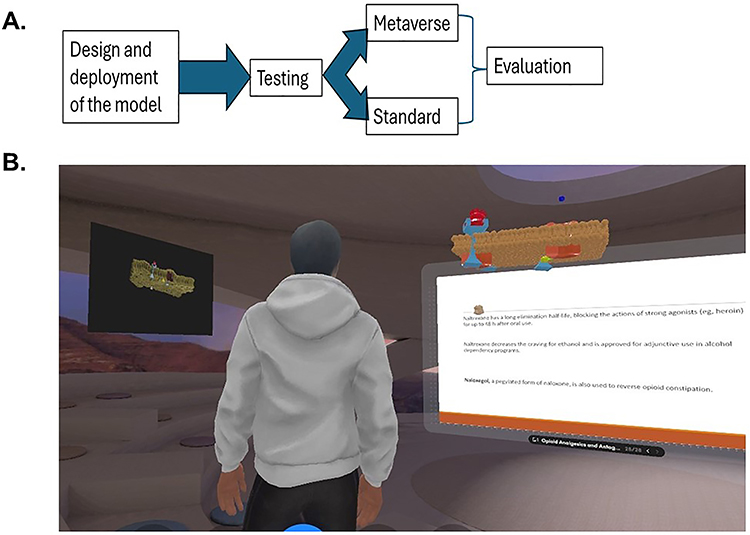 |
Figure 1 Development and application of a metaverse-based education. A conceptual framework of the development and assessment process (A). A metaverse-based classroom was created that included an interactive animated 3D model of opioid receptors (B). |
Materials and Methods
Model Development
To evaluate the utility of using the metaverse and 3D animated models in teaching pharmacology, a 3D animated model of the Mu opioid receptor on the postsynaptic membrane was created using the software, Blender®. This software provides a free and robust platform for developing 3D models, starting from predefined geometric shapes. It was used to build structures for the different components of the receptor and its signaling pathway. Upon completing the various structures, they were combined into a single structure. The animation was then added using keyframe insertion. The final model was then rendered and exported. The exported file was uploaded to the website Spatial.io®, which served as the hosting platform for the metaverse-based lecture. This platform was used to create a virtual classroom that contained the animated 3D model. The platform enables the students to visualize and interact with the model in real-time. Additionally, they can rotate and dismantle the model to explore its different components (Figure 1B).
Design
An experimental mixed-method study was designed to assess the potential of the metaverse as an education platform for teaching pharmacology to undergraduate pharmacy students. The study also assessed participants’ attitudes toward metaverse-based teaching.
Participants
Participants were recruited from an undergraduate pharmacology course at the University of Sharjah, Sharjah, UAE. Participants were provided with a description of the study design, and participation was entirely voluntary. The participants were divided into two groups based on their registered classes. The topic of the lecture in both groups was the pharmacology of opioids. The first group was taught using conventional face-to-face lecturing at a standard university hall (Standard). The other group was invited through a link to join the metaverse-based virtual classroom (Metaverse). Additionally, the virtual classroom included the same PowerPoint presentation used to tutor the standard group (Figure 1A). Students in the metaverse group were given the choice to join using their mobile phones, tablets, computers, or virtual reality headsets, depending on preference and availability. The same instructor gave the lecture to both groups to control instructor-related variations. Additionally, the instructor was trained in using a virtual reality headset during the lecture.
Both groups were asked to complete a quiz developed to measure baseline knowledge retention within 24 hours after taking the lecture. The quiz included multiple choice questions on the types of opioid receptors, opioid receptor signaling, side effects, and classes of opioids. The total quiz score and the time required to complete the quiz were collected and compared between the two groups. The time required to finish the assessment was considered as a surrogate marker for exam difficulty. Additionally, the metaverse group was asked to complete a survey that assessed their attitudes and satisfaction with the metaverse-based learning. The survey used a 5-point Likert ranging from strongly disagree=1 to completely agree=5. The survey included items on the ability to follow the lecture’s content, the understandability, the extent of engagement, the subjectively perceived stress during the lecture, and whether they would choose a metaverse-based education over conventional teaching methods if given a choice. The questionnaire was prepared based on similar literature and validated through a panel of experts. Finally, participants were asked to provide feedback on their perceived strengths and weaknesses in using the metaverse for pharmacology education. This was made by asking two questions: “Based on your experience in the metaverse lecture, what are the main advantages of metaverse based learning?” and “Based on your experience in the metaverse lecture, what are the main disadvantages of metaverse based learning”.
Statistical Analysis
Responses to the qualitative part were analyzed using thematic analysis according to Braun and Clarke’s six-step framework: 1. familiarization with data, 2. generating initial codes, 3. searching for themes, 4. reviewing themes, 5. defining and naming themes, and 6. producing the report.28 Coding was conducted manually by the researchers, and discrepancies were resolved through discussion to ensure consistency.
To enhance rigor and trustworthiness, we employed several strategies:
1. Triangulation: Two researchers independently coded the data and compared interpretations.
2. Audit Trail: Detailed documentation of coding decisions and theme development was maintained. 3. Reflexivity: Researchers reflected on potential biases throughout the analysis process.
Demographic data were collected from the participants, including their gender and age and reported as means (±SD) or frequencies (n, %). The satisfaction survey results were compared across the genders using a chi-square test. Differences between test scores and time required to finish the assessment were compared using student’s t test. A p-value of less than .05 was considered significant. All statistical analyses were performed using SPSS, version 24 (IBM).
Results
The current study recruited 98 students, distributed between those in the metaverse-based teaching group and the conventional teaching group (48% vs 52%). The average age of the participants was 21.3 (SD = 0.5), with the majority being female (85.7%). There was no statistically significant difference in age or gender distribution between the study arms. The full demographic data of the participants are provided in Supplementary Table 1.
In this study, students in the metaverse-based education had higher scores on the knowledge retention test (3.3 vs 2.6; p < 0.0001) than the conventional teaching group (Figure 2A). Additionally, the metaverse-based group required less time to complete the test than the other group (4.8 minutes vs 5.3 minutes; p = 0.034) (Figure 2B). The satisfaction survey showed that 22 (50%) participants reported a better ability to follow the metaverse-based lecture compared to the conventional lecture, with 10 (20%) participants reporting the opposite. Additionally, more than half of the participants reported that the metaverse-based lecture was more engaging (65.9% vs 34.1%). The students’ reported experiences and attitudes in the satisfaction survey were similar between males and females (Supplementary Table 2). Counterintuitive, a sizable proportion of the participants reported neutral responses to the attitudes and satisfaction survey. This proportion was the highest for the question asking about the technical ease of joining the metaverse based lecture (19 participants, 43.18%).
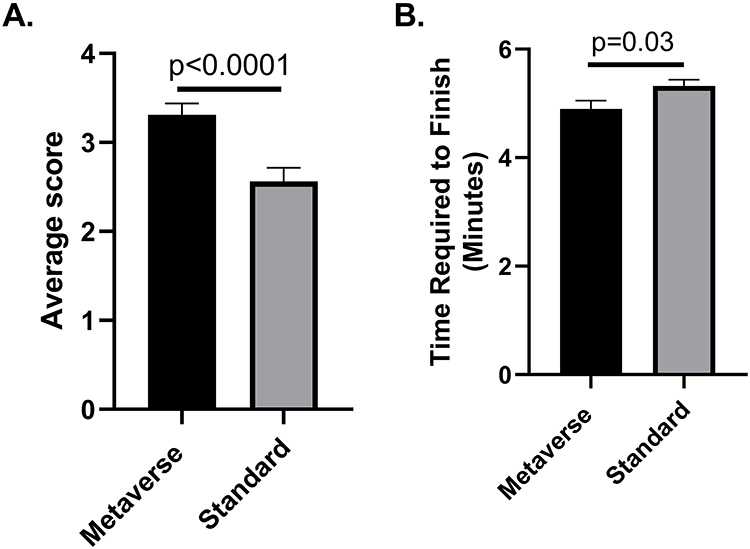 |
Figure 2 The effect of metaverse-based teaching on learning outcomes. Students in the metaverse-based group scored higher in knowledge retention (A) and required less time to complete the assessment (B). |
Responses to the open-ended questions indicated a generally positive experience with metaverse-based education. The majority of the responses reported that the engaging nature and the ability to interact with the model were the main strengths of this method. On the other hand, the main weakness was the technical difficulties of joining the lecture and the power- and resource-intensive nature of the platform (Table 1).
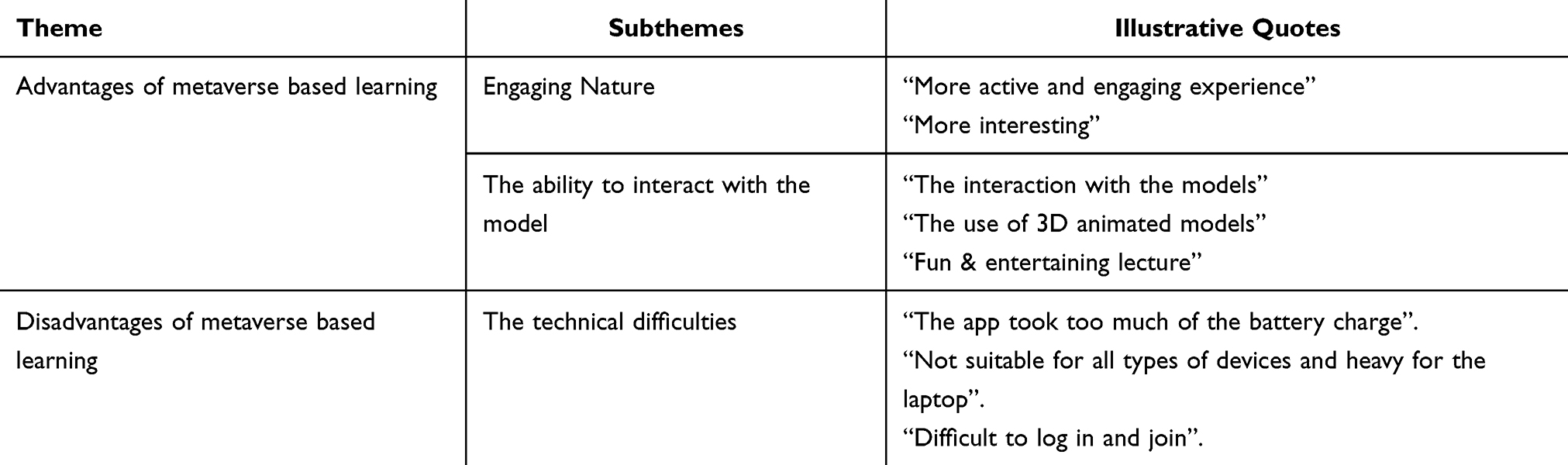 |
Table 1 Themes and Representative Quotes from Qualitative Responses |
Discussion
The data from this study showed a positive effect of using metaverse-based sessions to teach pharmacology among undergraduate pharmacy students. This positive effect was demonstrated by a higher score on the knowledge retention test and a shorter time to complete the test. Furthermore, participants reported a positive attitude toward using the metaverse as an educational platform.
Our findings showed a positive effect of using the metaverse on knowledge retention. This finding is consistent with the findings from previous studies that assessed the use of immersive VR in teaching health sciences.2,3,6,12 Noteworthy, these studies used different settings to facilitate the interaction between the learners and the models on an individual basis.2,12 Although interesting, the sole use of these devices lacks the interactive aspect of the teaching process, in which learners can communicate with each other and the instructor in real-time. In our study, using the metaverse platform enabled a combined experience where learners could interact dynamically with the model under study and communicate simultaneously with other learners and the instructor. This setting is expected to enhance the learning experience and allow for cross-boundary learning activities. To the best of my knowledge, this study is the first systematic assessment of the potential utility of the metaverse in teaching pharmacology to health sciences students in general and pharmacy students in particular.
Previous studies’ data demonstrated a positive student experience with using immersive VR in teaching health sciences students.2,12 Kim et al reported that the use of VR in teaching pharmacology was perceived as an efficient method that would be recommended to other peers among medical students.12 Similarly, Hanson et al reported similar satisfaction rates between using 3D and conventional teaching methods of Pharmacology among nursing students.2,3 Furthermore, Richardson et al reported a perceived better understanding, enthusiasm and enjoyment among students following the use 3D VR models in teaching drug receptor interaction for pharmacy students.27 Similarly, our data suggests a positive attitude among students toward the use of the metaverse as an educational platform. Our findings are showing a perceived more engaging nature and easier to understand content as compared to conventional teaching.
The results showed an interesting pattern regarding the neutral responses among the responses. The proportion of participants who responded with neutral responses ranged from 20% to 44% on different questions. Interestingly, this pattern was observed in all questions. Better understanding of the causes and implications of this pattern requires a larger population with more questions to identify its causes and implications.
Responses to the qualitative part of the study offer an interesting aspect of the participants’ experience. Participants reported a more engaging and interesting method of learning that is very close to natural standard experience. This engaging nature is consistent with published literature on the use of VR and 3D models in education. At the same time, the resources intensive nature of the software is an essential point that needs to be considered in future assessments and possible adoption.
This study has several limitations. First, the study was conducted in a single institution with a relatively small number of participants, which may limit our ability to generalize the findings. Second, we did not have control over the type of device used to access the lecture, which may have affected the overall experience of the participants. To address this limitation, a follow-up study is being conducted in which the metaverse-based group uses VR headsets in a more controlled setting.
Conclusion
The use of metaverse-based teaching in pharmacology offers a potentially effective method to increase knowledge retention and understanding among undergraduate students.
Data Sharing Statement
The data is available as supplementary data files.
Ethical Approval
This study protocol was approved by the Institutional Review Board of the University of Sharjah, Sharjah, UAE (Approval # REC-25-01-27-02-F). Written informed consents were obtained from all study participants including publication of anonymized responses. The participants’ written informed consent included publication of anonymized responses/direct quotes.
Funding
This study was supported by Chancellor’s Teaching Excellence and Innovation Grant (TEIG03), University of Sharjah, Sharjah, UAE, to AA. In addition, Qatar University funded the publication of this article.
Disclosure
The authors report no conflicts of interest in this work.
References
1. Banos JE, Blanco-Reina E, Bellido-Estévez I, et al. Beyond lectures and practical courses: teaching pharmacology using imaginative pedagogical tools. Pharmacol Res. 2024;202:107130. doi:10.1016/j.phrs.2024.107130
2. Hanson J, Andersen P, Dunn PK. Effectiveness of three-dimensional visualisation on undergraduate nursing and midwifery students’ knowledge and achievement in pharmacology: a mixed methods study. Nurse Educ Today. 2019;81:19–7. doi:10.1016/j.nedt.2019.06.008
3. Hanson J, Andersen P, Dunn PK. The effects of a virtual learning environment compared with an individual handheld device on pharmacology knowledge acquisition, satisfaction and comfort ratings. Nurse Educ Today. 2020;92:104518. doi:10.1016/j.nedt.2020.104518
4. Rayamajhi S, Machin A, Breen C, et al. Quality and impact of pharmacology digital simulation education on pre-registration healthcare students: a systematic literature review. Nurse Educ Today. 2024;140:106295. doi:10.1016/j.nedt.2024.106295
5. Gharib AM, Peterson GM, Bindoff IK, Salahudeen MS. Potential barriers to the implementation of computer-based simulation in pharmacy education: a systematic review. Pharmacy. 2023;11(3):86.
6. Veer V, Phelps C, Moro C. Incorporating mixed reality for knowledge retention in physiology, anatomy, pathology, and pharmacology interdisciplinary education: a randomized controlled trial. Med Sci Educ. 2022;32(6):1579–1586. doi:10.1007/s40670-022-01635-5
7. Wang Y, Li C, Qu L, et al. Application and challenges of a metaverse in medicine. Front Robot AI. 2023;10:1291199. doi:10.3389/frobt.2023.1291199
8. Locurcio LL. Dental education in the metaverse. Br Dent J. 2022;232(4):191. doi:10.1038/s41415-022-3990-7
9. Kye B, Han N, Kim E, et al. Educational applications of metaverse: possibilities and limitations. J Educ Eval Health Prof. 2021;18:32. doi:10.3352/jeehp.2021.18.32
10. Sandrone S. Medical education in the metaverse. Nat Med. 2022;28(12):2456–2457. doi:10.1038/s41591-022-02038-0
11. Zhang X, Chen Y, Hu L, et al. The metaverse in education: definition, framework, features, potential applications, challenges, and future research topics. Front Psychol. 2022;13:1016300. doi:10.3389/fpsyg.2022.1016300
12. Kim K, Xie N, Hammersmith L, et al. Impact of virtual reality on pharmacology education: a pilot study. Cureus. 2023;15(8):e43411. doi:10.7759/cureus.43411
13. Sendra-Portero F, Lorenzo-álvarez R, Rudolphi-Solero T, et al. The second life metaverse and its usefulness in medical education after a quarter of a century. J Med Internet Res. 2024;26:e59005. doi:10.2196/59005
14. Suh W, Ahn S. Utilizing the metaverse for learner-centered constructivist education in the post-pandemic era: an analysis of elementary school students. J Intell. 2022;10(1):17. doi:10.3390/jintelligence10010017
15. Cho IY, Yun JY, Moon SH. Development and effectiveness of a metaverse reality-based family-centered handoff education program in nursing students. J Pediatr Nurs. 2024;76:176–191. doi:10.1016/j.pedn.2024.02.005
16. Ghaempanah F, Moasses Ghafari B, Hesami D, et al. Metaverse and its impact on medical education and health care system: a narrative review. Health Sci Rep. 2024;7(9):e70100. doi:10.1002/hsr2.70100
17. De Gagne JC, Randall PS, Rushton S, et al. The use of metaverse in nursing education: an umbrella review. Nurse Educ. 2023;48(3):E73–E78. doi:10.1097/NNE.0000000000001327
18. Moro C. Utilizing the metaverse in anatomy and physiology. Anat Sci Educ. 2023;16(4):574–581. doi:10.1002/ase.2244
19. Werner H, Ribeiro G, Arcoverde V, et al. The use of metaverse in fetal medicine and gynecology. Eur J Radiol. 2022;150:110241. doi:10.1016/j.ejrad.2022.110241
20. Gonzalez-Romo NI, Mignucci-Jiménez G, Hanalioglu S, et al. Virtual neurosurgery anatomy laboratory: a collaborative and remote education experience in the metaverse. Surg Neurol Int. 2023;14:90. doi:10.25259/SNI_162_2023
21. Skalidis I, Muller O, Fournier S. CardioVerse: the cardiovascular medicine in the era of metaverse. Trends Cardiovasc Med. 2023;33(8):471–476. doi:10.1016/j.tcm.2022.05.004
22. Cho S, Kazantzis N, Baek WH, et al. Comparing counseling outcome for college students: metaverse and in-person approaches. Psychother Res. 2023;33(1):1–14. doi:10.1080/10503307.2023.2177942
23. Patil A, Szepietowski JC, Goldust M. Metaverse in dermatology speciality advancement: future to embrace. Dermatology. 2024;240(1):178–180. doi:10.1159/000534515
24. Petrigna L, Musumeci G. The metaverse: a new challenge for the healthcare system: a scoping review. J Funct Morphol Kinesiol. 2022;7(3):63.
25. Gutierrez-Cirlos C, Bermúdez-González JL, Carrillo-Pérez DL, et al. Medicine and the metaverse: current applications and future. Gac Med Mex. 2023;159(4):280–286. doi:10.24875/GMM.M23000795
26. Massetti M, Chiariello GA. The metaverse in medicine. Eur Heart J Suppl. 2023;25(Suppl B):B104–B107. doi:10.1093/eurheartjsupp/suad083
27. Richardson A, Bracegirdle L, McLachlan SIH, et al. Use of a three-dimensional virtual environment to teach drug-receptor interactions. Am J Pharm Educ. 2013;77(1):11. doi:10.5688/ajpe77111
28. Braun V, Clarke V. Using thematic analysis in psychology. Qual Res Psychol. 2008;3(2):77–101. doi:10.1191/1478088706qp063oa
 © 2026 The Author(s). This work is published and licensed by Dove Medical Press Limited. The
full terms of this license are available at https://www.dovepress.com/terms
and incorporate the Creative Commons Attribution
- Non Commercial (unported, 4.0) License.
By accessing the work you hereby accept the Terms. Non-commercial uses of the work are permitted
without any further permission from Dove Medical Press Limited, provided the work is properly
attributed. For permission for commercial use of this work, please see paragraphs 4.2 and 5 of our Terms.
© 2026 The Author(s). This work is published and licensed by Dove Medical Press Limited. The
full terms of this license are available at https://www.dovepress.com/terms
and incorporate the Creative Commons Attribution
- Non Commercial (unported, 4.0) License.
By accessing the work you hereby accept the Terms. Non-commercial uses of the work are permitted
without any further permission from Dove Medical Press Limited, provided the work is properly
attributed. For permission for commercial use of this work, please see paragraphs 4.2 and 5 of our Terms.