
Back to Journals » Journal of Healthcare Leadership » Volume 17
Evaluating Leadership Training for Managers in Healthcare: Focusing on Effective Communication
Authors Oetjen LA  , Connor C, Werneburg B, Stevens S, Kane S, Elias R
Received 18 March 2025
Accepted for publication 27 August 2025
Published 6 November 2025 Volume 2025:17 Pages 649—664
DOI https://doi.org/10.2147/JHL.S528912
Checked for plagiarism Yes
Review by Single anonymous peer review
Peer reviewer comments 4
Editor who approved publication: Dr Pavani Rangachari
Laurel Ann Oetjen,1,2 Chad Connor,1 Brooke Werneburg,1,2 Sheila Stevens,1 Sunanda Kane,3 Richard Elias1,3
1Office of Experience Training, Education & Coaching, Mayo Clinic, Rochester, MN, USA; 2Mayo Clinic College of Medicine and Science, Mayo Clinic, Rochester, MN, USA; 3Department of Medicine, Mayo Clinic, Rochester, MN, USA
Correspondence: Laurel Ann Oetjen, Email [email protected]
Introduction: Effective leadership communication is essential in healthcare, particularly for mid-level managers who serve as a bridge between frontline staff and institutional leadership. Despite its importance, leadership communication training may be deficient in healthcare education. These descriptive statics aimed to evaluate the implementation and impact of a structured leadership communication program designed to enhance mid-level managers’ skills in communication, psychological safety, and team dynamics at the Mayo Clinic.
Methods: A series of leadership development courses were developed and facilitated by the Experience Training, Education, and Coaching (XTEC) unit, focusing on evidence-based communication strategies. Three primary courses—CORE Communication Skills for Leaders, Navigating Team Dynamics, and Psychological Safety and Transparency—were conducted virtually. Participants completed post-course surveys assessing the effectiveness of training, confidence in skill application, and overall satisfaction. Additionally, an individual coaching program was evaluated using participant feedback. Data was collected from January 2021 to October 2023 using voluntary, anonymous surveys, with descriptive statistics used for analysis.
Results: From September 2019 to October 2023, a total of 2,297 healthcare managers participated in at least one leadership course, with 189 attending all three. Survey results were recorded starting in January 2021 and demonstrated high satisfaction and confidence in applying learned skills. 95% of CORE course participants reported achieving the learning objectives, while 97% of Navigating Team Dynamics attendees and 93% of Psychological Safety and Transparency participants stated they would recommend the training. One-on-one coaching was well received, with 97% of participants expressing confidence in maintaining learned strategies.
Conclusion: The findings highlight the need for leadership communication training among mid-level healthcare managers. High participation rates and positive feedback indicate substantial demand and perceived value. The study underscores the importance of experiential learning and guided practice in leadership development. Expanding training opportunities, integrating advanced topics, and exploring technological engagement strategies can further support leadership growth.
Keywords: communication skills training, leadership communication, coaching, health care
Introduction
Leadership in Healthcare
Healthcare is complex and rapidly changing; leading a team in such an environment is challenging. Adapting to the evolving needs of patients, new processes, workforce turnover, and continuous technological change make effective managerial and leadership skills key to guiding the success of a healthcare unit. To be effective managers, leaders must have communication skills to inform, direct, and inspire subordinates, and liaise with superiors. Leadership communication skills promote trust, empathy, feedback exchange and appreciation, which drive staff satisfaction and improve patient outcomes.1–3
New managers can find themselves getting promoted to positions of leadership without formal leadership education.4,5 Some healthcare institutions report findings such as adverse culture, reduced motivation, hindered learning, and poor patient outcomes.6 Although education is available it often is found with the range of additional degrees or certification programs without being offered internally.7 Weaknesses in communication skills became more apparent by the upheaval of the COVID-19 pandemic, which amplified communication challenges for managers. Moving from mostly in-person interaction to virtual or other type interactions, along with the increased emotional support needs of staff, increased workload, and new working environments, underscored the vital importance of effective leadership communication, both in-person and via remote technology.8
The mid-level manager is the communications conduit from the institution to staff at the front line and is involved in staff-to-patient interactions. This manuscript describes the implementation, evolution, and evaluation of a leadership communication program implemented at the Mayo Clinic, a large tertiary academic medical center, with a focus on mid-level staff managers working in clinical and ancillary services. Throughout this narrative review, the initial stages, evolution, and evaluative process will be defined in the hopes of guiding others in creating their own leadership development opportunities utilizing the successes and lessons learned.
Needs Assessment and Background
Leadership training programs are rarely a component of medical or healthcare education, but have been shown to increase skills in adaptability, initiative, communication, authenticity, presence, humility, ability to learn from mistakes, grit and resilience, competence, and followership.9,10 Engaging individuals in leadership training can also positively impact burnout prevention, engagement, productivity, and satisfaction in the workplace.11
Mayo Clinic is known for its world class medical care and engagement of patients, family, and staff. At the same time, it was recognized that even as a world leader in healthcare, all individuals in leadership positions can benefit from ongoing development of leadership communication skills. In order to address this, a leadership development opportunity was noted, and leadership communication efforts were identified.
The Experience Training, Education and Coaching (XTEC) unit consists of certified coaches specializing in interpersonal communication skills for clinicians, leaders, ancillary staff, and patients. During the COVID-19 pandemic, XTEC evaluated professional development resources for leaders at our organization. They found existing resources for high-level leaders but identified a gap for mid-level managers in areas such as reflective listening and engagement strategies. XTEC advisors developed courses focused on evidence-based empathic communication strategies to bridge this gap and enhance human connections based on literature review and communication models and goals in use at Mayo Clinic. Although the day-to-day operations of these mid-level managers can vary depending on their role, the main objectives for each of them include supervisory responsibilities to a varying number of individuals, department logistical and systems tasks, acting as a liaison between frontline staff and upper leadership, management of personnel issues, and ongoing development of their staff. Each department also has additional responsibilities which may include professional and quality improvement projects, clinical responsibilities, institution wide projects, and committee engagements. These tasks all require that our mid-level managers have skills in communication that can help to empower employees, motivate them towards organizational goals, and develop others.12 Mid-level managers are often associated with the human tasks or skills within management.6,12
This study was done in conjunction with program evaluation and updates to demonstrate the effectiveness of leadership communication education. Keeping in mind the limited research on leadership education, specifically associated with allied health staff, and the importance of leadership communication skills with various healthcare fields, we felt it was important to report the results broadly and contribute to the research that supports our hypothesis that mid-level managers who engage in leadership communication-based education, as measured through self-assessment and self-reflection methods following course completion will report increased confidence in communication skills.
Theoretical Framework
The framework for this project was developed through a review of literature and the use of the Mayo Clinic Mayo Model of Communication (formerly the Experience Model of Communication, XMOC).13 This evidence-based model is specifically tailored to meet the communication goals of an integrated medical center. XMOC identifies the core skills necessary for effective leadership communication: mindful presence, empathy, human connection, and transparency (Figure 1). In recent years, with the change from XMOC to the Mayo Model of Communication, additional research has been added to the model to support increased diversity in communication, as well additional contexts. The original model focused more on clinician or healthcare worker to patient communication and in the recent update additional literature reviews were done to include diverse population communication, generational communication, and leadership specific communication skills. The original skills serve as the project’s foundation as much of the recent updates were done after these programs were launched. The model itself pulls from several other communication models and strategies and integrates these into one larger model that supports leadership, healthcare specific, and patient-centered communication. Although not specifically a part of the model, it does draw on other communication strategies commonly used in healthcare to help provide a framework to the clinicians, managers, and allied health staff that utilize it.
 |
Figure 1 Mayo (Experience) Model of Communication. |
Mindful presence involves being fully present, self-aware, and emotionally regulated. Empathy in leadership is essential for understanding, perspective-taking, and effective listening. Building human connections is vital for staff satisfaction and organizational commitment. Transparency fosters psychologically safe work environments by encouraging knowledge sharing, amplifying voices, and openly discussing errors and challenges.14 The curriculum outlined herein aims to enhance leaders’ skills in these four areas. Details about course objectives, delivery methods, and communication elements can be found in Table 1.
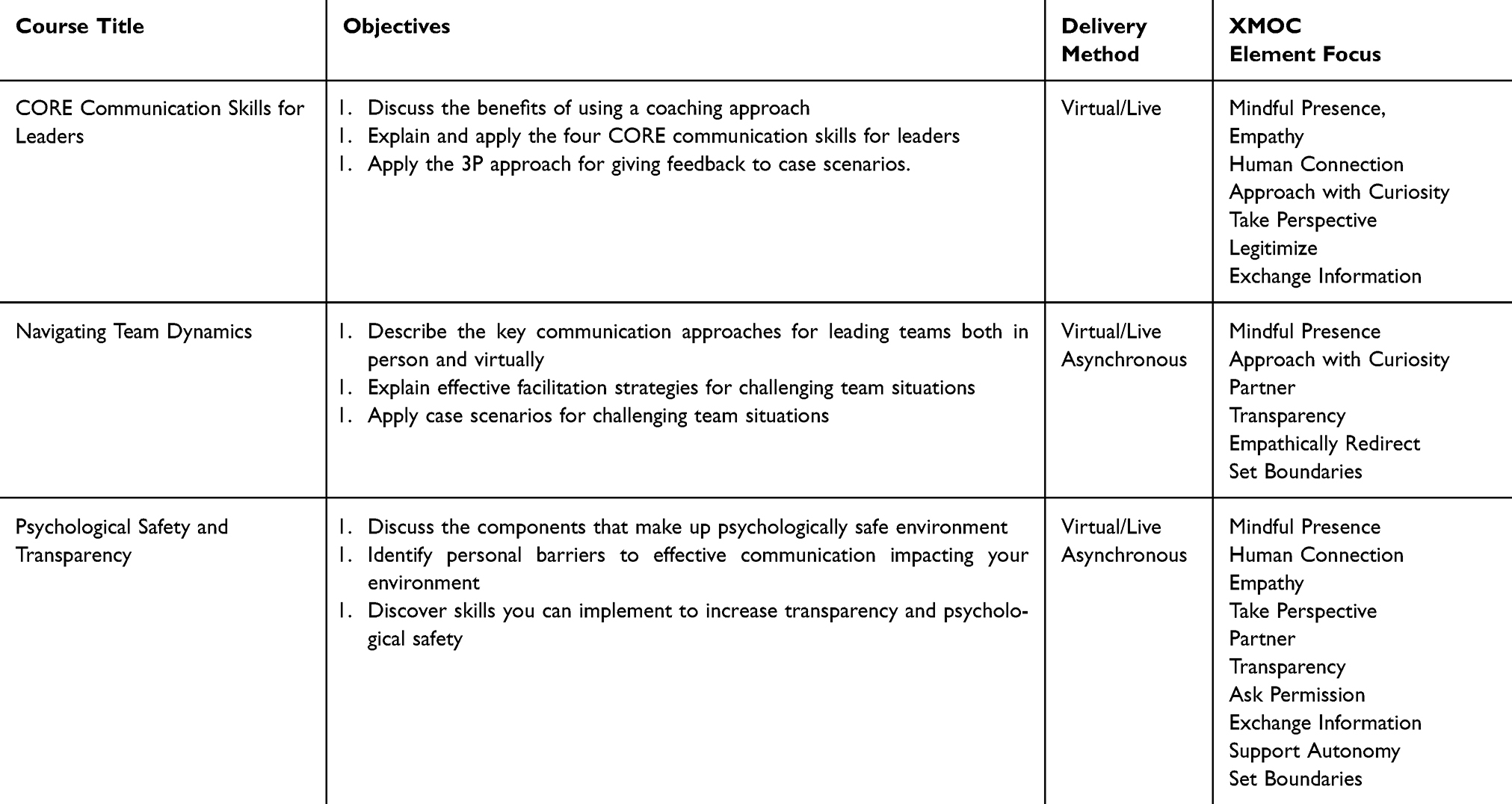 |
Table 1 Course Objectives, Delivery Method, Communication Elements for Each Leadership Course |
One-on-one coaching was offered to reinforce learned skills. Coaching is a crucial tool for developing leadership skills. It often includes individualized development plans tailored to the learner’s needs and offers continual feedback to foster skill growth.15 A coaching mindset helps leaders empower change, manage behaviors, and build confidence.16 Effective coaches engage, listen, and collaborate, thereby fostering growth in their coaching role.16,17
CORE Communication Skills for Leaders
CORE Communication Skills for Leaders (CORE) is a communication course focusing on developing human connections through self-awareness, curious listening, open-ended questions, and the giving and receiving feedback. This live, virtual, facilitated program aims to engage participants and reinforce their experiences. During the 60-minute course, leaders discuss and learn about the CORE approach, which includes reflective listening, perspective-taking, and empowerment strategies. Participants explore effective feedback conversations, reflect on how they create human connections with their staff, and apply reflective listening skills to common leadership scenarios. The interactive exercise provides a collated collection of participant responses in a digital register, providing a chance to learn from collective perspectives and from the facilitator.
A key principle of curriculum development is that it expands and changes on the basis of the needs of the managers who participate. After course completion, participants identified key areas for future communication topics, including navigating team dynamics and conflict, coaching staff for growth and accountability, building trust within teams, and effectively communicating change. This feedback, aggregated over a year, was used to plan future sessions.
Navigating Team Dynamics
Navigating Team Dynamics is a second leadership course offered virtually and facilitated by XTEC advisors. This course delves into managing team dynamics, including strategies for engaging reticent individuals, quiet groups, dominant group figures, combating groupthink, and redirecting unfocused groups. The key outcomes include describing specific communication approaches for leading teams both virtually and in-person, explaining group/team facilitation strategies, and applying these skills to various case scenarios.
Initially, Navigating Team Dynamics was offered asynchronously through an online learning management platform (Articulate Global, LLC, New York, NY) as a self-paced module. This module examined elements of team dynamics and encouraged participants to reflect on applying these concepts to their own leadership circumstances. While the asynchronous course was highly subscribed to, the lack of participant discussion was identified as a limitation. Consequently, the course was adapted to be offered live while still remaining virtual. Initially run once per month, the course was quickly oversubscribed, leading to an increase in offerings to twice per month and necessitating the training of additional advisors to teach the content.
Psychological Safety and Transparency
Manager communication is intrinsically linked to the concepts of psychological safety and transparency. If not executed correctly, it can lead to dysfunction within a workgroup and deteriorated and unsafe patient care. Creating a culture where transparency and continuous growth are encouraged, and where individuals feel comfortable discussing difficulties, near misses, and mistakes, can enhance efficiency, effectiveness, and foster learning and development.14,18 This program was piloted for six months, during which feedback was reviewed, and the presentation and content were adjusted to better meet the needs of manager participants. The primary objectives of this course include discussing the components of a psychologically safe and transparent environment, identifying personal barriers that may influence this environment, and implementing skills to increase transparency and psychological safety.
Leadership Series and Custom Offerings
Learner enthusiasm to complete the courses as a series has developed into a flexible Leadership Series program. Work groups can select content of relevance to their work area and the modes of presentation to managers. These courses can be offered over a series of days, or consecutively on a single day. Other resources such as quick reference guides, course summary guides, and individual coaching for managers are available to facilitate sustainment.
Leadership Coaching
Leadership coaching has been offered to any mid-level manager or above who is voluntarily willing to engage in goals focused on improvements in communication. All XTEC staff who provide coaching services are certified coaches within various fields. Coaching is offered virtually or face-to-face and is done in a way that allows for flexibility for the leaders. On average, coaching engagements last from five to eight sessions, happening anywhere from weekly to every two or three months, depending on the schedule of the individual. Coaching engagements start with a 30-minute discovery meeting where logistics and goals are discussed and continue based on these factors. All coaching clients are voluntary, and all engagements are kept confidential. Following the conclusion of a coaching engagement all clients are sent a survey to provide feedback.
Currently 77 individuals have gone through and completed coaching engagements with XTEC. Additional clients are engaged in the process at present and so are not included in the findings as they have not completed any of their post-coaching surveys.
Sustainment Efforts
Ongoing learning is key to leadership success.19 To maintain and extend education, sustainment offerings in the form of podcasts and newsletters have been implemented.
Podcasts
The Leadership Podcast Series was developed to continue to reach leaders across the enterprise using a modality that is familiar, accessible, and efficient. Each episode features facilitated interviews with leaders from various levels and areas of the enterprise with the aim of learning through experience, pearls, and case studies with new episodes released monthly. Interviewees are identified through recommendations from staff, patient comments and scores, and through engagement in learning activities.
Newsletter
Newsletters can be an effective way to reach multiple individuals in a quick, streamlined manner.20 The newsletter is sent via Email to course attendees using an opt-out model and is designed to be read in 10 minutes or less, with actionable skills to apply in extension of courses. The newsletter is distributed monthly with a rolling distribution list of course participants. Although the goal is to offer sustainment for the information taught in the courses, extension information, outside supportive links and research, new course offerings, and other media are included in some issues. Due to the observation that leaders were forwarding newsletter information to their staff, a self-subscribe option was added, to allow individuals unable to attend the live courses to gain usable insights into leadership development.
Ethics
This study was exempt from Institutional Review Board review. The institutional review board reviewed the content including marketing material, post-workshop/training session evaluations, consent information, and other follow up material and determined that this activity was exempt from review. All survey respondents are employees of Mayo Clinic and agree to participate in survey-based course evaluation methods for feedback as a part of their employment. Additionally, all surveys are voluntary and confidential. All participants are aware that information and data obtained from survey-based feedback responses, including but not limited to comments and written responses, may be utilized for program evaluation and update, research, and publications. Participating in the survey indicates staff consent and are aware that the surveys are utilized for course improvement and research. Surveys were conducted on a voluntary, anonymous basis with no compensation for completion. The surveys used were developed strictly for use with these courses and were not validated, however later surveys were reviewed by an internal group that specializes in research and survey design. Additionally, all surveys were reviewed by leadership within XTEC and approved. Surveys for Navigating Team Dynamics and Psychological Safety and Transparency courses were also reviewed by the internal research department and modified based on recommendations from research staff. Due to the confidential nature of the surveys no demographic information was obtained.
Materials and Methods
All participants of the CORE Communication Skills for Leaders course, from January 2021 to April 2022, were invited to participate in a post-course survey assessing effectiveness, confidence, and skills acquisition. CORE Communication Skills for Leaders was launched earlier, in September of 2019 and participant information was recorded between that time and January of 2021. No surveys were completed until January of 2021. This survey aimed to evaluate the course’s impact on learners, and data collection concluded upon reaching the target of 180 respondents. The target of 180 individuals was identified as the level of respondents expected during the pilot phase and at this point no further surveys were recorded as this initial survey was initially only done for the purpose of evaluating the pilot.
Surveys for the Navigating Team Dynamics and Psychological Safety and Transparency courses, which were introduced after CORE, were collected from May 2022 to October 2023. These surveys do continue to be a part of ongoing offerings, however data collection for this study concluded in October of 2023. Participants could access these surveys through QR codes or direct links provided at the end of each session, as well as through an embedded link in the Email invitations. All course attendees were eligible to complete these post-course surveys.
The individual coaching program was evaluated through responses collected between May 2022 and October 2023. To ensure anonymity and voluntary participation, once a coaching session concluded, an XTEC coordinator not involved in the coaching sent an invitation to the participant to complete the evaluation questionnaire. This invitation included a hyperlink to the questionnaire, which comprised 5-point Likert-scale items assessing various aspects of the coaching service. These aspects included progress toward goals, the skills of the coach, the observation process (if applicable), and overall experience. Additionally, the questionnaire sought clients’ perspectives on their commitment to maintaining change, confidence in maintaining those changes, the level of disruption the service may have caused to their practice, and the likelihood of recommending the service to a colleague.
Questionnaire Design
The questionnaire for the CORE course included items designed to assess the degree to which participants felt the learning objectives were met, their levels of satisfaction with the facilitator’s abilities and course content, the alignment of the content with institutional values, and the utility of the training to their jobs. These questions were initially utilized during the pilot phase and were asked to identify and gain insight into the course itself. This information was found to be useful in development of other courses and assisted in identifying outcomes of this particular course as noted. Following the COMPLETION of this study, the survey was again introduced to this course to assist in ongoing evaluation of the content and course design.
For the Navigating Team Dynamics (Table 2) and Psychological Safety and Transparency courses, introduced after CORE, a different questionnaire design was used. Known as the XMOC program evaluation (see Table 3), this questionnaire was given post-training to assess learners’ confidence in using newly acquired skills and their ability to demonstrate the four XMOC principles. Designed for health professionals, the items in both questionnaires were crafted with accessible language to ensure clarity and effectiveness. This is the same questionnaire that was then utilized for Psychological Safety and Transparency.
 |
Table 2 Evaluation Responses from the Course, Navigating Team Dynamics |
 |
Table 3 Evaluation Responses from the Course, CORE Communication Skills for Leaders |
Results Analysis
Participant responses for each course and the coaching program were collected, in English, through an online tool (Qualtrics, Provo, UT). At the end of each session, facilitators requested participants to complete the survey using a QR code. Additionally, survey links were included in the Email invitations to the courses. Descriptive statistics were used to generate tables and bar graphs within Qualtrics to aid in analyzing item responses. Tables 2–4 show the questions, response rate, survey timeline, and total number of completed responses for each leadership course and the coaching program. As an additional measure, de-identified attendance records were organized using Microsoft Excel (Microsoft, Redmond, USA) to classify individuals who attended one, two, or three classes. The goal of this was to identify how many individuals attended more than one class with the thought that this may indicate satisfaction with the course offerings at XTEC. As a part of all of the surveys, qualitative, free-text comments were optional. These qualitative impressions and opinions from course participants were collected and organized thematically, utilizing key phrases and statements with representative quotations presented in Tables 5. These themes were identified broadly by the researchers, and the comments were then coded and separated utilizing Microsoft Excel (Microsoft, Redmond, USA). The researchers then utilized these themes to identify areas of improvement and overall satisfaction or dissatisfaction with the courses. This information was initially utilized to help guide improvements to the courses and development of additional course content. For the purpose of the study, this information is noted as a part of the overall impressions with the courses and to assist in identifying and codifying outcomes.
 |
Table 4 Evaluation Responses from Individual Coaching Program |
Results
The three leadership courses, CORE Communication Skills for Leaders, Navigating Team Dynamics (synchronous and asynchronous), and Psychological Safety and Transparency, had a total of 2297 attendees from September of 2019 through October of 2023. Note that the attendance of courses was recorded starting in September of 2019, although no formal evaluative data was recorded until January of 2021. One hundred eighty-nine participants attended all three courses, 471 attended two courses, and 1637 attended one course. Although this is not a direct indicator of enjoyment of usefulness of the courses it is important to note that participants voluntarily attended more than one of the courses offered by XTEC on leadership communication.
CORE Communication Skills for Leaders had 180 participants complete the program evaluation questionnaire as a part of the pilot. The evaluation consisted of seven items assessed using a five-point Likert Scale. See Table 3 for details. Ninety-five percent (171/180) of respondents reported that the learning objectives were completely achieved. Eighty-eight percent (158/180) of respondents were very satisfied with the facilitator’s ability to facilitate learning. One hundred percent of respondents identified the training as connecting them to one or more organizational values. Ninety-nine percent (178/180) of respondents agreed or strongly agreed that the course improved the knowledge of their role within the organization and the same percentage agreed or strongly agreed that they would recommend the course to others.
Navigating Team Dynamics had 201 respondents to the program evaluation questionnaire with a response rate of 28% (201/724). Ninety percent (199/201) of respondents reported that they agreed or strongly agreed that they were confident in applying the skills and strategies discussed in the training. Ninety-seven percent (195/201) of respondents would recommend the training to a colleague. As for the items inquiring about the four XMOC principles (mindful presence, empathy, human connection and transparency), similar majorities strongly agreed or agreed that they were more skilled at demonstrating these four XMOC skills after participating in the training (Table 2). The item inquiring about empathy was erroneously omitted from many of the questionnaires completed by participants from the Navigating Team Dynamics course, resulting in fewer responses to this item21 compared to the mindful presence, human connection and transparency items (189, 179, and 182, respectively). This specific item was not included in the original surveys and once noticed was added as soon as possible.
Psychological Safety and Transparency had a 51% response rate (167/329). Eighty-eight percent (147/167) of responding participants reported they were confident in applying the skills and strategies discussed. Ninety-three percent (155/167) of respondents indicated that they would recommend the training to a colleague.
Twenty-nine individual coaching clients responded to the coaching questionnaire [response rate of 38% (29/77)]. All respondents reported satisfaction (Excellent and Good) pertaining to their progress toward goals, the skills of their coach, the observation process, and their overall experience. Ninety-seven percent (28/29) of respondents indicated that they Moderately or Very Much agreed that they are confident in their ability to maintain the changes. Every respondent reported that they Moderately or Very Much agreed that they would recommend the individual coaching service to a colleague.
Subjective Findings
Comments for CORE Communication Skills for Leaders had the notable themes that learned skills can be brought into leadership work immediately and that strategies were relevant and easy to incorporate into work. Navigating Team Dynamics feedback included comments that the content could be better served through a longer course or split into different courses to cover each team dynamics issue in more depth. Participants in Psychological Safety and Transparency identified the engaging discussion and time allotted to discussing topics of relevance to them as notable strengths. Many of the participants who participated in the individual coaching noted that they found it easier to engage in curious inquiries and perspective-taking utilizing the skills taught in coaching sessions. They also noted the increased use of open questions and found they were able to provide feedback and give information more readily based on their coaching experiences. See Table 5 for representative quotes from workshop. Comments from the individual coaching participants can be seen in Tables 6 and 7. These tables address 2 different questions, question 1 (Table 6) asking “What changes have you made as result of your coaching experience?” and question 2 (Table 7) asking “What did you find most helpful about your coaching experience?”
 |
Table 5 Themes and Comments from Workshop Participants |
 |
Table 6 Themes and Comments from Individual Coaching Evaluation Question: “What Changes Have You Made as a Result of Your Coaching Experience?” |
 |
Table 7 Themes and Comments from Individual Coaching Evaluation Question: “What Did You Find Most Helpful About Your Coaching Experience?” |
Discussion
Deficient leadership in healthcare has been shown to contribute to adverse patient outcomes as well as poor staff outcomes including burnout, decreased morale, decreased staff retention, and diminished staff engagement.22–24 Characteristics of effective leaders include good communication skills, ability to establish direction and goals, and motivating and engaging others in the to move towards the direction and goals established.15–17 The Mayo Clinic leadership communication development courses, with a focus on mid-level allied health staff management to address a gap in communications skills training for these leaders. The study aimed to demonstrate that mid-level managers who engage in communication-based leadership courses report increased improvements in their leadership communication as reported through self-reflection and self-assessment methods. This is concordant with research demonstrating the value of communication-based and experiential learning for healthcare leaders. These results are in alignment with research that shows that the integration of evidence-based decision-making and communication strategies assists with positive leadership behaviors and can improve overall team dynamics and psychological safety.
There is evidence that healthcare organizations derive tangible benefit from leadership development programs.25 Quality of leadership of immediate supervisors is associated with important outcomes such as employee burnout and satisfaction.21 A key insight that emerged from this project is that there is a large, unmet demand for leadership training among mid-level managers at the institution. Courses, although voluntary, were rapidly subscribed to, with many prospective attendees added to waiting lists and a sizeable proportion of enrollees attending more than one of the courses. This demand is consistent with research on leadership in medical education showing that physicians and other leaders desire more leadership skills training than they receive.26 This also supports that idea that ongoing development of leadership training, especially for this in mid-level management positions can benefit not only the organization but the people who work there. Because there is a lack of general education in this area it is important to note that hospitals and other healthcare institutions can develop in house training programs, led by individuals who have an understanding of communication strategies, and how they fit within the healthcare system.
Applicability of skills and guided practice, rather than theory, appears to be of principal importance to healthcare managers attending leadership training. This is concordant with research demonstrating the value of work-based and experiential learning for healthcare leaders.27
One-on-one coaching, although resource-intensive, is also highly valued by the managers that participated in our curriculum. Coaching in the healthcare context is known to be effective in promoting goal attainment, leader self-efficacy, resilience, perspective-taking capacity, and competency to lead change so it is unsurprising that managers of clinical areas would derive leadership benefit from personalized coaching.28,29
Limitations and Future Opportunities
Several limitations should be considered. These courses were designed for mid-level managers in healthcare settings, so their utility for other leadership levels or industries is unknown. We also do not know the impact of mandatory versus voluntary participation in such courses. The nature of the study and surveys being done voluntarily is also a limitation that needs to be considered as those who respond could be biased either positively or negatively. Additionally, because demographic information was not obtained as a part of the survey there is a lack of understanding as to the diversity of the group being surveyed. This may limit the generalizability of the research. It is important to note that the courses and offerings were provided to all Mayo Clinic sites, including Minnesota, Wisconsin, Florida, and Arizona, and that the inclusion criteria was being an employee of Mayo Clinic. Because of these factors it does stand to reason that a fairly diverse population of individuals attended the courses. As there is a lack of ability to follow up longitudinally this may also impact validity of long-term outcomes. Additionally, the training was conducted virtually, and the effectiveness of in-person sessions remains untested. Sample sizes for the courses, and specifically for the coaching aspect, should also be considered as they are small in comparison to other research studies. Future research should explore these variables, including offering programs outside of healthcare, focusing on executive leadership, comparing virtual and in-person training benefits, and the ability to scale these sessions to smaller institutions.
Further development of leadership content is crucial. Expanding the current courses to include giving and receiving feedback, team development, engagement, difficult conversations, and change management is a priority. Artificial Intelligence is being explored to assist with scripting tasks. Additionally, AI-driven interactions, through the use of generative AI and other technologies may benefit from ongoing evaluation to identify their role in education and facilitation of leadership conversations. Alternative engagement strategies like flipped classrooms, chat bots, and workshop-style courses are being explored to support leadership in a dynamic environment.
Conclusion
The findings of this study underscore the critical importance of effective leadership communication skills within healthcare. Leadership training courses for unit-level managers have demonstrated significant demand and beneficial impact, highlighting a substantial gap in pre-existing training frameworks. The data reveal that applicable skills and guided practice are paramount for healthcare managers, aligning with established research on the efficacy of experiential learning.
The success of one-on-one coaching emphasizes the value of personalized development avenues in enhancing leadership competency and resiliency. As healthcare continues to undergo rapid change, the necessity for robust leadership training programs will persist. In sum, the ongoing enhancement of leadership communication skills is essential for fostering effective leaders in the healthcare sector. The insights gained from this study provide a robust foundation for the continued development and expansion of leadership training programs, contributing to improved outcomes for both healthcare professionals and patients.
Disclosure
The authors report no conflicts of interest in this work.
References
1. Dewey C, Hingle S, Goelz E, Linzer M. Supporting clinicians during the COVID-19 Pandemic. Ann Intern Med. 2020;172(11):752–753. doi:10.7326/M20-1033
2. Rosa WE, Schlak AE, Rushton CH. A blueprint for leadership during COVID-19. Nurs Manage. 2020;51(8):28–34. doi:10.1097/01.NUMA.0000688940.29231.6f
3. Terkamo-Moisio A, Palonen M, Vaartio-Rajalin H, et al. Structural and psychological empowerment of students obtaining continuing leadership education in Finland-a national survey. Nurse Educ Today. 2022;116:105456. doi:10.1016/j.nedt.2022.105456
4. Liang Z, King JC, Nagle C, Pain T, Mallett AJ. Empowering and building the capabilities of mid-level health service managers to lead and support the health workforce-a study protocol. Int J Environ Res Public Health. 2024;21(8):994. doi:10.3390/ijerph21080994
5. Bornman J, Louw B. Leadership development strategies in interprofessional healthcare collaboration: a rapid review. J Healthc Leadersh. 2023;15:175–192. doi:10.2147/JHL.S405983
6. Koutalas E, Paraskevadaki E, Souliotis K, et al. Scenarios for assessing leadership behaviors of mid-level managers in the Greek national health system through the lens of servant leadership theory: a pilot study in the hospital cluster of North Attica. Cureus. 2024;16(5):e60438. doi:10.7759/cureus.60438
7. Osunlaja O, Enahoro A, Maha CC, Kolawole TO, Abdul S. Healthcare management education and training: preparing the next generation of leaders-a review. Int. J. Appl. Res. Soc. Sci. 2024;6(6):1178–1192. doi:10.51594/ijarss.v6i6.1209
8. Chesak SS, Perlman AI, Gill PR, Bhagra A. Strategies for resiliency of medical staff during COVID-19. Mayo Clin Proc. 2020;95(9):S56–S9. doi:10.1016/j.mayocp.2020.07.002
9. Blickle JG, Vojta L, Huang C, Wyse JM, Yarnell AM, Hartzell JD. Learning to lead: 10 leadership lessons from operation bushmaster. Mil Med. 2022;187(5–6):113–115. doi:10.1093/milmed/usac058
10. PL SG, McDonough J, McDonough J. What benefits do healthcare organisations receive from leadership and management development programmes? A systematic review of the evidence. BMJ Leader. 2020;4:21–36. doi:10.1136/leader-2019-000141
11. Barr TL, Nathenson SL. A holistic transcendental leadership model for enhancing innovation. Creativity and Well-Being in Health Care J Holist Nurs. 2022;40(2):157–168.
12. Patel NA, Nayak SN, Bariya BR, Patel MN. Analysis of leadership and team management skills of middle-level healthcare managers of Valsad district. Gujarat J Family Med Prim Care. 2024;13(2):498–504. doi:10.4103/jfmpc.jfmpc_2434_22
13. Packard JS, Brustad RA, Hoplin JM, Stevens SK. Beyond service education: impacting the human experience with sustained training utilizing the experience model of communication. Patient Exp. J. 2022;9(2):87–93. doi:10.35680/2372-0247.1691
14. Murray JS, Kelly S, Hanover C. Promoting psychological safety in healthcare organizations. Mil Med. 2022;187(7–8):808–810. doi:10.1093/milmed/usac041
15. Mosca JB, Curtis K, Puches L. Annual performance appraisals are replaced with the coaching and leadership of employees. J. Bus. Divers. 2022;22(1):1–9.
16. Bolea A, Atwater L. Applied Leadership Development: Nine Elements of Leadership Mastery. Routledge/Taylor & Francis Group.; 2016.
17. Ridgeway JH, Hathaway J, Preston H, et al. Understanding participant perspectives of workplace wellness coaching. Health Behav Policy Re.
18. Graham RNJ, Woodhead T. Leadership for continuous improvement in healthcare during the time of COVID-19. Clin Radiol. 2021;76(1):67–72. doi:10.1016/j.crad.2020.08.008
19. Northouse PG. Leadership: Theory and Practice.
20. Colbert GB. Newsletters in Medical Education. Semin Nephrol. 2020;40(3):284–290. doi:10.1016/j.semnephrol.2020.04.007
21. Dyrbye LN, Major-Elechi B, Hays JT, Fraser CH, Buskirk SJ, West CP. Relationship between organizational leadership and health care employee burnout and satisfaction. Mayo Clin Proc. 2020;95(4):698–708. doi:10.1016/j.mayocp.2019.10.041
22. Hargett CW, Doty JP, Hauck JN, et al. Developing a model for effective leadership in healthcare: a concept mapping approach. J Healthc Leadersh. 2017;9:69–78. doi:10.2147/JHL.S141664
23. Nightingale A. Implementing collective leadership in healthcare organisations. Nurs Stand. 2020;35(5):53–57. doi:10.7748/ns.2020.e11448
24. Van Diggele C, Burgess A, Roberts C, Mellis C. Leadership in healthcare education. BMC Medical Education. 2020;20:20. doi:10.1186/s12909-019-1907-1
25. Singer SJ, Hayes J, Cooper JB, et al. A case for safety leadership team training of hospital managers. Health Care Manage Rev. 2011;36(2):188–200. doi:10.1097/HMR.0b013e318208cd1d
26. Varkey P, Peloquin J, Reed D, Lindor K, Harris I. Leadership curriculum in undergraduate medical education: a study of student and faculty perspectives. Med Teach. 2009;31(3):244–250. doi:10.1080/01421590802144278
27. Mianda S, Voce A. Developing and evaluating clinical leadership interventions for frontline healthcare providers: a review of the literature. BMC Health Serv Res. 2018;18(1):747. doi:10.1186/s12913-018-3561-4
28. Grant AM, Studholme I, Verma R, Kirkwood L, Paton B, O’Connor S. The impact of leadership coaching in an Australian healthcare setting. J Health Organ Manag. 2017;31(2):237–252. doi:10.1108/JHOM-09-2016-0187
29. Spears-Jones C, Myles R, Porch T, Parris S, Ivy-Knudsen M, Dean HD. Leading organizational change: improved leadership behaviors among public health leaders after receiving multirater feedback and coaching. Workplace Health Saf. 2021;69(9):400–409. doi:10.1177/21650799211001728
 © 2025 The Author(s). This work is published and licensed by Dove Medical Press Limited. The
full terms of this license are available at https://www.dovepress.com/terms
and incorporate the Creative Commons Attribution
- Non Commercial (unported, 4.0) License.
By accessing the work you hereby accept the Terms. Non-commercial uses of the work are permitted
without any further permission from Dove Medical Press Limited, provided the work is properly
attributed. For permission for commercial use of this work, please see paragraphs 4.2 and 5 of our Terms.
© 2025 The Author(s). This work is published and licensed by Dove Medical Press Limited. The
full terms of this license are available at https://www.dovepress.com/terms
and incorporate the Creative Commons Attribution
- Non Commercial (unported, 4.0) License.
By accessing the work you hereby accept the Terms. Non-commercial uses of the work are permitted
without any further permission from Dove Medical Press Limited, provided the work is properly
attributed. For permission for commercial use of this work, please see paragraphs 4.2 and 5 of our Terms.
Recommended articles

Impact of Point of Care Quality Improvement Training and Coaching on Quality Perceptions of Health Care Workers: Implication for Quality Policy
Herawati DMD, Sunjaya DK, Gumilang L, Adistie F, Dewi Judistiani RT, Yuniati T, Handono B
Journal of Multidisciplinary Healthcare 2022, 15:1887-1899
Published Date: 31 August 2022