
Back to Journals » Biologics: Targets and Therapy » Volume 19
Escalation and De-Escalation Strategies for Endocrine Therapy in Early-Stage Breast Cancer
Authors Al-Batsh T, Abdel-Razeq N, Al-Masri Y, El-Khatib O  , Sharaf B , Tamimi F , Abdel-Razeq H
Received 26 November 2024
Accepted for publication 7 March 2025
Published 13 March 2025 Volume 2025:19 Pages 97—111
DOI https://doi.org/10.2147/BTT.S508634
Checked for plagiarism Yes
Review by Single anonymous peer review
Peer reviewer comments 2
Editor who approved publication: Dr Shein-Chung Chow
Tamer Al-Batsh,1 Nayef Abdel-Razeq,2 Yosra Al-Masri,1 Osama El-Khatib,1 Baha Sharaf,1 Faris Tamimi,1 Hikmat Abdel-Razeq1,3
1Section of Hematology and Medical Oncology, Department of Internal Medicine, King Hussein Cancer Center, Amman, 11941, Jordan; 2Department of Hematology and Medical Oncology, Mayo Clinic Florida, Jacksonville, FL, 32224, USA; 3School of Medicine, the University of Jordan, Amman, 11941, Jordan
Correspondence: Hikmat Abdel-Razeq, Section of Hematology and Medical Oncology, Department of Internal Medicine, King Hussein Cancer Center, 202 Queen Rania Al Abdullah Street, P.O. Box: 1269, Amman, 11941, Jordan, Tel +962-6 5300460, Ext: 1000, Email [email protected]
Abstract: Although adjuvant endocrine therapy (ET) greatly lowers the risk of recurrence and mortality in hormone receptor (HR)-positive early-stage breast cancer (EBC), more than 20% of patients may experience relapses within 10 years, often manifesting as incurable distant metastases. To improve outcomes, ovarian function suppression (OFS) with gonadotropin-releasing hormone agonists (GnRHa) added to tamoxifen or aromatase inhibitors like exemestane have shown significant disease-free survival (DFS) and, in some cases, overall survival (OS) benefits. CDK4/6 inhibitors, a cornerstone in metastatic HR-positive, HER2-negative breast cancer (MBC), are now being explored in EBC. Trials with abemaciclib and ribociclib have shown promise in high-risk EBC. For BRCA-mutant patients, the PARP inhibitor olaparib, as demonstrated in the OlympiA trial, significantly improved invasive DFS and OS when used as adjuvant therapy for one year. Conversely, de-escalation strategies are also emerging. Recent studies suggest that younger premenopausal women with low-risk disease may safely interrupt ET after 18– 30 months to pursue pregnancy. Additionally, genomic tumor profiling is widely utilized to decide on aggressiveness of adjuvant therapy of EBC. These advancements reflect a shift toward personalized adjuvant therapy, integrating targeted treatments like CDK4/6 inhibitors and PARP inhibitors, optimizing ET with OFS, and balancing efficacy with quality of life through de-escalation strategies. This tailored approach aims to improve long-term outcomes for HR-positive EBC patients.
Keywords: breast cancer, endocrine therapy, ovarian function suppression, CDK4/6 Inhibitors, abemaciclib, ribociclib, aromatase inhibitors, tamoxifen, olaparib
Introduction
Breast cancer is the second most commonly diagnosed cancer among women worldwide,1 and almost 95% of cases in Western societies are detected at an early stage.2 With advancements in screening methods, early detection, and the recent introduction of many anti-breast cancer therapies, more patients are surviving the disease.3
Adjuvant endocrine therapy (ET) has different mechanisms of action (Figure 1). Tamoxifen, a selective estrogen receptor modulator (SERM), blocks estrogen signaling in breast tissue and is commonly used in both premenopausal and postmenopausal women.4 Aromatase inhibitors (AIs), such as letrozole, anastrozole, and exemestane, further suppress estrogen production and are preferred in postmenopausal patients.4 Ovarian function suppression (OFS), achieved through gonadotropin-releasing hormone agonists (GnRHa), oophorectomy, or ovarian irradiation, is often combined with tamoxifen or AIs in high-risk premenopausal women to enhance endocrine blockade.5 Additionally, CDK4/6 inhibitors, such as ribociclib, palbociclib, and abemaciclib, have proven their effectiveness in combination with ET, particularly in high-risk patients, by targeting cell cycle dysregulation and preventing cancer cell proliferation.6 These therapies, individually or in combination, significantly improve outcomes and are tailored based on patient-specific risk factors and menopausal status.
 |
Figure 1 Mechanism of ET. Endocrine manipulation can be exerted by different mechanisms. Aromatase inhibitors (AI) reduce estrogen levels by inhibition of aromatase enzymes. Selective Estrogen Receptor Modulators (SERMs) exert their influence by diminishing the binding of estrogen and its receptor (ER). Selective Estrogen Receptors Degraders (SERDs) reduce the number of ERs in cancer cells by terminally blocking the receptor leading to its degradation (Sharaf B, Hajahjeh A, Bani Hani H, Abdel-Razeq H. Front Oncol. 2024; 14:1385577. doi: 10.3389/fonc.2024.1385577.). |
Adjuvant hormonal therapy has played a major role in improving the clinical outcomes of hormone receptor (HR)-positive breast cancer.2 The National Surgical Adjuvant Breast and Bowel Project (NSABP) B-14 trial showed that hormonal therapy successfully reduced the recurrence rate and improved overall survival (OS).3 Despite the significant impact of tamoxifen on breast cancer treatment, the recurrence rate continued to remain high at about 20% at the 10-year follow-up.7 Since the primary source of estrogen in postmenopausal women is peripheral aromatization rather than ovarian production, AIs were introduced to maximize the estrogen depletion strategy in postmenopausal women.8–10
AIs have been extensively studied in postmenopausal women in major clinical trials. The ATAC trial (Arimidex, Tamoxifen, Alone or in Combination) compared anastrozole with tamoxifen in postmenopausal women with early-stage, HR-positive breast cancer. The study showed that anastrozole significantly reduced the 20-year recurrence rate to 22%, compared to 28% with tamoxifen (P=0.003). Anastrozole also had a more favorable side effect profile with a lower incidence of thromboembolic events and endometrial cancer compared with tamoxifen, but with an increased risk of osteopenia, osteoporosis, and bone fractures.8 Similar results were obtained when letrozole and exemestane were compared with tamoxifen (Figure 2).8–10
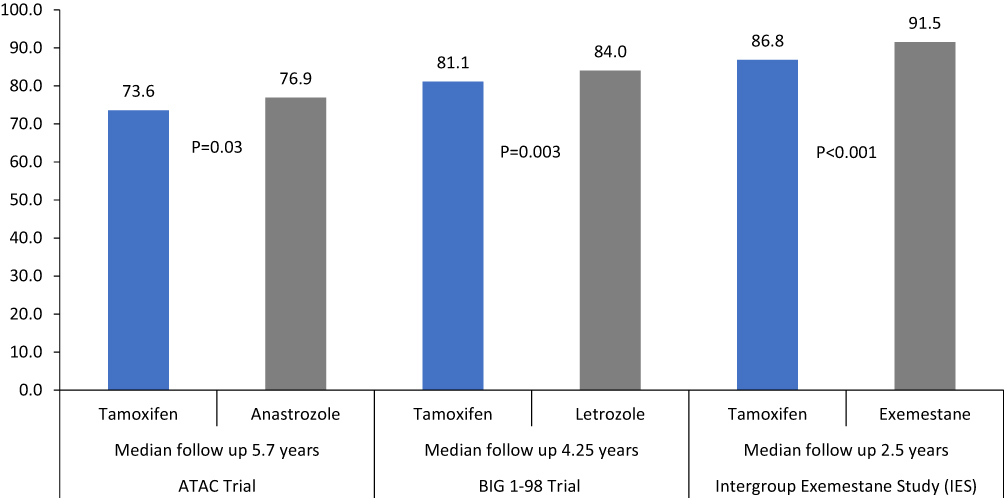 |
Figure 2 5-Year disease-free survival (DFS) of tamoxifen versus aromatase inhibitors (AI). All AI (Anastrozole, Letrozole and Exemestane) were better than tamoxifen. |
As a result of these trials, AIs are recommended as the preferred adjuvant treatment for postmenopausal women with HR-positive breast cancer.8–11 Even with these medications, the recurrence rate remains high, as shown in the Early Breast Cancer Trialists’ Collaborative Group (EBCTCG) meta-analysis; the 10-year recurrence rate is 19.1% for AIs and 22.7% with tamoxifen.11 With these findings, the need for further escalation in therapy to improve outcomes became evident, especially in premenopausal women.
Efforts to escalate ET in patients with EBC have taken several forms, which will be addressed in this review. These efforts include the incorporation of OFS with tamoxifen or AIs, the addition of CDK4/6 inhibitors-primarily to AI- and the integration of PARP inhibitors like olaparib, in genetically selected patients. At the same time, there is growing interest in “de-escalating” ET for younger premenopausal women seeking pregnancy, allowing the interruption of such therapy for up to two years, following 18–30 months of therapy, to facilitate pregnancy.12
Escalation Strategies
Ovarian Function Suppression (OFS)
The use of OFS in the treatment of breast cancer is not new. The concept dates back to 1889, when Schinzinger first proposed oophorectomy as adjunctive therapy for breast cancer to alter the hormonal milieu of the tumor.13,14 George Thomas Beatson put this concept into practice over 125 years ago (1896), reporting a decrease in cutaneous metastases in a premenopausal woman after oophorectomy.15 The mysterious mechanism underlying the response to oophorectomy was explained 75 years later when Jenson identified the estrogen receptor (ER).16
Avoiding the surgical removal of the ovaries, the concept of OFS was tested as part of the ET for premenopausal women with HR-positive EBC. The SOFT (Suppression of Ovarian Function Trial) and TEXT (Tamoxifen and Exemestane Trial) were the two major randomized clinical trials that compared tamoxifen or AIs (exemestane), alone or with OFS. The SOFT trial, conducted by the International Breast Cancer Study Group (IBCSG), focused on adjuvant ET for premenopausal women with early-stage, HR-positive breast cancer. Over 3000 premenopausal women with HR-positive breast cancer were enrolled. At enrollment, the median age of participants was 43 years, and a considerable proportion had already been treated with chemotherapy. OFS was achieved through administration of the GnRHa triptorelin in 80.7% of the patients. Participants were randomized to 5 years of adjuvant tamoxifen, tamoxifen plus OFS, or exemestane plus OFS. The primary endpoint was DFS, and secondary endpoints included overall survival (OS), breast cancer-free interval (BCFI), distant recurrence-free interval (DRFI), and safety profiles.17 The results were updated and recently published; at a median follow-up of 12 years, the DFS was significantly better with exemestane plus OFS (79.0%) and tamoxifen plus OFS (76.1%) compared to tamoxifen alone (71.9%), P=0.03. However, there was no statistically significant OS benefit for the whole group, even with extended follow-up; the 12-year OS was 89.4%, 89.0%, and 86.8% for exemestane plus OFS, tamoxifen plus OFS, and tamoxifen alone, respectively (P=0.06). In subgroup analysis, patients who received prior chemotherapy had significant improvement in OS with exemestane plus OFS and tamoxifen plus OFS, compared to tamoxifen alone, with 12-year OS of 84.4%, 81.1%, and 78.8%, respectively (Figure 3).17,18
 |
Figure 3 Disease-Free survival and overall survival (OS) with tamoxifen alone, tamoxifen plus ovarian function suppression (OFS) or exemestane plus OFS (based on the SOFT trial). |
The TEXT trial, conducted by the same group (IBCSG) and published in 2014, was designed to determine if exemestane in combination with OFS would be more beneficial than tamoxifen plus OFS in premenopausal women with HR-positive EBC. At the conclusion of the trial, 2672 premenopausal women were blindly randomized to 5 years of exemestane plus OFS or tamoxifen plus OFS. The primary endpoint was DFS and OS, while the secondary endpoints were similar to the SOFT trial: BCFI, DRFI, and safety profile.19,20 The study was recently updated after a median follow-up of 12 years and showed a significant improvement in DFS with exemestane combined with OFS compared to tamoxifen plus OFS. DFS was 80.5% with exemestane versus 75.9% with tamoxifen (HR, 0.77; 95% CI, 0.67–0.88). However, OS rates at 12 years were similar between the groups: 89.4% for exemestane and 89.1% for tamoxifen (HR, 0.93; 95% CI, 0.78–1.11).19,20 Subgroup analyses showed that patients who had received prior chemotherapy and those with node-positive disease derived greater benefit from exemestane plus OFS.
Similar to the SOFT trial, adverse events were more common with exemestane. Compared to patients treated with tamoxifen plus OFS, patients treated with exemestane plus OFS reported more menopausal symptoms, including hot flashes, vaginal dryness, and diminished interest in sex. Bone loss and musculoskeletal symptoms with exemestane also raised concerns about longer-term health risks, thus requiring continued monitoring and intervention.13–16
The SOFT and TEXT trials were designed to conduct a combined analysis. A total of 4690 premenopausal women with HR-positive EBC were assigned to 5 years of exemestane plus OFS versus tamoxifen plus OFS. DFS and DRFI, but not OS, were significantly improved with exemestane plus OFS. In the intention-to-treat (ITT) analysis, the absolute improvement in DFS at 12 years was 4.6% (HR, 0.79; 95% CI, 0.70–0.90, P<0.001), and 1.8% in DRFI (HR, 0.83; 95% CI, 0.70–0.98; P=0.03). Though OS was not statistically improved in the whole cohort, the benefit was clinically significant in high-risk subgroups, including patients younger than 35 years (4.0%) and those with tumors >2.0 cm (4.5%) or those with grade 3 disease (5.5%) (Figure 4).20
 |
Figure 4 Overall survival in clinicopathologic subgroups (based on SOFT and TEXT trials). Abbreviations: T, Tamoxifen, OFS, Ovarian Function Suppression, E, Exemestane, G, Grade, LN, Lymph Node. |
Similarly, The ASTRA trial evaluated the efficacy of adding OFS to tamoxifen in premenopausal women with HR-positive breast cancer following chemotherapy. The results demonstrated that the combination therapy significantly improved DFS, with an 8-year DFS rate of 85.4% in the tamoxifen + OFS group compared to 80.2% in the tamoxifen-only group (hazard ratio [HR], 0.67; 95% CI, 0.51 to 0.87). However, there were no significant differences in OS between the two groups. The OS rate was 96.5% in the tamoxifen + OFS group and 95.3% in the tamoxifen-only group (HR, 0.78; 95% CI, 0.49 to 1.25). These findings were particularly notable in high-risk patients, such as those with larger tumors and lymph node involvement. While the addition of OFS to tamoxifen provided a durable benefit in terms of DFS, it was associated with increased menopausal symptoms and concerns regarding long-term bone health.21
The Role of OFS to Preserve Fertility
Ovarian function suppression aims to prevent premature ovarian failure (POF) by temporarily inhibiting ovarian activity, typically using GnRHa. These agents block the release of follicle-stimulating hormone (FSH) and luteinizing hormone (LH) from the pituitary gland, both of which are crucial for ovarian follicle development and estrogen production. By suppressing ovarian function during chemotherapy, OFS reduces the risk of chemotherapy-induced ovarian follicle damage, thereby preserving fertility.
A systematic review and meta-analysis by Lambertini et al evaluated the effectiveness of GnRHa in preserving ovarian function and fertility in premenopausal women with EBC undergoing chemotherapy. The analysis included data from 873 patients across five trials. Ovarian suppression with GnRHa resulted in a 14.1% rate of premature ovarian insufficiency (POI) compared to 30.9% in the control group (adjusted odds ratio: 0.38; p < 0.001). Post-treatment pregnancy occurred in 10.3% of the GnRH agonist group, compared to 5.5% in the control group (incidence rate ratio: 1.83; p = 0.030). No significant differences were found in DFS (p = 0.999) or OS (p = 0.083).22
Adding CDK4/6 Inhibitors
Although adjuvant ET significantly reduces the risk of recurrence and mortality, more than 20% of patients with early breast cancer (EBC) may experience relapses within 10 years after surgery.23,24 Consequently, the development of new therapeutic strategies to further reduce the risk of relapse and enhance patient outcomes is of high importance, especially in those with high-risk features. CDK4/6 inhibitors are a class of targeted cancer therapies that specifically inhibit the activity of cyclin-dependent kinases 4 and 6 (CDK4/6), which play a crucial role in cell cycle regulation. By blocking these kinases, CDK4/6 inhibitors prevent the phosphorylation of the retinoblastoma protein, thereby halting cell cycle progression from the G1 to the S phase. This mechanism causes sensitive tumor cells to be arrested in the G1 phase of the cell cycle. The interruption of the cell cycle leads to decreased proliferation and increased apoptosis.25
CDK4/6 inhibitors, such as palbociclib, ribociclib, and abemaciclib, are now considered the cornerstone of treatment in the first line setting for metastatic breast cancer (MBC), HR-positive, HER2-negative subtypes. The PALOMA,26 MONALEESA,27 and MONARCH28 clinical trial programs highlighted the benefits of palbociclib, ribociclib, and abemaciclib, respectively, showing substantial delays in disease progression compared to ET alone. These findings underscore the importance of CDK4/6 inhibitors in extending the lives of patients with advanced breast cancer and improving their quality of life (QOL).
The NATALEE and monarchE study investigated the use of CDK4/6 inhibitors, ribociclib and abemaciclib, respectively, in the adjuvant setting as treatment options for HR-positive, HER2-negative EBC.29,30
Abemaciclib With Endocrine Therapy
The MONARCH-E trial was a Phase 3, randomized, open-label study that investigated the addition of abemaciclib, a CDK4/6 inhibitor, to ET in patients with high-risk, HR-positive, HER2-negative early breast cancer (EBC). The trial enrolled 5637 patients who had received neoadjuvant chemotherapy and had residual disease after treatment. The inclusion criteria required patients to have either at least four positive pathologic axillary lymph nodes (pALNs) or one to three pALNs with additional high-risk features, such as grade 3 disease, a tumor size ≥5 cm, or Ki-67 ≥20. The primary outcome was invasive disease-free survival (iDFS). Recently published updates, with a median follow-up of 54 months, demonstrated a sustained hazard ratio (HR) of 0.680 (95% CI, 0.599 to 0.772, P=0.01) for iDFS with abemaciclib plus ET, showing a deepening benefit over time with a 5-year absolute improvement in iDFS of 7.6% and distant relapse-free survival (DRFS) of 6.7% compared to ET alone. Although fewer deaths were reported in the abemaciclib-treated arm, statistical significance in overall survival (OS) has not been reached.31 Patients in the abemaciclib group had more adverse events, including diarrhea (82%) and neutropenia (45%). Clinically relevant diarrhea (Grade 2/3) occurred more frequently in elderly postmenopausal patients.32 These adverse effects can be significant enough to lead to treatment interruption or discontinuation in some patients.31
Ribociclib With Endocrine Therapy
The NATALEE trial was a phase 3, randomized, multicenter study that evaluated the addition of ribociclib, a CDK4/6 inhibitor, to ET in patients with high-risk, HR-positive, HER2-negative early breast cancer (EBC). The trial included 5101 postmenopausal women and men with stage IIA, IIB, or III HR-positive, HER2-negative EBC. Patients with stage III or IIB disease were eligible regardless of nodal status. For stage IIA disease, eligibility required at least one positive lymph node, or, if there was no nodal involvement, patients had to have a grade 2 tumor with a Ki-67 proliferation index of ≥20% or be classified as having high genomic risk. Additionally, patients with stage IIA disease and grade 3 tumors, regardless of nodal involvement, were also eligible. Patients were randomly assigned to receive ribociclib (400 mg once daily) + ET for 2 years or ET alone. Ribociclib showed significant improvements in the primary endpoint of 3-year iDFS; 90.4% vs 87.6%, absolute difference 2.8%.29 Ribociclib at 400 mg had a favorable safety profile, with common side effects including myelosuppression, elevated liver enzymes, and prolongation of the QT interval.
Comparison Between the monarchE and NATALEE Trials
There are several differences between the monarchE and NATALEE trials that need to be highlighted. The NATALEE trial allowed the inclusion of earlier-stage patients, specifically those with T2N0 if they had additional risk factors as highlighted above, whereas the monarchE trial allowed only patients with node-positive disease. Additionally, the duration of CDK4/6 inhibitor (ribociclib) treatment in the NATALEE trial was 3 years compared to only 2 years with abemaciclib in the monarchE trial. The toxicity profile was also different; diarrhea associated with abemaciclib can be an issue for some patients. However, good patient education and early treatment with anti-diarrhea drugs can minimize its negative impact. Table 1 summarizes some of the key differences between the two trials.
 |
Table 1 Key Differences Between NATALEE and MonarchE Trials |
Role of Palbociclib in Adjuvant Sitting
The PALLAS and PENELOPE-B trials are key studies in evaluating escalation strategies for high-risk HR-positive breast cancer.33,34 The PALLAS trial enrolled 5761 patients to assess the addition of palbociclib, a CDK4/6 inhibitor, to ET in high-risk HR+ patients, particularly those with node-positive disease or high Ki-67 expression. The trial showed no significant improvement in iDFS, with 3-year iDFS rates of 88.2% for the palbociclib group and 88.5% for the control group (HR 0.93, p= 0.51). Palbociclib discontinuation occurred in 42.2% of patients, with 27.2% stopping due to adverse events. A post hoc analysis reported cumulative discontinuation rates of 17.9% at 6 months and 30.0% at 1 year.
The PENELOPE-B trial included 1250 patients with HR+/HER2-negative breast cancer and residual disease post-neoadjuvant chemotherapy, examining palbociclib with ET. Similarly, no significant iDFS improvement was observed, with 3-year rates of 81.2% for the palbociclib group and 77.7% for placebo (HR 0.93, P = 0.52). The discontinuation rate was 20%, primarily due to neutropenia and infections.
PARP Inhibitors With Endocrine Therapy
For BRCA-mutant, (HR)-positive breast cancer patients, the risk of recurrence remains a significant concern, particularly due to the potential for late recurrences beyond five years. While HR-positive breast cancer generally has a more favorable prognosis compared to triple-negative breast cancer, BRCA mutations confer a higher risk of both local and distant recurrence, as well as an increased likelihood of developing secondary cancers, such as ovarian or contralateral breast cancer.35 This underscores the need for improved adjuvant therapies that target the underlying genetic vulnerabilities in these patients. Olaparib, a PARP inhibitor, addresses this need by exploiting the DNA repair deficiencies caused by BRCA mutations, thereby reducing the risk of recurrence and improving survival outcomes. The OlympiA trial’s findings highlight the importance of integrating olaparib into adjuvant treatment strategies for BRCA-mutant, HR-positive breast cancer, as it not only enhances iDFS and overall survival but also provides long-term protection against recurrence, even in this subgroup.36 This approach is particularly critical given the limitations of traditional endocrine therapies and the need for more targeted, effective treatments to improve outcomes in this high-risk population. The OlympiA trial was a multicenter, double-blind, placebo-controlled Phase III study designed to evaluate the efficacy of olaparib as adjuvant therapy for patients with high-risk, HER2-negative, BRCA-mutant breast cancer. The trial enrolled 1836 patients who had completed standard primary treatments, including surgery, chemotherapy, and radiation. Participants were randomized to receive either oral olaparib or placebo for one year.36
The third interim analysis of the OlympiA trial, presented at the 2024 San Antonio Breast Cancer Symposium, revealed significant long-term benefits of olaparib. After a median follow-up of 6.1 years, olaparib demonstrated a 35% reduction in the risk of invasive disease and distant recurrence, with 6-year iDFS rates of 79.6% in the olaparib group compared to 70.3% in the placebo group. Distant disease-free survival rates were 83.5% vs 75.7%, respectively. Additionally, olaparib achieved a 28% reduction in the risk of death, with a 6-year overall survival (OS) rate of 87.5% in the olaparib group versus 83.2% in the placebo group. These benefits were consistent across all subgroups, including triple-negative and ER-positive breast cancer.37 The trial’s results reinforce the importance of BRCA testing and support olaparib as a critical adjuvant therapy for BRCA-positive, HER2-negative breast cancer patients. Follow-up will continue until 2029 to further assess long-term outcomes, solidifying olaparib’s role in transforming the standard of care for high-risk breast cancer patients.
Everolimus in the Adjuvant Setting
In a recently published study (the SWOG S1207 trial), 1792 patients were randomly assigned to receive the physician’s choice of ET plus 1 year of everolimus at 10 mg daily or placebo. ET consisted of AI only in 67% of patients, tamoxifen only in 24%, and OFS plus tamoxifen or AI in 8% in the placebo group. At a median follow-up of 55 months, everolimus did not demonstrate a significant benefit in iDFS. The five-year iDFS rates were 74.9% for the everolimus group and 74.4% for the placebo group (HR 0.94, 95% CI, 0.77–1.14; P = 0.52). Similarly, OS rates at five years were 88.1% with everolimus and 85.8% with placebo (HR 0.97, 95% CI, 0.75–1.26; P = 0.84). iDFS events occurred in 193 patients in the everolimus group versus 211 in the placebo group (HR 0.94, 95% CI, 0.77–1.14; P = 0.52), and deaths were reported in 112 patients in the everolimus group compared to 119 in the placebo group (HR 0.97, 95% CI, 0.75–1.26; P = 0.84).38
De-Escalation Strategies
Despite its well-known benefits, ET for patients with EBC is associated with several adverse events. Vasomotor symptoms (eg, hot flashes, night sweats), musculoskeletal issues (eg, joint pain, stiffness), and heightened risks of osteoporosis and cardiovascular events are among the commonly encountered adverse events.39–42 These side effects can profoundly impact patients’ quality of life (QOL), potentially leading to treatment discontinuation or non-adherence.43,44 Furthermore, the financial implications of long-term hormone therapy, including CDK4/6 inhibitors, should not be overlooked. The cost associated with these medications, along with managing their side effects, can impose a significant economic burden on both patients and healthcare systems.45,46 This burden is especially significant in regions where access to affordable healthcare is limited. Additionally, among women diagnosed with breast cancer, a considerable number are of childbearing age. These young survivors often grapple with the dual challenge of managing their cancer while considering future fertility, which can be profoundly impacted by cancer treatments.
Interruption of Endocrine Therapy
Chemotherapy-induced amenorrhea (CIA) occurs due to the toxic effects of chemotherapy drugs on the ovaries, leading to damage or destruction of ovarian follicles and subsequent disruption of the menstrual cycle. The incidence and duration of CIA vary depending on several factors, including the patient’s age, the type of chemotherapy, and the cumulative dose received.47,48 CIA can have significant implications for fertility and the overall health of breast cancer survivors. For premenopausal women, CIA may result in temporary or permanent infertility, which can impact their reproductive choices and quality of life (QOL).49
It is extremely important to address fertility-related issues with all patients of childbearing age. Management of CIA in breast cancer survivors involves a multidisciplinary approach that should include obstetricians. Research into novel treatments for CIA, such as gonadotropin-releasing hormone agonists (GnRHa), to preserve ovarian function during chemotherapy, is ongoing and holds promise for improving outcomes for breast cancer patients.50,51
The POSITIVE trial specifically addresses the safety of temporarily pausing adjuvant ET to allow for pregnancy, offering hope to women who wish to conceive without compromising their long-term health outcomes.12,52,53 The trial enrolled 516 premenopausal women aged 42 years or younger and diagnosed with stage I, II, or III HR-positive breast cancer. Women enrolled needed to have received adjuvant ET for at least 18 months but no more than 30 months and express a desire to temporarily discontinue therapy for pregnancy attempts. Previous chemotherapy, with or without fertility preservation, was permitted, provided there was no clinical evidence of recurrence. Among participants, 368 (74%) became pregnant, with 317 (86%) having at least one live birth. The trial revealed that pausing adjuvant ET for pregnancy did not significantly increase the risk of cancer recurrence. The 3-year incidence of breast cancer events was 8.9% (95% CI, 6.3–11.6) in the treatment-interruption group and 9.2% (95% CI, 7.6–10.8) in the external control cohort, resulting in an absolute difference of −0.2 percentage points (95% CI, −3.1–2.8). For distant recurrences, the 3-year incidence was 4.5% (95% CI, 2.7–6.4) in the treatment-interruption group and 5.8% (95% CI, 4.5–7.2) in the control cohort, showing an absolute difference of −1.4 percentage points (95% CI, −3.5–1.0) and a HR of 0.70 (95% CI, 0.44–1.12) as estimated by the bootstrap-matching method. The trial also assessed the use of assisted reproductive technologies (ART) like ovarian stimulation for in vitro fertilization (IVF) and found no significant increase in short-term recurrence risk with ART use. Among those undergoing stimulation, 9.7% experienced a recurrence compared to 8.7% who did not (p = 0.15). Furthermore, 82.4% of women using ART achieved pregnancy, with a higher success rate observed in younger women (under 35) at 80%, compared to those over 40 at 50%. These findings suggest that pausing hormone therapy for pregnancy is a safe and viable option for young breast cancer survivors.
The clinical implication of the POSITIVE trial can be a bit tricky; we believe that patients should be counseled carefully when such discussions begin in the clinic.40 The study’s follow-up is relatively short, especially when considering the chance of disease recurrence in patients with HR-positive tumors, which can be encountered as late as 10 or even 20 years.54 Very young patients who anticipate completing their ET before the age of 35 may be better counseled against interruption, especially if their disease is high-risk (large tumor size, node-positive, or high-grade). The situation can be different in women approaching their 40s, where interruption of ET in these situations is more justifiable, especially for those with low-risk disease. In another study presented recently at the 2024 American Society of Clinical Oncology (ASCO) annual meeting, most survivors of stage 0 to stage III breast cancer who attempt to conceive after completing treatment can successfully become pregnant and have a live birth.55
Abbreviated Therapy in Low-Risk Patients
For postmenopausal women with HR+ EBC, the optimal duration of aromatase inhibitor (AI) therapy has been debated. A phase 3 trial randomized women who had completed 5 years of adjuvant ET to receive anastrozole for an additional 2 years (7 years total) or 5 years (10 years total). At 8 years, there was no significant difference in DFS (HR, 0.99; P=0.90) or OS between the groups. However, the 5-year group had a higher risk of bone fractures (HR, 1.35; P=0.04), supporting de-escalation after 7 years for most patients.56
De-Escalation in Low-Risk Disease and Older Patients
Several studies have attempted to select patients with low risk features in whom ET can be abbreviated or even withheld. One study included HR-positive/HER2-negative breast cancers with very small (T1a/b), node-negative early-stage tumors.57 Researchers found that patients who received adjuvant ET had a significantly lower 5-year recurrence rate of 2.8% compared to 6.4% in those who did not. Additionally, the 5-year overall survival rate was 98.9% in the ET group versus 96.5% in the non-therapy group. The study highlighted that even in cases of T1a/bN0 EBC, which involve tumors 1 cm or smaller with no lymph node involvement, adjuvant ET provided substantial benefits. These findings emphasize the crucial role of ET in enhancing long-term outcomes for patients with HR-positive, HER2-negative early breast cancer, regardless of the tumor’s small size. This study supports the continued use of adjuvant ET to reduce the risk of recurrence and improve survival in this patient population.
Other researchers utilized predictive models to try identifying a subgroup of breast cancer patients with very low risk disease who might not benefit from ET. In one study that attempted to utilize Oncotype DX to guide the escalation or de-escalation of ET in breast cancer treatment, researchers analyzed data from 45,217 patients with early HR-positive breast cancer; majority were postmenopausal. A total of 42,632 (94.3%) patients received ET, while 2585 (5.7%) patients did not. The study found that the 5-year OS rate was 96.4% for patients who received ET, compared to 93.1% for those who did not, p< 0.001. After adjusting for all covariates, the results indicated that postmenopausal patients with a 21-gene recurrence score (RS) of less than 11 did not show a statistically significant improvement in OS when adding ET to surgery, with or without radiation, p= 0.40. However, for patients with a RS between 11 and 25, there was a significant improvement in OS when ET was added to radiation, p< 0.001. This study underscores the utility of Oncotype DX in tailoring ET decisions based on individual recurrence risk scores, thereby optimizing treatment strategies for early HR-positive breast cancer patients.58
Another study evaluated the impact of omitting ET in older patients.59 The study compared the outcomes of adjuvant radiation therapy alone versus radiation therapy combined with ET in elderly women with early-stage, HR-positive breast cancer who underwent breast-conserving surgery. The trial included 618 participants, evenly divided, with 309 receiving radiation therapy alone and 309 receiving combination treatment. The findings revealed that the addition of ET significantly improved the 5-year DFS rate; 93% in the combination group compared to 88% in the radiation-only group, P <0.001. Furthermore, the OS rate at 5 years was higher in the combination group at 90%, compared to 85% in the radiation-only group, P<0.001. These results underscore the benefit of adding ET to radiation therapy in reducing recurrence and improving survival in elderly women with early-stage, hormone receptor-positive breast cancer.
Role of Genomic Profile in de-Escalation Approach
Genomic test assays play a crucial role in guiding treatment decisions for breast cancer, particularly in determining the need for chemotherapy or extension of ET in early-stage, hormone receptor (HR)-positive, HER2-negative breast cancer. Tests such as Oncotype DX, MammaPrint, and EndoPredict analyze the expression of specific genes within a tumor to assess its likelihood of recurrence. By identifying patients with a low risk of recurrence, these assays help clinicians safely de-escalate treatment, sparing patients from the potential side effects of chemotherapy without compromising outcomes. This personalized approach to therapy improves quality of life and reduces unnecessary interventions while maintaining effective cancer control.
In one study, the 70-gene expression signature, known as MammaPrint, was used to guide treatment decisions for women with EBC.60 The study enrolled 6693 women from 112 institutions across nine European countries, all of whom had EBC. The study showed that MammaPrint provided prognostic information independent of traditional clinical and pathological factors. Among patients classified as high risk by clinical-pathological criteria, 46% were reclassified as low risk by MammaPrint and could safely avoid chemotherapy. On the other hand, 17% of patients classified as low risk by clinical-pathological criteria were reclassified as high risk and might benefit from chemotherapy. These findings suggest that the 70-gene signature can significantly influence treatment decisions, potentially sparing many patients from unnecessary chemotherapy.
Similarly, a study by Noordhoek et al aimed to validate the MammaPrint 70-gene signature test for identifying elderly breast cancer patients at an ultralow risk of distant recurrence.61 The study focused on patients aged ≥70 years with invasive HR-positive breast cancer, staged T1-2N0-3 M0. A total of 418 patients were included, with a median age of 78 years; 60% were treated with ET. MammaPrint classified patients into ultralow (n=50), low (n=224), and high risk (n=144). The 10-year distant recurrence rates were 17% in MammaPrint-high, 8% in low (HR 0.46, 95% CI 0.25–0.84), and 2% in ultralow risk patients (HR 0.11, 95% CI 0.02–0.81). After adjustment for clinical risk and ET, MammaPrint-high risk patients still had a significantly higher recurrence rate (HR 0.49, 95% CI 0.26–0.90), compared to low (HR 0.49) and ultralow risk patients (HR 0.12, 95% CI 0.02–0.85). Notably, no MammaPrint-ultralow, high clinical risk patients developed distant recurrence. The study’s findings support the potential of MammaPrint in personalizing treatment for elderly patients with breast cancer.
The Breast Cancer Index (BCI) and Prosigna are genomic assays also used to assess the risk of recurrence in HR-positive breast cancer patients. The BCI was evaluated in the aTTom trial, which included 2445 postmenopausal women with ER-positive EBC to determine whether extended tamoxifen therapy beyond five years improved outcomes.62 The study’s primary endpoint was recurrence-free interval (RFI), while secondary endpoints included disease-free interval (DFI) and DFS. The overall analysis found no significant improvement in RFI with extended tamoxifen in the entire cohort (HR, 0.90; 95% CI, 0.69–1.16; P = 0.401). However, in a pre-planned subgroup analysis of node-positive (N+) patients (n=789), those classified as BCI-high derived a significant benefit from extended tamoxifen, with a 9.7% absolute reduction in recurrence risk (HR, 0.33; 95% CI, 0.14–0.75; P = 0.016). In contrast, BCI-low patients showed no benefit from extended tamoxifen (−1.2% absolute benefit; HR, 1.11; 95% CI, 0.76–1.64; P = 0.581).62 The Prosigna Breast Cancer Prognostic Gene Signature Assay has been validated in two major randomized clinical trials; the ABCSG-8 trial and the TransATAC study.63,64
Special Subgroups
Low ER Patients
Low estrogen receptor (ER)-positive breast cancer refers to tumors with ER expression levels between 1% and 10%. While still categorized as ER-positive, these cancers often exhibit a reduced response to hormonal therapies compared to tumors with higher ER expression. As a result, they have become an active target of research, particularly in exploring escalation and de-escalation treatment approaches to optimize patient outcomes.
In a study by Moldoveanu et al, data from 232,762 patients were analyzed, of which 2.0% had ER-low tumors. Patients with ER-low tumors were generally younger and had higher tumor stage, grade, and Ki67 expression.65 In these patients, adjuvant ET, recurrence score, and Ki67 levels varied depending on progesterone receptor (PR) status. Notably, pathological complete response (pCR) rates following neoadjuvant therapy were similar between ER-low/PR-negative (39.5%) and ER-low/PR-positive (38.1%) groups (p = 0.67), with rates closer to those of the ER-negative group (39.7%) than the ER-positive group (8.4%).63 These results suggest that ER-low tumors with a PR-negative status behave more similarly to ER-negative breast cancer in terms of treatment response, while PR-positive tumors are less aggressive.
In a similar vein, Skjervold et al analyzed 1955 breast cancer cases, stratifying them based on the likelihood of receiving adjuvant therapy and examining ER status in relation to year of diagnosis, histopathological grade, proliferation, and molecular subtypes. A total of 65 tumors (3.3%) were classified as ER-low with the highest prevalence in Luminal B (9.4%) and grade 3 tumors (4.3%). The risk of death from breast cancer was lower in ER-low and ER ≥ 10% cases compared to ER-negative cases. Among women diagnosed in 1995 or later, 4.6% had ER-low tumors compared to 1.5% in those diagnosed before 1995. Additionally, tumors diagnosed in the later period were smaller (mean size: 18 mm vs 22 mm), had a lower proportion of grade 3 tumors (31.7% vs 41.9%), and exhibited lower proliferation. Prognosis remained similar between ER-low and ER ≥ 10% cases, suggesting that the availability of adjuvant therapy may have contributed to improved tumor characteristics over time.66
Furthermore, Bari et al studied 4697 early-stage HER2-negative patients and found that 2.04% had ER-low tumors (ER 1–10%) and 0.88% had ER-intermediate tumors (ER 10–20%). They reported that ER-low tumors were associated with higher tumor grade, larger size, and greater axillary tumor burden compared to ER-high tumors. Moreover, both ER-low and ER-intermediate patients had survival outcomes similar to those of triple-negative breast cancer (TNBC) patients, with worse outcomes than those with ER-high tumors (p < 0.001).67 These findings underscore the poor prognosis of tumors with <20% ER expression and highlight the need for alternative therapeutic approaches.
HER2-Low Disease
HER2-low EBC refers to tumors that have a slight overexpression of the HER2 protein, typically classified as HER2 1+ or 2+ with fluorescence in situ hybridization (FISH) negativity. These tumors are characterized by relatively low levels of HER2 expression compared to higher HER2-positive cases. While traditionally considered less aggressive than high HER2-positive breast cancer, HER2-low tumors can still benefit from targeted therapies, such as trastuzumab, although their response may not be as pronounced. The management of HER2-low EBC is challenging.
In a study of Tarantino et al, which included 5235 patients, 2917 (55.7%) of whom had HER2-low status, no significant relationship was found between HER2-low status and OS, with a HR of 1.10 (p = 0.15).68 In contrast, a study by Corianò et al, which analyzed 754 patients and assessed pCR in different breast cancer subtypes, concluded that HER2 status could be a valuable prognostic and predictive biomarker for HER2-negative early breast cancer, particularly in ER+ cases.69 Additionally, in the phase 3 PALLAS trial, which included 5304 patients with 3050 (57.5%) classified as having HER2-low disease, and after a median follow-up of 59.8 months, HER2-low status was not associated with iDFS,distant relapse-free survival (DRFS), or OS in multivariable models (HR for iDFS: 0.93, 95% CI: 0.81–1.06), and there was no significant interaction between treatment arm and HER2 status.70 The variability in HER2-low prevalence and the ongoing debate about its clinical impact highlight the complexities of HER2-low assessment and its potential role in treatment strategies for EBC.
In summary, escalation and de-escalation approaches should be personalized for each patient based on disease risk stratification and patient preferences. Table 2 provides an overview of all clinical scenarios for escalation, de-escalation strategies, and unclear situations.
 |
Table 2 Clinical Scenarios for Escalation, de-Escalation Strategies and Unclear Situations |
Conclusions
Adjuvant endocrine therapy plays a key role in managing HR-positive early breast cancer, yet 20% relapse within 10 years. Personalized strategies that balance escalation and de-escalation should be implemented. For premenopausal women, adding ovarian suppression improves outcomes, while ET interruption for pregnancy in patients with low-risk disease appears safe, but needs longer follow up. In high-risk patients, CDK4/6 inhibitors like abemaciclib and ribociclib improve treatment outcomes and PARP inhibitors benefit subsets of BRCA-mutant patients. These tailored approaches optimize outcomes, integrating precision medicine to address recurrence, fertility, and quality of life in patients with early breast cancer.
Ethics Approval
This is a review paper, and as such ethical approval is not required.
Acknowledgments
The authors would like to thank Ms. Doaa Al-Saadi, Mrs. Hira Bani Hani and Mrs. Alice Haddadin for their support in preparing this manuscript.
Author Contributions
All authors made a significant contribution to the work reported, whether that is in the conception, study design, execution, acquisition of data, analysis and interpretation, or in all these areas; took part in drafting, revising or critically reviewing the article; gave final approval of the version to be published; have agreed on the journal to which the article has been submitted; and agree to be accountable for all aspects of the work.
Funding
This research was not funded; however, Article Publishing Charge (APC) is paid for by a special funding program from King Hussein Cancer Center.
Disclosure
The authors report no conflicts of interest in this work.
References
1. Bray F, Ferlay J, Soerjomataram I, et al. Global cancer statistics 2022: GLOBOCAN estimates of incidence and mortality worldwide for 36 cancers in 185 countries. CA Cancer J Clin. 2024;74(3):229–263. doi:10.3322/caac.21834
2. Iqbal J, Ghafoor A, Tse S, et al. Differences in breast cancer stage at diagnosis and cancer-specific survival by race and ethnicity in the United States. JAMA. 2015;313(2):165–173. doi:10.1001/jama.2014.17322
3. Fisher B, Costantino JP, Redmond C, et al. A randomized clinical trial evaluating tamoxifen in the treatment of patients with node-negative breast cancer who have estrogen-receptor-positive tumors. N Engl J Med. 1989;320(8):479–484. doi:10.1056/NEJM198902233200802
4. National Cancer Institute. Hormone therapy for breast cancer [Internet]. Bethesda (MD): National Cancer Institute; 2025. Available from: https://www.cancer.gov/types/breast/breast-hormone-therapy-fact-sheet.
5. Burstein HJ, Lacchetti C, Griggs JJ, et al. Adjuvant endocrine therapy for women with hormone receptor-positive breast cancer: ASCO clinical practice guideline. J Clin Oncol. 2019. Available from: ascopubs.org.
6. Spring LM, Wander SA, Andre F, et al. Cyclin-dependent kinase 4 and 6 inhibitors for hormone receptor-positive breast cancer: past, present, and future. Breast Cancer Res. 2020;22(1):19. doi:10.1186/s13058-020-1257-2
7. Early Breast Cancer Trialists’ Collaborative Group. Tamoxifen for early breast cancer: an overview of the randomized trials. Lancet. 1998;351(9114):1451–1467. doi:10.1016/S0140-6736(97)11423-4
8. Baum M, Buzdar A, Cuzick J, et al. Anastrozole alone or in combination with tamoxifen versus tamoxifen alone for adjuvant treatment of postmenopausal women with early breast cancer: first results of the ATAC randomized trial. Lancet. 2002;359(9324):2131–2139.
9. Breast International Group (BIG) 1-98 Collaborative Group, Colleoni M, Del Mastro L, et al. A comparison of letrozole and tamoxifen in postmenopausal women with early breast cancer. N Engl J Med. 2005;353(26):2747–2757.
10. Coombes RC, Hall E, Gibson L, et al. A randomized trial of exemestane after two to three years of tamoxifen therapy in postmenopausal women with primary breast cancer. N Engl J Med. 2004;350(11):1081–1092. doi:10.1056/NEJMoa040331
11. Early Breast Cancer Trialists’ Collaborative Group. Aromatase inhibitors versus tamoxifen in early breast cancer: patient-level meta-analysis of the randomized trials. Lancet. 2015;386(10001):1341–1352. doi:10.1016/S0140-6736(15)61074-1
12. Partridge A, Gelber S, Coates A, et al. Abstract GS4-09: pregnancy outcome and safety of interrupting therapy for women with endocrine-responsive breast cancer: primary results from the POSITIVE trial (IBCSG 48-14/BIG 8-13). Cancer Res. 2023;83:GS4–09.
13. Stuart-Harris R, Davis A. Optimal adjuvant endocrine therapy for early breast cancer. Women’s Health. 2010;6(3):383–398. doi:10.2217/whe.10.25
14. Swaby RF, Sharma CGN, Jordan VC. SERMs for the treatment and prevention of breast cancer. Rev Endocr Metab Disord. 2007;8(3):229–239. doi:10.1007/s11154-007-9034-4
15. Beatson GT. On the treatment of inoperable cases of carcinoma of the mamma: suggestions for a new method of treatment, with illustrative cases. Trans Med Chir Soc Edinburgh. 1896;15:153–179.
16. O’Malley BW, Khan SE, Jensen V. (1920–2012): father of the nuclear receptors. Proc Natl Acad Sci U S A. 2013;110(10):3707–3708. doi:10.1073/pnas.1301566110
17. Francis PA, Regan MM, Fleming GF, et al. Adjuvant ovarian suppression in premenopausal breast cancer. N Engl J Med. 2015;372(5):436–446. doi:10.1056/NEJMoa1412379
18. Francis PA, Pagani O, Fleming GF, et al. Adjuvant endocrine therapy in premenopausal breast cancer: 12-year results from SOFT. J Clin Oncol. 2023;41(7):1370–1375. doi:10.1200/JCO.22.01065
19. Pagani O, Regan MM, Fleming GF, et al. Adjuvant exemestane with ovarian suppression in premenopausal breast cancer. N Engl J Med. 2014;371(2):107–118. doi:10.1056/NEJMoa1404037
20. Pagani O, Regan MM, Fleming GF, et al. Adjuvant exemestane with ovarian suppression in premenopausal breast cancer: long-term follow-up of the combined TEXT and SOFT trials. J Clin Oncol. 2023;41(7):1376–1382. doi:10.1200/JCO.22.01064
21. ASTRA trial. Adding ovarian suppression to tamoxifen for premenopausal women with hormone receptor-positive breast cancer after chemotherapy: an 8-year follow-up. J Clin Oncol. 2023. PMID: 37607321. doi:10.1200/JCO.23.00557
22. Lambertini M, Fehm T, Puglisi F, et al. Fertility preservation in premenopausal women with breast cancer: a systematic review and meta-analysis of randomized controlled trials. J Clin Oncol. 2018;36(9):905–918.
23. Nelson DR, Morrow PK, Patel F, et al. Breast cancer-specific mortality in early breast cancer as defined by high-risk clinical and pathologic characteristics. PLoS One. 2022;17(2):e0264637. doi:10.1371/journal.pone.0264637
24. Pan H, Gray R, Braybrooke J, et al. 20-year risks of breast-cancer recurrence after stopping endocrine therapy at 5 years. N Engl J Med. 2017;377(19):1836–1846. doi:10.1056/NEJMoa1701830
25. Scott SC, Lee SS, Abraham J. Mechanisms of therapeutic CDK4/6 inhibition in breast cancer. Semin Oncol. 2017;44(6):385–394. doi:10.1053/j.seminoncol.2018.01.006
26. Slamon DJ, Neven P, Chia S, et al. Overall survival with palbociclib plus letrozole in advanced breast cancer. J Clin Oncol. 2024;42(9):994–1000. doi:10.1200/JCO.23.00137
27. Lu YS, Zhang Z, Chen X, et al. Updated overall survival of ribociclib plus endocrine therapy versus endocrine therapy alone in pre- and perimenopausal patients with HR+/HER2- advanced breast cancer in MONALEESA-7: a phase III randomized clinical trial. Clin Cancer Res. 2022;28(5):851–859. doi:10.1158/1078-0432.CCR-21-3032
28. Johnston S, Rugo HS, Mayer EL, et al. MONARCH 3 final PFS: a randomized study of abemaciclib as initial therapy for advanced breast cancer. NPJ Breast Cancer. 2019;5(1):5. doi:10.1038/s41523-018-0097-z
29. Slamon DJ, Neven P, Chia S, et al. Rationale and trial design of NATALEE: a phase III trial of adjuvant ribociclib + endocrine therapy versus endocrine therapy alone in patients with HR+/HER2- early breast cancer. Ther Adv Med Oncol. 2023;15:17588359231178125. doi:10.1177/17588359231178125
30. Johnston SRD, Harbeck N, Aft R, et al. Abemaciclib combined with endocrine therapy for the adjuvant treatment of HR+, HER2-, node-positive, high-risk, early breast cancer (monarchE). J Clin Oncol. 2020;38(34):3987–3998. doi:10.1200/JCO.20.02514
31. Paluch-Shimon S, Neven P, Huober J, et al. Efficacy and safety results by menopausal status in monarchE: adjuvant abemaciclib combined with endocrine therapy in patients with HR+, HER2-, node-positive, high-risk early breast cancer. Ther Adv Med Oncol. 2023;15:17588359231151840. doi:10.1177/17588359231151840
32. Rugo HS, O’Shaughnessy J, Boyle F, et al. Adjuvant abemaciclib combined with endocrine therapy for high-risk early breast cancer: safety and patient-reported outcomes from the monarchE study. Ann Oncol. 2022;33(6):616–627. doi:10.1016/j.annonc.2022.03.006
33. Meirson T, Goldstein DA, Gyawali B, Tannock IF, PALLAS Investigators. Palbociclib with adjuvant endocrine therapy in early breast cancer (PALLAS): interim analysis of a multicentre, open-label, randomized, phase 3 study. Lancet Oncol. 2023;24(5):589–599. doi:10.1016/S1470-2045(23)00218-9
34. Penelope-B Investigators. Palbociclib for residual high-risk invasive HR-positive and HER2-negative early breast cancer—the Penelope-B trial. N Engl J Med. 2023;388(6):533–543. doi:10.1056/NEJMoa2206289
35. Foulkes WD, Fragoso S, Duarte T, et al. Comparing prognosis for BRCA1, BRCA2, and non-BRCA breast cancer. Cancers (Basel). 2023;15(23):5699. doi:10.3390/cancers15235699
36. Geyer CE, Garber JE, Kaufman B, et al. Adjuvant olaparib for patients with germline BRCA1 or BRCA2 mutations and high-risk HER2-negative breast cancer (OlympiA): a multicentre, randomised, double-blind, placebo-controlled phase 3 trial. Lancet. 2021;397(10271):815–818. doi:10.1016/S0140-6736(21)00309-6
37. Garber JE, et al. Pre-specified analyses of invasive disease-free survival, distant disease-free survival, and overall survival from the OlympiA trial of adjuvant olaparib in germline BRCA1/2 mutation-associated breast cancer.
38. Chavez-MacGregor M, Miao J, Pusztai L, et al. Phase III randomized, placebo-controlled trial of endocrine therapy ± 1 year of everolimus in patients with high-risk, hormone receptor-positive, early-stage breast cancer. J Clin Oncol. 2024;42(25):3012–3021. doi:10.1200/JCO.23.02344
39. Amir E, Seruga B, Niraula S, Carlsson L, Ocaña A. Toxicity of adjuvant endocrine therapy in postmenopausal breast cancer patients: a systematic review and meta-analysis. J Natl Cancer Inst. 2011;103(17):1299–1309. doi:10.1093/jnci/djr242
40. Saha P, Regan MM, Pagani O, et al. Treatment efficacy, adherence, and quality of life among women younger than 35 years in the International Breast Cancer Study Group TEXT and SOFT adjuvant endocrine therapy trials. J Clin Oncol. 2017;35(27):3113–3122. doi:10.1200/JCO.2016.72.0946
41. Franzoi MA, Agostinetto E, Perachino M, et al. Evidence-based approaches for the management of side effects of adjuvant endocrine therapy in patients with breast cancer. Lancet Oncol. 2021;22(7):e303–e313. doi:10.1016/S1470-2045(20)30666-5
42. Condorelli R, Vaz-Luis I. Managing side effects in adjuvant endocrine therapy for breast cancer. Expert Rev Anticancer Ther. 2018;18(11):1101–1112. doi:10.1080/14737140.2018.1520096
43. Nicoletti AP, Damin AP. Factors influencing the first and fifth years’ adherence to adjuvant endocrine therapy in breast cancer patients in a low-income country. Breast Cancer Res Treat. 2024;204(3):599–606. doi:10.1007/s10549-023-07221-6
44. Walsh EA, Walsh LE, Hernand M, et al. Concurrent factors associated with adherence to adjuvant endocrine therapy among women with non-metastatic breast cancer. J Cancer Surviv. 2024. Epub ahead of print. doi:10.1007/s11764-024-01556-9
45. Le V, Zhong L, Narsipur N, et al. Cost-effectiveness of ribociclib plus endocrine therapy versus placebo plus endocrine therapy in HR-positive, HER2-negative breast cancer. JMCP. 2021;27(3):327–338. doi:10.18553/jmcp.2021.27.3.327
46. Magge T, Rajendran S, Brufsky AM, Foldi J. CDK4/6 inhibitors: the devil is in the detail. Curr Oncol Rep. 2024;26(6):665–678. doi:10.1007/s11912-024-01540-7
47. Abdel-Razeq HN, Mansour RA, Ammar KS, et al. Amenorrhea, fertility preservation, and counseling among young women treated with anthracyclines and taxanes for early-stage breast cancer: a retrospective study. Medicine (Baltimore). 2020;99(11):e19566. doi:10.1097/MD.0000000000019566
48. Manuel E, Raja NS, Moravek M. Fertility preservation in patients with breast cancer. Curr Breast Cancer Rep. 2024;16(3):328–335. doi:10.1007/s12609-024-00551-4
49. Blumenfeld Z. Chemotherapy and fertility. Best Pract Res Clin Obstet Gynaecol. 2012;26(3):379–390. doi:10.1016/j.bpobgyn.2011.11.008
50. Paluch-Shimon S, Cardoso F, Sessa C, et al. Prevention and screening in BRCA mutation carriers and other breast/ovarian hereditary cancer syndromes: ESMO clinical practice guidelines for cancer prevention and screening. Ann Oncol. 2016;27(suppl 5):v103–v110. doi:10.1093/annonc/mdw327
51. Abdel-Razeq H. Gonadotropin-releasing hormone agonists during chemotherapy for ovarian function and fertility preservation for patients with early-stage breast cancer. Cancer Manag Res. 2019;11:4273–4282. doi:10.2147/CMAR.S204069
52. Partridge AH, Niman SM, Ruggeri M, et al. Interrupting endocrine therapy to attempt pregnancy after breast cancer. N Engl J Med. 2023;388(18):1645–1656. doi:10.1056/NEJMoa2212856
53. Muliyil S. Navigating pregnancy and breast cancer. Nat Med. 2023. Epub ahead of print. PMID: 37221232. doi:10.1038/d41591-023-00047-1.
54. Gomis RR, Gawrzak S. Tumor cell dormancy. Mol Oncol. 2017;11(1):62–78. doi:10.1016/j.molonc.2016.09.009
55. Sorouri K, Zheng Y, Niman SM, et al. Fertility among young breast cancer survivors attempting pregnancy: a prospective, multicentre cohort study. J Clin Oncol. 2024;42(suppl 16):1518. doi:10.1200/JCO.2024.42.16_suppl.1518
56. Gnant M, Fitzal F, Rinnerthaler G, et al. Duration of adjuvant aromatase-inhibitor therapy in postmenopausal breast cancer. N Engl J Med. 2021;385(5):395–405. doi:10.1056/NEJMoa2104162
57. Sasada S, Kondo N, Hashimoto H, et al. Prognostic impact of adjuvant endocrine therapy for estrogen receptor-positive and HER2-negative T1a/bN0M0 breast cancer. Breast Cancer Res Treat. 2023;202(3):473–483. doi:10.1007/s10549-023-07097-6
58. Weiser R, Polychronopoulou E, Kuo Y, et al. De-escalation of endocrine therapy in early hormone receptor-positive breast cancer: current evidence and future perspectives. J Natl Compr Canc Netw. 2024;22(2):152–160.
59. Murphy CT, Li T, Wang LS, et al. Comparison of adjuvant radiation therapy alone versus radiation therapy and endocrine therapy in elderly women with early-stage, hormone receptor-positive breast cancer treated with breast-conserving surgery. Clin Breast Cancer. 2015;15(5):381–389. doi:10.1016/j.clbc.2015.02.005
60. Cardoso F, Van’t Veer LJ, Bogaerts J, et al. 70-Gene signature as an aid to treatment decisions in early-stage breast cancer. N Engl J Med. 2016;375(8):717–729. doi:10.1056/NEJMoa1602253
61. Noordhoek I, Bastiaannet E, de Glas NA, et al. Validation of the 70-gene signature test (MammaPrint) to identify patients with breast cancer aged ≥ 70 years with ultralow risk of distant recurrence: a population-based cohort study. J Geriatr Oncol. 2022;13(8):1172–1177. doi:10.1016/j.jgo.2022.07.006
62. Sestak I, Cuzick J, Dowsett M, et al. Prediction of benefit from extended adjuvant endocrine therapy using the Breast Cancer Index: results from the aTTom trial. J Clin Oncol. 2022;40(16_suppl):577. doi:10.1200/JCO.2022.40.16_suppl.577
63. ABCSG-8 Trial. Prosigna® in early-stage breast cancer: a randomized study. 2011.
64. TransATAC Study. Validation of Prosigna® in predicting recurrence in ER+ early-stage breast cancer. 2013.
65. Moldoveanu A, et al. Estrogen receptor-low breast cancer: clinical outcomes and treatment implications in early-stage HER2-negative breast cancer. J Clin Oncol. 2023;41(5):432–442. doi:10.1200/JCO.2023.41.5.432
66. Skjervold N, et al. Prognostic features and treatment outcomes in ER-low breast cancer: results from a large cohort study. Breast Cancer Res. 2023;31(2):152–161. doi:10.1186/s13058-023-01733-9
67. Bari A, et al. Clinical characteristics and survival outcomes of ER-low breast cancer in early-stage HER2-negative patients. Breast Cancer Res Treat. 2023;180(3):453–462. doi:10.1007/s10549-023-07109-0
68. Tarantino P, Jin Q, Tayob N, et al. Prognostic and biologic significance of ERBB2-low expression in early-stage breast cancer. JAMA Oncol. 2022;8(8):1177–1183. PMID: 35737367.doi:10.1001/jamaoncol.2022.2286
69. Corianò M, Ferrante M, Russo A, et al. Clinical implications of HER2-low expression in early-stage breast cancer. J Clin Oncol. 2023;41(8):1294–1301. PMID: 38743174.doi:10.1200/JCO.22.03399
70. Nader-Marta G, Singer C, Hlauschek D, et al. Clinical characterization, prognostic, and predictive values of HER2-low in patients with early breast cancer in the PALLAS trial (ABCSG-42/AFT-05/BIG-14-13/PrE0109). Lancet Oncol. 2023;24(2):145–158. PMID: 39375745.
 © 2025 The Author(s). This work is published and licensed by Dove Medical Press Limited. The
full terms of this license are available at https://www.dovepress.com/terms
and incorporate the Creative Commons Attribution
- Non Commercial (unported, 3.0) License.
By accessing the work you hereby accept the Terms. Non-commercial uses of the work are permitted
without any further permission from Dove Medical Press Limited, provided the work is properly
attributed. For permission for commercial use of this work, please see paragraphs 4.2 and 5 of our Terms.
© 2025 The Author(s). This work is published and licensed by Dove Medical Press Limited. The
full terms of this license are available at https://www.dovepress.com/terms
and incorporate the Creative Commons Attribution
- Non Commercial (unported, 3.0) License.
By accessing the work you hereby accept the Terms. Non-commercial uses of the work are permitted
without any further permission from Dove Medical Press Limited, provided the work is properly
attributed. For permission for commercial use of this work, please see paragraphs 4.2 and 5 of our Terms.