
Back to Journals » Advances in Medical Education and Practice » Volume 16

Enhancing Social Accountability in Medical Education and Accreditation: A Meeting Report
Authors Larche CL  , Kennel M, Tackett S, Marsh DC, Cameron E
Received 27 November 2024
Accepted for publication 19 February 2025
Published 26 March 2025 Volume 2025:16 Pages 471—476
DOI https://doi.org/10.2147/AMEP.S508928
Checked for plagiarism Yes
Review by Single anonymous peer review
Peer reviewer comments 2
Editor who approved publication: Dr Md Anwarul Azim Majumder
Cynthia L Larche,1 Maxwell Kennel,1 Sean Tackett,2 David C Marsh,3– 5 Erin Cameron1,6
1Gilles Arcand Centre for Health Equity, Human Sciences Division, Northern Ontario School of Medicine University, Sudbury, Ontario, Canada; 2Division of General Internal Medicine, Johns Hopkins Bayview Medical Center, Baltimore, Maryland, USA; 3Clinical Sciences Division, Northern Ontario School of Medicine University, Sudbury, Ontario, Canada; 4Health Sciences North Research Institute, Sudbury, Ontario, Canada; 5ICES North, Sudbury, Ontario, Canada; 6Human Sciences Division, Northern Ontario School of Medicine University, Thunder Bay, Ontario, Canada
Correspondence: Erin Cameron, Northern Ontario School of Medicine University, Thunder Bay, Ontario, Canada, Email [email protected]
Abstract: Accreditation in medical education stands in need of more empirical grounding. There is a paucity of accreditation research that hinders both quality assurance efforts and the introduction of innovative new approaches to accreditation, such as social accountability standards. The International Social Accountability and Accreditation Steering Committee (ISAASC) was established to address this gap. This meeting report outlines the outcomes of a workshop led by members of the ISAASC to identify research priorities related to social accountability and accreditation. The workshop was held during the International Congress on Academic Medicine (ICAM) on April 13, 2024, in Vancouver, British Columbia and used a modified nominal group technique. Four main priorities were identified, namely that there is a need to: 1) integrate various constituencies in accreditation research, 2) identify global drivers of social accountability standards, 3) measure impacts of socially accountable healthcare education, and 4) develop evaluation tools for accreditation activities.
Keywords: accreditation research, medical education, social accountability
Introduction
In 2021, the Association of Faculties of Medicine in Canada (AFMC) convened three think-tank sessions on Social Accountability and Accreditation with over 100 participants from 30 countries. Together they identified 12 critical actions that were compiled into a widely distributed report. Today the actions are being coordinated and advanced by an International Steering Committee and four working groups (ie, the standards setting group, capacity-building group, advocacy group, and research group).
This report synthesizes discussions from a workshop held at the International Conference of Academic Medicine (ICAM) on April 13th, 2024, in Vancouver, Canada. ICAM is an annual conference sponsored by the AFMC with a dedicated stream focused on accreditation. The workshop was hosted by the International Social Accountability and Accreditation Steering Committee (ISAASC) and brought together researchers, leaders, administrators, and students interested in accreditation research. The goal was to identify key research priorities through a co-design and collaborative group approach. The workshop began with an introduction that provided an overview of ISAASC and current accreditation research, and then engaged participants in a process informed by a nominal group technique (ie, independent idea generation, idea sharing in small groups, idea review and organization, and idea rating). The following sections highlight both the approach and the findings of this workshop.
Accreditation Research: Current Approaches in Accreditation Research
Accreditation research is growing, but still lacks a significant body of evidence to inform its practices. In the workshop, Dr. Sean Tackett began the session by outlining three emerging pathways within accreditation research, namely: investigator-driven research, academic-agency partnered research, or agency-led research. Along with co-facilitators Drs. Cynthia Whitehead, David Rojas, Rogaheh Gandomkar, each provided examples of the accreditation research pathways, which served as an inspiring place to start the discussions.
Social Accountability and Accreditation Research: Collective Priority Setting
Independent Idea Generation
After organizing into small groups, all participants were instructed to brainstorm as many ideas as they could to this prompt: “Generate research questions/topics that, if addressed, can lead to accreditation authorities improving the social accountability of medical education programs.” Participants had 15 minutes to brainstorm, writing each idea on a new sticky note.
Idea Sharing
Each participant took a turn stating one idea and then handing their sticky note to the facilitator, who had the option to rewrite the idea for clarity. Participants were advised not to repeat ideas they believed had already been mentioned. If a participant ran out of ideas, they could be skipped. This continued until all ideas were stated.
Idea Review and Organization
Each group then reviewed all the ideas, asking questions to clarify as needed. Duplicate ideas were merged, and wording was changed through group consensus. Sticky notes were rearranged so that similar concepts were grouped. The group decided whether clusters of ideas should be rated together or as standalone ideas.
Idea Rating
Each group participant rated the ideas by writing a number from one to five, with higher numbers indicating higher priority. Participants then silently placed their ratings next to the idea clusters they prioritized most. Once everyone was done, the facilitator tallied the ratings.
Large Group Activities
During a walking tour of each group’s workspace, all meeting participants reviewed each group’s ratings. Participants commented on observations and asked questions at each stop. Each participant was encouraged to place a vote next to the idea they felt was most important at each stop, each using a different set of stickers.
Large Group Reflection and Debrief
The session concluded with a large group reflection and debrief. Participants discussed whether there was agreement on the top-rated ideas, any other reflections on the work that needed to be done, and how they could move forward. Afterward, the sticky notes and ratings were typed up to inform a recruitment survey for the ISAASC research group.
Idea Reporting
We transcribed all ideas verbatim along with their overall rankings after the meeting, and then summarized each group’s priorities.
Priorities Identified
The session was held with 30 participants, having four small groups with seven to eight participants each. The list of each group’s priorities is shown in Figure 1, and the overlapping priorities are listed in Table 1.
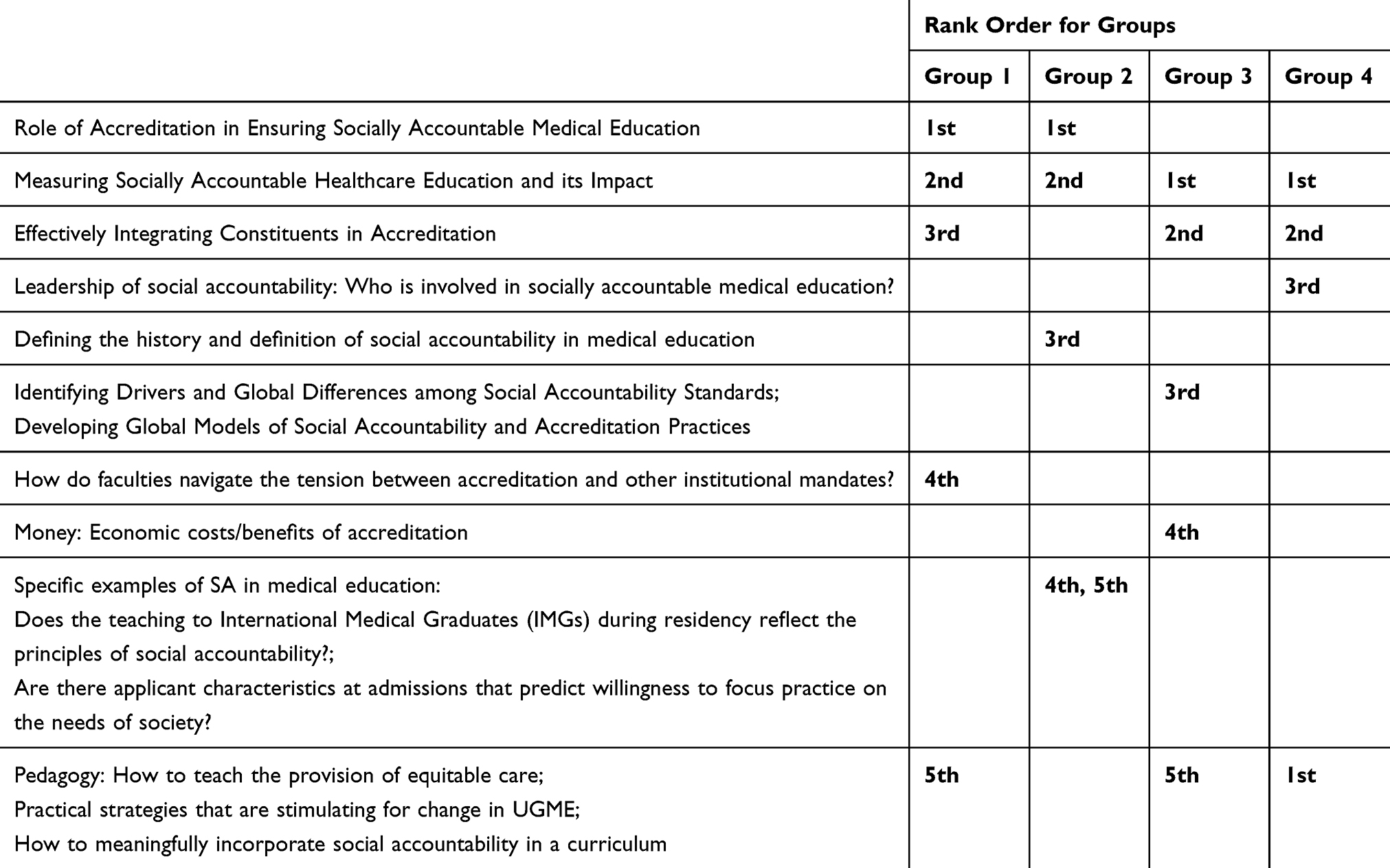 |
Table 1 Top Research Priorities: Themes |
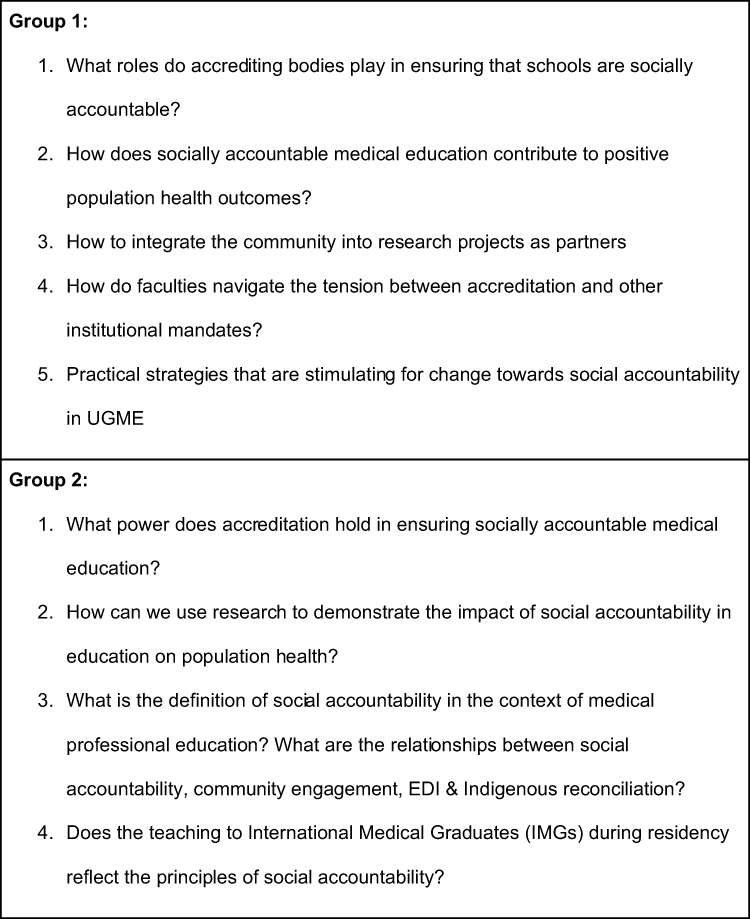 |
Figure 1 Continued. |
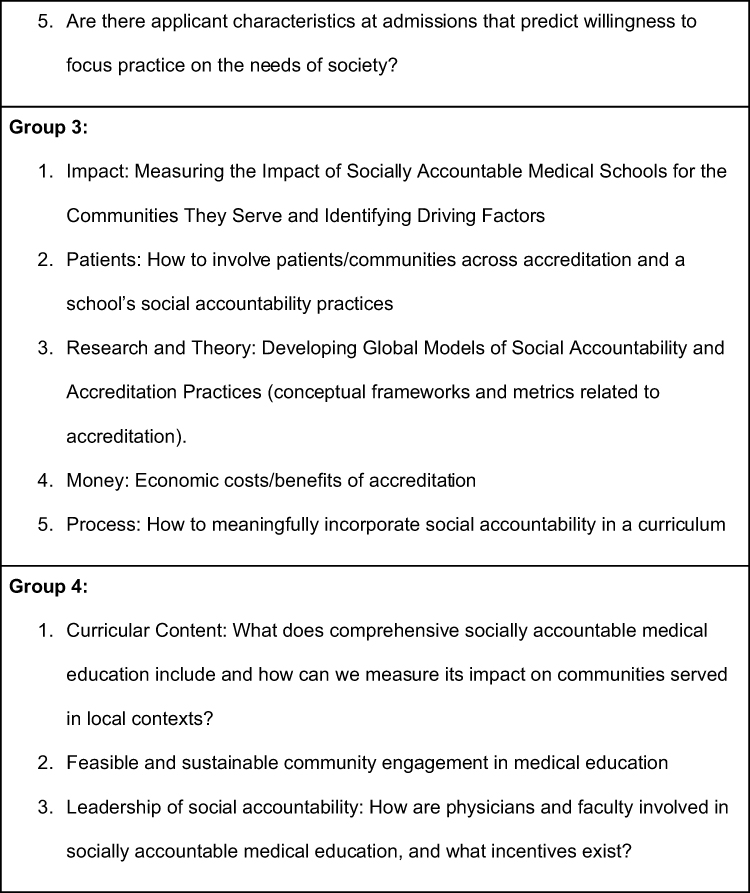 |
Figure 1 Research Questions from Each Group, in Decreasing Rank Order. |
Discussion
There is growing international interest in social accountability within health professions education programs. Changes to accreditation policies and procedures are promising avenues to effect further change. However, accreditation in general is not well-understood in the global context and lacks a large evidence base. Our effort to engage constituents in identifying priorities for research that advance social accountability through accreditation represents the beginning of what needs to be a global conversation. We found that this structured, collaborative approach yielded valuable insights and research questions.
One of the top priority topics was to identify the role of accreditation in ensuring socially accountable medical education. This requires understanding how accreditation standards can be designed or modified to promote social accountability to ensure that medical schools are accountable to the needs of the communities they claim to serve. To ensure this, measurement, tracking, and evaluation of the impact of socially accountable healthcare education will be necessary.
As such, another high priority research area involves measuring the impacts of socially accountable healthcare education. Robust methods to assess its effectiveness, both quantitatively and qualitatively, are needed. To measure the subsequent effects on community health outcomes could include developing community-driven evaluation of how well programs are meeting social accountability goals.
Most groups during the meeting identified the need to effectively integrate constituents and constituencies into accreditation processes, ensuring that representative voices are heard and involved to reflect community needs and values. This engagement is essential for creating accreditation standards that are relevant to the needs of different communities.
Identifying key leaders in this area is another priority, and it involves mapping who the decision-makers are, understanding their roles, and identifying how they can collaborate to achieve accreditation goals. Beneath this is the important task of defining the history and major characteristics of social accountability in order to better align standards across global research initiatives. To help us understand drivers in global social accountability standards, we must recognize the key variations among healthcare systems of different regions. This understanding is critical for developing global models of social accountability and accreditation practices. If such models were established, we could use these adaptable frameworks in different contexts while maintaining core principles. This includes sharing best practices and learning from successful initiatives in various regions.
Conclusion
In brief, workshop participants identified different issues, from accreditation through population health impacts. Ensuring that community voices are incorporated through all aspects of accreditation research aligns with social accountability. The findings from this process provide a strong foundation for research initiatives aimed at enhancing the social accountability of health professions education through improved accreditation practices.
Acknowledgments
We would like to acknowledge the funding contributions of the Northern Ontario School of Medicine University and the Social Sciences and Humanities Research Council. We would also like to thank our group facilitators, Cynthia Whitehead, Nick Torres, David Rojas, and Max Kennel.
Disclosure
The authors report no conflicts of interest in this work.
 © 2025 The Author(s). This work is published and licensed by Dove Medical Press Limited. The
full terms of this license are available at https://www.dovepress.com/terms
and incorporate the Creative Commons Attribution
- Non Commercial (unported, 3.0) License.
By accessing the work you hereby accept the Terms. Non-commercial uses of the work are permitted
without any further permission from Dove Medical Press Limited, provided the work is properly
attributed. For permission for commercial use of this work, please see paragraphs 4.2 and 5 of our Terms.
© 2025 The Author(s). This work is published and licensed by Dove Medical Press Limited. The
full terms of this license are available at https://www.dovepress.com/terms
and incorporate the Creative Commons Attribution
- Non Commercial (unported, 3.0) License.
By accessing the work you hereby accept the Terms. Non-commercial uses of the work are permitted
without any further permission from Dove Medical Press Limited, provided the work is properly
attributed. For permission for commercial use of this work, please see paragraphs 4.2 and 5 of our Terms.