
Back to Journals » Risk Management and Healthcare Policy » Volume 18
Engaging Essential Patient Support Personnel in Research as Patient Partners: A Survey Study
Authors Skubisz C  , DeRosa S, Pacanowski CR
Received 17 January 2025
Accepted for publication 13 May 2025
Published 31 July 2025 Volume 2025:18 Pages 2529—2537
DOI https://doi.org/10.2147/RMHP.S512398
Checked for plagiarism Yes
Review by Single anonymous peer review
Peer reviewer comments 2
Editor who approved publication: Dr Jongwha Chang
Christine Skubisz,1 Shayna DeRosa,2 Carly R Pacanowski2
1Department of Natural and Applied Sciences, Bentley University, Waltham, MA, USA; 2Department of Health Behavior and Nutrition Sciences, University of Delaware, Newark, DE, USA
Correspondence: Christine Skubisz, Department of Natural and Applied Sciences, Bentley University, 175 Forest Street, Waltham, MA, 02452, USA, Email [email protected]
Introduction: Patient engagement in research is a collaborative interaction between patients and researchers throughout the entire research process. Healthcare workers provide care for others, but are the patients themselves in areas of workplace safety and mental health. Essential patient support personnel working on the front line of healthcare are particularly vulnerable but have an underrepresented voice in the research conducted about their health and work.
Methods: To explore this topic, a survey study of essential patient support personnel (N=42), guided by the Integrated Model of Behavioral Prediction, measured attitudes about engagement, behavioral intentions, and past engagement behavior. Skills and constraints, predictors of behavioral intentions for engagement in the model, were also assessed.
Results: Results showed that essential patient support personnel had positive attitudes and positive behavioral intentions to engage in research, yet only two participants had engaged in research in the past. Participants reported the most positive behavioral intentions to contribute at the preparation stage of research. Overwhelmingly, participants reported that the most important skill essential patient support personnel bring to a research team is their first-hand experience. Significant constraints to engagement included a lack of time, insufficient compensation, and job burnout.
Conclusion: Efforts to bolster patient engagement in research should focus on increasing the skills necessary for study execution (eg, study design and data analysis) and removing constraints to contribution (eg, providing appropriate monetary compensation, being mindful of time and heavy work schedules).
Keywords: patient engagement in research, patient centered outcomes research, healthcare workers, integrated model of behavioral prediction, survey research
Introduction
By definition of their job responsibilities, researchers have work time allocated for research activities and extensive formal training that prepares them to execute a study. Equivalent time and training are often not accessible to patients, despite the fact that they have the potential to make valuable research contributions. These constraints to involvement are even more pronounced for potential patient partners working in demanding jobs, such as those in the healthcare sector. Healthcare workers provide care for others but have a valuable voice as patients themselves in areas of workplace safety, physical wellness, and mental health.
Patient engagement in health research has gained attention as a means to produce research that is more relevant and generalizable. The Patient Centered Outcomes Research Institute (PCORI) emphasizes the importance of involving patients in the research process to ensure that studies address real-world needs.1 Patient engagement in research is defined as “active, meaningful, and collaborative interaction between patients and researchers across all stages where decision-making is guided by patients’ contributions as partners recognizing their specific experiences, values, and expertise”.2
To achieve patient engagement, it is recommended that patients be involved in all three phases of research (preparation, execution, and translation), as outlined in a 2015 systematic review.3 First, the preparation phase is focused on agenda setting, establishing research priorities, and seeking funding. Second, the execution phase includes the selection of a study design, data collection, and analysis. Finally, the translation phase involves the dissemination of study results, implementation of key findings, and outcome evaluation. Research conducted by Finney Rutten et al, with a sample of patients with heart disease, found that patient partners have a stronger understanding of the preparation and translation phases of research and subsequently feel better prepared to contribute to these stages.4 This research found that patients have more difficulty conceptualizing their roles during the execution phase.
Notably, engagement is very different from serving as a study participant or subject. Engagement represents meaningful, substantive involvement in the planning, execution, and dissemination of research. There is evidence that very few studies achieve patient engagement that meets this definition. A systematic review conducted in 2018 by Fergusson et al5 screened 371,159 and reviewed 9490 published studies that reported having a “patient perspective” and found that just 23 studies engaged patients meaningfully. The authors defined engagement as “meaningful and active collaboration in governance, priority setting, conducting research and knowledge translation”. Engagement of patients from racial or ethnic minority groups was far lower, present in only 26% of studies. The authors estimate that less than 1% (23 out of 371,159) of research studies engaged patients meaningfully and actively. This is a missed opportunity given that patient engagement has measurable benefits, including improved enrollment rates, increased success in obtaining funding, and increased relevance of study outcomes for the population.6 Understanding engagement from the patient’s point of view may help reduce barriers and increase the behavior. The objective of this study is to understand engagement behavior in a specific segment of healthcare workers, essential patient support personnel, in their role as patients. The health of these workers is often overlooked, and the research focus has historically been placed on the patients they care for. Many healthcare workers neglect their own health by not seeking medical attention when needed or not taking sick leave when ill.7 Morbidity, for both physical and mental health conditions, is higher in healthcare workers compared to the general population.7,8
Essential Patient Support Personnel
Healthcare workers on the front line are particularly vulnerable to dangerous physical and mental health outcomes, but have an underrepresented voice in the research conducted about them. This project was funded by a PCORI Engagement Award, which formed a partnership of multiple stakeholder groups, including patients, to understand engagement in research. The partnership defined a vulnerable group of healthcare workers called essential patient support personnel. This definition was written collaboratively by the partnership, defining essential patient support personnel as “individuals who work closely with patients in positions that do not necessarily require a license. This includes clinical jobs that require certification and non-clinical jobs where individuals work closely with patients. These are individuals working in direct patient support roles”.
Essential patient support personnel are a large and diverse workforce, and many workers are not in named occupations recognized by the US Bureau of Labor Statistics. Given this, establishing the exact size of the population is challenging, but estimates can be drawn from several sources. Approximately 3.6 million Americans work in direct care positions, including residential care aides and nursing assistants.9 In addition, the long-term care workforce, which includes workers in facility settings and home health providers, employs approximately 4.5 million Americans.10 By these estimates, at least 8 million Americans are working as essential patient support personnel, and these workers are in high demand due to the aging population and large numbers of Americans living with chronic conditions.11 Essential patient support personnel are indispensable to paid caregiving, and the US healthcare system would cease to function without them.
The profile of a person working as an essential patient support personnel is a Black or Hispanic woman under age 50, earning a yearly income below the US poverty threshold.9,12 Most workers’ formal education ended with high school, vocational school, or community college. Some workers are the family members or friends of a person needing care, paid under a formal contract.13 Most are paid hourly in jobs that lack the basic protections afforded to higher-prestige positions, including healthcare benefits, labor unions, or paid time off.13 Foreign-born or undocumented workers often fill these roles, leaving workers vulnerable to exploitation.10 Approximately two-thirds of essential patient support personnel work in institutional facilities (ie, hospitals and offices), and one-third work in private homes.9
Essential patient support personnel care for others, but are also patients themselves. Workers experience physical hazards, including chemical and sharp instrument exposures, violence, and stress.14 The COVID-19 pandemic amplified their work-related health risks. Essential patient support personnel provide face-to-face, hands-on care, predominantly indoors, and some travel between multiple work sites.15 These settings had a large percentage of COVID-19 deaths due to the close contact environment.16,17 Due to health disparities, the races and ethnicities most often represented by essential patient support personnel have been more greatly affected by COVID-19. More Black and Hispanic Americans have died of COVID-19 compared to White Americans.18,19 Notably, many essential patient support personnel positions do not offer paid sick leave or paid time off work to seek health care services.13,20
This project focuses directly on essential patient support personnel in their role as patients making healthcare decisions for themselves. The goal of this project is to explore attitudes and intentions about contributing to the research process, not as a study participant or subject, but as an engaged partner. A partner role allows essential patient support personnel to make substantive contributions to the research that directly affects them, a role that is more effortful compared to serving as a study participant.
Essential patient support personnel have valuable experiences, values, and expertise, but typically have not had formal skills training and face constraints to research engagement. Research engagement has been studied previously, however, our engagement work with this population established that essential patient support personnel are not well understood in their role as patients.2–6 Engagement in research is a behavioral outcome and viewing it through this academic lens enables us to use behavior change models, such as the Integrated Model of Behavioral Prediction, as a guiding framework.21–23 The model predicts relationships between skills, constraints, and behavior. These variables, in the context of engagement behavior, are described in the next section.
Integrated Model of Behavioral Prediction
The Integrated Model of Behavioral Prediction (please see Figure 1) is a framework for understanding human behavior (ie, patient engagement in research) at the individual level.21–23 The model acknowledges that an infinite number of variables may influence a behavior, but a small number of variables offered in the model can accurately predict, change, or reinforce a specific behavior within a person. The Integrated Model of Behavioral Prediction is the most recent iteration and extension of the Theory of Reasoned Action and the Theory of Planned Behavior.21–23 A meta-analysis of behavior change interventions concluded that approaches based on theoretical frameworks were more effective in changing behavior, compared to approaches that were not theory-based.24
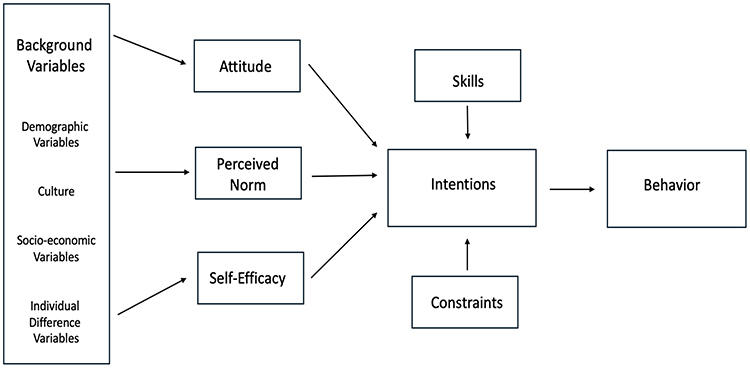 |
Figure 1 Integrated Model of Behavioral Prediction. |
In the model, attitudes, a person’s evaluation of how unfavorable or favorable performing a particular behavior would be, are a predictor of behavioral intentions.22 People will act on their intentions and carry out a behavior, such as research engagement, when they have the skills necessary, and constraints are reduced or removed. Skills are abilities, including knowledge. Constraints are external barriers that prevent a person from performing a behavior. Constraints to research engagement have not been adequately addressed in the academic literature, leaving a significant gap in the science of engagement.25 Guided by research questions based on the Integrated Model of Behavioral Prediction, this project will examine the attitudes, behavioral intentions, behavior, skills, and constraints that are specific to essential patient support personnel in the context of research engagement.
Research Questions
Research Question 1: Do essential patient support personnel have positive attitudes about research engagement? Research Question 2a: Do essential patient support personnel have positive behavioral intentions to engage in research in the future? Research Question 2b: Do behavioral intentions differ by stage of the research process (preparation, execution, translation)? Research Question 3: Have essential patient support personnel engaged in research in the past? Research Question 4: What research skills do essential patient support personnel perceive to have? Research Question 5: What constraints would prevent essential patient support personnel from engaging in research in the future?
Methods
Guided by the Integrated Model of Behavioral Prediction, participants were asked about their attitudes, behavioral intentions, behavior, skills, and constraints in the context of research engagement. A quantitative scale published by Heckert et al26 was used to measure future behavioral intentions to perform engagement behaviors within each of the three phases of research: preparation (eg, choosing the research topics or questions to study), execution (eg, collecting data from study participants), and translation (eg, explaining or applying results to real-world settings). The Appendix provides the survey questions presented to study participants. The survey included both closed and open-ended items.
Approval to conduct research was obtained from the Bentley University Institutional Review Board (#240403075). All study participants completed an informed consent process before beginning the self-administered online survey and agreed to have their anonymized data published. This study was carried out as part of a PCORI-funded engagement award. During the two-year award period, a contact list of essential patient support personnel working in various roles throughout the US was generated by the research team. Data collection took place between April and May 2024. Research team members, including the third author on this paper, working in an essential patient support personnel role, contacted potential participants via email. An initial invitation and one follow-up Email were sent to potential participants. This Email included a link to the online survey that was hosted by Qualtrics. The survey took approximately 10 minutes to complete. No personal identifying information was requested; however, at the conclusion of the study, participants were given the option to provide any Email address to receive a $50 gift card incentive. Email addresses were stored separately from participant responses. A sample of 42 essential patient support personnel participants completed the survey.
Results
The study sample included 36 women (85.7%) and six men (14.3%). Participant ages ranged from 18–70 years old (M=28.26, SD=10.30). Participants were 54.8% White, 14.3% Southeast Asian, 9.5% East Asian, 7.1% Native Hawaiian Pacific Islander, 7.1% multiracial, and 4.8% Black. In the sample, 42.9% had a high school degree or less education, 31% had a bachelor’s degree, 11.9% had an associate’s degree, and 14.3% had a graduate degree. Participants lived in eight states, including Delaware (n=15), Pennsylvania (n=10), Hawaii (n=6), New Jersey (n=3), Massachusetts (n=3), Texas (n=2), Alabama (n=1), and Idaho (n=1). Twenty-one different job titles (please see Table 1) were represented. Physical therapy assistants and technicians (n=11) and nursing assistants (n=5) were the most prevalent. When participants were asked to describe their health status, 6 (14.3%) reported excellent, 18 (42.9%) reported very good, 16 (38.1%) reported good, and 2 (4.8%) reported fair.
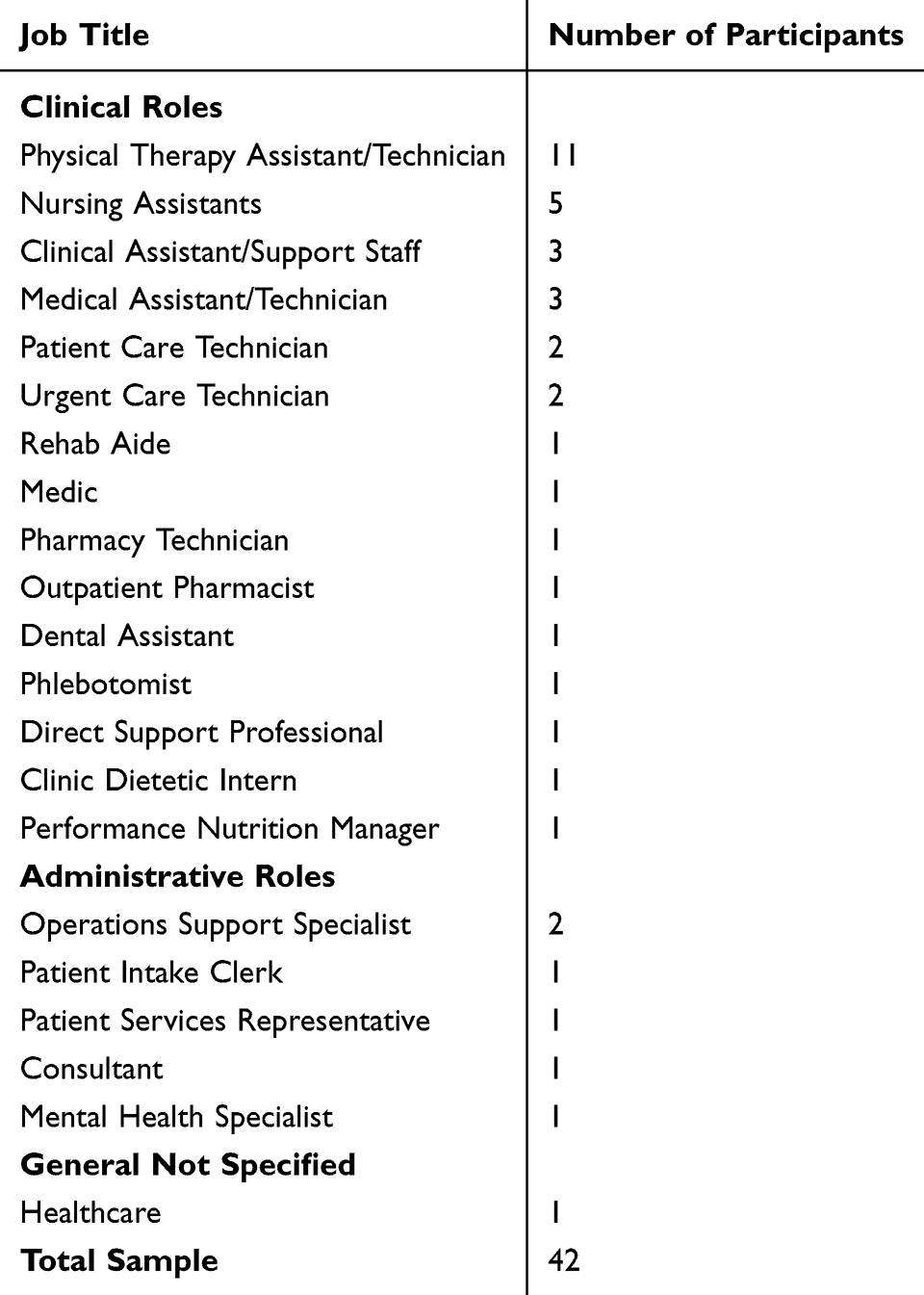 |
Table 1 Participant Job Titles: Essential Patient Support Personnel |
Participants were asked, “Do you think it is important for healthcare workers to be involved in research?” in an open-ended question. Most participants (n=37, 88%) reported a positive attitude about research engagement and answered yes to this question. Open-ended text boxes allowed participants to explain their answer if they wished to do so. Six participants who reported yes followed up by stating that healthcare workers are on the front lines and have first-hand experience to offer. Six participants who reported yes stated that it is important for healthcare workers to be knowledgeable about current research.
Turning to behavioral intentions, when asked if they personally would engage in research in the future (Research Question 2a), 40.5% said yes, 40.5% said they were unsure and needed more information, and 16.7% said no. Participants were provided with a list of different engagement behaviors representing the three stages of the research process (preparation, execution, and translation, Research Question 2b) and asked about future involvement intentions. Table 2 provides frequency data for all selected engagement behaviors. The most frequently selected behaviors were from the preparation stage of research: choosing the research topics or questions to study (n=17) and helping researchers understand what information patients and stakeholders need (n=16). While essential patient support personnel had positive attitudes about engagement generally, their past behavior in the research process was rare (Research Question 3). When asked if they had engaged in research in the past, nearly all responded no (n=40, 92.9%). Only two participants reported being involved in a research project in a way that meets the Harrington et al2 definition of patient engagement.
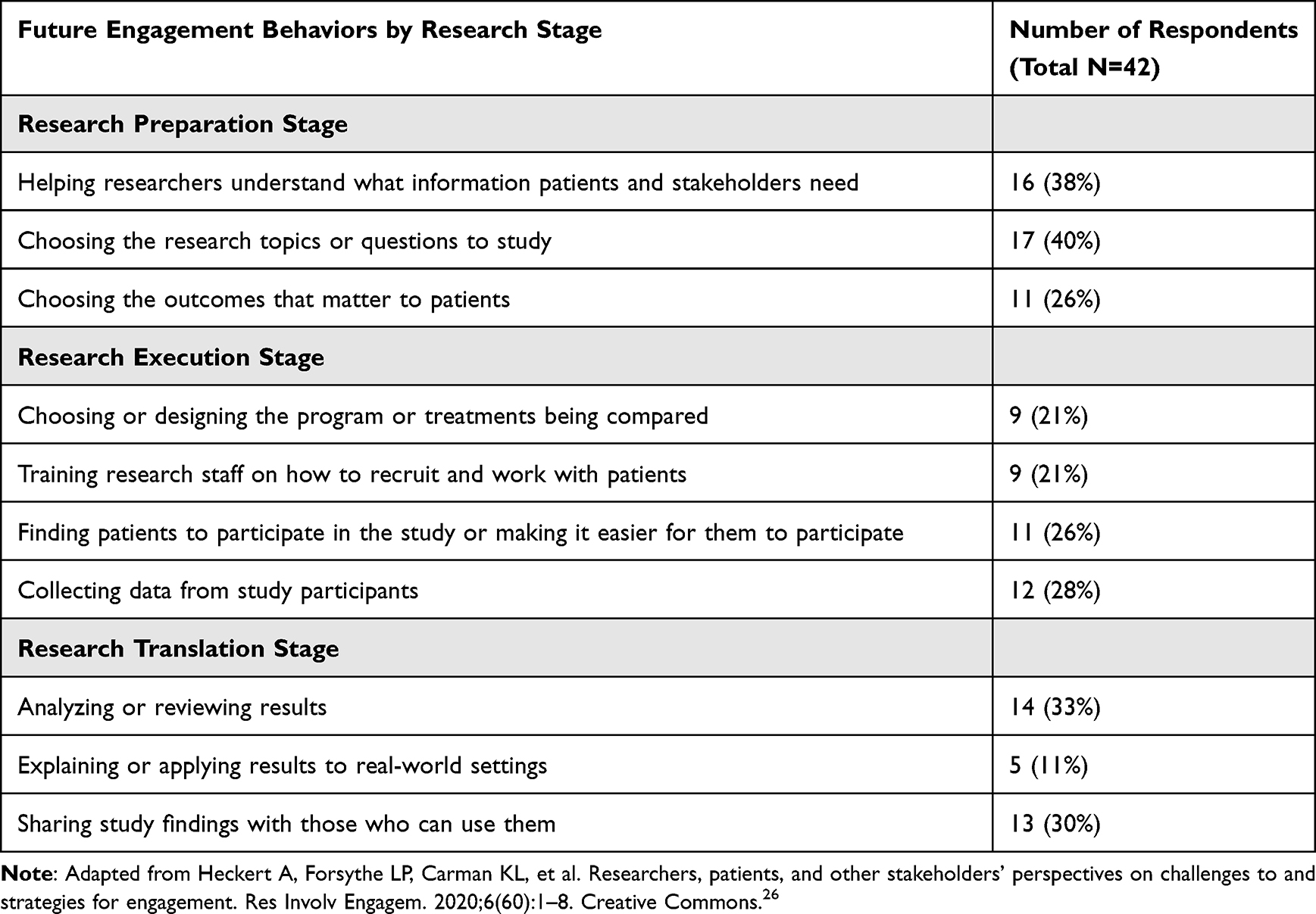 |
Table 2 Behavioral Intentions for Future Engagement in Different Research Stages |
The Integrated Model of Behavioral Prediction posits that behavioral intentions predict behavior if people have the skills necessary and constraints do not prevent the behavior from being carried out. Participants were asked about the skills they bring to the research process (Research Question 4). Responses were coded and aggregated for analysis. Essential patient support personnel cited their first-hand experience (n=29), their education (n=7), having a community perspective (n=1), collaboration experience (n=1), and being both patients and healthcare providers (n=1) as skills. Finally, when asked about constraints to engagement (Research Question 5), participants reported lack of time (n=19), no monetary compensation or insufficient compensation (n=6), burnout or being overworked (n=4), political beliefs (n=3), lack of confidence (n=3), and religious beliefs (n=2). Responses were coded and aggregated for analysis.
Conclusion
Essential patient support personnel have positive behavioral intentions to engage in research. Yet, for most, these positive intentions have not led to engagement behavior. Decades of research on behavior change, culminating in a 2024 meta-analysis, conclude that to motivate behavior, we need to remove obstacles and increase access.27 In the Integrated Model of Behavioral Prediction, the relationship between behavioral intentions and behavior is moderated by two factors: skills and constraints. This study was exploratory and a first effort aimed at understanding engagement behavior in essential patient support personnel. The Integrated Model of Behavioral Prediction served as a useful framework, and future work should test the causal model in its entirety.
This survey data corroborates the results of previous qualitative focus group data on patient engagement.4 When provided with choices, participants reported more positive behavioral intentions to participate in the first phase of research, preparation, compared to later phases. This choice is connected to skills. Engagement at the later stages of research requires skills and knowledge that essential patient support personnel may not have learned through their lived experiences and education. Applying results to real-world settings, designing the program or treatments being compared, and training research staff on how to recruit participants were the engagement behaviors selected least frequently by participants. Each of these activities could be a focus of skills training in patient centered outcomes research. It is important to note that skills training is reciprocal; researchers also learn and receive skills training from patient partners. It is the responsibility of the researchers to help patient partners acquire the skills needed and reduce their constraints to engagement. This project was focused on the engagement behavior of patients (essential patient support personnel), but future work should examine researchers’ skills and deficits as well.
When asked about constraints to engagement, participants reported lack of time (n=19) and insufficient monetary compensation (n=6) most frequently. Researchers need to be flexible when working with patient partners, especially those who work hours that do not match their own. Some essential patient support personnel work overnight or on weekends. Teams that include patient partners need to be inclusive. Future work should investigate this result further to identify how research can fit into the busy schedules of essential patient support personnel. The effort and time spent on research work may be perceived as less of a burden to patient partners if compensation is perceived as fair. In this study, insufficient or no monetary compensation was expressed as a constraint to engagement. Compensation may need to account for out-of-pocket costs in addition to project work time. This can include unpaid leave from work, lost work hours for travel and attendance at meetings, and childcare costs. Most essential patient support personnel work hourly, and some are self-employed. Compensation must adequately reimburse any costs incurred.
This research has limitations that should be considered in future studies. First, this project had a small sample size, which was reflective of the essential patient support personnel population in some ways, but caution should be taken in other areas. Most essential patient support personnel are younger women under age 50.9,10 This study sample was made up of 85.7% women, and 97.6% were under age 50. The sample was less representative of the known characteristics of essential patient support personnel in other demographic areas. For most essential patient support personnel, education ends with high school or technical school. In the sample, 42.9% had a high school degree or less. Most essential patient support personnel are non-White. This sample was 54.8% White and 42.5% non-White. Future research should aim to recruit more non-White participants and those with lower levels of formal education. Finally, this study relied on a convenience sample. Survey participants were asked to share the link with other essential patient support personnel using a snowball sampling technique. This may limit the generalizability of results.
This project has several strengths, including engaging essential patient support personnel in multiple stages of the research process. This work was funded by an engagement award and included patient partners in the entire research process from initial idea formulation to the dissemination of results. As established by Fergusson et al5 less than 1% of research studies are engaging patients meaningfully and actively. This project studied patient engagement while including patient partners actively and meaningfully. Second, this work examined engagement in an underrepresented population that has historically been neglected. Essential patient support personnel face physical and mental health challenges that have led to morbidity rates that are higher than the general population.7,8 Third, this work was guided by the consensus definition of engagement put forth by Harrington et al in 2020. For research to build in this area, it is fruitful for studies to operationalize patient engagement consistently. This will allow the body of scientific knowledge to build over time.
Despite the benefits to scientific inquiry, significant hurdles to meaningful patient engagement in research exist. Some challenges are universal across patient populations, including the need for additional time and funding, and the risk of tokenism where involvement is superficial rather than meaningful and active.6 This research has uncovered challenges that are specific to the essential patient support personnel population. This group provides care to their own patients but has been overlooked as a patient population with unique needs. Essential patient support personnel have demanding jobs, work long hours that may conflict with academic timeframes, and have concerns about being adequately compensated if they choose to engage in research. Ignoring specific constraints faced by a patient population will continue to result in low engagement in research. Low engagement will leave important voices unheard and important research questions unexplored.
Human Participants Protections
Approval to conduct research was obtained from the Bentley University Institutional Review Board (#240403075). Informed consent was obtained from all study participants.
Acknowledgments
The authors thank essential patient support personnel Amy Nichols and Kelley Shepherd, as well as researchers Nancy Lyons, Jason Li, Maddy Kelley, and Hannah Cash for their contributions to this project.
Funding
This research was supported by a Patient Centered Outcomes Research Institute (PCORI) Eugene Washington Engagement Award (EASC COVID #00339).
Disclosure
The authors report no conflicts of interest in this work.
References
1. Forsythe LP, Carman KL, Szydlowski V, et al. Patient engagement in research: early findings from the patient-centered outcomes research institute. Health Aff. 2019;38(3):359–367. doi:10.1377/hlthaff.2018.05067
2. Harrington RL, Hanna ML, Oehrlein EM, et al. Defining patient engagement in research: results of a systematic review and analysis: report of the ISPOR patient-centered special interest group. Value Health. 2020;23(6):677–688. doi:10.1016/j.jval.2020.01.01
3. Shippee ND, Domecq Garces JP, Prutsky Lopez GJ, et al. Patient and service user engagement in research: a systematic review and synthesized framework. Health Expect. 2015;18(5):1151–1166. doi:10.1111/hex.12090
4. Finney Rutten LJ, Morris MA, Schrader LM, et al. Approaching patient engagement in research: what do patients with cardiovascular disease think? Patient Prefer Adhere. 2015;1061–1064. doi:10.2147/PPA.S84980
5. Fergusson D, Monfaredi Z, Pussegoda K, et al. The prevalence of patient engagement in published trials: a systematic review. Res Involv Engagem. 2018;4:1–9. doi:10.1186/s40900-018-0099-x
6. Domecq JP, Prutsky G, Elraiyah T, et al. Patient engagement in research: a systematic review. BMC Health Serv Res. 2014;14:1–9. doi:10.1186/1472-6963-14-89
7. Shtereva-Nikolova N, Goranova-Spasov R, Naseva E, Gradinarova N, Aleksandrova M. Physicians’ and healthcare specialists’ behavior toward their own health. J IMAB. 2018;24(4):2241–2244. doi:10.5272/jimab.2018244.2241
8. Mohanty A, Kabi A, Mohanty AP. Health problems in healthcare workers: a review. J Fam Med Prim Care. 2019;8:2568–2572. doi:10.4103/jfmpc.jfmpc_431_19
9. Paraprofessional Health Institute. Direct care workers in the United States; 2021. Available from: https://www.phinational.org/wp-content/uploads/2021/09/Direct-Care-Workers-in-the-US-2021-PHI.pdf.
10. True S, Cubanski J, Garfield R, et al. COVID-19 and workers at risk: examining the long-term care workforce. Kaiser Family Foundation. Available from: https://digitalcommons.wcl.american.edu/wlpcarework/1/.
11. Bipartisan Policy Center. Addressing the Direct Care Workforce Shortage: A Bipartisan Call to Action. Washington, DC: Bipartisan Policy Center; 2023.
12. Office of the Assistant Secretary for Planning and Evaluation, U.S. Department of Health and Human Services. HHS poverty guidelines for 2023.
13. Organisation for Economic Co-operation and Development. Tasks, qualifications and training of long-term care workers: reducing the skills gap. OECD iLibrary.
14. Centers for Disease Control and Prevention. Healthcare risk factors.
15. Martinez Hickey S, Sawo M, Wolfe J. The state of the residential long-term care industry. Available from: https://www.epi.org/publication/residential-long-term-care-workers/.
16. Cronin CJ, Evans WN. Nursing home quality, COVID-19 deaths, and excess mortality. J Health Econ. 2022;82:1–22. doi:10.1016/j.jhealeco.2022.102592
17. Dosa D, Jump RL, LaPlante K, Gravenstein S. Long-term care facilities and the coronavirus epidemic: practical guidelines for a population at highest risk. J Am Med Direct Assoc. 2020;21(5):569–571. doi:10.1016/j.jamda.2020.03.004
18. Chidambaram P, Garfield R. Patterns in COVID-19 cases and deaths in long-term care facilities in 2020. Kaiser Family Foundation. www.kff.org/coronavirus-covid-19/issue-brief/patterns-in-covid-19-cases-and-deaths-in-long-term-care-facilities-in-2020/.
19. Centers for Disease Control and Prevention. Impact of racism on our nation’s health;2024.
20. de Perio MA, Srivastav A, Razzaghi H, Laney AS, Black CL. Paid sick leave among U.S. healthcare personnel. Am J Prev Med. 2023;65(3):521–527. doi:10.1016/j.amepre.2023.02.027
21. Fishbein M. A reasoned action approach to health promotion. Med Decis Making. 2008;28(6):834–844. doi:10.1177/0272989X08326092
22. Yzer M. The integrative model of behavioral prediction as a tool for designing health messages. In: Health Communication Message Design: Theory and Practice. Sage; 2012:21–40. www.sagepub.com/sites/default/files/upm-binaries/43568_2.pdf.
23. Ajzen I. The theory of planned behavior. Organ Behav Hum Decis Process. 1991;50(2):179–211. doi:10.1016/0749-5978(91)90020-T
24. Webb T, Joseph J, Yardley L, Michie S. Using the internet to promote health behavior change: a systematic review and meta-analysis of the impact of theoretical basis, use of behavior change techniques, and mode of delivery on efficacy. J Med Internet Res. 2010;12(1):e4. doi:10.2196/jmir.1376
25. Dai M, Harrington NG. The need to examine behaviors within “actual” constraints: a systematic review of research using the integrative model of behavioral prediction. J Hum Behav Soc Environ. 2023;33(1):126–142. doi:10.1080/10911359.2021.2019166
26. Heckert A, Forsythe LP, Carman KL, et al. Researchers, patients, and other stakeholders’ perspectives on challenges to and strategies for engagement. Res Involv Engagem. 2020;6(60):1–8. doi:10.1186/s40900-020-00227-0
27. Albarracín D, Fayaz-Farkhad B, Granados Samayoa JA. Determinants of behaviour and their efficacy as targets of behavioural change interventions. Nat Rev Psychol. 2024;3(6):1–6. doi:10.1038/s44159-024-00305-0
 © 2025 The Author(s). This work is published and licensed by Dove Medical Press Limited. The
full terms of this license are available at https://www.dovepress.com/terms
and incorporate the Creative Commons Attribution
- Non Commercial (unported, 4.0) License.
By accessing the work you hereby accept the Terms. Non-commercial uses of the work are permitted
without any further permission from Dove Medical Press Limited, provided the work is properly
attributed. For permission for commercial use of this work, please see paragraphs 4.2 and 5 of our Terms.
© 2025 The Author(s). This work is published and licensed by Dove Medical Press Limited. The
full terms of this license are available at https://www.dovepress.com/terms
and incorporate the Creative Commons Attribution
- Non Commercial (unported, 4.0) License.
By accessing the work you hereby accept the Terms. Non-commercial uses of the work are permitted
without any further permission from Dove Medical Press Limited, provided the work is properly
attributed. For permission for commercial use of this work, please see paragraphs 4.2 and 5 of our Terms.