
Back to Journals » Journal of Asthma and Allergy » Volume 19

Effectiveness of the P2X3 Antagonist Gefapixant for Refractory Atopic Cough: A Retrospective Cohort Study
Authors Ishiura Y  , Nomura S, Ohkura N, Hara J , Fujimura M, Ito T
Received 14 February 2026
Accepted for publication 25 May 2026
Published 3 June 2026 Volume 2026:19 603501
DOI https://doi.org/10.2147/JAA.S603501
Checked for plagiarism Yes
Review by Single anonymous peer review
Peer reviewer comments 2
Editor who approved publication: Dr Luis Garcia-Marcos
Yoshihisa Ishiura,1,2 Shosaku Nomura,1,2 Noriyuki Ohkura,3 Johsuke Hara,3 Masaki Fujimura,3 Tomoki Ito1,2
1First Department of Internal Medicine, Kansai Medical University, Osaka, Japan; 2Respiratory Medicine, Kansai Medical University Medical Center, Osaka, Japan; 3Respiratory Medicine, Kanazawa University, Ishikawa, Japan
Correspondence: Yoshihisa Ishiura, First Department of Internal Medicine, Kansai Medical University, 10-15 Fumizono-cho, Moriguchi, Osaka, 570-8507, Japan, Tel +81 6 6992 1001, Fax +81 6 6992 1066, Email [email protected]
Background: Atopic cough, arising from hyperresponsiveness of afferent airway C-fibers, is common, and cough is one of the commonest reasons for referral to respiratory clinic. Gefapixant is a first-in-class P2X3 receptor antagonist recently approved for use in patients with refractory cough to inhibit airway C-fiber activation. We conducted this study to investigate the clinical effect of gefapixant in patients with refractory atopic cough that responded only partially to azelastine monotherapy.
Methods: This was a single-center retrospective observational study. Patients with refractory atopic cough received gefapixant. Collected retrospectively from medical records, data included cough symptom questionnaire responses and results from respiratory function tests, cough reflex sensitivity tests, and blood tests.
Results: Data from 23 patients with refractory atopic cough were included in this study. Spirometry parameters, fractional exhaled nitric oxide levels, peripheral eosinophil counts, and IgE levels were unchanged after gefapixant treatment. Scores for the cough severity visual analog scale and Leicester cough questionnaire significantly improved after treatment with gefapixant (both p< 0.01). Cough reflex sensitivity to inhaled capsaicin also significantly improved after treatment with gefapixant (p< 0.01).
Conclusion: The P2X3 antagonist gefapixant appeared to improve patient-reported symptoms and cough reflex hypersensitivity in a retrospective cohort of patients with refractory atopic cough. These findings suggest P2X3 antagonists may be a treatment option for refractory atopic cough, possibly through possibly through reducing hypersensitivity of airway C fibers.
Plain Language Summary: Cough is a frequent problem and one of the commonest reasons for referral to respiratory clinic. Atopic cough is a common cause of cough recognized widely in Japan, arisen from hyperresponsiveness of afferent airway C-fibers. Gefapixant is a newly generated P2X3 receptor antagonist for patients with refractory cough by reducing hypersensitivity of airway C fibers. Therefore, we conducted this study to investigate the clinical effect of gefapixant in patients with refractory atopic cough. As results, gefapixant significantly improves symptoms (p< 0.01) and cough reflex hypersensitivity (p< 0.01) in patients with refractory atopic cough. These findings indicate the potential of P2X3 antagonist for refractory atopic cough as one of the causes of refractory chronic cough (RCC) through reducing hypersensitivity of airway C fibers.
Keywords: cough, refractory chronic cough, atopic cough, C-fibers, P2X3
Introduction
Cough is the commonest symptom in primary care worldwide.1 It adversely affects quality of life, sleep, work, and social activities, imposing a societal burden. Furthermore, when chronic, cough is associated with a substantial disease burden.2,3 Meta-analyses estimate the global prevalence of chronic cough to be approximately 10%.1 It is therefore important to investigate more effective treatments for refractory chronic cough (RCC), in particular, to improve patient quality of life.1–3
Gefapixant is a first-in class P2X3 receptor antagonist recently approved for use in patients with RCC. It reduces the cough response by reducing ATP-drive sensitization of sensory nerve transmission, especially C-fibers.4,5 However, little is known about which RCC-presenting disease entities can be effectively treated with gefapixant. Atopic cough is a common cause of chronic and subacute cough; it is caused by hypersensitivity of airway sensory C-fibers and can easily lead to RCC.6–13 We reported a patient with refractory atopic cough who received gefapixant and exhibited a marked improvement in symptomatic cough with airway cough reflex hypersensitivity despite only partial efficacy of numerous other drugs.14 We therefore conducted this study to investigate the clinical effectiveness of gefapixant as a treatment option for patients with refractory atopic cough as a retrospective cohort study.
Methods
Study Design and Patient Population
This was a single-center retrospective observational pilot study. It includes data from patients with refractory atopic cough who visited Kansai Medical University Medical Center from June 2022 to September 2025 and had only partial responses to azelastine 2 mg twice daily. The patients received additional treatment with gefapixant for refractory atopic cough. Each patient was tested at the same time each day. Control measurement of the capsaicin cough threshold was carried out before starting treatment with gefapixant. A gefapixant tablet (45mg) was taken orally twice daily for 4 weeks and at 8.00 a.m. on the test day. The dose tested in this study was the usual dose recommended for refractory chronic cough, based on Phase II and III studies. Respiratory function tests, FeNO, blood samples and each symptom score were measured before capsaicin challenge to assess the effect of this treatment regimens. Blood samples were collected to measure the leukocyte count and the total serum IgE level by a radioimmunosorbent test (RIST, Pharmacia, Uppsala, Sweden). Because this study analyzed data from patients who were able to continue outpatient treatment, most patients who experienced taste disturbance were excluded as they chose not to return to the clinic. Data from 23 patients with a mean age of 62.2 ± 19.3 years (± standard deviation, SD) (range 22–87 years) were included in this study. All patients were lifetime nonsmokers or former smokers and had no history of viral infection for at least 4 weeks prior to this study.
Data were collected retrospectively from medical records and included cough symptom questionnaire scores, blood examination test results, respiratory function test results, fractional exhaled nitric oxide (FeNO), and cough reflex sensitivity test results. The cough severity visual analog scale (VAS) was used to assess patient-reported cough burden at each visit (range, 0–100; higher score = greater severity). Other cough symptoms affecting quality of life were assessed using the Leicester Cough Questionnaire (LCQ) score (range, 3–21; lower score = greater severity).15
All patients had previously received treatment with 4 mg/day of azelastine, a histamine H1 receptor antagonist, and some had also received inhaled steroids (see Table 1), but these treatments achieved only partial success and were deemed insufficient. Therefore, additional treatment with gefapixant, a P2X3 antagonist, was indicated for these patients with refractory atopic cough. Re-evaluation of each parameter was conducted before and after 4 weeks of administration of gefapixant 45 mg twice daily.
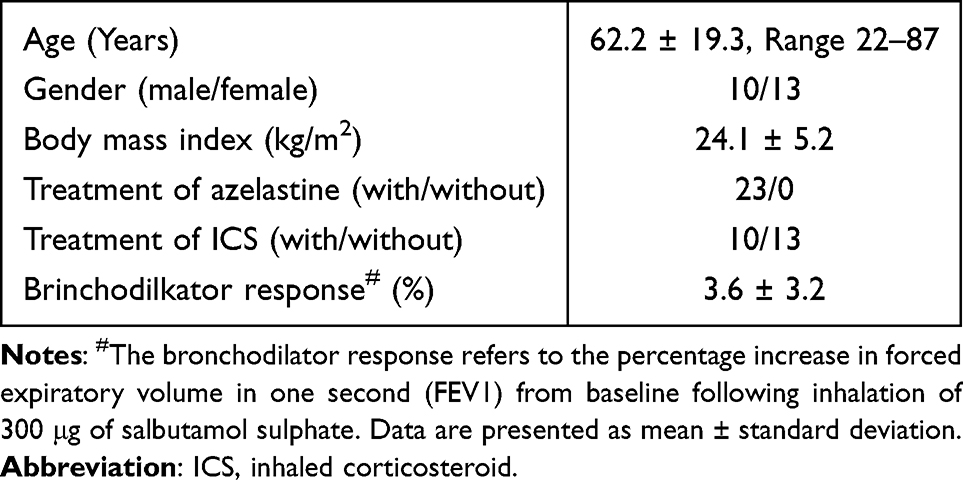 |
Table 1 Patient Characteristics |
Ethical Considerations
This study was registered at the University Hospital Medical Information Network (000058428) and approved by the Ethics Committee of Kansai Medical University (No. 2025122, approved on August 25, 2025). It was conducted in accordance with the Declaration of Helsinki and the Good Clinical Practice guidelines. Written informed consent was waived owing to the retrospective nature of the study.
Diagnosis
The diagnosis of atopic cough was conducted following the Japanese guidelines for the management of cough8 and criteria included: (1) persistent non-productive cough without wheezing and dyspnea for 8 weeks or longer, (2) poor response to bronchodilators, (3) one or more findings suggesting atopic predisposition or eosinophilia in induced sputum, and (4) cough improvement with a histamine H1 receptor antagonist and/or corticosteroids. Furthermore, based on our previous studies, we conducted additional examinations to make the diagnosis of atopic cough more reliable.10–13,16 We used the additional criteria of (5) no bronchial reversibility, defined as less than a 10% increase in forced expiratory volume in 1 second (FEV1) after inhalation of 300 µg of salbutamol sulfate; (6) increased cough reflex sensitivity, defined as a capsaicin concentration eliciting five or more coughs of 3.9 µM or less; (7) no abnormal findings that could cause cough on chest radiographs; and (8) normal FEV1 (80% of predicted value), forced vital capacity (FVC) (80% of predicted value), and FEV1/FVC ratio (70%). When all these criteria were satisfied, an accurate and definitive diagnosis of atopic cough was made.
Pulmonary Function, Cough Reflex Sensitivity, and Bronchial Reversibility
Pulmonary function, cough reflex sensitivity, and bronchial reversibility were measured, in that order, within 1 month of the first visit, before conducting this study. The FVC, FEV1, and flow-volume curve were measured using a dry wedge spirometer (Chestac 11, Chest Co., Tokyo, Japan). Spirometry was performed and evaluated according to the American Thoracic Society criteria and our previous study.17
Cough reflex sensitivity was assessed using capsaicin provocation testing.18 Capsaicin (30.5 mg) was dissolved in Tween 80 (1 mL) and ethanol (1 mL), and then in physiological saline (8 mL) to create a stock solution of 1 × 10⁻2 M, and stored at −20°C. The solution was diluted with physiological saline to create a series of solutions, starting at a concentration of 0.49 µM and increasing two-fold up to 1000 µM. Each subject inhaled a control solution of physiological saline, followed by the capsaicin solution at progressively increasing concentrations. The solutions were inhaled for 15 seconds every 60 seconds by tidal mouth breathing while wearing a nose clip, using a Bennett Twin Nebulizer (3012–60cc, Puritan Bennett, Carlsbad, CA, USA). Increasing concentrations were inhaled until five or more coughs were elicited. The nebulizer output was 0.21 mL/min. A medical technician in our pulmonary function laboratory counted the number of capsaicin-induced coughs in a blinded fashion. The cough threshold was defined as the lowest concentration of capsaicin that elicited five or more coughs.
To assess eosinophilic airway inflammation, FeNO was measured using a commercially available device (NIOX MINO™; Aerocrine, Stockholm, Sweden) prior to any forced expiratory maneuvers according to our previous study.19
Data Analysis
Capsaicin cough threshold values and total serum IgE levels were transformed to logarithmic values and expressed as the geometric mean with the geometric SD of the mean. Other data obtained in the study are presented as the mean ± SD. The cough severity VAS scores and LCQ scores before and after gefapixant administration were compared using the Wilcoxon signed-rank test. Other data before and after gefapixant administration were also compared using the Wilcoxon signed-rank test. Values of p < 0.05 were considered statistically significant. All analyses were performed using StatView 4.5J software (Abacus Concepts, Berkeley, CA, USA), without using artificial intelligence.
Results
The respiratory function results obtained by spirometry are shown in Table 2. Spirometry parameters before treatment with gefapixant were within the normal range as demonstrated in our previous study,10–14,16 and did not significantly change after additional 4 weeks treatment with gefapixant. These findings suggest that coughing in this disorder, named “atopic cough”, is caused by hypersensitivity of airway C-fibers and is unrelated to small airway obstructions. FeNO levels before treatment with gefapixant were also within the normal range as demonstrated in our previous study,10–14,16 and did not significantly change after additional 4 weeks treatment with gefapixant. These findings also suggest that coughing in this disorder is unrelated to eosinophilic inflammation. VAS scores, LCQ scores, cough sensitivity to inhaled capsaicin and blood examination results 4 weeks after treatment with gefapixant are shown in Table 3. Cough severity VAS scores and LCQ scores significantly improved after 4 weeks treatment with gefapixant (both p<0.01; Figures 1 and 2). The cough threshold to inhaled capsaicin before treatment with gefapixant was 1.65 ± 5.90 μmol/L, indicating cough reflex hypersensitivity as shown in our previous study.10–14,16 The cough threshold to inhaled capsaicin significantly improved after treatment with gefapixant (p<0.01; Figure 3), indicating that improvement of symptom scores was the result of reducing hypersensitivity of airway C fibers. Peripheral eosinophil counts and IgE levels were unchanged after gefapixant treatment. Our previous study demonstrated that Th2 cytokine inhibition reduces peripheral eosinophil counts and IgE levels accompanied by the improvement of cough threshold to inhaled capsaicin.13 These findings also suggest that the improvement of the symptom scores in refractory atopic cough is caused by the reduction of the hypersensitivity of airway C fibers, independent of airway eosinophilic inflammation. Adverse events associated with gefapixant were assessed at the first follow-up visit, within two weeks after the start of treatment. Some patients experienced taste disturbances, but these resolved within a few days of gefapixant discontinuation.
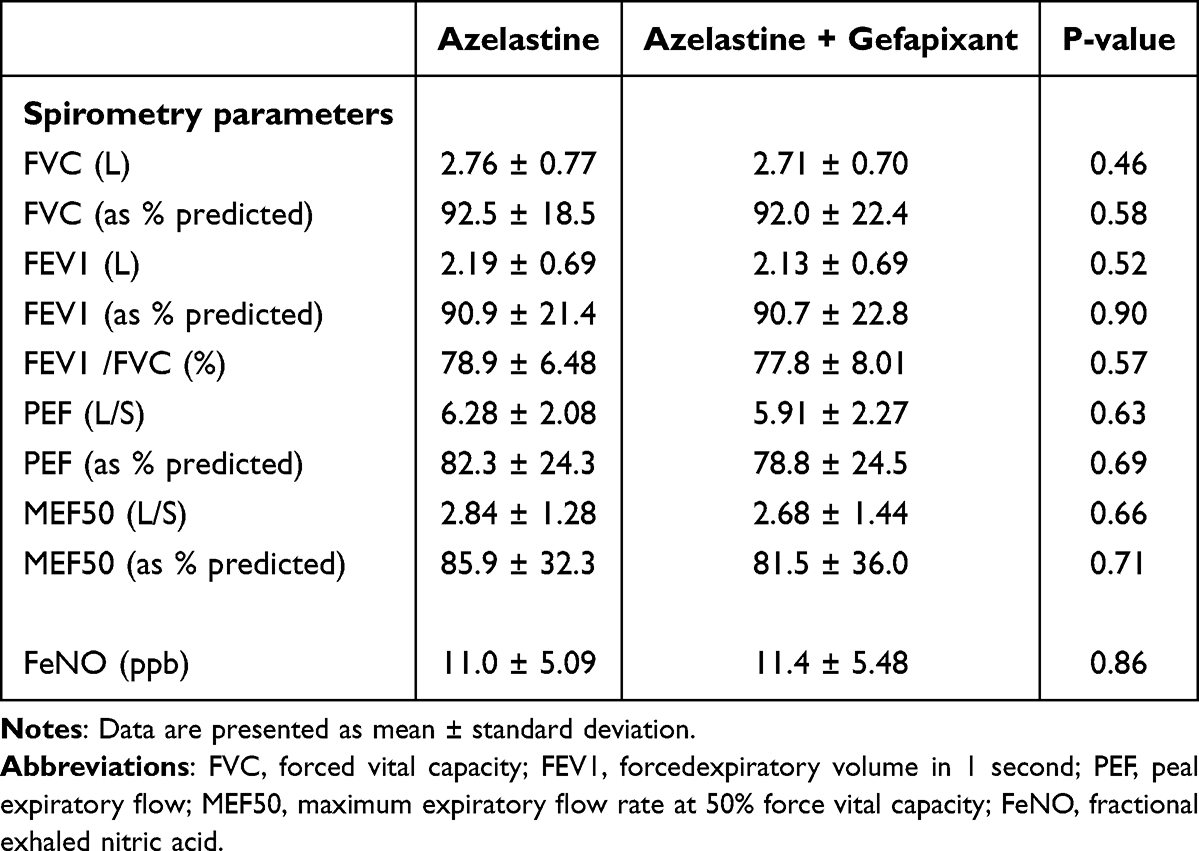 |
Table 2 Spirometry Parameters After Each Treatment |
 |
Table 3 Capsaicin Cough Threshold, VAS, LCQ and Blood Examination After Each Treatment |
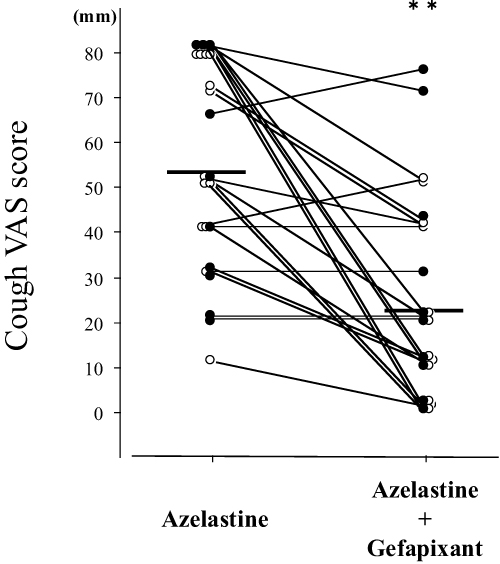 |
Figure 1 Individual visual analog scale scores for patients with refractory atopic cough receiving azelastine monotherapy and after receiving azelastine plus gefapixant combination therapy. Closed circles represent patients receiving inhaled steroid therapy and open circles represent patients without inhaled steroid therapy. **p < 0.01, determined by Wilcoxon signed-rank test. |
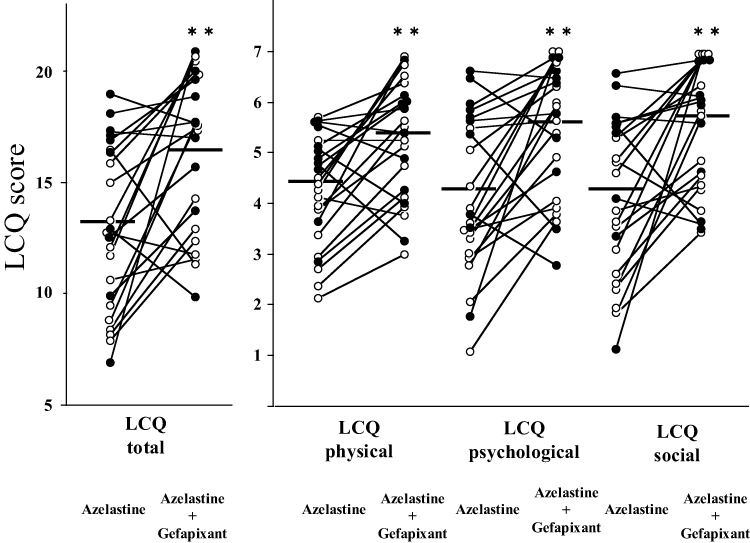 |
Figure 2 Individual Leicester cough questionnaire scores for patients with refractory atopic cough receiving azelastine monotherapy and after receiving azelastine plus gefapixant combination therapy. Closed circles represent patients receiving inhaled steroid therapy and open circles represent patients without inhaled steroid therapy. **p < 0.01, determined by Wilcoxon signed-rank test. Abbreviations: LCQ, Leicester cough questionnaire; LCQ total, total LCQ score; LCQ physical, LCQ physical domain score; LCQ psychological, LCQ psychological domain score; and LCQ social, LCQ social domain score. |
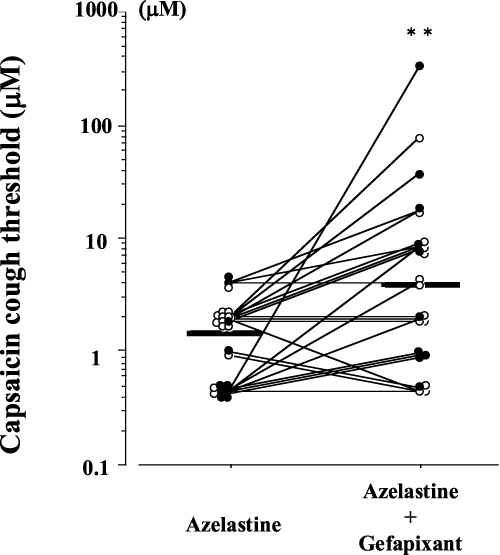 |
Figure 3 Individual capsaicin cough threshold data for patients with refractory atopic cough receiving azelastine monotherapy and after receiving azelastine plus gefapixant combination therapy. Closed circles represent patients receiving inhaled steroid therapy and open circles represent patients without inhaled steroid therapy. **p < 0.01, determined by paired t-tests transformed to logarithmic values. |
Discussion
Our results demonstrate that gefapixant, a P2X3 antagonist, improved patient-reported symptoms and cough reflex hypersensitivity in our cohort of patients with refractory atopic cough in a single-center retrospective observational pilot study. These findings imply the potential of P2X3 antagonist as therapeutic options for refractory atopic cough.
Atopic cough is commonly the underlying cause of chronic and subacute cough, which can persist for years when refractory,6,7 comprising an important clinical problem.9,12,14 More potent therapies for refractory atopic cough are required because histamine H1 receptor antagonists fail to adequately control cough in approximately 40% of cases.12 Atopic cough is also difficult to differentiate from cough-variant asthma because both disorders present with chronic eosinophilic nonproductive cough.8,9 However, these two diseases should be carefully distinguished because they require different treatments,8,9,20 and misdiagnosis can easily lead to refractory cough. The clinical features of atopic cough include bronchodilator resistance, because bronchodilator therapy mediates cough-suppressing effects only in cough-variant asthma.8,9,20 The fundamental features of atopic cough include eosinophilic inflammation of the central airways and increased cough reflex sensitivity,10 whereas those of cough-variant asthma are eosinophilic inflammation of the peripheral airways with mildly increased bronchial responsiveness.21,22 Atopic cough presents with lower FeNO levels and cough-variant asthma is associated with increased FeNO levels.11 Atopic cough is thought to arise from hyperresponsiveness of afferent airway C-fibers, with cough-variant asthma thought to arise from afferent Aδ-fibers hyperresponsiveness.8,9,20,23 Accurate differential diagnosis and effective treatment of atopic cough are necessary to prevent the condition becoming refractory.
Gefapixant, by inhibiting the P2X3 pathway, blocks adenosine triphosphate-dependent ion channels, thereby suppressing airway C-fiber activation.24 Given the known mechanism of action of gefapixant, we suspect that reducing hypersensitivity of airway C fibers may be driving the effectiveness of gefapixant for refractory atopic cough induced by afferent airway C-fiber hyperresponsiveness. Thus, the treatment of RCC with gefapixant should be investigated in large-scale prospective studies to validate our findings and establish if airway sensory C-fiber activation represents a treatable trait of refractory atopic cough that could be targeted through blocking the P2X3 pathway.
The present study had several limitations. First, although additional treatment with gefapixant demonstrated a statistically significant improvement in symptom scores and cough reflex hypersensitivity, all patients had already received azelastine, a histamine H1 antagonist. The clinical effect observed in this study cannot be definitively attributed to gefapixant and may reflect an interaction between histamine H1 antagonism and P2X3 antagonism. Further studies investigating administration of gefapixant alone would be required to elucidate the effectiveness of P2X3 inhibition for refractory atopic cough. Second, this study was conducted retrospectively, using data from patients who continued outpatient treatment. We could not conduct follow-up surveys for patients who discontinued outpatient treatment. As a result, we could not distinguish between patients who stopped visiting our clinic owing to adverse effects like taste disturbance and those who did not return because they achieved significant improvement. Taste disturbance is an important adverse effect of P2X3 inhibitors; to achieve sustained treatment and reduce treatment discontinuation, it will be important to develop new drugs that do not cause taste disturbance.25 Third, atopic cough is widely recognized in Japan as a common cause of chronic and subacute cough;6,7 however, this disease entity may not be well recognized in other countries. We believe our results support the importance of atopic cough caused by airway C-fiber hyperresponsiveness, which we hope will become recognized in more countries. Furthermore, while it is important to assess cough frequency using objective methods, we did not evaluate cough frequency in this study. Succeeding study may be required to assess the effect of gefapixant on cough frequency. Finally, measurement of cough reflex sensitivity via a capsaicin challenge test to assess airway C-fiber hyperresponsiveness is not routine clinical practice. However, this test is important to distinguish atopic cough from cough-variant asthma caused by hyperresponsiveness of sensory Aδ-fibers. Cough reflex sensitivity testing should be utilized more widely in clinical practice to distinguish atopic cough from cough-variant asthma to ensure accurate differential diagnosis and facilitate effective treatment.
Conclusions
In our cohort, treatment with the P2X3 antagonist gefapixant improved patient-reported symptoms and cough reflex hypersensitivity in patients with refractory atopic cough in this retrospective and uncontrolled study. These findings support the potential role of P2X3 antagonists in a subgroup of RCC caused by atopic cough. Larger prospective randomized and placebo controlled studies are required to confirm the clinical effect of P2X3 antagonists in patients with refractory atopic cough, especially those without prior histamine H1 antagonism.
Abbreviations
FeNO, fractional exhaled nitric oxide; FEV1, forced expiratory volume in 1 second; FVC, forced vital capacity; ICS, inhaled corticosteroid; IgE, immunoglobulin E; LCQ, Leicester cough questionnaire; MEF50, maximum expiratory flow rate at 50% force vital capacity; PEF, peak expiratory flow; ppb, parts per billion; RCC, refractory chronic cough; SD, standard deviation; VAS, visual analog scale.
Data Sharing Statement
The clinical data used to support the findings of this study are available from the corresponding author upon reasonable request.
Ethics Approval and Informed Consent
The study was approved by the Ethics Committee of Kansai Medical University (No. 2025122, approved on August 25, 2025), and conducted in accordance with the Declaration of Helsinki and the Good Clinical Practice guidelines. The requirement for written informed consent was waived owing to the retrospective nature of the study, and all patient data were kept strictly confidential.
Acknowledgments
This study was supported by a grant from “Private University Research Branding Project on Intractable Immune and Allergic diseases” from Kansai Medical University, Japan. We thank Amanda Holland, PhD, from Edanz (https://jp.edanz.com/ac) for editing the English text of a draft of this manuscript.
Author Contributions
All authors made a significant contribution to the work reported, whether that is in the conception, study design, execution, acquisition of data, analysis and interpretation, or in all these areas; took part in drafting, revising or critically reviewing the article; gave final approval of the version to be published; have agreed on the journal to which the article has been submitted; and agree to be accountable for all aspects of the work.
Disclosure
The authors declare that they have no competing interests for this work.
References
1. Satia I, Hassan W, McGarvey L, Birring SS. The clinical approach to chronic cough. J Allergy Clin Immunol Pract. 2025;13(3):454–9. PMID: 39557290. doi:10.1016/j.jaip.2024.11.004
2. Turner RD, Birring SS. Chronic cough as a disease. ERJ Open Res. 2024;10(6):00459–2024. eCollection 2024 Nov. PMID: 39559449. doi:10.1183/23120541.00459-2024
3. Hu X, Zhang K, Liu T, Zhu XJ. Chronic cough: a review and prospects. Medicine. 2025;104(41):e45162. PMID: 41088639. doi:10.1097/MD.0000000000045162
4. Kum E, Patel M, Diab N, et al. Efficacy and tolerability of gefapixant for treatment of refractory or unexplained chronic cough: a systematic review and dose-response meta-analysis. JAMA. 2023;330(14):1359–1369. PMID: 37694849. doi:10.1001/jama.2023.18035
5. Matsumoto H, Kanemitsu Y, Ohe M, et al. Real-world usage and response to gefapixant in refractory chronic cough. ERJ Open Res. 2025;11(4):01037–2024. eCollection 2025 Jul. PMID: 40630384. doi:10.1183/23120541.01037-2024
6. Ishiura Y, Fujimura M, Ogawa H, et al. Prevalence and causes of chronic cough in Japan. Respir Investig. 2024;62(3):442–448. Epub 2024 Mar 23.PMID: 38522360. doi:10.1016/j.resinv.2024.02.017
7. Ishiura Y, Fujimura M, Ogawa H, et al. Prevalence and causes of subacute cough in Japan. Respir Investig. 2025;63(1):74–80. Epub 2024 Dec 6.PMID: 39644876. doi:10.1016/j.resinv.2024.11.007
8. Mukae H, Kaneko T, Obase Y, et al. The Japanese respiratory society guidelines for the management of cough and sputum (digest edition). Respir Investig. 2021;59(3):270–290. PMID: 33642231. doi:10.1016/j.resinv.2021.01.007
9. Fujimura M, Niimi A, Naito K, et al. Guidelines for Diagnosis and Treatment of Prolonged and Chronic Cough for Cough Specialists. Kanazawa: Japan Cough Society. Maeda Syoten; 2021:27–31. (in Japanese).
10. Fujimura M, Ogawa H, Yasui M, Matsuda T. Eosinophilic tracheobronchitis and airway cough hypersensitivity in chronic non-productive cough. Clin Exp Allergy. 2000;30(1):41–47. PMID: 10606929. doi:10.1046/j.1365-2222.2000.00698.x
11. Fujimura M, Ohkura N, Abo M, et al. Exhaled nitric oxide levels in patients with atopic cough and cough variant asthma. Respirology. 2008;13(3):359–364. PMID: 18399857. doi:10.1111/j.1440-1843.2008.01273.x
12. Fujimura M, Nishi K, Ohka T, Yasui M, Kasahara K. Bronchial biopsy and sequential bronchoalveolar lavage in atopic cough: in view of the effect of histamine H1-receptor antagonists. Allergology Int. 2000;49:135–142. doi:10.1046/j.1440-1592.2000.00171.x
13. Ishiura Y, Fujimura M, Yamamoto H, et al. Effect of an orally active Th2 cytokine inhibitor, suplatast tosilate, on atopic cough. Arzneimittelforschung/Drug Res. 2008;58(6):297–302. PMID: 18677972. doi:10.1055/s-0031-1296510
14. Ishiura Y, Nomura S, Ishii Y, et al. Efficacy of Gefapixant, a P2X3 antagonist, for refractory atopic cough. Int Med Case Rep J. 2023;16:497–501. eCollection 2023.PMID: 37692174. doi:10.2147/IMCRJ.S427098
15. Kang J, Moon JY, Kim DK, et al. Reclassification of items in the Leicester Cough Questionnaire: correlation analysis. Respir Investig. 2024;62(6):1150–1156. PMID: 39393344. doi:10.1016/j.resinv.2024.09.017
16. Fujimura M, Ogawa H, Nishizawa Y, Nishi K. Comparison of atopic cough with cough variant asthma: is atopic cough a precursor of asthma? Thorax. 2003;58(1):14–18. PMID: 12511712. doi:10.1136/thorax.58.1.14
17. Ishiura Y, Fujimura M, Ohkura N, et al. Tiotropium add-on and treatable traits in asthma-COPD overlap: a real-world pilot study. J Asthma Allergy. 2022;15:703–712. eCollection 2022.PMID: 35651483. doi:10.2147/JAA.S360260
18. Fujimura M, Sakamoto S, Kamio Y, Matsuda T. Effects of methacholine-induced bronchoconstriction and procaterol-induced bronchodilation on cough receptor sensitivity to inhaled capsaicin and tartaric acid. Thorax. 1992;47:441–445. doi:10.1136/thx.47.6.441
19. Ishiura Y, Fujimura M, Ohkura N, et al. Triple therapy with budesonide/glycopyrrolate/formoterol fumarate improves inspiratory capacity in patients with asthma-chronic obstructive pulmonary disease overlap. Int J Chron Obstruct Pulmon Dis. 2020;15:269–277. eCollection 2020.PMID: 32103926. doi:10.2147/COPD.S231004
20. Tamaoki J, Nagase H, Sano H, et al. Practical Guidelines for Asthma Management (PGAM): digest edition. Respir Investig. 2025;63(3):405–421. PMID: 40112734. doi:10.1016/j.resinv.2025.03.009
21. Cox JK, Lockey R, Cardet JC. Cough-variant asthma: a review of clinical characteristics, diagnosis, and pathophysiology. J Allergy Clin Immunol Pract. 2025;13(3):490–498. PMID: 39557293. doi:10.1016/j.jaip.2024.11.005
22. Ma X, Ma X, Li X, Ma L, Peng X, Zhou X. Toward precision modeling of cough-variant asthma: standardized murine models, multidimensional evaluation, and translational applications. J Asthma Allergy. 2025;18:1743–1760. eCollection 2025.PMID: 41425642. doi:10.2147/JAA.S574008
23. Ohkura N, Fujimura M, Hara J, Ohsawa M, Kamei J, Nakao S. Bronchoconstriction-triggered cough in conscious Guinea pigs. Exp Lung Res. 2009;35(4):296–306. PMID: 19415547. doi:10.1080/01902140802668831
24. McGarvey LP, Birring SS, Morice AH, et al. COUGH-1 and COUGH-2 Investigators. Efficacy and safety of gefapixant, a P2X3 receptor antagonist, in refractory chronic cough and unexplained chronic cough (COUGH-1 and COUGH-2): results from two double-blind, randomised, parallel-group, placebo-controlled, phase 3 trials. Lancet. 2022;399(10328):909–923. doi:10.1016/S0140-6736(21)02348-5
25. Guo CR, Zhang ZZ, Zhou X, et al. Chronic cough relief by allosteric modulation of P2X3 without taste disturbance. Nat Commun. 2023;14(1):5844. PMID: 37730705. doi:10.1038/s41467-023-41495-0
 © 2026 The Author(s). This work is published and licensed by Dove Medical Press Limited. The
full terms of this license are available at https://www.dovepress.com/terms
and incorporate the Creative Commons Attribution
- Non Commercial (unported, 4.0) License.
By accessing the work you hereby accept the Terms. Non-commercial uses of the work are permitted
without any further permission from Dove Medical Press Limited, provided the work is properly
attributed. For permission for commercial use of this work, please see paragraphs 4.2 and 5 of our Terms.
© 2026 The Author(s). This work is published and licensed by Dove Medical Press Limited. The
full terms of this license are available at https://www.dovepress.com/terms
and incorporate the Creative Commons Attribution
- Non Commercial (unported, 4.0) License.
By accessing the work you hereby accept the Terms. Non-commercial uses of the work are permitted
without any further permission from Dove Medical Press Limited, provided the work is properly
attributed. For permission for commercial use of this work, please see paragraphs 4.2 and 5 of our Terms.
Recommended articles
Efficacy of Gefapixant, a P2X3 Antagonist, for Refractory Atopic Cough
Ishiura Y, Nomura S, Ishii Y, Imai K, Sawai Y, Tamaki T, Shimizu T, Miyashita N, Ito T
International Medical Case Reports Journal 2023, 16:497-501
Published Date: 4 September 2023