
Back to Journals » Advances in Medical Education and Practice » Volume 17
Differences and Trends of Artificial Intelligence in Medical Education: A Comparative Bibliometric Analysis Between China and the International Community

Received 11 October 2025
Accepted for publication 13 January 2026
Published 31 January 2026 Volume 2026:17 573537
DOI https://doi.org/10.2147/AMEP.S573537
Checked for plagiarism Yes
Review by Single anonymous peer review
Peer reviewer comments 2
Editor who approved publication: Dr Md Anwarul Azim Majumder
Songhua Ma,1,2 Qing Zhou,3 Huiqun Wu4
1Department of Physiology, Medical School of Nantong University, Nantong, People’s Republic of China; 2Nantong University Xining College, Nantong, People’s Republic of China; 3Education and Training Department, Affiliated Hospital of Nantong University, Nantong, People’s Republic of China; 4Department of Medical Informatics, Medical School of Nantong University, Nantong, People’s Republic of China
Correspondence: Songhua Ma, Email [email protected]
Objective: This study aims to explore the application of artificial intelligence in medical education by comparing research hotspots and evolutionary trends between China and the international community, ultimately proposing informed educational practices and policy recommendations.
Methods: Literature was retrieved from the core collections of CNKI and Web of Science for the period 2014– 2024, limited to article and review publications. After applying a unified Boolean search strategy and deduplication, the data were analyzed using CiteSpace 6.4.R1 to examine publication trends, collaboration networks, keyword co-occurrence/clustering/burst detection, and co-citation patterns.
Results: A total of 379 Chinese and 552 English records were included. Publications surged after 2018 and peaked during 2023– 2024. International hotspots centered on machine learning, deep learning, and large language models for simulation-based training and clinical reasoning; Chinese studies focused on “New Medical Sciences”, VR/AR, and medical imaging. The emergence of generative artificial intelligence and multimodal large models has become a new frontier in artificial intelligence research within global medical education from 2023 to 2024.
Conclusion: This study is based on a comparison of two databases to reveal the hotspots and differences in artificial intelligence and medical education research between China and the international research community. It not only compensates for the time lag of existing research, but also proposes three major trends driven by artificial intelligence in the development of medical education (generative AI, personalized learning, immersive experience). A complementary pattern exists between technology-driven and scenario-driven orientations. We recommend integrating AI literacy and ethics into curricula, establishing Generative-AI teaching/assessment guidelines, and building cross-institutional, yearly knowledge-map monitoring for sustainable innovation in medical education.
Keywords: artificial intelligence, AI, medical education, literature visualization, generative AI
Introduction
In the context of the global rapid advancement of science and technology, artificial intelligence (AI) is increasingly permeating various fields. Medical education, as a vital component of higher education, has also been profoundly impacted by AI technologies. In recent years, the applications of AI in medical education have been progressively expanding, with their potential and effectiveness drawing widespread attention. At the micro level, AI technologies have demonstrated remarkable advantages in areas such as medical image analysis, disease diagnosis simulation, and virtual patient interactions, significantly enhancing the precision and interactivity of medical learning.1 From a macro perspective, it even holds the potential to reshape the structure and format of medical education, fundamentally transforming the paradigms of modern medical education.2
At present, despite the global advancements in AI research within medical education, there remain notable disparities in research focuses, methodological frameworks, and depth of practical applications between Chinese and global medical education systems.3 In other countries such as the United States and Canada, AI application in medical education has reached relative maturity. Existing literature has explored its practical implementations in curriculum design, innovative teaching methodologies, and evaluation-feedback mechanisms.4 Building upon its own educational system, China has actively explored AI applications in indigenous medical education in recent years. For instance, AI has been used to promote diagnostic thinking skills and cultivate personalized teaching programs for medical students, while also fostering their humanistic care consciousness and facilitating collaborations between clinical medicine and social science research.5
Bibliometric analysis is a rigorous and widely adopted methodology for investigating scientific literature through quantitative evaluation, encompassing research hotspots, emerging trends, and academic impact.6
This study intends to utilize the resources of two major databases, Web of Science (WoS) and the Chinese National Knowledge Infrastructure (CNKI), in conjunction with the CiteSpace visualization tool, to conduct a comparative analysis of the current hotspots and developmental trends of AI in Chinese and global medical education. Despite the limitations of databases, this approach enables a systematic examination of research achievements, current developments, and pivotal focus areas in AI and medical education fields. This study will seek to chart the developmental trajectories and core themes of the field, shedding light on the future integration of AI and medical education across the global landscape.
Materials and Methods
Data Sources and Search Strategies
In this study, CNKI database was used as the source database for advanced searches with subject terms including “artificial intelligence”, “machine learning”, “deep learning”, “natural language processing”, “computer vision” combined with “medical education”. The search spanned the time range from January 1, 2014 to December 31, 2024, yielding 430 articles. After excluding conference notices, reports, and irrelevant literature, 379 Chinese documents were finally included. For the Web of Science Core Collection database, the search strategy used TS=(“artificial intelligence” OR “machine learning” OR “deep learning” OR “natural language processing” OR “computer vision”) AND TS=“medical education” within the same time period. This resulted in 632 records. Following exclusion of conference papers, editorial materials, and news articles, document types were restricted to “Article” and “Review” in English. The retrieval date was March 4, 2025, resulting in a final inclusion of 552 English documents. The screening process of all literature was independently conducted by two individuals, and the screening results excluded possible differences.
Research Tool
This study employed CiteSpace 6.4.R1 software for data analysis. CiteSpace is a visual mapping tool that can intuitively display research hotspots and evolutionary trends in specific fields through knowledge graphs.7 The software supports capabilities such as annual publication output analysis, co-authorship/collaborative network analysis among authors/institutions/countries, keyword co-occurrence/burst/clustering analysis, cited reference clustering analysis, co-citation analysis of authors/journals, and journal overlay mapping.
Data Analysis
The CiteSpace software was used to conduct co - occurrence analysis, cluster analysis, and perform keyword burst analysis with keywords as nodes. The time span was set from 2014 to 2024, the time slice was set to 1 year, and the map pruning methods were selected as “pathfinder” and “pruning sliced networks” to run the software for analysis. In the map, nodes represent the objects of analysis. The size of the circle of a node represents its frequency. The color gradation of the circle represents the different years when the content appeared. The lines between nodes indicate the co - occurrence strength, and the colors of nodes and lines correspond to the years. Centrality is a measure of the connection role of a node in the overall network. The higher the centrality, the greater the influence and importance of the node in the overall network. Nodes with a purple - red outer circle are those with high centrality. Burst refers to a sudden increase in the citation volume within a certain period. Burst analysis helps to identify research hotspots and understand the cutting - edge trends in the research field.
Results
Comparative Analysis of Annual Publication Quantity
As depicted in Figure 1, the annual quantity of research papers published globally on the integration of AI in medical education did not exhibit any substantial growth during the period from 2014 to 2017. Nevertheless, starting from 2018, a steadily rising trend became evident, and there was a notably significant upsurge, especially following the year 2022. On the whole, in this particular field, the number of papers published by international community has consistently exceeded that of China.
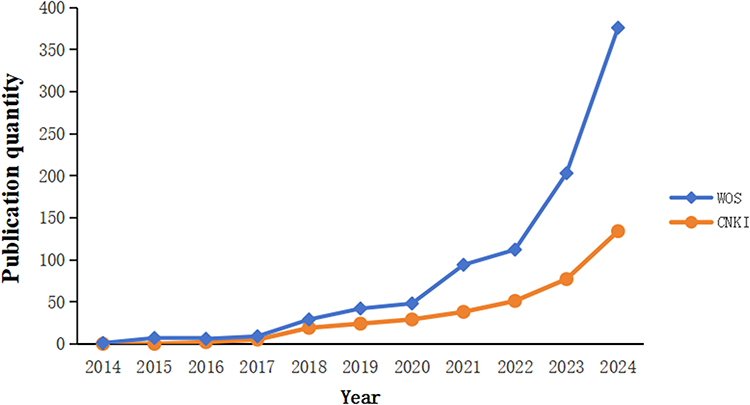 |
Figure 1 Comparative analysis of annual publication quantity in CNKI database and Web of Science database. |
Comparative Analysis of Research Institutions and Countries
Based on analysis of Web of Science and CNKI databases, the authors compiled lists of top 5 countries and institutions by publication quantity and centrality in the AI-medical education research field (Table 1). Results showed that the United States ranked first with 215 publications (38.9% of total), followed by China with 72 articles (13%). Notably, Belgium led in centrality rankings and maintained extensive research collaborations with countries such as India and Pakistan. The analysis of institutional contributions revealed a stark contrast between Chinese and global institutions in publication output (Table 2). Globally, Harvard University ranked first with 31 publications. In contrast, Chinese institutions demonstrated significantly lower productivity, with West China Hospital of Sichuan University leading domestically. Notably, the publication volume of top global institutions (eg, Harvard University) exceeded that of all top five Chinese institutions combined, underscoring a pronounced disparity in research output and international competitiveness. This gap highlights the need for Chinese institutions to strengthen interdisciplinary collaboration and global partnerships to bridge the technological and scholarly divide in AI-driven medical education research.
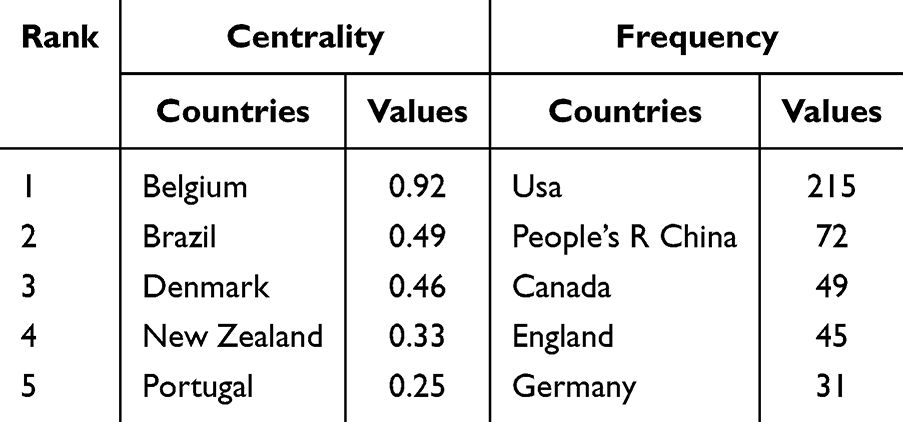 |
Table 1 The Top 5 Countries by Publication Quantity and Centrality in AI and Medical Education Research |
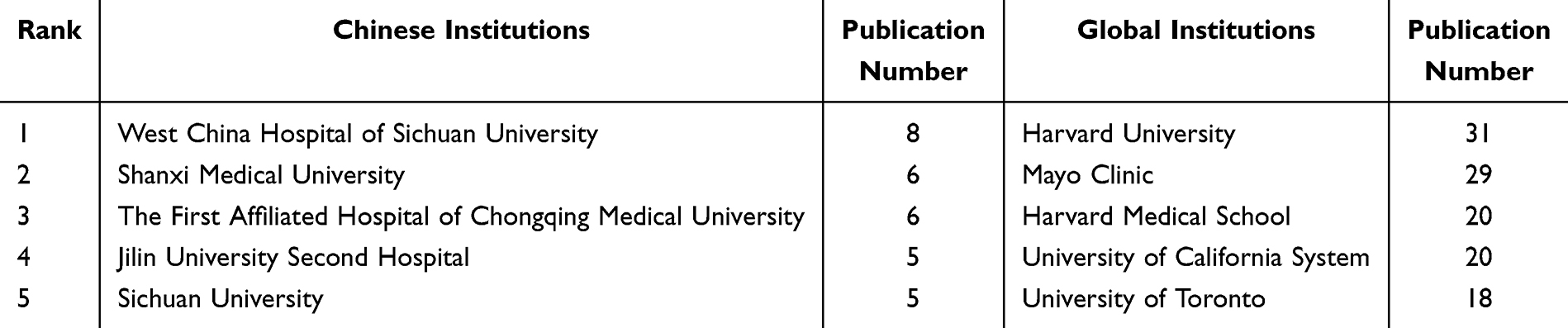 |
Table 2 The Top 5 Institutions by Publication Quantity in AI and Medical Education Research Between Chinese Institutions and Global Institutions |
In the country co-occurrence network map (density=0.0373, 80 nodes, 118 connections), the United States, China, the United Kingdom, and Canada occupied core positions. The US established collaborative links with Canada, the UK, Israel, and others. However, collaborative ties between China and Western countries were less extensive compared to the closer partnerships observed among Western nations themselves (Figure 2).
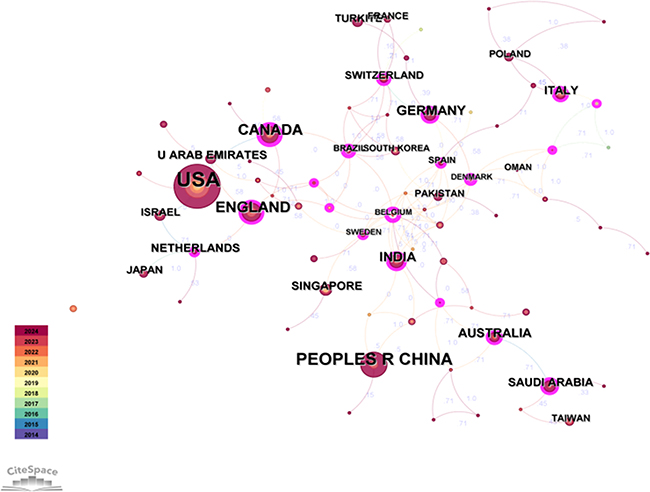 |
Figure 2 Co-occurring network diagram of the countries involved in the research on AI and medical education. |
Comparison of Keyword Co-Occurrence Analysis and Frequency Analysis
Based on the keyword co-occurrence network analysis of the Web of Science database, the map density is 0.0146, with 367 nodes and 982 connecting lines (Figure 3).
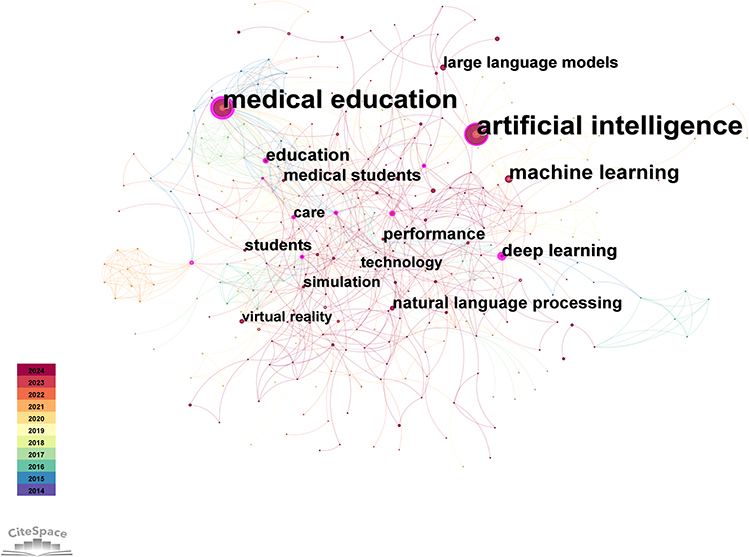 |
Figure 3 Co-occurring Keywords network diagram based on Web of Science database. |
A comparison of the frequencies of keyword occurrences and the first occurrence year in this field was shown in Table 3. As can be seen from Table 3, the hot issues of artificial intelligence in the field of medical education have gone through three development stages.
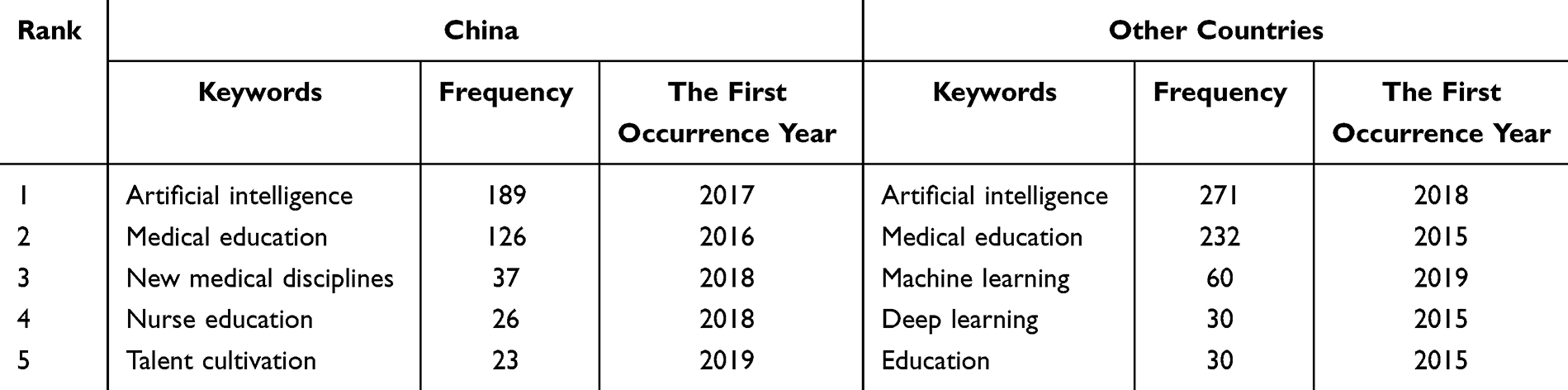 |
Table 3 Comparative Analysis of Top 5 Keywords in AI and Medical Education Research Between China and Other Countries |
The first stage was from 2015 to 2017. Artificial intelligence mainly relied on deep learning technology and was mainly applied to teaching reforms, medical student courses, and course feedback in medical education. The second stage was from 2018 to 2020. Due to the development of machine learning technology, the application of artificial intelligence in clinical teaching developed rapidly, especially research in areas such as simulation teaching, virtual reality, and medical imaging became hotspots. The third stage was from 2021 to 2024. Big data and natural language processing promoted the rapid development of large language models and generative artificial intelligence. Artificial intelligence represented by ChatGPT was applied in multiple fields of medical education.
By comparing the first occurrence years of keywords in this field, it can be seen that the research on artificial intelligence in the field of medical education in China was slightly earlier than that in other countries, especially in the research on virtual reality and medical imaging, which was significantly earlier than that in other countries. However, the international research community was ahead of China in research on big data and large language models. This comparative analysis highlights divergent research trajectories: China emphasizes localized educational adaptations, while global efforts prioritize technological advancements (eg, generative AI). Bridging these foci could enhance cross-regional synergies in AI-driven medical education.
Comparison of Keyword Cluster Analysis
Based on the keyword co-occurrence analysis in the research of artificial intelligence and medical education, cluster analysis was carried out. The research on artificial intelligence in China mainly focused on themes such as “medical education”, “medical research”, “teaching reform”, “nursing education”, and “New Medical Sciences” (which refers to China’s national reform of medical education, focusing on interdisciplinary training). While the research in other countries mainly focused on themes such as “medical education & training”, “machine learning”, and “digital health”. The average Silhouette Value (S value) of the map is 0.8641, and the Modularity Value (Q value) is 0.6945 (Figure 4).
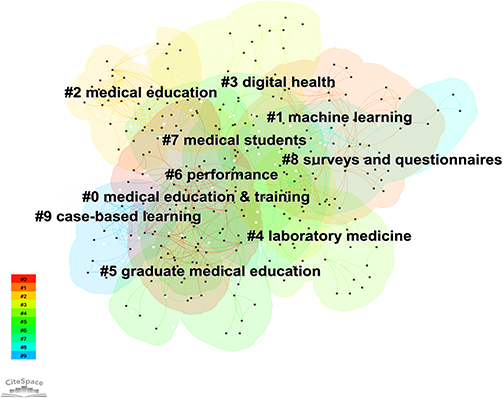 |
Figure 4 Keyword cluster analysis map based on Web of Science database. |
Analysis of Time Zone Diagram
In this study, the keyword clustering of the two databases was carried out based on the Log-Likelihood Rate (LLR) algorithm method, and the time zone view was obtained through operation (Figure 5).
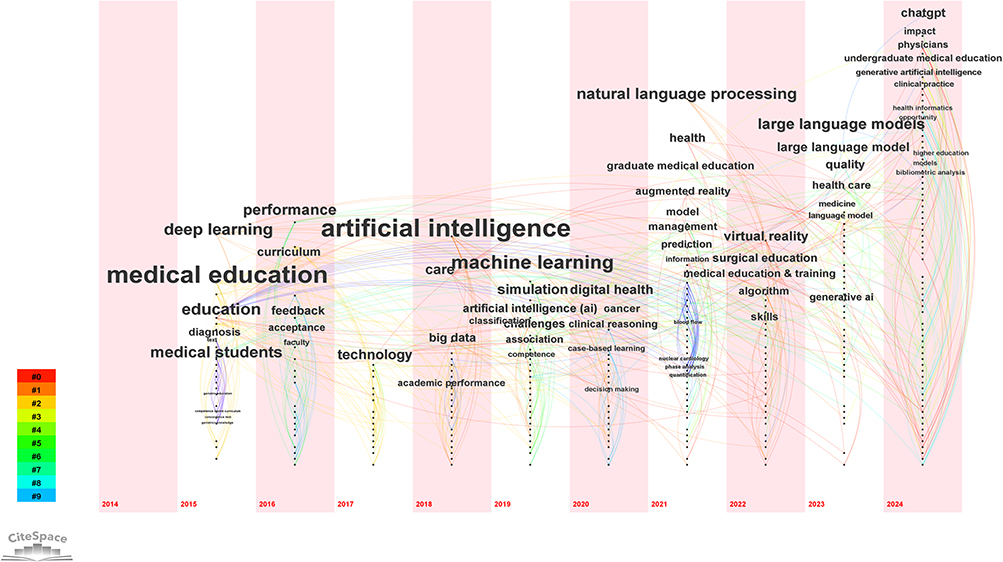 |
Figure 5 Time zone diagram of keyword cluster based on Web of Science database. |
Analyzing from the time zone diagram, it can be seen that in foreign medical education, research on the integration of deep learning and medical education started at an earlier stage. Deep learning, as an emerging field, began to attract attention in 2015, and its application in medical education gradually increased over time. Since 2017, the application of artificial intelligence in the medical field has become a research hotspot. Especially in 2018 and 2019, research related to medical education, technology, big data, and clinical reasoning increased significantly. The application of machine learning in the medical field also achieved remarkable development in 2018 and 2019, particularly in aspects such as medical simulation education, digital health, and case-based learning. By 2023, large language models and generative artificial intelligence (Generative AI) have emerged as prominent research foci. For instance, the extensive application of ChatGPT indicates that the ability of artificial intelligence in understanding and generating natural language is being explored and applied to medical education and practice.
However, the integration of medical education and artificial intelligence in China started slightly later than that in foreign countries. Since 2016, artificial intelligence has started to become a research hotspot in the field of medical education. Deep learning was the first to draw attention. In 2018, the concept of new medical disciplines emerged, and meanwhile, medical imaging became the research focus. Subsequently, the application of virtual reality technology and virtual simulation technology in medical education gradually became a research hotspot.
Comparison of Keyword Burst Detection Analysis
The analysis results of the CNKI database in China showed that intelligent medicine has the highest burst strength. From 2021 to 2022, the burst strength reached 2.75. Analyzing the newly emerged burst keywords with relatively high strength in the recent three years (2022–2024), they included virtual reality, teaching practice, and information technology. In contrast, according to the analysis results of the WoS database, “machine learning” had the highest burst strength from 2019 to 2022, reaching 4.01 (Figure 6). Among the newly emerged keywords with relatively high strength in the recent three years (2022–2024), there were “classification”, “medical education and training”, “cancer”, and “association”.
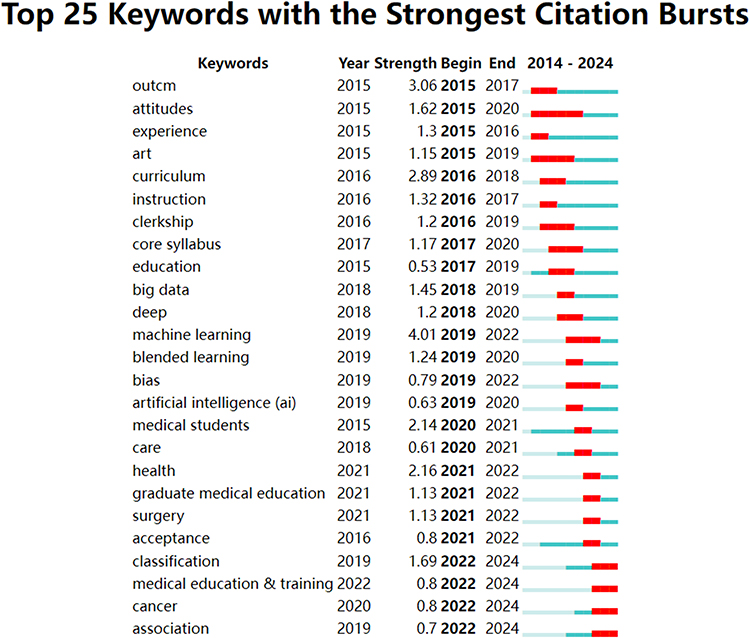 |
Figure 6 Top 25 keywords with strongest citation bursts based on Web of Science database. |
Based on the time and content of keyword mutations, it can be found that the research hotspots of artificial intelligence in the field of medical education in China mainly focused on the application of information technologies such as the combination of virtual reality technology and artificial intelligence in medical education practice. On the other hand, the research hotspots of artificial intelligence in the field of medical education in the international research community mainly concentrated on artificial intelligence technologies, such as machine learning, which were used to develop medical education learning tools, for example, in the field of oncology, to improve the efficiency and effectiveness of education.
Analysis of Co-Cited References and Analysis of Authors
Based on the Web of Science database, the clustering themes of the co-cited references included machine learning, multiple-choice questions, chatbots, radiology, neuroscience, ChatGPT, medical students, learning strategies, etc. It reflected that the current research frontiers of artificial intelligence in the field of medical education mainly focused on the application of large language models such as ChatGPT in medical disciplines. And these applications were likely to change the learning strategies of medical students and have a profound impact on medical education.
The top 5 authors of the co-cited references in the research of artificial intelligence in medical education were shown in Table 4. Professor Kung Tiffany H. from Harvard Medical School has significant influence in this field. The research topics mainly concentrated on using large language models, such as ChatGPT, to assist medical education and clinical decision-making. The research team evaluated the performance of ChatGPT in the USMLE (United States Medical Licensing Examination) and explored the potential and application prospects of AI in medical education.8
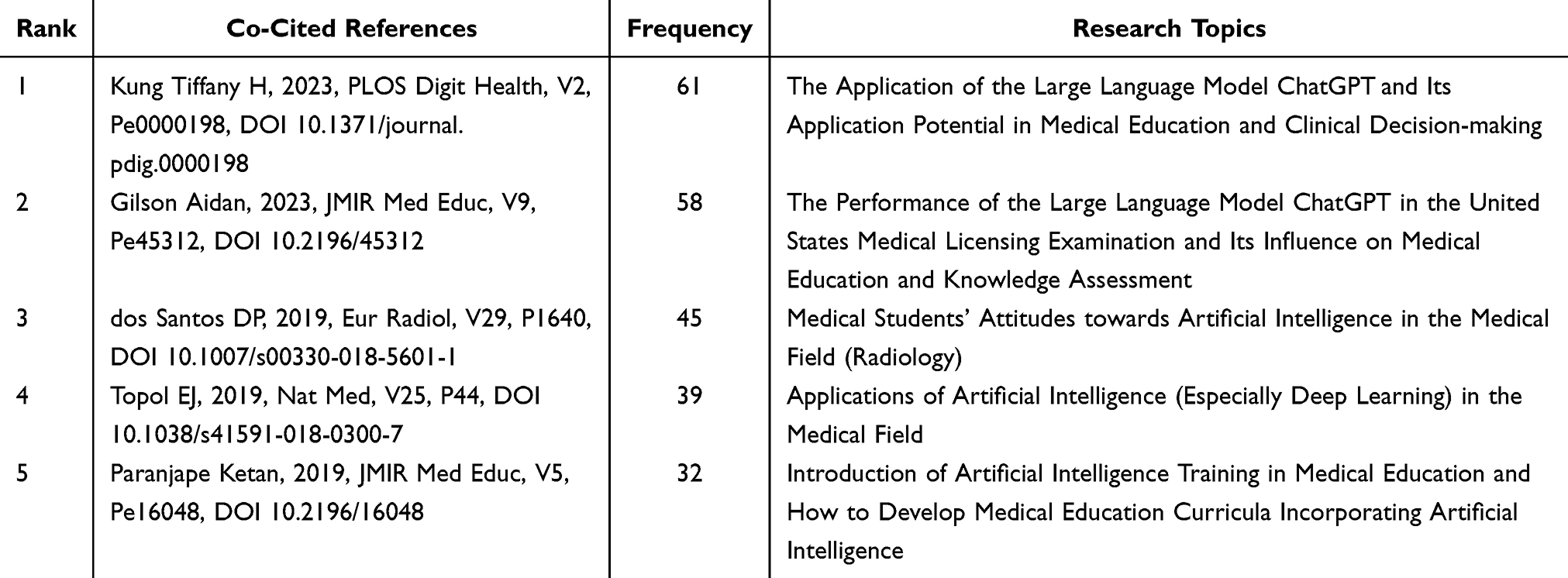 |
Table 4 The Top 5 Co-Cited References and Their Research Topics Based on the WoS |
Discussion
Drivers of Accelerated Growth in AI Applications (2023–2024)
The rapid expansion of AI research in medical education over the past two years is underpinned by synergistic advancements in technology, pedagogy, and policy. Breakthroughs in machine learning (ML), large language models (LLMs), and deep learning have enabled novel applications such as virtual patient training systems and automated exam question generation.9 Concurrently, evolving educational paradigms emphasizing personalized learning and interdisciplinary collaboration between medicine and information technology have further catalyzed AI adoption. The integration of big data analytics has empowered predictive and prescriptive insights, enhancing AI’s utility in curriculum design and clinical skill assessment.10,11
Comparative Analysis of Research Focus: China vs International Trends
In this study, Chinese research prioritizes pedagogical reforms, virtual reality (VR)-enabled skill training,12 and digital transformation, driven by the government’s “New Medical Science” initiative. This policy advocates multidisciplinary integration and AI-supported personalized learning, fostering innovations like flipped classrooms and hybrid education models.13 While global research leverages ML for medical imaging analysis and disease prediction.14–16 Meanwhile, international research maintains a strong focus on issues of “ethics”, “bias”, and “fairness”—a priority that mirrors and is deeply intertwined with the global conversation on AI ethics and governance.
Emerging Trends and Future Directions
Generative AI and Large Language Models (LLMs)
LLMs, exemplified by ChatGPT, are revolutionizing medical education through dynamic text generation, clinical reasoning support, and interactive learning. These tools enhance student engagement by simulating patient interactions, generating case studies, and providing real-time feedback.17–19 Future efforts must address challenges in contextual relevance and real-time knowledge updates to ensure accuracy in clinical training.20 Generative AI (AIGC) further enables adaptive content creation, including tailored textbooks and immersive virtual scenarios, thereby enriching resource libraries and fostering competency-based learning.21
Personalized Learning and Adaptive Education
AI-driven classification and association algorithms are reshaping individualized learning pathways. By analyzing student performance data, AI systems deliver customized content, adaptive assessments, and targeted feedback, optimizing knowledge retention and critical thinking.22,23 Emerging research explores generative AI’s role in designing student-centric curricula, though ethical considerations regarding data privacy and algorithmic bias require rigorous scrutiny.24
Virtual Reality and Immersive Technologies
VR and augmented reality (AR) offer unparalleled opportunities for skill acquisition through simulated surgeries, anatomical exploration, and procedural rehearsals.25,26 However, barriers such as high costs, technical complexity, and limited evidence-based validation hinder widespread adoption.27 Future integration with AI could enhance interactivity, enabling real-time performance analytics and personalized skill remediation.
Challenges and Ethical Considerations
Privacy, Ethics, and Humanistic Values
The use of patient data in AI training raises concerns about privacy breaches and dehumanization of care. Medical curricula must emphasize ethical AI usage and balance technical proficiency with empathy cultivation.28
Data Bias and Hallucinations
AI-generated inaccuracies (“hallucinations”) and systemic biases pose risks in clinical decision-making. Mitigation strategies include robust validation frameworks, diverse training datasets, and transparency in algorithmic design.29,30
AI Literacy in Medical Education
A global survey of medical students highlights insufficient preparedness for AI integration.31 To address this, curricula must incorporate AI literacy modules, equipping future practitioners with skills to critically evaluate and responsibly deploy AI tools.32
Several limitations merit consideration. The study primarily relies on bibliometric analyses and theoretical frameworks, lacking empirical evidence or case studies to validate how AI tools function effectively in real-world medical education settings. Moreover, the comparative analysis of Chinese and global research trends may oversimplify the complex sociocultural and infrastructural factors shaping these landscapes, as it relies predominantly on keyword frequency analysis without deeper contextual exploration of regional nuances. The database selection only used CNKI and Web of Science, which were representative but may miss relevant literature from other important databases such as PubMed and Scopus.
Conclusion
This study elucidates the disparities between China and foreign nations by adopting a cross-border comparative framework and leveraging a knowledge graph, thereby transcending the constraints of prior research that was confined to a singular database. By extending the research timeline to encompass 2023–2024, we have captured the most recent advancements in the application of generative AI and ChatGPT, effectively bridging the temporal gap inherent in existing studies. It highlights the transformative potential of generative AI and immersive technologies to reshape medical education, calling on educators to prioritize AI literacy and ethical frameworks within curricula. It also underscores the need for cross-disciplinary collaboration and policy alignment to address global disparities in AI adoption, thereby providing a strategic roadmap for future research on adaptive learning systems and bias mitigation strategies.
Data Sharing Statement
The data utilized in this study are publicly available and can be downloaded from the Web of Science Core Collection and CNKI.
Ethics Approval
This research did not involve humans or animals.
Author Contributions
SM designed this study, contributed to interpret the data and draft the manuscript. HW and QZ performed acquisition of data, analysis and interpretation, and helped to draft the manuscript. All authors took part in drafting, revising or critically reviewing the article; gave final approval of the version to be published; have agreed on the journal to which the article has been submitted; and agree to be accountable for all aspects of the work.
Funding
Key Research Project on Higher Education Reform in Jiangsu Province in 2025 (2025JGZD163); Research Funding of University “Qinglan Project” in Jiangsu Province; Teaching Reform Research Project of Nantong University in 2024 (2024E05); Jiangsu Overseas Visiting Scholar Program for University Prominent Young & Middle-aged Teachers and Presidents.
Disclosure
The authors report no conflicts of interest in this work.
References
1. Zhou HY, Yu Y, Wang C, et al. A transformer-based representation-learning model with unified processing of multimodal input for clinical diagnostics. Nat Biomed Eng. 2023;7:743–11. doi:10.1038/s41551-023-01045-x
2. Qu X, Yang JM, Chen T, et al. ChatGPT’s reflection on the change of medical education model. J Sichuan Univ. 2023;54(05):937–940.
3. Zhang W, Cai M, Lee HJ, et al. AI in Medical Education: global situation, effects and challenges. Educ Inf Technol. 2024;29(4):4611–4633. doi:10.1007/s10639-023-12009-8
4. Pucchio A, Rathagirishnan R, Caton N, et al. Exploration of exposure to artificial intelligence in undergraduate medical education: a Canadian cross-sectional mixed-methods study. BMC Med Educ. 2022;22(1):815. doi:10.1186/s12909-022-03896-5
5. Wu ZY, Liu Z, Zhang ZM. Research on the current status and future governance of artificial intelligence in the field of medical education. Chin J Med Ethics. 2024;37(09):1093–1100.
6. Choudhri AF, Siddiqui A, Khan NR, et al. Understanding bibliometric parameters and analysis. Radiographics. 2015;35(3):736–746. doi:10.1148/rg.2015140036
7. Chen CM. CiteSpace II: detecting and visualizing emerging trends and transient patterns in scientific literature. J Am Soc Inf Sci Technol. 2006;57(3):359–377. doi:10.1002/asi.20317
8. Kung TH, Cheatham M, Medenilla A, et al. Performance of ChatGPT on USMLE: potential for AI-assisted medical education using large language models. PLOS Digit Health. 2023;2(2):e0000198. doi:10.1371/journal.pdig.0000198
9. Dave M, Patel N. Artificial intelligence in healthcare and education. Br Dent J. 2023;234(10):761–764. doi:10.1038/s41415-023-5845-2
10. Gordon M, Daniel M, Ajiboye A, et al. A scoping review of artificial intelligence in medical education: BEME Guide No. 84. Med Teach. 2024;46(4):446–470. doi:10.1080/0142159X.2024.2314198
11. Wu M, Huang X, Jiang B, et al. AI in medical education: the moderating role of the chilling effect and STARA awareness. BMC Med Educ. 2024;24(1):644. doi:10.1186/s12909-024-05627-4
12. Jiang ZH, Feng SC, Wang WM. Application, challenges, and prospects of artificial intelligence generated content in medical education. China Educ Informatization. 2024;30(08):29–40.
13. Wang WM. The paradigm transformation of medical education under the background of the new technological revolution. Chin J Med Educ. 2024;44(6):401–406.
14. Komura D, Ishikawa S. Machine learning approaches for pathologic diagnosis. Virchows Arch. 2019;475(2):131–138. doi:10.1007/s00428-019-02594-w
15. Chen J, Li Y, Guo L, et al. Machine learning techniques for CT imaging diagnosis of novel coronavirus pneumonia: a review. Neural Comput Appl. 2022;36(1):181–199. doi:10.1007/s00521-022-07709-0
16. Titov O, Bykanov A, Pitskhelauri D. Neurosurgical skills analysis by machine learning models: systematic review. Neurosurg Rev. 2023;46(1):121. doi:10.1007/s10143-023-02028-x
17. Clusmann J, Kolbinger FR, Muti HS, et al. The future landscape of large language models in medicine. Commun Med. 2023;3(1):141. doi:10.1038/s43856-023-00370-1
18. Abd-Alrazaq A, AlSaad R, Alhuwail D, et al. Large language models in medical education: opportunities, challenges, and future directions. JMIR Med Educ. 2023;9:e48291. doi:10.2196/48291
19. Arif TB, Munaf U, Ul-Haque I. The future of medical education and research: is ChatGPT a blessing or blight in disguise? Med Educ Online. 2023;28(1):2181052. doi:10.1080/10872981.2023.2181052
20. Wu Y, Zheng Y, Feng B, et al. Embracing ChatGPT for medical education: exploring its impact on doctors and medical students. JMIR Med Educ. 2024;10:e52483. doi:10.2196/52483
21. Arango-Ibanez JP, Posso-Nuñez JA, Díaz-Solórzano JP, et al. Evidence-based learning strategies in medicine using AI. JMIR Med Educ. 2024;10:e54507. doi:10.2196/54507
22. Feng S, Shen Y. ChatGPT and the future of medical education. Acad Med. 2023;98(8):867–868. doi:10.1097/ACM.0000000000005242
23. Divito CB, Katchikian BM, Gruenwald JE, et al. The tools of the future are the challenges of today: the use of ChatGPT in problem-based learning medical education. Med Teach. 2024;46(3):320–322. doi:10.1080/0142159X.2023.2290997
24. Tozsin A, Ucmak H, Soyturk S, et al. The role of artificial intelligence in medical education: a systematic review. Surg Innov. 2024;31(4):415–423. doi:10.1177/15533506241248239
25. Wang Y, Chen C, Wang YP, et al. Research on the application status and development strategies of virtual reality technology in higher medical teaching. China Digit Med. 2024;19(02):42–47+93. doi:10.1186/s13020-024-00910-4
26. Wang J, Tao LM. Research on the application of virtual reality technology in the medical field and clinical practice teaching. Cont Med Educ. 2023;37(11):137–140.
27. Mergen M, Graf N, Meyerheim M. Reviewing the current state of virtual reality integration in medical education - a scoping review. BMC Med Educ. 2024;24:788. doi:10.1186/s12909-024-05777-5
28. Reuben JS, Meiri H, Arien-Zakay H. AI’s pivotal impact on redefining stakeholder roles and their interactions in medical education and health care. Front Digit Health. 2024;6:1458811. doi:10.3389/fdgth.2024.1458811
29. Hatem R, Simmons B, Thornton JE. A call to address AI “Hallucinations” and how healthcare professionals can mitigate their risks. Cureus. 2023;15(9):e44720. doi:10.7759/cureus.44720
30. Cross JL, Choma MA, Onofrey JA. Bias in medical AI: implications for clinical decision-making. PLOS Digit Health. 2024;3(11):e0000651. doi:10.1371/journal.pdig.0000651
31. Busch F, Hoffmann L, Truhn D, et al. Global cross-sectional student survey on AI in medical, dental, and veterinary education and practice at 192 faculties. BMC Med Educ. 2024;24(1):1066. doi:10.1186/s12909-024-06035-4
32. Sridharan K, Sequeira RP. Artificial intelligence and medical education: application in classroom instruction and student assessment using a pharmacology & therapeutics case study. BMC Med Educ. 2024;24(1):431. doi:10.1186/s12909-024-05365-7
 © 2026 The Author(s). This work is published and licensed by Dove Medical Press Limited. The
full terms of this license are available at https://www.dovepress.com/terms
and incorporate the Creative Commons Attribution
- Non Commercial (unported, 4.0) License.
By accessing the work you hereby accept the Terms. Non-commercial uses of the work are permitted
without any further permission from Dove Medical Press Limited, provided the work is properly
attributed. For permission for commercial use of this work, please see paragraphs 4.2 and 5 of our Terms.
© 2026 The Author(s). This work is published and licensed by Dove Medical Press Limited. The
full terms of this license are available at https://www.dovepress.com/terms
and incorporate the Creative Commons Attribution
- Non Commercial (unported, 4.0) License.
By accessing the work you hereby accept the Terms. Non-commercial uses of the work are permitted
without any further permission from Dove Medical Press Limited, provided the work is properly
attributed. For permission for commercial use of this work, please see paragraphs 4.2 and 5 of our Terms.