
Back to Journals » Infection and Drug Resistance » Volume 19
Development and in vitro Antifungal Evaluation of a Ternary Essential Oil–Based Oral Phytopharmaceutical Formulation Against Candida albicans
Authors Cuenca-León K  , Pacheco-Quito EM , Lima-Illescas M , Zarzuelo-Castañeda A
Received 25 February 2026
Accepted for publication 29 April 2026
Published 26 June 2026 Volume 2026:19 605104
DOI https://doi.org/10.2147/IDR.S605104
Checked for plagiarism Yes
Review by Single anonymous peer review
Peer reviewer comments 3
Editor who approved publication: Prof. Dr. Abdelwahab Omri
Katherine Cuenca-León,1– 4 Edisson-Mauricio Pacheco-Quito,1,2 Miriam Lima-Illescas,1– 3 Aránzazu Zarzuelo-Castañeda3
1Facultad de Ciencias de la Salud, Carrera de Odontología, Universidad Católica de Cuenca, Cuenca, Ecuador; 2Research Group: Innovación y Desarrollo Farmacéutico en Odontología, Carrera de Odontología, Jefatura de Investigación e Innovación, Universidad Católica de Cuenca, Cuenca, Ecuador; 3Department of Pharmaceutical Sciences, University of Salamanca, Salamanca, Spain; 4Ecuadorian Network of Women Scientists (REMCI), Catholic University of Cuenca Node, Quito, Ecuador
Correspondence: Katherine Cuenca-León, Email [email protected]
Background: The increasing resistance of Candida albicans to conventional antifungal agents has intensified the search for alternative therapies based on natural metabolites.
Aim: This study aimed to evaluate the phytochemical profile and antifungal activity of a phytopharmaceutical formulation composed of essential oils from Cymbopogon citratus (lemongrass), Coriandrum sativum (coriander), and Origanum vulgare (oregano), obtained by steam distillation from plants collected in the southern region of Ecuador.
Methodology: The chemical composition was characterized by gas chromatography coupled with mass spectrometry (GC–MS). A total of 40 compounds were identified, with carvacrol (30.01%), α-citral (12.57%), β-citral (9.55%), linalool (8.47%), (E)-2-decenal (8.38%), and geraniol (2.81%) as the major constituents. Antifungal activity was assessed using the agar diffusion method against C. albicans ATCC 90028, comparing formulations at 2.5%, 5%, 10%, and 25%.
Results: The ternary formulation at 10% in an alcoholic vehicle exhibited the largest inhibition zone (77.89 ± 2.48 mm), significantly surpassing both positive controls, including 0.12% chlorhexidine gluconate (35.13 ± 0.01 mm) and fluconazole (21.63 ± 6.29 mm). The aqueous formulation also demonstrated considerable antifungal activity, although lower than the alcoholic system.
Conclusion: The novel phytopharmaceutical formulation demonstrated notable antifungal activity and may represent a promising natural alternative for oral candidiasis management. Nevertheless, further studies incorporating complementary methodologies, such as minimum inhibitory and fungicidal concentration (MIC/MFC) assays, as well as in vivo and biocompatibility evaluations, would contribute to strengthening the translational potential and clinical applicability of these findings.
Keywords: phytopharmaceutical formulation, essential oils, GC–MS, Candida albicans, antifungal formulation
Introduction
Oral mucosal mycoses represent one of the most frequent clinical manifestations of superficial fungal infections, particularly under conditions that disrupt the microbiological balance and compromise mucosal integrity. Oral candidiasis is the most common of these infections, primarily affecting the buccal mucosa, dorsal tongue, and prosthetic surfaces, where Candida albicans finds favorable conditions for adhesion, colonization, and proliferation.1,2 In this context, the development of topical formulations intended for oral mucosa is of particular relevance, as they enable direct action at the site of infection and improved therapeutic efficacy.3
Despite the growing evidence supporting the antifungal properties of essential oils, important limitations remain regarding their formulation into effective and clinically applicable delivery systems, particularly for oral use. Most studies have primarily focused on evaluating the biological activity of individual oils or simple mixtures, often overlooking critical formulation parameters such as concentration, solvent selection, and physicochemical stability. These factors play a key role in determining the bioavailability and therapeutic performance of the active compounds. Moreover, comparative studies assessing essential oil–based formulations against conventional antifungal agents under standardized conditions are still scarce. Therefore, there is a need to develop and evaluate optimized phytopharmaceutical formulations that integrate both chemical characterization and biological efficacy.3–5
Against this background, the search for safe and effective antifungal alternatives with a lower potential for resistance development has driven increasing interest in natural products, among which essential oils occupy a prominent position. These complex matrices of volatile secondary metabolites have demonstrated broad antimicrobial activity, mainly attributed to the presence of phenolic compounds and oxygenated monoterpenes capable of interacting with multiple fungal cellular targets.4 Unlike conventional antifungals, essential oils exert their effects through multimodal mechanisms, including cytoplasmic membrane destabilization, alteration of transmembrane potential, and inhibition of essential metabolic processes, thereby reducing the likelihood of cross-resistance development.5,6
The essential oil of Origanum vulgare has been extensively studied due to its high concentration of carvacrol, a phenolic monoterpene with well-documented antifungal activity. This compound primarily acts by disrupting the lipid bilayer of the fungal cell membrane, leading to structural damage, leakage of intracellular components, and collapse of ionic gradients, ultimately resulting in fungal cell death.7 In turn, Cymbopogon citratus essential oil is characterized by its high citral content, composed of the α- and β-citral isomers, whose antifungal action has been associated with increased membrane permeability, protein denaturation, and interference with key metabolic enzymes.8,9 Finally, Coriandrum sativum essential oil contributes compounds such as linalool and various aliphatic aldehydes, which have demonstrated fungicidal and fungistatic activity against Candida species by targeting the membrane and intracellular enzymatic systems.10,11
Although the antifungal activity of these essential oils has been individually documented, recent studies suggest that combining different oils may enhance their efficacy through synergistic effects, resulting in antifungal activity superior to that achieved by each component alone.12,13 This pharmacological synergy is attributed to the complementary interaction of their bioactive metabolites, which act simultaneously on multiple cellular targets, thereby increasing antifungal pressure on the microorganism.14,15
Based on the above considerations, the present study aimed to analyze the chemical composition and evaluate the antifungal activity of a phytopharmaceutical formulation of essential oils from Cymbopogon citratus (lemongrass), Coriandrum sativum (coriander), and Origanum vulgare (oregano), locally obtained by steam distillation and characterized by gas chromatography coupled with mass spectrometry (GC-MS). The antifungal activity of the formulation was evaluated against Candida albicans using the agar diffusion technique, with the objective of generating experimental evidence to support the development of a topical oral formulation, specifically a mouthwash, as an alternative or complementary phytotherapeutic approach for strains exhibiting reduced susceptibility to conventional antifungals in the context of oral mucosal mycoses.2,16
Materials and Methods
Study Design
An in vitro experimental laboratory study was conducted to evaluate the antifungal efficacy of essential oils obtained from three plant species native to southern Ecuador: Cymbopogon citratus, Coriandrum sativum, and Origanum vulgare, against Candida albicans ATCC 90028, a reference strain widely used in antifungal susceptibility assays. The study was carried out under the approval of the Bioethics Committee (Universidad Católica de Cuenca), classified as exempt research, with approval code 108–2024.
The experimental design included the extraction of essential oils from the selected plant species, followed by their formulation in different concentrations and combinations, and subsequent evaluation of their antifungal activity using standardized in vitro methodologies. The overall objective of the study was to assess the antifungal potential of these plant-derived compounds within a pharmaceutical formulation approach relevant to the field of dentistry.
Botanical Certification
To ensure the authenticity and accurate identification of the plant species used in this study Cymbopogon citratus, Coriandrum sativum, and Origanum vulgare a rigorous botanical certification process was carried out. This certification was conducted by a specialized expert in plant taxonomy with extensive experience in species identification. (Professor Verónica Vivar - Ciencias Agropecuarias Universidad Católica de Cuenca) The process involved a detailed morphological examination of the samples, comparing their characteristics with standard botanical identification keys and reference herbarium specimens. Additionally, the samples were cross-verified against specialized botanical literature to confirm their classification. This multi-step verification ensured that each sample matched established botanical descriptions, guaranteeing the accuracy of species identification.
Essential Oil Extraction
Fresh plant material of Cymbopogon citratus, Coriandrum sativum, and Origanum vulgare was collected in the southern region of Ecuador, botanically authenticated by specialists, and subjected to steam distillation at the Center for Research, Innovation, and Technology Transfer (CIITT) of the Universidad Católica de Cuenca. The essential oils were stored in amber glass vials at 4 °C until analysis.
Phytopharmaceutical Formulation
Formulations containing essential oils of Origanum vulgare, Cymbopogon citratus, and Coriandrum sativum were prepared in binary combinations (all possible two-oil mixtures) and in a ternary combination, using equivalent proportions (1:1 and 1:1:1, respectively). For each combination, formulations at different final concentrations (2.5%, 5%, 10%, and 25%) were prepared using 70% ethanol as the solvent. Ethanol 70% (v/v) was also used as the negative control. The ternary combination at a concentration of 10% in 70% ethanol was selected for the development of the mouthwash, based on the obtained results and its consistency with concentrations commonly used in commercial oral care products.17,18
Phytochemical Analysis by GC–MS
Chemical characterization was performed using gas chromatography coupled with mass spectrometry (GC-MS). Volatile compounds were identified using an Agilent Technologies 7890A gas chromatograph coupled to an Agilent 5977A MSD mass selective detector, equipped with an HP-5MS capillary column (30 m × 0.250 mm × 0.25 µm). Injection was performed in split mode (50:1) with a volume of 1 µL, using helium as the carrier gas at a constant flow rate of 1 mL/min. The oven temperature program started at 60 °C (5 min), increased to 180 °C at 10 °C/min, and then to 300 °C at 20 °C/min, with a total run time of 24 min. Compound identification was achieved by comparing mass spectra with the NIST14.L library. The detailed chromatographic results, including retention times, relative peak areas, and compound identification obtained from the external laboratory analysis, are provided as supplementary material (Results Report, Supplementary Material 1).
Antifungal Assay
Antifungal activity was evaluated using a modified Kirby–Bauer disk diffusion method in accordance with Clinical and Laboratory Standards Institute guidelines (CLSI document M44-A).19 Candida albicans ATCC 90028 was cultured and adjusted to a turbidity equivalent to a 0.5 McFarland standard (~1 × 10⁸ CFU/mL). The standardized inoculum was uniformly spread onto Mueller–Hinton agar plates supplemented with 2% glucose and methylene blue (0.5 µg/mL), in order to enhance fungal growth and improve the definition of inhibition zone edges. The medium was prepared following manufacturer instructions and poured to achieve an approximate agar depth of 4 mm. Sterile blank disks were impregnated with the essential oil formulations and placed on the inoculated agar surface in triplicate. Fluconazole (25 µg/disk) and a 0.12% chlorhexidine gluconate mouthwash were used as positive controls, while 70% ethanol was used as the negative control, consistent with the formulation vehicle. Plates were incubated under aerobic conditions at 35–37 °C for 24 hours, after which inhibition zone diameters were measured in millimeters using a calibrated digital caliper to ensure accuracy and reproducibility (see Figure 1).
 |
Figure 1 Flowchart of essential oil analyses against C. albicans. |
Statistical Analysis
Data obtained from inhibition zone diameters (mm) were expressed as mean ± standard deviation (SD) based on three independent replicates per treatment (n = 3). Prior to inferential analysis, assumptions of normality and homogeneity of variances were assessed using the Shapiro–Wilk and Levene’s tests; however, given the small sample size, these results were interpreted with caution. Differences among groups were evaluated using one-way analysis of variance (ANOVA), followed by Tukey’s post hoc test for multiple comparisons. Post hoc comparisons were performed against the reference controls, including fluconazole (25 µg), chlorhexidine (CHX) 0.12%, and 70% ethanol (negative control), and results are presented accordingly. A p-value < 0.05 was considered statistically significant.17,20
Results
Individual formulations of essential oils from oregano (Origanum vulgare), coriander (Coriandrum sativum), and lemongrass (Cymbopogon citratus); binary mixtures (HL + Cil, Oreg + HL, and Oreg + Cil); and a ternary mixture (oregano + coriander + lemongrass) were evaluated. In addition, a positive control with fluconazole (25 µg), a positive control with 0.12% chlorhexidine gluconate, and a negative control consisting of ethanol 70% (v/v) were included. The ethanol control exhibited minimal inhibitory activity (6 mm), confirming the absence of intrinsic antifungal effects of the vehicle. All assays were performed in triplicate, and antifungal activity was determined by measuring inhibition zone diameters (mm).
As presented in Table 1, essential oil formulations demonstrated variable antifungal activity against Candida albicans, with statistically significant differences observed relative to the reference controls. The ternary combination (Origanum vulgare, Coriandrum sativum, and Cymbopogon citratus) achieved the highest inhibition zone (77.89 ± 2.48 mm), showing a statistically significant difference compared with both chlorhexidine (0.12%; p < 0.001) and fluconazole (25 µg; p = 0.001).
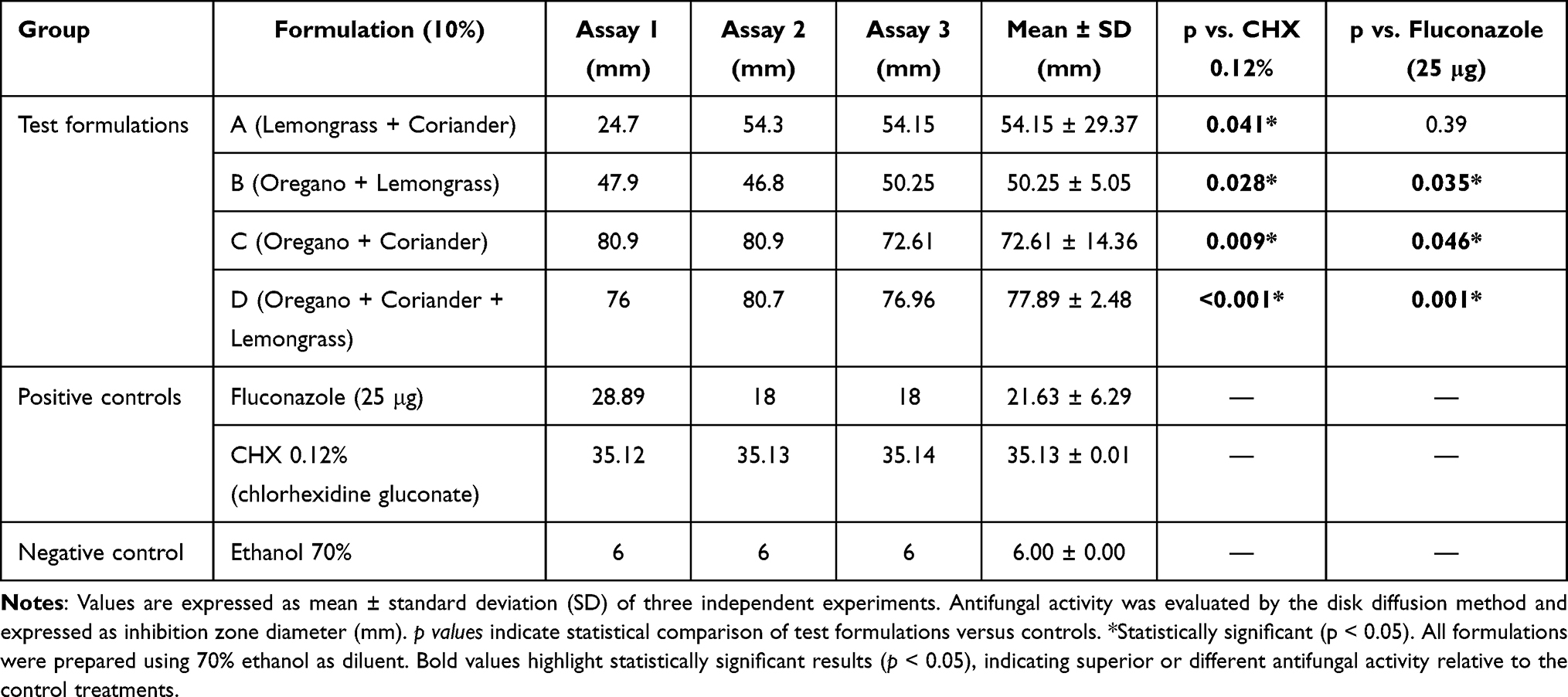 |
Table 1 In vitro Antifungal Susceptibility of 10% (v/v) Essential Oil Formulations and Controls Against Candida albicans by the Disk Diffusion Method |
Among the binary mixtures, the oregano–coriander formulation exhibited the greatest activity (72.61 ± 14.36 mm), followed by oregano – lemongrass (50.25 ± 5.05 mm) and lemongrass – coriander (54.15 ± 29.37 mm), with variable statistical significance depending on the control used. The negative control (70% ethanol) showed minimal inhibition (6.00 ± 0.00 mm), supporting that the observed antifungal effects are attributable to the essential oil components rather than the solvent system.
In parallel, GC-MS chromatographic analysis revealed differences in the phytochemical composition of the evaluated essential oil mixtures (Cymbopogon citratus, Coriandrum sativum, and Origanum vulgare), demonstrating distinct chemical profiles depending on the plant combination employed. Overall, formulations containing Origanum vulgare were characterized by a higher proportion of phenolic compounds, whereas those incorporating Cymbopogon citratus showed a predominance of monoterpenic aldehydes derived from citral. A complete list of identified compounds, retention times, and relative peak areas obtained from the chromatographic analysis is provided in the supplementary Results Report (Supplementary Material 1).
The cymbopogon citratus + oregano mixture (HL + Oreg) exhibited a profile clearly dominated by carvacrol (40.67%), accompanied by relevant concentrations of α-citral (15.48%) and β-citral (12.85%), resulting in a highly reactive chemical system characterized by the coexistence of phenols and oxygenated aldehydes, which favors a synergistic effect. Similarly, the coriander + oregano mixture (Cil + Oreg) showed a predominance of carvacrol (39%), together with linalool and unsaturated aldehydes such as 2-decenal and 2-decen-1-ol, suggesting a lipophilic profile with high antifungal potential. The simultaneous presence of phenols and monoterpene alcohols further enhances the ability of this formulation to interact with the cellular membranes of Candida albicans. In contrast, the cymbopogon citratus + coriander formulation (HL + Cil) was dominated by α-citral (18.76%), β-citral (15.61%), and linalool (11.99%), defining a profile largely composed of oxygenated monoterpenes (see Figure 2).
 |
Figure 2 Peak profile of major bioactive compounds identified in different essential oil mixtures. Relative peak areas (%) of citral, carvacrol, and linalool illustrate the chemical dominance patterns associated with antifungal activity. Notes: HL: Cymbopogon citratus (lemongrass); Cil: Coriandrum sativum (coriander); Oreg: Origanum vulgare (oregano). |
Overall, the results confirm that the presence and relative proportion of phenolic compounds, particularly carvacrol, together with monoterpenic aldehydes such as α- and β-citral, constitute key determinants of the observed antifungal activity. The GC–MS chromatographic profile (Figure 2) clearly demonstrates the dominance of these compounds within the formulation, revealing a prevalence of chemical families with well-established antimicrobial properties. Furthermore, the coexistence of oxygenated monoterpenes and phenolic compounds suggests a synergistic interaction that enhances the overall biological effect. As shown in Figure 3, the chromatographic profile is dominated by carvacrol, which exhibits the highest peak intensity at a retention time of 13.52 min, indicating its predominance within the formulation. This compound is accompanied by relevant contributions from oxygenated monoterpenes such as β-citral (12.73 min) and α-citral (12.43 min), as well as 2-decenal (12.91 min) and linalool (9.84 min), all of which are compounds associated with antifungal activity. Minor constituents, including o-cymene (8.57 min), γ-terpinene (9.22 min), and β-myrcene (7.61 min), were also identified, contributing to the overall phytochemical complexity of the system. Additionally, phenolic compounds such as thymol (13.21 min) and sesquiterpenes like caryophyllene (15.03 min) were detected at lower intensities. In this context, the combination of the three essential oils at a 10% concentration, particularly when formulated in an alcoholic vehicle, demonstrated the highest antifungal activity, which can be attributed to the complementary and potentially synergistic interactions among these bioactive constituents (see Figure 3).
 |
Figure 3 GC–MS chromatogram of the essential oil blend. Peaks are labeled according to their retention times and classified by chemical family: monoterpenes (green), oxygenated monoterpenes and aldehydes (blue), and phenolic compounds and sesquiterpenes (purple). Signal intensity is expressed in arbitrary units (a.u.). |
As shown in Figure 4, the dominant phytochemical composition varied according to the plant combination employed. A clear predominance of carvacrol was observed in formulations containing oregano, whereas mixtures lacking this component exhibited a higher contribution of citral-derived compounds. Notably, the ternary mixture displayed a more balanced distribution of major bioactive constituents, suggesting a complementary chemical profile associated with enhanced synergistic antifungal activity.
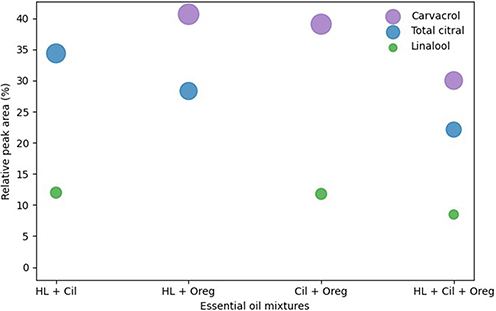 |
Figure 4 Predominant phytochemical compounds in essential oil mixtures (GC–MS). Notes: HL: Cymbopogon citratus (lemongrass); Cil: Coriandrum sativum (coriander); Oreg: Origanum vulgare (oregano). |
Formulation and Development of the Mouthwash
For the preparation of 100 mL of mouthwash, a ternary mixture of essential oils from Cymbopogon citratus, Coriandrum sativum, and Origanum vulgare was used as the active ingredient in equivalent proportions (1:1:1), adjusted to a final concentration of 10% (v/v), corresponding to 10 mL of the total essential oil blend (3.33 mL of each oil).
The hydroalcoholic vehicle consisted of ethanol and distilled water, using 20 mL of 70% ethanol and distilled water q.s. to complete 100 mL, in order to enhance the solubilization and stability of the essential oils. Glycerol at 5% (5 mL) was incorporated as a humectant. The preservative system consisted of sodium benzoate at 0.1% w/v (0.10 g), previously dissolved in the aqueous phase. In addition, a food-grade flavoring agent (0.1 mL) and a pharmaceutical-grade water-soluble colorant were added to ensure organoleptic acceptability.
The formulation process was carried out under constant stirring until a homogeneous system was obtained. The final product presented a transparent and monophasic appearance, with no evidence of phase separation or precipitation during preparation. The pH was adjusted to 6.0 ± 0.1, remaining within the physiological range for oral applications. The formulation also exhibited adequate physical stability under storage conditions (4 °C) for the duration of the experimental period, maintaining its visual characteristics without turbidity or sedimentation. These properties indicate appropriate compatibility between the essential oil blend and the hydroalcoholic vehicle. The final formulation was subsequently subjected to in vitro microbiological testing against Candida albicans using the agar diffusion technique.
Discussion
The results of the present study demonstrate that the phytopharmaceutical formulation of essential oils from Origanum vulgare, Cymbopogon citratus, and Coriandrum sativum at 10%, incorporated into an experimental mouthwash, exhibits greater in vitro antifungal activity compared with a conventional mouthwash containing 0.12% chlorhexidine gluconate. This observation is relevant considering that chlorhexidine remains a widely used reference antiseptic in dental practice for the management of Candida albicans, particularly in denture wearers and individuals with compromised oral hygiene. However, it should be noted that these findings are limited to controlled in vitro conditions and should not be directly extrapolated to clinical efficacy.
Sharifzadeh demonstrated that the antifungal activity of essential oils may be associated with their phytochemical composition, particularly the presence of compounds such as carvacrol, citral (α and β), linalool, and geraniol. Similarly, Gao reported that carvacrol, identified as a major component, has been described as a compound with relevant antifungal activity against Candida albicans, potentially affecting cellular structures such as the plasma membrane and related physiological processes.21,22 In the present study, the predominance of these compounds, as evidenced by GC–MS analysis, may contribute to the observed antifungal effect, although specific mechanisms were not directly evaluated.
Furthermore, Fuetefria and Cotaldo reported that citral, a major constituent of Cymbopogon citratus, exhibits antifungal activity that has been associated with alterations in cellular homeostasis and protein function. In vitro studies have shown its activity against Candida spp., including strains with reduced susceptibility to conventional antifungals.23,24 In this context, the presence of citral in the evaluated formulation may contribute to its antifungal performance, although its individual contribution within the mixture cannot be isolated in this study.
Additionally, compounds such as linalool and geraniol, present in Coriandrum sativum and Cymbopogon citratus, have been associated with antifungal and antibiofilm effects in previous studies, potentially through interactions with cellular metabolism and oxidative balance in Candida albicans.21,25 Their presence in the formulation may therefore contribute to the overall antifungal activity; however, the specific contribution of each compound remains to be clarified.
In line with these findings, the observed activity of the ternary mixture at 10% exhibited higher inhibition zone diameters than the 0.12% chlorhexidine control under the experimental conditions used. While this may suggest a broader spectrum of activity associated with the combination of compounds present in essential oils, it should be interpreted cautiously, as diffusion-based assays are influenced by physicochemical factors such as solubility and diffusibility of the compounds within the agar matrix. Chlorhexidine, although clinically effective, may exhibit different diffusion behavior compared with volatile compounds present in essential oils.10,26
The relatively large inhibition zones observed in this study may be influenced by the high diffusion capacity of volatile compounds present in essential oils within agar-based systems, which can enhance radial dispersion and should be considered when interpreting these results.
The observed activity of the ternary mixture is consistent with previous reports indicating that combinations of terpenoid and phenolic compounds may enhance antifungal effects compared with individual components, possibly due to complementary or additive interactions. However, the presence of true synergistic effects was not specifically evaluated in this study and would require additional analyses, such as checkerboard or fractional inhibitory concentration assays.12,27
From a pharmaceutical technology perspective, the formulation developed in this study resulted in a clear, monophasic, and physically stable mouthwash, with a pH of 6.0 compatible with oral use. The hydroalcoholic vehicle facilitated the dispersion of lipophilic compounds, and no phase separation, turbidity, or sedimentation was observed during the experimental period. These characteristics suggest adequate physicochemical compatibility between the essential oil blend and the formulation components. Moreover, the low viscosity and acceptable organoleptic properties of the formulation support its potential applicability as an oral rinse, although sensory acceptability was not formally evaluated.28,29
Overall, the results support the potential of essential oil–based formulations as alternative approaches for the in vitro control of Candida albicans. However, several limitations should be considered. First, the study was conducted exclusively under in vitro conditions using a single reference strain, which limits the generalizability of the findings. Second, the agar diffusion method does not allow determination of minimum inhibitory or fungicidal concentrations, nor does it provide information on antifungal activity against biofilms. Third, the mechanisms of action and potential synergistic interactions among the components were not directly assessed. Finally, although preliminary stability and physicochemical properties were observed, no long-term stability or cytotoxicity evaluations were performed.
Future studies should therefore include quantitative antifungal assays (MIC/MFC), biofilm models, cytotoxicity testing on oral cell lines, and in vivo evaluations to determine safety and clinical efficacy. In addition, advanced formulation studies aimed at optimizing stability, controlled release, and standardization of active compounds would be essential to support the translational development of this phytopharmaceutical product.30,31
Conclusions
The present study shows that a phytopharmaceutical formulation of essential oils from Origanum vulgare, Cymbopogon citratus, and Coriandrum sativum at 10%, incorporated into an experimental mouthwash, exhibited higher in vitro antifungal activity than a conventional 0.12% chlorhexidine formulation against Candida albicans. This effect may be related to the presence of bioactive compounds such as carvacrol, citral, linalool, and geraniol, as well as to their combined interaction within the formulation.
These findings suggest that the combination of essential oils and an appropriate formulation approach could represent a promising alternative for the in vitro control of Candida albicans. However, given the experimental conditions of this study, caution is required when extrapolating these results to clinical settings. Further studies are needed, including biofilm models, in vivo evaluations, and comprehensive safety and cytotoxicity assessments, in order to better understand the efficacy, safety, and potential applicability of this phytopharmaceutical formulation in dental practice.
Acknowledgments
Special acknowledgment is extended to the Laboratorio de Biotecnología del Centro de Investigación, Innovación y Transferencia Tecnológica (CIITT) de la Universidad Católica de Cuenca, for its contribution and constant collaboration during the experimental phase of this research. We also acknowledge the support of the Research Group: Innovación y Desarrollo Farmacéutico en Odontología, Facultad de Odontología, Jefatura de Investigación e Innovación, Universidad Católica de Cuenca, Cuenca, Ecuador.
Author Contributions
All authors made a significant contribution to the work reported, whether that is in the conception, study design, execution, acquisition of data, analysis and interpretation, or in all these areas; took part in drafting, revising or critically reviewing the article; gave final approval of the version to be published; have agreed on the journal to which the article has been submitted; and agree to be accountable for all aspects of the work.
Funding
The APC was funded by Universidad Católica de Cuenca, Cuenca, Ecuador, it is anchored to the project called: “Desarrollo de formulaciones bucales basadas en componentes activos de origen vegetal para el control de microorganismos orales” approved under code: PICTMS24-05.
Disclosure
The authors declare no conflicts of interest in this work.
References
1. Cuenca-León K, Pacheco-Quito EM, Granda-Granda Y, Vélez-León E, Zarzuelo-Castañeda A. Phytotherapy: a solution to decrease antifungal resistance in the dental field. Biomolecules. 2022;12(6):789. doi:10.3390/biom12060789
2. Casaroto AR, Lara VS. Phytomedicines for Candida-associated denture stomatitis. Fitoterapia. 2010;81(5):323–10. doi:10.1016/j.fitote.2009.12.003
3. Mougenot MF, Pereira VS, Costa ALR, et al. Biomimetic nanovesicles—sources, design, production methods, and applications. Pharmaceutics. 2022;14(10):2008. doi:10.3390/pharmaceutics14102008
4. Gao L, Xu T, Huang G, Jiang S, Gu Y, Chen F. Oral microbiomes: more and more importance in oral cavity and whole body. Protein Cell. 2018;9(5):488–500. doi:10.1007/s13238-018-0548-1
5. de Sousa DP, Damasceno ROS, Amorati R, et al. Essential oils: chemistry and pharmacological activities. Biomolecules. 2023;13(7):1144. doi:10.3390/biom13071144
6. Bakkali F, Averbeck S, Averbeck D, Idaomar M. Biological effects of essential oils - A review. Food Chem Toxicol. 2008;46(2):446–475. doi:10.1016/j.fct.2007.09.106
7. Cuenca-León K, Lima-Illescas M, Pacheco-Quito EM, Vélez-León E, Zarzuelo-Castañeda A. Effectiveness of lemon verbena (Cymbopogon citratus) in oral candidiasis: a systematic review. Clin Cosmet Investig Dent. 2024;16:295–305. doi:10.2147/CCIDE.S478181
8. Venzon L, Mariano LNB, Somensi LB, et al. Essential oil of cymbopogon citratus (lemongrass) and geraniol, but not citral, promote gastric healing activity in mice. Biomed Pharmacother. 2018;98:118–124. doi:10.1016/j.biopha.2017.12.020
9. De Bona Da Silva C, Guterres SS, Weisheimer V, Schapoval EES. Antifungal Activity of the Lemongrass Oil and Citral Against Candida spp. 2008.
10. Arendrup MC. Candida and Candidaemia: susceptibility and Epidemiology. Dan Med J. 2013;60(11).
11. Konsberg R, Axéll T, Sweden M, Olso N. Treatment of Candida-infecte denture stomatitis with a miconazole lacquer. Oral Med. 1994;78(3):306–311.
12. Yapar E A, Gökçe EH, Şahiner A, et al. Development of phytoactive essential oils-composed organogels against oral pathogens. J Drug Deliv Sci Technol. 2024;97:105778. doi:10.1016/j.jddst.2024.105778
13. Tonglairoum P, Ngawhirunpat T, Rojanarata T, Kaomongkolgit R, Opanasopit P. Fabrication and evaluation of nanostructured Herbal Oil/Hydroxypropyl-β-Cyclodextrin/Polyvinylpyrrolidone mats for denture stomatitis prevention and treatment. AAPS Pharm Sci Tech. 2016;17(6):1441–1449. doi:10.1208/s12249-016-0478-2
14. Chowdhary A, Meis JF. Antifungal resistance in clinically significant fungi. Fungal Genet Biol. 2020;139.
15. Faria DR, Melo RC, Arita GS, et al. Fungicidal activity of a safe 1,3,4-Oxadiazole derivative against Candida albicans. Pathogens. 2021;10(3):314. doi:10.3390/pathogens10030314
16. Rusic D, Bozic J, Bukic J, et al. Antimicrobial resistance: physicians’ and pharmacists’ perspective. Microb Drug Resist. 2021;27(5):670–677. doi:10.1089/mdr.2020.0272
17. Villavicencio-Caparó E, Cuenca-León K, Vélez- León E, Sayago-Heredia J, Cabrera-Duffau A. Pasos para la planificación de una investigación clínica. Odontología Activa UCACUE. 2016;1(1).
18. Cuenca-León K, Sarmiento-Ordóñez JM, Pacheco-Quito EM, Benavides-Túlcan SM, Castro NA, Zarzuelo-Castañeda A. Comparison of essential oil extraction techniques and their therapeutic applications in dentistry: focus on Candida albicans inhibition. J Exp Pharmacol. 2025;17:455. doi:10.2147/JEP.S521028
19. Bauer AW, Kirby WM, Sherris JC, Turck M. Antibiotic susceptibility testing by a standardized single disk method. Am J Clin Pathol. 1966;45(4_ts):493–496. doi:10.1093/ajcp/45.4_ts.493
20. Ebingen V-C, María A-C, Katherine C-L, Mirella -C-C, Diego P-V, Alberto A-C. Clinical studies design in dentistry. Mayo Agosto. 2016.
21. Sharifzadeh A, Fasaei BN, Asadi S, Fatemi N, Houshmandzad M, Ghaffari MH. Evaluation of antifungal and apoptotic effects of linalool, citral, and carvacrol separately and in combination with nystatin against clinical isolates of Pichia kudriavzevii. BMC Microbiol. 2024;24(1):333. doi:10.1186/s12866-024-03487-y
22. Gao S, Liu G, Li J, et al. Antimicrobial activity of lemongrass essential oil (Cymbopogon flexuosus) and its active component citral against dual-species biofilms of staphylococcus aureus and candida species. Front Cell Infect Microbiol. 2020;10:603858. doi:10.3389/fcimb.2020.603858
23. Fuentefria AM, Pippi B, Dalla Lana DF, Donato KK, de Andrade SF. Antifungals discovery: an insight into new strategies to combat antifungal resistance. Lett Appl Microbiol. 2018;66(1):2–13. doi:10.1111/lam.12820
24. Contaldo M, Di Stasio D, Romano A, et al. Oral candidiasis and novel therapeutic strategies: antifungals, phytotherapy, probiotics, and photodynamic therapy. Curr Drug Deliv. 2023;20(5):441–456. doi:10.2174/1567201819666220418104042
25. Dias MI, Barros L, Sousa MJ, Ferreira ICFR. Comparative study of lipophilic and hydrophilic antioxidants from in vivo and in vitro grown Coriandrum sativum. Plant Foods Hum Nutr. 2011;66(2):181–186. doi:10.1007/s11130-011-0227-3
26. Shala A, Singh S, Hameed S, Khurana SMP. Essential oils as alternative promising anti-candidal agents: progress and prospects. Curr Pharm Des. 2021;28(1):58–70. doi:10.2174/1381612827666210914124344
27. Chouhan S, Sharma K, Guleria S. Antimicrobial activity of some essential oils—present status and future perspectives. Medicines. 2017;4(3):58. doi:10.3390/medicines4030058
28. Brookes ZLS, McCullough M, Kumar P, McGrath C. Mouthwashes: implications for practice. Int Dent J. 2023;73:S98–S101. doi:10.1016/j.identj.2023.08.013
29. Duane B, Yap T, Neelakantan P, et al. Mouthwashes: alternatives and future directions. Int Dent J. 2023;73(2):S89–S97. doi:10.1016/j.identj.2023.08.011
30. Amann V, Kissmann AK, Firacative C, Rosenau F. Biofilm-Associated candidiasis: pathogenesis, prevalence, challenges and therapeutic options. Pharmaceuticals. 2025;18(4):460. doi:10.3390/ph18040460
31. Silva S, Rodrigues CF, Araújo D, Rodrigues ME, Henriques M. Candida species biofilms’ antifungal resistance. J Fungi. 2017;3(1):8. doi:10.3390/jof3010008
 © 2026 The Author(s). This work is published and licensed by Dove Medical Press Limited. The
full terms of this license are available at https://www.dovepress.com/terms
and incorporate the Creative Commons Attribution
- Non Commercial (unported, 4.0) License.
By accessing the work you hereby accept the Terms. Non-commercial uses of the work are permitted
without any further permission from Dove Medical Press Limited, provided the work is properly
attributed. For permission for commercial use of this work, please see paragraphs 4.2 and 5 of our Terms.
© 2026 The Author(s). This work is published and licensed by Dove Medical Press Limited. The
full terms of this license are available at https://www.dovepress.com/terms
and incorporate the Creative Commons Attribution
- Non Commercial (unported, 4.0) License.
By accessing the work you hereby accept the Terms. Non-commercial uses of the work are permitted
without any further permission from Dove Medical Press Limited, provided the work is properly
attributed. For permission for commercial use of this work, please see paragraphs 4.2 and 5 of our Terms.