
Back to Journals » HIV/AIDS - Research and Palliative Care » Volume 17
Development and Feasibility of “Towards the Sun”: A Digital Salutogenic Intervention to Enhance Sense of Coherence and Health Outcomes Among Newly Diagnosed HIV-Positive MSM
Authors Zhai M, Li Y, Long J, Li Y, Lei X
Received 6 June 2025
Accepted for publication 28 November 2025
Published 31 December 2025 Volume 2025:17 Pages 419—431
DOI https://doi.org/10.2147/HIV.S545278
Checked for plagiarism Yes
Review by Single anonymous peer review
Peer reviewer comments 2
Editor who approved publication: Prof. Dr. Olubunmi Akindele Ogunrin
Mimi Zhai,1,2 Yamin Li,1 Jianhai Long,3 Yunxia Li,2,4 Xianyang Lei5
1Nursing Department, Hunan Provincial People’s Hospital (The First Affiliated Hospital of Hunan Normal University), Changsha, Hunan Province, People’s Republic of China; 2The Xiangya School of Nursing, Central South University, Changsha, Hunan, 410013, People’s Republic of China; 3Department of Respiratory and Critical Care Medicine, Beijing Tiantan Hospital, Capital Medical University, Beijing, 100050, People’s Republic of China; 4School of Nursing, Lanzhou University, Lanzhou, Gansu, 730000, People’s Republic of China; 5Xiangya School of Public Health, Central South University, Changsha, Hunan, 410013, People’s Republic of China
Correspondence: Xianyang Lei, Xiangya School of Public Health, Central South University, No. 172 Tongzipo Road, Yuelu District, Changsha, Hunan Province, People’s Republic of China, Email [email protected]
Aim: To develop and conduct a preliminary evaluation of a digital salutogenic intervention—“Towards the Sun”—aimed at enhancing sense of coherence (SOC) and improving health outcomes among newly diagnosed HIV-positive men who have sex with men (MSM).
Methods: The initial intervention draft was developed using the systematic Intervention Mapping (IM) process, informed by preliminary research, literature review, and evidence-based needs assessment. Two rounds of expert panel review were then conducted to refine the draft, followed by a feasibility assessment among newly diagnosed HIV-positive MSM.
Results: The final digital intervention consisted of a five-stage, eight-week program, focusing on stress management, resource activation, and meaning exploration to strengthen the three dimensions of SOC. After review by 8 experts, the mean importance ratings of the intervention items were all above 4 and the coefficients of variation (CV) were less than 0.20, indicating consensus. A pilot study involving 7 newly diagnosed MSM demonstrated feasibility: SOC-13 scores increased, levels of stress and depression decreased, and participants reported high satisfaction with the overall content, especially the modules on self-acceptance and resource orientation.
Conclusion: This digital salutogenic intervention demonstrated good feasibility, user acceptance, and preliminary effectiveness among newly diagnosed HIV-positive MSM. As a strengths-based and innovative digital solution, it warrants further validation and dissemination in larger samples and randomized controlled designs.
Reporting Guidelines: The study followed the TIDieR (Template for Intervention Description and Replication) Checklist.
Keywords: digital salutogenic intervention, sense of coherence, HIV, men who have sex with men
Introduction
Human Immunodeficiency Virus (HIV) infection continues to pose a significant global public health challenge.1 Among key high-risk populations, men who have sex with men (MSM) face not only a higher risk of infection, but also heightened vulnerability to mental health issues. This vulnerability is largely driven by prevalent stressors such as societal stigma, discrimination, and homophobia, which negatively affect their mental health. Newly diagnosed HIV-positive MSM are typically at a psychologically vulnerable and behaviorally transitional stage,2 commonly experiencing depression, anxiety, social isolation, and low adherence to antiretroviral therapy. These factors not only impact their mental health but also hinder long-term disease management and quality of life improvement.3–5
Although interventions such as psychological counseling and social support have been implemented in HIV populations, their long-term effects remain limited.6 Most interventions focus on health education or emotional support, while systematic cultivation of individual internal resources and positive psychological factors has been overlooked.7 In particular, there is a lack of integrated intervention models that are theory-driven, supported by digital technology, and personalized for precise intervention.
The Minority Stress Model has been widely used to explain mental health disparities among sexual minorities.8 Distal stressors and proximal stressors interact to shape adverse health outcomes. Within this framework, sense of coherence (SOC) is considered an important psychological resource that may mitigate the negative effects of minority stressors on mental health and treatment adherence.
Building on this, Antonovsky’s Salutogenic Theory provides a complementary perspective by conceptualizing health as a continuum ranging from disease to health, emphasizing factors that facilitate movement toward the healthier end. It highlights SOC as a key psychological resource, encompassing the three dimensions of comprehensibility, manageability, and meaningfulness.9 Existing research has confirmed that SOC is closely related to stress reduction, improved coping abilities, and more positive health-related behaviors.9–13 However, digital interventions specifically aimed at enhancing SOC among newly diagnosed HIV-positive MSM remain scarce, and there is a lack of locally developed experience.
Therefore, this study systematically developed a digital intervention program—“Towards the Sun”—for newly diagnosed HIV-positive MSM, integrating the Minority Stress Model with Salutogenic Theory within the IM framework.14 The intervention was constructed through evidence-based needs assessment, theoretical modeling, expert consensus, and digital innovation, aiming to provide a scientific and personalized psychological support pathway for this population.
Methods
This study developed and optimized a digital salutogenic intervention program (“Towards the Sun”) for newly diagnosed HIV-positive MSM using a systematic, evidence-based approach grounded in the Intervention Mapping (IM) framework. The methodological process comprised three main steps: drafting the intervention protocol, expert revision and supplementation, and feasibility assessment.
Step 1: Development of a Draft Protocol for a Digital Salutogenic Intervention
Needs Assessment: Establishment of the Research Team, Preliminary Studies, and Literature Review
The needs assessment in this study consisted of three parts. First, a multidisciplinary research team was established, including a doctoral supervisor, a clinician, a clinical nurse, three nursing PhDs, and an HIV social worker, to design and implement the needs assessment, ensuring comprehensiveness and scientific rigor. Second, the research team previously conducted a six-month longitudinal follow-up study among 313 newly diagnosed HIV-positive MSM to evaluate trends and influencing factors in their Sense of Coherence (SOC) and its three dimensions: comprehensibility, manageability, and meaningfulness. Finally, based on the search strategy described in “Supplementary Material”, both Chinese and English literature were retrieved from databases such as PubMed and Web of Science to supplement empirical findings and provide an evidence base for designing the intervention content.
Construction of the Theoretical Framework
A theory synthesis approach was adopted to integrate the Salutogenic Theory and the Minority Stress Model, resulting in a theoretical framework with the enhancement of SOC as the core objective. Drawing on preliminary research and literature review, the framework clarifies the mediating role of SOC in the relationship between individual stress and health outcomes, covering the three dimensions of comprehensibility, manageability, and meaningfulness.
Development of Intervention Goals and Content
Based on the above theoretical framework and needs assessment, the overall goal of the intervention was set as improving the Sense of Coherence (SOC) among newly diagnosed HIV-positive MSM. Specific sub-goals included reducing stress, alleviating depression, enhancing antiretroviral therapy adherence, increasing CD4+ T cell counts, and lowering viral load.
Development of Theory-Based Intervention Content and Strategies
This step primarily involved identifying behavior change methods targeting influencing determinants and operationalizing them for the specific intervention context. Guided by the constructed theoretical framework, an eight-week digital intervention program was developed, including modules such as stress analysis and coping, activation of internal and external resources, and exploration of meaning. The content was delivered online in stages using videos, audio, and graphic materials.
Step 2: Revision and Supplementation of the Draft Protocol
The intervention protocol was revised through expert panel meetings. Experts were eligible if they held at least a bachelor’s degree, had an intermediate or senior professional title, and possessed a minimum of ten years of work experience in nursing, psychology, or infectious disease. The assessment process utilized an expert demographic questionnaire, an intervention program item evaluation form, and an overall intervention program evaluation questionnaire. Prior to the formal meetings, the research team distributed the draft materials to all experts. Two rounds of structured panel discussions were conducted to systematically collect and integrate expert feedback, ultimately producing a consensus-based revised protocol.
Expert Panel (EP) Discussion and First Revision
A group of eight experts was invited to form the panel. Prior to the meeting, the draft protocol and evaluation forms were distributed to the panelists. During the expert panel meeting, the study design and its rationale were presented, and each module’s content, scientific validity, and operability were discussed and rated item by item. The experts provided detailed revision suggestions. All feedback was recorded by the research team and incorporated into post-meeting revisions.
Second Round of Expert Panel (EP) Discussion and Final Revision
After the initial revision, the optimized protocol was redistributed to the expert panel. In the second round of discussions, the panel focused on the revised items, conducted further evaluations, and reached consensus on the adjusted content. This ensured the scientific rigor, innovation, and practical feasibility of each component of the protocol, resulting in the finalized version.
Evaluation of Expert Validity
The reliability of expert feedback was determined using Cr, Ca, and Cs. To assess the level of consensus, the mean importance score for each item was calculated. Consistency among expert opinions was evaluated by the coefficient of variation (CV). An item was considered to have achieved consensus if the mean importance score exceeded 4 and the CV was less than 0.2.
Step 3: Evaluation of the Feasibility of the Digital Salutogenic Intervention Protocol
Study Design and Participant Recruitment
A single-group pretest-posttest design was adopted. Inclusion criteria were: (1) male, age 18 years or older; (2) engaged in sexual activity with men in the past six months; (3) HIV-positive diagnosis within the past 12 months; (4) stable place of residence. Exclusion criteria included: (1) previous diagnosis of severe psychiatric disorders; (2) refusal to participate in the study; (3) no access to a mobile phone or the Internet; or (4) inability to complete the survey due to personal reasons.
Intervention Implementation and Evaluation Indicators
Quantitative assessment included SOC-13, PSS-10, PHQ-9, antiretroviral therapy adherence, CD4+ T cell count, and viral load. Qualitative interviews used semi-structured interviews to collect participants’ satisfaction, experiences, and suggestions for improvement regarding the intervention.
Assessment Procedure and Data Collection
All participants completed standardized questionnaires both before and after the intervention. After the intervention, participants underwent semi-structured interviews to provide feedback on content, procedures, experiences, and suggestions. The research team recorded and organized all quantitative and qualitative data.
Data Analysis
Data were analyzed using SPSS 27.0. Descriptive statistics were used to analyze participant characteristics and satisfaction. Expert consultation data were analyzed for reliability and consistency using the expert authority coefficient (Cr) and the coefficient of variation (CV). Qualitative data were summarized using content analysis to further refine the intervention protocol.
Ethical Statement
This study was approved by the Ethics Review Committee of Nursing and Behavioral Medicine, Xiangya School of Nursing, Central South University (Ethics Review No.: E202348). All participants provided written informed consent. Data were kept strictly confidential and used solely for research purposes.
Results
Step 1 Results: Development of a Draft Protocol for a Digital Salutogenic Intervention
Needs Assessment
A preliminary longitudinal study among newly diagnosed HIV-positive MSM was conducted, and relevant literature was retrieved from databases such as PubMed, Web of Science, and CNKI according to a predefined search strategy. Results showed that the majority of this population were young adults, and their Sense of Coherence (SOC)—including its three dimensions of comprehensibility, manageability, and meaningfulness—consistently declined during the follow-up period. Participants were classified into four subgroups: “persistently low,” “slowly declining,” “rapidly declining,” and “positive transition.” Stress, HIV-related stigma, and depression all had significant negative effects on SOC, with the effect of stress being the most pronounced. Systematic literature review further indicated that multi-module, phased interventions—combining videos, case discussions, and self-practice, delivered via interactive digital platforms—are key strategies for enhancing SOC among young MSM.7,15–18
Theoretical Framework and Research Objectives
A theory synthesis approach was adopted in this study, integrating and expanding the Minority Stress Model and Salutogenic Theory to develop a theoretical framework for investigating Sense of Coherence (SOC) among newly diagnosed HIV-positive MSM. The Minority Stress Model emphasizes that sexual minorities are subject not only to general societal stress but also to external stressors related to sexual orientation and internal stress stemming from self-identity, making their psychological burden particularly significant. Salutogenic Theory conceptualizes health as a continuum, with SOC as a core psychological resource enabling individuals to understand and manage stress, thus influencing the impact of stress on health outcomes. Newly diagnosed HIV-positive MSM experience multidimensional stress, causing their health status to fluctuate along a spectrum between complete health and complete illness, which in turn affects outcomes such as increased depression, reduced antiretroviral therapy adherence, and fluctuations in CD4+ T cell count and viral load. SOC serves as a crucial psychological resource for these individuals, and its level determines the extent to which stress affects their health outcomes.
Based on this, the overall objective of this study was to enhance Sense of Coherence (SOC), with specific sub-goals including reducing stress, alleviating depression, improving adherence to antiretroviral therapy, increasing CD4+ T cell count, and lowering viral load.
Draft Intervention Protocol
Guided by the theoretical framework, an eight-week intervention draft was developed, comprising five stages. The first stage is the Acquaintance Stage (“Establishing Trust”), lasting one week. The second stage is the Comprehensibility Stage, with the themes of “Analyzing Stress” and “Coping with Stress,” lasting two weeks. The third stage is the Manageability Stage, focusing on “Stimulating Internal Resources: Uncovering Personal Potential” and “Identifying External Resources: Discovering External Support,” also lasting two weeks. The fourth stage is the Meaningfulness Stage, covering “Reflecting Meaningfulness Growth Amid Challenges” and “Exploring Meaningfulness: Finding Meaning in Life,” for two weeks. The fifth stage is the Summary Stage (“Program Review”), lasting one week (Table S1 and Appendix 2).
Step 2 Results: Revision and Supplementation of the Draft Protocol
The expert panel consisted of eight members, with 62.5% aged 41–50 years; 50% held doctoral degrees; and 75% had senior professional titles. All experts had over 10 years of work experience, distributed across infectious disease nursing, psychology, nursing management, and related fields (Table S2). The expert judgment coefficient was 0.96 (range: 0.9–1.0), familiarity coefficient was 0.86 (range: 0.5–1.0), and authority coefficient was 0.91 (range: 0.75–1.0), ensuring the scientific rigor and validity of the consultation process (Table S3).
Feedback from the First Expert Panel Meeting and Protocol Revision
During the first expert panel meeting (Tables S4 and S5, Appendix 3), the experts gave high ratings to the scientific validity, operability, and clarity of objectives of the intervention protocol, but also provided specific suggestions for improvement (Table S4). For example, it was recommended to standardize “homework assignments” as “reflection and practice” to enhance interactivity and self-reflection. Additionally, experts emphasized the need to add “contingency plans and handling of unexpected situations” to ensure psychological safety for high-stress participants. The intervention protocol table was revised to include a column for “intervention format,” and detailed procedures for weekly content review were specified to improve replicability and scalability.
Regarding item revision, five items scored below 4 or had a CV greater than 0.2, and were streamlined or adjusted according to expert recommendations. For instance, in Stage 2.1, “Stress and Health” and “Homework: Completing the Stress Map” were deleted due to being overly theoretical and lacking practical experience, and a new goal of “self-acceptance” was added. In Stage 2.2, “Changing Perceptions of Stress” was merged with the previous stage due to overlapping objectives, and additional options for stress-coping techniques were provided. For the “internal resources” item in Stage 3.1 and the “external resources” item in Stage 3.2, usage instructions and function descriptions were supplemented as recommended. In the meaningfulness stage, experts suggested deleting highly theoretical and time-consuming deep reflection items, adding movie introductions with segmented explanations, and incorporating real-life cases to enhance emotional resonance and practical applicability. The intervention content “handling separation emotions” was removed due to low clinical operability and consensus, but the goal of “application of learned content” was retained.
Consensus and Final Adjustment in the Second Expert Panel Meeting
The revised protocol was resubmitted to the expert panel for a second round of evaluation (Tables S6 and S7). Compared with the first review, ratings for scientific validity, clarity of objectives, and structural rationality all improved, with mean importance scores for all intervention items above 4 and CVs below 0.2. The expert panel unanimously approved the final version. During this round, the experts particularly acknowledged the “digital + phased multidimensional intervention” structure, interactive film viewing, experiential cases, and crisis contingency plans as innovative features. Minor adjustments to case presentations were suggested to better reflect the practical needs of young MSM. In response, the research team further supplemented audio-visual content, specified details of interactive exercises, and made final refinements to content descriptions and push procedures to ensure the scientific rigor, completeness, and practical feasibility of the digital intervention protocol.
Step 3 Results: Evaluation of the Feasibility of the Digital Salutogenic Intervention Protocol
Participant Characteristics
A total of seven newly diagnosed HIV-positive MSM were enrolled in the pilot study, aged 20–30 years. The majority had a bachelor’s degree or above and were either employed or students. Most participants had not disclosed their sexual orientation (Table S8).
Intervention Implementation Feedback and Satisfaction
After the intervention, participants’ SOC-13 scores increased, while levels of stress and depression decreased. During the pilot intervention, participants generally reported that the intervention content was “practical, easy to understand and implement,” with particular benefit from the stress management and self-acceptance modules. Some participants stated that they “hoped to get out of the darkness sooner” and “learned to slowly accept themselves, realizing they are still valuable.” At the same time, some participants initially found it challenging to engage with the “reflection and practice” modules; in response, the research team adjusted the guidance approach and enhanced interactivity. In addition, some participants expressed concerns about privacy and provided feedback regarding the layout of intervention materials and audio volume in the videos. The research team promptly strengthened anonymization measures and optimized the layout and audiovisual quality. Overall, participants were highly satisfied with the intervention and expressed a desire for ongoing psychological support and more real-life case interactions.
Optimization and Final Feasibility Conclusion
Based on pilot data and feedback, the digital salutogenic intervention demonstrated good feasibility and high satisfaction among newly diagnosed HIV-positive MSM. The final content achieved a balance between scientific rigor and practical experience, with a flexible format, strong interactivity, and high cultural adaptability, meeting the diverse psychological support needs of young MSM.
Through expert panel meetings and pilot testing, the final Sense of Coherence intervention program for newly diagnosed HIV-positive MSM, titled “Towards the Sun,” was established. The intervention consists of five stages, is delivered over eight weeks (one session per week, approximately 30 minutes per session), and is presented via an online platform using a combination of video, images, audio, and text. Details of the intervention content are provided in Table 1.
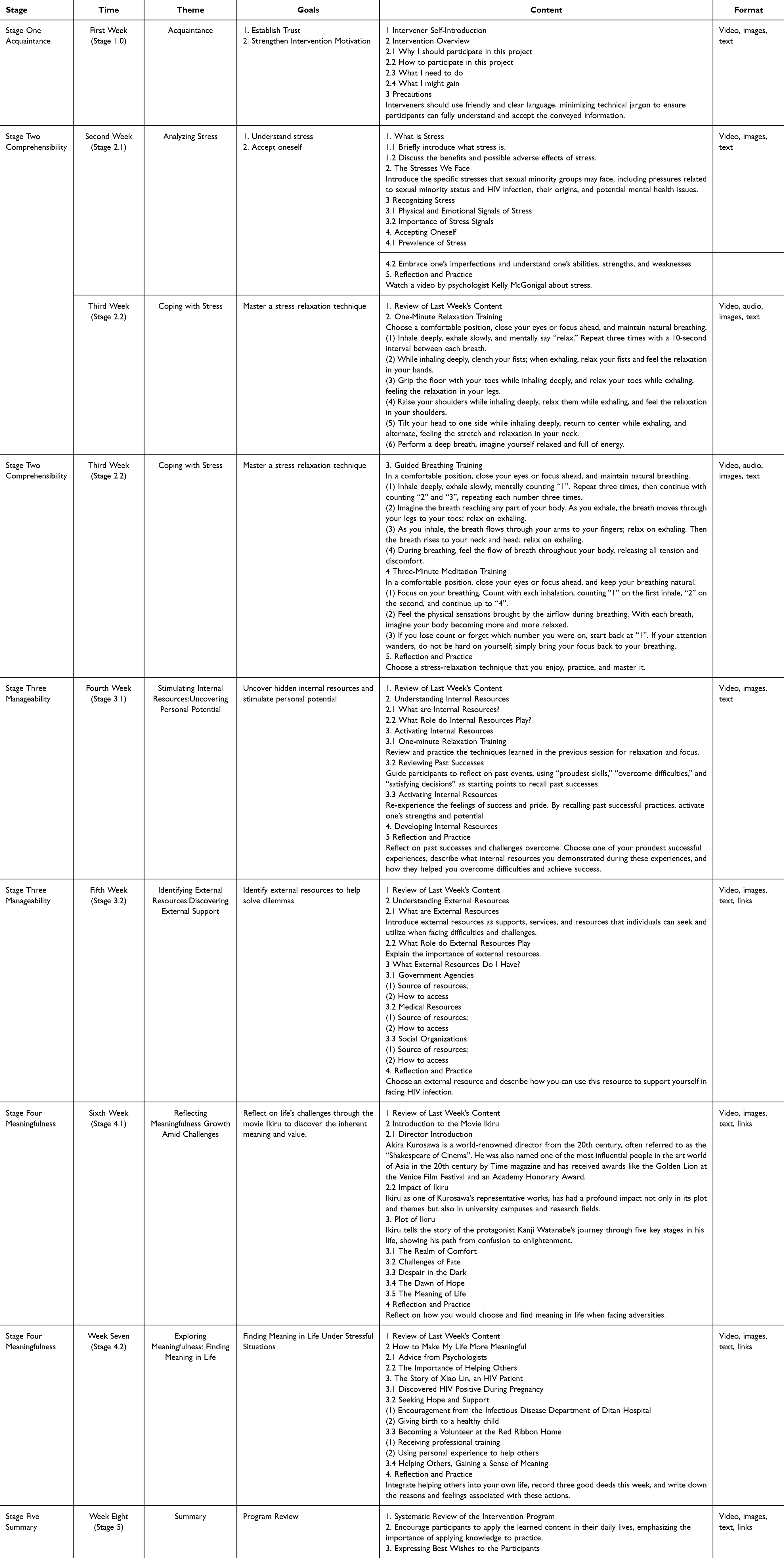 |
Table 1 “Towards the Sun” Intervention Program |
Discussion
Main Findings
This study employed the Intervention Mapping (IM) framework to develop and preliminarily validate a digital salutogenic intervention program, “Towards the Sun,” for newly diagnosed HIV-positive MSM. Following two rounds of expert consensus and pilot testing, the intervention demonstrated good applicability and acceptability. Preliminary trial results showed that participants’ SOC-13 scores improved, while stress and depression levels decreased after the intervention. Participants responded particularly positively to the “activation of internal and external resources” and “exploration of meaningfulness” modules, reporting significant benefits in terms of enhanced self-acceptance and the establishment of long-term treatment motivation. These findings suggest the potential for this program to be further validated in larger-scale studies.
Theoretical and Practical Significance
This study innovatively integrated Salutogenic Theory and the Minority Stress Model, establishing for the first time a theoretical framework for newly diagnosed HIV-positive MSM. This integration clarified the moderating pathways between sources of stress and Sense of Coherence (SOC), expanding the theoretical perspective for mental health interventions in this population. While traditional interventions often focus on pathology and deficits, this study emphasized positive psychological resources, providing a more positive, resource-oriented approach. Furthermore, the digital intervention format addressed common privacy concerns and real-world barriers to mental health service utilization among MSM, substantially increasing the accessibility of the intervention. By adhering to the standardized IM development process and incorporating both expert and user feedback mechanisms, this study offers practical guidance and methodological reference for the development of digital interventions for other chronic diseases and marginalized populations.
Strengths of Intervention Content and Technology
The intervention was delivered via an online digital platform using multimedia formats such as video, audio, and text, closely aligning with the media usage habits of the target population. Participants in the pilot study gave positive feedback, highlighting the intervention’s “ease of operation and good interactivity,” which effectively reduced the spatial and psychological barriers commonly associated with traditional face-to-face interventions. The research team placed high importance on participant feedback, making timely improvements to material design and interactivity—such as optimizing the presentation of the “reflection and practice” module and adding positive reinforcement measures—thus further enhancing user-friendliness.
Strengths and Limitations
This study has several strengths. First, it strictly adhered to the internationally recognized IM development process, ensuring the integration of theory, evidence, and practice. Second, it incorporated bidirectional feedback from both multidisciplinary experts and the target population, ensuring cultural adaptation and clinical relevance. Third, a mixed-methods evaluation approach was used, enhancing the robustness of the findings.
However, there are also limitations. The pilot study lacked a control group design, and the long-term effects of the intervention were not assessed. The use of self-reported questionnaires may have introduced social desirability bias. Future research should employ randomized controlled designs, expand the sample size, and extend the follow-up period to further evaluate the long-term stability and effectiveness of the intervention.
Implications for Nursing Practice and Health Policy
Implications for Nursing Practice
The digital psychological intervention developed in this study provides both primary healthcare providers and specialized nursing staff with a scientific and standardized tool for psychological intervention, making it particularly suitable for use in clinical practice. The digital format enhances the accessibility of nursing services, facilitating the wider dissemination of personalized psychological health support and optimizing overall health management for the MSM population.
Implications for Nursing Education
The development process and intervention methods described in this study offer a combined theoretical and practical teaching case for nursing education. Especially in undergraduate and graduate education related to infectious disease nursing and mental health promotion, this intervention can serve as an innovative practice-based teaching resource, enhancing nursing students’ capacity to address the psychological needs of high-risk populations.
Implications for Health Policy
This study provides empirical support for health authorities in formulating service policies addressing the mental health needs of newly diagnosed HIV-positive individuals. It is recommended that standardized digital mental health service models be incorporated into health policies, with an emphasis on privacy protection, fairness, and broad accessibility. Additionally, the findings contribute to increased societal attention and support for the mental health needs of sexual minority populations, promoting the implementation of more inclusive public health policies.
Conclusion
Based on Salutogenic Theory and the Minority Stress Model, this study developed and refined a digital intervention program to enhance Sense of Coherence among newly diagnosed HIV-positive MSM. Following expert consensus and pilot application, the program was found to be scientifically sound, highly operable, and well-adapted, gaining recognition from both participants and experts. Future research should expand the sample size, adopt randomized controlled designs, and systematically evaluate the effectiveness and long-term mechanisms of the intervention.
Data Sharing Statement
Relevant datasets may be obtained from the corresponding author on reasonable request. Open release is not possible because of participant confidentiality and other ethical considerations.
Acknowledgments
We sincerely thank all team members and collaborating institutions involved in the development of the “Towards the Sun” digital intervention. We appreciate their support in theory building, needs assessment, expert consultation, and pilot testing. The research team selected statistical procedures that matched the study objectives and carried out data collection, analysis, and interpretation in accordance with those methods.
Author Contributions
All authors made a significant contribution to the work reported, whether that is in the conception, study design, execution, acquisition of data, analysis and interpretation, or in all these areas; took part in drafting, revising or critically reviewing the article; gave final approval of the version to be published; have agreed on the journal to which the article has been submitted; and agree to be accountable for all aspects of the work.
Funding
This study was supported by the National Natural Science Foundation of China (No. 82504541, 72504117); the Natural Science Foundation of Hunan Province (No. 2025JJ60663); and the Natural Science Foundation of Changsha City (No. KQ2502027, KQ2502246).
Disclosure
The authors report no conflicts of interest in this work.
References
1. Zhai M, Lei X, Li Y, et al. The trend of AIDS in China: a prediction and comparative analysis with G20 countries based on the Global Burden of Disease Study 2019. J Glob Health. 2024;14:04029. doi:10.7189/jogh.14.04029
2. Lau JTF, Wu X, Wu AMS, Wang Z, Mo PKH. Relationships between illness perception and post-traumatic growth among newly diagnosed HIV-positive men who have sex with men in China. AIDS Behav. 2018;22(6):1885–1898. doi:10.1007/s10461-017-1874-7
3. Chard AN, Metheny NS, Sullivan PS. Social stressors and intoxicated sex among an online sample of men who have sex with men (MSM) drawn from seven countries. Subst Use Misuse. 2018;53(1):42–50. doi:10.1080/10826084.2017.1322985
4. Feinstein BA, Newcomb ME. The role of substance use motives in the associations between minority stressors and substance use problems among young men who have sex with men. Psychol Sex Orientat Gend Divers. 2016;3(3):357–366. doi:10.1037/sgd0000185
5. Bourne A, Weatherburn P. Substance use among men who have sex with men: patterns, motivations, impacts and intervention development need. Sex Transm Infect. 2017;93(5):342–346. doi:10.1136/sextrans-2016-052674
6. Melendez-Torres GJ, Meiksin R, Witzel TC, Weatherburn P, Falconer J, Bonell C. eHealth interventions to address HIV and other sexually transmitted infections, sexual risk behavior, substance use, and mental ill-health in men who have sex with men: systematic review and meta-analysis. JMIR Public Health Surveill. 2022;8(4):e27061. doi:10.2196/27061
7. Yu DSF, Cheng ST, Chow EO, Kwok T, McCormack B, Wu W. The effects of a salutogenic strength-based intervention on sense of coherence and health outcomes of dementia family carers: a randomized controlled trial. Age Ageing. 2023;52(9). doi:10.1093/ageing/afad160
8. Linander I, Lundberg T, Alm E. The gender minority stress model and/or cisnormativity? The need for pluralistic theoretical perspectives in improving trans health and medicine. Soc Sci Med. 2024;351:116957. doi:10.1016/j.socscimed.2024.116957
9. González-Siles P, Martí-Vilar M, González-Sala F, Merino-Soto C, Toledano-Toledano F. Sense of coherence and work stress or well-being in care professionals: a systematic review. Healthcare. 2022;10(7):1347. doi:10.3390/healthcare10071347
10. Curyło M, Rynkiewicz-Andryśkiewicz M, Andryśkiewicz P, et al. The sense of coherence and health behavior of men with alcohol addiction. Int J Environ Res Public Health. 2022;19(14):8650. doi:10.3390/ijerph19148650
11. da-Silva-Domingues H, Del-Pino-Casado R, Palomino-Moral P, López Martínez C, Moreno-Cámara S, Frías-Osuna A. Relationship between sense of coherence and health-related behaviours in adolescents and young adults: a systematic review. BMC Public Health. 2022;22(1):477. doi:10.1186/s12889-022-12816-7
12. Mittelmark MB. Stressor appraisal on a pathway to health: the role of the sense of coherence. In: The Handbook of Salutogenesis. Cham (CH): Springer; 2022:69–78.
13. Veiga GRS, Padilha BM, Bueno NB, et al. Salutogenesis, nutritional status and eating behaviour: a systematic review. Public Health Nutr. 2022;25(9):2517–2529. doi:10.1017/S1368980021004444
14. Kok G, Gottlieb NH, Peters G-JY, et al. A taxonomy of behaviour change methods: an intervention mapping approach. Health Psychol Rev. 2015;10(3):297–312. doi:10.1080/17437199.2015.1077155
15. Svendsen MJ, Sandal LF, Kjær P, et al. Using intervention mapping to develop a decision support system-based smartphone app (selfBACK) to support self-management of nonspecific low back pain: development and usability study. J Med Internet Res. 2022;24(1):e26555. doi:10.2196/26555
16. Hadjiconstantinou M, Schreder S, Brough C, et al. Using intervention mapping to develop a digital self-management program for people with type 2 diabetes: tutorial on MyDESMOND. J Med Internet Res. 2020;22(5):e17316. doi:10.2196/17316
17. Malm D, Fridlund B, Ekblad H, Karlström P, Hag E, Pakpour AH. Effects of brief mindfulness-based cognitive behavioural therapy on health-related quality of life and sense of coherence in atrial fibrillation patients. Eur J Cardiovasc Nurs. 2018;17(7):589–597. doi:10.1177/1474515118762796
18. Merakou K, Tsoukas K, Stavrinos G, et al. The effect of progressive muscle relaxation on emotional competence: depression-anxiety-stress, sense of coherence, health-related quality of life, and well-being of unemployed people in Greece: an intervention study. Explore. 2019;15(1):38–46. doi:10.1016/j.explore.2018.08.001
 © 2025 The Author(s). This work is published and licensed by Dove Medical Press Limited. The
full terms of this license are available at https://www.dovepress.com/terms
and incorporate the Creative Commons Attribution
- Non Commercial (unported, 4.0) License.
By accessing the work you hereby accept the Terms. Non-commercial uses of the work are permitted
without any further permission from Dove Medical Press Limited, provided the work is properly
attributed. For permission for commercial use of this work, please see paragraphs 4.2 and 5 of our Terms.
© 2025 The Author(s). This work is published and licensed by Dove Medical Press Limited. The
full terms of this license are available at https://www.dovepress.com/terms
and incorporate the Creative Commons Attribution
- Non Commercial (unported, 4.0) License.
By accessing the work you hereby accept the Terms. Non-commercial uses of the work are permitted
without any further permission from Dove Medical Press Limited, provided the work is properly
attributed. For permission for commercial use of this work, please see paragraphs 4.2 and 5 of our Terms.
Recommended articles


HIV in Three Groups of Young People from Medellín: General Population, Organizations for People with Socioeconomic Vulnerability, and Men Who Have Sex with Other Men
Cardona-Arias JA, Narváez Moreno NN, Higuita-Gutiérrez LF
HIV/AIDS - Research and Palliative Care 2023, 15:641-648
Published Date: 1 November 2023
Family Functioning and Depressive Symptoms Among HIV-Positive Men Who Have Sex with Men: Mediating Roles of Stigma and Resilience
Wang D, Scherffius A, Ouyang X, Deng Q
Psychology Research and Behavior Management 2024, 17:755-764
Published Date: 26 February 2024
Prevalence of HIV, Treponema pallidum and Their Coinfection in Men Who Have Sex with Men, Medellín-Colombia
Cardona-Arias JA, Vidales-Silva M, Ocampo-Ramírez A, Higuita-Gutiérrez LF, Cataño-Correa JC
HIV/AIDS - Research and Palliative Care 2024, 16:141-151
Published Date: 18 April 2024