
Back to Journals » International Journal of Nanomedicine » Volume 21
Design Evolution of Curcumin-Loaded Nanostructured Lipid Carriers: Formulation Strategies, Functional Modifications, and Mechanistic–Translational Perspectives
Authors Nurohman I, Suhandi C  , Chaerunisaa AY , Wilar G, Jafar G, Sriwidodo S
Received 5 December 2025
Accepted for publication 3 March 2026
Published 10 March 2026 Volume 2026:21 586727
DOI https://doi.org/10.2147/IJN.S586727
Checked for plagiarism Yes
Review by Single anonymous peer review
Peer reviewer comments 3
Editor who approved publication: Professor Jie Huang
Ikra Nurohman,1,2 Cecep Suhandi,2 Anis Yohana Chaerunisaa,2 Gofarana Wilar,3 Garnadi Jafar,4 Sriwidodo Sriwidodo2
1Doctoral Program of Pharmacy, Faculty of Pharmacy, Universitas Padjadjaran, Sumedang, 45363, Indonesia; 2Department of Pharmaceutics and Pharmaceutical Technology, Faculty of Pharmacy, Universitas Padjadjaran, Sumedang, 45363, Indonesia; 3Department of Pharmacology and Clinical Pharmacy, Faculty of Pharmacy, Universitas Padjadjaran, Sumedang, 45363, Indonesia; 4Department of Pharmaceutics and Pharmaceutical Technology, Faculty of Pharmacy, Universitas Bhakti Kencana, Bandung, 40614, Indonesia
Correspondence: Sriwidodo Sriwidodo, Department of Pharmaceutics and Pharmaceutical Technology, Faculty of Pharmacy, Universitas Padjadjaran, Sumedang, 45363, Indonesia, Tel +62 816-4204-079, Email [email protected]
Abstract: Curcumin possesses broad therapeutic potential but remains severely limited by poor solubility, instability, and low systemic bioavailability. Nanostructured lipid carriers (NLCs) have emerged as an advanced lipid-based delivery platform capable of overcoming these constraints through optimized lipid organization, high drug-loading capacity, and tunable surface functionality. This review provides a comprehensive examination of the design evolution of curcumin-loaded NLCs (Cur-NLCs), encompassing core components, formulation strategies, preparation techniques, and quality determinants that govern physicochemical and biological performance. Evidence-based classification of formulation approaches is presented, highlighting single-drug, co-loaded, and surface-modified or functionally engineered NLC systems and their respective therapeutic advantages. Mechanistic insights are discussed to elucidate how NLCs enhance curcumin’s stability, absorption, intracellular trafficking, and controlled release. Current challenges, including formulation heterogeneity, scalability, long-term stability, and translational readiness, are critically evaluated, alongside emerging clinical observations from engineered NLCs that further underscore their translational relevance. From a translational standpoint, the review identifies NLC designs based on pharmaceutically accepted lipids, scalable preparation methods, and minimal surface complexity as the most feasible candidates for near-term clinical development, while more elaborate multifunctional or ligand-modified systems are discussed as promising but longer-term strategies. However, the progress outlined in this review highlights NLCs as a highly adaptable platform capable of unlocking curcumin’s full pharmacological potential and accelerating its pathway toward therapeutic applicability.
Keywords: curcumin, nanostructured lipid carriers, lipid-based nanoparticles, drug delivery, bioavailability enhancement
Introduction
Curcumin, a polyphenolic compound derived from the rhizome of Curcuma longa, has gained substantial attention due to its wide-ranging pharmacological activities, including antioxidant, anti-inflammatory, antimicrobial, antidiabetic, anticancer, and neuroprotective effects.1–6 Despite its promising therapeutic potential, the clinical translation of curcumin remains limited because of its poor aqueous solubility (<0.1 mg/mL), rapid metabolism, and low systemic bioavailability (estimated oral bioavailability <1%).7,8 These physicochemical and pharmacokinetic drawbacks significantly restrict its absorption and therapeutic efficacy, highlighting the urgent need for advanced delivery systems capable of overcoming these challenges.
Over the past decade, nanotechnology-based delivery systems have emerged as powerful strategies to enhance the solubility, stability, and bioavailability of poorly water-soluble compounds such as curcumin.9 A growing number of publications have explored nanocarriers including liposomes, polymeric nanoparticles, micelles, and solid lipid nanoparticles (SLNs) for curcumin encapsulation.10–13 Among these, nanostructured lipid carriers (NLCs) have drawn particular interest, representing a second-generation lipid-based system that incorporates both solid and liquid lipids.14,15 This mixed-lipid matrix provides higher drug loading, greater physical stability, and a more flexible release profile compared to SLNs, offering distinct advantages for curcumin delivery.16 Mechanistically, the incorporation of liquid lipids into the solid lipid matrix introduces structural imperfections that disrupt the highly ordered crystalline lattice characteristic of SLNs.17 These imperfections create additional spatial accommodation for curcumin molecules, reducing drug expulsion during storage and enabling more sustained and predictable release kinetics. Functionally, this less ordered lipid architecture has been associated with improved gastrointestinal solubilization, enhanced absorption following lipid digestion, and prolonged systemic exposure, thereby translating the structural advantages of NLCs into meaningful pharmacokinetic and pharmacodynamic benefits.18
In addition to these formulation advantages, the lipid-based composition of NLCs offers favorable translational attributes, including the use of pharmaceutically accepted excipients, scalable manufacturing processes, and a safety profile that supports their potential progression toward clinical development.19 NLCs not only enhance curcumin’s pharmacokinetic profile but also expand its therapeutic applications across diverse disease models. Recent studies have shown that curcumin-loaded NLCs (Cur-NLCs) improve antioxidant defense and anti-inflammatory signaling, inhibit tumor progression, modulate glucose and lipid metabolism, and promote wound and tissue repair.14,15,20,21 Importantly, advances in nanofabrication now enable surface modification, ligand conjugation, and stimuli-responsive designs, providing a versatile platform for targeted or synergistic therapies.22–24
Despite this progress, the literature on Cur-NLCs remains fragmented, with most reports focusing either on formulation optimization or pharmacological outcomes in isolation.25,26 A comprehensive analysis linking formulation architecture, functional modification, and therapeutic efficacy is still lacking. Moreover, although preclinical data demonstrate remarkable potential, the translational pathway toward clinical application remains underexplored and requires systematic guidance grounded in formulation–function correlations.
Therefore, this review aims to provide a critical and integrative overview of the design evolution of Cur-NLCs, highlighting key formulation strategies, functional modifications, and their pharmacological implications. The discussion encompasses the progression from simple monoloading systems without efficacy testing to complex multifunctional NLCs with proven biological activity. By bridging formulation science and pharmacological evidence, this review seeks to identify the design principles that most effectively enhance curcumin’s bioactivity and therapeutic relevance. Unlike previous reviews that primarily focus on either formulation optimization or isolated pharmacological outcomes, this work uniquely integrates structural design, functional modifications, and translational considerations. This integrative perspective provides new conceptual insights into how NLC architecture can be rationally aligned with curcumin’s therapeutic objectives. Ultimately, this synthesis is intended to offer a forward-looking framework to guide the rational development of clinically translatable NLC systems for curcumin and related bioactives, aligning nanosystem design with pharmacodynamic needs and translational feasibility.
Design and Formulation of Curcumin-Loaded Nanostructured Lipid Carriers (Cur-NLCs)
NLCs represent an advanced generation of lipid-based delivery systems engineered to overcome the solubility, stability, and bioavailability limitations of curcumin. Their design integrates both solid and liquid lipids within a less-ordered lipid matrix, enabling higher drug loading, reduced expulsion during storage, and more flexible release profiles. The formulation of Cur-NLCs involves careful selection of lipids, surfactants, and preparation techniques to achieve optimal particle size, encapsulation efficiency (EE), stability, and biological performance. Figure 1 illustrates the major components constituting a Cur-NLC system, whereas Table 1 provides representative formulations and outcomes from recent studies.
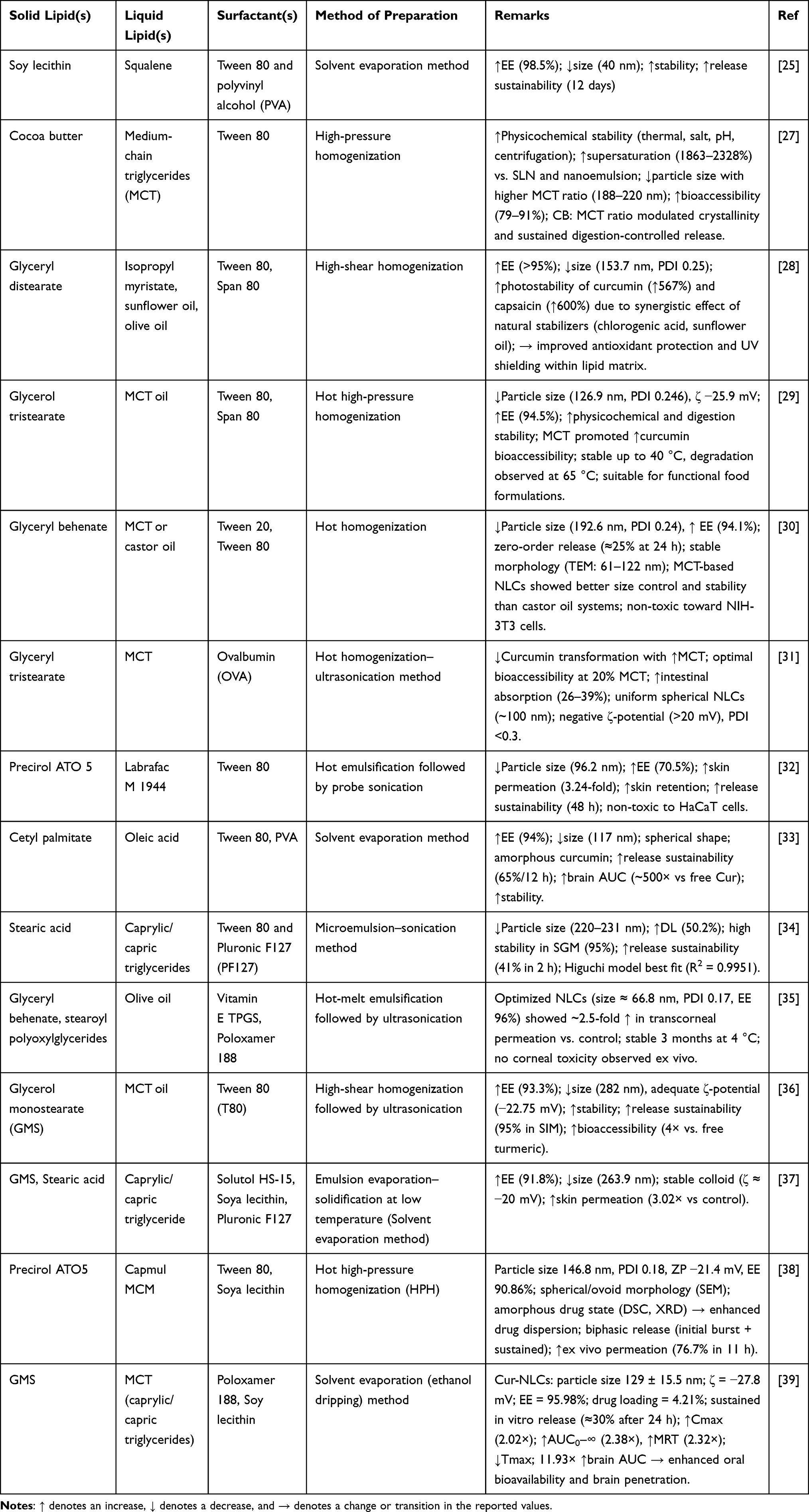 |
Table 1 Representative Formulation Compositions, Preparation Techniques, and Key Technological Outcomes of Curcumin-Loaded Nanostructured Lipid Carriers (Cur-NLCs) |
 |
Figure 1 Schematic illustration of a curcumin-loaded nanostructured lipid carrier (Cur-NLC). The figure shows the structural organization of Cur-NLCs, consisting of a solid–liquid lipid matrix encapsulating curcumin and stabilized by surfactants. |
Core Components of Cur-NLCs
The structural and functional properties of Cur-NLCs are primarily determined by three essential components: solid lipids, liquid lipids, and surfactants (Figure 1). Each component contributes to the physicochemical behavior of the nanocarriers, influencing particle size, EE, crystallinity, stability, and release kinetics. Solid lipids such as glyceryl distearate, glyceryl monostearate (GMS), glyceryl behenate, stearoyl polyoxylglycerides, cetyl palmitate, and stearic acid form the rigid portion of the matrix. Their melting points typically range from 45–80 °C, enabling the formation of a semi-crystalline core. Studies summarized in Table 1 show that the choice of solid lipid significantly affects drug incorporation and stability. For instance, glyceryl behenate–based NLCs consistently achieved high EE values above 90% and controlled release profiles,30,35 whereas stearic acid–based systems demonstrated excellent stability and predictable release kinetics.34
Liquid lipids are incorporated to create structural imperfections within the solid lipid matrix, improving drug solubility and preventing drug expulsion during storage. Frequently used examples include medium-chain triglycerides (MCT), squalene, isopropyl myristate, oleic acid, medium-chain mono- and diglycerides (glyceryl caprylate/caprate), and natural oils such as sunflower or olive oil. From Table 1, MCT emerges as the most widely used liquid lipid, enhancing curcumin solubilization, reducing particle size, and increasing bioaccessibility.29–31 Notably, Abdullah et al reported that increasing the MCT ratio reduced particle size from 220 nm to 188 nm while achieving bioaccessibility values up to 91%.27 Mechanistically, these improvements arise from a combination of complementary processes. Liquid lipids act as matrix plasticizers, reducing crystallinity and enabling greater curcumin accommodation, while also promoting internal lipid rearrangement that stabilizes the drug within less ordered domains.40 In parallel, during gastrointestinal digestion, the presence of digestible liquid lipids facilitates the formation of mixed micelles and colloidal structures, thereby enhancing digestion-mediated solubilization and intestinal bioaccessibility.41
Surfactants stabilize the NLC dispersion by reducing interfacial tension and preventing particle aggregation. Commonly used surfactants include Tween 80, Tween 20, Span 80, Poloxamer 188, Poloxamer 407, polyvinyl alcohol (PVA), polyoxyl 15 hydroxystearate, and Vitamin E TPGS. The surfactant system strongly influences particle size, zeta potential, and EE. For example, Pishnamazi et al achieved exceptionally high EE (98.5%) and very small particle size (40 nm) using a Tween 80–PVA blend.25 In another study, Rapalli et al systematically optimized the surfactant composition and demonstrated that Tween 80 alone yielded the most favorable performance, producing nanoparticles of 96.2 nm with improved EE (70.5%), enhanced skin permeation (3.24-fold), elevated skin retention, and sustained release over 48 h.32 Beyond colloidal stability, surfactant concentration and composition also play a decisive role in biocompatibility. Non-ionic surfactants such as Tween derivatives, Poloxamers, and polyoxyl 15 hydroxystearate are generally favored due to their lower membrane-disruptive potential, whereas excessive surfactant concentrations may compromise cell viability despite improved dispersion stability. Accordingly, careful optimization of surfactant systems is essential to balance interfacial stabilization with biological tolerance, particularly for formulations intended for repeated or long-term administration. This highlights the critical importance of surfactant selection and optimization in tailoring the interfacial properties and biological performance of Cur-NLCs.
Finally, the loaded drug, either curcumin alone or co-loaded with other therapeutic agents, interacts with the lipid matrix through hydrophobic, van der Waals, or molecular dispersion mechanisms. Studies in Table 1 consistently show that curcumin adopts an amorphous or molecularly dispersed state within the lipid matrix, leading to improved solubility and bioavailability.33,38 The amorphous state enhances solubility and bioavailability but can also be more prone to chemical degradation over prolonged storage compared with crystalline curcumin.42 Encapsulation within the lipid matrix, however, provides a protective environment that mitigates hydrolytic or oxidative degradation, helping to preserve chemical integrity and pharmacological activity over time.43
Preparation Techniques and Critical Quality Parameters
Multiple fabrication strategies have been employed to develop Cur-NLCs, and each technique inherently shapes the physicochemical profile, stability, and eventual biological performance of the formulation. As summarized in Table 1, widely utilized approaches include solvent evaporation, hot homogenization, high-pressure homogenization (HPH), ultrasonication-assisted methods, microemulsion–sonication, and hot-melt emulsification. Although their operational principles differ, these techniques share a foundational mechanism involving emulsification of a molten lipid phase in an aqueous surfactant medium, followed by cooling to induce lipid recrystallization. The choice of technique is therefore closely tied to scalability requirements, thermal sensitivity of the payload, and the desired particle size, crystallinity, and release kinetics.
Solvent evaporation remains one of the most frequently adopted approaches in Cur–NLC research due to its simplicity, reproducibility, and compatibility with thermolabile compounds. In this method, organic solvents facilitate lipid solubilization and allow curcumin to be molecularly dispersed within the lipid phase prior to emulsification. Evidence from studies such as Fang et al, Chen et al, and Pishnamazi et al consistently demonstrates the production of uniform nanoparticles within the 40–260 nm range, coupled with EE typically exceeding 90%.25,37,39 Moreover, solvent evaporation often yields lipid matrices with lower crystallinity because organic solvent removal disrupts lipid packing. This structural disorder creates additional void spaces within the lipid core, contributing to higher drug loading and sustained-release characteristics. However, residual solvent content and limited scalability remain key drawbacks that restrict its industrial translation.
Hot homogenization and HPH offer clear advantages for large-scale manufacturing, controlled particle engineering, and regulatory acceptability. These methods rely on intense mechanical forces that reduce droplet size during emulsification, leading to NLCs with narrow polydispersity index (PDI) and enhanced physical stability. Studies by Abdullah et al, Hyun et al, and Madane & Mahajan highlight the robustness of HPH-generated formulations, which consistently display PDI values <0.25, zeta potentials between −20 and −30 mV, and encapsulation efficiencies above 90%.27,29,38 Importantly, the intense shear and cavitation forces of HPH promote efficient dispersion of liquid lipids within the solid lipid matrix, creating the characteristic “imperfect crystal” structure essential for high curcumin loading. These advantages make HPH a preferred method for oral, parenteral, and food-grade applications; however, the elevated processing temperatures may reduce curcumin stability if not carefully controlled. Curcumin degradation has been reported mainly under prolonged exposure to temperatures above ~90–100 °C.44 Such degradation does not typically generate acute toxic byproducts but may result in inactive or less potent derivatives, thereby diminishing therapeutic efficacy. Accordingly, strict control of processing temperature, residence time, and homogenization cycles is critical to preserve curcumin stability during scale-up.
Hot-melt emulsification followed by ultrasonication serves as a hybrid technique that combines thermal processing with acoustic cavitation, providing enhanced control over particle size and crystallinity. In this method, ultrasonication breaks down larger emulsion droplets into nanometer-sized domains, enabling the production of uniform and stable NLCs even at relatively low surfactant concentrations. Lakhani et al demonstrated that this approach yields particles as small as ~67 nm with excellent long-term colloidal stability and improved transcorneal permeation, underscoring its suitability for ocular and topical delivery.35 The reduced crystallinity achieved through rapid cooling and ultrasonic cavitation also contributes to improved drug encapsulation and modified release kinetics. Nevertheless, challenges such as heat exposure during the melting phase and potential metal contamination from ultrasonic probes must be considered, especially for sensitive biological applications.
Across all preparation techniques, several critical quality parameters (CQPs), including particle size and PDI, zeta potential, EE, drug loading, crystallinity index, and release behavior, must be carefully optimized because they collectively define a structure–property–performance relationship in Cur-NLC systems. Specifically, lipid matrix architecture, governed by the solid–liquid lipid ratio, degree of crystallinity, and internal structural disorder, determines key physicochemical properties such as particle size, EE, and release kinetics, which in turn dictate biological performance, including stability, bioaccessibility, cellular uptake, and therapeutic efficacy. In the literature, particle sizes generally fall within the 40–300 nm range, supporting efficient absorption and enhanced tissue distribution.45,46 Encapsulation efficiencies commonly exceeding 90% demonstrate the strong affinity between curcumin and the lipid matrices typically employed in NLC systems.47 Drug release profiles vary widely, spanning biphasic patterns characterized by an initial burst followed by sustained release to more controlled zero-order kinetics, largely influenced by the ratio between solid and liquid lipids as well as the specific preparation method.48 Notably, increased lipid matrix disorder, such as that achieved by higher fractions of MCT, has consistently been associated with improved bioaccessibility and enhanced cellular uptake, underscoring the mechanistic linkage between nanoscale structure, physicochemical properties, and pharmacological performance.49
Factors Influencing Cur-NLC Characteristics
As illustrated in Figure 2, the physicochemical properties of Cur-NLCs arise from a complex interplay of formulation variables and process conditions. Key influential factors include:
 |
Figure 2 Key formulation and process parameters influencing the physicochemical characteristics of Cur-NLCs. The schematic highlights major formulation and processing variables that determine particle size, polydispersity, surface charge, encapsulation efficiency, and stability. |
Solid-to-Liquid Lipid Ratio
The ratio of solid to liquid lipid dictates the matrix structure and directly affects drug loading, particle size, and release profile. High liquid lipid content increases matrix imperfections, facilitating higher EE and sustained release. Abdullah et al and Feng et al both demonstrated that increasing MCT proportions led to smaller particles and enhanced bioaccessibility.27,31 However, excessively high liquid lipid content can compromise long-term physical stability by promoting particle aggregation or lipid matrix leakage, highlighting the need to balance matrix imperfection for bioaccessibility with colloidal and storage stability.50
Type of Lipid
Different solid and liquid lipids exhibit distinct melting characteristics, solubilization capacities, and crystallization behaviors that directly influence the physicochemical stability and performance of Cur-NLCs. Glyceryl behenate, for instance, is known to generate highly stable nanoparticles with reduced crystallinity, thereby creating more imperfections within the lipid matrix that facilitate curcumin encapsulation and controlled release.30,35 In contrast, GMS–based formulations have been widely reported to enhance skin permeation and dermal deposition, making them advantageous for topical delivery systems.36,37,39 Natural oils such as sunflower and olive oil can further contribute functional benefits by increasing photostability, improving the antioxidant profile of the formulation, and mitigating curcumin degradation under stress conditions.28
Surfactant Concentration and Type
Surfactants influence interfacial tension, nanoparticle size, and long-term colloidal stability. Tween 80 remains the most commonly used surfactant due to its strong emulsifying and stabilizing effect. However, polymeric surfactants such as Poloxamer 188 or PVA provide steric stabilization, reducing aggregation during storage. Blended surfactant systems (eg, Tween 80 + PVA) often yield superior outcomes, with 98.5% EE and 40 nm particles.25
Homogenization Conditions
Process parameters such as homogenization speed, pressure, cycle number, and ultrasonication duration determine droplet disruption and lipid dispersion. High-shear homogenization followed by ultrasonication typically produces smaller nanoparticles (~130–280 nm), whereas HPH results in narrower PDI and enhanced stability.29,36
Drug–Lipid Compatibility
Efficient encapsulation depends on curcumin’s affinity for the lipid matrix. DSC and XRD studies frequently reveal that curcumin exists in an amorphous form within NLCs, enhancing solubility and release uniformity.51 Compatibility also influences EE values as studies in Table 1 consistently show high EE (90–98%) when curcumin is molecularly dispersed within lipid matrices.
Comparative Overview of Cur-NLC Systems: Single-Drug, Multi-Drug, and Modified Nanocarriers
Cur-NLCs have been widely developed across oncology, neurodegenerative disorders, wound healing, metabolic inflammation, and even functional food applications. Across this landscape, three major formulation strategies have emerged (single-drug Cur-NLCs, multi-drug co-loaded NLCs, and modified/targeted Cur-NLC systems), each demonstrating distinctive performance characteristics driven by composition, drug synergism, and surface-engineering approaches. Below is a comparative overview integrating the outcomes, mechanistic enhancements, and application-specific advantages of these three formulation types.
Conventional Curcumin-Only NLCs
Conventional curcumin-only NLCs remain the foundational design strategy for improving curcumin delivery, providing consistent physicochemical performance and broad therapeutic applicability. As outlined in Table 2, these systems rely on a binary lipid matrix in which solid lipids (eg, glyceryl behenate, GMS, stearic acid, glyceryl tristearate) are partially blended with liquid lipids such as MCT, oleic acid, caprylic/capric triglycerides, or other lipidic solvents. This imperfect crystalline structure enhances molecular disorder, increases the number of accommodation sites for curcumin, and supports high EE (often exceeding 90%), which is a clear advantage over more crystalline SLNs.
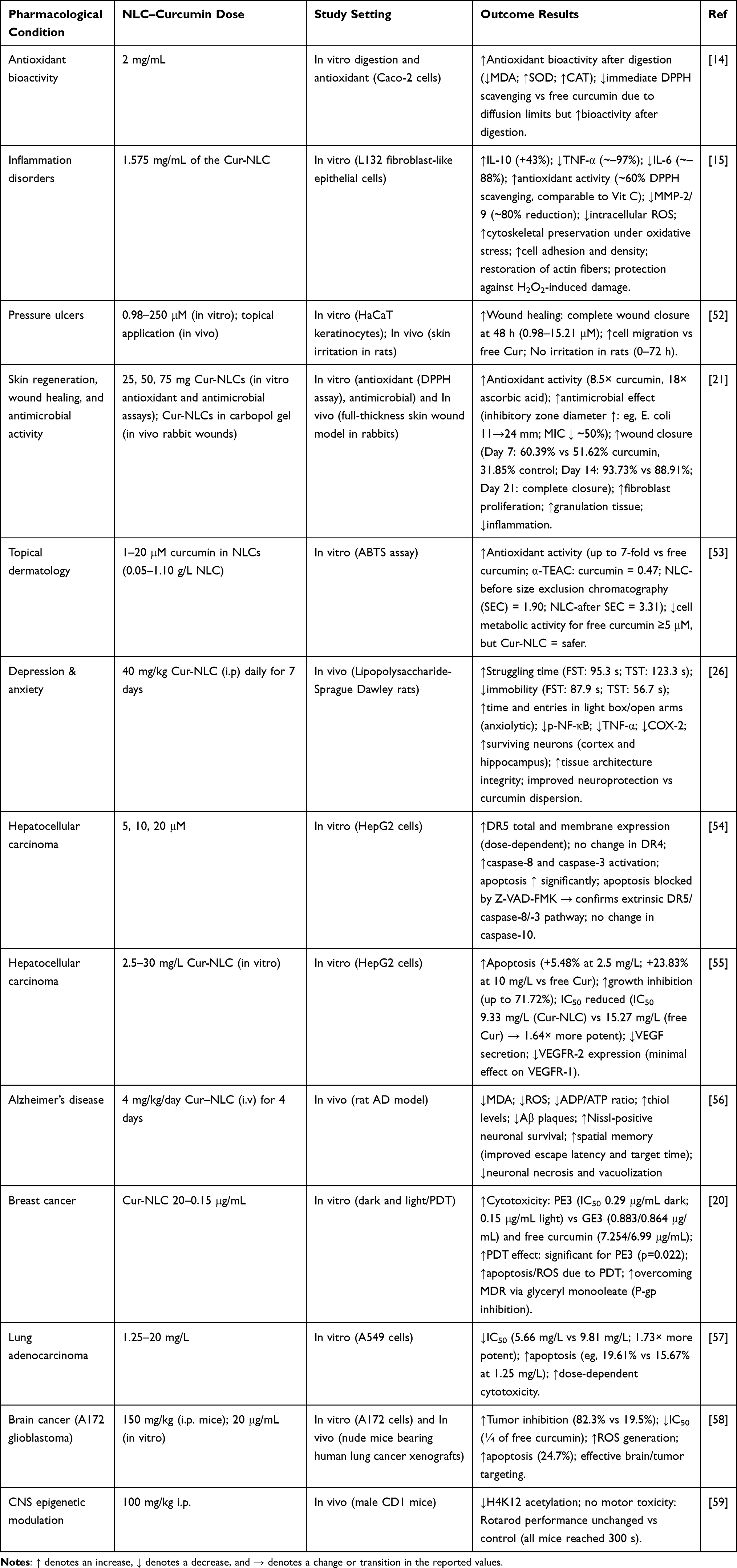 |
Table 2 Pharmacological Applications and Therapeutic Outcomes of Cur-NLCs |
Across the included studies, conventional Cur-NLCs exhibit highly reproducible physicochemical attributes. Particle sizes consistently fall within the nanoscale range (typically 50–250 nm) with low PDI values (<0.3), indicating homogeneous dispersions suitable for oral, topical, and parenteral use. Zeta potentials usually remain moderately negative (−20 to −35 mV), contributing to colloidal stability without excessive surfactant concentrations. These attributes collectively support favorable stability under storage, dilution, physiological salt conditions, and temperature fluctuations, enabling robust translational potential.
Functionally, curcumin-only NLCs demonstrate remarkable bioactivity enhancements across diverse pharmacological models. In antioxidant studies, Sun et al showed that although immediate DPPH scavenging was lower than free curcumin due to diffusion constraints, digested NLCs produced markedly superior antioxidant effects in Caco-2 cells (eg. reduced MDA and increased SOD and CAT activity), indicating improved bioaccessibility following lipid digestion.14 Calderon-Jacinto et al also reported up to seven-fold higher ABTS scavenging and greater α-TEAC values for Cur-NLCs compared with free curcumin, while preserving cell viability at concentrations where free curcumin caused metabolic suppression.53 Similarly, Elkhateeb et al demonstrated amplified antioxidant capacity (up to 18× higher than ascorbic acid) in parallel with strong antimicrobial activity and enhanced wound healing in vivo.21
Anti-inflammatory benefits are also well documented. Romera et al showed that Cur-NLCs significantly upregulated IL-10 and downregulated TNF-α and IL-6 (up to ~97% inhibition) while reducing intracellular ROS, preserving cytoskeletal integrity, and improving cell adhesion in L132 epithelial cells.15 These findings highlight the ability of NLCs to stabilize curcumin and amplify its intracellular actions. The wound-healing utility of Cur-NLCs is reinforced by Shamsuddin et al, who observed accelerated keratinocyte migration and complete wound closure within 48 h at low micromolar concentrations, with no irritation upon topical administration in rats.52 Elkhateeb et al further demonstrated improved fibroblast proliferation, granulation tissue formation, reduced inflammation, and faster wound contraction in rabbit full-thickness wound models.21
Potent antitumor activity is consistently observed across hepatocellular carcinoma, lung cancer, breast cancer, and brain tumor models. Wang et al found that Cur-NLCs enhanced DR5-mediated apoptosis, lowered IC50 values (1.6–1.7× more potent than free curcumin), and suppressed VEGF/VEGFR-2 expression.54,55 Chen et al reported 82.3% tumor inhibition in vivo with elevated ROS generation and apoptosis in brain cancer models.58 Kamel et al demonstrated major improvements under photodynamic therapy conditions, with IC50 values drastically lower than free curcumin and evidence of P-gp modulation.20 Additional efficacy against A549 lung carcinoma was shown by Wang et al, who reported lower IC50 and enhanced apoptosis.57
Neuroprotective benefits also emerge notably in CNS-related models. Malvajerd et al demonstrated reductions in MDA, ROS, and ADP/ATP ratio, increased neuronal survival, reduced Aβ plaque deposition, and improved spatial memory in an Alzheimer’s disease rat model.56 Puglia et al provided early evidence of curcumin-NLCs modulating epigenetic markers (eg, reduced H4K12 acetylation) without motor impairment, reinforcing their neurological safety profile.59 Rubab et al showed robust antidepressant and anxiolytic effects in LPS-challenged rats, including improved behavior (FST, TST, light-dark box), decreased inflammatory markers (TNF-α, COX-2, NF-κB), and enhanced neuronal survival.26 Collectively, their consistent antioxidant, anti-inflammatory, wound-healing, anticancer, and neuroprotective effects across in vitro and in vivo studies demonstrate that this “first-generation” NLC platform remains a robust benchmark for next-generation innovations, including combination-loaded and surface-engineered NLC systems.
Combination-Loaded Cur-NLCs
Combination-loaded Cur-NLCs represent the second major generation of NLCs, strategically engineered to exploit synergistic interactions between curcumin and other bioactive molecules. While conventional NLCs primarily improve curcumin’s solubility, stability, and cellular uptake, co-loaded systems extend this functionality by enabling multi-target modulation, particularly in conditions where single-agent therapy is insufficient. As summarized in Table 3, combination-loaded NLCs have been applied across a broad therapeutic spectrum, including chemoresistant cancers, chronic wounds, metabolic dysfunction, oxidative stress, skin rejuvenation, and hematologic malignancies, demonstrating the versatility of this dual-delivery approach.
 |
Table 3 Therapeutic Performance of Cur-NLCs Co-Delivered with Other Bioactive Compounds |
Formulation-wise, co-loaded systems present unique challenges, as the lipid matrix must simultaneously encapsulate two compounds with potentially contrasting physicochemical characteristics. The studies in Table 3 demonstrate that successful co-loading hinges on careful optimization of solid–liquid lipid ratios, surfactant systems, and processing parameters to maintain high entrapment efficiency for both actives. Remarkably, several formulations achieve >80–90% EE despite the increased molecular complexity. For example, Prathumwon et al successfully integrated curcumin with epigallocatechin gallate (EGCG) into a stable NLC-in-emulgel system, preserving strong antioxidant activity and reducing curcumin cytotoxicity.60 Similar formulation efficiency was observed in co-loaded curcumin–docetaxel systems by Kim et al and Rawal et al, curcumin–imatinib NLCs developed by Varshosaz et al, and curcumin–genistein formulations reported by Aditya et al, all demonstrating robust physicochemical outcomes suitable for high-potency biomedical applications.23,61,64,65
The biological enhancements driven by co-loading are particularly pronounced in antioxidant and anti-aging applications. In a comprehensive analysis by Prathumwon et al, curcumin–EGCG NLCs exhibited substantially elevated antioxidant capacity, including DPPH (118.83%), FRAP (217.25%), and lipid peroxidation inhibition (106.08%).60 The formulation also increased total phenolic content and significantly activated SIRT1 (114.8%), amplifying cellular anti-aging pathways. Importantly, EGCG co-loading reduced curcumin cytotoxicity (IC50 = 17.97 μM vs. 9.05 μM for curcumin alone), demonstrating a favorable therapeutic index. When incorporated into an emulgel matrix, the system achieved stronger inhibition of collagenase and elastase than curcumin alone, highlighting its potential in skin rejuvenation and dermal protection.
Synergy is equally compelling in oncology-focused combination-loaded NLCs. Kim et al reported that curcumin–docetaxel co-loaded NLCs induced robust synergism in breast cancer cells, including chemoresistant MCF7/ADR lines.61 The optimized 1:3 docetaxel: curcumin ratio produced exceptionally low combination index (CI) values (0.286 in MCF7; 0.130 in MCF7/ADR), accompanied by enhanced apoptosis, increased subG0 cell-cycle arrest, and markedly reduced IC50 values for both drugs. In vivo, these NLCs suppressed tumor growth by 41% and reduced tumor volume 1.7-fold versus docetaxel solution without inducing toxicity. Rawal et al similarly demonstrated strong synergism (CI = 0.32) in NCI-H460 NSCLC cells, with curcumin augmenting docetaxel cytotoxicity and improving dose-reduction indices.64 Varshosaz et al extended these findings to hematologic malignancies, showing that curcumin–imatinib NLCs dramatically lowered IC50 values in both Ramos and Jurkat lymphoma cells, indicating enhanced intracellular delivery and cooperative cytotoxicity.23 Earlier work by Aditya et al also validated synergistic anticancer activity of curcumin–genistein NLCs in PC3 prostate cancer cells, achieving 50% growth inhibition compared with only 35% from the free-drug combination.65
Beyond oncology, combination-loaded NLCs demonstrate major therapeutic advantages in wound healing and oxidative stress modulation. Lee et al showed that co-loading curcumin with epidermal growth factor (EGF) enhanced fibroblast and keratinocyte proliferation without cytotoxicity, significantly accelerating wound closure in diabetic rats.63 The co-loaded NLCs reduced half-healing time from 8.02 days (control) to just 4.26 days while simultaneously upregulating endogenous antioxidant enzymes (SOD, CAT, GPx), confirming dual benefits in tissue regeneration and oxidative stress control. Coc et al contributed additional evidence by demonstrating that curcumin–phenylalaninol oleamide NLCs enhanced ABTS radical scavenging activity compared to native curcumin, supporting their role in redox modulation.62
Combination-loaded Cur-NLCs represent a purposeful and clinically meaningful advancement of NLC technology. By co-delivering curcumin with structurally or mechanistically complementary agents, including EGCG, docetaxel, phenylalaninol oleamide, EGF, imatinib, and genistein, these systems consistently achieve superior therapeutic performance across molecular, cellular, and in vivo models. Their synergy-driven enhancements in antioxidant capacity, anti-inflammatory signaling, wound repair, and anticancer efficacy position combination-loaded NLCs as a transformative platform for next-generation, multi-target nanomedicine applications.
Surface-Modified and Functionally Engineered Cur-NLCs
The third and most technologically advanced category of Cur-NLCs consists of surface-modified and functionally engineered systems designed to overcome biological, physiological, and tissue-specific barriers that limit the performance of conventional NLCs. As summarized in Table 4, these formulations employ strategies such as ligand conjugation, peptide or glycoside modification, magnetic functionalization, antibody-mediated targeting, and bioactive phytochemical coatings (Figure 3), each engineered to impart specialized properties including targeted delivery, improved penetration, enhanced bioavailability, programmed release, or superior therapeutic response.
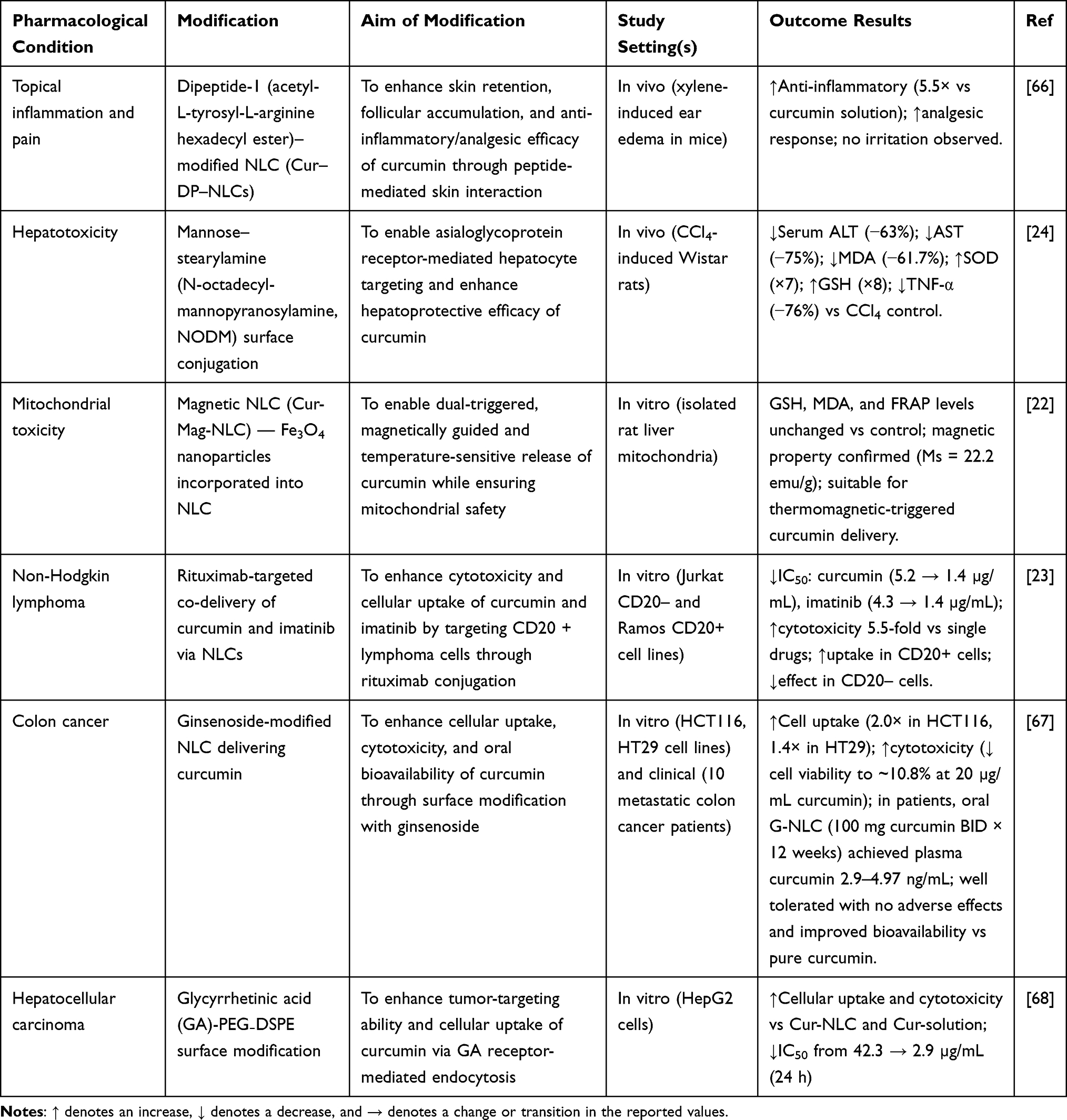 |
Table 4 Surface-Modified and Functionally Engineered Cur-NLCs: Design Rationales and Enhanced Biological Functionalities |
 |
Figure 3 Schematic overview of functionalized Cur-NLC systems designed for enhanced performance. This figure illustrates representative surface modification strategies applied to Cur-NLCs, including ligand conjugation (e.g, rituximab, dipeptide-1, mannose), bioactive decoration (e.g, ginsenoside, glycyrrhetinic acid), and magnetic functionalization. These modifications are designed to enhance targeting specificity, cellular uptake, and therapeutic performance across different biological contexts. |
A growing body of research shows that even subtle surface modifications can profoundly reshape the biodistribution and tissue interaction of Cur-NLCs. For example, Yuan et al developed a dipeptide-modified system (Cur–DP–NLCs) for topical anti-inflammatory therapy.66 The peptide (acetyl-L-tyrosyl-L-arginine hexadecyl ester) increased skin affinity, follicular accumulation, and retention, resulting in 5.5-fold stronger anti-inflammatory activity compared with curcumin solution in a mouse ear-edema model, without causing irritation. This highlights how peptide-mediated interactions enable superior dermal deposition and localized pharmacological action.
Targeted delivery via receptor–ligand interaction represents another powerful approach. Gupta et al conjugated mannose–stearylamine (NODM) to the NLC surface to exploit the asialoglycoprotein receptor on hepatocytes.24 In a CCl4-induced hepatotoxicity model, these mannose-targeted NLCs markedly improved hepatoprotection, producing large reductions in serum ALT/AST and oxidative stress markers, alongside dramatic increases in SOD and GSH levels. Such receptor-directed systems demonstrate how surface modifications can direct curcumin to specific organs, substantially improving therapeutic response.
Functionally engineered nanocarriers can also incorporate inorganic elements for external manipulation or on-demand release. Yoozbashi et al embedded Fe3O4 nanoparticles to create magnetic NLCs (Cur-Mag-NLC), enabling magnetically guided positioning and thermally responsive release, while maintaining mitochondrial safety.22 The formulation preserved mitochondrial GSH, MDA, and FRAP levels comparable to untreated controls, confirming suitability for thermomagnetic-triggered curcumin delivery in conditions involving mitochondrial dysfunction.
Some of the most specific targeting outcomes arise from surface functionalization using biological ligands such as antibodies and glycosides. For instance, Varshosaz et al conjugated rituximab onto curcumin–imatinib NLCs to target CD20⁺ lymphoma cells, achieving substantially increased cellular uptake and a 5.5-fold enhancement in cytotoxicity compared with the free drugs.23 Uptake Selectivity was clearly demonstrated by strong activity in CD20⁺ Ramos cells but minimal improvement in CD20− Jurkat cells, underscoring the precision achievable with antibody-decorated NLCs.
Phytochemical-based ligand engineering is another emerging direction. Vijayakumar et al modified Cur-NLCs with ginsenosides to enhance oral bioavailability and anticancer efficacy.67 The system significantly increased cellular uptake (2.0× in HCT116; 1.4× in HT29), decreased cell viability to ~10% at 20 µg/mL, and exhibited promising translational potential in a small clinical cohort of metastatic colon cancer patients, where oral administration of ginsenoside-NLCs resulted in measurable plasma curcumin levels (2.9–4.97 ng/mL) and a favorable safety profile.
Earlier foundational work such as Chu et al introduced GA-PEG-DSPE-modified NLCs to exploit glycyrrhetinic acid receptor–mediated uptake in hepatocellular carcinoma cells.68 This surface-engineered system sharply enhanced intracellular delivery of curcumin and reduced the IC50 from 42.3 to 2.9 µg/mL, illustrating that even simple ligand anchoring can dramatically amplify the potency of Cur-NLCs. It is important to note that the density of surface ligands can critically influence biodistribution, target tissue retention, and systemic clearance, with higher densities generally enhancing uptake but potentially increasing opsonization and immune recognition.69 Careful optimization of ligand presentation is therefore essential to maximize therapeutic efficacy while minimizing immunogenic risks, which is a key consideration for translational development. Overall, the studies demonstrate that surface-engineered Cur-NLCs represent the “third generation” of nano-enabled delivery systems. These platforms are no longer dependent solely on passive diffusion or enhanced permeability and retention (EPR) effects, but instead integrating active targeting, environment-responsive control, biomimetic interaction, or externally guided release. These advanced architectures offer superior pharmacological performance across diverse disease models, marking them as promising candidates for future translational and clinical development.
Mechanistic Insight: How NLC Enhances Curcumin Efficacy
Curcumin’s inherent biopharmaceutical challenges, including poor aqueous solubility, rapid hydrolytic breakdown, instability in physiological pH, and extensive first-pass metabolism, have long restricted its therapeutic translation. NLCs offer a design-driven solution that addresses these barriers through a combination of nanoscale engineering, biophysical stabilization, membrane-interaction enhancement, and targeted delivery functionalities. These mechanisms do not act in isolation; instead, they operate as an integrated continuum that reshapes curcumin’s absorption, distribution, cellular internalization, and overall pharmacodynamic performance. The interplay among these processes is summarized conceptually in Figure 4, highlighting how different NLC architectures support oral and parenteral administration routes.
 |
Figure 4 Proposed mechanistic pathways through which Cur-NLCs enhance pharmacological efficacy. The schematic depicts oral and parenteral delivery routes of Cur-NLCs and highlights key mechanisms contributing to improved efficacy, including particle size reduction, protection of curcumin from degradation, increased bioavailability, and targeted drug delivery. Native and modified Cur-NLCs are contrasted to illustrate how functionalization enables site-specific delivery and controlled release at target tissues. |
Particle Size–Mediated Enhancement of Absorption and Cellular Internalization
Reducing curcumin into nano-sized lipid carriers fundamentally alters its interaction with biological interfaces. NLCs typically falling between 40 and 300 nm increase the effective surface area available for dissolution and epithelial interaction.46 At these dimensions, the particles engage directly with mucus networks, enabling deeper penetration through mucin mesh pores, particularly when the lipid composition minimizes mucoadhesion.70,71 This improved transit through the mucus layer ensures that the nanoparticles reach the apical membrane of enterocytes at higher local concentrations, a key prerequisite for efficient uptake during oral delivery.72
Once at the epithelial surface, nanoparticles can exploit multiple endocytic pathways unavailable to raw curcumin. Numerous studies demonstrate that particles in the 80–150 nm range preferentially enter via clathrin-mediated endocytosis, while smaller and more flexible particles can utilize caveolae-mediated transport or micropinocytosis.73–75 The presence of liquid lipids lowers matrix rigidity, allowing smoother deformation during membrane wrapping, thus facilitating energy-favorable internalization.50 Additionally, NLCs can transiently modulate tight junction integrity through surfactant-induced membrane fluidization, modestly enhancing paracellular permeability without compromising barrier function.76
Beyond the intestine, the size of NLCs also determines systemic distribution patterns and immune clearance rates. Nanoparticles below ~200 nm evade rapid opsonization and exhibit prolonged circulation, especially when sterically stabilized or surface modified. This increases the likelihood of interacting with disease-targeted tissues.77,78 For parenteral formulations, size optimization is essential for maximizing tumor accumulation via the EPR effect in solid tumors.79 Together, these size-mediated interactions provide a cornerstone mechanism through which NLCs increase curcumin’s biological access and therapeutic exposure.
Drug Protection Through Lipid Matrix Stabilization and Biochemical Shielding
Curcumin is highly susceptible to hydrolysis, photodegradation, and oxidative breakdown, with degradation occurring within minutes under physiological pH.80 Encapsulation within NLCs creates a hydrophobic sanctuary that isolates curcumin molecules from aqueous phases and enzymatic attack.21,81 The imperfect crystalline structure produced by mixing solid and liquid lipids forms molecular cavities in which curcumin can reside with strong hydrophobic and van der Waals interactions.38,82 This architectural trait is unique to NLCs and contributes to their superior EE and stability compared to SLNs.
The protective effect extends beyond simple physical shielding. The lipid matrix also reduces curcumin’s conformational mobility, thereby slowing its degradation kinetics and preventing trans–cis isomerization.49,83 Moreover, encapsulation minimizes curcumin’s exposure to intestinal esterases and reductases, preserving its parent form during gastrointestinal transit.84 This mechanism is particularly important because free curcumin undergoes extensive biotransformation to glucuronides and sulfates before reaching systemic circulation.85
Additionally, the lipid matrix modulates microenvironmental pH around the encapsulated drug. Certain lipid compositions, especially those containing free fatty acids or phospholipid derivatives, can create slightly acidic microdomains that further suppress curcumin hydrolysis.86 Some NLC formulations incorporate antioxidants such as tocopherols or propolis-derived components, enhancing resistance to oxidative degradation.87–89 Collectively, these protective mechanisms extend curcumin’s half-life and ensure that a significantly larger proportion of the drug reaches target tissues intact.
Increased Bioavailability via Enhanced Solubilization, Controlled Release, and Lymphatic Transport
NLCs not only protect curcumin but also enhance its bioavailability through multiple solubilization-related mechanisms. The lipid constituents promote spontaneous emulsification and micelle interaction during digestion, creating a dynamic colloidal milieu that supports curcumin solubilization.90 Liquid lipids such as MCTs are digested rapidly by pancreatic lipases, generating monoglycerides and fatty acids that integrate into mixed micelles.91 These micellar systems are the principal vectors for transporting hydrophobic molecules across the intestinal epithelium.92 As shown in oral absorption stages in Figure 4, micelle-facilitated diffusion dramatically improves curcumin’s bioaccessibility.
Controlled release is an additional contributor to enhanced absorption. The combination of burst and sustained-release phases ensures that curcumin remains available at the absorption interface for an extended duration.47,63 This synchronization between release kinetics and intestinal transit time maximizes uptake efficiency. Formulations with higher liquid lipid content tend to exhibit more sustained release profiles due to reduced crystallinity and enhanced molecular mobility.60 In contrast, more ordered matrices provide tighter drug retention, suitable for applications requiring prolonged systemic exposure.30
Another vital but often under-discussed mechanism is lymphatic transport. Long-chain lipids in NLCs stimulate chylomicron formation, which facilitates drug transport through the lymphatic system instead of the portal vein.18,93 This route bypasses hepatic first-pass metabolism and can increase the systemic availability of curcumin several-fold. Evidence suggests that Cur-NLCs enriched with long-chain triglycerides or phospholipids show disproportionately higher AUC values due to this effect.31 Thus, the combined influence of improved solubilization, optimized release kinetics, and lymphatic uptake positions NLCs as one of the most effective platforms to enhance curcumin bioavailability.
Targeted Delivery and Enhanced Pharmacodynamic Activity
For parenteral administration, NLCs can be engineered with targeting ligands that dramatically improve site-specific drug accumulation. Surface modifications such as PEG, folic acid, hyaluronic acid, transferrin, lactoferrin, or peptides enable receptor-specific internalization into cancer cells, macrophages, or inflamed tissues.61,66,94–99 These targeting strategies increase delivery precision and may potentially reduce off-target exposure, suggesting the possibility of lower systemic toxicity; however, comprehensive toxicological and immunological evaluations are still limited.
Once internalized, NLCs enhance curcumin’s intracellular fate. The lipid shell facilitates endosomal escape through membrane fusion or proton sponge-like mechanisms, ensuring that curcumin reaches the cytosol, where most of its anti-inflammatory and anticancer targets reside.100,101 Encapsulation also protects curcumin from rapid intracellular conjugation by glutathione or UDP-glucuronosyltransferases, thereby extending its active residence time.14,30 Furthermore, NLCs enhance accumulation within mitochondria or lysosomes depending on surface chemistry, enabling targeted modulation of oxidative stress and apoptosis pathways.102,103
At the pharmacodynamic level, these improvements translate into more potent inhibition of NF-κB activation, stronger suppression of pro-inflammatory cytokines, enhanced mitochondrial depolarization in cancer cells, and improved ROS scavenging activity.104 Studies consistently show that, on a per-dose basis, curcumin delivered via NLCs demonstrates stronger efficacy than free curcumin, both in vitro and in vivo.26,33,54 When combined with targeting modifications, these effects amplify further, enabling curcumin to function as a multitarget therapeutic with significantly enhanced potency.24,66
Current Challenges and Future Perspectives
Despite significant advances in Cur-NLCs, several scientific, technological, and translational challenges remain unresolved. These limitations hinder the progression of NLC systems from laboratory prototypes to clinically deployable formulations. Understanding these bottlenecks is essential not only for improving current designs but also for shaping next-generation NLC technologies that deliver reproducible, scalable, and therapeutically impactful outcomes.
Challenges in Formulation Design, Reproducibility, and Scalability
One of the most persistent barriers is the inherent complexity of designing lipid matrices that reliably encapsulate curcumin while providing stability, controlled release, and high bioaccessibility. Although NLCs leverage imperfect lipid crystallinity to enhance loading, this same structural heterogeneity introduces batch-to-batch variability, particularly when scaling up from laboratory to pilot or industrial production.105 Even minor deviations in lipid purity, surfactant concentration, cooling rate, or homogenization pressure can significantly alter particle size distribution, polymorphic transitions, and drug entrapment behavior.106 These inconsistencies complicate reproducibility, an essential criterion for regulatory approval.
To improve inter-study consistency and facilitate scale-up, implementing rigorous process-control strategies, such as real-time monitoring of temperature, homogenization pressure, and cooling rate, alongside standardized lipid and surfactant quality specifications can be effective. Additionally, integrating process analytical technology (PAT) tools and robust formulation design principles, including optimized solid-to-liquid lipid ratios and surfactant systems, may help achieve reproducible particle characteristics and maintain functional performance during larger-scale production.107 From a translational perspective, consideration of regulatory guidelines, pharmaceutically acceptable excipients, and adherence to GMP-compliant manufacturing protocols is critical. Lessons from clinically approved lipid-based nanocarriers (eg, liposomal doxorubicin, SMEDDS formulations) can inform NLC development strategies, highlighting practical pathways for regulatory approval and clinical translation.108,109
Scalability presents another significant challenge. Techniques frequently used at laboratory scale, such as probe ultrasonication or ethanol injection, are difficult to translate into industrial processes due to heat generation, contamination risks, energy inefficiency, or residual solvent concerns.110 HPH is more scalable, but maintaining uniform particle distribution and preventing aggregation during continuous processing can be difficult.111 Moreover, lipid–drug interactions may change under large-scale conditions, leading to unexpected instability or suboptimal release kinetics.112 These technical constraints highlight the need for robust process-analytical technologies and standardized manufacturing protocols tailored specifically for NLC systems.
A related challenge concerns long-term physical stability. Cur-NLCs are prone to Ostwald ripening, polymorphic transitions, and particle aggregation, especially at elevated temperatures or during storage under fluctuating humidity.14,113 These instabilities can lead to drug expulsion, changes in release profiles, and reduced bioactivity. Although surfactant optimization and solid–liquid lipid ratio adjustments can mitigate these issues, achieving multi-year stability suitable for commercial pharmaceutical products remains a major hurdle.
Biological and Pharmacokinetic Limitations
While NLCs markedly improve curcumin’s solubility and bioavailability, biological barriers to optimal therapeutic action remain. For oral delivery, factors such as mucus composition, gastrointestinal motility, pH variability, and digestive enzyme activity influence nanoparticle fate.14 Inter-individual differences, driven by diet, microbiota, metabolic status, or disease conditions, can further complicate absorption and systemic distribution. As heavily illustrated in Figure 4, NLCs can enhance epithelial uptake, but their performance may decline in pathological states characterized by dysregulated mucus secretion, compromised barrier function, or altered lipoprotein metabolism.
Another barrier concerns curcumin’s rapid systemic clearance. Even when delivered via parenteral or targeted NLCs, curcumin can undergo swift metabolic conversion by hepatic enzymes or intracellular conjugation, limiting its therapeutic exposure time.14,114 Although matrix encapsulation improves stability, it does not fully prevent metabolic deactivation once curcumin is released into circulation. Furthermore, the biodistribution of NLCs remains suboptimal for certain tissues, particularly those protected by stringent biological barriers such as the blood–brain barrier (BBB).58 Only a subset of modified NLCs, typically PEGylated or ligand-conjugated, have demonstrated appreciable BBB penetration, and even these results remain inconsistent across studies.61
Immunological interactions also warrant attention. Depending on their size, surface chemistry, and lipid composition, NLCs may trigger complement activation, phagocytic uptake, or inflammatory responses that reduce circulation time and limit target accumulation.115 Surface modifications like PEGylation can mitigate immune clearance but may introduce issues such as accelerated blood clearance (ABC) upon repeated dosing. Collectively, these biological complexities underscore the need for more predictive models, robust biodistribution studies, and deeper exploration of NLC–host interactions.
In addition, several methodological gaps remain evident across the current Cur-NLC literature. Most studies lack comprehensive in vivo biodistribution and safety assessments of the nanocarriers themselves, with limited reporting on organ accumulation, long-term toxicity, or immunological consequences following repeated administration. Moreover, therapeutic efficacy is frequently benchmarked against free curcumin alone, without direct head-to-head comparisons to other established nanocarrier platforms such as liposomes, polymeric micelles, or nanoemulsions. This is a notable limitation, as alternative systems may offer distinct advantages, including superior colloidal stability (polymeric micelles),116 well-established clinical translation pathways (liposomes),117 or simpler manufacturing profiles (nanoemulsions).118 Without comparative evaluation, it remains difficult to determine whether the reported benefits are specific to NLC architecture or reflect general nanoscale delivery effects. Future studies incorporating comparative nanocarrier controls, alongside systematic biodistribution and safety profiling, are therefore essential to more clearly position Cur-NLCs within the broader nanomedicine landscape.
Limitations in Mechanistic Understanding and Standardized Evaluation
Although mechanistic frameworks have been proposed (Figure 4), our current understanding remains incomplete. Most studies rely on in vitro assays or short-term in vivo models that may not fully capture the nuances of nanoparticle–tissue interactions, intracellular trafficking, or metabolic pathways. For example, the role of lymphatic transport in curcumin absorption, while frequently cited, is insufficiently quantified, and key determinants such as triglyceride chain length, micelle dynamics, and chylomicron formation remain poorly characterized.119,120 Similarly, mechanisms underlying NLC-mediated modulation of intracellular antioxidant pathways, mitochondrial targeting, or lysosomal escape require deeper molecular interrogation.
Moreover, the field lacks standardized evaluation frameworks. Differences in experimental design, such as lipid compositions, surfactant systems, pH conditions, analytical techniques, and release media, limit cross-study comparisons. EE, particle stability, release kinetics, and pharmacokinetic parameters are measured using vastly different protocols.25,31 Without harmonized methodologies, establishing universal structure–function relationships or generating translationally relevant evidence becomes challenging. Future work must therefore integrate standardized analytical pipelines, validated in vitro–in vivo correlation (IVIVC) systems, and advanced imaging or omics-based profiling to elucidate nanoparticle behavior with higher resolution.
Future Directions and Emerging Opportunities
Future progress in Cur-NLCs will hinge on innovations that address the limitations above while leveraging new scientific insights and technological tools. One promising direction involves next-generation lipid engineering, including hybrid matrices incorporating phospholipids, sphingolipids, or responsive lipids capable of pH-, enzyme-, or temperature-triggered structural transformations.121 These dynamic matrices may enable on-demand curcumin release, deeper tissue penetration, and improved stability under physiological stress.
Despite encouraging pharmacodynamic outcomes, an important limitation across several in vivo studies is the frequent use of healthy animal models, which may not fully recapitulate the altered biological barriers present under pathological conditions. Disease-associated changes in tissue architecture, inflammation, vascular permeability, and enzymatic activity, such as those observed in diabetic wounds, inflammatory bowel disease, or tumor microenvironments, can substantially influence nanoparticle penetration, release behavior, and therapeutic response.122 Therefore, future studies should prioritize disease-relevant models, including diabetic wound models, colitis-associated colon cancer, or inflammation-driven tumor systems, to more accurately assess the translational performance of Cur-NLCs under clinically relevant conditions.
Another major opportunity lies in precision and personalized nanomedicine. With growing recognition of inter-individual variability in absorption, metabolism, and disease phenotypes, customizable NLC formulations tailored to patient-specific characteristics could outperform one-size-fits-all designs.123 Integration with machine learning and artificial intelligence may further accelerate this trajectory by predicting optimal lipid ratios, surface chemistries, and biological performance based on vast formulation datasets.124
Targeted delivery systems will also continue to evolve. Ligand-conjugated NLCs that recognize tumor antigens, inflammatory markers, or cell-specific receptors could significantly improve therapeutic index while minimizing systemic exposure. For chronic conditions such as neurodegeneration, metabolic syndrome, and chronic inflammation, modified NLCs engineered for BBB penetration, lymphatic targeting, or macrophage-specific uptake offer particularly compelling potential.103
Beyond these established indications, Cur-NLCs are increasingly being explored in emerging therapeutic areas where curcumin’s pleiotropic activity and lipid-based delivery offer distinct advantages. In neurodegenerative disorders beyond Alzheimer’s disease, Cur-NLCs show promise in Parkinson’s disease and ischemic stroke models, where enhanced BBB penetration and mitochondrial protection may mitigate neuroinflammation and oxidative injury.125 In cardiovascular diseases, NLC-mediated curcumin delivery has potential for targeting atherosclerotic plaques, suppressing vascular inflammation, and stabilizing endothelial function.126 Intestinal diseases represent another compelling frontier, as Cur-NLCs can be engineered for local delivery, mucus interaction, and epithelial repair in inflammatory bowel disease, enabling high local exposure with minimal systemic burden.127 Moreover, emerging evidence suggests that Cur-NLCs may complement combination immunotherapy strategies, either by modulating the tumor immune microenvironment or serving as immune-sensitizing adjuvants alongside immune checkpoint inhibitors.128 Collectively, these directions highlight the versatility of Cur-NLCs as adaptable platforms extending well beyond traditional application domains.
Finally, advancing Cur-NLCs toward clinical translation will require well-designed toxicology studies, regulatory alignment, and pharmaceutical-grade manufacturing strategies. Given the biocompatibility of lipid-based systems and their compatibility with GRAS excipients, NLCs are well positioned to progress into clinical trials once barriers to scalability and reproducibility are addressed. With continued refinement, Cur-NLCs stand poised to transition from experimental nanocarriers into clinically relevant therapeutic platforms.
Conclusion
Cur-NLCs have emerged as a robust and versatile platform capable of addressing long-standing biopharmaceutical challenges associated with curcumin. By integrating solid and liquid lipids into a flexible nanoscale matrix, NLCs markedly enhance curcumin’s solubility, protect it from chemical degradation, and improve its absorption and intracellular delivery. These structural and functional advantages translate into more pronounced pharmacological effects, including superior antioxidant, anti-inflammatory, antimicrobial, and regenerative activities across diverse therapeutic contexts. Although substantial progress has been made in optimizing formulation strategies and elucidating key mechanistic pathways, several critical gaps remain. Current studies vary widely in lipid composition, preparation methods, and characterization parameters, limiting comparability and hindering translational advancement. Moreover, long-term safety, large-scale manufacturability, and rigorous clinical performance remain insufficiently explored. Recent advances in surface-modified, ligand-targeted, magnetic, and phytochemical-engineered Cur-NLCs mark the emergence of a third generation of nanoarchitectures that provide superior targeting precision, improved tissue penetration, and stimuli-responsive release, which far exceed the capabilities of conventional systems. Early clinical findings with ginsenoside-modified NLCs further underscore the translational promise of these engineered platforms. Future development should therefore prioritize rational surface engineering, biological targeting strategies, and systematic preclinical-to-clinical evaluation to accelerate the transition of curcumin-loaded NLCs from experimental constructs to clinically viable therapeutic technologies.
Acknowledgments
We would like to extend our gratitude to the Universitas Padjadjaran for funding the APC through the Indonesian Endowment Fund for Education (LPDP) on behalf of the Indonesian Ministry of Higher Education, Science and Technology and managed under the EQUITY Program (Contract No. 4303/B3/DT.03.08/2025 and 3927/UN6.RKT/HK.07.00/2025). In addition, the author(s) used ChatGPT (OpenAI) to assist in proofreading and improving the readability of the initial manuscript draft. After using this tool, the author(s) carefully reviewed and edited the content as needed and take full responsibility for the content of the published article.
Funding
This work is supported by the Directorate of Research and Community Service, Directorate General of Research and Development, Ministry of Higher Education, Science and Technology with the financial support through the Doctoral Dissertation Research program, under contract number 093/C3/DT.05.00/PL/2025 and 1667/UN6.3.1/PT.00/2025.
Disclosure
The authors report no conflicts of interest in this work.
References
1. Jakubczyk K, Drużga A, Katarzyna J, Skonieczna-żydecka K. Antioxidant potential of curcumin—a meta-analysis of randomized clinical trials. Antioxidants. 2020;9(11):1092. doi:10.3390/antiox9111092
2. Dehzad MJ, Ghalandari H, Nouri M, Askarpour M. Antioxidant and anti-inflammatory effects of curcumin/turmeric supplementation in adults: a GRADE-assessed systematic review and dose–response meta-analysis of randomized controlled trials. Cytokine. 2023;164. doi:10.1016/j.cyto.2023.156144
3. Adamczak A, Ożarowski M, Karpiński TM. Curcumin, a natural antimicrobial agent with strain-specific activity. Pharmaceuticals. 2020;13(7):153. doi:10.3390/ph13070153
4. Marton LT, Pescinini-e-Salzedas LM, Camargo MEC, et al. The effects of curcumin on diabetes mellitus: a systematic review. Front Endocrinol. 2021:12. doi:10.3389/fendo.2021.669448
5. Luís Â, Amaral L, Domingues F, Pereira L, Cascalheira JF. Action of curcumin on glioblastoma growth: a systematic review with meta-analysis of animal model studies. Biomedicines. 2024;12(2):268. doi:10.3390/biomedicines12020268
6. Wang W, Zhao R, Liu B, Li K. The effect of curcumin supplementation on cognitive function: an updated systematic review and meta-analysis. Front Nutr. 2025;12. doi:10.3389/fnut.2025.1549509
7. Yusakul G, Chunglok W, Warinhomhoun S, Plyduang T. Solubility and stability of curcuminoids in microemulsions formulated with hydrophobic and hydrophilic deep eutectic solvents and their in vitro anti-inflammatory effects. J Drug Deliv Sci Technol. 2024;101:106272. doi:10.1016/j.jddst.2024.106272
8. Lopresti AL. The problem of curcumin and its bioavailability: could its gastrointestinal influence contribute to its overall health-enhancing effects? Adv Nutr. 2018;9(1):41–26. doi:10.1093/advances/nmx011
9. Liu Y, Liang Y, Yuhong J, et al. Advances in nanotechnology for enhancing the solubility and bioavailability of poorly soluble drugs. Drug Des Devel Ther. 2024;18:1469–1495. doi:10.2147/DDDT.S447496
10. Cardoso-Daodu IM, Ilomuanya MO. Development of curcumin encapsulated liposomes in chlorhexidine-loaded organogel using ternary phase systems for treatment of omphalitis in infants. Adv Pharmacol Pharm Sci. 2025;2025(1). doi:10.1155/adpp/6828052
11. Yeo S, Kim MJ, Shim YK, Yoon I, Lee WK. Solid lipid nanoparticles of curcumin designed for enhanced bioavailability and anticancer efficiency. ACS Omega. 2022;7(40):35875–35884. doi:10.1021/acsomega.2c04407
12. Mishra B, Yadav AS, Malhotra D, et al. Chitosan nanoparticle-mediated delivery of curcumin suppresses tumor growth in breast cancer. Nanomaterials. 2024;14(15):1294. doi:10.3390/nano14151294
13. Li CZ, Chang HM, Hsu WL, Venkatesan P, Lin MHC, Lai PS. Curcumin-loaded oil-free self-assembled micelles inhibit the influenza a virus activity and the solidification of curcumin-loaded micelles for pharmaceutical applications. Pharmaceutics. 2022;14(11):2422. doi:10.3390/pharmaceutics14112422
14. Sun R, Wei C, Tang X, Sun Y, Ji J. Nanostructured lipid carrier-filled hydrogel beads for the delivery of curcumin: digestion, intestinal permeation, and antioxidant bioactivity after gastrointestinal digestion. Pharmaceutics. 2025;17(5):541. doi:10.3390/pharmaceutics17050541
15. Romera LF, Schuh L, Leal C, et al. Jamamina: a green nanostructured lipid carrier with NaDES and curcumin for redox modulation and inflammatory disorders. Int J Mol Sci. 2025;26(17):8373. doi:10.3390/ijms26178373
16. López KL, Ravasio A, González-Aramundiz JV, Zacconi FC. Solid Lipid Nanoparticles (SLN) and Nanostructured Lipid Carriers (NLC) prepared by microwave and ultrasound-assisted synthesis: promising green strategies for the nanoworld. Pharmaceutics. 2023;15(5):1333. doi:10.3390/pharmaceutics15051333
17. Sakellari GI, Zafeiri I, Batchelor H, Spyropoulos F. Formulation design, production and characterisation of solid lipid nanoparticles (SLN) and nanostructured lipid carriers (NLC) for the encapsulation of a model hydrophobic active. Food Hydrocoll Health. 2021;1. doi:10.1016/j.fhfh.2021.100024
18. Elmowafy M, Al-Sanea MM. Nanostructured lipid carriers (NLCs) as drug delivery platform: advances in formulation and delivery strategies. Saudi Pharm J. 2021;29(9):999–1012. doi:10.1016/j.jsps.2021.07.015
19. Carrasco-Rojas J, Sandoval FI, Schuh CMAP, et al. NLC-based rifampicin delivery system: development and characterization for improved drug performance against staphylococcus aureus. Pharmaceutics. 2025;17(6):799. doi:10.3390/pharmaceutics17060799
20. Kamel AE, Fadel M, Louis D. Curcumin-loaded nanostructured lipid carriers prepared using peceolTM and olive oil in photodynamic therapy: development and application in breast cancer cell line. Int J Nanomed. 2019;14:5073–5085. doi:10.2147/IJN.S210484
21. Elkhateeb O, Badawy MEI, Tohamy HG, Abou-Ahmed H, El-Kammar M, Elkhenany H. Curcumin-infused nanostructured lipid carriers: a promising strategy for enhancing skin regeneration and combating microbial infection. BMC Vet Res. 2023;19(1). doi:10.1186/s12917-023-03774-2
22. Yoozbashi M, Rashidzadeh H, Kermanian M, et al. Magnetic nanostructured lipid carrier for dual triggered curcumin delivery: preparation, characterization and toxicity evaluation on isolated rat liver mitochondria. J Biomater Appl. 2022;36(6):1055–1063. doi:10.1177/08853282211034625
23. Varshosaz J, Jandaghian S, Mirian M, Sajjadi SE. Co-delivery of rituximab targeted curcumin and imatinib nanostructured lipid carriers in non-Hodgkin lymphoma cells. J Liposome Res. 2021;31(1):64–78. doi:10.1080/08982104.2020.1720718
24. Gupta MK, Sansare V, Shrivastava B, Jadhav S, Gurav P. Fabrication and evaluation of mannose decorated curcumin loaded nanostructured lipid carriers for hepatocyte targeting: in vivo hepatoprotective activity in Wistar rats. Curr Res Pharmacol Drug Discov. 2022;3. doi:10.1016/j.crphar.2022.100083
25. Pishnamazi M, Alshahrani SM, Alkhammash A. Exploring SLT80 nanostructured lipid carriers as a novel delivery system for curcumin: thermal analysis of experimental and theoretical approach. Case Stud Thermal Eng. 2025;70:106066. doi:10.1016/j.csite.2025.106066
26. Rubab S, Naeem K, Rana I, et al. Enhanced neuroprotective and antidepressant activity of curcumin-loaded nanostructured lipid carriers in lipopolysaccharide-induced depression and anxiety rat model. Int J Pharm. 2021:603. doi:10.1016/j.ijpharm.2021.120670
27. Guo Y, Song Z, Cao Y, Xiao J. Impact of cocoa butter and medium chain triglycerides ratios on processing stability, supersaturation, and digestive properties of curcumin-loaded nanostructured lipid carriers. LWT. 2024;197: 115895. doi:10.1016/j.lwt.2024.115895
28. Jandang W, Ampasavate C, Kiattisin K. Natural stabilizers and nanostructured lipid carrier entrapment for photosensitive compounds, curcumin and capsaicin. Pharmaceutics. 2024;16(3):412. doi:10.3390/pharmaceutics16030412
29. Hyun JE, Yi HY, Hong GP, Chun JY. Digestion stability of curcumin-loaded nanostructured lipid carrier. LWT. 2022;162:113474. doi:10.1016/j.lwt.2022.113474
30. Araujo VHS, da Silva PB, Szlachetka IO, et al. The influence of NLC composition on curcumin loading under a physicochemical perspective and in vitro evaluation. Colloids Surf a Physicochem Eng Asp. 2020:602. doi:10.1016/j.colsurfa.2020.125070
31. Feng J, Huang M, Chai Z, et al. The influence of oil composition on the transformation, bioaccessibility, and intestinal absorption of curcumin in nanostructured lipid carriers. Food Funct. 2020;11(6):5223–5239. doi:10.1039/d0fo00473a
32. Rapalli VK, Kaul V, Waghule T, et al. Curcumin loaded nanostructured lipid carriers for enhanced skin retained topical delivery: optimization, scale-up, in-vitro characterization and assessment of ex-vivo skin deposition. Eur J Pharm Sci. 2020:152. doi:10.1016/j.ejps.2020.105438
33. Sadegh Malvajerd S, Azadi A, Izadi Z, et al. Brain delivery of curcumin using solid lipid nanoparticles and nanostructured lipid carriers: preparation, optimization, and pharmacokinetic evaluation. ACS Chem Neurosci. 2019;10(1):728–739. doi:10.1021/acschemneuro.8b00510
34. Sadati Behbahani E, Ghaedi M, Abbaspour M, Rostamizadeh K, Dashtian K. Curcumin loaded nanostructured lipid carriers: in vitro digestion and release studies. Polyhedron. 2019;164. doi:10.1016/j.poly.2019.02.002
35. Lakhani P, Patil A, Taskar P, Ashour E, Majumdar S. Curcumin-loaded Nanostructured Lipid Carriers for ocular drug delivery: design optimization and characterization. J Drug Deliv Sci Technol. 2018;47. doi:10.1016/j.jddst.2018.07.010
36. Park SJ, Garcia CV, Shin GH, Kim JT. Improvement of curcuminoid bioaccessibility from turmeric by a nanostructured lipid carrier system. Food Chem. 2018;251. doi:10.1016/j.foodchem.2018.01.071
37. Chen P, Zhang H, Cheng S, Zhai G, Shen C. Development of curcumin loaded nanostructured lipid carrier based thermosensitive in situ gel for dermal delivery. Colloids Surf a Physicochem Eng Asp. 2016;506:356–362. doi:10.1016/j.colsurfa.2016.06.054
38. Madane RG, Mahajan HS. Curcumin-loaded nanostructured lipid carriers (NLCs) for nasal administration: design, characterization, and in vivo study. Drug Deliv. 2016;23(4):1326–1334. doi:10.3109/10717544.2014.975382
39. Fang M, Jin Y, Bao W, et al. In vitro characterization and in vivo evaluation of nanostructured lipid curcumin carriers for intragastric administration. Int J Nanomed. 2012;7:5395–5404. doi:10.2147/IJN.S36257
40. Bertoni S, Passerini N, Albertini B. Liquid lipids act as polymorphic modifiers of tristearin-based formulations produced by melting technologies. Pharmaceutics. 2021;13(7):1089. doi:10.3390/pharmaceutics13071089
41. Sambhakar S, Saharan R, Narwal S, et al. Exploring LIPIDs for their potential to improves bioavailability of lipophilic drugs candidates: a review. Saudi Pharm J. 2023;31(12). doi:10.1016/j.jsps.2023.101870
42. Bhatta HP, Han HK, Maharjan R, Jeong SH. Recent techniques to improve amorphous dispersion performance with quality design, physicochemical monitoring, molecular simulation, and machine learning. Pharmaceutics. 2025;17(10):1249. doi:10.3390/pharmaceutics17101249
43. Musakhanian J, Rodier JD, Dave M. Oxidative stability in lipid formulations: a review of the mechanisms, drivers, and inhibitors of oxidation. AAPS Pharm Sci Tech. 2022;23(5). doi:10.1208/s12249-022-02282-0
44. Zagórska J, Kukula-Koch W, Czop M, Iłowiecka K, Koch W. Impact of thermal processing on the composition of Curcuma longa rhizome. Foods. 2023;12(16):3086. doi:10.3390/foods12163086
45. Danaei M, Dehghankhold M, Ataei S, et al. Impact of particle size and polydispersity index on the clinical applications of lipidic nanocarrier systems. Pharmaceutics. 2018;10(2):57. doi:10.3390/pharmaceutics10020057
46. Khan AA, Mudassir J, Akhtar S, Murugaiyah V, Darwis Y. Freeze-dried lopinavir-loaded nanostructured lipid carriers for enhanced cellular uptake and bioavailability: statistical optimization, in vitro and in vivo evaluations. Pharmaceutics. 2019;11(2):97. doi:10.3390/pharmaceutics11020097
47. Amnuaykan P, Anantaworasakul P, Lueadnakrob K, et al. Nanostructured lipid carriers for sustained release and enhanced delivery of vanda coerulea protocorm extract. Pharmaceutics. 2025;17(8):1076. doi:10.3390/pharmaceutics17081076
48. Nguyen VH, Thuy VN, Van TV, Dao AH, Lee BJ. Nanostructured lipid carriers and their potential applications for versatile drug delivery via oral administration. OpenNano. 2022;8. doi:10.1016/j.onano.2022.100064
49. Guo S, Ma C, Hu Y, Song Z, Wang T, Yang R. A notable impact of lipid matrices on cholesterol bioaccessibility from phytosterols-loaded nanostructured lipid carriers during in vitro intestinal digestion. Food Biosci. 2023;52. doi:10.1016/j.fbio.2023.102500
50. Viegas C, Patrício AB, Prata JM, Nadhman A, Chintamaneni PK, Fonte P. Solid lipid nanoparticles vs. nanostructured lipid carriers: a comparative review. Pharmaceutics. 2023;15(6):1593. doi:10.3390/pharmaceutics15061593
51. Mall J, Naseem N, Haider MF, Rahman MA, Khan S, Siddiqui SN. Nanostructured lipid carriers as a drug delivery system: a comprehensive review with therapeutic applications. Intelligent Pharm. 2025;3(4):243–255. doi:10.1016/j.ipha.2024.09.005
52. Shamsuddin NAM, Azmi F, Husain K, Mun LL, Zulfakar MH. Design and characterisation of curcumin-loaded nanostructured lipid carriers for safe and efficient topical drug delivery in the treatment of pressure ulcer. Sains Malays. 2024;53(6):1343–1362. doi:10.17576/jsm-2024-5306-10
53. Calderon‐jacinto R, Matricardi P, Gueguen V, Pavon‐djavid G, Pauthe E, Rodriguez‐ruiz V. Dual nanostructured lipid carriers/hydrogel system for delivery of curcumin for topical skin applications. Biomolecules. 2022;12(6):780. doi:10.3390/biom12060780
54. Wang F, Ye X, Zhai D, et al. Curcumin-loaded nanostructured lipid carrier induced apoptosis in human HepG2 cells through activation of the DR5/caspase-mediated extrinsic apoptosis pathway. Acta Pharm. 2020;70(2):227–237. doi:10.2478/acph-2020-0003
55. Wang F, He Z, Dai W, et al. The role of the vascular endothelial growth factor/vascular endothelial growth factor receptors axis mediated angiogenesis in curcumin-loaded nanostructured lipid carriers induced human HepG2 cells apoptosis. J Cancer Res Ther. 2015;11(3):597–605. doi:10.4103/0973-1482.159086
56. Malvajerd SS, Izadi Z, Azadi A, et al. Neuroprotective potential of curcumin-loaded nanostructured lipid carrier in an animal model of alzheimer’s disease: behavioral and biochemical evidence. J Alzheimers Dis. 2019;69(3). doi:10.3233/JAD-190083
57. Wang F, Chen J, Dai W, He Z, Zhai D, Chen W. Pharmacokinetic studies and anticancer activity of curcumin-loaded nanostructured lipid carriers. Acta Pharm. 2017;67(3):357–371. doi:10.1515/acph-2017-0021
58. Chen Y, Pan L, Jiang M, Li D, Jin L. Nanostructured lipid carriers enhance the bioavailability and brain cancer inhibitory efficacy of curcumin both in vitro and in vivo. Drug Deliv. 2016;23(4):1383–1392. doi:10.3109/10717544.2015.1049719
59. Puglia C, Frasca G, Musumeci T, et al. Curcumin loaded NLC induces histone hypoacetylation in the CNS after intraperitoneal administration in mice. Eur J Pharm Biopharm. 2012;81(2):288–293. doi:10.1016/j.ejpb.2012.03.015
60. Prathumwon C, Anuchapreeda S, Kiattisin K, et al. Curcumin and EGCG combined formulation in nanostructured lipid carriers for anti-aging applications. Int J Pharm X. 2025;9:100323. doi:10.1016/j.ijpx.2025.100323
61. Kim CH, Kim BD, Lee TH, et al. Synergistic co-administration of docetaxel and curcumin to chemoresistant cancer cells using PEGylated and RIPL peptide-conjugated nanostructured lipid carriers. Cancer Nanotechnol. 2022;13(1). doi:10.1186/s12645-022-00119-w
62. Coc LMC, Lacatusu I, Badea N, et al. Curcumin co-loaded with a lipid mediator in the same nanostructured lipid delivery system. Farmacia. 2022;70(5):932–943. doi:10.31925/farmacia.2022.5.20
63. Lee HJ, Jeong M, Na YG, Kim SJ, Lee HK, Cho CW. An EGF- and curcumin-co-encapsulated nanostructured lipid carrier accelerates chronic-wound healing in diabetic rats. Molecules. 2020;25(20):4610. doi:10.3390/molecules25204610
64. Rawal S, Patel B, Patel MM. Fabrication, optimisation and in vitro evaluation of docetaxel and curcumin Co-loaded nanostructured lipid carriers for improved antitumor activity against non-small cell lung carcinoma. J Microencapsul. 2020;37(8):543–556. doi:10.1080/02652048.2020.1823498
65. Aditya NP, Shim M, Lee I, Lee Y, Im MH, Ko S. Curcumin and genistein coloaded nanostructured lipid carriers: in vitro digestion and antiprostate cancer activity. J Agric Food Chem. 2013;61(8):1878–1883. doi:10.1021/jf305143k
66. Yuan M, Niu J, Li F, et al. Dipeptide-1 modified nanostructured lipid carrier-based hydrogel with enhanced skin retention and topical efficacy of curcumin. RSC Adv. 2023;13(42):29152–29162. doi:10.1039/d3ra04739c
67. Vijayakumar A, Baskaran R, Baek JH, Sundaramoorthy P, Yoo BK. In vitro cytotoxicity and bioavailability of ginsenoside-modified nanostructured lipid carrier containing curcumin. AAPS Pharm Sci Tech. 2019;20(2). doi:10.1208/s12249-019-1295-1
68. Chu Y, Li D, Luo YF, He XJ, Jiang MY. Preparation and in vitro evaluation of glycyrrhetinic acid-modified curcumin-loaded nanostructured lipid carriers. Molecules. 2014;19(2):2445–2457. doi:10.3390/molecules19022445
69. Woodworth KE, Callaghan NI, Davenport Huyer L. Biomaterial Strategies for Targeted Intracellular Delivery to Phagocytes. Adv Funct Mater. 2026;36(1). doi:10.1002/adfm.202508761
70. Huang G, Shuai S, Zhou W, Chen Y, Shen B, Yue P. To enhance mucus penetration and lung absorption of drug by inhalable nanocrystals-in-microparticles. Pharmaceutics. 2022;14(3). doi:10.3390/pharmaceutics14030538
71. Correia AC, Costa I, Silva R, et al. Design of experiment (DoE) of mucoadhesive valproic acid-loaded nanostructured lipid carriers (NLC) for potential nose-to-brain application. Int J Pharm. 2024;664:124631. doi:10.1016/j.ijpharm.2024.124631
72. Kim KS, Na K, Bae YH. Nanoparticle oral absorption and its clinical translational potential. J Control Release. 2023;356:360. doi:10.1016/j.jconrel.2023.06.024
73. Makvandi P, Chen M, Sartorius R, et al. Endocytosis of abiotic nanomaterials and nanobiovectors: inhibition of membrane trafficking. Nano Today. 2021:40. doi:10.1016/j.nantod.2021.101279
74. Jin J, Shen Y, Zhang B, et al. In situ exploration of characteristics of macropinocytosis and size range of internalized substances in cells by 3D-structured illumination microscopy. Int J Nanomed. 2018;13:5321–5333. doi:10.2147/IJN.S171973
75. Augustine R, Hasan A, Primavera R, Wilson RJ, Thakor AS, Kevadiya BD. Cellular uptake and retention of nanoparticles: insights on particle properties and interaction with cellular components. Mater Today Commun. 2020;25. doi:10.1016/j.mtcomm.2020.101692
76. Hansen ME, Ibrahim Y, Desai TA, Koval M. Nanostructure-mediated transport of therapeutics through epithelial barriers. Int J Mol Sci. 2024;25(13):7098. doi:10.3390/ijms25137098
77. Patil R, Pardhi E, Mehra NK. Recent advancements in nanocrystals: emerging trends in drug delivery systems. Cryst Growth Des. 2025;25(20):8795–8824. doi:10.1021/acs.cgd.5c00939
78. Fan W, Peng H, Yu Z, et al. The long-circulating effect of pegylated nanoparticles revisited via simultaneous monitoring of both the drug payloads and nanocarriers. Acta Pharm Sin B. 2022;12(5):2479–2493. doi:10.1016/j.apsb.2021.11.016
79. Golombek SK, May JN, Theek B, et al. Tumor targeting via EPR: strategies to enhance patient responses. Adv Drug Deliv Rev. 2018:130. doi:10.1016/j.addr.2018.07.007
80. El-Saadony MT, Saad AM, Mohammed DM, et al. Curcumin, an active component of turmeric: biological activities, nutritional aspects, immunological, bioavailability, and human health benefits - a comprehensive review. Front Immunol. 2025;16. doi:10.3389/fimmu.2025.1603018
81. Abd El-Halim SM, Abdelbary GA, Amin MM, Zakaria MY, Shamsel-Din HA, Ibrahim AB. Stabilized oral nanostructured lipid carriers of Adefovir Dipivoxil as a potential liver targeting: estimation of liver function panel and uptake following intravenous injection of radioiodinated indicator. DARU J Pharma Sci. 2020;28(2):517–532. doi:10.1007/s40199-020-00355-8
82. Girardon M, Korchowiec B, Korchowiec J, Rogalska E, Canilho N, Pasc A. A way to introducing a hydrophilic bioactive agent into model lipid membranes. The role of cetyl palmitate in the interaction of curcumin with 1,2-dioleoyl-sn-glycero-3-phosphatidylcholine monolayers. J Mol Liq. 2020;308. doi:10.1016/j.molliq.2020.113040
83. Bertoncini-Silva C, Vlad A, Ricciarelli R, Giacomo Fassini P, Suen VMM, Zingg JM. Enhancing the bioavailability and bioactivity of curcumin for disease prevention and treatment. Antioxidants. 2024;13(3):331. doi:10.3390/antiox13030331
84. Gao J, Li J, Luo Z, Wang H, Ma Z. Nanoparticle-based drug delivery systems for inflammatory bowel disease treatment. Drug Des Devel Ther. 2024;18:2921–2949. doi:10.2147/DDDT.S461977
85. El-Saadony MT, Yang T, Korma SA, et al. Impacts of turmeric and its principal bioactive curcumin on human health: pharmaceutical, medicinal, and food applications: a comprehensive review. Front Nutr. 2023:9. doi:10.3389/fnut.2022.1040259
86. da Silva MG, de Godoi KRR, Gigante ML, Pavie Cardoso L, Paula Badan Ribeiro A. Developed and characterization of nanostructured lipid carriers containing food-grade interesterified lipid phase for food application. Food Res Int. 2022;155. doi:10.1016/j.foodres.2022.111119
87. Suhandi C, Wilar G, Lesmana R, et al. Propolis-based nanostructured lipid carriers for α-mangostin delivery: formulation, characterization, and in vitro antioxidant activity evaluation. Molecules. 2023;28(16):6057. doi:10.3390/molecules28166057
88. Suhandi C, Wilar G, Mohammed AFA, et al. Propolis-Based Nanostructured Lipid Carrier of α-Mangostin for Promoting Diabetic Wound Healing in Alloxan-Induced Mice. J Inflamm Res. 2025;18:7443–7457. doi:10.2147/JIR.S525243
89. Marathe S, Shadambikar G, Mehraj T, Sulochana SP, Dudhipala N, Majumdar S. Development of α-tocopherol succinate-based nanostructured lipid carriers for delivery of paclitaxel. Pharmaceutics. 2022;14(5):1034. doi:10.3390/pharmaceutics14051034
90. Lüdtke FL, Silva TJ, da Silva MG, Hashimoto JC, Ribeiro APB. Lipid nanoparticles: formulation, production methods and characterization protocols. Foods. 2025;14(6):973. doi:10.3390/foods14060973
91. Pereira E, Fernandes JM, Gonçalves R, et al. Evaluating the in vitro digestion of lipids rich in medium-chain fatty acids (MCFAs) using dynamic and static protocols. Food Chem. 2023:406. doi:10.1016/j.foodchem.2022.135080
92. Durgun ME, Mesut B, Hacıoğlu M, Güngör S, Özsoy Y. Optimization of the micellar-based in situ gelling systems posaconazole with quality by design (QbD) approach and characterization by in vitro studies. Pharmaceutics. 2022;14(3):526. doi:10.3390/pharmaceutics14030526
93. Mahor AK, Singh PP, Gupta R, et al. Nanostructured lipid carriers for improved delivery of therapeutics via the oral route. J Nanotechnol. 2023;2023:1–35. doi:10.1155/2023/4687959
94. Lakhani P, Patil A, Wu KW, et al. Optimization, stabilization, and characterization of amphotericin B loaded nanostructured lipid carriers for ocular drug delivery. Int J Pharm. 2019:572. doi:10.1016/j.ijpharm.2019.118771
95. Ma Y, Liu J, Cui X, et al. Hyaluronic acid modified nanostructured lipid carrier for targeting delivery of kaempferol to NSCLC: preparation, optimization, characterization, and performance evaluation in vitro. Molecules. 2022;27(14). doi:10.3390/molecules27144553
96. Rodero CF, Luiz MT, Sato MR, et al. Rapamycin-loaded nanostructured lipid carrier modified with folic acid intended for breast cancer therapy. Int J Pharm. 2025;668:124954. doi:10.1016/j.ijpharm.2024.124954
97. Chaudhuri A, Kumar DN, Srivastava SK, et al. Combinatorial delivery of docetaxel- and erlotinib-loaded functionalized nanostructured lipid carriers for the treatment of triple-negative breast cancer using quality-by-design approach. Pharmaceutics. 2024;16(7):926. doi:10.3390/pharmaceutics16070926
98. Khonsari F, Heydari M, Sharifzadeh M, Valizadeh H, Dinarvand R, Atyabi F. Transferrin decorated-nanostructured lipid carriers (NLCs) are a promising delivery system for rapamycin in Alzheimer’s disease: an in vivo study. Biomater Adv. 2022;137. doi:10.1016/j.bioadv.2022.212827
99. Varela-Fernández R, García-Otero X, Díaz-Tomé V, et al. Lactoferrin-loaded nanostructured lipid carriers (NLCs) as a new formulation for optimized ocular drug delivery. Eur J Pharm Biopharm. 2022:172. doi:10.1016/j.ejpb.2022.02.010
100. Pei D. Endosomal escape of lipid nanoparticles: a perspective on the literature data. ACS Nano. 2025;19(47):40293–40303. doi:10.1021/acsnano.5c11721
101. Pavlov RV, Akimov SA, Dashinimaev EB, Bashkirov PV. Boosting lipofection efficiency through enhanced membrane fusion mechanisms. Int J Mol Sci. 2024;25(24):13540. doi:10.3390/ijms252413540
102. Sahin H, Yucel O, Holloway P, et al. Comparison of drug delivery systems with different types of nanoparticles in terms of cellular uptake and responses in human endothelial cells, pericytes, and astrocytes. Pharmaceuticals. 2024;17(12):1567. doi:10.3390/ph17121567
103. Sadiq H, Rahman MU, Akram H, Rehman IU, Ali R, Khan R. Organelle-targeted nanostructured lipid carriers: strategic design, analytical validation, and translational insights for precision intracellular drug delivery. J Drug Deliv Sci Technol. 2025;114:107590. doi:10.1016/j.jddst.2025.107590
104. Buchke S, Sharma M, Bora A, Relekar M, Bhanu P, Kumar J. Mitochondria-targeted, nanoparticle-based drug-delivery systems: therapeutics for mitochondrial disorders. Life. 2022;12(5):657. doi:10.3390/life12050657
105. Buya AB, Mahlangu P, Witika BA. From lab to industrial development of lipid nanocarriers using quality by design approach. Int J Pharm X. 2024;8:100266. doi:10.1016/j.ijpx.2024.100266
106. Li C, Xie W, Yuan L, Abbas M, Chen D, Xie S. Hot melt emulsification shear method for solid lipid-based suspension: from laboratory-scale to pilot-scale production. Animal Dis. 2023;3(1). doi:10.1186/s44149-023-00098-4
107. Kim EJ, Kim JH, Kim MS, Jeong SH, Choi DH. Process analytical technology tools for monitoring pharmaceutical unit operations: a control strategy for continuous process verification. Pharmaceutics. 2021;13(6). doi:10.3390/pharmaceutics13060919
108. Aloss K, Hamar P. Recent preclinical and clinical progress in liposomal doxorubicin. Pharmaceutics. 2023;15(3):893. doi:10.3390/pharmaceutics15030893
109. Li ZL, Deng GX, Fang CZ, et al. Solid self-microemulsifying drug delivery system for improved oral bioavailability of relugolix: preparation and evaluation. Int J Nanomed. 2025;20:1065–1082. doi:10.2147/IJN.S497099
110. Evers MJW, Kulkarni JA, van der Meel R, Cullis PR, Vader P, Schiffelers RM. State-of-the-art design and rapid-mixing production techniques of lipid nanoparticles for nucleic acid delivery. Small Methods. 2018;2(9). doi:10.1002/SMTD.201700375
111. Inguva P, Grasselli S, Heng PWS. High pressure homogenization – an update on its usage and understanding. Chem Eng Res Des. 2024;202. doi:10.1016/j.cherd.2023.12.026
112. Shah RM, Jadhav SR, Bryant G, Kaur IP, Harding IH. On the formation and stability mechanisms of diverse lipid-based nanostructures for drug delivery. Adv Colloid Interface Sci. 2025;338:103402. doi:10.1016/j.cis.2025.103402
113. Liakopoulou A, Letsiou S, Avgoustakis K, Patrinos GP, Lamari FN, Hatziantoniou S. Curcumin-loaded lipid nanocarriers: a targeted approach for combating oxidative stress in skin applications. Pharmaceutics. 2025;17(2):144. doi:10.3390/pharmaceutics17020144
114. Rageh MM, Abdelmoneam EA, Sharaky M, Mohamad EA. Physico-chemical properties of curcumin nanoparticles and its efficacy against Ehrlich ascites carcinoma. Sci Rep. 2023;13(1). doi:10.1038/s41598-023-47255-w
115. Moghimi SM, Haroon HB, Yaghmur A, et al. Perspectives on complement and phagocytic cell responses to nanoparticles: from fundamentals to adverse reactions. J Control Release. 2023:356. doi:10.1016/j.jconrel.2023.02.022
116. Cho S, Rasoulianboroujeni M, Kang RH, Kwon GS. From conventional to next-generation strategies: recent advances in polymeric micelle preparation for drug delivery. Pharmaceutics. 2025;17(10):1360. doi:10.3390/pharmaceutics17101360
117. Nsairat H, Khater D, Sayed U, Odeh F, Al Bawab A, Alshaer W. Liposomes: structure, composition, types, and clinical applications. Heliyon. 2022;8(5):e09394. doi:10.1016/j.heliyon.2022.e09394
118. Mushtaq A, Mohd Wani S, Malik AR, et al. Recent insights into Nanoemulsions: their preparation, properties and applications. Food Chem X. 2023:18. doi:10.1016/j.fochx.2023.100684
119. Chi H, Zhang X, Chen Z, et al. Lymph-targeted delivery of CUR-NLCs enhances oral bioavailability: evidence from a double-catheterized rat model. Pharmaceutics. 2025;17(11):1484. doi:10.3390/pharmaceutics17111484
120. Feng J, Wang Z, Song H, et al. Boosting curcumin’s chemical stability and intestinal absorption via nanostructured lipid carriers: the impact of lipid composition. Food Chem. 2025:479. doi:10.1016/j.foodchem.2025.143785
121. Khan AA, Abdulbaqi IM, Abou Assi R, Murugaiyah V, Darwis Y. Lyophilized hybrid nanostructured lipid carriers to enhance the cellular uptake of verapamil: statistical optimization and in vitro evaluation. Nanoscale Res Lett. 2018;13(1):13. doi:10.1186/s11671-018-2744-6
122. Luo X, Li N, Zhu X, et al. Application of nanomaterials in diabetic complication management. Colloids Surf B Biointerfaces. 2026:258. doi:10.1016/j.colsurfb.2025.115229
123. Elumalai K, Srinivasan S. Harnessing nanoparticle technology for precision medicine in head and neck cancer: targeted delivery, immunomodulation, and clinical translation. Nano TransMed. 2025;4:100075. doi:10.1016/j.ntm.2025.100075
124. Lin Z, Chou WC, Cheng YH, He C, Monteiro-Riviere NA, Riviere JE. Predicting nanoparticle delivery to tumors using machine learning and artificial intelligence approaches. Int J Nanomed. 2022;17:1365–1379. doi:10.2147/IJN.S344208
125. Wilar G, Suhandi C, Wathoni N, Fukunaga K, Kawahata I. Nanoparticle-based drug delivery systems enhance treatment of cognitive defects. Int J Nanomed. 2024;19:11357–11378. doi:10.2147/IJN.S484838
126. Astley C, Houacine C, Zaabalawi A, et al. Nanostructured lipid carriers deliver resveratrol, restoring attenuated dilation in small coronary arteries, via the AMPK pathway. Biomedicines. 2021;9(12):1852. doi:10.3390/biomedicines9121852
127. Altaf S, Zeeshan M, Ali H, et al. pH-sensitive tacrolimus loaded nanostructured lipid carriers for the treatment of inflammatory bowel disease. Eur J Pharm Biopharm. 2024:204. doi:10.1016/j.ejpb.2024.114461
128. Lin X, Ding X, Zou Y, et al. Formulation optimization of sinomenine-loaded nanostructured lipid carriers based on molecular dynamics simulations and evaluation of pharmacological efficacy in rheumatoid arthritis. Int J Mol Sci. 2025;26(23):11449. doi:10.3390/ijms262311449
 © 2026 The Author(s). This work is published and licensed by Dove Medical Press Limited. The
full terms of this license are available at https://www.dovepress.com/terms
and incorporate the Creative Commons Attribution
- Non Commercial (unported, 4.0) License.
By accessing the work you hereby accept the Terms. Non-commercial uses of the work are permitted
without any further permission from Dove Medical Press Limited, provided the work is properly
attributed. For permission for commercial use of this work, please see paragraphs 4.2 and 5 of our Terms.
© 2026 The Author(s). This work is published and licensed by Dove Medical Press Limited. The
full terms of this license are available at https://www.dovepress.com/terms
and incorporate the Creative Commons Attribution
- Non Commercial (unported, 4.0) License.
By accessing the work you hereby accept the Terms. Non-commercial uses of the work are permitted
without any further permission from Dove Medical Press Limited, provided the work is properly
attributed. For permission for commercial use of this work, please see paragraphs 4.2 and 5 of our Terms.
Recommended articles
Sacha Inchi Oil–Based Nanostructured Lipid Carriers for Curcumin Delivery: Development and Physicochemical Characterization
Nurohman I, Chaerunisaa AY, Wilar G, Jafar G, Suhandi C, Sriwidodo S
Nanotechnology, Science and Applications 2026, 19:589429
Published Date: 16 April 2026
Intranasal Delivery of Curcumin-Loaded Pure Drug Self-Assembled Lipid-Based Nanoparticles for Targeted Therapy of Depression
Chen T, Liu X, Li D, Cheng Z, Zheng X, Yu Z
International Journal of Nanomedicine 2026, 21:611765
Published Date: 12 June 2026