
Back to Journals » Neuropsychiatric Disease and Treatment » Volume 22
Depression and Gastrointestinal Health Abnormalities: Treatment Approaches from the Perspective of Traditional Chinese Medicine
Authors Lu K  , Tang A, Liu Y , Li L, Fang R, Zhang S, Chen Y, Cao F
Received 24 November 2025
Accepted for publication 31 January 2026
Published 20 February 2026 Volume 2026:22 584034
DOI https://doi.org/10.2147/NDT.S584034
Checked for plagiarism Yes
Review by Single anonymous peer review
Peer reviewer comments 2
Editor who approved publication: Dr Roger Pinder
Ke Lu,1,2,* Amei Tang,3,* Yang Liu,1 Lingji Li,1 Rongze Fang,1 Shunliang Zhang,2 Yexin Chen,2 Feng Cao2
1School of Basic Chinese Medicine (Qihuang College), Guizhou University of Traditional Chinese Medicine, Guiyang, Guizhou, People’s Republic of China; 2School of Health Care, Guizhou University of Traditional Chinese Medicine, Guiyang, Guizhou, People’s Republic of China; 3First Affiliated Hospital, Guizhou University of Traditional Chinese Medicine, Guiyang, Guizhou, People’s Republic of China
*These authors contributed equally to this work
Correspondence: Feng Cao, Guizhou University of Traditional Chinese Medicine, Huaxi District University City Dongqing South Road, Guiyang, Guizhou, People’s Republic of China, Email [email protected]
Abstract: Depression is often associated with gastrointestinal issues, forming a self-sustaining cycle known as the emotion-gastrointestinal axis. Traditional Chinese Medicine (TCM) provides multi-component and multi-target therapies, though its mechanisms are not fully understood. This article reviews key studies on how TCM, including herbal formulas, single herbs, active ingredients, and acupuncture, influences the brain-gut axis in treating depression and gastrointestinal problems. This article reviews recent research on the pharmacological mechanisms of Chinese medicine, providing a basis for its targeted molecular therapy and future development. Additionally, it provides insights into enhanced treatment strategies for clinical patients and investigates the potential role of TCM in addressing depression and gastrointestinal-related health disorders.
Keywords: depression, gut-brain crosstalk, traditional chinese medicine, gastrointestinal-related health abnormalities
Introduction
Depression, characterized by its high prevalence among mental disorders globally, has emerged as a significant public health concern with profound implications for human health.1 According to data from the World Health Organization (WHO), over one billion individuals worldwide are affected by mental health disorders, including anxiety and depression. Annually, depression accounts for more than 700,000 suicide deaths,2 positioning it as the second leading cause of death following cancer and the foremost cause of disability. By 2030, depression is anticipated to constitute the largest global disease burden, with its detrimental effects on individual health, family dynamics, and societal productivity warranting significant attention.3 The clinical manifestations of depression are notably complex, encompassing not only the central symptoms of low mood or irritability, loss of interest, and anhedonia but also decreased energy, fatigue, sleep disturbances, abnormal appetite and weight fluctuations, self-worth denial, and even suicidal ideation and behaviors. Furthermore, depression is frequently associated with gastrointestinal dysfunction. Through the bidirectional regulatory mechanism of the brain–gut axis, emotional disturbances in patients with depression can directly influence gastrointestinal motility, sensory function, and mucosal barrier integrity. Concurrently, gastrointestinal symptoms such as abdominal distension, constipation, diarrhea, functional abdominal pain, heartburn, and acid regurgitation can exacerbate depressive symptoms,4 creating a detrimental cycle of emotional and gastrointestinal interactions. This cycle further complicates the patient’s condition and increases the challenges associated with diagnosis and treatment.5
From a pathogenesis perspective, the pathological processes underlying depression involve disruptions in multiple pathways. Currently, the academic community recognizes that these processes are closely associated with an imbalance of monoamine neurotransmitters,6 excessive activation of the hypothalamic-pituitary-adrenal (HPA) axis,7 heightened immune-inflammatory responses,8 impairments in neuroplasticity and neurogenesis,9 and abnormalities in the structure of the gut microbiota10. (Figure 1). It is particularly noteworthy that the prevalence of psychosocial comorbidities, such as anxiety and depression, is significantly higher in patients with functional gastrointestinal disorders.11 Moreover, these patients exhibit significantly elevated scores for anxiety and depression symptoms compared to individuals without gastrointestinal symptoms. The compositional characteristics of the intestinal microbiota are intricately linked to the host’s physiological functions and neuropsychiatric health. The Firmicutes/Bacteroidetes ratio serves as a critical indicator of intestinal physiological status. Research indicates that a reduction in Firmicutes abundance typically signifies intestinal dysfunction,12 while an imbalance with Bacteroidetes may influence the development of mental disorders via the gut-brain axis. Specifically, a decrease in Firmicutes coupled with an increase in Bacteroidetes can enhance IgA secretion in the intestinal mucosa, inhibit pathogenic bacterial colonization, and protect the intestinal mucosal barrier through symbiosis with the host. However, Mendelian randomization analysis suggests that this alteration in bacterial proportions may constitute a potential risk factor for depression. Concurrently, a decline in Bacteroides colonization levels may elevate the host’s susceptibility to Alzheimer’s disease.13 Inflammation serves as a central mediator in the relationship between gut microbiota and depression, with its regulatory mechanisms being intricately linked to specific functional bacterial taxa. Butyric acid-producing bacteria, including Romboutsia, Intestinimonas, and Ruminococcaceae_UCG011, have been identified as protective factors against depression and exhibit a negative correlation with pro-inflammatory cytokines. Notably, a decrease in Romboutsia is associated with compromised intestinal barrier integrity, upregulation of pro-inflammatory cytokines within the TNF family, exacerbation of neuroinflammation, and a reduction in neurotransmitter levels, collectively contributing to the onset of depression.14 Conversely, an increased abundance of Intestinimonas can safeguard the intestinal mucosa by downregulating TNF-α, IL-1β, and IL-6 levels while upregulating IgA.15 Additionally, Ruminococcaceae can enhance the intestinal mucosal barrier, downregulate VEGF-A expression, and inhibit the secretion of TNF-α and IL-6 by immune cells, thereby mitigating inflammation and exerting antidepressant effects.16 In contrast, infections caused by pathogenic bacteria, including Streptococcus pneumoniae,17 Escherichia coli18 and Mycobacterium tuberculosis,19 can lead to a pathological elevation in VEGF-A levels, compromise the integrity of the blood–brain barrier, and exacerbate meningitis. Conversely, symbiotic bacteria can directly detect microbial metabolites or products, such as short-chain fatty acids (SCFAs), through T cells or dendritic cells, thereby initiating the activation of regulatory T cells and facilitating an immune response. Furthermore, symbiotic bacteria promote the induction of Th17 cells, which in turn regulate the function and homeostasis of epithelial cells.20
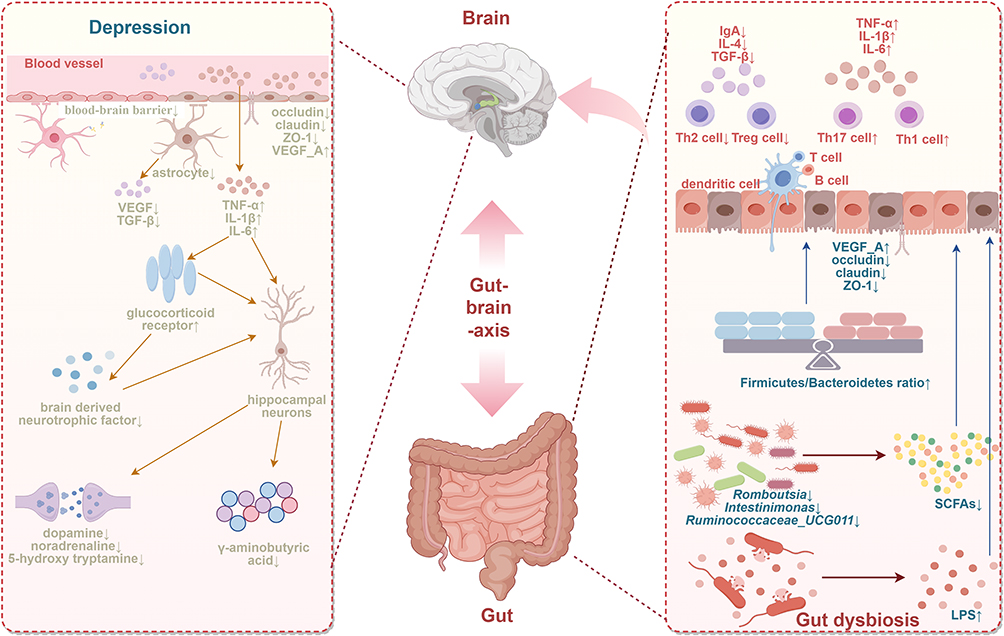 |
Figure 1 The effect of intestinal microbial imbalance on depression. (Note: The arrow↑ indicates upregulation, and the arrow↓ indicates downregulation). |
Currently, the clinical management of depression is predominantly reliant on pharmacological interventions, which can be categorized into two treatment phases: the initial or acute phase (lasting 6–12 weeks) and the maintenance phase (spanning 4–9 months). The pharmacological options include Selective Serotonin Reuptake Inhibitors (SSRIs, such as fluoxetine), Serotonin and Norepinephrine Reuptake Inhibitors (SNRIs, such as venlafaxine), Norepinephrine and Specific Serotonin Antidepressants (NaSSAs, such as mirtazapine), Tricyclic Antidepressants (TCAs, such as amitriptyline), Serotonin Antagonists and Reuptake Inhibitors (SARIs, such as trazodone), and Monoamine Oxidase Inhibitors (MAOIs, such as phenelzine).21 Nonetheless, existing pharmacotherapies exhibit significant limitations. Initially, the administration of these medications is frequently associated with a range of adverse effects. For instance, SSRIs may induce symptoms such as restlessness, anxiety, gastrointestinal disturbances, sleep disorders, as well as dizziness and headaches. Similarly, TCAs can result in side effects including dry mouth, constipation, sedation, and weight gain.22 Conversely, there are notable interindividual variations in patients’ responses to pharmacological treatments, with the duration of efficacy often being prolonged. This is particularly pertinent for patients experiencing depression concomitant with gastrointestinal symptoms, as the gastrointestinal side effects of chemical medications may not only fail to ameliorate the condition but may also exacerbate the detrimental cycle of “emotion-gastrointestinal” interactions.23 Furthermore, empirical evidence indicates that the prolonged administration of first-line antidepressants can alter the composition and metabolic profiles of gut microbiota in both patients with depression and rodent models. This alteration may further compromise intestinal barrier function, underscoring the critical need to identify safe and efficacious alternative therapeutic strategies.24–26
Methods
Search Strategy
A comprehensive literature review was conducted utilizing peer-reviewed and clinical databases such as PubMed, Web of Science, ClinicalTrials.gov, MEDLINE, EMBASE, and Springer LINK. The search employed keywords including Traditional Chinese Medicine (TCM) and depression and gastrointestinal health abnormalities (including irritable bowel syndrome, functional dyspepsia, gastrointestinal autonomic nerve dysfunction, non-erosive reflux disease, colorectal cancer, constipation, ulcerative colitis, gastric ulcer, and intestinal microbiota dysbiosis). The articles selected for review were published within the period from October 2010 to October 2025.
Inclusion Types
Consider including original studies, randomized controlled trials (RCTs), cohort studies, and experimental protocols.
Inclusion Criteria
Published in SCI journals (Q1-Q4).
Exclusion Criteria
Research involving conference abstracts, case reports, meta-analyses, and non-standardized outcome measures was excluded from consideration.
Traditional Chinese Medicine and Depression Combined with Gastrointestinal Health Abnormalities
Traditional Chinese medicine (TCM) presents distinct advantages in the treatment of depression.27 TCM compounds, which are centered around natural products, along with physical therapies such as acupuncture and massage, exhibit multi-component and multi-target characteristics with minimal side effects.28 In clinical trials, these methods target depression by addressing the link between mood disorders and gastrointestinal issues. This comprehensive approach eases gastrointestinal discomfort and improves depressive symptoms, providing a new treatment perspective for depression with gastrointestinal symptoms (Table 1). Given the crucial role of intestinal flora and its metabolites in managing intestinal barrier function and depression, numerous animal studies suggest that traditional Chinese medicine might offer dual treatment and regulation by influencing the intestinal flora-brain-gut axis pathway29 (Table 2).
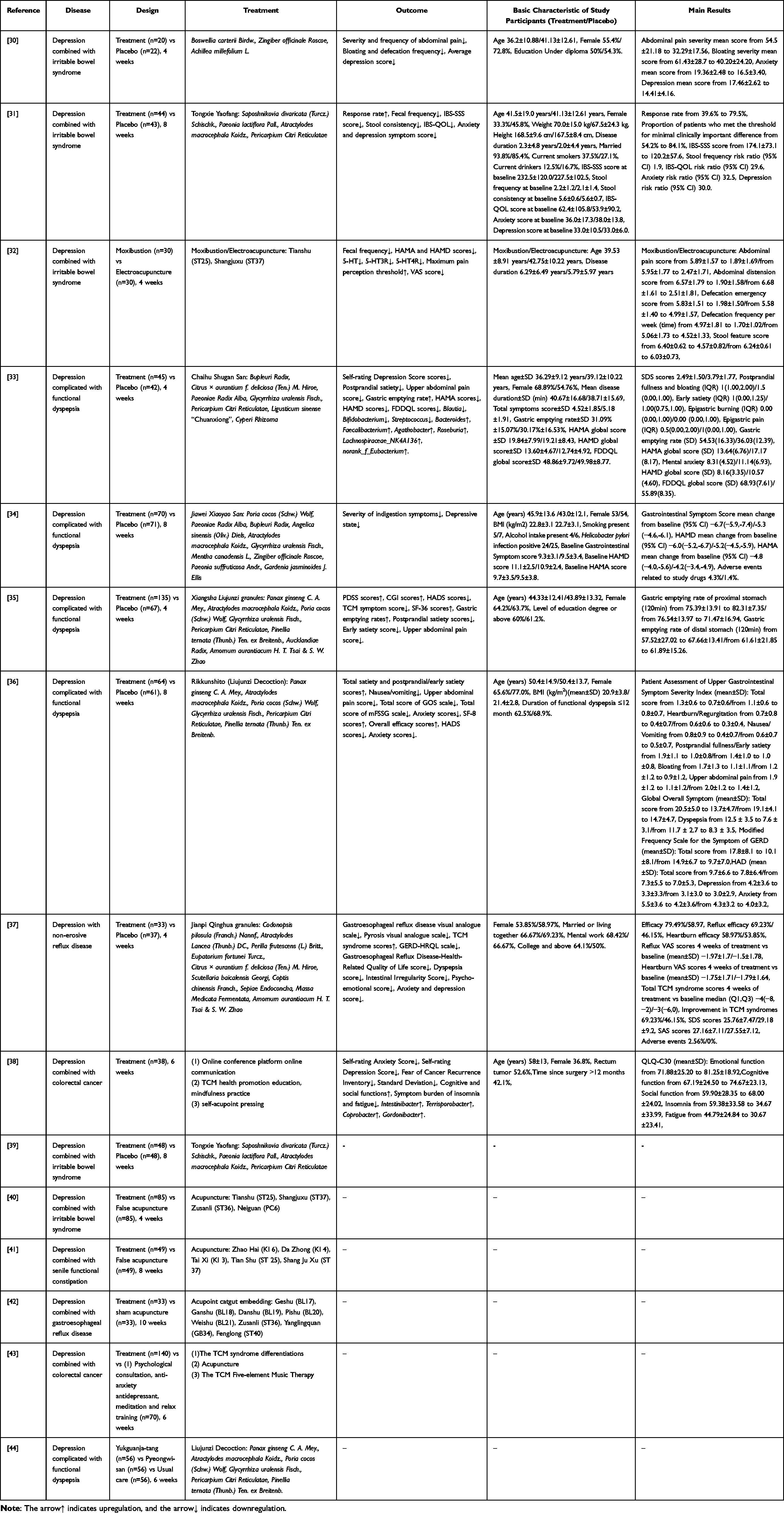 |
Table 1 The Clinical Efficacy of Traditional Chinese Medicine in the Treatment of Depression and Gastrointestinal Health Abnormalities |
 |
Table 2 The Mechanism of Traditional Chinese Medicine in the Treatment of Depression and Gastrointestinal Health Abnormalities in Animal Models |
TCM is distinguished from modern medicine by two primary characteristics: the holistic concept and syndrome differentiation and treatment. The holistic concept in TCM posits that the five physiological systems—liver, heart, spleen, lung, and kidney—are interconnected and unified with the external environment and society. Consequently, alterations in one zang-fu organ can lead to changes in related organs, and both the natural and social environments can contribute to the onset of diseases. This perspective bears some resemblance to the contemporary understanding of depression in modern medicine. While the complete etiology of depression remains not fully elucidated, it is recognized that depression is associated with an imbalance of brain neurotransmitters.111 Specifically, insufficient secretion or abnormal transmission of serotonin, dopamine, and norepinephrine can disrupt emotional regulation. Additionally, structural and functional abnormalities in the hippocampus and prefrontal cortex are implicated in the pathophysiology of depression.112 Nevertheless, it is not solely the brain that is implicated; lesions in other organs can also precipitate or exacerbate depression. For instance, a decline in thyroid function within the endocrine system can result in symptoms such as depression and fatigue, thereby inducing depression-like behaviors.113 Research has demonstrated that individuals with diabetes may exhibit depressive symptoms due to neuropathy caused by prolonged metabolic disturbances.114 Furthermore, in the context of digestive system disorders, chronic hepatitis and cirrhosis can disrupt endotoxin metabolism and neurotransmitter synthesis, thereby influencing the onset of depression.115 Studies have highlighted that gastrointestinal diseases may impact depression via the “brain-gut axis.” For example, conditions such as colitis and irritable bowel syndrome can affect neurological and psychiatric disorders through alterations in the intestinal microbiota, their metabolites, or the intestinal environment.116 The etiology of depression extends beyond the physiological domain to encompass social dimensions. Depression exhibits a pronounced familial aggregation, with relatives of affected individuals facing a 2–10 times higher risk compared to those in the general population.117 Research indicates that within the social milieu, factors such as significant life changes, prolonged social stress, adverse interpersonal relationships, and certain personality traits can serve as precipitating factors for depression. Furthermore, depression is linked to environmental contexts. Studies have demonstrated an increase in depression and anxiety among adolescents and young adults aged 14–24 residing in urban areas, suggesting that enhanced exposure to green spaces and reduced urban noise may mitigate the risk of these mental health disorders.118 Interaction with natural environments, even through simulated audio-visual experiences, has been shown to alleviate stress and improve emotional well-being.119 Contemporary medical research suggests that the etiology of depression is multifactorial, involving genetic predispositions, neurobiological factors, depression related to physical illnesses, and psychosocial environments, and may also be influenced by urban or natural environmental conditions.120 Consequently, altering a single condition may not suffice to achieve the desired therapeutic outcome and could potentially result in recurrent depressive episodes. TCM frequently employs a holistic approach in the management of diseases.121 This approach not only addresses the diverse syndromes associated with depression, which are triggered by various symptoms, by rectifying the imbalance among different organs, but also enhances the overall equilibrium of patients.122 This is achieved through a combination of TCM prescriptions, acupuncture, massage, physical exercises such as Taijiquan and Baduanjin, music therapy, dietary interventions, and other modalities, all aimed at regulating patients’ emotional states and ameliorating depressive symptoms.
While a lot of studies have demonstrated that TCM positively impacts depression, digestive symptoms, and the intestinal environment, there remains a lack of comprehensive literature reviews specifically addressing the treatment of depression and gastrointestinal health abnormalities through TCM. This article aims to systematically review recent literature concerning the treatment of depression associated with gastrointestinal health abnormalities using TCM. The review focuses on TCM interventions for various gastrointestinal symptoms, including depression comorbid with irritable bowel syndrome, functional dyspepsia, intestinal microflora disorders, gastrointestinal motility disorders, and gastrointestinal ulcers. These interventions are evaluated from the perspectives of clinical efficacy and mechanisms of action. The objective is to provide a theoretical foundation and practical reference for the treatment of these conditions with TCM, thereby fostering the innovative application of TCM in the domain of mental-gastrointestinal comorbidities.
Clinical Study on TCM for Depression with Gastrointestinal Health Abnormalities
Clinical investigations into the efficacy of traditional Chinese medicine for the treatment of IBS accompanied by depression have demonstrated that Boswellia carterii Birdw., Zingiber officinale Roscoe, and Achillea millefolium L., when compared to a placebo, may significantly alleviate abdominal pain and enhance depression scores. However, it is important to note that the study’s findings are limited by a small sample size, comprising only 42 participants.30 A clinical trial involving 87 patients diagnosed with irritable bowel syndrome with diarrhea (IBS-D) demonstrated that an 8-week regimen of Tongxie Yaofang granules—comprising Saposhnikovia divaricata (Turcz.) Schischk., Paeonia lactiflora Pall., Atractylodes macrocephala Koidz., Pericarpium Citri Reticulatae— reduced the severity and frequency of diarrhea compared to the placebo group. Additionally, the treatment was associated with improvements in quality of life and a reduction in symptoms of anxiety and depression.31 In this study, 60 IBS-D patients participated in a trial comparing electroacupuncture and moxibustion at Tianshu (ST25) and Shangjuxu (ST37). After 1 month, electroacupuncture improved urgency and defecation frequency, while moxibustion enhanced stool consistency. Both groups showed reduced anxiety and depression scores. After 3 months, only the moxibustion group maintained low emotional scores. Both treatments lowered 5-HT, 5-HT3R, and 5-HT4R levels, increased intestinal perception threshold, and decreased VAS scores, limitations include a small sample size and no placebo control.32
In the domain of clinical research concerning functional dyspepsia accompanied by depression, Japanese researchers have conducted a multi-center, randomized, placebo-controlled, double-blind clinical trial evaluating the efficacy of Rikkunshito—a Chinese herbal medicine comprising Panax ginseng C. A. Mey., Atractylodes macrocephala Koidz., Poria cocos (Schw.) Wolf, Glycyrrhiza uralensis Fisch., Pericarpium Citri Reticulatae, Pinellia ternata (Thunb.) Ten. ex Breitenb.—derived from the traditional Chinese Liujunzi Decoction. This study encompassed 125 patients across 56 hospitals. The findings indicated that the incidence of “significant improvement” and “improvement” in the overall therapeutic effect (OTE) questionnaire was markedly higher in patients within the Rikkunshito group compared to those in the placebo group at both the 4th and 8th weeks of treatment. Concurrently, this patient cohort exhibited a significant trend of improvement in the total score of the gastrointestinal symptom severity assessment index (PAGI-SYM), as well as in scores for dyspepsia, postprandial satiety/early satiety, and abdominal distension. Additionally, there was a notable enhancement in the total score of the hospital anxiety and depression scale (HADS) and its anxiety dimension score. Nonetheless, this study is limited by the absence of a post-treatment follow-up plan, which hinders the evaluation of the long-term sustainability of the treatment’s efficacy.36 A further randomized, double-blind, placebo-controlled trial investigating Liujunzi Decoction (specifically, Xiangsha Liujunzi Decoction, which includes the addition of Aucklandiae Radix, Amomum aurantiacum H. T. Tsai & S. W. Zhao to the original formulation) was conducted with 216 patients over a treatment period of four weeks. This study corroborated previous findings by demonstrating that, in comparison to the placebo group, patients receiving Xiangsha Liujunzi Decoction exhibited improvements in several measures: the Postprandial Distress Severity Scale (PDSS), the HADS, the TCM Symptom Score, the 36-Item Short Form Health Survey (SF-36), and the Clinical Global Impression (CGI) score. Additionally, the gastric emptying (GE) rate of both the proximal and distal stomach was enhanced.35 Collectively, these studies indicate that both the original and modified prescriptions (Rikkunshito and Xiangsha Liujunzi Decoction), with Liujunzi Decoction as the foundational component, have a beneficial therapeutic effect on alleviating depression and anxiety, while concurrently ameliorating gastrointestinal symptoms in patients with functional dyspepsia. The above studies have limitations that do not mention the follow-up plan after the end of treatment.
A study involving 144 patients with functional dyspepsia across nine regions in China investigated the effects of the traditional Chinese medicine formulation, Jiawei Xiaoyao Pill. This prescription comprises Poria cocos (Schw.) Wolf, Paeoniae Radix Alba, Bupleuri Radix, Angelica sinensis (Oliv.) Diels, Atractylodes macrocephala Koidz., Glycyrrhiza uralensis Fisch., Mentha canadensis L., Zingiber officinale Roscoe, Paeonia suffruticosa Andr., Gardenia jasminoides J. Ellis. The intervention lasted for four weeks. The findings indicated improvement in dyspeptic symptoms and a reduction in scores on both the Hamilton Depression Scale and the Hamilton Anxiety Scale when compared to the placebo group. However, the differences between the treatment and placebo groups were not statistically significant.34 A study involving 87 patients with functional dyspepsia (FD) was conducted using Chaihu Shugan Powder, which consists of Bupleuri Radix, Citrus × aurantium f. deliciosa (Ten.) M. Hiroe, Paeoniae Radix Alba, Glycyrrhiza uralensis Fisch., Pericarpium Citri Reticulatae, Ligusticum sinense “Chuanxiong”, Cyperi Rhizoma, known for its properties in soothing the liver and invigorating the spleen. Following the intervention, the patient’s self-rating depression scale score was lower compared to the placebo group. Additionally, there was reduction in postprandial satiety and upper abdominal pain, alongside increase in the gastric emptying rate. Additionally, improvements were observed in the Hamilton Anxiety Rating Scale (HAMA), Hamilton Depression Rating Scale (HAMD), and the functional dyspepsia quality of life scale. Analysis of the intestinal microbiota revealed a decrease in the relative abundance of Blautia, Bifidobacterium, and Streptococcus, while there was an increase in Bacteroides, Faecalibacterium, Agathobacter, Roseburia, Lachnospiraceae_NK4A13, and norank_f_Eubacterium. These findings suggest that, compared to a placebo, Chaihu Shugan Powder may be more effective in alleviating clinical symptoms, enhancing gastric motility, and improving anxiety, depression, and overall quality of life in FD patients. Furthermore, it appears to exert a positive regulatory effect on the composition and relative abundance of intestinal microbial communities in these patients.33
In the clinical management of gastrointestinal-related disorders, a study on non-erosive reflux disease involving 39 patients with spleen deficiency and dampness-heat syndrome revealed that a 4-week treatment with Jianpi Qinghua granules [Codonopsis pilosula (Franch.) Nannf., Atractylodes Lancea (Thunb.) DC., Perilla frutescens (L.) Britt., Eupatorium fortunei Turcz., Citrus × aurantium f. deliciosa (Ten.) M.Hiroe, Scutellaria baicalensis Georgi, Coptis chinensis Franch., Sepiae Endoconcha, Massa Medicata Fermentata, Amomum aurantiacum H. T. Tsai & S. W. Zhao] improved therapeutic outcomes, demonstrating long-term efficacy. The total score of TCM symptoms was substantially reduced, and improvements were observed in the self-rating depression and anxiety scales.37 A single-arm clinical trial investigating the integration of TCM with group psychotherapy demonstrated the efficacy of interventions organized for colorectal cancer (CRC) patients via online meeting platforms. Participants engaged in 90-minute virtual sessions that included TCM health promotion education, mindfulness exercises, and self-acupoint pressing targeting CRC-related symptoms following their diagnosis. Post-intervention assessments revealed a significant reduction in symptoms of insomnia and fatigue, alongside notable improvements in scores on the Self-Rating Anxiety Scale (SAS) and Self-Rating Depression Scale (SDS). Additionally, analysis of the intestinal microflora indicated a significant increase in the abundance of probiotics such as Enterobacteriaceae, Trichobacter, Faecalibacterium, and Gordonia. These findings suggest that the combination of TCM and group psychotherapy may effectively mitigate psychological distress in patients with colorectal cancer.38 Building upon the findings of this single-arm study, the research team subsequently developed a Phase II randomized controlled clinical trial. This trial is designed to employ a synergistic intervention approach, incorporating TCM syndrome differentiation treatment, acupuncture, and TCM five-element music therapy.43 The primary focus is to evaluate the impact of this combined intervention program on the postoperative quality of life in colorectal cancer patients, thereby highlighting the diversity and potential efficacy of TCM treatment modalities for complex syndromes. However, this study only set up the treatment group and lacked the comparison with the placebo group, which could not clarify the clinical advantages of the intervention.
Mechanism Study on TCM for Depression with Gastrointestinal Health Abnormalities
TCM in Regulating Depression Combined with Intestinal Flora Disorder
There exists bidirectional communication between the gut microbiota and the central nervous system, primarily mediated by the microbiota-gut-brain axis. Clinical research has demonstrated that individuals with depression, particularly major depressive disorder (MDD), exhibit a gut microbiota composition that significantly differs from that of healthy individuals.123 This is characterized by reduced diversity and abundance, an increased prevalence of Enterobacteriaceae, Bacteroidetes, and Aliteplase, and a decreased presence of Faecalibacterium, Lactobacillus, Bifidobacterium, and Actinobacteria.124 Additionally, there is a noted reduction in short-chain fatty acids (SCFAs) in fecal matter.125 Animal studies have further corroborated these findings, showing that the transplantation of fecal microbiota from patients with depression into germ-free mice can induce behaviors akin to depression. However, these behaviors can be mitigated through probiotic interventions or antidepressant treatments, which also tend to normalize the microbial composition.126 From a regulatory pathway perspective, an imbalance in intestinal flora initially compromises the integrity of the intestinal mucosal barrier.127 This imbalance leads to a reduction in the number of goblet cells in the colon and a decrease in the thickness of the mucus layer, as well as diminished expression of tight junction proteins such as ZO-1 and occludin.128 Consequently, intestinal permeability is increased, allowing endotoxins like lipopolysaccharide (LPS) to enter the bloodstream,129 thereby activating a systemic inflammatory response. Proinflammatory cytokines, including TNF-α, IL-6, and IFN-γ, subsequently breach the blood–brain barrier (BBB),130 inducing neuroinflammation. Concurrently, the gut microbiota influences depression by modulating tryptophan metabolism,131 which affects both tryptophan hydroxylase 1-mediated 5-hydroxytryptamine synthesis and the kynurenine pathway.132 Additionally, it regulates hyperactivity of the HPA axis and alters SCFAs levels.133 SCFAs play a role in regulating microglial activation, neurogenesis, and synaptic plasticity; their reduction exacerbates neuroinflammation, anxiety, and depression. Furthermore, this imbalance affects the expression of brain-derived neurotrophic factor (BDNF), where downregulation of BDNF impairs hippocampal neuroplasticity.134 In addition, stressors such as chronic unpredictable mild stress (CUMS) can induce intestinal dysbacteriosis and intestinal barrier damage, forming a vicious cycle of “stress-dysbacteriosis-intestinal inflammation-depression”. Natural products or probiotics can alleviate intestinal inflammation and depression-like behavior by repairing intestinal barrier, regulating flora composition and metabolite levels, suggesting that intestinal microbiota may be a controllable target for the prevention and treatment of depression.135
Xiaoyao Powder, comprising Poria cocos (Schw.) Wolf, Paeoniae Radix Alba, Bupleuri Radix, Angelica sinensis (Oliv.) Diels, Atractylodes macrocephala Koidz., Glycyrrhiza uralensis Fisch., Mentha canadensis L., Zingiber officinale Roscoe, has been traditionally utilized in the clinical management of depression characterized by liver stagnation and spleen deficiency syndrome.136 It has demonstrated notable efficacy and safety in mitigating depressive symptoms. Numerous in vivo studies have substantiated its effectiveness in ameliorating depression associated with intestinal barrier dysfunction and dysbiosis. A study conducted in 2012 revealed that CUMS in rats led to weight loss, decreased sucrose preference, and increased resting time in the open field test, indicative of depression, after three weeks of treatment. Biomarkers related to energy metabolism, amino acid metabolism, and alterations in intestinal microbiota were identified in the urine of these rats, suggesting that Xiaoyao Powder may exert its therapeutic effects through these metabolic pathways.45 Ding et al discovered that Xiaoyao Powder, administered for six weeks in a CUMS-induced rat depression model, effectively alleviates depression-related physiological and behavioral issues. It reverses weight loss, boosts food intake and sucrose preference, and improves movement and exploration behaviors. Additionally, Xiaoyao Powder mitigates colonic damage, enhances intestinal barrier proteins (ZO-1, occludin, claudin-1), and increases 5-HT levels in the hypothalamus and colon. These findings suggest Xiaoyao Powder may regulate depression by influencing the brain-gut axis and enhancing intestinal barrier function.46 Zhu et al demonstrated that in a rat model of depression induced by chronic immobilization stress (CIS), a three-week treatment with Xiaoyao Powder significantly reduced the release of pro-inflammatory cytokines, including IL-1β, TNF-α, IL-17, IL-21, and IL-22, by modulating the PI3K/Akt/mTOR signaling pathway in the colon. This treatment also enhanced the secretion of anti-inflammatory cytokines, such as IL-10 and TGF-β, and adjusted the Th17/Treg balance, thereby ameliorating depression-like behaviors.47 In a study by Liu et al, it was observed that the components of Xiaoyao Powder, categorized into liver-soothing herbs [Paeoniae Radix Alba, Bupleuri Radix, Angelica sinensis (Oliv.) Diels, Mentha canadensis L.] and spleen-invigorating herbs (Poria cocos (Schw.) Wolf, Atractylodes macrocephala Koidz., Glycyrrhiza uralensis Fisch., Zingiber officinale Roscoe), effectively counteracted the intestinal dysbiosis in rats subjected to CUMS. Notably, the liver-soothing herbs exhibited superior efficacy compared to Xiaoyao Powder and spleen-invigorating herbs in modulating the cecal microbiota of the depressed rats.49 Subsequent research has demonstrated that Xiaoyao Powder can decrease the Bacteroides/Firmicutes ratio and the abundance of Bacteroides and Corynebacterium, while enhancing the abundance of Lactobacillus and Adlercreutzia. Additionally, this formulation can attenuate the significant enrichment of LPS in depressed rats. It also reduces the expression of factors involved in the TLR4/NLRP3 signaling pathway in colon and brain tissues, thereby enhancing the integrity of the intestinal tract and the BBB, ultimately mitigating depression-like behaviors in rats via the brain-gut axis.48 Furthermore, a study by Yang et al on a high-fat diet-induced obesity model revealed that Xiaoyao Powder treatment could ameliorate obesity-related anxiety and depression-like behaviors. The underlying mechanism may involve the upregulation of Faecalibaculum_rodentium and Lactobacillus_murinus abundance in the intestine, an increase in their metabolites, SCFAs, an improvement in the transcription level of the dopamine D2 receptor (DRD2) in the medial prefrontal cortex (mPFC), and the inhibition of central nervous system (CNS) inflammation.50 Xiaoyao Powder undergoes metabolic transformation in the intestinal microflora to yield compounds such as benzoic acid, liquiritigenin, glycyrrhetinic acid, and saikosaponin D. These metabolites have been shown to inhibit the activity of fatty acid amide hydrolase (FAAH) in the brain, thereby preventing the hydrolysis of fatty acid amides.51 Research indicates that Xiaoyao Powder enhances the integrity of the intestinal barrier, modulates gut microbiota, and ameliorates neuroinflammation and metabolic disorders via the brain-gut axis by altering metabolite profiles.
In the investigation of alternative prescriptions for depression in conjunction with intestinal microbiota disorders, a range of treatments demonstrated notable efficacy. Specifically, in the restraint stress-induced C57BL/6 mouse model, varying dosages (0.5 g/kg, 1 g/kg, 4 g/kg) were administered. Following a 5-day treatment period, a significant reduction in anxiety and depression-like behaviors was observed in the mice. Concurrently, the treatment effectively ameliorated the dysbiosis of intestinal flora induced by restraint stress. This was evidenced by a reversal in the declining abundance of probiotics such as Lactobacillaceae and Prevotellaceae, as well as a reduction in the increasing abundance of γ-Proteobacteria. The underlying mechanism is likely associated with the modulation of NF-κB activation levels in colon tissue, leading to the downregulation of TNF-α and IL-6 expression, and subsequent upregulation of BDNF expression, ultimately alleviating depressive symptoms.52 A separate investigation into Chaihu Shugan Powder demonstrated its efficacy in ameliorating intestinal flora imbalances in pseudo-sterile mice. This was evidenced by a marked increase in the abundance of Bacteroidetes and Lactobacillus within the intestine, alongside a notable reduction in Oscillibacter levels. Concurrently, there was a significant elevation in the concentrations of metabolites 3-hydroxy picolinic acid and inosine, coupled with a substantial decrease in the pro-inflammatory cytokines IL-1β and IL-6. These changes subsequently led to an upregulation of 5-HT and Glu levels in the hippocampus, ultimately ameliorating metabolic disorders associated with depression through the modulation of the intestinal microbial community structure.53 Furthermore, the research conducted by Yue et al on Shugan Hewei Decoction, comprising Bupleuri Radix, Paeonia lactiflora Pall., Citrus aurantium L., Curcuma longa L., Amomum aurantiacum H. T. Tsai & S. W. Zhao, Amomum verum Blackw., Atractylodes Lancea (Thunb.) DC., Aucklandiae Radix, Coptis chinensis Franch., Tetradium ruticarpum (A. Juss.) T. G. Hartley, Glycyrrhiza uralensis Fisch., demonstrated that this formulation can modulate the cecal microflora in a rat model subjected to chronic unpredictable stress. Specifically, it was observed to increase the abundance of Bacteroidetes, Prevotellae_9, Roseburia, Blautia, and Prevotella_1, while reducing the abundance of Firmicutes, Lactobacillus, and Lachnospiraceae_NK4A136. Concurrently, the decoction inhibits the excessive activation of the NLRP3 inflammasome and the TLR4/NF-κB signaling pathway in both the cecum and serum, thereby mitigating cecal mucosal injury and alleviating depressive symptoms.54 Subsequent investigations have corroborated that the prescription also exerts antidepressant effects by enhancing the tryptophan metabolism of intestinal microorganisms and modulating the AMPK/mTOR pathway.55
In the context of the HPA axis regulation pathway, the Shugan Jieyu Capsule—composed of Hypericum perforatum L., and Acanthopanax senticosus (Rupr.etMaxim.) Harms, and approved by the State Food and Drug Administration for the treatment of mild-to-moderate depression—has been shown to modulate gut microbiota composition. Specifically, it reduces the abundance of Actinobacteria while increasing the abundance of Tenericutes and Ruminococcaceae, thereby influencing HPA axis function and mitigating depression-like behaviors.57 Furthermore, a separate investigation into Hypericum perforatum L. revealed that it may alleviate depressive symptoms by promoting the growth of Akkermansia_muciniphila, modulating tryptophan metabolism, decreasing kynurenine (KYN) levels, and regulating the NFκB/NLRP2/Caspase-1/IL-1β signaling pathway.70
Kaixin San, a traditional prescription comprising Panax ginseng C. A. Mey., Polygala tenuifolia Willd., Acori Tatarinowii Rhizoma, Poria cocos (Schw.) Wolf, modulates inflammatory pathways through multiple mechanisms. It achieves this by reducing the abundance of Helicobacter, increasing the prevalence of beneficial bacteria such as Allobaculum, decreasing levels of pro-inflammatory factors like LPS and IL-1β, enhancing the integrity of the intestinal tract and blood–brain barrier, and down-regulating the excessive activation of the HPA axis, thereby ameliorating symptoms of depression.60 Conversely, another study indicated that fluoxetine intake exacerbated the imbalance of the intestinal microbiome and compromised the intestinal barrier in CUMS mice. However, the administration of Kaixin San effectively mitigated the intestinal damage induced by fluoxetine and influenced depression-like behaviors by restoring microbial homeostasis and providing direct cytoprotection to intestinal epithelial cells.61 The administration of Yueju Wan, comprising Cyperi Rhizoma, Ligusticum sinense “Chuanxiong”, Gardenia jasminoides J. Ellis, Atractylodes Lancea (Thunb.) DC., Massa Medicata Fermentata, was observed to decrease the abundance of Prevotella and Bacteroides while increasing the abundance of Eubacterium. This formulation also modulated purine and tryptophan metabolism, among other pathways, leading to a reduction in IL-1β levels within the hippocampus and inhibition of NLRP3 inflammasome activation, thereby ameliorating neuroinflammation.62 The administration of Shugan granules, comprising Angelica sinensis (Oliv.) Diels, Bupleuri Radix, Cyperi Rhizoma, Paeonia lactiflora Pall., Atractylodes macrocephala Koidz., Mentha canadensis L., Poria cocos (Schw.) Wolf, Gardenia jasminoides J. Ellis, Paeonia suffruticosa Andr., Glycyrrhiza uralensis Fisch., resulted in a reduction in the abundance of Bacteroides and an increase in the abundance of Butyricimonas. This intervention also influenced alterations in intestinal metabolites, leading to the inactivation of the PI3K/Akt/mTOR pathway within the hippocampus. Consequently, this process inhibited the expression of inflammatory factors, including TNF-α, IL-1β, and IL-6, and suppressed the activation of microglia in the hippocampus.66
A recent study on Changpu San, a prescription comprising Acori Tatarinowii Rhizoma, Panax ginseng C. A. Mey., Polygala tenuifolia Willd., Rehmanniaglutinosa (Gaertn.) Libosch. ex Fisch. and C. A. Mey., Poria cocos (Schw.) Wolf, Dioscorea polystachya Turcz., Cinnamomum cassia (L.) D. Don, has demonstrated its potential in modulating neurotransmitter synthesis and metabolic regulation pathways. The study found that Changpu San up-regulates beneficial bacteria such as Prevotella and Bacillus, which enhances tryptophan metabolism, elevates tryptophan levels in the brain, reduces KYN levels and kynurenine pathway (KP) activity, decreases neurotoxic metabolites, and lowers pro-inflammatory factors. These effects collectively contribute to reducing systemic inflammation and restoring the balance between the serotonin pathway (SP) and KP, thereby alleviating depression-like symptoms.56 Additionally, the Jianpi Jieyu Decoction, consisting of Astragalus membranaceus (Fisch). Bunge, Pseudostellaria heterophylla, Acanthopanax senticosus (Rupr.etMaxim). Harms, Atractylodes macrocephala Koidz., Paeonia lactiflora Pall., Hyriopsis cumingii (Lea), Polygala tenuifolia Willd., Glycyrrhiza uralensis Fisch., has been shown to mitigate depression-like behaviors in CUMS mice. It achieves this by reversing the reduction in Tau phosphorylation levels in the hippocampus, up-regulating GluR1 expression, and increasing GABA levels in both serum and hippocampus, ultimately enhancing cognitive function.58 Zhizi Chi Decoction, composed of Gardenia jasminoides J. Ellis and Sojae Semen Praeparatum, has been shown to enhance the levels of beneficial gut bacteria, increase butyric acid production, and decrease pro-inflammatory markers such as TNF-α. It also reverses the elevated levels of 5-HIAA and kynurenine in the plasma, ileum, and hippocampus of rats subjected to CUMS. This intervention reduces the ratios of 5-HIAA to 5-HT and kynurenine to tryptophan (KYN/TRP), thereby exerting an antidepressant effect via the gut-brain axis.63 Furthermore, another study indicates that Zhizi Chi Decoction mitigates inflammation through modulation of the HPA axis and intestinal microbiota. It is involved in the neuroactive ligand–receptor interaction process, regulates the secretion of prolactin and estrogen, and modulates MAPK and TNF signaling pathways, thereby demonstrating a multifaceted antidepressant effect.64 Yangxin Jieyu Decoction, comprising Panax ginseng C. A. Mey., Ophiopogon japonicus (L.f.) Ker-Gawl., Schisandrae Chinensis Fructus, Epimedium brevicornu Maxim., Allium macrostemon Bunge, Rosae Rugosae Flos, Albizia julibrissin Durazz., Curcuma aromatica Salisb., Acori Tatarinowii Rhizoma, Citrus reticulata Blanco, has been shown to enhance the abundance of intestinal bacteria such as Lactobacillus, Romboutsia, and Bilophila. It also reverses alterations in depression-related metabolites, including succinic acid and taurine, increases the abundance of immunoglobulin, and upregulates enzymes associated with propionic acid metabolism and the TCAs cycle. These effects may contribute to its potential antidepressant properties through the modulation of the central inhibitory neurotransmitter GABA.59 Similarly, Gegen Qinlian Decoction, which consists of Pueraria montana (Lour.) Merr., Scutellaria baicalensis Georgi, Coptis chinensis Franch., Glycyrrhiza uralensis Fisch., can enhance the composition of bacterial genera such as Ruminococcus and influence depression by modulating metabolites like oleanolic acid.65
In the investigation of TCM and its active constituents for the treatment of depression, various components exert antidepressant effects by modulating the intestinal flora, influencing inflammatory responses, and interacting with the brain-gut axis pathway. A study examining the co-decoction of Lilium lancifolium Ker Gawl. and Rehmanniaglutinosa (Gaertn.) Libosch. ex Fisch. and C. A. Mey., along with its key active ingredient, verbascoside, demonstrated that improvements in intestinal microflora, specifically increasing Mucispirillum, Candidatus_arthromitus, Parabacteroides, and Adlercreutzia, while reducing Desulfovibrio, Prevotella, Alistipes, and Bacteroides, help maintain host homeostasis through the gut microbiome-brain axis. This modulation also results in decreased levels of inflammatory factors such as IL-1β, IL-6, IL-17, and TNF-α, thereby ameliorating depression.67 Furthermore, Valeriana jatamansi has been shown to improve behavioral symptoms and intestinal tissue damage in depressed mice, as well as regulate the diversity of intestinal microorganisms. This is evidenced by an increase in the abundance of Brevundimonas, Gemmobacter, Luteimonas, Romboutsia, Turicibacter, and Parasutterella, accompanied by a reduction in serum vitamin B12 levels. Additionally, it reduces the penetration of homocysteine into the central nervous system, a mechanism associated with the upregulation of cubilin and amnionless levels in intestinal tissue and methionine synthase levels in the hippocampus.68 Lindera aggregata (Sims) Kosterm. enhances gastrointestinal motility by elevating serum concentrations of D-xylose and ghrelin. Additionally, it confers neuroprotective effects in the hippocampus by upregulating the expression of BDNF and facilitating the activation of TrkB and cAMP response element-binding protein (CREB) in the hippocampi of mice subjected to CUMS or in HT22 cells damaged by corticosterone.69
A prior study demonstrated that Berberine has the potential to mitigate damage to the gastric mucosa and intestinal microvilli within the stomach, ileum, cecum, and colon, thereby ameliorating behaviors associated with depression.76 Glycyrrhizin and Cistanche tubulosa total glycosides were shown to increase the abundance of Lactobacillus and Bacteroides, respectively.77 Additionally, alterations in the microbial community, including a decrease in Proteobacteria and regulatory flora such as Firmicutes, Bacteroidetes, Ruminococcaceae, and Peptococcaceae, alongside an increase in Erysipelotrichaceae and Muribaculaceae, were observed.78 These changes, along with modifications in metabolic pathways—such as the reduction of TNF-α, IL-1β, and IFN-γ levels, and improvements in tryptophan metabolism and the regulation of the HPA axis—contribute to antidepressant effects. Furthermore, both Puerarin and Pogostemon cablin essential oil were found to influence depressive symptoms through modulation of the gut microbiota.73 Specifically, Puerarin decreased the abundance of Proteobacteria, Flexispira, and Desulfovibrio, while increasing Firmicutes, Bacillales, and Lactobacillus. In contrast, Pogostemon cablin essential oil reduced the abundance of Ruminococcus_1 and Ruminococcus_2, while enhancing the abundance of Bacteroides and Blautia, and modulating short-chain fatty acids by increasing propionic acid and decreasing caproic acid levels.75 Subsequent research has demonstrated that Gardeniae Fructus oil modulates the intestinal microbiota and influences the hippocampal TLR4/NF-κB/NLRP3 signaling pathway, thereby mitigating neuroinflammation and enhancing the concentrations of 5-HT, dopamine (DA), and BDNF in the hippocampus.80 Additionally, Polygalae Radix Oligosaccharide Esters were found to increase the abundance of Romboutsia, Roseburia, Lachnospiraceae_NK4A136, Prevotella_9, and Eubacterium_coprostanoligenes, while decreasing the abundance of Bacteroides, Oscillibacter, Parasutterella, and Intestinimonas. This modulation resulted in elevated levels of acetic acid, propionic acid, and butyric acid in fecal matter, alongside reduced levels of serum LPS, IL-6, and TNF-α in the cerebral cortex and duodenum. Consequently, both neural and systemic inflammation were alleviated.74 Polygonatum sibiricum polysaccharide has been shown to inhibit serum LPS levels by modulating the composition of intestinal microbiota. Specifically, it decreases the abundance of Muribaculaceae, Lactobacillaceae, Ruminococcaceae, and Erysipelotrichaceae, while increasing the abundance of Akkermansiaceae and Helicobacter. This modulation contributes to the amelioration of abnormal neuronal activation and alterations in local field potentials (LFP) within the paraventricular nucleus.71 Additionally, the polysaccharide exerts its effects by reducing pro-inflammatory cytokines such as TNF-α, IL-1β, and IL-6, and by regulating signaling pathways including PI3K/AKT/TLR4/NF-κB and ERK/CREB/BDNF, thereby enhancing HPA axis function and monoamine neurotransmitter levels.71,72 Similarly, research on Hesperidin derived from Pericarpium Citri Reticulatae has demonstrated an increase in the abundance of Pseudomonadota and Bacteroidota, improvement of the intestinal barrier, elevation of BDNF and 5-HT expression, and a significant reduction in depressive symptoms.79
TCM in Regulating Depression Combined with Irritable Bowel Syndrome
Irritable bowel syndrome (IBS) is a functional gastrointestinal disorder marked by abdominal pain, bowel habit changes, and altered fecal characteristics.137 It often coexists with psychological issues like depression and anxiety, affecting 20% to 60% of IBS sufferers. This comorbidity worsens visceral pain and reduces quality of life, stemming from brain-gut axis dysfunction. An imbalance in this axis, which connects the central and enteric nervous systems, influences the disorder through various pathways.138 Firstly, the hyperactivation of the HPA axis leads to increased release of corticotropin-releasing factor (CRF) by the hypothalamus during stress, which in turn causes the pituitary-adrenal axis to secrete glucocorticoids abnormally. This process not only alters gastrointestinal motility and enhances rectal sensitivity but also exacerbates central emotional disorders.139 Secondly, there is an imbalance between neurotransmitters and brain-gut peptides, with 5-HT playing a crucial role in regulating intestinal motility and mood. Additionally, the abnormal expression of neuropeptide Y (NPY), which is associated with post-traumatic stress disorder and intestinal motility, is observed.140 For instance, a pro-inflammatory state induced by early life stress can up-regulate the activity of indoleamine-2, 3-dioxygenase,141 thereby disrupting 5-HT metabolism142 and subsequently affecting intestinal peristalsis and emotional regulation. Thirdly, intestinal neuroimmune disorders are evident, wherein depression-related psychological factors can increase the number of intestinal mucosal mast cells in patients with IBS, induce low-grade inflammation of the cecal mucosa, compromise the integrity of the intestinal barrier, and potentially alter the composition of the intestinal microbiota. This further perpetuates the vicious cycle of “intestinal abnormalities-central mood disorders” through the brain-gut axis.143,144 Moreover, abnormalities in the autonomic nervous system, the interaction between sex hormones (such as estrogen) and 5-hydroxytryptamine,145 and alterations in brain activity in patients with IBS, as evidenced by functional magnetic resonance imaging, are mediated by depression and contribute to pathological processes.
Research on traditional Chinese medicine prescriptions and their active components for IBS and depression has demonstrated that various interventions operate synergistically through multi-dimensional mechanisms. At the level of intestinal barrier repair, a study conducted in 2015 revealed that the Chang ‘an II Formula comprising Saposhnikovia divaricata (Turcz.) Schischk., Paeonia lactiflora Pall., Atractylodes macrocephala Koidz., Astragalus membranaceus (Fisch.) Bunge, mitigates intestinal mucosal inflammation, repairs the mucosal barrier, and reverses the effects in post-infectious IBS (PI-IBS) model rats, which included conditions such as early sibling deprivation, restraint, and rectal administration of TNBS. The study observed a significant decrease in the CD4+/CD8+ cell ratio in the lamina propria and submucosa, alongside an increase in IL-1β expression in the intestinal mucosa. Conversely, IL-4 expression was reduced. The treatment effectively reversed the alterations in CD4+/CD8+ cell ratio and the expression levels of IL-1β and IL-4 induced by PI-IBS. This intervention protects the intestinal mucosa from PI-IBS through its anti-inflammatory, immunomodulatory, and anti-anxiety properties.84 Baizhu Shaoyao Decoction, composed of Saposhnikovia divaricata (Turcz.) Schischk., Paeonia lactiflora Pall., Atractylodes macrocephala Koidz., Pericarpium Citri Reticulatae, has been shown to enhance the expression of tight junction proteins (Claudin-1, ZO-1, Occludin), thereby reducing intestinal epithelial permeability and restoring the integrity of the intestinal barrier in IBS-D rats. Additionally, it may influence metabolism and stress response by modulating the expression of FoxO1 and FoxO3a in the small intestine of IBS-D rats, and it may alter neurotransmitter levels to alleviate depression.82 Furthermore, Costunolide, an active constituent of Aucklandiae Radix, has demonstrated efficacy in ameliorating gastrointestinal dysfunction and depression-like behavior in stress-induced IBS mice. This is achieved by enhancing intestinal mucosal permeability, inhibiting mast cell activation, upregulating the expression of colonic atresia protein, downregulating Claudin 2 expression, and upregulating the expression of GluN2A, BDNF, p-ERK1/2, and p-CREB in hippocampal cells through the modulation of 5-HT metabolism, thereby maintaining the function of the intestinal mucosal barrier and mitigating depression-like behavior.85
Xiaoyao Powder modulates the ACT1/TRAF6/P38 MAPK/AP-1 signaling pathway to decrease IL-17A, IL-17F, and TNF-α, thereby improving neuroinflammation in an IBS mouse model induced by CUMS and senna leaf gavage. Additionally, it elevates brain dopamine levels by regulating DRD2 and TH, which alleviates depressive symptoms and affects brain-derived neurotrophic factors and the HPA axis in IBS and depression patients. This treatment improves gastrointestinal symptoms, fecal water content, AWR score, and reduces colonic permeability.81 Gallic Acid mitigates visceral pain and depression by downregulating P2X7 receptor and p-ERK1/2 expression in the hippocampus, spinal cord, and DRG, lowering serum IL-1β and TNF-α levels, and increasing IL-10 levels.87
At the level of neurotransmitter-brain-gut axis regulation, prior research on Curcumin has demonstrated its impact on IBS through the modulation of neurotransmitters, as well as BDNF and CREB signaling within both the central nervous system and the peripheral intestinal system.86 The Changkang Fang Formula, which comprises Salvia miltiorrhiza Bunge, Paeonia lactiflora Pall., Fagopyrum dibotrys (D. Don) Hara, Saposhnikovia divaricata (Turcz.) Schischk., Cuscutachinensis Lam., Rehmanniaglutinosa (Gaertn.) Libosch. ex Fisch. and C. A. Mey., Coptis chinensis Franch., Cicadae Periostracum, exerts its regulatory effects on the brain-gut axis by upregulating microbial taxa such as Bacteroidetes, Dubosiella, Lactobacillus, Clostridiales, Corynebacteriales, Ruminococcaceae, and Lachnospiraceae. This modulation enhances the production of brain-gut peptides (BGPs), thereby alleviating pain and reversing intestinal motility disorders. Furthermore, the Changkang Fang Formula influences the levels of BDNF and 5-HT in both the colon and hippocampus, alongside the expression of genes associated with BGP pathways. It is posited that these effects are mediated through the 5-HT-PKA-CREB-BDNF signaling pathway.83
A study on electroacupuncture demonstrated that stimulation at the acupoints Tianshu (ST25), Dachangshu (BL25), and Baihui (GV20) effectively inhibited the hyperactivation of CRF neurons in the paraventricular nucleus (PVN), as well as the overexpression of serum CRF, colonic CRF, CRF-R1, MCT, protease-activated receptor 2, and TRPV1 in a mouse model. Additionally, this intervention modulated the signaling pathways of the hypothalamic paraventricular nucleus and colonic adrenocorticotropic hormone-releasing factor, thereby ameliorating negative emotional states and visceral hypersensitivity in the mice.88
TCM Regulating Depression Combined with Gastrointestinal Motility Disorder
Gastrointestinal motility disorders are primarily characterized by irregularities in the rhythm, intensity, or coordination of gastrointestinal smooth muscle contractions,146 leading to symptoms such as abdominal distension, abdominal pain, and altered bowel habits. Constipation, a prevalent manifestation of gastrointestinal motility disorders, has been found to have a significant association with depression. Epidemiological studies indicate that between 9% and 40% of individuals with depression report experiencing constipation, and those with constipation exhibit notably higher anxiety and depression scores compared to healthy individuals.147 Furthermore, constipation preceding the onset of depression may serve as a potential early indicator, offering valuable insights for the early diagnosis of depression.148 The relationship between the two phenomena is bidirectional: constipation may contribute to the pathogenesis of depression through mechanisms such as low-grade intestinal inflammation, including mast cell infiltration and activation, and the release of cytokines into the bloodstream, thereby serving as a risk factor for depression.149 Conversely, depression can activate the HPA axis, leading to the release of stress-related factors that exacerbate gastrointestinal motility disorders, thus rendering constipation a somatic symptom of depression. Alterations in hippocampal synaptic plasticity associated with depression, disruptions in neurotransmitter systems such as 5-HT150 and GABA,151 and imbalances in the intestinal microbiota—whose metabolites, including short-chain fatty acids and lipopolysaccharides, can influence both gastrointestinal motility and central mood regulation—collectively mediate the pathological cycle of “gastrointestinal motility disorder-depression”.
As early as 2011, research indicated that the antidepressant Chaihu Shugan Powder and its main component, Ferulic acid, have dual benefits: they act as antidepressants and enhance intestinal function. Behaviorally and gastrointestinally, they reduce mice’s resting time, boost activity, and speed up gastric emptying and intestinal transit. Mechanistically, they regulate the monoamine system by inhibiting the reuptake of 5-HT, norepinephrine, and dopamine. They also lower CRH and ACTH levels in the HPA axis. Additionally, they increase ghrelin levels and induce intestinal contractions in vitro, achieving a combined antidepressant and intestinal motility effect.90 The recent study revealed that Chaihu Shugan Powder and its primary active component, Ferulic acid, have significant effects on endothelial cell function, promoting vascular health, mitigating oxidative damage, alleviating depressive symptoms, and modulating multiple depression-related disorders. These effects are mediated through the Ghrl-Edn1/MECP2/P-mTOR/VEGFA-OS pathway in forced swimming rat models exhibiting MDD, endothelial dysfunction (ED), and gastrointestinal disorders (GD).89 Furthermore, research indicates that the combination of Citrus × aurantium f. deliciosa (Ten.) M.Hiroe and Ligusticum sinense “Chuanxiong”, both constituents of Chaihu Shugan Powder, can counteract the elevation of cysteine aspartic protease-3 and c-fos protein levels induced by CUMS, as well as the activation of the COX-2/PGE2 and IL-1β/IDO pathways. Additionally, these compounds can reverse the reduction in GFAP, BDNF, and mTOR expression levels. Improvements in depression-like behaviors and gastrointestinal motility disorders were observed, attributed to the modulation of the glutamatergic system, the AMPAR/BDNF/mTOR/synapsin I pathway, the immune system, and ghrelin signaling.92 Zuojin Wan, composed of Tetradium ruticarpum (A. Juss.) T. G. Hartley and Coptis chinensis Franch., has been shown to increase Oscillospirales and decrease Parabacteroides, potentially modulating depression-like behavior and gastrointestinal dysfunction through the FXR-BA gut microbiota and the liver-brain-gut axis.93 Additionally, research indicates that Zuojin Wan influences TPH2, facilitating the growth of GABAergic and dopaminergic neurons, which in turn elevates the 5-HT content in intestinal neurons. This process supports the development and survival of GABAergic and intestinal dopaminergic neurons, thereby ameliorating depression-induced gastrointestinal dysfunction.94
A study investigating the effects of electroacupuncture at specific acupoints, namely ST36 (Zusanli) and CV12 (Zhongwan), demonstrated that the inhibition of GABAergic neurons in the bed nucleus of the stria terminalis (BNST) was alleviated following intervention. This finding elucidates the neural mechanism by which chemical activation of BNST GABAergic neurons modulates autophagy in gastric cells, thereby mitigating gastric dysfunction associated with depression. Consequently, this research offers a theoretical foundation for the application of electroacupuncture in the treatment of emotional disorders that are accompanied by somatic symptoms.95 A study investigating the combined effects of electroacupuncture at acupoints Yintang (EX-HN3) and Neiguan (PC6) with Tongbian Decoction—comprising Toosendan Fructus, Ophiopogon japonicus (L.f). Ker-Gawl., Scrophularia ningpoensis Hemsl., Rehmanniaglutinosa (Gaertn.) Libosch. ex Fisch. and C. A. Mey., Semen Armeniacae Amarum., Atractylodes macrocephala Koidz., Citrus × aurantium f. deliciosa (Ten.) M. Hiroe, Magnolia officinalis Rehd. et Wils., Trichosanthes kirilowii Maxim., Cannabis Sativa L., Pruni Semen, Aucklandiae Radix—on depression accompanied by constipation demonstrated that this combined treatment exhibited a more pronounced antidepressant effect compared to electroacupuncture alone. This synergistic approach was found to mitigate intestinal inflammation, restore neuronal morphology, and enhance the expression of TPH2 in both the PFC and colon. Additionally, serum levels of 5-HTP were elevated, and the TPH2/5-HT pathway was modulated via the gut-brain axis, indicating a coordinated regulatory effect on the nervous and gastrointestinal systems, with significant antidepressant and pro-motility outcomes.96
Nobiletin, the primary active compound extracted from the Wenyang Yiqi Formula, has been demonstrated to reduce the expression of MAPT in colon tissue and decrease serum levels of TNF-α, IL-1β, IL-6, IFN-γ, and the MAPK pathway. It also enhances fecal particle count, water content, intestinal propulsion rate, and ameliorates colon pathological damage and depression-like behaviors, potentially by modulating the function of interstitial cells of Cajal (ICCs) through targeting microtubule-associated protein tau (MAPT) in colon tissue.97 A study on Norisoboldine, derived from Lindera aggregata (Sims) Kosterm., revealed that Norisoboldine suppresses the abnormal activation of intestinal innate immunity, inhibits M1 markers (CD86, iNOS), upregulates M2 markers (CD206, Arg-1), rebalances the Th1/Treg cell population, and inhibits the activation of the NF-κB signaling pathway. This results in reduced levels of IL-1β, TNF-α, and IL-6, decreased neuronal apoptosis, and increased expression of nerve repair proteins, including BDNF and PSD-95, thereby alleviating depression-like behaviors.98
TCM Regulating Depression Combined with Ulcerative Gastrointestinal Diseases
The primary clinical manifestations of ulcerative colitis (UC) include weight loss, recurrent diarrhea, abdominal pain, rectal bleeding, and hematochezia.152 The precise pathogenesis of UC remains unclear;153 however, contemporary medical understanding suggests a strong association with infections,154 immune system abnormalities,155 and psychological factors.156,157 The fluctuating nature of the disease significantly elevates the prevalence of mental disorders, particularly depression and anxiety, among patients with UC.158 There exists a bidirectional relationship wherein intestinal inflammation exacerbates mental health issues, and psychological factors, in turn, influence intestinal inflammation and disease recurrence.159 Intestinal inflammation may induce neuroinflammation by increasing intestinal mucosal permeability, allowing inflammatory mediators to enter the central nervous system via systemic circulation and compromise the blood–brain barrier. Patients with UC often endure prolonged psychosocial stress and economic burdens due to the chronic recurrence of the disease, making them more susceptible to negative emotions such as anxiety and depression, which further exacerbate intestinal damage.160 The fundamental mechanism underlying this association is intricately linked to the regulation of the gut-brain axis. This involves the bidirectional communication between gut microbiota and the host, with 5-HT, synthesized by intestinal chromaffin cells, serving as a crucial mediator.161 Notably, its precursor, tryptophan, is capable of crossing the blood–brain barrier. The preservation of the integrity of both the intestinal mucosal barrier and the blood–brain barrier is vital for sustaining gut–brain homeostasis.162
In the investigation of depression in conjunction with ulcerative gastrointestinal disorders, prior research has demonstrated that a zinc (II)-curcumin complex enhances mucosal resistance through its involvement in free radical scavenging and the upregulation of HSP70 expression. This process subsequently mitigates the elevation of iNOS expression and indirectly facilitates the release of 5-HT, thereby exerting antidepressant effects through the activation of 5-HT receptors, as well as exhibiting anti-ulcer and anti-depressive properties.104 Furthermore, the combination of Wuling Powder (comprising Poria cocos(Schw.) Wolf, Polyporus umbellatus (Pers.) Fr., Alisma plantago-aquatica L. Cinnamomum cassia Presl, Atractylodes macrocephala Koidz.) with mesalazine has been shown to balance antidepressant effects and alleviate colitis-associated intestinal inflammation by modulating the ProBDNF/p75NTR/sortilin and BDNF/TrkB signaling pathways.102 A study identified that Corylin, a representative flavonoid compound isolated from Cullen corylifolium (L.) Medik., can bind to 5-HTPDC, thereby promoting its enzymatic degradation. This process results in the accumulation of 5-HTP in the colon, which can subsequently enter the circulatory system and cross the blood–brain barrier, serving as a novel source of 5-HT in the brain. Concurrently, Corylin modulates the intestinal microflora by increasing Enterorhabdus, Candidatus_Stoquefichus populations while decreasing Turicibacter. This modulation aids in ameliorating chronic UC by influencing the inflammatory interactions along the gut-brain axis. Additionally, Corylin’s binding to 5-HTPDC leads to an elevated production of 5-HTP in the colon, contributing to improvements in both intestinal and central nervous system disorders.103 Furthermore, the herbal formula Sini San, comprising Bupleuri Radix, Citrus × aurantium f. deliciosa (Ten.) M.Hiroe, Paeoniae Radix Alba, Glycyrrhiza uralensis Fisch., was shown to enhance the integrity of the intestinal and blood-brain barriers. It also reduced pro-inflammatory factors such as TNF-α, IL-1β, and IL-6, while increasing the anti-inflammatory factor IL-10. These effects collectively restored the integrity of the intestinal mucosal and blood–brain barriers, alleviated depression-like behavior in mice, and provided therapeutic benefits for UC and depression.99 Vinegar-processed Schisandrae Chinensis Fructus improved the abundance of Bacteroides and Parabacteroides, decreased the abundance of Candidatus_Amulumruptor, increased the level of tryptophan, decreased the levels of kynurenine and xanthate, up-regulated the aromatic hydrocarbon receptor (AhR), inhibited the activation of NF-κB p-p65, improved the level of inflammation, restored the integrity of colonic mucosa and blood-brain barrier, and reduced the damage of hippocampal neurons. Improvement of depression-like behavior in chronic UC mice.100 The total flavone content of Abelmoschus manihot (L.) Medicus has been shown to enhance the abundance of bacterial genera such as Bacteroides, Roseburia, Alistipes, Oscillibacter, Rikenellaceae_RC9, and Ruminiclostridium_9, while down-regulating the presence of Alloprevotella, Lactobacillus, Helicobacter, Candidatus_Saccharimonas, Enterorhabdus, and Lachnospiraceae_UCG-006. This modulation of gut microbiota is associated with improvements in intestinal barrier integrity and the regulation of intestinal inflammation.101
Discussion
Depression is a multifaceted mental disorder characterized by high prevalence and a significant rate of recurrence, frequently accompanied by comorbidities affecting multiple systems. Its pathogenesis is understood to involve intricate interactions across several dimensions, including genetic susceptibility, neurobiological abnormalities, immune-inflammatory imbalances, disruptions in the gut-brain axis, and psychosocial stressors. Despite extensive research, a comprehensive and unified cognitive framework for understanding depression has yet to be established. TCM excels in treating depression linked to gastrointestinal issues through its core principle of “overall regulation.” Its strengths lie in diverse treatment options (eg, TCM, acupuncture, moxibustion), a holistic approach to body regulation, and safety (non-addictive, well-tolerated, minimal side effects). It coincides with the pathological characteristics of depression combined with gastrointestinal symptoms “physical and mental comorbidity”, providing a unique path different from chemical drugs for the treatment of such complex diseases.
Nevertheless, current research on this disease within the domain of TCM is subject to numerous limitations, which must be addressed objectively to advance the field. Foremost among these limitations is the inadequacy in the standardization and representativeness of clinical studies. There is a notable absence of large-scale, multi-center, and multi-sample longitudinal studies, particularly concerning the various clinical phenotypes of gastrointestinal-related health disorders associated with depression. This gap is especially evident in the context of depression subtypes corresponding to diarrhea-type and constipation-type gastrointestinal dysfunction. The disparity in efficacy remains uncertain. Second, existing clinical studies predominantly rely on questionnaires as the primary method for assessing efficacy, lacking comprehensive collection and analysis of objective laboratory indicators such as serum inflammatory factors, intestinal flora composition, neurotransmitter metabolites, and brain functional imaging. This deficiency results in a low level of research evidence. Third, there is a lack of transparency and content integrity in the research; some studies have not disclosed their experimental designs in a timely manner, and key results have not been fully reported. Additionally, some experimental studies have not identified the principal active ingredients of TCM compounds or preparations, making it challenging to trace the material basis of efficacy, thereby hindering the interpretation of mechanisms and the translation of findings into practice. Fourth, the inconsistency in animal experimental design poses significant challenges. Variations in the construction of animal models can result in differing phenotypes of depression and gastrointestinal comorbidity, as seen with the use of diverse experimental animals such as Sprague-Dawley rats, C57BL/6J mice, and Kunming mice, alongside various depression modeling methods like chronic unpredictable mild stimulation and chronic social defeat models. Additionally, there is a lack of standardization in drug intervention dosages, with some studies failing to establish high, medium, and low multi-dose groups to adequately explore dose–effect relationships and potential toxicity. Furthermore, the non-uniformity in the duration of drug interventions further diminishes the comparability of research outcomes, potentially introducing bias. Notwithstanding the aforementioned limitations, the integration of clinical studies with animal experimental data collectively substantiates the efficacy of TCM, encompassing herbal treatments and acupuncture, in modulating multiple targets. These targets include neurotransmitter imbalances, emotional regulation, hyperactivity of the HPA axis, neuroimmune inflammation, and the homeostasis of the gut-brain axis (Tables 1 and 2).
Given the aforementioned limitations, future research should prioritize the “holistic concept” of TCM by developing a research framework and intervention model that embody greater disciplinary specificity. It is imperative to enhance the standardization and scientific rigor of research design. In clinical studies, multi-center, large-sample, and long-term follow-up cohort studies should be conducted to examine various gastrointestinal symptom phenotypes and depression subtypes. Concurrently, the integration of objective laboratory indicators with subjective symptom scores is essential to elevate the quality of evidence. In the realm of basic research, there is a need to standardize animal model criteria—such as explicit modeling methods and stress intensity—alongside the regulation of drug dosage gradients and intervention durations. Furthermore, identifying active ingredients is crucial to provide a robust foundation for clinical translation. Conversely, this approach underscores the distinctive features and benefits of TCM through its concept of “mind-body co-governance”. It transcends the constraints of isolated pharmacological interventions by establishing a comprehensive intervention framework that integrates “body-spirit-environment” collaborative conditioning. This is achieved through the use of TCM compounds or acupuncture to regulate physiological aspects such as the nervous system, immunity, and gut microbiota. Concurrently, TCM psychological counseling, including emotional adjustment, is employed to enhance mental well-being. Additionally, environmental optimization, such as adjustments in living and rest conditions, and the construction of a social support system are incorporated. This results in a multi-dimensional, holistic intervention model that ultimately facilitates the synergistic improvement of both depression and gastrointestinal-related health issues.
Conclusion
In conclusion, TCM holds potential in addressing depression alongside gastrointestinal-related health abnormalities through its multi-target mechanisms. These mechanisms include the modulation of neurotransmitter systems such as monoamines, GABA, and glutamic acid; the restoration of function in emotional regulation brain regions like the prefrontal cortex and hippocampus; the inhibition of excessive activation of the HPA axis; the mitigation of neuroimmune inflammation imbalances; and the regulation of the intestinal flora-gut-brain axis homeostasis. Despite its promising potential, the clinical value of TCM remains constrained by the limitations of current research. To fully realize its benefits, it is imperative to overcome these limitations by standardizing research design, enhancing the quality of evidence, and emphasizing the holistic characteristics of TCM. Advancing TCM from an empirical treatment approach to one that is evidence-based and standardized will provide innovative and effective solutions for the treatment of global psycho-gastrointestinal comorbidities.
Abbreviations
5-HIAA, 5-Hydroxyindole-3-acetic acid; 5-HT, 5-hydroxytryptamine; 5-HT3R, 5-hydroxytryptamine type 3; 5-HT4R, 5-hydroxytryptamine type 4; AhR, aromatic hydrocarbon receptor; Akt, Protein Kinase B; BBB, blood–brain barrier; BGPs, brain-gut peptides; BDNF, brain-derived neurotrophic factor; CREB, cAMP response element-binding protein; CIS, chronic immobilization stress; CRC, colorectal cancer; CRP, C-reactive protein; CRF, corticotropin-releasing factor; CUMS, chronic unpredictable mild stress; DA, dopamine; DRD2, dopamine D2 receptor; ED, endothelial dysfunction; ENS, enteric nervous system; FAAH, fatty acid amide hydrolase; FD, functional dyspepsia; FMT, fecal microbiota transplantation; GABA, γ-aminobutyric acid; GD, gastrointestinal disorders; GE, gastric emptying; GluR1, Glutamate Receptor 1; HADS, Hospital Anxiety and Depression Scale; HAMA, Hamilton Anxiety Rating Scale; HAMD, Hamilton Depression Rating Scale; HPA, hypothalamic-pituitary-adrenal; ICCs, interstitial cells of Cajal; IFN-γ, Interferon-γ; IL-6, Interleukin-6; IBS, Irritable bowel syndrome; KYN, kynurenine; KP, kynurenine pathway; LPS, lipopolysaccharide; LFP, local field potentials; MAPK, mitogen-activated protein kinase; MAPT, microtubule-associated protein tau; MAOIs, Monoamine Oxidase Inhibitors; mPFC, medial prefrontal cortex; mTOR, mammalian Target of Rapamycin; MCT, mast cell tryptase; MDD, major depressive disorder; NaSSAs, Norepinephrine and Specific Serotonin Antidepressants; NF-κB, nuclear factor kappa-B; NPY, neuropeptide Y; PDSS, Postprandial Distress Severity Scale; PAGI-SYM, Patient Assessment of Gastrointestinal Symptom Severity Index; PI3K, Phosphatidyqinositol‐3 kinase; PI-IBS, post-infectious IBS; PVN, paraventricular nucleus; SAS, Self-Rating Anxiety Scale; SARIs, Serotonin Antagonists and Reuptake Inhibitors; SCFAs, short-chain fatty acids; SDS, Self-Rating Depression Scale; SNRIs, Serotonin and Norepinephrine Reuptake Inhibitors; SS, Symptom Score; SSRIs, Selective Serotonin Reuptake Inhibitors; SP, serotonin pathway; TCAs, Tricyclic Antidepressants; TGF-β, Transforming Growth Factor-β; Th17, T helper cell 17; TLR4, Toll Like Receptor 4; TCM, Traditional Chinese medicine; TPH2, tryptophan hydroxylase 2; Treg, Regulatory T cells; TRP, tryptophan; VAS, visual analogue scale; WHO, World Health Organization; ZO-1, Zonula occludens-1.
Data Sharing Statement
Data sharing is not applicable to this article as no datasets were generated or analysed during the current study.
Author Contributions
All authors made a significant contribution to the work reported, whether that is in the conception, study design, execution, acquisition of data, analysis and interpretation, or in all these areas; took part in drafting, revising or critically reviewing the article; gave final approval for the version to be published; have agreed on the journal to which the article has been submitted; and agree to be accountable for all aspects of the work.
Funding
This research was supported by the Project of the National Natural Science Foundation of China (No. 82160863).
Disclosure
The authors report no conflicts of interest in this work.
References
1. Thapar A, Eyre O, Patel V, Brent D. Depression in young people. Lancet. 2022;400(10352):617–43. doi:10.1016/S0140-6736(22)01012-1
2. Fernandez-Rodrigues V, Sanchez-Carro Y, Lagunas LN, et al. Risk factors for suicidal behaviour in late-life depression: a systematic review. WJP. 2022;12(1):187–203. doi:10.5498/wjp.v12.i1.187
3. Malhi GS, Mann JJ. Depression. Lancet. 2018;392(10161):2299–2312. doi:10.1016/S0140-6736(18)31948-2
4. Wilpart K, Törnblom H, Svedlund J, Tack JF, Simrén M, Van Oudenhove L. Coping skills are associated with gastrointestinal symptom severity and somatization in patients with irritable bowel syndrome. Clin Gastroenterol Hepatol. 2017;15(10):1565–1571.e3. doi:10.1016/j.cgh.2017.02.032
5. Seguella L, Pesce M, Capuano R, et al. High-fat diet impairs duodenal barrier function and elicits glia-dependent changes along the gut-brain axis that are required for anxiogenic and depressive-like behaviors. J Neuroinflammation. 2021;18(1):115. doi:10.1186/s12974-021-02164-5
6. Liu H, Zhang X, Shi P, et al. α7 Nicotinic acetylcholine receptor: a key receptor in the cholinergic anti-inflammatory pathway exerting an antidepressant effect. J Neuroinflammation. 2023;20(1):84. doi:10.1186/s12974-023-02768-z
7. Keller J, Gomez R, Williams G, et al. HPA axis in major depression: cortisol, clinical symptomatology and genetic variation predict cognition. Mol Psychiatry. 2017;22(4):527–536. doi:10.1038/mp.2016.120
8. Penninx BWJH, Lamers F, Jansen R, et al. Immuno-metabolic depression: from concept to implementation. Lancet Reg. Health Eur. 2025;48:101166. doi:10.1016/j.lanepe.2024.101166
9. Dellarole A, Morton P, Brambilla R, et al. Neuropathic pain-induced depressive-like behavior and hippocampal neurogenesis and plasticity are dependent on TNFR1 signaling. Brain Behav Immun. 2014;41:65–81. doi:10.1016/j.bbi.2014.04.003
10. Cruz-Pereira JS, Rea K, Nolan YM, O’Leary OF, Dinan TG, Cryan JF. Depression’s unholy trinity: dysregulated stress, immunity, and the microbiome. Annu Rev Psychol. 2020;71(1):49–78. doi:10.1146/annurev-psych-122216-011613
11. Fairlie T, Shah A, Talley NJ, et al. Overlap of disorders of gut–brain interaction: a systematic review and meta-analysis. Lancet Gastroenterol Hepatol. 2023;8(7):646–659. doi:10.1016/S2468-1253(23)00102-4
12. Jia Z, Wu A, He M, Zhang L, Wang C, Chen A. Metabolites of stable fly reduce diarrhea in mice by modulating the immune system, antioxidants, and composition of gut microbiota. Microb Pathogenesis. 2019;134:103557. doi:10.1016/j.micpath.2019.103557
13. Hoffman JD, Parikh I, Green SJ, et al. Age drives distortion of brain metabolic, vascular and cognitive functions, and the gut microbiome. Front Aging Neurosci. 2017;9:298. doi:10.3389/fnagi.2017.00298
14. Wu J, Ou G, Wang S, et al. The predictive, preventive, and personalized medicine of depression: gut microbiota and inflammation. EPMA Journal. 2024;15(4):587–598. doi:10.1007/s13167-024-00379-z
15. Rampanelli E, Romp N, Troise AD, et al. Gut bacterium Intestinimonas butyriciproducens improves host metabolic health: evidence from cohort and animal intervention studies. Microbiome. 2025;13(1):15. doi:10.1186/s40168-024-02002-9
16. Yao Y, Cai X, Fei W, Ye Y, Zhao M, Zheng C. The role of short-chain fatty acids in immunity, inflammation and metabolism. Crit. Rev. Food Sci. Nutr. 2022;62(1):1–12. doi:10.1080/10408398.2020.1854675
17. Ramos-Sevillano E, Ercoli G, Brown JS. Mechanisms of naturally acquired immunity to Streptococcus pneumoniae. Front Immunol. 2019;10:358. doi:10.3389/fimmu.2019.00358
18. Taktak-BenAmar A, Morjen M, Ben Mabrouk H, et al. Expression, purification and functionality of bioactive recombinant human vascular endothelial growth factor VEGF165 in E. coli. AMB Expr. 2017;7(1):33. doi:10.1186/s13568-016-0300-2
19. Walton EM, Cronan MR, Cambier CJ, et al. Cyclopropane modification of trehalose dimycolate drives granuloma angiogenesis and mycobacterial growth through vegf signaling. Cell Host Microbe. 2018;24(4):514–525.e6. doi:10.1016/j.chom.2018.09.004
20. Belkaid Y, Hand TW. Role of the Microbiota in Immunity and Inflammation. Cell. 2014;157(1):121–141. doi:10.1016/j.cell.2014.03.011
21. Keyloun KR, Hansen RN, Hepp Z, Gillard P, Thase ME, Devine EB. Adherence and persistence across antidepressant therapeutic classes: a retrospective claims analysis among insured us patients with Major Depressive Disorder (MDD). CNS Drugs. 2017;31(5):421–432. doi:10.1007/s40263-017-0417-0
22. Niarchou E, Roberts L, Naughton BD. What is the impact of antidepressant side effects on medication adherence among adult patients diagnosed with depressive disorder: a systematic review. J Psychopharmacol. 2024;38(2):127–136. doi:10.1177/02698811231224171
23. Braund TA, Tillman G, Palmer DM, Gordon E, Rush AJ, Harris AWF. Antidepressant side effects and their impact on treatment outcome in people with major depressive disorder: an iSPOT-D report. Transl Psychiatry. 2021;11(1):417. doi:10.1038/s41398-021-01533-1
24. Ma J, Wang R, Chen Y, Wang Z, Dong Y. 5-HT attenuates chronic stress-induced cognitive impairment in mice through intestinal flora disruption. J Neuroinflammation. 2023;20(1):23. doi:10.1186/s12974-023-02693-1
25. Ritchie G, Strodl E, Parham S, Bambling M, Cramb S, Vitetta L. An exploratory study of the gut microbiota in major depression with anxious distress. J Affective Disorders. 2023;320:595–604. doi:10.1016/j.jad.2022.10.001
26. Sonali S, Ray B, Ahmed Tousif H, et al. Mechanistic insights into the link between gut dysbiosis and major depression: an extensive review. Cells. 2022;11(8):1362. doi:10.3390/cells11081362
27. Li C, Huang J, Cheng YC, Zhang YW. Traditional Chinese Medicine in depression treatment: from molecules to systems. Front Pharmacol. 2020;11:586. doi:10.3389/fphar.2020.00586
28. Li X, Li X, Wang L, et al. Advancing traditional chinese medicine research through network pharmacology: strategies for target identification, mechanism elucidation and innovative therapeutic applications. Am J Chin Med. 2025;53(07):2021–2042. doi:10.1142/S0192415X25500752
29. Zhang C, Xue P, Zhang H, et al. Gut brain interaction theory reveals gut microbiota mediated neurogenesis and traditional Chinese medicine research strategies. Front Cell Infect Microbiol. 2022;12:1072341. doi:10.3389/fcimb.2022.1072341
30. Kazemian A, Toghiani A, Shafiei K, et al. Evaluating the efficacy of mixture of Boswellia carterii, Zingiber officinale, and Achillea millefolium on severity of symptoms, anxiety, and depression in irritable bowel syndrome patients. J Res Med Sci. 2017;22(1). doi:10.4103/jrms.JRMS_905_16
31. Liang SB, Cheng HJ, Zhang QY, et al. Chinese herbal formula Tongxie Yaofang granules for diarrhoea-predominant irritable bowel syndrome: a randomised, double-blind, placebo-controlled, phase II trial. BMJ Open. 2025;15(1):e088410. doi:10.1136/bmjopen-2024-088410
32. Meng ZJ, hua LJ, jun YX, et al. Comparison of electroacupuncture and moxibustion on brain-gut function in patients with diarrhea-predominant irritable bowel syndrome: a randomized controlled trial. Chin J Integr Med. 2015;21(11):855–865. doi:10.1007/s11655-015-2049-x
33. Wang Y, Jia Y, Liu X, et al. Effect of Chaihu-Shugan-San on functional dyspepsia and gut microbiota: a randomized, double-blind, placebo-controlled trial. J Ethnopharmacol. 2024;322:117659. doi:10.1016/j.jep.2023.117659
34. Chen G, Feng P, Wang S, et al. An herbal formulation of jiawei xiaoyao for the treatment of functional dyspepsia: a multicenter, randomized, placebo-controlled, clinical trial. Clin Transl Gastroenterol. 2020;11(10):e00241. doi:10.14309/ctg.0000000000000241
35. Lv L, Wang FY, Ma XX, et al. Efficacy and safety of Xiangsha Liujunzi granules for functional dyspepsia: a multi-center randomized double-blind placebo-controlled clinical study. WJG. 2017;23(30):5589. doi:10.3748/wjg.v23.i30.5589
36. Tominaga K, Sakata Y, Kusunoki H, et al. Rikkunshito simultaneously improves dyspepsia correlated with anxiety in patients with functional dyspepsia: a randomized clinical trial (the DREAM</sc> study). Neurogastroenterology Motil. 2018;30(7):e13319. doi:10.1111/nmo.13319
37. Zhang T, Bai G, Wang W, et al. Efficacy and safety of Jianpi Qinghua granules for non-erosive reflux disease with spleen deficiency and damp-heat syndrome: a multicenter, randomized, double-blind, placebo-controlled clinical trial. Front Nutr. 2025;11:1509931. doi:10.3389/fnut.2024.1509931
38. Sun L, Pang Y, Wang Z, et al. Effect of traditional Chinese medicine combined group psychotherapy on psychological distress management and gut micro-biome regulation for colorectal cancer survivors: a single-arm Phase I clinical trial. Support Care Cancer. 2023;31(12):698. doi:10.1007/s00520-023-08131-5
39. Liang SB, Han M, Cheng HJ, et al. Chinese herbal formula Tongxie Yaofang for diarrhea-predominant irritable bowel syndrome: study protocol for a randomized, multiple-blind, placebo-controlled trial. Trials. 2022;23(1):226. doi:10.1186/s13063-022-06142-x
40. Zhao J, Chen M, Wang X, et al. Efficacy of acupuncture in refractory irritable bowel syndrome: study protocol for a randomised controlled trial. BMJ Open. 2021;11(9):e045655. doi:10.1136/bmjopen-2020-045655
41. Huai Y, Fan Q, Dong Y, et al. Efficacy and mechanism of acupuncture for functional constipation in older adults: study protocol for a randomized controlled trial. Front Neurol. 2024;15:1341861. doi:10.3389/fneur.2024.1341861
42. Wen S, Zhao X, Lin X, et al. Acupoint catgut embedding advantage in treating gastro-oesophageal reflux disease (ACE-GERD): study protocol for a randomised controlled trial. BMJ Open. 2024;14(10):e081059. doi:10.1136/bmjopen-2023-081059
43. Yan Y, Liu J, Pang Y, et al. Efficacy of Traditional Chinese Medicine Combined Online Group Psychotherapy (TCM-eRhab) on improving quality of life and relieving psychological burden for colorectal cancer survivors: a study protocol for a phase-II randomized controlled trial. BMC Complement Med Ther. 2024;24(1):290. doi:10.1186/s12906-024-04533-y
44. Lee B, Ha NY, Park HJ, et al. Herbal medicine yukgunja-tang for functional dyspepsia: a protocol for a randomized, controlled, multicenter clinical trial. Healthcare. 2023;11(10):1456. doi:10.3390/healthcare11101456
45. Gao X, Cui J, Zheng X, et al. An investigation of the antidepressant action of xiaoyaosan in rats using ultra performance liquid chromatography–mass spectrometry combined with metabonomics. Phytother Res. 2013;27(7):1074–1085. doi:10.1002/ptr.4805
46. Ding F, Wu J, Liu C, et al. Effect of xiaoyaosan on colon morphology and intestinal permeability in rats with chronic unpredictable mild stress. Front Pharmacol. 2020;11:1069. doi:10.3389/fphar.2020.01069
47. Zhu H, Cai S, Huang S, Su L, Zhang S. Integrative multi-omics and network pharmacology reveal the mechanisms of xiaoyaosan in treating depression. ACS Omega. 2025;10(23):24140–24159. doi:10.1021/acsomega.4c10769
48. Liu X, Liu H, Wu X, et al. Xiaoyaosan against depression through suppressing LPS mediated TLR4/NLRP3 signaling pathway in “microbiota-gut-brain” axis. J Ethnopharmacol. 2024;335:118683. doi:10.1016/j.jep.2024.118683
49. Liu X, Lv M, Wang Y, et al. Anti-depressive effects of Xiaoyaosan, Shugan and Jianpi herbal treatments: role on the gut microbiome of CUMS rats. Phytomedicine. 2021;87:153581. doi:10.1016/j.phymed.2021.153581
50. Yang Y, Zhong Z, Wang B, Wang Y. Xiaoyao San ameliorates high-fat diet-induced anxiety and depression via regulating gut microbiota in mice. Biomed. Pharmacother. 2022;156:113902. doi:10.1016/j.biopha.2022.113902
51. Zhang ZW, Han P, Fu J, et al. Gut microbiota-based metabolites of Xiaoyao Pills (a typical Traditional Chinese medicine) ameliorate depression by inhibiting fatty acid amide hydrolase levels in brain. J Ethnopharmacol. 2023;313:116555. doi:10.1016/j.jep.2023.116555
52. Han SK, Kim JK, Park HS, Shin YJ, Kim DH. Chaihu-Shugan-San (Shihosogansan) alleviates restraint stress-generated anxiety and depression in mice by regulating NF-κB-mediated BDNF expression through the modulation of gut microbiota. Chin Med. 2021;16(1):77. doi:10.1186/s13020-021-00492-5
53. Yu M, Jia HM, Zhang T, et al. Gut microbiota is the key to the antidepressant effect of chaihu-shu-gan-san. Metabolites. 2020;10(2):63. doi:10.3390/metabo10020063
54. Yue Y, Chen Y, Liu H, et al. Shugan hewei decoction alleviates cecum mucosal injury and improves depressive- and anxiety-like behaviors in chronic stress model rats by regulating cecal microbiota and inhibiting nlrp3 inflammasome. Front Pharmacol. 2021;12:766474. doi:10.3389/fphar.2021.766474
55. Yue Y, Ke Y, Zheng J, Wang Z, Liu H, Liu S. Microbiota-derived tryptophan metabolism and AMPK/mTOR pathway mediate antidepressant-like effect of shugan hewei decoction. Front Pharmacol. 2024;15:1466336. doi:10.3389/fphar.2024.1466336
56. Xiang F, Hu L, Zhang S, Lv P, Wei G, Yan Z. Integration of network pharmacology and untargeted metabolomics reveals Changpu San’s antidepressant mechanisms via tryptophan metabolism. J Ethnopharmacol. 2025;345:119590. doi:10.1016/j.jep.2025.119590
57. Tan J, Li X, Zhu Y, et al. Antidepressant shugan jieyu capsule alters gut microbiota and intestinal microbiome function in rats with chronic unpredictable mild stress -induced depression. Front Pharmacol. 2022;13:828595. doi:10.3389/fphar.2022.828595
58. Liu L, Zou Z, Yang J, et al. Jianpi jieyu decoction, an empirical herbal formula, exerts psychotropic effects in association with modulation of gut microbial diversity and GABA activity. Front Pharmacol. 2021;12:645638. doi:10.3389/fphar.2021.645638
59. Liang XQ, Mai PY, Qin H, et al. Integrated 16S rRNA sequencing and metabolomics analysis to investigate the antidepressant role of Yang-Xin-Jie-Yu decoction on microbe-gut-metabolite in chronic unpredictable mild stress-induced depression rat model. Front Pharmacol. 2022;13:972351. doi:10.3389/fphar.2022.972351
60. Cao C, Liu M, Qu S, et al. Chinese medicine formula Kai-Xin-San ameliorates depression-like behaviours in chronic unpredictable mild stressed mice by regulating gut microbiota-inflammation-stress system. J Ethnopharmacol. 2020;261:113055. doi:10.1016/j.jep.2020.113055
61. Wu J, Li X, Huang X, et al. Kai-Xin-San, an ancient herbal mixture for anti-depression, mitigates the fluoxetine-induced gut dysbiosis and intestinal damage in chronic unpredictable mild stressed mice. J Ethnopharmacol. 2026;354:120484. doi:10.1016/j.jep.2025.120484
62. Qu Z, Wu S, Zheng Y, et al. Fecal metabolomics combined with metagenomics sequencing to analyze the antidepressant mechanism of Yueju Wan. J. Pharm. Biomed. Anal. 2024;238:115807. doi:10.1016/j.jpba.2023.115807
63. Liu J, Fang Y, Cui L, et al. Butyrate emerges as a crucial effector of Zhi-Zi-Chi decoctions to ameliorate depression via multiple pathways of brain-gut axis. Biomed. Pharmacother. 2022;149:112861. doi:10.1016/j.biopha.2022.112861
64. Tian X, Wang G, Teng F, et al. Zhi Zi Chi decoction (Gardeniae fructus and semen Sojae Praeparatum) attenuates anxious depression via modulating microbiota–gut–brain axis in corticosterone combined with chronic restraint stress ‐induced mice. CNS Neurosci Ther. 2024;30(4):e14519. doi:10.1111/cns.14519
65. Peng Y, Du Y, Zhang Y, et al. Gegen Qinlian decoction alleviates depression-like behavior by modulating the gut microenvironment in CUMS rats. BMC Complement Med Ther. 2024;24(1):339. doi:10.1186/s12906-024-04638-4
66. Li J, Li Y, Duan W, et al. Shugan granule contributes to the improvement of
67. Mao Q, Zhang H, Zhang Z, et al. Co-decoction of lilii bulbus and Radix Rehmannia Recens and its key bioactive ingredient verbascoside inhibit neuroinflammation and intestinal permeability associated with chronic stress-induced depression via the gut microbiota-brain axis. Phytomedicine. 2024;129:155510. doi:10.1016/j.phymed.2024.155510
68. Lv P, Xiang F, Zhang S, et al. Valeriana jatamansi jones improves depressive behavior in CUMS mice by modulating vitamin B12-related ileal homeostasis. J Ethnopharmacol. 2025;342:119392. doi:10.1016/j.jep.2025.119392
69. Wang X, Zhang X, Xie W, et al. Lindera aggregata improves intestinal function and alleviates depressive behaviors through the BDNF/TrkB/CREB signaling pathway induced by CUMS in mice. Brain Res. 2025;1846:149295. doi:10.1016/j.brainres.2024.149295
70. Jiang ZM, Wang FF, Zhao YY, et al. Hypericum perforatum L. attenuates depression by regulating Akkermansia muciniphila, tryptophan metabolism and NFκB-NLRP2-Caspase1-IL1β pathway. Phytomedicine. 2024;132:155847. doi:10.1016/j.phymed.2024.155847
71. Wang X, Gao F, et al. Polysaccharides from Polygonatum cyrtonema Hua prevent depression-like behaviors in mice with chronic unpredictable mild stress through refining gut microbiota-lipopolysaccharide-paraventricular nucleus signal axis. Heliyon. 2024;10(19):e38554. doi:10.1016/j.heliyon.2024.e38554
72. Zhang Y, Sun Y, Liu Y, et al. Polygonum sibiricum polysaccharides exert the antidepressant-like effects in chronic unpredictable mild stress-induced depressive mice by modulating microbiota-gut-brain axis. Phytother Res. 2023;37(8):3408–3423. doi:10.1002/ptr.7813
73. Song X, Wang W, Ding S, Liu X, Wang Y, Ma H. Puerarin ameliorates depression-like behaviors of with chronic unpredictable mild stress mice by remodeling their gut microbiota. J Affective Disorders. 2021;290:353–363. doi:10.1016/j.jad.2021.04.037
74. Chen Q, Jia T, Wu X, Chen X, Wang J, Ba Y. Polygalae radix oligosaccharide esters may relieve depressive-like behavior in rats with chronic unpredictable mild stress via modulation of gut microbiota. IJMS. 2023;24(18):13877. doi:10.3390/ijms241813877
75. Ouyang P, Kang D, You W, Shen X, Mo X, Liu Y. Pogostemon cablin essential oil affects anxiety- and depressive-like behaviors and the gut microbiota in chronic unpredictable mild stress model rats. Front Nutr. 2024;11:1303002. doi:10.3389/fnut.2024.1303002
76. Zhu X, Sun Y, Zhang C, Liu H. Effects of berberine on a rat model of chronic stress and depression via gastrointestinal tract pathology and gastrointestinal flora profile assays. Mol. Med. Rep. 2017;15(5):3161–3171. doi:10.3892/mmr.2017.6353
77. Zhao Y, Qin S, Yang Z, et al. Gastrodin ameliorates depressive-like behaviors via modulating gut microbiota in CUMS-induced mice. Behav. Brain Res. 2024;465:114968. doi:10.1016/j.bbr.2024.114968
78. Fan L, Peng Y, Wang J, Ma P, Zhao L, Li X. Total glycosides from stems of Cistanche tubulosa alleviate depression-like behaviors: bidirectional interaction of the phytochemicals and gut microbiota. Phytomedicine. 2021;83:153471. doi:10.1016/j.phymed.2021.153471
79. Liang H-Q, Chen S-D, Wang Y-J, et al. Effect of hesperidin on chronic unpredictable mild stress-related depression in rats through gut-brain axis pathway. Chin J Integr Med. 2025;31(10):908–917. doi:10.1007/s11655-024-3802-9
80. Han M, Zhou Y, Gao X, et al. Modulation of gut microbiota by Gardeniae Fructus oil exerts TLR4/NF-κB/NLRP3 pathway-mediated antidepressant effects based on transcriptomics and fecal transplantation. Front Pharmacol. 2025;16:1635897. doi:10.3389/fphar.2025.1635897
81. Yu J, Li X, Sun Y, Wang L, Zhang Y. Transcriptomic analysis and experiment to verify the mechanism of Xiaoyao san in the treatment of irritable bowel syndrome with depression. J Ethnopharmacol. 2025;347:119732. doi:10.1016/j.jep.2025.119732
82. Wei Y, Fan Y, Huang S, Lv J, Zhang Y, Hao Z. Baizhu shaoyao decoction restores the intestinal barrier and brain–gut axis balance to alleviate diarrhea-predominant irritable bowel syndrome via FoxO1/FoxO3a. Phytomedicine. 2024;122:155163. doi:10.1016/j.phymed.2023.155163
83. Ling X, Peng S, Zhong J, et al. Effects of chang-kang-fang formula on the microbiota-gut-brain axis in rats with irritable bowel syndrome. Front Pharmacol. 2022;13:778032. doi:10.3389/fphar.2022.778032
84. yun WF, Su M, Qiu ZY, et al. Herbal prescription Chang’an II repairs intestinal mucosal barrier in rats with post-inflammation irritable bowel syndrome. Acta Pharmacol Sin. 2015;36(6):708–715. doi:10.1038/aps.2014.170
85. Li X, Liu Q, Yu J, et al. Costunolide ameliorates intestinal dysfunction and depressive behaviour in mice with stress-induced irritable bowel syndrome via colonic mast cell activation and central 5-hydroxytryptamine metabolism. Food Funct. 2021;12(9):4142–4151. doi:10.1039/d0fo03340e
86. Yu Y, Wu S, Li J, et al. The effect of curcumin on the brain-gut axis in rat model of irritable bowel syndrome: involvement of 5-HT-dependent signaling. Metab Brain Dis. 2015;30(1):47–55. doi:10.1007/s11011-014-9554-z
87. Wen L, Tang L, Zhang M, et al. Gallic Acid Alleviates Visceral Pain and Depression via Inhibition of P2X7 Receptor. IJMS. 2022;23(11):6159. doi:10.3390/ijms23116159
88. Xu JG, Yuan Y, Ma HK, et al. Electroacupuncture ameliorates visceral hypersensitivity and negative emotions by regulating paraventricular hypothalamic nucleus and colonic corticotropin-releasing factor signaling. World J Psychiatry. 2025;15(8). doi:10.5498/wjp.v15.i8.107342
89. Xu M, tao ZQ, Zhou L, et al. Ferulic acid in Chaihu Shugan San modulates depression-like behavior, endothelial and gastrointestinal dysfunction in rats via the Ghrl-Edn1/Mecp2/P-mTOR/VEGFA pathway: a multi-omics study. J Ethnopharmacol. 2025;346:119624. doi:10.1016/j.jep.2025.119624
90. jin ZY, Huang X, Wang Y, et al. Ferulic acid-induced anti-depression and prokinetics similar to Chaihu–Shugan–San via polypharmacology. Brain Res. Bull. 2011;86(3–4):222–228. doi:10.1016/j.brainresbull.2011.07.002
91. Li P. CNP signal pathway up-regulated in rectum of depressed rats and the interventional effect of Xiaoyaosan. WJG. 2015;21(5):1518. doi:10.3748/wjg.v21.i5.1518
92. Liu X, Luo M, Wang Z, et al. Mind shift I: fructus aurantii - rhizoma chuanxiong synergistically anchors stress-induced depression-like behaviours and gastrointestinal dysmotility cluster by regulating psycho-immune-neuroendocrine network. Phytomedicine. 2024;128:155324. doi:10.1016/j.phymed.2023.155324
93. Qiao D, Chen B, Huang Y, et al. Zuojinwan ameliorates depressive-like behavior and gastrointestinal dysfunction in mice by modulating the FXR-bile acid-gut microbiota pathway. Front Microbiol. 2025;16:1576799. doi:10.3389/fmicb.2025.1576799
94. Wang Y, Huang Y, Zhao M, et al. Zuojin pill improves chronic unpredictable stress-induced depression-like behavior and gastrointestinal dysfunction in mice via the theTPH2/5-HT pathway. Phytomedicine. 2023;120:155067. doi:10.1016/j.phymed.2023.155067
95. Yuan Y, Xu J, Zhu S, et al. BNSTGABA neurons regulate autophagy to alleviate depression with gastric dysfunction symptoms. Brain Res. Bull. 2025;226:111360. doi:10.1016/j.brainresbull.2025.111360
96. Chen Y, Shen P, Li Q, et al. Electroacupuncture and Tongbian decoction ameliorate CUMS-induced depression and constipation in mice via TPH2/5-HT pathway of the gut-brain axis. Brain Res. Bull. 2025;221:111207. doi:10.1016/j.brainresbull.2025.111207
97. Zhou Q, He Z, Yan S, Wang X, Wu B. Nobiletin, an active component of Wenyang Yiqi formula, alleviates constipation associated depression through targeting MAPT to inhibit the MAPK signaling pathway. Phytomedicine. 2024;126:155203. doi:10.1016/j.phymed.2023.155203
98. Wu B, Wu J, Bai X, Zhou Q, Wang X. Mechanistic insights into the effects of Norisoboldine on intestinal immunity and neuroinflammation in a mouse model of slow transit constipation with depression. J Ethnopharmacol. 2026;354:120479. doi:10.1016/j.jep.2025.120479
99. Zheng M, Liu H, Zhang R, et al. Exploring the mechanism of Sinisan in the treatment of ulcerative colitis with depression based on UPLC-Q-Orbitrap-MS combined with network pharmacology, molecular docking, and experimental validation. J Ethnopharmacol. 2025;347:119696. doi:10.1016/j.jep.2025.119696
100. Zhang J, Gao T, Chen G, et al. Vinegar-processed Schisandra Chinensis enhanced therapeutic effects on colitis-induced depression through tryptophan metabolism. Phytomedicine. 2024;135:156057. doi:10.1016/j.phymed.2024.156057
101. Wang R, Chen T, Wang Q, et al. Total flavone of abelmoschus manihot ameliorates stress-induced microbial alterations drive intestinal barrier injury in dss colitis. DDDT. 2021;15:2999–3016. doi:10.2147/DDDT.S313150
102. Wang JJ, Fan YH, Cao WT, Huang R, Yao XY, Li ML. Mechanism of Wuling powder modulating proBDNF/p75NTR/sortilin and BDNF/TrkB pathways in the treatment of ulcerative colitis complicated with depression. World J Gastroenterol. 2025;31(8). doi:10.3748/wjg.v31.i8.100227
103. Wang ZJ, Chen LH, Xu J, QX X, Xu W, Yang XW. Corylin ameliorates chronic ulcerative colitis via regulating the gut–brain axis and promoting 5-hydroxytryptophan production in the colon. Phytomedicine. 2023;110:154651. doi:10.1016/j.phymed.2023.154651
104. Mei X, Xu D, Xu S, Zheng Y, Xu S. Gastroprotective and antidepressant effects of a new zinc(II)–curcumin complex in rodent models of gastric ulcer and depression induced by stresses. Pharmacol Biochem Behav. 2011;99(1):66–74. doi:10.1016/j.pbb.2011.04.002
105. Jiang Y, Hu Y, Yang Y, et al. Tong-Xie-Yao-Fang promotes dendritic cells maturation and retards tumor growth in colorectal cancer mice with chronic restraint stress. J Ethnopharmacol. 2024;319:117069. doi:10.1016/j.jep.2023.117069
106. Yao W, Hua DM, Zhang YR, et al. Molecular mechanisms of the Xiao-chai-hu-tang on chronic stress-induced colorectal cancer growth based on an integrated network pharmacology and RNA sequencing approach with experimental validation. BMC Complement Med Ther. 2025;25(1):135. doi:10.1186/s12906-025-04860-8
107. Tao Y, Tian X, Luo J, Zhu H, Chu Y, Pei L. Mangiferin inhibits chronic stress-induced tumor growth in colorectal liver metastases via WAVE2 signaling pathway. Heliyon. 2023;9(3):e13753. doi:10.1016/j.heliyon.2023.e13753
108. Cao S, Yang J, Chen L, et al.
109. Li Z, Cao S, Yang J, et al. Electroacupuncture regulates oxidative stress-mediated nlrp3/asc/caspase-1 pathway to inhibit microglial activation: alleviating neuroinflammation and depression in IBD. JIR. 2025;18:11935–11950. doi:10.2147/JIR.S534219
110. Bao C, Huang J, Wu H, et al. Moxibustion alleviates depression-like behavior in rats with Crohn’s disease by inhibiting the kynurenine pathway metabolism in the gut-brain axis. Front Neurosci. 2022;16:1019590. doi:10.3389/fnins.2022.1019590
111. Nutt DJ. Relationship of neurotransmitters to the symptoms of major depressive disorder. J Clin Psychiatry. 2008;69(Suppl E1):4–7.
112. Cui L, Li S, Wang S, et al. Major depressive disorder: hypothesis, mechanism, prevention and treatment. Sig Transduct Target Ther. 2024;9(1):30. doi:10.1038/s41392-024-01738-y
113. Cohen BM, Sommer BR, Vuckovic A. Antidepressant-resistant depression in patients with comorbid subclinical hypothyroidism or high-normal tsh levels. AJP. 2018;175(7):598–604. doi:10.1176/appi.ajp.2017.17080949
114. Herder C, Zhu A, Schmitt A, et al. Biomarkers of inflammation and improvement in depressive symptoms in type 1 and type 2 diabetes: differential associations with depressive symptom clusters. Diabetologia. 2025;68(9):2057–2068. doi:10.1007/s00125-025-06472-w
115. Rogal SS, Bielefeldt K, Wasan AD, et al. Inflammation, psychiatric symptoms, and opioid use are associated with pain and disability in patients with cirrhosis. Clin Gastroenterol Hepatol. 2015;13(5):1009–1016. doi:10.1016/j.cgh.2014.10.029
116. Foster JA, McVey Neufeld KA. Gut–brain axis: how the microbiome influences anxiety and depression. Trends Neurosci. 2013;36(5):305–312. doi:10.1016/j.tins.2013.01.005
117. Zacher Kjeldsen MM, Bricca A, Liu X, Frokjaer VG, Madsen KB, Munk-Olsen T. Family history of psychiatric disorders as a risk factor for maternal postpartum depression: a systematic review and meta-analysis. JAMA Psychiatry. 2022;79(10):1004. doi:10.1001/jamapsychiatry.2022.2400
118. Bray I, Reece R, Sinnett D, Martin F, Hayward R. Exploring the role of exposure to green and blue spaces in preventing anxiety and depression among young people aged 14–24 years living in urban settings: a systematic review and conceptual framework. Environ. Res. 2022;214:114081. doi:10.1016/j.envres.2022.114081
119. Li H, Ding Y, Zhao B, Xu Y, Wei W. Effects of immersion in a simulated natural environment on stress reduction and emotional arousal: a systematic review and meta-analysis. Front Psychol. 2023;13:1058177. doi:10.3389/fpsyg.2022.1058177
120. Nemeroff CB. The state of our understanding of the pathophysiology and optimal treatment of depression: glass half full or half empty? AJP. 2020;177(8):671–685. doi:10.1176/appi.ajp.2020.20060845
121. Luo Y, Wang CZ, Hesse-Fong J, Lin JG, Yuan CS. Application of Chinese medicine in acute and critical medical conditions. Am J Chin Med. 2019;47(06):1223–1235. doi:10.1142/S0192415X19500629
122. Piao Y, Yin D. Mechanism underlying treatment of diabetic kidney disease using Traditional Chinese Medicine based on theory of Yin and Yang balance. J Tradit Chin Med. 2018;38(5):797–802.
123. Chen JJ, He S, Fang L, et al. Age-specific differential changes on gut microbiota composition in patients with major depressive disorder. Aging. 2020;12(3):2764–2776. doi:10.18632/aging.102775
124. Gao M, Wang J, Liu P, et al. Gut microbiota composition in depressive disorder: a systematic review, meta-analysis, and meta-regression. Transl Psychiatry. 2023;13(1):379. doi:10.1038/s41398-023-02670-5
125. Yu S, Wang L, Jing X, Wang Y, An C. Features of gut microbiota and short-chain fatty acids in patients with first-episode depression and their relationship with the clinical symptoms. Front Psychol. 2023;14:1088268. doi:10.3389/fpsyg.2023.1088268
126. Zheng P, Zeng B, Zhou C, et al. Gut microbiome remodeling induces depressive-like behaviors through a pathway mediated by the host’s metabolism. Mol Psychiatry. 2016;21(6):786–796. doi:10.1038/mp.2016.44
127. López-López AL, Jaime HB, Escobar Villanueva MDC, Padilla MB, Palacios GV, Aguilar FJA. Chronic unpredictable mild stress generates oxidative stress and systemic inflammation in rats. Physiol Behav. 2016;161:15–23. doi:10.1016/j.physbeh.2016.03.017
128. Cheng Y, Desse S, Martinez A, Worthen RJ, Jope RS, Beurel E. TNFα disrupts blood brain barrier integrity to maintain prolonged depressive-like behavior in mice. Brain Behav Immun. 2018;69:556–567. doi:10.1016/j.bbi.2018.02.003
129. ran LJ, chang FS, su TS, et al. Hippocampal CysLT1R knockdown or blockade represses LPS-induced depressive behaviors and neuroinflammatory response in mice. Acta Pharmacol Sin. 2017;38(4):477–487. doi:10.1038/aps.2016.145
130. Li M, Kouzmina E, McCusker M, et al. Pro‐ and anti‐inflammatory cytokine associations with major depression in cancer patients. Psycho-Oncology. 2017;26(12):2149–2156. doi:10.1002/pon.4316
131. Yates BA. Tryptophan metabolism, exercise and depression. Nat Rev Endocrinol. 2025;21(4):201. doi:10.1038/s41574-025-01090-3
132. Cowen PJ. Not fade away: the HPA axis and depression. Psychol Med. 2010;40(1):1–4. doi:10.1017/S0033291709005558
133. Wang J, Xie J, He F, et al. Akkermansia muciniphila-derived SCFAs improve the depression-like behaviors of mice by inhibiting neuroinflammation. Pharmacol Res. 2025;220:107938. doi:10.1016/j.phrs.2025.107938
134. Ozan E, Okur H, Eker Ç, Eker ÖD, Gönül AS, Akarsu N. The effect of depression, BDNF gene val66met polymorphism and gender on serum BDNF levels. Brain Res. Bull. 2010;81(1):61–65. doi:10.1016/j.brainresbull.2009.06.022
135. Brushett S, Gacesa R, Vich Vila A, et al. Gut feelings: the relations between depression, anxiety, psychotropic drugs and the gut microbiome. Gut Microbes. 2023;15(2):2281360. doi:10.1080/19490976.2023.2281360
136. Wang YT, Wang XL, Wang ZZ, Lei L, Hu D, Zhang Y. Antidepressant effects of the traditional Chinese herbal formula Xiao-Yao-San and its bioactive ingredients. Phytomedicine. 2023;109:154558. doi:10.1016/j.phymed.2022.154558
137. Zhang Q-E, Wang F, Geng Q, et al. Depressive symptoms in patients with irritable bowel syndrome: a meta-analysis of comparative studies. Int J Biol Sci. 2018;14(11):1504–1512. doi:10.7150/ijbs.25001
138. Mayer EA, Ryu HJ, Bhatt RR. The neurobiology of irritable bowel syndrome. Mol Psychiatry. 2023;28(4):1451–1465. doi:10.1038/s41380-023-01972-w
139. Dinan TG, Quigley EMM, Ahmed SMM, et al. Hypothalamic-Pituitary-Gut Axis Dysregulation in Irritable Bowel Syndrome: plasma Cytokines as a Potential Biomarker? Gastroenterology. 2006;130(2):304–311. doi:10.1053/j.gastro.2005.11.033
140. Camilleri M, Zhernakova A, Bozzarelli I, D’Amato M. Genetics of irritable bowel syndrome: shifting gear via biobank-scale studies. Nat Rev Gastroenterol Hepatol. 2022;19(11):689–702. doi:10.1038/s41575-022-00662-2
141. Gibney SM, Fagan EM, Waldron AM, O’Byrne J, Connor TJ, Harkin A. Inhibition of stress-induced hepatic tryptophan 2,3-dioxygenase exhibits antidepressant activity in an animal model of depressive behaviour. Int J Neuropsychopharm. 2014;17(06):917–928. doi:10.1017/S1461145713001673
142. Dunlop SP, Coleman NS, Blackshaw E, et al. Abnormalities of 5-hydroxytryptamine metabolism in irritable bowel syndrome. Clin Gastroenterol Hepatol. 2005;3(4):349–357. doi:10.1016/S1542-3565(04)00726-8
143. Casado-Bedmar M, Keita ÅV. Potential neuro-immune therapeutic targets in irritable bowel syndrome. Therap Adv Gastroenterol. 2020;13:1756284820910630. doi:10.1177/1756284820910630
144. Hughes PA, Zola H, Penttila IA, Blackshaw AL, Andrews JM, Krumbiegel D. Immune activation in irritable bowel syndrome: can neuroimmune interactions explain symptoms? Am J Gastroenterol. 2013;108(7):1066–1074. doi:10.1038/ajg.2013.120
145. Mulak A. Sex hormones in the modulation of irritable bowel syndrome. WJG. 2014;20(10):2433. doi:10.3748/wjg.v20.i10.2433
146. Yun Q, Wang S, Chen S, et al. Constipation preceding depression: a population-based cohort study. eClinicalMedicine. 2024;67:102371. doi:10.1016/j.eclinm.2023.102371
147. Oliva V, Lippi M, Paci R, et al. Gastrointestinal side effects associated with antidepressant treatments in patients with major depressive disorder: a systematic review and meta-analysis. Prog Neuro Psychopharmacol Biol Psychiatry. 2021;109:110266. doi:10.1016/j.pnpbp.2021.110266
148. Deng Z, Zeng X, Wang H, Bi W, Huang Y, Fu H. Causal relationship between major depressive disorder, anxiety disorder and constipation: a two-sample Mendelian randomization study. BMC Gastroenterol. 2024;24(1):434. doi:10.1186/s12876-024-03526-y
149. Liu JJ, Wei YB, Strawbridge R, et al. Peripheral cytokine levels and response to antidepressant treatment in depression: a systematic review and meta-analysis. Mol Psychiatry. 2020;25(2):339–350. doi:10.1038/s41380-019-0474-5
150. Li S, Li Y, Cai Y, et al. Lacticaseibacillus paracasei NCU-04 relieves constipation and the depressive-like behaviors induced by loperamide in mice through the microbiome-gut-brain axis. Curr Res Food Sci. 2024;9:100875. doi:10.1016/j.crfs.2024.100875
151. Xia T, Huang F, Yun F, et al. Lacticaseibacillus rhamnosus LRJ-1 alleviates constipation through promoting gut Bacteroides-derived γ-aminobutyric acid production. Curr Res Food Sci. 2024;9:100924. doi:10.1016/j.crfs.2024.100924
152. Jairath V, Feagan BG. Global burden of inflammatory bowel disease. Lancet Gastroenterol Hepatol. 2020;5(1):2–3. doi:10.1016/S2468-1253(19)30358-9
153. Zhao M, Gönczi L, Lakatos PL, Burisch J. The burden of inflammatory bowel disease in Europe in 2020. J Crohn’s Colitis. 2021;15(9):1573–1587. doi:10.1093/ecco-jcc/jjab029
154. Kruger AJ, Dormont F, Capit N, et al. Biologic switch timing and risk of infection in patients with ulcerative colitis/crohn’s disease: a retrospective study. Clin Gastroenterol Hepatol. 2025;23(12):2253–2262. doi:10.1016/j.cgh.2025.01.028
155. Agirman G, Yu KB, Hsiao EY. Signaling inflammation across the gut-brain axis. Science. 2021;374(6571):1087–1092. doi:10.1126/science.abi6087
156. Barberio B, Zamani M, Black CJ, Savarino EV, Ford AC. Prevalence of symptoms of anxiety and depression in patients with inflammatory bowel disease: a systematic review and meta-analysis. Lancet Gastroenterol Hepatol. 2021;6(5):359–370. doi:10.1016/S2468-1253(21)00014-5
157. Stapersma L, Van Den Brink G, Szigethy EM, Escher JC, Utens EMWJ. Systematic review with meta‐analysis: anxiety and depression in children and adolescents with inflammatory bowel disease. Aliment Pharmacol Ther. 2018;48(5):496–506. doi:10.1111/apt.14865
158. Morais LH, Schreiber HL, Mazmanian SK. The gut microbiota–brain axis in behaviour and brain disorders. Nat Rev Microbiol. 2021;19(4):241–255. doi:10.1038/s41579-020-00460-0
159. Parker A, Fonseca S, Carding SR. Gut microbes and metabolites as modulators of blood-brain barrier integrity and brain health. Gut Microbes. 2020;11(2):135–157. doi:10.1080/19490976.2019.1638722
160. Irving P, Barrett K, Nijher M, De Lusignan S. Prevalence of depression and anxiety in people with inflammatory bowel disease and associated healthcare use: population-based cohort study. Evid Based Mental Health. 2021;24(3):102–109. doi:10.1136/ebmental-2020-300223
161. Wu H, Denna TH, Storkersen JN, Gerriets VA. Beyond a neurotransmitter: the role of serotonin in inflammation and immunity. Pharmacol Res. 2019;140:100–114. doi:10.1016/j.phrs.2018.06.015
162. Zhang ZW, Gao CS, Zhang H, et al. Morinda officinalis oligosaccharides increase serotonin in the brain and ameliorate depression via promoting 5-hydroxytryptophan production in the gut microbiota. Acta Pharmaceutica Sinica B. 2022;12(8):3298–3312. doi:10.1016/j.apsb.2022.02.032
 © 2026 The Author(s). This work is published and licensed by Dove Medical Press Limited. The
full terms of this license are available at https://www.dovepress.com/terms
and incorporate the Creative Commons Attribution
- Non Commercial (unported, 4.0) License.
By accessing the work you hereby accept the Terms. Non-commercial uses of the work are permitted
without any further permission from Dove Medical Press Limited, provided the work is properly
attributed. For permission for commercial use of this work, please see paragraphs 4.2 and 5 of our Terms.
© 2026 The Author(s). This work is published and licensed by Dove Medical Press Limited. The
full terms of this license are available at https://www.dovepress.com/terms
and incorporate the Creative Commons Attribution
- Non Commercial (unported, 4.0) License.
By accessing the work you hereby accept the Terms. Non-commercial uses of the work are permitted
without any further permission from Dove Medical Press Limited, provided the work is properly
attributed. For permission for commercial use of this work, please see paragraphs 4.2 and 5 of our Terms.