
Back to Journals » Nature and Science of Sleep » Volume 18

Current Status and Influencing Factors of Insomnia Severity in Adolescents: A Cross-Sectional Study
Authors Huang HS  , Zhang ZY , Xv R
Received 11 December 2025
Accepted for publication 3 March 2026
Published 23 March 2026 Volume 2026:18 586681
DOI https://doi.org/10.2147/NSS.S586681
Checked for plagiarism Yes
Review by Single anonymous peer review
Peer reviewer comments 2
Editor who approved publication: Dr Sarah L Appleton
Hai-Shan Huang,1 Zhuo-Yan Zhang,2 Rong Xv1
1Nursing Department, Tongji Hospital, Tongji Medical College, Huazhong University of Science and Technology, Wuhan, People’s Republic of China; 2School of Nursing, Tongji Medical College, Huazhong University of Science and Technology, Wuhan, People’s Republic of China
Correspondence: Zhuo-Yan Zhang, School of Nursing, Tongji Medical College, Huazhong University of Science and Technology, Wuhan, People’s Republic of China, Email [email protected]
Aim: To investigate the status and influencing factors of insomnia severity among Chinese urban adolescents and to develop a predictive model for early identification.
Design: A multi-center cross-sectional study.
Methods: A survey was conducted with 4288 secondary school students from Wuhan, China. A nested case-control sampling method was used within the cross-sectional survey to enhance statistical power for predictive modeling. Data were collected using standardized scales including the Insomnia Severity Index (ISI), the Three-dimensional Psychological Pain Scale (TDPPS), and the Patient Health Questionnaire-9 (PHQ-9). Statistical analyses included univariate analysis, correlation analysis, and multivariable binary logistic regression to identify independent predictors and construct a prediction model.
Results: Psychological pain was the strongest risk factor (OR=1.444), followed by depression (OR=1.292) and parental absence > 3 months (OR=1.290). Increasing age (OR=0.361) and higher paternal education (OR=0.644) were protective. The final optimized prediction model demonstrated excellent goodness-of-fit (Nagelkerke R2 = 0.761), with an overall correct classification rate of 88.6% and a sensitivity of 87.2%.
Conclusion: This study identifies psychological pain as the strongest predictor of adolescent insomnia, exceeding the influence of depression and anxiety. We developed a streamlined 9-variable prediction model with high accuracy (88.6%), offering a practical tool for efficient, large-scale insomnia screening in school settings. This enables early identification and paves the way for targeted, preventive interventions.
Implications for Practice: Clinical assessments for adolescent insomnia should incorporate the evaluation of psychological pain. The model enables school nurses and mental health professionals to efficiently identify at-risk adolescents, promoting precision-based preventive care.
Impact: This study addresses the multifactorial nature of adolescent insomnia and the lack of practical screening tools. Findings will benefit school health systems and mental health practitioners.
Reporting Method: This study was reported in accordance with the STROBE guidelines for cross-sectional studies.
Patient or Public Contribution: Patients or the public were not involved in the design, conduct, analysis, interpretation, or preparation of the manuscript for this study.
Keywords: adolescent, insomnia, binary logistic regression, risk factors, protective factors
Introduction
Adolescence is a critical period for brain development and the remodeling of sleep-wake rhythms. Insomnia during this stage is not only highly prevalent but can also have profound negative effects on cognitive function, emotional regulation, and long-term mental health.1 Global evidence indicates a continuous rise in the prevalence of adolescent insomnia, closely related to modern societal stressors such as excessive digital media use and intensified academic competition, making it a pressing public health crisis.2,3 The relationship between sleep and mental health in adolescents is complex and may involve chain-mediating pathways.4 Despite increasing academic attention to adolescent insomnia, existing research has notable limitations and gaps. Firstly, theoretical perspectives are often narrow. Many studies treat insomnia merely as a symptom of depression or anxiety,5 or focus only on general psychological factors like stress, overlooking psychological pain-a more fundamental and broader construct of suffering. Psychological pain, encompassing unbearable internal experiences and strong escape motivation, is considered a core driver of various maladaptive behaviors, including suicide and self-harm,6 but its role in insomnia, particularly among the general adolescent population, remains underexplored. Secondly, there is a lack of systematic integration of risk factors. Most studies focus either on individual psychology or family environment, lacking models that simultaneously incorporate and compare the relative contributions of multi-level variables from individual (eg, psychological pain), family (eg, parental companionship, paternal education), and social (eg, bullying) domains, leading to a fragmented understanding of insomnia’s etiology.7,8 Finally, and most crucially, there is a gap in translating research findings into practice. Existing studies mostly stop at identifying and reporting risk factors, rarely integrating them into quantifiable, computable, and readily applicable prediction models or screening tools.9,10 This leaves frontline institutions like schools and communities without effective means to efficiently identify at-risk adolescents, hindering the timeliness and precision of preventive interventions.
Therefore, this study aims to achieve three objectives through a large-sample cross-sectional survey, seeking breakthroughs in both theory and practice: (1) To test the independent predictive power of psychological pain relative to traditional emotional indicators for insomnia, expanding the understanding of insomnia’s psychological drivers; (2) To compare and confirm the independent predictive roles of factors from individual., family, and social levels within a comprehensive model, particularly exploring often-overlooked structural family variables; (3) Based on the analytical results, to construct a highly predictive and easily disseminable insomnia risk prediction equation, providing a directly applicable empirical tool for implementing precise and efficient sleep health screening in Chinese secondary school settings.
Method
Participants and Sample Size
This study employed a multi-center cross-sectional survey design. Using random cluster sampling, two regular junior high schools and two regular senior high schools were randomly selected from seven central urban districts of Wuhan City, Hubei Province, as survey sites. All enrolled students from the selected schools underwent cluster questionnaire surveys.The data collection was conducted in October 2025.
Inclusion criteria:①Adolescents aged 12 to 18 years (inclusive);②The student understood the study purpose and voluntarily provided oral consent to participate in the assessment;③ Able to understand Chinese and possessing the basic comprehension skills necessary to complete standardized questionnaires;④Able to complete the baseline assessment questionnaire within the scheduled school time.
Exclusion criteria:①Excessively short response time or obviously patterned answers;②Extensive missing key information (any core predictor variable missing or the number of missing items exceeding 20% of the total items for any scale); ③Failure to complete the assessment for the core dependent variable of this study (ISI-7 scale).
The sample size for the initial cross-sectional survey was calculated using the formula for estimating a single population proportion:
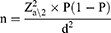
With a confidence level of 95% (Z = 1.96), an estimated insomnia prevalence (P) of 2.1% based on previous literature,11 and a margin of error (d) of 0.15P, a minimum of 7960 participants was required. Accounting for a potential 20% non-response rate, the final required sample size was 9950. Our final sample of 30,833 valid responses far exceeded this requirement, ensuring sufficient precision for prevalence estimation and providing a robust basis for the subsequent nested case-control analysis.
From this initial sample, 2144 students were identified as having moderate-to-severe insomnia, defined by an Insomnia Severity Index (ISI) total score > 14. To construct a dataset suitable for robust binary logistic regression analysis and to clearly identify risk factors, a nested case-control design was implemented within the cross-sectional data. All 2144 students with moderate-to-severe insomnia were included as the case group. For the control group, a random sample of 2144 students with mild or no insomnia (ISI total score ≤ 14) was selected from the remaining pool of participants. This process resulted in a final analytical sample of 4288 participants, with a balanced 1:1 ratio between cases and controls, which optimizes the statistical power for predictive modeling.12 It is important to clarify that, despite the use of a nested case-control sampling strategy for the analytical phase, the fundamental design of this study remains cross-sectional. This approach was adopted solely to enhance statistical power and efficiency in identifying risk factors within the logistic regression framework, and it does not imply a longitudinal or causal design. All data were collected at a single time point, and therefore, the findings indicate associations rather than causal relationships.
This study was reported in accordance with the STROBE guidelines for cross-sectional studies.The data underlying this study are not publicly available due to ethical restrictions. Access can be requested from the corresponding author with approval from the our Ethics Committee.
Ethics
This study was performed in accordance with the guidelines of the Declaration of Helsinki and approved by the Institutional Review Board of Tongji Hospital, Tongji Medical College, Huazhong University of Science and Technology (TJ-IRB202510009). As the study involved adolescents aged 12–18 years, the ethics committee approved a dual-consent process: written informed consent was obtained from parents or legal guardians, and verbal assent was obtained from the adolescent participants themselves. This procedure was deemed appropriate given the non-invasive nature of the survey, the adolescents’ capacity to understand the study, and the importance of respecting their autonomy while ensuring parental oversight.
Measurements and Variable Definition
Study variables included one dependent variable and 18 predictor variables. The dependent variable was “mild insomnia vs severe insomnia,” assessed via the ISI-7 total score. Data with a total score greater than 14 were coded as 2 (severe group), and those with a total score less than or equal to 14 were coded as 1 (mild group).
The 18 predictor variables covered multiple categories. Demographic variables included gender (male/female), age (in years), only-child status (yes/no), and residence (rural/urban). Family environment variables included subjective family economic status, paternal education level, maternal education level (both ordinal variables), parental marital relationship, and family parenting style. Academic and psychosocial variables involved several validated scales. Academic performance was assessed via self-reported academic ranking (ordinal variable).
School bullying behavior was assessed using the Multidimensional Peer Victimization Scale (MPVS). Developed by Mynard and Joseph,13 this scale includes physical victimization, verbal victimization, social manipulation, and property damage. The revised version (MPVS-R) added a cyberbullying dimension, forming five core dimensions with 20 items total. The scale uses a frequency scoring method, with higher scores indicating more severe victimization.14 This scale has been used in Chinese children and adolescents with good reliability and validity.15
Friendship quality was assessed using the short version of Parker’s Friendship Quality Questionnaire.16 This questionnaire contains 18 items rated on a 5-point Likert scale (1 = completely does not apply, 5 = completely applies). Higher scores reflect better friendship quality, represented by the total score.
Psychological pain was assessed using the Three-dimensional Psychological Pain Scale (TDPPS). Developed by Li et al,7 this scale contains 17 items covering three dimensions: pain experience, pain arousal, and pain avoidance. It uses a 5-point Likert scale, Total score ranges from17 to 85, with higher total scores indicating higher levels of psychological pain.
Depression was assessed using the Patient Health Questionnaire-9 (PHQ-9). Developed by Kroenke et al,17 the PHQ-9 consists of 9 items rated on a 4-point scale. Higher scores indicate greater risk of depression. A total score greater than 13 suggests the presence of depressive symptoms.
Anxiety was assessed using the Generalized Anxiety Disorder-7 (GAD-7). Developed by Spitzer et al,18 the GAD-7 consists of 7 items assessing anxiety symptoms over the past two weeks.
Insomnia was assessed using the Insomnia Severity Index (ISI). Developed by Morin19 and revised by Bastien et al,20 the ISI is used to assess the severity of insomnia symptoms and their impact on function over the past two weeks. The ISI consists of 7 items rated on a 5-point Likert scale, with higher total scores indicating greater insomnia severity.
Perceived stress level was measured using the Chinese version of the Perceived Stress Scale (CPSS). This scale includes two dimensions-tension and loss of control-and consists of 14 items (including 7 reverse-scored items). Higher total scores indicate higher levels of perceived stress. This scale is a revised version of Cohen’s Perceived Stress Scale (PSS-14) adapted for the Chinese cultural context, introduced and validated by Yang Tingzhong.21 It is widely used in domestic research, with Cronbach’s α typically above 0.70, demonstrating good psychometric properties.22
Resilience was assessed using the Resilience Scale for Chinese Adolescents (RSCA). This localized scale contains 27 items rated on a 5-point Likert scale. It covers five dimensions: goal focus, emotional control, positive cognition, interpersonal assistance, and family support. The total score is the sum of all item scores, with higher scores indicating higher levels of psychological resilience in adolescents.23
All the above scales have been widely used in relevant domestic and international research, with Chinese versions demonstrating good reliability and validity, providing reliable measurement tools for this study. The internal consistency reliability (Cronbach’s α coefficient) for each scale was calculated using the entire sample (N=4288), and all results were above 0.70, indicating good data reliability.A summary of all research variables, their measurement tools, and scoring methods is provided in Table 1.
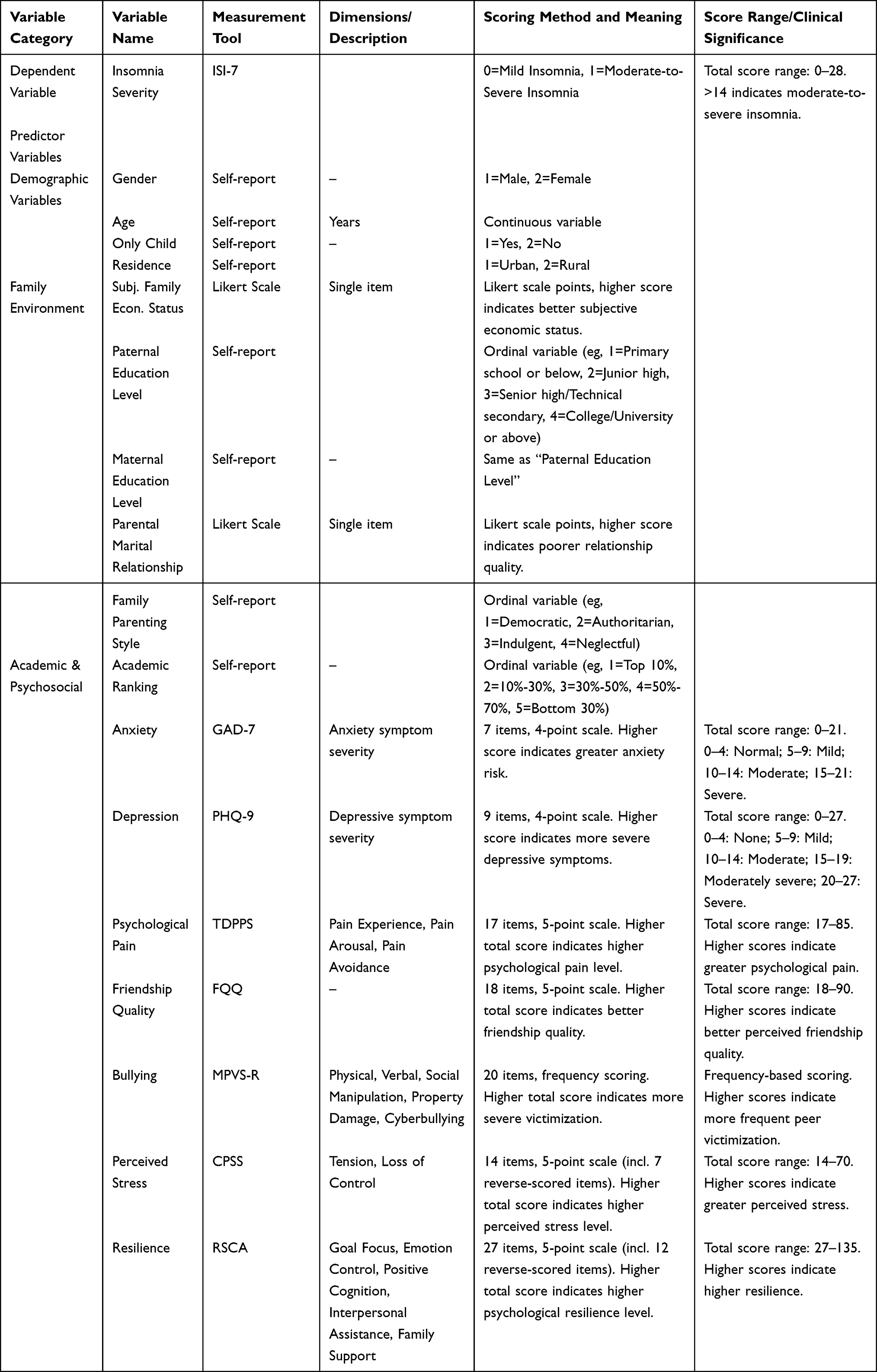 |
Table 1 Research Variables and Their Measurement Tool Definitions |
Statistical Analysis
All data analyses were performed using SPSS 26.0. First, univariate analysis was conducted using chi-square tests for categorical variables and Mann–Whitney U-tests for continuous variables due to their non-normal distribution to preliminarily screen variables associated with insomnia risk. Pearson correlation analysis was then performed to examine the bivariate relationships between continuous variables and insomnia severity. To assess multicollinearity among predictor variables, variance inflation factor (VIF) and tolerance statistics were calculated using linear regression models, with each predictor variable regressed onto all other predictors included in the final logistic regression model. VIF values below 5 and tolerance values above 0.2 were considered indicative of no significant multicollinearity.Subsequently, all variables showing a univariate association with insomnia severity at p < 0.25 were entered into an initial binary logistic regression model for further screening, following methodological recommendations to avoid excluding potential predictors. Results are presented as odds ratios (OR) with their 95% confidence intervals (CI). Model fit was assessed using the Hosmer-Lemeshow test, −2 log-likelihood, Cox & Snell R2, and Nagelkerke R2. A p-value < 0.05 was considered statistically significant.
Result
Univariate Analysis
This study included 4288 valid adolescent samples. Based on the Insomnia Severity Index (ISI) score (cut-off >14), they were divided into two groups: the mild insomnia group (n=2144, 50.0%) and the moderate-to-severe insomnia group (n=2144, 50.0%). Univariate analysis aimed to preliminarily screen factors associated with adolescent insomnia severity. Chi-square tests were used for all categorical variables, and independent samples t-tests or Mann–Whitney U-tests were used for continuous variables. Results are shown in Table 2. All variables except for resilience (p = 0.559) met the pre-specified threshold of p < 0.25 for inclusion in the subsequent multivariable logistic regression model.
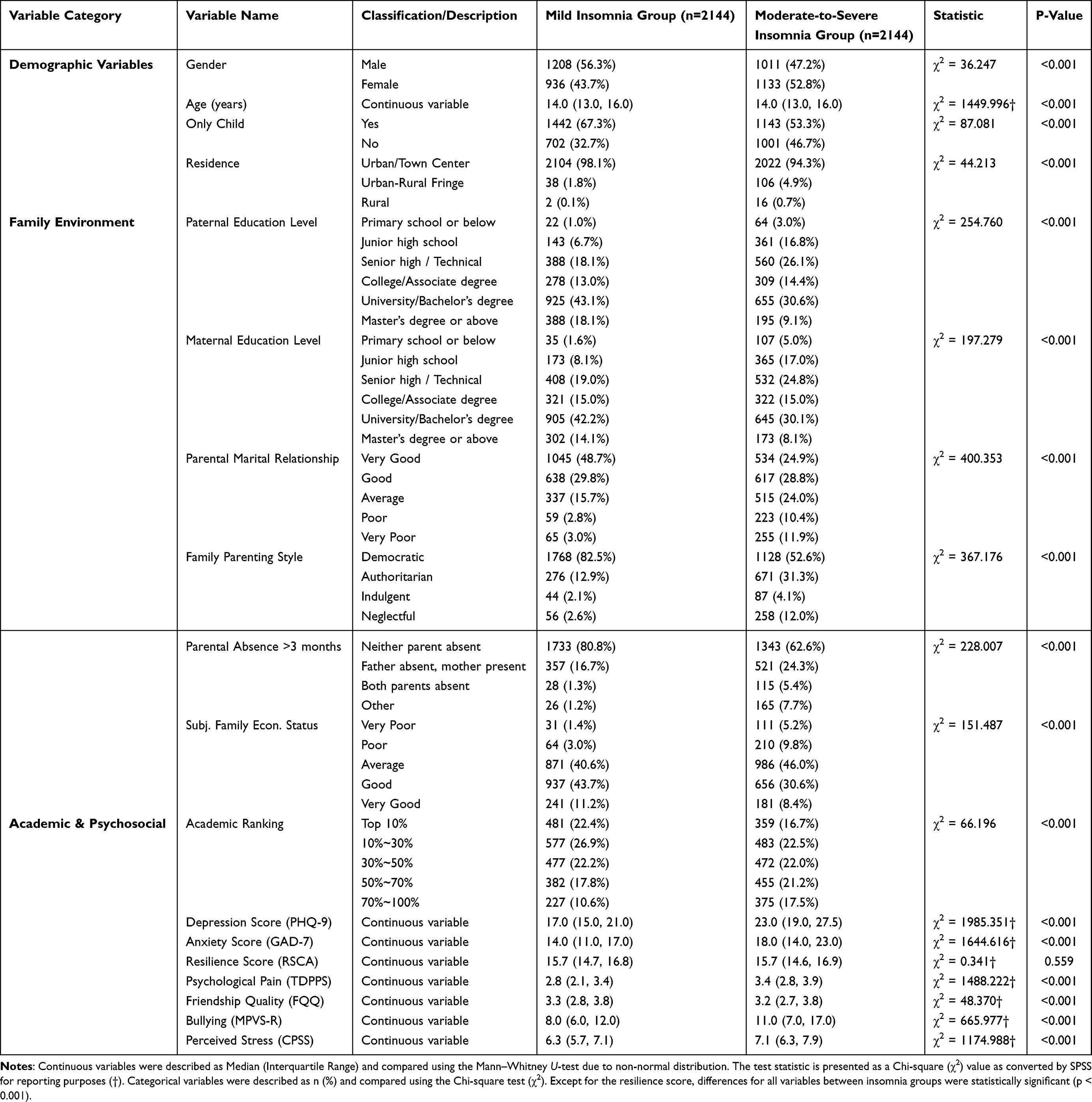 |
Table 2 Univariate Analysis Results for Adolescent Insomnia Severity |
Correlation Analysis
To further explore the bivariate relationships between continuous variables and insomnia severity, Pearson correlation analysis was conducted. As shown in Table 3, all variables demonstrated significant correlations with insomnia severity (p < 0.001). Depression (r = 0.637), anxiety (r = 0.583), and psychological pain (r = 0.496) showed strong positive correlations with insomnia severity, indicating close associations between emotional problems and sleep disturbances. Perceived stress (r = 0.450) and bullying experiences (r = 0.317) demonstrated moderate positive correlations.
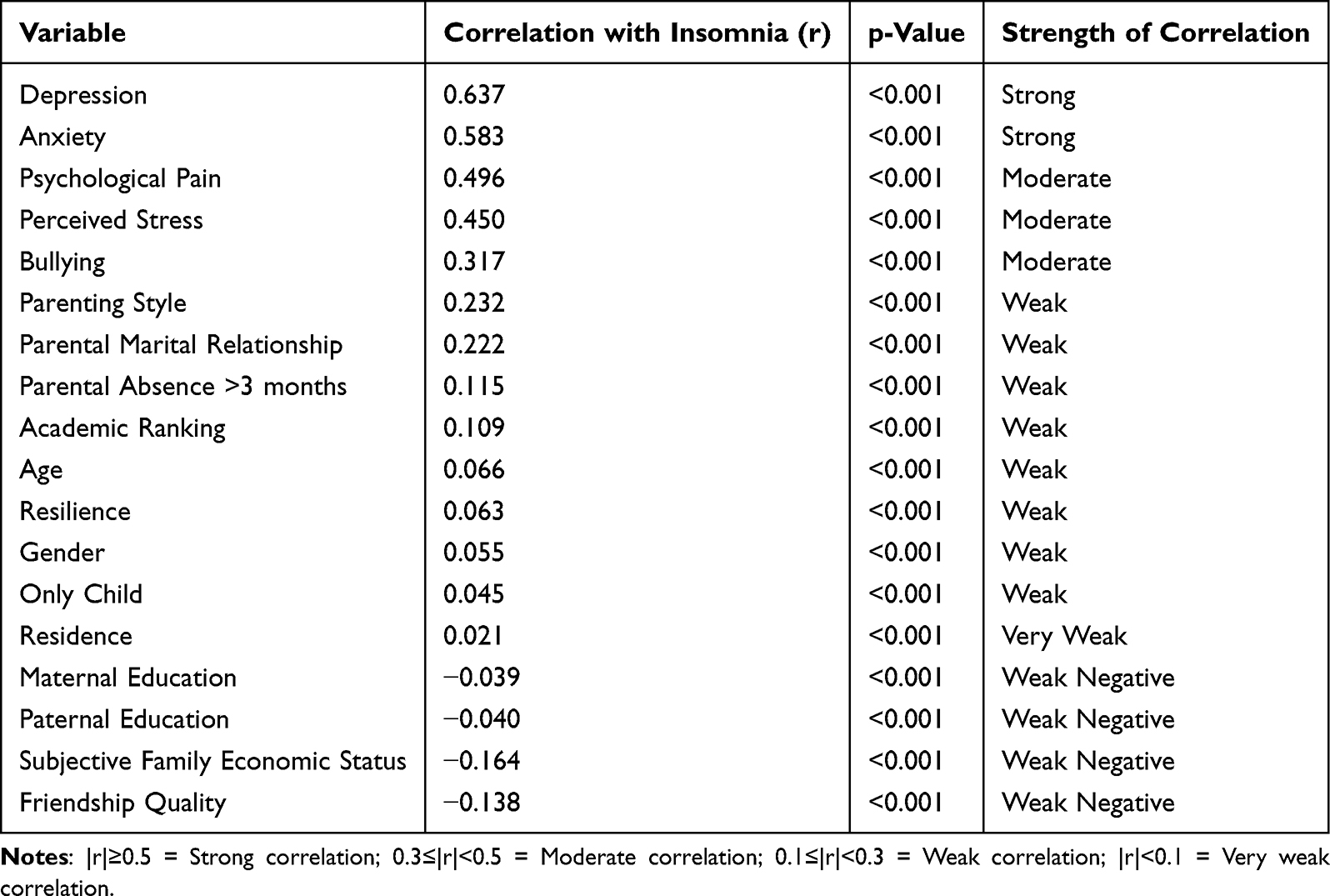 |
Table 3 Pearson Correlation Analysis Between Variables and Insomnia Severity |
Among family environment variables, parenting style (r = 0.232) and parental marital relationship (r = 0.222) showed weak positive correlations with insomnia severity. Notably, protective factors including paternal education level (r = −0.040), maternal education level (r = −0.039), subjective family economic status (r = −0.164), and friendship quality (r = −0.138) showed significant negative correlations with insomnia severity.
Examination of intercorrelations among predictor variables revealed several notable relationships: depression and anxiety were highly correlated (r = 0.827), as were psychological pain with anxiety (r = 0.694) and depression (r = 0.687). Paternal and maternal education levels were strongly correlated (r = 0.728). All variance inflation factors (VIFs) in subsequent regression analyses were below 5, indicating acceptable levels of multicollinearity.
Multivariable Analysis
Multicollinearity diagnostics revealed that all variance inflation factor (VIF) values were below 5 (range: 1.053–4.623) and tolerance values were all greater than 0.2, indicating that multicollinearity was not significant and would not have a major impact on the model estimates.To identify independent predictors of adolescent insomnia severity, all variables significant (p < 0.25) in the univariate analysis were included in a binary logistic regression model, resulting in Table 4. The Omnibus Test of Model Coefficients showed a chi-square value of 3643.089 (p < 0.001), indicating the model as a whole was statistically significant. The Nagelkerke R2 value was 0.763, meaning this combination of predictor variables explained approximately 76.3% of the variance in insomnia severity. The model’s overall prediction accuracy was 88.8%, with a sensitivity of 87.2% for identifying individuals with moderate-to-severe insomnia, demonstrating excellent classification and discrimination ability.
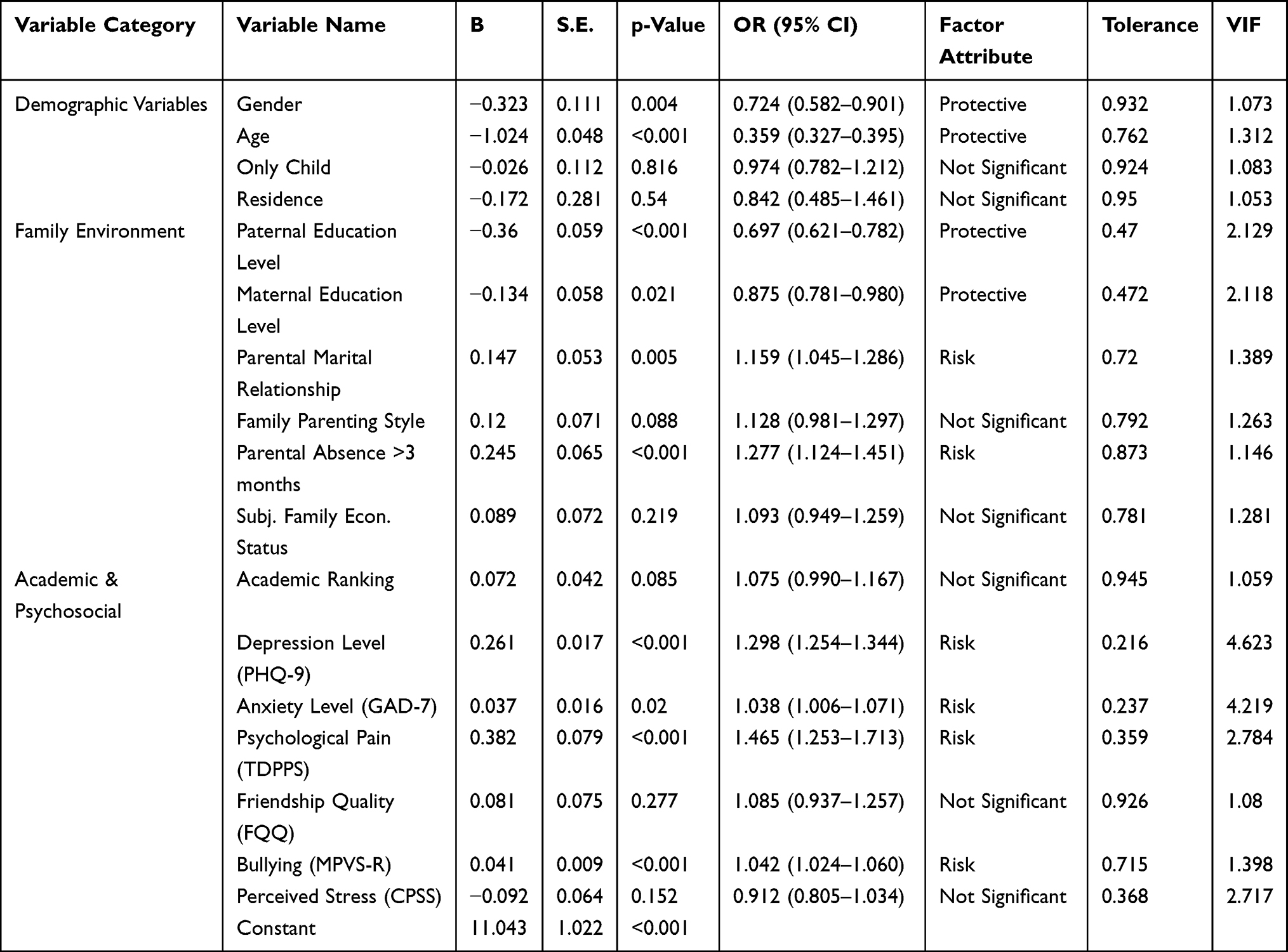 |
Table 4 Multivariable Binary Logistic Regression Analysis Results for Adolescent Insomnia Severity |
Multivariable analysis results showed that, after controlling for all other variables, a total of 9 variables were independent predictors of adolescent insomnia severity (p < 0.05). Psychological pain was the strongest risk factor (OR = 1.465, 95% CI: 1.253–1.713), indicating that for each unit increase, insomnia risk increased by 46.5%. Depression level (OR = 1.298, 95% CI: 1.254–1.344) and parental absence for more than 3 months (OR = 1.277, 95% CI: 1.124–1.451) were also very strong risk predictors, increasing insomnia risk by approximately 29.8% and 27.7%, respectively. Additionally, bullying experiences (OR = 1.042), anxiety symptoms (OR = 1.038), and poor parental marital relationship (OR = 1.159) all showed independent predictive effects. Regarding protective factors, increasing age (OR = 0.359) showed the strongest protective effect, followed by female gender (OR = 0.724) and higher paternal education level (OR = 0.697). Only-child status, residence, maternal education level, family parenting style, subjective family economic status, academic ranking, friendship quality, and perceived stress were no longer significant (p > 0.05) after multivariable adjustment, suggesting their associations shown in univariate analysis may be mediated by other psychosocial factors.
To further optimize model efficiency, only the 9 predictor variables that showed significance in both univariate and multivariable analyses were included in the final binary logistic regression model, with results shown in Table 5. The Omnibus Test of Model Coefficients showed a chi-square value of 3627.583 (p < 0.001). The Nagelkerke R2 value was 0.761, meaning this streamlined combination of predictor variables explained approximately 76.1% of the variance in insomnia severity. The model’s overall prediction accuracy was 88.6%, with a sensitivity of 87.2% for identifying individuals with moderate-to-severe insomnia, indicating that the model maintained excellent classification and discrimination ability after simplification.
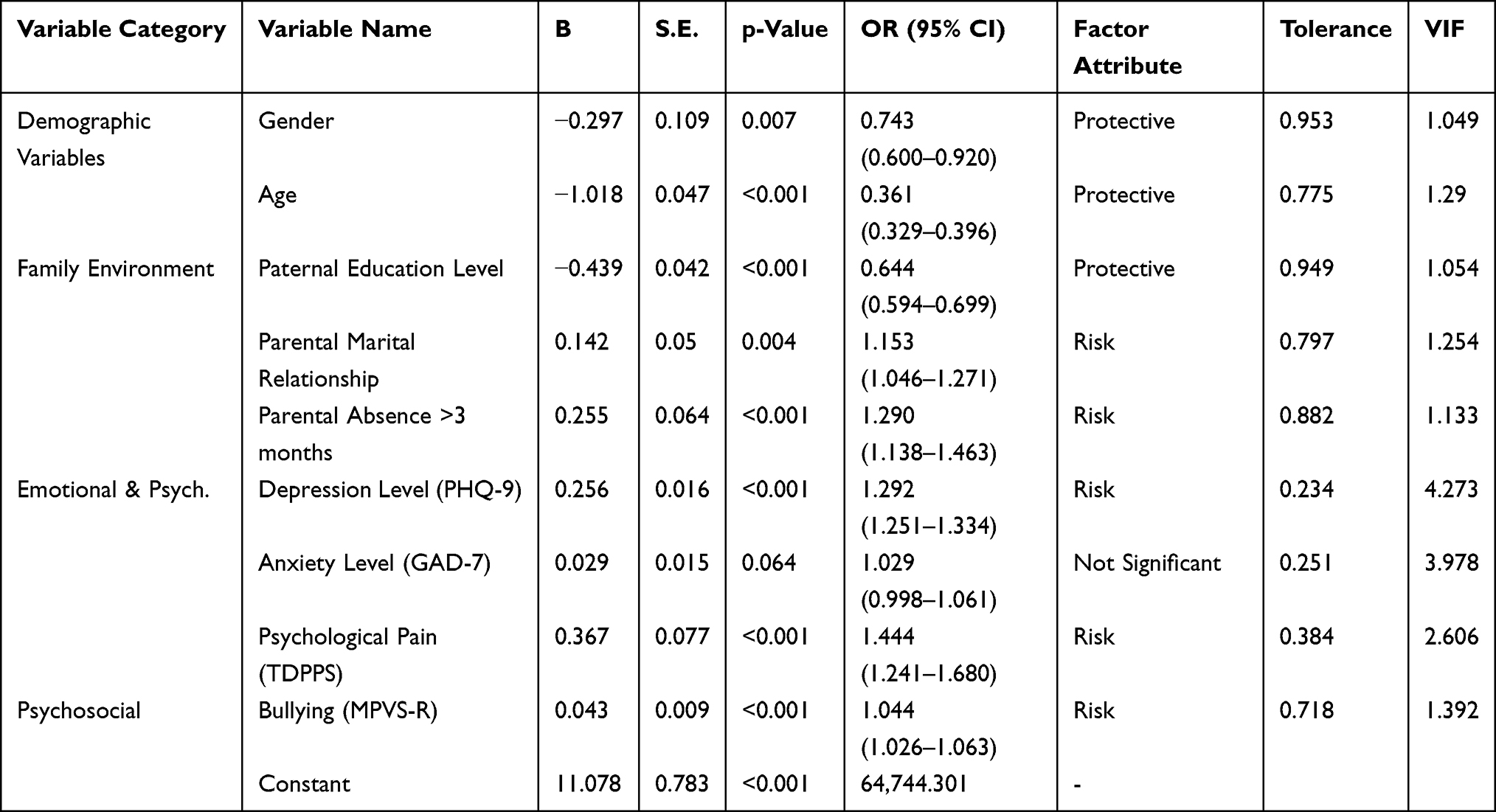 |
Table 5 Multivariable Binary Logistic Regression Analysis Results for Adolescent Insomnia Severity (Optimized Model) |
Multivariable analysis results confirmed that all 9 included variables were independent predictors of adolescent insomnia severity (p < 0.05). Psychological pain remained the strongest risk factor (OR = 1.444, 95% CI: 1.241–1.680). Depression level (OR = 1.292, 95% CI: 1.251–1.334) and parental absence for more than 3 months (OR = 1.290, 95% CI: 1.138–1.463) followed closely as important risk predictors. Bullying experiences (OR = 1.044) and poor parental marital relationship (OR = 1.153) also showed independent risk predictive effects. Regarding protective factors, increasing age (OR = 0.361) and higher paternal education level (OR = 0.644) showed significant protective effects, with the protective effect of paternal education level being particularly notable Female gender (OR = 0.743) was also a significant protective factor. Notably, in this optimized model, anxiety level (p = 0.064) did not reach the 0.05 significance level.
Based on the regression coefficients (B values) from the final optimized model, we constructed the following streamlined Logistic regression prediction equation:

This equation integrates core influencing factors from individual emotional/psychological, family environment, and social experiences, excluding redundant variables. All continuous variables (eg, depression level, psychological pain) are entered using their original scores; for categorical variables, gender is entered as Male=1, Female=2; paternal education level is entered in its ordinal form; parental marital relationship is entered using the Likert score; parental absence is entered as Yes=1, No=0.
This final model significantly enhances the tool’s simplicity and practicality while maintaining high prediction accuracy (88.6%) and high sensitivity (87.2%). This equation provides a powerful empirical tool for implementing rapid, efficient, large-scale insomnia risk screening in school settings, possessing significant practical application value.
Discussion
The Level of Insomnia Severity and the Rationale for Grouping
This study was embedded within a large-scale community survey of 30,833 urban adolescents. From this population, 2144 individuals (a prevalence of approximately 7.0%) were identified as suffering from moderate-to-severe insomnia based on the established ISI cutoff. This substantial absolute number underscores the significant and often underrecognized burden of clinically relevant insomnia in this demographic, warranting heightened clinical and public health attention.
The subsequent nested case-control sampling strategy, which included all 2144 identified cases and an equal number of randomly selected controls, was deliberately employed to fulfill the methodological requirements of binary logistic regression analysis. This 1:1 distribution enhances the statistical power for robustly identifying risk and protective factors, particularly for a prevalent but complex condition like insomnia, and is well-suited for developing predictive models.12 Correlation analyses conducted prior to modeling revealed strong associations between emotional variables (eg, depression, anxiety, psychological pain) and insomnia severity, providing preliminary evidence for their central role and justifying their inclusion in the subsequent multivariable model.
Insomnia Severity in Adolescents Was Influenced by Multiple Factors
Psychological Pain Was the Core Predictor of Insomnia Severity
In this study, psychological pain was the strongest risk factor (OR = 1.444) for predicting moderate-to-severe insomnia, its predictive power surpassing traditional indicators of depression and anxiety. This finding aligns closely with the recent research trend viewing psychological pain as a “transdiagnostic mechanism” that transcends specific diagnoses.24 Our research suggests that insomnia may not only be a symptom of emotional disorders but also a behavioral manifestation through which adolescents attempt to escape or alleviate intense internal psychological pain.6 Research provides a possible physiological basis for this, indicating an association between psychological pain and overactivity in brain networks responsible for processing negative emotions and self-referential thoughts in insomnia patients.25,26 Therefore, future insomnia interventions should not stop at sleep hygiene education or emotion management but should deeply assess and address the internal, often unspoken, psychological pain experienced by adolescents, for example, by incorporating acceptance and commitment therapy-based techniques.27
Family Structural Factors Were Significant Influencers of Insomnia Severity
This study revealed risk patterns specific to Chinese culture. Paternal education level as a significant protective factor (OR=0.644) reflects the crucial role of fathers in resource acquisition and educational decision-making within Chinese families. Surveys indicate a positive correlation between paternal education level and the scientific nature of parenting styles.28 The identification of parental absence for more than three months as an important risk factor (OR=1.290) directly corresponds to the social reality of large-scale rural-urban migration in China, where many adolescents experience emotional absence during critical growth periods.29
Furthermore, poorer parental marital relationship (indicated by a higher self-reported score) was identified as an independent risk factor for insomnia (OR=1.153). This aligns with established literature linking family conflict and discord with adverse child outcomes, including sleep disturbances.30,31 In the Chinese context, a higher score reflecting a poorer relationship may encompass overt conflict, chronic tension, or emotional detachment within the family. Such an environment can directly increase adolescent stress and anxiety, disrupting sleep regulation mechanisms. It may also indirectly affect sleep through impacting parenting practices and the overall emotional security of the adolescent.
Emotional and Social Factors Were Also Independent Predictors
This study also confirmed cross-culturally consistent risk factors. Depression (OR=1.292) remains a strong predictor of insomnia, consistent with abundant existing evidence that the two are often considered comorbid conditions with a bidirectional relationship.32 The predictive effect of anxiety was overshadowed by psychological pain and depression and was no longer significant in the final optimized model, supporting emerging theories that psychological pain may be the common underlying driver of depression, anxiety, and insomnia.33 Regarding social factors, although the effect size for bullying experience as a risk factor (OR = 1.044) was small, its cumulative and chronic impact should not be overlooked. Bullying creates a persistent state of social threat, leading to sustained activation of the Hypothalamic-Pituitary-Adrenal (HPA) axis, disrupting the normal secretion rhythm of melatonin, and consequently impairing sleep architecture.34 Bullying victimization not only directly harms adolescent mental health but also, through disrupting sleep—a key pathway—can trigger both internalizing and externalizing problems.35,36
Regarding protective factors, increasing age (OR = 0.361) showed the strongest protective effect, which may be related to the development of more mature emotion regulation strategies and prefrontal cortex function with advancing age.37 The finding of female gender as protective (OR=0.743) contrasts with some previous studies, which may reflect the specificity of this sample or suggest that, within this specific cultural context, female adolescents might have advantages in seeking social support and emotional expression, thereby better buffering insomnia risk.38,39
The Value of the Prediction Model for Clinical Practice
The streamlined prediction model developed in this study demonstrates promising utility for initial screening. While maintaining high predictive performance in our sample (Nagelkerke R2 = 0.761, overall accuracy 88.6%), the model includes only 9 easily assessable variables, which enhances its feasibility for potential application as a primary screening tool in resource-limited settings like schools. By quickly identifying high-risk individuals using the developed prediction equation, early warning for insomnia and precise allocation of intervention resources could be achieved, potentially shifting preventive care towards a more evidence-based approach. However, it is crucial to emphasize that the reported performance reflects internal validation. External validation in independent, population-based samples is necessary to confirm its generalizability and calibrate its true clinical utility before widespread implementation.
Limitation
This study has several limitations. First, the cross-sectional design cannot infer causality; longitudinal studies are necessary in the future. Second, the data came from student self-reports and may be influenced by common method bias and social desirability. Third, the sample was drawn from central urban areas of a large city; caution is needed when generalizing conclusions to rural areas, smaller cities, or adolescents from different cultural backgrounds. Future research should validate the model in broader populations.Fourth, the case-control design may inflate the model’s reported performance. External validation in a community sample is necessary to assess its true clinical utility.
Relevance to Clinical Practice
This study advances the field by identifying psychological pain as the strongest predictor of adolescent insomnia, surpassing traditional factors like depression and anxiety. It integrates individual, family, and social factors into a single, highly accurate predictive model. The primary clinical contribution is the development of a streamlined, 9-variable risk equation, providing a practical and efficient tool for early, large-scale insomnia screening in school settings. This enables targeted interventions and shifts preventive care towards a more precise, evidence-based approach.
Conclusion
Based on a sample of adolescents from major Chinese cities, this study systematically identified individual, family, and social multi-level risk and protective factors influencing insomnia severity and successfully constructed a binary logistic regression prediction model containing nine core variables. The research confirmed that psychological pain is the strongest risk factor for predicting moderate-to-severe insomnia, its role surpassing traditional indicators of depression and anxiety, suggesting that alleviating psychological pain should be an important target for insomnia intervention. Simultaneously, the study highlighted the non-negligible independent contributions of structural family variables, particularly paternal education level and parental absence, to adolescent insomnia, deepening the understanding of the association between family environment and sleep health within the Chinese cultural context.
The final streamlined prediction model demonstrated excellent goodness-of-fit (Nagelkerke R2 = 0.761) and classification accuracy (88.6%). While ensuring high predictive performance, it significantly enhanced the tool’s simplicity and practicality. This model effectively translates theoretical research findings into a quantifiable screening tool usable in school environments, providing a solid empirical basis for implementing large-scale, precise early identification of insomnia risk and tiered intervention among Chinese secondary school student populations, holding significant public health practice value.
Data Sharing Statement
The data supporting the findings of this study are not publicly available due to ethical restrictions protecting participant privacy. De-identified data will be made available upon reasonable request to the corresponding author, subject to approval by the our Ethics Committee.
Ethics Approval
This study was performed in accordance with the guidelines of the Declaration of Helsinki and approved by the Institutional Review Board of Medical Ethics Committee of Tongji Hospital, Tongji Medical College, Huazhong University of Science and Technology (TJ-IRB202510009).
Acknowledgments
The authors would like to thank all the participating schools, students, and research assistants who made this study possible.
Author Contributions
Haishan Huang: Conceptualization, Methodology, Formal Analysis, Investigation, Data Curation, Writing – Original Draft. Zhuoyan Zhang: Conceptualization, Methodology, Supervision, Project Administration, Funding Acquisition, Writing – Original Draft, Writing – Review & Editing. Rong Xv: Investigation, Data Curation, Writing – Review & Editing. All authors took part in drafting, revising, or critically reviewing the article; gave final approval of the version to be published; have agreed on the journal to which the article has been submitted; and agree to be accountable for all aspects of the work.
Funding
This research was supported by the Undergraduate Innovation and Training Program of Huazhong University of Science and Technology (Zhuoyan Zhang) and Hubei Provincial Natural Science Foundation (2025AFB744) (Haishan Huang).
Disclosure
The authors declare that there is no conflict of interest regarding the publication of this paper.
References
1. Tarokh L, Saletin JM, Carskadon MA. Sleep in adolescence: physiology, cognition and mental health. Neurosci Biobehav Rev. 2016;70:182–15. doi:10.1016/j.neubiorev.2016.08.008
2. Carter B, Rees P, Hale L, Bhattacharjee D, Paradkar MS. Association Between Portable Screen-Based Media Device Access or Use and Sleep Outcomes: a Systematic Review and Meta-analysis. JAMA Pediatr. 2016;170(12):1202–1208. doi:10.1001/jamapediatrics.2016.2341
3. Li X, Vanderloo LM, Keown-Stoneman CDG, et al. Screen Use and Mental Health Symptoms in Canadian Children and Youth During the COVID-19 Pandemic. JAMA Network Open. 2021;4(12):e2140875. doi:10.1001/jamanetworkopen.2021.40875
4. Li L, Zhang Y, Fan M, Cao B. Sleep and mental health among Chinese adolescents: the chain-mediating role of physical health perception and school adjustment. BMC Psychol. 2024;12(1):228. doi:10.1186/s40359-024-01719-4
5. Sivertsen B, Harvey AG, Lundervold AJ, Hysing M. Sleep problems and depression in adolescence: results from a large population-based study of Norwegian adolescents aged 16–18 years. Eur Child Adolesc Psychiatry. 2014;23(8):681–689. doi:10.1007/s00787-013-0502-y
6. Shneidman ES. The Suicidal Mind. Oxford University Press; 1996.
7. Li H, Xie W, Luo X, et al. Clarifying the role of psychological pain in the risks of suicidal ideation and suicidal acts among patients with major depressive episodes. Suicide Life Threat Behav. 2014;44(1):78–88. doi:10.1111/sltb.12056
8. Xiong Y, Qin X, Wang Q, Ren P. Parental Involvement in Adolescents’ Learning and Academic Achievement: cross-lagged Effect and Mediation of Academic Engagement. J Youth Adolesc. 2021;50(9):1811–1823. doi:10.1007/s10964-021-01460-w
9. Cui M, Ma X, Tian L, Xu W, Dai H. The chain mediating role of stress and resilience in the relationship between anxiety sensitivity and depressive symptoms among Chinese college students. J Affect Disord Rep. 2024;17:100821. doi:10.1016/j.jadr.2024.100821
10. Johnson DA, Jackson CL, Williams NJ, Alcántara C. Are sleep patterns influenced by race/ethnicity - a marker of relative advantage or disadvantage? Evidence to date. Nat Sci Sleep. 2019;11:79–95. doi:10.2147/NSS.S169312
11. Liao C, Luo L, Yan N, Zhang Y, Yuan G, Jiang G. Insomnia and its influencing factors in children and adolescents in Chongqing. Sichuan Mental Health. 2024;37(5):451–456. doi:10.11886/scjsws20230612003
12. Franklin JC, Ribeiro JD, Fox KR, et al. Risk factors for suicidal thoughts and behaviors: a meta-analysis of 50 years of research. Psychol Bull. 2017;143(2):187–232. doi:10.1037/bul0000084
13. Mynard H, Joseph S. Development of the multidimensional peer-victimization scale. Aggress Behav. 2000;26(2):169–178. doi:10.1002/(SICI)1098-2337(2000)26:2<169::AID-AB3>3.0.CO;2-A
14. Betts LR, Houston JE, Steer OL. Development of the Multidimensional Peer Victimization Scale-Revised (MPVS-R) and the Multidimensional Peer Bullying Scale (MPVS-RB). J Genet Psychol. 2015;176(1–2):93–109. doi:10.1080/00221325.2015.1007915
15. Dong HQ. Peer victimization and children’s problem behaviors: the moderating role of self-esteem. Chin J Clin Psychol. 2015;23(2):281–284. doi:10.16128/j.cnki.1005-3611.2015.02.020
16. Parker JG, Asher SR. Friendship and friendship quality in middle childhood: links with peer group acceptance and feelings of loneliness and social dissatisfaction. Dev Psychol. 1993;29(4):611–621. doi:10.1037/0012-1649.29.4.611
17. Kroenke K, Spitzer RL, Williams JB. The PHQ-9: validity of a brief depression severity measure. J Gen Intern Med. 2001;16(9):606–613. doi:10.1046/j.1525-1497.2001.016009606.x
18. Spitzer RL, Kroenke K, Williams JB, Löwe B. A brief measure for assessing generalized anxiety disorder: the GAD-7. Arch Intern Med. 2006;166(10):1092–1097. doi:10.1001/archinte.166.10.1092
19. Morin CM. Insomnia: Psychological Assessment and Management. Guilford Press; 1993.
20. Bastien CH, Vallières A, Morin CM. Validation of the Insomnia Severity Index as an outcome measure for insomnia research. Sleep Med. 2001;2(4):297–307. doi:10.1016/S1389-9457(00)00065-4
21. Cohen S, Kamarck T, Mermelstein R. A global measure of perceived stress. J Health Soc Behav. 1983;24(4):385–396.
22. Cortina J. What Is Coefficient Alpha?: an Examination of Theory and Applications. J Appl Psychol. 1993;78(1):98–104. doi:10.1037/0021-9010.78.1.98
23. Hu YQ, Gan YQ. Development and psychometric validity of the Resilience Scale for Chinese Adolescents. Acta Psychologica Sinica. 2008;40(8):902–912. doi:10.3724/SP.J.1041.2008.00902
24. Li Y, Guo K. Research on the relationship between physical activity, sleep quality, psychological resilience, and social adaptation among Chinese college students: a cross-sectional study. Front Psychol. 2023;14:1104897. doi:10.3389/fpsyg.2023.1104897
25. Dressle RJ, Riemann D. Hyperarousal in insomnia disorder: current evidence and potential mechanisms. J Sleep Res. 2023;32(6):e13928. doi:10.1111/jsr.13928
26. Shen Z, Yang X, She T, et al. Deficits in brain default mode network connectivity mediate the relationship between poor sleep quality and anxiety severity. Sleep. 2024;47(3):zsad296. doi:10.1093/sleep/zsad296
27. El Rafihi-Ferreira R, Morin CM, Toscanini AC, et al. Acceptance and commitment therapy-based behavioral intervention for insomnia: a pilot randomized controlled trial. Braz J Psychiatry. 2021;43(5):504–509. doi:10.1590/1516-4446-2020-0947
28. Giannotti M, Gemignani M, Rigo P, Venuti P, De Falco S. The Role of Paternal Involvement on Behavioral Sensitive Responses and Neurobiological Activations in Fathers: a Systematic Review. Front Behav Neurosci. 2022;16(820884). doi:10.3389/fnbeh.2022.820884
29. Li X, Coid JW, Tang W, et al. Sustained effects of left-behind experience during childhood on mental health in Chinese university undergraduates. Eur Child Adolesc Psychiatry. 2021;30(12):1949–1957. doi:10.1007/s00787-020-01666-6
30. Kelly RJ, El-Sheikh M. Marital conflict and children’s sleep: reciprocal relations and socioeconomic effects. J Fam Psychol. 2011;25(3):412–422. doi:10.1037/a0023789
31. Billows M, Gradisar M, Dohnt H, Johnston A, McCappin S, Hudson J. Family disorganization, sleep hygiene, and adolescent sleep disturbance. J Clin Child Adolesc Psychol. 2009;38(5):745–752. doi:10.1080/15374410903103635
32. Alvaro PK, Roberts RM, Harris JK. A Systematic Review Assessing Bidirectionality between Sleep Disturbances, Anxiety, and Depression. Sleep. 2013;36(7):1059–1068. doi:10.5665/sleep.2810
33. Chen S, Cheng Y, Zhao W, Zhang Y. Psychological pain in depressive disorder: a concept analysis. J Clin Nurs. 2023;32(13–14):4128–4143. doi:10.1111/jocn.16543
34. Tu KM, Erath SA, El-Sheikh M. Peer Victimization and Adolescent Adjustment: the Moderating Role of Sleep. J Abnorm Child Psychol. 2015;43(8):1447–1457. doi:10.1007/s10802-015-0035-6
35. Jiang S, Ren Q, Jiang C, Wang L. Academic stress and depression of Chinese adolescents in junior high schools: moderated mediation model of school burnout and self-esteem. J Affect Disord. 2021;295:384–389. doi:10.1016/j.jad.2021.08.085
36. Tang W, Chen M, Wang N, et al. Bullying victimization and internalizing and externalizing problems in school-aged children: the mediating role of sleep disturbance and the moderating role of parental attachment. Child Abuse Negl. 2023;138:106064. doi:10.1016/j.chiabu.2023.106064
37. Brown SA, Jernigan TL, Dowling GJ. The adolescent brain cognitive development study. Health Psychol. 2023;42(12):840–841. doi:10.1037/hea0001353
38. Tang J, Liao Y, Kelly BC, et al. Gender and Regional Differences in Sleep Quality and Insomnia: a General Population-based Study in Hunan Province of China. Sci Rep. 2017;7(43690). doi:10.1038/srep43690
39. Lee CY, Goldstein SE. Loneliness, Stress, and Social Support in Young Adulthood: does the Source of Support Matter? J Youth Adolesc. 2016;45(3):568–580. doi:10.1007/s10964-015-0395-9
 © 2026 The Author(s). This work is published and licensed by Dove Medical Press Limited. The
full terms of this license are available at https://www.dovepress.com/terms
and incorporate the Creative Commons Attribution
- Non Commercial (unported, 4.0) License.
By accessing the work you hereby accept the Terms. Non-commercial uses of the work are permitted
without any further permission from Dove Medical Press Limited, provided the work is properly
attributed. For permission for commercial use of this work, please see paragraphs 4.2 and 5 of our Terms.
© 2026 The Author(s). This work is published and licensed by Dove Medical Press Limited. The
full terms of this license are available at https://www.dovepress.com/terms
and incorporate the Creative Commons Attribution
- Non Commercial (unported, 4.0) License.
By accessing the work you hereby accept the Terms. Non-commercial uses of the work are permitted
without any further permission from Dove Medical Press Limited, provided the work is properly
attributed. For permission for commercial use of this work, please see paragraphs 4.2 and 5 of our Terms.