
Back to Journals » International Journal of General Medicine » Volume 18
Correlation of Environmental Aerosols and Changes in Pulmonary Function of Pigeon Breeders in Turpan
Authors Maimaitiniyazi M, Yang X
Received 25 November 2024
Accepted for publication 11 February 2025
Published 1 March 2025 Volume 2025:18 Pages 1193—1201
DOI https://doi.org/10.2147/IJGM.S508539
Checked for plagiarism Yes
Review by Single anonymous peer review
Peer reviewer comments 2
Editor who approved publication: Dr Vinay Kumar
Mailidan Maimaitiniyazi,1,2 Xiaohong Yang1,2
1XinJiang Medical University, Urumqi, Xinjiang Uygur Autonomous Region, 830000, People’s Republic of China; 2Department of Respiratory and Critical Care Medicine, People’s Hospital of Xinjiang Uygur Autonomous Region, Urumqi, 830000, People’s Republic of China
Correspondence: Xiaohong Yang, Email [email protected]
Background: To investigate the effects of aerosol size and concentration in pigeon lofts on the lung function of pigeon feeders.
Methods: From January 2022 to February 2022, 135 pigeon-feeders randomly selected from four villages in Turpan City, Xinjiang Uygur Autonomous Region were included in the exposure group, and 135 healthy medical check-ups from the same villages who had not been exposed to pigeons were included in the control group, and were questioned in detail to record the relevant information about the study subjects, to complete the pulmonary function examination, and to examine the concentration and size of aerosols in the surroundings, to analyze the effects of different concentrations and sizes of pigeon house aerosols on the lung function of the pigeon-feeders. The effects of different concentrations and sizes of pigeon loft aerosols on the lung function (FEV1, FVC, FEV1%, FVC%, FEV1/FVC) of the pigeon breeders were analyzed, and the correlation between the lung function and the number of years of keeping pigeons, the number of pigeons kept, and the time of daily exposure were analyzed.
Results: The aerosol concentration in the pigeon lofts of the exposed group was higher than that of the control group. Comparing the lung function of the exposed group with that of the control group, it was found that the lung function indexes of FVC, FEV1% and FVC% were lower than those of the control group, the aerosol concentration was negatively correlated with the lung function indexes of FEV1, FVC, FEV1%, FVC%, FEV1/FVC, the daily contact time with pigeons was negatively correlated with lung function indices, the number of years of keeping pigeons was negatively correlated with FEV1, and the difference was statistically significant.
Conclusion: The higher the aerosol concentration in the pigeon lofts, the longer the years of keeping, the longer the daily contact time with pigeons, the more pronounced is the decrease of the lung function indices in pigeon feeders.
Keywords: pigeon feeders, lung function, aerosol
Introduction
Hypersensitivity pneumonitis (HP) is an immune-mediated interstitial lung disease (ILD) caused by repeated inhalational exposure to low-molecular weight compounds, which occurs in susceptible individuals. Hypersensitivity pneumonitis may present in two forms: non-fibrotic HP and fibrotic HP.1,2 Bird breeders’ disease or “avian” HP is the most common form in clinical practice. It is an example of HP triggered by animal proteins.3 Pigeon breeders’ lung (PBL) is a type of allergic pneumonia in which lung lesions are the result of an immune response to repeated inhalation of large amounts of aerosols of feather and fecal origin.4 Antigen exposure can occur at home, in the workplace, or during leisure time, mainly through inhaling particles with a diameter of less than 5 micrometers, and cause characteristic granulomatous inflammation in the distal airways and alveoli.5
After an allergic reaction triggers inflammation, the local environment promotes the activation of common fibrotic pathways.6 The structural changes and the resulting increase in tissue stiffness are, on the one hand, the cause of the loss of lung compliance leading to changes in respiratory function, and on the other hand, in some patients with a “progressive” phenotype, they allow the fibrotic process to continue in a positive feedback loop. This phenomenon is the root of slow and unstoppable pathological deterioration, leading to a decline in respiratory capacity, which can result in respiratory failure and death.6 The occurrence of these lesions is also closely related to the duration of antigen exposure and the concentration of the antigen.3
In the fibrotic form of HP, a reduction in lung capacity, including decreased forced vital capacity (FVC) and total lung capacity (TLC), is characteristic of functional restrictive ventilatory defects. A decrease in carbon monoxide diffusing capacity (DLCO) is the first abnormality observed in ILD. Low values of these functional parameters at diagnosis predict an increased mortality rate.7 In particular, a ≥ 10% decline in FVC over 6–12 months of disease progression is a strong predictor of decreased survival rate.8 Lastly, distal bronchial obstruction, reflecting involvement of the bronchioles, can sometimes be manifested in Pulmonary function tests (PFT) by a reduction in mean expiratory flow and increases in residual volume. Therefore, PFT represent a simple and non-invasive test that can measure the impact of pathology on the lungs, estimate its severity, and thus help assess medium- and long-term prognosis. Therefore, PFT is a key element in the diagnosis phase, as well as a key element in pathological monitoring and the evaluation of therapeutic measures.
Up to now, most researches on livestock and poultry house aerosols have focused on the types, concentrations of aerosols and their spread to the surrounding environment.9 However, few studies have been carried out on their impacts on the health of breeders, the evaluation of environmental stress, and the influence of different sanitary management measures on the air quality in livestock and poultry houses. For this reason, this study used an aerosol tester to detect the concentrations of antigen aerosols of different sizes in pigeon houses and family environments, and a portable lung function tester to test the lung functions of pigeon breeders and non - pigeon - exposed individuals. By comparing the lung functions between the exposed group and the control group, the influence of pigeon house environmental aerosols on the lung functions of pigeon breeders was studied, the importance of controlling environmental air quality and the harm it may cause were revealed, helping patients prevent diseases and improve prognosis.
Subjects and Methods
Research Subjects
From January 2022 to February 2022, 135 pigeon keepers aged between 18 and 70 years old in Chaku’er, Erbao, Sanbao and Shengjin villages in Turpan City, Xinjiang Uygur Autonomous Region were randomly selected as the exposed group (with more than one year of pigeon - keeping experience and owning more than 10 pigeons). Through group matching, 135 healthy people who had no contact with pigeons in the villages where the exposed group was located were selected as the control group, and the two groups were matched in terms of age and gender.
Exclusion Criteria
① Patients who have had myocardial infarction, stroke, or shock within the past 3 months. Patients with severe heart failure, severe arrhythmia, unstable angina, or massive hemoptysis within the past 4 weeks.②Patients with respiratory diseases, autoimmune diseases, immunodeficiency, idiopathic interstitial pneumonia, malignant tumors, thrombotic diseases, surgical trauma, tuberculosis, and those taking drugs that cause pulmonary interstitial changes, etc.③Patients with mental disorders, inability to communicate normally, and epilepsy requiring medication treatment. Uncontrolled hypertension (systolic blood pressure > 200 mmHg, diastolic blood pressure > 100 mmHg). Aortic aneurysm. Severe hyperthyroidism. Patients who have recently undergone eye, ear, cranial, or thoracoabdominal surgery.④Heart rate >120 beats/minute. Patients with pneumothorax, huge pulmonary bullae and not planning for surgical treatment. Pregnant women. Tympanic membrane perforation (the affected ear canal needs to be plugged before measurement). Patients with stress urinary incontinence.
Methods
Research Design
Select the exposed group and control group that meet the requirements according to the inclusion and exclusion criteria, and then conduct a questionnaire survey on the basic information of the research subjects.
Collection Method
Use a portable spirometer (Shanghai Hanfei Medical Equipment Co., Ltd.) to perform lung function tests, and collect the lung function-related indicators of each research subject. Use an aerosol detector (DUSTTR AKTM II 8530 aerosol detector, TSI Company, USA) to adopt the 5-point sampling method, which are respectively the center point of the diagonal line in the pigeon house, and 4 equidistant points at 3m away from the center point of the diagonal line outside the pigeon house (sampling height is 1.2–1.5m above the ground, sampler flow rate is 3L/min, and each sampling time is 1min). Sample respectively when the pigeons are stationary, flying, before cleaning the pigeon house and after cleaning. During sampling, conduct aerosol sampling in the courtyard (house environment) of the exposed group and control group at the same time period and under the same weather conditions. Similarly adopt the 5-point sampling method, which are respectively the center point of the diagonal line in the courtyard, and 4 equidistant points at 3m away from the center point of the diagonal line.
Measure the concentrations of aerosols with particle sizes of 1.0μm, 2.5μm, 4.0μm and 10.0μm respectively. Collect 5 samples each time and take the average value. There is no rain, fog or snow 2 days before sampling and on the day of sampling, so as to eliminate the errors caused by changes in temperature and water content as much as possible. Collect the concentrations of aerosols with different particle sizes in the house environment of each person in the exposed group and control group and in the pigeon house environment of the pigeon breeders.
Index Evaluation
Collect data and perform statistical analysis to examine the impact of aerosols in pigeon lofts on pulmonary function, as well as the correlation between the concentration of aerosols of different sizes within the loft environment, years of pigeon breeding, number of pigeons bred, daily exposure time, and various indicators of pulmonary function: forced expiratory volume in 1 second (FEV1), pulmonary vital capacity (FVC), FEV1%, FVC%, and FEV1/FVC. Estimate the severity of these effects. This study was implemented after being evaluated by the Medical Ethics Committee of the author’s hospital (Ethics Approval No.: KY201803715). Participants voluntarily joined the experiment, and those who agreed to participate signed the relevant informed consent and confidentiality agreements.
Statistical methods
Statistical methods: SPSS 26.0 statistical software was used for data analysis. For measurement data that conformed to normal distribution, the mean ± standard deviation (x ± s) was used for representation; for those that did not conform to normal distribution, the median (inter - quartile range) [M(Q1, Q3)] was used. If meeting the requirements of normality and homogeneity of variance, t - test was adopted for inter - group comparison of measurement data; If not, rank - sum test was used for inter - group comparison. Paired - design rank - sum test was used for comparing the aerosol concentrations around the hospital and pigeon lofts. Count data were presented as frequency and constituent ratio, and χ²-test was used for inter - group comparison. Correlation analysis was carried out by using Spearman correlation analysis and Spearman partial correlation analysis respectively, with P < 0.05 considered as statistically significant difference.
Results
Comparison of General Information Between the Exposed Group and the Control Group
The baseline data of age, gender, body mass index (BMI), smoking and other information of the two groups were compared, the difference was not statistically significant (P>0.05), and it was comparable, please refer to Table 1 for details.
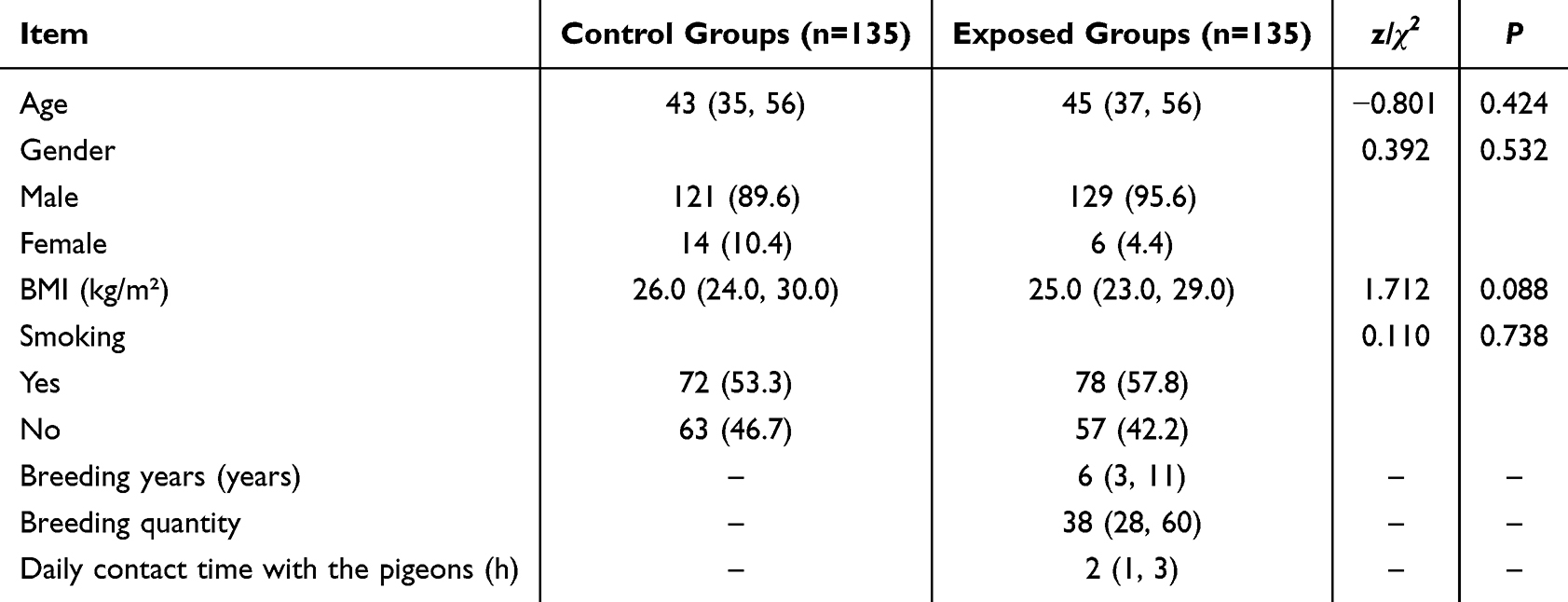 |
Table 1 Comparison of General Information Between the Exposed Group and the Control Group [n (%), x ± s, M (Q1, Q3) |
Comparison of Pulmonary Function Indexes Between the Exposed and Control Groups
FVC, FEV1% and FVC% were lower in the exposed group than in the control group, and the differences were statistically significant (P<0.05), as shown in Table 2 and Figure 1A–C.
 |
Table 2 Comparison of Lung Function Indexes Between the Exposure Group and the Control Group (x ± s) |
 |
Figure 1 Comparison of FVC, FEV1%, and FVC% between the two groups. (A) FVC is lower in the exposed group than in the control group. (B) FEV1% is lower in the exposed group than in the control group. (C) FVC% is lower in the exposed group than in the control group. |
Comparison of the Aerosol Concentration in the Pigeon Lofts and House Environment of the Exposed Group With That of the Control Group
The difference between the aerosol concentration in the house environment of the exposed group and that of the control group was not statistically significant (P > 0.05), whereas the concentration of aerosol in the environment around the pigeon lofts of the exposed group was higher than that house environment of the control group and the exposed group, with a statistically significant difference (P < 0.05), as shown in Table 3.
 |
Table 3 Comparison of Aerosol Concentration in the Surroundings of Pigeon Lofts and in the House Environment of the Exposed Group With That in the House Environment of the Control Group [mg/m3, M(Q1, Q3)] |
Correlation Analysis Between Aerosol Concentration Around the Pigeon Loft Environment and Lung Function Indexes in the Exposed Group
Aerosol concentration of different particle sizes was negatively correlated with lung function indexes such as FEV1, FVC, FEV1%, FVC%, FEV1 / FVC, etc. Spearman’s bias correlation analysis was conducted by further controlling for the confounding factors such as age, sex, BMI, smoking, etc., which showed that the concentration of different aerosol sizes was negatively correlated with the lung function indexes, and the differences were statistically significant (P < 0.05). The results showed that aerosol concentrations of different sizes were negatively correlated with the lung function indices, and the differences were statistically significant (P < 0.05), as shown in Table 4.
 |
Table 4 Correlation Analysis Between Aerosol Concentrations of Different Particle Sizes and Lung Function Indices in the Exposure Group |
The Group, Number, Daily Contact Time and Lung Function Index Correlation
The results of the Spearman analysis indicate that the number of years of breeding are negatively correlated with pulmonary function indicators such as FEV1, FVC, FEV1%, FVC% (P < 0.05), daily contact time with pigeons are negatively correlated with pulmonary function indicators such as FEV1, FVC, FEV1%, FVC%, FEV1 / FVC (P < 0.05). In contrast, the number of pigeons bred is not statistically significantly different when compared with the same pulmonary function indicators (P > 0.05). Further controlling for confounding factors such as age, gender, BMI, and smoking, the Spearman partial correlation analysis results show that the breeding years is negatively correlated with FEV1 (P < 0.05); however, when compared FVC, FEV1%, FVC%, FEV1 / FVC (P > 0.05). Similarly, the number of pigeons bred is not statistically significantly different when compared with the pulmonary function indicators (P > 0.05). Daily contact time with pigeons is negatively correlated with FEV1, FVC, FEV1%, and FVC%, FEV1 / FVC (P < 0.05), as shown in Table 5.
 |
Table 5 Results of the Correlation Analysis of Feeding years, Feeding Number, Daily Contact Time With Pigeons and Lung Function Indicators in the Exposed Group |
Discussion
Hypersensitivity pneumonitis (HP) is an uncommon interstitial lung disease, which manifests with symptoms of dyspnea and cough following exposure to an inhaled antigen.10 The pathophysiology of HP is best characterized by an inflammatory and/or fibrotic destruction of the lung parenchyma and small airways.11 Any occupation that involves exposure to aerosols and/or dust or organic particulate suspensions ultimately faces the risk of HP.12
Pigeon breeder’s lung (PBL)13 is a kind of hypersensitivity pneumonitis (HP), which is a pulmonary inflammatory response induced by repeated inhalation of pigeon fur and other shedding materials by sensitive individuals. As the disease progresses, inflammatory injuries such as granuloma and pulmonary fibrosis occur successively. The mechanism of the evolution of its inflammatory damage remains unclear.1,14 Linking pulmonary function defects related to pigeon breeding with specific spirometry patterns (ie, obstructive or restrictive), as well as the concentration and size of aerosols in the pigeon loft, can further elucidate the pathophysiological pathways associated with environmentally related lung disease.15
This study collected 135 people from three towns in Turpan City, Xinjiang Uygur Autonomous Region, who have long - term made a living by raising pigeons through the method of random sampling, and also selected 135 healthy people in the same villages as the pigeon - raisers but without contact with pigeons by means of group - matching. The concentration of antigen aerosols of different sizes in the pigeon lofts and family environments of the research objects was detected by using an aerosol tester, and the lung functions of the two groups of people were detected by using a portable lung function tester. By comparing the lung functions between the exposed group and the control group, the influence of the aerosols in the pigeon loft environment on the lung functions of the pigeon - raisers was studied, revealing the importance of controlling the environmental air quality and the possible harm it may cause, which is helpful for patients to prevent diseases and improve prognosis.
The results of pulmonary function tests from two groups reveal that the lung function indicators such as FVC, FEV1%, and FVC% in the exposed group are all lower than those in the control group, and the differences between the groups are statistically significant (P<0.05). It can be inferred that the inhalation of aerosols formed by pigeon feathers, feces, and other substances by pigeon breeders will lead to the deterioration of lung function. Since there are differences in climate, antigens, and exposure - causing activities among different regions, and the lung function instrument used in this study is not a large - scale pulmonary function detection system, lacking relevant examination data such as lung gas exchange function (diffusion), and the sample size is small, and the lung capacity results of the research subjects depend on the efforts of the subjects and the cooperation between the subjects and the examiners, it is impossible to draw conclusions about what kind of ventilatory dysfunction is mainly responsible for the lung function changes in the pigeon - breeding population and specific epidemiological data from this conclusion. In the future, the sample size can be increased, the lung function examination instruments and equipment can be improved, and combined with the lung imaging examination results of patients, further relevant research can be carried out. Since the lung function results are affected by factors such as height, age, gender, race, BMI, smoking, and the subjects’ cooperation with the examination, the reason why there is no statistically significant difference in FEV1 between the two groups may be that when collecting data, group matching was adopted instead of one - to - one pairing.
According to the detection results of the aerosol detector, there is no statistically significant difference in the concentration of aerosols of different sizes in the house environments between the two groups. However, the concentration of aerosols around the pigeon loft environment in the exposed group is higher than that in the control group and the house environment within the exposed group. These results indicate that keeping pigeons will increase the concentration of allergenic antigen aerosols of different sizes in the environment around the pigeon loft. It may be because pigeon keepers mainly raise pigeons on the loft, where they are relatively in a ventilated environment, which makes it easier for pigeon feathers and secretions to spread into the air. Since the loft is at a relatively high position, it is more difficult for breeders to clean up the environment around the pigeons in a timely manner. Aerosols can enter the outside environment with gas exchange. The different sizes of aerosol concentrations obtained from the test results are negatively correlated with various pulmonary function indicators obtained by using a portable spirometer. These results indicate that there is a dose-response relationship between antigen aerosol exposure levels and the reduction of various pulmonary function indicators.
On average, each person inhales about 10 m³ of air per day, which contains a large number of microorganisms and other antigenic aerosols. These substances are rapidly absorbed by the lungs and transported to all parts of the body, causing harm. There are three indicators in the evaluation of aerosol hazards: the components of aerosol particles, the concentration of aerosol particles, and the size of aerosol particles. Repeated inhalation of antigenic aerosols secreted by pigeons plays a priming role in PBL inflammatory response.1 The size and concentration of antigenic particles directly affect the location of particle deposition and the degree of lung injury.16 Small (<3 µm) enough to be inhaled into the distal bronchi and alveoli, clearance via local lymphatic drainage inducing an IgG antibody response, capacity to activate complement pathways (eg, cell walls of molds containing β-(1–3)-dglucan) and high molecular weight glycoproteins resistant to degradation (eg, pigeon intestinal mucin and Trichosporon cutaneum).17
In the exposed group, because most pigeon breeders lack awareness of the hazards of aerosols produced by pigeons, they fail to adopt individual protective measures in a timely manner. Being in such an aerosol-stimulating environment for a long time brings many adverse effects on the health of the breeders. Therefore, taking necessary protective measures is the key to preventing pigeon breeder’s lung. For example, wearing high-efficiency filter masks such as N95, N99 or KN95 can effectively block fine particulate matters; the layout of pigeon farms should be reasonable, and the structure and facilities of pigeon houses must be conducive to the timely and rapid removal of feathers, feces and other excreta to prevent the generation of antigenic aerosols. For any patient presenting with unexplained dyspnea, clinicians must carefully record their occupational and recreational history. Appropriate cases can be diagnosed with PBL through exposure history, clinical manifestations, physical examination results, chest X-ray examinations, chest CT scans, and simple laboratory tests, without the need for invasive procedures such as bronchoalveolar lavage and biopsy.18 The most important factor in treatment is early identification and removal of the antigen, and cases of respiratory insufficiency may require corticosteroid therapy, oxygen support, etc.19
Similarly, the duration of exposure plays a role in the process of sensitization.20 Spearman correlation analysis was performed on various pulmonary function indicators of pigeon breeders and their breeding years, number of pigeons raised, daily contact time with pigeons and pulmonary function indicators. The results showed that the breeding years were negatively correlated with pulmonary function indicators such as FEV1, FVC, FEV1%, and FVC%, respectively. The daily contact time with pigeons was negatively correlated with pulmonary function indicators such as FEV1, FVC, FEV1%, FVC%, and FEV1/FVC, respectively, and the differences were statistically significant (P < 0.05). There was no statistically significant difference between the number of pigeons raised and various pulmonary function indicators (P > 0.05). Further controlling for confounding factors such as age, gender, BMI, and smoking through Spearman’s partial correlation analysis, the results showed a negative correlation between the years of pigeon keeping and FEV1. There was no statistically significant difference between the number of pigeons kept and various pulmonary function indicators (P > 0.05). The daily time spent in contact with pigeons was negatively correlated with pulmonary function indicators such as FEV1, FVC, FEV1%, FVC%, and FEV1/FVC; this indicates that the longer the duration of pigeon keeping and the longer the daily contact time with pigeons, the longer the exposure time to antigenic aerosols, and the more persistent the allergic reactions will be, thereby leading to a more pronounced deterioration in the lung function of pigeon keepers.
The reason why there is no statistically significant difference between the breeding quantity and each index of lung function is considered to be that the number of pigeons raised by the subjects in this study is generally small, mostly concentrated between 15 and 50, with few raising more than a hundred. In the future, more accurate research results can be obtained by further expanding the sample size, improving the cooperation of the subjects, enhancing the accuracy of the measuring instruments, and reducing systematic errors.
Abbreviations
HP, hypersensitivity pneumonitis; PBL, pigeon breeders’ lung; PFT, pulmonary function tests; PID, pulmonary interstitial disease; FEV1, forced expiratory volume in 1s; FVC, pulmonary vital capacity.
Data Sharing Statement
To investigate the effects of aerosol size and concentration in pigeon lofts on the lung function of pigeon feeders, so the dataset analyzed in this study is not publicly available but is available to the corresponding author on reasonable request.
Ethics approval and consent to participate
We confirm that all experiments were performed in accordance with the Declaration of Helsinki. The study was approved by the Ethical Committee of the People’s Hospital of Xinjiang Uygur Autonomous Region, NO. KY201803715. Each patient provided written informed consent before participating in the study.
Author Contributions
All authors made a significant contribution to the work reported, whether that is in the conception, study design, execution, acquisition of data, analysis and interpretation, or in all these areas; took part in drafting, revising or critically reviewing the article; gave final approval of the version to be published; have agreed on the journal to which the article has been submitted; and agree to be accountable for all aspects of the work.
Funding
This study received grants from:1. “Tianshan Elite Talent” High-Level Medical and Health Professionals Development Program (Grant No. TSYC202301B049); 2. Central Government-Guided Local Science and Technology Development Special Fund Project (Grant No. ZYYD2025QY22).
Disclosure
The authors report no conflicts of interest in this work.
References
1. Vasakova M, Morell F, Walsh S, et al. Hypersensitivity pneumonitis: perspectives in diagnosis and management. Am J Respir Crit Care Med. 2017;196(6):680–689. doi:10.1164/rccm.201611-2201PP
2. Christopoulos K. Bird ownership and pulmonary outcomes apart from hypersensitivity pneumonitis in European older adults. Respir Med Res. 2023;84:101066. doi:10.1016/j.resmer.2023.101066
3. Soumagne T, Dalphin ML, Dalphin JC. Hypersensitivity pneumonitis in children. Rev Mal Respir. 2019;36(4):495–507. doi:10.1016/j.rmr.2018.06.010
4. Gürsoy TR, Onay ZR, Eyüboğlu TŞ, et al. Pigeon breeder`s disease as a cause of hypersensitivity pneumonia in children. Turk J Pediatr. 2020;62(4):623–633. doi:10.24953/turkjped.2020.04.012
5. Selman M, Pardo A, T.e. K Jr. Hypersensitivity pneumonitis: insights in diagnosis and pathobiology. Am J Respir Crit Care Med. 2012;186(4):314–324. doi:10.1164/rccm.201203-0513CI
6. Wijsenbeek M, Cottin V. Spectrum of fibrotic lung diseases. N Engl J Med. 2020;383(10):958–968. doi:10.1056/NEJMra2005230
7. Creamer AW, Barratt SL. Prognostic factors in chronic hypersensitivity pneumonitis. Eur Respir Rev. 2020;29(156):190167. doi:10.1183/16000617.0167-2019
8. Gimenez A, Storrer K, Kuranishi L, et al. Change in FVC and survival in chronic fibrotic hypersensitivity pneumonitis. Thorax. 2018;73(4):391–392. doi:10.1136/thoraxjnl-2017-210035
9. Wang X, Chen L, Yang G, et al. Bacterial and fungal aerosols in poultry houses: PM(2.5) metagenomics via single-molecule real-time sequencing. Poult Sci. 2024;103(12):104348. doi:10.1016/j.psj.2024.104348
10. Lacasse Y, Selman M, Costabel U, et al. Clinical diagnosis of hypersensitivity pneumonitis. Am J Respir Crit Care Med. 2003;168(8):952–958. doi:10.1164/rccm.200301-137OC
11. Koster MA, Thomson CC, Collins BF, et al. Diagnosis of hypersensitivity pneumonitis in adults, 2020 clinical practice guideline: summary for clinicians. Ann Am Thorac Soc. 2021;18(4):559–566. doi:10.1513/AnnalsATS.202009-1195CME
12. Thaon I, Reboux G, Moulonguet S, et al. Occupational hypersensitivity pneumonitis. Rev Mal Respir. 2006;23(6):705–725. doi:10.1016/S0761-8425(06)72084-8
13. Mangion JR, Delaney M. Pigeon-breeder’s lung. Extensive workup clarifies the clinical picture. Postgrad Med. 1993;93(4):215–7,221–2. doi:10.1080/00325481.1993.11701648
14. Wu C, Ding W, Li Q, et al. The correlation between pulmonary fibrosis and methylation of peripheral Smad3 in cases of pigeon breeder’s lung in a Chinese Uygur population. Oncotarget. 2017;8(26):43104–43113. doi:10.18632/oncotarget.17763
15. Vergadi E, Ieronymaki E, Lyroni K, et al. Akt signaling pathway in macrophage activation and M1/M2 polarization. J Immunol. 2017;198(3):1006–1014. doi:10.4049/jimmunol.1601515
16. Kudo T, Sekiguchi K, Sankoda K, et al. Effect of ultrasonic frequency on size distributions of nanosized mist generated by ultrasonic atomization. Ultrason Sonochem. 2017;37:16–22. doi:10.1016/j.ultsonch.2016.12.019
17. Bourke SJ, Dalphin JC, Boyd G, et al. Hypersensitivity pneumonitis: current concepts. Eur Respir J Suppl. 2001;32:81s–92s. doi:10.1183/09031936.01.18s320081
18. Riario Sforza GG, Marinou A. Hypersensitivity pneumonitis: a complex lung disease. Clin mol Allergy. 2017;15:6. doi:10.1186/s12948-017-0062-7
19. Barnes H, Troy L, Lee CT, et al. Hypersensitivity pneumonitis: current concepts in pathogenesis, diagnosis, and treatment. Allergy. 2022;77(2):442–453. doi:10.1111/all.15017
20. Costabel U, Miyazaki Y, Pardo A, et al. Hypersensitivity pneumonitis. Nat Rev Dis Primers. 2020;6(1):65. doi:10.1038/s41572-020-0191-z
 © 2025 The Author(s). This work is published and licensed by Dove Medical Press Limited. The
full terms of this license are available at https://www.dovepress.com/terms
and incorporate the Creative Commons Attribution
- Non Commercial (unported, 3.0) License.
By accessing the work you hereby accept the Terms. Non-commercial uses of the work are permitted
without any further permission from Dove Medical Press Limited, provided the work is properly
attributed. For permission for commercial use of this work, please see paragraphs 4.2 and 5 of our Terms.
© 2025 The Author(s). This work is published and licensed by Dove Medical Press Limited. The
full terms of this license are available at https://www.dovepress.com/terms
and incorporate the Creative Commons Attribution
- Non Commercial (unported, 3.0) License.
By accessing the work you hereby accept the Terms. Non-commercial uses of the work are permitted
without any further permission from Dove Medical Press Limited, provided the work is properly
attributed. For permission for commercial use of this work, please see paragraphs 4.2 and 5 of our Terms.