
Back to Journals » International Journal of General Medicine » Volume 18
Comparative Prognostic Accuracy of Clinical and Inflammation- or Nutrition-Based Scores in Older Adults with Community-Acquired Pneumonia
Authors Eksioglu M  , Azapoglu Kaymak B , Unal Akoglu E, Akyıldız SF, Sivil R , Cimilli Ozturk T
Received 28 May 2025
Accepted for publication 20 August 2025
Published 27 August 2025 Volume 2025:18 Pages 4811—4824
DOI https://doi.org/10.2147/IJGM.S540730
Checked for plagiarism Yes
Review by Single anonymous peer review
Peer reviewer comments 2
Editor who approved publication: Prof. Dr. Héctor Mora-Montes
Merve Eksioglu,1 Burcu Azapoglu Kaymak,1 Ebru Unal Akoglu,1 Selman Faruk Akyıldız,1 Ramazan Sivil,2 Tuba Cimilli Ozturk1
1Department of Emergency Medicine, University of Health Sciences, Fatih Sultan Mehmet Education and Research Hospital, Istanbul, Turkey; 2Department of Emergency Medicine, University of Health Sciences, Antalya Education and Research Hospital, Antalya, Turkey
Correspondence: Merve Eksioglu, Department of Emergency Medicine, University of Health Sciences, Fatih Sultan Mehmet Education and Research Hospital, Hastane Sokak No: 1/9 İçerenköy, Ataşehir, Istanbul, 34752, Turkey, Tel +90 216 578 30 00; +90 505 295 36 87, Email [email protected]
Purpose: This study aimed to assess the prognostic accuracy of the Glasgow Prognostic Score (GPS), modified Glasgow Prognostic Score (mGPS), and C-reactive protein/albumin ratio (CAR) in predicting 30-day mortality and intensive care unit (ICU) admission compared with the Pneumonia Severity Index (PSI) and CURB-65 in older adults with community-acquired pneumonia (CAP).
Patients and Methods: This retrospective, single-center cohort study was conducted in a tertiary emergency department. Patients aged ≥ 65 years with CAP were included. Exclusion criteria were hospital- or ventilator-associated pneumonia, pneumonia mimics, and immunocompromised status. GPS and mGPS were calculated using CRP > 10 mg/L and albumin < 35 g/L. ROC and logistic regression analyses were performed.
Results: A total of 349 patients (mean age: 77.96 ± 8.42 years; 52.7% men) were included. The 30-day mortality and ICU admission rates were 19.5% and 27.2%, respectively. For predicting mortality, the GPS showed an AUC of 0.753 (95% CI: 0.690– 0.816), sensitivity of 75.0%, specificity of 73.3%, PPV of 43.9%, and NPV of 92.4%. mGPS had an AUC of 0.747 (95% CI: 0.679– 0.814), sensitivity 77.9%, specificity 73.3%, PPV 45.2%, and NPV 93.2%. The CAR yielded an AUC of 0.677 (95% CI: 0.604– 0.751), sensitivity of 82.4%, specificity of 45.6%, PPV of 29.5%, and NPV of 91.4%. For ICU admission, the AUCs were 0.770 (GPS), 0.757 (mGPS), and 0.676 (CAR). The PSI demonstrated the highest predictive accuracy (AUC: 0.884 for mortality, 0.919 for ICU admission), followed by CURB-65 (AUC: 0.848 and 0.879, respectively). Independent predictors of 30-day mortality included acute confusion, lower PaO2/FiO2 ratio, low systolic blood pressure, reduced hemoglobin levels, and Alzheimer’s disease or dementia.
Conclusion: The PSI and CURB-65 demonstrated superior prognostic accuracy. GPS and mGPS showed moderate performance, whereas CAR exhibited the lowest overall discriminative ability for both outcomes.
Keywords: geriatric emergency care, community-acquired pneumonia, prognostic scores, pneumonia severity index, PSI, glasgow prognostic score, GPS, C-reactive protein to albumin ratio, CAR
Introduction
Community-acquired pneumonia (CAP) remains a leading cause of morbidity and mortality in older adults, a population characterized by age-related immune senescence, multimorbidity, and reduced physiological reserve.1–3 These factors contribute to atypical clinical presentations, increased frailty, and poor short-term outcomes.3 In the emergency department (ED), early and accurate risk stratification is essential to guide clinical decision-making and ensure appropriate levels of care, particularly in this vulnerable group.
The Pneumonia Severity Index (PSI) and CURB-65 are widely used clinical tools to predict 30-day mortality in patients with CAP.4,5 CURB-65 is commonly favored in emergency and primary care settings because of its simplicity, while PSI provides a more comprehensive assessment by including comorbidities and functional status.6 Despite their clinical utility, these tools may not fully capture the underlying biological vulnerability specific to older adults.
Recent studies have increasingly highlighted the prognostic relevance of systemic inflammation and nutritional status in older adults with pneumonia. Biomarkers such as C-reactive protein (CRP) and serum albumin—reflecting inflammatory activity and nutritional reserve, respectively—have been consistently linked to adverse clinical outcomes in CAP.7–10 The CRP/albumin ratio (CAR), a composite biomarker derived from these two parameters, has shown potential as a prognostic indicator in various clinical settings, including pneumonia, geriatric nutritional assessment, and cardiovascular disease.11–13
The Glasgow Prognostic Score (GPS) and its modified version (mGPS), which combine serum CRP and albumin levels (CRP >10 mg/L and albumin <35 g/L), were initially developed to reflect systemic inflammation and nutritional status in oncology settings. They were first validated as prognostic tools in patients with inoperable non-small cell lung cancer.14 Subsequent studies have demonstrated that mGPS is associated with in-hospital mortality among older adults, independent of the underlying diagnosis, highlighting its potential applicability in broader clinical populations.15 Furthermore, mGPS has shown prognostic relevance in acute medical conditions, including the prediction of pneumonia development in patients with acute ischemic stroke.16 Despite these findings, limited evidence exists regarding the use of GPS and mGPS in the emergency department, particularly in older adult patients with community-acquired pneumonia.
This study aimed to evaluate the predictive accuracy of CAR, GPS, and mGPS in estimating 30-day mortality and ICU admission in older adults diagnosed with CAP presenting to the emergency department and to compare their performance with established clinical tools, namely PSI and CURB-65.
Materials and Methods
Study Design and Setting
This retrospective, single-center cohort study was conducted in the emergency department of the University of Health Sciences, Fatih Sultan Mehmet Education and Research Hospital, a tertiary academic referral center in Istanbul, Turkey. The study period was from January 1, 2022, to January 1, 2023.
CAP was defined in accordance with the 2019 American Thoracic Society/Infectious Diseases Society of America (ATS/IDSA) guidelines as an acute pulmonary infection with symptom onset occurring within 48 h of hospital admission and not associated with recent hospitalization or mechanical ventilation.1 Eligible patients were identified through the hospital’s electronic medical records using ICD-10 codes for pneumonia (J12–J18) and associated symptoms such as dyspnea, cough, fever, and fatigue (R06.02, R05, R50, R53, R53.81). Patients were excluded if they had hospital-acquired or ventilator-associated pneumonia, non-infectious mimics of pneumonia (such as pulmonary edema, pulmonary embolism, atelectasis, tuberculosis, or interstitial lung disease), or were immunocompromised due to congenital or acquired immunodeficiency, immunosuppressive medications, or a history of organ or bone marrow transplantation. Only patients aged ≥ 65 years with complete clinical, laboratory, and radiological data required to calculate the PSI, CURB-65, GPS, mGPS, and CAR scores were included.
Data Collection and Clinical Variables
Demographic information (age and sex), comorbidities, initial vital signs (systolic and diastolic blood pressure, heart rate, respiratory rate, body temperature, and oxygen saturation), and mental status (Glasgow Coma Scale and documentation of acute mental changes) were recorded. The laboratory parameters included CRP (mg/L), serum albumin (g/L), urea (mmol/L), glucose (mg/dL), sodium (mmol/L), hemoglobin (g/dL), hematocrit (%), white blood cell count (109;/L), lymphocyte count (109;/L), and platelet count (109;/L). Radiologic imaging via thoracic computed tomography (CT) was used to confirm the presence of pneumonia and assess pleural effusion. Blood gas analysis was used to measure the PaO2 and pH values. The PaO2/FiO2 ratio was calculated by dividing the arterial oxygen pressure (PaO2, mmHg) by the fraction of inspired oxygen (FiO2, expressed as a decimal). For patients breathing room air, the FiO2 was assumed to be 0.21. For those on supplemental oxygen, FiO2 was estimated according to the oxygen flow rate based on validated formulas.17,18 When arterial blood gas values were not available, PaO2 was derived from SpO2 using conversion equations validated in prior studies.18 CAR was calculated by dividing the CRP concentration (mg/L) by the serum albumin level (g/L).
Calculation of Prognostic Scores
The PSI was calculated based on a composite of age, sex, nursing home residence, comorbidities, vital signs, physical examination findings, laboratory values (pH, PaO2, urea, sodium, glucose, hematocrit), and radiographic evidence of pleural effusion.4 The CURB-65 score included confusion, urea >7 mmol/L, respiratory rate ≥30 breaths/min, systolic blood pressure <90 mmHg or diastolic blood pressure ≤60 mmHg, and age ≥65 years.5
The GPS was calculated as follows: patients with CRP ≤10 mg/L and albumin ≥35 g/L were assigned 0 points; those with CRP >10 mg/L and albumin ≥35 g/L were assigned 1 point; and those with CRP >10 mg/L and albumin <35 g/L were assigned 2 points.14 The mGPS assigned 0 points for CRP ≤10 mg/L regardless of albumin level, 1 point for CRP >10 mg/L with albumin ≥35 g/L, and 2 points for CRP >10 mg/L with albumin <35 g/L.15
Outcome Measures
The primary outcome was 30-day all-cause mortality following the diagnosis of CAP. The secondary outcome was ICU admission during hospital stay.
ICU admission decisions in our study were made based on standardized clinical criteria aligned with the national guideline titled Implementation Procedures and Principles of Intensive Care Services in Inpatient Healthcare Facilities issued by the Turkish Ministry of Health.19 According to this directive, patients are admitted to the ICU when they meet specific physiological or clinical indicators of critical illness. For patients with pneumonia, these include the need for invasive or noninvasive mechanical ventilation, persistent hypoxemia despite supplemental oxygen therapy, hemodynamic instability requiring vasopressor support, impaired consciousness, and the presence of sepsis or multi-organ dysfunction. In our institution’s routine clinical practice, emergency physicians initiate ICU consultations with the Department of Anesthesiology and Reanimation, and final decisions are made collaboratively in accordance with these national standards. These criteria are generally consistent with international guidelines, including those of the Infectious Diseases Society of America and the American Thoracic Society for severe community-acquired pneumonia.1
Statistical Analysis
Continuous variables are expressed as mean ± standard deviation (SD), and categorical variables as frequencies and percentages. The Kolmogorov–Smirnov test was used to assess normal distribution. Comparisons between survivors and non-survivors were performed using the Independent Samples t-test or Mann–Whitney U-test for continuous variables and the Chi-square or Fisher’s exact test for categorical variables, as appropriate. To identify independent predictors of 30-day mortality, a multivariable logistic regression model was constructed, incorporating demographic, clinical, and laboratory variables. Model calibration and explanatory power were assessed using the Hosmer–Lemeshow test and Nagelkerke R², respectively. Variables considered clinically relevant based on prior literature and clinical judgment, in addition to showing potential association in univariate analysis (p < 0.10), were included in the multivariable logistic regression model. A manual stepwise approach was applied to identify independent predictors of 30-day mortality, balancing both statistical significance and clinical plausibility. The prognostic performance of PSI, CURB-65, GPS, mGPS, and CAR in predicting 30-day mortality and ICU admission was evaluated using receiver operating characteristic (ROC) curve analysis. For each score, the area under the curve (AUC), optimal cut-off (based on the Youden index), sensitivity, specificity, positive predictive value (PPV), negative predictive value (NPV), and overall accuracy were calculated.
A post-hoc power analysis demonstrated that the study had excellent statistical power (>99%) to detect clinically meaningful differences in the prognostic performance of the evaluated scoring systems. All analyses were performed using SPSS version 26.0 (IBM Corp., Armonk, NY, USA) and MedCalc version 23 (MedCalc Software Ltd., Ostend, Belgium). Statistical significance was set at p < 0.05.
Results
Of the 758 patients initially screened, 349 met the inclusion criteria and were included in the final analysis. Patients were excluded if they had non-infectious pneumonia-like diagnoses (n = 183), prior hospital-acquired or ventilator-associated pneumonia (n = 67), immunocompromised status (n = 9), or incomplete data (n = 150) (Figure 1). The final cohort consisted of 184 men (52.7%) and 165 women (47.3%), with a mean age of 77.96 ± 8.42 years. The overall 30-day mortality rate was 19.5% (n = 68). At discharge, 188 patients (53.9%) were discharged, 66 (18.9%) were admitted to the general medical ward, and 95 (27.2%) required ICU admission.
 |
Figure 1 The flowchart illustrates the selection process and final cohort formation of geriatric patients with community-acquired pneumonia. |
The demographic, radiological, and comorbidity characteristics of the study population are presented in Table 1. Non-survivors were significantly older (p = 0.006) and more likely to reside in nursing homes (p < 0.001), and to have multilobar infiltrations (p < 0.001), pleural effusion (p < 0.001), aspiration pneumonia (p < 0.001), cerebrovascular disease (p = 0.001), and Alzheimer’s disease or dementia (p < 0.001).
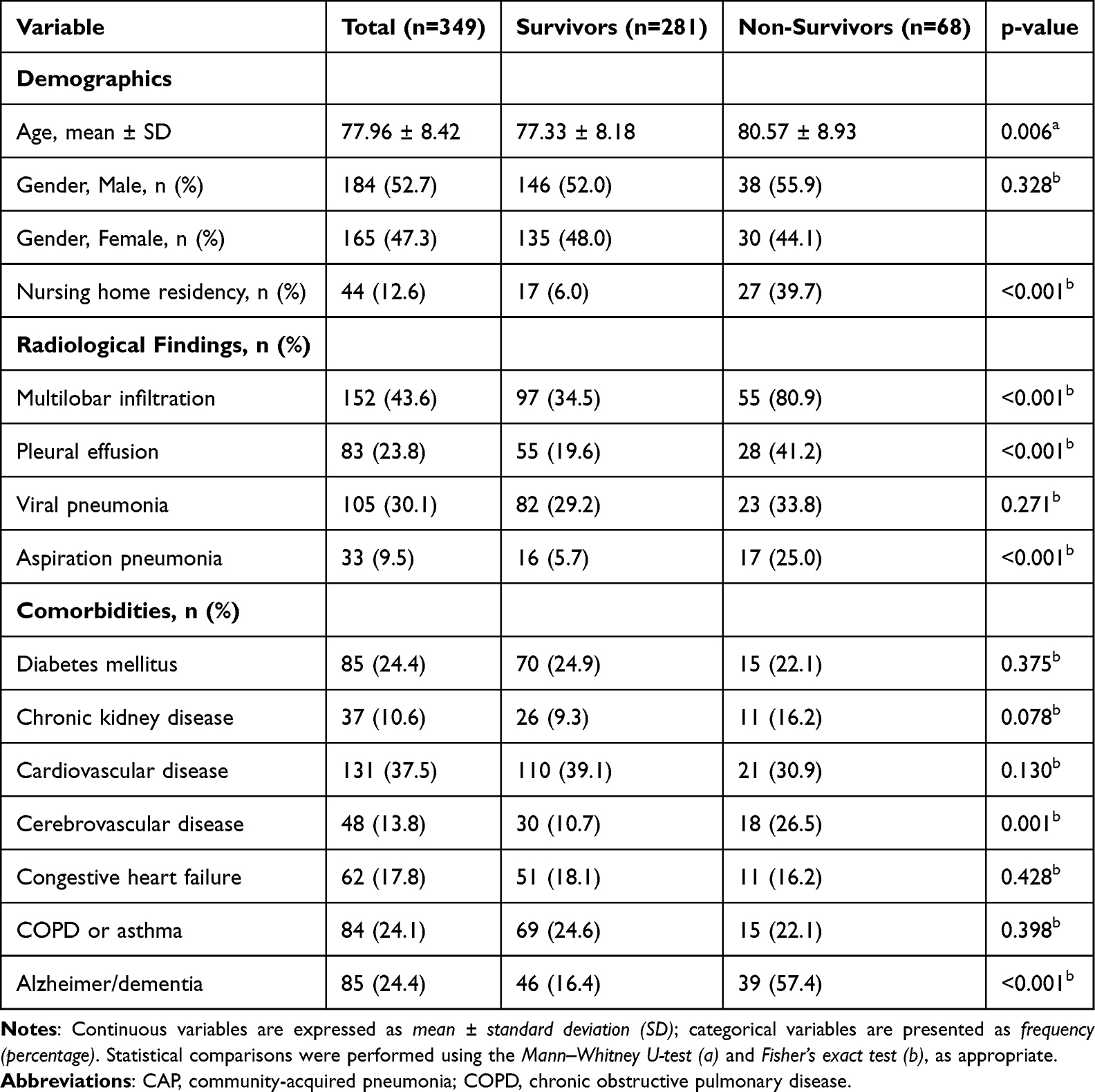 |
Table 1 Baseline Characteristics by 30-Day Survival Status |
The laboratory and ABG findings are summarized in Table 2. Non-survivors had significantly elevated CRP and CAR values and lower albumin, hemoglobin, and lymphocyte levels. Acid-base imbalance (pH < 7.35) and impaired oxygenation (PaO2/FiO2 ≤250) were also more frequently observed in this group (both p ≤ 0.001).
 |
Table 2 Laboratory and ABG Findings by 30-Day Survival Status |
A comparison of the prognostic scores between survivors and non-survivors is shown in Table 3. Non-survivors had significantly higher CURB-65 and PSI scores (mean PSI: 170.47 ± 39.49 vs 106.13 ± 34.28; p < 0.001), and a greater proportion had GPS and mGPS scores of 2. The mean CAR was also substantially elevated among non-survivors (4.60 ± 4.66 vs 2.06 ± 2.41; p < 0.001).
 |
Table 3 Severity Scores and Inflammation-Based Indices by 30-Day Survival Status |
Multivariable Analysis for 30-Day Mortality
Multivariable logistic regression analysis identified six independent predictors of 30-day mortality (Table 4). These included a lower PaO2/FiO2 ratio (OR = 0.989; 95% CI: 0.985–0.994; p < 0.001), systolic blood pressure (OR = 0.976; 95% CI: 0.960–0.991; p = 0.003), reduced hemoglobin concentration (OR = 0.735; 95% CI: 0.602–0.897; p = 0.002), the presence of acute confusion (OR = 4.984; 95% CI: 2.067–12.019; p < 0.001), Alzheimer’s dementia (OR = 2.362; 95% CI:
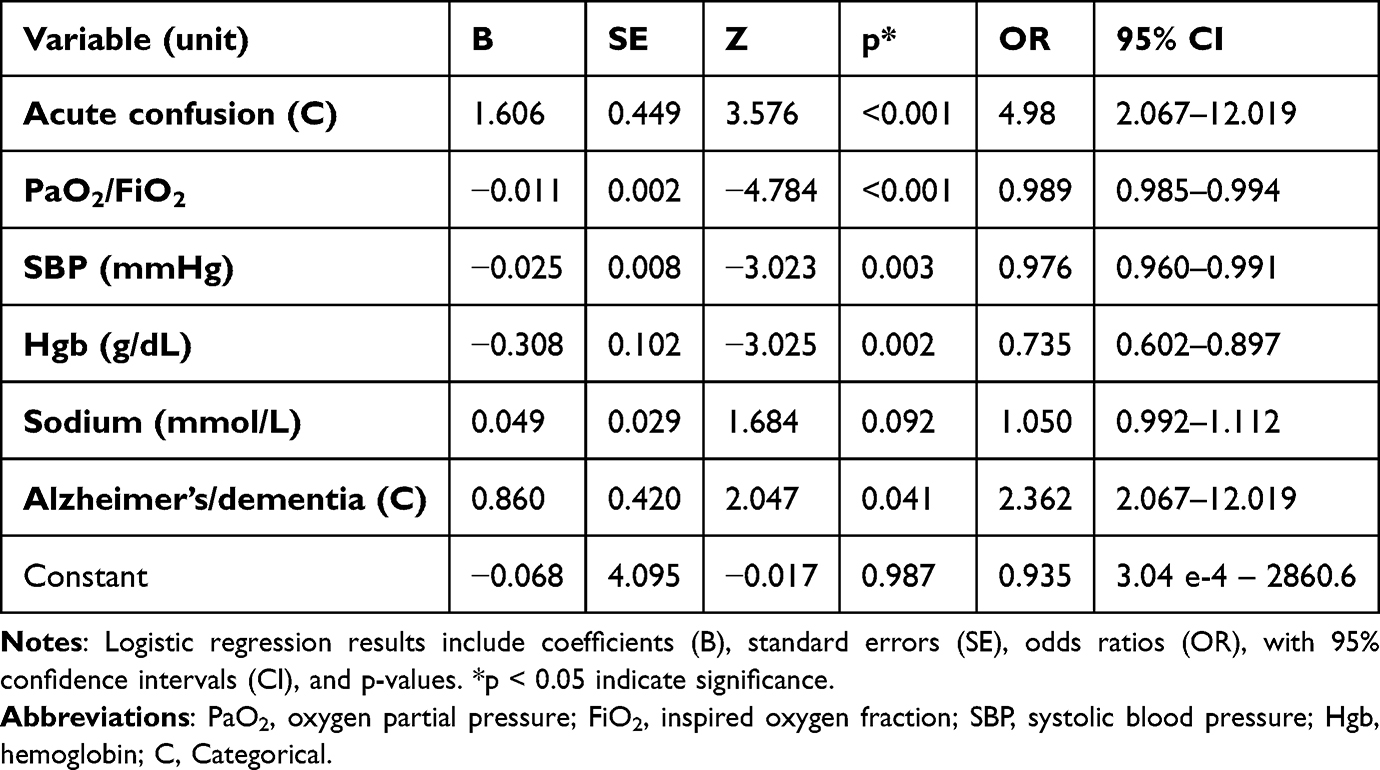 |
Table 4 Multivariable Logistic Regression Analysis of Predictors of 30-Day Mortality |
1.037–5.380; p = 0.041), and a trend toward significance for serum sodium level (serum sodium mmol/L; OR = 1.050; 95% CI: 0.992–1.112; p = 0.092).
The overall model demonstrated good calibration (Hosmer–Lemeshow test, p = 0.705) and good explanatory power (Nagelkerke R² = 0.631). The discriminative ability of the model was also satisfactory, with an area under the ROC curve (AUC) of 0.940 (95% CI: 0.90–0.98).
Prognostic Performance of Inflammation- and Nutrition-Based and Clinical Scoring Systems
ROC analysis for 30-day mortality prediction demonstrated that PSI had the highest discriminative ability, with an AUC of 0.884 (95% CI: 0.842–0.927) at a cutoff >130, yielding a sensitivity of 82.35% and specificity of 79.36%. The CURB-65 also performed well, with an AUC of 0.848 (95% CI: 0.787–0.909) at a cut-off >2, showing 77.94% sensitivity and 82.92% specificity. Among the inflammation-based indices, GPS achieved an AUC of 0.753 (95% CI: 0.690–0.816) with a cut-off >1, corresponding to a sensitivity of 75.00%, specificity of 73.31%, and NPV of 92.4%. The mGPS yielded a similar performance (AUC: 0.747; 95% CI: 0.679–0.814) at a cutoff of >1, with 77.94% sensitivity, 73.31% specificity, and an NPV of 93.2%. The CAR score exhibited the lowest predictive value (AUC = 0.677; 95% CI: 0.604–0.751) but maintained high sensitivity (82.35%) and NPV (91.4%) at a cutoff of >0.879, despite a low specificity (45.55%) (Table 5, Figure 2).
 |
Table 5 ROC Curve Analysis of Prognostic Scores for 30-Day Mortality Prediction |
 |
Figure 2 ROC curves demonstrating the predictive performance of PSI, CURB-65, GPS, mGPS, and CAR for 30-day mortality in geriatric patients with CAP. |
For predicting ICU admission, PSI again demonstrated the highest performance (AUC = 0.919; 95% CI: 0.885–0.945) at a cutoff >129, with a sensitivity of 84.21% and specificity of 85.83%. The CURB-65 followed with an AUC of 0.879 (95% CI: 0.840–0.911) at a cutoff >2, yielding a sensitivity of 74.74% and specificity of 88.19%. Among the inflammation-based scores, GPS had an AUC of 0.770 (cut-off >1), with a sensitivity, specificity, and NPV of 72.63%, 77.56%, and 88.3%, respectively. The mGPS demonstrated an AUC of 0.757 (cut-off >1), with 74.74% sensitivity, 77.56% specificity, and 89.1% NPV. The CAR score showed the lowest discriminative ability (AUC = 0.676) at a cutoff of >3.64, with a sensitivity of 44.21%, specificity of 83.46%, and NPV of 80.0% (Table 6, Figure 3).
 |
Table 6 ROC Curve Analysis of Prognostic Scores for Predicting ICU Admission |
 |
Figure 3 ROC curves comparing the predictive accuracy of PSI, CURB-65, GPS, mGPS, and CAR for ICU admission in geriatric patients with CAP. |
Discussion
Timely and accurate risk stratification remains a key component of geriatric emergency care, particularly in patients with CAP. In this retrospective cohort study, we assessed the prognostic utility of inflammation- and nutrition-based indices in comparison with established clinical tools for predicting 30-day mortality and ICU admission. Among all the evaluated models, PSI and CURB-65 demonstrated the highest discriminative performance. In contrast, while the GPS and mGPS exhibited moderate predictive value, their performance did not surpass that of the clinical scores. CAR demonstrated the lowest overall accuracy for both outcomes. Although CAR showed relatively higher sensitivity and negative predictive value for 30-day mortality, its low specificity limits its reliability as a standalone prognostic marker. Our study addresses a clinically relevant gap by focusing on geriatric patients with CAP presenting to the emergency department—an area where early risk stratification remains challenging. By directly comparing inflammation- and nutrition-based indices with well-established clinical tools, our findings contribute to ongoing efforts to improve prognostic accuracy in geriatric emergency care. To our knowledge, this is one of the first studies to evaluate and compare GPS and mGPS directly against widely accepted clinical tools such as PSI and CURB-65 in a geriatric CAP population presenting to the emergency department. While our findings provide valuable comparative insights, they also indicate that the additional prognostic utility of these indices may be limited compared to that of established clinical scoring systems.
Previous studies have highlighted the prognostic value of GPS and mGPS, which assess systemic inflammation and nutritional status through CRP and albumin levels, in a range of clinical conditions, including malignancies, cardiovascular diseases, and critical illness.14–16,20–25 In oncology, these scores are linked to tumor progression and poor survival, while in cardiovascular cohorts, elevated GPS/mGPS scores have been associated with an increased risk of adverse in-hospital outcomes and long-term mortality.20–25 In a study of hospitalized older patients, inflammation-based scores, including GPS and mGPS, predicted all-cause mortality independent of the admitting diagnosis.15 Moreover, recent research in patients with acute ischemic stroke showed that GPS and mGPS were elevated in those who developed stroke-associated pneumonia, although their discriminative power was inferior to that of NLR or CRP-based combinations.16 These findings support the relevance of inflammation and nutrition-based indices in diverse acute and chronic conditions. In our cohort of elderly patients with CAP, GPS and mGPS showed only moderate predictive accuracy, performing below that of traditional clinical tools such as PSI and CURB-65. Notably, our study included only patients with complete albumin data, ensuring a robust score calculation but potentially enriching the sample with more severely ill patients. This may have contributed to the relatively high 30-day mortality rate observed in our cohort and could limit the generalizability of our findings to broader ED populations, especially in settings where nutritional markers are not routinely assessed.
The prognostic utility of CAR has shown considerable variability across different studies. In our cohort of older adults with CAP presenting to the emergency department, although CAR demonstrated relatively high sensitivity and negative predictive value for 30-day mortality, its low specificity resulted in poor overall accuracy. For ICU admission, CAR showed even lower sensitivity, further limiting its predictive value. These findings are in line with previous studies, where the prognostic performance of CAR has generally been modest, though with some variation depending on clinical settings, patient populations, and measurement methods.15,26–28 In a cohort of elderly inpatients, CAR was significantly associated with 28-day mortality in univariate analysis; however, it failed to retain independent prognostic value after adjustment for other clinical variables.15 Similarly, a study conducted in an ICU setting reported a low AUC of 0.594 for CAR in predicting 28-day mortality.26 However, when CAR was combined with other clinical variables, such as functional status or inflammatory burden, in composite models, its predictive power improved, with AUCs exceeding 0.76.27,28 Taken together, these findings support the conclusion that the prognostic value of CAR, particularly as a standalone marker, remains limited in both our study and the broader literature. Although a few studies have reported improved predictive performance when CAR is combined with other clinical variables, such enhancements appear modest and require further validation.
The superiority of PSI and CURB-65, observed in our analysis, is well supported by the literature. The PSI has long been validated as a comprehensive scoring tool for mortality risk assessment in CAP, with a high negative predictive value and strong ability to identify low-risk patients.29,30 Although CURB-65 includes fewer parameters, it demonstrated similar accuracy in our cohort, with greater specificity and positive predictive value. This makes it particularly suitable for rapid triage in emergency settings, especially when time or resource constraints are present. Notably, CURB-65’s predictive capacity has been shown to improve when combined with clinical variables such as PaO2/FiO2 ratio or altered mental status, potentially approximating the performance of PSI in older populations.31
Beyond aggregate scores, our study identified several independent predictors of 30-day mortality: lower PaO2/FiO2 ratio, reduced systolic blood pressure, decreased hemoglobin concentration, acute confusion, and the presence of Alzheimer’s disease or dementia. These findings corroborate prior research indicating that oxygenation status, hemodynamic compromise, and cognitive dysfunction are critical indicators of adverse outcomes in older adults with CAP.31,32 Reduced PaO2/FiO2 and lower systolic blood pressure are also key components of the SOAR criteria, which were specifically developed for geriatric risk stratification.32 Furthermore, a recent prognostic modeling study in an elderly cohort incorporated hemoglobin levels and mental status as essential parameters, demonstrating improved discriminatory performance compared to conventional tools.33 The emergence of Alzheimer’s disease or dementia as an independent predictor in our cohort further suggests that baseline cognitive status may be an important consideration in mortality risk assessments for older adults with CAP. Although serum sodium level, a component of the PSI, did not emerge as a statistically significant independent predictor in our cohort, the observed trend suggests that electrolyte disturbances in older adults warrant careful consideration in prognostic assessments.
In conclusion, our findings demonstrated that the clinical scoring systems PSI and CURB-65 had higher prognostic accuracy than inflammation- and nutrition-based indices for predicting 30-day mortality and ICU admission in older adults with CAP. GPS and mGPS showed moderate prognostic performance, whereas CAR exhibited the weakest discriminative ability in both mortality and ICU prediction. Although relatively high NPVs were observed for GPS, mGPS, and CAR, these values may largely reflect the low event rate and high sensitivity, rather than robust predictive power. From a clinical perspective, high NPV suggests a potential utility of these indices in ruling out severe outcomes; however, their low positive predictive values and limited specificity indicate that they are not sufficient as standalone tools for clinical decision-making. Instead, their use may be considered complementary to established clinical scores such as PSI and CURB-65. This study had several limitations, including its retrospective design and the absence of data on frailty, premorbid functional and cognitive status, microbiological results, and dynamic biomarker changes, which may have limited the comprehensiveness of our risk assessment. Future large-scale, prospective, multicenter studies—ideally incorporating these additional parameters—are warranted to reassess the prognostic value of inflammation- and nutrition-based indices and to explore their integration with clinical scoring systems. Such efforts may contribute to more personalized and evidence-based risk stratification strategies for older adults with CAP.
Conclusion
PSI and CURB-65 demonstrated the highest predictive accuracy for 30-day mortality and ICU admission. GPS and mGPS showed moderate prognostic performance, whereas CAR exhibited limited discriminative ability. Future large-scale, prospective, multicenter studies are needed to more thoroughly reassess the prognostic value of these indices and to better define their role in emergency care risk stratification for older adults with community-acquired pneumonia.
Abbreviations
ABG, arterial blood gas; AUC, area under the curve; CAR, C-reactive protein/albumin ratio; CI, confidence interval; COPD, chronic obstructive pulmonary disease; CRP, C-reactive protein; CURB-65, confusion, urea, respiratory rate, blood pressure, and age ≥65 score; FiO2, fraction of inspired oxygen; GPS, Glasgow Prognostic Score; Hgb, hemoglobin; ICU, intensive care unit; mGPS, modified Glasgow Prognostic Score; NPV, negative predictive value; OR, odds ratio; PaO2, partial pressure of oxygen; PPV, positive predictive value; PSI, Pneumonia Severity Index; SBP, systolic blood pressure; WBC, white blood cell count.
Data Sharing Statement
The dataset supporting the findings of this study is openly available in Mendeley Data at the following link:
Ekşioğlu, Merve; Azapoglu Kaymak, Burcu; Unal Akoglu, Ebru; Akyıldız, Selman Faruk; Sivil, Ramazan; Cimilli Ozturk, Tuba (2025), “Dataset used for geriatric CAP prognostic score comparison study”, Mendeley Data, V1, https://doi.org/10.17632/kbcjcdynf5.1
Ethics Approval and Informed Consent
This retrospective study was approved by the Non-Interventional Clinical Research Ethics Committee of Istanbul Medipol University (Decision No: 100; Date: 23 January 2025). The requirement for written informed consent was waived due to the retrospective nature of the study. Additionally, institutional permission to access and analyze patient data was obtained from the administrative board of the hospital from which the data were collected. All patient data were anonymized to ensure confidentiality. The study was conducted in accordance with the ethical principles outlined in the Declaration of Helsinki.
Acknowledgments
The authors would like to thank the University of Health Sciences, Fatih Sultan Mehmet Training and Research Hospital, and its Emergency Department for providing access to the patient data used in this study. This study was presented as an oral presentation at the 8th National Emergency Medicine Course Days Congress (TATD Kurs Günleri), held in Antalya, Turkey, between April 28 and May 1, 2025.
Author Contributions
All authors made a significant contribution to the work reported, whether that is in the conception, study design, execution, acquisition of data, analysis and interpretation, or in all these areas; took part in drafting, revising or critically reviewing the article; gave final approval of the version to be published; have agreed on the journal to which the article has been submitted; and agree to be accountable for all aspects of the work.
Funding
The authors received no financial support for the research, authorship, and/or publication of this article.
Disclosure
The authors report no conflicts of interest in this work.
References
1. Metlay JP, Waterer GW, Long AC, et al. Diagnosis and treatment of adults with community-acquired pneumonia: an official clinical practice guideline of the American Thoracic Society and Infectious Diseases Society of America. Am J Respir Crit Care Med. 2019;200:e45–e67. doi:10.1164/rccm.201908-1581ST
2. Troeger C, Forouzanfar M, Rao PC. GBD. 2015 LRI collaborators. estimates of the global, regional, and national morbidity, mortality, and aetiologies of lower respiratory tract infections in 195 countries: a systematic analysis for the global burden of disease study 2015. Lancet Infect Dis. 2017;17:1133–1161. doi:10.1016/S1473-3099(17)30396-1.
3. Cillóniz C, Dominedò C, Pericàs JM, Rodriguez-Hurtado D, Torres A. Community-acquired pneumonia in critically ill very old patients: a growing problem. Eur Respir Rev. 2020;29:190126. doi:10.1183/16000617.0126-2019
4. Fine MJ, Auble TE, Yealy DM, et al. A prediction rule to identify low-risk patients with community-acquired pneumonia. N Engl J Med. 1997;336:243–250. doi:10.1056/NEJM199701233360402
5. Lim WS, van der Eerden MM, Laing R, et al. Defining community acquired pneumonia severity on presentation to hospital: an international derivation and validation study. Thorax. 2003;58:377–382. doi:10.1136/thorax.58.5.377
6. Aujesky D, Auble TE, Yealy DM, et al. Prospective comparison of three validated prediction rules for prognosis in community-acquired pneumonia. Am J Med. 2005;118:384–392. doi:10.1016/j.amjmed.2005.01.006
7. Yende S, Tuomanen EI, Wunderink R, et al. Preinfection systemic inflammatory markers and risk of hospitalization due to pneumonia. Am J Respir Crit Care Med. 2005;172:1440–1446. doi:10.1164/rccm.200506-888OC
8. Chalmers JD, Singanayagam A, Hill AT. C-reactive protein is an independent predictor of severity in community-acquired pneumonia. Am J Med. 2008;121:219–225. doi:10.1016/j.amjmed.2007.10.033
9. Lee JH, Kim J, Kim K, et al. Albumin and C-reactive protein have prognostic significance in patients with community-acquired pneumonia. J Crit Care. 2011;26:287–294. doi:10.1016/j.jcrc.2010.10.007
10. Viasus D, Garcia-Vidal C, Simonetti A, et al. Prognostic value of serum albumin levels in hospitalized adults with community-acquired pneumonia. J Infect. 2013;66:415–423. doi:10.1016/j.jinf.2012.12.007
11. Kunutsor SK, Laukkanen JA. Serum C-reactive protein-to-albumin ratio is a potential risk indicator for pneumonia: findings from a prospective cohort study. Respir Med. 2022;199:106894. doi:10.1016/j.rmed.2022.106894
12. Kaya T, Ulaş SB, Nalbant A, et al. C-reactive protein/albumin ratio as a novel predictor for nutritional status of geriatric patients. Brain Behav. 2024:
13. Kurniawan RB, Oktafia P, Saputra PBT, et al. The roles of C-reactive protein-albumin ratio as a novel prognostic biomarker in heart failure patients: a systematic review. Curr Probl Cardiol. 2024;49:102475. doi:10.1016/j.cpcardiol.2024.102475
14. Forrest LM, McMillan DC, McArdle CS, Angerson WJ, Dunlop DJ. Evaluation of cumulative prognostic scores based on the systemic inflammatory response in patients with inoperable non-small-cell lung cancer. Br J Cancer. 2003;89:1028–1030. doi:10.1038/sj.bjc.6601242
15. Di Rosa M, Sabbatinelli J, Giuliani A, et al. Inflammation scores based on C-reactive protein and albumin predict mortality in hospitalized older patients independent of the admission diagnosis. Immun Ageing. 2024;21:67. doi:10.1186/s12979-024-00471-y
16. Li J, Luo H, Chen Y, et al. Comparison of the predictive value of inflammatory biomarkers for the risk of stroke-associated pneumonia in patients with acute ischemic stroke. Clin Interv Aging. 2023;18:1477–1490. doi:10.2147/CIA.S425393
17. Matthay MA, Arabi Y, Arroliga AC, et al. A new global definition of acute respiratory distress syndrome. Am J Respir Crit Care Med. 2024;209:37–47. doi:10.1164/rccm.202303-0558WS
18. Rice TW, Wheeler AP, Bernard GR, Hayden DL, Schoenfeld DA, Ware LB. National Institutes of health, national heart, lung, and blood institute ARDS network. comparison of the spo2/fio2 ratio and the pao2/fiO2 ratio in patients with acute lung injury or ARDS. Chest. 2007;132:410–417. doi:10.1378/chest.07-0617
19. Turkish Ministry of Health. Implementation Procedures and Principles of Intensive Care Services in Inpatient Health Facilities. Available from: https://shgmkamuruhsatdb.saglik.gov.tr/TR-29027/yatakli-saglik-tesislerinde-yogun-bakim-hizmetlerinin-uygulama-usul-ve-esaslari-hakkinda-teblig.html.
20. Min Y, Li X, Chen H, Xu Y, Lan G. Predicting outcomes of lung cancer using the modified Glasgow prognostic score: a systematic review and meta-analysis. Pak J Med Sci. 2024;40:534–543. doi:10.12669/pjms.40.3.8397
21. Qi F, Xu Y, Zheng Y, Li X, Gao Y. Pre-treatment Glasgow prognostic score and modified Glasgow prognostic score may be potential prognostic biomarkers in urological cancers: a systematic review and meta-analysis. Ann Transl Med. 2019;7:531. doi:10.21037/atm.2019.09.160
22. Nie D, Zhang L, Wang C, Guo Q, Mao X. A high Glasgow prognostic score (GPS) or modified Glasgow prognostic score (mGPS) predicts poor prognosis in gynecologic cancers: a systematic review and meta-analysis. Arch Gynecol Obstet. 2020;301:1543–1551. doi:10.1007/s00404-020-05581-8
23. Li J, Yan K, Zhu P, et al. Prognostic value of glasgow prognostic score and its modified scores on 5-year outcome in patients with coronary heart disease undergoing percutaneous coronary intervention. Heliyon. 2024:
24. Wang R, Wen X, Huang C, Liang Y, Mo Y, Xue L. Association between inflammation-based prognostic scores and in-hospital outcomes in elderly patients with acute myocardial infarction. Clin Interv Aging. 2019;14:1199–1206. doi:10.2147/CIA.S214222
25. Altay S, Gürdoğan M, Keskin M, Kardaş F, Çakır B. The inflammation-based glasgow prognostic score as a prognostic factor in patients with intensive cardiovascular care unit. Medicina. 2019;55:139. doi:10.3390/medicina55050139
26. Park JE, Chung KS, Song JH, et al. The C-reactive protein/albumin ratio as a predictor of mortality in critically ill patients. J Clin Med. 2018;7:333. doi:10.3390/jcm7100333
27. Cha K, Choi SP, Kim SH, Oh SH. Prognostic value of ambulation ability with albumin and C-reactive protein to predict 28-day mortality in elderly sepsis patients: a retrospective multicentre registry-based study. BMC Geriatr. 2022;22:661. doi:10.1186/s12877-022-03339-2
28. Ayrancı MK, Küçükceran K, Dundar ZD. NLR and CRP to albumin ratio as a predictor of in-hospital mortality in the geriatric ED patients. Am J Emerg Med. 2021;44:50–55. doi:10.1016/j.ajem.2021.01.053
29. Huang L, Weng B, Gu X, et al. Performance of various pneumonia severity models for predicting adverse outcomes in elderly inpatients with community-acquired pneumonia. Clin Microbiol Infect. 2024;30:1426–1432. doi:10.1016/j.cmi.2024.07.008
30. Loke YK, Kwok CS, Niruban A, Myint PK. Value of severity scales in predicting mortality from community-acquired pneumonia: systematic review and meta-analysis. Thorax. 2010;65:884–890. doi:10.1136/thx.2009.134072
31. Abisheganaden J, Ding YY, Chong WF, Heng BH, Lim TK. Predicting mortality among older adults hospitalized for community-acquired pneumonia: an enhanced confusion, urea, respiratory rate and blood pressure score compared with pneumonia severity index. Respirology. 2012;17:969–975. doi:10.1111/j.1440-1843.2012.02183.x
32. Myint PK, Kamath AV, Vowler SL, Maisey DN, Harrison BD, Harrison BDW. British Thoracic Society. Severity assessment criteria recommended by the British Thoracic Society (BTS) for community-acquired pneumonia (CAP) and older patients. Should SOAR (systolic blood pressure, oxygenation, age and respiratory rate) criteria be used in older people? A compilation study of two prospective cohorts. Age Ageing. 2006;35:286–291. doi:10.1093/ageing/afj081.
33. Li N, Chu W. Development and validation of a survival prediction model in elder patients with community-acquired pneumonia: a MIMIC-population-based study. BMC Pulm Med. 2023;23:23. doi:10.1186/s12890-023-02314-w
 © 2025 The Author(s). This work is published and licensed by Dove Medical Press Limited. The
full terms of this license are available at https://www.dovepress.com/terms
and incorporate the Creative Commons Attribution
- Non Commercial (unported, 4.0) License.
By accessing the work you hereby accept the Terms. Non-commercial uses of the work are permitted
without any further permission from Dove Medical Press Limited, provided the work is properly
attributed. For permission for commercial use of this work, please see paragraphs 4.2 and 5 of our Terms.
© 2025 The Author(s). This work is published and licensed by Dove Medical Press Limited. The
full terms of this license are available at https://www.dovepress.com/terms
and incorporate the Creative Commons Attribution
- Non Commercial (unported, 4.0) License.
By accessing the work you hereby accept the Terms. Non-commercial uses of the work are permitted
without any further permission from Dove Medical Press Limited, provided the work is properly
attributed. For permission for commercial use of this work, please see paragraphs 4.2 and 5 of our Terms.