
Back to Journals » International Journal of General Medicine » Volume 18
Comparative Efficacy of Swim-Up, Density-Gradient Centrifugation, and Microfluidic Sorting in Sperm Preparation, and the Impact on Motility, Morphology, and DNA Integrity
Authors Wen ZN, Duan L, Chen Y, Qiu QH, Liu G, Luo N, Li PH, Tian EP, Ge RS
Received 16 February 2025
Accepted for publication 13 April 2025
Published 29 April 2025 Volume 2025:18 Pages 2355—2366
DOI https://doi.org/10.2147/IJGM.S517575
Checked for plagiarism Yes
Review by Single anonymous peer review
Peer reviewer comments 2
Editor who approved publication: Dr Woon-Man Kung
Zi-Na Wen, Li Duan, Yong Chen, Qing-Hong Qiu, Gang Liu, Ning Luo, Peng-Hao Li, Er-Po Tian, Ren-Shan Ge
Andrology Laboratory, Sichuan Jinxin Xinan Women and Children Hospital, Chengdu, Sichuan, People’s Republic of China
Correspondence: Ren-Shan Ge, Sichuan Jinxin Xinan Women and Children Hospital, Chengdu, Sichuan, People’s Republic of China, Email [email protected]
Background: Reactive oxygen species (ROS) are considered a major factor contributing to sperm DNA damage during sperm preparation for assisted reproductive technologies (ART). This study aimed to investigate whether microfluidic sorting can select sperm with a low DNA fragmentation index (DFI) and to explore the underlying mechanisms. We compared the effects of three sperm preparation methods—swim-up, density-gradient centrifugation, and microfluidic sorting—on sperm quality and DNA integrity.
Methods: Semen samples from 12 patients were divided into three equal portions and processed using swim-up, density-gradient centrifugation, and microfluidic sorting techniques. Sperm concentration, motility, morphology, DFI, intracellular H2O2 levels, and mitochondrial O2⁻ levels were measured and compared across the three methods. Additionally, DFI was assessed in both fresh and frozen-thawed sperm samples.
Results: Sperm prepared using microfluidic sorting exhibited significantly higher total motility (85.3 ± 3.2%) and progressive forward motility (72.5 ± 2.8%) compared to density-gradient centrifugation (total motility: 70.1 ± 3.5%; progressive motility: 58.4 ± 3.1%). Microfluidic sorting also resulted in a significantly lower DFI (8.2 ± 1.5%) compared to density-gradient centrifugation (25.6 ± 2.3%) and swim-up (15.4 ± 1.8%). Intracellular H2O2 levels were similar across all methods, but mitochondrial O2⁻ levels were significantly lower in microfluidic-sorted sperm (12.3 ± 1.2%) compared to fresh semen (20.5 ± 1.8%). After cryopreservation, sperm prepared by microfluidic sorting and swim-up maintained lower DFI levels (10.5 ± 1.6% and 14.8 ± 1.9%, respectively) compared to density-gradient centrifugation (28.3 ± 2.5%).
Conclusion: Microfluidic sorting is an effective method for selecting sperm with higher motility, normal morphology, and lower DFI, while also reducing mitochondrial O2⁻ levels. This method shows promise for improving sperm quality and DNA integrity, particularly in the context of ART and cryopreservation. Further clinical studies are needed to validate these findings and explore the long-term implications of microfluidic sorting in ART procedures.
Keywords: sperm preparation, DNA fragmentation index, microfluidic, mitochondrial O2⁻, assisted reproductive technologies
Introduction
Over the past four decades, studies have reported a significant decline in sperm quality, with approximately 7% of men experiencing reduced fertility.1–3 Male infertility can be attributed to various factors, and semen analysis remains a critical tool for assessing fertility potential and guiding treatment strategies.4 Notably, infertile men, regardless of whether they exhibit normal or abnormal semen parameters such as concentration, motility, and morphology, often show increased levels of sperm DNA fragmentation.5 Elevated sperm DNA fragmentation has been linked to adverse effects on natural fertility, including prolonged time to pregnancy, as well as reduced fertilization rates, impaired embryo development, and lower pregnancy rates in assisted reproductive technology (ART) procedures.6–10
Sperm preparation techniques play a crucial role in ART, as they aim to isolate motile, morphologically normal, and genetically intact sperm for fertilization. Among the most widely used methods are swim-up and density-gradient centrifugation, both of which have been employed for decades in clinical practice. The swim-up technique relies on the natural motility of sperm to migrate from a semen sample into a culture medium, thereby selecting for highly motile sperm. While this method is simple and effective in isolating motile sperm, it can be time-consuming and may yield inconsistent results, particularly in cases of low sperm motility or concentration.11 Additionally, swim-up may not effectively remove all non-viable sperm and debris, potentially leading to suboptimal sperm selection.
On the other hand, density-gradient centrifugation separates sperm based on their density, allowing for the isolation of sperm with better motility and morphology. However, this method involves repeated centrifugation steps, which have been associated with increased production of reactive oxygen species (ROS) and oxidative stress, potentially leading to sperm DNA damage.11,12 Studies have shown that density-gradient centrifugation can result in elevated levels of sperm DNA fragmentation, which may negatively impact ART outcomes.11,13 These limitations of traditional sperm preparation methods have prompted the exploration of alternative techniques that can minimize oxidative stress and improve sperm quality.
In recent years, microfluidics technology has emerged as a promising alternative for sperm processing in ART. Microfluidic devices are designed to select motile sperm with normal morphology without the need for centrifugation, thereby reducing the risk of oxidative stress and DNA damage.14–18 These devices utilize microchannels to hydrodynamically constrain the migration of damaged or non-motile sperm while allowing motile sperm to progress toward an outlet chamber. This approach not only minimizes mechanical stress on sperm but also offers a faster and more efficient method for sperm selection compared to traditional techniques. However, early microfluidic devices faced challenges such as complex construction, lower efficiency in samples with low sperm counts, and the inability to completely remove non-viable sperm and debris without additional filtration steps.14,15,19 Despite these limitations, ongoing advancements in microfluidics have aimed to address these issues and optimize the performance of these devices for clinical use.
In this study, we introduce a novel space-constrained microfluidic sorting chip that simplifies the sperm selection process. This device requires only two pipetting steps, is chemical-free, and operates rapidly, making it a potentially superior alternative to traditional methods. By comparing the effectiveness of microfluidic sorting with swim-up and density-gradient centrifugation, we aim to evaluate its ability to select sperm with lower DNA fragmentation and improved motility and morphology. Furthermore, we seek to explore the mechanisms underlying the observed improvements in sperm quality with microfluidic sorting. While the mechanisms of swim-up and density-gradient centrifugation are well-documented in the literature, the specific pathways by which microfluidic sorting reduces oxidative stress and DNA fragmentation remain less understood. Our study aims to elucidate these mechanisms, particularly focusing on the role of mitochondrial superoxide anion (O2⁻) and intracellular hydrogen peroxide (H2O2) levels in sperm DNA integrity.
By investigating these aspects, we hope to provide valuable insights into the development of more efficient sperm processing techniques for ART, ultimately improving clinical outcomes for patients with high sperm DNA fragmentation. This study also aims to address whether microfluidic sorting can maintain sperm DNA integrity during cryopreservation, a common practice in ART that can further exacerbate DNA damage in sperm.
Materials and Methods
This study was approved by the ethics committee of Sichuan Jinxin Xinan Women and Children Hospital. Informed consent was obtained from all study participants. All the methods were carried out in accordance with the Declaration of Helsinki.
Study Design
This study was a prospective, observational study conducted at the Andrology Laboratory of Sichuan Jinxin Xinan Women and Children Hospital, Chengdu, Sichuan, China. The study aimed to compare the effectiveness of three sperm preparation methods—swim-up, density-gradient centrifugation, and microfluidic sorting—in terms of sperm motility, morphology, DNA fragmentation index (DFI), and ROS levels. The study was conducted over a period of 6 months, from January 2023 to June 2023.
Inclusion Criteria
- Male patients aged between 25 and 45 years.
- Patients undergoing routine semen analysis as part of fertility evaluation.
- Semen samples with sperm concentration ≥ 15 million/mL, motility ≥ 40%, and normal morphology ≥ 4% according to the World Health Organization (WHO) 2010 guidelines.
- Patients who provided informed consent for the use of their semen samples for research purposes.
Exclusion Criteria
- Patients with a history of chronic diseases such as diabetes, hypertension, or cardiovascular diseases.
- Patients with a history of chemotherapy or radiation therapy.
- Patients with known genetic disorders affecting fertility.
- Semen samples with evidence of leukocytospermia or infection.
- Patients who declined to participate in the study.
A total of 12 patients were included in the study. The demographic and baseline characteristics of the patients are summarized in Table 1. The mean age of the patients was 32.5 ± 4.2 years, and the mean body mass index (BMI) was 24.1 ± 2.3 kg/m². The majority of the patients were non-smokers (75%) and had no significant medical history affecting fertility. The mean duration of infertility among the participants was 3.2 ± 1.5 years.
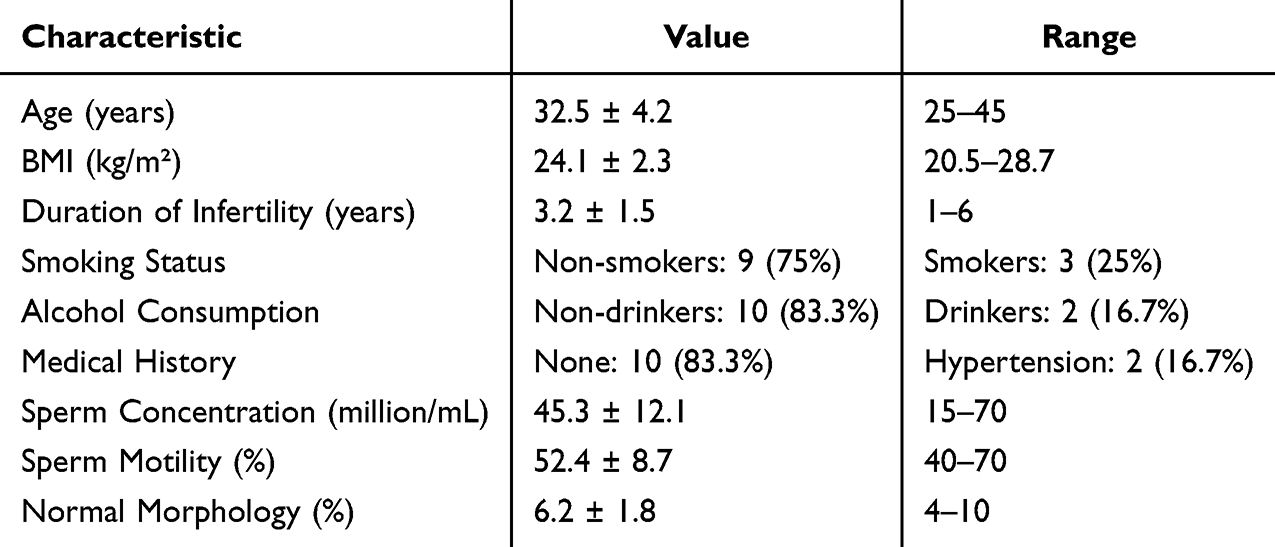 |
Table 1 Patient Demographics and Baseline Characteristics |
Reagents and Semen Samples
The Diff-Quik Stain kit was purchased from Huakang Biomedical (Shenzhen, China). The Sperm DNA fragment staining kit and sperm ROS staining (DCFH-DA and MitoSOX Red) kit were purchased from Puhua Technology (Chengdu, China). Semen were obtained from 12 patients who had routine semen analysis conducted according to the 5th edition World Health Organization laboratory manual (WHO, 2010). Semen samples remaining after semen analysis were used for sperm preparation using swim-up, density-gradient centrifugation and microfluidic sorting.
Sperm Preparation
Each semen sample was thoroughly mixed and divided into three equal portions, then three sperm preparation techniques are used: swim-up, density-gradient centrifugation, and microfluidics sorting.
In the swim-up technique, 2 mL of culture medium were added into a 15 mL conical tube, and then 1 mL of semen was carefully added under the culture medium. The centrifuge tube was tilted at a 45° angle to increase the contact area between the semen and the culture medium, and then incubated at 37°C for 1 h. After incubation, the tube was gently held upright, and 1 mL of the upper layer of medium containing motile sperm was aspirated and transferred to a new test tube for further testing.
The density-gradient centrifugation technique involved placing a layer of ISolate culture medium (1 mL) with 80% density on top of another layer (1 mL) with 40% density in a 15-mL conical tube (Cook, Australia). The semen (1 mL) was layered on top of the ISolate and centrifuged at 300 ×g for 15 min at room temperature. After centrifugation, the semen and two layers of Isolate were removed, leaving the sperm pellet in the tube. The sperm pellet was then mixed with 5 mL Sperm Washing Solution (Cook, Australia) and centrifuged at 200 ×g for 5 min. The supernatant was removed, and the sperm pellet was resuspended in 0.4 mL of Sperm Washing Medium for analysis.
The microfluidic sorting of sperm was performed using a commercially available microfluidic chip device, which consists of an inlet sample chamber and a single-use chip with microfluidic channels connected to an outlet chamber (Puhua Technology, Chengdu, China) (Figure 1). The microfluidic chip was made of a polycarbonate filtration membrane with a pore size of 5μm, allowing passage of normally motile sperm because the width of a normal sperm head ranges from 2.5 to 3.2μm. The microchannels between the inlet and outlet restricted the migration of damaged sperm hydrodynamically while allowing motile sperm to progress towards the outlet. Prior to adding the semen, the microfluidic chip was loaded with Sperm Washing Medium, and a total of 1 milliliter of semen was processed. It was then incubated at 37°C for 30 min. The processed sample was collected from the outlet of the chip for evaluation.
 |
Figure 1 The microfluidic sorting device, a single-use chip with an inlet sample chamber connected to an outlet collection chamber by a microfluidic channel. The microfluidic channel is made of a polycarbonate filter with a pore diameter of 5 μm. The dimensions of the microchannels between the inlet and outlet port hydrodynamically constrain the migration of compromised sperm while allowing motile sperm to swim towards the outlet. |
Computer-Assisted Sperm Analysis (CASA) of Sperm Concentration and Motility
A CASA system (Hamilton IVOS II, USA) was used to measure sperm concentration, motility, and progressive forward motility as previously described.20 After processing, an aliquot of sperm was added into a microcell slide chamber with a depth of 20 μm (Goldcyto Biotech Corp, Guangzhou, China). The slide was then analyzed under pseudo-dark-field illumination. For each sample, 10 randomly selected fields containing >200 moving sperm cell tracks were examined at 60 hz. The concentration of sperm, the percentage of motility, and the percentage of progressive forward motility were recorded.
Assessment of Sperm Morphology
A sperm smear on a glass slide was prepared. After air-drying, the slides were stained using the Diff-Quik Stain kit following the manufacturer’s instructions. Sperm morphology assessment was performed using bright field optics at a magnification of ×1000 with oil immersion. Duplicates of 200 spermatozoa per sample were assessed, and the percentage of normal forms was calculated.
Assessment of Sperm DFI
The Sperm DFI was evaluated using flow cytometry and the DFI kit as per the manufacturer’s instruction. In brief, a 10 μL aliquot of mixed sperm suspension was taken and sequentially combined with 100 μL of solution A and 200 μL of solution B from the kit. This was followed by adding 600 μL of staining solution (acridine orange). The cells were then analyzed using flow cytometry.
Measurement of Sperm ROS
Sperm ROS levels were measured using flow cytometry and the ROS kit following the manufacturer’s instructions. First, a 30 μL sperm suspension was washed with 1.5 mL of phosphate buffer saline at 200×g for 3 minutes. To quantify the level of H2O2 and mitochondrial O2- in the cells, 300 μL of staining solution containing DCFH-DA and MitoSOX Red mitochondrial superoxide indicator was added to 300 μL of the sperm suspension. The solution was then incubated at 37°C for 30 min. Next, the cell solution was centrifuged at 200×g for 3 min to collect the sperm, which were subsequently resuspended in 300 μL of phosphate-buffered saline and analyzed using flow cytometry.
Sperm Cryopreservation
Motile sperm obtained through three different methods were frozen and stored using the following procedure. The sperm suspension was mixed with a freezing medium (Quinn’s Advantage, USA) and then kept at room temperature for 5 min. It was subsequently transferred to a temperature of 4°C and maintained there for 30 min. After that, the suspension was exposed to liquid nitrogen vapor for 30 min. Finally, the sperm samples were stored in liquid nitrogen for long-term preservation.
Sperm samples were loaded into cryopreservation straws with a volume of 0.5 mL per straw. The straws were then placed in a programmable freezing system (Model Planer Kryo 10 Series II, Planer plc). The programmable freezing system was set to follow a controlled - rate freezing curve. Initially, the temperature was decreased from 4°C to −80°C at a rate of 2°C/min. After reaching −80°C, the samples were directly plunged into liquid nitrogen for long - term storage.
Statistical Analysis
The sample size calculation for this study was based on comparing the DFI among three sperm preparation methods: swim - up, density - gradient centrifugation, and microfluidic sorting. Given the lack of specific prior data, the standard deviation of DFI was estimated at 7 units, drawn from similar studies. A clinically significant difference of 8 units in DFI between microfluidic sorting and density - gradient centrifugation was considered meaningful, as such a change has shown to impact ART outcomes. With a significance level (alpha) of 0.05 and a power of 0.80, using the formula for one - way ANOVA comparing three groups, the sample size per group was calculated. The formula considered the number of groups (k = 3), variance (σ2=49), and squared effect size (δ2=64). Through calculations, a sample size of approximately 10–12 per group was determined. Although multiple comparisons were made, Dunnett’s multiple comparisons test was used, which controls the family - wise error rate without over - conservatism. Thus, a sample size of 12 patients per group was selected, yet future research should aim for larger samples to enhance statistical power and generalizability. Statistical analysis was performed by GraphPad software (version 6, GraphPad Software Inc., San Diego, CA). All data were expressed as mean ± standard error (SEM). One-way analysis of variance (ANOVA) was used. Then, Dunnett’s multiple comparisons test was conducted to compare each of the treatment groups (swim - up, density - gradient centrifugation, and microfluidic sorting) against all other groups pairwise. p<0.05 was considered statistically significant.
Results
Microfluidic Sperm Sorting Enhances Sperm Motility and Normal Morphology
The analysis of sperm motility revealed significant differences among the three preparation methods. Sperm samples processed using microfluidic sorting exhibited the highest total motility, which was significantly higher than that of density-gradient centrifugation and swim-up (Figure 2A). This suggests that microfluidic sorting is more effective in isolating highly motile sperm, which is crucial for successful fertilization. Progressive forward motility, a key parameter for sperm’s ability to reach and fertilize the egg, was also significantly improved in microfluidic-sorted sperm compared to density-gradient centrifugation and swim-up (Figure 2B). However, there was no significant difference in non-progressive forward motility across the three methods (Figure 2C), indicating that microfluidic sorting primarily enhances the progressive movement of sperm, which is more relevant for fertilization success (Figure 2D).
 |
Figure 2 A total and progressive forward motility and concentration of sperm prepared by swim-up, density-gradient centrifugation and microfluidic sorting; (A) a total motility; (B) progressive forward motility; (C) non-progressive forward motility; (D) sperm concentration. Mean ± SEM, n = 12. *P < 0.05, **P < 0.01, ***P < 0.001 compared with density-gradient centrifugation. |
In terms of sperm morphology, microfluidic sorting resulted in a higher percentage of normal sperm forms compared to density-gradient centrifugation, although this difference did not reach statistical significance. Swim-up, on the other hand, showed a slightly lower percentage of normal morphology compared to microfluidic sorting. Representative images of Diff-Quik staining further illustrated the morphological differences, with arrows indicating sperm exhibiting normal head morphology. These findings suggest that microfluidic sorting may be more effective in selecting sperm with normal morphology, which is associated with better fertilization potential and embryo development.
Microfluidic Sorting Improves Sperm DNA Integrity
The DFI was significantly lower in sperm prepared using microfluidic sorting compared to both density-gradient centrifugation and swim-up (Figure 3A). This indicates that microfluidic sorting is more effective in selecting sperm with intact DNA, which is critical for successful fertilization and embryo development. The DFI of fresh semen was also measured as a baseline, showing a higher fragmentation rate compared to all three preparation methods (Figure 3B–E). These results suggest that microfluidic sorting not only reduces DNA fragmentation but also maintains sperm DNA integrity better than traditional methods. The lower DFI in microfluidic-sorted sperm may be attributed to the reduced mechanical stress and oxidative damage during the sorting process, as the method avoids the repeated centrifugation steps associated with density-gradient centrifugation, which can generate ROS and lead to DNA damage.
 |
Figure 3 (A) comparison of DFI between fresh semen and three different sperm preparation methods; (B) DFI of fresh semen; (C) DFI of density-gradient centrifugation; (D) DFI of swim-up; (E) DFI of microfluidic sorting. Mean ± SEM, n = 12, *P < 0.05, **P < 0.01 compared with fresh semen. |
Microfluidic Sorting Reduces Mitochondrial Superoxide Levels Without Affecting Intracellular Hydrogen Peroxide
The levels of ROS were assessed to understand the oxidative stress experienced by sperm during preparation. Intracellular H2O2 levels were similar across all three methods, with no significant differences observed (Figure 4A and C–F). This suggests that the production of H2O2, a common ROS, is not significantly influenced by the choice of sperm preparation method. However, mitochondrial superoxide anion (O2⁻) levels were significantly lower in microfluidic-sorted sperm compared to fresh semen (Figure 4B and C–F). This reduction in mitochondrial O2⁻ levels suggests that microfluidic sorting minimizes oxidative stress, which is known to contribute to DNA damage and reduced sperm quality. The lower O2⁻ levels in microfluidic-sorted sperm may be due to the gentle handling and reduced mechanical stress during the sorting process, which helps preserve mitochondrial function and reduce ROS production.
 |
Figure 4 The ROS of sperm prepared by swim-up, density-gradient centrifugation and microfluidic sorting; (A) ROS-H2O2; (B) ROS-mitochondrial O2−; (C) ROS of fresh semen; (D) ROS of density-gradient centrifugation; (E) ROS of swim-up; (F) ROS of microfluidic sorting. Mean ± SEM, n = 10, ns P >0.05, *P < 0.05 compared with fresh semen. |
Cryopreservation Does Not Increase DNA Fragmentation in Microfluidic-Sorted Sperm
After cryopreservation, the DFI of sperm prepared using microfluidic sorting remained significantly lower compared to density-gradient centrifugation (Figure 5A–D). Similarly, swim-up-prepared sperm also showed lower DFI levels after freezing and thawing, although not as low as those prepared by microfluidic sorting. These findings indicate that microfluidic sorting not only preserves sperm DNA integrity during the preparation process but also maintains it during cryopreservation, which is a common practice in ART. Cryopreservation is known to induce oxidative stress and DNA damage in sperm, but the lower DFI observed in microfluidic-sorted sperm after freezing suggests that this method may mitigate some of the negative effects of cryopreservation. This could be particularly beneficial for ART procedures that rely on frozen sperm, as maintaining DNA integrity is crucial for successful fertilization and embryo development.
 |
Figure 5 Comparison of DFI of frozen thaw sperm after preparing by swim-up, density-gradient centrifugation and microfluidic sorting. (A) comparison of DFI between frozen thaw sperm prepared by density-gradient centrifugation and the other two different sperm preparation methods; (B) DFI of frozen thaw sperm prepared by density-gradient centrifugation; (C) DFI of frozen thaw sperm prepared by swim-up; (D) DFI of frozen thaw sperm prepared by microfluidic sorting. Mean ± SEM, n = 10, ***P < 0.001, ****P < 0.0001 compared with density-gradient centrifugation. |
Discussion
This study compared the swim-up, density-gradient centrifugation, and microfluidic sorting methods in sperm preparation, focusing on their impacts on sperm motility, morphology, DNA integrity, and ROS levels. The results offer important insights into these techniques and have far - reaching implications for ART.
The swim-up method has long been used in sperm preparation for ART. Our results show that swim-up can isolate motile sperm, which is consistent with previous literature.11 After cryopreservation, swim-up - prepared sperm had lower DFI levels compared to those prepared by density-gradient centrifugation. This may be because swim-up selects sperm based on their ability to actively move through the culture medium, which could potentially enrich for sperm with better DNA integrity. However, the swim-up method is not without its drawbacks. As reported previously, it is time - consuming, often requiring a 1 - hour incubation period in our study. This can be a significant bottleneck in a busy ART laboratory. Moreover, the outcome of swim-up is highly dependent on the initial sperm motility and concentration in the sample. In cases of low sperm motility or concentration, the method may not effectively separate high - quality sperm from the rest of the sample. This is because the number of sperm capable of swimming up into the culture medium may be insufficient, leading to a suboptimal selection process. Additionally, swim-up may not completely remove non - viable sperm and debris, which could potentially interfere with subsequent fertilization processes.
Density-gradient centrifugation separates sperm based on their density, aiming to isolate sperm with better motility and morphology. In our study, we found that sperm prepared by density-gradient centrifugation had higher DFI levels compared to those prepared by microfluidic sorting. This finding supports the hypothesis that the repeated centrifugation steps in this method can generate ROS. ROS production during centrifugation is a well - documented concern in the literature.11,12 The mechanical forces exerted during centrifugation can damage sperm membranes and cellular components, leading to an increase in ROS generation. Oxidative stress caused by elevated ROS levels can then result in DNA damage, as reflected by the higher DFI. Although our results support the link between density-gradient centrifugation and increased DFI, some studies have reported contradictory results.21,22 These discrepancies could be due to differences in experimental protocols. For example, the type of density-gradient medium used can vary between studies. Different media may have different osmotic pressures and chemical compositions, which could affect sperm viability and ROS production during centrifugation. Additionally, variations in centrifugation speed, duration, and temperature can also impact the outcome. In our study, we used specific centrifugation conditions, but these may not be directly comparable to those in other studies.
Microfluidic sorting demonstrated significant advantages in our study. Sperm prepared by microfluidic sorting had higher total motility and progressive forward motility compared to density-gradient centrifugation. This is likely because the microfluidic device allows motile sperm to freely migrate through the microchannels while physically restricting the movement of damaged or non - motile sperm. The pore size of the microfluidic chip (5μm in our study) is designed to be slightly larger than the width of a normal sperm head (2.5–3.2μm), enabling the passage of normal sperm while blocking abnormal ones. Microfluidic sorting also led to a significantly lower DFI compared to density-gradient centrifugation and swim-up. This can be attributed to the reduced mechanical stress and oxidative damage during the sorting process. Unlike density-gradient centrifugation, microfluidic sorting does not involve repeated centrifugation, which minimizes the generation of ROS. The lower mitochondrial O2⁻ levels in microfluidic - sorted sperm further support the idea that this method reduces oxidative stress. By maintaining mitochondrial function, microfluidic sorting helps preserve sperm DNA integrity.
In ART, sperm quality is a critical determinant of successful fertilization and embryo development. High DFI is associated with a range of negative outcomes, including reduced fertilization rates, impaired embryo cleavage, and lower pregnancy rates.6–10 Microfluidic sorting’s ability to select sperm with low DFI and high motility offers a potential solution to improve these outcomes. By providing sperm with intact DNA, microfluidic sorting can enhance the chances of successful fertilization and the development of healthy embryos. For patients with high sperm DFI, microfluidic sorting could be a valuable addition to the existing treatment options. Currently, for men with high DFI, options such as antioxidant treatment or surgical sperm extraction from the testis are recommended in ART.23,24 Microfluidic sorting provides an alternative approach that directly selects sperm with better DNA integrity, potentially reducing the need for more invasive or complex interventions.
Cryopreservation is a widely used technique in ART for storing sperm for future use. However, it is known to cause oxidative stress and DNA damage in sperm.25 The freezing and thawing processes can disrupt sperm membranes, increase ROS production, and lead to DNA fragmentation. In our study, we found that microfluidic sorting maintained lower DFI levels even after cryopreservation. This finding is particularly significant for ART procedures that rely on cryopreserved sperm. By reducing the DFI in cryopreserved sperm, microfluidic sorting can potentially improve the success rates of using frozen sperm in ART. It helps preserve sperm DNA integrity during the cryopreservation process, increasing the likelihood of successful fertilization and embryo development when the sperm is thawed and used.
Based on our findings, microfluidic sorting shows great promise as an alternative to traditional sperm preparation methods in ART. However, before it can be widely adopted, several steps need to be taken. Multi - center studies with larger sample sizes are essential. Our current study had a relatively small sample size of 12 patients, which may limit the generalizability of the results. Larger studies involving diverse patient populations from different geographical locations and with various infertility etiologies are needed to confirm the effectiveness of microfluidic sorting. These studies should also include a longer follow - up period to assess long - term clinical endpoints such as live birth rates, pregnancy complications, and the long - term health of offspring. In addition to efficacy, the cost - effectiveness of microfluidic sorting needs to be evaluated. Microfluidic devices and associated reagents may be more expensive than traditional methods initially. However, if microfluidic sorting can improve ART success rates and reduce the need for additional treatments due to failed cycles, it may prove to be cost - effective in the long run.
It should be noted that the Diff - Quik method was used for sperm morphology assessment in our study, not for DFI testing. The Diff - Quik method is a simple and rapid staining technique commonly used to evaluate sperm morphology. It allows for the visualization of sperm head, mid - piece, and tail structures under a light microscope. The advantage of this method is its simplicity and cost - effectiveness, making it accessible in many laboratories. However, it has limitations in terms of sensitivity and specificity. It may not be able to detect subtle morphological abnormalities as accurately as more advanced techniques such as electron microscopy. Additionally, the subjective nature of morphological assessment using Diff - Quik staining can lead to inter - observer variability. The Computer - Assisted Sperm Analysis (CASA) machine is a valuable tool for quantitatively assessing sperm motility and concentration. It provides objective data by analyzing sperm movement patterns. However, CASA has several flaws. CASA algorithms may not accurately represent the complex and diverse movement patterns of sperm. Sperm can exhibit non - linear, circular, or erratic movements, which the machine may misinterpret. For example, sperm with abnormal flagellar function may have a unique movement pattern that is not easily distinguishable from normal sperm by CASA. Factors such as sample preparation can significantly affect the accuracy of CASA measurements. If the sperm sample is not properly mixed, there may be uneven distribution of sperm in the analysis chamber, leading to inaccurate motility and concentration readings. The presence of debris in the sample can also interfere with the machine’s ability to accurately identify and track sperm. Moreover, variations in the optical properties of the sample, such as differences in refractive index, can affect the quality of the images captured by CASA and, consequently, the accuracy of the analysis.
In this study, we investigated the effectiveness of microfluidic sorting compared to traditional sperm preparation methods—swim-up and density-gradient centrifugation—in terms of sperm motility, morphology, DFI, and ROS levels. Our findings suggest that microfluidic sorting is a promising technique for selecting sperm with higher motility, lower DFI, and reduced mitochondrial O2⁻ levels, which could potentially improve outcomes in ART. However, several limitations of this study must be acknowledged. 1) Small Sample Size:One of the primary limitations of this study is the small sample size, with only 12 semen samples analyzed. While the results are promising, the limited number of samples may not provide sufficient statistical power to draw definitive conclusions. A larger sample size is necessary to validate the findings and ensure the generalizability of the results. We recommend consulting with a statistician to perform a formal sample size estimation for a comparative study of this nature. Future studies should aim to include a significantly larger cohort of patients to strengthen the statistical validity of the findings. 2) Single-center study: This study was conducted at a single center, which may limit the generalizability of the results to other populations or clinical settings. Multi-center studies involving diverse patient populations would provide more robust evidence regarding the effectiveness of microfluidic sorting in ART. 3) Short study duration:The study was conducted over a period of 6 months, which may not be sufficient to evaluate the long-term effects of microfluidic sorting on sperm quality and ART outcomes. Longer follow-up studies are needed to assess the clinical implications of this technique, particularly in terms of pregnancy rates and live birth outcomes. 4) Lack of clinical endpoints: While this study focused on laboratory parameters such as sperm motility, morphology, and DFI, it did not evaluate clinical endpoints such as fertilization rates, embryo quality, or pregnancy outcomes. Future studies should incorporate these clinical endpoints to provide a more comprehensive assessment of the benefits of microfluidic sorting in ART. 5) Potential bias in sample selection:The inclusion criteria for this study were based on WHO 2010 guidelines, which may have excluded patients with severe male factor infertility. As a result, the findings may not be applicable to all patient populations, particularly those with more severe sperm abnormalities. Our study followed the WHO 5th edition guidelines for semen analysis, despite the 6th edition being available since 2020. One of the main reasons for this is the widespread use of the 5th edition in previous research. Many studies have used the 5th edition criteria for semen analysis, allowing for better comparison of our results with the existing literature. This consistency in methodology enables a more comprehensive understanding of the data and its implications. However, it is important to note that the 6th edition of the WHO guidelines may offer more refined and updated criteria for semen analysis. The 6th edition may incorporate new research findings on sperm quality and its relationship to fertility. Future studies should consider re - evaluating our findings using the 6th edition criteria. This would ensure that the results are in line with the latest standards and may provide additional insights into the performance of the sperm preparation methods.
Conclusions
In conclusion, microfluidic sorting shows promise in selecting high - quality sperm with better motility, morphology, lower DFI, and reduced mitochondrial O2⁻ levels compared to density - gradient centrifugation. However, further research is needed to validate these findings, especially through larger - scale, multi - center studies with longer follow - up periods and inclusion of clinical endpoints.
Abbreviations
ANOVA, One-way analysis of variance; AR, acrosome reaction; ART, assisted reproductive technologies; CASA, Computer-assisted sperm analysis; DFI, DNA fragmentation index; ROS, reactive oxygen species.
Funding
This work was supported by Sichuan Medical Research Project Program of Sichuan Medical Association (No.S21080 to Z.W.), Chengdu Technology Innovation Research and Development Project of Chengdu Bureau of Science and Technology (No.2022-YF05-01601-SN to R.S.G.).
Disclosure
The authors report no conflicts of interest in this work.
References
1. Levine H, Jorgensen N, Martino-Andrade A, et al. Temporal trends in sperm count: a systematic review and meta-regression analysis. Hum Reprod Update. 2017;23:646–659. doi:10.1093/humupd/dmx022
2. Levine H, Jørgensen N, Martino-Andrade A, et al. Temporal trends in sperm count: a systematic review and meta-regression analysis of samples collected globally in the 20th and 21st centuries. Hum Reprod Update. 2022;dmac035.
3. Lv MQ, Ge P, Zhang J, Yang YQ, Zhou L, Zhou DX. Temporal trends in semen concentration and count among 327 373 Chinese healthy men from 1981 to 2019: a systematic review. Hum Reprod. 2021;36:1751–1775. doi:10.1093/humrep/deab124
4. Agarwal A, Baskaran S, Parekh N, et al. Male infertility. Lancet. 2021;397:319–333. doi:10.1016/S0140-6736(20)32667-2
5. Ammar O, Tekeya O, Hannachi I, Sallem A, Haouas Z, Mehdi M. Increased sperm DNA fragmentation in infertile men with varicocele: relationship with apoptosis, seminal oxidative stress, and spermatic parameters. Reprod Sci. 2021;28:909–919. doi:10.1007/s43032-020-00311-6
6. Evenson DP, Jost LK, Marshall D, et al. Utility of the sperm chromatin structure assay as a diagnostic and prognostic tool in the human fertility clinic. Human Reprod. 1999;14:1039–1049. doi:10.1093/humrep/14.4.1039
7. Spano M, Bonde JP, Hjollund HI, Kolstad HA, Cordelli E, Leter G. Sperm chromatin damage impairs human fertility. Danish First Pregnancy Planner Study Team Fertil Steril. 2000;73:43–50.
8. Robinson L, Gallos ID, Conner SJ, et al. The effect of sperm DNA fragmentation on miscarriage rates: a systematic review and meta-analysis. Hum Reprod. 2008;23:2663–2668. doi:10.1093/humrep/den321
9. Simon L, Murphy K, Shamsi MB, et al. Paternal influence of sperm DNA integrity on early embryonic development. Hum Reprod. 2014;29:2402–2412. doi:10.1093/humrep/deu228
10. Simon L, Emery B, Carrell DT. Sperm DNA fragmentation: consequences for reproduction. Adv Exp Med Biol. 2019;(1166):87–105. doi:10.1007/978-3-030-21664-1_6
11. Zini A, Finelli A, Phang D, Jarvi K. Influence of semen processing technique on human sperm DNA integrity. Urology. 2000;56:1081–1084. doi:10.1016/S0090-4295(00)00770-6
12. Nabi A, Khalili MA, Halvaei I, Roodbari F. Prolonged incubation of processed human spermatozoa will increase DNA fragmentation. Andrologia. 2014;46:374–379. doi:10.1111/and.12088
13. Zalata A, Hafez T, Comhaire F. Evaluation of the role of reactive oxygen species in male infertility. Hum Reprod. 1995;10:1444–1451. doi:10.1093/HUMREP/10.6.1444
14. Cho BS, Schuster TG, Zhu X, Chang D, Smith GD, Takayama S. Passively driven integrated microfluidic system for separation of motile sperm. Anal Chem. 2003;75:1671–1675. doi:10.1021/ac020579e
15. Schuster T, Cho B, Keller LM, Takayama S, Smith GD. Isolation of motile spermatozoa from semen samples using microfluidics. Reprod Biomed Online. 2003;7:75–81. doi:10.1016/S1472-6483(10)61732-4
16. Zhang X, Khimji I, Gurkan UA, et al. Lensless imaging for simultaneous microfluidic sperm monitoring and sorting. Lab Chip. 2011;11:2535–2540. doi:10.1039/c1lc20236g
17. Tasoglu S, Safaee H, Zhang X, et al. Exhaustion of racing sperm in nature-mimicking microfluidic channels during sorting. Small. 2013;9:3374–3384. doi:10.1002/smll.201300020
18. Asghar W, Velasco V, Kingsley JL, et al. Selection of functional human sperm with higher DNA integrity and fewer reactive oxygen species. Adv Healthcare Mater. 2014;3:1671–1679. doi:10.1002/adhm.201400058
19. Shirota K, Yotsumoto F, Itoh H, et al. Separation efficiency of a microfluidic sperm sorter to minimize sperm DNA damage. Fertil Steril. 2016;105:315–321. doi:10.1016/j.fertnstert.2015.10.023
20. Mortimer ST, Swan MA, Mortimer D. Effect of seminal plasma on capacitation and hyperactivation in human spermatozoa. Hum Reprod. 1998;13:2139–2146. doi:10.1093/humrep/13.8.2139
21. Malvezzi H, Sharma R, Agarwal A, Abuzenadah AM, Abu-Elmagd M. Sperm quality after density gradient centrifugation with three commercially available media: a controlled trial. Reprod Biol Endocrinol. 2014;12:121.
22. Wang M, Sun J, Wang L, et al. Assessment of density gradient centrifugation (DGC) and sperm chromatin dispersion (SCD) measurements in couples with male factor infertility undergoing ICSI. Assist Reprod Genet. 2014;31:1655–1663.
23. Bradley CK, McArthur SJ, Gee AJ, Weiss KA, Schmidt U, Toogood L. Intervention improves assisted conception intracytoplasmic sperm injection outcomes for patients with high levels of sperm DNA fragmentation: a retrospective analysis. Andrology. 2016;4,903–910.
24. Esteves SC, Sanchez-Martin F, Sanchez-Martin P, Schneider DT, Gosalvez J. Comparison of reproductive outcome in oligozoospermic men with high sperm DNA fragmentation undergoing intracytoplasmic sperm injection with ejaculated and testicular sperm. Fertil Steril. 2015;104:1398–1405. doi:10.1016/j.fertnstert.2015.08.028
25. Raad G, Lteif L, Lahoud R, et al. Cryopreservation media differentially affect sperm motility, morphology and DNA integrity. Andrology. 2018;6,836–845.
 © 2025 The Author(s). This work is published and licensed by Dove Medical Press Limited. The
full terms of this license are available at https://www.dovepress.com/terms
and incorporate the Creative Commons Attribution
- Non Commercial (unported, 4.0) License.
By accessing the work you hereby accept the Terms. Non-commercial uses of the work are permitted
without any further permission from Dove Medical Press Limited, provided the work is properly
attributed. For permission for commercial use of this work, please see paragraphs 4.2 and 5 of our Terms.
© 2025 The Author(s). This work is published and licensed by Dove Medical Press Limited. The
full terms of this license are available at https://www.dovepress.com/terms
and incorporate the Creative Commons Attribution
- Non Commercial (unported, 4.0) License.
By accessing the work you hereby accept the Terms. Non-commercial uses of the work are permitted
without any further permission from Dove Medical Press Limited, provided the work is properly
attributed. For permission for commercial use of this work, please see paragraphs 4.2 and 5 of our Terms.