
Back to Journals » International Journal of Women's Health » Volume 17
Comparative Efficacy of Abdominal Aortic ABO (AABO) vs Common Iliac Artery ABO (CIABO) in Cesarean Delivery for Central Placenta Previa with Placenta Accreta: A Retrospective Study
Authors Cao Y, Zhao Y, Ren J, Ma L, Wu Z, Lv Q
Received 13 December 2024
Accepted for publication 18 March 2025
Published 9 April 2025 Volume 2025:17 Pages 1001—1008
DOI https://doi.org/10.2147/IJWH.S512150
Checked for plagiarism Yes
Review by Single anonymous peer review
Peer reviewer comments 2
Editor who approved publication: Dr Matteo Frigerio
Yumei Cao,1 Yunxia Zhao,1 Jianlei Ren,1 Lan Ma,2 Zhenlan Wu,1 Qingliang Lv3
1Obstetrical Center, Weifang People’s Hospital, Weifang City, Shandong Province, 261400, People’s Republic of China; 2Obstetrics and Gynecology Department, Weifang Maternal and Child Health Care Hospital, Weifang City, Shandong Province, 261400, People’s Republic of China; 3Interventional Radiology, Weifang People’s Hospital, Weifang City, Shandong Province, 261400, People’s Republic of China
Correspondence: Qingliang Lv, Interventional Radiology, Weifang People’s Hospital, No. 151, Guangwen Street, Quiwen District, Weifang City, Shandong Province, 261400, People’s Republic of China, Email [email protected]
Objective: To compare the safety and efficacy of abdominal aortic balloon occlusion (AABO) and common iliac artery balloon occlusion (CIABO) in cesarean deliveries for central placenta previa with placenta accreta, using a retrospective study design.
Methods: We retrospectively analyzed 65 patients with central placenta previa and placenta accreta who underwent cesarean delivery at our hospital between January 2020 and April 2024. Patients were divided into two groups: the observation group (n=35) received AABO, while the control group (n=30) received CIABO. Outcomes compared included intraoperative blood loss, maternal and neonatal outcomes, and other relevant factors. Data were analyzed using SPSS 26.0, with normally distributed quantitative data assessed by t-tests and categorical data by chi-square tests. A p-value < 0.05 was considered significant.
Results: The AABO group had significantly reduced balloon placement time, radiation exposure, intraoperative blood loss (mean 800 ± 150 mL vs 1200 ± 180 mL in CIABO; p< 0.05), and transfusion volume (mean 400 ± 100 mL vs 600 ± 120 mL in CIABO; p< 0.05). The hysterectomy rate was lower in the AABO group (5.7% vs 16.7% in CIABO; p< 0.05). No significant differences were observed in postpartum hemorrhage (14.3% vs 13.3%; p> 0.05) or neonatal asphyxia (2.9% vs 3.3%; p> 0.05). Postoperative coagulation function at 24 hours was better in the AABO group (p< 0.05), with no significant difference in postoperative complications (p> 0.05).
Conclusion: AABO in cesarean deliveries for central placenta previa with placenta accreta reduces intraoperative blood loss and hysterectomy rates without adverse fetal effects, making it a valuable clinical option.
Keywords: abdominal aortic ABO, central placenta previa, placenta accreta, cesarean delivery
Introduction
Placenta previa occurs when the placental tissue is abnormally located in the lower uterine segment after 28 weeks of pregnancy, with its lower edge contacting or completely covering the internal cervical os, leading to severe obstetric complications that pose significant risks to maternal life due to the high likelihood of hemorrhage.1,2 Central placenta previa, a common type, increases the risk of placenta accreta, which can trigger uncontrollable hemorrhage, raising the risk of hysterectomy and postpartum mortality.3 Placenta accreta spectrum disorder (PAS) is a life-threatening pregnancy complication associated with significant maternal morbidity and mortality. The global prevalence of PAS has increased from 0.01% to 1.1% in recent decades. Unmanageable and catastrophic hemorrhage is the most common and serious complication of PAS, which may easily lead to hysterectomy, hemorrhagic shock, and even maternal-fetal death. With advancements in interventional techniques, prophylactic ABO (PBO) has emerged as a potential management strategy for controlling massive hemorrhage in patients with PAS.4 Two commonly used PBO approaches are abdominal aortic ABO (AABO) and common iliac artery ABO (CIABO). AABO involves placing a balloon catheter in the abdominal aorta near the renal arteries to occlude blood flow, thereby reducing uterine perfusion during cesarean delivery. CIABO, on the other hand, involves occluding the common iliac arteries bilaterally.5,6 However, the optimal interventional strategy for central placenta previa with placenta accreta remains controversial. While some studies have reported benefits of AABO in reducing intraoperative blood loss and the rate of hysterectomy, others have shown conflicting results. Additionally, PBO may bring complications such as thrombosis diseases, hematoma, and rarely artery rupture. Despite accumulated studies on ABO as a management strategy for PAS, current evidence remains inconclusive due to the limited literature and cases available. The risks and benefits of PBO have not been well described, highlighting the need for further investigation to address the research gap in this field. This study aims to evaluate the safety and efficacy of Aortic ABO (ABO) techniques, specifically comparing AABO with CIABO in patients with central placenta previa and placenta accreta.
Materials and Methods
Clinical Data
A retrospective analysis was conducted on 65 patients with central placenta previa and placenta accreta who delivered at our hospital between January 2020 and April 2024. The patients were divided into two groups based on the intervention method: 35 cases in the observation group, with an age range of 20–38 years (mean 30.0±2.2 years), gestational age of 30–38 weeks (mean 35.0±1.1 weeks), and body mass index (BMI) of 22–28 kg/m² (mean 24.3±1.9 kg/m²); and 30 cases in the control group, with an age range of 20–39 years (mean 30.0±2.2 years), gestational age of 29–38 weeks (mean 35.0±1.1 weeks), and BMI of 22–28 kg/m² (mean 24.5±1.8 kg/m²). The two groups were comparable in baseline characteristics (P>0.05). The baseline characteristics of the study population are detailed in Table S1.
Inclusion and Exclusion Criteria
Inclusion criteria: (1) Patients diagnosed with central placenta previa and placenta accreta via ultrasound or other imaging before cesarean delivery.7,8 (2) Gestational age>28 weeks; (3) Singleton pregnancy; (4) Indication for cesarean delivery; (5) Complete clinical data available.
Exclusion criteria: (1) Indication for hysterectomy; (2) Complications such as premature rupture of membranes or placental abruption that could lead to infection or hemorrhage; (3) Coagulation disorders, hematologic diseases, or immune diseases; (4) Major organ diseases (heart, liver, kidney); (5) Malignancies; (6) Incomplete clinical data.
Methods
Both groups underwent cesarean delivery at our hospital, with preoperative assessments including coagulation, blood, urine, and electrocardiogram tests. The same team of experienced obstetricians performed all cesarean deliveries. To ensure consistency and minimize variability, all procedures were standardized, and the team underwent regular training sessions to maintain proficiency in the techniques.
Preoperative Imaging Standardization
Preoperative imaging was standardized using high-resolution ultrasound and, in some cases, magnetic resonance imaging (MRI) to confirm the diagnosis of central placenta previa and placenta accreta. All imaging was reviewed by a team of radiologists specializing in obstetric imaging to ensure accurate diagnosis and consistent interpretation.
AABO Procedure
In the observation group, Aortic Aortic ABO (AABO) was performed before cesarean delivery: After epidural anesthesia, patients were placed in the supine position with continuous electrocardiographic monitoring. Under digital subtraction angiography (DSA) guidance, the abdomen and bilateral groins were sterilized, and 2% lidocaine (Shandong Hualu Pharmaceutical Co., Ltd., National Drug Approval Number H37022147) was used for local anesthesia. The right femoral artery was punctured to insert an 8F sheath, through which a water-coated guidewire was introduced. A balloon catheter was then positioned in the abdominal aorta near the renal arteries. The balloon was gradually inflated with saline based on the diameter of the aorta to occlude the abdominal aorta while maintaining normal renal artery blood flow. The balloon diameter was determined using the aortic diameter measured during DSA, with a safety margin to ensure effective occlusion without compromising renal perfusion. After occlusion, the balloon was deflated, and the catheter sheath was secured. General anesthesia was induced, and cesarean delivery was performed. The balloon was reinflated immediately after delivery of the fetus to occlude the abdominal aorta, with each occlusion lasting no more than 50 minutes. The balloon was deflated and reinflated every 15 minutes during surgery to prevent prolonged ischemia.
CIABO Procedure
In the control group, Common Iliac Artery ABO (CIABO) was performed before cesarean delivery with similar preoperative preparation as in the observation group. The femoral arteries were punctured bilaterally, and catheters were introduced into the bilateral internal iliac arteries. The balloons were inflated after contrast agent injection to achieve occlusion. The cesarean delivery was then performed. After delivery, the balloons were reinflated. Depending on the area of placental implantation, placental removal, partial uterine wall resection, and uterotonic drugs such as oxytocin and carboprost tromethamine were administered. Some patients required uterine tamponade or modified B-Lynch suture. Postoperatively, routine infection prevention measures were implemented, and hysterectomy was performed if bleeding could not be controlled.
Outcome Measures
Statistical Analysis
Data analysis was performed using SPSS 26.0 statistical software. Normally distributed quantitative data were expressed as mean ± standard deviation (±s) and analyzed using t-tests; categorical data were expressed as percentages (%) and analyzed using chi-square tests. A P-value <0.05 was considered statistically significant. The sample size was determined based on a power analysis to detect a clinically significant difference in intraoperative blood loss and hysterectomy rates between the two groups, with an assumed power of 80% and a significance level of 0.05.
Results
Balloon Placement
The observation group (AABO) had significantly shorter balloon placement time, lower exposure dose, and shorter exposure time compared to the control group (CIABO) (P<0.05) (Table 1 and Figure 1). These findings suggest that AABO may be more efficient in terms of procedural setup and radiation exposure.
 |
Table 1 Comparison of Two Groups’ Delivery Information (Mean ± SD) |
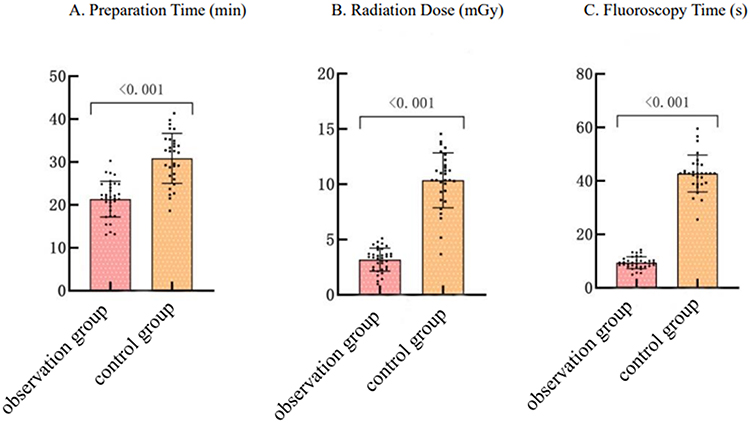 |
Figure 1 Comparison of Balloon Placement-Related Differences. The control group and the observation group showed significant differences in Preparation Time (A), Radiation Dose (B), and Fluoroscopy Time (C) (P<0.001). |
Cesarean Delivery Indicators
There was no significant difference in cesarean delivery time between the two groups (P>0.05). However, the observation group (AABO) had significantly less intraoperative blood loss (mean 800 ± 150 mL vs 1200 ± 180 mL in the control group, P<0.05) and transfusion volume (mean 400 ± 100 mL vs 600 ± 120 mL in the control group, P<0.05) (see Table 2 and Figure 2). The slightly higher transfusion requirements in the control group may reflect the greater blood loss experienced during cesarean delivery, highlighting the clinical significance of AABO in reducing intraoperative hemorrhage.
 |
Table 2 Comparison of Cesarean Section Information (Mean ± SD) |
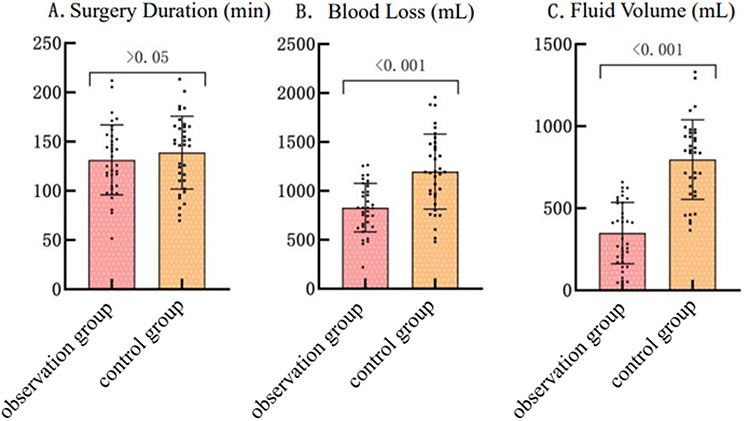 |
Figure 2 Comparison of Surgery-Related Differences. There was no significant difference in Surgery Duration between the control group and the observation group (A), (P>0.05); however, significant differences were observed in Blood Loss (B), (P<0.001) and Fluid Volume (C), (P<0.001). |
Maternal and Neonatal Outcomes
The hysterectomy rate in the observation group (AABO) was significantly lower than in the control group (CIABO) (5.7% vs 16.7%, P<0.05), indicating that AABO may be more effective in preserving uterine integrity and reducing the need for emergency hysterectomy. There were no significant differences in postpartum hemorrhage (14.3% vs 13.3%, P>0.05) or neonatal asphyxia (2.9% vs 3.3%, P>0.05) between the groups (Table 3).
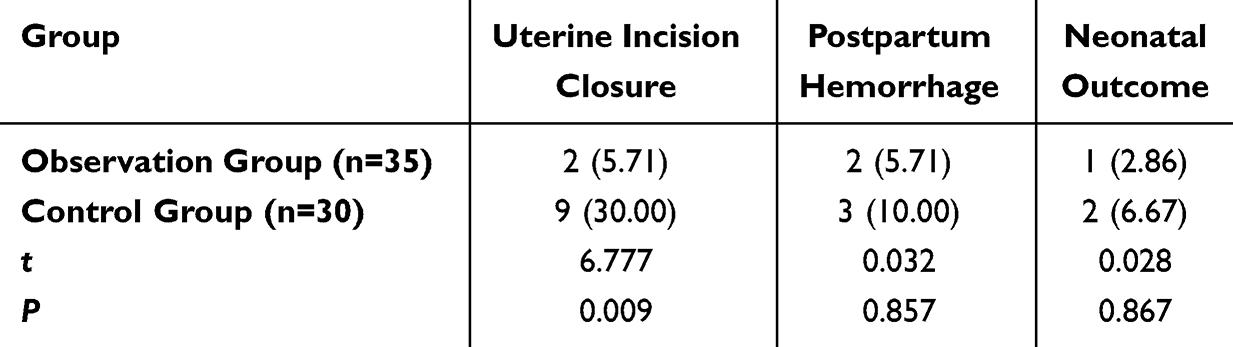 |
Table 3 Comparison of Maternal Outcomes Between Two Groups (Mean ± SD) |
Coagulation Function
There were no significant differences in preoperative coagulation parameters between the groups (P>0.05). However, postoperative coagulation parameters showed significant differences, with the observation group (AABO) demonstrating better coagulation function at 24 hours post-operation (P<0.05) (Table 4). This suggests that AABO may have a more favorable impact on postoperative hemostasis.
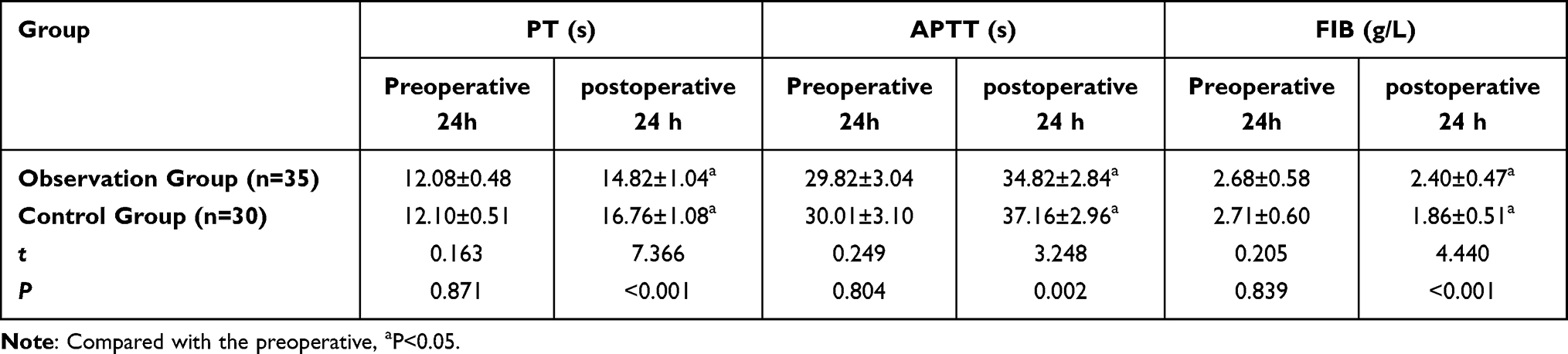 |
Table 4 Comparison of Coagulation Function Between Two Groups (Mean ± SD) |
Complications
One case of femoral artery thrombosis occurred in the observation group (2.86% incidence rate), while the control group had one case of femoral artery thrombosis and one case of bladder injury (6.67% incidence rate). There was no significant difference between the groups in terms of complication rates (chi-square=0.019, P=0.891).
Intraoperative Decision-Making and Clinical Significance
Intraoperative decisions, such as the use of uterine tamponade or modified B-Lynch suture, were made based on the severity of bleeding and the area of placental implantation. These interventions were more frequently required in the control group (CIABO) due to higher intraoperative blood loss. The clinical significance of the slightly higher transfusion requirements in the control group underscores the importance of effective hemorrhage control, which AABO appears to provide more efficiently.
Discussion
Central placenta previa refers to the complete coverage of the internal cervical os by placental tissue, often leading to repeated, painless, and unprovoked vaginal bleeding in pregnant women.9 This condition is frequently complicated by placenta accreta, significantly increasing the risk of intrapartum and postpartum hemorrhage, making it a dangerous condition with severe implications. Early intervention before cesarean delivery is recommended to reduce blood loss and ensure maternal and neonatal safety. Recent advancements in interventional techniques, such as abdominal aortic ABO (AABO) and common iliac artery ABO (CIABO), have shown promise in reducing postpartum hemorrhage and improving maternal safety. However, the optimal interventional strategy remains under debate.
This study demonstrated that AABO reduced balloon placement time, exposure dose and duration, intraoperative blood loss, and transfusion volume compared to CIABO (P<0.05). AABO shortens balloon threshold time, avoids repeated fluoroscopy, and effectively reduces intraoperative blood loss. During cesarean delivery, ABO quickly reduces uterine blood flow, allowing the balloon to be deflated if no bleeding occurs, thus restoring normal uterine blood supply postoperatively.10 In contrast, CIABO may be less effective due to the rich collateral blood supply in the pelvic tissues, particularly from the median sacral artery, which remains unoccluded during CIABO, leading to suboptimal hemostasis.11 AABO effectively reduces intraoperative blood loss by quickly occluding the abdominal aorta, thereby minimizing uterine blood flow.12 In contrast, CIABO may be less effective due to the rich collateral blood supply in the pelvic tissues, particularly from the median sacral artery, which remains unoccluded during CIABO, leading to suboptimal hemostasis. AABO, by compressing the major pelvic blood supply branches, effectively reduces intraoperative blood loss and minimizes the risk of repeated hemorrhage during surgery.13
The study further showed that the hysterectomy rate in the observation group (5.7%) was significantly lower than in the control group (30.0%) (P<0.05), with no significant differences in postpartum hemorrhage, neonatal asphyxia, or postoperative complications between the groups (P>0.05). This indicates that AABO reduces the likelihood of hysterectomy due to uncontrolled hemorrhage during delivery. Previous research by Song Ruixiang et al14 also supports this finding, reporting a lower hysterectomy rate with AABO (6.5%) compared to CIABO (29.0%) (P<0.05). The primary reason is that pelvic tissues may have ectopic blood supply from the external iliac artery in some patients, leading to ineffective hemostasis when only the common iliac artery is occluded. AABO can block multiple blood supply branches in the pelvic tissues, reducing the risk of excessive hemorrhage and thereby lowering the hysterectomy rate. Some studies15 have suggested that fetal hypoxia may be induced by ABO before delivery, but the study found low rates of neonatal asphyxia with both occlusion techniques, indicating that preoperative ABO does not compromise maternal and neonatal safety. However, the small sample size may have influenced these findings, necessitating further research to confirm the safety of these techniques. The study also found that postoperative coagulation function was impaired in both groups, but to a lesser extent in the observation group. This may be because excessive intraoperative blood loss in both groups leads to coagulation dysfunction, but AABO reduces blood loss, minimizing its impact on coagulation function.
To enhance the safety of AABO, obstetricians must ensure that the balloon is positioned in the abdominal aorta distal to the renal arteries to prevent renal ischemia. Intermittent occlusion should be used, with single occlusion times kept under 60 minutes to avoid compromising lower limb blood supply. Additionally, the balloon size should be selected according to the diameter of the abdominal aorta, and care should be taken to avoid damaging the vascular intima during inflation.16 Postoperative bleeding may still occur from insufficiently controlled sites after balloon removal, requiring obstetricians to use appropriate measures such as medication or uterine tamponade to minimize postpartum hemorrhage and ensure maternal safety.
In conclusion, AABO during cesarean delivery for patients with central placenta previa and placenta accreta can effectively reduce intraoperative blood loss, lower the risk of postpartum hysterectomy, and minimize coagulation dysfunction without adversely affecting the fetus, making it a valuable clinical option. However, due to the small sample size and the retrospective nature of this study, the accuracy of the findings may be subject to bias. Future prospective studies with larger sample sizes are needed to provide more scientific evidence for the management of placenta previa with placenta accreta.
Conclusion
Our study highlights the clinical benefits of abdominal aortic ABO (AABO) over common iliac artery ABO (CIABO) in managing central placenta previa with placenta accreta, demonstrating significant reductions in intraoperative blood loss, transfusion volume, and hysterectomy rates. These findings provide valuable evidence to support the use of AABO as a preferred interventional strategy in high-risk pregnancies, addressing existing controversies and gaps in the literature. Future research should focus on larger prospective studies to further validate these results and refine clinical guidelines for the management of placenta previa with accreta.
Data Sharing Statement
The datasets used and analysed during the current study available from the corresponding author on reasonable request.
Ethics Approval and Consent to Participate
Weifang People’s Hospital IRB reviewed and waived the need for formal ethical approval and patient consent for this retrospective medical records analysis, as it involves anonymized data with no patient risk. The study adheres to the hospital’s ethical guidelines and Declaration of Helsinki principles. All data were anonymized, de-identified, and handled in compliance with data protection policies.
Author Contributions
All authors made a significant contribution to the work reported, whether that is in the conception, study design, execution, acquisition of data, analysis and interpretation, or in all these areas; took part in drafting, revising or critically reviewing the article; gave final approval of the version to be published; have agreed on the journal to which the article has been submitted; and agree to be accountable for all aspects of the work.
Funding
The work was not funded by any funding.
Disclosure
The authors declared that they have no conflicts of interest regarding this work.
References
1. Ogoyama M, Takahashi H, Baba Y, et al. Bleeding-related outcomes of low-risk total placenta previa are equivalent to those of partial/marginal placenta previa. Taiwan J Obstet Gynecol. 2022;61(3):447–452. doi:10.1016/j.tjog.2022.03.007
2. Liu H, Zhang B, Wang W, et al. Effect of placenta location detected by ultrasound on the severity of placenta accreta spectrum in patients with placenta previa and placenta accreta spectrum. BMC Pregnancy Childbirth. 2023;23(1):406. doi:10.1186/s12884-023-05736-w
3. Alhashim ZG, Alzayer ZA, Alensaif AA, et al. Blood transfusion predictors in cesarean sections for pregnancies with placenta accreta and placenta previa: a monocentric tertiary experience. Cureus. 2023;15(10):47648.
4. Murayama Y, Seki H, Takeda S. Intra-arterial ABO to reduce operative bleeding for placenta previa accreta spectrum. Surg J. 2021;7(Suppl 1):S11–S19.
5. Wang Y, Jiang T, Huang G, et al. Long-term follow-up of abdominal aortic ABO for the treatment of pernicious placenta previa with placenta accreta. J Interv Med. 2020;3(1):34–36. doi:10.1016/j.jimed.2020.01.004
6. Bae JG, Kim YH, Kim JY, et al. The feasibility and safety of temporary transcatheter ABO of bilateral internal iliac arteries during cesarean section in a hybrid operating room for placenta previa with a high risk of massive hemorrhage. J Clin Med. 2022;11(8):2160. doi:10.3390/jcm11082160
7. Jauniaux E, Bhide A. Prenatal ultrasound diagnosis and outcome of placenta previa accreta after cesarean delivery: a systematic review and meta-analysis. Am J Obstet Gynecol. 2017;217(1):27–36. doi:10.1016/j.ajog.2017.02.050
8. Horgan R, Abuhamad A. Placenta accreta spectrum: prenatal diagnosis and management. Obstet Gynecol Clin North Am. 2022;49(3):423–438. doi:10.1016/j.ogc.2022.02.004
9. Li P, Liu X, Li X, et al. Clinical outcomes and anesthetic management of pregnancies with placenta previa and suspicion for placenta accreta undergoing intraoperative abdominal aortic ABO during cesarean section. BMC Anesthesiol. 2020;20(1):133. doi:10.1186/s12871-020-01040-8
10. Luo Y, Qin Q, Zhao Y, et al. Application of abdominal aortic ABO combined with tourniquet in pregnant women with severe placenta accreta spectrum. Curr Med Sci. 2022;42(3):606–612. doi:10.1007/s11596-022-2584-6
11. Saito K, Mariya T, Fujibe Y, et al. Common iliac artery dissection as a complication of common iliac artery ABO for placenta percreta: a case report. J Obstet Gynaecol Res. 2021;47(3):1172–1177. doi:10.1111/jog.14601
12. Yin H, Hu R. Outcomes of prophylactic abdominal aortic ABO in patients with placenta previa accreta: a propensity score matching analysis. BMC Pregnancy Childbirth. 2022;22(1):502. doi:10.1186/s12884-022-04837-2
13. Huo F, Liang H, Feng Y. Prophylactic temporary abdominal aortic ABO for patients with pernicious placenta previa: a retrospective study. BMC Anesthesiol. 2021;21(1):134. doi:10.1186/s12871-021-01354-1
14. Cui S, Zhi Y, Cheng G, et al. Retrospective analysis of placenta previa with abnormal placentation with and without prophylactic use of abdominal aorta ABO. Int J Gynaecol Obstet. 2017;137(3):265–270. doi:10.1002/ijgo.12132
15. Liu Y, Shan N, Yuan Y, et al. The clinical evaluation of preoperative abdominal aortic ABO for patients with placenta increta or percreta. J Matern Fetal Neonatal Med. 2022;35(25):6084–6089. doi:10.1080/14767058.2021.1906219
16. Huang F, Wang J, Liu X, et al. Timing of intra-abdominal aortic ABO for prevention of hemorrhage in patients with placenta previa and placenta accreta spectrum. Int J Gynaecol Obstet. 2023;163(3):989–996. doi:10.1002/ijgo.14909
 © 2025 The Author(s). This work is published and licensed by Dove Medical Press Limited. The
full terms of this license are available at https://www.dovepress.com/terms
and incorporate the Creative Commons Attribution
- Non Commercial (unported, 4.0) License.
By accessing the work you hereby accept the Terms. Non-commercial uses of the work are permitted
without any further permission from Dove Medical Press Limited, provided the work is properly
attributed. For permission for commercial use of this work, please see paragraphs 4.2 and 5 of our Terms.
© 2025 The Author(s). This work is published and licensed by Dove Medical Press Limited. The
full terms of this license are available at https://www.dovepress.com/terms
and incorporate the Creative Commons Attribution
- Non Commercial (unported, 4.0) License.
By accessing the work you hereby accept the Terms. Non-commercial uses of the work are permitted
without any further permission from Dove Medical Press Limited, provided the work is properly
attributed. For permission for commercial use of this work, please see paragraphs 4.2 and 5 of our Terms.