
Back to Journals » Clinical Epidemiology » Volume 17
Cohort Update: ESPRESSO (Epidemiology Strengthened by Histopathology Reports in Sweden)
Authors Ludvigsson JF  , Lashkariani M
Received 9 October 2024
Accepted for publication 4 February 2025
Published 25 February 2025 Volume 2025:17 Pages 193—196
DOI https://doi.org/10.2147/CLEP.S499859
Checked for plagiarism Yes
Review by Single anonymous peer review
Peer reviewer comments 2
Editor who approved publication: Dr Thomas Ahern
Jonas F Ludvigsson,1– 3 Mariam Lashkariani1
1Department of Medical Epidemiology and Biostatistics, Karolinska Institutet, Stockholm, Sweden; 2Department of Paediatrics, Örebro University Hospital, Örebro, Sweden; 3Department of Medicine, Columbia University College of Physicians and Surgeons, New York, NY, USA
Correspondence: Jonas F Ludvigsson, Department of Medical Epidemiology, Karolinska Institutet, Stockholm, Sweden, Tel +46 (0) 8-52480000, Fax +46 (0) 8-314975, Email [email protected]
Background
A profile paper regarding the ESPRESSO cohort (Epidemiology Strengthened by histopathology Reports in Sweden)1 was published by our team in 2019. The aim of the current research letter was to account for the revised data collection process until 31 December 2023.
For the original ESPRESSO cohort (2015–2017), we contacted all pathology departments (n=28) in Sweden to obtain histopathology record data of the digestive system (from pharynx to anus), liver, gallbladder, and pancreas. We asked local IT personnel to retrieve data on the personal identity number (a unique number in Sweden used to link the histopathology data to other Swedish databases), the date of histopathology, topography (the location from which the histopathology is obtained; relevant topography codes being T56-T69), morphology (the histopathology appearance), and, where available, free text. We identified some 2.1 million unique individuals with at least one histopathology report spanning from 1965 to 2017. Since many participants had multiple histopathology reports, the total number of reports was around 6.1 million.1 The government agency Statistics Sweden then performed a matching process in which each individual was paired with up to five controls from the general population. The matching variables included sex, birth year, calendar year, and county of residence. Statistics Sweden subsequently identified first-degree relatives and spouses for both cases with histopathology reports and controls. Therefore, the total population of the ESPRESSO cohort until 2017 was 13.0 million.1 The included individuals have since been linked to Sweden’s nationwide administrative healthcare registers: the Cause of Death Register, the Patient Register, the Cancer Register, the Medical Birth Register, the Prescribed Drug Register, and the Total Population Register.2
Since its establishment in 2019, the ESPRESSO cohort has generated more than 120 publications. A number of these publications have included patient chart validation showing high accuracy for serrated polyps (positive predictive value (PPV)=95%; 95% confidence interval, CI=89–98%),3 and eosinophilic esophagitis (PPV=89%; 95% CI=82–94%).4 Using free text data from histopathology reports as the gold standard, we also conducted a further investigation into the validity of Systematized Nomenclature of Medicine (SnoMed) codes within the ESPRESSO database to identify metabolic dysfunction-associated steatotic liver disease (MASLD)/non-alcoholic fatty liver disease (NAFLD; PPV=92%; 95% CI=86–96%).5 However, we acknowledge that the validity of ESPRESSO may differ between different conditions.
New Data Collection
The original data collection for ESPRESSO occurred between 12 October 2015 and 10 April 2017. As a result, a few Swedish pathology departments had incomplete data for 2015 due to “early reporting”. As part of the ESPRESSO update process, we subsequently solicited histopathology report data from all pathology departments, commencing on 1 January 2015. This research letter summarises the collected data until 31 December 2023 using the complete Swedish population as our sampling frame. The update was approved by the Stockholm Ethics Review Board on 20 September 2021 (directive number: 2021–04542), and the new data were collected between 7 December 2021 and 31 December 2023, with some data being delivered in 2024. The study complies with the Declaration of Helsinki.
Some of the newly acquired data overlapped with the pre-existing data in “ESPRESSO-2017”,1 which was addressed during the data linkage process at Statistics Sweden (the agency accountable for selecting controls and identifying first-degree relatives and spouses).
Table 1 presents the number and percentages of histopathology reports up until 2023 (old and new cohorts combined) per pathology department. SAS Software (SAS Institute, Inc) was used for the statistics. Certain pathology departments were merged for administrative purposes, as indicated in the table legend.
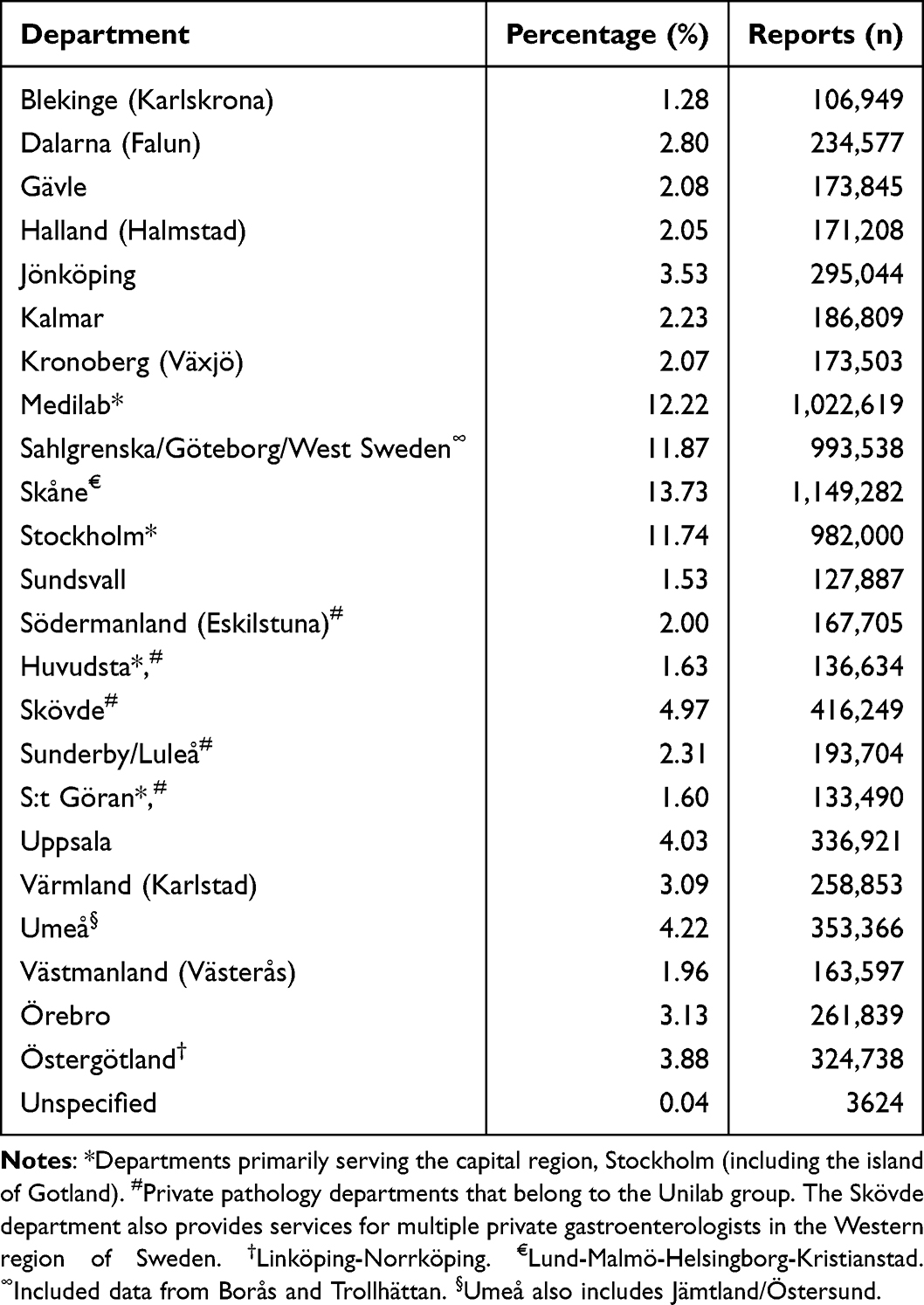 |
Table 1 Number of Histopathology Reports per Pathology Department |
Histopathology Reports
Through the update we added 2,308,902 histopathology reports from 2015 to 2023 to ESPRESSO.
The updated cohort (1965–2023) hence consisted of 8,367,981 histopathology reports (female: 51.9%), with a median participant age of 60.0 years (mean: 55.8). Among the reports, 416,728 (5.0%) were obtained in children (aged 0–17). The age group of 18–39 years old accounted for 1,453,948 reports, representing 17.4% of the total. The distribution of reports for other age groups is as follows: 40–59 (2,264,786; 27.1%), 60–69 (1,719,887; 20.6%), 70–79 (1,726,238; 20.6%), and ≥80 years (786,394; 9.4%).
In terms of organ-specific histopathology reports (Figure 1), most histopathology reports originated from the stomach (n=1,692,891), and the colon (n=2,457,828), with 20,007 from an unspecified luminal gastrointestinal location.
 |
Figure 1 Number of gastrointestinal histopathology reports in 1965–2023 in Sweden. *Includes adenoid tissue. |
The most common morphology codes in the updated ESPRESSO cohort (1965–2023) represented normal morphology (M00100 and M00110; n=2,094,561) and inflammation (M4x; n=1,991,937), as well as various forms of gastrointestinal cancer.
The annual number of histopathology reports between 2015 and 2021 (part of the update) exceeded 300,000, reaching its peak in 2021 at approximately 350,000 (Figure 2). There was a 6.5% decrease in 2020, the first year of the COVID-19 pandemic in Sweden.6 The decline in 2020 was observed across all non-COVID-19 healthcare services in Sweden during the first year of the pandemic: for instance, hospital admissions decreased by 5% for gastrointestinal diseases, 9% for cancer, and 9% for cardiovascular disease.6 Additionally, one in five adults reported abstaining from seeking healthcare in 2020.6 Because almost all data collection occurred until the years 2022 and 2023, the data for these two years are incomplete (166,000 histopathology reports from 2022 and 90,000 from 2023).
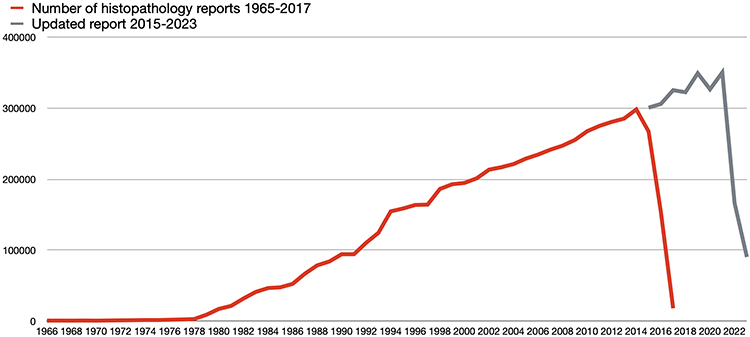 |
Figure 2 Annual number of histopathology reports (grey curve represents update). |
Data at an Individual Level
Overall, histopathology reports 1965–2023 were obtained from 2,604,891 unique individuals, with females accounting for 53.8%. Children comprised 6.3%, while individuals aged ≥80 represented 9.1%.
Conclusion
The nationwide ESPRESSO study integrates histopathology data with data from the Swedish national healthcare registers. The histopathology data aid in the identification of disease precursors and conditions not covered by International Classification of Disease (ICD) codes, thereby enhancing the reliability of existing diagnoses. The overall objective of the ESPRESSO study is to gain insights into the aetiology and prognosis of different diseases.
In this research letter, we present the updated findings of ESPRESSO from 1965 to 2023, encompassing more than 8.3 million histopathology reports from approximately 2.6 million unique individuals. In recent years, there have been more than 300,000 gastrointestinal histopathology reports in Sweden annually.
Abbreviations
ESPRESSO, Epidemiology strengthened by histopathology reports in Sweden; PPV, positive predictive value.
Funding
Karolinska Institutet.
Disclosure
Dr Ludvigsson has coordinated an unrelated study on behalf of the Swedish IBD Quality Register (SWIBREG). That study received funding from Janssen Corporation. Dr Ludvigsson has also received financial support from Merck/MSD for research on inflammatory bowel disease and for developing a paper reviewing national healthcare registers in China. Additionally, Dr Ludvigsson has an ongoing research collaboration on coeliac disease with Takeda. Systems developer Mariam Lashkariani declares no competing interests for this work.
References
1. Ludvigsson JF, Lashkariani M. Cohort profile: ESPRESSO (Epidemiology Strengthened by histoPathology Reports in Sweden). Clin Epidemiol. 2019;11:101–114. doi:10.2147/CLEP.S191914
2. Laugesen K, Ludvigsson JF, Schmidt M, et al. Nordic health registry-based research: a review of health care systems and key registries. Clin Epidemiol. 2021;13:533–554. doi:10.2147/CLEP.S314959
3. Bozorg SR, Song M, Emilsson L, et al. Validation of serrated polyps (sps) in Swedish pathology registers. BMC Gastroenterol. 2019;20(1):3. doi:10.1186/s12876-019-1134-6
4. Rojler L, Glimberg I, Walker MM, et al. Validation of the diagnosis of eosinophilic esophagitis based on histopathology reports in Sweden. Ups J Med Sci. 2021;126. doi:10.48101/ujms.v126.7687
5. Simon TG, Roelstraete B, Khalili H, et al. Mortality in biopsy-confirmed nonalcoholic fatty liver disease: results from a nationwide cohort. Gut. 2021;70(7):1375–1382. doi:10.1136/gutjnl-2020-322786
6. Ludvigsson JF. How Sweden approached the COVID-19 pandemic: summary and commentary on the National Commission Inquiry. Acta Paediatr. 2023;112(1):19–33. doi:10.1111/apa.16535
 © 2025 The Author(s). This work is published and licensed by Dove Medical Press Limited. The
full terms of this license are available at https://www.dovepress.com/terms
and incorporate the Creative Commons Attribution
- Non Commercial (unported, 3.0) License.
By accessing the work you hereby accept the Terms. Non-commercial uses of the work are permitted
without any further permission from Dove Medical Press Limited, provided the work is properly
attributed. For permission for commercial use of this work, please see paragraphs 4.2 and 5 of our Terms.
© 2025 The Author(s). This work is published and licensed by Dove Medical Press Limited. The
full terms of this license are available at https://www.dovepress.com/terms
and incorporate the Creative Commons Attribution
- Non Commercial (unported, 3.0) License.
By accessing the work you hereby accept the Terms. Non-commercial uses of the work are permitted
without any further permission from Dove Medical Press Limited, provided the work is properly
attributed. For permission for commercial use of this work, please see paragraphs 4.2 and 5 of our Terms.