
Back to Journals » Nature and Science of Sleep » Volume 18

Cognitive Reappraisal and Sleep Quality: A Serial Mediation Analysis of Associations Through Meaningful Work and Perceived Stress
Authors Oh S 
Received 3 November 2025
Accepted for publication 16 January 2026
Published 16 February 2026 Volume 2026:18 578237
DOI https://doi.org/10.2147/NSS.S578237
Checked for plagiarism Yes
Review by Single anonymous peer review
Peer reviewer comments 3
Editor who approved publication: Prof. Dr. Ahmed BaHammam
Sunyoung Oh
Department of Vocational Studies, Kyonggi University, Seoul, South Korea
Correspondence: Sunyoung Oh, Department of Vocational Studies, Kyonggi University, 24 Kyonggidae-ro 9-gil, Seodaemun-gu, Seoul, South Korea, Email [email protected]
Purpose: Although cognitive reappraisal—an adaptive emotion regulation strategy—has been associated with lower stress and greater resilience, its implications for sleep health remain insufficiently understood. This study examined whether cognitive reappraisal is related to better sleep quality through its associations with meaningful work and perceived stress among working adults.
Methods: Data were drawn from the Midlife in the United States (MIDUS) study. Cognitive reappraisal was assessed in an earlier wave, approximately two years prior to the assessment of meaningful work (measured with a single item), perceived stress, and sleep quality during the biomarker phase. The final analytic sample consisted of 852 working adults. Path analysis using Mplus was conducted to test the proposed serial mediation model, with demographic, psychological, and occupational covariates included in all paths.
Results: Cognitive reappraisal was positively associated with work meaning, which was negatively associated with perceived stress. Reappraisal also showed a direct association with lower stress. Perceived stress, in turn, was associated with poorer sleep quality. The indirect effect was significant, supporting the proposed serial pathway: individuals reporting greater use of cognitive reappraisal experienced better sleep quality through higher work meaning and lower stress.
Conclusion: The findings suggest that emotion regulation is related to sleep health in working adults, in part through its association with meaningful work and perceived stress. By integrating emotion regulation, work meaning, and stress within a single model, this study clarifies how these psychosocial processes are interconnected in relation to sleep. These associations point to the potential relevance of cognitive reappraisal and work-related meaning for efforts aimed at reducing perceived stress and supporting sleep health.
Keywords: sleep quality, cognitive reappraisal, meaningful work, perceived stress
Introduction
Emotion regulation represents a core domain of individual differences that shapes how people experience, interpret, and adapt to stress.1 Among various regulation strategies, cognitive reappraisal—an emotion regulation strategy in which individuals reinterpret the meaning of emotionally arousing situations to modulate their affective response—has been identified as particularly adaptive.2 Individuals who habitually use reappraisal tend to report less negative affect, lower stress, greater well-being, and enhanced psychological resilience.3–5 Despite extensive evidence linking reappraisal to affective outcomes, its potential role in restorative processes such as sleep has only recently begun to receive empirical attention.
Sleep is a vital component of human functioning, enabling cognitive restoration and physiological recovery.6 Inadequate or poor-quality sleep compromises core cognitive processes—including attentional control and executive functioning—which are essential for effective daily performance.7 Beyond these cognitive consequences, poor sleep is also associated with elevated risks for cardiovascular disease, metabolic dysfunction, immune dysregulation, and psychological disorders.8,9 Given these wide-ranging consequences, understanding psychological factors that may protect sleep has become increasingly important. Emerging evidence suggests that individuals who frequently engage in reappraisal report better sleep quality, likely because they experience lower emotional arousal and perceived stress.10–12 Recent experimental evidence further suggests that reappraisal can improve sleep-related outcomes.13 Yet, the psychological mechanisms through which reappraisal facilitates sleep remain poorly understood. Clarifying these mediating processes is essential for explaining how a stable regulatory tendency translates into restorative outcomes.
The present study seeks to fill this gap by examining cognitive-affective processes that may link reappraisal with sleep quality, focusing on work-related meaning construction and perceived stress. Work is one of the most pervasive sources of stress among employees,14 and such stress is closely tied to sleep disruption.15,16 Yet work also provides a primary arena in which individuals interpret their experiences and construct meaning and evaluate their sense of purpose and contribution. Because work occupies a substantial portion of daily life, meaning constructed in the work domain may be particularly salient for shaping stress experiences with downstream implications for sleep. We propose that meaningful work—the subjective experience that one’s work is significant, purposeful, and aligned with personal values and identity17—serves as a key psychological resource that connects emotion regulation to stress adaptation. Individuals who habitually use cognitive reappraisal may be more inclined to reinterpret daily challenges at work as opportunities for growth or contribution, thereby deriving greater meaning from these experiences. When work is experienced in this way, it can function as a resource that buffers the impact of adversity on psychological well-being. Consistent with this view, recent research has shown that work meaningfulness functions as a resource that supports well-being under conditions of health-related adversity by mitigating psychological distress among working adults.18 Experiencing work as meaningful, in turn, may reduce perceived stress—one of the most pervasive and detrimental correlates of poor sleep15—and thus foster better sleep quality.
Taken together, this study offers an integrative view of how cognitive reappraisal, work meaning, and stress are interconnected in relation to sleep health. Although each of these associations has been examined separately, prior work has not considered them simultaneously within a unified framework. By modeling meaning-making and stress alongside reappraisal, the study contributes to sleep research by extending theoretical understanding of the cognitive and affective processes linking an adaptive emotion regulation tendency with sleep quality. In addition, this approach offers insight for occupational health by highlighting modifiable psychological processes associated with stress and sleep health.
Theoretical Background
Cognitive reappraisal is a deliberate emotion regulation strategy that involves reinterpreting the meaning of emotionally charged situations to modify their emotional impact.1 This cognitive reframing process allows individuals to assign new meaning to stressful experiences, thereby altering their emotional and motivational significance. Extensive research has shown that individuals who habitually use reappraisal report less negative affect, greater positive affect, increased well-being, and lower anxiety and depression.3,5 Reappraisal has also been found to play a central role in regulating affective reactivity to negative events, reducing perceived stress, and promoting psychological resilience in the face of adversity,4,19 supporting its utility as a stress-regulation resource. Because reappraisal involves cognitively reframing how experiences are understood and valued, it may extend beyond emotional adaptation to influence how individuals derive meaning from their daily work experiences.
Meaningful work is commonly defined as the subjective experience that one’s work is significant, purposeful, and congruent with personal values and identity.17,20 A growing body of evidence identifies meaningful work as a critical psychological resource associated with lower stress, greater well-being, and fewer depressive symptoms.21–24 Employees who experience their work as meaningful report greater work engagement, fulfillment, and resilience under pressure.21,25,26 Importantly, meaningful work is not a fixed attribute of a job but is cognitively constructed through interpretive processes.27,28 From a sensemaking perspective,28 employees interpret cues from their tasks, roles, and organizational environment to construct narratives that imbue their work with personal significance.
We propose that cognitive reappraisal plays a central role in this meaning construction process. According to Lazarus and Folkman’s transactional model of stress,29 reappraisal allows individuals to reframe work-related stressors—not as threats, but as challenges or opportunities for growth. Although this reframing does not alter the objective demands of work, it changes their perceived significance, fostering more adaptive interpretations. While empirical research has not yet explored whether cognitive reappraisal contributes to perceptions of meaningful work, evidence from related areas suggests that reappraisal can shape the meanings individuals derive from adverse or demanding experiences. Meaning-making theories describe positive reappraisal as a cognitive process through which individuals restore a sense of coherence or construct adaptive interpretations of stressful events.30 Through reinterpreting negative experiences in a more positive light, individuals come to believe that something valuable or beneficial has been gained—such as wisdom or personal growth.31 Recent experimental evidence further demonstrates that positive reappraisal increases the perceived meaningfulness of everyday negative events, indicating that reframing directly promotes meaning-making.32 Taken together, these findings suggest that individuals who habitually use reappraisal may be more likely to view challenging work situations as meaningful elements of their personal and professional development. Therefore, we hypothesized that cognitive reappraisal is positively associated with perceptions of meaningful work.
Hypothesis 1: Cognitive reappraisal will be positively associated with perceptions of meaningful work.
Meaningful work, in turn, may serve as a key psychological resource that protects individuals from stress. Meaningful work has been consistently associated with lower psychological strain and reduced distress in demanding work environments.24,25 According to the Job Demands–Resources (JD–R) model,33 job resources that activate motivational processes enable individuals to meet work demands and protect themselves from resource depletion. Consequently, such resources are negatively related to burnout and buffer the adverse effects of job demands.34 Empirical research has shown that meaningful work functions as a job-related psychological resource that promotes vigor and protects against emotional exhaustion.24,35 Additional evidence indicates that meaningful work can buffer the effects of hindrance stressors,36 and foster resilience through greater work engagement.26 Given that work situations represent the single most important contributors to perceived stress among employees,14 these findings suggest that meaningful work may help reduce overall perceived stress by strengthening individuals’ psychological resources in demanding contexts. Therefore, we hypothesize that perceptions of meaningful work will be negatively associated with perceived stress and that cognitive reappraisal will show an indirect association with perceived stress through perceptions of meaningful work. Moreover, although meaningful work is expected to play a role in the association between cognitive reappraisal and perceived stress, we anticipate a partial indirect pattern, as cognitive reappraisal may also show links to lower perceived stress through other adaptive processes that extend beyond the work domain.
Hypothesis 2: Perceptions of meaningful work will be negatively associated with perceived stress. Hypothesis 3: Cognitive reappraisal will be indirectly related to perceived stress via its relationship with meaningful work.
We suggest that the stress-reducing benefits of meaningful work may extend to sleep health. Perceived stress is a well-established predictor of poor sleep quality.37 Elevated stress levels are associated with longer sleep onset latency, more frequent nighttime awakenings, and poorer overall sleep quality.16,38 Stress–sleep frameworks posit that heightened physiological and cognitive arousal interferes with sleep initiation and maintenance,39 and theories of sleep reactivity further suggest that individuals become more susceptible to sleep disturbances under stress.16 Consistent with these theoretical perspectives, physiological arousal triggered by stress disrupts normal sleep cycles,40 while cognitive preoccupation with stressors interferes with the ability to relax and disengage before bedtime.41,42 Recent evidence from the COVID-19 pandemic further confirms the robustness of this association across diverse populations and high-stress contexts.43,44 Accordingly, by mitigating perceived stress, meaningful work may help promote better sleep quality. We therefore hypothesize that perceived stress will be negatively associated with sleep quality and that cognitive reappraisal will be indirectly related to sleep quality through its sequential associations with meaningful work and perceived stress.
Hypothesis 4: Perceived stress will be positively associated with poorer sleep quality. Hypothesis 5: Cognitive reappraisal will be indirectly associated with sleep quality through its sequential associations with meaningful work and perceived stress.
Materials and Methods
Sample and Procedures
Data were drawn from the biomarker subsamples of the second wave of the core cohort (MIDUS 2; M2) and the refresher cohort (MIDUS Refresher; MR) of the Midlife in the United States study (MIDUS; http://midus.wisc.edu/), a national longitudinal study of health and well-being in adulthood. The M2 sample comprised participants originally surveyed in 1995–1996 and recontacted for follow-up between 2004 and 2006 (response rate = 75%). The MR cohort, recruited between 2011 and 2014, was designed to mirror the demographic composition of M2 in terms of age and gender. Both cohorts completed a structured phone interview and a self-administered questionnaire. A subset of participants from each cohort participated in the MIDUS Biomarker Project, which involved comprehensive psychophysiological assessments conducted during a clinic visit. For the M2 cohort, biomarker data were collected between 2004 and 2009, on average approximately two years after the MIDUS 2 survey, although the exact timing varied across participants. For the MR cohort, biomarker data were collected between 2012 and 2016, following completion of the Refresher survey. Comprehensive information about the project, its protocol, and variables measured is available elsewhere.45
From the biomarker subsamples (M2: N = 1054; MR: N = 863), we initially selected participants who (a) were currently working for pay and (b) had completed measures of meaningful work and relevant work-related covariates (eg, job demand), resulting in subsamples of N = 555 (M2) and N = 387 (MR). We then excluded participants who reported working fewer than 20 hours per week to ensure sufficient and regular engagement in work activities, which is necessary for obtaining meaningful and reliable responses on work-related constructs such as meaningful work. This approach is consistent with prior daily work research that applied a similar cutoff to capture employees with adequate exposure to day-to-day work demands.46 This exclusion applied to 39 participants from M2 and 31 from MR. The final analytic sample included 516 participants from M2 and 356 from MR (total N = 872). Prior studies have employed similar working subsamples from MIDUS.47,48
Given that the data collection protocols and measures were identical across the two cohorts, we combined data from M2 and MR to enhance statistical power, resulting in a total sample of 872 participants. While MR participants were generally younger, more racially diverse, less likely to smoke, and had lower decision authority, no significant differences were observed in key study variables across cohorts (see Table 1). No extreme outliers were detected, as all observations fell within three times the interquartile range (±3 × IQR). The total sample (49.2% female) had a mean age of 48.59 years (SD = 10.25), and 89.0% identified as White. Most participants (82.1%) had completed education beyond high school. As such, the sample primarily reflects midlife, predominantly White, and relatively well-educated working adults. Missing data were handled using full information maximum likelihood (FIML), which yields unbiased estimates under missing-at-random assumptions and is preferable to traditional techniques such as listwise deletion or mean imputation.49 Because several variables in the path model served as exogenous predictors, cases with missing data on these predictors (n = 20) were excluded, as missingness on exogenous variables cannot be incorporated into the FIML estimation process and could impede proper model identification and stable estimation. This resulted in a final analytic sample of 852 participants for the path analysis.
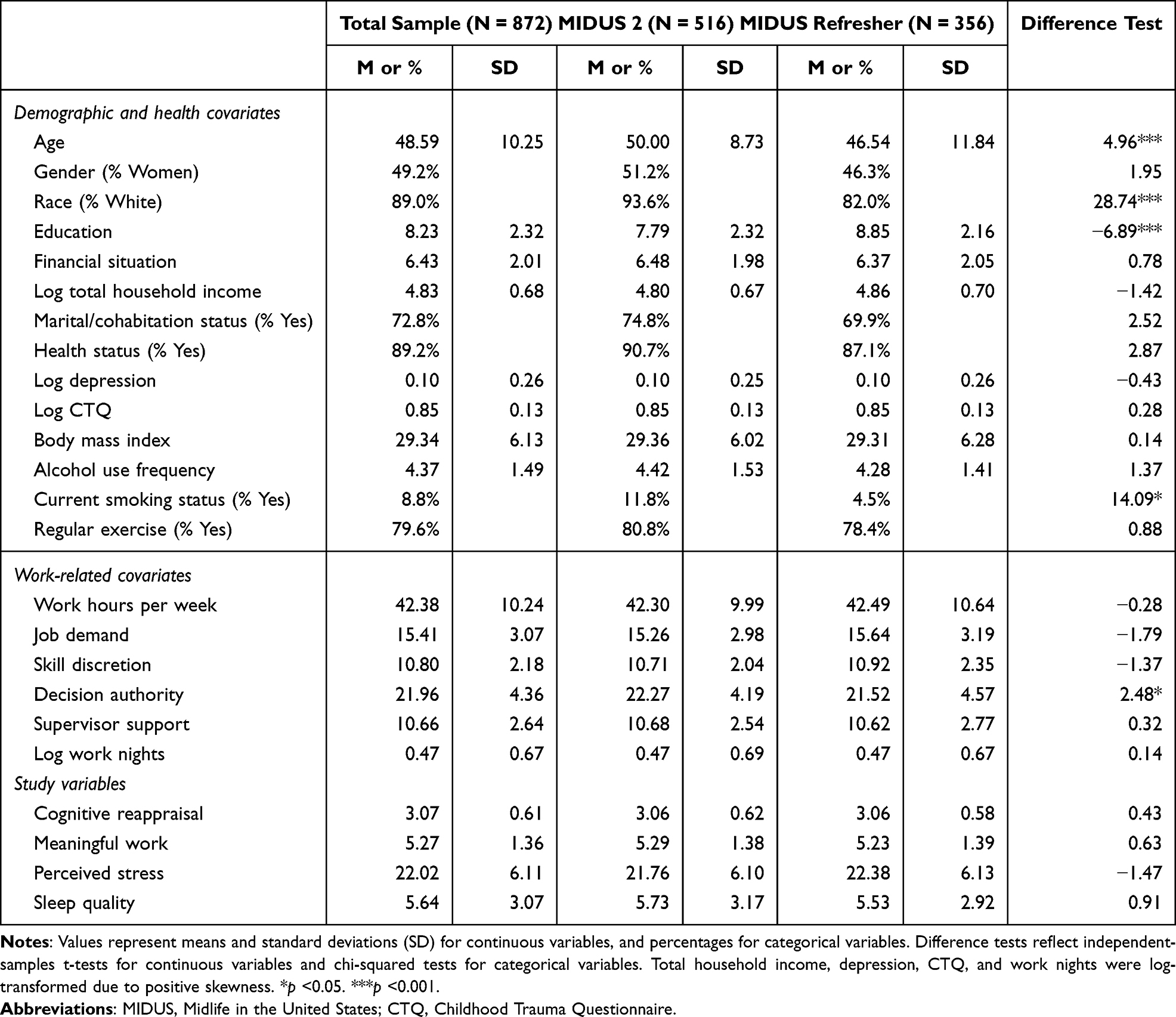 |
Table 1 Descriptive Characteristics of the Total Sample and by MIDUS Cohort (MIDUS 2 and MIDUS Refresher) |
Measures
Variables were drawn from both the general survey and biomarker phases of MIDUS 2 and the Refresher cohort. Cognitive reappraisal, demographic information, work-related covariates, and depression were assessed during the general survey; meaningful work, perceived stress, sleep quality, BMI, childhood abuse and presence of symptoms of chronic conditions were measured during the biomarker phase. Accordingly, the analytic model incorporates a partially longitudinal structure, with cognitive reappraisal temporally preceding the other key study variables, which were measured concurrently during the biomarker phase.
Cognitive Reappraisal
Cognitive reappraisal was assessed using the 4-item Positive Reappraisal Scale50 (eg, “When I am faced with a bad situation, it helps to find a different way of looking at things”). Items were rated on a 4-point Likert scale (1 = A lot to 4 = Not at all) and reverse scored. Higher scores reflected greater reappraisal tendency (Cronbach’s α = 0.79; McDonald’s ω = 0.80). Additional psychometric information, including factor structure and validity analyses, is provided in the Supplementary Materials.
Meaningful Work
Meaningful work was assessed with a single global item (“My work makes the world a better place”)51 rated on a 7-point scale from 1 (strongly disagree) to 7 (strongly agree). Because the MIDUS survey includes only one item that captures global perceived meaningfulness, meaningful work could only be measured with a single-item indicator. We conceptualized this item as a reflective global appraisal of meaningful work, consistent with theoretical views that meaningful work represents a higher-order evaluative judgment.17 Although this item most directly captures the greater-good facet of meaningful work, prior work identifies greater-good motivation as a core subdimension that meaningfully contributes to individuals’ overall experience of meaningful work.17 To evaluate the validity of this single-item indicator, we conducted an independent validation study using Mechanical Turk participants (N = 113). This study demonstrated strong convergent validity with the Steger et al17 scale, the Work and Meaning Inventory (r = 0.62, p <0.001).
Perceived Stress
The 10-item Perceived Stress Scale (PSS)52 measured participants’ stress over the past month (eg, “How often have you felt nervous or stressed?”). Items were rated on a 5-point scale (1 = Never to 5 = Very often), with reverse-coding of positive items, and scores were summed (Cronbach’s α = 0.87; McDonald’s ω = 0.87).
Sleep Quality
Sleep quality was assessed using the Pittsburgh Sleep Quality Index (PSQI),53 a widely used 19-item retrospective questionnaire that evaluates sleep quality and disturbances over the past month. The PSQI includes 19 self-rated items, which are grouped into seven component scores: subjective sleep quality, sleep latency, sleep duration, habitual sleep efficiency, sleep disturbances, use of sleeping medication, and daytime dysfunction. Each component is scored on a scale from 0 to 3, and the global PSQI score (range: 0–21) is calculated by summing the seven component scores, with higher scores indicating poorer sleep (Cronbach’s α = 0.60; McDonald’s ω = 0.60).
Covariates
We measured a broad set of demographic, health-related, and work-related variables as potential background covariates, given their documented associations with stress, sleep patterns, and work experiences in behavioral medicine research. These variables included age, sex (0 = male, 1 = female), years of education (1–12 scale), race (0 = White, 1 = Non-White), marital/cohabitation status (1 = yes, 0 = no), and total household income (log-transformed due to skewness). Health-related covariates included current smoking status (1 = yes, 0 = no), alcohol use frequency (1 = daily to 6 = never), body mass index (BMI), general health status (presence of any symptoms or chronic conditions; 1 = yes, 0 = no), and regular exercise (≥20 minutes, ≥3 times/week; 1 = yes, 0 = no).
In addition to these potential background variables, we included several theory-driven covariates based on prior conceptual and empirical work suggesting that they could plausibly influence the pathways linking cognitive reappraisal, meaningful work, perceived stress, and sleep quality. Work-related factors—including job demand, skill discretion, decision authority, and supervisor support—were measured using established job characteristics scales widely used in prior studies,54 given their documented associations with meaningful work and perceived stress. Perceived financial situation (0 = worst possible, 10 = best possible) was also included as a covariate due to its established association with stress.55 Depression, assessed as a continuous count of symptoms related to depressed affect and anhedonia,56 was included due to its strong link to sleep quality.57 Experiences of childhood abuse were measured using the 25-item Childhood Trauma Questionnaire (CTQ), given evidence of its association with work stress58 and adult sleep.59 Both depression and CTQ scores were positively skewed and were log-transformed prior to analysis. In addition, we measured the number of nights participants spent away from home for work in the past 12 months, given strong evidence that night work disrupts circadian rhythms and impairs sleep quality over time.60
Following Sturman et al’s recent recommendations for theory-driven and parsimonious control variable use,61 we evaluated whether the inclusion of each covariate meaningfully altered the magnitude, direction, or substantive interpretation of the focal associations. Covariates that did not meaningfully alter effect estimates or improve model interpretability were not retained. Based on these criteria and preliminary analyses, the final models included the following covariates (see Supplementary Table S2): education and skill discretion in predicting meaningful work; age, gender, perceived financial situation, CTQ, and job demand in predicting perceived stress; and gender, CTQ, depression, and health status in predicting sleep quality. Consistent with Sturman et al’s recommendation, we report all focal analyses both with and without covariates; results from the unadjusted models are presented in the Supplementary Material.
Analyses
All data analyses were conducted using Mplus 6.62 Pearson correlation analyses were first performed among all study variables. Path analysis was then used to test the hypothesized model and examine the proposed relationships among cognitive reappraisal, meaningful work, perceived stress, and sleep quality. Assumptions relevant to path analysis were examined prior to estimation. Relationships among the primary continuous variables were approximately linear based on visual inspection, and robust maximum likelihood estimation (MLR) was used to account for potential non-normality and heteroscedasticity. Model fit was assessed using the comparative fit index (CFI), Tucker-Lewis index (TLI), root mean square error of approximation (RMSEA), and standardized root mean square residual (SRMR). Following Hu and Bentler,63 CFI and TLI values ≥.95, RMSEA values ≤.06, and SRMR values ≤.08 were considered indicative of good model fit. A post hoc Monte Carlo power analysis64 (10,000 replications, 95% confidence level) was conducted to evaluate the statistical power for detecting the serial indirect effects. Given the sample size of 852 and the observed effect sizes, the estimated power to detect the indirect effects was 1.00.
Results
Descriptive statistics and correlations are presented in Table 2, and the full correlation matrix, including all candidate covariates, is available in Supplementary Table S1. As expected, cognitive reappraisal was positively associated with meaningful work, meaningful work was negatively associated with perceived stress, and perceived stress was associated with sleep quality. All primary variables demonstrated significant intercorrelations in the expected directions.
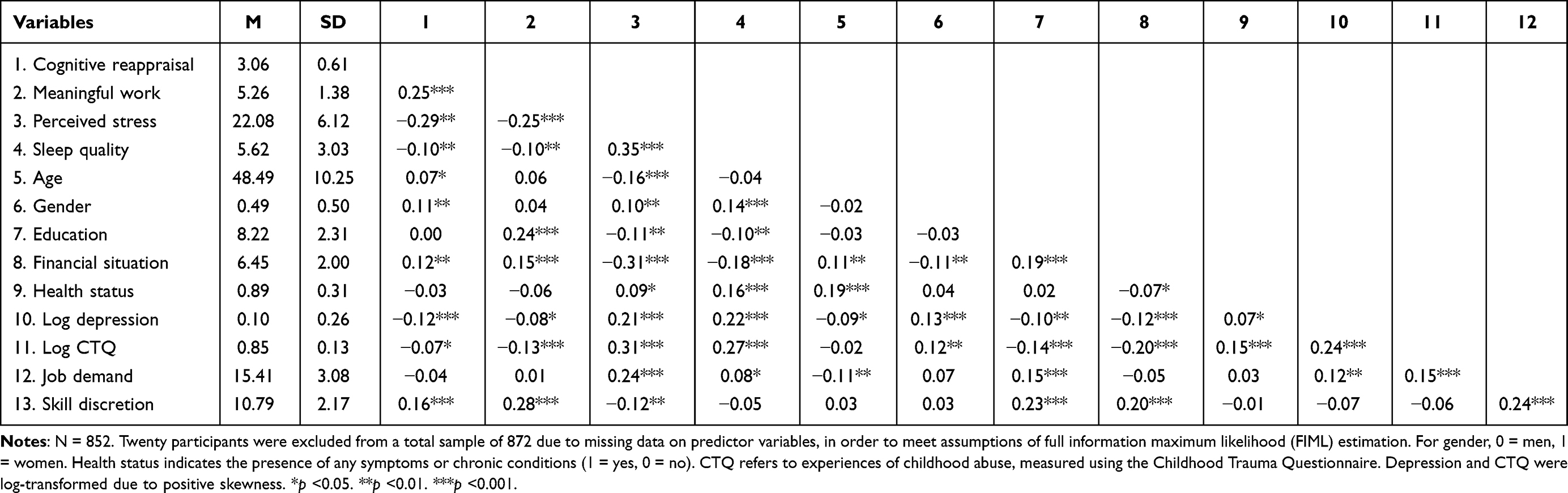 |
Table 2 Means, Standard Deviations, and Intercorrelations Among Study Variables |
In addition to modeling sleep quality as a continuous outcome, we examined the prevalence of clinically meaningful sleep disturbance using the conventional PSQI cutoff of ≥5.53 A total of 57.6% of participants met this threshold, indicating that more than half of the sample experienced sleep difficulties at a level commonly used to indicate clinically relevant sleep disturbance. To clarify which sleep domains were most strongly associated with the global PSQI score, we examined descriptive statistics and correlations for all seven PSQI components. As summarized in Supplementary Table S7, perceived stress showed significant correlations with all seven components, with the strongest associations observed for subjective sleep quality (r = 0.27; p < 0.01), sleep latency (r = 0.18; p < 0.01), sleep disturbances (r = 0.24; p < 0.01), and daytime dysfunction (r = 0.45; p < 0.01), and smaller but significant associations for sleep duration (r = 0.12; p < 0.01), sleep efficiency (r = 0.08; p < 0.05), and use of sleeping medication (r = 0.10; p < 0.01). Overall, these results indicate that perceived stress is broadly associated with multiple aspects of sleep captured by the PSQI.
Next, we tested the proposed serial mediation model using path analysis in Mplus 6.62 The results indicated that the hypothesized model provided an acceptable fit to the data, X2(18) = 26.48, CFI = 0.98, TLI = 0.97, RMSEA = 0.02, SRMR = 0.02. As shown in Figure 1, the results supported the hypothesized relationships. Consistent with Hypothesis 1, reappraisal was significantly associated with meaningful work (B = 0.49, SE = 0.08, 95% CI [0.34, 0.64]), even after adjusting for education and skill discretion. Supporting Hypothesis 2, meaningful work was negatively associated with perceived stress (B = −0.64, SE = 0.14, 95% CI [−0.90, −0.37]), controlling for age, gender, financial situation, CTQ, and job demand. Reappraisal was also directly associated with lower perceived stress (B = −2.14, SE = 0.30, 95% CI [−2.72, −1.55]). As expected, higher levels of perceived stress were associated with poorer sleep quality (B = 0.13, SE = 0.02, 95% CI [0.10, 0.17]) after controlling for gender, CTQ, depression, and health status, supporting Hypothesis 4.
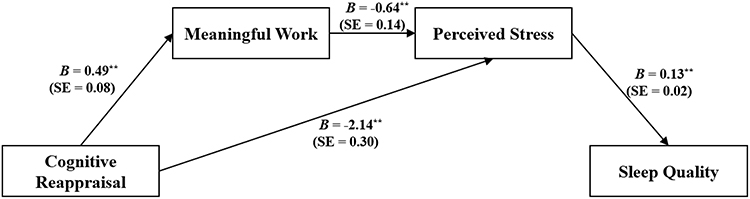 |
Figure 1 Results of path analysis among cognitive reappraisal, meaningful work, perceived stress, and sleep quality. Values represent unstandardized coefficients. Paths for covariates are omitted for clarity (see Supplementary Table S2 and Figure S1 for significant direct effects). **p <0.01. Abbreviation: SE, standard error. |
Supporting Hypothesis 3, the indirect relationship from reappraisal to perceived stress through meaningful work was significant (B = −0.31, SE = 0.08, 95% CI [−0.47, −0.16]). Meaningful work was also indirectly associated with sleep quality through its association with perceived stress (B = −0.09, SE = 0.02, 95% CI [−0.13, −0.04]). In addition, the indirect association from reappraisal to sleep quality through perceived stress was significant (B = −0.28, SE = 0.05, 95% CI [−0.39, −0.18]). Finally, consistent with Hypothesis 5, the sequential indirect association from reappraisal to sleep quality through meaningful work and perceived stress was significant (B = −0.04, SE = 0.01, 95% CI [−0.07, −0.02]).
To evaluate the practical magnitude of the indirect associations, we quantified effect sizes using the approach proposed by Lachowicz et al,65 whereby the proportion of variance in the outcome attributable to a mediation pathway is obtained by squaring the completely standardized indirect effect. The indirect effect from cognitive reappraisal to sleep through perceived stress had a completely standardized value of −0.057, indicating that this pathway accounted for approximately 0.33% of the variance in sleep quality. The sequential pathway from reappraisal to meaningful work, then to perceived stress, and subsequently to sleep had a completely standardized indirect effect of −0.008, explaining approximately 0.007% of the variance in sleep quality.
Supplementary Analyses
Although our hypotheses were grounded in the theoretical rationale described earlier, we conducted supplementary analyses to examine reversed and competing model specifications (see Supplementary Table S8 for full model fit information). Model comparisons were conducted using Akaike’s Information Criterion (AIC) and Bayesian Information Criterion (BIC), with lower values indicating better fit.66 First, we tested a reverse-order model in which sleep quality predicted perceived stress, which in turn predicted meaningful work and subsequently predicted cognitive reappraisal (sleep → stress → meaningful work → reappraisal). This model showed poorer fit (AIC = 35790.35, BIC = 35894.80) relative to our final model (AIC = 35690.46, BIC = 35790.16). We then examined a model in which cognitive reappraisal predicted meaningful work, meaningful work predicted sleep quality, and sleep quality subsequently predicted perceived stress (reappraisal → meaningful work → sleep → stress). This specification also showed weaker fit (AIC = 35718.11, BIC = 35817.81). Finally, we evaluated a parallel-path model in which cognitive reappraisal predicted both meaningful work and perceived stress, and both variables in turn predicted sleep quality (reappraisal → meaningful work → sleep; reappraisal → perceived stress → sleep). This model likewise showed poorer fit (AIC = 35712.59, BIC = 35812.29) compared with the final model. Taken together, these comparative analyses indicate that our theoretically guided model provides a better fit to the data than the alternative models we tested.
Sensitivity Analysis
To evaluate the robustness of the primary findings, we conducted three sets of sensitivity analyses (see the Supplementary Material for corresponding model results). First, we compared results obtained using FIML with those from listwise deletion. The findings were consistent across methods, with no substantive changes in significance, direction, or effect size (see Tables S3 and S4). Second, we re-estimated the final model without the control variables to assess their influence. The results remained robust and closely aligned with the main analysis, showing no meaningful changes in significance, direction, or effect magnitude (see Tables S and S5). Third, we conducted subgroup analyses separately for participants from the MIDUS 2 (M2) and MIDUS Refresher (MR) cohorts. The primary associations were replicated in both subgroups, supporting the generalizability of the model (see Tables S3 and S6).
Discussion
This study examined a theoretically grounded pattern of associations linking cognitive reappraisal with sleep quality through meaningful work and perceived stress. The ordering tested in the present study was guided by prior research that cognitive reappraisal—conceptualized as a relatively stable regulatory tendency shaping how individuals interpret work experiences—is associated with the construction of work-related meaning; that meaning-related appraisals are linked to subsequent stress-related affective responses; and that perceived stress is closely tied to sleep impairment. Although meaningful work, perceived stress, and sleep quality were assessed concurrently at the biomarker visit and their temporal ordering therefore cannot be definitively established, these theoretical considerations provided the basis for testing this ordering as the primary model. Consistent with this hypothesized pattern, the results indicate that cognitive reappraisal was indirectly associated with sleep quality through its association with meaningful work and, in turn, perceived stress. Although the observed indirect effects were modest in magnitude, as is common in psychosocial serial mediation models, such effects are consistent with prior research on psychosocial pathways to sleep and may still be meaningful when considered cumulatively across interconnected psychological processes. These findings align with prior research demonstrating that cognitive reappraisal is associated with reduced psychological distress and enhanced well-being,5,67 as well as with evidence linking stress to poor sleep through mechanisms such as physiological arousal and cognitive rumination.16,37,40 In addition to the sequential pattern of associations, cognitive reappraisal also showed an indirect association with sleep quality via perceived stress alone, suggesting that stress-related processes may represent an additional pathway linking reappraisal to sleep outcomes. Together, these findings extend existing research by providing an integrative account of how emotion regulation may be linked to sleep health through meaning-making and stress processes, underscoring the interconnections among cognitive, motivational, and stress-related mechanisms.
This study contributes to the literature in several ways. First, from a sleep research perspective, the present study advances understanding of psychosocial factors associated with sleep quality in working adults by clarifying pathways through which stress is linked to sleep. A substantial body of sleep research has demonstrated that stress plays a central role in sleep disruption. Building on this literature, prominent stress–sleep models emphasize that stress-related processes—such as heightened physiological arousal and increased vulnerability of the sleep system to stressors—interfere with the initiation and maintenance of sleep and contribute to disturbances in sleep continuity and architecture.16 Experimental evidence further shows that acute psychosocial stress can disrupt sleep continuity even among healthy adults.68 Together, this body of work underscores the importance of identifying psychosocial factors that help attenuate stress-related sleep disruption. In this context, the present study contributes by focusing on psychosocial processes that may attenuate stress experiences relevant to sleep in everyday work settings. Specifically, our findings highlight cognitive reappraisal and work-related meaning as upstream factors associated with lower perceived stress and, in turn, better self-reported sleep quality. By situating sleep quality within a psychosocial framework that integrates cognitive reappraisal, meaning-making and stress appraisal, this study extends prior sleep research by illustrating how upstream cognitive processes may be relevant to sleep health through their associations with stress.
Second, this study contributes to the emotion regulation literature by extending understanding of how cognitive reappraisal is associated with downstream aspects of everyday functioning, including sleep health. Although reappraisal has been widely studied as a strategy for regulating affect and supporting mental health,67,69 relatively little is known about how habitual reappraisal tendencies correspond with restorative outcomes such as sleep in the context of working life. The present findings indicate that reappraisal is indirectly associated with sleep quality through its concurrent associations with meaningful work and perceived stress. These patterns suggest that individuals who tend to engage in cognitive reappraisal may also be more likely to construe their work experiences in adaptive ways that are associated with lower perceived stress and better sleep. By highlighting these associations, the present study extends prior emotion regulation research by illustrating how reappraisal, meaning-related interpretations, and stress are jointly related to sleep health within the chronic demands of everyday work contexts.
Third, this study contributes to theoretical models of meaningful work by examining cognitive reappraisal as a potential antecedent of meaningful work perceptions. Although prior research has largely emphasized external drivers of meaningful work, such as job characteristics or leadership behaviors,20,70 our findings indicate that employees’ cognitive habits, particularly their tendency to reinterpret challenging work experiences, are also related to how meaningful they perceive their work to be. This perspective aligns with sensemaking theories of meaning construction55 and suggests that reappraisal may be associated with more adaptive meaning-related interpretations of work experience. Furthermore, although meaningful work has been associated with reduced burnout and greater psychological resilience,36 our results show that meaningful work is also associated with lower stress and better sleep, underscoring its relevance for understanding broader aspects of employee well-being.
Fourth, the findings enrich the literature on occupational health by highlighting psychological resources that are associated with more favorable responses to workplace stressors in relation to sleep quality. Although prior research has established that occupational stressors are robust predictors of sleep disturbances,6 relatively few studies have examined how individual-level psychological resources, such as cognitive reappraisal and meaning-making, are linked to sleep-relevant outcomes. By identifying indirect associations in which cognitive reappraisal and meaning-related experiences are linked with sleep quality—partly through perceived stress—this study directly addresses this gap and clarifies how individual-level psychological strengths may be relevant for sleep health in occupational contexts.
Finally, from an applied and occupational perspective, the findings highlight several considerations for supporting sleep and psychological well-being among employees. Notably, more than half of participants (57.6%) exceeded the conventional PSQI cutoff for clinically poor sleep, underscoring the high prevalence of sleep difficulties in this working adult sample. This level of prevalence underscores the practical importance of efforts aimed at reducing stress-related sleep disturbance in working populations. Although the present study cannot directly inform clinical sleep interventions due to its observational design and reliance on self-reported sleep quality, the findings may nevertheless inform applied and occupational efforts to promote sleep health by suggesting cognitive reappraisal as an emotion-regulation process associated with lower perceived stress and better sleep quality. Consistent with prior experimental research demonstrating that cognitive reappraisal can reduce stress,71 the current findings suggest that reappraisal-related skills could be explored as one component of programs aimed at helping employees manage stress and support healthier sleep patterns. In addition, previous intervention research has shown that mindfulness-based programs can enhance both reappraisal and meaning-making at work,58,59 suggesting that such approaches may offer promising avenues for supporting employees’ stress regulation. Integrating these strategies into workplace wellness initiatives addressing stress-related sleep concerns may provide useful directions for future research on promoting emotional well-being and sleep health.
At the organizational level, promoting meaningful work through intentional job design and leadership practices may also foster better sleep by alleviating stress and strengthening employees’ sense of purpose. Job design strategies that enhance task significance, increase autonomy, and make the broader impact of employees’ contributions more visible can reinforce perceptions of meaning at work.20 Leadership behaviors that explicitly connect daily tasks to organizational values and social contributions, and that communicate a clear sense of purpose, may further strengthen these effects.20 In addition, job crafting initiatives that encourage employees to align their tasks with personal strengths and goals can facilitate the construction of meaningful work experiences,72 thereby reducing stress and enhancing well-being. Beyond structural interventions, organizations may also consider incorporating emotion regulation–focused programs, such as cognitive reappraisal training, to help employees reinterpret work-related stressors in more adaptive ways. Such combined approaches—addressing both the meaning of work and employees’ regulatory capacities—may be particularly effective in mitigating stress and supporting sleep health.
Despite its strengths, this study has several limitations that warrant consideration. First, the cross-sectional design limits causal inference. Although cognitive reappraisal was measured approximately two years prior to the assessment of meaningful work, perceived stress, and sleep quality, the latter three variables were assessed contemporaneously at the same wave. Consequently, temporal precedence among the mediators and outcome cannot be established, which precludes causal interpretation of the proposed sequential pathway. For example, although the present study specifies one theoretically grounded directional model, the association between meaningful work and perceived stress may also be reciprocal. It is plausible that perceived stress may diminish experiences of meaningful work, as high-strain conditions—such as unfair treatment, disrespect, or toxic work climates—can erode individuals’ sense of purpose and significance at work by undermining the cognitive and motivational resources required for meaning-making.73 In this way, stress may impair the processes through which work meaning is constructed, suggesting that meaningful work and stress may influence one another over time. Similarly, sleep problems may exacerbate stress, which may in turn undermine individuals’ capacity to sustain a sense of meaning at work, further highlighting the potential for reciprocal associations among these processes. Accordingly, future research should employ longitudinal or experimental designs to more rigorously assess temporal ordering and directionality.
Second, a further limitation concerns the measurement of meaningful work with a single global item. Although the item demonstrated acceptable convergent validity in our independent validation study and prior research has shown that single-item indicators of meaning-related constructs can exhibit strong psychometric properties,74 this approach does not fully address the limitation posed by the multidimensional nature of meaningful work. Theoretical models conceptualize meaningful work as comprising several interrelated facets—such as positive meaning, meaning-making, and greater-good motivation—which collectively define the construct at a broader level.17 Our global reflective indicator primarily captures the greater-good facet and therefore cannot fully represent the construct’s multidimensional character, even if it provides a reasonable approximation of overall perceived meaningfulness. Consequently, future research should employ comprehensive multidimensional measures of meaningful work to more fully capture the construct and ensure that observed associations with stress or sleep outcomes reflect the full conceptual scope of meaningful work rather than a single facet.
Third, although the PSQI is a widely used and psychometrically robust self-report measure of sleep quality, the absence of objective sleep assessments represents an important limitation of the present study. The PSQI has been linked to clinically relevant outcomes such as hypertension75 and inflammatory processes including interleukin-6,76 supporting its validity as an indicator of sleep-related health risk. Nevertheless, self-reported sleep does not always correspond closely to objectively measured parameters. For instance, Lehrer et al77 demonstrated that individuals tend to overestimate sleep duration and efficiency and underestimate sleep onset latency and wake time when using self-reports compared with actigraphy and polysomnography. These discrepancies suggest that subjective sleep ratings capture an important experiential and perceptual dimension of sleep—one that is theoretically relevant to stress and cognitive processes—but may not fully reflect physiological sleep architecture. Accordingly, the present findings should be interpreted with the understanding that our measure reflects perceived rather than objectively measured sleep quality. Future research would benefit from incorporating multimethod sleep assessments, such as actigraphy or polysomnography, to evaluate whether the observed psychological pathways similarly predict physiological aspects of sleep. Such designs would provide a more comprehensive understanding of how cognitive reappraisal, meaningful work, and stress relate to both subjective experiences of sleep and objective sleep physiology.
Fourth, although the analyses adjusted for a broad set of sociodemographic and health-related covariates, some theoretically relevant factors were not assessed. Dispositional characteristics such as trait optimism and other emotion regulation strategies (eg, suppression or rumination) may covary with cognitive reappraisal and influence stress reactivity, potentially acting as confounding factors that affect multiple components of the proposed pathway and complicate the interpretation of reappraisal’s unique role. In addition, job-related variables, such as low job control or job insecurity, may independently contribute to perceived stress and sleep outcomes.6 Sleep quality was also assessed via self-report rather than clinical diagnosis, and chronic sleep disorders (eg, insomnia) may have influenced reported symptoms. Future research incorporating these factors would help clarify the boundary conditions and incremental validity of the present findings.
Fifth, this study did not examine work schedule characteristics that may moderate the associations among cognitive reappraisal, meaningful work, stress, and sleep. Shift work, in particular, is a salient contextual factor known to disrupt circadian rhythms and impair sleep.78 Although the present study included the number of nights away from home due to job demands as a covariate, this variable does not capture shift timing or non-daytime schedules and showed no meaningful associations with the primary study constructs. As a result, the present findings may be less generalizable to workers who regularly engage in rotating, evening, or night shifts—groups known to experience circadian disruption and sleep impairments.78 Beyond work schedules, broader work environment characteristics may further condition the observed pathways. Prior research indicates that adverse organizational climates—especially low levels of organizational justice—are robustly associated with insomnia and specific sleep problems, independent of job demands and control.79 Such environments may amplify stress appraisals and undermine perceived control or fairness, thereby constraining employees’ capacity to engage in adaptive emotion regulation or to derive meaning from work.
Sixth, the generalizability of the present findings may be limited by characteristics of the study sample and the context in which the data were collected. Specifically, the present findings may not generalize to populations with clinically diagnosed sleep disorders, as emotion regulation profiles and stress–sleep dynamics in clinical insomnia appear to differ from those observed in non-clinical samples.80 In addition, the associations observed in this study may vary across occupational sectors, particularly in high-stress professions such as healthcare, emergency response, or customer service. Workers in these settings often face intense emotional demands, limited autonomy, and irregular schedules, including shift work, which may attenuate the potential protective roles of cognitive reappraisal and meaningful work. Future research should therefore examine whether the proposed pathways generalize across diverse occupational sectors and cultural contexts, with particular attention to high-stress work environments.
The present findings should also be interpreted in light of the historical context of the data collection period. The data were collected prior to recent structural changes in the nature of work, including increasing technological change and automation, which have contributed to heightened job insecurity in contemporary work settings.81 These shifts may be particularly consequential for younger workers, who are more likely to experience precarious employment and elevated uncertainty. Accordingly, caution is warranted when generalizing the present findings to younger cohorts whose work-related stress exposures may differ from those represented in the current sample.
Finally, the sample was predominantly White and middle-aged, which may limit the generalizability of the findings to more racially, ethnically, and culturally diverse working populations. Prior research has documented substantial disparities in sleep health across racial and ethnic groups, including differences in sleep quality, sleep disorders (eg, sleep-disordered breathing, insomnia), and undiagnosed sleep apnea.82 Minoritized populations are more likely to be exposed to distinct sociocultural and structural stressors, which may shape stress appraisals and sleep outcomes in ways not fully captured in the present sample. Moreover, evidence suggests that the association between cognitive reappraisal and psychological well-being may vary across cultures, with some studies reporting stronger associations in East Asian samples than in Western populations.64 Taken together, these considerations underscore the need for caution in extending the present findings beyond the current sample and highlight the importance of testing the proposed pathways across diverse demographic, occupational, cultural, and socioeconomic contexts in future research.
Conclusion
By integrating emotion regulation, meaning-making, and stress appraisal into a unified framework, the present study clarifies how cognitive reappraisal may be linked to sleep health in working adults. Consistent with the proposed model, cognitive reappraisal was associated with greater experiences of meaningful work, which in turn were associated with lower perceived stress and, subsequently, better sleep quality. Together, these findings delineate a theoretically grounded, sequential pathway through which emotion regulation may be relevant to sleep health, via its association with work-related meaning and stress processes. Beyond advancing theoretical understanding of the psychosocial mechanisms linking emotion regulation to sleep, these results suggest potential implications for supporting sleep well-being in occupational contexts in which stress-related sleep difficulties are common. At the same time, the cross-sectional design, the reliance on self-reported measures, and the sample characteristics—composed primarily of midlife, predominantly White US workers—limit causal inference and generalizability to younger, more diverse, or non-Western populations. Future longitudinal and experimental research is therefore needed to clarify temporal ordering and to examine whether these associations replicate across diverse populations, cultural contexts, and occupational settings.
Institutional Review Board Statement
This study used publicly available secondary data from the Midlife in the United States (MIDUS) study. The MIDUS data collection was originally approved by the Institutional Review Board (IRB) at the University of Wisconsin–Madison, and all participants provided informed consent. The present secondary analysis used publicly available, de-identified data and therefore was not subject to institutional ethics review under the Bioethics and Safety Act of the Republic of Korea.
Data Sharing Statement
De-identified data from this study are available in a protected archive: https://midus.wisc.edu. Data can be obtained by submitting a data use agreement to the Inter-university Consortium for Political and Social Research (ICPSR) and following their data access procedures.
Author Contributions
All authors gave final approval of the version to be published; have agreed on the journal to which the article has been submitted; and agree to be accountable for all aspects of the work.
Conceptualization, methodology, formal analysis, writing – original draft, writing – review & editing, visualization, S.O.
Funding
This research received no external funding.
Disclosure
The author reports no conflicts of interest. Portions of this manuscript were edited for clarity and language refinement using ChatGPT (OpenAI, GPT-5, 2025). The author reviewed and verified all AI-assisted outputs to ensure accuracy and integrity of the content.
References
1. Gross JJ. Antecedent- and response-focused emotion regulation: divergent consequences for experience, expression, and physiology. J Pers Soc Psychol. 1998;74(1):224–16. doi:10.1037/0022-3514.74.1.224
2. Gross JJ, John OP. Individual differences in two emotion regulation processes: implications for affect, relationships, and well-being. J Pers Soc Psychol. 2003;85(2):348–362. doi:10.1037/0022-3514.85.2.348
3. John OP, Gross JJ. Healthy and unhealthy emotion regulation: personality processes, individual differences, and life span development. J Pers. 2004;72(6):1301–1334. doi:10.1111/j.1467-6494.2004.00298.x
4. Riepenhausen A, Wackerhagen C, Reppmann ZC, et al. Positive cognitive reappraisal in stress resilience, mental health, and well-being: a comprehensive systematic review. Emotion Rev. 2022;14(4):310–331. doi:10.1177/17540739221114642
5. Hu T, Zhang D, Wang J, Mistry R, Ran G, Wang X. Relation between emotion regulation and mental health: a meta-analysis review. Psychol Rep. 2014;114(2):341–362. doi:10.2466/03.20.PR0.114k22w4
6. Litwiller B, Snyder LA, Taylor WD, Steele LM. The relationship between sleep and work: a meta-analysis. J Appl Psychol. 2017;102(4):682–699. doi:10.1037/apl0000169
7. You Y, Liu J, Li X, Wang P, Liu R, Ma X. Relationship between accelerometer-measured sleep duration and stroop performance: a functional near-infrared spectroscopy study among young adults. PeerJ. 2024;12:e17057. doi:10.7717/peerj.17057
8. Belenky G, Wesensten NJ, Thorne DR, et al. Patterns of performance degradation and restoration during sleep restriction and subsequent recovery: a sleep dose response study. J Sleep Res. 2003;12(1):1–12. doi:10.1046/j.1365-2869.2003.00337.x
9. Medic G, Wille M, Hemels M. Short- and long-term health consequences of sleep disruption. Nat Sci Sleep. 2017;9:151–161. doi:10.2147/NSS.S134864
10. Mojsa-Kaja J, Ivcevic Z. Emotion regulation strategies and mental health symptoms during COVID-19: the mediating role of insomnia. Int J Occup Med Environ Health. 2023;36(1):151–159. doi:10.13075/ijomeh.1896.01977
11. Zhang Y, Rehman S, Addas A, Ahmad M, Khan A. The mediating role of cognitive reappraisal on bedtime procrastination and sleep quality in higher educational context: a three-wave longitudinal study. Nat Sci Sleep. 2025;17:129–142. doi:10.2147/NSS.S497183
12. Chen Y, Zhang L, Yin H. Different emotion regulation strategies mediate the relations of corresponding connections within the default-mode network to sleep quality. Brain Imaging Behav. 2023;18(2):302–314. doi:10.1007/s11682-023-00828-9
13. Witvliet CVO, Blank SL, Gall AJ. Compassionate reappraisal and rumination impact forgiveness, emotion, sleep, and prosocial accountability. Front Psychol. 2022;13. doi:10.3389/fpsyg.2022.992768
14. Sørensen JB, Lasgaard M, Willert MV, Larsen FB. The relative importance of work-related and non-work-related stressors and perceived social support on global perceived stress in a cross-sectional population-based sample. BMC Public Health. 2021;21(1):543. doi:10.1186/s12889-021-10594-2
15. Åkerstedt T, Orsini N, Petersen H, Axelsson J, Lekander M, Kecklund G. Predicting sleep quality from stress and prior sleep – a study of day-to-day covariation across sixweeks. Sleep Med. 2012;13(6):674–679. doi:10.1016/j.sleep.2011.12.013
16. Kalmbach DA, Anderson JR, Drake CL. The impact of stress on sleep: pathogenic sleep reactivity as a vulnerability to insomnia and circadian disorders. J Sleep Res Blackwell Publishing Ltd. 2018;27(6). doi:10.1111/jsr.12710
17. Steger MF, Dik BJ, Duffy RD. Measuring meaningful work. J Career Assess. 2012;20(3):322–337. doi:10.1177/1069072711436160
18. Zheng D, Marbut AR, Zhang J, O’Keefe LC. The contribution of psychological resilience and job meaningfulness to well-being of working cancer survivors. Workplace Health Saf. 2022;70(10):468–478. doi:10.1177/21650799221085466
19. Carlson JM, Dikecligil GN, Greenberg T, Mujica-Parodi LR. Trait reappraisal is associated with resilience to acute psychological stress. J Res Pers. 2012;46(5):609–613. doi:10.1016/j.jrp.2012.05.003
20. Lysova EI, Allan BA, Dik BJ, Duffy RD, Steger MF. Fostering meaningful work in organizations: a multi-level review and integration. J Vocat Behav. 2019;110:374–389. doi:10.1016/j.jvb.2018.07.004
21. Allan BA, Batz-Barbarich C, Sterling HM, Tay L. Outcomes of meaningful work: a meta analysis. J Manage Studies. 2019;56(3):500–528. doi:10.1111/joms.12406
22. Arnold KA, Walsh MM. Customer incivility and employee well-being: testing the moderating effects of meaning, perspective taking and transformational leadership. Work Stress. 2015;29(4):362–378. doi:10.1080/02678373.2015.1075234
23. Dich N, Lund R, Hansen ÅM, Rod NH. Mental and physical health effects of meaningful work and rewarding family responsibilities. PLoS One. 2019;14(4):e0214916. doi:10.1371/journal.pone.0214916
24. Kim M, Beehr TA. Organization-based self-esteem and meaningful work mediate effects of empowering leadership on employee behaviors and well-being. J Leadersh Organ Stud. 2018;25(4):385–398. doi:10.1177/1548051818762337
25. Minkkinen J, Auvinen E, Mauno S. Meaningful work protects teachers’ self-rated health under stressors. J Posit Sch Psychol. 2020;4(2):140–152. doi:10.47602/jpsp.v4i2.209
26. Van Wingerden J, Poell RF. Meaningful work and resilience among teachers: the mediating role of work engagement and job crafting. PLoS One. 2019;14(9):e0222518. doi:10.1371/journal.pone.0222518
27. Wrzesniewski A, Dutton JE, Debebe G. Interpersonal sensemaking and the meaning of work. Res Organ Behav. 2003;25:93–135. doi:10.1016/S0191-3085(03)25003-6
28. Aguinis H, Glavas A. On corporate social responsibility, sensemaking, and the search for meaningfulness through work. J Manage. 2019;45(3):1057–1086. doi:10.1177/0149206317691575
29. RStanley L, Susan F. Stress, Appraisal, and Coping. Springer; 1984.
30. Park CL. Making sense of the meaning literature: an integrative review of meaning making and its effects on adjustment to stressful life events. Psychol Bull. 2010;136(2):257–301. doi:10.1037/a0018301
31. Nowlan JS, Wuthrich VM, Rapee RM. Positive reappraisal in older adults: a systematic literature review. Aging Ment Health Routledge. 2015;19(6):475–484. doi:10.1080/13607863.2014.954528
32. Lau CYH, Tov W. Effects of positive reappraisal and self-distancing on the meaningfulness of everyday negative events. Front Psychol. 2023;14. doi:10.3389/fpsyg.2023.1093412
33. Bakker AB, Demerouti E. The job demands resources model: state of the art. J Manage Psychol. 2007;22(3):309–328. doi:10.1108/02683940710733115
34. Crawford ER, LePine JA, Rich BL. Linking job demands and resources to employee engagement and burnout: a theoretical extension and meta-analytic test. J Appl Psychol. 2010;95(5):834–848. doi:10.1037/a0019364
35. Lam CF, Wan WH, Roussin CJ. Going the extra mile and feeling energized: an enrichment perspective of organizational citizenship behaviors. J Appl Psychol. 2016;101(3):379–391. doi:10.1037/apl0000071
36. Meng L, Du J, Lin X. Surviving bench stress: meaningful work as a personal resource in the expanded job demands-resources model. Curr Psychol. 2023;42(21):17757–17768. doi:10.1007/s12144-022-02956-9
37. Åkerstedt T. Psychosocial stress and impaired sleep. Scand J Work Environ Health. 2006;32(6):493–501. doi:10.5271/sjweh.1054
38. Zoccola PM, Dickerson SS, Lam S. Rumination predicts longer sleep onset latency after an acute psychosocial stressor. Psychosom Med. 2009;71(7):771–775. doi:10.1097/PSY.0b013e3181ae58e8
39. Tang. Effects of Cognitive Arousal and Physiological Arousal on Sleep Perception; 2004.
40. Hall M, Thayer JF, Germain A, et al. Psychological stress is associated with heightened physiological arousal during NREM sleep in primary insomnia. Behav Sleep Med. 2007;5(3):178–193. doi:10.1080/15402000701263221
41. Clancy F, Prestwich A, Caperon L, Tsipa A, O’Connor DB. The association between worry and rumination with sleep in non-clinical populations: a systematic review and meta-analysis. Health Psychol Rev. 2020;14(4):427–448. doi:10.1080/17437199.2019.1700819
42. Slavish DC, Graham-Engeland JE. Rumination mediates the relationships between depressed mood and both sleep quality and self-reported health in young adults. J Behav Med. 2015;38(2):204–213. doi:10.1007/s10865-014-9595-0
43. Huang W, Wen X, Li Y, Luo C. Association of perceived stress and sleep quality among medical students: the mediating role of anxiety and depression symptoms during COVID-19. Front Psychiatry. 2024;15. doi:10.3389/fpsyt.2024.1272486
44. Zhao X, Lan M, Li H, Yang J. Perceived stress and sleep quality among the non-diseased general public in China during the 2019 coronavirus disease: a moderated mediation model. Sleep Med. 2021;77:339–345. doi:10.1016/j.sleep.2020.05.021
45. Dienberg Love G, Seeman TE, Weinstein M, Ryff CD. Bioindicators in the MIDUS National Study: protocol, measures, sample, and comparative context. J Aging Health. 2010;22(8):1059–1080. doi:10.1177/0898264310374355
46. Wehrt W, Sonnentag S. When is taking charge depleting? Job control and self-control demands as moderators in daily depletion processes. Scand J Work Organ Psychol. 2024;9(1):1–17. doi:10.16993/sjwop.219
47. Keller E, Guardiano M, Li J. Discrimination in the workplace linked to psychological distress. J Occup Environ Med. 2024;66(10):803–809. doi:10.1097/JOM.0000000000003175
48. Zilioli S, Imami L, Slatcher RB. The impact of negative family–work spillover on diurnal cortisol. Health Psychol. 2016;35(10):1164–1167. doi:10.1037/hea0000380
49. Enders C, Bandalos D. The relative performance of full information maximum likelihood estimation for missing data in structural equation models. Struct Equation Model. 2001;8(3):430–457. doi:10.1207/S15328007SEM0803_5
50. Wrosch C, Heckhausen J, Lachman ME. Primary and secondary control strategies for managing health and financial stress across adulthood. Psychol Aging. 2000;15(3):387–399. doi:10.1037/0882-7974.15.3.387
51. Gardner H, Csikszentmihalyi M, Damon W. Good Work: When Excellence and Ethics Meet. Basic Books; 2001.
52. Cohen S, Kamarck T, Mermelstein R. A global measure of perceived stress. J Health Soc Behav. 1983;24(4):385. doi:10.2307/2136404
53. Buysse DJ, Reynolds CF, Monk TH, Berman SR, Kupfer DJ. The pittsburgh sleep quality index: a new instrument for psychiatric practice and research. Psychiatry Res. 1989;28(2):193–213. doi:10.1016/0165-1781(89)90047-4
54. Lachman ME, Weaver SL. Sociodemographic variations in the sense of control by domain: findings from the MacArthur studies of midlife. Psychol Aging. 1998;13(4):553–562. doi:10.1037/0882-7974.13.4.553
55. Park N, Heo W, Ruiz-Menjivar J, Grable JE. Financial hardship, social support, and perceived stress. J Financ Couns Plan. 2017;28(2):322–332. doi:10.1891/1052-3073.28.2.322
56. Wang PS, Berglund P, Kessler RC. Recent care of common mental disorders in the United States. J Gen Intern Med. 2000;15(5):284–292. doi:10.1046/j.1525-1497.2000.9908044.x
57. Bowman MA, Kline CE, Buysse DJ, et al. Longitudinal association between depressive symptoms and multidimensional sleep health: the SWAN sleep study. Ann Behav Med. 2021;55(7):641–652. doi:10.1093/abm/kaaa107
58. Sampasa-Kanyinga H, Nilsen W, Colman I. Child abuse and work stress in adulthood: evidence from a population-based study. Prev Med. 2018;108:60–66. doi:10.1016/j.ypmed.2017.12.029
59. Kajeepeta S, Gelaye B, Jackson CL, Williams MA. Adverse childhood experiences are associated with adult sleep disorders: a systematic review. Sleep Med. 2015;16(3):320–330. doi:10.1016/j.sleep.2014.12.013
60. Akerstedt T. Shift work and disturbed sleep/wakefulness. Occup Med. 2003;53(2):89–94. doi:10.1093/occmed/kqg046
61. Sturman MC, Sturman AJ, Sturman CJ. Uncontrolled control variables: the extent that a researcher’s degrees of freedom with control variables increases various types of statistical errors. J Appl Psychol. 2022;107(1):9–22. doi:10.1037/apl0000849
62. Muthén L, Muthén BO. Mplus User’s Guide.
63. Hu L, Bentler PM. Cutoff criteria for fit indexes in covariance structure analysis: conventional criteria versus new alternatives. Struct Equation Model. 1999;6(1):1–55. doi:10.1080/10705519909540118
64. Schoemann AM, Boulton AJ, Short SD. Determining power and sample size for simple and complex mediation models. Soc Psychol Personal Sci. 2017;8(4):379–386. doi:10.1177/1948550617715068
65. Lachowicz MJ, Preacher KJ, Kelley K. A novel measure of effect size for mediation analysis. Psychol Methods. 2018;23(2):244–261. doi:10.1037/met0000165
66. Kline RB. Principles and Practice of Structural Equation Modeling. Guilford Press; 2011.
67. Troy AS, Wilhelm FH, Shallcross AJ, Mauss IB. Seeing the silver lining: cognitive reappraisal ability moderates the relationship between stress and depressive symptoms. Emotion. 2010;10(6):783–795. doi:10.1037/a0020262
68. Ackermann S, Cordi M, La Marca R, Seifritz E, Rasch B. Psychosocial stress before a nap increases sleep latency and decreases early slow-wave activity. Front Psychol. 2019;10:20. doi:10.3389/fpsyg.2019.00020
69. Gross JJ. Emotion regulation: current status and future prospects. Psychol Inq. 2015;26(1):1–26. doi:10.1080/1047840X.2014.940781
70. Rosso BD, Dekas KH, Wrzesniewski A. On the meaning of work: a theoretical integration and review. Res Organ Behav. 2010;30:91–127. doi:10.1016/j.riob.2010.09.001
71. Liu JJW, Ein N, Gervasio J, Vickers K. The efficacy of stress reappraisal interventions on stress responsivity: a meta-analysis and systematic review of existing evidence. PLoS One Public Lib Sci. 2019;14(2). doi:10.1371/journal.pone.0212854
72. Tims M, Derks D, Bakker AB. Job crafting and its relationships with person–job fit and meaningfulness: a three-wave study. J Vocat Behav. 2016;92:44–53. doi:10.1016/j.jvb.2015.11.007
73. Bailey C, Madden A. What makes work meaningful – or meaningless? MIT Sloan Manag Rev. 2016;57(4):53–61.
74. Matthews RA, Pineault L, Hong YH. Normalizing the use of single-item measures: validation of the single-item compendium for organizational psychology. J Bus Psychol. 2022;37(4):639–673. doi:10.1007/s10869-022-09813-3
75. Lo K, Woo B, Wong M, Tam W. Subjective sleep quality, blood pressure, and hypertension: a meta-analysis. J Clin Hypertens Blackwell Publishing Inc. 2018;20(3):592–605. doi:10.1111/jch.13220
76. Stahl ST, Smagula SF, Rodakowski J, et al. Subjective sleep quality and trajectories of interleukin-6 in older adults. Am J Geriatric Psychiatry. 2021;29(2):204–208. doi:10.1016/j.jagp.2020.06.019
77. Lehrer HM, Yao Z, Krafty RT, et al. Comparing polysomnography, actigraphy, and sleep diary in the home environment: the Study of Women’s Health Across the Nation (SWAN) Sleep Study. SLEEP Advan. 2022;3(1). doi:10.1093/sleepadvances/zpac001
78. Linton SJ, Kecklund G, Franklin KA, et al. The effect of the work environment on future sleep disturbances: a systematic review. Sleep Med Rev. 2015;23:10–19. doi:10.1016/j.smrv.2014.10.010
79. Hayashi T, Odagiri Y, Takamiya T, Ohya Y, Inoue S. Organizational justice and insomnia: relationships between justice components and insomnia symptoms among private company workers in Japan. J Occup Health. 2015;57(2):142–150. doi:10.1539/joh.14-0174-OA
80. Garrivet J, Gohier B, Maruani J, et al. Exploring emotional regulation in insomnia with and without major depressive episode. J Sleep Res. 2025;34(1). doi:10.1111/jsr.14280
81. Yam KC, Tang PM, Jackson JC, Su R, Gray K. The rise of robots increases job insecurity and maladaptive workplace behaviors: multimethod evidence. J Appl Psychol. 2023;108(5):850–870. doi:10.1037/apl0001045
82. Chen X, Wang R, Zee P, et al. Racial/Ethnic differences in sleep disturbances: the multi-ethnic study of atherosclerosis (Mesa). Sleep. 2015. doi: 10.5665/sleep.4732
 © 2026 The Author(s). This work is published and licensed by Dove Medical Press Limited. The
full terms of this license are available at https://www.dovepress.com/terms
and incorporate the Creative Commons Attribution
- Non Commercial (unported, 4.0) License.
By accessing the work you hereby accept the Terms. Non-commercial uses of the work are permitted
without any further permission from Dove Medical Press Limited, provided the work is properly
attributed. For permission for commercial use of this work, please see paragraphs 4.2 and 5 of our Terms.
© 2026 The Author(s). This work is published and licensed by Dove Medical Press Limited. The
full terms of this license are available at https://www.dovepress.com/terms
and incorporate the Creative Commons Attribution
- Non Commercial (unported, 4.0) License.
By accessing the work you hereby accept the Terms. Non-commercial uses of the work are permitted
without any further permission from Dove Medical Press Limited, provided the work is properly
attributed. For permission for commercial use of this work, please see paragraphs 4.2 and 5 of our Terms.