
Back to Journals » Journal of Pain Research » Volume 19
Clinical Outcomes of Pregabalin Therapy in Adults with Type I Complex Regional Pain Syndrome: A Case Series
Authors Chang WY  , Chang CC, Wu YT, Li TY
Received 25 December 2025
Accepted for publication 14 April 2026
Published 22 April 2026 Volume 2026:19 591680
DOI https://doi.org/10.2147/JPR.S591680
Checked for plagiarism Yes
Review by Single anonymous peer review
Peer reviewer comments 2
Editor who approved publication: Professor Robert B. Raffa
Wen-Yuan Chang,1 Cheng-Chiang Chang,1,2 Yung-Tsan Wu,1– 3 Tsung-Ying Li1– 3
1Department of Physical Medicine and Rehabilitation, Tri-Service General Hospital, National Defense Medical University, Taipei City, Taiwan; 2School of Medicine, College of Medicine, National Defense Medical University, Taipei City, Taiwan; 3Integrated Pain Management Center, Tri-Service General Hospital, National Defense Medical University, Taipei City, Taiwan
Correspondence: Tsung-Ying Li, Department of Physical Medicine and Rehabilitation, Tri-Service General Hospital, National Defense Medical University, 161 Sec. 6 Mingchuan E. Road, Neihu 114, Taipei City, Taiwan, Tel +886-2-87923311 ex 13857, Email [email protected]
Background: Complex regional pain syndrome (CRPS) is a challenging pain disorder that may follow local trauma or central nervous system injury. Complex regional pain syndrome with identifiable nerve injury is classified as type II while cases without are classified as type I. Evidence regarding the effectiveness of pregabalin in treating complex regional pain syndrome remain limited. The study presents three cases of complex regional pain syndrome successfully treated with pregabalin.
Methods: We retrospectively reviewed clinical data of patients diagnosed with complex regional pain syndrome at a single medical center in Taiwan between January 2022 and July 2025. Diagnosis was based on the Budapest criteria and confirmed with three-phase bone scintigraphy.
Results: Three adult patients were included. All patients demonstrated clinical improvement in pain, quality of life, and rehabilitation adherence. One patient showed radiographic improvement on follow-up three-phase bone scan.
Conclusion: Pregabalin appears to be a safe and potentially beneficial therapeutic option for complex regional pain syndrome and merits consideration as first-line pharmacotherapy within multidisciplinary treatment paradigms.
Keywords: complex regional pain syndrome, pain, pregabalin, three-phase bone scan
Introduction
Complex Regional Pain Syndrome (CRPS) is a rare but debilitating pain disorder, most commonly affecting women, typically developing after trauma such as surgery or fractures. Incidence peaks between 50 and 80 years of age. CRPS is characterized by severe, disproportionate pain accompanied by fluctuating sensory, autonomic, motor, and trophic symptoms that present significant diagnostic and therapeutic challenges due to heterogeneous clinical presentation and poor treatment response.1 Diagnosis is based on the Budapest criteria, endorsed by the International Association for the Study of Pain.2 Management requires a multidisciplinary approach including pharmacotherapy, psychological interventions, occupational therapy, and patient education 1. Evidence for pharmacological treatment remains limited. Gabapentin has been studied but appears ineffective,3 while a few pediatric case reports suggest potential benefit of pregabalin.4–6 Since CRPS is considered a neuropathic pain disorder, this study illustrates the clinical manifestation, management, and outcome of three adult CRPS cases treated with pregabalin.
Materials and Methods
This retrospective case series included three patients who presented to rehabilitation department of Tri-Service General Hospital between January 2022 and March 2025 with symptoms and signs suggestive of CRPS. All eligible patients who had complete medical records and were treated with pregabalin for CRPS were consecutively enrolled. Exclusion criteria included patients with coexisting peripheral neuropathies unrelated to CRPS, as well as those receiving gabapentinoids for indications other than CRPS. Diagnosis was based on clinical judgement using the Budapest criteria and confirmed with three-phase bone scintigraphy. This study was approved by the Institutional Review Board, Tri-Service General Hospital (TSGHIRB No.: C202515124), and all patients provided informed and written consent for case reporting. The study conformed to the Declaration of Helsinki.
Case Presentation
Case 1
A 61-year-old Taiwanese male with history of left basal ganglia and centrum semiovale infarction with right hemiplegia, and Broca’s aphasia (July 28, 2024) presented three months later with pain and swelling of the right upper limb. Ultrasound examination indicated common extensor tenosynovitis at right wrist and adhesive capsulitis of right shoulder. He received local steroid injection twice at right shoulder and suprascapular nerve block accompanied by oral non-steroidal anti-inflammatory drugs (NSAIDs) but with limited effect. Accompanied by burning and sharp pain, he exhibited decreased sweating over his right arm. His lab data including autoimmune markers, biochemistry and inflammation markers were normal. Based on his clinical symptoms fulfilling Budapest criteria, CRPS was impressed. At the same time, his three-phase bone scan suggested recent-onset CRPS (Figure 1A). Therefore, he started taking pregabalin (150 mg/day). The Visual Analog Scale (VAS) significantly dropped from 9 to 5. Due to improved symptoms, he could start physical and occupational therapy for forearm muscle strengthening, stretching and activities of daily living, such as upper body ergometer, and dressing. After 6-month pregabalin treatment, there was no edema, hyperesthesia or skin color change over his right upper hand. The following three-phase bone scan in July 2025 showed less prominent tracer uptake at right shoulder and hand (Figure 1B). The patient also claimed the significant improvement of quality of life and right hand function with voluntary movement and carried on his rehabilitation program smoothly without pregabalin-related complications during follow-up period.
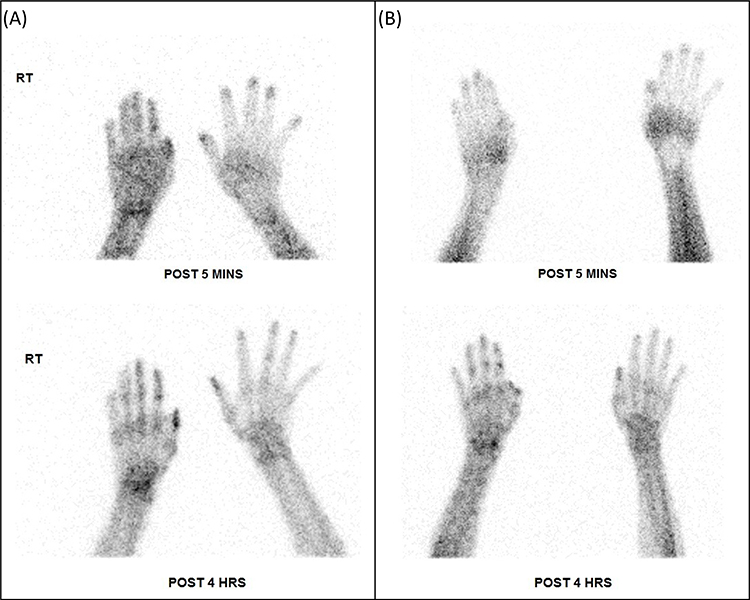 |
Figure 1 Three-phase bone scintigraphy in a patient with complex regional pain syndrome. (A) Increased tracer distribution in the right hand during the arterial and soft tissue phases (5 minutes) with markedly increased uptake in the right wrist and phalanges during the bone phase (4 hours). (B) Follow-up at 6 months showed persistent but less prominent tracer uptake compared to the baseline scan. |
Case 2
A 49-year-old female who was a victim of spontaneous intracerebral hemorrhage of left thalamus with right hemiplegia on March, fourth, 2023, presented right foot pain, edema, nail and skin atrophy in our rehabilitation department 10 months later in January 2024. She recalled, increased spasticity accompanied with shooting pain over right foot was noted at first, so she took baclofen (30 mg/day) due to equina varus since November 2023. There was mild relief of pain, VAS from 4 to 2 and Modified Ashworth Scale from 3 to 2. However, she still had sharp pain and temperature intolerance over right foot, which bothered her a lot, especially while standing with weight loading. Hyperesthesia and allodynia were noted while gentle stretching. Laboratory investigations were unremarkable. In January 2024, her three-phase bone scan showed late phase CRPS, that further convinced us of the diagnosis of CRPS. After taking pregabalin (75 mg/day), her VAS dropped to 1 and she was able to engage in more intensive rehabilitation training, such as weight bearing loading over right side, plantar flexion and dorsiflexion of right foot. Meanwhile, muscle spasticity was controlled by regular botulism injection at foot flexor muscles to avoid equina varus and claw toes. A few months later, pregabalin gradually tapered down and she denied any progressive skin or nail change. Recently, she can walk with a cane under supervision and engage in more social activities.
Case 3
An 82-year-old man came to our clinic on 10 April 2025 with a-week severe right wrist pain. He had been diagnosed with herniated intervertebral disc of C4/5 and C5/6 with spinal stenosis and myeloradiculopathy with right hemparesis and received anterior cervical discetomies and interbody fusion with cages on 27 January 2025 due to falling injury. On examination, edema of right wrist with allodynia made him difficulty in hand grasp and pulling. Moderate to severe pain (VAS: 6) drew him from rehabilitation exercise, which is essential requirement for better recovery. Ultrasound indicated mild tenosynovitis of flexor digitorum profundus, flexor digitorum superficialis and extensor carpi ulnaris. Local steroid injection was done at wrist joint and lesion sites with short-term pain relief. CRPS fell into our differential diagnosis then. Under multiple pain medication, pregabalin (150 mg/day), tramadol, and celecoxib (150 mg/day) were given at first; subsequently, VAS dropped to 3. Three-phase bone scan in April 2025, suggested acute CRPS, which further consolidated the impression. Opioid and NASID were gradually discontinued after several times of nerve hydrodissection and tender point injections. The patient could carry on occupational therapy with tolerable pain condition (VAS: 1–2) controlled with pregabalin (150 mg/day) in May 2025. In addition, he was able to complete more daily tasks with moderate assistance and better sleep quality with less interruption by breakthrough pain during midnight.
Discussion
This case series describes three patients with Type I CRPS diagnosed using the Budapest criteria and supported by three-phase bone scintigraphy, secondary to central nervous system pathology (stroke, intracranial hemorrhage, and cervical myeloradiculopathy) (Table 1). Although three-phase bone scintigraphy is not considered the diagnostic gold standard, it provided valuable supportive evidence after exclusion of alternative etiologies such as avascular necrosis and infection.
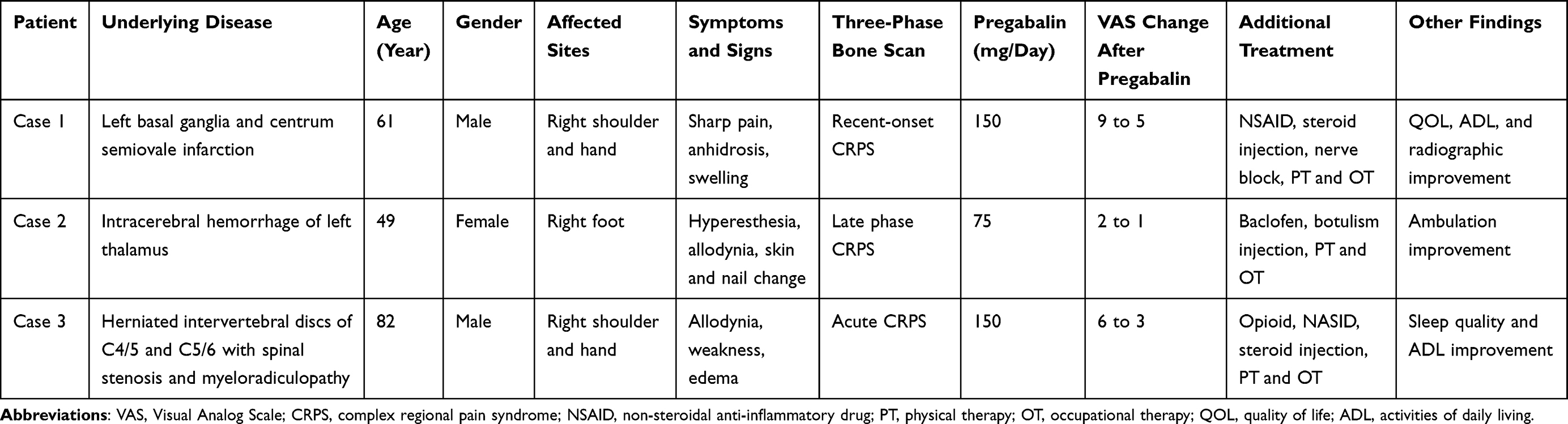 |
Table 1 Summary of Cases |
The complex pathophysiology of CRPS remains incompletely understood, involving multifaceted interactions between aberrant inflammatory cascades, immune dysregulation, vasomotor dysfunction, neuroplastic changes, genetic predisposition, and psychological factors.3,4 Recent studies emphasized that the neurogenic inflammation is responsible for allodynia and hyperalgesia.5 It involves the release of pro-inflammatory neuropeptides, including substance P and calcitonin gene-related peptide (CGRP), from peripheral nociceptive C-fibers, subsequently activating mast cells and dendritic cells to release inflammatory mediators such as histamine, serotonin, and tumor necrosis factor-alpha, perpetuating the inflammatory cascade.6,7
Central sensitization plays a crucial role, manifested by hyperalgesia extending beyond the affected region, enhanced temporal summation, and multisensory processing dysfunction. Impaired periaqueductal grey and altered neuronal plasticity such as the excitability of thalamocortical nociceptive pathways due to loss of peripheral inhibition and upregulation of glutamate receptors in the central nervous system disrupted antinociceptive modulation.8,9 Psychological distress, including anxiety, depression, body perception disturbances, and reduced limb ownership, both contribute to and result from CRPS. Ultimately, CRPS reveals as a complex syndrome where inflammatory, autoimmune, neuroplastic, genetic, and psychological factors interact dynamically, explaining the condition’s variability and treatment challenges. Thus, it highlights the need for multimodal therapeutic approaches targeting multiple pathophysiological pathways simultaneously.
According to Complex Regional Pain Syndrome: Practical Diagnostic and Treatment Guidelines in 2022 8, there is no consensus on treatment for CRPS with a variety of medical choices, such as anti-inflammation drug (NSAID), immune modulator (intravenous immunoglobulin, steroid), bisphosphonate, cation-channel blockers (gabapentin, pregabalin), opioids, tricyclic/heterocyclic antidepressants, NMDA receptor antagonists, anti-hypertensives and a-adrenergic antagonists and emerging treatment such as Botulinum toxin type A injections. While gabapentin represents the established first-line treatment for neuropathic pain,10 there is very low-certainty evidence for its effectiveness from a Cochrane systematic reviews.11 The similar compound, pregabalin which number need to treat is 7.7 (95% confidence interval: 6.5–9.4) with moderate-certainty evidence from meta-analyses of randomized trials.12
However, CRPS and neuropathic pain are different in certain domains. Neuropathic pain defined by International Association for the Study of Pain is pain caused by a lesion or disease of the somatosensory nervous system, such as post-traumatic condition, postherpetic neuralgia, diabetic and non-diabetic painful polyneuropathy. On the other hand, CRPS presents distinctive vasomotor, sudomotor and trophic change of limb or skin integrity, making the therapeutic medication difficult.
Pregabalin works at the alpha-2-delta auxiliary subunit of voltage-dependent calcium channels within the central nerve system and modulates calcium influx at the nerve terminals, thereby inhibiting excitatory neurotransmitter release including glutamate, norepinephrine, serotonin, dopamine, substance P, and CGRP.13 This neurotransmitter modulation potentially reduces neuropeptide-mediated inflammation and influences descending noradrenergic and serotonergic pain transmission pathways from the brainstem to the spinal cord, resulting in anti-nociceptive effects.
In a recent comparative analysis between gabapentin and pregabalin in neuropathic pain management demonstrate pregabalin’s superiority across multiple outcome measures, including Visual Analog Scale scores, quality of life assessments (SF-12/SF-36/EQ-5D), and reduced opioid requirements.14 Moreover, pregabalin demonstrated higher oral bioavailability, faster absorption, and a more predictable dose-response relationship than gabapentin in pharmacokinetics.15,16 As for drug side effects, gabapentin had a three-fold higher incidence of nausea and vomiting.14 It suggests that pregabalin exhibits better therapeutic outcomes and tolerability.
Even with low dose pregabalin treatment, our three cases showed improvement in not only pain intensity but also vasomotor dysregulation. This finding extends previous research focusing on Type II CRPS secondary to traumatic amputation or peripheral nerve injury, suggesting therapeutic benefit in adults with Type I CRPS of central origin. Notably, one patient demonstrated decreased tracer uptake on follow-up three-phase bone scintigraphy after six months of pregabalin therapy, providing objective evidence of therapeutic response. In addition, the most concern of the CRPS is pain. All our patients had more than one management for CRPS, including oral medication (NSAID, opioid and pregabalin), botulism or steroid injection and they did have certain effects. Pain reduction, regardless of the specific intervention, correlated with decreased depressive symptoms and enhanced engagement in physical and occupational therapy programs emphasizing manual edema mobilization, desensitization techniques, functional optimization, and activities of daily living integration.
CRPS is a multifactorial condition involving inflammatory, neuroplastic, immune, and psychological mechanisms, which contribute to its heterogeneity and therapeutic challenges. However, our findings suggest that pregabalin demonstrates clinically significant anti-inflammatory and anti-nociceptive effects that may justify its consideration as first-line therapy in CRPS management. However, this study is limited by a small sample size and the absence of serum pregabalin measurements, which prevents a direct correlation between clinical efficacy, safety, and therapeutic drug concentrations.
Furthermore, because the pregabalin as a pain therapeutic involves diverse signaling pathways via alpha-2-delta subunit,17 future research should utilize liquid chromatography–mass spectrometry (LC-MS) for the identification and semi-quantification of pain-related proteins and metabolites.18 This proteomic and metabolomic approach would provide a more comprehensive view of molecular dynamics. Finally, well-designed, randomized controlled trials or cohort study are needed to directly compare pregabalin and gabapentin within CRPS populations, utilizing standardized outcome measures and extended follow-up periods.
Conclusion
Pregabalin appears to be a safe and effective therapeutic option for CRPS, with observed benefits in pain control, vasomotor symptoms, and rehabilitation participation. These findings support consideration of pregabalin as part of potential option within first-line pharmacotherapy within a comprehensive multidisciplinary treatment paradigm. Randomized controlled trials are needed to confirm efficacy and establish definitive treatment protocols.
Abbreviations
CRPS, Complex regional pain syndrome; NSAIDs, non-steroidal anti-inflammatory drugs; VAS, Visual Analog Scale; CGRP, calcitonin gene-related peptide.
Ethics Approval and Consent to Participate
This study adhered to the ethical guidelines of Helsinki and was approved by the Institutional Review Board of Tri-Service General Hospital (Reference No.: C202515124). All patients included in this study provided written informed consent.
Consent for Publication
Consent for publication has been approved by all the participants.
Acknowledgments
We would like to express our sincere gratitude to the rehabilitation team, including doctors, nurses, physical therapist, and occupational therapists for their expertise, dedication, and support to the patients.
Author Contributions
All authors made substantial contributions to the conception and design of the study, data acquisition, analysis and interpretation; participated in drafting or critically revising the manuscript; approved the final version to be published; agreed on the journal to which the article has been submitted; and agreed to be accountable for all aspects of the work.
Disclosure
This study did not receive any specific grant from funding agencies in the public, commercial, or not-for-profit sectors. No potential conflict of interest was reported by the authors.
References
1. Ferraro MC, O’Connell NE, Sommer C, et al. Complex regional pain syndrome: advances in epidemiology, pathophysiology, diagnosis, and treatment. Lancet Neurol. 2024;23(5):522–7. doi:10.1016/S1474-4422(24)00076-0
2. Goebel A, Birklein F, Brunner F, et al. The Valencia consensus-based adaptation of the IASP complex regional pain syndrome diagnostic criteria. Pain. 2021;162(9):2346–2348. doi:10.1097/j.pain.0000000000002245
3. Parkitny L, McAuley JH, Di Pietro F, et al. Inflammation in complex regional pain syndrome: a systematic review and meta-analysis. Neurology. 2013;80(1):106–117. doi:10.1212/WNL.0b013e31827b1aa1
4. Abd-Elsayed A, Stark CW, Topoluk N, et al. A brief review of complex regional pain syndrome and current management. Ann Med. 2024;56(1):2334398. doi:10.1080/07853890.2024.2334398
5. Misidou C, Papagoras C. Complex regional pain syndrome: an update. Mediterr J Rheumatol. 2019;30(1):16–25. doi:10.31138/mjr.30.1.16
6. Littlejohn G. Neurogenic neuroinflammation in fibromyalgia and complex regional pain syndrome. Nat Rev Rheumatol. 2015;11(11):639–648. doi:10.1038/nrrheum.2015.100
7. Li WW, Guo TZ, Shi X, et al. Neuropeptide regulation of adaptive immunity in the tibia fracture model of complex regional pain syndrome. J Neuroinflammation. 2018;15(1):105. doi:10.1186/s12974-018-1145-1
8. Nijs J, George SZ, Clauw DJ, et al. Central sensitisation in chronic pain conditions: latest discoveries and their potential for precision medicine. Lancet Rheumatol. 2021;3(5):e383–e392. doi:10.1016/S2665-9913(21)00032-1
9. Lebel A, Becerra L, Wallin D, et al. fMRI reveals distinct CNS processing during symptomatic and recovered complex regional pain syndrome in children. Brain. 2008;131(Pt 7):1854–1879. doi:10.1093/brain/awn123
10. NICE. Neuropathic pain in adults: pharmacological management in non-specialist settings. 2020.
11. Ferraro MC, Cashin AG, Wand BM, et al. Interventions for treating pain and disability in adults with complex regional pain syndrome- an overview of systematic reviews. Cochrane Database Syst Rev. 2023;6(6):Cd009416. doi:10.1002/14651858.CD009416.pub3
12. Finnerup NB, Attal N, Haroutounian S, et al. Pharmacotherapy for neuropathic pain in adults: a systematic review and meta-analysis. Lancet Neurol. 2015;14(2):162–173. doi:10.1016/S1474-4422(14)70251-0
13. Gajraj NM. Pregabalin: its pharmacology and use in pain management. Anesthesia Analg. 2007;105(6):1805–1815. doi:10.1213/01.ane.0000287643.13410.5e
14. Mayoral V, Galvez R, Ferrándiz M, et al. Pregabalin vs. gabapentin in the treatment of neuropathic pain: a comprehensive systematic review and meta-analysis of effectiveness and safety. Front Pain Res. 2024;5:1513597. doi:10.3389/fpain.2024.1513597
15. Taylor CP, Angelotti T, Fauman E. Pharmacology and mechanism of action of pregabalin: the calcium channel alpha2-delta (alpha2-delta) subunit as a target for antiepileptic drug discovery. Epilepsy Res. 2007;73(2):137–150. doi:10.1016/j.eplepsyres.2006.09.008
16. Calandre EP, Rico-Villademoros F, Slim M. Alpha(2)delta ligands, gabapentin, pregabalin and mirogabalin: a review of their clinical pharmacology and therapeutic use. Expert Rev Neurother. 2016;16(11):1263–1277. doi:10.1080/14737175.2016.1202764
17. Alles SRA, Cain SM, Snutch TP. Pregabalin as a pain therapeutic: beyond calcium channels. Front Cell Neurosci. 2020;14:83. doi:10.3389/fncel.2020.00083
18. Wang Y, Qin Y, Zeng S, et al. Proteomic and metabolomic analysis of plasma for pain at different labor stages. Talanta. 2025;282:126905. doi:10.1016/j.talanta.2024.126905
 © 2026 The Author(s). This work is published and licensed by Dove Medical Press Limited. The
full terms of this license are available at https://www.dovepress.com/terms
and incorporate the Creative Commons Attribution
- Non Commercial (unported, 4.0) License.
By accessing the work you hereby accept the Terms. Non-commercial uses of the work are permitted
without any further permission from Dove Medical Press Limited, provided the work is properly
attributed. For permission for commercial use of this work, please see paragraphs 4.2 and 5 of our Terms.
© 2026 The Author(s). This work is published and licensed by Dove Medical Press Limited. The
full terms of this license are available at https://www.dovepress.com/terms
and incorporate the Creative Commons Attribution
- Non Commercial (unported, 4.0) License.
By accessing the work you hereby accept the Terms. Non-commercial uses of the work are permitted
without any further permission from Dove Medical Press Limited, provided the work is properly
attributed. For permission for commercial use of this work, please see paragraphs 4.2 and 5 of our Terms.