
Back to Journals » International Journal of Women's Health » Volume 17
Causal Relationship Between Matrix Metalloproteinase and Cervical Lesions: A Two-Sample Mendelian Randomization Analysis
Authors Pan M, Tian W, Su M, Zhang S, Hai Y
Received 14 April 2025
Accepted for publication 31 July 2025
Published 18 August 2025 Volume 2025:17 Pages 2569—2582
DOI https://doi.org/10.2147/IJWH.S533897
Checked for plagiarism Yes
Review by Single anonymous peer review
Peer reviewer comments 2
Editor who approved publication: Dr Everett Magann
Mingxing Pan,1 Wei Tian,2 Meiling Su,3 Shaohua Zhang,4 Yanjie Hai5
1Digestive Endoscopy Center, Hongqi Hospital Affiliated to Mudanjiang Medical University, Mudanjiang, Heilongjiang, People’s Republic of China; 2Department of Operating Room, Hongqi Hospital Affiliated to Mudanjiang Medical University, Mudanjiang, Heilongjiang, People’s Republic of China; 3Department of Pain, Hongqi Hospital Affiliated to Mudanjiang Medical University, Mudanjiang, Heilongjiang, People’s Republic of China; 4Department of Radiotherapy, Handan Central Hospital, Handan, Hebei, People’s Republic of China; 5Department of Oncology, Hongqi Hospital Affiliated to Mudanjiang Medical University, Mudanjiang, Heilongjiang, People’s Republic of China
Correspondence: Yanjie Hai, Email [email protected]
Purpose: This study aimed to investigate the causal relationship between matrix metalloproteinases (MMPs) and cervical lesions, as their correlation remains unclear despite reports of their involvement in the pathogenesis of these lesions.
Patients and Methods: A two-sample Mendelian randomization (MR) analysis was performed using genome-wide association studies (GWAS) summary data to assess the causal associations of MMPs (MMP-1, 2, 3, 7, 9, 10, 12, 14, 16, and 17) with cervical lesions. The primary analysis utilized the inverse-variance weighted (IVW) method, supplemented by weighted median, mode, and MR-Egger regression. Heterogeneity was evaluated using Cochran’s Q test and Leave-one-out analysis, while MR-Egger regression and MR pleiotropy residual sum and outlier (MR-PRESSO) methods addressed horizontal pleiotropy.
Results: IVW analysis revealed causal effects of MMP-3 on cervical precancerous lesions (OR = 0.9993, P=0.0248), MMP-7 on cervical cancer (OR=0.6131, P = 0.0303), MMP-9 on cervical inflammation (OR = 1.1081, P = 0.0446), and MMP-12 on cervical erosion (OR = 0.8354, P = 0.0444), and cervical cancer (OR = 0.6836, P = 0.006). Sensitivity analyses confirmed these findings.
Conclusion: The study highlights causal associations between MMPs and cervical lesions, suggesting their potential as therapeutic targets and biomarkers for early detection. Future research should further explore the mechanisms involved.
Keywords: matrix metalloproteinase, cervical lesions, Mendelian randomization, causal relationship, genetic association, SNPs
Introduction
Cervical lesions encompass a spectrum of conditions ranging from benign to malignant, including cervical inflammation, cervical erosion and ectropion, cervical precancerous lesions, and cervical cancer. Cervical cancer is a significant global public health issue and one of the common malignant tumors that pose a severe threat to women’s health worldwide.1 In 2020, there were estimated to be 604,000 new cases of cervical cancer globally, with 342,000 deaths.2 Clinically, cervical lesions often present with symptoms such as abnormal vaginal bleeding, discharge, and pain.3 The risk factors for cervical lesions include smoking, multiple sexual partners, early sexual debut, and chronic infections, particularly with human papillomavirus (HPV)3 Despite the potential of the latest nine-valent HPV vaccine to prevent up to 90% of cervical lesion cases,4 the vaccination coverage remains suboptimal, especially in developing countries that account for approximately 85% of cervical cancer occurrences.5 In a subset of women infected by HPV, the virus can persist, leading to cervical lesions and ultimately to the development of cervical cancer, which is a complex process involving multiple genetic and environmental factors.6 Thus, it is particularly important to explore the influencing factors in the development process of cervical lesions and cervical cancer.
Matrix metalloproteinases (MMPs), a family of enzymes that regulate the degradation and remodeling of the extracellular matrix,7 are involved in various cellular processes, including tissue remodeling, inflammation, and cancer progression.8 In recent years, the association between cervical lesions and MMPs has attracted much attention.9 A previous study indicated that MMP overexpression might be a poor prognostic marker in cervical cancer.10 The elevated expression of MMP-1 in tumor tissue can be considered a predictive factor for the development of metastases.11 MMP-7 was considered a potential oncogene in cervical cancer cells and was involved in cell proliferation, migration, and invasion.12 MMP-9 was also demonstrated to promote cell invasion.13 However, Wang et al demonstrated that there was no relation between MMP-2 overexpression and overall survival.14 Davidson et al indicated that the presence of MMP-9 mRNA or protein did not predict the prognosis.15 Thus, there are many contradictions in the research on the relationship between MMPs and cervical lesions. Further studies are warranted to demonstrate the causal association between them, thereby conferring a theoretical basis for follow-up research and clinical treatment.
To disentangle the complex relationship between cervical lesions and MMPs, we employed a two-sample Mendelian randomization (MR) analysis. MR leverages the correlation between disease genotype to mimic the influence of exposure factors on disease pathogenesis, achieved by employing genetic variations linked to exposure factors as instrumental variables (IVs).16 MR is regarded as a complementary approach to randomized controlled trials as it minimizes the impact of confounding factors.17
Herein, a two-sample MR study was conducted, leveraging the publicly available genome-wide association studies (GWAS) databases, to delve into the potential causal relationships between cervical lesions and MMPs. The results of this study have the potential to provide new insights into the pathogenesis of cervical lesions.
Materials and Methods
Study Design
In this study, single-nucleotide polymorphisms (SNPs) derived from GWAS were selected as genetic IVs. The two-sample MR study was founded upon three fundamental assumptions:18
- Relevance assumption: The IVs had a strong connection to the exposure.
- Independence assumption: There was no correlation between the IVs and any variables that affected both exposure and outcome.
- Exclusion restriction assumption: The IVs did not alter the outcome through any other causal pathways other than their effects on the exposure.
In this MR analysis, MMPs (MMP-1, −2, −3, −7, −9, −10, −12, −14, −16, and −17) were considered as the exposure factors, with cervical lesions including cervical inflammation, cervical erosion and ectropion, cervical precancerous lesions, and cervical cancer serving as the outcome (Figure 1). The study was submitted to the ethics committee of Hongqi Hospital Affiliated to Mudanjiang Medical University. The need for ethical approval was waived by the committee because the study used publicly available aggregated data that did not allow the re-identification of the original participants, as supported by Article 32 of the Measures for Ethical Review of Life Science and Medical Research Involving Human Subjects dated February 18, 2023, China, as well as various legislations around the globe.19
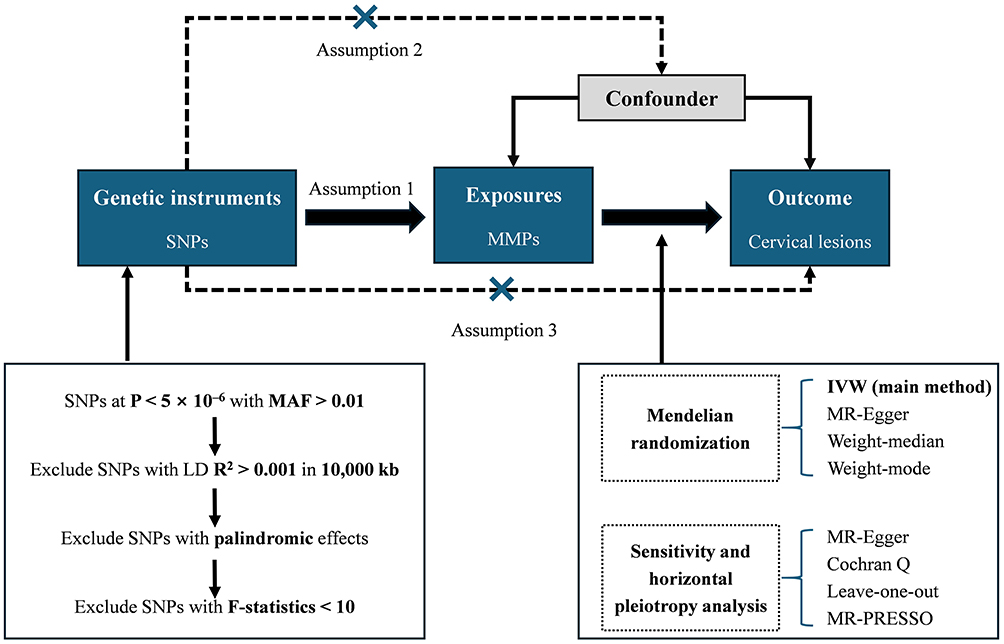 |
Figure 1 Diagram of three stringent assumptions and core design of the present MR study. Bold text was used to emphasize the important information. Abbreviations: MR, Mendelian randomization; SNPs, single nucleotide polymorphisms. MMPs, matrix metalloproteinases; MAF, minor allele frequency. LD, linkage disequilibrium; IVW, inverse-variance weighted; MR-PRESSO, mendelian randomization pleiotropy residual sum and outlier. |
Data Source
The summary data on cervical inflammation, cervical erosion and ectropion, as well as cervical cancer, were derived from the FInGen consortium, which has aggregated GWAS results for various diseases, encompassing the genomic and electronic health record data of over 100,000 Finnish participants20 The summary data on cervical precancerous lesions were sourced from UK Biobank (UKB), a large-scale biomedical database and research resource containing genetic, lifestyle, and health information from half a million UK participants.21 SNPs related to the 10 kinds of MMPs (MMP-1, MMP-2, MMP-3, MMP-7, MMP-9, MMP-10, MMP-12, MMP-14, MMP-16, and MMP-17) were obtained from the GWAS Catalog, which boasts an extensive collection of 589,865 genetic associations from 6,799 publications.22 The specific information is shown in Table S1.
Instrument Selection
Initially, SNPs significantly associated with the genome-wide MMPs were screened based on a loose cutoff at P < 5 × 10⁻⁶, among which, the SNPs with a minor allele frequency (MAF) > 0.01 were selected.23 A more stringent cutoff (eg, P < 5×10⁻⁸) may improve instrument strength and reduce potential bias, but too few SNPs were initially identified to be able to conduct the MR analysis. Therefore, it had to be relaxed to P < 5×10⁻⁶. The linkage disequilibrium (LD) among SNPs was eliminated based on the criteria of R2 < 0.001 and a window size of 10,000 kb.23 If the selected IV was absent in the summary data of the outcome, a proxy SNP with a high LD (R2 > 0.8) with that particular IV was identified and chosen for substitution.24 The F-statistic of each SNP in the IVs was calculated to assess the IVs’ strength, excluding potential weak instrument bias between the IVs and the exposure factors.25 The formula for the F-statistic is as follows:
F = R2* (N-2) / (1-R2), where R2 represents the proportion of exposure variation explained by the SNP in the IV, and the F-value is required to be > 10.26
Statistical Analysis
This analysis prominently employed the inverse variance weighted (IVW) method as the primary analytical technique, assessing the causal association between exposure and outcome risk by computing the odds ratio (OR) alongside a 95% confidence interval (95% CI).27 IVW stands as the pivotal method for interpreting MR results, determining the weighted average of effect sizes by leveraging the inverse variance of each SNP as the weighting factor.28 Furthermore, the study’s findings were rigorously tested for robustness using methods including MR-Egger, weighted median, and weighted mode. The MR-Egger method accounts for the potential presence of an intercept term, enabling it to provide precise causal effect estimates even in scenarios of pleiotropy bias.26 Meanwhile, the weighted median method postulates that half of the instrumental variables remain valid, thereby facilitating the analysis of the causal relationship between exposure and outcome.29 All analyses in this study were conducted using R version 4.0.5 along with the “TwoSampleMR” package. Visual representations were achieved through the use of scatter plots and sensitivity analysis graphs.23 A scatter plot is used to demonstrate the effect relationship of IVs on exposure and outcome, a funnel plot is used to detect whether there is any bias, and a forest plot is used to display the effect estimates of SNPs and their consistency.
Sensitivity Analysis
Sensitivity analysis plays a crucial role in detecting potential pleiotropy that may arise in MR studies.28 In this study, Cochran’s Q test was employed to assess the heterogeneity among IVs.23 When P > 0.05, it is considered that the heterogeneity is low, indicating that the estimates among instrumental variables are randomly varied and have minimal impact on the IVW results.30 Simultaneously, considering the impact of genetic variation’s pleiotropy on the estimation of association effects, this study employed the MR-Egger regression method to explore the existence of horizontal pleiotropy. When the intercept term of MR-Egger regression approaches zero or is not statistically significant, it suggests that there is no pleiotropy.31 Additionally, this study employed the MR pleiotropy residual sum and outlier (MR-PRESSO) method to identify potential outliers (ie, SNPs with P < 0.05) and re-estimated the causal association after excluding them, thereby correcting for horizontal pleiotropy.30 The Leave-one-out analysis was used to assess the robustness and consistency of the results.28
Results
Selection of Instrumental Variables
We respectively incorporated 20, 7, 16, 16, 10, 23, 23, 19, 14, 14 independent SNPs as IVs for MMP-1, MMP-2, MMP-3, MMP-7, MMP-9, MMP-10, MMP-12, MMP-14, MMP-16, MMP-17. The minimum F-statistics of these SNPs were 86.92, 22.54, 160.51, 60.01, 24.87, 73.24, 110.09, 22.35, 22.75, and 26.00, respectively, all of which exceeded the threshold of 10, indicating enough strength of IVs (Table S2). Additionally, the information on SNPs that were unmatched in the summary data of outcomes and excluded due to palindrome structure is exhibited in Table S3. Notably, due to data quality issues related to cervical precancerous lesions, the number of MMPs-associated SNPs ultimately used for this outcome analysis was affected (see details in Table S3).
Causal Effects of MMPs on Cervical Lesions
The results of IVW (Table 1) found causal effects of MMP-3 on a lower risk of cervical precancerous lesions (OR (95% CI) = 0.9993 (0.9987–0.9999), P = 0.0248), MMP-7 on a lower risk of cervical cancer (OR (95% CI) = 0.6131 (0.3939–0.9545), P = 0.0303), MMP-9 on a higher risk of cervical inflammation (OR (95% CI) = 1.1081 (1.0025–1.2248), P = 0.0446), MMP-12 on lower risks of cervical erosion and ectropion (OR (95% CI) = 0.8354 (0.701–0.9955), P = 0.0444), and cervical cancer (OR (95% CI) = 0.6836 (0.5211–0.8968), P = 0.006). No genetic effects were observed from the remaining MMPs on cervical lesions. In addition, scatter plots provide intuitive visualizations of the SNP-specific effect sizes on MMPs and cervical lesions (Figures S1A–S5A). Forest plots illustrate the individual SNP effect estimates and coherence (Figures S1B–S5B).
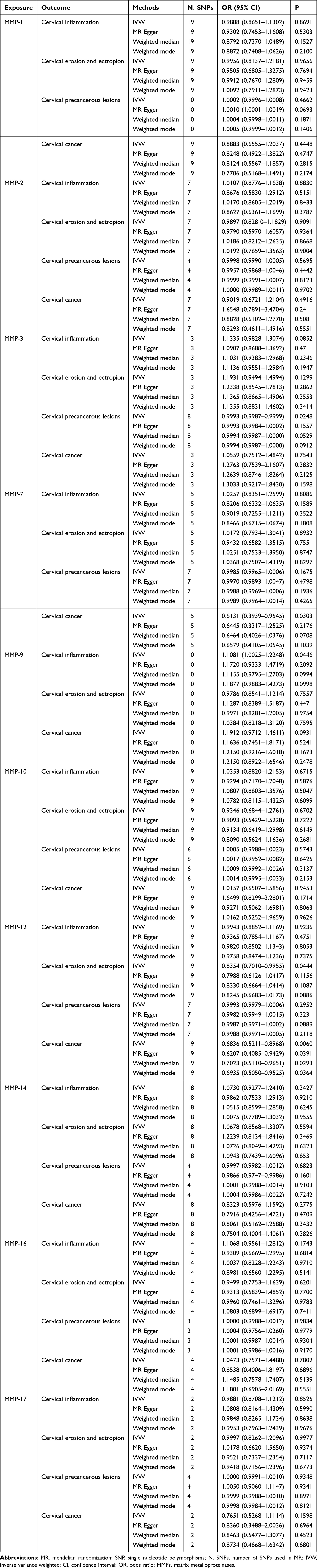 |
Table 1 MR Results of Causal Effects of MMPs on Cervical Lesions |
Cochran’s Q test found no heterogeneity in the MR analysis of MMP-3 on cervical precancerous lesions, MMP-7 on cervical cancer, MMP-9 on cervical inflammation, MMP-12 on cervical erosion and ectropion, or MMP-12 on cervical cancer (Table 2). The results of the MR-Egger regression suggested that the significant causal associations found above were not biased by horizontal pleiotropy (Table 2). The results of the MR-PRESSO global test indicated no outliers in the significant causal relationship between MMPs and cervical lesions (Table 3). Additionally, the leave-one-out analysis (Figure S1C–S5C), which evaluates the influence of each SNP individually, indicated that the causal estimates of MMPs were not unduly influenced by any single SNP. The funnel plots confirmed the unbiased nature of the results (Figures S1D–S5D).
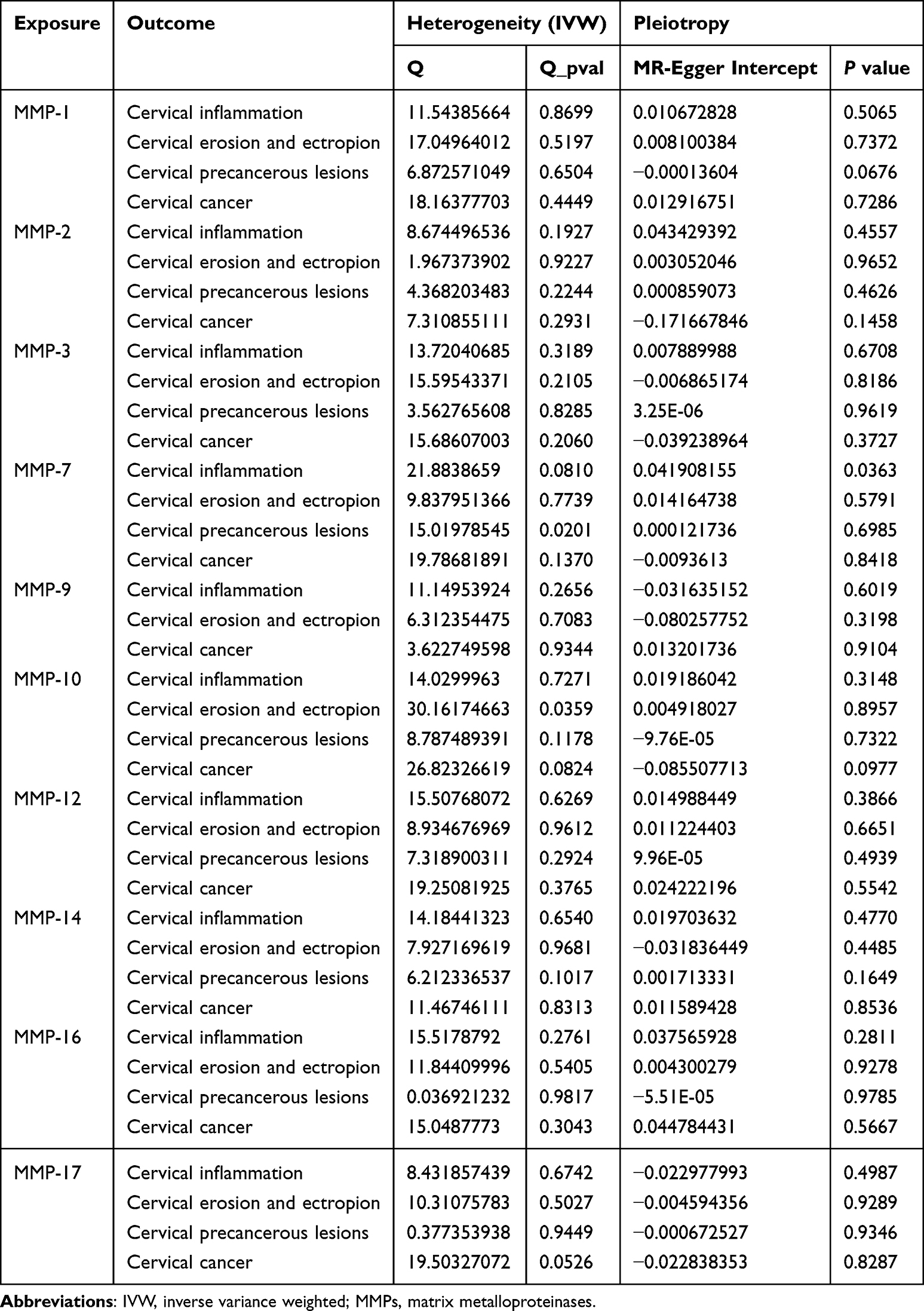 |
Table 2 The Heterogeneity Analysis by Cochran’s Q Test and Horizontal Pleiotropy Analysis by MR-Egger Regression |
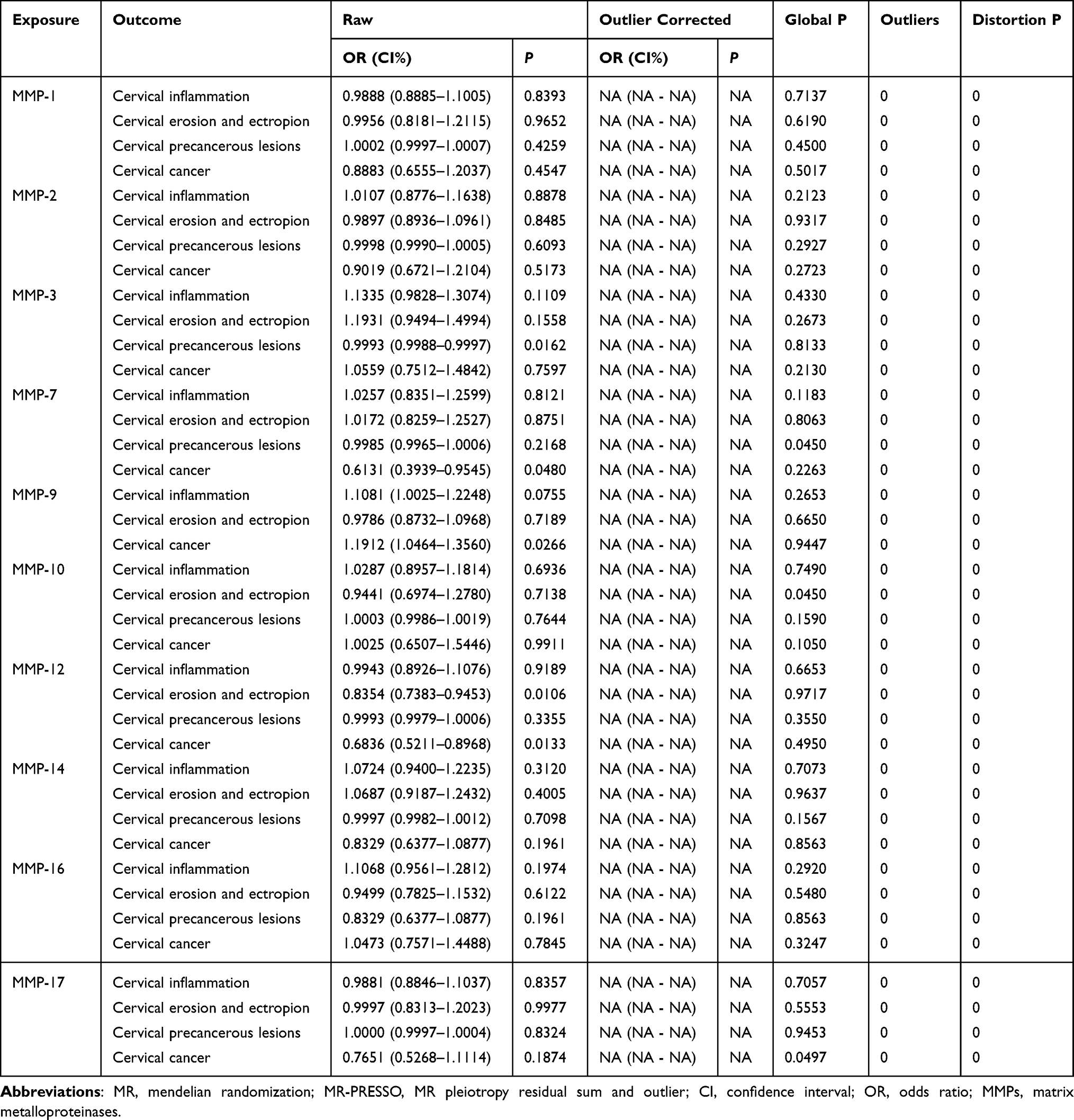 |
Table 3 The Pleiotropy Analysis by MR-PRESSO Global Test |
Discussion
This study employed a two-sample MR analysis to investigate the potential causal associations between various MMPs and cervical lesions. Our results provide intriguing insights into the role of specific MMPs in the pathogenesis of cervical inflammation, cervical erosion and ectropion, cervical precancerous lesions, and cervical cancer.
Our analysis found a causal effect of MMP-3 on a lower risk of cervical precancerous lesions. MMP-3, also known as stromelysin-1, is a member of the MMP family that plays a crucial role in the degradation of extracellular matrix components, such as collagen, elastin, and proteoglycans.8 Within the MMP family, MMP-3 is unique in its ability to activate other MMPs, thereby amplifying their proteolytic activities.32 The results of this study, which found that MMP-3 may be interpreted as protective, contrast with previous research. Indeed, Shao et al found MMP-3 upregulation in cervical cancer patients’ serum, which was associated with increased cell viability and proliferation, indicating its role as a risk factor in cervical cancer.33 Possible reasons for this discrepancy could involve the complex interplay between MMP-3 and other factors in different stages of cervical lesion development, or variations in the study populations and methodologies employed. It is plausible that MMP-3 may exhibit protective effects in the early stages of cervical dysplasia by modulating inflammatory responses or facilitating tissue repair, whereas its overexpression in later stages may contribute to disease progression by promoting cell proliferation and invasion.9 Furthermore, the dataset used in the present study was on blood MMP-3 levels, which may not necessarily represent the local MMP-3 levels in cervical tissues. Despite being statistically significant, the OR of MMP-3 was close to 1, raising doubts regarding the clinical significance of such results. Nevertheless, the OR of 0.9993 indicates that the risk of cervical precancerous lesions would decrease by 0.07% for each 1-unit increase of MMP-3 levels. Considering that the normal blood MMP-3 levels are in the range of 18–120 ng/mL and can increase in the range of 486±35 in inflammatory conditions like rheumatoid arthritis,34 a change in risk based on 1-ng/mL changes can become clinically significant. Nevertheless, further research is needed to elucidate the precise role of MMP-3 in cervical carcinogenesis.
Importantly, the findings suggest a causal relationship between MMP-7 and a lower risk of cervical cancer. MMP-7, also known as matrilysin, is known for its ability to degrade extracellular matrix components and activate other MMPs.35 MMP-7 appears to play a role in promoting tumorigenesis and progression.36 Zhu et al revealed that MMP-7 functions as an oncogene in cervical cancer, exhibiting elevated expression in both tissues and serum of patients, and correlates with advanced pathological features.12 Guo et al indicated that MMP-7 expression was associated with lymph node metastasis and indicated an invasive potential in early cervical cancers.37 However, the functional properties of MMP-7 may change in specific contexts or under certain regulatory mechanisms. As for MMP-3 discussed above, the dataset was on blood MMP-7 levels, which may be different from local cervical levels. Alternatively, MMP-7 could be part of a complex regulatory network where its activity is tightly controlled and balanced with other factors, resulting in a net inhibitory effect on cancer progression in some cases.10 The mechanisms of MMP-7 in cervical lesions remain to be investigated.
Our results indicated a causal effect of MMP-9 on increasing the risk of cervical inflammation. MMP-9, also known as gelatinase B, is involved in the degradation of gelatin and other extracellular matrix components.38 In the context of cervical inflammation, MMP-9 may contribute to tissue damage and the promotion of inflammatory responses. Short et al demonstrated that MMP-9 plays a crucial role in cervical inflammation in pregnant women living with HIV infection, correlating with genital tract inflammation and adverse vaginal microbiota.39 Matheus et al found that MMP-9 expression increases with the severity of cervical lesions and is particularly elevated in the presence of infectious agents in low-grade squamous intraepithelial lesions.40 The observed association between MMP-9 and cervical inflammation suggests that it may play a role in the pathogenesis of cervical lesions by facilitating the infiltration of inflammatory cells and the release of inflammatory mediators.13 Therefore, targeting MMP-9 may be a promising strategy for reducing cervical inflammation and preventing disease progression.
Additionally, we found causal effects of MMP-12 on reducing the risks of cervical erosion and ectropion, as well as cervical cancer. MMP-12, also known as macrophage elastase, is primarily expressed by macrophages and plays a role in tissue repair and inflammation.38 Makise et al indicated that MMP-12 expression, upregulated by the overexpression of Nup88, stimulates malignant phenotypes, including the invasive ability of cervical cancer cells.41 Chen et al found that MMP-12 plays a crucial role in perineural invasion in cervical cancer by degrading the extracellular matrix.42 However, it is plausible that the role of MMP-12 may be context-dependent, with protective effects in early stages of cervical lesions through tissue repair and inflammation, while its overexpression or deregulation in more advanced or malignant stages may contribute to disease progression. Therefore, the balance and regulation of MMP-12 activity within the cervical tissue microenvironment are likely crucial in determining its overall impact on cervical health and disease.
The clinical implications of our findings are significant. The identification of specific MMPs as causal factors in cervical diseases provides potential targets for therapeutic interventions. For example, inhibiting the activity or expression of MMPs implicated in disease progression may reduce the risk of cervical cancer development. Additionally, MMPs may serve as biomarkers for disease prediction, diagnosis, and prognosis. However, further studies are needed to confirm these associations and elucidate the underlying biological mechanisms.
A central feature of many cervical lesions is HPV infection, and HPV infection is a well-known cause of cervical cancer.43 Although MR analyses examine associations between genetically predicted exposures and genetically predicted outcomes, hence excluding the impact of confounders, future MR studies should examine whether there are causal associations between HPV infection and MMP expression, and how it modulates the risk of cervical lesions. At the molecular level, it is known that HPV early genes encode oncoproteins (notably E5, E6, E7, and E2) that can modulate MMP expression. Indeed, these oncoproteins influence signaling pathways such as AKT, MEK/ERK, and AP-1, which in turn regulate MMP expression and activation. For example, the HPV E2 and E7 oncoproteins have been shown to increase MMP levels, facilitating carcinogenesis by promoting extracellular matrix degradation, tumor invasion, and metastasis.44–46 HPV-positive cervical cancer cell lines show higher invasiveness and elevated MMP transcripts compared to HPV-negative lines.47 HPV16 and HPV18 infections correlate with increased MMP-2 expression in papillomas, precancerous lesions, and squamous cell carcinomas, suggesting that HPV infection contributes to early malignant transformation via MMP upregulation.48 HPV prophylactic vaccination is recognized as an appropriate method to decrease the risk of cervical cancer,49 and its effect on MMP should be evaluated in future studies.
However, several limitations should be acknowledged. Firstly, the number of MMP-associated SNPs ultimately used for the outcome analysis was affected by data quality issues related to cervical precancerous lesions. This could have potentially limited the power to detect significant associations, especially for those MMPs with fewer high-quality SNPs available. Efforts should be made to improve the quality and quantity of genetic data available for cervical lesions. This could include collecting larger and more diverse sample sets, ensuring robust genotyping and phenotyping protocols, and harmonizing data across studies. Secondly, the genetic variants and their effects may differ across populations. The current study may not fully capture genetic diversity across different ethnicities, which could limit the generalizability of the findings. Conducting multi-ethnic studies will help to identify potential population-specific genetic associations and enhance the generalizability of findings. Such studies can provide insights into the genetic architecture of cervical lesions across diverse populations. Above all, while the current study provides valuable insights into the potential causal role of MMPs in cervical lesions, further research is needed to overcome existing limitations and fully elucidate the complex genetic underpinnings of these conditions.
Conclusion
In conclusion, our study provides evidence for the potential causal associations between specific MMPs and cervical lesions. These findings contribute to a better understanding of the pathogenesis of these conditions and may have important implications for the development of new therapeutic strategies and diagnostic tools. However, further research is needed to validate these associations and explore the underlying biological mechanisms.
Data Sharing Statement
All data generated or analyzed during this study are included in this published article.
Ethics Approval and Consent to Participate
The study was submitted to the ethics committee of Hongqi Hospital Affiliated to Mudanjiang Medical University. The need for ethical approval was waived by the committee because the study used publicly available aggregated data that did not allow the re-identification of the original participants, as supported by Article 32 of the Measures for Ethical Review of Life Science and Medical Research Involving Human Subjects dated February 18, 2023, China, as well as various legislations around the globe.19
Author Contributions
All authors made a significant contribution to the work reported, whether that is in the conception, study design, execution, acquisition of data, analysis and interpretation, or in all these areas; took part in drafting, revising or critically reviewing the article; gave final approval of the version to be published; have agreed on the journal to which the article has been submitted; and agree to be accountable for all aspects of the work.
Funding
There is no funding to report.
Disclosure
The authors report no conflicts of interest in this work.
References
1. Perkins RB, Wentzensen N, Guido RS, Schiffman M. Cervical cancer screening. JAMA. 2023;330(6). doi:10.1001/jama.2023.13174
2. Sung H, Ferlay J, Siegel RL, et al. Global cancer statistics 2020: GLOBOCAN estimates of incidence and mortality worldwide for 36 cancers in 185 countries. Cancer J Clinicians. 2021;71(3):209–249. doi:10.3322/caac.21660
3. Lea JS, Lin KY. Cervical cancer. Obstetrics Gynecol Clin North America. 2012;39(2):233–253. doi:10.1016/j.ogc.2012.02.008
4. Huh WK, Joura EA, Giuliano AR, et al. Final efficacy, immunogenicity, and safety analyses of a nine-valent human papillomavirus vaccine in women aged 16–26 years: a randomised, double-blind trial. Lancet. 2017;390(10108):2143–2159. doi:10.1016/s0140-6736(17)31821-4
5. Canfell K, Kim JJ, Brisson M, et al. Mortality impact of achieving WHO cervical cancer elimination targets: a comparative modelling analysis in 78 low-income and lower-middle-income countries. Lancet. 2020;395(10224):591–603. doi:10.1016/s0140-6736(20)30157-4
6. Burd EM. Human papillomavirus and cervical cancer. Clin Microbiol Rev. 2003;16(1):1–17. doi:10.1128/cmr.16.1.1-17.2003
7. de Almeida LGN, Thode H, Eslambolchi Y, et al. Matrix metalloproteinases: from molecular mechanisms to physiology, pathophysiology, and pharmacology. Pharmacol Rev. 2022;74(3):714–770. doi:10.1124/pharmrev.121.000349
8. Niland S, Riscanevo AX, Eble JA. Matrix metalloproteinases shape the tumor microenvironment in cancer progression. Int J Mol Sci. 2021;23(1). doi:10.3390/ijms23010146
9. Amabebe E, Ogidi H, Anumba DO. Matrix metalloproteinase-induced cervical extracellular matrix remodelling in pregnancy and cervical cancer. Reproduc Fertility. 2022;3(3):R177–R191. doi:10.1530/raf-22-0015
10. Chen W, Huang S, Shi K, Yi L, Liu Y, Liu W. Prognostic role of matrix metalloproteinases in cervical cancer: a meta-analysis. Cancer Control. 2021;28. doi:10.1177/10732748211033743
11. Tian R, Li X, Gao Y, Li Y, Yang P, Wang K. Identification and validation of the role of matrix metalloproteinase-1 in cervical cancer. Int J Oncol. 2018. doi:10.3892/ijo.2018.4267
12. Zhu L, Zheng X, Du Y, Xing Y, Xu K, Cui L. Matrix metalloproteinase-7 may serve as a novel biomarker for cervical cancer. Onco Targets Ther. 2018;11:4207–4220. doi:10.2147/ott.S160998
13. Tanaka T, Terai Y, Ohmichi M. Association of matrix metalloproteinase‑9 and decorin expression with the infiltration of cervical cancer. Oncol Lett. 2018. doi:10.3892/ol.2018.9713
14. Wang P-H, Ko J-L, Tsai H-T, et al. Clinical significance of matrix metalloproteinase-2 in cancer of uterine cervix: a semiquantitative study of immunoreactivities using tissue array. Gynecologic Oncol. 2008;108(3):533–542. doi:10.1016/j.ygyno.2007.11.018
15. Davidson B, Goldberg I, Kopolovic J, et al. Expression of matrix metalloproteinase-9 in squamous cell carcinoma of the uterine cervix-clinicopathologic study using immunohistochemistry and mRNA in situ hybridization. Gynecologic Oncol. 1999;72:380–386.
16. Birney E. Mendelian randomization. Cold Spring Harbor Perspectives Med. 2021. doi:10.1101/cshperspect.a041302
17. Ference BA, Holmes MV, Smith GD. Using mendelian randomization to improve the design of randomized trials. Cold Spring Harbor Perspectives Med. 2021;11(7). doi:10.1101/cshperspect.a040980
18. Emdin CA, Khera AV, Kathiresan S. Mendelian randomization. Am Med Assoc. 2017;318(19):1525–1526.
19. Scheibner J, Ienca M, Kechagia S, et al. Data protection and ethics requirements for multisite research with health data: a comparative examination of legislative governance frameworks and the role of data protection technologies. J Law Biosci. 2020;7(1):lsaa010. doi:10.1093/jlb/lsaa010
20. Kurki MI, Karjalainen J, Palta P, et al. FinnGen provides genetic insights from a well-phenotyped isolated population. Nature. 2023;613:
21. Si S, Li J, Tewara MA, Xue F. Genetically determined chronic low-grade inflammation and hundreds of health outcomes in the UK biobank and the finngen population: a phenome-wide mendelian randomization study. Front Immunol. 2021;12. doi:10.3389/fimmu.2021.720876
22. Long Y, Tang L, Zhou Y, Zhao S, Zhu H. Causal relationship between gut microbiota and cancers: a two-sample Mendelian randomisation study. BMC Med. 2023;21(1). doi:10.1186/s12916-023-02761-6
23. Skrivankova VW, Richmond RC, Woolf BAR, et al. Strengthening the reporting of observational studies in epidemiology using Mendelian randomization. JAMA. 2021;326(16). doi:10.1001/jama.2021.18236
24. Brion M-JA, Shakhbazov K, Visscher PM. Calculating statistical power in Mendelian randomization studies. Int J Epidemiol. 2013;42(5):1497–1501. doi:10.1093/ije/dyt179
25. Palmer TM, Lawlor DA, Harbord RM, et al. Using multiple genetic variants as instrumental variables for modifiable risk factors. Statistical Method Med Res. 2011;21(3):223–242. doi:10.1177/0962280210394459
26. Bowden J, Del Greco MF, Minelli C, Davey Smith G, Sheehan NA, Thompson JR. Assessing the suitability of summary data for two-sample Mendelian randomization analyses using MR-Egger regression: the role of the I2 statistic. Int J Epidemiol. 2016. doi:10.1093/ije/dyw220
27. Zuber V, Colijn JM, Klaver C, Burgess S. Selecting likely causal risk factors from high-throughput experiments using multivariable Mendelian randomization. Nat Commun. 2020;11(1). doi:10.1038/s41467-019-13870-3
28. Zheng J, Baird D, Borges M-C, et al. Recent developments in Mendelian randomization studies. Curr Epidemiol Rep. 2017;4(4):330–345. doi:10.1007/s40471-017-0128-6
29. Bowden J, Davey Smith G, Haycock PC, Burgess S. Consistent estimation in Mendelian randomization with some invalid instruments using a weighted median estimator. Genetic Epidemiol. 2016;40(4):304–314. doi:10.1002/gepi.21965
30. Verbanck M, Chen C-Y, Neale B, Do R. Detection of widespread horizontal pleiotropy in causal relationships inferred from Mendelian randomization between complex traits and diseases. Nature Genet. 2018;50(5):693–698. doi:10.1038/s41588-018-0099-7
31. Bowden J, Holmes MV. Meta‐analysis and Mendelian randomization: a review. Res Synthesis Method. 2019;10(4):486–496. doi:10.1002/jrsm.1346
32. Serra R. Matrix metalloproteinases in health and disease. Biomolecules. 2020;10(8). doi:10.3390/biom10081138
33. Shao L, Liu W, Zhang C, et al. The Role and Function of Secretory Protein Matrix Metalloproteinase-3 (MMP3) in Cervical Cancer. Iran J Public Health. 2024;53(4):855–866. doi:10.18502/ijph.v53i4.15562
34. Hussein R, Aboukhamis I. Serum matrix metalloproteinase-3 levels monitor the therapeutic efficacy in Syrian patients with rheumatoid arthritis. Heliyon. 2023;9(3):e14008. doi:10.1016/j.heliyon.2023.e14008
35. Alaseem A, Alhazzani K, Dondapati P, Alobid S, Bishayee A, Rathinavelu A. Matrix metalloproteinases: a challenging paradigm of cancer management. Semi Cancer Biol. 2019;56:100–115. doi:10.1016/j.semcancer.2017.11.008
36. Liao H-Y, Da C-M, Liao B, Zhang -H-H. Roles of matrix metalloproteinase-7 (MMP-7) in cancer. Clin Biochem. 2021;92:9–18. doi:10.1016/j.clinbiochem.2021.03.003
37. Guo H, Dai Y, Wang A, Wang C, Sun L, Wang Z. Association between expression of MMP‐7 and MMP‐9 and pelvic lymph node and para‐aortic lymph node metastasis in early cervical cancer. J Obstetrics Gynaecol Res. 2018;44(7):1274–1283. doi:10.1111/jog.13659
38. Raziyeva K, Kim Y, Zharkinbekov Z, Kassymbek K, Jimi S, Saparov A. Immunology of acute and chronic wound healing. Biomolecules. 2021;11(5). doi:10.3390/biom11050700
39. Short C-ES, Quinlan RA, Wang X, et al. Vaginal microbiota, genital inflammation and extracellular matrix remodelling collagenase: MMP-9 in pregnant women with HIV, a potential preterm birth mechanism warranting further exploration. Front Cell Infect Microbiol. 2021;11. doi:10.3389/fcimb.2021.750103
40. Matheus ER, Zonta MA, Discacciati MG, et al. MMP‐9 expression increases according to the grade of squamous intraepithelial lesion in cervical smears. Diagn Cytopathol. 2014;42(10):827–833. doi:10.1002/dc.23124
41. Makise M, Uchimura R, Higashi K, et al. Overexpression of the nucleoporin Nup88 stimulates migration and invasion of HeLa cells. Histochem Cell Biol. 2021;156(5):409–421. doi:10.1007/s00418-021-02020-w
42. Chen G, Zheng Z, Sun H, et al. Dedifferentiated schwann cells promote perineural invasion mediated by the PACAP paracrine signalling in cervical cancer. J Cell Mol Med. 2023;27(23):3692–3705. doi:10.1111/jcmm.17897
43. D’Auge T G, Cuccu I, Etrusco A, et al. State of the art on HPV-related cervical lesions. Ital J Gynaecol Obstr. 2024;36(2):135–137. doi:10.36129/jog.2024.16
44. Mendonça F, Teles AM, Nascimento M, et al. Human papillomavirus modulates matrix metalloproteinases during carcinogenesis: clinical significance and role of viral oncoproteins. In vivo. 2022;36(6):2531–2541. doi:10.21873/invivo.12990
45. Rocha NP, Lopes GS, Bonecini-Almeida MG, Fernandes ATG. Matrix metalloproteinase modulation in cervical cancer. Clinics Oncol. 2024;9:2079.
46. Behren A, Simon C, Schwab RM, et al. Papillomavirus E2 protein induces expression of the matrix metalloproteinase-9 via the extracellular signal-regulated kinase/activator protein-1 signaling pathway. Cancer Res. 2005;65(24):11613–11621. doi:10.1158/0008-5472.CAN-05-2672
47. Kaewprag J, Umnajvijit W, Ngamkham J, Ponglikitmongkol M. HPV16 oncoproteins promote cervical cancer invasiveness by upregulating specific matrix metalloproteinases. PLoS One. 2013;8(8):e71611. doi:10.1371/journal.pone.0071611
48. Lee HJ, Kim JW. Immunohistochemical study on the expression of matrix metalloproteinase 2 and high-risk human papilloma virus in the malignant progression of papillomas. J Korean Assoc Oral Maxillofac Surg. 2013;39(5):224–230. doi:10.5125/jkaoms.2013.39.5.224
49. D’Augè TG, Donato VD, Giannini A. Strategic approaches in management of early-stage cervical cancer: a comprehensive editorial. CEOG. 2024;51(10). doi:10.31083/j.ceog5110235
 © 2025 The Author(s). This work is published and licensed by Dove Medical Press Limited. The
full terms of this license are available at https://www.dovepress.com/terms
and incorporate the Creative Commons Attribution
- Non Commercial (unported, 4.0) License.
By accessing the work you hereby accept the Terms. Non-commercial uses of the work are permitted
without any further permission from Dove Medical Press Limited, provided the work is properly
attributed. For permission for commercial use of this work, please see paragraphs 4.2 and 5 of our Terms.
© 2025 The Author(s). This work is published and licensed by Dove Medical Press Limited. The
full terms of this license are available at https://www.dovepress.com/terms
and incorporate the Creative Commons Attribution
- Non Commercial (unported, 4.0) License.
By accessing the work you hereby accept the Terms. Non-commercial uses of the work are permitted
without any further permission from Dove Medical Press Limited, provided the work is properly
attributed. For permission for commercial use of this work, please see paragraphs 4.2 and 5 of our Terms.