
Back to Journals » Advances in Medical Education and Practice » Volume 17
Basic Thinking Skills and Their Direct Instructional Approaches: A Narrative Review
Authors Vafamehr V  , Haghani F, Jamshidian S
Received 23 September 2025
Accepted for publication 19 December 2025
Published 7 January 2026 Volume 2026:17 569680
DOI https://doi.org/10.2147/AMEP.S569680
Checked for plagiarism Yes
Review by Single anonymous peer review
Peer reviewer comments 4
Editor who approved publication: Dr Sateesh Arja
Vajiheh Vafamehr, Fariba Haghani, Sepideh Jamshidian
Medical Education Research Center, Isfahan University of Medical Sciences, Isfahan, Iran
Correspondence: Fariba Haghani, Email [email protected]
Introduction: Basic thinking skills serve as fundamental cognitive operations that underpin all forms of thought, acting as catalysts to enhance the speed, efficiency, and quality of mental processes. These skills are prerequisite for developing higher-level abilities such as critical thinking, problem-solving and clinical reasoning, which are essential pillars of medical education. Addressing the existing gap in practical instructional methods, this narrative review aimed to define basic thinking skills and identify specific tools and approaches for their direct instruction.
Methods: A narrative review was conducted by searching authoritative databases. Keywords such as “basic thinking skills”, “direct instruction”, and their equivalents were utilized. From an initial pool of 4,697 records, following the removal of duplicates and a rigorous screening process, 56 sources (9 regarding the identification of skills and 47 regarding instructional methods) that were most relevant to the study objectives were selected and analyzed.
Results: Basic thinking skills align largely with frameworks such as Bloom’s taxonomy (remembering, understanding, applying) and Marzano’s dimensions. Identified direct instructional tools and methods were classified into three main categories: 1) Standalone programs independent of the formal curriculum (eg, CoRT, Philosophy for Children [P4C], and thinking schools); 2) Programs embedded within specific academic subjects (eg, the use of Six Thinking Hats or concept mapping in nursing and medical courses); and 3) Programs infused throughout the entire curriculum (eg, ACTS). Recent evidence (2020– 2025) highlights the significant effectiveness of these tools in enhancing clinical reasoning and ethical decision-making in health professions education.
Conclusion: The findings demonstrate that direct instruction of basic thinking skills via structured tools efficiently fosters higher-order thinking. Versatile tools like concept maps and Six Thinking Hats adapt well to medical education. Educators and curriculum planners should adopt hybrid approaches for systematic integration into pre-clinical and clinical training, building foundations for professional competence and lifelong learning.
Keywords: thinking skills, instructional approaches, narrative review
Introduction
John Dewey defines thinking as “an active and continuous examination of beliefs based on evidence and reasons”1 Building on this, Bloom2 considers thinking as a conscious and active focus on a subject, analyzing and investigating it using logic and reasoning and obtaining logical and acceptable results and conclusions.
Experts have defined types of thinking as horizontal/vertical thinking, convergent/divergent thinking, critical thinking, creative thinking, and lateral thinking.2,3 Regardless of these categories, the researchers of the American Curriculum Planning and Supervision Association, in their book Dimensions of Thinking: Framework for Curriculum and Instruction, have defined five dimensions for thinking used to analyze various teaching approaches. These dimensions include 1) basic thinking skills, 2) thinking processes, 3) creative and critical thinking, 4) metacognition, and 5) the relationship of content area knowledge to thinking.4
Basic thinking skills are fundamental cognitive operations necessary for analysis, comprehension, and problem-solving in varied contexts, including medical. These skills are fundamental cognitive operations utilized in various processes and types of thinking. For example, skills such as comparing and categorizing are often employed in decision-making and problem-solving.4 Basic thinking skills can be likened to a catalyst in a chemical reaction; while they do not create the initial conditions or the final product, they significantly increase the speed of the reaction.5 Since learning basic thinking skills is essential for developing critical and creative thinking, as well as metacognition and decision-making, understanding these skills and their teaching methods is crucial and should be considered the first step in teaching thinking.
After identifying the types of basic thinking skills, it is also important to determine the methods for teaching these skills. Two main approaches to teaching thinking are proposed: a) integrating topics related to teaching thinking into school lessons, and b) teaching thinking directly.6–8 In the first approach, thinking skills are developed while teaching traditional school subjects. However, proponents of the second approach argue that thinking skills should be taught directly, suggesting that implicit teaching integrated with other lessons is insufficient. Consequently, a dedicated lesson on thinking skills should be included in the curriculum.8 In teaching higher-order thinking skills (HOTS, such as analysis and evaluation, build upon lower-order skills like remembering and understanding), a hybrid approach—where a skill such as critical thinking is taught independently while also developing field-specific critical thinking—has been reported to be more effective than other methods.9
Various programs have been designed for the direct training of thinking skills. In 1990, Nisbet and Davies identified more than 30 types of thinking skills training programs.10 Some of these programs are designed to develop discrete skills and processes such as categorization and ordering as a means of creating building blocks for thinking. Another type of thinking training program focuses on real-world and broader skills such as considering different perspectives, dealing with complex information, or creative problem-solving. Philosophy for Children and CoRT (Cognitive Research Trust) are examples of these programs.11
In schools worldwide, De Bono’s Six Thinking Hats technique is widely used for teaching decision-making. For instance, Papakitsos et al12 employed poetry, painting, and art to introduce the Six Hats to middle school students, who then applied the learned skills to solve real-life problems. For the post-simulation reflection phase in the emergency department, Zhang et al13 used De Bono’s Six Thinking Hats as a method to structure the debriefing conversations of medical assistants after the simulation event. The assistants who used the six-colored hats technique during the conversation were better able to stay in their respective thinking frames during the conversation compared to the participants who did not use this technique. Similarly, Mevlude et al14 used the Six Hats model to teach critical thinking to surgical nursing students, showing that this technique can enhance problem-solving and reflective abilities in various contexts.
In an intervention study, Khabaz et al15 taught 10 skills of CoRT Edward De Bono to a sample of 20 female students of Birjand University. The results show the significant impact of training on problem-solving skills and the subjective well-being of students. Ahmedbeigi et al16 taught thinking skills to undergraduate accounting students of Azad University and demonstrated that teaching skills related to critical thinking significantly increase collaborative learning in students. Zare17 taught the skills of analysis, interpretation, evaluation, inference, understanding, explanation, and self-management to undergraduate students of Payam Noor University in Tehran during 12 direct training sessions. This study showed that this training promoted self-directed learning and problem-solving in students.
Zulfiqari18 taught cognitive and metacognitive strategies such as reading aloud, questioning, and reviewing as effective factors in activating the mind for critical thinking, during seven one-hour sessions, to the students of Payam Noor University in Hamedan. The results of this study showed the improvement of students’ critical thinking skills.
The mentioned evidence shows the effectiveness of direct teaching of basic thinking skills to learners. However, a comprehensive and unified summary of specific direct teaching tools and methods for these fundamental skills, particularly within the context of health professions education (HPE), remains largely underexplored. While many tools and strategies for teaching thinking skills have originated in K-12 education, their applicability and limitations in the distinct, high-stakes environment of medical education require careful consideration. There is a clear need to synthesize existing knowledge on direct training approaches to equip educators with appropriate methods for fostering these foundational cognitive abilities in future health professionals.
This review aims to address this gap by systematically identifying basic thinking skills and the available tools and methods for their direct training. Specifically, this study seeks to answer the following research questions:
RQ1: What are the key basic thinking skills identified in the literature?
RQ2: What specific tools and direct training methods are available for teaching these basic thinking skills?
Method
This current narrative review study was conducted to identify basic thinking skills and their teaching methods from 2021 to 2023. The two research questions of this study were as follows: “What are the basic thinking skills?” and “What tools and methods have been used to teach basic thinking skills directly?” Searching for resources with keywords “Core Think* skill*”, “General Think* skill*”, “Basic Think* skill*”, “Essential Think* skill*” Train*Pedagog*Teach*Educat*Techni*Method*Activit * and strategy* and their Farsi equivalents were done in various search engines and databases including SID, Google Scholar, Google, ERIC, ISI, PubMed, Scopus, Proquest, and Magiran without time limit. The search was done twice in each: to answer the first research question, only keywords related to basic thinking skills were used, and to answer the second research question, all keywords were used. It should be noted that the current research was focused on direct methods of teaching thinking, but in the search strategy, the directness of the method was not considered in order not to eliminate appropriate benefits. In the next step, the indirectness of the teaching method was considered as an exclusion criterion.
All studies and documents related to types of basic thinking skills and direct training courses and methods were included in the study, regardless of the methodology used. Studies or documents that dealt with specific types of thinking, such as critical thinking, creative thinking, design thinking, or systemic thinking, or did not directly contribute to developing thinking skills, were excluded from the study.
In the initial search, 1587 records were obtained for the first question and 3110 records for the second question (4697 records in total). In the next step, after studying the title of the records, 1549 records from the first question and 2837 records from the second question (4386 records in total), which were unrelated or duplicates, were deleted. Then, abstracts of articles and content of non-article records were studied for 38 records related to the first question and 273 records related to the second question. After studying the abstracts of the articles and checking the content of non-article documents, 255 records unrelated to the article were identified and discarded.
Finally, a detailed study of 9 sources for the first question and 58 sources for the second question, which were the most suitable for the title and purpose of the study, was conducted. In the detailed study of the articles and documents, it was intended to obtain the answers to the two research questions. In fact, by careful study, what was considered basic thinking skills in that source and the methods that were recommended or used for its direct training were extracted.
Ethical considerations: This research is a part of research project number 399880 and has the ethics code number IR.MUI.MED.REC.1399.981.
Results
In this review study, after examining 67 sources, basic thinking skills and their direct teaching methods were identified. In response to the question “What are the basic thinking skills?” based on 9 sources analyzed19–27 several classifications for basic thinking skills were obtained (see Table 1). Although the answer to the research question is the types of basic thinking skills, the categories that considered the whole range of thinking skills, including both basic thinking skills and higher-level thinking skills, were also reported. These categories share much in common, and Marzano5 believes that these lists should not be considered inviolable.
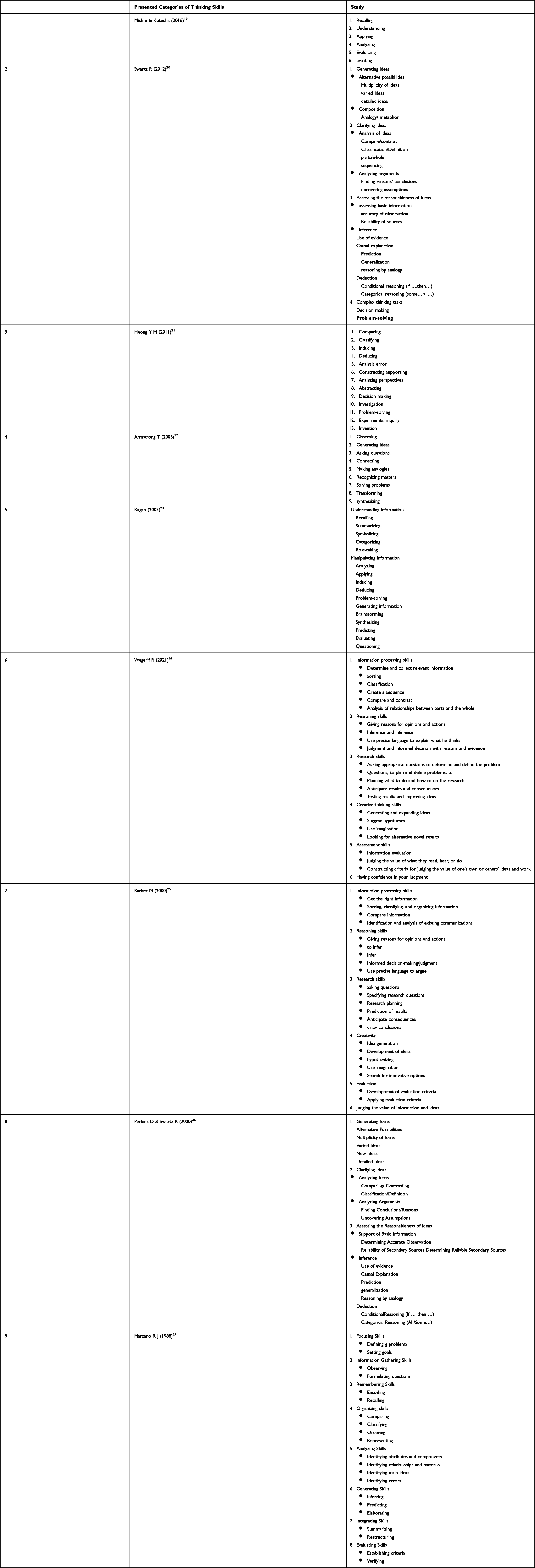 |
Table 1 Summary of Classification of Thinking Skills (Answer to the Question “What are the Basic Thinking Skills?”) |
One of the classifications presented for basic thinking skills is Mishra and Kotecha’s classification.19 They have described thinking skills based on Bloom’s taxonomy in two categories: higher-order thinking skills (analysis, evaluation, and generating) and lower-order thinking skills (remembering, understanding, and applying).
In response to the question “What tools and methods are used for direct training of basic thinking skills”, the programs, methods, and tools found under the title of activities related to direct training of basic thinking skills, are in three categories:
- The general thinking skills training programs are taught separately from the official curriculum and were placed in the following categories based on the nature of the program manager:
- Programs implemented in schools
- Programs are provided in institutions, systems, or virtual databases
- Programs offered in thinking schools, thinking clubs
- Programs that are offered in free training courses
- Programs offered in universities
2. Programs that are taught as part of a subject in the curriculum of schools or universities
3. Programs that are infused throughout the curriculum in schools or universities
The types of thinking training programs, the nature of the implementation of the programs, and the number of documents obtained for each case are given in Table 2.
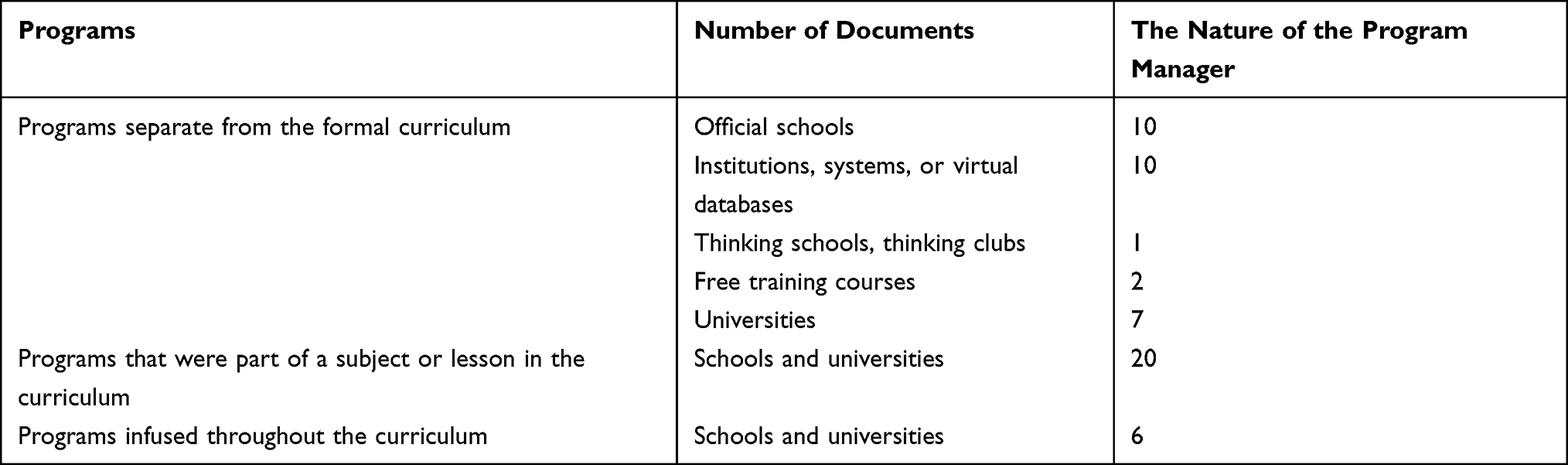 |
Table 2 Types of Direct Training Programs for Basic Thinking Skills |
Tables 3–9 present the themes and sub-themes of the reviewed articles and documents.
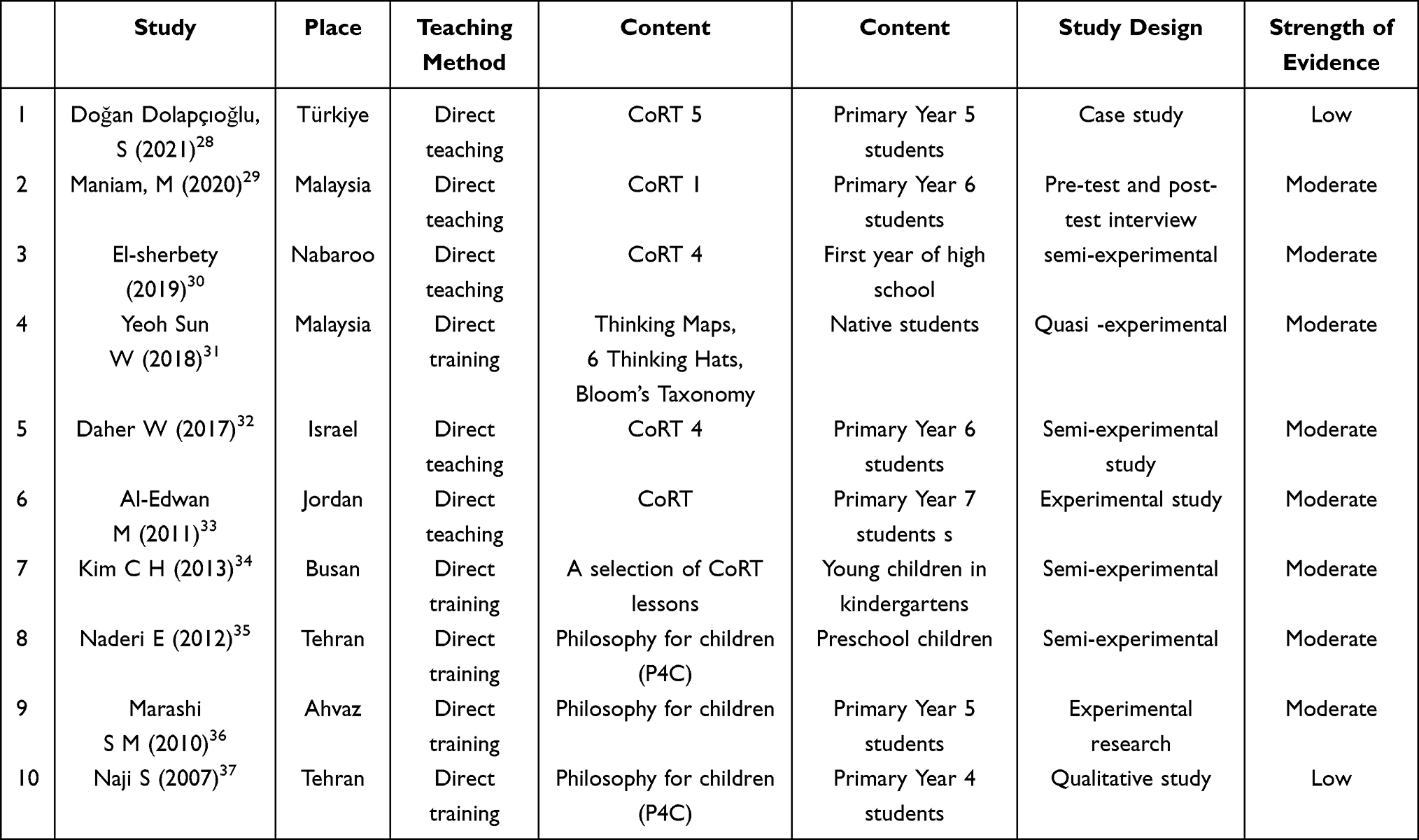 |
Table 3 Resources Related to Teaching General Thinking Skills in Schools Separately from the Curriculum |
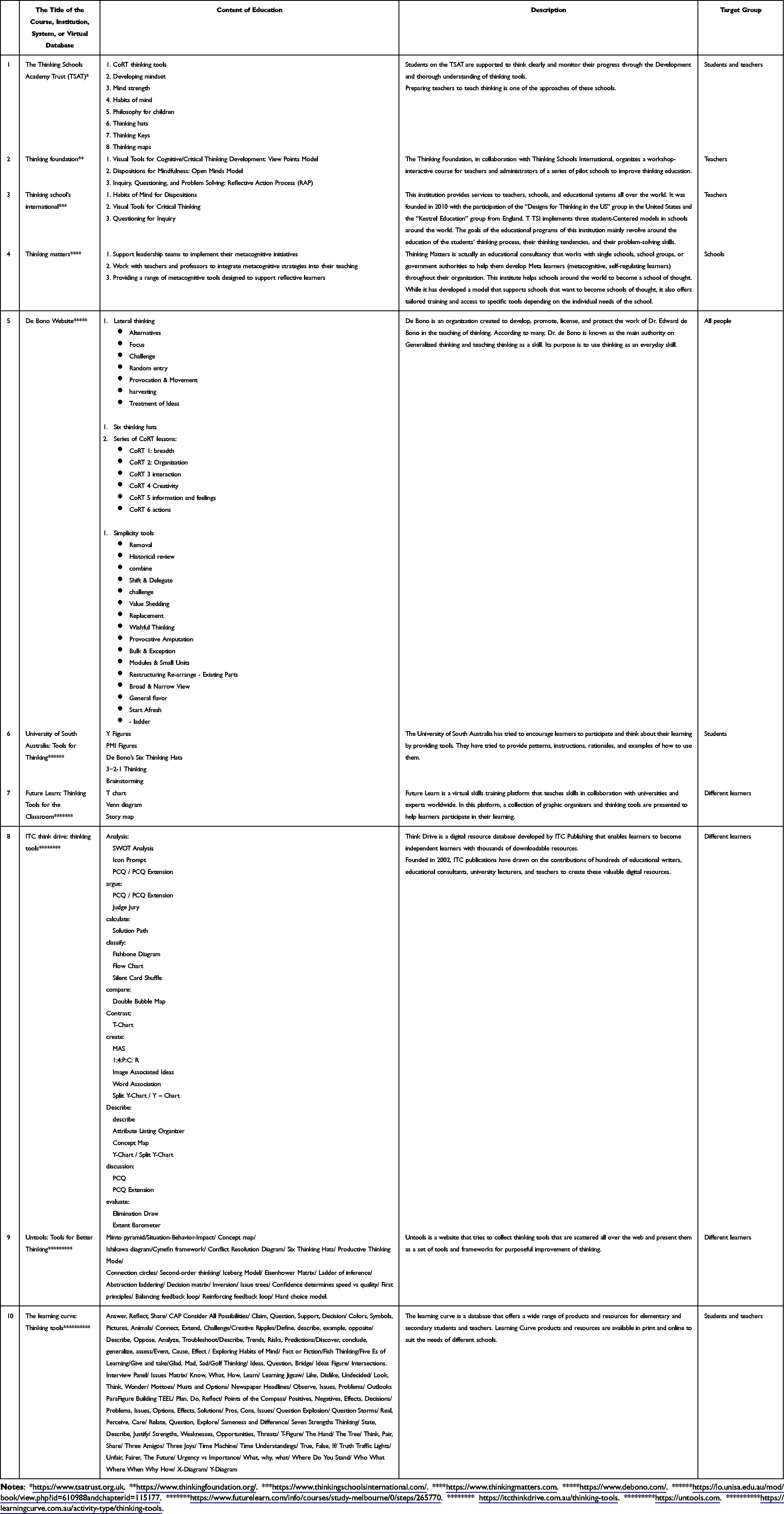 |
Table 4 Courses, Institutes, Systems, or Virtual Bases for Teaching General Thinking Skills Separately from the Curriculum |
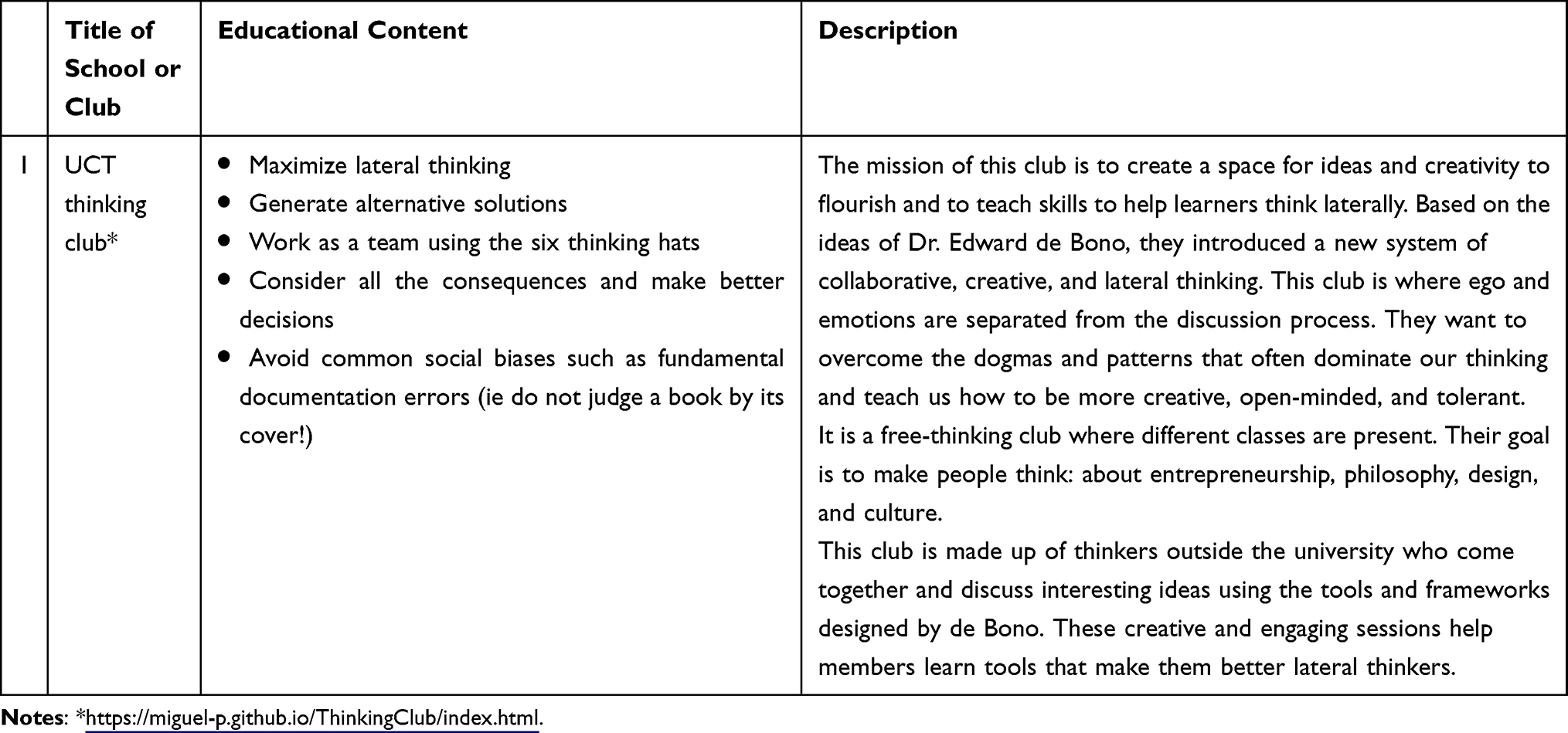 |
Table 5 Resources Related to Teaching Basic Thinking Skills in Thinking Clubs Separately from the Curriculum |
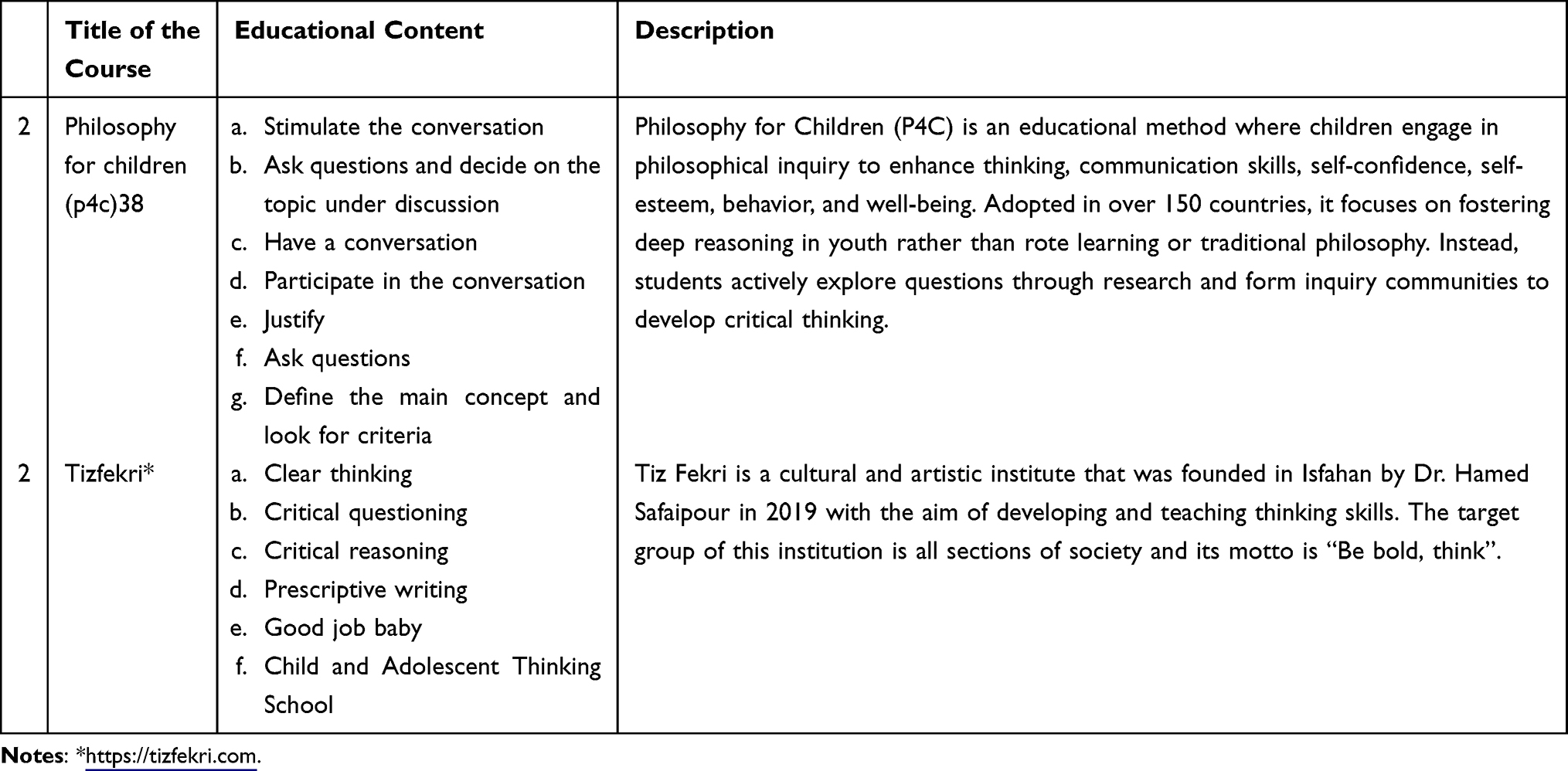 |
Table 6 Resources Related to Teaching Basic Thinking Skills in the Form of Free Training Courses and Separate from the Curriculum |
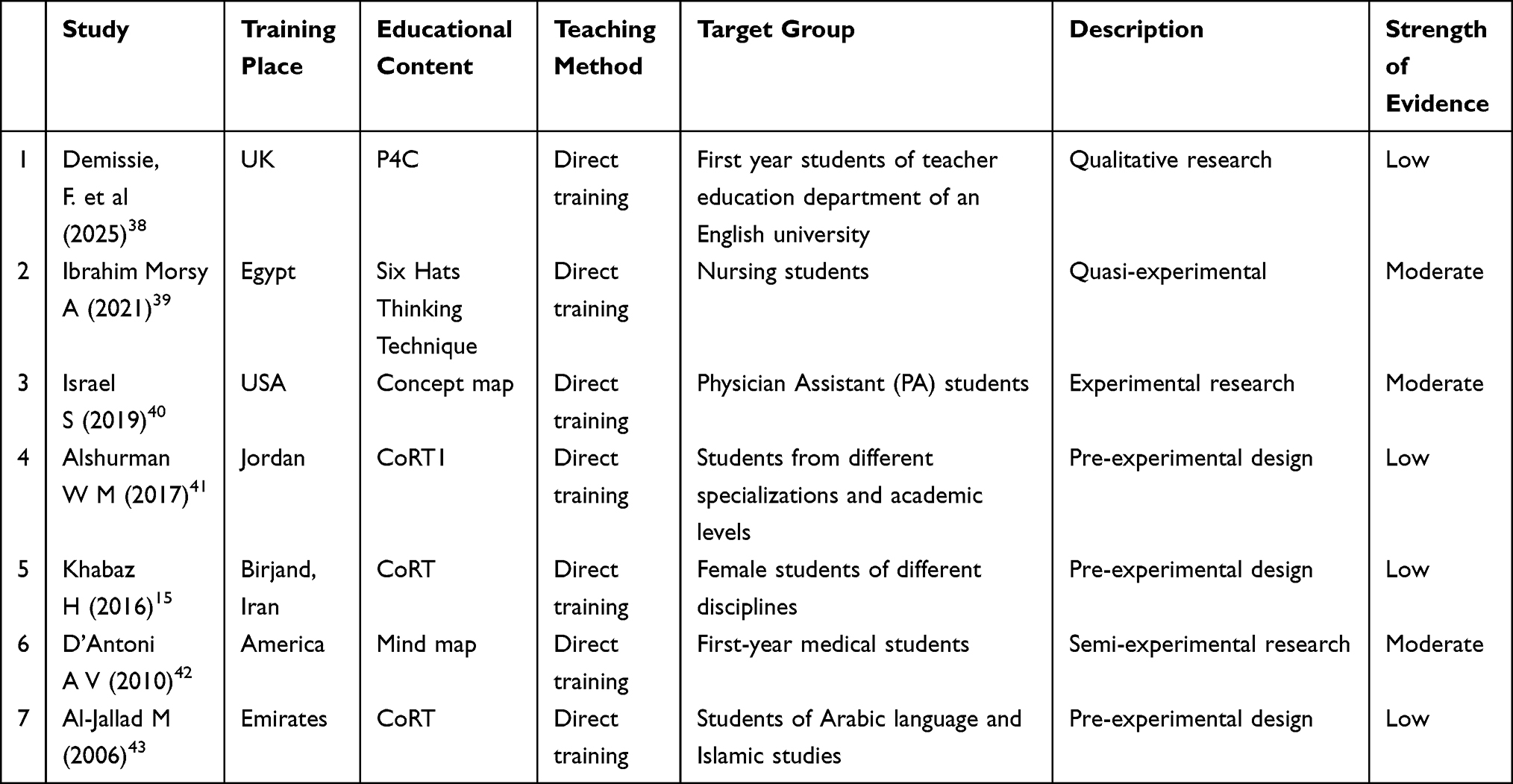 |
Table 7 Resources Related to Teaching Basic Thinking Skills in Universities Separately from the Curriculum |
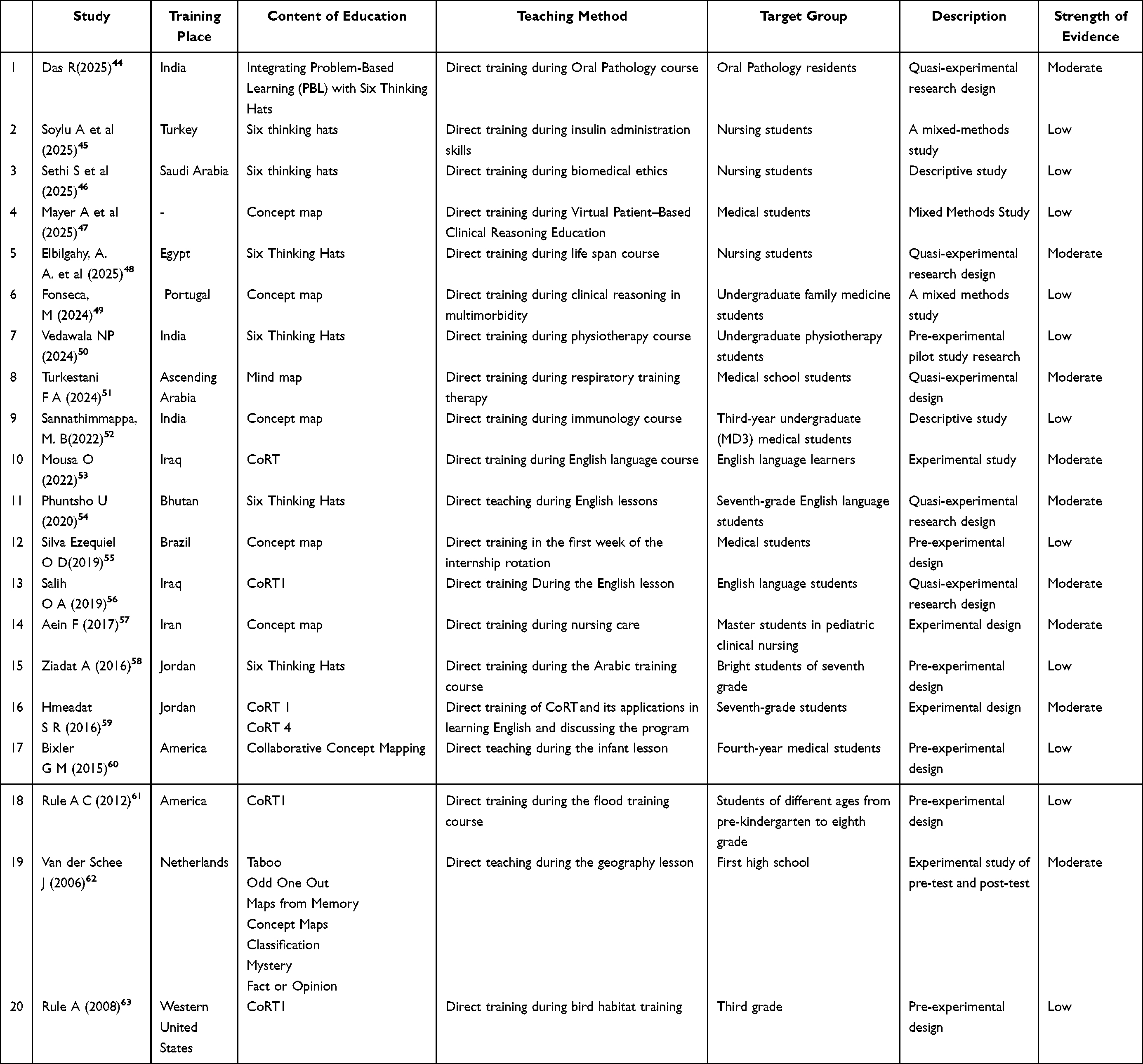 |
Table 8 Resources Related to Teaching Basic Thinking Skills Integrated in One or Several Lessons |
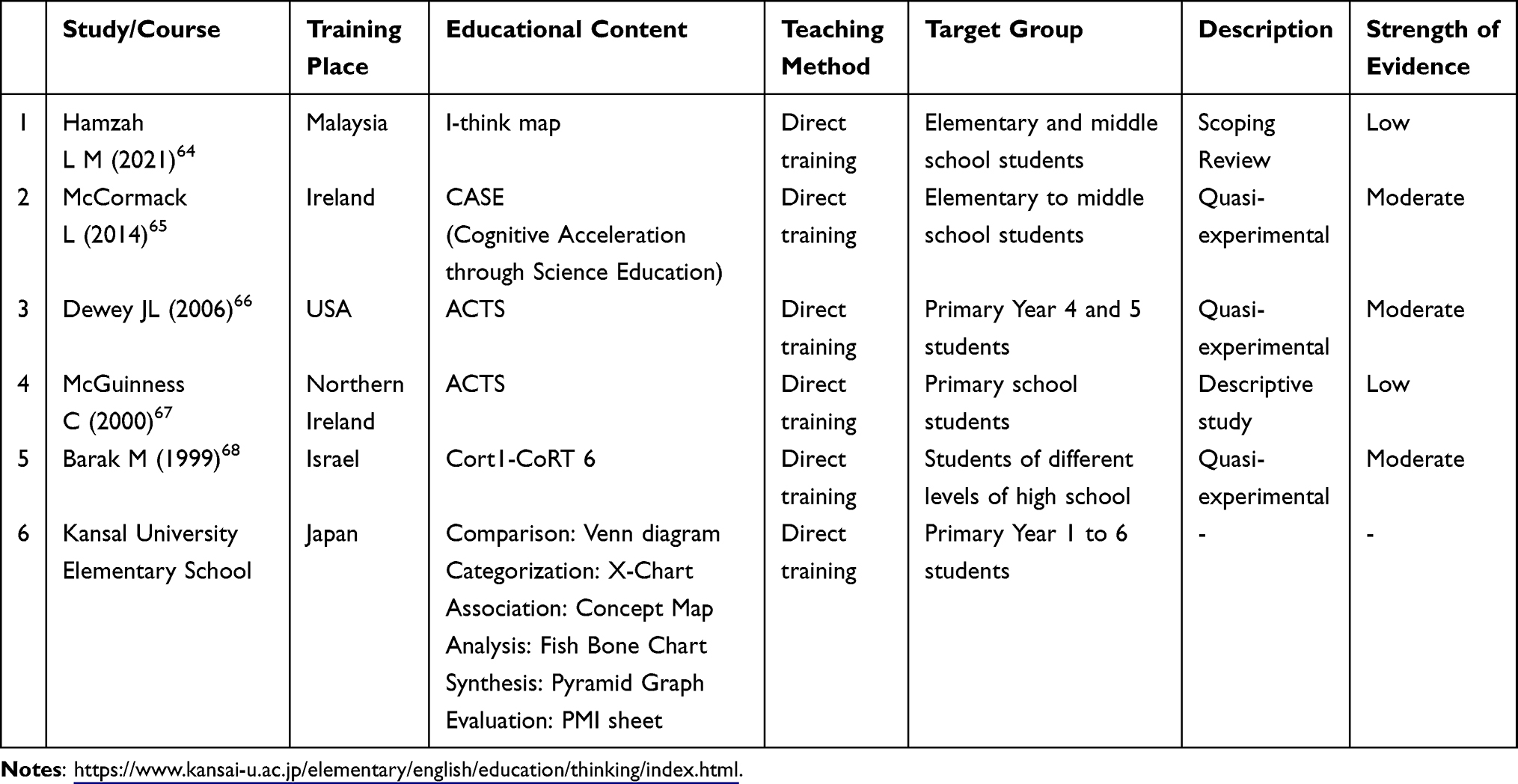 |
Table 9 Resources Related to Teaching Basic Thinking Skills Infused Throughout the Curriculum |
Discussion
This narrative review synthesizes the literature on basic thinking skills—fundamental cognitive operations such as recalling, understanding, applying, analyzing, evaluating, and creating, as framed by Bloom’s taxonomy19 and the direct instructional approaches for their development. The findings highlight a diverse array of tools and programs, categorized into standalone programs (eg, CoRT, Philosophy for Children), subject-embedded methods (eg, Six Thinking Hats in specific courses), and curriculum-infused strategies (eg, ACTS, i-Think). These approaches align with the dimensions of thinking outlined by Marzano,4 emphasizing their role as catalysts for higher-order thinking skills (HOTS) like critical thinking and problem-solving in educational contexts. While much of the evidence originates from K-12 settings, emerging applications in health professions education (HPE) demonstrate potential for fostering clinical reasoning and professional competence. The review extends prior frameworks by integrating recent studies, particularly those from 2020 to 2025, to address the evolving demands of medical education amid complexities like multimorbidity and interdisciplinary care.
Strength of Evidence
The quality and relevance of studies vary across tools, with assessments based on design rigor (eg, randomized controlled trials [RCTs] as high, quasi-experimental as moderate, descriptive or expert opinion as low) and applicability to HPE. For the CoRT program, evidence is moderate, primarily from quasi-experimental studies in K-12 (eg, Doğan Dolapçıoğlu & Doğanay, 2021;28 Maniam et al 202029) showing improvements in creativity and problem-solving, but limited HPE-specific RCTs; recent applications in higher education (eg, Mousa, 202253) suggest moderate relevance for university-level critical thinking, though generalizability to clinical settings is low due to small samples. Philosophy for Children (P4C) has moderate evidence from mixed-methods and experimental designs in K-12 (eg, Ventista & Maria, 2019;69 Naderi et al, 201235), enhancing reasoning and moral judgment, with emerging low-to-moderate relevance in higher education (eg, using P4C for discussion facilitation; Demissie et al, 202538), but scant HPE-specific data limits its strength in medical contexts.
Six Thinking Hats demonstrates high evidence, supported by RCTs and quasi-experimental studies in both K-12 and HPE (eg, Ibrahim & Darweesh, 2021;39 Alshurman, 201741), with recent 2025 studies in nursing confirming significant gains in critical thinking and skills retention (eg, Elbilgahy et al, 2025;48 Soylu et al, 202545). Concept mapping also has high evidence from systematic reviews and RCTs (eg, Aein & Aliakbari, 2017;57 Bixler et al, 201560), with 2020–2025 meta-analyses in nursing and medical education showing robust improvements in critical thinking (eg, Faraji et al, 2025;70 Fonseca et al, 202449). Infused programs like ACTS and i-Think have moderate evidence from longitudinal and scoping reviews in K-12 (eg, Hamzah & Wan Yusoff, 2021;64 McGuinness, 200067), but low relevance to HPE due to minimal adaptation studies. Overall, HPE-focused evidence is stronger for tools like Six Thinking Hats and concept mapping, with calls for more RCTs to address publication bias and heterogeneity.
Integration of Recent Literature in Health Professions Education
While the review’s core sources emphasize K-12 applications, recent literature (2020–2025) shifts focus to HPE, balancing the emphasis. For instance, in nursing education, Elbilgahy et al (2025) used Six Thinking Hats in a quasi-experimental design with 160 students, yielding significant critical thinking improvements (p<0.001) via structured case analysis.48 Similarly, Soylu et al (2025) found it superior to video or traditional methods for insulin administration skills in an RCT (n=90), with median scores rising from 6.50 to 23.00.45 In medical education, Sethi et al (2025) applied Six Thinking Hats in bioethics, simplifying decision-making for undergraduates through role-based thinking.46 For concept mapping, Faraji et al (2025) meta-analyzed 44 studies (2005–2022), reporting a standardized mean difference of 1.693 (p<0.001) in performance70 and Fonseca et al (2024) showed enhanced clinical reasoning in multimorbidity.49 Collaborative concept maps in virtual patient scenarios (Mayer et al, 2025) fostered interdisciplinary clinical reasoning, though student preferences varied on scope and presentation.47 These studies underscore adaptations for HPE, such as integrating tools into simulations or ethics modules, to address gaps in traditional curricula.
Mechanisms of Pedagogical Impact and Conditions for Effectiveness
Each tool strengthens specific basic thinking skills through distinct mechanisms, rooted in cognitive theories like constructivism1 and metacognition.71 CoRT directs attention via tools (eg, PMI for positives/minus/interesting), enhancing generating and clarifying ideas by breaking down complexity; it is most effective in small groups with facilitator guidance, particularly for problem-solving in low-stakes environments.15 P4C promotes inquiry through Socratic dialogue, building reasoning and evaluation by encouraging justification and concept definition; effectiveness peaks in collaborative settings with diverse participants, though it requires trained facilitators to avoid superficial discussions.69
Six Thinking Hats fosters balanced analysis by assigning modes (eg, black hat for risks), reducing bias and promoting comprehensive exploration; mechanisms include parallel thinking for creativity and emotional awareness, most effective in team-based clinical simulations where time constraints mimic real-world decisions.45,48 Concept mapping externalizes mental models hierarchically, aiding organization and inference by visualizing connections; it strengthens analysis and synthesis, performing best when integrated with feedback in clinical rotations, especially for novices.47,70 Infused programs like ACTS embed skills across curricula via sustained practice, reinforcing metacognition through reflection; effectiveness depends on teacher training and curriculum-wide adoption, ideal for longitudinal HPE programs.67 Conditions for optimal impact include learner readiness (eg, prior basic knowledge), group size (<10 for interaction), and integration with domain-specific content; challenges like time demands or resistance are mitigated by hybrid approaches.8
The evidences map, which summarizes the tools, contexts, and results along with study quality indicators, is shown in Table 10.
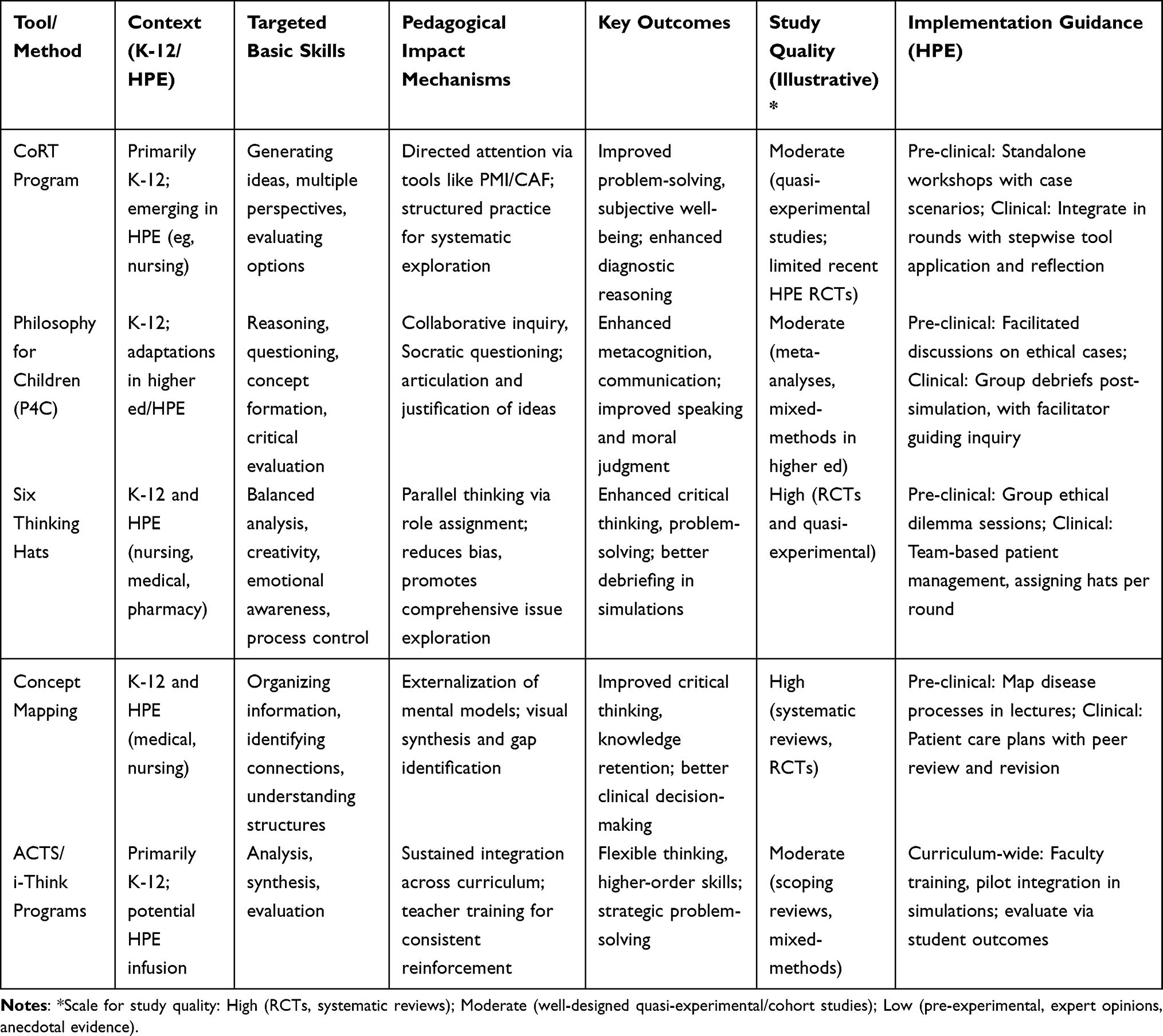 |
Table 10 Evidence Map Table Summarizing Tools, Contexts and Outcomes, Along with Study Quality Indicators |
Practical Contributions and Implementation Guidance
To enhance utility in HPE, the identified tools can be linked to stepwise implementation. In pre-clinical settings: (1) Assess learner baseline skills via pre-tests; (2) Introduce tools through workshops (eg, CoRT for idea generation in lectures); (3) Apply in small groups with case studies; (4) Provide feedback and reflection prompts; (5) Evaluate via post-tests. In clinical settings: (1) Integrate into rotations (eg, Six Thinking Hats in team huddles); (2) Use simulations for practice; (3) Facilitate debriefs focusing on skill application; (4) Monitor transfer to patient care; (5) Adjust based on outcomes. This bridges theory to practice, aligning with calls for hybrid approaches.9
Conclusion
This review identifies key basic thinking skills (eg, recalling, understanding, applying) and direct teaching methods (eg, CoRT, Six Thinking Hats, concept mapping), demonstrating their efficacy in fostering HOTS through structured, collaborative approaches. In HPE, these tools enhance clinical reasoning, problem-solving, and self-directed learning, with recent evidence (2020–2025) confirming superior outcomes in nursing and medical contexts compared to traditional methods.
Practical implications for medical educators include ready-to-use tools: (1) Six Thinking Hats for ethics workshops (assign hats to analyze cases); (2) Concept mapping for care planning modules (students map patient scenarios, with peer review); (3) CoRT for problem-solving sessions (use PMI in group discussions); (4) P4C for debriefs (facilitate inquiry on moral dilemmas). These can be scaled via online platforms for hybrid learning.
Limitations include the narrative review design, lacking formal quality appraisal (eg, no AMSTAR-2 scoring), potential publication bias toward positive results, and language bias (English/Persian sources dominant). Search strategies may have missed gray literature.
A research agenda proposes: (1) RCTs comparing tools in diverse HPE settings (eg, pre-clinical vs clinical); (2) Longitudinal studies assessing long-term retention and patient outcomes; (3) Investigations into digital adaptations (eg, AI-assisted mapping). These steps will refine evidence for impactful HPE curricula.
Acknowledgments
We are sincerely grateful to all the professors whose advice we used in the different stages of this review research.
Disclosure
The authors report no conflicts of interest in this work.
References
1. Dewey J. How We Think. Boston, MA: DC Heath & Co; 1910.
2. Broom GM, Smith MJ. A critical analysis of the concept of reflection: implications for nursing education. J. Adv Nurs. 1979;4(1):31–23.
3. Paul R, Elder L. Critical Thinking: Tools for Taking Charge of Your Learning and Your Life.
4. Marzano RJ. Dimensions. of Thinking: A Framework for Curriculum and Instruction. Association for Supervision and Curriculum Development; 1988.
5. Higgins S, Baumfield V. A defense of teaching general thinking skills. J Philos Educ. 1998;32(3):391–398. doi:10.1111/1467-9752.00103
6. Vainikainen MP, Hautamäki J, Hotulainen R, Kupiainen S. General and specific thinking skills and schooling: preparing the mind for new learning. Thinking Skills Creativity. 2015;18:53–64. doi:10.1016/j.tsc.2015.04.006
7. Badri Gargari R, Ganaatpishe E. Effectiveness of the science myth buster teaching method on critical thinking of students. J. Educ Psychol. 2015;14(3):45–58.
8. Marin LM, Halpern DF. Pedagogy for developing critical thinking in adolescents: explicit instruction produces greatest gains. Thinking Skills Creativity. 2011;6(1):1–13. doi:10.1016/j.tsc.2010.08.002
9. Gheshlaghi Azar N, Yazdani S, Khoshgoftar Z. Development of higher-order thinking in health profession education: a comprehensive toolkit for medical educators. J Educ Health Promot. 2023;12(1):455.
10. Wilson V. Can. Thinking skills be taught? Education forum on teaching thinking skills report. Scottish Council Res Educ. 2000;2000.
11. Holyoak KJ, Morrison RG. The Cambridge Handbook of Thinking and Reasoning. Cambridge University Press; 2005.
12. Papakitsos E, Theologis E, Foulidi X, et al. Utilizing the method of de bono’s six thinking hats for making educational decisions. Educ J Univ Patras UNESCO Chair. 2017;4(1):60–70.
13. Zhang XC, Lee H, Rodriguez C, Rudner J, Papanagnou D. A novel approach to debriefing medical simulations: the six thinking hats. Cureus. 2018;10(4):e2543. doi:10.7759/cureus.2543
14. Mevlude K, Serdar S, Ergin E. Using the ‘Six Thinking Hats’ model of learning in a surgical nursing class: sharing the experience and student opinions. Aust J Adv Nurs. 2009;26(3):59–69.
15. Khabaz H, Khamesan A, Rastgi Moghadam M, Rezaee M. The effect of extensively exercising skills training with emphasis on Edward De Bono’s method (CoRT) on problem-solving skills and subjective well-being. J Educ Psychol Stud. 2016;13(23):47–64.
16. Ahmadbeigi F, Ahghar G, Imani Naeini M. The effectiveness of critical thinking training for cooperative learning among students of Islamic Azad University, Tehran North Branch. J Higher Educ Curriculum Stud. 2018;9(17):167–181.
17. Zare H, Nahravanian P. The effect of training on problem-solving style and self-directed learning. Adv Cogn Sci. 2017;19(2):85–96.
18. Zolfaghari H. The effectiveness of metacognitive strategies of SQP4R on critical thinking of distance education students. J Psychol Sci. 2020;18(84):2329–2336.
19. Mishra R, Kotecha K. Are we there yet? Inclusion of higher-order thinking skills (HOTs) in assessment. J Eng Educ Trans. 2016;29:2–5.
20. Swartz R. Infusing instruction in thinking into content instruction: what do we know about its success?. Sri Lankan J Educ Res. 2012;2012.
21. Heong YM, Othman WB, Md Yunos JB, Kiong TT, Hassan RB, Binti Mohamad MM. The level of marzano higher order thinking skills among technical education students. Int J Soc Sci Human. 2011;1(2):121–125.
22. Armstrong T. The Whole-Brain Solution: Thinking Tools to Help Students Observe, Make Connections, and Solve Problems. Pembroke Publishers Limited; 2003.
23. Kagan S. Kagan structures for thinking skills. Kagan Online Magazine. 2003;2003.
24. Wegerif R. Report 2: literature review in thinking skills, technology, and learning. School of Education, Open University; 2021.
25. Barber M. Thinking for Learning: Teaching Thinking. Imaginative Minds; 2000.
26. Perkins D, Swartz R. The nine basics of teaching thinking. In: Costa AL, Bellanca J, Fogarty R, editors Vol 2. If Minds Matter: A Foreword to the Future. Skylight Publishing, Inc; 2000.
27. Marzano RJ. How classroom teachers approach the teaching of thinking. Theory Into Pract. 1993;32(3):154–160. doi:10.1080/00405849309543591
28. Doğan Dolapçıoğlu S, Doğanay A. Role of the cognitive research trust thinking program in developing critical thinking skills. Sakarya Univ J Educ. 2021;11(2):396–411.
29. Maniam M, Thanasamy TK, Raja JS, Aluemalai K. A study on the CoRT program of thinking skills (breadth) to develop expository writing skills among primary pupils. Int J Asian Soc Sci. 2020;10(5):232–247.
30. El-Sherbeny AMM. Using CoRT-based program to improve creative writing skills of EFL secondary stage students. MAED. 2019;108(6):41–63.
31. Yeoh Sun W, Abdul Razaq A, Ramle A, Chew Fong P, Umi Kalsum Mohd S, Fonny H. Cognitive effects of thinking hats and Bloom’s taxonomy on indigenous pupils in Malaysia. Adv Sci Lett. 2018;24(7):5289–5291. doi:10.1166/asl.2018.11719
32. Daher W, Tabaja-Kidan A, Gierdien F. Educating grade 6 students for higher-order thinking and its influence on creativity. Pythagoras. 2017;38(1):a350. doi:10.4102/pythagoras.v38i1.350
33. Al-Edwan ZSM. The effectiveness of a training program based on cognitive research trust strategies to develop seventh-grade students’ critical thinking in a history course. J Soc Sci. 2011;7(3):436–442.
34. Kim CH, Kim BN, Hwang HS. The effects of creativity training by CoRT thinking skills on young children’s creativity and nature-friendly attitude. J Fish Marine Sci Educ. 2013;25(6):1263–1272.
35. Naderi E, Tejalinia A, Shariatmadari A, Saif Naraghi M. Investigating the effect of the implementation of the “Philosophy for Children” program in fostering the creativity of male students in the first grade of high school in the 14th district of Tehran. Thinking Child. 2012;3(1):117–191.
36. Marashi SM, Safai Moghadam M, Khazami P. Investigating the effect of the implementation of a philosophy education program for children using the research community method on the development of moral judgment of fifth-grade elementary students in Ahvaz city. Thinking Child. 2010;1(1):83–102.
37. Naji S, Qazinejad P. Examining the results of the philosophy program for children on children’s reasoning skills and behavioral performance. Curricul Stud. 2007;2(7):123–150.
38. Demissie F, Stacey J, Baillie K. Using the philosophy for children (P4C) approach to facilitate discussions in higher education classrooms: insights from educators’ collaborative reflections. J Learn Dev High Educ. 2025;2025(36). doi:10.47408/jldhe.vi36.1389
39. Ibrahim MA, Darweesh H. Effect of six hats thinking technique on the development of critical thinking disposition and problem-solving skills of nursing students. Am J Nurs Res. 2021;9(1):8–14.
40. Israel C. Does the Use of Mind Mapping as a Learning Strategy by Physician Assistant Students Promote Critical Thinking as Measured by the Health Science Reasoning Test? Seton Hall University Dissertations and Theses (ETDs); 2019.
41. Alshurman WM. The effects of the first part of the CoRT program for teaching thinking (BREADTH) on the development of communication skills among a sample of students from Al al-Bayt University in Jordan. Educ Res Rev. 2017;12(2):73–82. doi:10.5897/ERR2016.3069
42. D’Antoni AV, Zipp GP, Olson VG, Cahill TF. Does the mind map learning strategy facilitate information retrieval and critical thinking in medical students? BMC Med Educ. 2010;10:61. doi:10.1186/1472-6920-10-61
43. Al-Jallad M. The effectiveness of using the CoRT program on developing creative thinking skills among the female students of the Arabic Language and Islamic Studies at Ajman University Network of Science and Technology. J Umm Al-Qura Univ Educ Soc Human Sci. 2006;18(2):147–180.
44. Das R, Ramani P, Sukumaran G, Ramasubramanian A, Veeraiyan DN. Evaluating the effectiveness of problem-based learning combined with six thinking hats in oral pathology education. BMC Oral Health. 2025;25:1523. doi:10.1186/s12903-025-06554-6
45. Soylu A, Seven A, Soylu D. The impact of training using six thinking hats versus video training on nursing students’ insulin administration skills: a mixed-methods study. BMC Nurs. 2025;24(1):679. doi:10.1186/s12912-025-03473-3
46. Sethi S, Garg R. The six-thinking-hat technique for decision-making in biomedical ethics. Med Educ. 2025;59(9):1013–1014. doi:10.1111/medu.15674
47. Mayer A, Hege I, Kononowicz AA, Müller A, Sudacka M. Collaborative development of feedback concept maps for virtual patient–based clinical reasoning education: mixed methods study. JMIR Med Educ. 2025;
48. Elbilgahy AA, Alanazi FJ. Effect of applying six thinking hats teaching method for development through life span course on students opinion and critical thinking skills. BMC Med Educ. 2025;25:884. doi:10.1186/s12909-025-07362-w
49. Fonseca M, Broeiro-Gonçalves P, Barosa M, et al. Concept mapping to promote clinical reasoning in multimorbidity: a mixed methods study in undergraduate family medicine. BMC Med Educ. 2024;24:1478. doi:10.1186/s12909-024-06484-x
50. Vedawala NP, Thakrar SJ, Thakrar JV, Patel PG, Patel YG. Six thinking hats model of learning—creative teaching method in physiotherapy: a pilot study. J Educ Health Promot. 2024;13(1):24. doi:10.4103/jehp.jehp_724_23
51. Turkestani FA, Zipp GP, Nufaiei ZA, et al. Mind mapping to enhance critical thinking skills in respiratory therapy education. J Educ Health Promot. 2024;13(1):198. doi:10.4103/jehp.jehp_1816_23
52. Sannathimmappa MB, Nambiar V, Aravindakshan R. Concept maps in immunology: a metacognitive tool to promote collaborative and meaningful learning among undergraduate medical students. J Adv Med Educ Prof. 2022;10(3):172–178. doi:10.30476/jamp.2022.94275.1576
53. Mousa O. The role of the Cognitive Research Trust (CoRT) program as a new instructional model for developing thinking skills among university students. Int J Educ Tech Higher Educ. 2022;19(1):45–59.
54. Phuntsho U, Wangdi D. The effect of using the Six Thinking Hats strategy on the development of writing skills and creativity of seventh-grade EFL students. J English Lang Teach. 2020;10(2):27–35.
55. Silva Ezequiel OD, Cerrato Tibirica SH, Damasio Moutinho IL, et al. Medical students’ critical thinking assessment with collaborative concept maps in a blended educational strategy. Educ Health. 2019;32:127–130.
56. Salih OA. The effectiveness of the CoRT1 (Breadth) program in developing the achievement of 1st-year university students in English reading comprehension. J Tikrit Univ Humanities. 2019;23(8):39–56.
57. Aein F, Aliakbari F. Effectiveness of concept mapping and traditional linear nursing care plans on critical thinking skills in clinical pediatric nursing course. J Educ Health Promot. 2017;6(1):13. doi:10.4103/jehp.jehp_49_14
58. Ziadat AH, Al Ziyadat MT. The effectiveness of a training program based on the six hats model in developing creative thinking skills and academic achievements in the Arabic language course for gifted and talented Jordanian students. Int Educ Stud. 2016;9(6):150–157. doi:10.5539/ies.v9n6p150
59. Hmeadat SR. The effect of the cognitive research trust program for the development of thinking skills on the achievement of Jordanian English Language Learners. Arab J Sci Res Publish. 2016;2(1):442–450.
60. Bixler GM, Brown A, Way D, Ledford C, Mahan JD. Collaborative concept mapping and critical thinking in fourth-year medical students. Clin Pediatr. 2015;54(9):833–839. doi:10.1177/0009922815590223
61. Rule AC, Schneider JS, Tallakson DA, Highnam D. Creativity and thinking skills integrated into a science enrichment unit on flooding. Creative Educ. 2012;3(8):1371–1379. doi:10.4236/ce.2012.38200
62. Van der Schee J, Leat D, Vankan L. Effects of the use of thinking through geography strategies. Int Res Geogr Environ Educ. 2006;15(2):124–133. doi:10.2167/irgee190.0
63. Rule A, Barrera M. Three Authentic Curriculum-Integration Approaches to Bird Adaptations That Incorporate Technology and Thinking Skills. ERIC Database; 2008:ED501247.
64. Hamzah LM, Wan Yusoff WM. A scoping review on implementation of I-Think maps and its effects on higher order thinking skills in Malaysian schools. Asian J Univ Educ. 2021;17(2):169. doi:10.24191/ajue.v17i2.13386
65. McCormack L, Finlayson OE, McLaughlin TJ. The CASE Programme was implemented across the primary and secondary school transition in Ireland. Int J Sci Educ. 2014;36(17):2892–2917. doi:10.1080/09500693.2014.938711
66. Dewey JL. Activating Children’s Thinking Skills (ACTS): An Intervention Evaluation Study [doctoral thesis]. University of London; 2006.
67. McGuinness C. ACTS: a methodology for teaching thinking across the curriculum. Teach Think. 2000;2:1–12.
68. Barak M, Doppelt Y. Integrating the Cognitive Research Trust (CoRT) program for creative thinking into a project-based technology curriculum. Res Sci Technol Educ. 1999;17(2):139–151. doi:10.1080/0263514990170202
69. Ventista O, Maria M. An Evaluation of the ‘Philosophy for Children’ Program: The Impact on Cognitive and Non-Cognitive Skills [doctoral thesis]. Durham University; 2019.
70. Faraji A, Banafshi Z, Jalali R, Jalali A. Concept mapping teaching method and nursing education: a systematic review and meta-analysis. BMC Med Educ. 2025;25(1):792. doi:10.1186/s12909-025-07392-4
71. Paul R, Elder L. The Miniature Guide to Critical Thinking Concepts and Tools.
 © 2026 The Author(s). This work is published and licensed by Dove Medical Press Limited. The
full terms of this license are available at https://www.dovepress.com/terms
and incorporate the Creative Commons Attribution
- Non Commercial (unported, 4.0) License.
By accessing the work you hereby accept the Terms. Non-commercial uses of the work are permitted
without any further permission from Dove Medical Press Limited, provided the work is properly
attributed. For permission for commercial use of this work, please see paragraphs 4.2 and 5 of our Terms.
© 2026 The Author(s). This work is published and licensed by Dove Medical Press Limited. The
full terms of this license are available at https://www.dovepress.com/terms
and incorporate the Creative Commons Attribution
- Non Commercial (unported, 4.0) License.
By accessing the work you hereby accept the Terms. Non-commercial uses of the work are permitted
without any further permission from Dove Medical Press Limited, provided the work is properly
attributed. For permission for commercial use of this work, please see paragraphs 4.2 and 5 of our Terms.