
Back to Journals » Patient Preference and Adherence » Volume 20
Attributes and Trade-Offs Impacting Contraceptive Choice: A Discrete Choice Experiment
Authors Patel VP  , Holub A, Betts KA, Liu L, Mattera M, Naya CH, Collins K , Rood K, Teal S
Received 1 July 2026
Accepted for publication 21 July 2026
Published 23 July 2026 Volume 2026:20 634397
DOI https://doi.org/10.2147/PPA.S634397
Checked for plagiarism Yes
Review by Single anonymous peer review
Peer reviewer comments 2
Editor who approved publication: Dr Johnny Chen
Vanessa Perez Patel,1 Ashley Holub,2 Keith A Betts,3 Lorraine Liu,2 Matthew Mattera,2 Christine Hotaru Naya,2 Kevin Collins,1 Kara Rood,4 Stephanie Teal5
1Department of Medical Affairs & Outcomes Research, Organon LLC, Jersey City, NJ, USA; 2Department of Health Economics & Outcomes Research, Analysis Group, Boston, MA, USA; 3Department of Health Economics & Outcomes Research, Analysis Group, Los Angeles, CA, USA; 4Department of Obstetrics and Gynecology, The Ohio State University, Columbus, OH, USA; 5Department of Obstetrics and Gynecology, University Hospitals, Cleveland, OH, USA
Correspondence: Vanessa Perez Patel, Department of Medical Affairs & Outcomes Research, Organon LLC, Jersey City, NJ, USA, Email [email protected]
Purpose: To quantify the preferences and trade‑offs of women selecting contraception and of providers prescribing contraception, and to identify the attributes most influential in their decision‑making.
Methods: A discrete choice experiment (DCE) evaluated seven randomized attributes: effectiveness, mode of administration, return to fertility, cardiovascular (CV) risk, immediate postpartum eligibility, breastfeeding compatibility, and amenorrhea risk. Participants across the United States (US) were recruited from February-May 2025 using web-based market research panels. Women completed 12 choice tasks. Providers completed a DCE for three patient profiles to capture context‑specific decision‑making. A total of 307 women and 305 healthcare providers (HCPs) were included. Women were eligible if they were 18– 49 years old, resided in the US, and considered using prescription contraception in the past 12 months. HCPs were eligible if they specialized in obstetrics and gynecology or family medicine, practiced in the US for at least 2 years, prescribed contraception in their routine practice, had familiarity with all contraceptive options, and had written at least 50 contraception prescriptions annually.Relative importance (RI), reflecting the overall contribution of each attribute to decision‑making, and willingness to trade-off (WTT) estimates were derived from preference weights (or marginal utilities for continuous attributes). Preferences were estimated using conditional logistic regression.
Results: Women most valued effectiveness (RI=30.7%), followed by low CV risk (RI=24.0%). Trade-offs favored daily oral consumption (WTT=3.04) but not a delayed return to fertility (WTT=− 2.05). When considering long-acting reversible contraception (LARC), women favored arm placement over uterine placement (WTT=− 0.51). HCPs prioritized effectiveness irrespective of patient profile (range of RI=37.0%– 40.1%) and consistently preferred LARC attributes over those of oral or injectable methods.
Conclusion: Incorporating stated preferences into shared decision-making, supported by education emphasizing autonomy across all methods, provides an opportunity to align contraceptive care with women’s goals.
Keywords: preferences, decision-making, contraception, reproductive health, method selection, choice
Introduction
Unintended pregnancy is a major public health concern in the United States (US), accounting for 41.6% of pregnancies reported as unintended in 2019.1 Beyond its economic burden, estimated at $21 billion in annual direct medical costs in 2010, unintended pregnancy disproportionately affects socioeconomically disadvantaged populations.2 Moreover, several adverse maternal and infant health outcomes have been linked to unintended pregnancy, including, but not limited to, delayed prenatal care, preterm birth, and low birthweight.1–4
Access to high‑quality family planning and contraceptive services is essential to health and well‑being,5 is prioritized in the US Sustainable Development Goals for Health,6 and is classified as an essential health benefit by the Affordable Care Act.7 In 2022–2023, more than half of US women aged 15–49 used contraception, yet only 35.7% received family planning services, with use differing by age, race, and socioeconomic status.8,9
Access to care, patient-centered contraceptive counseling, and availability of preferred contraceptive methods are important factors influencing utilization of contraception and family planning services.10,11 Despite availability of safe and effective contraception, nearly one in five women had an unmet need for family planning in 2023, and 40% of users discontinue contraception within 12 months of initiation.12 US data (2015–2019) indicate that roughly one in three women who have ever discontinued the pill or an intrauterine device (IUD) did so due to dissatisfaction (ie, not due to pregnancy seeking),13 thus highlighting a significant need to better understand women’s contraceptive goals and preferences.
A targeted literature review revealed a lack of systematic evidence on stated contraceptive preferences among women and HCPs in the US; such data are essential to address our limited understanding regarding contraceptive decision making, which often occurs in a shared process involving both women and their HCPs, and the attributes and trade-offs impacting choice. Prior research has demonstrated the importance of considering both patient and HCP perspectives in healthcare decision-making.14 Thus, eliciting the stated preferences of both groups allows assessment of alignment and potential gaps between women’s preferences and those of HCPs, with implications for patient-centered contraceptive care. To address this gap, a discrete choice experiment (DCE) was conducted to quantify how key contraceptive attributes shape the preferences of women selecting contraception for pregnancy prevention and of HCPs prescribing contraception, and to quantify the trade-offs impacting decision-making.
Materials Methods
Data Source and Study Population
This DCE enrolled 307 women and 305 HCPs across the US. Participants were recruited through market research panels between February and May 2025 and were blinded to the study sponsor. The study was exempt by the Western Copernicus Group Institutional Review Board under 45 CFR §46.104(d)(2), and no identifiable personal information was collected. Participants provided informed consent before completing the interview and survey.
Women were eligible if they were 18 to 49 years old, resided in the US, and considered using prescription contraception for the prevention of pregnancy in the 12 months before the DCE. Sampling targets were prespecified and applied. Recruitment targeted an approximately even distribution across three age groups (18–24, 25–34, and 35–49 years). In addition, at least 25% of participants were recruited with a self‑reported body mass index (BMI) ≥25.0 kg/m2 to ensure representation of a population often underrepresented in contraceptive research. Supplementary Figure 1 illustrates the recruitment and inclusion of women in this study.
HCPs were eligible if they specialized in obstetrics and gynecology (OB/GYN) or family medicine, practiced in the US for at least 2 years at the time of the DCE (excluding residency or training), prescribed contraception as part of their routine practice, and had familiarity with all contraceptive options, particularly long- and short-acting reversible methods. HCPs were also required to have written at least 50 contraception prescriptions annually. Sampling targets ensured representation across HCP types, with approximately 50% OB/GYN and the remainder evenly divided between family medicine physicians and nurse practitioners (NPs) or physician assistants (PAs) in these specialties. Supplementary Figure 2 presents the recruitment and inclusion of HCPs, including the distribution by specialty.
Study Design and Measures
The DCE was administered electronically. All participants first completed an eligibility screening survey, followed by demographic questions and, for HCPs, practice characteristics. Women additionally provided relevant clinical and reproductive history. All participants completed a DCE tutorial before starting the DCE survey. Participants then completed the DCE tasks, with women completing one experiment and HCPs completing three, each aligned with prespecified patient profiles: a healthy nulliparous 25‑year‑old considering future childbearing; a healthy 40‑year‑old desiring no future pregnancies; and a healthy 35‑year‑old with BMI of 29–31 kg/m2.
Before data collection, a pilot study was conducted with 16 eligible participants (8 women and 8 HCPs) to evaluate cognitive burden, clarity, and comprehension; refinements were made accordingly. All study procedures adhered to best practices from the International Society for Pharmacoeconomics and Outcomes Research (ISPOR).15
Identification of Attributes and Levels
Seven attributes were included. Attribute selection and level definitions were informed by a targeted review of the literature, clinical guidelines, expert input, and labeling for prescription contraceptives; no adjustment beyond wording clarifications were required of the attributes based on the pilot study. Effectiveness was defined as the annual probability of pregnancy with typical use. Cardiovascular (CV) risk described the potential for blood clots, myocardial infarction, or stroke. Mode of administration captured both the method type (eg, placement in the arm or uterus, oral use, injection) and duration of effectiveness (eg, several years, daily, or every three months). Additional attributes included immediate postpartum eligibility, compatibility with breastfeeding, likelihood of amenorrhea, and return to fertility after discontinuation.
Exact attribute wording and levels appear in Supplementary Table 1. An example choice card illustrating two hypothetical contraceptive options with randomized attribute levels is shown in Supplementary Figure 3.
DCE Design
Sample size was determined based on established guidance from published DCEs and ISPOR recommendations,16,17 resulting in a target enrollment of approximately 300 women and 300 HCPs. Based on the number of attributes and levels in this study, a total of 60 choice cards were generated using a D-efficient design in Ngene.18,19 To minimize cognitive burden,20 choice cards were divided into six blocks, each containing 10 cards; participants were randomly assigned to one block. Levels under each attribute were randomized. Two additional choice cards were added to each block to assess internal validity: a dominance card and a stability card (see sensitivity analyses for more details). Participants completed a total of 12 choice cards for one DCE.
HCPs completed one DCE for each patient profile, totaling 36 choice tasks across the three profiles.
To minimize ordering effects, choice cards in each block were randomly sequenced, except for the fixed dominance and stability checks. For HCPs, the order of patient profiles was also randomized to ensure a balanced distribution across sequences.
Statistical Analyses
Characteristics were summarized descriptively and separately for women and HCPs. Stated preferences were assessed using conditional logistic regression models, with one model estimated for women preferences, and three models estimated for HCP preferences (one per patient profile).
The dependent variable was the selected contraception option for each choice card (ie, Method A vs Method B), and the independent variables were the attribute levels, modeled as categorical variables. Regression coefficients, representing the preference weights (ie, part-worth utilities), 95% confidence intervals, and P values were reported for each attribute level. Preference weights (or marginal utilities for continuous attributes) were used to derive relative importance (RI), which shows the overall effect of each attribute on preferences relative to the other attributes, and willingness to trade-off (WTT), which represents the percentage points of effectiveness an average participant would be willing to forgo (or require) to accept an alternative attribute. In this study, WTT was assessed relative to effectiveness; a negative (positive) WTT beta coefficient indicates a method would need to be more (less) effective to accept the given attribute level.
RI scores were normalized to percentages based on the difference between the best and worst attribute level, multiplied by the coefficient for each attribute, to allow for comparisons across attributes. WTT for all categorical attributes was calculated by dividing the preference weight for a given attribute by the marginal utility of effectiveness. As CV risk was continuous, the marginal utility change was divided by the marginal utility for effectiveness (ie, difference in utility per percentage point based on the maximum and minimum range of attribute levels). Higher RI scores reflect greater importance and thus larger influence on contraceptive choices; larger WTT estimates represent greater trade-offs and, therefore, a larger influence on decision-making.
All analyses were performed using SAS Enterprise Guide statistical software version 7.1.
Subgroup and Sensitivity Analyses
Subgroup analyses were conducted to evaluate potential variation in contraceptive preferences. Among women, stated preferences were examined by age group, higher body weight status, and family planning status; among HCPs, preferences were evaluated by patient profile.
Sensitivity analyses assessed internal validity. Participants passed the dominance test if they selected the option with superior levels on key attributes (eg, highest effectiveness and lowest CV risk) and passed the stability test if they provided consistent responses to two repeated choice tasks. Sensitivity analyses were then performed among participants who passed the validity tests (dominance or stability).
Ethical Considerations
This study was deemed exempt by the Western Copernicus Group Institutional Review Board under 45 CFR §46.104(d)(2), and no identifiable personal information was collected. The research involved only interactions related to educational tests, survey procedures, interview procedures, or observation of public behavior. All procedures performed involving human participants were in accordance with the Declaration of Helsinki, and participants provided informed consent before completing the interview and survey.
Results
Sample Characteristics
In total 307 women and 305 HCPs met eligibility criteria and completed the DCEs, representing 57.0% and 71.9%, respectively, of those initially approached during recruitment. Women were 29.9 (SD,7.8) years old, on average, commonly identified as White (67.8%), Black (28.0%), or of Asian (5.5%) race, and of non-Hispanic or Latino (83.7%) ethnicity (Table 1). Per sampling quotas, age was evenly distributed. Approximately half of women (49.2%) reported having private insurance, while 28.7% and 10.7% reported Medicaid and Medicare coverage, respectively. Relationship status included 32.9% married, 37.5% in a relationship but not married, and 29.6% single. The most reported contraception methods used at the time of the DCE were combined hormonal or oral progesterone-only birth control pills (56.0%), condoms (31.6%), and IUDs (15.0%); 11.1% reported having the etonogestrel implant. Approximately 38.1% of women reported not wanting more children in the future. More than half of the women (52.4%) had a higher body weight.
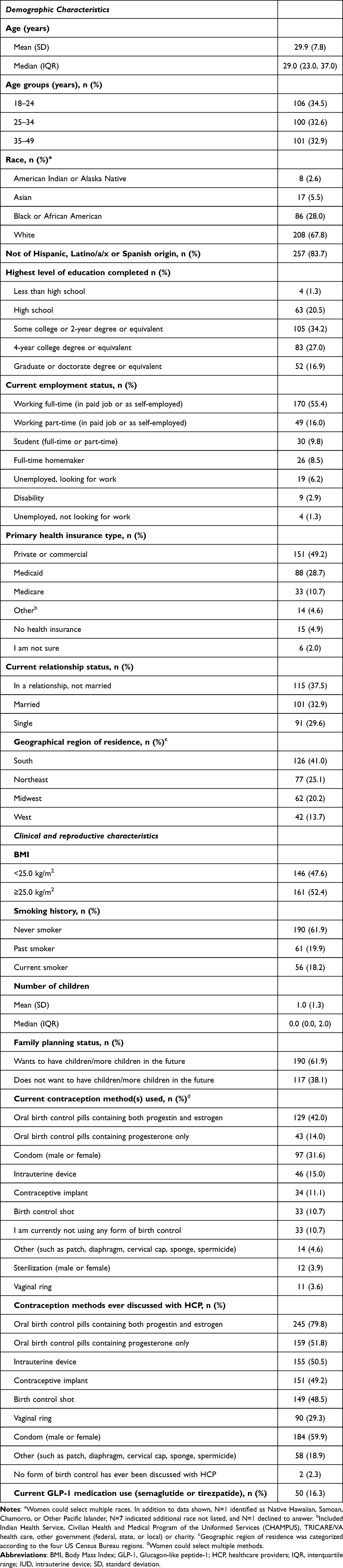 |
Table 1 Sample Characteristics of Women in a Discrete Choice Experiment Evaluating Contraceptive Preferences (N=307) |
HCPs were 64.7 (SD, 2.9) years old, on average, predominantly female (58.7%), and most commonly self-identified as White (74.1%) or of Asian (17.0%) race; 89.2% identified as non-Hispanic or Latino ethnicity (Table 2). Approximately half (50.8%) were OB-GYN Doctor of Medicine (MD)/Doctor of Osteopathic Medicine (DO), and nearly a quarter (24.3%) were family medicine MD/DOs; the remaining (24.9%) identified as NP or PA in either setting. On average, HCPs practiced for 16.3 (SD, 10.3) years. Approximately 85.6% prescribed LARC methods as part of their routine practice.
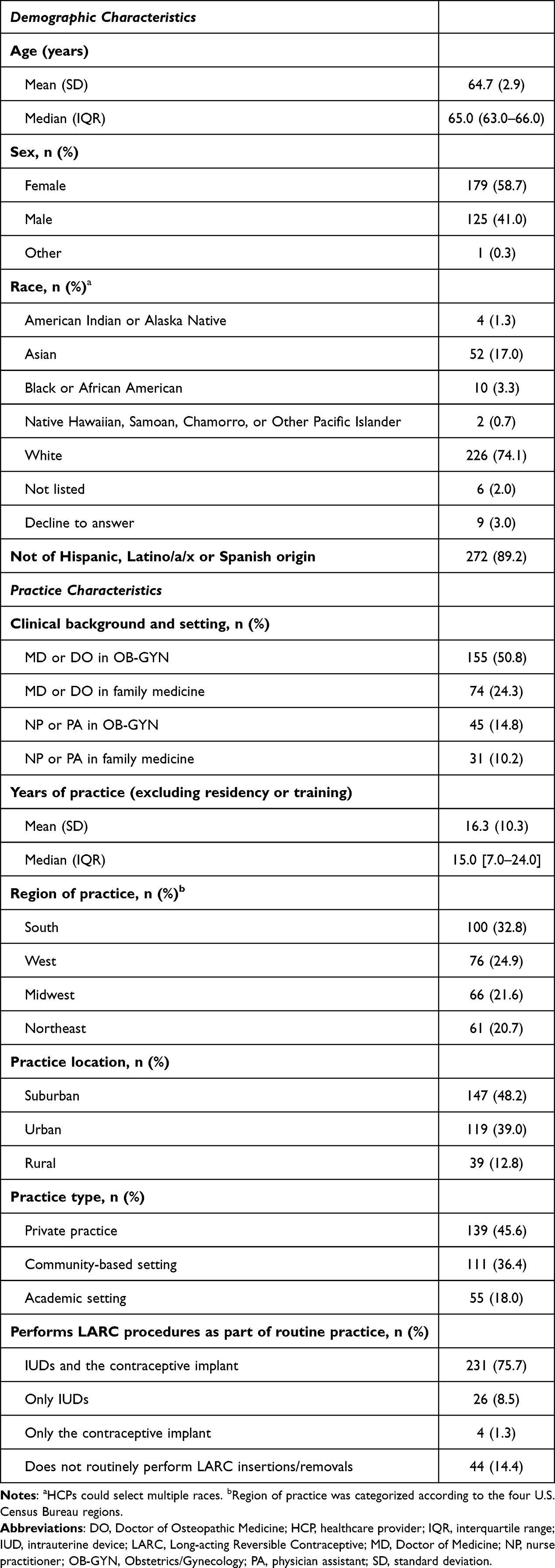 |
Table 2 Sample Characteristics of Healthcare Providers in a Discrete Choice Experiment Evaluating Contraceptive Preferences (N=305) |
Relative Importance and Trade-Offs (Women)
All attributes except amenorrhea and breastfeeding had a statistically significant association with women’s contraceptive preferences (Table 3 and Figure 1a). Lower effectiveness, higher CV risk, and longer delays in return to fertility were associated with decreased preference (P <0.001), whereas a daily mode of administration and immediate postpartum eligibility were associated with increased preference (P <0.001). Effectiveness (30.7%), CV risk (24.0%), mode of administration (18.1%), and return to fertility (10.5%) were the most influential attributes. Methods that could be used immediately postpartum were preferred over those requiring a delay. Preference weights indicated a directional preference for arm placement with the etonogestrel implant relative to uterine placement with IUDs in the overall sample (P =0.47; not statistically significant).
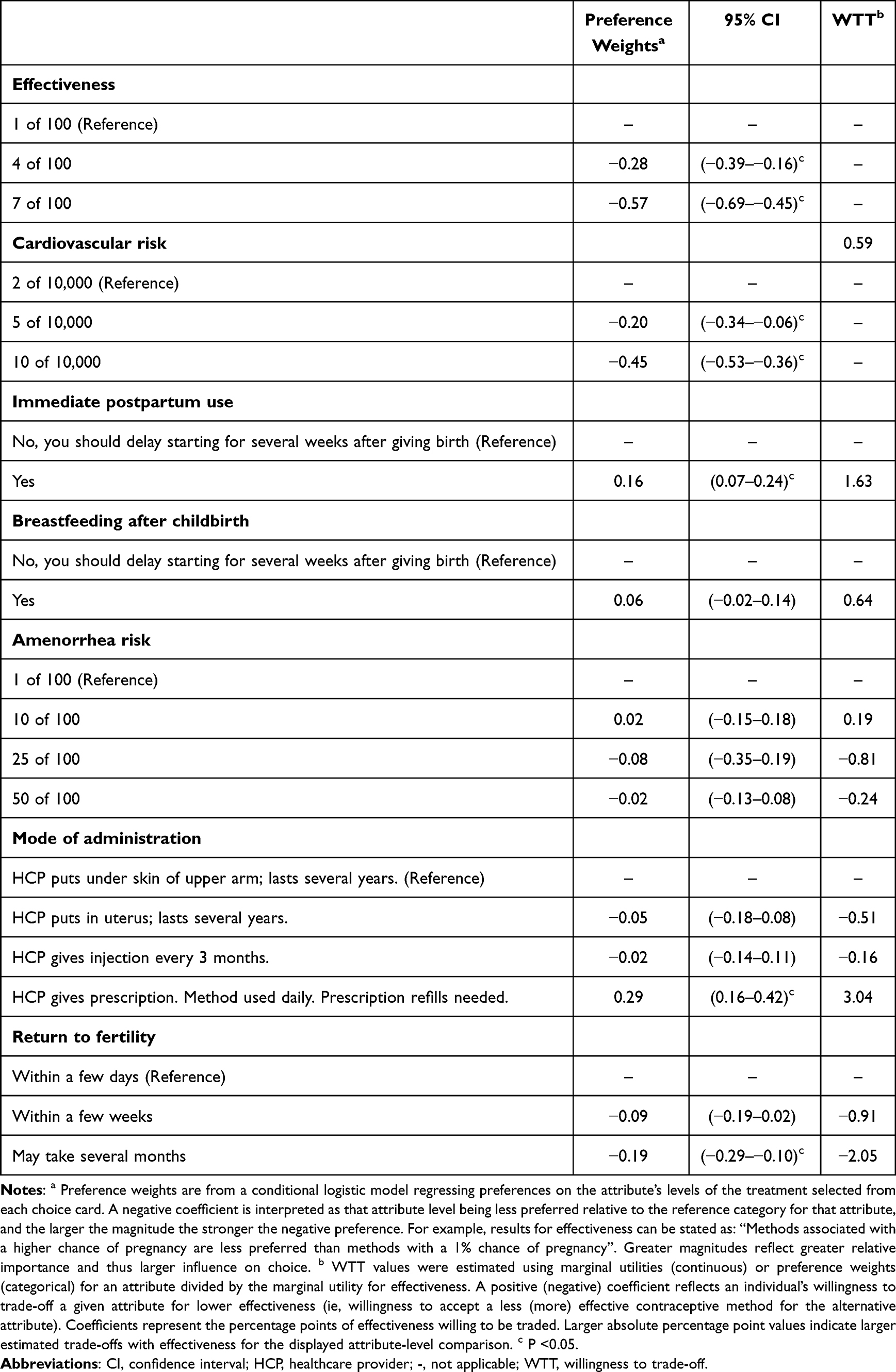 |
Table 3 Preference Weights and Trade-Offs Among Women in a Discrete Choice Experiment Evaluating Contraceptive Decision-Making (N=307) |
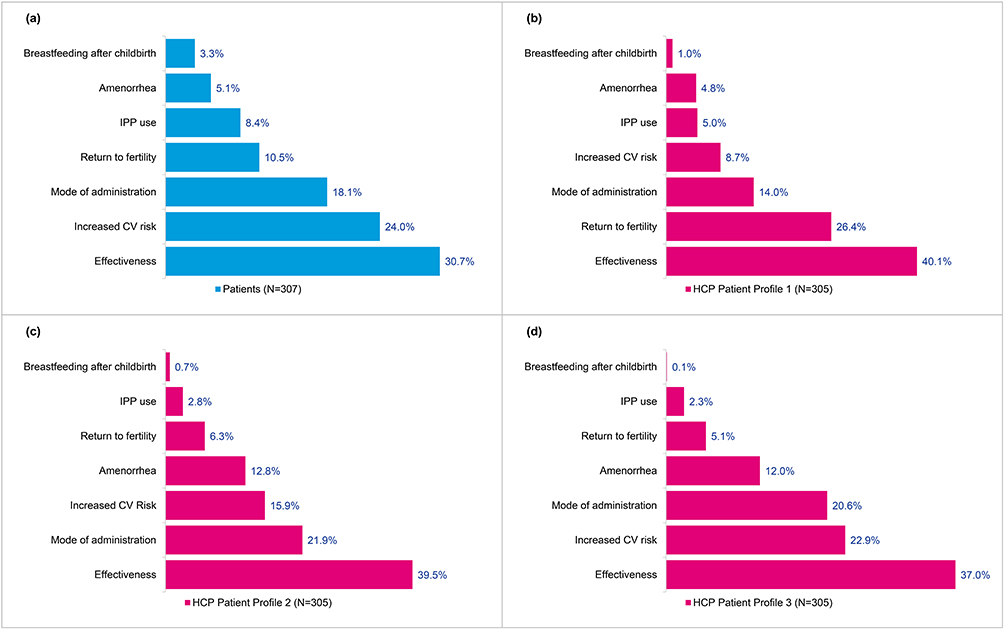 |
Figure 1 Relative Importance of Contraceptive Attributes. (a) Contraceptive Attributes Impacting Choice Among Women (b) Contraceptive Attributes Impacting Choice Among HCPs for Patient Profile 1 (young, nulliparous, may want children in the future) (c) Contraceptive Attributes Impacting Choice Among HCPs for Patient Profile 2 (older, family complete) (d) Contraceptive Attributes Impacting Choice Among HCPs for Patient Profile 3 (higher bodyweight). Abbreviations: CV, cardiovascular; HCP, healthcare provider; IPP, immediate postpartum. Notes: aRelative importance explains how much weight participants place on an attribute overall; higher scores reflect greater importance and thus larger influence on choice. Relative importance scores were normalized to percentages based on the difference between the best and worst attribute level, multiplied by the coefficient for each attribute, to allow for comparisons across attributes. Relative importance scores are interpreted as the proportional value of a change from a treatment with the worst levels to a treatment with the best levels, captured by a specific attribute. For example, a relative importance of 30.7% associated with effectiveness for women is interpreted as “effectiveness contributed 30.7% of the overall weight when choosing between attributes” or “Effectiveness explains 30.7% of the variation in preferences across attributes”. Results indicate that contraceptive effectiveness is the leading attribute influencing choice across the study analyses presented. bMode of administration captures method type and duration of effectiveness. |
Women’s trade-offs favored daily oral consumption (WTT=3.04) but not a delayed return to fertility (WTT=−2.05) (Table 3). When considering LARC, women favored arm placement over uterine placement (WTT=−0.51).
Subgroup and Sensitivity Analyses (Women)
Subgroup analyses showed modest variation in preferences across select characteristics (Supplementary Table 2–4). Effectiveness was the most influential attribute among women 25–34 and 35–49 years (RI=25.7% and 29.7%, respectively). In contrast, women 18–24 years prioritized mode of administration (RI=24.2%), with effectiveness second (RI=23.1%). In this group, daily oral regimens were preferred, though not significantly more than arm placement with the etonogestrel implant (P =0.13; not statistically significant), and injectables were disliked relative to arm placement with the etonogestrel implant (P =0.03); among LARC methods, the implant’s mode of administration was significantly more favored than that of IUDs (P <0.001). Across body weight categories and family planning status, high contraceptive effectiveness was consistently valued most, followed by low CV risk. WTT estimates by subgroup (Supplementary Table 2–4) were generally consistent with those observed in the overall sample.
Preference weights and WTT estimates were similar in sensitivity analyses restricted to women who passed the dominance test (n=263; 85.7%) and those who passed the stability test (n=247; 80.5%) (data not shown).
Relative Importance and Trade-Offs (HCPs)
Effectiveness, CV risk, mode of administration, and return to fertility were consistently and significantly associated with HCP contraceptive preferences (P <0.001) (Table 4 and Figure 1b–1d). High effectiveness, low CV risk, a rapid return to fertility, and the mode of administration/duration of effectiveness of LARC methods (vs short-acting reversible contraception) consistently positively impacted HCP preferences. Effectiveness was the most influential attribute for all profiles (RI=37.0%–40.1%), while the second‑most influential attribute varied by clinical scenario: return to fertility for the young nulliparous woman (RI=26.4%; rapid return preferred), mode of administration for the older woman with completed childbearing (RI=21.9%; LARC preferred), and CV risk for the woman with higher body weight (RI=22.9%; lower risk preferred).
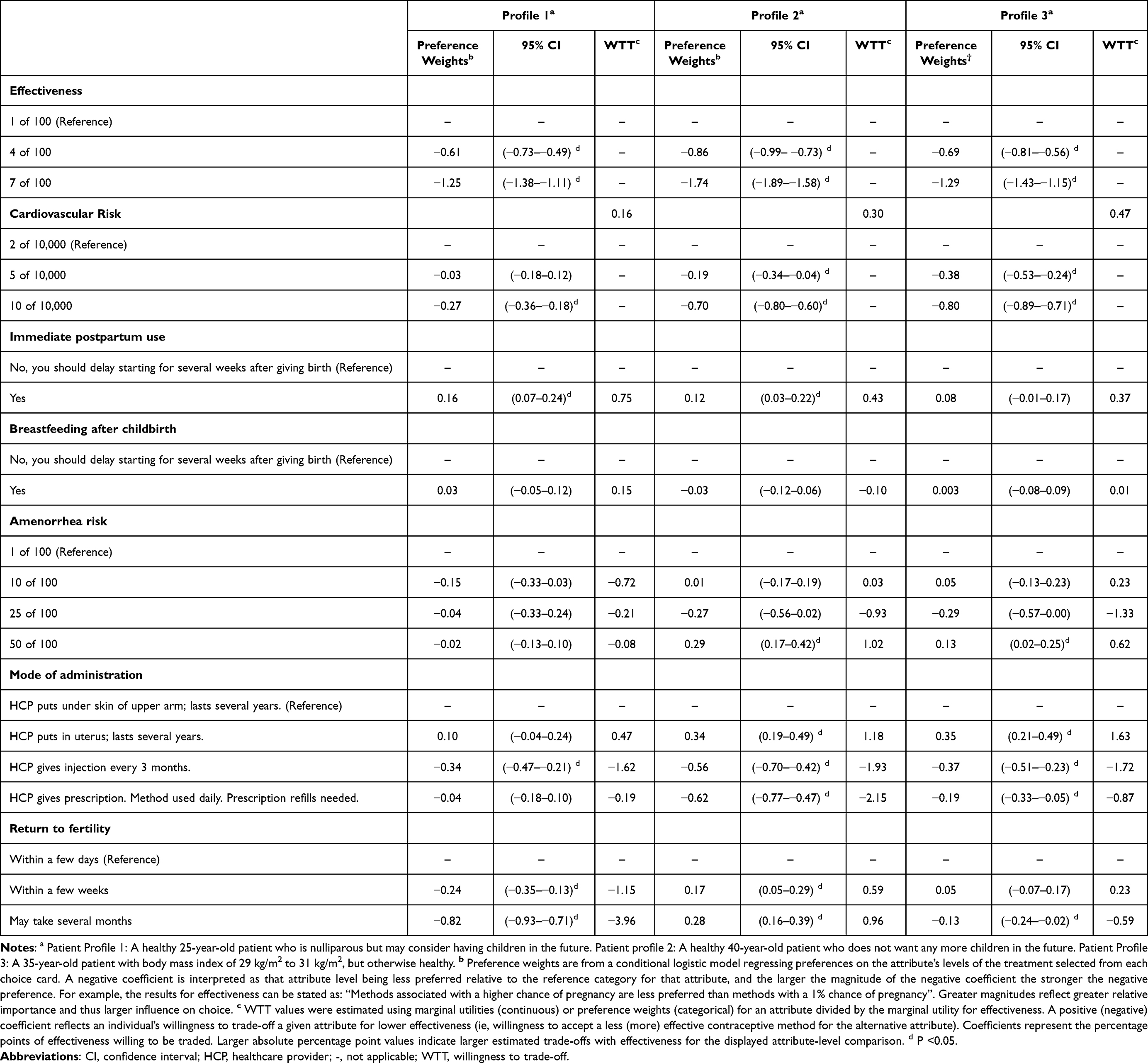 |
Table 4 HCP Preference Weights and Trade-Offs, by Patient Profile, in a Discrete Choice Experiment Evaluating Contraceptive Decision-Making (N=305) |
HCPs unanimously disliked contraception requiring a daily oral regimen or an injection every 3 months and required greater effectiveness to use these methods over the etonogestrel implant or IUDs (Table 4). For Patient Profile 1 (young, nulliparous woman), the largest WTT value indicated that HCPs required substantially greater effectiveness to accept a method with a slower return to fertility (WTT=−3.96). For Patient Profiles 2 (older woman, family planning complete) and 3 (woman with higher body weight), the largest WTT values reflected a requirement for increased effectiveness to prefer injectable (WTT=−1.93 for Profile 2, WTT=−1.72 for Profile 3) or oral methods (WTT=−2.15 for Profile 2, WTT=−0.87 for Profile 3).
Subgroup and Sensitivity Analyses (HCPs)
The three patient profiles were designed to define distinct subgroups; as such, no additional subgroup analyses were performed for HCPs. The estimated preference weights of the attributes, RI values, and WTT estimates were robust to sensitivity analyses.
Discussion
In this study, women prioritized contraceptive effectiveness and low CV risk most strongly, indicating a clear preference for highly effective methods with favorable safety profile. Although trade-offs favored oral daily consumption, they did not favor a delayed return to fertility. Apart from women 18–24 years, whose choices were most influenced by mode of administration, preference results were generally consistent across the clinically relevant subgroups, including women with higher body weight—a historically underrepresented subgroup in contraception research. HCPs in this study consistently prioritized effectiveness irrespective of patient profile and demonstrated a strong preference for LARC attributes over those of oral or injectable contraceptive methods.
Attributes commonly associated with injectable and oral contraceptive methods were viewed less favorably by women in this study compared with the features of LARC, highlighting a discordance between their preferred contraceptive attributes and their stated preference for a daily oral mode of administration. Women consistently prioritized contraception that is highly effective and associated with low CV risk—and valued other key attributes including a rapid return to fertility and immediate postpartum eligibility—all of which are most aligned with LARCs and particularly the etonogestrel implant as the most effective reversible method available.21 Oral methods in particular are generally characterized by higher typical-use failure rates and, for some formulations and individuals, increased CV risk;22 this method along with injectables are further associated with delayed returns to fertility. Combined hormonal oral contraception is particularly not recommended immediately postpartum.23
The preference for highly effective contraception with other features characteristic of LARC, and the expressed preference for daily oral consumption among women in this study, may indeed reflect a higher familiarity of oral contraceptives and misperceptions in the real-world regarding reversibility and user autonomy. Prior work underscores the salience of these findings. For example, a study of LARC preferences by Haas et al18 identified two distinct patient subgroups: the first prioritized effectiveness above everything else and was unlikely to use a method their HCP did not recommend, and the second valued their HCP’s recommendations but preferred oral contraceptive options above all else.24 Together, these findings underscore the central role of individual preferences in contraceptive selection and highlight opportunities to improve patient education and counseling through clear benefit-risk discussion reinforcing autonomy across all methods.
Consistent dislike of the features associated with daily oral and injectable contraceptive methods among HCPs highlights a disconnect with the preferences and trade-offs driving choice among women. These gaps signal a material opportunity to further contraceptive education and better align counseling approaches to patient priorities. Importantly, these findings provide a novel contribution to the scientific literature given the limited evidence available on the contraceptive attributes influencing HCP decision-making, particularly in the US context. Existing research on HCPs has primarily focused on attitudes, perceptions, counseling practices, barriers, and facilitators to contraceptive care, rather than quantifying preferences for specific contraceptive characteristics.25 Unlike traditional surveys, the DCE methodology of this study quantified the RI of the studied attributes and the trade-offs made when evaluating contraceptive options, thereby providing unique insights into factors that may influence counseling and shared decision-making.
The observed differences between women and HCPs suggest that the latter may not always accurately anticipate which contraceptive attributes women value most. Such discrepancies have potential implications for contraceptive counseling and shared decision-making, as discussions may emphasize outcomes that are less important to women while underemphasizing attributes most influential of their choices. The study findings support approaches that actively elicit women’s preferences in a clinical encounter and suggest that initiatives aimed at increasing HCP awareness of women’s priorities may further facilitate patient-centered contraceptive care.
Study findings should be interpreted considering certain limitations. First, participants were recruited from market research panels, which may limit generalizability but facilitated a broad reach to ensure adequate sample size. Further, the results reflect stated preferences under hypothetical yet clinically realistic scenarios. As DCEs reduce complex treatment decisions to a limited set of attributes, thus facilitating internal validity and data quality, decisions in the real-world may or may not weigh various other attributes and may omit other factors (eg, contraceptive costs) that can influence decisions. On costs specifically, it is worth acknowledging that the heterogeneous nature of contraceptive coverage and out-of-pocket costs in the US poses difficulty in defining a cost attribute that would be meaningful across respondents;26–29 consequently, the preferences identified in this study should be interpreted as preferences for contraceptive attributes independent of direct cost considerations.
Conclusions
The study findings underscore the importance of integrating a balanced discussion of each contraceptive method’s risks, benefits, and attributes during contraceptive counseling, while eliciting and honoring patient preferences. This discrete choice experiment found that women’s preferences were largely consistent across clinically relevant subgroups, indicating broad agreement on the relative importance of contraceptive attributes, with the notable exception of women aged 18–24. In contrast, differences observed between women’s preferences and those of HCPs highlight opportunities to improve education, patient-centered contraceptive counseling, and shared decision-making. Greater awareness of women’s priorities may help to ensure that contraceptive discussions better reflect the priorities and outcomes most important to women. These findings have implications not only for clinical practice and education but also for health systems, payers, and policymakers, underscoring the need to facilitate access and reimbursement to the full range of contraceptive options. Future real-world longitudinal research is warranted to evaluate how contraceptive care aligned with women’s preferences influences utilization, satisfaction, and reproductive health outcomes.
Abbreviations
BMI, body mass index; CI, confidence interval; CV, cardiovascular; DCE, discrete choice experiment; DO, Doctor of Osteopathic Medicine; GLP-1, Glucagon-like peptide-1; HCPs, healthcare providers; ISPOR, International Society for Pharmacoeconomics and Outcomes Research; IUD, intrauterine device; IQR, interquartile range; LARC, long-acting reversible contraception; MD, Doctor of Medicine; NPs, nurse practitioners; OB/GYN, obstetrics and gynecology; PAs, physician assistants; RI, Relative importance; SD, standard deviation; US, United States; WTT, willingness to trade-off.
Data Sharing Statement
De-identified, aggregated data supporting the findings of this study are available from the corresponding author upon reasonable request. Because participants did not consent to public data sharing, the dataset cannot be deposited in a public repository.
Ethical Considerations
This study was deemed exempt by the Western Copernicus Group Institutional Review Board under 45 CFR §46.104(d)(2), and no identifiable personal information was collected. The research involved only interactions related to educational tests, survey procedures, interview procedures, or observation of public behavior. All procedures performed involving human participants were in accordance with the Declaration of Helsinki, and participants provided informed consent before completing the interview and survey.
Acknowledgments
The editorial and formatting support was provided by Manjusha Sajith Ph.D, Indegene Limited, Bangalore, India and was funded by Organon, LLC.
Author Contributions
All authors made a significant contribution to the work reported, whether that is in the conception, study design, execution, acquisition of data, analysis and interpretation, or in all these areas; took part in drafting, revising or critically reviewing the article; gave final approval of the version to be published; have agreed on the journal to which the article has been submitted; and agree to be accountable for all aspects of the work.
Funding
This study was funded by Organon, LLC.
Disclosure
VPP is an employee of Organon. KC was employed by Organon during study execution. KAB, LL, CHN, and MM are employees of Analysis Group, which received funding for this research from Organon. AH was an employee of Analysis Group during study execution. Organon provided consultancy fees to KR (employee of the Ohio State University) and ST (employee of University Hospitals) for medical input during protocol development and consultation during study execution. Additionally, ST Stephanie Teal reports Grants or contracts from NICHD, Mylan Pharmaceuticals; Honoraria from Oregon Health and Sciences University, American Diabetes Association; Leadership or fiduciary roles from American Gynecological and Obstetrical Society, American Board of Obstetrics and Gynecology, outside the submitted work. The authors report no other conflicts of interest in this work.
References
1. Rossen LM, Hamilton BE, Abma JC, Gregory ECW, Beresovsky V, Resendez AV. Updated methodology to estimate overall and unintended pregnancy rates in the United States. Vital Health Stat. 2023;201:124395. doi:10.15620/cdc:124395.
2. Centers for Disease Control and Prevention. The 6|18 Initiative. Evidence summary: prevent unintended pregnancy. 2015. Available from: https://archive.cdc.gov/www_cdc_gov/sixeighteen/docs/6-18-evidence-summary-pregnancy.pdf.
3. Delgado-Ron JA, Janus M. Association between pregnancy planning or intention and early child development: a systematic scoping review. PLOS Glob Public Health. 2023;3(12):e0002636. doi:10.1371/journal.pgph.0002636
4. Nelson HD, Darney BG, Ahrens K, et al. Associations of unintended pregnancy with maternal and infant health outcomes: a systematic review and meta-analysis. Jama. 2022;328(17):1714–17. doi:10.1001/jama.2022.1909
5. World Health Organization. Framework for ensuring human rights in the provision of contraceptive information and services. 2014. Available from: https://www.who.int/publications/i/item/9789241507745.
6. Askew I, Raney L, Kerrigan M, Sridhar A. Family planning saves maternal and newborn lives: whyuniversal access to contraception must be prioritized in national maternal and newborn health policies, financing, and programs. Int J Gynaecol Obstet. 2024;164(2):536–540. doi:10.1002/ijgo.15127
7. U.S. Centers for Medicare & Medicaid Services. Health benefits & coverage. Available from: https://www.healthcare.gov/coverage/what-marketplace-plans-cover/.
8. Daniels K, Abma JC. Current contraceptive status among females ages 15–49: united States, 2022–2023. NCHS Data Brief. 2025;539:1–11. doi:10.15620/cdc/174618
9. Martinez GM. Receipt of family planning services in the United States: 2022–2023. NCHS Data Brief. 2024;520:169629. doi:10.15620/cdc/169629
10. Fox E, Reyna A, Malcolm NM, et al. Client preferences for contraceptive counseling: a systematic review. American Journal of Preventive Medicine. 2018;55(5):691–702. doi:10.1016/j.amepre.2018.06.006
11. ACOG. Patient-centered contraceptive counseling: ACOG Committee Statement Number 1. Obstet Gynecol. 2022;139(2):350–353. doi:10.1097/AOG.0000000000004659
12. Ali M, Kiarie J, Shah I. Priorities for research on family planning impact: recommendations of a WHO Think Tank meeting. Family Medicine and Community Health. 2023;11(4):e002406. doi:10.1136/fmch-2023-002406
13. Daniels K, Abma JC. Contraceptive methods women have ever used: united States, 2015–2019. Available from: https://www.cdc.gov/nchs/data/nhsr/nhsr195.pdf.
14. Harrison M, Milbers K, Hudson M, Bansback N. Do patients and health care providers have discordant preferences about which aspects of treatments matter most? Evidence from a systematic review of discrete choice experiments. BMJ Open. 2017;7(5):e014719. doi:10.1136/bmjopen-2016-014719
15. Reed Johnson F, Lancsar E, Marshall D, et al. Constructing experimental designs for discrete-choice experiments: report of the ISPOR conjoint analysis experimental design good research practices task force. Value Health. 2013;16(1):3–13. doi:10.1016/j.jval.2012.08.2223
16. Bridges JF, Hauber AB, Marshall D, et al. Conjoint analysis applications in health—a checklist: a report of the ISPOR Good Research Practices for Conjoint Analysis Task Force. Value Health. 2011;14(4):403–413. doi:10.1016/j.jval.2010.11.013
17. Orme BK. Getting Started with Conjoint Analysis: Strategies for Product Design and Pricing Research.
18. ChoiceMetrics. Ngene 1.2 User Manual & Reference Guide; 2018.
19. Janssen EM, Hauber AB, Bridges JFP. Conducting a discrete-choice experiment study following recommendations for good research practices: an application for eliciting patient preferences for diabetes treatments. Value Health. 2018;21(1):59–68. doi:10.1016/j.jval.2017.07.001
20. Soekhai V, de Bekker-Grob EW, Ellis AR, Vass CM. Discrete choice experiments in health economics: past, present and future. Pharmacoeconomics. 2019;37:201–226. doi:10.1007/s40273-018-0734-2
21. American College of Obstetricians & Gynecologists. Effectiveness of birth control methods. 2024. Available from: https://www.acog.org/womens-health/infographics/effectiveness-of-birth-control-methods.
22. Centers for Disease Control and Prevention. Contraception and birth control methods. 2024. Available from: https://www.cdc.gov/contraception/about/index.html.
23. World Health Organization; Johns Hopkins Bloomberg School of Public Health, Center for Communication Programs. Family Planning- A Global Handbook for Providers, 2022 edition. 2022. Available from: https://www.who.int/publications/i/item/9780999203705.
24. Haas M, Church J, Street DJ, et al. The preferences of women in Australia for the features of long-acting reversible contraception: results of a discrete choice experiment. Eur J Contracept Reprod Health Care. 2022;27(5):424–430. doi:10.1080/13625187.2022.2098947
25. Manzer JL, Ouellette L, Tingey L, et al. Provider perspectives on contraceptive care: a systematic review. Am J Prev Med. 2024;67(6):S32–S40. doi:10.1016/j.amepre.2024.07.025
26. Tschann M, Soon R. Contraceptive coverage and the affordable care act. Obstetrics Gynecol Clin North Am. 2015;42(4):605–617. doi:10.1016/j.ogc.2015.07.001
27. Guttmacher. The federal contraceptive coverage guarantee: a critical policy that must be protected. Fact sheet. 2025. Available from: https://www.guttmacher.org/fact-sheet/contraceptive-coverage-guarantee.
28. Guttmacher. Insurance Coverage of Contraceptives. 2026. Available from: https://www.guttmacher.org/state-policy/explore/insurance-coverage-contraceptives.
29. The role of pharmacy benefit managers in prescription drug markets Part I: self-interest or health care? 2023. Available from: https://oversight.house.gov/hearing/the-role-of-pharmacy-benefit-managers-in-prescription-drug-markets-part-i-self-interest-or-health-care.
 © 2026 The Author(s). This work is published and licensed by Dove Medical Press Limited. The
full terms of this license are available at https://www.dovepress.com/terms
and incorporate the Creative Commons Attribution
- Non Commercial (unported, 4.0) License.
By accessing the work you hereby accept the Terms. Non-commercial uses of the work are permitted
without any further permission from Dove Medical Press Limited, provided the work is properly
attributed. For permission for commercial use of this work, please see paragraphs 4.2 and 5 of our Terms.
© 2026 The Author(s). This work is published and licensed by Dove Medical Press Limited. The
full terms of this license are available at https://www.dovepress.com/terms
and incorporate the Creative Commons Attribution
- Non Commercial (unported, 4.0) License.
By accessing the work you hereby accept the Terms. Non-commercial uses of the work are permitted
without any further permission from Dove Medical Press Limited, provided the work is properly
attributed. For permission for commercial use of this work, please see paragraphs 4.2 and 5 of our Terms.
Recommended articles
Patient Perceived Quality of Virtual Group Contraception Counseling
Ereme K, Akullo K, Class QA, Hinz E
Open Access Journal of Contraception 2024, 15:99-105
Published Date: 4 July 2024
Postpartum Patient Perspectives on the US Medicaid Waiting Period for Permanent Contraception
Hartheimer JS, Bullington BW, Berg KA, White K, Boozer M, Serna T, Miller ES, Bailit JL, Arora KS
Open Access Journal of Contraception 2025, 16:31-41
Published Date: 25 February 2025