
Back to Journals » Diabetes, Metabolic Syndrome and Obesity » Volume 18
Association of KCNJ11 E23K/rs5219 Gene Polymorphism with Type 2 Diabetes and Diabetes-Related Cardiovascular Disease
Authors Buraczynska M  , Boczkowska S, Zaluska W
Received 27 November 2024
Accepted for publication 3 February 2025
Published 27 February 2025 Volume 2025:18 Pages 653—661
DOI https://doi.org/10.2147/DMSO.S506639
Checked for plagiarism Yes
Review by Single anonymous peer review
Peer reviewer comments 2
Editor who approved publication: Dr Rebecca Baqiyyah Conway
Monika Buraczynska, Sylwia Boczkowska, Wojciech Zaluska
Department of Nephrology, Medical University of Lublin, Lublin, Poland
Correspondence: Monika Buraczynska, Department of Nephrology, Medical University of Lublin, Jaczewskiego 8, Lublin, 20-950, Poland, Tel/Fax +48 81 7244357, Email [email protected]
Objective: A potassium voltage-gated channel subfamily J member 11 (KCNJ11) is a candidate gene for diabetes and cardiovascular disease. We investigated the relationship of KCNJ11 E23K gene polymorphism with type 2 diabetes (T2DM) and diabetes-related cardiovascular disease (CVD).
Methods: In this case–control study, the KCNJ11 E23K (rs5219) single nucleotide polymorphism was evaluated using the PCR-RFLP method in 780 patients with T2DM and 425 healthy controls. The genotype distribution was compared between subgroups of patients with CVD (524) and without CVD (256).
Results: The genotyping results showed that the T allele and TT genotype were associated with the risk of T2DM (OR 1.26, p = 0.008 and OR 1.55, p = 0.0019, respectively). The T2DM group was analyzed according to the presence or absence of CVD. The T allele frequency was significantly higher in CVD+ than CVD− patients (49% vs 28%, p = 0.0001). The frequency of TT genotype in CVD+ subgroup was 20% compared to 8.5% in CVD−. This shows the significant correlation of the T allele with CVD in T2DM patients in all genetic association models. The OR for T allele was 2.44, p < 0.0001 representing 2.5-fold higher odds of CVD. For TT genotype, the OR 5.61, p < 0.0001 represents almost 6-fold higher risk of CVD development. The multiple logistic regression analysis showed that KCNJ11 E23K polymorphism was a significant risk predictor for CVD development (p < 0.0001).
Conclusion: This is the first study of the relationship between KCNJ11 gene polymorphism and cardiovascular risk in T2DM patients in Polish population. The E23K (rs5219) polymorphism is associated with T2DM. It also increases the risk of cardiovascular disease in T2DM patients. If confirmed in other studies, it can be considered a potential marker for predicting the risk of CVD in T2DM patients.
Keywords: KCNJ11 gene, type 2 diabetes, cardiovascular risk, single nucleotide polymorphism, genotyping
Introduction
Type 2 diabetes mellitus (T2DM) is a polygenic disorder of glucose metabolism characterized by insulin resistance and/or pancreatic β-cell dysfunction.1 It develops as a result of complex interactions between multiple genetic and environmental factors. T2DM accounts for close to 90% of all diabetes cases, affecting over 450 million people around the world.2 Type 2 diabetes is associated with high morbidity and mortality due to macrovascular and microvascular complications.3,4 The presence of cardiovascular disease (CVD) in T2DM patients is a serious clinical problem and one of the most frequent causes of death.5 Genome-wide association studies (GWAS) have identified more than 100 loci for susceptibility to T2DM and different genetic variants significantly associated with diabetes and cardiovascular disease.6–8 The identification of new genes predisposing to T2DM would expand our knowledge of this complex disease and its vascular complications and result in better preventing, diagnosis and treatment options.
One of the important candidate genes that may be associated with T2DM is the potassium inwardly rectifying channel subfamily J, member 11 (KCNJ11) involved in the insulin secretion pathway.9,10 The KCNJ11 gene is located on chromosome 11p15.1, it encodes Kir6.2 protein. The 390 amino acid protein is the internal fragment of the adenosine triphosphate sensitive potassium ion channel (KATP) that plays an important role in glucose metabolism, pancreatic beta cell function and insulin action.11,12 Several single nucleotide polymorphisms (SNP) have been described in the KCNJ11 gene. One of them is E23K (rs5219) polymorphism caused by a change of guanine to adenine at codon 23, resulting in a glutamic acid to lysine substitution. It reduces sensitivity of potassium channel to ATP resulting in its over-activity and critically inhibits insulin secretion.13 An association between KCNJ11 rs5219 polymorphism and T2DM risk have been observed in several studies.14,15 The KCNJ11 gene guides the formation of ATP-sensitive potassium channel in cardiomyocytes. The genomic analysis studies have recently implicated the KCNJ11 variants in pathological processes in a variety of cardiovascular diseases.16
We hypothesized that E23K polymorphism in KCNJ11 gene is a risk factor of T2DM in a Caucasian population. The aim of the present study was to test this hypothesis by investigating the potential association of KCNJ11 rs5219 polymorphism with T2DM and T2DM-related cardiovascular disease.
Materials and Methods
Study Subjects
The patients enrolled in this preliminary case–control study were recruited from the University Hospital, Medical University of Lublin. The patient group included 780 unrelated subjects (422 males and 358 females) with type 2 diabetes of at least 10-year duration (mean age 62.9 ± 9.1 years). All patients were Caucasians of Polish origin. The majority of patients and control subjects were included in our earlier study.17 In the current investigation, patients were genotyped with another SNP, as a new candidate gene, to evaluate the effect of the KCNJ11 gene polymorphism on the development of diabetes-related cardiovascular disease.
The diagnosis of type 2 diabetes was based on the current American Diabetes Association criteria.18 The disease onset was at >30 years of age in all subjects. A complete physical examination included plasma fasting glucose, glycated hemoglobin (HbA1c), full lipid profile, and body mass index (BMI). Patients with the following conditions were excluded: type 1 and other types of diabetes, liver dysfunction, acute or chronic inflammatory conditions, autoimmune diseases and malignancies. The T2DM duration was defined as the period between the first diagnosis of diabetes and the time of enrollment in the study.
T2DM-related cardiovascular disease was diagnosed in 524 patients (67%) with at least one of the following pathological conditions: congestive heart failure, left ventricular hypertrophy, angina pectoris, ischemic heart disease, myocardial infarction and ischemic cerebral stroke. To verify the clinical presentation of CVD, the relevant biochemical tests were performed and the radiographic, echocardiographic and vascular diagnostic criteria applied.
The healthy control group of randomly selected 425 individuals (mean age 57.5 ± 8.1 years) consisted of unrelated volunteers with fasting plasma glucose less than 100 mg/dl, HbA1c <5.7% and no known personal or family history of diabetes of any type and cardiovascular disease.
Participation in the study was voluntary and before being included all T2DM patients and healthy controls provided a written informed consent. All procedures and experiments in this study were carried out in accordance with principles of the Declaration of Helsinki (version 2013). The ethical approval of detailed research protocol for the study was provided by the Bioethics Committee of Medical University of Lublin (KE-0254/26/01/2023).
Determination of KCNJ11 E23K (rs5219) Genotype
Genomic DNA was extracted from venous blood using a Qiagen DNeasy Blood & Tissue Kit (Qiagen Poland, Warsaw, Poland). DNA purity and concentration were determined in Nano Drop 2000 (Thermo Fisher Scientific, Waltham, MA. USA). The E23K variant in the KCNJ11 gene was detected by polymerase chain reaction – restriction fragment length polymorphism (PCR-RFLP) assay using the Thermal Cycler 9700 (Applied Biosystems, Foster City, CA., USA). The primer sequences were as follows: forward 5ʹ-GACTCTGCAGTGAGGCCCTA-3ʹ and reverse 5ʹ-ACGTTGCAGTTGCCTTTCTT-3ʹ. The PCR program was carried out in the following steps: after initial denaturation at 95°C for 6 min DNA was subjected to 35 amplification cycles of denaturation at 94°C for 30s, annealing at 62°C for 30s and extension at 72°C for 1 min, with a final extension at 72°C for 10 min. The PCR product of 210 bp was incubated with Ban II restriction endonuclease (Thermo Fisher Scientific, Waltham, MA. USA) at 37°C for 12 h. The products of digestion were separated by electrophoresis in 2.5% agarose gel. DNA fragments of 146 bp, 36 bp and 28 bp corresponded to the minor C allele (E in E23K) and two fragments, 174 bp and 36 bp represented the T allele (K in E23K). The genotyping was validated by repeating PCR reactions for 10% of samples. In addition, randomly selected samples (20 for each genotype) were directly sequenced in CEQ 8000 Genetic Analysis System (Beckman Coulter, High Wycombe, UK) to confirm the genotype reading in agarose gel. The genotype concordance rate between assays was 100%.
Statistical Analysis
The statistical management and analysis of collected data were conducted using a statistical software SPSS version 18.0 for Windows (SPSS, Inc., Chicago, IL. USA). The Kolmogorov–Smirnov test was used for normality. The values of normally distributed variables for the baseline characteristics are shown as mean ± standard deviation (SD) or numbers and percentages where appropriate. Differences in discrete and continuous variables between groups were evaluated by an unpaired Student’s t-test and Mann–Whitney test. Potential deviation from Hardy-Weinberg balance in the genotype distribution was assessed in a Fisher's exact test. The KCNJ11 rs5219 polymorphism distributions in patients with and without CVD were compared using a Pearson chi-square test of independence. The strength of the observed associations of studied polymorphism with clinical phenotype was estimated by computing the odds ratios (OR) with corresponding 95% confidence intervals (CI), with a non-risk allele/genotype considered a reference. Variables showing significant associations were analyzed in multivariate logistic regression analysis. It was used to find independent predictors of CVD risk in T2DM patients. ORs were adjusted based on age, gender, BMI and the presence of hypertension. The level of statistical significance for all tests was set at p < 0.05.
Results
Characteristics of the Study Population
The study cohort consisted of 780 T2DM patients and 425 control individuals. T2DM patients were divided into two phenotype subgroups, patients with CVD (n = 524) and those without CVD (n = 256) for the purpose of comparison. The clinical and laboratory parameters of the study subjects are summarized in Table 1. Patients with CVD were older (mean age 64.6 ± 11.3 years) than those without CVD (mean age 61.3 ± 9.2 years). The male/female ratio was similar in CVD+ and CVD− subgroups (p = 0.087). The CVD+ patients were younger at the time of diabetes diagnosis (p = 0.001). There were no statistically significant differences between patients with and without CVD with respect to BMI, triglyceride levels and HbA1c values. The levels of total cholesterol were higher (p < 0.001) and of HDL cholesterol were lower (p = 0.002) in the CVD+ subgroup.
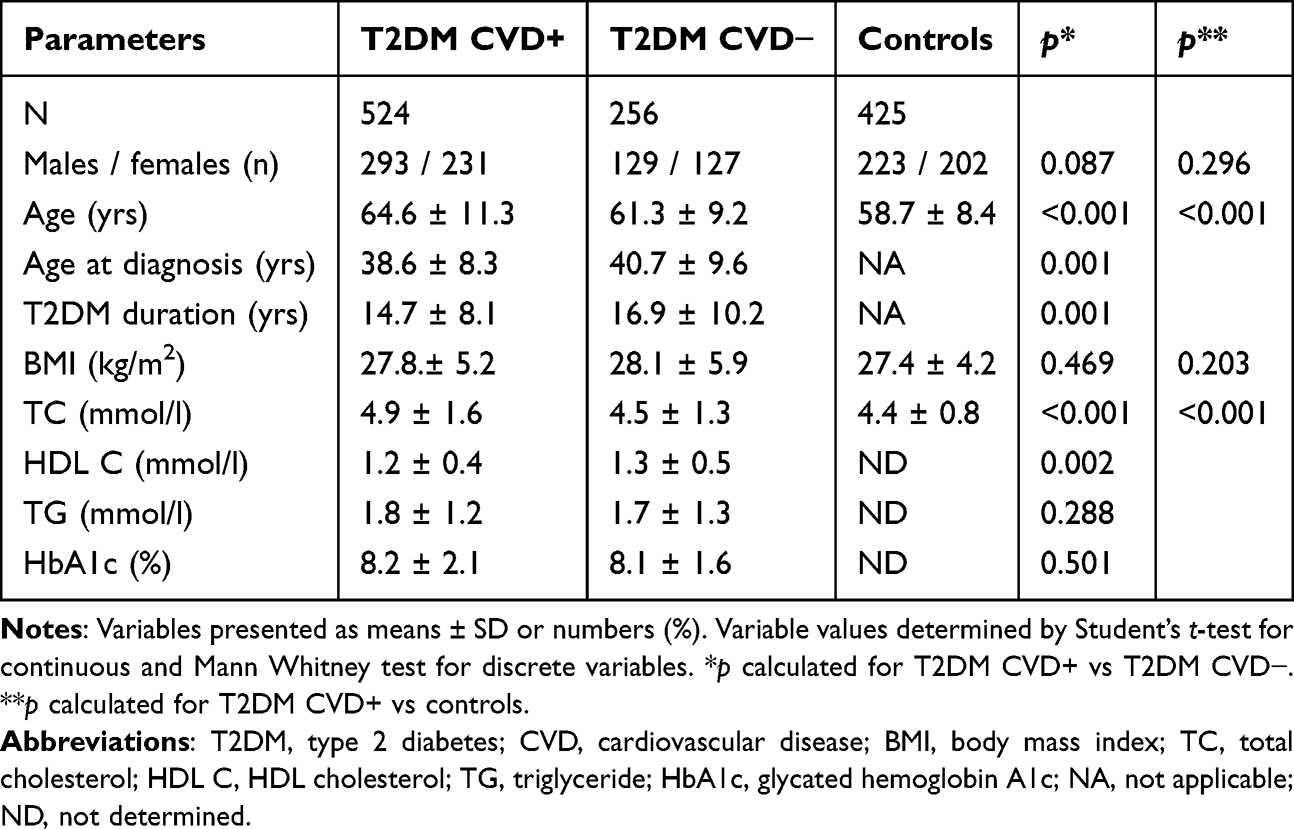 |
Table 1 Basic Characteristics of T2DM Patients and Controls According to the Presence or Absence of CVD |
KCNJ11 E23K Genotyping
All subjects were successfully genotyped with the E23K (rs5219) SNP in the KCNJ11 gene. The frequencies of the genotypes (CC, CT and TT) among T2DM patients and healthy controls are compared in Table 2. The minor allele (T) frequency in control group was similar to those reported for other European populations.19,20 The allele and genotype proportions in control group are consistent with Hardy–Weinberg equilibrium (p = 0.532). In the polymorphism distribution comparison of T2DM and control groups, we observed a statistically significant differences in the codominant and dominant genetic models. The T allele and TT genotype were associated with the risk of T2DM (OR 1.26, 95% CI 1.06–1.49, p = 0.008 and OR 1.55, 95% CI 1.07–2.26, p = 0.019, respectively). The frequency of the minor allele in healthy individuals involved in this study was 37% compared to 43% in T2DM group (p = 0.043).
 |
Table 2 Distribution of KCNJ11 E23K Genotypes and Alleles in T2DM Patients and Healthy Controls |
Association Between KCNJ11 E23K Polymorphism and CVD
The group of T2DM patients was further analyzed according to the presence or absence of CVD. The distribution of the E23K (rs5219) polymorphism was compared in subgroups of CVD+ (n = 524) and CVD− (n = 256) patients. The results presented in Table 3 show that genotype and allele frequencies differed significantly between these subgroups. The frequency of the minor T allele in the CVD+ subgroup was significantly higher than in patients without CVD (49% and 28%, respectively, p < 0.0001). The TT genotype was also more frequent in the subgroup with CVD compared to CVD− patients (20% and 8.5%, respectively, p < 0.0001). These results show the significant correlation of the T allele carriership with a development of CVD in T2DM patients in all genetic association models. The OR for the T allele was 2.44 (1.94–3.08), p< 0.0001, representing 2.5-fold higher odds of CVD. For the TT genotype, the OR 5.61 (3.32–9.50), p < 0.0001 represents almost 6-fold higher odds of CVD compared to CC homozygotes. The T allele was also more frequent in both CVD+ and CVD− subgroups when compared to healthy controls (p = 0.0002 for CVD+ and p = 0.016 for CVD−). The adjusted OR for the T allele was 2.12 (1.86–2.95), p< 0.0001 for CVD+ and 1.12 (0.73–1.36), p = 0.001 for CVD−. The clinical and biochemical characteristics of CVD+ and CVD− patients were further analyzed with respect to genotype (Table 4). A statistically significant difference was found in CVD+ patients between genotypes and HDL cholesterol levels (p = 0.041). There were no other differences related to genotypes in CVD+ or CVD− subjects.
 |
Table 3 Distribution of KCNJ11 E23K Polymorphism in T2DM Patients with and without CVD |
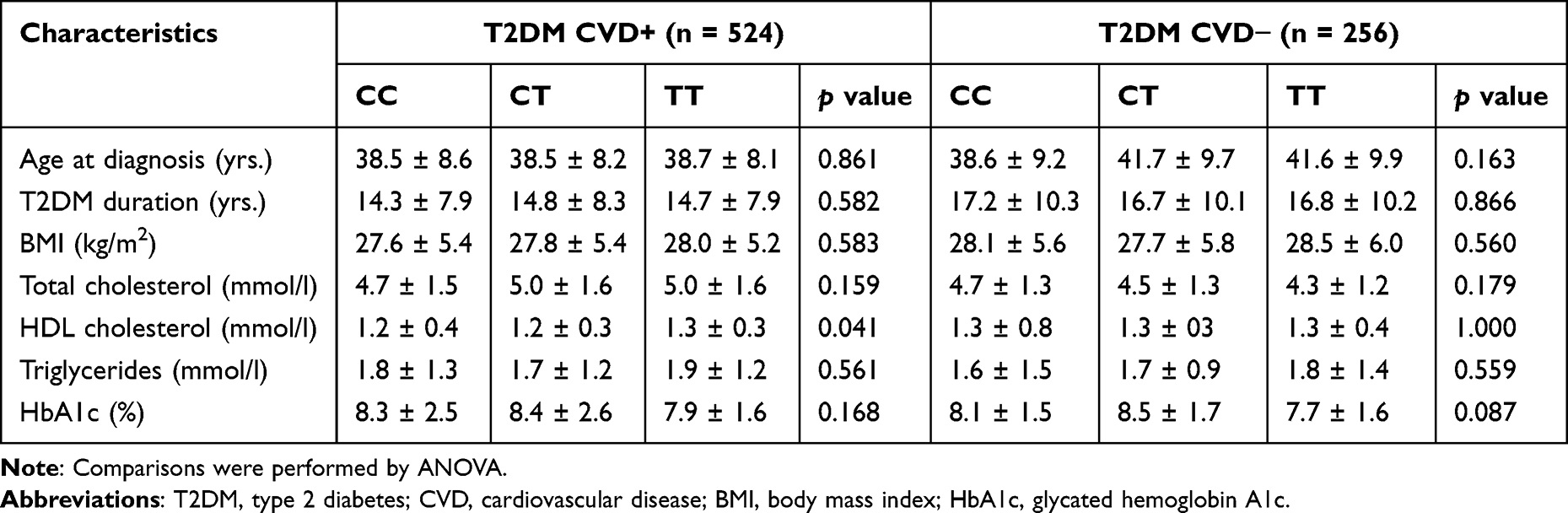 |
Table 4 Correlation Between rs5219 Genotype and Basic Characteristics of T2DM Patients with and without CVD |
Multivariate Logistic Regression Analysis
Multiple logistic regression analysis was applied to confirm the possible independent risk factors for CVD in T2DM patients (Table 5). The results showed that KCNJ11 E23K polymorphism was a significant risk predictor for CVD development (p < 0.0001). In addition, other variables, T2DM duration age at T2DM onset and HbA1c were significantly correlated with cardiovascular disease phenotype (p = 0.022, p = 0.034 and p = 0.005, respectively).
 |
Table 5 Multivariate Logistic Regression Analysis |
Discussion
In this study, we evaluated the potential association between the E23K polymorphism (rs5219) in the KCNJ11 gene and the susceptibility to type 2 diabetes and diabetes-related cardiovascular disease in T2DM patients. The KCNJ11 is considered a promising candidate sensibility gene for T2DM due to the Kir6.2 protein crucial for pancreatic beta-cell function.12 The previous reports supported the association of the E23K polymorphism with T2DM20–24 and its microvascular complications.25,26 The prevalence of the T allele in our study was 37%, comparable to other European studies.19,20,27,28 The minor T allele carriership was significantly associated with type 2 diabetes. The number of the T allele carriers (CT + TT genotypes) was much higher in the T2DM patient group than in the control group (p < 0.005). The higher risk of developing T2DM was associated with both T allele and TT genotype (OR 1.26, p = 0.008 and OR 1.55, p = 0.019, respectively). In a meta-analysis study, the KCNJ11 E23K polymorphism increased the risk of T2DM by 1.25-fold.14 In the comparison of the polymorphism distribution in T2DM and control groups in different genetic models we observed statistically significant differences under codominant and dominant models (p = 0.019 and p = 0.005, respectively). This result is similar to the study of Aka et al of 250 T2DM subjects, in which the association of the E23K polymorphism with diabetes was observed in all models, including dominant and co-dominant models.22 In contrast to these results, some authors reported the association of E23K polymorphism with T2DM only in the recessive model.21,24 The KCNJ11 E23K polymorphism might be associated with T2DM due to suppressed insulin secretion caused by decreased ATP sensitivity of the KATP channel.29
The presence of cardiovascular disease in type 2 diabetes patients is a serious clinical problem.5 The ATP-sensitive potassium channels are implicated in physiological and pathological processes in a variety of cardiovascular diseases.16,30,31 It was reported that KCNJ11 contributes to CVD in individuals with diabetes.22,32,33
For our analysis of an association between the KCNJ11 E23K variant and cardiovascular disease, the distribution of the polymorphism was compared in the CVD+ and CVD− subgroups of T2DM patients. In this analysis, the T allele and homozygous TT genotype were strongly associated with the occurrence of cardiovascular disease in all genetic models. The increased frequency of the T allele carriers in T2DM CVD+ subgroup suggests that E23K polymorphism might be a risk factor for CVD in type 2 diabetes patients. Similarly, the evidence that the T allele of E23K polymorphism is associated with coronary heart disease was presented in the study of Raza et al. The frequency of the TT genotype was much higher in CAD patients than in those without CAD, resulting in 25-fold higher risk of CAD.31 The results of Chinese study of CHD patients also confirmed the association of the E23K variant with increased risk of CHD.34 In the study of Aka et al, the authors investigated the KCNJ11 E23K gene polymorphism for the risk of cardiovascular complications in T2DM patients. They found a significant association between E23K and cardiovascular disease under the allele and recessive models.22 There are also reports suggesting that the E23K polymorphism can identify subjects with low risk of CAD. In a Spanish study of 318 patients with T2DM and diabetic nephropathy, the E23K SNP was associated with a lower risk of atherosclerotic plaques.35 The results of an Italian study suggested an important role of rs5219 SNP in the KCNJ11 gene in the susceptibility to ischemic heart disease (IHD) and coronary microvascular dysfunction. In this study, a trend was observed for the TT (K23K) genotype of rs5219 to be associated with protection against coronary microvascular dysfunction.36 This protective effect might be due to a modest increase in KATP channel activity by the E23 variant. In any case, the KCNJ11 E23K polymorphism modifies the KATP channel current and/or activity that correlates with cardiovascular disease. The observed phenotypic effects of the K23 allele might be modified by several factors such as hypertension or stress.37
Our study has some limitations. Although the strict selection criteria for the patient and control groups were applied, there could be a potential selection bias due to the design of the study as retrospective. Patients were enrolled regardless of the time of CVD diagnosis. It is possible that some T2DM patients classified as CVD− could have undetected clinically silent atherosclerosis, which would affect the results. Furthermore, our preliminary study was restricted to one SNP in the KCNJ11 gene, so some other polymorphisms at this locus could contribute to the development of CVD.
Conclusion
This is the first study in the Polish population on the association of the KCNJ11 gene polymorphism with T2DM and cardiovascular risk in T2DM patients. Our results confirmed the role of the E23K polymorphism in the pathogenesis of type 2 diabetes. Moreover, they demonstrated a strong association of the E23K polymorphism with increased risk of cardiovascular disease in T2DM patients. If this effect is replicated in other studies, the KCNJ11 E23K polymorphism could be considered a potential clinically relevant marker for predicting risk of CVD in T2DM patients.
Data Sharing Statement
The datasets used and analyzed during this study are available from the corresponding author on reasonable request.
Author Contributions
All authors made a significant contribution to the work reported, whether that is in the conception, study design, execution, acquisition of data, analysis and interpretation, or in all these areas, took part in drafting, revising or critically reviewing the article, gave final approval of the version to be published, have agreed on the journal to which the article has been submitted, and agree to be accountable for all aspects of the work.
Funding
This research did not receive any specific funding.
Disclosure
The authors declare no conflict of interest.
References
1. Skyler JS, Bakris GL, Bonifacio E, et al. Differentiation of diabetes by pathophysiology, natural history and prognosis. Diabetes. 2017;66:242–255. doi:10.2337/db16-0806
2. Cho NH, Shaw JE, Karuranga S, et al. IDF diabetes atlas: global estimates of diabetes prevalence for 2017 and projections for 2045. Diabet Res Clin Pract. 2018;138:271–281. doi:10.1016/j.diabres.2018.02.023
3. Faselis C, Katsimardou A, Imprialos K, et al. Microvascular complications of type 2 diabetes mellitus. Curr Vasc Pharmacol. 2019. doi:10.2174/1570161117666190502103733
4. Visaria J, Iver NN, Raval A, et al. Incidence and prevalence of microvascular and macrovascular diseases and all-cause mortality in type 2 diabetes mellitus: a 10-year study in a US commercially insured and Medicare Advantage population. Clin Ther. 2019;41:1522–1536. doi:10.1016/j.clinthera.2019.05.012
5. Rawshani A, Rawshani A, Franzen S, et al. Risk factors, mortality and cardiovascular outcomes in patients with type 2 diabetes. New Engl J Med. 2018;379:633–644. doi:10.1056/NEJMoa1800256
6. Yahaya TO, Salisu TF. A review of type 2 diabetes mellitus predisposing genes. Curr Diabetes Rev. 2019;16:52–61. doi:10.2174/1573399815666181204145806
7. Vujkovic M, Keaton JM, Lynch JA, et al. Discovery of 318 new risk loci for type 2 diabetes and related vascular outcomes among 1.4 million participants in a multi-ancestry meta-analysis. Nat Genet. 2020;52:680–691. doi:10.1038/s41588-020-0637-y
8. Kim H, Westerman KF, Smith K, et al. High-throughput genetic clustering of type 2 diabetes loci reveals heterogeneous mechanistic pathways of metabolic disease. Diabetologia. 2023;66:495–507. doi:10.1007/s00125-022-05848-6
9. Haghvirdizadeh P, Haerian MS, Haerian BS. KCNJ11: genetic polymorphisms and risk of diabetes mellitus. J Diabetes Res. 2015;2015:1–9. doi:10.1155/2015/908152
10. Ling C. Epigenetic regulation of insulin action and secretion – role in the pathogenesis of type 2 diabetes. J Intern Med. 2020;288:158–167. doi:10.1111/joim.13049
11. McTaggart JS, Clarc RH, Ashcroft FM. The role of the KATP channel in glucose homeostasis in health and disease. J Physiol. 2010;588:3201–3209. doi:10.1113/jphysiol.2010.191767
12. Ashcroft FM. KATP channels and the metabolic regulation of insulin secretion in health and disease: the 2022 banting medal for scientific achievement award lecture. Diabetes. 2023;72:693–702. doi:10.2337/dbi22-0030
13. Schwanstecher K, Meyer U, Schwanstecher M. KIR6.2 polymorphism predisposes to type 2 diabetes by inducing overactivity of pancreatic β-cell ATP-sensitive K+ channels. Diabetes. 2002;51:875–879. doi:10.2337/diabetes.51.3.875
14. Wang D, Chen X, Yang Y, et al. Association of Kir6.2 gene rs5219 variation with type 2 diabetes: a meta-analysis of 21,464 individuals. Prim Care Diabetes. 2018;12:345–353. doi:10.1016/j.pcd.2018.03.004
15. Ren Y, Zhu W, Shi J, et al. Association between KCNJ11 E23K polymorphism and the risk of type 2 diabetes mellitus: a global meta-analysis. J Diabetes Compl. 2022;36:108170. doi:10.1016/j.jdiacomp.2022.108170
16. Huang Y, Hu D, Huang C, et al. Genetic discovery of ATP-sensitive K(+) channels in cardiovascular disease. Circ Arrhythm Electrophysiol. 2020;12:e007322. doi:10.1161/CIRCEP.119.007322
17. Buraczynska M, Wrzos S, Zaluska W. MMP9 gene polymorphism (rs3918242) increases the risk of cardiovascular disease in type 2 diabetes patients. J Clin Med. 2023;12:6990. doi:10.3390/jcm.12226990
18. Davies MJ, Aroda VR, Collins BS, et al. Management of hyperglycemia in type 2 diabetes, 2022. A consensus report by the American Diabetes Association (ADA) and the European Association for the Study of Diabetes (EASD). Diabetes Care. 2022;45:2753–2786. doi:10.2337/dci22-0034
19. Gloyn AN, Hashim Y, Ashcroft SJ, et al. Association studies of variants in promoter and coding regions of beta-cell ATP-sensitive K-channel genes SUR1 and Kir6.2 with type 2 diabetes mellitus (UKPDS53). Diabet Med. 2001;18:206–212. doi:10.1046/j.1464-5491.2001.00449.x
20. Cejkova P, Novota P, Cerna M, et al. KCNJ11 E23K polymorphism and diabetes mellitus with adult onset in Czech population. Folia Biol. 2007;53:173–175. doi:10.14712/fb2007053050173
21. Makhzoom O, Kabalan Y, Al-Quoballi F. Association of KCNJ11 rs5219 gene polymorphism with type 2 diabetes mellitus in a population of Syria: a case-control study. BMC Med Genet. 2019;20. doi:10.1186/s12881-019-0846-3.
22. Aka TD, Saha U, Shati SA, et al. Risk of type 2 diabetes mellitus and cardiovascular complications in KCNJ11, HHEX and SLC30A8 genetic polymorphisms carriers: a case-control study. Heliyon. 2021;7:e08376. doi:10.1016/j.heliyon.2021.e08376
23. Jan A, Zakiullah, Khuda F, et al. Validation of genome-wide association studies (GWAS)-identified type 2 diabetes mellitus risk variants in Pakistani Pashtun population. mol Cell Endocrinol. 2022;38. doi:10.15605/jafes.037.S5
24. Tran NQ, Truong SD, Ma PT, et al. Association of KCNJ11 and ABCC8 single nucleotide polymorphisms with type 2 diabetes mellitus in Kinh Vietnamese population. Medicine. 2022;101:46. doi:10.1097/MD.0000000000031653
25. Liu N, Wu HH, Li Y, et al. An analysis of the association between a polymorphism of KCNJ11 and diabetic retinopathy in a Chinese Han population. Eur J Med Res. 2015;20. doi:10.1186/s40001-014-0075-3
26. Elzehery R, El-Hafez HA, Elsehely I, et al. Association of the 23K (rs5219) polymorphism in the potassium channel (KCNJ11) gene with diabetic neuropathy in type 2 diabetes. Gene. 2024;921:148525. doi:10.1016/j.gene.2024.148525
27. Vaxillaire M, Veslot J, Dina C, et al. Impact of common type diabetes risk polymorphisms in the DESIR prospective studies. Diabetes. 2008;57:244–254. doi:10.2337/db07-0615
28. Majcher S, Ustianowski P, Malinowski D, et al. KCNJ11 and KCNQ1 gene polymorphisms and placental expression in women with gestational diabetes mellitus. Genes. 2022;13(8):1315. doi:10.3390/genes13081315
29. Rizvi S, Raza ST, Mahdi F, et al. Genetic polymorphisms in KCNJ11 (E23K, rs5219) and SDF-1β (G801A, rs1801157) genes are associated with the risk of type 2 diabetes mellitus. Br J Biomed Sci. 2018;75:139–144. doi:10.1080/09674845.2018.1473939
30. Lei ZM, Yue H, Pei LH, et al. KATP channel: relation with cell metabolism and role in the cardiovascular system. Int J Biochem Cell Biol. 2005;37:751–764. doi:10.1016/j.biocel.2004.10.008
31. Raza ST, Singh SP, Rizvi S, et al. Association of eNOS (G894T, rs1799983) and KCNJ11 (E23K, rs5219) gene polymorphism with coronary artery disease in North Indian population. Afr Health Sci. 2021;21:1163–1171.31. doi:10.4314/ahs.v21i3.25
32. Koo BK, Cho BL, Park HS, et al. Polymorphisms of KCNJ11 (Kir6.2 gene) are associated with type 2 diabetes and hypertension in the Korean population. Diabetic Med. 2007;24:178–186. doi:10.1111/j.1464-5491.2006.02050.x
33. Zhuang L, Zhao Y, Zhao W, et al. The E23K and A190A variations of the KCNJ11 gene are associated with early-onset of type 2 diabetes and blood pressure in the Chinese population. mol Cell Biochem. 2015;404:133–141. doi:10.1007/s11010-015-2373-7
34. Xiong C, Zheng F, Wan J, et al. The E23K polymorphism in Kir6.2 gene and coronary heart disease. Clin Chim Acta. 2006;367:93–97. doi:10.1016/j.cca.2005.11.032
35. Mota-Zamorano S, Gonzalez NM, Robles NR, et al. Polymorphisms in glucose homeostasis genes are associated with cardiovascular and renal parameters in patients with diabetic nephropathy. Ann Med. 2022;54:3039–3051. doi:10.1080/07853890.2022.2138531
36. Fedele F, Mancone M, Chilian WM, et al. Role of genetic polymorphisms of ion channels in the pathophysiology of coronary microvascular dysfunction and ischemic heart disease. Basic Res Cardiol. 2013;108. doi:10.1007/s00395-013-0387-4
37. Reyes S, Terzic A, Mahoney DW, et al. K(ATP) channel polymorphism is associated with left ventricular size in hypertensive individuals: a large scale community based study. Hum Genet. 2008;123:665–667. doi:10.1007/s00439-008-0519-3
 © 2025 The Author(s). This work is published and licensed by Dove Medical Press Limited. The
full terms of this license are available at https://www.dovepress.com/terms
and incorporate the Creative Commons Attribution
- Non Commercial (unported, 3.0) License.
By accessing the work you hereby accept the Terms. Non-commercial uses of the work are permitted
without any further permission from Dove Medical Press Limited, provided the work is properly
attributed. For permission for commercial use of this work, please see paragraphs 4.2 and 5 of our Terms.
© 2025 The Author(s). This work is published and licensed by Dove Medical Press Limited. The
full terms of this license are available at https://www.dovepress.com/terms
and incorporate the Creative Commons Attribution
- Non Commercial (unported, 3.0) License.
By accessing the work you hereby accept the Terms. Non-commercial uses of the work are permitted
without any further permission from Dove Medical Press Limited, provided the work is properly
attributed. For permission for commercial use of this work, please see paragraphs 4.2 and 5 of our Terms.
Recommended articles

HTR1A Gene Polymorphism in Type 2 Diabetes Mellitus Comorbid with Major Depressive Disorder in a Chinese Population
Simayi D, Guan Y
Diabetes, Metabolic Syndrome and Obesity 2022, 15:1597-1604
Published Date: 25 May 2022