
Back to Journals » International Journal of Women's Health » Volume 17
Association Between Non-HDL/HDL Cholesterol Ratio and Urinary Incontinence in US Women:NHANES 2005-2018
Authors Yao Z, Huang S, Chen H
Received 3 July 2025
Accepted for publication 14 October 2025
Published 30 October 2025 Volume 2025:17 Pages 3983—3994
DOI https://doi.org/10.2147/IJWH.S551357
Checked for plagiarism Yes
Review by Single anonymous peer review
Peer reviewer comments 2
Editor who approved publication: Dr Matteo Frigerio
Zhemin Yao,1 Shuangshuang Huang,2 Hao Chen1
1Department of Urinary Surgery, Yueqing Affiliated Hospital of Wenzhou Medical University, Wenzhou, Zhejiang, 325600, People’s Republic of China; 2Operating Departments, Yueqing Affiliated Hospital of Wenzhou Medical University, Wenzhou, Zhejiang, 325600, People’s Republic of China
Correspondence: Hao Chen, Department of Urinary Surgery, Yueqing Affiliated Hospital of Wenzhou Medical University, No. 338 Qingyuan Road, Yueqing, Wenzhou, Zhejiang, 325600, People’s Republic of China, Tel +86-13567778100, Email [email protected]
Background: Urinary incontinence (UI) is a common health issue among women, and dyslipidemia has been suggested as a potential novel risk factor. The ratio of non-high-density lipoprotein cholesterol to high-density lipoprotein cholesterol (NHHR) provides a comprehensive assessment of lipid metabolism imbalance. However, its association with UI remains unclear. This study aimed to investigate the relationship between NHHR and UI in adult women.
Methods: This cross-sectional study utilized data from the National Health and Nutrition Examination Survey (NHANES) conducted between 2005 and 2018. A total of 13,885 adult women were included. UI and its subtypes were assessed via structured questionnaires, and NHHR was calculated accordingly. Multivariable logistic regression models were used to examine the association between NHHR and UI. Smooth curve fitting and threshold effect analysis were applied to explore potential nonlinear relationships. Subgroup analyses were conducted to evaluate heterogeneity across different populations. Sensitivity analyses were conducted to verify the robustness of the study results.
Results: NHHR was significantly positively associated with stress urinary incontinence (SUI). In the fully adjusted model, each 1-unit increase in NHHR was associated with a 7.5% higher risk of SUI (OR = 1.075, 95% CI: 1.027– 1.126). Participants in the highest NHHR quartile (Q4) had a 32.0% higher risk of SUI compared to those in the lowest quartile (Q1) (OR = 1.320, 95% CI: 1.133– 1.539). Smooth curve fitting revealed a nonlinear relationship between NHHR and UI, with an inflection point at 3.281. The positive association between NHHR and SUI was more pronounced among women with body mass index (BMI) ≥ 30 kg/m² and those with insufficient physical activity. However, after adjusting for potential confounders, no significant associations were observed between NHHR and urgency urinary incontinence (UUI) or mixed urinary incontinence (MUI). The results of the sensitivity analyses were consistent with the main findings.
Conclusion: NHHR showed a positive association with SUI, particularly among women with obesity and low physical activity. These findings underscore the potential of NHHR as a novel biomarker for SUI risk stratification and suggest that targeting lipid imbalances through lifestyle interventions could contribute to reducing the burden of SUI. Further research is warranted to elucidate the underlying mechanisms and to evaluate the potential of NHHR as a therapeutic target in the prevention and management of SUI.
Keywords: urinary incontinence, stress urinary incontinence, NHHR, NHANES
Introduction
UI is a prevalent chronic health condition worldwide, with particularly high incidence rates among middle-aged and postmenopausal women, affecting approximately 44% to 57% of this population.1 Beyond its physical implications—such as limiting daily activities—UI significantly impacts mental health by contributing to anxiety and depression, and it interferes with social, occupational, and familial functioning, thereby greatly diminishing overall quality of life.2 On a societal level, UI poses a substantial economic burden. In the United States alone, the direct healthcare cost of managing UI reached an estimated $82.6 billion in 2020.3 Given these widespread adverse consequences, identifying modifiable risk factors and implementing effective preventive strategies are of critical importance.
UI is recognized as a multifactorial condition, with established risk factors including advanced age, parity, history of pelvic surgery, and chronic comorbidities such as diabetes and hypertension.4 In recent years, increasing evidence has suggested that dyslipidemia may represent a novel risk factor for UI. The proposed mechanisms include the induction of oxidative stress and vascular endothelial dysfunction, leading to ischemic and fibrotic changes in bladder and urethral tissues, which may contribute to UI pathogenesis.5 Moreover, hyperlipidemia has been associated with structural and functional abnormalities of the lower urinary tract.6 However, studies investigating the relationship between lipid metabolism and UI remain limited, particularly those examining comprehensive lipid indices.
UI subtypes may be differentially affected by metabolic and structural factors. SUI has been consistently linked to structural and functional deficits of the urethra and bladder neck, along with compromised support from the striated urethral sphincter and levator ani muscles, resulting in reduced urethral closure pressure and bladder neck incompetence.7 In contrast, UUI and MUI are primarily associated with detrusor overactivity, altered neurological regulation, and functional bladder abnormalities rather than structural weakness.8 Moreover, components of metabolic syndrome, including dyslipidemia, obesity, and insulin resistance, are more prevalent among women with SUI than in continent women, suggesting that metabolic disturbances may exacerbate underlying structural vulnerability in the pelvic floor.9 Collectively, these findings support the hypothesis that SUI is particularly sensitive to metabolic and lipid-related factors, whereas UUI and MUI are likely less affected by these pathways.
NHHR has emerged as a novel and integrated indicator for evaluating lipid metabolism disorders. NHHR reflects both the atherogenic lipoprotein burden and overall cardiometabolic risk, by combining the adverse effects of non-HDL-C with the protective role of HDL-C. Compared with single lipid parameters, NHHR offers a more comprehensive and accurate assessment of lipid dysregulation.10 Prior research has shown strong associations between the NHHR and various metabolic disorders. For example, NHHR outperforms non-HDL-C, HDL-C, and LDL-C/HDL-C in predicting metabolic dysfunction-associated steatotic liver disease (MASLD) among US adults, with receiver operating characteristic (ROC) analysis demonstrating superior discriminatory ability.11 Similarly, NHHR demonstrates stronger predictive value for MASLD than non-HDL-C and HDL-C, with Cox regression indicating a 134% higher risk in the highest quartile, further emphasizing its robust association with metabolic outcomes.12 Elevated NHHR levels are also associated with U-shaped or L-shaped relationships with all-cause and cardiovascular mortality in individuals with diabetes13 and are associated with psychiatric conditions, including depression.14 Despite these findings, the relationship between NHHR and UI has not yet been systematically explored.
Therefore, this study aims to examine the association between NHHR and UI among adult women using data from the NHANES. NHANES was selected because it provides a large, nationally representative sample with standardized laboratory measurements and comprehensive health questionnaires, allowing robust and generalizable evaluation of the associations between lipid parameters and urinary incontinence.
Materials and Methods
Study Design and Population
The NHANES is a comprehensive nationwide study conducted by the National Center for Health Statistics to assess the health and nutritional status of the US population. Although NHANES has received ethical approval, this study was also reviewed and approved by the Ethics Committee of Yueqing Affiliated Hospital of Wenzhou Medical University (approval number: YQYY202500123). Given the cross-sectional design of this study, the results reflect the presence of urinary incontinence (SUI, UUI, and MUI) at a specific time point rather than incident cases. This study utilized NHANES data spanning 2005–2018 and analyzed NHHR and UI-related data from participants with complete information.
Of the initial 70,190 participants, individuals were excluded for the following reasons: age <20 years (n = 30,441), missing data on UI (n = 3,109), missing NHHR values (n = 3,891), male participants (n = 16,105), and missing covariate information (n = 2,759). After these exclusions, a total of 13,885 adult women were included in the final analysis (Figure 1).
 |
Figure 1 Study flow chart of participant involvement. |
Assessment of NHHR
The NHHR was calculated using data from the NHANES laboratory files “HDL.Doc” and “TCHOL.Doc.” NHHR was defined as the ratio of non-high-density lipoprotein cholesterol (non-HDL-C) to high-density lipoprotein cholesterol (HDL-C), where non-HDL-C was computed by subtracting HDL-C from total cholesterol (TC).13 All cholesterol concentrations were expressed in mmol/L.
Assessment of Urinary Incontinence
The primary outcome of this study was the presence of UI, categorized into three major subtypes: SUI, UUI, and MUI. These categories were determined based on two specific self-reported questions in the NHANES questionnaire, each requiring a binary (yes/no) response. This method of classifying UI subtypes through self-report has been validated for both reliability and accuracy.15
SUI was characterized by involuntary urine leakage during physical activities. It was defined by an affirmative response to the question: “During the past 12 months, have you leaked or lost control of even a small amount of urine during activities such as coughing, lifting, or exercising?”UUI was defined as leakage caused by an inability to reach the toilet in time due to a sudden, compelling urge to urinate. It was based on an affirmative response to the question:
During the past 12 months, have you leaked or lost control of even a small amount of urine because of a sudden urge to urinate or pressure to urinate, and you could not get to the toilet fast enough?
MUI was defined as the concurrent presence of both SUI and UUI symptoms. Participants who gave ambiguous or missing responses to these questions were excluded to ensure clear outcome classification.
Covariates
Potential confounding variables were identified based on prior literature16,17 and included the following: age, race/ethnicity, marital status, poverty income ratio (PIR), smoking status, alcohol consumption, physical activity, BMI, hypertension, diabetes, cardiovascular disease (CVD), number of childbirths, history of cesarean section, hysterectomy, and hormone use. Due to a high proportion of missing data for alcohol consumption, vaginal delivery, and cesarean section, these missing values were treated as separate categories (ie, coded as “missing value”). Detailed definitions and coding procedures for all variables are provided in Supplementary Material Table 1.
Statistical Analysis
Given the complex, multistage, stratified probability sampling design of NHANES, all statistical analyses were conducted in accordance with official NHANES analytic guidelines, incorporating appropriate sampling weights to ensure national representativeness. In descriptive analyses, continuous variables were presented as weighted means, while categorical variables were expressed as weighted percentages. The association between NHHR and UI was examined using three multivariable logistic regression models: Model 1: unadjusted; Model 2: adjusted for age, ethnicity, marital status, and PIR; Model 3: further adjusted for BMI, smoking, alcohol consumption, physical activity, hypertension, diabetes, cardiovascular disease, cesarean section history, number of vaginal deliveries, hormone use, and hysterectomy status.
NHHR was also categorized into quartiles (Q1: < 1.77; Q2: 1.77–2.39; Q3: 2.39–3.24; Q4: > 3.24) to evaluate its potential dose-response relationship with UI using tests for trend across quartiles. Nonlinear associations were assessed using threshold effect analysis and smooth curve fitting. Subgroup analyses were conducted to explore potential effect modification and heterogeneity across different strata. Additionally, sensitivity analyses were conducted to assess the robustness of the observed associations. After excluding participants with missing covariate data, NHHR was categorized into quartiles and tertiles. Weighted multivariable logistic regression analyses were then repeated to evaluate the association with UI subtypes. All statistical analyses were performed using EmpowerStats (version 4.2) and R software (version 4.3.0). A two-sided p-value < 0.05 was considered statistically significant.
Results
Baseline Characteristics of the Participants
A total of 13,885 participants were included in this study, with a mean age of 48.63 years. Based on NHHR quartiles, significant differences were observed across groups in terms of age, PIR, BMI, HDL-C and TC (all p < 0.0001). Participants in the Q4 tended to be older, had lower PIR, higher BMI, and more pronounced lipid abnormalities.
Regarding ethnicity, the proportion of Mexican American participants was highest in Q4. In terms of marital status, the prevalence of divorce was also greatest in Q4. Participants in the Q4 group exhibited a significantly higher prevalence of hypertension and diabetes (both p < 0.0001). The incidence of all three UI subtypes (SUI, UUI, and MUI) was highest in the Q4 group.
Obstetric history showed that a history of ≥3 vaginal deliveries and prior cesarean sections was more common in Q4. Additionally, rates of hysterectomy and smoking were significantly elevated in the Q4 group (both p < 0.0001), while participation in physical activity was the lowest among these participants (Table 1).
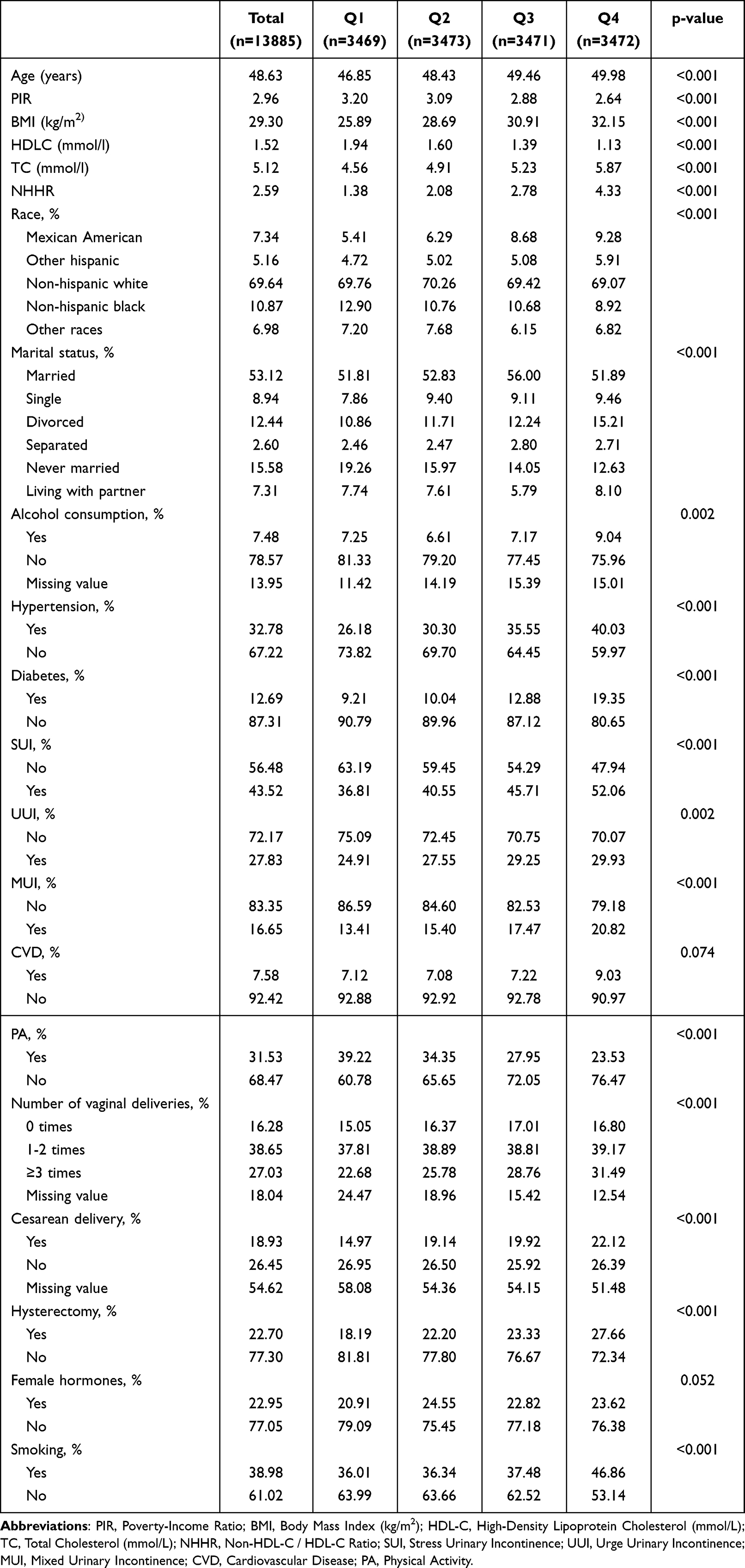 |
Table 1 Baseline Characteristics of Participants Stratified by NHHR Quartiles |
Association Between NHHR and UI
As shown in Table 2, NHHR was positively associated with SUI across all three models. In the fully adjusted model (Model 3), each 1-unit increase in NHHR was associated with a 7.5% increase in the risk of SUI (OR = 1.075, 95% CI: 1.027–1.126). Participants in the Q4 had a significantly higher risk of SUI compared to those in the Q1, with an OR of 1.320 (95% CI: 1.133–1.539; p for trend = 0.0003). For UUI, a significant association with NHHR was observed only in the unadjusted model (Model 1) (OR = 1.066, p = 0.0002), but this association became non-significant after full adjustment for covariates. As for MUI, a significant association persisted in Model 2 (OR = 1.109, p < 0.0001); however, the association was attenuated and lost statistical significance in Model 3 (OR = 1.039, p = 0.1360). These findings suggest that NHHR may be an independent risk factor for SUI, whereas its associations with UUI and MUI appear to be confounded or mediated by other variables.
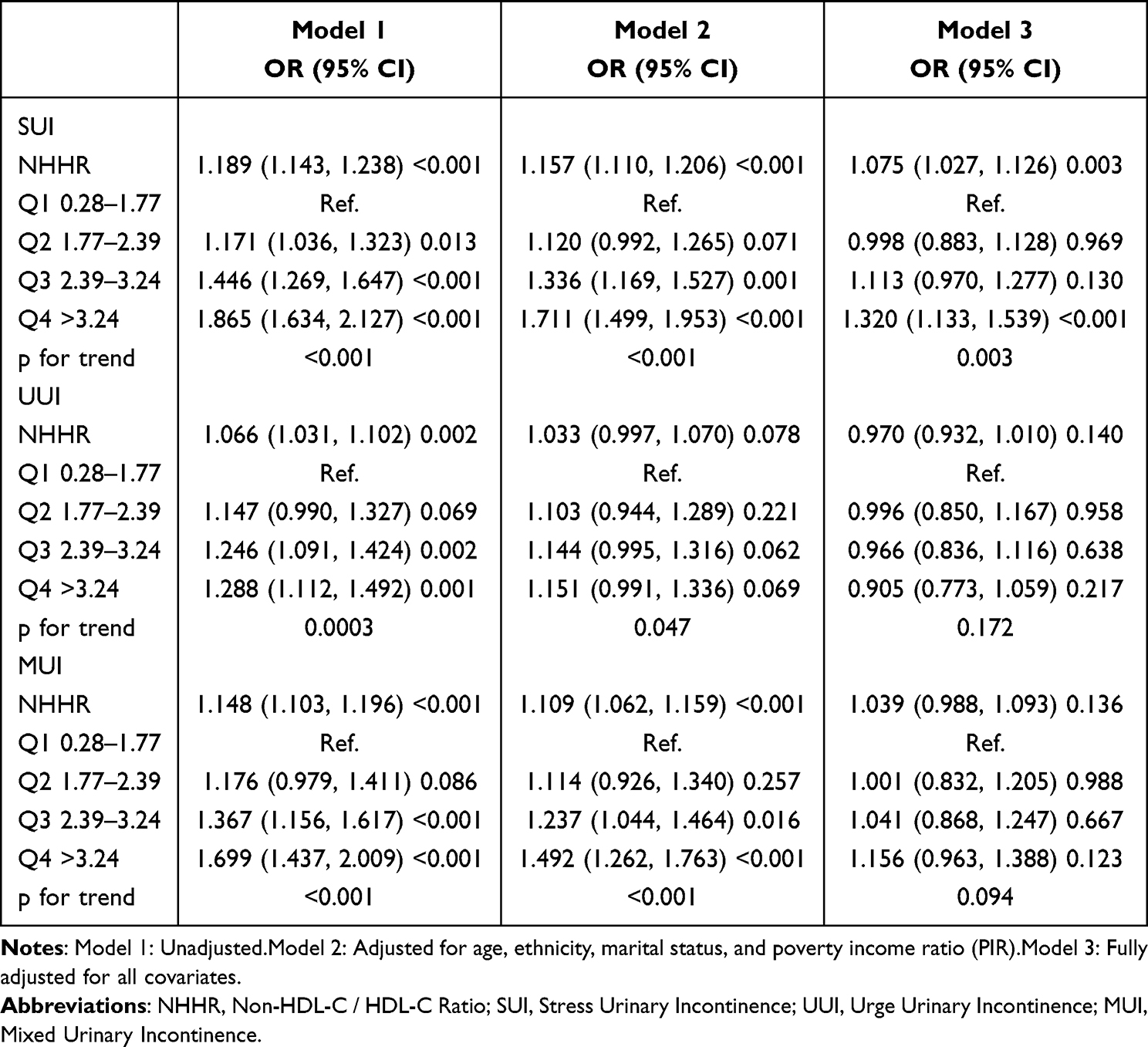 |
Table 2 Weighted Multivariable Logistic Regression Analyses of the Association Between NHHR and Urinary Incontinence |
Smooth curve fitting demonstrated a nonlinear relationship between NHHR and SUI (Figure 2). The shape of the dose–response curve suggested a potential threshold effect. As shown in Table 3, the inflection point was identified at an NHHR value of 3.281 (P < 0.001). Below this threshold, each 1-unit increase in NHHR was associated with a significant 17.1% increase in the risk of SUI (OR = 1.171, 95% CI: 1.107–1.238). However, beyond the threshold, the association was not statistically significant (P = 0.9437).
 |
Table 3 Threshold Effect Analysis of the Association Between NHHR and UI |
 |
Figure 2 Smooth Curve Fitting for the Association Between NHHR and UI. The curve shows a threshold effect at NHHR=3.281 (P for log-likelihood ratio < 0.001). |
Subgroup Analysis of the Association Between NHHR and SUI
Table 4 presents the strength of the association between NHHR and SUI across various subpopulations, along with tests for interaction. The results indicated that NHHR was significantly positively associated with SUI among participants who were younger than 45 years, had a BMI ≥30 kg/m², did not consume alcohol, did not engage in vigorous physical activity, had no history of hypertension or cardiovascular disease, had no history of vaginal delivery, had a history of cesarean section, and had not undergone hysterectomy (all p < 0.05). Notably, BMI and physical activity demonstrated significant effect modification on the association between NHHR and SUI (p for interaction < 0.05).
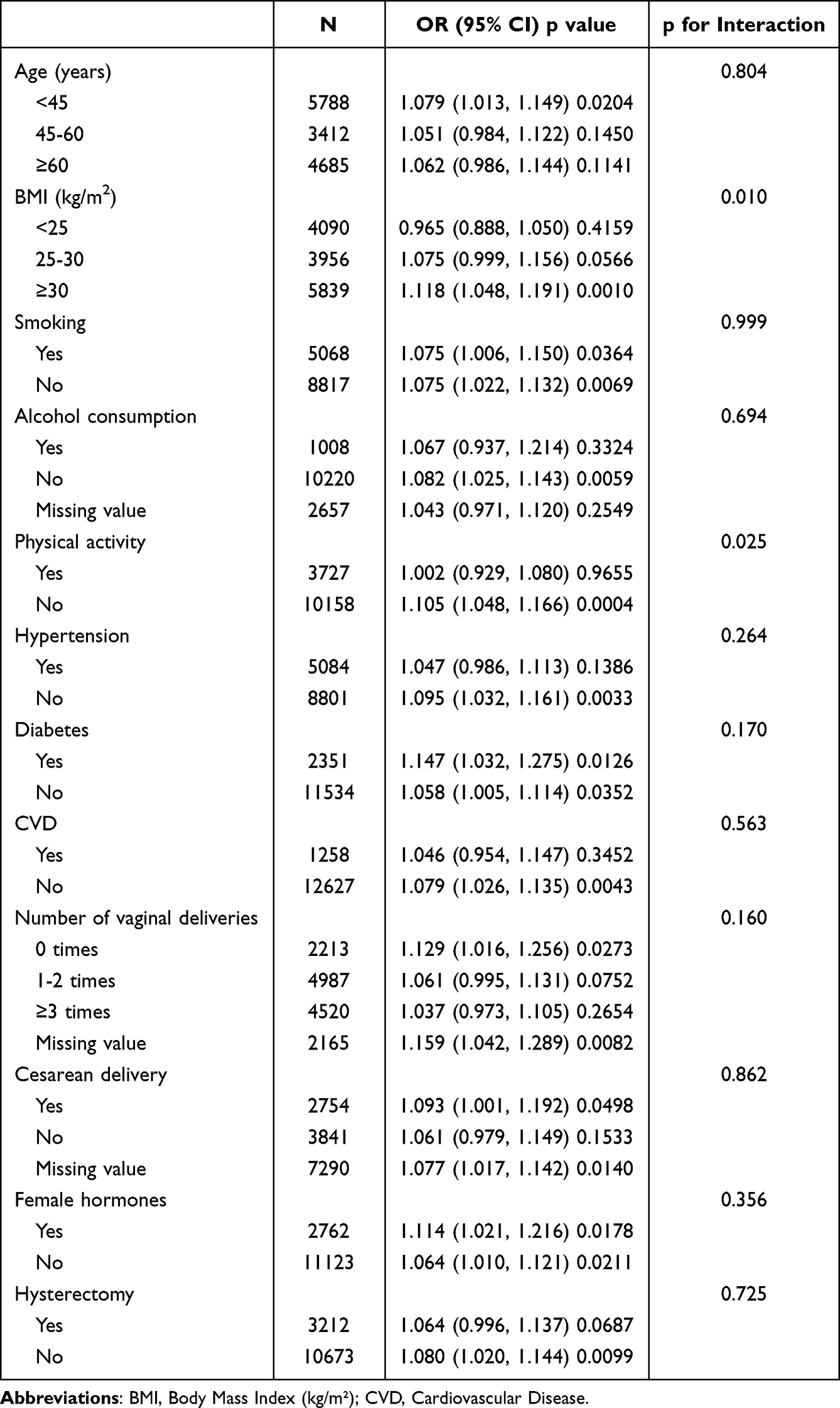 |
Table 4 Subgroup Analyses of the Association Between NHHR and SUI |
Sensitivity Analyses
To test the robustness of our findings, we further examined the association between NHHR and urinary incontinence after excluding participants with missing data. When NHHR was categorized into quartiles (Supplementary Table S2), higher levels were still significantly associated with an increased risk of SUI. In the fully adjusted model, the odds ratio was 1.412 (95% CI: 1.066–1.870) when comparing the highest with the lowest quartile (p for trend = 0.005). However, no consistent associations were observed for UUI or MUI after full covariate adjustment. Similar results were obtained when NHHR was categorized into tertiles (Supplementary Table S3), with the highest tertile associated with higher odds of SUI (OR = 1.509, 95% CI: 1.185–1.922, p < 0.001), but not with UUI or MUI. These sensitivity analyses further confirm the robustness of the observed association between elevated NHHR and SUI.
Discussion
This study comprehensively assessed the association between NHHR and UI. After adjustment for all covariates, NHHR was significantly associated with SUI, but not with UUI or MUI (Table 2). Smooth curve fitting and threshold effect analyses revealed a nonlinear relationship between NHHR and SUI. Subgroup analyses showed that this association was particularly strong among women with obesity and low physical activity, suggesting greater predictive value of NHHR in these populations (Figure 2; Tables 3 and 4). The attenuation of the association beyond the NHHR threshold of 3.281 (Table 3) suggests a saturation effect, whereby further lipid imbalance may not lead to additional increases in SUI risk. Clinically, this threshold could serve as a target for interventions, such as lipid-lowering therapies, aimed at preventing SUI progression. The robustness of these findings was further confirmed in sensitivity analyses: after excluding participants with missing values, categorization of NHHR into either quartiles or tertiles yielded consistent results, with higher NHHR levels remaining significantly associated with increased SUI risk, but not with UUI or MUI (Supplementary Tables S2–S3).
Our findings are consistent with several recent studies linking dyslipidemia to urinary incontinence. For example, one study showed that visceral adiposity index was positively associated with SUI, particularly in obese individuals, suggesting that metabolic dysregulation driven by visceral fat accumulation may underlie the pathogenesis of SUI.17 Another study reported a significant association between the lipid accumulation product—an indicator of visceral obesity and lipid dysfunction—and the prevalence of SUI.18 Additionally, obese women have a significantly higher prevalence of SUI compared to those of normal weight, and weight reduction has been shown to markedly alleviate SUI symptoms. An earlier clinical trial demonstrated that moderate weight loss reduced the frequency of SUI episodes by approximately 50%.19 Collectively, these findings support the role of metabolic syndrome and its components, such as obesity and dyslipidemia, in the development of SUI, forming a pathological link between metabolic dysfunction, pelvic floor disorders, and SUI.
NHHR, as an integrated marker reflecting the balance between atherogenic and protective lipoproteins, may influence the pathophysiology of UI through multiple pathways. From a vascular perspective, elevated NHHR indicates increased risk of atherosclerosis, which may lead to microvascular damage in the pelvic floor, compromising blood supply to the bladder and urethra.20 Atherosclerosis-induced endothelial dysfunction can result in impaired pelvic microcirculation, characterized by arteriolar sclerosis, luminal narrowing, and inadequate perfusion, ultimately leading to smooth muscle atrophy, interstitial fibrosis, and degeneration of nerve terminals in the bladder and urethra. These pathological changes impair urethral sphincter contractility and reduce the mechanical support of the bladder neck.21 Animal studies have shown that a high-cholesterol diet induces ischemic changes and collagen deposition in the bladder wall,5 a phenomenon consistent with the bladder fibrosis often observed in SUI patients.
At the molecular level, dyslipidemia associated with elevated NHHR can activate systemic low-grade inflammation.22 Increased non-HDL-C promotes monocyte infiltration and the release of pro-inflammatory cytokines such as TNF-α and IL-6, which have been shown to inhibit myogenic differentiation of muscle cells, reduce the number and contractility of pelvic floor muscle fibers, and disrupt neuromuscular junction signaling, contributing to urethral sphincter dysfunction.23,24 Moreover, NHHR-related oxidative stress can result in excessive accumulation of reactive oxygen species, activation of the NF-κB signaling pathway, and upregulation of matrix metalloproteinases, which accelerate collagen degradation in pelvic connective tissues and weaken structural support of the pelvic floor.25
In contrast, the pathogenesis of UUI and MUI is primarily associated with abnormalities in neural regulation or detrusor overactivity, which are less influenced by metabolic factors. These subtypes may involve more complex mechanisms, such as neuropathy or chronic bladder inflammation.26 Additionally, the smaller number of cases for these subtypes compared with SUI may have limited statistical power to detect significant associations. Residual confounding or unmeasured mediators may also explain the lack of significant associations after covariate adjustment.
The stronger association between NHHR and SUI in women with BMI ≥30 kg/m² may be attributed to both mechanical and metabolic factors. Obesity increases intra-abdominal pressure, which mechanically stresses the pelvic floor and impairs its structural integrity.27 Concurrently, obesity-related dyslipidemia exacerbates vascular inflammation and oxidative injury,28 which may synergistically enhance the NHHR-SUI relationship in this subgroup. The heightened sensitivity observed in physically inactive individuals likely reflects the absence of protective effects provided by regular exercise, which can improve lipid profiles, enhance pelvic floor muscle strength, and promote microcirculation.29,30 Notably, while hypertension is known to impair β-adrenergic-mediated bladder relaxation and reduce perfusion to pelvic tissues, increasing UI risk,31 the stronger association in normotensive participants suggests that NHHR may act as an independent pathogenic factor, whose effect is more evident when hypertension is not a confounder.
Clinically, NHHR may serve as a simple and practical screening tool for identifying women at increased risk of SUI, particularly among those who are obese or physically inactive, among whom associations appear stronger. Monitoring NHHR in these populations could help prioritize targeted preventive interventions. It is hypothesized that reducing NHHR through lifestyle modifications, such as increased physical activity, dietary improvements, or pharmacological strategies, may lower the risk of SUI.19,32,33 Evidence that weight reduction can markedly alleviate SUI symptoms supports these approaches, suggesting that NHHR could also serve as a targetable biomarker in future intervention studies.
This study has several main strengths. It is the first study to investigate the association between NHHR and UI in a nationally representative cohort using a novel and comprehensive lipid metabolism index. The analysis was based on a large, nationally representative NHANES dataset with a rigorous sampling design and a robust sample size of 13,885 participants, which enhances the generalizability and statistical power of the findings. Furthermore, potential mechanisms linking NHHR and UI were also systematically explored. Nonetheless, several limitations must be acknowledged. As this is a cross-sectional study, causality cannot be inferred due to its design. UI was assessed through self-report and was not confirmed by urodynamic testing, which may introduce recall bias or misclassification. Although multiple covariates were adjusted for in the analysis, unmeasured factors such as medication use and psychological conditions may still influence the results. Additionally, given that the study population was limited to US residents, caution should be exercised when generalizing these findings to other populations.
Conclusion
This study identified a nonlinear positive association between NHHR and SUI, with a threshold at 3.281 beyond which the association plateaus. It also explored potential inflammatory and metabolic mechanisms that may underlie this association. However, given the cross-sectional design, causal inferences cannot be drawn. Future prospective cohort studies and randomized controlled trials are needed to elucidate the causal relationship between NHHR and SUI.
Data Sharing Statement
The data and materials in the current study are available from the corresponding author on reasonable request.
Ethics Approval and Consent to Participate
NHANES was conducted in accordance with the Declaration of Helsinki and approved by the National Center for Health Statistics Research Ethics Review Board, with written informed consent obtained from all participants. The present study was additionally approved by the Ethics Committee of Yueqing Hospital, Wenzhou Medical University (approval number: YQYY202500123). As this study used de-identified, publicly available data, no further participant consent was required.
Author Contributions
All authors made a significant contribution to the work reported, whether that is in the conception, study design, execution, acquisition of data, analysis and interpretation, or in all these areas; took part in drafting, revising or critically reviewing the article; gave final approval of the version to be published; have agreed on the journal to which the article has been submitted; and agree to be accountable for all aspects of the work.
Funding
There is no funding to report.
Disclosure
The authors declare no financial or non-financial competing interests related to this study. No affiliations exist that could influence the content of this manuscript.
References
1. Kinchen KS, Lee J, Fireman B, Hunkeler E, Nehemiah JL, Curtice TG. The prevalence, burden, and treatment of urinary incontinence among women in a managed care plan. J Womens Health. 2007;16:415–422. doi:10.1089/jwh.2006.0122
2. Sussman RD, Syan R, Brucker BM. Guideline of guidelines: urinary incontinence in women. BJU Int. 2020;125:638–655. doi:10.1111/bju.14927
3. Coyne KS, Wein A, Nicholson S, Kvasz M, Chen CI, Milsom I. Economic burden of urgency urinary incontinence in the United States: a systematic review. J Manag Care Pharm. 2014;20:130–140. doi:10.18553/jmcp.2014.20.2.130
4. Pang H, Lv J, Xu T, et al. Incidence and risk factors of female urinary incontinence: a 4-year longitudinal study among 24 985 adult women in China. Bjog. 2022;129:580–589. doi:10.1111/1471-0528.16936
5. Nomiya M, Andersson KE, Yamaguchi O. Chronic bladder ischemia and oxidative stress: new pharmacotherapeutic targets for lower urinary tract symptoms. Int J Urol. 2015;22:40–46. doi:10.1111/iju.12652
6. Yoshida M, Kudoh J, Masunaga K, Nagata T, Shiomi M. Effects of chronic hyperlipidemia on lower urinary tract function-bladder dysfunction in myocardial infarction-prone watanabe heritable hyperlipidemic rabbits. Low Urin Tract Symptoms. 2012;4(1):21–26. doi:10.1111/j.1757-5672.2011.00138.x
7. Falah-Hassani K, Reeves J, Shiri R, Hickling D, Mclean L. The pathophysiology of stress urinary incontinence: a systematic review and meta-analysis. Int Urogynecol J. 2021;32:501–552. doi:10.1007/s00192-020-04622-9
8. Dooley Y, Kenton K, Cao G, et al. Urinary incontinence prevalence: results from the national health and nutrition examination survey. J Urol. 2008;179(2):656–661. doi:10.1016/j.juro.2007.09.081
9. Ströher RLM, Sartori MGF, Takano CC, De Araújo MP, Girão M. Metabolic syndrome in women with and without stress urinary incontinence. Int Urogynecol J. 2020;31:173–179. doi:10.1007/s00192-019-03880-6
10. Zhang F, Li Z, Wang M, Wang Y, Lu C. Association of non-highdensity lipoprotein cholesterol to highdensity lipoprotein cholesterol ratio (NHHR) and subsequent hypertension and heart diseases: findings from the CHARLS cohort. Aging Clin Exp Res. 2025;37:26. doi:10.1007/s40520-024-02919-z
11. Li B, Liu Y, Ma X, Guo X. The association between non-high-density lipoprotein cholesterol to high-density lipoprotein cholesterol ratio and hepatic steatosis and liver fibrosis among US adults based on NHANES. Sci Rep. 2025;15:6527. doi:10.1038/s41598-025-90773-y
12. Chen H, Miao X, Hu M, et al. Associations between high-density lipoprotein cholesterol, non-high-density lipoprotein cholesterol, and their ratio with metabolic dysfunction-associated steatotic liver disease: a retrospective cohort study. Front Endocrinol. 2025;16:1585811. doi:10.3389/fendo.2025.1585811
13. Yu B, Li M, Yu Z, et al. The non-high-density lipoprotein cholesterol to high-density lipoprotein cholesterol ratio (NHHR) as a predictor of all-cause and cardiovascular mortality in US adults with diabetes or prediabetes: NHANES 1999-2018. BMC Med. 2024;22:317. doi:10.1186/s12916-024-03536-3
14. Qi X, Wang S, Huang Q, et al. The association between non-high-density lipoprotein cholesterol to high-density lipoprotein cholesterol ratio (NHHR) and risk of depression among US adults: a cross-sectional NHANES study. J Affect Disord. 2024;344:451–457. doi:10.1016/j.jad.2023.10.064
15. Weinberg AE, Leppert JT, Elliott CS. Biochemical measures of diabetes are not independent predictors of urinary incontinence in women. J Urol. 2015;194:1668–1674. doi:10.1016/j.juro.2015.06.074
16. Yang J, Du Y, Guo J. U‑shaped association between relative fat mass (RFM) and stress urinary incontinence: a cross‑sectional study. Eur J Med Res. 2025;30:256. doi:10.1186/s40001-025-02481-y
17. Ye C, Huang W, Liu Y, Chen G, Du S, Li K. Associations between metabolic score for visceral fat and urinary incontinence among US adult women: a population-based cross-sectional study. BMC Public Health. 2025;25:932. doi:10.1186/s12889-025-21966-3
18. Li J, Wang D, Tian H, Yang J, Xia H, Guo W. Association between lipid accumulation products and stress urinary incontinence: a cross-sectional study from NHANES 2005 to 2018. Lipids Health Dis. 2024;23:358. doi:10.1186/s12944-024-02350-3
19. Subak LL, Wing R, West DS, et al. Weight loss to treat urinary incontinence in overweight and obese women. N Engl J Med. 2009;360:481–490. doi:10.1056/NEJMoa0806375
20. Azab S. The impact of atherosclerosis on lower urinary tract function. Aging Male. 2013;16:108–111. doi:10.3109/13685538.2013.795532
21. Azadzoi KM, Yalla SV, Siroky MB. Oxidative stress and neurodegeneration in the ischemic overactive bladder. J Urol. 2007;178:710–715. doi:10.1016/j.juro.2007.03.096
22. O’Hagan R, Berg AR, Hong CG, Parel PM, Mehta NN, Teague HL. Systemic consequences of abnormal cholesterol handling: interdependent pathways of inflammation and dyslipidemia. Front Immunol. 2022;13:972140. doi:10.3389/fimmu.2022.972140
23. Boyle JJ, Johns M, Kampfer T, et al. Activating transcription factor 1 directs Mhem atheroprotective macrophages through coordinated iron handling and foam cell protection. Circ Res. 2012;110:20–33. doi:10.1161/circresaha.111.247577
24. Pelosi M, De RM, Barberi L, Musarò A. IL-6 impairs myogenic differentiation by downmodulation of p90RSK/eEF2 and mTOR/p70S6K axes, without affecting AKT activity. Biomed Res Int. 2014;2014:206026. doi:10.1155/2014/206026
25. Liu C, Yang Q, Fang G, et al. Collagen metabolic disorder induced by oxidative stress in human uterosacral ligament‑derived fibroblasts: a possible pathophysiological mechanism in pelvic organ prolapse. Mol Med Rep. 2016;13:2999–3008. doi:10.3892/mmr.2016.4919
26. Vaughan CP, Markland AD. Urinary Incontinence in Women. Ann Intern Med. 2020;
27. Doumouchtsis SK, Loganathan J, Pergialiotis V. The role of obesity on urinary incontinence and anal incontinence in women: a review. Bjog. 2022;129:162–170. doi:10.1111/1471-0528.16848
28. Ghorpade DS, Ozcan L, Zheng Z, et al. Hepatocyte-secreted DPP4 in obesity promotes adipose inflammation and insulin resistance. Nature. 2018;555:673–677. doi:10.1038/nature26138
29. Mann S, Beedie C, Jimenez A. Differential effects of aerobic exercise, resistance training and combined exercise modalities on cholesterol and the lipid profile: review, synthesis and recommendations. Sports Med. 2014;44:211–221. doi:10.1007/s40279-013-0110-5
30. Bø K, Mørkved S, Frawley H, Sherburn M. Evidence for benefit of transversus abdominis training alone or in combination with pelvic floor muscle training to treat female urinary incontinence: a systematic review. Neurourol Urodyn. 2009;28:368–373. doi:10.1002/nau.20700
31. Pang H, Yin J, Li Z, et al. The incidence of urinary incontinence in Chinese hypertensive women and the relationship between hypertension and urinary incontinence. Eur J Obstet Gynecol Reprod Biol. 2024;301:210–215. doi:10.1016/j.ejogrb.2024.08.019
32. Carvalhais A, Araújo J, Natal Jorge R, K B. Urinary incontinence and disordered eating in female elite athletes. J Sci Med Sport. 2019;22:140–144. doi:10.1016/j.jsams.2018.07.008
33. Deng S, Qiu Y, Wang Q, et al. The relationship between non-high-density lipoprotein cholesterol to high-density lipoprotein cholesterol ratio (NHHR) and rheumatoid arthritis: a cross-sectional study. Front Nutr. 2025;12:1594218. doi:10.3389/fnut.2025.1594218
 © 2025 The Author(s). This work is published and licensed by Dove Medical Press Limited. The
full terms of this license are available at https://www.dovepress.com/terms
and incorporate the Creative Commons Attribution
- Non Commercial (unported, 4.0) License.
By accessing the work you hereby accept the Terms. Non-commercial uses of the work are permitted
without any further permission from Dove Medical Press Limited, provided the work is properly
attributed. For permission for commercial use of this work, please see paragraphs 4.2 and 5 of our Terms.
© 2025 The Author(s). This work is published and licensed by Dove Medical Press Limited. The
full terms of this license are available at https://www.dovepress.com/terms
and incorporate the Creative Commons Attribution
- Non Commercial (unported, 4.0) License.
By accessing the work you hereby accept the Terms. Non-commercial uses of the work are permitted
without any further permission from Dove Medical Press Limited, provided the work is properly
attributed. For permission for commercial use of this work, please see paragraphs 4.2 and 5 of our Terms.