
Back to Journals » Cancer Management and Research » Volume 18

Association Between ABO Blood Group and Survival in Early-Stage Colon Cancer: A Single-Center Retrospective Cohort Analysis
Authors Yılmaz M  , Altunok O, Çolak R, Kapar C
Received 17 March 2026
Accepted for publication 29 May 2026
Published 5 June 2026 Volume 2026:18 605315
DOI https://doi.org/10.2147/CMAR.S605315
Checked for plagiarism Yes
Review by Single anonymous peer review
Peer reviewer comments 3
Editor who approved publication: Dr Alessandro Rizzo
Mesut Yılmaz, Oğuz Altunok, Rumeysa Çolak, Caner Kapar
Department of Medical Oncology, SBU Istanbul Bakirkoy Dr. Sadi Konuk Training and Research Hospital, Istanbul, Turkey
Correspondence: Mesut Yılmaz, SBU Istanbul Bakirkoy Dr. Sadi Konuk Training and Research Hospital, Medical Oncology Department, Istanbul, Turkey, Email [email protected]
Background: ABO blood group antigens influence cell adhesion, inflammation, and metastatic processes, raising interest in their potential prognostic role in colorectal cancer. However, previous studies have reported inconsistent findings. This study evaluated the association between ABO blood group and overall survival (OS) in early-stage colon cancer patients undergoing curative surgery.
Methods: This retrospective cohort included patients with pathologic stage II–III colon adenocarcinoma treated surgically between 2016 and 2024 at a single-center institution. Demographic, clinicopathological, and laboratory data—including ABO blood group—were collected. OS was analyzed using Kaplan–Meier and Log rank tests, and independent prognostic factors were assessed with multivariable Cox regression.
Results: A total of 158 patients were included (median age 59 years; 63.3% male). Blood group distribution was: O (39.2%), A (38.6%), B (12.7%), and AB (9.5%). During a median follow-up of 31 months, 17.7% of patients died. Blood group B demonstrated significantly shorter OS compared with group O (log-rank p=0.014). In the multivariable analysis, only blood group B remained an independent predictor of worse OS (HR=1.99; 95% CI: 1.11– 3.60; p=0.022).
Conclusion: Blood group B is independently associated with poorer survival in early-stage colon cancer. ABO typing may represent a potential adjunctive prognostic marker, warranting validation in larger prospective cohorts.
Keywords: colon cancer, colorectal adenocarcinoma, ABO blood group, overall survival, prognostic markers, biomarker
Background
The ABO blood group system consists of glycoprotein antigens expressed on erythrocytes as well as on various epithelial surfaces, including gastrointestinal mucosa. These antigens participate in cell adhesion, intercellular signaling, inflammatory pathways, and metastatic behavior of tumor cells.1,2 Biologically, ABO antigens located on gastrointestinal epithelial membranes and tumor surfaces may influence cellular adhesion, membrane signaling, proliferation, and metastatic capacity.3 Moreover, polymorphisms in the ABO gene locus have been associated with inflammatory and adhesion-related molecules such as TNF-α, ICAM-1, and P-selectin, potentially modulating immune surveillance and contributing to tumor progression.4 Previous studies have also suggested that non-O blood groups, including blood group B, may exhibit stronger associations with inflammatory and endothelial activation pathways, which could partially explain their relationship with adverse oncologic outcomes.
These mechanisms suggest that ABO antigens may influence the development and progression of gastrointestinal malignancies. Although AJCC TNM staging remains the cornerstone of prognostic stratification in colon cancer, clinically relevant heterogeneity in outcomes may still exist among patients within the same stage category. Therefore, additional prognostic biomarkers may help improve individualized risk assessment. However, studies evaluating the prognostic significance of ABO blood groups in colorectal cancer have reported heterogeneous results. For instance, Cao et al5 reported improved survival among patients with blood group AB, whereas Franchini et al6 found no significant association. Limited data from Türkiye have suggested a possible link between blood group A and liver metastasis; however, these studies were based on relatively small retrospective cohorts and primarily focused on metastatic patterns rather than long-term survival outcomes in early-stage disease. Therefore, the prognostic significance of ABO blood groups in Turkish patients with non-metastatic colon cancer remains insufficiently characterized.7
The present study aimed to investigate the association between ABO blood group and overall survival (OS) in patients with early-stage (pathologic stage II–III) colon cancer undergoing curative surgery, and to determine whether ABO blood type retains independent prognostic significance alongside established clinicopathological factors.
Materials and Methods
Study Design and Patient Selection
This study is a retrospective cohort analysis based on the archive records of the SBÜ İstanbul Bakırköy Dr. Sadi Konuk Medical Oncology Clinic, including patients with histologically confirmed colon adenocarcinoma who underwent curative surgery between 2016 and 2024 and had pathologic stage II–III disease. Patients with rectal tumors, synchronous or metachronous malignancies, metastatic disease at diagnosis, or insufficient survival/follow-up information in the institutional records were excluded from the study.
Data Collection
Demographic data (age, sex, family history), tumor characteristics (localization, histologic grade, perineural invasion, lymphovascular invasion, tumor perforation), stage according to the AJCC 8th edition, number of lymph nodes retrieved, baseline serum CEA and CA19-9 levels, adjuvant treatment status, and ABO blood group were recorded. ABO blood group was categorized as A, B, and AB, with group O serving as the reference category. Age was categorized using a cutoff of 50 years based on its common use in colorectal cancer literature to distinguish early-onset disease from conventional-onset disease.8
Statistical Analysis
Continuous variables were summarized as median (minimum–maximum), while categorical variables were presented as counts and percentages. Survival analyses were performed using the Kaplan–Meier method, and differences between groups were assessed with the Log rank test. Multivariable Cox regression analysis was used to evaluate the independent effects of prognostic factors. The clinically prioritized model included stage, ABO blood group, lymphovascular invasion, perineural invasion, retrieval of ≥12 lymph nodes, adjuvant treatment status, and age >50 years. Results were reported as hazard ratios (HRs) with 95% confidence intervals (CIs) and p-values. P-values in the univariable analysis were derived from Log rank tests. A p-value <0.05 was considered statistically significant. All analyses were conducted using SPSS version 26.0.
Ethical Approval
Ethical approval for this study was obtained from the Ethics Committee of Bakırköy Dr. Sadi Konuk Training and Research Hospital (approval number: 2025–416). Written informed consent for the use of anonymized clinical data in research was routinely obtained from all participants at the beginning of treatment in accordance with institutional policy. The study was conducted in accordance with the principles of the Declaration of Helsinki.
Results
A total of 158 patients were included in the study. The median age was 59 years (range: 28–81), and 63.3% of the patients were male. The distribution of ABO blood groups was as follows: O 39.2%, A 38.6%, B 12.7%, and AB 9.5%. Tumor localization was right-sided in 44.3% and left-sided in 55.7% of cases. Histologic grade distribution was 7.0% well-differentiated, 79.7% moderately differentiated, and 13.3% poorly differentiated. Perineural invasion was present in 57.6% of patients, and lymphovascular invasion in 62.7%. Adjuvant treatment was administered to 92.4% of the cohort, and 94.3% had ≥12 lymph nodes retrieved. Regarding pathological stage, 25.9% of patients had stage II disease and 74.1% had stage III disease. Based on age at diagnosis, 81.6% of patients were ≥50 years old and 18.4% were <50 years old. The median follow-up time was 31 months, during which 17.7% of patients (n=28) died.
Kaplan–Meier analysis showed that blood group B was associated with shorter overall survival compared with group O (log-rank p=0.014) (Figure 1). No significant differences in OS were observed between groups A or AB and group O. In univariable analysis, stage III disease was associated with significantly worse OS compared with stage II (p=0.031). Similarly, retrieval of ≥12 lymph nodes was associated with OS in univariable analysis (p=0.043). However, these variables lost their prognostic significance in the multivariable model. Perineural invasion and lymphovascular invasion were not significantly associated with OS at the univariable level (Table 1).
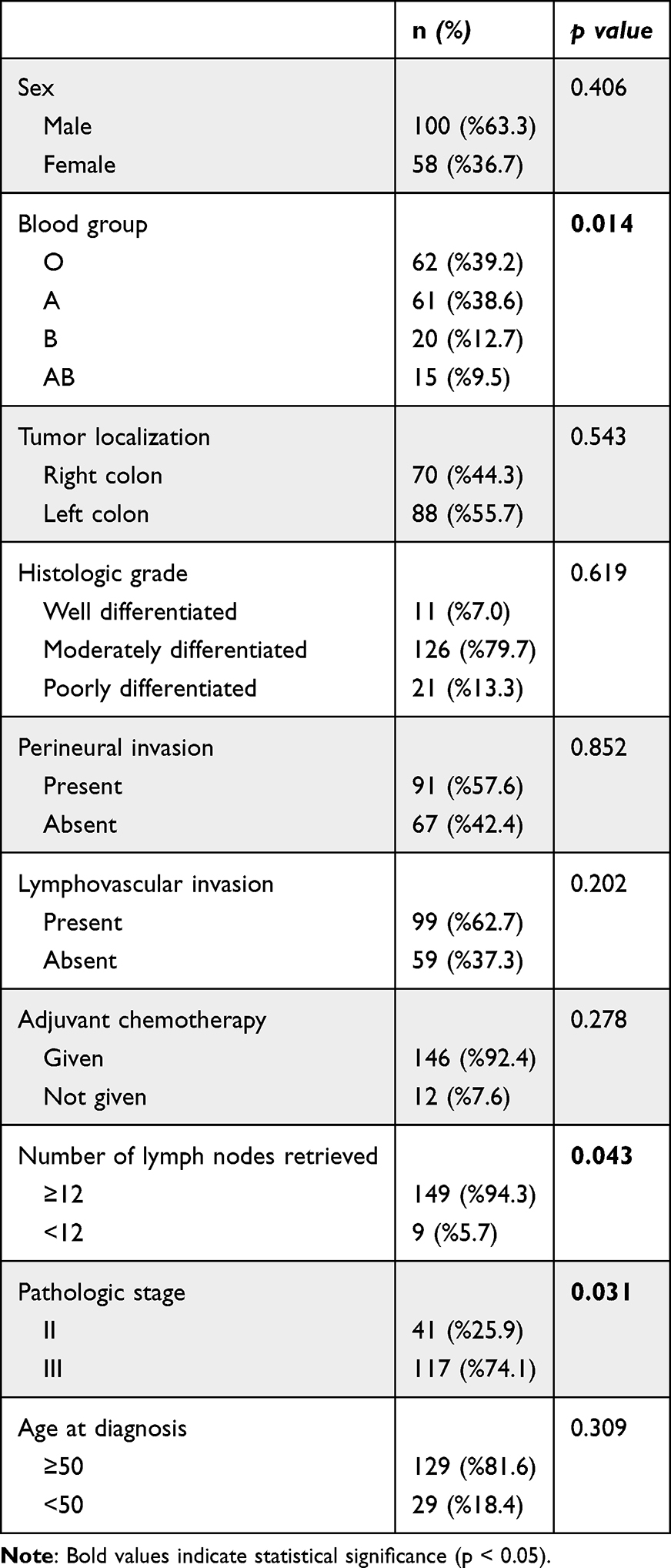 |
Table 1 Patient Characteristics and Univariable Analysis |
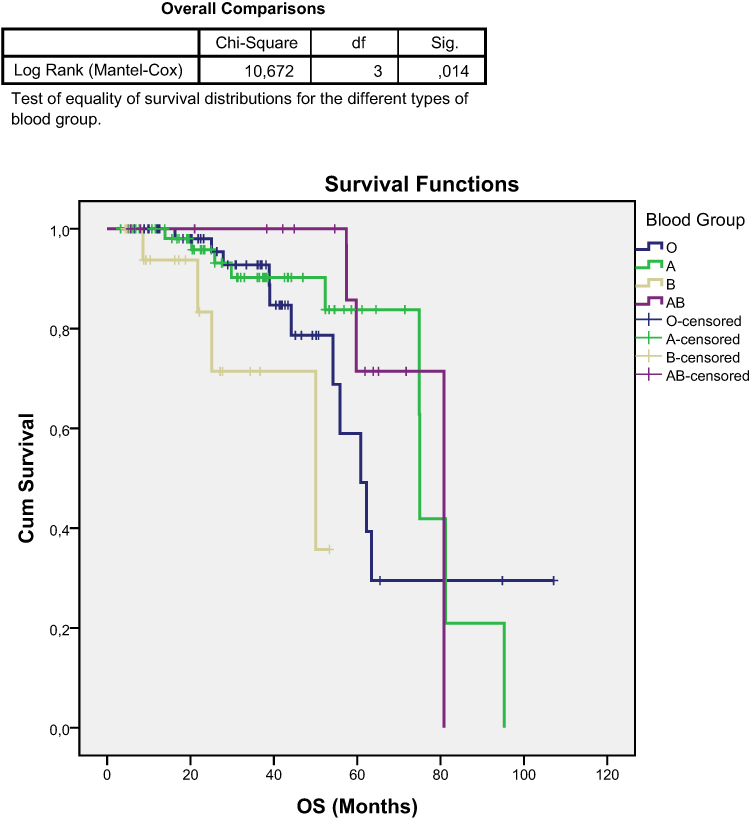 |
Figure 1 Kaplan–Meier overall survival curves according to ABO blood groups in patients with early-stage colon cancer. |
Stage, ABO blood group (reference: O), lymphovascular invasion (LVI), perineural invasion (PNI), retrieval of ≥12 lymph nodes, adjuvant therapy, and age >50 years were included in the clinical multivariable model. In the multivariable Cox regression analysis, only blood group B (reference: O) emerged as an independent adverse prognostic factor for overall survival (HR = 1.99; 95% CI: 1.11–3.60; p = 0.022). Other clinicopathological variables—including stage, lymph node yield, LVI, PNI, adjuvant treatment, and age ≥50 years—did not demonstrate independent prognostic significance in the model (Table 2).
 |
Table 2 Multivariable Cox Regression Analysis for Overall Survival |
Discussion
In this retrospective study, blood group B was found to be independently associated with poorer overall survival in patients with early-stage colon cancer who underwent curative surgery. This adverse effect persisted after adjustment for multiple clinicopathological variables. Our findings are consistent with data suggesting that blood group B may exhibit a biologically more aggressive phenotype in colorectal cancer, as previously reported by Zhang et al, who demonstrated significantly lower 5-year OS rates in patients with blood group B.9 Our findings regarding the relatively favorable survival pattern observed in the AB group are also in line with prior literature suggesting a potential survival advantage among AB individuals.10,11
Several biological mechanisms may explain these group-specific prognostic differences. ABO antigens are known to influence glycosylation patterns on epithelial and tumor cell surfaces, thereby modulating cell adhesion, receptor activation, and metastatic behavior.1–3 Moreover, genetic variations at the ABO locus have been strongly associated with inflammatory and endothelial markers such as TNF-α, IL-6, ICAM-1, E-selectin, and P-selectin.4,12,13 These molecules play important roles in inflammation, immune response, and cancer spread. Based on these findings, it is possible that blood group B may be associated with a relatively more inflammatory or immunosuppressive microenvironment that supports tumor progression, which may explain the poorer survival in this group.
Beyond colorectal cancer, prognostic associations between ABO blood groups and malignancies have been extensively documented in non-gastrointestinal tumors as well. Large epidemiologic studies have shown that non-O blood groups—particularly A and B—are associated with higher risks of pancreatic, gastric, and ovarian cancers, as well as higher mortality in some cohorts.14–16 The landmark study by Wolpin et al demonstrated that pancreatic cancer incidence was significantly higher among A, B, and AB groups compared with group O,14 while Gates et al reported similar findings in ovarian cancer.15 These data support the notion that ABO antigens exert systemic effects not limited to the gastrointestinal tract.
This study has some limitations. Its retrospective single-center design introduces potential selection bias and limits external validity. The number of events was relatively small, and the B and AB subgroups included limited numbers of patients, which may have reduced the statistical robustness of the multivariable analyses. Interpretation of the prognostic impact of adjuvant treatment should also be made cautiously given the limited number of patients who did not receive adjuvant therapy. Additionally, no mechanistic biomarkers such as inflammatory cytokines or adhesion molecules were evaluated, which could have strengthened the biological interpretation of the findings. Furthermore, the median follow-up duration was relatively short for early-stage colon cancer and may have limited the ability to capture late survival events. Finally, the relatively low number of deaths compared with the number of variables included in the multivariable model may have increased the risk of overfitting and reduced the stability of the estimated associations.
Despite these limitations, ABO blood group remains an inexpensive and universally available marker. If validated in larger prospective multicenter cohorts, ABO blood group typing may serve as a simple adjunctive biomarker to complement existing clinicopathological risk stratification models in early-stage colon cancer. Future research should further explore the interplay between ABO antigens, tumor biology, systemic inflammation, and antitumor immunity to better elucidate the underlying mechanisms and identify potential therapeutic targets.
Conclusion
In this retrospective cohort analysis, blood group B was independently associated with worse overall survival in patients with early-stage colon cancer who underwent curative surgery. In contrast, no statistically significant prognostic effect was observed for blood groups A or AB. Overall, our findings suggest that ABO blood group may represent a potential and easily accessible biomarker contributing to prognostic stratification; however, these results should be considered exploratory and hypothesis-generating until validated in larger prospective multicenter studies with longer follow-up.
Disclosure
The authors report no conflicts of interest in this work.
References
1. Liumbruno GM, Franchini M. Beyond immunohaematology: the role of the ABO blood group in human diseases. Blood Transfus. 2013;11(4):491–6.
2. Vasan SK, Hwang J, Rostgaard K, et al. ABO blood group and risk of cancer: a registry-based cohort study of 1.6 million blood donors. Cancer Epidemiol Biomarkers Prev. 2016;25(3):419–427.
3. Franchini M, Liumbruno GM. ABO blood group: old dogma, new perspectives. Clin Chem Lab Med. 2013;51(8):1545–1553.
4. Melzer D, Perry JR, Hernandez D, et al. A genome-wide association study identifies protein quantitative trait loci (pQTLs). PLoS Genet. 2008;4(5):e1000072.
5. Cao X, Wen ZS, Sun YJ, et al. Prognostic value of ABO blood group in patients with curatively resected colorectal cancer. Gastroenterol Res Pract. 2014;2014:512981.
6. Franchini M, Liumbruno GM, Lippi G. ABO blood group and cancer: a narrative review. Semin Thromb Hemost. 2016;42(6):589–596.
7. Demirci U, Hacibekiroglu I, Aktas G, et al. Blood group characteristics in colorectal cancers. Turk J Colorectal Dis. 2018;28(3):112–116.
8. Stoffel EM, Murphy CC. Epidemiology and mechanisms of the increasing incidence of colon and rectal cancers in young adults. Gastroenterology. 2020;158(2):341–353.
9. Zhang BL, He N, Huang YB, Song FJ, Chen KX. ABO blood groups and risk of cancer: a systematic review and meta-analysis. Asian Pac J Cancer Prev. 2014;15(11):4643–4650.
10. Xu WH, Zheng X, Yang J, et al. ABO blood group is associated with survival in patients with resected colon cancer. Br J Cancer. 2014;111(1):174–180.
11. Miao SY, Zhou W, Chen L, Wang S, Liu XA. Influence of ABO blood group on the prognosis of patients with gastrointestinal cancer: evidence from 23,255 patients. Onco Targets Ther. 2016;9:6757–6764.
12. Melzer D, Perry JR, Hernandez D, et al. Effects of ABO blood group on circulating levels of soluble adhesion molecules. Arterioscler Thromb Vasc Biol. 2008;28(9):1697–1702.
13. Barbalic M, Dupuis J, Dehghan A, et al. ABO blood group and inflammatory biomarkers. J Thromb Haemost. 2010;8(1):134–141.
14. Wolpin BM, Kraft P, Xu M, et al. ABO blood group and pancreatic cancer risk. J Natl Cancer Inst. 2009;101(6):424–431.
15. Gates MA, Wolpin BM, Cramer DW, Hankinson SE, Tworoger SS. ABO blood group and ovarian cancer risk. J Natl Cancer Inst. 2011;103(5):424–431.
16. Vasan SK, Rostgaard K, Majeed A, et al. ABO blood group and cancer risk in the Danish population. Int J Cancer. 2016;138(8):2025–2030.
 © 2026 The Author(s). This work is published and licensed by Dove Medical Press Limited. The
full terms of this license are available at https://www.dovepress.com/terms
and incorporate the Creative Commons Attribution
- Non Commercial (unported, 4.0) License.
By accessing the work you hereby accept the Terms. Non-commercial uses of the work are permitted
without any further permission from Dove Medical Press Limited, provided the work is properly
attributed. For permission for commercial use of this work, please see paragraphs 4.2 and 5 of our Terms.
© 2026 The Author(s). This work is published and licensed by Dove Medical Press Limited. The
full terms of this license are available at https://www.dovepress.com/terms
and incorporate the Creative Commons Attribution
- Non Commercial (unported, 4.0) License.
By accessing the work you hereby accept the Terms. Non-commercial uses of the work are permitted
without any further permission from Dove Medical Press Limited, provided the work is properly
attributed. For permission for commercial use of this work, please see paragraphs 4.2 and 5 of our Terms.