
Back to Journals » Journal of Multidisciplinary Healthcare » Volume 18
Application of Mixed Reality Technology in Medical Student Education: A Scoping Review
Authors Zhang R  , Xiang W, Xia L, Qi H, Liu W
Received 17 July 2025
Accepted for publication 5 November 2025
Published 12 November 2025 Volume 2025:18 Pages 7443—7457
DOI https://doi.org/10.2147/JMDH.S532712
Checked for plagiarism Yes
Review by Single anonymous peer review
Peer reviewer comments 2
Editor who approved publication: Dr David C. Mohr
Rui Zhang,1,* Wei Xiang,1,* Lu Xia,2 Haixia Qi,1 Wenbao Liu1
1Faculty of Military Health Services, Naval Medical University, Shanghai, 200438, People’s Republic of China; 2Day Surgery Unit, Huadong Hospital Affiliated to Fudan University, Shanghai, 200040, People’s Republic of China
*These authors contributed equally to this work
Correspondence: Haixia Qi, Faculty of Military Health Services, Naval Medical University, Shanghai, 200438, People’s Republic of China, Email [email protected] Wenbao Liu, Faculty of Military Health Services, Naval Medical University, Shanghai, 200438, People’s Republic of China, Email [email protected]
Objective: To provide an overview of the current state of mixed reality (MR) technology’s application in medical education and to review a research scope of the area.
Methods: According to the Joanna Briggs Institute’s scope-based review procedures, searches were conducted in the following databases: PubMed, Embase, Web of Science Core Collection, Cochrane Library, CNKI, WanFang Database, and VIP Database. The included literatures were compiled and examined, and the search period was limited to the period from the database’s creation to April 20, 2025.
Results: In all, 4118 records were found. After eligibility assessment, 28 studies in English or Chinese that examine the use of MR in education for medical students were included. Data extraction focused on theoretical/skills test scores, students’ satisfaction, testing and evaluation of the system operation as well as students’ learning interest of MR. The majority of studies indicated MR technology effectively enhances students’ theoretical knowledge and skill proficiency. Eighteen studies consistently reported a high students’ satisfaction level with MR-assisted instruction; MR systems demonstrated favorable usability due to its high consistency. Ten studies showed students in the MR-assisted learning groups exhibit heightened learning interest.
Conclusion: MR Technology has demonstrated excellent performance in enhancing students’ mastery of theories/skills, improving students’ satisfaction, and increasing students’ interest. However, it has not yet been widely adopted due to the high costs associated with teacher training and the purchase and maintenance of equipment. The future should prioritize continuously developing the immersive experience and engagement of MR technology, integrating ecological instantaneous evaluation methodologies and artificial intelligence technology, and combining economic benefit analysis and feasibility testing to perform higher-quality original research.
Keywords: mixed reality, medical education, review of scope
Introduction
The medical knowledge system is enormous, complicated, and continually changing.1 The rapid evolution of medical knowledge and surgical techniques places unprecedented demands on traditional “see one, do one, teach one” educational models, necessitating innovative training solutions. This challenge is underscored by reports from organizations like the British Medical Council, which highlight a flexible, fair and innovative training approach that is urgently needed to address the mismatch between teaching quality and the demands of clinical medical work.2 Currently, the teaching resources for medical practice are still relatively limited. There are widespread problems such as insufficient medical equipment, scarce real patient resources, and a lack of clinical practice opportunities.3 Furthermore, it is challenging to give students thorough and organized practical training because standard simulation trials are expensive and ineffective. Students’ capacity to successfully translate theoretical knowledge into clinical practice is significantly hampered by this.4 When they finish their academic studies, the majority of medical students still lack excellent practical operating abilities, demonstrating a mismatch between theoretical knowledge and practical skills and making it challenging to naturally merge the two.5
With the growing use of digital image processing technology in the medical industry, technologies such as virtual reality (VR), augmented reality (AR), and three-dimensional (3D) printing have gradually been integrated into modern medical education and training.6 VR is a completely digital image, whereas AR just superimposes virtual visuals onto the real world.7 MR technology is a sophisticated technology built on the foundation of VR and AR technologies.8 MR technology advances this concept by not only overlaying virtual objects onto the real world but also anchoring them to it, allowing the user to interact with digital content as if it were physically present. It can superimpose virtual images on real-world photos, creating an interactive feedback information loop between the virtual world, the actual world, and the user, thereby improving the user’s perception of reality.9
Virtual simulation experimental instruction introduces a new approach for talent development based on ability. This teaching style has been used in a variety of teaching settings.10 Relevant research has demonstrated that it has benefits such as strengthening students’ practical skills, widening educational resource channels, lowering teaching expenses, and improving the efficiency and quality of experimental teaching.11 More and more medical scholars and educators are beginning to recognize the value of virtual simulation teaching and are actively developing it.
As of now, some researchers have used MR technology in medical teaching.12 However, there is variability in many dimensions, including intervention content, intervention form, implementation devices and types of intervention programs, and outcome measures. The scope review study does not rigorously limit the research design and sample size, does not do complex data merging, but instead focuses on summarizing research topics, methodological variations, and result distributions, allowing it to immediately convey the specific manifestations of “inconsistent” findings. Therefore, this scoping review, which followed the scope review criteria established by the Joanna Briggs Institute (JBI) in Australia, aims to answer the following questions: (1) What are the characteristics and content of MR interventions in medical education? (2) What outcomes are being measured, and what are the reported effects? (3) What are the current limitations and gaps in the literature?13
Materials and Methods
Study Design
The specific review issues are as follows: Evaluating the content and impact of MR technology in medical education. The specific content, outcome indicators, and application impact of MR technology in medical education. The limitations of current research on the use of MR technology in medical education and the revelation for future study. This scoping reviews’ protocol has been registered in the Open Science Framework (OSF) (10.17605/OSF.IO/3X68M).
Search Strategy
A preliminary search was conducted in PubMed, Embase, Web of Science Core Collection, Cochrane Library, China National Knowledge Infrastructure (CNKI), WanFang Data Knowledge Service Platform, and the VIP Chinese Science and Technology Journal Database. The search was conducted using a combination of free and subject words. The search time ran from the date the database was created until April 20, 2025. The search formula for PubMed in English was shown here.
#1 mixed realit* [Title/Abstract] OR MR [Title/Abstract]
#2 Students, Medical [Title/Abstract] OR Education, Medical [Title/Abstract] OR medical educat* [Title/Abstract] OR medical school [Title/Abstract] OR medical train* [Title/Abstract] OR medical teach* [Title/Abstract]
#3 Search: Students, Medical OR Education, Medical [MeSH Terms]
#4 #2 OR #3
#5 Search: #1 AND #4
Eligibility Criteria
The inclusion criteria were defined using the PCC principle. The population (P) consisted of medical students. The concept (C) involved the use of mixed reality technology to increase the effectiveness of medical teaching. The context (C) was the setting in which medical students received their education. The literature included randomized controlled trials, quasi-experimental studies, previous experimental research, cohort studies, and other original research. Exclusion criteria: Non-Chinese or English literature; unable to access the entire text; reviews or systematic reviews, conferences, policies and guidelines, research programs.
Study Selection
The obtained literature records were imported into Endnote, and any duplicates were eliminated. Two master’s students who had been trained in evidence-based medicine independently assessed the literature and abstracts for the first time before reading the complete text for the second screening. In the event of a disagreement during the screening procedure, a conversation with a third researcher was undertaken to determine the literature that satisfied the criteria.
Data Extraction and Analysis
Author, publication year, nation, study type, sample size, study population, assessment/intervention content, cycle/frequency of the intervention, and outcome indicators were among the data extracted.
Result
Literature Search Results
Based on the pre-established inclusion and exclusion criteria and literature search strategy, an initial search yielded 4118 articles. After deleting duplicate articles, 2762 remained. After a step-by-step screening process, 28 articles were included.14–41 The flowchart of the literature screening process is shown in Figure 1.
 |
Figure 1 Flowchart of literature screening process. |
Characteristics of Included Literature
A total of 28 articles were included, published from 2020 to 2025. Regarding the research types, there were 10 randomized controlled studies, 16 quasi-experimental studies, 1 cohort study, and 1 previous experimental research. In terms of control settings, 4 articles used self-control before and after, 2 articles did not set a control group, and 22 articles used traditional teaching methods as the control group. The basic characteristics of the included articles are shown in Table 1.
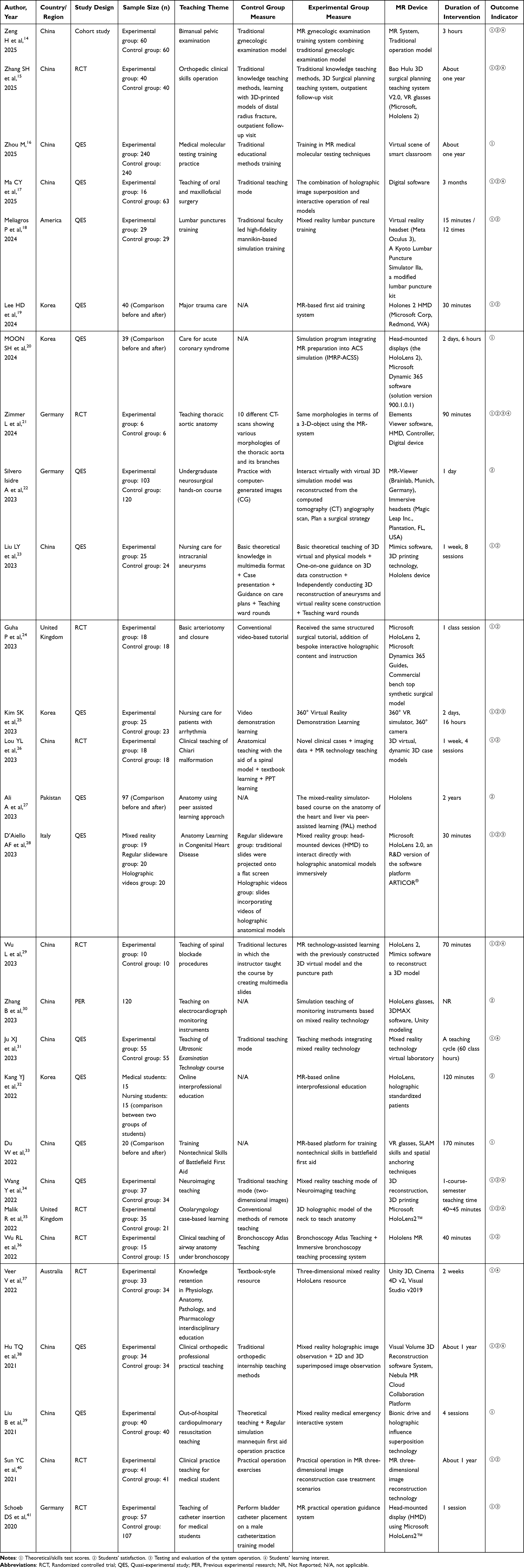 |
Table 1 Characteristics of Included Studies |
Intervention Content
The key elements of MR technology intervention mainly include research topics, venues, frequency, duration, software and equipment, etc. The research topics included in the study cover various fields of medical education, including clinical skills operation, anatomical theory learning, surgical teaching, medical molecular testing, nursing education, etc. The intervention venues included in the study were all carried out in indoor environments. The intervention duration of most included studies was a one-time intervention.14,19,21,22,24,28,29,32,33,35,36,39,41 Some studies divided the intervention into multiple sessions, with seven studies having medium-term interventions lasting from one week to three months.17,18,20,23,25,26,37 Seven studies had long-term interventions lasting from half a year to two years.15,16,27,31,34,38,40 All research plans were implemented by building relevant mixed reality platforms. Some studies introduced that the development process was to build 3D models through Unity 3D, 360°VR simulation and perform virtual operation processing on three-dimensional data under visualization to achieve human-machine integrated interaction actions.15,25,26,28,29,37,38,40 Some studies achieved the perfect combination of the real world and the virtual world through 3D printing.23,34 Some studies constructed interactive holographic content through Dynamics 365 forming Holographic patients.17,20,24 Most of the included studies used headset glasses as the main equipment, and were used in conjunction with the MR system developed by the research group. Regarding the VR glasses used in the intervention plan, most studies used Hololens,15,19,20,23,24,27–29,32,35,36,41 and some studies used Meta Oculus 3, HTC Vive pro 2.0, and Magic Leap Inc Plantation.18,22,33
Intervention Outcomes
The intervention of mixed reality technology in medical education outcomes include theoretical/skills test scores, students’ satisfaction, testing and evaluation of the system operation, students’ learning interest. Of the 28 papers included, 24 described the effect of MR training on students’ theoretical/skill test scores.14–21,23–26,28,29,33–41 18 research examined student satisfaction following the use of mixed reality technology in medical education.14,15,17–19,21–30,32,34–36,38,40 Four studies described how students evaluated system operation following the use of mixed reality technology.21,25,28,41 Ten research examined the effect of mixed reality technologies on students’ learning interests.14,15,17,21,29,31,34,35,37,38
Theoretical/Skills Test Scores
The theoretical scores of the MR group and the control group were compared in sixteen investigations.15–17,19–21,23,25,26,28,31,34–38 Three of these investigations concluded no difference in theoretical scores between the MR intervention group and the control group.15,21,25 Twelve investigations showed that following the intervention, the MR intervention group’s made more progress than the control group.16,17,19,20,23,26,28,31,34–36,38 According to one study, the teaching group using MR technology had a lower theoretical level than the group using textbooks.37
The performance on skill tests of MR group and the control group was compared in 14 studies.14–18,21,24,29,33,38–41 Three of these investigations concluded no difference in skill operation between the MR intervention group and control group.14,18,33 But according to Du W et al, MR technology intervention could improve the Nontechnical skills of Battlefield First Aid in conflict, even though it could not boost skill ratings.33 Eleven investigations showed that following the intervention, the MR intervention group’s skill operation level made more progress than the control group.15–17,21,24,29,38–41
Students’ Satisfaction
According to eighteen research, trainees expressed more satisfaction with MR-assisted operation education than they did with conventional teaching techniques.14,15,17–19,21–30,32,34–36,38,40 According to two investigations, the MR-using intervention group experienced more pleasure.19,36 According to three investigations, the MR intervention group’s trainees expressed greater satisfaction with immersion and learning focus.15,19,36 In terms of improving teaching interactivity and fostering information understanding, five studies showed that trainees were more satisfied with MR training.15,17,23,34,36
Testing and Evaluation of the System Operation
The MR systems are comparatively available, according to four research.21,25,28,41 Among these, Zimmer L et al used the NASA-TLX to assess the MR system’s usability, and the findings showed that it was very user-friendly.21 The majority of participants (84.0%) in the study by Kim SK et al reported that using the head-mounted virtual reality equipment was extremely simple.25
Students’ Learning Interest
Ten research demonstrated that MR technology makes instruction more engaging.14,15,17,21,29,31,34,35,37,38 Two studies showed that MR technology can improve students’ attention in class,14,34 and another two showed that students in the MR intervention group were more proactive and participated more actively.29,35
Limitations of the Included Studies
So far, there is a gap between operability and reality, and MR technology is unable to accurately replicate specimen models that are as realistic as the actual ones.15 Patient respiration, body shape, and tissue deformation all have an impact on the guidance effect and accuracy of MR equipment in clinical practice, and these aspects can easily result in puncture errors.42 Furthermore, the cost of MR equipment is the greatest barrier to its widespread use in medical education.29 The significant costs associated with the initial purchase of MR equipment, teacher training, and ongoing technical maintenance significantly impede its widespread use and incorporation into medical colleges’ and universities’ curricula.14,21,23
Furthermore, according to current studies, relatively few trainees expressed dissatisfaction with the MR devices’ initial difficulty,28 and operators had to exert some effort to get adjusted to the new apparatus.43 The majority of studies had issues with single sources and small sample sizes, which will limit the generalizability of the findings and the capacity to examine the impacts of particular subgroups.14,18 A thorough evaluation of MR system was limited since the majority of the included studies used traditional evaluation criteria and did not establish appropriate grading standards based on the features of the MR system.14,19 Significant changes to teaching strategies and available resources are needed to include MR into medical institutions’ current curricula.14 According to research, wearing wearable helmets for extended periods of time can cause symptoms including weariness or headaches.44 A student who had minor and temporary negative reactions in a mixed reality simulation but continued to participate in the study has only been documented in one study.18
Discussion
The use of MR technology in medical education includes a wide range of intervention types and contents.45 Its features of virtual-real fusion, real-time interaction, and accurate matching have all showed outstanding teaching benefits. However, there is significant variation in the components of intervention content between studies. The lowest intervention time was 30 minutes, while the longest might last up to two years. In terms of intervention strategies, each study developed medical education platforms with unique characteristics using mixed reality technology. In general, instructional objectives were met primarily through the creation of three-dimensional virtual spaces, the generation of high-precision three-dimensional images, and the use of holographic projection technology to superimpose virtual images onto the user’s visual field. Meanwhile, by combining 3D printing and Internet of Things (IoT) sensing technologies, students might feel real-world things through touch, boosting multi-sensory learning. Furthermore, the “Holographic Patient” produced using MR technology enhanced the engagement and immersion of instruction.
Most studies revealed that mixed reality systems were generally rated highly in terms of usability. Its benefits were mostly seen in the consistency of instructional content. Although teachers might focus on different topics or make suitable changes during the teaching process, standardized MR teaching tools could ensure that the teaching content is consistent and stable each time. However, the usefulness of MR systems was yet be improved. Kim SK et al discovered that using controllers and head-mounted displays (HMDs) requires additional operational steps.21 Schoeb DS et al also noted that in actual operation, participants frequently need to rely on technical support workers for assistance, which will provide some challenges to autonomous learning.41
Most studies conducted the use of MR technology in teaching can significantly increase students’ theoretical performance. The rationales can be distilled into four main points: engaging students, developing spatial awareness, offering immersion, and fostering interactivity. According to research, MR-assisted teaching increased the frequency with which students communicate in class. Students were more enthusiastic about participating than in traditional remote teaching.35 Some study used three-dimensional reconstruction of CT angiography image data of intracranial aneurysms to present their internal structure in a stereoscopic manner, making it easier for students to understand complex spatial structures and thus improving their ability to read images.23,26 Teachers could control picture display using interaction methods including gesture recognition and voice commands. At the same time, by incorporating 3D printing technology, students were able to operate real models, which increased the excitement and interactivity of teaching while also improving students’ concentration and engagement in class.34,36 Although a few studies have found no significant difference in theoretical scores between the MR technology intervention group and the control group, this could be due to factors such as a large sample size dispersion in random grouping.15,21,25 For example, Kim SK’s study found no statistical difference between the groups, but it did show that the participants randomly assigned to the MR group made slightly more progress.25 Furthermore, one research indicated that the traditional teaching group achieved a greater improvement in theoretical scores. This could be because the users in the mixed reality group were swayed by the novelty of the equipment, or their attention was diverted from the essential content by learning interaction mechanisms like gestures and voice commands.37
According to the majority of research, MR-assisted teaching can greatly raise students’ operational proficiency in practical skills by structured training, repetitive practice, and facilitating immersive interactive learning. Therefore, the use of MR technology in surgical training by Guha P et al showed that students’ ability to choose instruments had significantly improved.24 This could be explained by the fact that MR technology has given students a more methodical approach to skill development. Students were presented with learning material in a phased and guided fashion through its interactive tutorials, which produced holographic pictures of each surgical tool in the order of use, rapidly reinforcing and confirming important operation procedures. According to a research, students could use expert-validated MR modules to accomplish standardized simulation training, which providing them repetitive practice.20 This method successfully gets around a lot of the drawbacks of traditional real-time simulation teaching, like the need for a lot of human resources, the strong reliance on teacher dominance, and the considerable influence of individual teacher differences and environmental factors. By repetitive practice, students can gradually increase their operational proficiency. Furthermore, MR technology could incorporate interactive patient monitoring features, voice prompts, and customized training situations to improve the immersive learning environment. This greatly enhances learning results while also igniting students’ interest in skill development.19,20 Three studies have concluded that MR technology is just as effective as traditional teaching methods in improving students’ skill proficiency. The reasons for this can be summarized as the lack of precise scoring criteria and insufficient time for repeated practice.
MR could help students improve their situational management skills, teamwork skills, and self-esteem.14,20,24,25,33 Liu Bin et al used the MR system’s bionic drive and holographic image overlay technology to conduct more realistic drills, fostering students’ teamwork and rescue abilities when confronted with various physiological states of the simulation manikin.39 Meanwhile, the immersive experience powered by MR technology could dramatically increase the operator’s self-confidence and self-efficacy.20 Furthermore, two investigations found that the MR intervention group was more likely to retain long-term memory.26,37 When training future medical professionals, any impact on long-term memory is critical because a thorough comprehension of complex concepts promotes the retrieval of long-term knowledge, which is especially significant when dealing with complicated cases. MR-based teaching promotes blended learning by using a conversational explanation approach as well as visual aids such as holographic pictures and real-world settings. Blended learning is more effective at long-term memory retention than single-mode learning, resulting in effective learning.35
The students’ satisfaction level in the MR intervention group was quite high, showing that interactive and active learning methods outperformed standard teaching methods.46 According to research studies, the majority of participants regarded MR to be engaging, helpful, and innovative.22,27 The novelty of this notion, as well as the enjoyable components of the game mode, could be one of the reasons for the high acceptability among students. This is consistent with the findings of other research, all of which have found that immersive technologies improve learning, self-efficacy, and engagement while providing high levels of enjoyment.47 MR technology minimizes difficulty, improves engagement and immersion, captures students’ attention, and piques their interest. For example, the study by Wu L et al developed MR holographic visuals that are immersive and interactive, which raises interest in learning processes in general.29 Meanwhile, in order to lessen the operational difficulty for students with weak anatomical foundations, Wang Y et al introduced MR technology into neurosurgery training practice. This technology simulated the human neuroanatomical structure, restored the surgical process from various angles, and presented a three-dimensional interactive picture. The pupils demonstrated increased enthusiasm in studying and improved classroom focus.34
Implications for Future Research
Future study should focus on continuously optimizing 3D reconstruction technology and software performance to improve simulation authenticity and immersion. Simultaneously, multimodal teaching integration approaches should be studied in order to organically merge mixed reality technology with traditional teaching methods, resulting in complimentary advantages. Future virtual models can be built using the ecological momentary assessment (EMA) method’s real-time data collection to create a big data system that includes the vital signs of patients in virtual simulations.48 This will increase the simulation’s clinical relevance and authenticity. To thoroughly assess the usefulness of this technology in medical education, a learner-centered research paradigm should be used in the study design. Nowadays, the majority of research uses quasi-experimental methods without a random grouping mechanism. Future multi-center, large-sample randomized controlled trials are needed to reduce systematic errors and improve the scientificity and generalizability of the research findings.
Furthermore, in order to assess the impact of MR technology in medical education, measurement instruments and assessment methods must be further developed and validated. To fully evaluate the sustainability of its teaching effectiveness, long-term tracking metrics should be incorporated in addition to short-term learning results. To obtain a thorough grasp of the attitudes, expectations, worries, ideas for improvement of students and pertinent staff regarding the use of MR technology in medical education, qualitative research based on interviews is advised. In order to evaluate the economic viability of MR technology in educational settings with restricted resources, a cost–benefit analysis should be carried out from a practical feasibility standpoint. It is anticipated that MR technology will become an essential teaching tool in medical education if the irreplaceable synergy of real and virtual objects can be realized in particular teaching scenarios.
In the future, in the field of medical education, integrating MR technology with AI technology will have broad application prospects. Firstly, AI technology-driven virtual patients will possess the ability to simulate dynamic disease progression. Combined with the spatial immersion feature of MR technology, they can conduct the entire training and teaching process, from consultation, physical examination to emergency treatment, within a virtual environment. Secondly, integrating MR technology with AI technology can achieve more precise surgical navigation, enabling precise 1:1 matching and digital twin creation of human body images, which helps to enhance the accuracy and safety of surgical room teaching. Then, in MR teaching scenarios, AI is used to rapidly produce complex cases, including those with rare diseases. The geographical boundaries of medical education resources can be broken down by utilizing virtual classrooms and features like intelligent annotations and real-time translation to reduce disparities in training worldwide.
Conclusion
Compared to traditional practical instruction, medical education based on mixed reality technology is more valid and beneficial. It has demonstrated efficacy in enhancing students’ theoretical performance and practical skill acquisition by leveraging MR systems to facilitate structured practice, repetitive training, and heightened immersion and interactivity. The standardized and consistent nature of MR systems results in favorable usability evaluations. The immersive and interactive learning modalities afforded by MR systems contribute to higher student satisfaction and learning interest. However, there is currently a gap between the operational feasibility of MR technology and the actual situation. The accuracy of 3D scene construction and the precision of virtual reality interaction need to be improved. Most current research has issues such as a single source of research subjects and a small sample size, which limits the general applicability of the research results. At the same time, the initial purchase and maintenance costs of equipment, as well as the training expenses for teachers, are relatively high, which hinders the wide application and integration of this technology in medical education.
The consistent findings of high student engagement and improved practical skills are particularly significant, as they suggest MR can directly address the long-standing challenges of the theory-practice gap and the scarcity of real-world clinical training opportunities. Due to limitations in current research types and sample sizes, large-scale, high-quality randomized controlled studies should be conducted to pay more attention to the role of MR technology in medical education and increase relevant objective outcome indicators to more objectively evaluate its intervention effect. Ultimately, large-scale, methodologically sound trials are essential to unlock the full potential of MR, moving it from a novel supplement to an integrated and indispensable tool for training the next generation of healthcare professionals.
Funding
This study was supported by the Surface Project of Teaching Research and Reform of the Faculty of Military Health Services of Naval Medical University for the Year 2024(2024WJB11), Research Project on Curriculum Reform of the Faculty of Military Health Services of Naval Medical University for the Academic Year 2025(2025WKCZ05).
Disclosure
The authors report no conflicts of interest in this work.
References
1. Atkinson AR, Abbott C, Oswald A, et al. Strategies to enable transformation in medical education: faculty and trainee development in competence by design. Perspect Med Educ. 2024;13(1):85–94. doi:10.5334/pme.960
2. General Medical Council. National training survey 2025 results. 2025. Available from: https://www.gmc-uk.org/-/media/documents/national-training-survey-2025-results-report-111657596.pdf.
3. Liu X, Feng J, Liu C, et al. Medical education systems in china: development, status, and evaluation. Acad Med. 2023;98(1):43–49. doi:10.1097/acm.0000000000004919
4. Lee GB, Chiu AM. Assessment and feedback methods in competency-based medical education. Ann Allergy Asthma Immunol. 2022;128(3):256–262. doi:10.1016/j.anai.2021.12.010
5. Mondal H, Mondal S. Adopting augmented reality and virtual reality in medical education in resource-limited settings: constraints and the way forward. Adv Physiol Educ. 2025;49(2):503–507. doi:10.1152/advan.00027.2025
6. Hamilton A, Molzahn A, McLemore K. The evolution from standardized to virtual patients in medical education. Cureus. 2024;16(10):e71224. doi:10.7759/cureus.71224
7. Park S, Shin HJ, Kwak H, Lee HJ. Effects of immersive technology-based education for undergraduate nursing students: systematic review and meta-analysis using the Grading of Recommendations, Assessment, Development, and Evaluation (GRADE) approach. J Med Internet Res. 2024;26:e57566. doi:10.2196/57566
8. Brenner A, Warnecke Y, Fujarski M, Varghese J. Mixed reality in medical education - introduction of a practical course module. Stud Health Technol Inform. 2024;316:1515–1516. doi:10.3233/shti240702
9. Stromberga Z, Phelps C, Smith J, Moro C. Teaching with disruptive technology: the use of augmented, virtual, and mixed reality (HoloLens) for disease education. Adv Exp Med Biol. 2021;1317:147–162. doi:10.1007/978-3-030-61125-5_8
10. Padilha JM, Machado PP, Ribeiro A, Ramos J, Costa P. Clinical virtual simulation in nursing education: randomized controlled trial. J Med Internet Res. 2019;21(3):e11529. doi:10.2196/11529
11. Bonnin C, Pejoan D, Ranvial E, et al. Immersive virtual patient simulation compared with traditional education for clinical reasoning: a pilot randomised controlled study. J Vis Commun Med. 2023;46(2):66–74. doi:10.1080/17453054.2023.2216243
12. Elendu C, Amaechi DC, Okatta AU, et al. The impact of simulation-based training in medical education: a review. Medicine. 2024;103(27):e38813. doi:10.1097/md.0000000000038813
13. Lockwood C, Dos Santos KB, Pap R. Practical guidance for knowledge synthesis: scoping review methods. Asian Nurs Res. 2019;13(5):287–294. doi:10.1016/j.anr.2019.11.002
14. Zeng H, Li M, Liu N, Li S. Mixed reality in medical education: a study on bimanual pelvic examination. Int J Gynaecol Obstet. 2025;170(3):1243–1249. doi:10.1002/ijgo.70153
15. Zhang SH, Xu XL, Li XZ, Yang B, Lin PJ, S HX. Preliminary application of mixed reality technology in the teaching of orthopedic clinical skills. Chin J Bone Joint Injury. 2025;40(1):103–105. doi:10.7531/j.issn.1672-9935.2025.01.027
16. Z M. Exploration and research on the construction of a medical molecular testing laboratory based on Mixed Reality (MR) Technology. Mass standardization. 2024;22:39–41. doi:10.3969/j.issn.1007-1350.2024.22.015
17. Ma CY, He Y. The innovative combination and exploration of applying digital sensing technology in the teaching of oral and maxillofacial surgery in the new era. Chin J Prac Stomatology. 2025;18(01):75–80. doi:10.19538/j.kq.2025.01.012
18. Meliagros P, Diener-Brazelle J, Garber A. Using mixed reality to teach medical students lumbar punctures. Am J Med. 2024;137(12):1272–1275. doi:10.1016/j.amjmed.2024.08.003
19. Lee HD, Huh Y, Kim S, et al. Educational effects of and satisfaction with mixed-reality-based major trauma care simulator: a preliminary evaluation. Medicine (United States). 2024;103(1):E36816. doi:10.1097/MD.0000000000036816
20. Moon SH, Jeong H, Choi MJ. Integrating mixed reality preparation into acute coronary syndrome simulation for nursing students: a single-group pretest-posttest study. BMC NURSING. 2024;23(1):468. doi:10.1186/s12912-024-02110-9
21. Zimmer L, Hatzl J, Uhl C, et al. Perspective or spectacle? Teaching thoracic aortic anatomy in a mixed reality assisted educational approach- a two-armed randomized pilot study. Langenbecks Arch Surg. 2024;409(1):274. doi:10.1007/s00423-024-03463-0
22. Silvero Isidre A, Friederichs H, Muther M, et al. Mixed reality as a teaching tool for medical students in neurosurgery. Medicina. 2023;59(10):1720. doi:10.3390/medicina59101720
23. Liu LY, Du TY, Yu WJ, Zhao JM, L L. The application of mixed reality technology in the teaching of intracranial aneurysm care. J QiLu Nurs. 2023;29(16):165–166. doi:10.3969/j.issn.1006-7256.2023.16.055
24. Guha P, Lawson J, Minty I, Kinross J, Martin G. Can mixed reality technologies teach surgical skills better than traditional methods? A prospective randomised feasibility study. BMC Med Educ. 2023;23(1):144. doi:10.1186/s12909-023-04122-6
25. Kim SK, Lee Y, Go Y. Constructing a mixed simulation with 360° virtual reality and a high-fidelity simulator: usability and feasibility assessment. CIN: Computers, Informatics, Nursing. 2023;41(8):
26. Lou YL, Yang JC, Ji SF, L J, M YH. Research on the application of Mixed Reality Technology (MR) in the clinical teaching of chiari malformation for undergraduate medical students in neurospinal surgery. ChangTan. 2023;18:67–69.
27. Ali A, Baseer N, Huma Z, et al. Mixed reality model for learning and teaching in anatomy using peer assisted learning approach. European Journal of Anatomy. 2023;27:129–138. doi:10.52083/trad3516
28. d’Aiello AF, Cabitza F, Natali C, et al. The effect of holographic heart models and mixed reality for anatomy learning in congenital heart disease: an exploratory study. J Med Syst. 2023;47(1):64. doi:10.1007/s10916-023-01959-8
29. Wu L, Lin J, Liu Y, Wei Z, Chen C, Zhuang Y. Mixed reality technology enhances teaching of spinal blockade procedures. Clin Anat. 2023;36(4):687–693. doi:10.1002/ca.24028
30. Zhang B, Li MZ, Z JB. Design of monitor virtual teaching system based on mixed reality technology. Mod Elec Tech. 2023;46(10):119–123.
31. Ju XJ, L GH. Research on the application of mixed reality technology in teaching under the background of enrollment expansion: taking the “ultrasound examination technology” course as an example. Ability and Wisdom. 2023;01:109–111.
32. Kang YJ, Kang Y. Mixed reality-based online interprofessional education: a case study in South Korea. Korean J Med Educ. 2022;34(1):63–69. doi:10.3946/kjme.2022.220
33. Du W, Zhong X, Jia Y, et al. A novel scenario-based, mixed-reality platform for training nontechnical skills of battlefield first aid: prospective interventional study. JMIR Serious Games. 2022;10(4):e40727. doi:10.2196/40727
34. Wang Y, Li D, Li CK, Gao L, Z M. Application of mixed reality technology in neuroimaging teaching for clinical medical students of eight-year program. Chin Med Educ Tech. 2022;36(5):606–610. doi:10.13566/j.cnki.cmet.cn61-1317/g4.202205019
35. Malik R, Abbas JR, Jayarajah C, Bruce IA, Tolley N. Mixed reality enhanced otolaryngology case-based learning: a randomized educational study. Laryngo Scope. 2023;133(7):1606–1613. doi:10.1002/lary.30364
36. Wu RL, Li RC, Ye L, Zhen XQ, Xie FF, S JY. Application of mixed reality technology in clinical teaching of airway anatomy under bronchoscopy. Chin J Med Edu Res. 2022;21(8):1038–1041. doi:10.3760/cma.j.cn116021-20200320-00961
37. Veer V, Phelps C, Moro C. Incorporating mixed reality for knowledge retention in physiology, anatomy, pathology, and pharmacology interdisciplinary education: a randomized controlled trial. Med Science Educ. 2022;32(6):1579–1586. doi:10.1007/s40670-022-01635-5
38. Hu TQ, Z TA. Construction and application of orthopedic teaching mode based on mixed reality technology. Tech and Method. 2021;35(06):28–30.
39. Liu B, Sun C, Hu HT, D T. Innovation of cardiopulmonary resuscitation teaching based on hybrid reality medical first aid interactive system. Chin Med Modern Distance Educ of China. 2021;19(18):23–25. doi:10.3969/j.issn.1672-2779.2021.18.010
40. Sun YC, Zhang C, Lei XF, Wang JP, K Y. Research on the application of mixed reality technology in multi-level clinical practice teaching of medical students. Modern Vocational Educ. 2021;24:48–49.
41. Schoeb DS, Schwarz J, Hein S, et al. Mixed reality for teaching catheter placement to medical students: a randomized single-blinded, prospective trial. BMC Med Educ. 2020;20(1):510. doi:10.1186/s12909-020-02450-5
42. Luzon JA, Stimec BV, Bakka AO, Edwin B, Ignjatovic D. Value of the surgeon’s sightline on hologram registration and targeting in mixed reality. Int J Comput Assist Radiol Surg. 2020;15(12):2027–2039. doi:10.1007/s11548-020-02263-3
43. Peng YL, Xie ZY, Chen SA, et al. Application effect of head-mounted mixed reality device combined with 3D printing model in neurosurgery ventricular and hematoma puncture training. BMC Med Educ. 2023;23(1):670. doi:10.1186/s12909-023-04659-6
44. Pettijohn KA, Peltier C, Lukos JR, Norris JN, Biggs AT. Virtual and augmented reality in a simulated naval engagement: preliminary comparisons of simulator sickness and human performance. Appl Ergon. 2020;89:103200. doi:10.1016/j.apergo.2020.103200
45. Smith RT, Clarke TJ, Mayer W, Cunningham A, Matthews B, Zucco JE. Mixed reality interaction and presentation techniques for medical visualisations. Adv Exp Med Biol. 2020;1260:123–139. doi:10.1007/978-3-030-47483-6_7
46. Freeman S, Eddy SL, McDonough M, et al. Active learning increases student performance in science, engineering, and mathematics. Proc Natl Acad Sci U S A. 2014;111(23):8410–8415. doi:10.1073/pnas.1319030111
47. Ryan GV, Callaghan S, Rafferty A, Higgins MF, Mangina E, McAuliffe F. Learning outcomes of immersive technologies in health care student education: systematic review of the literature. J Med Internet Res. 2022;24(2):e30082. doi:10.2196/30082
48. Kraft R, Reichert M, Pryss R. Mobile crowdsensing in ecological momentary assessment mhealth studies: a systematic review and analysis. Sensors. 2024;24(2). doi:10.3390/s24020472
 © 2025 The Author(s). This work is published and licensed by Dove Medical Press Limited. The
full terms of this license are available at https://www.dovepress.com/terms
and incorporate the Creative Commons Attribution
- Non Commercial (unported, 4.0) License.
By accessing the work you hereby accept the Terms. Non-commercial uses of the work are permitted
without any further permission from Dove Medical Press Limited, provided the work is properly
attributed. For permission for commercial use of this work, please see paragraphs 4.2 and 5 of our Terms.
© 2025 The Author(s). This work is published and licensed by Dove Medical Press Limited. The
full terms of this license are available at https://www.dovepress.com/terms
and incorporate the Creative Commons Attribution
- Non Commercial (unported, 4.0) License.
By accessing the work you hereby accept the Terms. Non-commercial uses of the work are permitted
without any further permission from Dove Medical Press Limited, provided the work is properly
attributed. For permission for commercial use of this work, please see paragraphs 4.2 and 5 of our Terms.