
Back to Journals » International Journal of Nanomedicine » Volume 20
Application of Metal-Organic Frameworks Nanoparticles in the Diagnosis and Treatment of Breast Cancer
Authors Jiang XR, Mi J, Wang Y, Yin M, Tong Y, Zhu Y 
Received 10 May 2025
Accepted for publication 13 August 2025
Published 22 August 2025 Volume 2025:20 Pages 10127—10149
DOI https://doi.org/10.2147/IJN.S534422
Checked for plagiarism Yes
Review by Single anonymous peer review
Peer reviewer comments 3
Editor who approved publication: Professor Jie Huang
Xin-Ran Jiang,1,* Jiahao Mi,1,* Yiling Wang,1 Mengqi Yin,1 Yuna Tong,2 Yuxuan Zhu1
1Department of Pharmacy, Personalized Drug Therapy Key Laboratory of Sichuan Province, Sichuan Academy of Medical Science & Sichuan Provincial People’s Hospital, School of Medicine, University of Electronic Science and Technology of China, Chengdu, 610072, People’s Republic of China; 2Department of Nephrology, The Third People’s Hospital of Chengdu, Chengdu, 610031, People’s Republic of China
*These authors contributed equally to this work
Correspondence: Yuna Tong, Email [email protected] Yuxuan Zhu, Email [email protected]
Abstract: Breast cancer remains the most prevalent malignancy among women and the second leading cause of cancer-related mortality worldwide, primarily attributable to delayed diagnosis and limited therapeutic efficacy. Recent nanotechnology advances exhibit transformative potential in breast cancer management. Metal-organic frameworks (MOFs) have emerged as promising nanoplatforms for biomedical applications due to their exceptional adsorption capacity, high surface area, tunable porosity, structural stability, and facile surface functionalization-properties enabling advanced drug delivery systems (DDSs). This review systematically summarizes MOFs for DDSs and their applications in breast cancer. Classification by metal-ligand composition precedes critical analysis of synthesis methodologies, including comparative advantages and limitations alongside key factors influencing biomedical performance. A dedicated sections highlights normal and stimuli-responsive MOFs activated by endogenous or exogenous triggers. Furthermore, the application of multifunctional MOFs has been comprehensively explored, including chemotherapy, photothermal therapy, photodynamic therapy, immunotherapy, and diagnostic-therapeutic integration in breast cancer. Finally, challenges and possible solutions for MOFs in drug delivery are discussed.
Keywords: metal-organic frameworks, drug delivery systems, breast cancer
Introduction
According to the latest global cancer information provided by the International Agency for Research on Cancer (IARC), globally there are estimated to be nearly 20 million new cancer cases and 9.7 million cancer deaths in 2022, of which female breast cancer is second only to lung cancer (2.48 million, or 12.4%), with about 2.3 million new cases (11.6%), and death rates for female breast cancer in transitioning countries were higher compared with those in transitioned countries.1 It follows that cancer, especially breast cancer, has contributed to a tremendous health hazard to human.
Conventional breast cancer therapies-surgery, radiotherapy and chemotherapy-remain first-line interventions yet face persistent limitations in metastasis suppression and tissue toxicity.2 Surgery achieves curative outcomes in early-stage breast cancer but risks postoperative recurrence and fails in advanced cancers.3 Radiotherapy targeting the hypothalamic-pituitary axis frequently induces growth hormone deficiency (GHD), causing developmental and metabolic sequelae in pediatric survivors.4 Chemotherapy, though essential for advanced and metastatic disease, triggers near-ubiquitous myelosuppression through cytotoxicity against rapidly dividing tissues (eg, hematopoietic system),5 compounded by drug resistance and poor aqueous solubility.6 These constraints accelerate demand for precision therapeutics. Emerging delivery systems (liposomes, inclusion complexes, polymeric carriers; Figure 1) can enhance drug bioavailability and biocompatibility through structural modifications exploiting tumor permeability.7–10 Nevertheless, the critical limitations of liposomes suffer from low drug-loading capacity11 and blood instability,12 while undefined pore architectures and weak drug-carrier interactions precipitate uncontrolled release.13 These unresolved challenges underscore the imperative for innovative targeted breast cancer therapies.
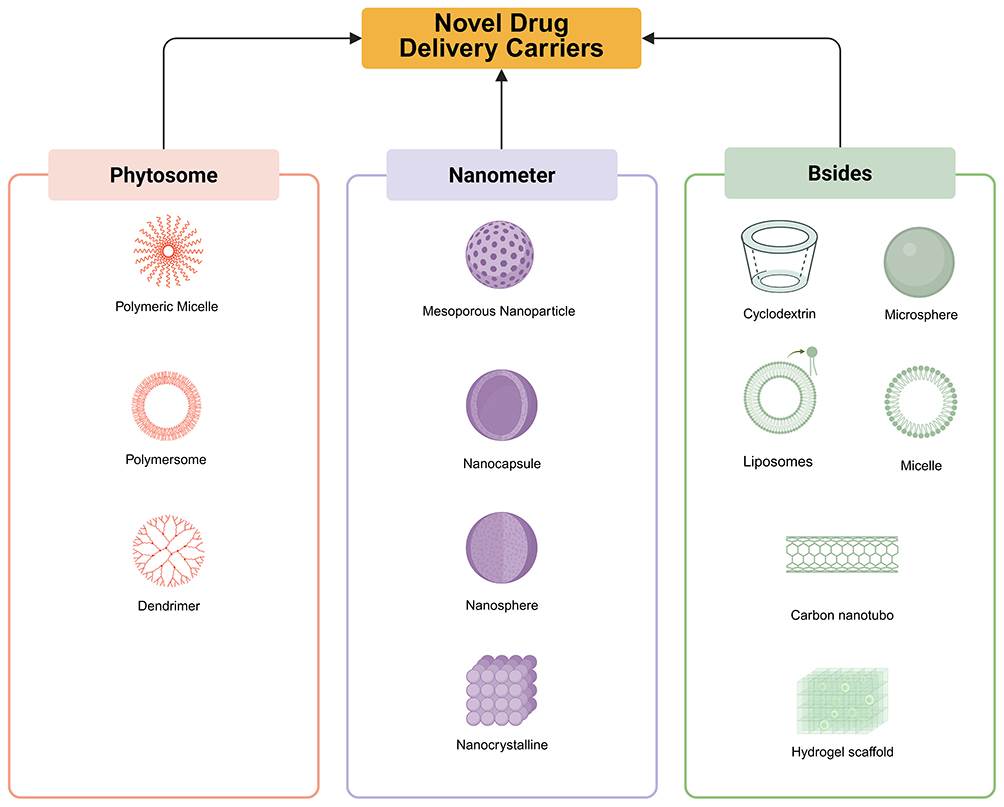 |
Figure 1 Novel drug delivery carriers. |
Metal-organic framework materials (MOFs) are a class of compounds consisting of metal ions or metal clusters coordinated with organic ligands to form one-, two-, or three-dimensional structures where the organic ligands contain potential voids. Metal-organic frameworks have excellent properties such as high adsorption capacity, high surface area (for easy loading of goods), high porosity (for the encapsulation of various drugs and other functional reagents), thermal and chemical stability (for easy post-synthesis functionalization). It has been reported that Metal-Organic Frameworks (MOFs) achieve significantly higher drug loading capacities than liposomes, due to their tunable pore geometries, although they experience greater batch-to-batch variability. Moreover, the rigid framework of MOFs substantially enhances tumor penetration efficiency, especially within the dense breast cancer stroma, with active targeting strategies significantly improving tumor accumulation compared to conventional carriers. It is such properties that enable them to be used in a wide range of industries and technologies such as photocatalysis,14 electrochemistry,15 gas storage and separation,16 energy,17 imaging,18 sensing19 and biomedicine.20
Despite the ligand bonds in MOFs causing structural instability in biological environments, these nanomaterials paradoxically demonstrate exceptional potential as theragnostic carriers in breast cancer.21 The controlled drug release kinetics, biocompatibility, and biodegradability of MOFs facilitate precise chemotherapeutic agent delivery through dual targeting mechanisms: (1) passive targeting via enhanced permeability and retention (EPR) effect;22 and (2) active targeting mediated by surface-conjugated ligands, aptamers, or antibodies.23 This multimodal approach increases tumor accumulation while minimizing off-target toxicity, thus addressing key limitations of traditional chemotherapy.24
This review focuses on MOF-based on delivery systems and their application in breast cancer. Primary classification by metal-ligand coordination architectures establishes fundamental topological taxonomies. Critical analysis of prevalent synthesis strategies highlights their physicochemical determinants in biological performance. The functionalization strategies for drug delivery have been comparatively analyzed, which include passive targeting and active targeting via surface modification of ligands. Synergistically integrated diagnostic and therapeutic applications have also been systemized, proposing novel paradigms for precision breast cancer treatment. Finally, a possible solution to the problem of MOFs based drug delivery system is proposed (Figure 2).
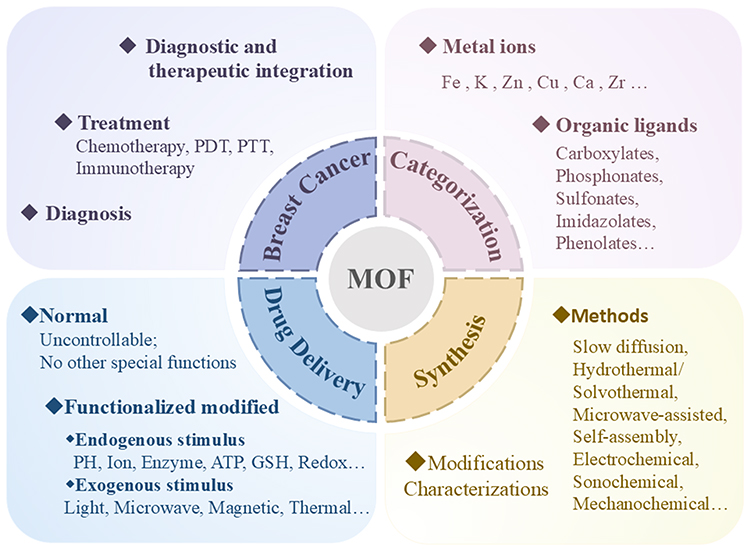 |
Figure 2 Classification, synthesis, and applications of MOFs in drug delivery and breast cancer. |
Categorization of MOFs
MOFs are crystalline coordination networks formed by metal ions/clusters and multitopic organic linkers, possessing intrinsic porosity for hosting guest species (eg, therapeutic molecules, counterions).25 Contemporary research has diversified MOF architectures through systematic variations of metallic nodes and organic ligands, enabling applications spanning DDSs, catalysis, sensing, and energy technologies. This review specifically focuses on MOF-based DDSs, classifying candidate materials by central metal ions (Table 1) and ligand functionalities.
 |
Table 1 Classification of MOFs by Metal Ions for Drug Loading |
Classification by Metal Ions
Biosafety profiling-encompassing biocompatibility, biodegradation kinetics, and inherent cytotoxicity-constitutes a primary design criterion for MOFs in drug delivery systems (DDSs). Most metallic constituents exhibit concentration-dependent toxicity, notably constraining usable varieties to endogenous physioregulatory ions, eg, iron (Fe), potassium (K), zinc (Zn), copper (Cu), and calcium (Ca). Despite favorable biocompatibility profiles, these cations necessitate comprehensive evaluation of administration routes, exposure duration, speciation dynamics, and bioaccumulation/elimination kinetics.43 Additionally, exogenous elements applied for specific medical purposes are included, such as platinum (Pt) for anti-tumor,44 gadolinium (Gd) and zirconium (Zr) for medical diagnostics.45
Fe-MOFs
Iron cations (Fe), essential trace elements regulating hematopoiesis and immune function, demonstrate well-characterized biosafety profiles. These attributes establish iron-based MOFs as prime candidates for biomedical synthesis. It has been found that iron-based MOFs for biomedical applications should follow important specifications: precise particle size control, simple synthesis route, biocompatibility and non-toxicity, chemical stability and controlled degradation.46 And iron-based MILs (Material of the Lavoisier Institute) have advantages over other subclasses of MOFs in biodegradability and cytotoxicity.47 For example, Current studies utilizing MTT/CCK8 assays have demonstrated favorable biocompatibility of MIL-88, MIL-100, and MIL-101 with human or animal cells.26–31,48 Recent advancements in iron-based MOFs include a novel litchi-like porous composite, Fe3O4@Fe-MOF@Hap, developed by Yang.49 This composite exhibits a drug-loading capacity of 75.38 mg/g, saturation magnetization of 34 emu/g for magnetic targeting, along with pH-responsive drug release and excellent biocompatibility.
K-MOFs
Potassium-based MOFs (K-MOFs) demonstrate dual-functionality: their porous architectures facilitate energy-relevant processes (eg, selective ion transport, catalytic reactions, and gas adsorption), while exhibiting minimal cytotoxicity and environmental compatibility advantageous for drug delivery. Cyclodextrins (CDs), cyclic oligosaccharides, serve as biocompatible linkers for synthesizing CD-MOFs. Three variants (K-α-CD-MOF, K-β-CD-MOF, K-γ-CD-MOF) enhance drug solubility, bioavailability, structural integrity, and biosafety profiles.32,33,50 Kristi et al51 achieved 9–30 wt% active pharmaceutical ingredient (API) loading in K-γ-CD-MOF via crystallization optimization, with demonstrated cytoprotective effects in mammalian cell lines and Danio rerio models.
Zn-MOFs
Zinc ions (Zn2+) exert bacteriostatic effects via binding anionic bacterial components, disrupting enzymatic activity and protein synthesis. This broad-spectrum antimicrobial activity synergizes with conventional antibiotics. Kai et al34 engineered a bio-MOF utilizing Zn2+ nodes, immobilizing curcumin through electrostatic interactions. The resulting cationic MOF (QCSMOF-Van) demonstrated rapid bactericidal activity through bacterial adhesion and lysis, achieving a 33.47% drug loading efficiency 6.42% higher than the parent MOF. Beyond their antimicrobial advantages, Zn-MOFs exhibit excellent biocompatibility and notable sustained-release efficacy. Deng et al35 pioneered Zn2(EBNB)2(BPY)2·2H2O as a 3D porous carrier, attaining 0.256 payload capacity. In vitro cytotoxicity assays revealed dose-dependent responses, with >100% cell viability relative to controls at <20 μg/mL concentrations. Sustained release profiles showed 79.85% cumulative delivery within 30 hours.
Cu-MOFs
Although less extensively studied than Fe-MOFs, copper MOFs (Cu-MOFs) exhibit significant drug delivery potential owing to the catalytic activity of Cu2+ in pharmacologically relevant reactions.36,37 Li et al38 synthesized nanoscale Cu-BTC loaded with diethyldithiocarbamate (DDTC), a metabolite of the alcohol-aversion drug disulfiram. The Cu-DDTC complex (formed via Cu2+-DDTC coordination) demonstrated high antitumor activity as a proteasome inhibitor, though exhibiting instability in vivo. The Cu-BTC@DDTC nanoformulation achieved 89%±0.4% tumor cell inhibition at 4 μg/mL within 48 h, indicating anticancer potential. Mechanistic studies revealed ferroptosis induction through SLC7A11/GPX4 signaling pathway inhibition. Notably, Cu-BTC@DDTC (10 mg/kg) synergized with low-dose cisplatin (1 mg/kg), showing enhanced antitumor efficacy and biosafety.
Ca-MOFs
Calcium ions (Ca2+) regulate critical physiological processes including neuromuscular coordination, coagulation cascades, and osteogenesis. This biofunctional synergy enables calcium-based MOFs in orthopedic scaffolds to concurrently promote osteoblast proliferation and potentiate antimicrobial efficacy post-surgery. Vadivelmurugan et al39 synthesized Ca-Sr-MOF via co-precipitation and coated it with aminomalononitrile (AMN) through electrostatic interactions. The antibiotic-loaded Ca-Sr-MOF and Ca-Sr-AMN-MOF exhibited loading capacities of 63% and 57%, respectively, with cumulative release rates of 55.15% versus 9.1% over 72 h. Both systems demonstrated potentiated antimicrobial efficacy (>90% bacterial inhibition) and osteoblast biocompatibility (viability >95%). Notably, a red blood cell membrane- derived nano-system (γ3-RCMZ) was engineered for sepsis treatment.40 Calcium chloride donors exert dual anti-inflammatory actions through Caspase-1/NF-κB pathway suppression and oxidative stress mitigation, attenuating endothelial damage. The γ3-RCMZ platform further demonstrated target-specific bactericidal activity with uncompromised biocompatibility.
Zr-MOFs
Zr-MOFs are extensively studied for their high coordination versatility and chemical stability.52 Sun et al41 synthesized a carbazolyl-functionalized UiO-67-CDC via solvothermal method, followed by methylation modification to prepare UiO-67-CDC-(CH3)2, achieving a 56.5 wt% anticancer drug loading. The electron-deficient Zr-MOFs exhibit fluorescence sensing with high sensitivity through charge transfer mechanisms. Separately, Jiang et al42 developed a Zr-cluster-based ZJU-800, demonstrating 58.8 wt% drug loading capacity and low cytotoxicity (cell viability >90% via MTT assay).
Classification by Organic Ligands
Theoretically feasible MOF combinations exceed thousands through systematic variation of metal nodes and organic linkers. Experimentally validated systems predominantly utilize carboxylate, phosphonate, sulfonate, imidazolate, and phenolate ligands, with dicarboxylic/polycarboxylic acids serving as the primary rigid backbone scaffolds.53 Interestingly, Ligand functionalization enables precise modulation of MOF physicochemical properties,54 creating highly active sites for multifunctional therapeutics. For instance, porphyrin-phthalocyanine MOFs incorporating phosphonate/azolate linkers exhibit water solubility and high stability.55
In DDSs, linker selection must balance physicochemical properties, biocompatibility, and degradation kinetics. For example, Abánades Lázaro et al56 demonstrated that fumarate-ligated Zr-MOFs exhibit superior stability versus UiO-66 analogs due to lower ligand pKa values, intensifying phosphate-carboxylate coordination competition. Ligand chemistry further governs drug loading/release profiles. Semirigid 5-(4′-carboxyphenoxy) nicotinic acid (H2cpon) -derived Zn-cpon-1, synthesized via CIO4−-templated assembly, displays significant DDS potential. And the loading of Zn-cpon-1 for 5-FU was significantly higher than that for 6-mercaptopurine (6-MP), 44.75 and 4.79 wt%, respectively.57
Bio-metal-organic frameworks (bio-MOFs), integrating biomolecules (eg, nucleobases, cyclodextrins, enzymes, peptides, porphyrins, sugars, and amino acids) as linker, combine structural tunability of MOFs with biocompatible and biodegradable profiles.58 The bio-MOF constructed from the small molecules of curcumin and Zn has now been successfully synthesized, exhibiting permanent porosity and a surface area of up to 3002 m2/g.59 There are now more researches on the preparation and application of bio-MOFs, such as anticancer drug-targeted delivery systems,60 adsorbents,61,62 and sensors.63,64 Despite advances, key challenges persist: (1) complex synthesis routes with poor controllability and high cost; (2) limited stability under physiological conditions.65
Synthesis and Modification Strategies of MOFs
As discussed above, the synthesis of MOFs requires careful consideration of metal ions, organic linkers, and the loaded drug and/or solvent. Furthermore, the chosen synthesis method and experimental conditions significantly influence the crystallinity of MOFs, thereby determining their structure, properties, and functionality. Commonly reported synthesis strategies include slow diffusion, hydrothermal/solvothermal reactions, microwave-assisted synthesis, self-assembly, and electrochemical, sonochemical, or mechanochemical approaches. All methods depend on three key parameters: (1) reaction conditions (time, temperature, pressure, pH), (2) raw material properties (types and concentration ratios of metal salts, ligands, solvents, and modifiers), and (3) post-synthesis chemical modifications.66–68 Understanding these variables is crucial for optimizing MOFs synthesis. A comparative analysis of the advantages and disadvantages of these methods is provided in Table 2.69–77
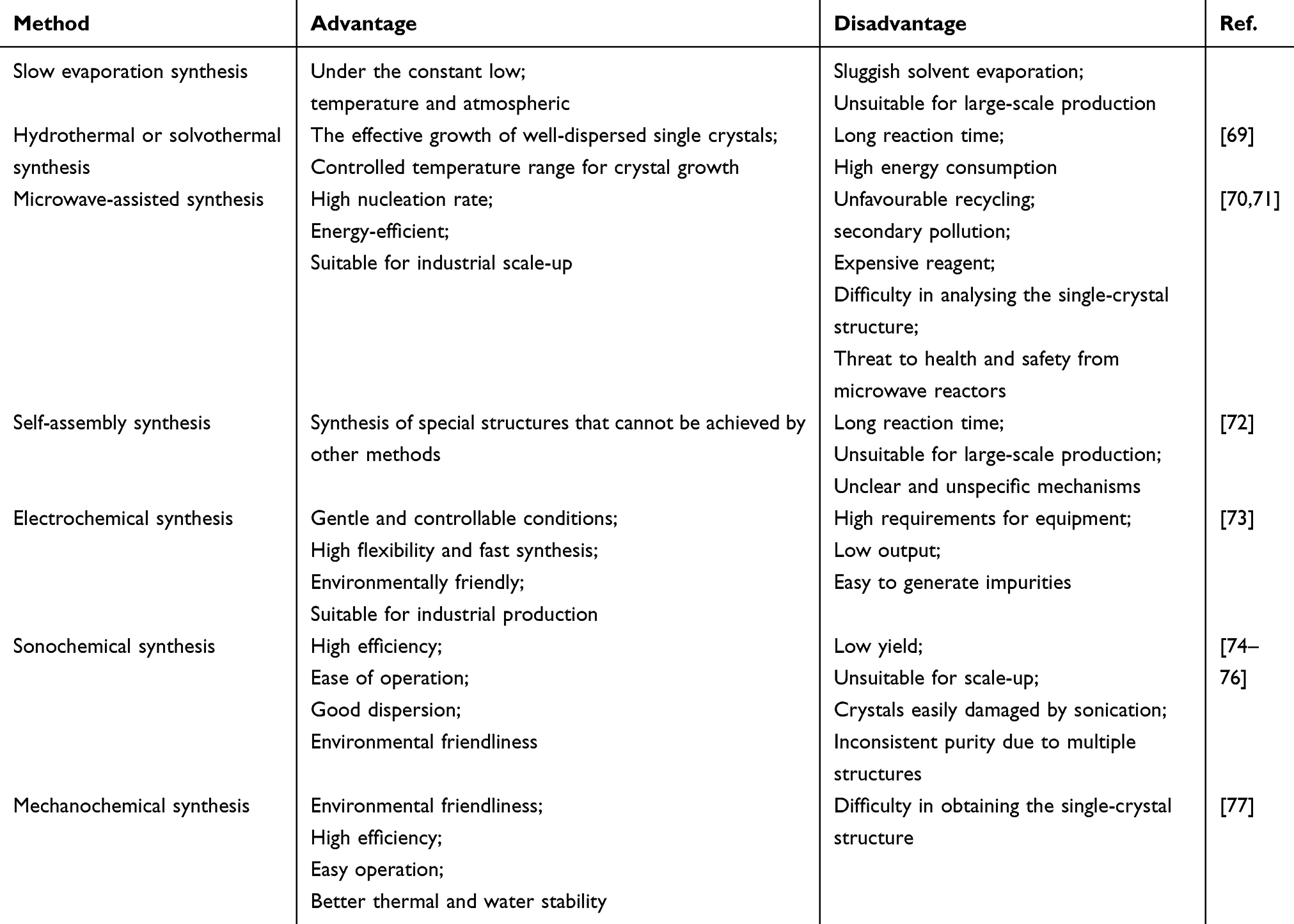 |
Table 2 Synthesis Methods of MOFs |
In biomedical applications, the safety of metal-organic frameworks (MOFs) necessitates particular consideration. Given that MOFs are synthesized using solvents, it is imperative to prioritize non-toxic and biodegradable solvents to minimize potential cytotoxic effects. For drug delivery systems, the selection of synthesis methods must take into account critical parameters such as biostability, pore size, particle size, drug loading capacity, and controlled release profiles, ensuring compatibility with physiological environments. Representative drug loading strategies, including encapsulation, covalent conjugation and surface adsorption, are systematically compared (Figure 3).
 |
Figure 3 Schematic representation of the strategies to load drugs into MOFs. |
Following initial synthesis, MOFs can be functionalized to enhance their framework properties and confer application-specific functionalities, particularly for targeted drug delivery. Two primary strategies are employedin-situ functionalization during synthesis (eg, ligand substitution) and post-synthetic modification (eg, surface grafting).78,79 Subsequently, synthesized MOFs require systematic physicochemical characterization to: (i) confirm structural integrity via powder X-ray diffraction (PXRD) and electron microscopy (TEM, SEM); (ii) analyze chemical composition using nuclear magnetic resonance (NMR) and elemental analysis (EA); (iii) evaluate thermal stability through thermogravimetric analysis (TGA); and (iv) assess drug-loading efficiency and controlled release profiles via UV-vis and fluorescence spectroscopy.80 These data collectively validate the material’s suitability for biomedical applications, ensuring optimal performance while addressing toxicity concerns.
MOFs-Based Drug Delivery Systems
The excellent properties of MOFs can be well applied in DDSs: (i) high surface area and porosity enable superior drug loading capacity; (ii) tunable metal-ligand coordination allows precise customization for diverse drug physicochemical properties; (iii) post-synthetic functionalization (eg, PEGylation or antibody conjugation) enhances targeting specificity and controlled release kinetics; (iv) weak coordination bonds impart biodegradability while maintaining biocompatibility. Consequently, recent research efforts prioritize the development of three MOF-based DDS categories, including conventional, stimuli-responsive and targeted MOFs. This section reviews these systems, with emphasis on their encapsulation efficiency (EE) and loading efficiency (LE)-two critical metrics calculated as follows:


Conventional MOFs-Based DDSs
Conventional MOF-based DDSs are synthesized using the methods detailed above. Drug loading is achieved via two primary strategies: (1) in-situ encapsulation during framework assembly, or (2) post-synthetic diffusion into porous architectures.81 Non-functionalized systems rely exclusively on intrinsic MOF-drug physicochemical interactions for payload retention, thereby lacking targeting specificity or stimulus-responsive behavior. Consequently, drug release follows passive diffusion kinetics dictated by concentration gradients.
Xie et al82 engineered sub-200 nm Ti-MOFs via tetraethyl orthosilicate (TEOS)-assisted synthesis, reducing particle size by 42.78% (698.6±22 nm → 399.7 nm) while maintaining crystallinity. The system demonstrated > 90% cell viability and pH-responsive IBU release: 55.3–72.1% within 5 h, reaching 99.4% cumulative release at 24 h, outperforming conventional carriers by 18.6%. Complementarily, Suresh et al83 developed MOF-5-based carriers for amorphous drug stabilization, enhancing aqueous solubility and physical stability. Encapsulation of hydrophobic therapeutics-curcumin (CUR), sulindac (SUL), and tranexamic acid (TAT)-yielded stable composites (>120-day amorphous state retention) via host-guest interactions. Loading capacities spanned 7.7–34.0 wt%, correlating with drug hydrophobicity.
Expanding MOF-based solubility enhancement strategies, He et al84 pioneered nanoscale cyclodextrin metal-organic frameworks (CD-MOFs) for azilsartan (AZL) encapsulation, employing a methanol-mediated crystallization protocol with PEG20000 as a crystallizing agent. This methodology yielded high-purity CD-MOFs enabling efficient AZL loading (17.2 ± 0.8 wt%), synergistically enhancing aqueous solubility by 340-fold and oral bioavailability by 9.7-fold versus free AZL-significantly surpassing conventional MOF-5 carriers in both metrics (Figure 4). Synchrotron Fourier-transform infrared spectroscopy (SR-FTIR) and small-angle X-ray scattering (SAXS) analyses revealed stabilization via dual supramolecular interactions: (1) γ-cyclodextrin cavity inclusion and (2) MOF pore confinement. This dual-host mechanism simultaneously prevented drug recrystallization and enabled pH-responsive release in intestinal fluid (pH 6.8 ± 0.2; cumulative release >92%), resolving critical limitations of single-mechanism systems.
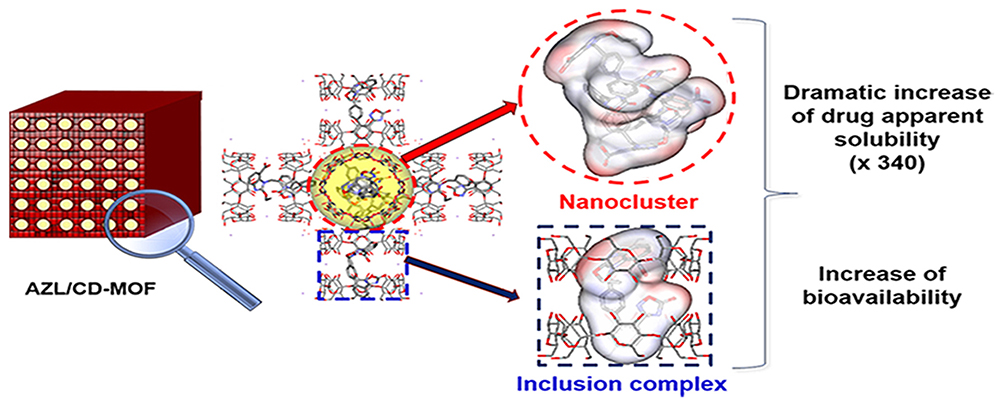 |
Figure 4 Dual molecular mechanism of complexation and nanoclustering in CD-MOF significantly enhanced bioavailability and solubility of insoluble drugs. Reproduced from He Y, Zhang W, Guo T, Zhang G et al. Drug Nanoclusters Formed in Confined Nano-Cages of CD-MOF: Dramatic Enhancement of Solubility and Bioavailability of Azilsartan. Acta Pharmaceutica Sinica B 2019, 9 (1), 97–106. © 2018 Chinese Pharmaceutical Association and Institute of Materia Medica, Chinese Academy of Medical Sciences. Production and hosting by Elsevier B.V..84 under the terms of the Creative Commons Attribution-NonCommercial-NoDerivatives 4.0 (CC BY-NC-ND 4.0). |
Functionalized Modified MOFs-Based DDSs
The functionalization of MOFs has expanded their biomedical applications, particularly in stimuli-responsive drug delivery, cancer targeting, and antimicrobial therapies. As a specialized subclass of metal-organic frameworks, stimuli-responsive MOFs exhibit dynamic structural or functional adaptations when exposed to specific biological or external triggers. These triggers are primarily divided into two types. Endogenous stimuli arise naturally within biological systems, such as ions, pH, ATP, GSH, nucleic acids, enzymes, and redox. Exogenous stimuli involve externally applied physical factors like light, heat, electricity, and magnetism. Researchers now strategically integrate these triggers to design multi-stimuli-responsive systems capable of precise therapeutic control in complex physiological environments.
Endogenous Stimulus Response
Endogenous stimulus-responsive MOFs are engineered via biomimetic or natural component integration, enabling spatiotemporally precise drug release through activation by biological triggers. These systems undergo programmable morphological/chemical adaptations in response to pathological cues, enhancing therapeutic precision and diagnostic accuracy.85
Researchers optimize particle characteristics including size, shape, and mechanical stiffness to simultaneously evade immune surveillance and achieve organ-specific targeting.86 A prominent application lies in cancer therapy, where these MOFs function as molecular gatekeepers that selectively release drugs upon encountering the tumor microenvironment (TME). Distinctive TME features-such as hypoxic conditions, lactate-induced acidosis with pH levels ranging from 5.0 to 6.5, elevated redox potential, overexpression of specific enzymes like matrix metalloproteinases, and aberrant vascular permeability-create unique biochemical signatures exploitable for targeted drug activation.87,88
Despite their targeting precision, excessive responsiveness to endogenous stimuli can compromise structural stability, leading to premature drug release prior to reaching diseased sites. Current strategies address this limitation by surface-functionalizing MOFs with polyethylene glycol (PEG) biopolymers.89
pH-Responsive
Recent advances in pH-responsive MOFs have demonstrated their potential for tumor-targeted therapy, particularly TME. The pH values in this environment range from 6.5 to 6.9, and after endocytosis and fusion with lysosomes, the pH decreases to 4.5.90,91 pH-responsive MOFs make use of acid-labile bonds, which include amides, carboxylates, esters, imides, oximes, acetals, and ketals and which remain stable at physiological pH 7.4 but undergo selective hydrolysis when the pH is below 6.5. This pH-triggered bond cleavage induces structural degradation of the MOF framework, enabling targeted drug release specifically within acidic TME regions while maintaining stability during systemic circulation.92 Some common pH-responsive compounds (carboxymethyl cellulose,93,94 chitosan,95,96 gelatin,36,97 calcium phosphate98) are also based on this principle.
Amino-functionalized Mn-MOFs exhibit pH-responsive degradation, enabling rapid drug release in the acidic TME. Zhao et al99 developed a core-shell DUCNP@Mn-MOF encapsulating 3-F-10-OH-evodiamine (FOE), leveraging small particle size for enhanced permeability and retention (EPR)-mediated tumor accumulation and pH-triggered FOE release. The system demonstrated pH-dependent burst release (83% at pH 5.6; 75% at pH 6.5 within 5 min) and high biocompatibility (> 80% cell viability at 250 μg/mL). DUCNP@Mn-MOF/FOE induced 39.4% tumor cell apoptosis without significant organ toxicity, showcasing its therapeutic precision.
Zhang et al100 developed pH-responsive MIL-101-NH2 (Figure 5) for dual loading of curcumin and anti-HIF-2α siRNA via covalent conjugation, achieving 69.5% drug loading efficiency. The framework demonstrated pH-dependent cumulative release (59.7% ± 1.8% at pH 5.0–7.0) while maintaining structural stability in osteoarthritic conditions. At 400 μg/mL, the system preserved >80% chondrocyte viability with no significant cytotoxicity. Mechanistically, MIL-101-NH2 facilitated lysosomal escape of siHIF-2α, synergistically alleviating osteoarthritis through downregulation of disease-associated metabolites and upregulation of cartilage-specific markers.
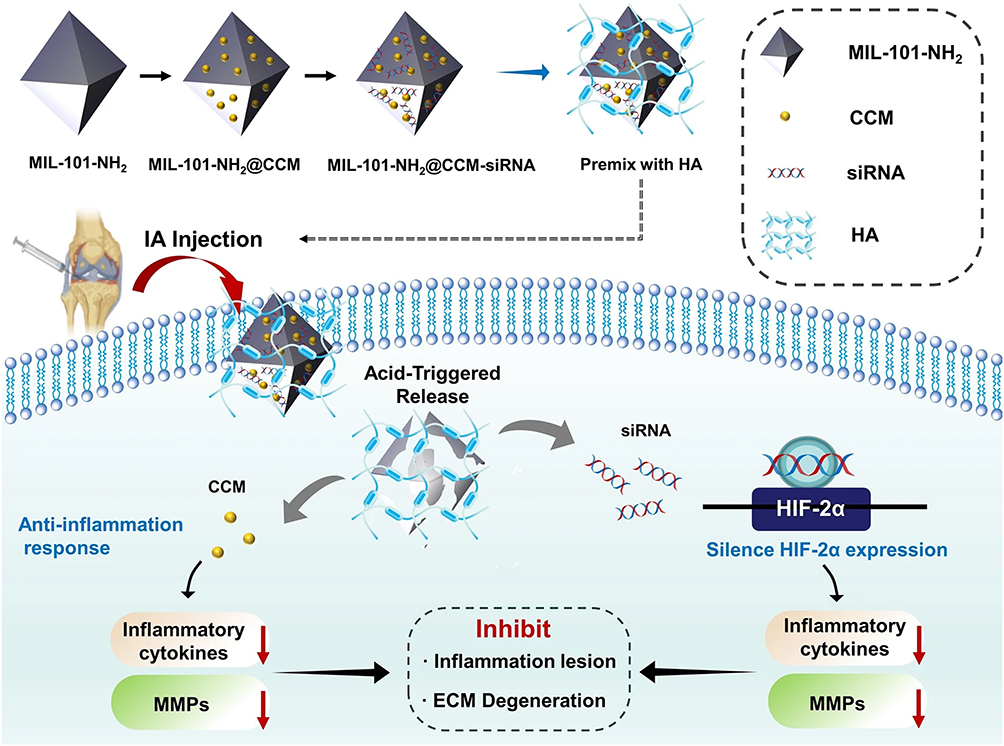 |
Figure 5 Preparation and schematic illustration of MIL-101-NH2@CCM-siRNA nanoparticles for OA therapy. Reproduced from Zhang, ZJ, Hou, YK, Chen, MW et al. A pH-responsive metal-organic framework for the co-delivery of HIF-2α siRNA and curcumin for enhanced therapy of osteoarthritis. J Nanobiotechnol 21, 18 (2023).100 under the terms of the Creative Commons Attribution International License (CC BY 4.0). |
Ion-Responsive
Ion-responsive MOFs employ metal ions (Ca2+, Na+, Pb2+, Zn2+, Mg2+, K+) or anions (PO43-, H2PO4-) to regulate drug release through three primary mechanisms: anion exchange, competitive binding and metal ion/nucleic acid complex formation. Anion exchange represents the predominant mechanism, wherein incoming anions displace framework components by preferentially coordinating with metal nodes, thereby destabilizing the MOF architecture. Conversely, cations can degrade negatively charged MOFs through electrostatic interactions.101 A representative study by Tan et al102 demonstrated this principle using UiO-66-NH2 functionalized with quaternary ammonium groups and capped with carboxylated pillar[5]arene (CP5). The resulting electronegative pseudorotaxanes exhibited Zn2+-responsive 5-FU release, achieving a 115 μmol/g 5-FU loading capacity, which was 2.7-fold higher than that of non-conjugated CP5 systems. Zn2+-triggered release demonstrated concentration-responsive kinetics, accelerating from 0.08 to 0.23 h−1 with payload increasing from 38% to 92% across Zn2+, mechanistically confirming the CP5-mediated gating effect.
Enzyme-Responsive
Enzyme-responsive MOFs leverage enzymatic activity and programmable porosity to construct bioresponsive drug carriers. Targeted release is achieved through specific interactions between MOF pore channels and enzyme moieties. A core design strategy employs enzymatic cleavage of peptide bonds integrated within the framework.85 Recent advances demonstrate enzymes acting as molecular gatekeepers for MOF delivery systems. Upon exposure to target enzymes, the catalytic activity of these MOFs increases significantly, enabling spatiotemporally controlled drug release. Carrillo-Carrión et al103 exemplified this concept by developing an ALP-responsive MOF that selectively releases drugs in tumor tissues overexpressing ALP (a validated tumor-associated biomarker), achieving 89% targeted drug accumulation versus 12% in normal tissues.
ATP-Responsive
ATP-responsive metal-organic frameworks (MOFs) dynamically respond to adenosine triphosphate (ATP) concentration fluctuations through three interconnected mechanisms: (i) ATP binds to MOF metal nodes or ligands via hydrogen bonding or electrostatic interactions, inducing structural transformations that regulate pore opening/closing. (ii) ATP-MOF binding triggers adaptive structural reconfiguration, modulating drug release kinetics and optoelectronic properties. (iii) integrated fluorescent probes amplify ATP detection signals, achieving nanomolar-level sensitivity. For instance, Chen et al104 developed a near-infrared fluorescent nanoprobe that detects ATP concentrations within 0.25–10 mM while synchronously releasing anticancer drugs to induce tumor cell apoptosis. Inheriting the biocompatibility of endogenous stimuli-responsive systems, ATP-MOFs further enable ATP concentration-dependent drug release control, demonstrating significant potential for precision medicine.
GSH-Responsive
Glutathione, a thiol-rich tripeptide ubiquitous in eukaryotic systems, functions as both a metabolic regulator and antioxidant by neutralizing free radicals and detoxifying carcinogens. Critically, tumor cells exhibit dysregulated GSH homeostasis with intracellular concentrations reaching 10-fold higher than in normal cells, a pathological feature directly correlated with accelerated proliferation and chemoresistance.105 This pathological overexpression has driven the development of GSH-responsive MOFs exploiting two distinct activation mechanisms: coordination-induced structural reconfiguration or redox-triggered bond cleavage. Du et al106 demonstrated this by engineering a BMS-986205-conjugated MOF (BMS-SNAP-MOF) that degrades in GSH-rich tumor microenvironments, synchronously releasing the IDO inhibitor BMS-986205 and generating nitric oxide (NO) to potentiate immunotherapy. Similarly, Zhang et al107 designed an iron-porphyrin MOF co-loaded with glucose oxidase(Gox) and iridium (Ir) nanoparticles. GSH-triggered decomposition releases porphyrin photosensitizer, inducing a cytotoxic ROS burst that enhances photodynamic and chemodynamic therapy efficacy.
Redox-Responsive
Tumor progression results from disrupted redox homeostasis, where elevated reactive oxygen species (ROS) serve as critical mediators. While physiological ROS levels maintain procancerigenic signaling through oxidative stress-activated pathways, supraphysiological ROS induce oxidative damage and trigger programmed cell death.108 In TME, sustained ROS overproduction damages mitochondrial respiration, depolarizes membrane potentials, and propagates ROS overproduction. Concurrently, ROS activate redox-sensitive pathways (eg, NF-κB, AP-1) in both cancer cells and tumor-associated macrophages, driving inflammatory factor release.109 These dynamics underpin the design of redox-responsive MOFs for tumor-targeted therapy. Zhang et al110 engineered a hyaluronic acid-functionalized MOF crosslinked via disulfide bonds (-S-S-), enabling glutathione-triggered drug release specifically in TME. Capitalizing on ROS-mediated cytotoxicity, He et al111 developed a Fe/Cu-SS MOF (PFP@Fe/Cu-SS) that generates hydroxyl radicals (•OH) through Fenton-like reactions. The resulting lipid peroxides (LPO) induce ferroptosis, a ROS-dependent cell death mechanism, demonstrating potent antitumor efficacy.
Exogenous Stimulus Response
Endogenous stimulus-responsive MOFs adapt their structure and function to intracellular physiological conditions, enabling localized drug release that enhances therapeutic efficacy while minimizing systemic toxicity. In contrast, exogenous stimulus-responsive systems utilize externally applied triggers, offering artificial controllability unconstrained by biological variability. Light-responsive MOFs exemplify this approach through wavelength-specific activation. Cornell et al112 demonstrated this with UiO-AZB-F, a MOF activated by green light to achieve on-demand 5-fluorouracil (5-FU) release. Separately, microwave-responsive MOFs leverage deep tissue penetration for targeted therapy, as evidenced by Cui et al113 who developed gadolinium-based MOFs (Gd-MOFs) that generate microwave-induced hyperthermia while releasing PD-1 inhibitors, synergistically enhancing antitumor immunity.
Magneto-responsive MOFs are typically engineered through two primary strategies: encapsulation of magnetic nanoparticles within MOF architectures, or hybridization with magnetic polymers. These systems enable multifunctional capabilities including magnetic targeting, controlled drug release, magnetic resonance imaging (MRI) contrast enhancement, and magnetothermal therapy through external magnetic guidance. Guo et al114 applied magnetic fields to navigate Hm@TSA/As-MOFs through ascites fluid, negating extracellular matrix barriers to deliver Tanshinone IIA and Astragaloside IV precisely to hepatocellular carcinoma sites. Similarly, Wang et al112 designed lactose-modified paramagnetic Lac-FcMOFs that amplify mild magnetothermal therapy (MMHT) efficacy by disrupting redox homeostasis (RDH), thereby enhancing tumor suppression.
Dual/Multiple Responsiveness
Dual/multi-stimuli-responsive MOF nanoplatforms integrate responses to endogenous physiological and exogenous environmental triggers, enabling spatiotemporally controlled drug release. Emerging research highlights their potential to overcome limitations of single-stimulus systems through synergistic therapeutic effects, enhanced environmental adaptability, and compatibility with combinatorial therapies. Representative designs include ATP and pH,115 ions and pH,116 pH, GSH and light117 co-responsive MOFs, which achieve precise spatiotemporal targeting, improved signal transduction fidelity, and robust stability under dynamic biological conditions. These systems exemplify the convergence of stimuli-responsive adaptability with multi-modal therapeutic precision.
MOFs in Breast Cancer
Breast cancer is the most commonly diagnosed cancer and the leading cause of cancer deaths among women globally in 112 countries.1 Major molecular subtypes include hormone receptor-positive (HR+, ~70%), human epidermal growth factor receptor 2-positive (HER2+, 15–20%), and triple-negative breast cancer (TNBC, 10–15%).118–120 A comprehensive review identified 24 FDA-approved breast cancer therapeutics from 1991 to 2021, comprising 18 small molecules, 3 monoclonal antibodies, and 3 antibody-drug conjugates (ADCs).121 Currently, MOFs significantly contribute to targeted therapy, early diagnosis and comprehensive treatment strategies for breast cancer, as evidenced in Table 3.122,123–141
 |
Table 3 MOFs in Breast Cancer Diagnosis and Treatments |
For Breast Cancer Treatment
Chemotherapy
MOFs exhibit exceptional specific surface areas, tunable porosity, and biocompatibility, establishing them as optimal platforms for targeted drug delivery and controlled release systems. Taheri-Ledari et al has developed magnetic Bio-MOF-13 for doxorubicin DOX delivery, which greatly validated the therapeutic efficacy of engineered MOFs.142 The Bio-MOF-13 system enables dual pH/magnetic field-responsive targeting in breast cancer cells, demonstrating low systemic toxicity suitable for intravenous administration. Furthermore, surface-functionalized MOFs synergize high drug loading capacity with pH-responsive behavior, positioning them as promising candidates for breast cancer therapy.143,144
Multivariate modulation (MTV) strategies represent a paradigm shift in optimizing MOFs for biomedicine. By incorporating multiple functional ligands into single frameworks, MTV enables co-delivery of therapeutic cargos. Demonstrating this approach, Abánades Lázaro et al145 engineered defect-engineered UiO-66 MOFs through modulator diversification, successfully co-loading dichloroacetic acid and 5-fluorouracil (5-FU). This multi-drug-loaded system exhibited enhanced cytotoxicity against MCF-7 breast cancer cells compared to single-drug formulations.
Ferroptosis, a regulated cell death pathway characterized by iron-dependent lipid peroxidation, offers a novel therapeutic strategy against chemotherapy-resistant tumors. Li et al146 engineered a copper-porphyrin MOF (Cu-TCPP(Fe)) to disrupt antiferroptotic defense mechanisms in TNBC. This nanoplatform integrates glucose-depleting gold nanoparticles and the ferroptosis inducer RSL3 (inhibits glutathione biosynthesis). The peroxidase-mimetic activity amplified ferroptotic vulnerability in triple-negative breast cancer, disrupting antioxidant defenses for synergistic therapy.
Du et al147 engineered core-shell PCP-MOF@G@B nanostructures for dual-starvation therapy. A pH/ROS-responsive PEG-CDM-PEI copolymer shell enabled tumor-triggered size/charge switching, enhancing penetration. Endogenous H2O2 generation accelerated MOF degradation, achieving 75–94% cumulative release. In MDA-MB-231 xenografts, PCP-MOF@G@B induced 42% apoptosis-mediated cell death, suppressing tumor volume by 89% while improving survival rates in murine models.
Photodynamic Therapy (PDT)
Photodynamic therapy (PDT) utilizes photosensitizers activated by specific wavelengths to generate ROS, primarily singlet oxygen (1O2), inducing tumor cell apoptosis. MOF-based carriers effectively encapsulate photosensitizers within their porous structures, enabling localized ROS generation upon light irradiation.148 This process rapidly triggers immunogenic cell death (ICD), concurrently releasing tumor-associated antigens that stimulate acute inflammation and enhance antigen immunogenicity, thereby amplifying antitumor immunity.149
However, tumor hypoxia severely constrains PDT efficacy in deep tissues. To overcome this limitation, Xu et al150 innovatively engineered a BODIPY-functionalized Zr-MOF (69-L2) via post-synthetic ligand exchange, hybridized with perfluorocarbon polymers to create an oxygen-elevating nanoplatform (Figure 6A). Under LED irradiation, this system demonstrated sustained oxygen-carrying capacity and potent 1O2 generation (Figure 6B), achieving 50–70% cytotoxicity against MDA-MB-231 triple-negative breast cancer cells at 25–100 μg/mL. Subsequent integration into hydrogel scaffolds reduced tumor volumes by 80–85% in murine mammary carcinoma models after 80-day implantation.
 |
Figure 6 (A) Preparation and schematic illustration of 69-L2@F. (B) ROS generation for 69-L2@P and 69-L2@F. (a) Normalized DCF fluorescent intensity. (n = 5; *p < 0.05, **p < 0.01, two-way ANOVA followed by a Sidak’s test for multiple comparisons). (b) Overlapped histograms of DCF intensity for normoxic and hypoxic cells. (c) Flow cytometry analysis of cells with MOF intensity vs DCF intensity. Reproduced from Chen X, Mendes BB, Zhuang Y et al. A Fluorinated BODIPY-Based Zirconium Metal–Organic Framework for In Vivo Enhanced Photodynamic Therapy. J Am Chem Soc 2024, 146 (2), 1644–1656. Copyright © 2024 The Authors. Published by American Chemical Society.150 under the terms of the Creative Commons Attribution International License (CC BY 4.0). |
Beyond single PDT, synergistic integration with complementary modalities addresses monotherapy constraints. Liang et al136 engineered a hyaluronic acid-polyethylene glycol (HA-PEG) grafted PCN-224 MOFs co-loaded with the PD-L1 inhibitor BMS-202. In 4T1 tumor-bearing mice, combined PDT and PD-L1 blockade potentiated primary tumor ablation while inducing systemic antitumor immunity, suppressing metastatic growth by 73% through enhanced dendritic cell maturation and cytotoxic T-lymphocyte activation.
Photothermal Therapy (PTT)
Photothermal therapy (PTT) employs photothermal agents that convert near-infrared (NIR) radiation into localized hyperthermia through non-radiative relaxation, effectively ablating tumor cells.151 Recognized for its non-invasiveness, precision, and capacity to induce antitumor immunity under specific conditions,152 PTT commonly utilizes noble metal nanoparticles (eg, Au, Pd, Pt) that exhibit strong NIR absorption and photothermal conversion efficiency.153 Current research focuses increasingly on synergistic PTT integration with complementary modalities for breast cancer treatment.
For synergistic photothermal-chemodynamic therapy (PTT/CDT) targeting malignant breast cancer bone metastases, Zou et al154 developed a Cu2−xSe@ZIF-8 nanocomposite against metastatic breast cancer. Encapsulating Cu2−xSe within ZIF-8 minimizes systemic toxicity while enabling efficient photothermal conversion and Cu+/Cu2+-mediated •OH generation via Fenton-like reactions. For the same synergistic therapy, Yang et al155 engineered Fe3+-loaded mesoporous organosilica frameworks for TNBC treatment. The platform simultaneously facilitates Fe3+-mediated Fenton reactions and mild PTT, generating cytotoxic •OH and promoting immunogenic cell death, which demonstrates potent adaptive immune activation.
Immunotherapy
Tumor immunotherapy utilizes the host immune system to induce tumor-specific adaptive immunity, either through active immune activation or passive immunotherapy using therapeutic antibodies, thereby reducing off-target toxicity that is inherent in conventional therapies. Unlike chemotherapy or radiotherapy, immunotherapy primarily enhances endogenous antitumor responses by activating tumor-infiltrating lymphocytes (TILs) and antigen-presenting cells (APCs), rather than through direct tumor ablation. Advances in cancer immunology have established immunotherapy as a transformative modality with the potential for durable remission.
Several studies suggest that the high surface area of MOFs facilitates the efficient encapsulation of immunomodulators, such as PD-1 inhibitors and TLR agonists. Furthermore, surface engineering strategies, including the functionalization with hyaluronic acid, enhance tumor-specific targeting. MOFs are gaining momentum as precision nanocarriers for immunotherapeutic agents in breast cancer. Immunostimulatory MOF (ISAMn-MOF) based on Mn2+ utilizing a green synthesis method was developed by Zheng et al.156 In murine models of breast cancer lung metastasis, ISAMn-MOF combined with anti-PD-1 antibodies reduced pulmonary metastatic nodules by 88% (10.4 vs 88.6 in PBS controls) and improved survival rate, demonstrating potent systemic antitumor immunity.
Defect-engineered MOFs strategically overcome therapy resistance through tunable redox activity. Peng et al157 designed a ferric ion-based defect-engineered MOF biomimetic system that depletes glutathione (GSH) while downregulating glutathione peroxidase 4 (GPX4), inducing lethal lipid peroxidation. Concurrently, Fe3+ activates NADPH oxidase 4 (NOX4) to generate H2O2, which undergoes Fenton reactions to produce cytotoxic hydroxyl radical. This dual-action mechanism induced ferroptosis, achieving 87% tumor suppression in chemoresistant breast cancer models (Figure 7). Complementarily, Zn/Gd-bimetallic MOF-5 nanoparticles act as nano-immunomodulators,158 directly inducing immunogenic cell death while synergizing with PD-L1 blockade to inhibit primary tumors growth and metastasis.
 |
Figure 7 Synthesis procedure of defective self-assembled MOF and schematic illustration of this multidrug delivery nanoplatform triggering iron death to overcome drug resistance. Reproduced from Peng H, Zhang X, Yang P et al. Defect Self-Assembly of Metal-Organic Framework Triggers Ferroptosis to Overcome Resistance. Bioactive Materials 2023, 19, 1–11. 10.1016/j.bioactmat.2021.12.018. © 2021 The Authors. Publishing services by Elsevier B.V. on behalf of KeAi Communications Co. Ltd.157 under the terms of the Creative Commons Attribution-NonCommercial-NoDerivatives 4.0 (CC BY-NC-ND 4.0). |
For Breast Cancer Diagnosis
Noteworthy, MOFs have demonstrated significant potential in tumor diagnostics, particularly for HER2-positive breast cancer detection through specific protein recognition and signal amplification.159–162 Liang et al163 engineered tetrahedral DNA-guided Zr-MOF superstructures integrating catalytic activity with molecular recognition, quantifying HER2 at molecular (LOD: 12 pg/mL) and cellular (LOD: 10 cells) levels. Zhang et al73 developed a ZIF-8/Co-MOF hybrid electrochemical aptasensor for simultaneous detection of human epidermal growth factor receptor 2 (HER2) and estrogen receptor (ER) within 60 min, achieving linear ranges of 0–15 pg/mL with ultra-low detection limits (HER2: 3.8 fg/mL; ER: 6.8 fg/mL).
In addition, a clinically feasible electrochemical biosensor enable multiplexed quantification of breast cancer biomarkers including ER, PR, HER2 and Ki67. The bio-platform can selectively detect HER2, ER, Ki67 and PR in the range of 0–1500 pg/mL with detection limits of 0.01420, 0.03201, 0.01430 and 0.01229 pg/mL, respectively, to achieve a wider and more comprehensive breast cancer diagnosis.164 Beyond molecular diagnostics, MOFs facilitate tumor imaging through intrinsic or engineered contrast properties. These imaging capabilities are often integrated with therapeutic functions, such as photodynamic therapy or drug delivery, to achieve real-time theranostics. The following section reviews MOF-based platforms for integrated breast cancer diagnosis and treatment.
Therapy-Diagnostics Integration
Theranostics integrates diagnostic and therapeutic functions within a unified platform, offering significant advantages over isolated diagnostic or therapeutic approaches. In breast cancer management, MOFs enable simultaneous tumor detection and targeted intervention, enhancing early diagnosis accuracy while providing real-time treatment guidance. MOF-based theranostic systems improve therapeutic precision through stimuli-responsive drug release and multimodal imaging capabilities, advancing personalized oncology paradigms.
Zhang et al165 exemplify this with core-shell AuNS@MOF-ZD2 nanocomposites, where ZD2 peptides confer selective targeting of triple-negative breast cancer (TNBC) cells. The MOF shell provides T1-weighted magnetic resonance imaging (MRI) contrast, while the gold nanosphere (AuNS) core enables photothermal therapy (PTT) with 40.5% NIR photothermal conversion efficiency. This integrated platform facilitates concurrent tumor monitoring and precision hyperthermia ablation.
Beyond single-modality theranostics, synergistic integration of multiple therapeutic strategies significantly enhances treatment efficacy while minimizing systemic toxicity. Chen et al166 engineered a pH/NIR dual-responsive platform (PCN-DOX@PDA) combining chemotherapy, photothermal therapy (PTT), and photodynamic therapy (PDT). The system achieved 78% doxorubicin (DOX) loading capacity, with pH 5.4-triggered release reaching 80% post 808-nm NIR irradiation. Concurrently, the PCN-600 carrier generated single-linear oxygen under 634-nm laser irradiation for potent tumor cell elimination, while polydopamine (PDA) enhanced photothermal conversion efficiency. The Fe3+-centered MOF additionally served as a T2-weighted MRI contrast agent, enabling real-time therapeutic monitoring.
Recent studies further demonstrate MOFs as versatile platforms for multimodal imaging and combination therapies in breast cancer.110,167,168 These systems integrate stimuli-responsive drug release with photodynamic/chemodynamic activities, often coupled with magnetic resonance or computed tomography imaging to guide precision treatment.
Conclusions and Outlook
Metal-organic frameworks (MOFs) establish a transformative paradigm for precision breast cancer theranostics through three core advancements: (1) Engineered stimuli-responsiveness enabling tumor-targeted drug release with minimized off-target effects; (2) Intrinsic multifunctionality supporting simultaneous diagnostic imaging and combinatorial therapy; (3) Synergistic modulation of tumor microenvironments to overcome therapeutic resistance. By integrating real-time monitoring capabilities with dynamically controlled treatment modalities, MOF-based platforms significantly enhance therapeutic precision while reducing systemic toxicity. These advances collectively position MOFs as next-generation nanoplatforms advancing personalized oncology frameworks.
Despite progress, challenges persist in clinical translation, such as toxicity, biostability, aggregation and premature clearance problems during circulation, and unclear metabolic pathways.169 These limitations can be mitigated through structural and formulation optimizations, including biomimetic ligand design (eg, nucleotides, peptides), selection of biocompatible metal nodes (iron, calcium), surface engineering via polymer coatings or supramolecular assemblies, as well as targeted modulation of enzymatic degradation pathways and efflux transporters.
Funding
This work was supported by the Research Program of the Science and Technology Department of Sichuan Province [2024YFFK0319, 24NSFTD0024]; Chengdu Medical College-Sichuan Sansong Medical Mangement Group Co., Ltd. Joint Research Fund (24LNYXSSB05); Open Project of Central Nervous System Drug Key Laboratory of Sichuan Province (230015-01SZ).
Disclosure
The authors declare no competing interests.
References
1. Bray F, Laversanne M, Sung H, et al. Global cancer statistics 2022: GLOBOCAN estimates of incidence and mortality worldwide for 36 cancers in 185 countries. CA Cancer J Clin. 2024;74(3):229–263. doi:10.3322/caac.21834
2. Kumari P, Ghosh B, Biswas S. Nanocarriers for cancer-targeted drug delivery. J Drug Targeting. 2016;24(3):179–191. doi:10.3109/1061186X.2015.1051049
3. Yang Y, Zheng X, Chen L, et al. Multifunctional gold nanoparticles in cancer diagnosis and treatment. IJN. 2022;17:2041–2067. doi:10.2147/IJN.S355142
4. Bahamondes Lorca VA, Wu S. Growth hormone and radiation therapy: friend, foe, or both? Endocrine-Related Cancer. 2024;2024:ERC–22–0371. doi:10.1530/ERC-22-0371
5. Singh K, Bhori M, Kasu YA, Bhat G, Marar T. Antioxidants as precision weapons in war against cancer chemotherapy induced toxicity – exploring the armoury of obscurity. Saudi Pharm J. 2018;26(2):177–190. doi:10.1016/j.jsps.2017.12.013
6. Banstola A, Emami F, Jeong J-H, Yook S. Current applications of gold nanoparticles for medical imaging and as treatment agents for managing pancreatic cancer. Macromol Res. 2018;26(11):955–964. doi:10.1007/s13233-018-6139-4
7. Cheng X, Gao J, Ding Y, et al. Multi‐functional liposome: a powerful theranostic nano‐platform enhancing photodynamic therapy. Adv Sci. 2021;8(16):2100876. doi:10.1002/advs.202100876
8. Alshati F, Alahmed TAA, Sami F, et al. Guest-host relationship of cyclodextrin and its pharmacological benefits. CPD. 2023;29(36):2853–2866. doi:10.2174/0113816128266398231027100119
9. Koshy J, Sangeetha D. Recent progress and treatment strategy of pectin polysaccharide based tissue engineering scaffolds in cancer therapy, wound healing and cartilage regeneration. Int J Biol Macromol. 2024;257:128594. doi:10.1016/j.ijbiomac.2023.128594
10. Bai Y, Liu CP, Song X, Zhuo L, Bu H, Tian W. Photo‐ and pH‐ dual‐responsive β‐cyclodextrin‐based supramolecular prodrug complex self‐assemblies for programmed drug delivery. Chem Asian J. 2018;13(24):3903–3911. doi:10.1002/asia.201801366
11. Makeen HA, Mohan S, Al-Kasim MA, et al. Gefitinib loaded nanostructured lipid carriers: characterization, evaluation and anti-human colon cancer activity in vitro. Drug Delivery. 2020;27(1):622–631. doi:10.1080/10717544.2020.1754526
12. Görgens A, Corso G, Hagey DW, et al. Identification of storage conditions stabilizing extracellular vesicles preparations. J Extracellular Vesicle. 2022;11(6):e12238. doi:10.1002/jev2.12238
13. Karami A, Mohamed O, Ahmed A, Husseini GA, Sabouni R. Recent advances in metal-organic frameworks as anticancer drug delivery systems: a review. ACAMC. 2021;21(18):2487–2504. doi:10.2174/1871520621666210119093844
14. Jasim SA, Amin HIM, Rajabizadeh A, et al. Retracted: synthesis characterization of Zn-based MOF and their application in degradation of water contaminants. Wat Sci Technol. 2022;86(9):2303–2335. doi:10.2166/wst.2022.318
15. Wang J, Li N, Xu Y, Pang H. Two‐dimensional MOF and COF nanosheets: synthesis and applications in electrochemistry. Chemistry a European J. 2020;26(29):6402–6422. doi:10.1002/chem.202000294
16. Altintas C, Altundal OF, Keskin S, Yildirim R. Machine learning meets with metal organic frameworks for gas storage and separation. J Chem Inf Model. 2021;61(5):2131–2146. doi:10.1021/acs.jcim.1c00191
17. Ding M, Flaig RW, Jiang H-L, Yaghi OM. Carbon capture and conversion using metal-organic frameworks and MOF-based materials. Chem Soc Rev. 2019;48(10):2783–2828. doi:10.1039/C8CS00829A
18. Gupta DK, Kumar S, Wani MY. MOF magic: zirconium-based frameworks in theranostic and bio-imaging applications. J Mater Chem B. 2024;2024:1. doi:10.1039/D3TB02562D
19. Shen Y, Tissot A, Serre C. Recent progress on MOF-based optical sensors for VOC sensing. Chem Sci. 2022;13(47):13978–14007. doi:10.1039/D2SC04314A
20. Giliopoulos D, Zamboulis A, Giannakoudakis D, Bikiaris D, Triantafyllidis K. Polymer/metal organic framework (MOF) nanocomposites for biomedical applications. Molecules. 2020;25(1):185. doi:10.3390/molecules25010185
21. Zhao D, Zhang W, Yu S, Xia S-L, Liu Y-N, Yang G-J. Application of MOF-based nanotherapeutics in light-mediated cancer diagnosis and therapy. J Nanobiotechnol. 2022;20(1):421. doi:10.1186/s12951-022-01631-2
22. Ding Y, Xu H, Xu C, et al. A nanomedicine fabricated from gold nanoparticles‐decorated metal–organic framework for cascade chemo/chemodynamic cancer therapy. Adv Sci. 2020;7:17. doi:10.1002/advs.202001060
23. Akhtar MJ, Ahamed M, Alhadlaq HA, Alrokayan SA, Kumar S. Targeted anticancer therapy: overexpressed receptors and nanotechnology. Clin Chim Acta. 2014;436:78–92. doi:10.1016/j.cca.2014.05.004
24. Marangoni K, Menezes R. RNA aptamer-functionalized polymeric nanoparticles in targeted delivery and cancer therapy: an up-to-date review. Curr Pharm Des. 2022;28(34):2785–2794. doi:10.2174/1381612828666220903120755
25. Raptopoulou CP. Metal-organic frameworks: synthetic methods and potential applications. Materials. 2021;14(2):310. doi:10.3390/ma14020310
26. Darvishi S, Javanbakht S, Heydari A, et al. Ultrasound-assisted synthesis of MIL-88(Fe) coordinated to carboxymethyl cellulose fibers: a safe carrier for highly sustained release of tetracycline. Int J Biol Macromol. 2021;181:937–944. doi:10.1016/j.ijbiomac.2021.04.092
27. Karimi S, Namazi H. Fabrication of biocompatible magnetic Maltose/MIL-88 metal–organic frameworks decorated with folic acid-chitosan for targeted and pH-responsive controlled release of doxorubicin. Int J Pharm. 2023;634:122675. doi:10.1016/j.ijpharm.2023.122675
28. Sun B, Zheng X, Zhang X, Zhang H, Jiang Y. Oxaliplatin-loaded Mil-100(Fe) for chemotherapy–ferroptosis combined therapy for gastric cancer. ACS Omega. 2024;9(14):16676–16686. doi:10.1021/acsomega.4c00658
29. Simon MA, Anggraeni E, Soetaredjo FE, et al. Hydrothermal synthesize of HF-Free MIL-100(Fe) for isoniazid-drug delivery. Sci Rep. 2019;9(1):16907. doi:10.1038/s41598-019-53436-3
30. Tohidi S, Aghaie-Khafri M. Chitosan-coated MIL-100(Fe) as an anticancer drug carrier: theoretical and experimental investigation. ACS Med Chem Lett. 2023;14(9):1242–1249. doi:10.1021/acsmedchemlett.3c00256
31. Lin Z, Liao D, Jiang C, et al. Current status and prospects of MIL-based MOF materials for biomedicine applications. RSC Med Chem. 2023;14(10):1914–1933. doi:10.1039/D3MD00397C
32. Forgan RS, Smaldone RA, Gassensmith JJ, et al. Nanoporous carbohydrate metal–organic frameworks. J Am Chem Soc. 2012;134(1):406–417. doi:10.1021/ja208224f
33. Sha J-Q, Zhong X-H, Wu L-H, Liu G-D, Sheng N. Nontoxic and renewable metal–organic framework based on α-cyclodextrin with efficient drug delivery. RSC Adv. 2016;6(86):82977–82983. doi:10.1039/C6RA16549D
34. Huang K, Liu W, Wei W, et al. Photothermal hydrogel encapsulating intelligently bacteria-capturing bio-MOF for infectious wound healing. ACS Nano. 2022;16(11):19491–19508. doi:10.1021/acsnano.2c09593
35. Linxin D, Song L, Xuehua S. The properties of MOF-Zn2(EBNB)2(BPY)2·2H2O and its basic study of loading methadone. BMC Chemistry. 2020;14(1):57. doi:10.1186/s13065-020-00709-y
36. Javanbakht S, Nezhad-Mokhtari P, Shaabani A, Arsalani N, Ghorbani M. Incorporating Cu-Based metal-organic framework/drug nanohybrids into gelatin microsphere for ibuprofen oral delivery. Mater Sci Eng C. 2019;96:302–309. doi:10.1016/j.msec.2018.11.028
37. Du J, Chen G, Yuan X, Yuan J, Li L. Multi-Stimuli Responsive Cu-MOFs@Keratin Drug Delivery System for Chemodynamic Therapy. Front Bioeng Biotechnol. 2023;11. doi:10.3389/fbioe.2023.1125348.
38. Li C, Zhou S, Chen C, et al. DDTC-Cu (I) based metal-organic framework (MOF) for targeted melanoma therapy by inducing SLC7A11/GPX4-mediated ferroptosis. Colloids Surf B. 2023;225:113253. doi:10.1016/j.colsurfb.2023.113253
39. Vadivelmurugan A, Sharmila R, Pan W-L, Tsai S-W. Preparation and evaluation of aminomalononitrile-coated Ca–Sr metal–organic frameworks as drug delivery carriers for antibacterial applications. ACS Omega. 2023;8(44):41909–41917. doi:10.1021/acsomega.3c06991
40. Zhang Y, Li J, Jing Q, Chen Z, Wang K, Sun C. An erythrocyte membrane-derived nanosystem for efficient reversal of endothelial injury in sepsis. Adv. Healthcare Mater. 2024;13(3):2302320. doi:10.1002/adhm.202302320
41. Sun X-Y, Zhang H-J, Zhao X-Y, Sun Q, Wang -Y-Y, Gao E-Q. Dual functions of pH-sensitive Cation Zr-MOF for 5-Fu: large drug-loading capacity and high-sensitivity fluorescence detection. Dalton Trans. 2021;50(30):10524–10532. doi:10.1039/D1DT01772A
42. Jiang K, Zhang L, Hu Q, et al. Pressure controlled drug release in a Zr-Cluster-Based MOF. J Mater Chem B. 2016;4(39):6398–6401. doi:10.1039/C6TB01756H
43. Rojas S, Devic T, Horcajada P. Metal organic frameworks based on bioactive components. J Mater Chem B. 2017;5(14):2560–2573. doi:10.1039/C6TB03217F
44. Chen J, Zhang Z, Ma J, et al. Current Status and prospects of MOFs in controlled delivery of Pt anticancer drugs. Dalton Trans. 2023;52(19):6226–6238. doi:10.1039/D3DT00413A
45. Gatou M-A, Vagena I-A, Lagopati N, Pippa N, Gazouli M, Pavlatou EA. Functional MOF-based materials for environmental and biomedical applications: a critical review. Nanomaterials. 2023;13(15):2224. doi:10.3390/nano13152224
46. Peng X, Xu L, Zeng M, Dang H. Application and development prospect of nanoscale iron based metal-organic frameworks in biomedicine. IJN. 2023;18:4907–4931. doi:10.2147/IJN.S417543
47. Zhong Y, Liu W, Rao C, et al. Recent advances in Fe-MOF compositions for biomedical applications. CMC. 2021;28(30):6179–6198. doi:10.2174/0929867328666210511014129
48. Kocaaga B, Bagimsiz G, Alev IA, et al. Fabrication of MIL-101(Fe)-embedded biopolymeric films and their biomedical applications. Macromol Res. 2024;32:1211–1226. doi:10.1007/s13233-024-00305-2
49. Yang Y, Xia F, Yang Y, et al. Litchi-like Fe 3 O 4 @Fe-MOF capped with HAp gatekeepers for pH-triggered drug release and anticancer effect. J Mater Chem B. 2017;5(43):8600–8606. doi:10.1039/C7TB01680H
50. Dummert SV, Saini H, Hussain MZ, et al. Cyclodextrin metal–organic frameworks and derivatives: recent developments and applications. Chem Soc Rev. 2022;51(12):5175–5213. doi:10.1039/D1CS00550B
51. Krukle-Berzina K, Lends A, Boguszewska-Czubara A. Cyclodextrin metal–organic frameworks as a drug delivery system for selected active pharmaceutical ingredients. ACS Omega. 2024;9(8):8874–8884. doi:10.1021/acsomega.3c06745
52. Cavka JH, Jakobsen S, Olsbye U, et al. A new zirconium inorganic building brick forming metal organic frameworks with exceptional stability. J Am Chem Soc. 2008;130(42):13850–13851. doi:10.1021/ja8057953
53. Allendorf MD, Bauer CA, Bhakta RK, Houk RJT. Luminescent metal–organic frameworks. Chem Soc Rev. 2009;38(5):1330. doi:10.1039/b802352m
54. Horcajada P, Gref R, Baati T, et al. Metal–organic frameworks in biomedicine. Chem Rev. 2012;112(2):1232–1268. doi:10.1021/cr200256v
55. De S, Devic T, Fateeva A. Porphyrin and phthalocyanine-based metal organic frameworks beyond metal-carboxylates. Dalton Trans. 2021;50(4):1166–1188. doi:10.1039/D0DT03903A
56. Abánades Lázaro I, Haddad S, Rodrigo-Muñoz JM, et al. Surface-functionalization of Zr-Fumarate MOF for selective cytotoxicity and immune system compatibility in nanoscale drug delivery. ACS Appl Mater Interfaces. 2018;10(37):31146–31157. doi:10.1021/acsami.8b11652
57. Xing K, Fan R, Wang F, et al. Dual-stimulus-triggered programmable drug release and luminescent ratiometric pH Sensing from chemically stable biocompatible zinc metal–organic framework. ACS Appl Mater Interfaces. 2018;10(26):22746–22756. doi:10.1021/acsami.8b06270
58. Shashikumar U, Joshi S, Srivastava A, et al. Trajectory in biological metal-organic frameworks: biosensing and sustainable strategies-perspectives and challenges. Int J Biol Macromol. 2023;253:127120. doi:10.1016/j.ijbiomac.2023.127120
59. Su H, Sun F, Jia J, He H, Wang A, Zhu G. A highly porous medical metal–organic framework constructed from bioactive curcumin. Chem Commun. 2015;51(26):5774–5777. doi:10.1039/C4CC10159F
60. Elmehrath S, Nguyen HL, Karam SM, Amin A, Greish YE. BioMOF-based anti-cancer drug delivery systems. Nanomaterials. 2023;13(5):953. doi:10.3390/nano13050953
61. Salama E, Ghanim M, Hassan HS, et al. Novel aspartic-based bio-MOF adsorbent for effective anionic dye decontamination from polluted water. RSC Adv. 2022;12(29):18363–18372. doi:10.1039/D2RA02333D
62. Chen R, Yao Z, Han N, et al. Insights into the adsorption of VOCs on a cobalt-adeninate metal–organic framework (Bio-MOF-11). ACS Omega. 2020;5(25):15402–15408. doi:10.1021/acsomega.0c01504
63. Shen X, Yan B. Photofunctional hybrids of lanthanide functionalized Bio-MOF-1 for fluorescence tuning and sensing. J Colloid Interface Sci. 2015;451:63–68. doi:10.1016/j.jcis.2015.03.039
64. Duan D, Ye J, Cai X, Li K. Cobalt(II)-ion-exchanged Zn-Bio-MOF-1 derived CoS/ZnS composites modified electrochemical sensor for chloroneb detection by differential pulse voltammetry. Microchim Acta. 2021;188(4):111. doi:10.1007/s00604-021-04759-4
65. Wang H-S, Wang Y-H, Ding Y. Development of biological metal–organic frameworks designed for biomedical applications: from bio-sensing/bio-imaging to disease treatment. Nanoscale Adv. 2020;2(9):3788–3797. doi:10.1039/D0NA00557F
66. Seetharaj R, Vandana PV, Arya P, Mathew S. Dependence of solvents, pH, molar ratio and temperature in tuning metal organic framework architecture. Arab J Chem. 2019;12(3):295–315. doi:10.1016/j.arabjc.2016.01.003
67. Kamakura Y, Hosono N, Terashima A, Kitagawa S, Yoshikawa H, Tanaka D. Atomic force microscopy study of the influence of the synthesis conditions on the single‐crystal surface of interdigitated metal‐organic frameworks. ChemPhysChem. 2018;19(17):2134–2138. doi:10.1002/cphc.201800439
68. Sun Y-X, Sun W-Y. Influence of temperature on metal-organic frameworks. Chin Chem Lett. 2014;25(6):823–828. doi:10.1016/j.cclet.2014.04.032
69. Han C, Zhu D, Wu H, Li Y, Cheng L, Hu K. TEA controllable preparation of magnetite nanoparticles (Fe3O4 NPs) with excellent magnetic properties. J Magn Magn Mater. 2016;408:213–216. doi:10.1016/j.jmmm.2016.02.060
70. Gao Y, Wang F, Wang -C-C, Yi X-H. Microwave-assisted production of metal-organic frameworks for water purification: a mini-review. Surf Interfaces. 2024;44:103724. doi:10.1016/j.surfin.2023.103724
71. Klinowski J, Almeida Paz FA, Silva P, Rocha J. Microwave-assisted synthesis of metal–organic frameworks. Dalton Trans. 2011;40(2):321–330. doi:10.1039/C0DT00708K
72. Biswal D, Kusalik PG. Probing molecular mechanisms of self-assembly in metal–organic frameworks. ACS Nano. 2017;11(1):258–268. doi:10.1021/acsnano.6b05444
73. Zhang Y, Li N, Xu Y, et al. An ultra-sensitive electrochemical aptasensor based on Co-MOF/ZIF-8 Nano-thin-film by the in-situ electrochemical synthesis for simultaneous detection of multiple biomarkers of breast cancer. Microchem J. 2023;187:108316. doi:10.1016/j.microc.2022.108316
74. Son W-J, Kim J, Kim J, Ahn W-S. Sonochemical synthesis of MOF-5. Chem Commun. 2008;(47):6336. doi:10.1039/b814740j
75. Głowniak S, Szczęśniak B, Choma J, Jaroniec M. Recent developments in sonochemical synthesis of nanoporous materials. Molecules. 2023;28(6):2639. doi:10.3390/molecules28062639
76. Vinoth V, Wu JJ, Asiri AM, Anandan S. Sonochemical synthesis of silver nanoparticles anchored reduced graphene oxide nanosheets for selective and sensitive detection of glutathione. Ultrason Sonochem. 2017;39:363–373. doi:10.1016/j.ultsonch.2017.04.035
77. Biswal BP, Chandra S, Kandambeth S, Lukose B, Heine T, Banerjee R. Mechanochemical synthesis of chemically stable isoreticular covalent organic frameworks. J Am Chem Soc. 2013;135(14):5328–5331. doi:10.1021/ja4017842
78. Mandal S, Natarajan S, Mani P, Pankajakshan A. Post‐synthetic modification of metal–organic frameworks toward applications. Adv Funct Mater. 2021;31(4):2006291. doi:10.1002/adfm.202006291
79. Huang W, Wang S, Zhang X, et al. Universal F4‐modified strategy on metal–organic framework to chemical stabilize PVDF‐HFP as quasi‐solid‐state electrolyte. Adv Mater. 2023;35(52):2310147. doi:10.1002/adma.202310147
80. Gutiérrez M, Zhang Y, Tan J-C. Confinement of luminescent guests in metal–organic frameworks: understanding pathways from synthesis and multimodal characterization to potential applications of LG@MOF systems. Chem Rev. 2022;122(11):10438–10483. doi:10.1021/acs.chemrev.1c00980
81. He S, Wu L, Li X, et al. Metal-organic frameworks for advanced drug delivery. Acta Pharmaceutica Sinica B. 2021;11(8):2362–2395. doi:10.1016/j.apsb.2021.03.019
82. Xie Y, Liu X, Ma X, Duan Y, Yao Y, Cai Q. Small titanium-based MOFs prepared with the introduction of tetraethyl orthosilicate and their potential for use in drug delivery. ACS Appl Mater Interfaces. 2018;10(16):13325–13332. doi:10.1021/acsami.8b01175
83. Suresh K, Matzger AJ. Enhanced drug delivery by dissolution of amorphous drug encapsulated in a water unstable metal–organic framework (MOF). Angew Chem Int Ed. 2019;58(47):16790–16794. doi:10.1002/anie.201907652
84. He Y, Zhang W, Guo T, et al. Drug nanoclusters formed in confined nano-cages of CD-MOF: dramatic enhancement of solubility and bioavailability of Azilsartan. Acta Pharmaceutica Sinica B. 2019;9(1):97–106. doi:10.1016/j.apsb.2018.09.003
85. Cook AB, Decuzzi P. Harnessing Endogenous Stimuli for Responsive Materials in Theranostics. ACS Nano. 2021;15(2):2068–2098. doi:10.1021/acsnano.0c09115
86. Anchordoquy TJ, Barenholz Y, Boraschi D, et al. Mechanisms and barriers in cancer nanomedicine: addressing challenges, looking for solutions. ACS Nano. 2017;11(1):12–18. doi:10.1021/acsnano.6b08244
87. Kumari S, Advani D, Sharma S, Ambasta RK, Kumar P. Combinatorial therapy in tumor microenvironment: where do we stand? Biochimica et Biophysica Acta. 2021;1876(2):188585. doi:10.1016/j.bbcan.2021.188585
88. Khalaf K, Hana D, Chou J-T-T, Singh C, Mackiewicz A, Kaczmarek M. Aspects of the tumor microenvironment involved in immune resistance and drug resistance. Front Immunol. 2021;12:656364. doi:10.3389/fimmu.2021.656364
89. Jiang K, Ni W, Cao X, Zhang L, Lin S. A nanosized anionic MOF with rich thiadiazole groups for controlled oral drug delivery. Mater Today Bio. 2022;13:100180. doi:10.1016/j.mtbio.2021.100180
90. Yan Y, Ding H. pH-responsive nanoparticles for cancer immunotherapy: a brief review. Nanomaterials. 2020;10(8):1613. doi:10.3390/nano10081613
91. Luan X, Pan Y, Zhou Y, et al. Targeted self‐assembly of renal clearable Cu 2‐ x Se to induce lysosome swelling for multimodal imaging guided photothermal/chemodynamic synergistic therapy. Adv Funct Mater. 2022;32(51):2208354. doi:10.1002/adfm.202208354
92. Xue L, Thatte AS, Mai D, et al. Responsive biomaterials: optimizing control of cancer immunotherapy. Nat Rev Mater. 2023;9(2):100–118. doi:10.1038/s41578-023-00617-2
93. Javanbakht S, Pooresmaeil M, Hashemi H, Namazi H. Carboxymethylcellulose capsulated cu-based metal-organic framework-drug nanohybrid as a pH-sensitive nanocomposite for ibuprofen oral delivery. Int J Biol Macromol. 2018;119:588–596. doi:10.1016/j.ijbiomac.2018.07.181
94. Javanbakht S, Hemmati A, Namazi H, Heydari A. Carboxymethylcellulose-coated 5-fluorouracil@MOF-5 nano-hybrid as a bio-nanocomposite carrier for the anticancer oral delivery. Int J Biol Macromol. 2020;155:876–882. doi:10.1016/j.ijbiomac.2019.12.007
95. Valadi FM, Shahsavari S, Akbarzadeh E, Gholami MR. Preparation of new MOF-808/Chitosan composite for Cr(VI) adsorption from aqueous solution: experimental and DFT study. Carbohydr Polym. 2022;288:119383. doi:10.1016/j.carbpol.2022.119383
96. Mosavi SH, Zare-Dorabei R. Synthesis of NMOF-5 using microwave and coating with chitosan: a smart biocompatible pH-responsive nanocarrier for 6-mercaptopurine release on MCF-7 cell lines. ACS Biomater Sci Eng. 2022;8(6):2477–2488. doi:10.1021/acsbiomaterials.2c00068
97. Li Z, Zheng A, Mao Z, et al. Silk fibroin–gelatin photo-crosslinked 3D-bioprinted hydrogel with MOF-methylene blue nanoparticles for infected wound healing. IJB. 2023;9(5):773. doi:10.18063/ijb.773
98. Li G, Chen Y, Zhang L, et al. Facile approach to synthesize gold Nanorod@Polyacrylic acid/calcium phosphate yolk–shell nanoparticles for dual-mode imaging and pH/NIR-responsive drug delivery. Nano-Micro Lett. 2018;10(1):7. doi:10.1007/s40820-017-0155-3
99. Zhao X, He S, Li B, et al. DUCNP@Mn-MOF/FOE as a highly selective and bioavailable drug delivery system for synergistic combination cancer therapy. Nano Lett. 2023;23(3):863–871. doi:10.1021/acs.nanolett.2c04042
100. Zhang Z-J, Hou Y-K, Chen M-W, et al. A pH-responsive metal-organic framework for the co-delivery of HIF-2α siRNA and curcumin for enhanced therapy of osteoarthritis. J Nanobiotechnol. 2023;21(1):18. doi:10.1186/s12951-022-01758-2
101. Oroojalian F, Karimzadeh S, Javanbakht S, et al. Current trends in stimuli-responsive nanotheranostics based on metal–organic frameworks for cancer therapy. Mater Today. 2022;57:192–224. doi:10.1016/j.mattod.2022.05.024
102. Tan L, Li H, Zhou Y, et al. Zn 2+ ‐triggered drug release from biocompatible zirconium MOFs equipped with supramolecular gates. Small. 2015;11(31):3807–3813. doi:10.1002/smll.201500155
103. Carrillo-Carrión C, Comaills V, Visiga AM, Gauthier BR, Khiar N. Enzyme-responsive Zr-based metal–organic frameworks for controlled drug delivery: taking advantage of clickable PEG-phosphate ligands. ACS Appl Mater Interfaces. 2023;15(23):27600–27611. doi:10.1021/acsami.3c03230
104. Chen -X-X, Hou M-J, Mao G-J, et al. ATP-responsive near-infrared fluorescence MOF nanoprobe for the controlled release of anticancer drug. Mikrochim Acta. 2021;188(9):287. doi:10.1007/s00604-021-04953-4
105. Kennedy L, Sandhu JK, Harper M-E, Cuperlovic-Culf M. Role of glutathione in cancer: from mechanisms to therapies. Biomolecules. 2020;10(10):1429. doi:10.3390/biom10101429
106. Du L, He H, Xiao Z, et al. GSH-responsive metal-organic framework for intratumoral release of NO and IDO inhibitor to enhance antitumor immunotherapy. Small. 2022;18(15):e2107732. doi:10.1002/smll.202107732
107. Zhang G, Chang L, Xu X, et al. Ultrasmall iridium-encapsulated porphyrin metal-organic frameworks for enhanced photodynamic/catalytic therapy by producing reactive oxygen species storm. J Colloid Interface Sci. 2024;677(Pt B):1022–1033. doi:10.1016/j.jcis.2024.08.144
108. Sies H, Jones DP. Reactive oxygen species (ROS) as pleiotropic physiological signalling agents. Nat Rev Mol Cell Biol. 2020;21(7):363–383. doi:10.1038/s41580-020-0230-3
109. Glorieux C, Liu S, Trachootham D, Huang P. Targeting ROS in Cancer: rationale and Strategies. Nat Rev Drug Discov. 2024;23(8):583–606. doi:10.1038/s41573-024-00979-4
110. Zhang H, Yin X-B. Mixed-ligand metal–organic frameworks for all-in-one theranostics with controlled drug delivery and enhanced photodynamic therapy. ACS Appl Mater Interfaces. 2022;14(23):26528–26535. doi:10.1021/acsami.2c06873
111. He H, Du L, Guo H, et al. Redox responsive metal organic framework nanoparticles induces ferroptosis for cancer therapy. Small. 2020;16(33):2001251. doi:10.1002/smll.202001251
112. Cornell HD, Zhu Y, Ilic S, et al. Green-light-responsive metal–organic frameworks for colorectal cancer treatment. Chem Commun. 2022;58(34):5225–5228. doi:10.1039/D2CC00591C
113. Cui H, Zhao -Y-Y, Wu Q, et al. Microwave-responsive gadolinium metal-organic frameworks nanosystem for MRI-guided cancer thermotherapy and synergistic immunotherapy. Bioact Mater. 2024;33:532–544. doi:10.1016/j.bioactmat.2023.11.010
114. Guo H, Li X, Mao D, et al. Homologous-magnetic dual-targeted metal-organic framework to improve the anti-hepatocellular carcinoma efficacy of PD-1 inhibitor. J Nanobiotechnol. 2024;22(1):206. doi:10.1186/s12951-024-02469-6
115. Zeng Y, Zhang C, Du D, et al. Metal-organic framework-based hydrogel with structurally dynamic properties as a stimuli-responsive localized drug delivery system for cancer therapy. Acta Biomater. 2022;145:43–51. doi:10.1016/j.actbio.2022.04.003
116. Kahn JS, Freage L, Enkin N, Garcia MAA, Willner I. Stimuli‐responsive DNA‐functionalized metal–organic frameworks (MOFs). Adv Mater. 2017;29(6):1602782. doi:10.1002/adma.201602782
117. Gharehdaghi Z, Naghib SM, Rahimi R, et al. Highly improved pH-responsive anticancer drug delivery and T2-weighted MRI imaging by magnetic MOF CuBTC-based nano/microcomposite. Front Mol Biosci. 2023;10:1071376. doi:10.3389/fmolb.2023.1071376
118. Tarantino P, Viale G, Press MF, et al. ESMO expert consensus statements (ECS) on the definition, diagnosis, and management of HER2-Low breast cancer. Ann Oncol. 2023;34(8):645–659. doi:10.1016/j.annonc.2023.05.008
119. Ye F, Dewanjee S, Li Y, Jha NK, Chen Z-S, Kumar A. Advancements in clinical aspects of targeted therapy and immunotherapy in breast cancer. Mol Cancer. 2023;22:105. doi:10.1186/s12943-023-01805-y
120. Geurts V, Kok M. Immunotherapy for metastatic triple negative breast cancer: current paradigm and future approaches. Curr Treat Options Oncol. 2023;24(6):628–643. doi:10.1007/s11864-023-01069-0
121. Wu Q, Qian W, Sun X, Jiang S. Small-molecule inhibitors, immune checkpoint inhibitors, and more: FDA-approved novel therapeutic drugs for solid tumors from 1991 to 2021. J Hematol Oncol. 2022;15(1):143. doi:10.1186/s13045-022-01362-9
122. Hashemi A, Hayat-Gheibi SR, Baghbani-Arani F. Co-delivery of epirubicin and letrozole using a metal-organic framework nanoparticle in breast cancer therapy. J Drug Delivery Sci Technol. 2024;95:105515. doi:10.1016/j.jddst.2024.105515
123. Safinejad M, Rigi A, Zeraati M, et al. Lanthanum-based metal organic framework (La-MOF) use of 3,4-Dihydroxycinnamic acid as drug delivery system linkers in human breast cancer therapy. BMC Chem. 2022;16(1):93. doi:10.1186/s13065-022-00886-y
124. Wu Q, Li T, Song J, et al. A novel instantaneous self-assembled hollow MOF-derived nanodrug for microwave thermo-chemotherapy in triple-negative breast cancer. ACS Appl Mater Interfaces. 2022;14(46):51656–51668. doi:10.1021/acsami.2c13561
125. Singh R, Kumar B, Sahu RK, et al. Development of a pH-sensitive functionalized metal organic framework: in vitro study for simultaneous delivery of doxorubicin and cyclophosphamide in breast cancer. RSC Adv. 2021;11(53):33723–33733. doi:10.1039/d1ra04591a
126. Falsafi M, Zahiri M, Saljooghi AS, et al. Aptamer targeted red blood cell membrane-coated porphyrinic copper-based MOF for guided photochemotherapy against metastatic breast cancer. Microporous Mesoporous Mater. 2021;325:111337. doi:10.1016/j.micromeso.2021.111337
127. Sakamaki Y, Ozdemir J, Heidrick Z, et al. A bioconjugated chlorin-based metal–organic framework for targeted photodynamic therapy of triple negative breast and pancreatic cancers. ACS Appl Bio Mater. 2021;4(2):1432–1440. doi:10.1021/acsabm.0c01324
128. Zhang P, Ouyang Y, Sohn YS, et al. miRNA-guided imaging and photodynamic therapy treatment of cancer cells using Zn(II)-Protoporphyrin IX-loaded metal–organic framework nanoparticles. ACS Nano. 2022;16(2):1791–1801. doi:10.1021/acsnano.1c04681
129. Xu C, Dong J, Shi X, et al. Engineered microalgae for photo-sonodynamic synergistic therapy in breast cancer treatment. Acta Biomater. 2025;193:531–544. doi:10.1016/j.actbio.2024.12.047
130. Truong Hoang Q, Kim M, Kim BC, Lee CY, Shim MS. Pro-oxidant drug-loaded porphyrinic zirconium metal-organic-frameworks for cancer-specific sonodynamic therapy. Colloids Surf B. 2022;209:112189. doi:10.1016/j.colsurfb.2021.112189
131. Wu X, Yang S, Li M, et al. Crystal violet-loaded Bi(III)-based metal–organic framework boosting enhanced photothermal effect for breast cancer treatment. ACS Appl Bio Mater. 2025;8(5):3972–3982. doi:10.1021/acsabm.5c00129
132. Soman S, Kulkarni S, John J, et al. Transferrin-conjugated UiO-66 metal organic frameworks loaded with doxorubicin and indocyanine green: a multimodal nanoplatform for chemo-photothermal-photodynamic approach in cancer management. Int J Pharm. 2024;665:124665. doi:10.1016/j.ijpharm.2024.124665
133. Zeng C, Chen X, Lin M, et al. Overcoming matrix barriers for enhanced immune infiltration using siRNA-Coated metal-organic frameworks. Acta Biomater. 2025;196:410–422. doi:10.1016/j.actbio.2025.03.001
134. Zhao Q, Gong Z, Li Z, et al. Target reprogramming lysosomes of CD8+ T cells by a mineralized metal–organic framework for cancer immunotherapy. Adv Mater. 2021;33(17):2100616. doi:10.1002/adma.202100616
135. Wu Q, Zhao L, Tan L, et al. Microwave-responsive AlEu-MOFs potentiate NLRP3-mediated pyroptosis via a “triple initiating” tactic for breast cancer microwave-immunotherapy. Small. 2025;2025:2501157. doi:10.1002/smll.202501157
136. Liang X, Mu M, Chen B, et al. Metal-organic framework-based photodynamic combined immunotherapy against the distant development of triple-negative breast cancer. Biomater Res. 2023;27(1):120. doi:10.1186/s40824-023-00447-x
137. Javazm AB, Kashani GK, Matini A, Naghib SM, Rahmanian M, Tajabadi M. Label-free polyethylenimine@carbon quantum dots@Ni-metal–organic frameworks biosensing platform for highly sensitive detection of HER2-positive breast cancer biomarker. Microchem J. 2025;215:114120. doi:10.1016/j.microc.2025.114120
138. Rahmidar L, Gumilar G, Luh wulan septiani N, et al. Label-free and early detection of HER2 breast cancer biomarker based on UiO-66-NH2 modified gold chip (Au/UiO-66-NH2) using surface plasmon resonance technique. Microchem J. 2024;199:109963. doi:10.1016/j.microc.2024.109963
139. Ibrahim MR, Alneyadi S, Truong K-N, et al. Design of a Zn-based porphyrin MOF biosensor for fluorometric detection of HER2 as a breast cancer biomarker. RSC Adv. 2025;15(27):21479–21492. doi:10.1039/d5ra01942g
140. Dezhakam E, Vayghan RF, Dehghani S, et al. Highly efficient electrochemical biosensing platform in breast cancer detection based on MOF-COF@Au core-shell like nanostructure. Sci Rep. 2024;14:1. doi:10.1038/s41598-024-78836-y
141. Afzalinia A, Mirzaee M. Ultrasensitive fluorescent miRNA biosensor based on a “Sandwich” oligonucleotide hybridization and fluorescence resonance energy transfer process using an Ln(III)-MOF and Ag nanoparticles for early cancer diagnosis: application of central composite design. ACS Appl Mater Interfaces. 2020;12(14):16076–16087. doi:10.1021/acsami.0c00891
142. Taheri-Ledari R, Zarei-Shokat S, Qazi FS, et al. A mesoporous magnetic Fe 3 O 4 /BioMOF-13 with a Core/shell nanostructure for targeted delivery of doxorubicin to breast cancer cells. ACS Appl Mater Interfaces. 2023;17(12):17703–17717. doi:10.1021/acsami.3c14363
143. Gharehdaghi Z, Rahimi R, Naghib SM, Molaabasi F. Cu (II)-porphyrin metal-organic framework/graphene oxide: synthesis, characterization, and application as a pH-responsive drug carrier for breast cancer treatment. J Biol Inorg Chem. 2021;26(6):689–704. doi:10.1007/s00775-021-01887-3
144. Alves RC, Schulte ZM, Luiz MT, et al. Breast cancer targeting of a drug delivery system through postsynthetic modification of Curcumin@N 3-Bio-MOF-100 via click chemistry. Inorg Chem. 2021;60(16):11739–11744. doi:10.1021/acs.inorgchem.1c00538
145. Abánades Lázaro I, Wells CJR, Forgan RS. Multivariate modulation of the Zr MOF UiO‐66 for defect‐controlled combination anticancer drug delivery. Angew Chem Int Ed. 2020;59(13):5211–5217. doi:10.1002/anie.201915848
146. Li K, Lin C, Li M, et al. Multienzyme-like reactivity cooperatively impairs glutathione peroxidase 4 and ferroptosis suppressor protein 1 pathways in triple-negative breast cancer for sensitized ferroptosis therapy. ACS Nano. 2022;16(2):2381–2398. doi:10.1021/acsnano.1c08664
147. Du H, Meng S, Geng M, et al. Detachable MOF-based core/shell nanoreactor for cancer dual-starvation therapy with reversing glucose and glutamine metabolisms. Small. 2023;19(42):e2303253. doi:10.1002/smll.202303253
148. Li Z, Zhou Z, Wang Y, et al. Activatable nano-photosensitizers for precise photodynamic cancer therapy. Coord Chem Rev. 2023;493:215324. doi:10.1016/j.ccr.2023.215324
149. Xu D, Duan Q, Yu H, Dong W. Photodynamic therapy based on porphyrin-based metal–organic frameworks. J Mater Chem B. 2023;11(26):5976–5989. doi:10.1039/D2TB02789E
150. Chen X, Mendes BB, Zhuang Y, et al. A fluorinated BODIPY-based zirconium metal–organic framework for in vivo enhanced photodynamic therapy. J Am Chem Soc. 2024;146(2):1644–1656. doi:10.1021/jacs.3c12416
151. Son S, Kim B, Lee J, et al. Cancer therapeutics based on diverse energy sources. Chem Soc Rev. 2022;51(19):8201–8215. doi:10.1039/D2CS00102K
152. Aboeleneen SB, Scully MA, Harris JC, Sterin EH, Day ES. Membrane-wrapped nanoparticles for photothermal cancer therapy. Nano Converg. 2022;9(1):37. doi:10.1186/s40580-022-00328-4
153. Ye Z, Bao Y, Chen Z, et al. Recent advances in the metal/organic hybrid nanomaterials for cancer theranostics. Coord Chem Rev. 2024;504:215654. doi:10.1016/j.ccr.2023.215654
154. Zou B, Xiong Z, He L, Chen T. Reversing breast cancer bone metastasis by metal organic framework-capped nanotherapeutics via suppressing osteoclastogenesis. Biomaterials. 2022;285:121549. doi:10.1016/j.biomaterials.2022.121549
155. Yang B, Fu H, Kong R, et al. Boosting immunotherapy of triple negative breast cancer through the synergy of mild PTT and Fe-loaded organosilica nanoparticles. J Mater Chem B. 2022;10(41):8490–8501. doi:10.1039/d2tb01424f
156. Zheng S-J, Yang M, Luo J-Q, et al. Manganese-based immunostimulatory metal–organic framework activates the cGAS-STING pathway for cancer metalloimmunotherapy. ACS Nano. 2023;17(16):15905–15917. doi:10.1021/acsnano.3c03962
157. Peng H, Zhang X, Yang P, et al. Defect self-assembly of metal-organic framework triggers ferroptosis to overcome resistance. Bioact Mater. 2023;19:1–11. doi:10.1016/j.bioactmat.2021.12.018
158. Dai Z, Wang Q, Tang J, et al. Immune-regulating bimetallic metal-organic framework nanoparticles designed for cancer immunotherapy. Biomaterials. 2022;280:121261. doi:10.1016/j.biomaterials.2021.121261
159. Sun S, Zhao Y, Wang J, Pei R. Lanthanide-based MOFs: synthesis approaches and applications in cancer diagnosis and therapy. J Mater Chem B. 2022;10(46):9535–9564. doi:10.1039/D2TB01884E
160. Wang Z, Sun Q, Liu B, et al. Recent advances in porphyrin-based MOFs for cancer therapy and diagnosis therapy. Coord Chem Rev. 2021;439:213945. doi:10.1016/j.ccr.2021.213945
161. Zhang S, Rong F, Guo C, et al. Metal–organic frameworks (MOFs) based electrochemical biosensors for early cancer diagnosis in vitro. Coord Chem Rev. 2021;439:213948. doi:10.1016/j.ccr.2021.213948
162. Osman DI, El-Sheikh SM, Sheta SM, et al. Nucleic acids biosensors based on metal-organic framework (MOF): paving the way to clinical laboratory diagnosis. Biosens Bioelectron. 2019;141:111451. doi:10.1016/j.bios.2019.111451
163. Liang Q, Zhou Q, Shi H, et al. DNA framework-controlled Poly(MOFs) as a visual platform for diagnosis of HER2-positive breast cancer. Nano Today. 2024;54:102143. doi:10.1016/j.nantod.2023.102143
164. Zhang Y, Liu X, Xu Y, et al. A clinically feasible diagnostic electrochemical micronano motors biosensor built on miniature swimmer for multiplex detection and grading of breast cancer biomarkers. Analy Chem. 2024;96(30):12316–12322. doi:10.1021/acs.analchem.4c01385
165. Zhang L, Liu C, Gao Y, et al. ZD2-engineered gold Nanostar@Metal-organic framework nanoprobes for T1 -weighted magnetic resonance imaging and photothermal therapy specifically toward triple-negative breast cancer. Adv Healthc Mater. 2018;7(24):e1801144. doi:10.1002/adhm.201801144
166. Chen Z, Sun Y, Wang J, et al. Dual-responsive triple-synergistic Fe-MOF for TUMOR THERANOstics. ACS Nano. 2023;17(10):9003–9013. doi:10.1021/acsnano.2c10310
167. An L, Cao M, Zhang X, Lin J, Tian Q, Yang S. pH and glutathione synergistically triggered release and self-assembly of au nanospheres for tumor theranostics. ACS Appl Mater Interfaces. 2020;12(7):8050–8061. doi:10.1021/acsami.0c00302
168. Hu Z, Xu C, Liang Y, Liu T, Tian H, Zhang Y. Multifunctional drug delivery nanoparticles based on MIL-100 (Fe) for photoacoustic imaging-guided synergistic chemodynamic/chemo/photothermal breast cancer therapy. Mater Des. 2022;223:111132. doi:10.1016/j.matdes.2022.111132
169. Abramenko N, Deyko G, Abkhalimov E, et al. Acute toxicity of Cu-MOF nanoparticles (nanoHKUST-1) towards embryos and adult zebrafish. IJMS. 2021;22(11):5568. doi:10.3390/ijms22115568
 © 2025 The Author(s). This work is published and licensed by Dove Medical Press Limited. The
full terms of this license are available at https://www.dovepress.com/terms
and incorporate the Creative Commons Attribution
- Non Commercial (unported, 4.0) License.
By accessing the work you hereby accept the Terms. Non-commercial uses of the work are permitted
without any further permission from Dove Medical Press Limited, provided the work is properly
attributed. For permission for commercial use of this work, please see paragraphs 4.2 and 5 of our Terms.
© 2025 The Author(s). This work is published and licensed by Dove Medical Press Limited. The
full terms of this license are available at https://www.dovepress.com/terms
and incorporate the Creative Commons Attribution
- Non Commercial (unported, 4.0) License.
By accessing the work you hereby accept the Terms. Non-commercial uses of the work are permitted
without any further permission from Dove Medical Press Limited, provided the work is properly
attributed. For permission for commercial use of this work, please see paragraphs 4.2 and 5 of our Terms.