
Back to Journals » Journal of Multidisciplinary Healthcare » Volume 19
Application of Message Framing Theory to HPV Vaccination in Undergraduate Students: A Scoping Review

Received 27 September 2025
Accepted for publication 20 January 2026
Published 27 January 2026 Volume 2026:19 570714
DOI https://doi.org/10.2147/JMDH.S570714
Checked for plagiarism Yes
Review by Single anonymous peer review
Peer reviewer comments 3
Editor who approved publication: Prof. Dr. Krzysztof Laudanski
Shiya Liu,1,2 Sufang Huang1
1Department of Emergency Medicine, Tongji Hospital, Tongji Medical College, Huazhong University of Science and Technology, Wuhan, 430030, People’s Republic of China; 2School of Nursing, Tongji Medical College, Huazhong University of Science and Technology, Wuhan, 430030, People’s Republic of China
Correspondence: Sufang Huang, Email [email protected]
Purpose: To systematically analyze the application of message framing theory in HPV vaccination among undergraduate students, explore its effects and existing challenges, and provide a theoretical basis for future research as well as evidence-based support for clinical healthcare professionals to develop relevant interventions.
Methods: A systematic search was conducted across PubMed, Web of Science, CINAHL, Embase, the Cochrane Library, Wanfang Data, CNKI, and the China Biomedical Literature Database. The search timeframe spanned from the inception of each database to April 1, 2025, and relevant literature was systematically synthesized using a scoping review methodology.
Results: The search identified 785 studies, of which eleven met the inclusion criteria. The main types of message framing applications were gain-loss framing and temporal framing. Interventions included information materials, manuals, web page information, and posts. The main outcome indicators included HPV vaccination attitudes or willingness, HPV-related/HPV vaccine-related risk perceptions, credibility of the information, basic attitudes toward HPV vaccine and willingness to search for HPV vaccine information.
Conclusion: The application of message framing theory in HPV vaccination among undergraduate students is still in its infancy, with its effectiveness preliminarily validated. In the future, greater emphasis should be placed on applying message framing theory when disseminating HPV-related knowledge, with targeted reinforcement of gains and losses to meet the psychological needs of different subgroups. Additionally, more high-quality studies and multi-dimensional dynamic evaluations are required to verify its application effects and improve the reliability and accuracy of findings.
Keywords: HPV, message framing, framing effect, undergraduate student, scoping review
Introduction
Human papilloma virus (HPV) infection is the most prevalent sexually transmitted disease (STD) in the world.1 It is important to note that HPV infection is prevalent in the population, and it is estimated that the lifetime probability of HPV infection is about 80% in women and up to 90% in men.2,3 HPV infection in men is frequently asymptomatic,4 which is easy to be overlooked. However, as the “carrier” of HPV, men can transmit HPV to their sexual partners through sexual contact.
In 2022, the World Health Organisation (WHO) reported 620,000 cancer deaths in women and 70,000 in men worldwide related to carcinogenic HPV strains, of which 350,000 were due to cervical cancer.5,6 When comparing cervical cancer data across countries with different levels of economic development, we find that developing countries face significantly higher challenges in terms of morbidity and mortality rates. The age-standardized morbidity rate in developing countries is as high as 18.8 per 100,000 population, while that in developed countries stands at only 11.3 per 100,000. Meanwhile, the mortality rate in developing countries reaches 12.4 per 100,000, which is markedly higher than the 5.2 per 100,000 recorded in developed countries.7 Without any intervention measures in place, it is projected that over 44 million women in low- and middle-income countries will be diagnosed with cervical cancer in the next 50 years.8 It is important to note that HPV infection is not limited to cervical and vulvar cancers. Indeed, it has been closely linked to the development of a wide range of diseases, including genital warts, penile cancer, anal cancer, and oropharyngeal cancer.9
HPV vaccination is an effective means of blocking HPV infection and can prevent cervical cancer and other HPV-associated diseases. Implementation of a well-established three-level prevention and control strategy, including vaccination, screening, early diagnosis and treatment, can effectively reduce the mortality rate of cervical cancer patients and improve their prognosis. HPV vaccination is most effective when administered in early adolescence, prior to exposure to HPV through sexual contact.10
Despite being a cancer-preventive vaccine that has been on the market for over 15 years, the HPV vaccine still shows suboptimal uptake in practical application, especially among undergraduate students, who fall within the eligible age group.11 In 2023, the global coverage rate of the first dose of the HPV vaccine among girls was estimated at 27%, a figure far below the World Health Organization’s (WHO) target of 90% by 2030.12 An analysis of national survey data from 2023 conducted by the US Centers for Disease Control and Prevention (CDC) revealed that 61.4% of adolescents in the eligible age group had completed the full HPV vaccination schedule in 2023, which remains well below the 80% coverage target for adolescents set by the US.13 Department of Health and Human Services. For developing countries represented by China, the vaccination situation is even more worrying due to the relatively late market approval of the HPV vaccine. A multicenter study on female undergraduate students in eastern, central and western China indicated that only 11% of the participants had received the HPV vaccine.14
The research of Tversky and others15 provides us with important insights into this phenomenon. They identified that different methods of presenting information can result in cognitive biases in individuals, which in turn influence their decision-making preferences,16 a phenomenon known as the framing effect. This phenomenon can be regulated and presented in a manner that is conducive to the desired outcome. In order to more effectively increase the HPV vaccination rate among undergraduate students, it may be necessary to pay greater attention to the ways in which message framing is regulated and presented. Message framing theory has been extensively researched and applied in numerous areas, including health behaviour and chronic disease management.17–19
Against the specific backdrop of HPV vaccination, message framing theory offers a novel approach to effectively boosting individual HPV vaccination rates. Some scholars have begun to apply the theory of message framing in practice with the aim of enhancing subjects’ willingness to be vaccinated and promoting vaccination behavior. This review aims to map the existing evidence on message framing interventions to promote HPV vaccination among undergraduate students, thereby providing a basis for future research and the implementation of relevant interventions by clinical healthcare professionals.
Methods
Research Question
(1) What are the types of applications of message framing theory in HPV vaccination for undergraduate students?
(2) Based on message framing theory, what are the types of intervention programs for HPV vaccination for undergraduate students and how effective are they in application?
Literature Sources and Search Strategies
This scoping review used the PRISMA-ScR20 and the Joanna Briggs Institute (JBI) methodology for scoping reviews21 ensuring reproducibility and validity. A literature search was conducted in PubMed, Web of Science, CINAHL, Embase, Cochrane Library, Wanfang, CNKI and China Biomedical Literature Database from the date of the database’s creation to 1 April 2025. The most recent search was performed on March 1, 2025. The search terms were: (Message Framing OR Framing Effect OR Gain- framed Message OR Loss-framed Message OR Loss-versus-gain Framing OR Temporal Framing OR Narrative Framing) AND(Human Papillomavirus OR Human Papillomavirus Vaccine OR Papillomavirus Vaccines OR HPV OR HPV Vaccination).
Inclusion and Exclusion Criteria
Inclusion criteria: (1) the literature type was original studies: qualitative studies, quantitative studies, mixed studies, etc; (2) the article was written in Chinese or English; (3) study population: undergraduate students; and (4) the main focus of the study was to implement an intervention based on message framing theory for the HPV vaccination of the study participants.
Exclusion criteria: (1) studies about message framing theory and HPV vaccination but do not focus on undergraduate students; (2) conferences, dissertations; (3) non-original studies (reviews, commentaries, systematic reviews, scoping reviews, meta-analyses, etc).; (4) articles with full text unavailable, inaccessible, or unlocatable.
Evidence Selection and Information Extraction
The retrieved literature was imported into NoteExpress for organizing and checking to remove duplicates. Two professionally trained nursing postgraduate students independently screened the literature initially by reading the titles, abstracts and based on the inclusion and exclusion criteria. After the initial screening, the literature was screened again by reading the full text, and in case of disagreement, it was discussed with a third experienced researcher to finalize the inclusion. Data extraction was performed by 2 graduate students at the same time, and information extracted included author, year, nation, gender of study population, sample size, type of message framing, intervention, and outcome indicators, as shown in Table 1.
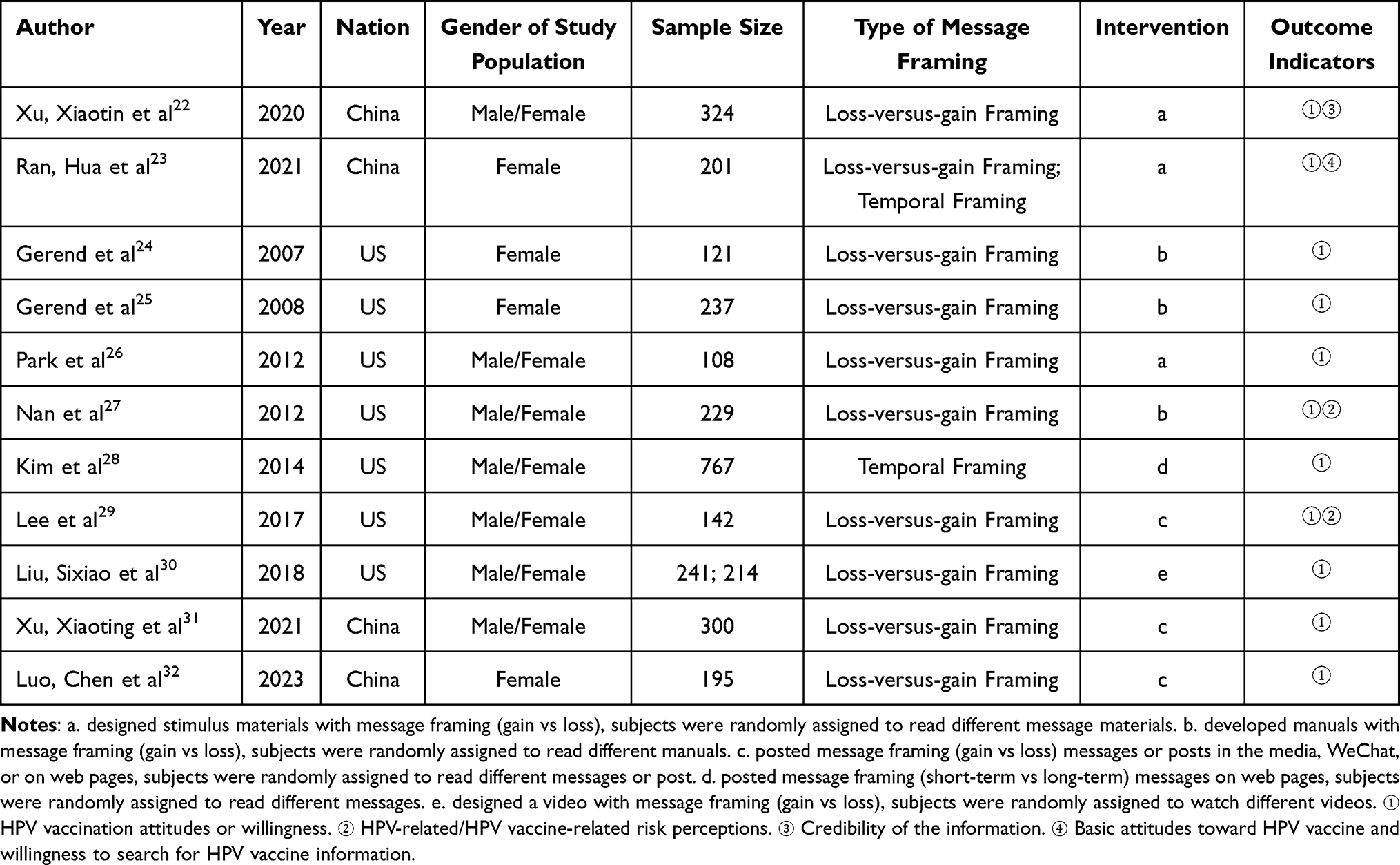 |
Table 1 Basic Characteristics of the Included Literature |
Results
Literature Search Results
Eight databases were searched to obtain a total of 1136 articles, 804 articles remained after duplication, 732 articles were screened by reading the title and abstract, 2 articles were removed without access to the full text, and the full text was read for re-screening, and 11 studies were finally included (9 in English and 2 in Chinese). The steps of the literature search are shown in Figure 1.
 |
Figure 1 The literature search process. |
Types of Message Framing Theory Applications
Loss-versus-Gain Framing
Tversky’s15 study argues that framing effects demonstrate that messages expressed in the form of gains or losses have different effects on behavioral decisions.19 Gain framing emphasizes the benefits or good consequences of accepting a behavior, and loss framing emphasize the losses or bad consequences of rejecting a behavior. The “gain-loss frame” is the most widely used type of message framing, and 10 studies22–27,29–32 have examined the effects of the gain-loss framing on HPV vaccination among undergraduate students.
Temporal Framing
Temporal framing refers to the introduction of time as a reference in information processing, including short-term framing (information about short-term outcomes of behaviors) and long-term framing (information about long-term outcomes of behaviors). The role of temporal framing has been explored in 2 studies.23,28
Interventions
Since the central idea of message theoretical framing is that different expressions of a message can have a different effect on causing an individual to perceive it differently, the included literature all treats the expression of messages such as the relationship between HPV and HPV vaccines, cervical cancer, and knowledge of HPV vaccines differently according to the type of framing selected.
Three studies22,23,26 designed stimulus materials with message framing (gain vs loss); three studies24,25,27 developed manuals with message framing (gain vs loss); four studies28,29,31,32 posted message framing (gain vs loss)/(short-term vs long-term) messages or posts in the media, WeChat, or on web pages; a study30 designed a video with message framing (gain vs loss), and subjects were randomly assigned to read different message materials, manuals, posts, or watch different videos.
Outcome Indicators and Intervention Effects
HPV Vaccination Attitudes or Willingness
Eleven studies22–32 addressed the evaluation of HPV vaccination attitudes or willingness, of which seven studies22–25,29,31 reported that the loss framing would have a better effect on undergraduate students’ willingness to receive HPV vaccination than the gain framing; two studies30,32 concluded that the message framing did not have a significant direct effect on willingness to receive HPV vaccination; three studies26–28 analyzed the effect of message framing in different types of individuals, Park26 found that the effect of message framing differed in people with different levels of risk perception, and loss framing had a positive effect on the vaccination intention of individuals with a high level of risk perception, and the same individuals with a low level of risk perception would reap the effect of a positive effect in the face of gain framing. Nan27 pointed out that among the different types of motivational orientations, the message framing has different effects, for approach-oriented individuals, the gain-loss framing has the same effect and both increase their vaccination intentions; however, for avoidance-oriented individuals, the loss framing has a significantly better effect than the gain framing. Kim28 investigated the effect of Consideration of Future Consequence (CFC) and time framing on HPV vaccination, and the results showed that individuals with high CFC were more likely to be influenced by messages framed in a short-term time frame, whereas individuals with low CFC responded similarly to different time frames.
HPV-Related/HPV Vaccine-Related Risk Perceptions
Two studies27,29 addressed the evaluation of the perceived severity of HPV-related risk. The results of the studies showed that loss framing messages enhanced individuals’ perceived severity of HPV-related messages, and the increase in perceived severity also promoted subjects’ attention to HPV-related messages.
Credibility of the Information
1 study22 reported on ratings of message credibility for the HPV vaccine, which found that Undergraduate students were more credible about message for loss framing than for gain framing, and that they had difficulty believing that HPV vaccination would have an immediate effect, but that they believed that if they did not receive the HPV vaccine, they could experience serious consequences from contracting the HPV virus.
Basic Attitudes Toward HPV Vaccine and Willingness to Search for HPV Vaccine Information
1 study22 showed that long-term framing promotes individuals’ perceptions of vaccine effectiveness and willingness to search for information more than short-term framing.
Discussion
Advantages of Applying Message Framing Theory in HPV Vaccination Among Undergraduate Students
In conjunction with the advent of the Big Data Age, the tide of social informatisation is set to engender a profound and pervasive influence across all facets of our lives. In the current era, with the diversification and convenience of information acquisition channels, the influence of foreign information on individuals has become more and more significant. This information not only enriches our knowledge base, but also shapes our cognition and understanding of related things. When confronted with a significant decision, individuals frequently consult a multitude of sources to assess the advantages and disadvantages, thereby enabling them to make more informed choices. External information can prompt individuals to alter their conduct. As their understanding of matters grows and their decisions evolve, individuals tend to modify their behavioral patterns to adapt to new circumstances and challenges.
In practical application, researchers leverage the message framing theory to optimize the presentation of HPV-related health information. The dual-frame design, incorporating both the gain frame and loss frame, enables targeted communication tailored to distinct population groups.
The gain frame highlights the positive health benefits of HPV vaccination (eg, effective prevention of cervical cancer and other associated diseases), making it suitable for audiences who are more sensitive to potential gains and inclined to pursue positive outcomes. In contrast, the loss frame emphasizes the health risks and losses arising from failure to be vaccinated (eg, an elevated risk of HPV infection and increased susceptibility to related cancers). This frame is more effective at arousing a sense of crisis among individuals who are sensitive to potential losses, thereby prompting them to take preventive actions.
Research findings indicate that the application of message framing theory yields positive effects on HPV vaccination among undergraduate students. In particular, enhanced use of the loss frame can significantly strengthen individuals’ perceived severity of HPV-related risks27,29 and their trust in health information,23 this helps guide undergraduate students to understand HPV, thus keeping them sufficiently vigilant and mindful of the disease, and enabling them to gain a clearer insight into the potential harms of remaining unvaccinated. The heightened risk perception facilitates the development of sound health attitudes among undergraduate students, which in turn encourages them to engage in preventive and protective behaviors in daily life. This psychological motivation directly translates into a stronger willingness to receive HPV vaccination.23–29,31
Compared with the traditional one-way information dissemination model, the message framing theory optimizes the presentation format of HPV-related information. By structuring the information from the perspective of gains or losses, it transforms abstract health knowledge into a more intuitive and understandable form, prompting undergraduate students to actively seek out and learn about HPV-related information—including the precautions for vaccination, the vaccination process, and the potential benefits it may bring.
Therefore, efforts should be stepped up to enhance data integration among universities, hospitals, and disease control departments, so as to systematically track undergraduate students’ awareness, consultation, and vaccination rates regarding the HPV vaccine. It is also essential to analyze how different health communication approaches impact vaccination rates, thereby identifying weak links in information dissemination. Subsequent clinical health education or knowledge dissemination targeting university students should strengthen the application of information theory frameworks. Tailored to diverse student needs, personalized communication should convey the benefits of vaccination or the severe consequences of non-vaccination, establishing a dual-dimensional “gain-loss” message framework. This approach intensifies cognitive impact, heightens awareness of the severity of HPV infection among university students, encourages proactive seeking and understanding of HPV-related health information, guides self-directed health management, ultimately increases HPV vaccination rates among this demographic, and effectively reduces HPV infection rates while preventing HPV-related diseases.
Limitations of the Application of Message Framing Theory in HPV Vaccination Among Undergraduate Students
At present, there are still some shortcomings and limitations in the application of message framing theory: ①Some studies lacked a blank control in their experimental design. For instance, only the gain-loss frame control was set up, and the control of message framing and no message framing was not set up. This, to a certain extent, led to a decrease in the credibility and rigor of the results of the study. ② Most of the current research focuses on the gain-loss frame, and the interaction between the two types of frames, time frame and narrative frame, as well as multiple frame types, needs further investigation. ③The HPV vaccination rate is affected by safety, efficacy, supply, price, awareness of HPV and HPV vaccine, individual personality traits, personal risk perception, parental attitudes and other factors, and the current research has rarely considered the interaction of multiple factors.④Most of the retrieved studies are based on the contexts of China or the United States, with a lack of research findings conducted in other cultural settings.⑤Most of researches have adopted the cross-sectional research method, this research method mainly focuses on the immediate attitude or intention change as the final landing point of the impact of message framing, but this research perspective ignores the complex and continuous process between generating the intention to vaccinate against HPV and actually adopting the behavior of HPV vaccination. In fact, numerous psychological changes, behavioral decisions, and actual actions are involved from the time an individual generates the idea of HPV vaccination to the time he or she finally decides and implements the vaccination behavior. It is a continuous process that involves multiple stages and influencing factors, rather than a simple immediate response. Unfortunately, there is little longitudinal tracking of actual changes in vaccination in current research. This lack of longitudinal tracking prevents us from accurately assessing the true relationship between Message framing-based interventions and actual vaccination rates. Without such in-depth research and data support, it is difficult to make an accurate assessment of the effectiveness of message framing in behavioral interventions for HPV vaccination.
Future Research Directions of the Application of Message Framing Theory in HPV Vaccination Among Undergraduate Students
In view of the limitations in existing studies, targeted improvements should be made in future research. First, in experimental design, beyond expanding research on the application of temporal and narrative frameworks, the inclusion of a blank control group is essential. This will enhance the comprehensive understanding of the message framing theory and strengthen the rigor and reliability of research findings. In terms of participant selection, future studies should conduct more extensive research on populations from diverse cultural backgrounds. Meanwhile, greater attention needs to be paid to the heterogeneity among groups with distinct characteristics, which should be organically integrated with a variety of external factors. In addition, the scope of outcome indicators should be expanded to exclude the confounding effects of external factors on primary results, thereby enabling a more accurate evaluation of the application effects of message framing theory in practical issues such as HPV vaccination. Furthermore, to gain precise insights into how message framing theory influences vaccination behavior, researchers should not be confined to single cross-sectional outcomes. Instead, in-depth investigations into the dynamic process are required, along with the adoption of more comprehensive and meticulous research methods (including longitudinal follow-up). This approach will yield more accurate and holistic data, thereby providing a more scientific basis for the formulation and optimization of relevant intervention strategies.
Conclusions
This study summarises and analyses relevant studies on the application of message framing theory in HPV vaccination among undergraduate students based on the framework of a scoping review. It also identifies the types of message framing theory applications, interventions, outcome indicators, and intervention effects. The application of message framing theory in HPV vaccination among undergraduate students is still in its infancy, and preliminary evidence suggests that it can significantly improve vaccination intention and the perceived level of HPV-related risks among undergraduate students. In the future, emphasis should be placed on monitoring the weak links in HPV-related knowledge promotion. Meanwhile, the application of message framing theory should be strengthened in clinical health education, and the emphasis on gains and losses should be adjusted to meet the psychological needs of different types of student groups. Nevertheless, the number of extant studies is limited, the interventions are constrained, and there is a lack of long-term dynamic outcome indicators. Future research should adopt longitudinal designs and culturally sensitive framing strategies to improve HPV vaccination uptake.
Abbreviations
HPV, Human Papilloma Virus; STD, sexually transmitted disease; CFC, Consideration of Future Consequence.
Data Sharing Statement
The databases used in the study were all open access, and all articles included in this review can be accessed online. All data generated or analysed during this study is included in this article (Table 1).
Author Contributions
All authors made a significant contribution to the work reported, whether that is in the conception, study design, execution, acquisition of data, analysis and interpretation, or in all these areas; took part in drafting, revising or critically reviewing the article; gave final approval of the version to be published; have agreed on the journal to which the article has been submitted; and agree to be accountable for all aspects of the work.
Funding
No funding was received for conducting this study.
Disclosure
The authors declare no conflicts of interest in this work.
References
1. Chesson HW, Dunne EF, Hariri S, Markowitz LE. The estimated lifetime probability of acquiring human papillomavirus in the United States. Sex Transm Dis. 2014;41(11):660–9. doi:10.1097/OLQ.0000000000000193
2. Garolla A, Graziani A, Grande G, Ortolani C, Ferlin A. HPV-related diseases in male patients: an underestimated conundrum. J Endocrinol Invest. 2024;47(2):261–274. doi:10.1007/s40618-023-02192-3
3. Szymonowicz KA, Chen JJ. Biological and clinical aspects of HPV-related cancers. Cancer Biol Med. 2020;17(4):864–878. doi:10.20892/j.issn.2095-3941.2020.0370
4. Wang G, Gu H, Lin F, Hu Y. The analysis of HPV infection of genitals among heterosexual couples. Chin J Gen Pract. 2020;18(10):1691–1694.
5. de Martel C, Georges D, Bray F, Ferlay J, Clifford GM. Global burden of cancer attributable to infections in 2018: a worldwide incidence analysis. Lancet Glob Health. 2020;8(2):e180–e190. doi:10.1016/S2214-109X(19)30488-7
6. Human papillomavirus and cancer. 2025.
7. Sung H, Ferlay J, Siegel RL, et al. Global cancer statistics 2020: GLOBOCAN estimates of incidence and mortality worldwide for 36 cancers in 185 countries. CA Cancer J Clin. 2021;71(3):209–249. doi:10.3322/caac.21660
8. Xu T, Zhan X, He X, Wu J. Disease durden of ceivical cancer in belt and road surrounding countries in 2018. Chin J Public Health. 2023;39(10):1311–1314.
9. Serrano B, Brotons M, Bosch FX, Bruni L. Epidemiology and burden of HPV-related disease. Best Pract Res Clin Obstet Gynaecol. 2018;47:14–26. doi:10.1016/j.bpobgyn.2017.08.006
10. Meites E, Kempe A, Markowitz LE. Use of a 2-dose schedule for human papillomavirus vaccination - updated recommendations of the advisory committee on immunization practices. MMWR Morb Mortal Wkly Rep. 2016;65(49):1405–1408. doi:10.15585/mmwr.mm6549a5
11. Wang S, Yan H, Ren W, Zhao F, Qiao Y. Progress in cervical cancer prevention and control in China. Chin Preventive Med. 2023;24:1–7.
12. Immunization coverage. 2025.
13. Burki T. Continued suboptimal HPV vaccine coverage in the USA. Lancet Oncol. 2024;25(10):1257. doi:10.1016/S1470-2045(24)00394-2
14. Chen Y, Su D. Research progress on HPV vaccination willingness, vaccination rate and influencing factors of female college students in China. Chin J Sch Health. 2023;1–5.
15. Tversky A, Kahneman D. The framing of decisions and the psychology of choice. Science. 1981;211(4481):453–458. doi:10.1126/science.7455683
16. Chen J, Nie H. Information framing effect of public policy dissemination on short video platforms: a video content analysis and experimentation based on the “double reduction”policy. Document Inform Knowledge. 2023;1–11.
17. Poggio R, Prado C, Santero M, et al. Effectiveness of financial incentives and message framing to improve clinic visits of people with moderate-high cardiovascular risk in a vulnerable population in Argentina: a cluster randomized trial. Prev Med. 2021;153:106738. doi:10.1016/j.ypmed.2021.106738
18. Paragas EDJ, Barcelo TI. Effects of message-framed informational videos on diabetes management knowledge and self-efficacy. Int J Nurs Pract. 2019;25(4):e12737. doi:10.1111/ijn.12737
19. Yang M, Zhao Y, Song S, Zhu Q. Origin, application, and development of message framing theory in foreign health behavior research. J Chin Soc Scientific Tech Inform. 2020;39:662–674.
20. Tricco AC, Lillie E, Zarin W, et al. PRISMA extension for scoping reviews (PRISMA-ScR): checklist and explanation. Ann Intern Med. 2018;169(7):467–473. doi:10.7326/M18-0850
21. Peters M, Marnie C, Tricco AC, et al. Updated methodological guidance for the conduct of scoping reviews. JBI Evid Implement. 2021;19(1):3–10. doi:10.1097/XEB.0000000000000277
22. Xiaoting X, Tingting Z, Qinghua Z. Research on the impact of message framing on HPV vaccination in online health vommunities: a mediation of message credibility. Library Inform. 2020;(5):39–47.
23. Ran H, Geng S. Future-minded adventurers: an experimental study of health-related message framing on women’s attitudes and willingness toward adopting HPV vaccination. Journalism Res. 2021;(2):85–102.
24. Gerend MA, Shepherd JE. Using message framing to promote acceptance of the human papillomavirus vaccine. Health Psychol. 2007;26(6):745–752. doi:10.1037/0278-6133.26.6.745
25. Gerend MA, Shepherd JE, Monday KA. Behavioral frequency moderates the effects of message framing on HPV vaccine acceptability. Ann Behav Med. 2008;35(2):221–229. doi:10.1007/s12160-008-9024-0
26. Park S. The effects of message framing and risk perceptions for HPV vaccine campaigns: focus on the role of regulatory fit. Health Market Quart. 2012;29(4):283–302. doi:10.1080/07359683.2012.732847
27. Nan X. Communicating to young adults about HPV vaccination: consideration of message framing, motivation, and gender. Health Commun. 2012;27(1):10–18. doi:10.1080/10410236.2011.567447
28. Kim J. The impact of consideration of future consequences and temporal framing on acceptance of the HPV vaccine. 2014.
29. Lee MJ, Cho J. Promoting HPV vaccination online: message design and media choice. Health Promot Pract. 2017;18(5):645–653. doi:10.1177/1524839916688229
30. Liu S, Yang JZ, Chu H, Sun S, Li H. Different culture or different mind? Perception and acceptance of HPV vaccine in China and in the US. J Health Commun. 2018;23(12):1008–1016. doi:10.1080/10810730.2018.1536729
31. Xu X, Yang M, Zhao YC, Zhu Q. Effects of message framing and evidence type on health information behavior: the case of promoting HPV vaccination. ASLIB J Inf Manag. 2021;73(1):63–79. doi:10.1108/AJIM-02-2020-0055
32. Luo C, He Y, Xu Y, Yang X, Wang H, Yang T. How does loss-versus-gain message framing affect HPV vaccination intention? Mediating roles of discrete emotions and cognitive elaboration. Curr Psychol. 2023;1–13. doi:10.1007/s12144-023-04382-x
 © 2026 The Author(s). This work is published and licensed by Dove Medical Press Limited. The
full terms of this license are available at https://www.dovepress.com/terms
and incorporate the Creative Commons Attribution
- Non Commercial (unported, 4.0) License.
By accessing the work you hereby accept the Terms. Non-commercial uses of the work are permitted
without any further permission from Dove Medical Press Limited, provided the work is properly
attributed. For permission for commercial use of this work, please see paragraphs 4.2 and 5 of our Terms.
© 2026 The Author(s). This work is published and licensed by Dove Medical Press Limited. The
full terms of this license are available at https://www.dovepress.com/terms
and incorporate the Creative Commons Attribution
- Non Commercial (unported, 4.0) License.
By accessing the work you hereby accept the Terms. Non-commercial uses of the work are permitted
without any further permission from Dove Medical Press Limited, provided the work is properly
attributed. For permission for commercial use of this work, please see paragraphs 4.2 and 5 of our Terms.