
Back to Journals » Advances in Medical Education and Practice » Volume 17
Application of Artificial Intelligence in Education of Prosthodontics and Implant Dentistry: A Review
Authors Gan Y  , Guo J, Zhai J , Huang J
Received 9 October 2025
Accepted for publication 20 January 2026
Published 13 February 2026 Volume 2026:17 573041
DOI https://doi.org/10.2147/AMEP.S573041
Checked for plagiarism Yes
Review by Single anonymous peer review
Peer reviewer comments 3
Editor who approved publication: Dr Md Anwarul Azim Majumder
Yeitian Gan,* Jiawen Guo,* Jirui Zhai, Jingyan Huang
Department of Prosthodontics, Hospital of Stomatology, Guanghua School of Stomatology, Sun Yat-sen University, Guangdong Provincial Key Laboratory of Stomatology, Guangzhou, 510055, People’s Republic of China
*These authors contributed equally to this work
Correspondence: Jingyan Huang, Email [email protected]
Objective: This review evaluates the specific applications of Artificial Intelligence (AI) in prosthodontic and implant dentistry education, and discusses related educational challenges.
Data and Sources: Searches in PubMed, Scopus, Wiley and Web of Science used targeted keywords including artificial intelligence, prosthodontics, education, implant dentistry, virtual simulation, and combinations of the keywords.
Study Selection: We included 213 articles focusing exclusively on AI applications in prosthodontic and implant dentistry education, covering theoretical learning, skill training, and clinical practice.
Results: The review identified key AI applications: 1) Generative AI enhancing theoretical learning on Prosthodontics and Implant Dentistry for students and faculty; 2) AI-powered simulators and assessment tools improving laboratory and clinical skill training of Prosthodontics and Implant Dentistry. 3) Critical challenges regarding academic integrity, algorithmic bias, and data privacy were also highlighted.
Conclusions: AI offers transformative potential in medical education and translation by enhancing skill acquisition and assessment. Addressing the ethical and practical challenges is essential for its successful and responsible integration into the curriculum.
Keywords: artificial intelligence, education, prosthodontics, implant dentistry
Introduction
Artificial Intelligence (AI) represents a rapidly advancing interdisciplinary field, specifically integrating computer science, neuroscience, cognitive psychology, and engineering to emulate or reproduce human cognitive functions, such as perception, reasoning, learning, and decision-making. Broadly defined, AI refers to the capacity of digital computers or computer-controlled systems to perform tasks traditionally associated with intelligent biological beings; consequently, it encompasses both software and hardware methodologies aimed at replicating human-like behavior and thought processes.1 Various AI systems are designed to perform specific functions with high precision and have been widely adopted across various domains, including healthcare and education.
At the core of AI lie several key subfields that have direct implications for medical and dental education. First and foremost, Machine Learning (ML), a foundational component of AI, enables systems to learn from data and improve performance without being explicitly programmed, and has been employed in diagnostic modeling, adaptive learning environments, and more recently, personalized education platforms.2 Parallel to this, Natural Language Processing (NLP) allows machines to understand and generate human language, supporting the development of intelligent tutoring systems and clinical documentation tools.3 In the same vein, Computer Vision empowers systems to interpret visual data and has been instrumental in analyzing medical images, assessing dental radiographs, and supporting image-based training modules.4 Robotics, another vital area, facilitates autonomous interaction with the environment and has been integrated into simulation-based education, particularly in surgical and procedural training.5 Finally, planning and expert systems contribute to decision support and problem-solving, simulating expert-level reasoning in clinical education.6
In addition to these subfields, several enabling technologies serve as the technical foundation for AI applications. To begin with, Artificial Neural Networks (ANNs), inspired by the structure of the human brain, process complex data patterns and are widely used in diagnostic support and performance analytics.7 Knowledge graphs enhance the organization and retrieval of structured knowledge in clinical learning environments. Virtual reality (VR) technologies create immersive educational experiences that replicate real-world clinical settings, allowing students to develop procedural skills in a controlled, risk-free environment.8 Similarly, remote virtual digitalization techniques support distant learning through interactive, high-fidelity simulations. Lastly, Deep Learning, a specialized branch of ML, enables the modeling of highly complex tasks through multi-layered neural networks.9
Taken together, the convergence of these technologies has significantly influenced the evolution of medical education, particularly within the field of oral medicine. AI has introduced transformative changes in the way dental students acquire clinical knowledge, develop diagnostic and procedural skills, and engage with both instructors and digital learning environments. As such, an increasing number of studies have explored the role of AI-driven tools—ranging from VR-based surgical simulations to intelligent robotic trainers—in enhancing the quality, efficiency, and accessibility of dental education.10
AI in the education of prosthodontics and implant dentistry is no exception. While AI already offers broad support in oral medicine education, its specialized role in teaching technical skills within prosthodontics and implant dentistry has recently gained significant momentum. Nevertheless, a notable gap remains in the comprehensive assessment of AI applications tailored to this subfield. Specialized implications include, but are not limited to:
- Automated crown and bridge design including automatic margin-line extraction and CAD/CAM optimization),11
- Detection and classification of restorations and marginal defects,12
- Prediction of restoration failure and material selection,13
- Prosthetically driven implant planning and 3D implant placement,
- Automated detection and quantification of peri-implant bone loss or peri-implantitis on radiographs,14
- Classification of implant systems from radiographic images,15
- Prediction of implant success or failure.13
By systematically examining these areas, this review seeks to provide a foundational overview and identify future directions for AI-driven educational innovation in prosthodontics and implant dentistry.
Materials and Methods
This paper presents a literature analysis and a systematic review following the newest updated guideline from the Preferred Reporting Items for Systematic Reviews.
(PRISMA) 2020 statement.16 The search was conducted on PubMed, Wiley Online Library, Web of Science, and Scopus databases. In addition, a manual search was performed.
The search strategy was developed using specific keywords and Boolean operators to combine terms effectively. The primary search terms included “Artificial Intelligence”, “Deep Learning”, “Machine Learning”, “Neural Networks”, “virtual reality”, “VR”, “Prosthodontics”, “Dental Implants”, “Implantology”, “education” “teaching”, and “training”. These terms were combined using Boolean operators (AND/OR) to refine the results and target studies addressing the application of AI in education of prosthodontics and implant dentistry. For example, the following search string was used: (“Artificial Intelligence” OR “Deep Learning” OR “Machine Learning” OR “Neural Networks”) AND (“Prosthodontics” OR “Dental Implants” OR “Implantology”) AND (“education” OR “teaching”). The search strategy was tailored to the indexing protocols of each database to ensure comprehensive coverage.
The literature search was performed on 30 June 2025. All titles and abstracts that evaluated the application of AI-based tools in education of prosthodontics and implant dentistry were reviewed.
Research questions:
- What is the quantity per year of publications focused on AI utilization in education of prosthodontics and implant dentistry in the past decade?
- What qualitative patterns and proportional distributions characterize AI-related publications in prosthodontics and implant dentistry education during the past decade?
This paper performs both quantitative and qualitative assessments of AI publications in education of prosthodontics and implant dentistry in the past decade. The inclusion criteria were original research studies and literature reviews published in past decade in English that evaluated or reviewed the application of AI-based tools in education of prosthodontics and implant dentistry. Letters to editors, non-English publications, and articles with inaccessible full-text papers were excluded from the review.
Two reviewers independently screened titles and abstracts of all studies retrieved from the search mentioned above strategy. The abstracts of the full-text articles were examined based on their relevance and eligibility for inclusion. Reasons for exclusion during full-text screening included (1) lack of focus on education of prosthodontics or implant dentistry, (2) absence of AI-specific analysis, and (3) inaccessible full-text articles. Following this, full-text screening was performed by one of the independent reviewers and assessed by another reviewer. Disagreements between reviewers were resolved by discussion. In addition, a manual search was conducted to seek additional articles for inclusion.
Results
Publication Trends of the Literature on Application of Artificial Intelligence in Education of Prosthodontics and Implant Dentistry
A total of 213 studies addressing the application of artificial intelligence in prosthodontics and implant dentistry education were identified across four major databases (PubMed, Web of Science, Scopus, and Wiley Online Library) according to the PRISMA flow (Figure 1). The annual publication trend from 2015 to 2025 demonstrated a progressive increase (Figure 2A). No eligible studies were published in 2015, and only limited outputs were observed from 2016 to 2018 (2, 1, and 3 studies, respectively). A moderate rise was noted in 2019 and 2020 (6 and 8 studies). A substantial escalation occurred from 2021 onward, with annual publications increasing to 27 in 2021, 36 in 2022, and 43 in 2023. The number peaked in 2024 (47 studies) followed by a slight decrease in 2025 (40 studies). Overall, the trend indicates a marked and sustained growth in research activity related to AI-supported education in prosthodontics and implant dentistry over the past decade.
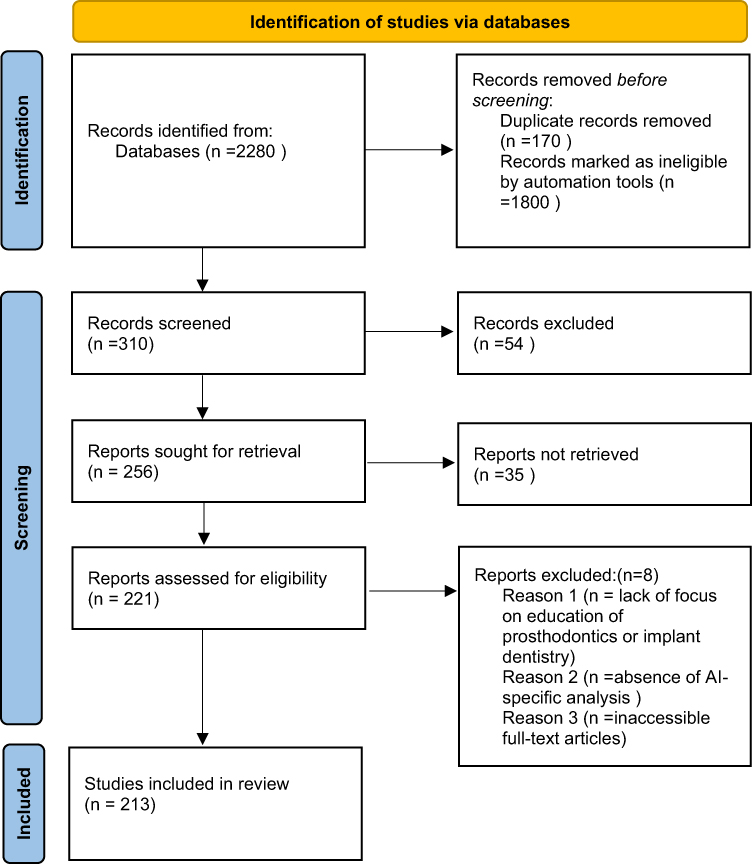 |
Figure 1 The PRISMA flow identifying studies on application of AI-assisted education of prosthodontics and implant dentistry via databases. |
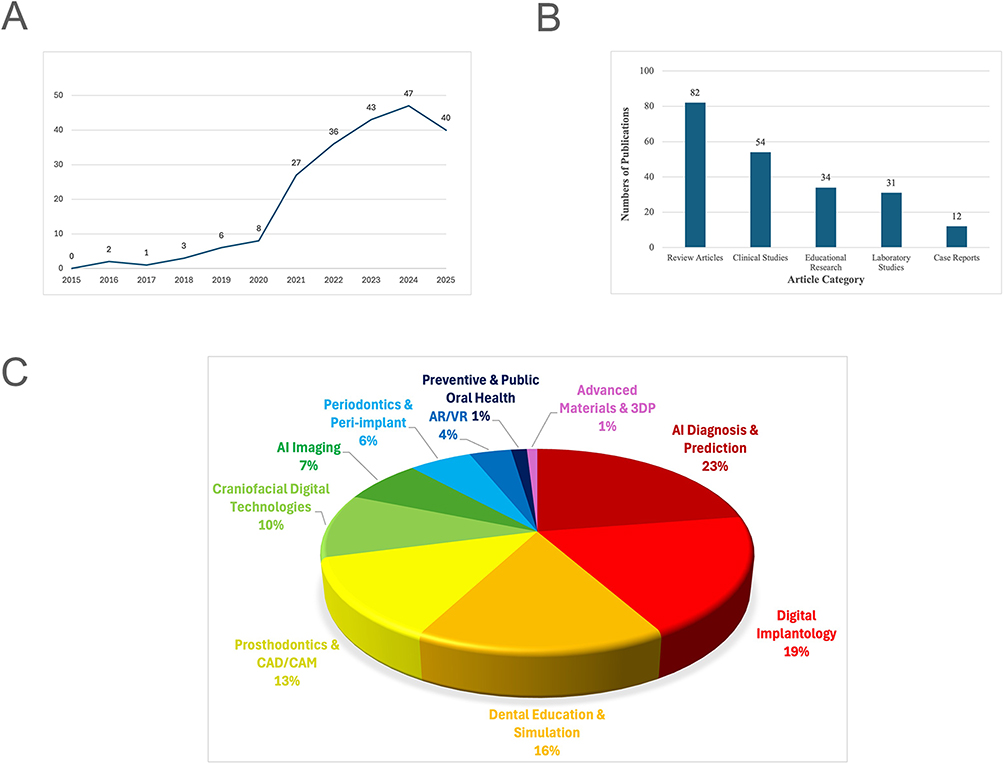 |
Figure 2 Publication trend and landscape of the literature on application of artificial intelligence in education of prosthodontics and implant dentistry. (A) Annual counts of publications on the application of artificial intelligence in prosthodontics and implant dentistry education (2015–2025). (B) article category of included studies by in artificial intelligence applications in prosthodontics and implant dentistry education (2015–2025). (C) research domain of included studies by in artificial intelligence applications in prosthodontics and implant dentistry education (2015–2025). |
Publication Landscape of the Literature on Application of Artificial Intelligence in Education of Prosthodontics and Implant Dentistry
Across the included studies, clear differences were observed in the types of evidence contributing to AI-related research in prosthodontics and implant dentistry education (Figure 2B). Review articles comprised the largest proportion (n = 82), reflecting increasing efforts to consolidate existing knowledge and assess the implications of AI technologies for clinical training and digital workflows. Clinical studies accounted for 54 publications, representing a growing body of real-world evidence evaluating AI-assisted diagnosis, treatment planning, and implant-related clinical outcomes. Educational studies totaled 34 publications, indicating expanding use of AI-supported teaching methods, simulation-based training, and digital competency development within prosthodontics and implant education. Laboratory studies (n = 31) primarily focused on algorithm development, model validation, and performance testing under controlled conditions. Case reports were least common (n = 12), generally describing isolated or novel applications of AI tools in complex clinical scenarios. Overall, the distribution reflects a diverse but maturing research landscape, with increasing emphasis on clinical implementation, educational innovation, and structured evidence synthesis.
The thematic focus of AI applications also varied considerably (Figure 2C). Diagnosis and prediction comprised the largest domain (n = 48), followed by digital implantology (n = 41). Studies on dental education and simulation (n = 34), prosthodontics/CAD–CAM technologies (n = 28), and craniofacial digital applications (n = 22) represented additional core areas of development. Smaller domains—including AI-based imaging (n = 15), peri-implant/periodontal applications (n = 12), AR/VR-assisted training (n = 8), preventive/public oral health (n = 3), and advanced materials or 3D printing (n = 2)—were grouped as emerging fields with limited representation. Collectively, these patterns indicate that recent research has concentrated predominantly on diagnostic modeling, implant-oriented AI systems, and educational innovation.
The following sections present a detailed analysis of AI applications in prosthodontics and implant dentistry education from the last ten years. The review is structured along the educational continuum, examining developments in theoretical learning, laboratory-based training, and clinical-stage instruction through both quantitative and qualitative lenses.
Literature Analysis of AI-Assisted Theoretical Learning in Prosthodontics and Implantology
With the rapid advancement of information technology, web-based remote virtual instruction has gradually emerged as a significant component in prosthodontics education, serving as a crucial supplement to traditional teaching method. In recent years, the integration of emerging technologies such as artificial intelligence (AI), virtual reality (VR), and augmented reality (AR) has further enhanced the effectiveness and experience of remote virtual teaching. These technologies have not only enriched educational resources but also provided students with more flexible, personalized, and efficient learning approaches.17
In the field of prosthodontics, web-based remote virtual instruction helps students improve their theoretical knowledge and diagnostic abilities by simulating clinical operation environments and enabling practice in virtual settings. Moreover, this teaching model can offer personalized learning paths and feedback based on students’ progress and performance, thereby further enhancing learning outcomes.18
However, despite the great potential of web-based remote virtual instruction in prosthodontics education, its application still faces challenges such as technological costs, operational complexity, and students’ adaptation to virtual environments.19 Therefore, an in-depth exploration of the application effects of web-based remote virtual instruction in prosthodontics and its impact on student learning is of great significance for optimizing teaching models and improving teaching quality.20
The web-based remote virtual teaching platform provides students with abundant learning resources, including online courses, teaching videos, and virtual simulation operations. These resources not only cover the professional theoretical knowledge of prosthodontics but also provide detailed steps and skills for clinical operations, helping students better understand and master the course content.21
Moreover, Reissmann et al17 indicated that web-based remote virtual teaching enables students to study according to their own schedules, free from the time and location constraints of traditional classroom teaching. This flexibility helps students better balance study and life and improve learning efficiency. Through virtual simulation operations, students can practice clinical operations in a virtual environment, such as tooth preparation and denture fabrication. Virtual simulation systems can provide real-time feedback, helping students promptly identify and correct issues in their operations, thereby enhancing their clinical skills.18 This personalized learning approach helps students better grasp knowledge and improve learning outcomes.
In addition to structured online learning systems, AI-driven conversational agents such as ChatGPT have emerged as powerful tools in supporting fragmented, on-demand learning within health professions education. These intelligent chatbot platforms allow students to engage in microlearning by accessing brief, context-specific answers to clinical questions, enabling timely clarification of concepts and facilitating continuous, self-directed knowledge acquisition across diverse learning environments. This form of just-in-time learning aligns with cognitive theories of active recall and spaced repetition, both of which are critical for deep learning and long-term retention in complex disciplines such as prosthodontics and implantology.
Recent studies have demonstrated the potential of large language models (LLMs) like ChatGPT in medical and dental education. For instance, Rahad et al22 explored the utility of ChatGPT in dental education at Meharry Medical College, finding that ChatGPT could assist in dental essay writing and generate relevant content for dental students, highlighting its potential as a supplementary educational tool. Similarly, Danesh et al23 evaluated ChatGPT’s performance on the American Academy of Periodontology In-Service Examination, revealing that ChatGPT-4 correctly answered 73.6% of the questions, indicating its capacity to support knowledge acquisition in periodontology.
Furthermore, a study by Eroğlu Çakmakoğlu (2023)24 discussed the role of ChatGPT in dental education, emphasizing its ability to simplify complex concepts and terminologies into more comprehensible elements, thereby enhancing students’ understanding and communication skills. These findings suggest that AI chatbots like ChatGPT can serve as effective tools for fragmented learning in dental education, providing immediate, context-specific information that enhances students’ understanding and retention of complex theoretical content. Building on this potential, recent discussions have also highlighted how generative AI can extend its impact beyond students, supporting both learners and faculty in diverse educational contexts.
Literature Analysis of AI-Assisted Laboratory-Stage-Training in Prosthodontic and Implantology Skills
With the increasing demand for dental treatment, the professional competence, clinical training, and experience accumulation of dental students are becoming increasingly important. Indeed, the efficacy of dental treatment typically depends on the clinical skills of the practitioners. Although traditional simulation manikins can assist in training the clinical skills of dental students, however, the current simulation manikins consist only of simple functional head regions and tooth arrangements, which have gaps compared to real patients. To address this, some specially designed software programs, like ColorMapEditor and 3Shape Dental System, can connect two-dimensional images to create three-dimensional tooth models. Through this software, multiple aspects of the teeth, including color, volume, shape, and density, can be modified to create various types of virtual teeth. Moreover, ColorMapEditor offers unlimited possibilities for adjustment and addition of options to optimize virtual teeth, allowing them to practice as much as needed. Furthermore, virtual teeth can be made in any shape and with any type of pathology. Further development of software and hardware technologies is necessary to improve the coloring and shaping capabilities of the pulp chamber interior and tooth surface, not only for treatment but also for diagnosis, thereby creating higher fidelity.25 Similarly, Lao Zhentao et al obtained three-dimensional morphological data of the dental arches and gingiva of patients with anterior tooth restorations using a 3Shape intraoral scanner. They then created diagnostic models in conjunction with digital aesthetic design (DSD). The tooth preparation training was carried out via the Simodont virtual simulation system, with assessments conducted according to a grading standard. The results indicated that the quality of tooth preparation among students was significantly enhanced, with improved scores post-training, increased accuracy in clinical operations, and reduced procedural time.26
Furthermore, virtual reality (VR) technology, utilizing multisensory feedback to create real-time, simulated virtual operating environments, inherently offers significant advantages for the teaching of clinical operations. VR technology uses computer technology to generate digital environments similar to real environments in terms of vision, hearing, touch, and other senses. Subsequently, operators use specialized equipment to interact with virtual objects and instantly receive feedback from them, redefining the virtual reality dental simulator and demonstrating its concurrent validity in clinically relevant assessment and feedback.27 In addition, the rapid development of virtual environment technology has brought new opportunities to the medical field. Created and processed by computers, with specialized equipment such as helmet displays and haptic joysticks, users can observe scenes and interact with them while experiencing multisensory feedback, thereby achieving nearly realistic training effects.28
Within the field of dentistry alone, several VR-based training systems have been developed for educational purposes, including the DentSim system, the Virtual Education System for Dentistry,29 and the Individual Dental Education Assistant system.30 Collectively, these systems leverage advanced VR and haptic technologies to provide immersive and interactive learning experiences, enhancing students’ clinical skills and knowledge. Eve et al found that a 3D immersive haptic simulator, which combines 3D virtual reality with haptic feedback, effectively evaluates and enhances the clinical skills of dental students and prosthodontic residents by simulating complex procedures like implant placement and restorative surgeries, providing real-time feedback on precision, efficiency, and technique. It can distinguish between different clinical skill levels and provide valuable feedback to help them improve their performance.31
Nevertheless, for dental students, mastering clinical skills alone is insufficient; equally important is the development of clinical reasoning. Clinical reasoning refers to the cognitive process through which healthcare professionals diagnose and manage emergent or complex symptoms in clinical settings. Developing clinical reasoning is crucial for enhancing the clinical competence of medical students. By integrating medical theory with clinical practice, students analyze comprehensive patient information, including medical history, practical procedures, and laboratory results, to make precise differential diagnoses. The Nanjing University School of Medicine, affiliated with the Nanjing Stomatological Hospital, has pioneered the use of virtual standardized patients (SPs). This technology employs virtual reality to accurately simulate patient conditions and positive clinical signs, allowing students to engage in key diagnostic and treatment procedures in a virtual environment. As a result, the implementation of this system has proven to be highly effective, significantly enhancing students’ clinical reasoning abilities.32 In restorative education, letting students design their own treatment plans on a virtual patient sharpens clinical reasoning, planning, risk assessment, and decision-making. Unlike the traditional “see one, do one” model, the VP offers a zero-risk, repeatable, and metrics-driven environment where multiple schemes can be trialed, compared, and refined within seconds, creating a tight design-feedback-iteration loop.33
Furthermore, Ceylan et al34 have found that AI-driven intelligent dialogue models can facilitate more effective communication between doctors and patients. These models can answer patients’ questions regarding treatment plans, expected outcomes, and costs, thereby enhancing patient satisfaction and trust. AI chatbots can engage in real-time conversations with patients, explaining the steps and expected results of restorative treatments, helping patients better understand their treatment plans and, consequently, alleviating their anxiety and doubts.
For novice prosthodontists, tooth preparation for crown and bridge restorations is highly challenging. The key difficulty lies in minimizing damage to healthy tooth structure while creating adequate space for the restoration. In vitro tests have demonstrated that clinicians using mechatronic systems achieve a 53% improvement in positioning accuracy compared to those not using such systems. However, clinical validation of these systems has yet to be conducted.35 Yuan et al36,37 introduced a robotic system for tooth preparation, which comprises the following hardware components: (a) a dental fixture that connects the target tooth to the robotic tool and shields adjacent teeth from laser cutting; (b) a 6-degree-of-freedom robotic arm; (c) an efficient low-heat laser suitable for hard tissue preparation; (d) CAD/CAM software for generating the 3D motion path of the laser and designing the preparation shape; and (e) an intraoral scanner for acquiring the 3D information of the relevant teeth. A system equipped with micro-robots and a tunable picosecond laser device has demonstrated tooth preparation accuracy that meets clinical requirements, with an error of approximately 0.089 ± 0.026 mm.37 Another robotic system, when compared with human clinicians in crown preparation, exhibited an average repeatability of about 40 µm, outperforming human clinicians.38
The application of robotic systems in tooth preparation has shown significant advantages in terms of precision and repeatability, holding promise as a powerful tool for clinicians, especially in enhancing the operational skills of novice practitioners. Nevertheless, further clinical validation is still required to ensure their effectiveness and safety in practical applications.
Through these applications, artificial intelligence provides comprehensive support for novice prosthodontists, ranging from treatment plan design to risk prediction, from the colorimetry and morphology of restorations to material selection, and from imaging analysis to the application of intelligent devices (Figure 3). AI technology significantly enhances the efficiency and accuracy of clinical operations for novice prosthodontists.
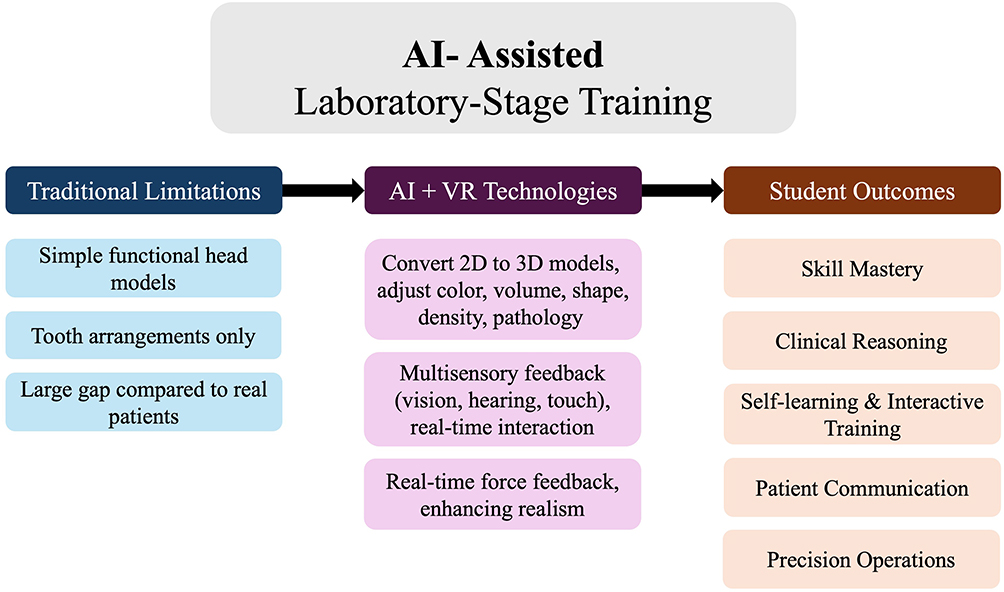 |
Figure 3 AI-assisted laboratory-stage training. |
Literature Analysis of AI-Assisted Clinical-Stage Skill Practice
In the contemporary realm of dentistry, artificial intelligence (AI) and robotic technologies have progressively emerged as pivotal forces in transforming clinical practice. Particularly within the domain of prosthodontics, the application of AI has not only enhanced the precision of diagnostics and treatment but also furnished novice clinicians with robust supportive tools. Because prosthodontics encompasses intricate clinical procedures, such as dental restoration, implant placement, and aesthetic design, all of which demand a high degree of accuracy and extensive experience. However, novice clinicians, when confronted with complex clinical scenarios, often lack the requisite experience to formulate optimal treatment plans. It is in such contexts that AI technologies can play a crucial role by providing evidence-based decision-making support through data analysis and intelligent algorithms, thereby assisting them in better addressing clinical challenges.
To illustrate, Karnik et al39 have indicated that artificial intelligence (AI) algorithms are capable of creating personalized treatment plans by analyzing patients’ clinical records, diagnostic images, and specific characteristics. These algorithms employ machine learning and data mining techniques to identify patterns and correlations within large datasets, thereby determining the optimal treatment plan for each patient. For instance, AI can take into account the patient’s oral health status, aesthetic preferences, functional requirements, and anatomical concerns to generate a customized prosthodontic solution. Bernauer et al40 have demonstrated that AI can analyze patients’ medical histories, oral health status, and treatment plans to predict potential complications and risks. For example, by assessing patients’ bone density, alveolar bone conditions, and occlusal forces, AI can predict the risk of implant failure and provide corresponding recommendations for novice prosthodontists. Shetty et al41 have proposed that AI systems can provide precise color matching by analyzing the optical properties of teeth. These systems utilize machine learning algorithms to learn from extensive datasets of tooth color information, thereby selecting the most suitable prosthesis color for each patient. For example, AI-driven shade-matching systems can obtain three-dimensional color information of teeth via intraoral scanners and compare it with the colors in the database to generate prostheses that are highly consistent with the color of natural teeth. Joda et al42 have found that AI-assisted CAD/CAM software can analyze intraoral scan data to generate precise prosthesis shape designs. Additionally, these software programs employ deep learning algorithms to design prostheses that are highly consistent with the shape of natural teeth, based on the patient’s dental arrangement and occlusal conditions, ensuring the aesthetics and functionality of the prosthesis.
Lerner et al43 have also suggested that AI can recommend the most suitable materials based on the patient’s oral environment and restorative requirements. For instance, AI can analyze the patient’s occlusal force, oral pH, and allergy history to select the most appropriate restorative materials (such as zirconia, lithium disilicate, etc). For anterior restorations that require high translucency and aesthetic outcomes, AI recommends the use of lithium disilicate materials; for posterior restorations, considering the higher occlusal forces, AI suggests the use of stronger materials like zirconia. Complementarily, Gerhardt et al44 have pointed out that AI algorithms can automatically detect and label teeth and small edentulous regions in CBCT images. These algorithms, utilizing Convolutional Neural Networks (CNNs), are capable of rapidly and accurately identifying dental structures and bone conditions. In other words, AI systems can automatically mark the positions of teeth and edentulous areas on CBCT images, assisting novice prosthodontists in quickly devising restorative plans and reducing the time and errors associated with manual marking.
The optical properties of ceramic materials used in dental restorations are influenced by a multitude of complex factors. For medical students, mastering clinical procedures is essential, but the ability to accurately assess the properties of ceramic materials is equally important. The intricate nature of these factors and their cumulative effects on optical properties necessitate the use of advanced tools for precise evaluation. Artificial intelligence (AI) models thus offer significant support in this regard, providing enhanced computational and judgment capabilities for determining the factors that influence the optical properties of ceramic materials in dental restorations.
Concretely, in terms of material characteristics, AI models can analyze how the composition and microstructure of ceramic materials affect their optical properties. For instance, optical parameters such as refractive index, translucency, and color can be predicted and optimized using machine learning algorithms. Moreover, AI is also capable of evaluating the impact of the thickness and layering of ceramic materials on optical performance. Research has shown that the thickness of ceramic layers, the color of the bonding agent, and the color of the underlying tooth all influence the color and translucency of porcelain veneers.45 Furthermore, AI models can consider environmental factors, such as lighting conditions and the color of surrounding tissues, to provide a comprehensive assessment of how ceramic materials will perform in the oral cavity.46
Critically, AI models excel in shade matching, thereby offering more accurate tooth color matching than traditional visual assessment methods.47 This is particularly crucial for the aesthetic outcomes of dental restorations, especially in cases involving complex colors and structures. Through deep learning, AI can predict the aesthetic outcomes of different ceramic materials in the oral environment, aiding clinicians in selecting the most suitable materials for their patients. Finally, based on extensive experimental data, AI models can also predict the optical properties of ceramic materials and assess their suitability for dental restorations. For example, machine learning models can be used to predict the flexural strength of CAD/CAM resin materials and identify the factors that influence it.48 In summary, AI models can recommend the most appropriate ceramic materials based on individual patient characteristics, such as tooth color and oral environment, thereby enhancing the satisfaction with the restoration outcomes.
Recent studies have indeed demonstrated the utility of deep learning models in predicting the risk of implant failure. For instance, Huang et al developed an ensemble model that integrates clinical variables with radiographic imaging features to predict implant loss within five years. Their model achieved an area under the receiver operating characteristic curve (AUC) of 0.90, outperforming models based solely on clinical data (AUC = 0.72).49
Furthermore, Nazari et al highlighted the ability of AI models to incorporate individualized patient parameters—such as bone density, implant positioning, and systemic health conditions—offering personalized predictions of implant success and thus enhancing treatment planning and long-term outcomes.50
Systematic reviews also support the effectiveness of AI in implant prognosis. A recent meta-analysis of 13 studies concluded that AI algorithms exhibited high diagnostic performance, with sensitivity and specificity ranging from 67% to 95% and 78% to 100%, respectively, while significantly reducing the time required for analysis.12
In addition to complications, AI also plays a role in predicting the functional lifespan of dental prostheses. For example, Cheng et al utilized a BP neural network to predict facial deformation after complete denture prosthesis, achieving a mean prediction error of 22.49% in the Z direction, indicating the potential of AI to efficiently and accurately assess the biomechanical and aesthetic outcomes of prosthodontic interventions.51
Recent studies have demonstrated the high clinical accuracy of robot-assisted dental implant systems (rCAIS) and dynamic navigation systems. Liu et al reported that, in partially edentulous patients, rCAIS achieved median deviations of 0.62 mm at the coronal and apical positions and 1.16° in angular deviation, indicating precise implant placement.52 A systematic review and meta-analysis by Luo et al further confirmed that robotic systems offer high implant accuracy with greater stability compared to dynamic navigation systems.53 In parallel, Zhang et al found that dynamic navigation systems outperformed freehand surgery in coronal, apical, and angular deviations, while showing comparable accuracy to static surgical guides, making them suitable for clinical teaching and complex cases.54
Taken together, the integration of AI into clinical prosthodontic and implant training supports data-driven decision-making, enables personalized treatment strategies, and enhances the precision of prognosis (Figure 4). These technologies are poised to become indispensable tools in modern dental education and practice.
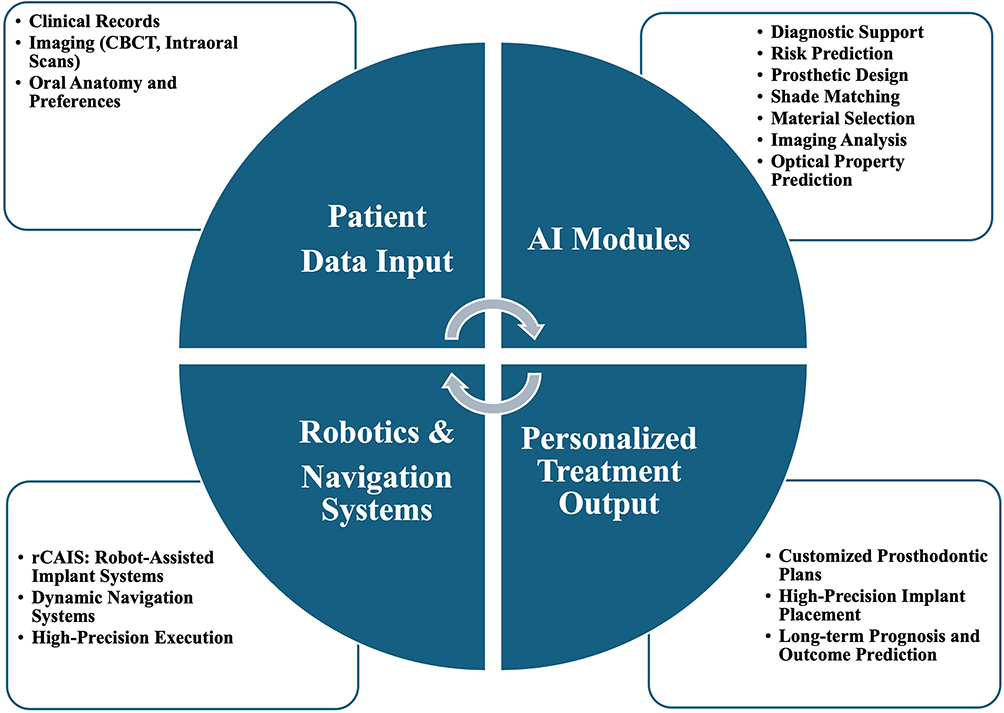 |
Figure 4 AI-assisted clinical skills practice in prosthodontics and implantology. |
Critical Analysis Contrasting AI-Assisted Teaching Methods with Traditional Teaching Approaches
To conduct a more thorough and critical analysis, publications contrasting AI-assisted teaching methods with traditional teaching approaches in prosthodontics and implant dentistry were further screened from the 213 publications. However, only one article met the inclusion requirements. To figure out the quantitative comparison between AI-assisted teaching methods and traditional teaching approaches, we expanded our search to include broader medical and healthcare education. Then 6 relevant publications with accessible full-text papers were identified, which was summarized in Table 1. Among the studies reviewed, randomized controlled trials (RCT) or meta-analytical methods were used to evaluate the effectiveness of various AI-assisted educational tools.
Evidence supports AI’s role in enhancing knowledge acquisition and diagnostic accuracy. The RCT by Gokkurt Yilmaz et al demonstrated that AI-generated personalized feedback on radiographic diagnostic performance led to significantly greater test score improvements compared to basic feedback. A 2025 meta-analysis by Li et al further clarified that while overall knowledge scores did not differ significantly, GAI-based teaching significantly outperformed traditional methods in practice-oriented courses and longer learning durations (≥1 week), highlighting its strength in applied, sustained learning contexts.
For basic manual skills, technology often shows equivalence rather than clear superiority. An RCT on veneer preparation found no significant difference between VR simulator and traditional phantom head training. However, Li et al’s meta-analysis reported that GAI-based teaching significantly improved practical skill scores compared to traditional methods, suggesting its advantage lies in developing complex clinical reasoning, not just procedural mimicry.
Consistently, AI/VR tools enhance subjective learning engagement and motivation. Gokkurt Yilmaz et al reported higher satisfaction in AI feedback groups, and Li et al’s meta-analysis confirmed that GAI-based instruction leads to significantly higher student satisfaction, reinforcing that interactive, adaptive tools improve both motivation and perceived educational quality.
Despite positive outcomes, limitations remain, including technical dependencies, and high initial costs. The meta-analysis also notes low overall evidence quality due to heterogeneity and methodological shortcomings, emphasizing that GAI is best viewed as a complementary tool requiring careful integration.
Several investigations, including those by Koolivand et al, Bevizova et al, and Li et al, focused on virtual reality (VR)–based systems used to enhance preclinical dental training, demonstrating improvements in theoretical knowledge and, in certain cases, psychomotor performance when compared with conventional phantom-head or model-based teaching.55–57
Other studies, such as those by Gökkurt-Yılmaz et al and Pang et al, assessed AI-generated or AI-assisted learning materials, including personalized radiology guides and adaptive teaching platforms. These studies consistently reported enhanced diagnostic accuracy, improved OSCE scores, and higher student satisfaction relative to traditional instructor-generated materials.58,59 In addition, meta-analyses by Li et al synthesized evidence across multiple randomized trials and indicated that generative AI approaches tend to yield significant benefits in practical skill acquisition and learner satisfaction, despite showing mixed results in theoretical knowledge outcomes.60
Furthermore, digitally enhanced instructional methods, as examined by and Sung et al, demonstrated notable improvements in technical skill development and short-term knowledge gains, suggesting that digitally enriched learning environments may support or surpass traditional pedagogical formats.61,62 Collectively, the studies included in Table 1 highlight the growing potential of AI-driven and digital teaching modalities to augment or improve educational outcomes across dental and medical training settings.
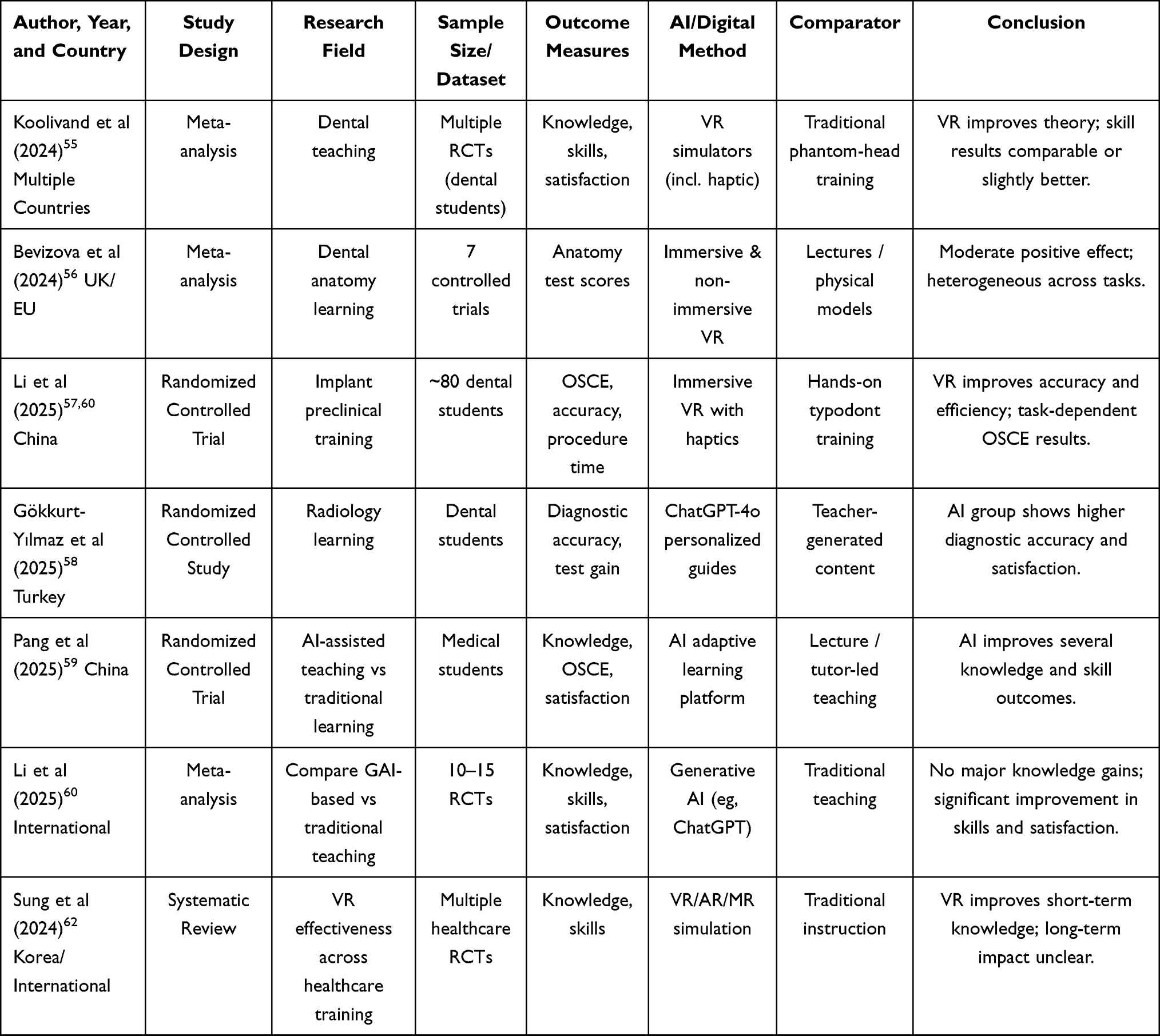 |
Table 1 Summaries of Included Studies Related to AI-Assisted Training Methods with Traditional Training Approaches |
Discussion
This systematic review synthesized current evidence on AI applications in prosthodontics and implantology education, addressing the defined research questions through comprehensive analysis of 213 publications from 2015–2025.
The analysis of publication trends reveals that AI integration in this educational domain is accelerating, particularly since 2021, reflecting broader technological adoption patterns in healthcare education. The distribution of study types—predominantly reviews followed by clinical and educational research—suggests the field is transitioning from theoretical exploration toward applied implementation.
The three-tier educational framework (theoretical, laboratory, clinical) provides a structured understanding of how AI technologies are being deployed across different learning stages, from knowledge acquisition to skill development and clinical application. The analysis reveals that while AI technologies are rapidly developing—particularly in diagnostic support, VR simulation, and personalized learning systems—their educational integration remains uneven across different training stages.30,63 Quantitative comparison evidenced by RCT OR Meta-analysis between AI-assisted teaching methods and traditional teaching approaches in prosthodontics and implant dentistry is limited,55 while 5 comparative articles were identified in broader medical and healthcare education. This pattern suggests that technological advancement has outpaced systematic educational adaptation and more comparative evidence on the effectiveness of AI-assisted education are needed.
Compared to general medical education reviews, this analysis highlights domain-specific challenges unique to prosthodontics, particularly concerning the integration of aesthetic judgment and manual skill development with digital workflows.11 Unlike technology-focused evaluations, our synthesis emphasizes the need to balance technological innovation with pedagogical integrity, especially in preserving essential tactile competencies and clinical reasoning skills that define expert practice.
Nevertheless, several limitations should be acknowledged in this review. The majority of the included studies focused on short-term educational outcomes, with limited longitudinal evidence regarding skill retention and long-term impact. The rapid evolution of AI technologies also presents a challenge, as literature published up to 2025 may not fully capture more recent advancements and implementations. Furthermore, while ethical considerations, integrity challenges, and data privacy concerns represent critical dimensions in AI-enhanced education, these topics were not extensively addressed.
Ethical and integrity dilemmas are also inevitable topics in the integration of AI into dental education. The advent of “AI ghostwriting” challenges traditional academic authorship and assessment, raising concerns about the erosion of scholarly accountability when AI can rapidly generate assignments or even simulated research content.64,65 Concurrently, issues of data governance—including dataset provenance, algorithmic bias, and patient privacy—demand structured frameworks to ensure that AI applications are both ethically sound and clinically reliable.66,67 Furthermore, the “black-box” nature of many AI systems, coupled with their propensity for generating plausible but inaccurate outputs (“hallucinations”), poses significant risks to educational validity and future clinical decision-making. These challenges necessitate the development of clear institutional policies, AI literacy training, and transparent oversight mechanisms to safeguard academic and professional integrity.
Beyond technical and ethical concerns, AI integration also engages deeper pedagogical and humanistic tensions. There is a risk that over-reliance on simulated, AI-driven training may diminish the development of empathy, interpersonal communication, and the nuanced clinical judgment cultivated through direct patient interaction.68 In specific contexts such as China, rapid technological adoption can accentuate contradictions between enduring educational values—such as mentorship and humanistic care—and the efficiency-driven, standardized outputs of AI systems. Ultimately, while AI can significantly augment training efficiency and personalized learning, dental education must preserve its core humanistic foundation. A balanced approach should leverage AI as a powerfulauxiliary tool while ensuring that the cultivation of professional judgment, ethical reasoning, and patient-centered values remains firmly rooted in human-guided education.
Future work should prioritize longitudinal studies with standardized outcome measures to evaluate lasting educational impact. There is urgent need for developing comprehensive pedagogical frameworks that guide AI integration while preserving essential clinical competencies. Additionally, establishing ethical guidelines and transparent governance models will be crucial for responsible implementation. International collaboration will be particularly valuable in addressing these challenges systematically, ensuring that AI enhances rather than compromises the humanistic aspects of dental education.
Conclusion
In summary, the integration of Artificial Intelligence (AI) into prosthodontic and implantology education signifies a paradigm shift in pedagogical and clinical training methodologies. AI-driven tools—including virtual simulations, intelligent tutoring systems, and robotic-assisted platforms—demonstrate substantial potential to enhance diagnostic precision, procedural skill acquisition, and personalized learning, thereby complementing traditional pedagogical approaches.
To ensure effective and ethical adoption, it is recommended to implement competency-based AI literacy modules and developing hybrid simulation curricula that thoughtfully blend virtual and hands-on training. This structured integration leverages AI’s strengths in feedback and complex skill development while preserving the essential tactile and judgmental competencies fostered through conventional methods. Through deliberate curriculum renewal, faculty development, and interdisciplinary collaboration, AI is poised to become an indispensable component of a modern, comprehensive dental education framework.
Acknowledgments
The authors would like to thank Yang Yang and Yan Wang for their assistance with literature screening and preliminary data organization during the preparation of this review. This study was financially supported by the National Natural Science Foundation of China (No. 82201117).
Disclosure
The authors report no conflicts of interest in this work.
References
1. Russell S, Norvig P. Artificial intelligence: a modern approach . 4th ed. London: Pearson Education Limited. 2016.
2. Chen L, Chen P, Lin Z. Artificial intelligence in education: a review. IEEE Access. 2020;8:75264–16. doi:10.1109/ACCESS.2020.2988510
3. Jorg T, Kampgen B, Feiler D, et al. Efficient structured reporting in radiology using an intelligent dialogue system based on speech recognition and natural language processing. Insights Imaging. 2023;14(1):47. doi:10.1186/s13244-023-01392-y
4. Schwendicke F, Samek W, Krois J. Artificial intelligence in dentistry: chances and challenges. J Dent Res. 2020;99(7):769–774. doi:10.1177/0022034520915714
5. Liu L, Watanabe M, Ichikawa T. Robotics in dentistry: a narrative review. Dent J. 2023;11(3):62 doi:10.3390/dj11030062.
6. Shortliffe EH, Cimino JJ. Biomedical Informatics: Computer Applications in Health Care and Biomedicine. Springer; 2014.
7. LeCun Y, Bengio Y, Hinton G. Deep learning. Nature. 2015;521(7553):436–444. doi:10.1038/nature14539
8. Monaghesh E, Negahdari R, Samad-Soltani T. Application of virtual reality in dental implants: a systematic review. BMC Oral Health. 2023;23(1):603. doi:10.1186/s12903-023-03290-7
9. Esteva A, Robicquet A, Ramsundar B, et al. A guide to deep learning in healthcare. Nat Med. 2019;25(1):24–29. doi:10.1038/s41591-018-0316-z
10. Claman D, Sezgin E. Artificial intelligence in dental education: opportunities and challenges of large language models and multimodal foundation models. JMIR Med Educ. 2024;10:e52346. doi:10.2196/52346
11. Alsheghri A, Zhang Y, Keren J, Cheriet, F, Guibault, F. Automatic margin line extraction using 3D deep learning on digital surface models of prepared teeth for crown generation. Comput Biol Med. 2025;196(Pt C):110960. doi:10.1016/j.compbiomed.2025.110960
12. Alqutaibi AY, Aboalrejal AN. Artificial Intelligence (AI) as an aid in restorative dentistry is promising, but still a work in progress. J Evid Based Dent Pract. 2023;23(1):101837. doi:10.1016/j.jebdp.2023.101837
13. Mun SB, Yoo SR, Kim YJ, Kim, K, Kim, BC, Kim, KG. AI-driven prediction of dental implant numbers to be placed for patient-specific treatment planning. Int Dent J. 2025;75(6):103896. doi:10.1016/j.identj.2025.103896
14. Lee WF, Day MY, Fang CY, et al. Establishing a novel deep learning model for detecting peri-implantitis. J Dent Sci. 2024;19(2):1165–1173. doi:10.1016/j.jds.2023.11.017
15. Macri M, D’Albis V, D’Albis G, et al. The role and applications of artificial intelligence in dental implant planning: a systematic review. Bioengineering. 2024;11(8 80778). doi:10.3390/bioengineering11080778
16. Page MJ, McKenzie JE, Bossuyt PM, et al. The PRISMA 2020 statement: an updated guideline for reporting systematic reviews. BMJ. 2021;372:n71. doi:10.1136/bmj.n71
17. Reissmann DR, Sierwald I, Berger F, Heydecke, G. A model of blended learning in a preclinical course in prosthetic dentistry. J Dent Educ. 2015;79(2):157–165. doi:10.1002/j.0022-0337.2015.79.2.tb05870.x
18. Vincent M, Joseph D, Amory C, et al. Contribution of haptic simulation to analogic training environment in restorative dentistry. J Dent Educ. 2020;84(3):367–376. doi:10.21815/JDE.019.187
19. Donkin R, Yule H, Fyfe T. Online case-based learning in medical education: a scoping review. BMC Med Educ. 2023;23(1):564. doi:10.1186/s12909-023-04520-w
20. Seed Ahmed M, Soltani A, Zahra D, et al. Remote online learning reimagined: perceptions and experiences of medical students in a post-pandemic world. BMC Med Educ. 2025;25(1):215. doi:10.1186/s12909-025-06815-6
21. Alfallaj HA, Afrashtehfar KI, Asiri AK, Almasoud, FS, Alnaqa, GH, Al-Angari, NS. The status of digital dental technology implementation in the saudi dental schools’ curriculum: a national cross-sectional survey for healthcare digitization. Int J Environ Res Public Health. 2022;20(1):321. doi:10.3390/ijerph20010321
22. Rahad K, Martin K, Amugo I, et al. ChatGPT to enhance learning in dental education at a historically black medical college. Dent Res Oral Health. 2024;7(1):8–14. doi:10.26502/droh.0069
23. Danesh A, Pazouki H, Danesh F, Danesh, A, Vardar-Sengul, S. Artificial intelligence in dental education: chatGPT’s performance on the periodontic in-service examination. J Periodontol. 2024;95(7):682–687. doi:10.1002/JPER.23-0514
24. E EÇ. The place of ChatGPT in the future of dental education. J Clin Trials Exp Investig. 2023;2(3):121–129 doi:10.5281/zenodo.8210063.
25. de Boer IR, Wesselink PR, Vervoorn JM. The creation of virtual teeth with and without tooth pathology for a virtual learning environment in dental education. Eur J Dent Educ. 2013;17(4):191–197. doi:10.1111/eje.12027
26. Zhitong L, Xiaoyu Z, Zhenyu L, Mingjie, S, Xinqi, H. Practice and evaluation of case-based virtual simulation training in clinical practice of prosthodontics. Stomatology. 2024;44(1):56–59.
27. Dixon J, Towers A, Martin N, Field, J. Re-defining the virtual reality dental simulator: demonstrating concurrent validity of clinically relevant assessment and feedback. Eur J Dent Educ. 2021;25(1):108–116. doi:10.1111/eje.12581
28. G R. Applications of virtual environments in medicine. Methods Inf Med. 2003;42(5):524–534. doi:10.1055/s-0038-1634379
29. Li Y, Ye H, Ye F, et al. The current situation and future prospects of simulators in dental education. J Med Internet Res. 2021;23(4):e23635. doi:10.2196/23635
30. Lin PY, Chen TC, Lin CJ, et al. The use of augmented reality (AR) and virtual reality (VR) in dental surgery education and practice: a narrative review. J Dent Sci. 2024;19(Suppl 2):S91–S101. doi:10.1016/j.jds.2024.10.011
31. Eve EJ, Koo S, Alshihri AA, et al. Performance of dental students versus prosthodontics residents on a 3D immersive haptic simulator. J Dent Educ. 2014;78(4):630–637. doi:10.1002/j.0022-0337.2014.78.4.tb05715.x
32. Gao Y, Zhao QP, Zhou XD, Guo, QM, Xi, T. The role of virtual reality technology in medical education in the context of emerging medical discipline. Sichuan Da Xue Xue Bao Yi Xue Ban. 2021;52(2):182–187. doi:10.12182/20210260301
33. Suarez A, Adanero A, Diaz-Flores Garcia V, Freire, Y, Algar, J. Using a virtual patient via an artificial intelligence chatbot to develop dental students’ diagnostic skills. Int J Environ Res Public Health. 2022;19(14):8735. doi:10.3390/ijerph19148735
34. Ceylan G, Özel GS, Memişoglu G, Emir, F, Şen, S. Evaluating the facial esthetic outcomes of digital smile designs generated by artificial intelligence and dental professionals. Appl Sci. 2023;13(15):9001. doi:10.3390/app13159001
35. Ortiz Simon JL, Martinez AM, Espinoza DL, Romero Velazquez, JG. Mechatronic assistant system for dental drill handling. Int J Med Robot. 2011;7(1):22–26. doi:10.1002/rcs.363
36. Yuan F, Wang Y, Zhang Y, Sun, Y, Wang, D, Lyu, P. Study on the appropriate parameters of automatic full crown tooth preparation for dental tooth preparation robot. Chin J Stomatol. 2017;52(5):270–273. doi:10.3760/cma.j.issn.1002-0098.2017.05.002
37. Yuan F, Wang Y, Zhang Y, Sun, Y, Wang, D, Lyu, P. An automatic tooth preparation technique: a preliminary study. Sci Rep. 2016;6(1):25281. doi:10.1038/srep25281
38. Wang D, Wang L, Zhang Y, Lv, P, Sun, Y, Xiao, J. Preliminary study on a miniature laser manipulation robotic device for tooth crown preparation. Int J Med Robot. 2014;10(4):482–494. doi:10.1002/rcs.1560
39. Karnik AP, Chhajer H, Venkatesh SB. Transforming prosthodontics and oral implantology using robotics and artificial intelligence. Front Oral Health. 2024;5:1442100. doi:10.3389/froh.2024.1442100
40. Bernauer SA, Zitzmann NU, Joda T. The use and performance of artificial intelligence in prosthodontics: a systematic review. Sensors. 2021;21(19):6628. doi:10.3390/s21196628
41. Shetty S, Gali S, Augustine D, Sv, S. Artificial intelligence systems in dental shade-matching: a systematic review. J Prosthodont. 2024;33(6):519–532. doi:10.1111/jopr.13805
42. Joda T, Gallucci GO, Wismeijer D, Zitzmann, NU. Augmented and virtual reality in dental medicine: a systematic review. Comput Biol Med. 2019;108:93–100. doi:10.1016/j.compbiomed.2019.03.012
43. Lerner H, Mouhyi J, Admakin O, Mangano, F. Artificial intelligence in fixed implant prosthodontics: a retrospective study of 106 implant-supported monolithic zirconia crowns inserted in the posterior jaws of 90 patients. BMC Oral Health. 2020;20(1):80. doi:10.1186/s12903-020-1062-4
44. Gerhardt MDN, Fontenele RC, Leite AF, et al. Automated detection and labelling of teeth and small edentulous regions on cone-beam computed tomography using convolutional neural networks. J Dent. 2022;122:104139. doi:10.1016/j.jdent.2022.104139
45. Igiel C, Weyhrauch M, Mayer B, Scheller, H, Lehmann, K. Effects of ceramic layer thickness, cement color, and abutment tooth color on color reproduction of feldspathic veneers. Int J Esthet Dent. 2018;13(1):110–119.
46. Hernandes DK, Arrais CA, Lima E, Cesar PF, Rodrigues JA. Influence of resin cement shade on the color and translucency of ceramic veneers. J Appl Oral Sci. 2016;24(4):391–396. doi:10.1590/1678-775720150550
47. Wei J, Peng M, Li Q, Wang Y. Evaluation of a novel computer color matching system based on the improved back-propagation neural network model. J Prosthodont. 2018;27(8):775–783. doi:10.1111/jopr.12561
48. Li H, Sakai T, Tanaka A, et al. Interpretable AI explores effective components of CAD/CAM resin composites. J Dent Res. 2022;101(11):1363–1371. doi:10.1177/00220345221089251
49. Huang N, Liu P, Yan Y, et al. Predicting the risk of dental implant loss using deep learning. J Clin Periodontol. 2022;49(9):872–883. doi:10.1111/jcpe.13689
50. Fouladi S, Bargrizaneh AA, Amin MR, et al. Artificial intelligence models and predicting implant success. Biomed Res Ther. 2025;12(1):7029–7038. doi:10.15419/bmrat.v12i1.949
51. Cheng C, Cheng X, Dai N, Jiang X, Sun Y, Li W. Prediction of facial deformation after complete denture prosthesis using BP neural network. Comput Biol Med. 2015;66:103–112. doi:10.1016/j.compbiomed.2015.08.018
52. Liu Y, Zheng Q, Xu Z, et al. Accuracy and operation procedure of robotic computer-aided implant surgery. Sci Rep. 2025;15(1):307. doi:10.1038/s41598-024-83997-x
53. Luo Z, Li A, Unkovskiy A, et al. Accuracy of robotic computer-assisted implant surgery in clinical studies: a systematic review and meta-analysis. BMC Oral Health. 2025;25(1):540. doi:10.1186/s12903-025-05837-2
54. Younis H, Lv C, Xu B, et al. Accuracy of dynamic navigation compared to static surgical guides and the freehand approach in implant placement: a prospective clinical study. Head Face Med. 2024;20(1):30. doi:10.1186/s13005-024-00433-1
55. Koolivand H, Shooreshi MM, Safari-Faramani R, et al. Comparison of the effectiveness of virtual reality-based education and conventional teaching methods in dental education: a systematic review. BMC Med Educ. 2024;24(1):8. doi:10.1186/s12909-023-04954-2
56. Bevizova K, Falougy HE, Thurzo A, Harsanyi S. Is virtual reality enhancing dental anatomy education? A systematic review and meta-analysis. BMC Med Educ. 2024;24(1):1395. doi:10.1186/s12909-024-06233-0
57. Li Y, Ye H, Wu W, et al. Effectiveness and methodologies of virtual reality dental simulators for veneer tooth preparation training: randomized controlled trial. J Med Internet Res. 2025;27:e63961. doi:10.2196/63961
58. Gokkurt Yilmaz BN, Ozbey F, Yilmaz BE. Effect of artificial intelligence-assisted personalized feedback on radiographic diagnostic performance of dental students: a controlled study. BMC Med Educ. 2025;25(1):1403. doi:10.1186/s12909-025-07875-4
59. Pang X, Zou J, Zhang X, et al. The impact of artificial intelligence-assisted teaching on medical students’ learning outcomes: an integrated model based on the ARCS model and constructivist theory. BMC Med Educ. 2025;25(1):1309. doi:10.1186/s12909-025-07826-z
60. Li J, Yin K, Wang Y, Jiang X, Chen D. Effectiveness of generative artificial intelligence-based teaching versus traditional teaching methods in medical education: a meta-analysis of randomized controlled trials. BMC Med Educ. 2025;25(1):1175. doi:10.1186/s12909-025-07750-2
61. Blond N, Chaux AG, Hascoet E, Lesclous P, Cloitre A. Blended learning compared to traditional learning for the acquisition of competencies in oral surgery by dental students: a randomized controlled trial. Eur J Dent Educ. 2024;28(4):943–954. doi:10.1111/eje.13030
62. Sung H, Kim M, Park J, Shin N, Han Y. Effectiveness of virtual reality in healthcare education: systematic review and meta-analysis. Sustainability. 2024;16(19):8520. doi:10.3390/su16198520
63. Nassar HM, Tekian A. Computer simulation and virtual reality in undergraduate operative and restorative dental education: a critical review. J Dent Educ. 2020;84(7):812–829. doi:10.1002/jdd.12138
64. Van Noorden R. Pioneering duplication detector trawls thousands of coronavirus preprints. Nature. 2020. doi:10.1038/d41586-020-02161-3
65. Jose DL, Santiago, DLM, Antonio, AR, Enrique, BG, Carlos, DLC. Reflections on the Potential and Risks of AI for Scientific Article Writing after the AI Endorsement by Some Scientific Publishers: Focusing on Scopus AI. Actas Esp Psiquiatr. 2025;53:2 433–442 doi:10.62641/aep.v53i2.1849.
66. Safranek CW, Sidamon-Eristoff AE, Gilson A, Chartash D. The role of large language models in medical education: applications and implications. JMIR Med Educ. 2023;9:e50945. doi:10.2196/50945
67. Preiksaitis C, Rose C. Opportunities, challenges, and future directions of generative artificial intelligence in medical education: scoping review. JMIR Med Educ. 2023;9:e48785. doi:10.2196/48785
68. Johri S, Jeong J, Tran BA, et al. An evaluation framework for clinical use of large language models in patient interaction tasks. Nat Med. 2025;31(1):77–86. doi:10.1038/s41591-024-03328-5
 © 2026 The Author(s). This work is published and licensed by Dove Medical Press Limited. The
full terms of this license are available at https://www.dovepress.com/terms
and incorporate the Creative Commons Attribution
- Non Commercial (unported, 4.0) License.
By accessing the work you hereby accept the Terms. Non-commercial uses of the work are permitted
without any further permission from Dove Medical Press Limited, provided the work is properly
attributed. For permission for commercial use of this work, please see paragraphs 4.2 and 5 of our Terms.
© 2026 The Author(s). This work is published and licensed by Dove Medical Press Limited. The
full terms of this license are available at https://www.dovepress.com/terms
and incorporate the Creative Commons Attribution
- Non Commercial (unported, 4.0) License.
By accessing the work you hereby accept the Terms. Non-commercial uses of the work are permitted
without any further permission from Dove Medical Press Limited, provided the work is properly
attributed. For permission for commercial use of this work, please see paragraphs 4.2 and 5 of our Terms.