
Back to Journals » Biologics: Targets and Therapy » Volume 19

Antibody-Based Therapeutics in Small Cell Lung Cancer: A Narrative Review
Authors Torchia A  , Ciappina G, Giammaruco M, Monteferrante I, Landi L, Cappuzzo F
Received 1 February 2025
Accepted for publication 5 April 2025
Published 15 April 2025 Volume 2025:19 Pages 189—199
DOI https://doi.org/10.2147/BTT.S500460
Checked for plagiarism Yes
Review by Single anonymous peer review
Peer reviewer comments 2
Editor who approved publication: Dr Shein-Chung Chow
Andrea Torchia,1,2,* Giuliana Ciappina,3,* Maristella Giammaruco,2 Ilaria Monteferrante,4 Lorenza Landi,5 Federico Cappuzzo2
1Clinical and Molecular Medicine, Sapienza - Università di Roma, Rome, Italy; 2Medical Oncology 2, IRCCS Regina Elena National Cancer Institute, Rome, Italy; 3Department of Clinical and Experimental Medicine, University of Messina, Messina, Italy; 4Department of Anesthesiology, Intensive Care and Pain Therapy, IRCCS Regina Elena National Cancer Institute, Rome, Italy; 5Clinical Trials Unit: Phase 1 and Precision Medicine, IRCCS Regina Elena National Cancer Institute, Rome, Italy
*These authors contributed equally to this work
Correspondence: Federico Cappuzzo, IRCCS Regina Elena National Cancer Institute, Via Elio Chianesi 53, Rome, 00144, Italy, Email [email protected], [email protected]
Abstract: Small-cell lung cancer (SCLC) is the most aggressive lung cancer, mostly diagnosed at advanced stage, and with few therapeutic options for patients failing the first-line treatment. Antibody-based therapies, such as antibody-drug conjugates and T-cell engagers, are emerging as a promising option in the treatment of various solid tumors, including SCLC. T-cell engagers are molecules able to trigger the T-cell-mediated tumor cell death binding, at the same time, a T-cell and a tumor cell target. Tarlatamab is a DLL3-directed bi-specific T-cell engager (BiTE) whose efficacy was evaluated in a Phase 2 study. Antibody-drug conjugates (ADC) consist of a tumor-directed monoclonal antibody conjugated to a cytotoxic payload able to selectively kill tumor cells through different mechanisms. Ifinatamab-deruxtecan is an anti-B7-H3 ADC showing efficacy in pretreated SCLC patients in a phase 2 clinical trial. Sacituzumab govitecan is a Trop-2-directed ADC already used in other tumor types and evaluated in SCLC in the phase 2 TROPiCS-03 trial, with positive results. Bispecific antibodies targeting VEGF and PD-(L)1 showed antitumor activity in phase 1 and 2 clinical trials. Other antibody-based agents are currently at an earlier phase of their clinical development and showed a promising activity. Novel antibody-based agents could potentially acquire a prominent role in the treatment of SCLC, a field with few therapeutic options. Direct comparisons with the current standard of care still lack, however Phase 3 trials are currently ongoing.
Keywords: small-cell lung cancer, treatment, antibody, antibody–drug conjugate, T-cell engager, bispecific antibody
Introduction
Small-cell lung cancer (SCLC) is the most aggressive form of lung cancer. It has an incidence of 1–5 cases per 100,000 people per year and accounts for 10–15% of all lung cancers.1 The risk of developing SCLC is higher in older men (more than 65 years old) and in heavy smokers (more than 30 cigarettes per day).2 Moreover, approximately 65–70% of patients are diagnosed with extensive-stage SCLC (ES-SCLC), which results in a poor prognosis.1 Small-cell lung cancer is historically characterized by an initial high response to platinum-based chemotherapy, but also by the rapid development of resistance, with less than 10% of patients being alive after 5 years.3 Recently, the introduction of immune checkpoint inhibitors (ICIs) in combination with platinum-based chemotherapy in the first-line treatment of ES-SCLC has significantly increased survival rates.4–8 Despite the benefits of immunotherapy, the majority of patients fail first-line treatment due to primary or acquired resistance to ICIs.9 Different ICIs combinations were evaluated to reinforce immune-checkpoint blockade with the addition of anti-CTLA4 or anti-TIGIT agents to first-line chemoimmunotherapy, however results were negative, and these combinations provided no additional benefit.10,11 Currently, second-line treatment for ES-SCLC is based on chemotherapy. In particular, the choice of second-line treatment depends on the treatment-free interval (TFI) and the response to first-line. If the TFI is higher than 3 months (ie platinum-sensitive patients), rechallenging with platinum-based chemotherapy is recommended. For patients with a TFI lower than 3 months (ie platinum-refractory patients), survival rates are very poor, and the only therapeutic options are topotecan, lurbinectedin (currently only FDA-approved), or, if possible, participation in a clinical trial.12 Another potential treatment option for this group of patients is represented by treatment beyond progression with second-line immunotherapy. Some studies have suggested that ICIs may continue to have an anti-tumor effect even after the failure of first-line chemoimmunotherapy. A recent retrospective analysis evaluated 150 patients with ES-SCLC who progressed after first-line chemoimmunotherapy and received immunotherapy beyond progression or second-line chemotherapy. Response and survival rates were higher in patients receiving immunotherapy, with a greater benefit in a subgroup of patients with baseline liver metastases, fewer than three metastatic sites, and those who were nonsmokers.13 However, the retrospective nature of these data and the limitation of the benefit only to certain subgroups do not allow immunotherapy beyond progression to be defined as a standard of care. Angiogenesis is involved in SCLC growth, spread, and development of resistance to chemotherapy, and overexpression of vascular endothelial growth factor (VEGF) is associated with a poor prognosis in historical data.14,15 Different trials have investigated the efficacy of antiangiogenic agents combined with chemotherapy for the treatment of SCLC, with no clear benefit.16–18 Novel pharmaceutical strategies are emerging in the treatment of solid tumors, including SCLC, a disease that still has limited therapeutic options and a poor prognosis. Antibody-based therapies have earned a prominent place in this setting, showing a significant efficacy in numerous tumor types.19,20 After some negative trials conducted in the past years in SCLC,21,22 new agents are showing promising results. In this review, we describe the role of novel antibody-based treatment in SCLC, gathering results from both completed and ongoing clinical trials from main medical research databases and international cancer meetings websites, and highlighting their potential impact on its treatment.
Results
T-Cell Engagers
T-cell engagers are antibody-based molecules binding, at the same time, a T-cell-specific target and a tumor-cell target, forcing them to interact and triggering the T-cell-mediated tumor cell death.23 This strategy allows to bypass the antigen presentation pathway, needed for immunotherapy with ICIs to be effective, and intrinsically suppressed in SCLC.24
Delta-Like Ligand 3
Delta-like ligand 3 (DLL3) is an inhibitory Notch signaling ligand promoting neuroendocrine tumor cells proliferation, migration, and invasion,25 aberrantly expressed in up to 85% of SCLC patients, and minimally expressed in normal cells.26,27 Tarlatamab is a bi-specific T-cell engager (BiTE) targeting both DLL3 on tumor cells and CD3 on T-cells, triggering T-cells activation and tumor cells lysis (Figure 1). It was the first DLL3-targeting BiTE advancing to clinical evaluation in SCLC, after showing antitumor activity in preclinical models.28,29 Its efficacy and safety were evaluated in the phase 2 DeLLphi-301 trial (Table 1),30 including SCLC patients previously treated with a single line of platinum-based chemotherapy (73% received chemoimmunotherapy), ECOG PS 0–1, and with treated, asymptomatic, and stable brain metastases. In the first part of the trial, two dose regimens were evaluated, 10 mg and 100 mg, both administered intravenously every 2 weeks. The 10 mg regimen was selected by an independent committee as target dose and enrollment only continued in this group. The efficacy, evaluated in 188 patients (100 in the 10 mg group, 88 in the 100 mg group), exceeded the historical control benchmark, with an objective response rate (ORR) of 40% in the 10 mg group. Responses were durable, with 59% of them still ongoing after 6 months. Positivity for DLL3 expression was not required for enrollment. Of the 157 patients evaluable for DLL3 expression, 151 resulted positive (defined as DLL3 expression on more than 0% of tumor cells). Responses were recorded in patients both positive, negative, and without evaluable tissue sample. Regarding safety, the 10 mg regimen was better tolerated, with a lower percentage of dose interruption and reduction than the 100 mg regimen. Due to the mechanism of action of tarlatamab, its adverse events (AEs) profile included the cytokine-release syndrome (CRS) and the immune effector cell–associated neurotoxicity syndrome (ICANS). Most CRS cases were of grade 1–2, did not require dose adjustments of tarlatamab, and were managed with supportive care with steroids, paracetamol, and hydration, seldom requiring more specific interventions (eg tocilizumab). More severe cases were more common in the 100 mg group. ICANS was significantly less frequent and less severe in the 10 mg group: grade 3 or higher cases were reported only in the 100 mg group, and it led to dose interruption or reduction more frequently in the higher dose group. Most cases have arisen after the first 2 cycles of treatment both for CRS and ICANS. The main limitations of the study are the lack of a control group, and the exclusion of ECOG PS 2 patients. The randomized, phase 3 DeLLphi-304 trial is currently ongoing to compare tarlatamab to standard of care chemotherapy as a second line treatment of ES-SCLC with OS as primary endpoint.31 Furthermore, the safety and efficacy of tarlatamab combined to ICIs as first-line maintenance has been evaluated in the phase 1b DeLLphi-303 trial, showing a clinically significant activity and a manageable safety profile of the combination without new safety signals,32 and in the ongoing phase 3 DeLLphi-305 trial (Table 1).33
 |
Table 1 Clinical Trials on Novel Antibody-Based Therapeutics in ES-SCLC |
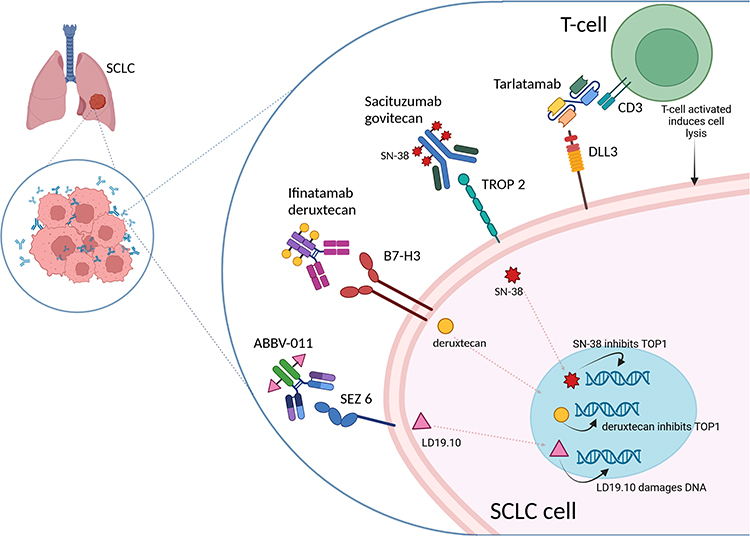 |
Figure 1 The main antibody-based agents used for the treatment of SCLC and their mechanisms of action are shown in Figure 1. Tarlatamab is a bi-specific T-cell engager (BiTE) targeting both DLL3 on tumor cells and CD3 on T-cells, leading to T-cell activation and tumor cell lysis. The other three drugs described in the figure are ADCs: Sacituzumab govitecan (SG), which consists of a humanized anti-Trop-2 antibody linked through a hydrolyzable linker to SN-38, an irinotecan metabolite with TOP1 inhibition effects. Ifinatamab-deruxtecan (I-DXd) is a B7-H3-directed ADC consisting of an anti-B7-H3 antibody, a cleavable tetra-peptide linker, and the payload deruxtecan, a DNA topoisomerase I inhibitor. Finally, ABBV-011 is a SEZ6-directed ADC consisting of an anti-SEZ6 monoclonal antibody, SC17, conjugated through a non-cleavable linker to the payload LD19.10, a DNA-damaging calicheamicin linker drug. Created in BioRender. Ciappina, G. (2025) https://BioRender.com/ v97z557. Abbreviations: B7-H3, B7 homolog 3; DLL3, Delta-like ligand 3; SCLC, small cell lung cancer; SEZ6, Seizure-related homolog 6; TOP1, topoisomerase 1; TROP-2, Trophoblast cell surface antigen 2. |
Trispecific T-cells activating constructs (TriTACs) are T-cell engager molecules binding to a tumor-specific antigen, human serum albumin, and CD3 on the T-cell surface. Similarly to BiTEs, they can bypass the antigen presentation pathway, directly activating T-cells against tumor cells.34 HPN328 (or MK-6070) is a TriTAC targeting DLL3, able to recruit T-cells in tumor microenvironment and with anti-tumor activity.35 Its efficacy and safety in patients with high-grade neuroendocrine tumors, comprising SCLC, is currently being evaluated in the phase 1/2 MK-6070-001/HPN328-4001 trial (NCT04471727) (Table 1). Included patients had a neuroendocrine malignancy associated with DLL3 expression, brain metastases were allowed if treated, stable, and asymptomatic. The ongoing trial is currently evaluating HPN328/MK-6070 administered alone or in combination with atezolizumab or with the antibody-drug conjugate (ADC) ifinatamab-deruxtecan. Results relative to HPN328/MK-6070 monotherapy efficacy and safety in pretreated ES-SCLC according to the presence of brain metastases were recently reported.36 All included patients had ECOG PS 0–1, received platinum-based chemotherapy, 96% received immunotherapy, 57% had history of brain metastases. Forty-nine patients were treated with the minimum effective dose of the study drug, ie at least 1.215 mg. In patients with brain metastases and without brain metastases, ORR was 37% and 19%, extra-cranial ORR 52% and 19%, disease control rate (DCR) 78% and 48%, respectively. Nine CNS progression events were reported in patients with brain metastases at baseline, none in patients without them. Treatment-related AEs included CRS (64% of patients with brain metastases, 57% in patients without brain metastases) and ICANS, occurring only in patients with brain metastases (14%, all grade 1–2). Despite the benefits of T-cell engagers like tarlatamab, acquired drug resistance seems inevitable, and there is currently insufficient data available on the molecular pathogenesis of resistance mechanisms. It has been speculated that an alteration of the NOTCH signaling pathway, previously implicated in SCLC development and DLL3 regulation in cancer and other biological processes, could be responsible for resistance to these drugs.37 In a recent study by Lee et al, an nCounter assay was conducted to evaluate transcriptional changes after tarlatamab treatment, in the absence of notable genomic alterations and following an unsuccessful attempt at RNA sequencing, in patients who progressed on tarlatamab. Using cell lines derived from pre- and post-tarlatamab tumors, upregulation of NOTCH family genes and downregulation of Delta-like family genes were observed. This finding aligns with the previously proposed hypothesis regarding the alteration of NOTCH signaling, which may deviate DLL3 expression during the development of tarlatamab resistance.38,39
Antibody-Drug Conjugates
Antibody-drug conjugates are molecules consisting of a tumor-directed monoclonal antibody (mAb) conjugated, through a linker with variable chemical properties, to a cytotoxic payload, able to selectively target tumor cells.40 Antibody-drug conjugates can kill tumor cells through the cytotoxic activity of the payload, both released into cells after the ADC internalization and spread to neighboring cells (bystander effect) and inducing antibody-dependent cell-mediated cytotoxicity, antibody dependent phagocytosis, and complement dependent cytotoxicity41 (Figure 1).
B7 homolog 3
B7 homolog 3 (B7-H3, also known as CD276 and encoded by the CD276 gene) is a transmembrane protein with an immunomodulatory effect. In normal tissue, it suppresses T-cell activation and proliferation; in malignant tissues, it inhibits tumor-directed immune response. Furthermore, it exerts a protumorigenic effect promoting migration and invasion of tumor cells, chemoresistance, endothelial-to-mesenchymal transition, and angiogenesis, and is associated with disease progression and lower survival. It is heterogeneously expressed in normal tissue, while highly expressed in tumors, comprising SCLC.42,43
Ifinatamab-deruxtecan (I-DXd) is a B7-H3 directed ADC consisting of an anti-B7-H3 antibody, a cleavable tetra-peptide linker, and the payload deruxtecan, a DNA topoisomerase I inhibitor, designed for target-dependent internalization and intracellular release of the payload.44,45 Results from the interim analysis of the phase 2 trial IDeate-Lung01 (Table 1), evaluating I-DXd in ES-SCLC, were recently reported.46 Included patients were pretreated, and asymptomatic brain metastases, treated or untreated, were permitted. In the dose optimization phase, 2 dose regimens were evaluated: 8 mg/kg and 12 mg/kg, both administered intravenously every 3 weeks. Both cohorts have proven to be effective treatments for pretreated ES-SCLC, with an ORR in the 12 mg/kg cohort of 55%. Treatment was well tolerated at both doses, however AEs were more common in the 12 mg/kg cohort, in particular grade 3 or higher ones. Most were gastrointestinal and hematologic, the incidence of interstitial lung disease was similar between the cohorts (7–8%), all infusion-related reactions recorded in the 12 mg/kg cohort (14.3% of patients) were grade 1–2. Based on these results, I-DXd at the selected dose of 12 mg/kg has a meaningful anti-tumor activity in pretreated ES-SCLC patients with an acceptable safety profile. The main limitations of the trial are the lack of a control arm due to the study design and the exclusion of patients with ECOG PS 2. A phase 3 trial, IDeate-Lung02 (Table 1), is currently ongoing to compare I-DXd to the standard of care in relapsed SCLC including, among secondary objectives, the relationship between B7-H3 expression and clinical outcome.47
The study ARTEMIS-001 (Table 1) is an open-label, phase 1 trial evaluating the safety and efficacy of HS-20093 (also known as GSK’227) in advanced solid tumors, comprising SCLC.48,49 HS-20093/GSK’227 is an anti-B7-H3 ADC consisting of a fully humanized antibody linked to a topoisomerase inhibitor payload. Included patients were pretreated with standard platinum-based chemotherapy, 73% also received immunotherapy. During the dose-escalation and dose-expansion phases, 56 patients received either 8 mg/kg (31) or 10 mg/kg (25) of the study drug. Objective response rate was 61% and 50% in the 8 mg/kg and 10 mg/kg groups, respectively, DCR was 81% and 96%, and mPFS was 5.9 months and 7.3 months, respectively. Responses were observed regardless of B7-H3 expression. The most common treatment related AEs (TRAEs) were hematologic. The limitations of this study are mainly due to the early phase of the ongoing clinical development and to the poor representativeness of the study population. However, a phase 3 study is currently ongoing in China to compare HS-20093 to standard chemotherapy in relapsed SCLC, and a global phase 1 trial began in August 2024.50
Trophoblast Cell Surface Antigen 2
Trophoblast cell surface antigen 2 (Trop-2) is a cell surface glycoprotein and calcium signaling transducer encoded by the TACSTD2 gene. In normal conditions, it has a role in the development of embryonic organs.51 It is overexpressed in cancer cells, with a low or absent expression in normal cells, and it promotes tumor growth and invasiveness.52,53
Sacituzumab govitecan (SG) is an ADC consisting of a humanized anti-Trop-2 antibody coupled through an hydrolyzable linker to SN-38, an irinotecan metabolite.53 It has already been evaluated in the treatment of other histologies and is currently approved for the treatment of breast cancer.54,55 The TROPiCS-03 (Table 1) trial is a multi-cohort, phase 2, basket trial evaluating SG in solid tumors, comprising SCLC.56 Included patients received only one line of previous systemic anti-tumor therapy (both platinum-sensitive and resistant were included) and had an ECOG PS 0 or 1, brain metastases were allowed only if treated and stable. Sacituzumab govitecan showed significant activity, both in platinum-sensitive and resistant patients, with an ORR of 42% and a DCR of 84%. The safety profile was consistent with other clinical trials in other histologies: all patients had AEs of any grade, 74.4% reported AEs of grade 3 or higher (most common: neutropenia and diarrhea). Treatment related AEs were reported in 61% of patients, serious AEs in 51%, 3 deaths were reported, 1 considered related to treatment (neutropenic sepsis). No patient discontinued the treatment due to AEs. The main limitations of the trial are the lack of control group, the small sample size, and the exclusion of patients with ECOG PS 2.
SHR-A1921 is a Trop2-directed ADC with a topoisomerase inhibitor payload linked to an anti-Trop2 mAb via a cleavable tetrapeptide linker. Its efficacy and safety in pretreated ES-SCLC is being evaluated in a phase 1 trial (NCT05154604) (Table 1), whose results have been recently reported.57 Included patients had an ECOG PS 0–1, brain metastases were allowed only if treated and stable. Seventeen patients were enrolled, 53% had received at least 2 previous lines of therapy, 65% had been treated with immunotherapy. All 16 evaluable patients had a low level Trop2 expression. The study drug showed clinical activity, with an ORR of 33%, a DCR of 67%, a median duration of response (mDOR) of 4.4 months, and a mPFS of 3.8 months. The safety profile was manageable: all included patients had a TRAEs of any grade, 6 patients (35%) reported a TRAEs of grade 3 or higher, with stomatitis being the most common (12%), no TRAEs caused discontinuation of study treatment or death.
Seizure-Related Homolog 6
Seizure-related homolog 6 (SEZ6) is a transmembrane protein involved in neurons development and function.58,59 It has an elevated expression on SCLC cells membrane, while being minimally expressed in normal tissues.60 ABBV-011 is a SEZ6-directed ADC consisting of an anti-SEZ6 mAb, SC17, conjugated through a non-cleavable linker to the payload LD19.10, a DNA-damaging calicheamicin linker drug.60 Its safety and efficacy alone and in combination with budigalimab, an anti-PD-1 mAb, in SCLC is being evaluated in a phase 1 trial (NCT03639194) (Table 1), whose initial outcomes on ABBV-011 monotherapy were recently reported.61 Included patients were pretreated, received at least 1 line of platinum-based chemotherapy, had ECOG PS 0–1, brain metastases were allowed if treated and stable. They were not selected based on SEZ6 expression for the dose escalation phase, while for the dose expansion phase only patients with SEZ6-positive tumors were included (defined, based on preclinical data on efficacy of ABBV-011, as at least 25% of tumor cells with at least 1+ of staining intensity by immunohistochemistry). Ninety-nine patients were enrolled and received at least 1 dose of ABBV-011, of whom 77% received immunotherapy with an anti-PD-L1/PD-1 agent. In the dose escalation phase, the 2 mg/kg dose was initially selected for the expansion phase. However, the onset of delayed hepatotoxicity, a class effect of calicheamicin-based ADCs, led to its reduction to 1 mg/kg. In the safety population, defined as patients receiving at least 1 dose of the study drug, TRAEs of any grade occurred in 77% of patients, grade 3 or higher in 34% of patients, and no on-target ocular or neurological toxicities were reported. Grade 5 treatment-emergent AEs (TEAEs) occurred in 19% of the safety population, none of them was considered related to the study drug. Most common TEAEs of grade 3 or higher were hepatotoxicity (12%), fatigue (9%), thrombocytopenia (9%), anemia (6%), and hypokalemia (6%). In the dose-expansion cohort, the ORR was 25%, the clinical benefit rate (CBR), defined as the rate of patients with an objective response and stable disease, 65%, and the CBR lasting for at least 12 weeks 43%. The mDOR was 4.2 months, the mPFS 3.5 months. The study drug showed antitumor activity both in platinum-sensitive and in platinum-resistant patients. The main limitations of the study, mostly related to the early stage of clinical development of the drug, are the small sample size, the lack of a control arm, the optimal dosing not yet defined, and the exclusion of ECOG PS 2 patients.
Antibody-Drug Conjugates Resistance
Few data are currently available on the mechanisms of resistance to ADCs in SCLC. In vivo evaluation would require multiple tissue biopsies making it impractical in the clinical routine.
Theoretically, the mechanisms of acquired resistance to ADCs are based on three main mechanisms: 1) downregulation or increased degradation of the target antigen after chronic exposure to a target-directed ADC, 2) decreased endosomal/lysosomal acidification and proteolytic activity, leading to altered intracellular trafficking of the mAb-payload complex, and 3) impairment of payload activity by direct alteration of the payload target (eg, microtubules or DNA repair mechanisms) or upregulation of drug efflux pumps.62 A mechanism of resistance to SG was described in a patient with triple-negative breast cancer (TNBC) in whom genetic alterations comprising mutations, copy number variations, and structural variations drove the resistance. They affected both the target antigen (Trop2) and the payload (SN-38), resulting in reduced Trop-2 expression and increased drug efflux, with reduced drug exposure and development of resistance to SG.63 Potential strategies to overcome ADCs resistance could be represented by targeting multiple antigens, as in bispecific antibodies, improving payload design, combining different therapies, such as ICIs, and targeting efflux pumps.62
Antiangiogenics
In recent years, the combined use of bispecific antibodies targeting both VEGF and PD-(L)1 has renewed interest in this research line. Ivonescimab is a bispecific antibody targeting PD-1 and VEGF64 approved in China for the treatment of epidermal growth factor receptor (EGFR)-mutant advanced non-squamous non-small cell lung cancer (NSCLC)65 and in clinical development in other countries.66 Its use in the first-line treatment of ES-SCLC is being evaluated in a phase 1b trial whose preliminary results were recently reported67 (Table 1). Included patients were untreated, had ECOG PS 0–1, could not have active brain metastases. Thirty-five patients were treated with ivonescimab in combination with first-line chemotherapy with carboplatin and etoposide, followed by ivonescimab as maintenance. In the dose-escalation phase, patients received the study treatment at three dose levels: 3, 10, and 20 mg/kg every 3 weeks. Antitumor activity was evaluated in all 35 patients: the ORR was 80% (66.7%, 90.9%, and 76.2% at 3, 10, and 20 mg/kg dose levels, respectively), with a mDOR of 5.6 months. The mPFS was 6.9 months, the PFS rate after 1 year was 23.5%. The mOS was 14.5 months, the OS rate after 1 year was 72.0%. All included patients had at least 1 AE, 91.4% of them had a TRAE. Grade 3 or higher TRAEs occurred in 60% of patients (66.7%, 54.5%, and 61.9% in 3, 10, and 20 mg/kg dose levels, respectively), the most common being decreased neutrophil count (22.9%). Grade 5 TRAEs occurred in 2 patients: one was attributed to disease progression and the other to cardiac arrest. Immune-related AEs (irAEs) of grade 3 or higher were reported in 11.4% of patients (enteritis and colitis).
PM8002 is a bispecific antibody targeting PD-L1 and VEGF-A, currently in clinical development in China for the treatment of different solid tumors, comprising SCLC.68,69 Results from a phase 2 clinical trial evaluating its use in combination with paclitaxel as a second-line treatment for SCLC have been published by Cheng et al69 (Table 1). Included patients were pretreated with a platinum-based chemotherapy, previous treatment with ICIs were not mandatory, brain metastases were allowed only if treated and asymptomatic. Efficacy was reported for patients who did not received ICIs (26/27) and were evaluable (22/26): ORR was 72.7%, DCR was 81.8%, mPFS was 5.5 months. Safety was reported for ICI-naïve patients (26/27): TEAEs occurred in 96.2% of subjects, 73.1% had grade 3 or higher TEAEs. Most common TRAEs of grade 3 or higher were neutropenia (53.8%) and leukopenia (34.6%). Immune-related AEs occurred in 30.8% of patients, 4.0% of grade 3 or higher (one grade 3 proteinuria).
Apart from novel antibody-based therapeutics, different clinical trials are evaluating the role of the anti-VEGF mAb bevacizumab combined with the standard first-line chemo-immunotherapy. Results from the second interim analysis of the phase 3 BEAT-SC clinical trial conducted in Japan and China were recently presented:70 the addition of bevacizumab was associated with an improvement in PFS (mPFS 5.7 vs 4.4 months, HR 0.73) with no effect on OS (HR 1.13). In the phase 2 CeLEBrATE trial71 the combination of standard chemo-immunotherapy plus bevacizumab was active in the first-line treatment of SCLC (mOS: 12.7 months, mPFS: 6.2 months, ORR: 67.9%) with a tolerable safety profile.
Discussion
Despite the advancements in solid tumors treatment in recent years, patients with ES-SCLC still have a poor prognosis and only few therapeutic options, despite the initial high sensitivity to platinum-based chemotherapy and the introduction of ICIs. Primary or acquired resistance to ICIs is common, and reinforcing the immune-checkpoint blockade did not bring significant survival benefit.9–11 Second-line treatment options, consisting of platinum-based chemotherapy rechallenge or other chemotherapeutic agents such as topotecan and lurbinectedin, are not satisfying and the 5-year OS is still lower than 10%.3 Antibody-based therapies, such as T-cell engagers, ADCs, and bispecific anti-VEGF and anti-PD-(L)1 antibodies are gaining a prominent place in the treatment of various solid tumors, including SCLC. The DLL3-directed BiTE tarlatamab showed a promising and lasting antitumor activity in the phase 2 DeLLphi-301 trial, with a favorable safety profile for the 10 mg dose regimen, also with regards to CRS and ICANS.30 In the phase 2 TROPiCS-03 trial, the anti-Trop2 ADC SG also showed a clinically significant antitumor activity and a favorable safety profile, coherent with already known data from its use in other histologies.56 In the phase 2 IDeate-Lung01 trial, the anti-B7-H3 ADC I-DXd, at the selected dose of 12 mg/kg, had a considerable antitumor activity maintaining an acceptable safety profile.46 The phase 2 trial evaluating PM8002, bispecific antibody targeting VEGF-A and PD-L1, reported a significant clinical activity in pretreated SCLC patients with manageable safety profile.69 Other antibody-based agents are currently in an earlier phase of clinical development, all showing promising results: HPN328/MK-6070,35 HS-20093/GSK’227,48 SHR-A1921,57 ABBV-011,61 and ivonescimab.67 These novel therapeutic strategies have characteristic AEs, in particular CRS and ICANS for T-cell engagers and gastrointestinal and hematologic toxicity for ADCs, requiring caution and further optimization also due to the early phase of clinical development of the drugs. Based on available data, the safety profiles of the agents reported here is manageable. However, further data are needed to better characterize their safety profile and to define the optimal management of AEs. The above mentioned trials share some limitations: except the trials evaluating ivonescimab and bevacizumab, they all included pretreated patients but only the TROPiCS-03 required the administration of chemoimmunotherapy, current first-line standard of care treatment of ES-SCLC; patients with ECOG PS 2 and with untreated brain metastases were excluded from the trials, even though they represent a significant proportion of patients with ES-SCLC in the second-line setting; all studies, being them phase 1 and 2 trials, lack the comparator arm; the correlation between the antibody target expression and the antitumor activity of the study drug is not clear and, apart from ABBV-011 and SEZ-6, it is not possible to determine if there is an expression threshold predicting response. Furthermore, expression of the tumor antigens can be influenced by different factors, both clinical and molecular: Ajay et al72 reported lower expression of SEZ6 in female, of TACSTD2 in samples obtained from lymph nodes and from pretreated patients, of DLL3, TACSTD2, and SEZ6 in samples from brain metastases. Furthermore, SCLC is increasingly recognized as a heterogeneous disease with different transcriptional subtypes,73 associated with different levels of expression of target antigens. Available data suggest a higher expression of SEZ6 in SCLC-A and SCLC-N subtypes and of DLL3 in SCLC-A subtype;72,74 data on CD276 expression are less consistent.74,75 Although no treatment has yet demonstrated superiority over the current standard of care, the results reported here are promising and pave the way for the use of novel pharmacological strategies in a disease with significant unmet clinical needs. Regarding antiangiogenics, data from the phase 3 trial evaluating bevacizumab in the first-line setting did not show any benefit in OS. However, data on bispecific antibodies, both in untreated and treated patients, remain promising. International, randomized, phase 3 trials are currently ongoing to compare tarlatamab and I-DXd to standard of care in first-line maintenance and second-line settings.31,33,47
Abbreviations
ADC, antibody–drug conjugate; AE, adverse event; B7-H3, B7 homolog 3; BiTE, bi-specific T-cell engager; CBR, clinical benefit rate; CRS, cytokine-release syndrome; DCR, disease control rate; DLL3, delta-like ligand 3; DOR, duration of response; ES-SCLC, extensive-stage small-cell lung cancer; ICANS, immune effector cell–associated neurotoxicity syndrome; ICI, immune checkpoint inhibitor; I-DXd, ifinatamab-deruxtecan; mAb, monoclonal antibody; ORR, objective response rate; OS, overall survival; PFS, progression-free survival; SCLC, small-cell lung cancer; SEZ6, seizure-related homolog 6; SG, sacituzumab govitecan; TFI, treatment-free interval; TRAE, treatment related adverse event; TriTAC, Trispecific T-cells activating construct; Trop2, trophoblast cell surface antigen 2.
Disclosure
Lorenza Landi received fees for membership of an advisory board or lectures from Pfizer, Novartis, AstraZeneca, Roche, BMS, MSD, Lilly, Amgen, Sanofi, AbbVie, and J&J; Federico Cappuzzo received fees for membership of an advisory board or lectures from Roche, AstraZeneca, BMS, Pfizer, Takeda, Lilly, Bayer, Amgen, Sanofi, Pharmamar, Novocure, Mirati, Galecto, OSE, and MSD. The authors report no other conflicts of interest in this work.
References
1. Cohen S, Brennan B, Banerjee M, Kalemkerian GP. Temporal trends in small cell lung cancer: analysis of the U.S. surveillance, epidemiology and end results (SEER) database. JCO. 2023;41(16_suppl):e20641–e20641. doi:10.1200/JCO.2023.41.16_suppl.e20641
2. Sen T, Dotsu Y, Corbett V, et al. Pulmonary neuroendocrine neoplasms: the molecular landscape, therapeutic challenges, and diagnosis and management strategies. Lancet Oncol. 2025;26(1):e13–e33. doi:10.1016/S1470-2045(24)00374-7
3. Amarasena IU, Chatterjee S, Walters JA, Wood-Baker R, Fong KM. Platinum versus non-platinum chemotherapy regimens for small cell lung cancer. Cochrane Database Syst Rev. 2015;2015(8). doi:10.1002/14651858.CD006849.pub3
4. Liu SV, Reck M, Mansfield AS, et al. Updated overall survival and PD-L1 subgroup analysis of patients with extensive-stage small-cell lung cancer treated with atezolizumab, carboplatin, and etoposide (IMpower133). JCO. 2021;39(6):619–630. doi:10.1200/JCO.20.01055
5. Paz-Ares L, Dvorkin M, Chen Y, et al. Durvalumab plus platinum–etoposide versus platinum–etoposide in first-line treatment of extensive-stage small-cell lung cancer (CASPIAN): a randomised, controlled, open-label, phase 3 trial. Lancet. 2019;394(10212):1929–1939. doi:10.1016/S0140-6736(19)32222-6
6. Rudin CM, Awad MM, Navarro A, et al. Pembrolizumab or placebo plus etoposide and platinum as first-line therapy for extensive-stage small-cell lung cancer: randomized, double-blind, phase III KEYNOTE-604 study. JCO. 2020;38(21):2369–2379. doi:10.1200/JCO.20.00793
7. Cheng Y, Han L, Wu L, et al. Effect of first-line serplulimab vs placebo added to chemotherapy on survival in patients with extensive-stage small cell lung cancer: the ASTRUM-005 randomized clinical trial. JAMA. 2022;328(12):1223. doi:10.1001/jama.2022.16464
8. Wang J, Zhou C, Yao W, et al. Adebrelimab or placebo plus carboplatin and etoposide as first-line treatment for extensive-stage small-cell lung cancer (CAPSTONE-1): a multicentre, randomised, double-blind, placebo-controlled, phase 3 trial. Lancet Oncol. 2022;23(6):739–747. doi:10.1016/S1470-2045(22)00224-8
9. Cao Z, Deng K, Jiang J, Tian K, Wang B. Combined treatment of small cell lung cancer using radiotherapy and immunotherapy: challenges and updates. Biomed Pharmacother. 2025;182:117727. doi:10.1016/j.biopha.2024.117727
10. Goldman JW, Dvorkin M, Chen Y, et al. Durvalumab, with or without tremelimumab, plus platinum–etoposide versus platinum–etoposide alone in first-line treatment of extensive-stage small-cell lung cancer (CASPIAN): updated results from a randomised, controlled, open-label, phase 3 trial. Lancet Oncol. 2021;22(1):51–65. doi:10.1016/S1470-2045(20)30539-8
11. Rudin CM, Liu SV, Soo RA, et al. SKYSCRAPER-02: tiragolumab in combination with atezolizumab plus chemotherapy in untreated extensive-stage small-cell lung cancer. JCO. 2024;42(3):324–335. doi:10.1200/JCO.23.01363
12. Dingemans AMC, Früh M, Ardizzoni A, et al. Small-cell lung cancer: ESMO Clinical Practice Guidelines for diagnosis, treatment and follow-up. Ann Oncol. 2021;32(7):839–853. doi:10.1016/j.annonc.2021.03.207
13. Peng J, Zhai X, Liu X, et al. Beyond first-line therapy: efficacy and safety outcomes of continuing immunotherapy in extensive stage small cell lung cancer after PD-L1 inhibitor progression. Transl Oncol. 2025;52:102249. doi:10.1016/j.tranon.2024.102249
14. Lucchi M, Mussi A, Fontanini G, Faviana P, Ribechini A, Angeletti CA. Small cell lung carcinoma (SCLC): the angiogenic phenomenon. Eur J Cardiothorac Surg. 2002;21(6):1105–1110. doi:10.1016/S1010-7940(02)00112-4
15. Salven P, Ruotsalainen T, Mattson K, Joensuu H. High pre-treatment serum level of vascular endothelial growth factor (VEGF) is associated with poor outcome in small-cell lung cancer. Int J Cancer. 1998;79(2):144–146. doi:10.1002/(SICI)1097-0215(19980417)79:2<144::AID-IJC8>3.0.CO;2-T
16. Spigel DR, Townley PM, Waterhouse DM, et al. Randomized phase II study of bevacizumab in combination with chemotherapy in previously untreated extensive-stage small-cell lung cancer: results from the SALUTE trial. JCO. 2011;29(16):2215–2222. doi:10.1200/JCO.2010.29.3423
17. Pujol JL, Lavole A, Quoix E, et al. Randomized Phase II–III study of bevacizumab in combination with chemotherapy in previously untreated extensive small-cell lung cancer: results from the IFCT-0802 trial. Ann Oncol. 2015;26(5):908–914. doi:10.1093/annonc/mdv065
18. Tiseo M, Boni L, Ambrosio F, et al. Italian, multicenter, phase III, randomized study of cisplatin plus etoposide with or without bevacizumab as first-line treatment in extensive-disease small-cell lung cancer: the GOIRC-AIFA FARM6PMFJM trial. JCO. 2017;35(12):1281–1287. doi:10.1200/JCO.2016.69.4844
19. Hurvitz SA, Hegg R, Chung WP, et al. Trastuzumab deruxtecan versus trastuzumab emtansine in patients with HER2-positive metastatic breast cancer: updated results from DESTINY-breast03, a randomised, open-label, phase 3 trial. Lancet. 2023;401(10371):105–117. doi:10.1016/S0140-6736(22)02420-5
20. Powles T, Valderrama BP, Gupta S, et al. Enfortumab vedotin and pembrolizumab in untreated advanced urothelial cancer. N Engl J Med. 2024;390(10):875–888. doi:10.1056/NEJMoa2312117
21. Blackhall F, Jao K, Greillier L, et al. Efficacy and safety of rovalpituzumab tesirine compared with topotecan as second-line therapy in DLL3-high SCLC: results from the phase 3 TAHOE study. J Thorac Oncol. 2021;16(9):1547–1558. doi:10.1016/j.jtho.2021.02.009
22. Johnson ML, Zvirbule Z, Laktionov K, et al. Rovalpituzumab tesirine as a maintenance therapy after first-line platinum-based chemotherapy in patients with extensive-stage–SCLC: results from the phase 3 MERU study. J Thorac Oncol. 2021;16(9):1570–1581. doi:10.1016/j.jtho.2021.03.012
23. Huehls AM, Coupet TA, Sentman CL. Bispecific T-cell engagers for cancer immunotherapy. Immunol Cell Biol. 2015;93(3):290–296. doi:10.1038/icb.2014.93
24. Mahadevan NR, Knelson EH, Wolff JO, et al. Intrinsic immunogenicity of small cell lung carcinoma revealed by its cellular plasticity. Cancer Discovery. 2021;11(8):1952–1969. doi:10.1158/2159-8290.CD-20-0913
25. Furuta M, Kikuchi H, Shoji T, et al. DLL3 regulates the migration and invasion of small cell lung cancer by modulating snail. Cancer Sci. 2019;110(5):1599–1608. doi:10.1111/cas.13997
26. Tanaka K, Isse K, Fujihira T, et al. Prevalence of Delta-like protein 3 expression in patients with small cell lung cancer. Lung Cancer. 2018;115:116–120. doi:10.1016/j.lungcan.2017.11.018
27. Rojo F, Corassa M, Mavroudis D, et al. International real-world study of DLL3 expression in patients with small cell lung cancer. Lung Cancer. 2020;147:237–243. doi:10.1016/j.lungcan.2020.07.026
28. Giffin MJ, Cooke K, Lobenhofer EK, et al. AMG 757, a half-life extended, DLL3-targeted bispecific T-cell engager, shows high potency and sensitivity in preclinical models of small-cell lung cancer. Clin Cancer Res. 2021;27(5):1526–1537. doi:10.1158/1078-0432.CCR-20-2845
29. Paz-Ares L, Champiat S, Lai WV, et al. Tarlatamab, a first-in-class DLL3-targeted bispecific T-cell engager, in recurrent small-cell lung cancer: an open-label, phase i study. JCO. 2023;41(16):2893–2903. doi:10.1200/JCO.22.02823
30. Ahn MJ, Cho BC, Felip E, et al. Tarlatamab for patients with previously treated small-cell lung cancer. N Engl J Med. 2023;389(22):2063–2075. doi:10.1056/NEJMoa2307980
31. Paz-Ares LG, Felip E, Ahn MJ, et al. Randomized phase 3 study of tarlatamab, a DLL3-targeting bispecific T-cell engager (BiTE),compared to standard of care in patients with relapsed small cell lung cancer (DeLLphi-304). JCO. 2023;41(16_suppl):TPS8611–TPS8611. doi:10.1200/JCO.2023.41.16_suppl.TPS8611
32. Lau S, Ahn MJ, Moskovitz M, et al. OA10.04 tarlatamab with a PD-L1 inhibitor as first-line maintenance after chemo-immunotherapy for ES-SCLC: deLLphi-303 phase 1b study. J Thorac Oncol. 2024;19(10):S31–S32. doi:10.1016/j.jtho.2024.09.058
33. Perol M, Ahn MJ, Cheng Y, et al. P1.13A.02 tarlatamab plus durvalumab as first-line maintenance in extensive-stage small cell lung cancer: deLLphi-305 phase 3 trial. J Thorac Oncol. 2024;19(10):S206–S207. doi:10.1016/j.jtho.2024.09.372
34. Austin RJ, Lemon BD, Aaron WH, et al. TriTACs, a novel class of T-cell–engaging protein constructs designed for the treatment of solid tumors. Mol Cancer Ther. 2021;20(1):109–120. doi:10.1158/1535-7163.MCT-20-0061
35. Molloy ME, Aaron WH, Barath M, et al. HPN328, a trispecific T cell–activating protein construct targeting DLL3-expressing solid tumors. Mol Cancer Ther. 2024;23(9):1294–1304. doi:10.1158/1535-7163.MCT-23-0524
36. Choudhury NJ, Beltran H, Johnson ML, et al. OA10.06 impact of brain metastases on safety and efficacy of MK-6070, a DLL3-targeting T cell engager, in small cell lung cancer. J Thorac Oncol. 2024;19(10):S32–S33. doi:10.1016/j.jtho.2024.09.060
37. Zhang H, Yang Y, Li X, Yuan X, Chu Q. Targeting the notch signaling pathway and the notch ligand, DLL3, in small cell lung cancer. Biomed Pharmacother. 2023;159:114248. doi:10.1016/j.biopha.2023.114248
38. Ahn HM, Park SY, Choi Y, Kim J, Lee Y. Molecular subtype changes after acquiring resistance to tarlatamab in small cell lung cancer. Drug Resist Updates. 2025;79:101198. doi:10.1016/j.drup.2024.101198
39. Kim JW, Ko JH, Sage J. DLL3 regulates notch signaling in small cell lung cancer. iScience. 2022;25(12):105603. doi:10.1016/j.isci.2022.105603
40. Lambert JM, Berkenblit A. Antibody–drug conjugates for cancer treatment. Annu Rev Med. 2018;69(1):191–207. doi:10.1146/annurev-med-061516-121357
41. Fu Z, Li S, Han S, Shi C, Zhang Y. Antibody drug conjugate: the “biological missile” for targeted cancer therapy. Sig Transduct Target Ther. 2022;7(1):1–25. doi:10.1038/s41392-022-00947-7
42. Kontos F, Michelakos T, Kurokawa T, et al. B7-H3: an attractive target for antibody-based immunotherapy. Clin Cancer Res. 2021;27(5):1227–1235. doi:10.1158/1078-0432.CCR-20-2584
43. Hwang J, Zorko N, Elliott A, et al. Pan-cancer associations of B7-H3 (CD276) transcriptional expression across human malignancies. JCO. 2023;41(16_suppl):2624. doi:10.1200/JCO.2023.41.16_suppl.2624
44. Katsumata L, Deguchi T, Hasegawa J, et al. Abstract 4891: ifinatamab deruxtecan (I-DXd), a novel B7-H3-targeting antibody-drug conjugate, demonstrates efficient payload delivery into tumor through target-dependent internalization. Cancer Res. 2023;83(7_Supplement):4891. doi:10.1158/1538-7445.AM2023-4891
45. Yamato M, Hasegawa J, Maejima T, et al. DS-7300a, a DNA topoisomerase I inhibitor, DXd-based antibody–drug conjugate targeting B7-H3, exerts potent antitumor activities in preclinical models. Mol Cancer Ther. 2022;21(4):635–646. doi:10.1158/1535-7163.MCT-21-0554
46. Rudin CM, Ahn MJ, Johnson M, et al. OA04.03 ifinatamab deruxtecan (I-DXd) in extensive-stage small cell lung cancer (ES-SCLC): interim analysis of ideate-lung01. J Thorac Oncol. 2024;19(10):S15–S16. doi:10.1016/j.jtho.2024.09.033
47. Owonikoko TK, Byers LA, Cheng Y, et al. IDeate-Lung02: a phase 3, randomized, open-label study of ifinatamab deruxtecan (I-DXd) vs treatment of physician’s choice (TPC) in relapsed small cell lung cancer (SCLC). JCO. 2024;42(16_suppl):TPS8126–TPS8126. doi:10.1200/JCO.2024.42.16_suppl.TPS8126
48. Wang J, Duan J, Wu L, et al. OA04.06 efficacy and safety of HS-20093 in extensive stage small cell lung cancer in a multicenter, phase 1 study (ARTEMIS-001). J Thorac Oncol. 2024;19(10, Supplement):S17. doi:10.1016/j.jtho.2024.09.036
49. Wang J, Duan J, Sun Y, et al. ARTEMIS-001: data from a phase 1a/b study of HS-20093 in patients with relapsed small cell lung cancer (SCLC). JCO. 2024;42(16_suppl):8093. doi:10.1200/JCO.2024.42.16_suppl.8093
50. GSK’s B7-H3-targeted antibody-drug conjugate, GSK’227, receives US FDA Breakthrough Therapy Designation in late-line relapsed or refractory osteosarcoma | GSK. 2025. Available from: https://www.gsk.com/en-gb/media/press-releases/gsk-b7-h3-targeted-antibody-drug-conjugate-gsk227-receives-us-fda-breakthrough-therapy-designation-in-late-line-relapsed-or-refractory-osteosarcoma/.
51. Tsukahara Y, Tanaka M, Miyajima A. TROP2 expressed in the trunk of the ureteric duct regulates branching morphogenesis during kidney development. PLoS One. 2011;6(12):e28607. doi:10.1371/journal.pone.0028607
52. Wang J, Day R, Dong Y, Weintraub SJ, Michel L. Identification of Trop-2 as an oncogene and an attractive therapeutic target in colon cancers. Mol Cancer Ther. 2008;7(2):280–285. doi:10.1158/1535-7163.MCT-07-2003
53. Goldenberg DM, Cardillo TM, Govindan SV, Rossi EA, Sharkey RM. Trop-2 is a novel target for solid cancer therapy with sacituzumab govitecan (IMMU-132), an antibody-drug conjugate (ADC)*. Oncotarget. 2015;6(26):22496–22512. doi:10.18632/oncotarget.4318
54. Bardia A, Rugo HS, Tolaney SM, et al. Final results from the randomized phase III ASCENT clinical trial in metastatic triple-negative breast cancer and association of outcomes by human epidermal growth factor receptor 2 and trophoblast cell surface antigen 2 expression. JCO. 2024;42(15):1738–1744. doi:10.1200/JCO.23.01409
55. Rugo HS, Bardia A, Marmé F, et al. Overall survival with sacituzumab govitecan in hormone receptor-positive and human epidermal growth factor receptor 2-negative metastatic breast cancer (TROPiCS-02): a randomised, open-label, multicentre, phase 3 trial. Lancet. 2023;402(10411):1423–1433. doi:10.1016/S0140-6736(23)01245-X
56. Dowlati A, Chiang AC, Cervantes A, et al. Phase 2 open-label study of sacituzumab govitecan as second-line therapy in patients with extensive-stage small cell lung cancer: results from TROPiCS-03. J Thorac Oncol. 2025;S1556-0864(24):02549. doi:10.1016/j.jtho.2024.12.028
57. Wang J, Wu L, Li X, et al. OA04.05 SHR-A1921, A TROP-2 targeted antibody-drug conjugate (ADC), in patients (pts) with advanced small-cell lung cancer (SCLC). J Thorac Oncol. 2024;19(10, Supplement):S16–S17. doi:10.1016/j.jtho.2024.09.035
58. Shimizu-Nishikawa K, Kajiwara K, Sugaya E. Cloning and characterization of seizure-related gene, SEZ-6. Biochem Biophys Res Commun. 1995;216(1):382–389. doi:10.1006/bbrc.1995.2635
59. Nash A, Aumann TD, Pigoni M, et al. Lack of sez6 family proteins impairs motor functions, short-term memory, and cognitive flexibility and alters dendritic spine properties. Cereb Cortex. 2020;30(4):2167–2184. doi:10.1093/cercor/bhz230
60. Wiedemeyer WR, Gavrilyuk J, Schammel A, et al. ABBV-011, A novel, calicheamicin-based antibody–drug conjugate, targets SEZ6 to eradicate small cell lung cancer tumors. Mol Cancer Ther. 2022;21(6):986–998. doi:10.1158/1535-7163.MCT-21-0851
61. Morgensztern D, Ready N, Johnson ML, et al. A phase I first-in-human study of ABBV-011, a seizure-related homolog protein 6–targeting antibody–drug conjugate, in patients with small cell lung cancer. Clin Cancer Res. 2024;30(22):5042–5052. doi:10.1158/1078-0432.CCR-24-1547
62. Passaro A, Jänne PA, Peters S. Antibody-drug conjugates in lung cancer: recent advances and implementing strategies. JCO. 2023;41(21):3747–3761. doi:10.1200/JCO.23.00013
63. Coates JT, Sun S, Leshchiner I, et al. Parallel genomic alterations of antigen and payload targets mediate polyclonal Acquired clinical resistance to sacituzumab govitecan in triple-negative breast cancer. Cancer Discovery. 2021;11(10):2436–2445. doi:10.1158/2159-8290.CD-21-0702
64. Zhong T, Huang Z, Pang X, et al. 521 AK112, a tetravalent bispecific antibody targeting PD-1 and VEGF, enhances binding avidity and functional activities and elicits potent anti-tumor efficacy in pre-clinical studies. Regular and Young Investigator Award Abstracts. BMJ Publishing Group Ltd; 2022:A546–A547. 10.1136/jitc-2022-SITC2022.0521
65. Dhillon S. Ivonescimab: first approval. Drugs. 2024;84(9):1135–1142. doi:10.1007/s40265-024-02073-w
66. Fang W, Zhao Y, Luo Y, et al. Ivonescimab plus chemotherapy in non–small cell lung cancer with EGFR variant: a randomized clinical trial. JAMA. 2024;332(7):561. doi:10.1001/jama.2024.10613
67. Chen Z, Wu L, Wang Q, et al. Brief report: ivonescimab combined with etoposide plus carboplatin as first-line treatment for extensive-stage SCLC: results of a phase 1b clinical trial. J Thorac Oncol. 2025;20(2):233–239. doi:10.1016/j.jtho.2024.10.013
68. Wu L, Li G, Wei S, et al. Efficacy and safety of PM8002, a bispecific antibody targeting PD-L1 and VEGF-A, as a monotherapy in patients with solid tumors: clinical data from advanced cervical cancer and platinum-resistant recurrent ovarian cancer cohorts. JCO. 2024;42(16_suppl):5524. doi:10.1200/JCO.2024.42.16_suppl.5524
69. Cheng Y, Qin Z, Meng X, et al. 1992P A phase II safety and efficacy study of PM8002 (anti-PD-L1 x VEGF-A bispecific) combined with paclitaxel as a second-line therapy for small cell lung cancer (SCLC). Ann Oncol. 2023;34:S1062. doi:10.1016/j.annonc.2023.09.1223
70. Han B, Ohe Y, Nishio M, et al. 1789P Second OS interim analysis from BEAT-SC: a randomized phase III study of bevacizumab (bev) or placebo in combination with atezolizumab and platinum-based chemotherapy in patients with extensive-stage small cell lung cancer (ES-SCLC). Ann Oncol. 2024;35:S1063–S1064. doi:10.1016/j.annonc.2024.08.1880
71. Andrini E, Lamberti G, Mazzoni F, et al. A Phase II, open-label, single-arm trial of carboplatin plus etoposide with bevacizumab and atezolizumab in patients with extended-stage small-cell lung cancer (CeLEBrATE study): background, design and rationale. Future Oncol. 2022;18(7):771–779. doi:10.2217/fon-2021-1027
72. Ajay A, Wang H, Rezvani A, et al. Assessment of targets of antibody drug conjugates in SCLC. Npj Precis Onc. 2025;9(1):1. doi:10.1038/s41698-024-00784-7
73. Rudin CM, Poirier JT, Byers LA, et al. Molecular subtypes of small cell lung cancer: a synthesis of human and mouse model data. Nat Rev Cancer. 2019;19(5):289–297. doi:10.1038/s41568-019-0133-9
74. Lissa D, Takahashi N, Desai P, et al. Heterogeneity of neuroendocrine transcriptional states in metastatic small cell lung cancers and patient-derived models. Nat Commun. 2022;13(1):2023. doi:10.1038/s41467-022-29517-9
75. Gay CM, Owonikoko TK, Byers LA, et al. Multidimensional analysis of B7 homolog 3 (B7-H3) RNA expression in small-cell lung cancer (SCLC) molecular subtypes. JCO. 2024;42(16_suppl):8088. doi:10.1200/JCO.2024.42.16_suppl.8088
 © 2025 The Author(s). This work is published and licensed by Dove Medical Press Limited. The
full terms of this license are available at https://www.dovepress.com/terms
and incorporate the Creative Commons Attribution
- Non Commercial (unported, 4.0) License.
By accessing the work you hereby accept the Terms. Non-commercial uses of the work are permitted
without any further permission from Dove Medical Press Limited, provided the work is properly
attributed. For permission for commercial use of this work, please see paragraphs 4.2 and 5 of our Terms.
© 2025 The Author(s). This work is published and licensed by Dove Medical Press Limited. The
full terms of this license are available at https://www.dovepress.com/terms
and incorporate the Creative Commons Attribution
- Non Commercial (unported, 4.0) License.
By accessing the work you hereby accept the Terms. Non-commercial uses of the work are permitted
without any further permission from Dove Medical Press Limited, provided the work is properly
attributed. For permission for commercial use of this work, please see paragraphs 4.2 and 5 of our Terms.