
Back to Journals » Clinical Epidemiology » Volume 18
An Introduction to Competing Risks in Epidemiology [Letter]

Received 3 March 2026
Accepted for publication 21 March 2026
Published 7 April 2026 Volume 2026:18 606572
DOI https://doi.org/10.2147/CLEP.S606572
Checked for plagiarism Yes
Editor who approved publication: Dr Laura Horsfall
Alvaro Muñoz, Derek K Ng
Department of Epidemiology, Johns Hopkins University Bloomberg School of Public Health, Baltimore, MD, USA
Correspondence: Alvaro Muñoz, Department of Epidemiology, Johns Hopkins University Bloomberg School of Public Health, 615 N. Wolfe Street, Baltimore, MD, 21205, USA, Email [email protected]
View the original paper by Professor Sorensen and colleagues
A Response to Letter has been published for this article.
Dear editor
We read “An Introduction to Competing Risks in Epidemiology” by Sørensen, Horváth-Puhó and Peacock1 with great interest. It is a well written review and at an expository level accessible to many readers. However, there were some issues that were not clearly stated or were missing.
- Proportionality is not intrinsic to either cause-specific hazards (csH) or sub-hazards (subH) models. This is a widely adopted assumption but in the competing risks setting this assumption rarely holds in practice. The default analytical approach should allow for relative hazards (both csH and subH) to depend on time (i.e., non-proportional hazards) which can be easily implemented with widely available software (e.g., in R for time dependent subH ratios: using the options cov2 and tf of the function ccr of the cmprsk package; in STATA for time-dependent hazard ratios: using the tvc() and texp() options in stcrreg and stcox). Indeed, in their seminal paper for sub-hazards models, Fine and Gray had the foresight to warn that “In applications, we anticipate time x covariate interactions”.2
- The authors indicated that the sub-hazards model “retains individuals with competing events in the risk set, which is conceptually counterintuitive because these individuals are no longer at risk of the event of interest”.1 However, we previously proposed that such approach “… is not problematic if occurrence of a given event is conceptualized as conferring ‘cure’ (i.e., immunity) for the other events. In doing so, these individuals with immunity should be appropriately kept in the risk set (consistent with the classical cure model), even though they will never experience the event of interest and thus provide the basis for properly estimating the ‘cured’ proportions. More importantly, the accumulation of the sub-hazards directly reproduces the cumulative incidences of each event type.”3
- The authors state that in the context of competing risks “the direct 1-to-1 relation between the hazard rate and the cumulative risk is lost”1 but this is not quite accurate for the sub-hazards approach. Namely, if
 denotes the cumulative incidence of event
  at time
  , the sub-hazard
  for event
  is defined as
  where
where  is the derivative (i.e., rate of increase) of
  and the accumulation of
  (i.e., integral) determines
  in a similar fashion to the relationship between the survival and hazard function of the classical analyses of composite events (i.e.,
 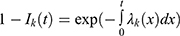 ). This equation shows the direct link between the cumulative risk function and the sub-hazard rate.
 - Given the well documented interdependency (or “tethering”) of csH ratios and subH ratios,4 assuming proportionality of the csH and subH when it is not the case can lead to reporting inadmissible (i.e., violating the mathematical links of csH and subH ratios) results. Case in point, the authors reported constant cause-specific hazard ratios of MACE and non-cardiovascular death as well as a constant subdistribution hazard ratio of MACE in the VTE versus comparison cohorts.1 Unfortunately, this is an inadmissible result in the context of two competing events: there is incompatibility of proportional sub-hazards for one event type and proportional cause-specific hazards for both event types (see proof in pages 9 and 10 by Muñoz et al).4 Furthermore, if the csH ratio and the subH ratio of MACE were constant, they must be equal to each other at all time points since they are always equal at time zero.3,4 The authors reported 2.09 (95% CI: 2.06–2.13) for the cause-specific hazard ratio of MACE and 1.48 (95% CI: 1.46–1.49) for the subdistribution hazard ratio of MACE1 which conveys a strong difference between the two. This inadmissible result in which constant csH and subH ratios are different is indicative of a strong violation of the proportionality assumptions.
- Finally, in Figure 4,1 the illustration of the left censoring case (Individual 3) should have had the black dot at the beginning of the dashed line and there should not have been any continuous line after the vertical grey line indicating the study start. In addition, the interval censoring case (Individual 4) should have a black dot within the dashed interval.
We fully concur with the authors1 exhortation to not ignore competing risks because it can preclude the elucidation of differential exposure effects on specific events. However, analyses assuming proportionality of csH and/or subH can yield inadmissible results and thus allowing for time-dependent csH and/or subH ratios should be the default approach. Better yet, methods (albeit more complex) to directly compare the two ratios using nonparametric approaches are available3 and should be considered to respect the tethered relationships of csH and subH in the context of competing risks.
Disclosure
The authors report no conflicts of interest in this communication.
References
1. Sørensen HT, Horváth-Puhó E, Peacock JL. An introduction to competing risks in epidemiology. Clin Epidemiol. 2026;18:1–2. doi:10.2147/clep.S574928
2. Fine JP, Gray RJ. A proportional hazards model for the subdistribution of a competing risk. J Am Statist Assoc. 1999;94(446):496. doi:10.1080/01621459.1999.10474144
3. Ng DK, Antiporta DA, Matheson MB, Muñoz A. Nonparametric assessment of differences between competing risk hazard ratios: application to racial differences in pediatric chronic kidney disease progression. Clin Epidemiol. 2020;12:83–93. doi:10.2147/clep.S225763
4. Muñoz A, Abraham AG, Matheson M, Wada N. Non-proportionality of hazards in the competing risks framework. In: Gail M, Pfeiffer R, Satten G, Cai T, Gandy A, editors. Lee m-LT. Risk Assessment and Evaluation of Predictions, Springer New York; 2013:3–22.
 © 2026 The Author(s). This work is published and licensed by Dove Medical Press Limited. The
full terms of this license are available at https://www.dovepress.com/terms
and incorporate the Creative Commons Attribution
- Non Commercial (unported, 4.0) License.
By accessing the work you hereby accept the Terms. Non-commercial uses of the work are permitted
without any further permission from Dove Medical Press Limited, provided the work is properly
attributed. For permission for commercial use of this work, please see paragraphs 4.2 and 5 of our Terms.
© 2026 The Author(s). This work is published and licensed by Dove Medical Press Limited. The
full terms of this license are available at https://www.dovepress.com/terms
and incorporate the Creative Commons Attribution
- Non Commercial (unported, 4.0) License.
By accessing the work you hereby accept the Terms. Non-commercial uses of the work are permitted
without any further permission from Dove Medical Press Limited, provided the work is properly
attributed. For permission for commercial use of this work, please see paragraphs 4.2 and 5 of our Terms.