
Back to Journals » Diabetes, Metabolic Syndrome and Obesity » Volume 19
Advances and Challenges in the Comprehensive Management of Diabetic Foot: A Narrative Review from a General Practice Perspective

Received 6 May 2026
Accepted for publication 9 June 2026
Published 1 July 2026 Volume 2026:19 614749
DOI https://doi.org/10.2147/DMSO.S614749
Checked for plagiarism Yes
Review by Single anonymous peer review
Peer reviewer comments 3
Editor who approved publication: Prof. Dr. Ernesto Maddaloni
Ruyi Shao, Xudong Lv
School of Medicine, ShaoXing University, ShaoXing, 312000, People’s Republic of China
The Zhuji People’s Hospital, ShaoXing University, Zhuji, 311800, People’s Republic of China
Correspondence: Xudong Lv, The Zhuji People’s Hospital, ShaoXing University, Zhuji, 311800, People’s Republic of China, Email [email protected]
Background: Diabetic foot is one of the most severe complications of diabetes, characterized by insidious onset, high disability rates, and substantial treatment costs, posing a major global public health issue. This article reviews the latest advancements in diabetic foot management in 2025 from a general practice perspective.
Methods: This narrative review synthesizes current literature on diabetic foot management from a general practice perspective. A comprehensive search of PubMed, Embase, and Web of Science was conducted, primarily focusing on cutting-edge studies published in 2025 to capture the latest advancements, while also incorporating landmark earlier research for foundational context.
Results: The review indicates that simple techniques, such as the 10-g monofilament test and dorsalis pedis artery palpation, remain crucial for primary care screening. Meanwhile, artificial intelligence and multi-omics technologies provide novel approaches for the precise prediction of high-risk feet. Additionally, the integration of general practice and specialized care, along with digital health interventions, significantly enhances the efficacy of whole-cycle management. However, challenges persist in the widespread adoption of appropriate primary care techniques, the implementation of multidisciplinary team (MDT) pathways led by general practitioners, and the evaluation of health economics.
Conclusion: This article synthesizes evidence from 2025 research to inform the development of a diabetic foot prevention and control system that includes primary care first-visit management, bidirectional referral, and acute-chronic differentiation. It highlights the pivotal role of general practitioners in bridging the gap between advanced specialized care and grassroots practice.
Keywords:
diabetic foot, general practice, appropriate technology, tiered healthcare, multidisciplinary collaboration
Introduction
Diabetic foot (DF) is one of the most severe and challenging complications of diabetes mellitus. Its development results from a combination of factors, including peripheral neuropathy, lower extremity vascular disease, and recurrent infections. These factors interplay and overlap, leading to foot ulcers that originate on the sole, progress deeper into the foot, and may ultimately become non-salvageable limbs. The increasing global incidence of diabetic foot not only severely impacts patients’ quality of life but also imposes a heavy burden on both individuals and the healthcare system. Public health events such as the COVID-19 pandemic have further adversely affected the daily management of these patients.1
In recent years, rapid advancements in molecular biology, materials science, and information technology have driven a significant shift in the understanding of diabetic foot and the development of corresponding interventions. Research approaches have evolved beyond merely addressing symptoms after they occur, progressing toward a more comprehensive understanding. This includes precise elucidation of pathological mechanisms, identification of targeted intervention sites, and the establishment of intelligent management models covering the entire lifecycle of prevention, treatment, and rehabilitation. Major research achievements in 2025 prominently reflect this developmental trend.
Researchers initially focused on macroscopic clinical manifestations, subsequently advancing to the microscopic cellular and molecular level to elucidate whether novel cell death mechanisms, such as ferroptosis and neutrophil extracellular traps (NETs), constitute critical barriers to wound healing. Artificial intelligence and machine learning hold significant importance in risk prediction, with current efforts dedicated to developing predictive models that encompass the entire disease progression chain from onset to amputation, enabling earlier intervention. Therapeutic approaches continue to evolve, with emerging innovations including bioactive materials, neuromodulation techniques, and data-mining-based precision traditional Chinese medicine (TCM) regimens, building upon conventional debridement and revascularization.2 Patient-centered management models emphasize education, continuous care, and digital remote support, enhancing the long-term and systematic nature of treatment. Despite rapid advancements in specialized diagnostic and therapeutic technologies, the current state of diabetic foot prevention and control remains suboptimal, primarily due to a “treatment-first, prevention-later” approach and fragmented healthcare services. General practitioners (GPs) serve as guardians of community health, playing an indispensable role in early-stage risk identification, assessment, referral decisions, and long-term follow-up. From a general practice perspective, exploring how to translate cutting-edge research findings into practical, locally applicable technologies and management strategies to establish efficient hierarchical care pathways holds greater clinical and public health significance. This article aims to comprehensively and systematically review relevant advancements to provide reference material for general practitioners in clinical practice.
Methods
Methods
This study was designed as a narrative review aimed at providing a comprehensive overview of recent advances and ongoing challenges in diabetic foot (DF) management, particularly within the general practice setting. Unlike systematic reviews, narrative reviews allow for a broader, more flexible synthesis of literature to identify emerging trends and conceptual shifts.
Search Strategy
A literature search was conducted using PubMed, Embase, and Web of Science databases up to December 2025. The core search terms utilized included combinations of “diabetic foot,” “primary care,” “general practice,” “multidisciplinary team,” “artificial intelligence,” and “emerging therapies,” linked with Boolean operators (AND/OR).
Study Selection and Synthesis
Given the rapid evolution of emerging technologies (such as AI and multi-omics) and novel pathophysiological concepts (eg., ferroptosis and NETosis) in recent years, this review intentionally prioritized literature published in 2025 to capture the most cutting-edge advancements and current paradigm shifts in diabetic foot management.
However, to avoid temporal bias and ensure a solid theoretical foundation, seminal landmark studies published prior to 2025 were also deliberately included. The criteria for identifying these earlier landmark studies were: (1) highly cited foundational research defining core pathophysiological concepts; (2) papers forming the basis of current international clinical guidelines; or (3) studies representing the first discovery of a key therapeutic milestone. Data were synthesized narratively, organized into thematic sections.
Deepened Understanding of Pathophysiological Mechanisms and Risk Assessment
New Perspectives on Cell Fate and Immune Microenvironment
With continuous advancements in molecular biology techniques, our understanding of the pathophysiological mechanisms of diabetic foot has evolved from the macroscopic “ischemia-neuropathy-infection” triad framework to a deeper exploration of cellular and molecular networks. Recent studies have clearly delineated two key cellular pathological processes in the non-healing wounds of diabetic foot. First, ferroptosis, an iron-dependent and lipid peroxidation-driven regulatory form of cell death, has been identified as a critical mechanism hindering the epithelialization of diabetic foot ulcers. Maghimi et al3 conducted an in-depth analysis of wound tissues and revealed that in the local microenvironment of diabetic foot patients, lipid metabolites such as arachidonic acid (AA) and adrenic acid are significantly enriched and abnormally accumulated. This directly inhibits the activity of glutathione peroxidase 4 (GPX4), leading to the collapse of the cellular antioxidant defense system, followed by severe lipid peroxidation damage in vascular endothelial cells and fibroblasts. From the perspective of metabolic reprogramming, this finding elucidates the molecular pathways of wound microenvironment deterioration and cell death, providing a clear target for intervention. The second mechanism is NETosis. Aziz et al4 conducted an in-depth investigation into the formation process of neutrophil extracellular traps (NETs) and identified their pathological role in chronic infection persistence and biofilm formation. When a high-sugar environment persistently induces a stress state, neutrophils release a reticular structure composed of DNA, histones, and granulases to combat pathogens. However, this immune response functions as a “double-edged sword.” Excessive NETosis exacerbates local inflammatory storms, damages surrounding tissues, and provides a physical scaffold for bacterial biofilms to develop drug resistance. This structure enables pathogens to evade host immune clearance and antibiotic attacks, thereby contributing to recurrent infections and ulcer progression. Additionally, high-sugar-induced changes in molecular expression, such as CD36, are associated with impaired wound healing.5 Notably, ferroptosis and NETosis do not occur in isolation. Due to the high-sugar microenvironment, products of lipid peroxidation are highly likely to further activate neutrophils, thereby intensifying NETosis formation. Moreover, proteases released by NETosis may disrupt cell membrane integrity, which in turn can trigger ferroptosis. This vicious cycle likely represents a deep network mechanism underlying the prolonged non-healing of diabetic foot wounds, suggesting the necessity for future research to focus on multi-target synergistic intervention strategies.
Paradigm Shift in Risk Assessment
Within the realm of risk evaluation, the current research paradigm is undergoing a profound transformation, evolving from traditional “post-event grading” based on disease progression to “pre-event early warning” leveraging multidimensional big data, with the goal of achieving more proactive and precise disease management. In the context of exploring serum biomarkers, we stand at a critical turning point, marking a leap from focusing on a single indicator to simultaneously considering multiple components. Kuang6 demonstrated that the combined expression levels of secretory frizzled-related protein 4 (SFRP4), C-X-C chemokine receptor 4 (CXCR4), and fibrinogen (FIB) exhibit a highly significant correlation with the Wagner classification of diabetic foot, providing a robust molecular basis for non-invasive assessment of disease severity. Meanwhile, Lian et al7 utilized metabolomics approaches to obtain plasma and urine samples from diabetic foot patients, precisely identifying a unique set of acylcarnitine and bile acid metabolic profiles. These metabolic small molecules represent early changes that occur prior to the manifestation of clinical symptoms, offering promising potential as sensitive “sentinels” for early detection of foot disease. Additionally, serum bile acid levels have been confirmed to possess significant clinical value.8 More groundbreaking is the unique role of artificial intelligence (AI) and machine learning in risk prediction models. Zhang et al9 developed a machine learning algorithm model integrating clinical features with multidimensional laboratory indicators, demonstrating exceptional predictive performance (AUC>0.87), which shows significant advantages over traditional statistical methods. Furthermore, Gao et al10 developed a clinical decision support model that extends the application scenarios of AI to prognostic assessment, enabling efficient prediction of amputation risk. Additionally, predictive models based on multiple inflammatory indices and the Prognostic Nutrition Index (PNI) are also in continuous development.11 The application of these tools not only assists physicians in formulating more proactive and individualized limb-sparing strategies but also provides quantifiable evidence for optimizing the allocation of medical resources.Moreover, identifying modifiable risk factors for key complications like peripheral vascular disease (PVD) remains crucial. Studies in resource-limited settings, such as Ethiopia, have demonstrated that smoking, alcohol consumption, hypertension, and physical inactivity are significant predictors of PVD in diabetic patients, highlighting the importance of targeted lifestyle interventions and screening in specific populations.12
Advancing to Clinical Translation
Diabetic foot is a complex systemic disease driven by multiple mechanisms and factors, rather than a localized lesion caused by a single factor. This highlights the evident limitations of both single-dimensional biomarkers and isolated assessment tools in clinical applications. The inevitable future direction is to establish a comprehensive evaluation system that integrates molecular biological characteristics, imaging parameters, and clinical phenotypic data. However, transitioning from the laboratory to the clinical setting remains fraught with significant challenges. On one hand, most novel biomarkers discovered through metabolomics are still in the “discovery phase,” lacking large-scale, multicenter prospective clinical validation. Their sensitivity and specificity require confirmation across different populations, and they are far from achieving true clinical translation. On the other hand, although AI models possess remarkable data processing capabilities and predictive power, their algorithmic “black box” nature results in poor clinical interpretability, making it difficult for physicians to fully trust the decision-making recommendations they provide. More critically, the construction of high-quality models heavily relies on standardized and structured data, yet the current fragmentation and heterogeneity of medical data pose a significant bottleneck.13 Transforming these cutting-edge molecular mechanism studies and complex algorithmic models into accessible, low-cost, and highly reliable screening tools for primary healthcare institutions will be a key focus of scientific research in the coming years, particularly in strategies for promoting simplified screening tools in resource-limited regions.14
Application and Evaluation of Appropriate Screening Tools in Primary Care
Although multi-omics and AI technologies have brought revolutionary breakthroughs in risk assessment, low-cost appropriate technologies remain the mainstay of screening in primary healthcare institutions with limited resources. In recent years, numerous studies have been conducted on the standardized application and re-evaluation of the diagnostic efficacy of traditional screening tools. Multiple analyses have confirmed that the screening protocol combining the 10-g monofilament (SWME) and 128 Hz tuning fork maintains high diagnostic sensitivity for peripheral neuropathy.15,16 Additionally, a correlation study between digital palpation of the dorsalis pedis artery—the most intuitive vascular assessment method—and the ankle-brachial index (ABI) further confirms its pivotal role in primary screening.14 Furthermore, a risk stratification questionnaire incorporating patient baseline information (age, disease duration) and simple physical signs (foot deformities, calluses) can effectively assist general practitioners in identifying high-risk feet within a short time frame, enabling precise risk stratification.15 The standardized use of these conventional clinical tools by general practitioners serves as the first line of defense in advancing screening at the early stage and reducing ulcer incidence.
Innovations in Diagnostic Technologies and the Establishment of Early Warning Systems
Imaging and Artificial Intelligence
Accurate and timely assessment of disease conditions is the fundamental basis for developing effective treatment strategies for diabetic foot. Current innovations in diagnostic technologies are advancing simultaneously in intelligence and micro-level assessment, particularly in imaging diagnostics, where the deep integration of artificial intelligence is reshaping clinical decision-making processes, as strongly evidenced by the systematic reviews of Alhasson and Alharbi.17 Image analysis systems based on deep learning convolutional neural networks have demonstrated significant potential far surpassing traditional subjective evaluations. These systems possess multiple functionalities: first, they can automatically identify the etiological type of ulcers, distinguishing between neurogenic, ischemic, or neuroischemic types; second, they can precisely quantify ulcer area and depth; third, they can detect occult osteomyelitis with diagnostic efficacy comparable to that of experienced specialists’ visual judgment. The most clinically valuable aspect lies in AI’s ability to dynamically quantify wound healing progress, meaning therapeutic efficacy evaluation no longer relies on subjective physician experience but is supported by objective and continuous data, thereby laying a solid foundation for timely treatment adjustments.
However, the implementation of AI and digital health interventions in primary care faces substantial barriers. Current AI models often suffer from algorithmic bias, lack external validation in diverse real-world settings, and raise significant concerns regarding data privacy. Furthermore, there is a potential risk of over-reliance on technology, which could undermine clinical intuition and exacerbate health disparities for populations with limited digital literacy or access to technology.
Biomechanics and Molecular Biomarkers
In addition to macroscopic imaging assistance, monitoring foot biomechanics and subtle changes at the microscopic molecular level has become crucial for establishing an early warning system. Pei et al18 innovatively combined gait analysis with neuroelectrophysiological examination to evaluate biomechanics, revealing the key pathophysiological chain preceding diabetic foot development. Abnormally elevated peak plantar pressure in patients is often accompanied by early slowing of common peroneal nerve conduction velocity. The expression of axon regeneration-related mediators impaired by the hyperglycemic environment is also a significant cause of non-healing.19 These functional changes often precede visible foot deformities or ulcer formation, strongly suggesting that biomechanical assessment can serve as a sensitive sentinel for screening high-risk feet, significantly advancing the window for clinical intervention. Researchers in the field of molecular diagnostics are seeking more specific circulating biomarkers to achieve earlier microscopic warnings. Xie et al20 used routine biochemical indicators such as glycated hemoglobin, albumin, and fibrinogen to construct a predictive model for ulcer recurrence. This approach is cost-effective and conducive to grassroots promotion, but its specificity is limited, making precise stratification difficult. In contrast, Li et al21 adopted an integrated multi-omics strategy, deeply mining proteomic and transcriptomic data and validating with independent cohorts. They identified myeloperoxidase (MPO) and myeloid trigger receptor 2 (TREM2) for the first time as potential secretory biomarkers distinguishing healing from non-healing diabetic foot ulcers. These two indicators demonstrate significantly superior prognostic value compared to traditional inflammatory markers, providing new biological evidence for precise ulcer prognosis.
Diagnostic Pathways and Referral Decisions from a Hierarchical Diagnosis Perspective
An ideal diabetes diagnostic system should not adopt a “one-size-fits-all” approach but rather adhere to the principles of hierarchical stratification and comprehensive coordination. From a general practice perspective, the focus of diagnostic pathways lies in “initial screening” and “referral decisions.” On one hand, primary healthcare institutions should rely on plantar pressure measurement, routine biochemical indicators, and simple neurovascular examinations to establish the first line of defense for diabetic foot screening. General practitioners must master preliminary assessment capabilities based on the Wagner and Texas classifications, clearly identifying which patients can undergo conservative management in the community and which require urgent referral. On the other hand, academic research on referral timing has become increasingly in-depth, with the latest guidelines and consensus emphasizing that general practitioners should initiate referral immediately when the following conditions occur: signs of ulcer infection (eg., erythema, purulent discharge), Wagner classification ≥2, presence of severe lower limb ischemia (eg., rest pain, gangrene), or multiple comorbidities.22 The ideal future pathway should be a closed-loop hierarchical diagnosis system of “primary screening (simple tools) - specialized diagnosis (multi-omics/AI),” achieving precision and accessibility while effectively alleviating the congestion of specialized medical resources. This is the inevitable path for optimizing the future diabetic foot diagnosis and treatment system. Figure 1 illustrates the proposed closed-loop hierarchical diagnosis and management pathway for diabetic foot, which aligns with the discussion on referral decisions in this section.
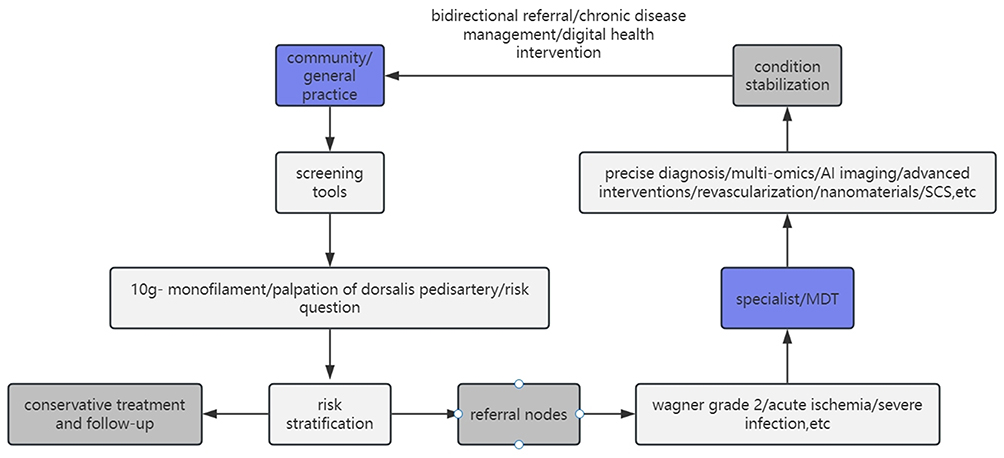 |
Figure 1 Proposed closed-loop hierarchical diagnosis and management pathway for diabetic foot from a general practice perspective. |
Innovation and Diversified Development of Treatment Strategies
Vascular Reconstruction and Surgical Decision-Making
The treatment system for diabetic foot has evolved into a diversified framework characterized by “fundamental therapy for consolidation, surgical techniques for breakthroughs, and novel therapies for enhanced efficacy.” For instance, in the field of vascular surgery, endovascular interventions (such as angioplasty) have established a dominant position due to their minimally invasive and repeatable advantages, targeting the core pathological change of lower limb ischemia. However, the uncertainty of prognosis has not been entirely eliminated by technological advancements. Hu et al23 conducted an in-depth analysis of the complex factors influencing therapeutic outcomes, identifying the degree of calcification in the femoral artery, the quality of the distal outflow tract, and the patient’s adherence to postoperative antiplatelet therapy as key variables determining the duration of vascular patency and the success rate of limb salvage. When the condition progresses to the end-stage or is complicated by uncontrollable severe infections, amputation remains the last resort to preserve the patient’s life. Qi et al24 and Jupiter25 emphasized that deep soft tissue infections, osteomyelitis, and extensive necrotic tissue are primary indications compelling surgeons to make amputation decisions. Studies on the correlation between diabetic foot infections/ulcer prognosis and the timing of amputation also provide important references.26 Regarding the selection of amputation planes, Turemis et al27 proposed a clinically valuable perspective based on long-term follow-up data, challenging traditional perceptions by suggesting that the risk of re-amputation is actually higher after single-toe amputation compared to multi-toe amputation. The underlying biomechanical mechanism may involve the disruption of weight-bearing structure integrity following monodactyly resection, which subjects residual plantar tissues to abnormally high pressure loads and consequently accelerates the formation of new ulcers. In addition to common pathological factors, rare external injuries such as animal bites may also cause severe lower limb damage requiring specific surgical intervention.28 Furthermore, the tibial lateral bone transfer technique based on the principle of distraction osteogenesis, as an innovative approach in limb salvage, improves distal limb perfusion by inducing microvascular network regeneration, offering new hope for ischemic diabetic foot patients lacking vascular graft conditions.29
Wound Microenvironment Regulation
With the interdisciplinary convergence of materials science and bioengineering, the concept of wound management is transitioning from passive coverage to active intelligent microenvironment regulation. Negative Pressure Wound Therapy (NPWT) remains fundamental in managing complex wounds, but as noted by Guo et al,30 its efficacy largely depends on optimizing wound base blood supply and effectively promoting the patient’s systemic nutritional status. Malnutrition is a critical factor affecting healing, and Meta-analyses of related indicators, such as the Prognostic Nutrition Index (PNI), further underscore its importance.31 A retrospective study by Jian et al32 focused on local anti-infection strategies, demonstrating that topical antibiotic cement exhibits significant advantages in controlling Wagner 3–4 grade ulcer infections, particularly in soft tissue defects outside the heel region. Notably, novel nanomaterials are bringing intelligence to wound treatment. Wang et al33 developed a cascade reactive oxygen species (ROS)-regulated gold-copper nanozyme hydrogel that has garnered considerable attention. This material not only releases nitric oxide (NO) but also mimics the activity of endogenous antioxidant enzymes (eg., catalase, superoxide dismutase), acting as a “smart regulator” of the wound microenvironment to precisely balance oxidative stress levels, thereby significantly accelerating ulcer healing. Additionally, research on the application of micro/nano-robots in wound healing has introduced new perspectives to this field.34 The potential of nanomaterials in transforming DFU management is increasingly recognized, with innovations like silver nanoparticles offering intrinsic antimicrobial capabilities and unique properties that accelerate healing and enhance drug delivery.35 However, continued research is vital for integrating these nanoscale innovations into routine clinical practices.Within the realm of biologics, the safety of exogenous recombinant human platelet-derived growth factor-BB (rhPDGF-BB) has been systematically evaluated.36 In contrast, spinal cord stimulation (SCS) offers an alternative approach by modulating sympathetic tone to improve microcirculation and alleviate ischemic pain, providing an effective non-pharmacological treatment option for many patients suffering from refractory pain with limited drug options.37
Modern Interpretation of Traditional Chinese Medicine (TCM) in Diabetes Foot Management
TCM has demonstrated renewed vitality in chronic disease management for diabetic foot, with current research trends shifting from empirical summaries to mechanistic explanations and standardization. Li et al38 revealed that fish scale ointment, a traditional topical preparation, can selectively induce ferroptosis in dysfunctional cells at wound sites by activating the nuclear factor E2-related factor 2 (Nrf2) pathway, thereby clearing pathological tissues and creating space for healthy tissue regeneration. This discovery ingeniously interprets the scientific essence of “removing necrotic tissue and promoting tissue regeneration” in classical TCM theory using modern molecular biology terminology. Berberine, as a natural compound, provides novel insights into its anti-inflammatory, metabolic, and epigenetic mechanisms, offering new pharmacological evidence for diabetes foot treatment.39 According to a systematic review by Rawash et al,40 objective evaluations of the therapeutic effects of bee products (eg., honey) and plant extracts confirm their potential applications in anti-inflammatory, antibacterial, and epithelialization-promoting effects. The significance of modernizing TCM lies not only in validating the efficacy of traditional therapies but, more crucially, in providing a novel “removing necrotic tissue and promoting tissue regeneration” approach to address challenging issues such as drug-resistant bacterial infections and microenvironmental imbalances in Western medicine. This highlights the broad translational potential of integrated TCM-Western medicine approaches in diabetes foot management.
Challenges in Integrating Therapeutic Concepts and Bottlenecks in Translational Medicine
Facing the complex systemic disease of diabetic foot, any single therapy appears inadequate. The individualized comprehensive treatment plan developed by multidisciplinary teams (MDTs) is currently recognized as the optimal clinical pathway. However, significant challenges remain in integrating concepts and translating practices. Firstly, Western medicine strictly adheres to evidence-based medical guidelines, emphasizing standardized diagnostic and therapeutic pathways, whereas Traditional Chinese Medicine (TCM) emphasizes holistic concepts and the flexibility of syndrome differentiation and treatment. These two fundamentally different theoretical systems and their corresponding efficacy evaluation criteria currently struggle to achieve true organic integration. High-quality randomized controlled trials (RCTs) combining TCM and Western medicine remain scarce, thereby limiting their recommendation levels in international guidelines. Additionally, although novel therapies such as nanozyme hydrogels and spinal cord electrical stimulation (SCS) hold broad application prospects, the majority of research remains at the early clinical or small-sample trial stage. Therefore, their long-term safety, biocompatibility of implantable materials, health economics costs, and specific applicability require more rigorous and long-term evaluations. In the future, establishing a rapid translational pathway from basic mechanism research to clinical application and breaking down barriers between laboratories and clinical settings will be the inevitable path to accelerating therapeutic innovation and truly benefiting patients.
Comprehensive Metabolic Management Under the Holistic Approach
The occurrence and progression of diabetic foot are not isolated local events, but rather a comprehensive manifestation of systemic metabolic status and comorbidity management. General practitioners (GPs), with their “holistic healthcare” perspective, play a central role in the comprehensive management of diabetic foot patients. Recent studies have emphasized the impact of glycemic variability (GV) and target range duration (TIR) on ulcer healing, with a 10% increase in TIR significantly improving ulcer healing rates. This suggests that GPs should prioritize stable glycemic control alongside glycated hemoglobin (HbA1c) monitoring.41 For comorbidities such as cardiovascular disease, malnutrition, and depression/anxiety commonly associated with diabetic foot, the “glycemic, lipid, and blood pressure” (GLP) collaborative management strategy provided by GPs is crucial. The Prognostic Nutrition Index (PNI) and hypoalbuminemia can affect wound healing,31 so GPs can effectively improve patient outcomes through nutritional assessment and intervention during follow-up. This shift from “treatment of the foot” to “treatment of the person” represents the unique value of general practice in the management of diabetic foot.
Evolution of Nursing Management and Patient Support Systems
Multidisciplinary Collaboration and Continuity of Care
Currently, the management of modern diabetic foot is undergoing a profound paradigm shift, transitioning from a singular, disease-focused model to a comprehensive, patient-centered approach. The scope and role of nursing are rapidly expanding, with the establishment of an efficient multidisciplinary team (MDT) network becoming fundamental to improving care quality and optimizing prognosis. Qiu et al42 developed a “continuity of care through multidisciplinary team collaboration led by specialized nurses” model, providing an excellent clinical example for achieving such transformation. Specifically, specialized nurses are no longer merely implementers of treatment but have evolved into “case managers” or “health coordinators” for patients, integrating resources across vertical dimensions such as wound care, nutritional support, psychological counseling, and rehabilitation training. Clinical practice has demonstrated that this highly integrated resource approach significantly enhances patient treatment adherence, effectively reduces ulcer recurrence rates and readmission rates, and achieves a “seamless transition” from in-hospital acute-phase treatment to home-based rehabilitation, effectively breaking down the temporal and spatial barriers of traditional medical services.
However, while the MDT approach is widely advocated, its implementation in real-world practice encounters significant challenges, including resource constraints, poor communication between specialties, and conflicting guidelines. In the context of general practice, there is a pressing need for enhanced training programs to equip primary care physicians with the necessary skills for early diabetic foot detection and coordination of MDT pathways. Without addressing these systemic and educational barriers, the theoretical benefits of MDT models will struggle to translate into widespread clinical practice.
Psychosocial Need
Within the framework of the biopsychosocial medical model, addressing patients’ psychological and social needs has become an indispensable component in the management of diabetic foot. Yang et al43 conducted a systematic analysis of the “unmet needs” of patients with diabetic foot ulcers, revealing significant service gaps in areas such as disease cognition, psychological counseling, social support systems, and self-management efficacy, in addition to the physical suffering endured. The quantitative study by Wang et al44 holds considerable cautionary value, as it profoundly demonstrates the widespread existence of “disease progression fear” among patient populations. This deep-seated fear of amputation, disease deterioration, or even death is often closely associated with chronic pain experiences, insufficient social support, and distrust of the healthcare system. This is not merely a negative emotion but an invisible barrier hindering treatment adherence and rehabilitation progress. It serves as a warning to clinical healthcare providers to perceive the inner suffering of patients through their wounds and integrate psychological interventions into routine care pathways. Furthermore, the impact on quality of life extends beyond psychological distress to severe functional impairment. Recent studies in specific populations, such as the Dominican Republic, confirm that high Wagner grades are the main factor associated with significantly lower quality of life and functional capacity.45 Additional research exploring diabetic foot ulcers in diverse and unique clinical contexts further underscores the necessity for tailored, context-specific management approaches.12,35
Digital Health Interventions
The deep integration of digital health technologies provides a powerful tool for transcending the temporal and spatial limitations of traditional nursing care. Telemedicine, through online wound monitoring, real-time consultations, and precision health education, can effectively improve follow-up rates, enabling healthcare professionals to intervene at the early stages of disease progression and thereby prevent recurrence.46 A randomized controlled trial (RCT) conducted by Xie et al47 further confirmed that nurse-led online health education programs significantly reduced the “delay time” from symptom onset to seeking medical assistance for patients with high-risk diabetic feet. Studies on the current status and influencing factors of delayed medical visits also provide important background evidence for this.48 Furthermore, “digital therapeutics,” as evidence-based treatment interventions in software form, are gradually reshaping chronic disease management models.49 Relevant applications (Apps) not only provide standardized foot self-examination guidance, personalized education, and behavioral reminders but can also utilize augmented reality (AR) technology to assist in wound dressing changes, truly placing self-management tools in patients’ hands. For instance, health education based on the LEARNS model has achieved favorable intervention outcomes,50 leading Liang et al51 to conduct a systematic review of digital health applications in home-based rehabilitation. Additionally, Zhu et al52 developed the “HEALing” intervention project, demonstrating that, beyond cold technical tools, “empowerment and active listening” are equally indispensable. The findings of the mixed-methods study indicate that establishing a trust-based physician-patient relationship is a prerequisite for digital interventions to be effective, and technology should serve as an extension of humanistic care rather than a substitute.
Digital Divide and Sustainability Challenges
While patients’ self-management capabilities and psychosocial status are critical determinants of long-term prognosis, and education, empowerment, and support have become core components of standard care protocols, we must maintain a sober perspective while embracing technology—such as the health inequalities caused by the “digital divide.” Nair Narayanan and Awang53 highlight that complex digital technologies may invisibly create new barriers, excluding elderly, low-educated, or economically disadvantaged patients. The best-evidence summaries on self-management for diabetic foot patients provide guidance for nursing practices.54 This population not only fails to benefit equally from digital dividends but may also experience anxiety and technological rejection due to barriers. Moreover, existing nursing intervention studies predominantly focus on short-term outcomes, such as ulcer healing rates and adherence scores, while long-term cost-benefit analyses, in-depth tracking of patients’ quality of life, and assessments of caregiver burdens remain insufficient. However, research on integrated care models has demonstrated their positive effects in improving patients’ foot conditions and quality of life.55 Therefore, future research should not merely focus on technological development but also explore “age-friendly” and “accompanying” digital intervention models, such as introducing family members or volunteers as “digital intermediaries” or developing voice-interaction, simplified interface elderly-friendly apps to ensure that the benefits of technology are accessible to all populations.
Limitations
Several limitations of this narrative review should be acknowledged. First, by primarily focusing on studies published in 2025 to capture the latest advancements, this review may introduce temporal bias. Although we incorporated landmark earlier studies based on predefined criteria, this approach may still omit important earlier evidence that continues to inform best practice, and the historical evolution of certain concepts may not be comprehensively detailed. Future systematic reviews with broader time frames are needed to validate these emerging findings. Second, as a narrative review, it lacks a formal systematic quality appraisal (eg., risk of bias assessment) of the included studies, which may affect the weight of the evidence presented. Finally, the selection of literature was influenced by the authors’ expertise, which may inherently carry selection bias. Future systematic reviews with broader time frames and rigorous quality assessments are needed to validate these emerging findings.
Summary and Prospects
Current Research Consensus and Paradigm Reconstruction
A systematic review of the research landscape in the field of diabetic foot by 2025 reveals that the discipline is undergoing a continuous transition from macroscopic morphological descriptions to microscopic mechanistic investigations, and from a single-technology intervention model to a multidisciplinary integrated diagnostic and therapeutic approach. The academic community has reached a high degree of consensus that diabetic foot is a highly heterogeneous complex syndrome, and the “one-size-fits-all” fixed mindset must be abandoned in favor of individualized comprehensive treatment strategies based on precise risk assessment. When confronted with the intricate and multifaceted changes in pathophysiology, relying solely on isolated efforts from a single discipline is no longer sustainable. Establishing an efficiently functioning multidisciplinary collaborative team has become an essential pathway to improving treatment outcomes and enhancing patient prognosis. Furthermore, a fundamental shift in medical philosophy has occurred, where patients are no longer passive recipients of treatment but have become “co-deciders” who collaborate with healthcare professionals in shared decision-making. Through education and patient empowerment to stimulate self-management potential, the foundation for stabilizing long-term prognosis improvement is solidified. In summary, data science and information technology are no longer merely auxiliary tools but have deeply integrated into the entire disease management process, serving as the core driving force for continuous evolution and innovation in the relevant field.
Core Disputes and Urgent Research Gaps
Beyond the flourishing research landscape, we must critically examine the significant divergences and critical gaps that chart the course for future exploration. First, the “translational chasm” between basic research and clinical application persists. Despite promising discoveries in novel biomarkers, innovative therapies, and advanced AI prediction models, most achievements remain in the nascent stages. Bridging this divide requires rigorous large-scale prospective trials and pragmatic studies to validate real-world efficacy, safety, and cost-effectiveness, thereby achieving true technological translation. Second, specific patient subgroups suffer from a paucity of attention. Current research disproportionately centers on “typical” diabetic foot profiles, leaving complex subgroups—such as those with end-stage renal disease (ESRD), particularly maintenance hemodialysis patients,56 or rare autoimmune diseases57—poorly understood regarding their distinct pathophysiology, risk trajectories, and management strategies. These marginalized populations often bear the poorest prognoses yet face the most severe scarcity of evidence-based data, representing an urgent priority for dedicated research. Third, the pervasive absence of health economic evaluations represents a significant oversight. Amidst increasing resource constraints, studies on digital therapeutics, novel biomaterials, and MDT models often demonstrate clinical efficacy while neglecting cost-effectiveness. Crucial data regarding long-term economic viability, impact on healthcare systems, and patient financial toxicity remain scarce. Without this evidence, even superior therapies struggle to secure adoption at the public health policy level. Furthermore, the potential of real-world data remains largely untapped. Electronic medical records, radiomics, and wearable device data are often fragmented, lacking the integration and standardization necessary to transform them into robust assets for knowledge discovery and clinical decision support. As Stotl13 emphasizes, establishing a comprehensive data management framework is a prerequisite for activating these dormant assets and realizing smart healthcare.Finally, global health equity remains a pressing concern. The burden of diabetic foot disease falls heaviest on low- and middle-income countries (LMICs) with limited resources. Research paradigms dominated by high-income medical centers are often cost-prohibitive and technically complex, rendering them ill-suited for direct transplantation. There is an urgent imperative to develop low-cost, accessible prevention and management strategies tailored to resource-constrained environments14—a task that represents not only a medical challenge but an ethical obligation.
Future Research Directions
From a general practice perspective, we must pay closer attention to the following trends. First, the trend toward the popularization of appropriate technologies. Although novel biomarkers and AI models continue to emerge, the key to addressing resource imbalance lies in transforming them into low-cost and user-friendly tools for community implementation. Second, the trend toward integrated management models. Establishing a “hospital-community-family” integrated management network led by general practitioners, with a focus on advancing tiered diagnosis and treatment and the practical implementation of referral pathways, represents the core direction for future development. Third, the human-centered approach to treatment goals. Expanding from mere ulcer treatment to comprehensive patient management, general practitioners should enhance patients’ quality of life through metabolic management, psychological support, and health education. To successfully overcome the intractable condition of diabetic foot and achieve a fundamental shift from disease treatment to holistic patient care, future research should emphasize evaluating management strategies in primary care settings and identifying general-specialty collaboration mechanisms tailored to national conditions, thereby truly bridging the critical gap in diabetic foot management.
Finally, beyond technological and clinical advancements, the effective management of diabetic foot is deeply influenced by broader socioeconomic and cultural contexts. The growing burden of aging populations and health disparities significantly impacts DF outcomes, particularly in resource-limited settings. Socioeconomic factors and cultural beliefs can influence patients’ health-seeking behaviors and adherence to treatment. Therefore, patient education, continuous follow-up care, and the integration of mental health considerations are indispensable components of holistic care. Moreover, the active involvement of family members and community resources plays a critical role in supporting self-management and preventing complications in the home setting. Future research must ensure that innovative care models are culturally sensitive, economically viable, and inclusive of the social determinants of health.
Declaration of AI Use
During the preparation of this work, the authors used Zhipu ChatGLM solely to improve the language, grammar, and readability of the article. After using this tool, the authors thoroughly reviewed and edited the content to ensure accuracy and appropriateness. The authors take full responsibility for the scientific content, data interpretation, and conclusions presented in this article.
Data Sharing Statement
Data sharing is not applicable to this article as no datasets were generated or analyzed during the current study.
Author Contributions
Ruyi Shao: Conceptualization, Investigation, Data curation, Writing – original draft.
Xudong Lv: Conceptualization, Project administration, Supervision, Writing – review & editing.
All authors gave final approval of the version to be published; have agreed on the journal to which the article has been submitted; and agree to be accountable for all aspects of the work.
Funding
The author(s) received no financial support for the research, authorship, and/or publication of this article.
Disclosure
The authors declare that they have no competing interests.
References
1. Gonzales M, Morris T, Nickson N, et al. Impact of COVID-19 pandemic on diabetic foot ulcer management in Kalamazoo, Michigan. J Am Podiatr Med Assoc. 2025;115(6):24–13. doi:10.7547/24-036
2. Gupta A, Chalotra R, Sharma K, et al. Current therapeutic strategies in management of diabetic foot ulcers. Tissue Barriers. 2025. doi:10.1080/21688370.2025.2611185
3. Maijimi S, L QW, Maiwulangjiang M, et al. Correlation study between ferroptosis-related lipid metabolites and wound healing of diabetic foot ulcers. Chin. J. Aesthet. Med. 2025;34(10):43–47. doi:10.15909/j.cnki.cn61-1347/r.007069
4. Aziz W, Sultana H, Kumar V, et al. The relationship between NETosis and biofilm formation in chronic infections. Biomolecules. 2025;15(12):1692. doi:10.3390/biom15121692
5. Ho V, Tran T, Patel J, et al. Hyperglycemia induced in Sprague-Dawley rats modulates the expression of CD36 and CD69 during wound healing. Int J Mol Sci. 2025;26(24):12032. doi:10.3390/ijms262412032
6. Kuang DY. Correlation analysis and clinical value of serum SFRP4, CXCR4, and FIB levels with the severity of diabetic foot in patients. Chin. J. Convalesc. Med. 2025;34(9):91–94. doi:10.13517/j.cnki.ccm.2025.09.019
7. Lian F, Gu J, Huan J, et al. Distinct urine and plasma metabolic signatures in diabetic foot: early diagnostic biomarkers and predictive modeling. BMC Endocr Disord. 2025;25(1):285. doi:10.1186/s12902-025-02097-7
8. Huang DD, Ren YZ, Sun XL. Clinical application value of serum bile acids and BMI in patients with type 2 diabetes complicated with diabetic foot. Lab Med Clin. 2025;22(21):2920–2924.
9. Zhang Y, Tian Y, Jian Y, et al. Development and external validation of machine-learning based models to predict diabetic foot ulcer in diabetes population. Front Endocrinol. 2025;16:1692917. doi:10.3389/fendo.2025.1692917
10. Gao L, Liu Z, Han S, et al. A machine-learning-based clinical decision model for predicting amputation risk in patients with diabetic foot ulcers: diagnostic performance and practical implications. Diagnostics. 2025;15(24):3142. doi:10.3390/diagnostics15243142
11. J ZY. Predictive Value of Multiple Inflammation Indexes and Prognostic Nutritional Index (PNI) for Amputation Risk in Patients with Diabetic Foot[D]. Nanchang: Nanchang University; 2025. doi:10.27232/d.cnki.gnchu.2025.000879
12. Deme ZC, Feda GF, Tsegaye D, et al. Peripheral vascular disease and its associated factors among diabetic patients on follow-up at ras desta damtew memorial hospital, Addis Ababa, Ethiopia. Endocr Metab Immune Disord Drug Targets. 2025. doi:10.1016/j.endmts.2025.100271
13. Štotl I. Data in diabetic foot care: from current state to a management framework for implementation. J Clin Med. 2025;14(24):8674. doi:10.3390/jcm14248674
14. Ntuli S. Prevalence, screening practices and risk stratification for diabetic foot complications in primary healthcare clinics: a cross-sectional study in Gauteng Province, South Africa. Int J Environ Res Public Health. 2025;22(12):1794. doi:10.3390/ijerph22121794
15. Li G, Lu Q, Wen B. WEN B,et al.Analysis of the incidence and influencing factors of high-risk foot in elderly patients with type 2 diabetes in a community in Beijing. PLoS One. 2025;20(3):e0313794. doi:10.1371/journal.pone.0313794
16. Yuan C, Liu Z, Li X, et al. A dynamic weighted ensemble learning framework for cardiovascular risk prediction in type 2 diabetes: a comparative study with SHAP-based interpretability. Sci Rep. 2025;15(1):45029. doi:10.1038/s41598-025-28786-w
17. Alhasson HF, Alharbi SS. Advances in image-based diagnosis of diabetic foot ulcers using deep learning and machine learning: a systematic review. Biomedicines. 2025;13(12):2928. doi:10.3390/biomedicines13122928
18. W PZ, Z MA, D QG, et al. Relationship between plantar pressure changes and nerve conduction in patients with diabetic foot. Difficult Complicated Cases. 2025;24(9):1069–1072.
19. Patel J, Ho V, Tran T, et al. Hyperglycemia impairs expression of mediators of axonal regeneration during diabetic wound healing in rats. Biomedicines. 2025;13(12):2994. doi:10.3390/biomedicines13122994
20. Xie XM, Su R, Zhong MX, et al. Construction of a risk prediction scheme for diabetic foot ulcer recurrence based on biochemical test indicators. Int J Lab Med. 2025;46(20):2490–2496.
21. Li B, Li T, Wang J, et al. Integrated multi-omics and independent validation reveal MPO and TREM2 as secretory biomarkers for non-healing diabetic foot ulcers. Genes. 2025;16(12):1419. doi:10.3390/genes16121419
22. National Primary Diabetes Prevention and Management Guidelines. released. Chin Health Preservation. 2022;8(05):2.
23. Hu YX, Han MM, Chen XC, et al. Analysis of influencing factors for endovascular treatment of diabetic foot. Zhejiang Clin Med J. 2025;27(9):1337–1339.
24. Qi AP, Yu Y, Zheng JY, et al. Analysis of risk factors for amputation in patients with diabetic foot. Eur J Vasc Endovasc Surg. 2025;11(6):789–793. doi:10.19418/j.cnki.issn2096-0646.2025.06.15
25. Jupiter DC, Pescatore SM. Osteomyelitis and osteomyelitis-related amputations in Texas diabetic populations. J Am Podiatr Med Assoc. 2025;115(6):23–192. doi:10.7547/23-192
26. Wang D, Jupiter DC. Associations of diabetic foot infection with ulcer prognosis and amputation timing in patients with type 2 diabetes mellitus. J Am Podiatr Med Assoc. 2025;115(6):23–230. doi:10.7547/23-230
27. TuremiS C, Gursan O, Erpala F, et al. Comparison of single and multiple toe amputations in diabetic patients with long-term follow-up and evaluation of reamputation risk. J Am Podiatr Med Assoc. 2025;115(6):23–216. doi:10.7547/23-216
28. Jenkins DW, Berggren SW, Pierson K. Canine smasticating on the lower extremity. J Am Podiatr Med Assoc. 2025;115(6):24–071. doi:10.7547/24-071
29. Xiao LF, Wang Y, LI H, et al. Mechanism and clinical progress of tibial transverse bone transport technology in the treatment of diabetic foot. Int J Orthop. 2025;46(6):363–367.
30. Guo Q, W HJ, Su MM. Analysis of influencing factors for prognosis of patients with diabetic foot treated by negative pressure drainage technology. Chin Med Cosmetol. 2025;15(9):118–123. doi:10.19593/j.issn.2095-0721.2025.09.026
31. L ZG, Xu R, Bian XN, et al. Meta-analysis of influencing factors for malnutrition in patients with diabetic foot ulcers. Chin J Nurs. 2025;60(20):2527–2534.
32. Jian Y, Li L, Chen W, et al. Correction: comparative analysis of the therapeutic effect of antibiotic bone cement on Wagner grade 3 or 4 diabetic foot ulcer in heel and non-heel areas: a retrospective cohort study. Front Endocrinol. 2025;16. 1762804. doi:10.3389/fendo.2025.1762804
33. Wang X, Zhang Y, Chen Y, et al. Cascade ROS-modulating Au/Cu nanozyme hydrogel with nitric oxide release ability for accelerated diabetic foot ulcer healing. Colloids Surf. B. 2025. doi:10.1016/j.colsurfb.2025.115403
34. Liu Y, Wang K, Gao F, et al. Micro/nanorobots in wound healing: bridging gap from concept to clinical translation. Int J Nanomed. 2025;20:15343–15362. doi:10.2147/IJN.S557042
35. AL-Raeei M. Harnessing nanoscale innovations for enhanced healing of diabetic foot ulcers. Endocr Metab Immune Disord Drug Targets. 2024. doi:10.1016/j.endmts.2024.100210
36. Heck S, Slade HB, Lynch SE. Safety of exogenous recombinant human platelet-derived growth factor-BB (rhPDGF-BB) for medical and cosmetic applications: a review. J Cosmet Dermatol. 2026;25(1):e70636. doi:10.1111/jocd.70636
37. Zhang S, Mi J. Research progress of spinal cord electrical stimulation in the treatment of diabetic foot. Chin Med Innovation. 2025;22(33):178–182.
38. Li L, Liu XN, Guo S, et al. Effect of fish scale ointment on diabetic foot ulcer by inducing ferroptosis via the nuclear factorE2-related factor 2 pathway. World J. Diabetes. 2025;16(12):111789. doi:10.4239/wjd.v16.i12.111789
39. Liu D, Zhao L, Wang Y, et al. Berberine: a rising star in management of type 2 diabetes—novel insights into its anti-inflammatory, metabolic, and epigenetic mechanisms. Pharmaceuticals. 2025;18(12):1890. doi:10.3390/ph18121890
40. Rawwash AA, Hussein EAF, Atta OM. Bee products and traditional plant therapies for wound care: a comprehensive review of scientific evidence and clinical applications. J. Pharmacopunct. 2025;28(4):255–268. doi:10.3831/KPI.2025.28.4.255
41. Peng HM, Deng HR, Zhou YW, et al. Impact of glycemic variability on the relationship between time in range and glycemic management indicators in patients with type 1 diabetes. Nat Med J China. 2022;102(16):1190–1195. doi:10.3760/cma.j.cn112137-20211009-02236
42. M QH, F WX, M YJ, et al. Application of specialist nurse-led multidisciplinary team collaborative continuous nursing in patients with diabetic foot. Nurs. Pract Res. 2025;22(10):1443–1448.
43. Yang F, Y WW, D XX, et al. Research progress on unmet needs and assessment tools in patients with diabetic foot ulcers. Qingdao Med Health. 2025;57(06):467–471.
44. Wang Q, J ZH, Shi N, et al. Current status and influencing factors of fear of disease progression in patients with diabetic foot ulcers. Chin J Nurs. 2025;60(20):2486–2492.
45. Calderón B, Soto M, Beltré A. Factors associated with quality of life and functional capacity in patients with diabetic foot in the Dominican Republic. Endocr Metab Immune Disord Drug Targets. 2024. doi:10.1016/j.endmts.2024.100203
46. Y MY, Wei B. Research progress on the application of telemedicine in preventing recurrence of diabetic foot ulcers. Med Front. 2025;15(31):42–45. doi:10.20235/j.issn.2095-1752.2025.31.009
47. Xie Y, Liu Z, Ming Y, et al. The effect of a nurse-led health education intervention on treatment delay in patients with diabetic high-risk foot: a randomised controlled trial. Int. J. Nurs. Stud. 2025. doi:10.1016/j.ijnurstu.2025.105316
48. Fu X. Current Status and Influencing Factors of Treatment Delay in Patients with Diabetic Foot[D]. Chengdu: University of Electronic Science and Technology of China; 2025. doi:10.27005/d.cnki.gdzku.2025.000339
49. Zhang J, N DS, A CC, et al. Research progress on the application of digital therapy in patients with diabetic foot. Chin J Nurs. 2025;60(11):1399–1404.
50. Y ZY, Li H, Li M, et al. Intervention effect of health education based on LEARNS model in patients with diabetic foot. Henan Med Res. 2025;34(23):4365–4369.
51. B LB, X LC, H YY, et al. Research progress on the application of digital health intervention in home rehabilitation of patients with diabetic foot. Chin General Practice Nurs. 2025;23(16):3050–3054.
52. Zhu X, Lee ES, Chan FHF, et al. Healing through empowerment and active listening (HEALing): a mixed-methods evaluation of feasibility and acceptability of a nurse-led self-care support intervention for people with diabetic foot ulcers. Diabetic Med. 2025. doi:10.1111/dme.70187
53. Nair Narayanan D, Awang S. Stepping forward: a study protocol for developing and validating a Malaysian diabetic foot self-care practice assessment instrument. PLoS One. 2025;20(12):e0337754. doi:10.1371/journal.pone.0337754
54. S JC, Lei Y, P LS, et al. Summary of the best evidence for self-management in patients with diabetic foot. Contemp. Nurse. 2025;32(9):24–31. doi:10.19792/j.cnki.1006-6411.2025.26.005
55. Yang Y, Yang S, Tang J. Impact of comprehensive nursing on foot condition and quality of life in patients with diabetic foot. Diabetes New World. 2025;28(20):121–124. doi:10.16658/j.cnki.1672-4062.2025.20.121
56. M ZQ, Yin Y, M HJ, et al. Analysis of risk factors for diabetic foot in patients with diabetic nephropathy undergoing maintenance hemodialysis. Guangdong Med J. 2025;46(11):1660–1664. doi:10.13820/j.cnki.gdyx.20251690
57. Ahmed W, Khan MZ, Saeed R, et al. Eosinophilic granulomatosis with polyangiitis presenting as mononeuritis multiplex in a diabetic patient: diagnostic and therapeutic challenges. Cureus. 2025;17(12):e98219. doi:10.7759/cureus.98219
 © 2026 The Author(s). This work is published and licensed by Dove Medical Press Limited. The
full terms of this license are available at https://www.dovepress.com/terms
and incorporate the Creative Commons Attribution
- Non Commercial (unported, 4.0) License.
By accessing the work you hereby accept the Terms. Non-commercial uses of the work are permitted
without any further permission from Dove Medical Press Limited, provided the work is properly
attributed. For permission for commercial use of this work, please see paragraphs 4.2 and 5 of our Terms.
© 2026 The Author(s). This work is published and licensed by Dove Medical Press Limited. The
full terms of this license are available at https://www.dovepress.com/terms
and incorporate the Creative Commons Attribution
- Non Commercial (unported, 4.0) License.
By accessing the work you hereby accept the Terms. Non-commercial uses of the work are permitted
without any further permission from Dove Medical Press Limited, provided the work is properly
attributed. For permission for commercial use of this work, please see paragraphs 4.2 and 5 of our Terms.