
Back to Journals » Clinical, Cosmetic and Investigational Dermatology » Volume 19
A Reliability Tier Classification System (RTCS) for Marketed Exosome-Based Products to Facilitate Clinical Decision-Making
Authors Pinto H  , Sánchez-Vizcaíno Mengual E
Received 28 April 2026
Accepted for publication 8 July 2026
Published 21 July 2026 Volume 2026:19 620535
DOI https://doi.org/10.2147/CCID.S620535
Checked for plagiarism Yes
Review by Single anonymous peer review
Peer reviewer comments 2
Editor who approved publication: Dr Monica K. Li
Hernán Pinto, Elena Sánchez-Vizcaíno Mengual
Scientific Department, Meta Cell Technology, Sant Cugat del Vallès, Spain
Correspondence: Elena Sánchez-Vizcaíno Mengual, Scientific Department, Meta Cell Technology, Sant Cugat del Vallés, Spain, Tel +34 636835848, Email [email protected]
Background: Exosomes are nanosized extracellular vesicles involved in intercellular communication. The composition, regulatory status, and scientific support of commercially marketed "exosome-based” products are highly variable, creating challenges for clinicians seeking safe and evidence-informed options in dermatology and aesthetic practice.
Objective: The Reliability Tier Classification System (RTCS) was developed to support clinical decision-making. It was designed as a framework-based tool that categorizes exosome-based products and devices intended to enhance exosome release into four reliability tiers.
Methods: The RTCS comprises two components: (A) Descriptive Product Classification, and (B) Hierarchical Categorization Algorithm. The first component assesses four domains: (1) regulatory authorization status; (2) origin; (3) manufacturing transparency; and (4) peer-reviewed scientific evidence. The second component assigns four reliability tiers (I–IV).
Results: RTCS output standardizes nomenclature for regulatory status (DRUG, MD, COS, NA), origin (AUTO, ALLO, XENO, MIM), and manufacturing reliability (composite transparency score: labeling accuracy, certification disclosure, manufacturing conditions, availability of published clinical evidence, regulatory setbacks, and availability of a detailed exosome production protocol).
Conclusion: This clinician-facing tool provides a structured approach to appraising marketed exosome-based products in a rapidly expanding, variably documented marketplace, not yet clinically validated. It is designed to be updateable as regulatory policies and scientific evidence evolve and may serve as a pillar for future implementation and validation.
Keywords: regenerative medicine, exosomes, classification, manufacturing, clinical decision-making
Introduction
Exosomes are nanosized extracellular vesicles (EV) (30–150 nm) released by most cell types and involved in intercellular communication through the transfer of proteins, lipids, and nucleic acids.1 Their potential as therapeutic agents, drug-delivery vehicles, and biomarkers has accelerated the commercialization of exosome-based products, particularly in regenerative medicine and aesthetics.2 However, despite rapid market growth, no exosome-based therapies have received approval from the US Food and Drug Administration (FDA) or the European Medicines Agency (EMA) for human use, and the regulatory status of marketed products remains heterogeneous.3
In clinical practice, this creates a disconnect between increasing patient demand and limited regulatory and evidentiary clarity. This is particularly relevant in aesthetic medicine, where products are frequently marketed across jurisdictions and routes of administration. In many settings, injectable use is restricted to specific regulatory pathways, and autologous preparations are treated differently from non-autologous products.
This regulatory heterogeneity is not limited to the United States and Europe. Recent reviews highlight that East Asian jurisdictions have also adopted distinct approaches to EV and exosome-based products. In Japan, regulation involves the Ministry of Health, Labour and Welfare (MHLW) and the Pharmaceuticals and Medical Devices Agency (PMDA); in South Korea, the competent authority is the Ministry of Food and Drug Safety (MFDS); in Taiwan, oversight is provided by the Taiwan Food and Drug Administration (TFDA); and in China, the National Medical Products Administration (NMPA), together with the Center for Drug Evaluation (CDE), is responsible for drug evaluation and advanced therapeutic product oversight.4 Although regulatory pathways differ across these jurisdictions, common concerns include product origin, manufacturing control, isolation and purification methods, quality consistency, safety evaluation, and documentation of intended clinical use.3,5 This fragmented international landscape reinforces the need for a practical framework that integrates regulatory status, manufacturing transparency, and evidence availability across regulatory environments.
In contrast, numerous commercial offerings are marketed with ambiguous claims or incomplete documentation regarding composition, origin, and intended mechanism of action. Commercial products labeled as “exosomes” vary widely,6–8 and provide incomplete information on vesicle origin, manufacturing conditions, and supporting evidence, creating practical challenges for clinicians who must distinguish credible products from poorly documented offerings.3,9 While emerging clinical data suggest a low incidence of serious adverse events with EV–based interventions, the evidence remains limited and heterogeneous, and risk profiles may differ across product types and sources.10 This variability complicates clinician interpretation and limits the ability to extrapolate safety and clinical relevance across products.9
For dermatologists and aesthetic physicians, a practical challenge is not whether exosomes are scientifically interesting, but how to appraise marketed products in day-to-day practice. What is the product regulatory category? Is the labeling accurate and verifiable? Are manufacturing conditions transparent? Is there peer-reviewed evidence supporting the intended indication? In this context, conventional exosome classification approaches (eg, by size, biogenesis, or cell of origin) are not designed to support clinical decision-making for marketed products.1,6,7 There is a need for a pragmatic tool that integrates regulatory status, documentation transparency, and scientific evidence to support structured product appraisal.
Framework-based classification systems have been successfully used in other therapeutic fields to support healthcare decision-making under market complexity.11,12 Inspired by these approaches, and by reports highlighting transparency gaps in direct-to-consumer secretome and exosome-related interventions,3 we developed the Reliability Tier Classification System (RTCS) to classify marketed exosome-based products and devices using standardized nomenclature, and to categorize them into reliability tiers (I–IV) based on regulatory authorization, evidence availability, and manufacturing transparency.
Materials and Methods
The RTCS consists of two complementary components: the Descriptive Product Classification and the Hierarchical Categorization Algorithm.
RTCS Descriptive Product Classification
Based on scientific, regulatory, and practical considerations, a product classification was developed. It describes the intrinsic and regulatory characteristics of marketed exosome-based products and devices. Four evaluation domains were defined as follows: 1) Regulatory authorization status; 2) Origin; 3) Manufacturing transparency; 4) Peer-reviewed scientific evidence. Domain identification was based on a literature review and regulatory documentation.
Regulatory Authorization Status
Product authorization status was selected as a domain because its application options depend on it.13 Most exosome-based products are either in the early stages of regulatory approval or in the basic science translational research stage.14
Exosome-based products are classified following the European Medicines Agency (EMA) or the Food and Drug Administration (FDA), as DRUG when authorized as drugs, as MD when authorized as medical devices, as COS when authorized as cosmetics, or as NA when not authorized (Figure 1). In countries such as Japan and South Korea, the methodology for obtaining EVs and their sources is relevant to the definition of EV drugs. In Japan, cell and gene therapy products containing living cell components are categorized as “regenerative medical products” and subject to a unique conditional and time-limited approval system.15 EVs that do not contain living cell components are typically categorized as drugs that act primarily through pharmacological, immunological, or metabolic mechanisms.16 Under a regulatory framework, this implies that similar cells produce the same drug via the same method of preparation, and that the EVs’ function derives from their function in the parent cell. This situation raises regulatory concerns, as product validation remains a challenge alongside noncellular characterization and purification selectivity. However, despite the growing marketing of EVs, the regulation of EV‐based cosmetics remains largely absent in these countries.3
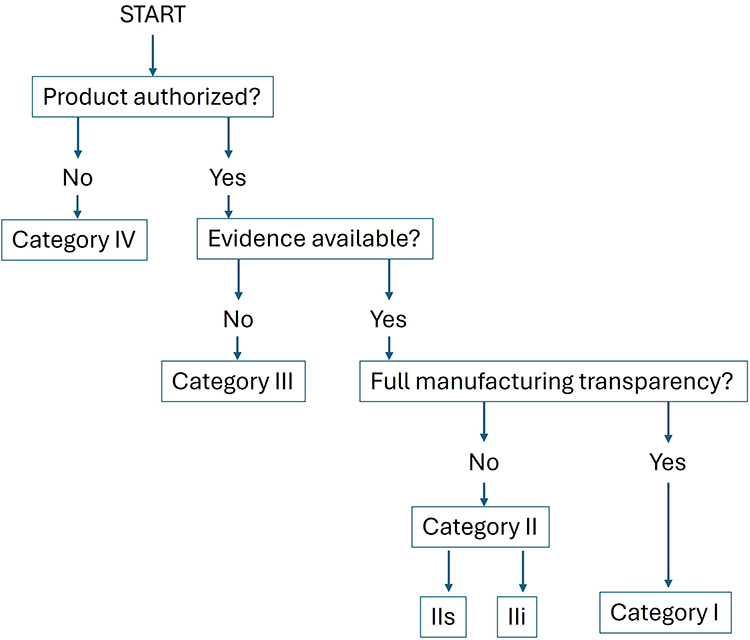 |
Figure 1 Hierarchical decision-tree core and secondary criteria algorithm. Products are first evaluated for regulatory authorization. Non-authorized products are assigned to Category IV (no reliability). Authorized products are subsequently assessed for the availability of peer-reviewed scientific evidence for the intended indication and route of administration. In the absence of evidence, products are assigned to Category III (very low reliability). Evidence-supported products are then evaluated against predefined manufacturing transparency criteria. Products fulfilling all criteria are assigned to Category I. In contrast, products that do not meet all transparency criteria are assigned to Category II and further subclassified as IIs (meeting all three core criteria) or IIi (not meeting all core criteria). Regulatory flags are displayed in the classification layer as an asterisk and explained in the report; they do not alter reliability categories. |
Regulatory warnings or enforcement actions will be annotated as either regulatory warnings or formal enforcement actions (RW), or regulatory observations or minor compliance issues (RO). These cases will be identified with an asterisk, and a detailed explanation of each case will be provided in the classification report (Figure 1). They do not alter the authorization status, but provide additional transparency into regulatory performance and oversight, and allow differentiation between fully and conditionally compliant products.
Origin
Exosome-related products may include human-derived exosomes, non-human exosomes, or exosome mimetics. Human-derived exosomes from the same individual are autologous; those from another individual are allogeneic. Exosomes from other species are xenogeneic; they can include animals, plants, or even bacteria.6 Exosome mimetics are nanoparticles coated with cell membranes that mimic exosomes.7,8 Naïve exosomes are naturally produced by cells, whereas engineered exosomes are loaded with materials such as proteins, nucleic acids, and other biomolecules.17,18
The exosome origin was selected as a domain because it often determines the safety and effectiveness of the product. Human exosome-based products are classified as AUTO (autologous) if the donor and recipient of the exosomes are intended to be the same, or as ALLO (allogeneic) if not. According to the production methodology, they can be further identified as naïve (n) or engineered (e). Non-human exosomes are classified as XENO (xenogeneic) and subcategorized as animal (a), plant (p), or bacterial (b) according to the organism that gave them origin. Finally, products based on proteins, vesicle fractions, synthetic compounds, or hybrid structures, designed to mimic exosome functionality, are classified as MIM (Table 1).
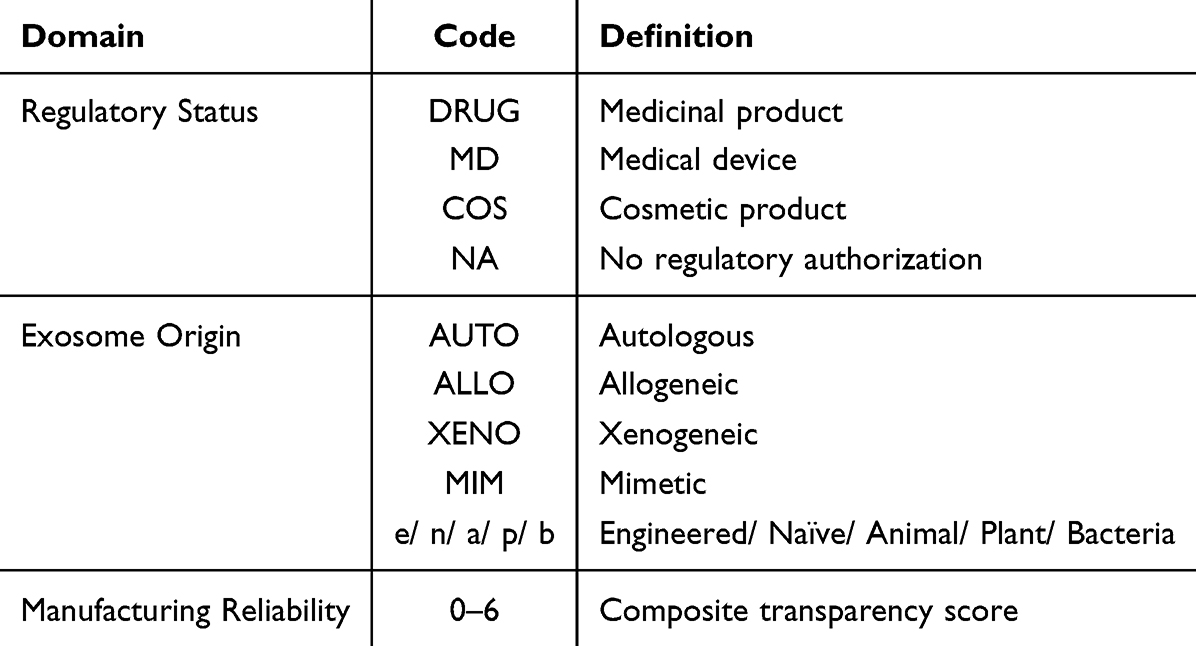 |
Table 1 A Reliability Tier Classification System (RTCS) Descriptive Product Classification |
Manufacturing Transparency
This domain was selected because, though manufacturers must provide true information to their customers, that is not always the case for exosome-based products. The optimal information source must be valid (with clear, high-quality data), relevant (clinically applicable), comprehensive (covering all benefits and harms of all possible interventions), and user-friendly (quickly and easily accessible and usable).19 Relevant information on manufacturing conditions, patient and physician feedback, or regulatory setbacks should be considered before deciding to use a product.20
Manufacturing transparency was evaluated through 6 predefined criteria. “Certification disclosure”, “accurate labeling” and “manufacturing conditions” were defined as core criteria, while “availability of published clinical evidence”, “regulatory setbacks/history” and “detailed exosome production protocol” were defined as secondary.
The proposed classification includes a graded system to report the number of criteria manufacturers meet, yielding a single composite score ranging from 0 to 6, calculated as the sum of the points for transparency indicators for which verifiable information is available (1 point each) (Table 1).
Peer-Reviewed Scientific Evidence
Peer-reviewed scientific evidence, provided through scientific articles published by peer-reviewed, indexed journals, is always essential to any reliability assessment tool. Despite their massive therapeutic potential, exosomes are complex, heterogeneous, and relatively new in clinical applications. Without rigorous data, companies face significant risks in regulatory approval, safety, and market adoption.
RTCS Hierarchical Categorization Algorithm
This algorithm categorizes the reliability of commercially available exosome-based products and devices (including those intended for preconditioning samples to enhance exosome release) in a four-tier (I–IV) list. Tiers reflect progressively decreasing regulatory robustness and scientific support (Table 2 and Figure 1). Products in tier I are the most reliable, and those in tier IV are the least reliable.
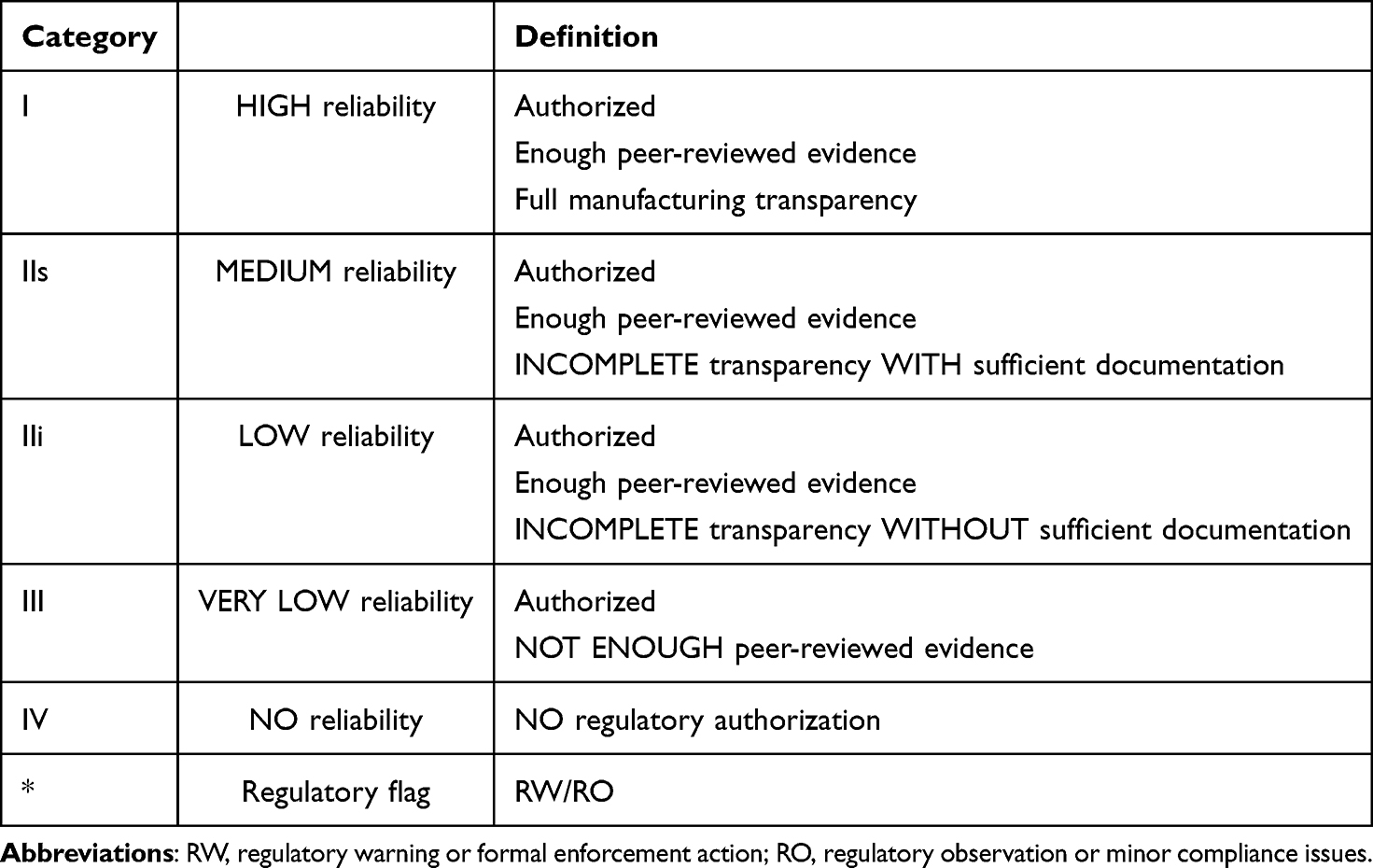 |
Table 2 RTCS Categorization Proposal |
The algorithm was built as a hierarchical decision-tree model, with the decision logic operating sequentially.
Results
Clinician-Facing RTCS Input Level
Descriptive Product Classification (RTCS first component) assesses and reflects the documentary reality of the evaluated exosome-based product.
Regulatory Authorization Status
- Inputs: regulatory authorization status (FDA, EMA, and national competent authorities). History of regulatory setbacks (warnings and observation/enforcement actions).
Origin
- Inputs: declared exosome origin. Subclassification: naïve or engineered production, animal, plant, or bacteria of specific origin.
Manufacturing Transparency
- Inputs: binary assessment (met/not met) for each predefined indicator to form a composite transparency score, which is equal to the number of indicators with accessible, product-specific, and internally consistent documentation. When evidence is provided only as marketing statements without verifiable documentation, the indicator is scored as not met.
Peer-Reviewed Scientific Evidence
- Input: peer-reviewed evidence of availability that supports the marketed intended indication and route of administration.
RTCS Descriptive Product Classification provides the necessary information to enter the RTCS Hierarchical Categorization Algorithm. This is a deterministic, rule-based decision tree intended for rapid clinician appraisal of marketed exosome-based products and devices. The algorithm uses three sequential gates to assign categories: (1) regulatory authorization, (2) peer-reviewed evidence, and (3) manufacturing transparency.
Decision Tree
- Gate 1. Regulatory authorization: If the product is NA, assign Category IV. Stop.If the product is an authorized DRUG, MD, or COS, proceed to Gate 2.
- Gate 2. Peer-reviewed evidence: If there is no peer-reviewed evidence supporting the specific intended indication and route of administration, assign Category III. Stop.If peer-reviewed evidence is present, proceed to Gate 3.
- Gate 3. Manufacturing transparency: If any core criteria indicator is not met, assign Category IIi. Stop.If all core criteria indicators are met, but any secondary criteria indicator is not, assign Category IIs. Stop.If all core and secondary criteria are met, assign Category I. Stop.
RTCS Categories
- Category I (High Reliability): Authorized products supported by peer-reviewed evidence and fulfilling all predefined manufacturing and protocol transparency criteria.
- Category IIs (Medium Reliability): Products with valid regulatory authorization and peer-reviewed evidence, but incomplete manufacturing or protocol documentation transparency. The subclassification “s” is assigned specifically when all core manufacturing/protocol transparency criteria are fulfilled, regardless of whether secondary transparency elements are missing.
- Category IIi (Low Reliability): Products with valid regulatory authorization and peer-reviewed evidence, but incomplete manufacturing or protocol documentation transparency. The subclassification “i” is assigned when not all core manufacturing/protocol transparency criteria are met, irrespectively to the fact of secondary transparency elements missing.
- Category III (Very Low reliability): Authorized products lacking sufficient peer-reviewed scientific evidence supporting their intended indication and route of administration. These products cannot be considered evidence-supported for the claimed clinical purpose. Reclassification may occur if new peer-reviewed evidence becomes available.
- Category IV (No Reliability): Products without legal authorization from a recognized regulatory agency, such as the FDA or the EMA, are considered unsuitable for clinical applications.
- *(Regulatory Flags): Warnings and enforcement actions are annotated, identified with an asterisk, and attached to the category.
Standardized Clinician-Facing RTCS Output Label
For consistency in reporting, the algorithm’s output is displayed as a compact label that combines the regulatory class, reliability category, origin code, and transparency score. Recommended format: [Regulatory class] [Reliability category/*] – [Origin/subcodes] [Transparency score].
- Regulatory class: DRUG, MD, COS, or NA.
- Reliability category: I, IIs, IIi, III, or IV. Add *when applicable (RW/RO should be detailed elsewhere in the report).
- Origin: AUTO, ALLO, XENO, or MIM. Add n, e, a, p, b, when applicable.
- Transparency score: integer 0–6.
RTCS Output Examples
The examples below are hypothetical and illustrative, rather than real and validated results.
Example 1: A product authorized as a drug, based on engineered exosomes of human origin, with peer-reviewed evidence, and all manufacturing trust points, will be categorized as DRUG I - ALLOe 6.
Example 2: A product authorized as a drug based on autologous naïve exosomes, with peer-reviewed evidence and five manufacturing trust points, but missing one secondary criterion, will be categorized as DRUG IIs – AUTOn 5.
Example 3: A product registered as a medical device based on allogeneic engineered exosomes, with peer-reviewed evidence and three manufacturing trust points, but missing one core criterion, will be categorized as MD IIi – ALLOe 3.
Example 4: A product based on proteins derived from human exosomes, registered as a cosmetic, with peer-reviewed evidence and four manufacturing trust points, that meets all core criteria, will be categorized as COS IIs – MIM 4.
Example 5: A plant exosome-based product registered as a cosmetic with a regulatory flag, no peer-reviewed evidence, three manufacturing trust points, not missing any core criteria, will be categorized as COS III* – XENOp 3.
Example 6: A non-authorized autologous exosome-based cosmetic with peer-reviewed evidence, four manufacturing trust points, and no missing core criteria will be categorized as NA IV.
Discussion
Although scientific evidence may evolve, the absence of peer-reviewed validation currently represents a higher degree of uncertainty than incomplete manufacturing/protocol transparency. This principle underlies the hierarchy of the proposed categorization algorithm.
A central strength of this framework is prioritizing regulatory authorization as the primary gatekeeper for clinical suitability. Health products are regulated under distinct legal categories (eg, medicinal products, medical devices, cosmetics, personal care products, biocides), and each product should fall into a single category with permitted routes of administration and claims defined accordingly.2,13,14,21,22 However, regulatory classification and enforcement can be complex and may vary across territories, and misclassification or inappropriate claims remain common. For example, the FDA notes that firms may violate the law by marketing cosmetics with drug claims or marketing drugs as cosmetics without meeting drug requirements.13 These realities are particularly relevant in aesthetic medicine, where products may be marketed across jurisdictions and indications.
In dermatology and aesthetic practice, the route of administration is a critical safety and legal boundary. Regulatory agencies, including the FDA and EMA, state that cosmetics are intended for superficial action and not for delivery into deep tissues; therefore, injection of cosmetic formulations falls outside legally permissible use and introduces avoidable risk.2,13,14,21,22 In addition, exosomes are not currently FDA-approved for cosmetic use, and there are no FDA-approved topical therapies containing peptides or exosomes as the primary ingredient.2 This regulatory distinction is essential because many commercial products are marketed using ambiguous language regarding composition, mechanism of action, or intended depth of action, and ingredient lists may be inconsistent. These discrepancies highlight deficiencies in transparency and regulatory compliance and support the inclusion of legal status and certification visibility as core components of any clinician-facing appraisal framework.14,21–23
Beyond regulation, the framework reflects well-described challenges in producing clinical-grade exosome preparations. Manufacturing remains constrained by variability in cell culture conditions, isolation techniques, and scalability; yield and biological quality are sensitive to source cell state and purification methodology; and batch-to-batch variability is a persistent concern, underscoring the need for rigorous quality control and standardized protocols.19,24 Accordingly, the present framework incorporates manufacturing transparency and protocol availability as key determinants of documented reliability. The literature also indicates substantial variability in manufacturing transparency across marketed products, and many commercial offerings do not provide sufficient information.25 Regulatory warnings further emphasize that products marketed for regenerative indications—including those claimed to be autologous—may still present unclear information and potential compliance issues.4 Together, these observations justify the inclusion of a structured manufacturing reliability assessment and regulatory-history flag within the descriptive classification layer.
Importantly, the RTCS is presented as a conceptual and deterministic model rather than a validated platform. If developed as an independent web-based catalog, product information provided by manufacturers or extracted from publicly accessible documentation could be entered to generate standardized classification outputs and reliability categories, facilitating clinician appraisal, improving transparency, and supporting evidence-informed selection.2,10,12 Future development would require interdisciplinary collaboration among regulatory specialists, clinicians, and software developers to ensure neutrality, consistent update procedures, and governance mechanisms for disputed classifications.10,12
Safety considerations reinforce the need for cautious appraisal and structured decision support. Systematic reviews indicate a low incidence of serious adverse events in EV–based interventions, while highlighting potential immunogenicity considerations for engineered or non-autologous products. Regulatory guidance and warnings similarly underscore that legal compliance and accurate labeling remain central to patient safety in this rapidly commercializing area.
The RTCS is designed to generate testable hypotheses and provides a roadmap for validation. Feasible approaches include: (i) literature and market analysis to compare classifications against published data and regulatory records;12,21,23 (ii) laboratory testing to correlate classification outputs;1,7,8,24,26 and (iii) regulatory audits cross-referencing product registrations and labeling compliance against classification categories.13,14,21,22 While detailed experimental protocols are beyond the scope of this conceptual manuscript, these strategies provide practical pathways to confirm, refine, and update the model over time.
Some limitations must be considered, including the current lack of approved exosome-based therapies, restricted access to comprehensive compositional data, and limited evidence supporting cosmetic products labeled as exosome-containing. The RTCS can be useful as a proposed appraisal framework. However, it must be considered that it has not yet been validated in real-world product assessment or tested for inter-rater consistency. The authors acknowledge that controversy may arise regarding the relative weighting of criteria, particularly around manufacturing reliability and incomplete reporting. Manufacturing reliability is inherently challenging because documentation quality and transparency vary widely, and robust regulation would ideally reduce the need for subjective interpretation. Independent validation would be helpful to add credibility and assess the reliability of the RTCS categorization. Nevertheless, current market variability necessitates an explicit, reproducible framework.
Conclusion
The present classification is intended to be dynamic, allowing updates as new peer-reviewed evidence and regulatory information become available. We propose a clinician-facing dynamic and practical framework to classify and categorize marketed exosome-based products and related devices, integrating regulatory status, biological origin, manufacturing transparency, and evidence availability. The RTCS is a conceptual and unvalidated framework intended to support day-to-day clinical decision-making in a rapidly expanding market characterized by variable documentation and regulatory ambiguity. Ongoing updates, implementation, and validation will be required to confirm clinical utility.
Funding
Meta Cell Technology paid for the Article Processing Charges. No other financial support was received.
Disclosure
Hernán Pinto is the Chief Science Officer of Meta Cell Technology, who paid the article processing charges to the journal. Any opinions or ideas expressed are his own. Hernán Pinto reports Leadership or fiduciary roles from Spanish Society for Aesthetic Medicine, outside the submitted work. Elena Sánchez-Vizcaino Mengual is an employee at Meta Cell Technology. They did not receive any extra fees for this work. The authors report no other conflicts of interest in this work.
References
1. Doyle LM, Wang MZ. Overview of extracellular vesicles, their origin, composition, purpose, and methods for exosome isolation and analysis. Cells. 2019;8(7):727. PubMed PMID: 31311206. doi:10.3390/cells8070727
2. Ash M, Zibitt M, Shauly O, Menon A, Losken A, Gould D. The innovative and evolving landscape of topical exosome and peptide therapies: a systematic review of the available literature. Aesthet Surg J Open Forum. 2024;6. doi:10.1093/asjof/ojae017
3. Li Q, Li Y, Shao J, et al. Exploring regulatory frameworks for exosome therapy: insights and perspectives. Health Care Sci. 2025;4(4):299–9. doi:10.1002/hcs2.70028
4. Verma N, Arora S. Navigating the global regulatory landscape for exosome-based therapeutics: challenges, strategies, and future directions. Pharmaceutics. 2025;17(8):990. doi:10.3390/pharmaceutics17080990
5. Wang C, Tsai T, Lee C. Regulation of exosomes as biologic medicines: regulatory challenges faced in exosome development and manufacturing processes. Clin Transl Sci. 2024;17(8). doi:10.1111/cts.13904
6. Janouskova O, Herma R, Semeradtova A, et al. Conventional and nonconventional sources of exosomes–isolation methods and influence on their downstream biomedical application. Front Mol Biosci. 2022;9. doi:10.3389/fmolb.2022.846650
7. Lener T, Gimona M, Aigner L, et al. Applying extracellular vesicles based therapeutics in clinical trials - an ISEV position paper. J Extracell Vesicles. 2015;4(1):30087. PubMed PMID: 26725829. doi:10.3402/jev.v4.30087
8. Sahin F, Atasoy BT, Yalcin S, Bitirim VC. Membrane-targeted immunogenic compositions using exosome mimetic approach for vaccine development against SARS-CoV-2 and other pathogens. Sci Rep. 2025;15(1):10899. doi:10.1038/s41598-025-95503-y
9. Kalluri R, LeBleu VS. The biology, function, and biomedical applications of exosomes. Science. 2020;367(6478):eaau6977. doi:10.1126/science.aau6977
10. Van Delen M, Derdelinckx J, Wouters K, Nelissen I, Cools N. A systematic review and meta‐analysis of clinical trials assessing safety and efficacy of human extracellular vesicle‐based therapy. J Extracell Vesicles. 2024;13(7):e12458. doi:10.1002/jev2.12458
11. Barbier L, Vandenplas Y, Boone N, Huys I, Janknegt R, Vulto AG. How to select a best-value biological medicine? A practical model to support hospital pharmacists. Am J Health Syst Pharm. 2022;79(22):2001–2011. doi:10.1093/ajhp/zxac235
12. Asadpour A, Yahaya BH, Bicknell K, Cottrell GS, Widera D. Uncovering the gray zone: mapping the global landscape of direct-to-consumer businesses offering interventions based on secretomes, extracellular vesicles, and exosomes. Stem Cell Res Ther. 2023;14(1):111. doi:10.1186/s13287-023-03335-2
13. US Food & Drug Administration. Is it a cosmetic, a drug, or both? (Or is it soap?). 2024.
14. Beetler DJ, Di Florio DN, Law EW, et al. The evolving regulatory landscape in regenerative medicine. Mol Aspects Med. 2023;91:101138. doi:10.1016/j.mam.2022.101138
15. Tsuchiya A, Terai S, Horiguchi I, et al. Basic points to consider regarding the preparation of extracellular vesicles and their clinical applications in Japan. Regen Ther. 2022;21:19–24. doi:10.1016/j.reth.2022.05.003
16. Azuma K, Yamanaka S. Recent policies that support clinical application of induced pluripotent stem cell-based regenerative therapies. Regen Ther. 2016;4:36–47. doi:10.1016/j.reth.2016.01.009
17. Song Y, Kim Y, Ha S, et al. The emerging role of exosomes as novel therapeutics: biology, technologies, clinical applications, and the next. Am J Reprod Immunol. 2021;85(2). doi:10.1111/aji.13329
18. Ceccotti E, Saccu G, Herrera Sanchez MB, Bruno S. Naïve or engineered extracellular vesicles from different cell sources: therapeutic tools for kidney diseases. Pharmaceutics. 2023;15(6):1715. doi:10.3390/pharmaceutics15061715
19. Masic I, Miokovic M, Muhamedagic B. Evidence based medicine - new approaches and challenges. Acta Inform Med. 2008;16(4):219–225. PubMed PMID: 24109156. doi:10.5455/aim.2008.16.219-225
20. US Food and Drug Administration. Consumer alert on regenerative medicine products including stem cells and exosomes. 2020. Available from: https://www.fda.gov/vaccines-blood-biologics/consumers-biologics/consumer-alert-regenerative-medicine-products-including-stem-cells-and-exosomes.
21. European Medicines Agency. Product-information requirements. 2020. Available from: https://www.ema.europa.eu/en/human-regulatory-overview/marketing-authorisation/product-information-requirements.
22. US Food & Drug Administration. FDA’s labeling resources for human prescription drugs. 2025. Available from: https://www.fda.gov/drugs/laws-acts-and-rules/fdas-labeling-resources-human-prescription-drugs.
23. Chaudhari P, Ghate V, Nampoothiri M, Lewis S. Multifunctional role of exosomes in viral diseases: from transmission to diagnosis and therapy. Cell Signal. 2022;94:110325. doi:10.1016/j.cellsig.2022.110325
24. Ahn SH, Ryu SW, Choi H, You S, Park J, Choi C. Manufacturing therapeutic exosomes: from bench to industry. Mol Cells. 2022;45(5):284–290. doi:10.14348/molcells.2022.2033
25. Primorac D, Brlek P, Bulić L, et al. Clinical applications of extracellular vesicles: promises and pitfalls. Int J Mol Sci. 2026;27(3):1509. doi:10.3390/ijms27031509
26. Kurian TK, Banik S, Gopal D, Chakrabarti S, Mazumder N. Elucidating methods for isolation and quantification of exosomes: a review. Mol Biotechnol. 2021;63(4):249–266. doi:10.1007/s12033-021-00300-3
 © 2026 The Author(s). This work is published and licensed by Dove Medical Press Limited. The
full terms of this license are available at https://www.dovepress.com/terms
and incorporate the Creative Commons Attribution
- Non Commercial (unported, 4.0) License.
By accessing the work you hereby accept the Terms. Non-commercial uses of the work are permitted
without any further permission from Dove Medical Press Limited, provided the work is properly
attributed. For permission for commercial use of this work, please see paragraphs 4.2 and 5 of our Terms.
© 2026 The Author(s). This work is published and licensed by Dove Medical Press Limited. The
full terms of this license are available at https://www.dovepress.com/terms
and incorporate the Creative Commons Attribution
- Non Commercial (unported, 4.0) License.
By accessing the work you hereby accept the Terms. Non-commercial uses of the work are permitted
without any further permission from Dove Medical Press Limited, provided the work is properly
attributed. For permission for commercial use of this work, please see paragraphs 4.2 and 5 of our Terms.
Recommended articles
Unveiling the Pathological Landscape of Intrauterine Adhesion: Mechanistic Insights and Exosome-Biomaterial Therapeutic Innovations
Qin Z, Yu Q, Long Y
International Journal of Nanomedicine 2025, 20:9667-9694
Published Date: 5 August 2025
Muco-Adhesive Hydrogels-Based Exosome Delivery for Periodontal Tissue Regeneration and Inflammation Reduction: A Review
Chen H, Zhang L, Duan Y, Lan X, Xu H, Wu L
International Journal of Nanomedicine 2025, 20:14413-14437
Published Date: 4 December 2025
Exosome-Mediated Rewiring of Oxidative Stress–Inflammation–ECM Remodeling Axis Mitigates UVB-Triggered Skin Photoaging
Yu F, Zhou J, Chen M, Liu Y, Qiu J, Chen J, Teng Y, Gou K, Tang Y, Xu Y, Wu Z, Zhang Z, Chen L
International Journal of Nanomedicine 2026, 21:600909
Published Date: 8 April 2026
Exosome–Biomaterial Platforms for Diabetic Skin Infections: Microenvironment Remodeling, Responsive Delivery, and Clinical Translation
Xiao J, He Z, Bu Y, Lu Y, Liang S
International Journal of Nanomedicine 2026, 21:607504
Published Date: 26 June 2026