
Back to Journals » Drug Design, Development and Therapy » Volume 20
A Comparative Study of Pharmacokinetics and Pharmacodynamics of Continuous Ciprofol Infusion Between Young and Elderly Patients
Authors Zhu J  , Zhong B, Cao Y, Zhang X, Xu B
Received 3 December 2025
Accepted for publication 20 April 2026
Published 8 July 2026 Volume 2026:20 583960
DOI https://doi.org/10.2147/DDDT.S583960
Checked for plagiarism Yes
Review by Single anonymous peer review
Peer reviewer comments 2
Editor who approved publication: Prof. Dr. Georgios Panos
Jiaxi Zhu,1,2,* Bowen Zhong,1,* Ying Cao,1 Xingan Zhang,1 Bo Xu1,2
1Department of Anesthesiology, General Hospital of Southern Theater Command, Guangzhou, Guangdong Province, 510010, People’s Republic of China; 2The First School of Clinical Medicine, Southern Medical University, Guangzhou, Guangdong Province, 510515, People’s Republic of China
*These authors contributed equally to this work
Correspondence: Bo Xu, Department of Anesthesiology, General Hospital of Southern Theater Command, Guangzhou, Guangdong Province, 510010, People’s Republic of China, Tel +86 13802738125, Email [email protected]
Objective: This study aimed to systematically compare the pharmacokinetics (PK) and pharmacodynamics (PD) profiles of continuous ciprofol infusion between young and elderly patients under general anesthesia, clarify the impact of age, and provide evidence for precise clinical drug use.
Methods: This non-randomised design study enrolled a total of 40 patients scheduled for elective surgery, who were divided into a young group (20– 45 years, n=20) and an elderly group (65– 85 years, n=20). All participants received ciprofol for anesthesia induction (0.4 mg/kg) and maintenance (0.8 mg/kg/h). Arterial blood samples were collected at 20 predefined time points for plasma concentration analysis using ultra-high-performance liquid chromatography-tandem mass spectrometry (UHPLC-MS/MS). PK parameters were determined using non-compartmental analysis. PD endpoints, including bispectral index (BIS) and the Modified Observer’s Assessment of Alertness/Sedation (MOAA/S) scale, were monitored simultaneously.
Results: PK analysis revealed that compared with the young group, the elderly group exhibited a significant reduction in total body clearance (CL) of ciprofol (0.60 ± 0.09 vs. 0.75 ± 0.08 L/h/kg, p < 0.001) and a prolonged elimination half-life (t1/2) (3.40 ± 0.92 vs. 2.68 ± 0.51 h, p = 0.003), resulting in significantly increased drug exposure (AUC0–t, p = 0.016; AUC0-∞, p = 0.018). PD analysis showed that the elderly group achieved a deeper sedation; however, equivalence analysis confirmed clinical equivalence between the two groups for key BIS parameters (BIS peak and BIS AUC0–t). The exploratory PK-PD analysis suggested that the effective sedative plasma concentration range of ciprofol potentially falls between 400– 700 ng/mL. Regarding safety, the incidence of adverse events was higher in the elderly group than in the young group.
Conclusion: Ciprofol exhibits delayed clearance and increased hemodynamic sensitivity in elderly patients. To achieve safe and effective anesthesia, enhanced intraoperative monitoring and individualized management strategies should be implemented for elderly patients.
Keywords: Ciprofol, pharmacokinetics, pharmacodynamics, general anesthesia, elderly
Introduction
The global demographic shift toward an aging population is increasingly pronounced, with the number of individuals aged 60 years and older expected to reach 2 billion within the next four decades.1 This structural change elevates the demands on perioperative anesthetic management. Older patients typically demonstrate reduced tolerance to surgical stress and anesthetic agents, attributable to age-related physiological alterations such as diminished circulatory reserve, declining hepatic and renal function, changes in body composition, and reduced receptor sensitivity.2,3 These changes can substantially influence the pharmacokinetics of anesthetics—including absorption, distribution, metabolism, and excretion—thereby increasing the risk of hemodynamic instability and perioperative complications.
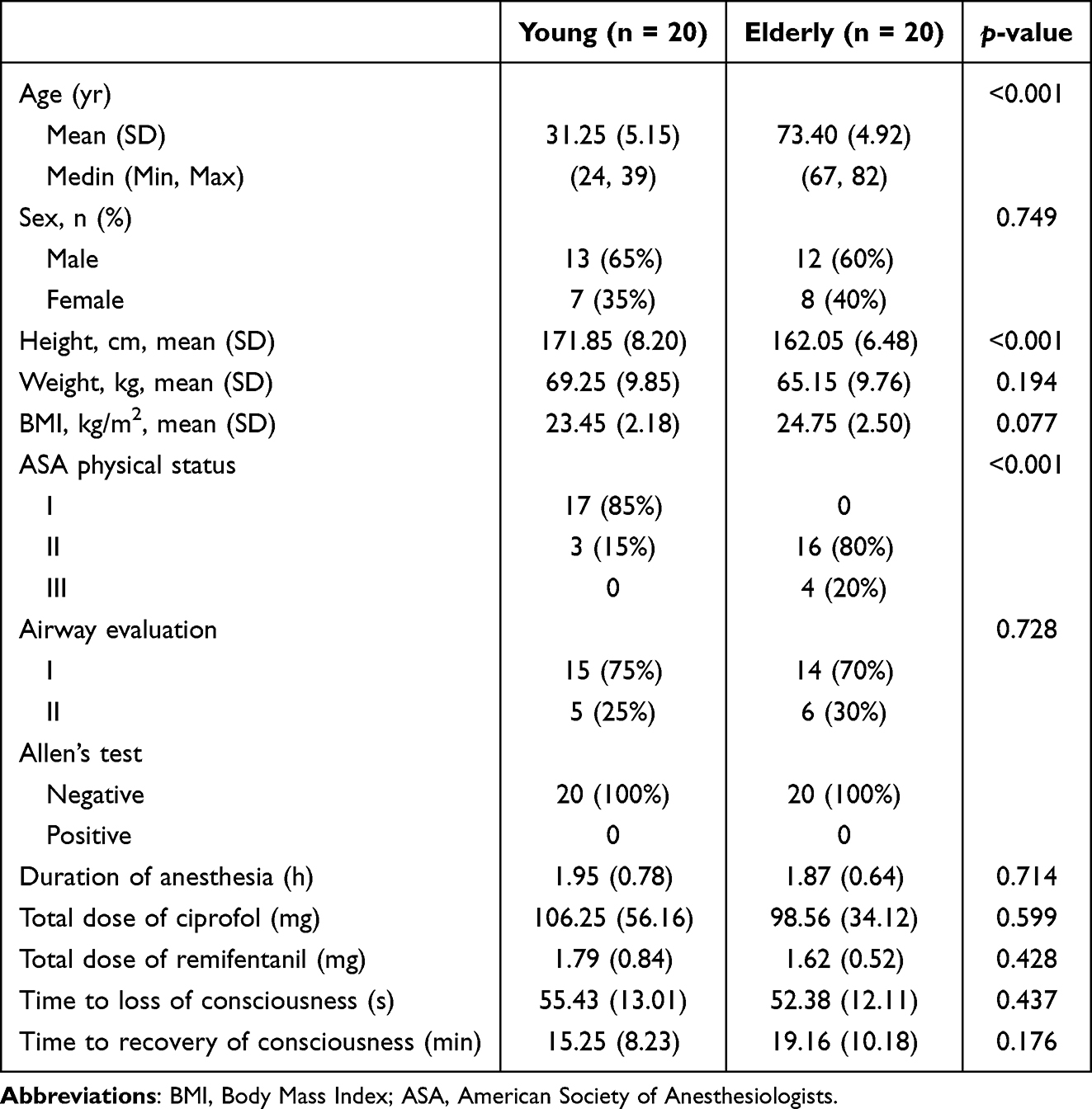 |
Table 1 Characteristics of the Study Patients |
 |
Table 2 Summary of Adverse Events |
 |
Table 3 Pharmacokinetic Characteristics of Ciprofol |
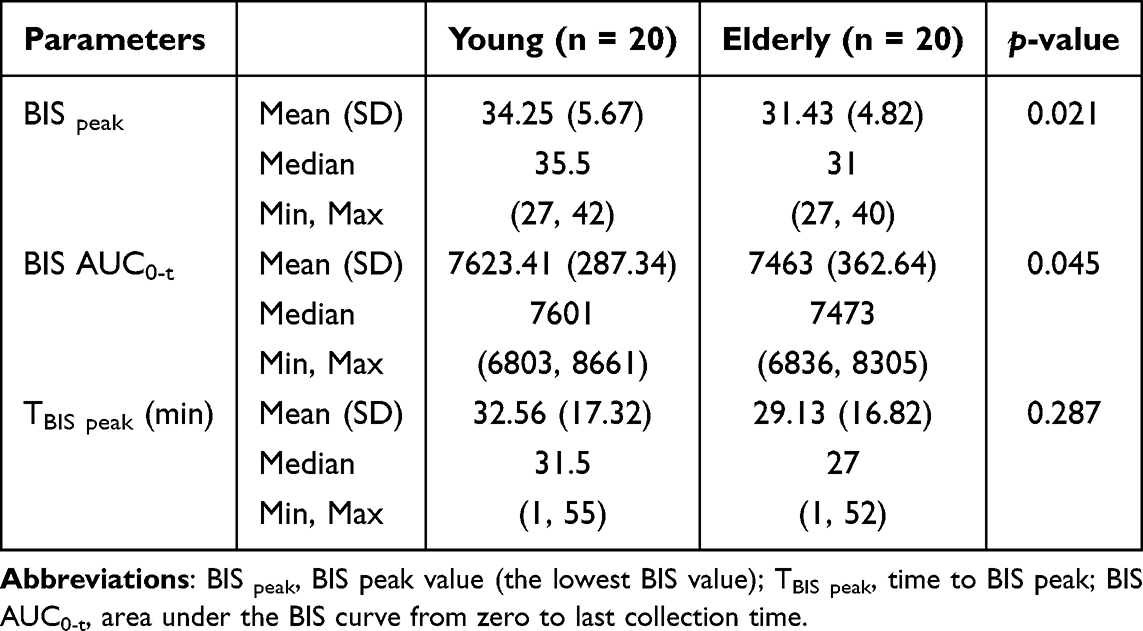 |
Table 4 BIS Parameters of Young and Elderly Participants |
Among intravenous anesthetics, propofol is widely used for the induction and maintenance of general anesthesia owing to its favorable pharmacological profile, characterized by rapid onset and clearance. Its mechanism of action involves allosteric potentiation of γ-aminobutyric acid type A (GABA_A) receptors, enhancing central inhibitory neurotransmission to produce sedation and anesthesia.4,5 Its pharmacokinetic (PK) and pharmacodynamic (PD) characteristics, such as rapid onset, fast recovery, and minimal metabolic residue, render it suitable for clinical anesthesia.6–8 However, propofol is associated with clinically relevant drawbacks, including dose-dependent cardiorespiratory depression, injection-site pain, and-though rare-propofol infusion syndrome, a potentially life-threatening condition.9–12 Consequently, the development of alternative agents with comparable efficacy and an improved safety profile holds significant clinical value.
Ciprofol is a novel phenolic intravenous anesthetic structurally related to propofol (Figure 1). Substitution of the isopropyl group in propofol with a cyclopropylethyl moiety enhances its affinity and potency at GABA_A receptors.13–15 Further molecular modification through introduction of a cyclohexyl group results in high plasma protein binding (up to 98.7%) and a more stable metabolic pathway, primarily via UGT1A9-mediated glucuronidation.16 Clinical studies have demonstrated that ciprofol is non-inferior to propofol in anesthetic induction efficacy, while significantly reducing the incidence of injection pain and improving postoperative recovery quality.14,17
 |
Figure 1 Chemical structures of ciprofol and propofol. |
Previous investigations have preliminarily characterized the PK/PD profiles of ciprofol in healthy older adults, younger individuals, and patients with hepatic or renal impairment.18–20 Nevertheless, existing research remains limited in several respects: most studies have focused on single-dose administration in healthy volunteers, lacking PK/PD data under continuous infusion during surgical anesthesia. Moreover, correlations between PK/PD parameters and clinical monitoring indicators have not been comprehensively analyzed.
To address these gaps, this non-randomised design study enrolled younger and older patients undergoing elective surgery, all of whom received continuous ciprofol infusion for anesthesia induction and maintenance. We systematically evaluated the PK/PD characteristics and relevant clinical monitoring parameters in both groups, with the aim of clarifying the influence of age on ciprofol’s PK/PD profile and the clinical implications for dose adjustment. This study seeks to provide high-quality, evidence-based support for the precise perioperative use of ciprofol in elderly patients.
Materials and Methods
Ethics
This clinical trial was conducted in the Department of Anesthesiology, General Hospital of the Southern Theater Command of the People’s Liberation Army. The Ethics Committee of the General Hospital of the Southern Theatre Command of the PLA obtained ethical clearance in December 2024 (No. NZLLKZ2024149). The Declaration of Helsinki and Good Clinical Practice guidelines were strictly followed during the trial (No. ChiCTR2400093796), and all participants provided written informed consent.
Participants
Individuals having an American Society of Anesthesiologists (ASA) physical status classification of I–III, a modified Mallampati score of I–II, and a negative Allen test were eligible for the study. The research population comprised young patients (20–45 years) and older patients (65–85 years), both male and female, with a BMI ranging from 18 to 30 kg/m2. Physical examination, medical history, and clinical laboratory test results did not reveal any clinically significant abnormalities during the screening period. The exclusion criteria included significant cardiovascular, pulmonary, hepatic, or renal failure; history of psychiatric illness or long-term use of psychotropic drugs; any cerebrovascular accident within the past 3 months, such as stroke; participation in another drug clinical trial within the past 30 days; language communication barriers that would prevent the completion of cognitive function tests; and a history of allergy to the study drug.
Study Design
Patients underwent routine fasting for 8 hours and fluid restriction for 4 hours preoperatively. Upon entering the operating room, a peripheral venous access was established in the upper limb, and standard monitoring was initiated, including non–invasive blood pressure (NIBP), electrocardiography (ECG), pulse oximetry (SpO2), and electroencephalography (EEG). Radial artery puncture and catheterization were performed for continuous arterial blood pressure monitoring and blood sample collection.
Anesthesia induction was achieved via sequential intravenous administration: sufentanil (0.2–0.5 μg/kg), ciprofol (0.4 mg/kg, infusion rate: 20 mg/min), and cisatracurium (0.3 mg/kg) were administered in sequence. Tracheal intubation was performed after adequate muscle relaxation was confirmed. During anesthesia maintenance, administration of ciprofol and remifentanil followed a standardized titration protocol. The initial maintenance infusion rate of ciprofol was set at 0.8 mg/kg/h and adjusted dynamically based on bispectral index (BIS) feedback: the infusion rate was increased by 0.1 mg/kg/h if BIS remained above 60 for 30 consecutive seconds, and decreased accordingly if BIS remained below 40 for 30 consecutive seconds. An observation window of at least 2 minutes was applied after each dose adjustment to evaluate the pharmacodynamic response. Meanwhile, remifentanil was infused continuously at 0.2–0.5 μg/kg/min and titrated according to intraoperative hemodynamic parameters to cooperatively maintain BIS within the target range of 40–60. For respiratory management, mechanical ventilation was used with a tidal volume of 6–8 mL/kg to maintain end-tidal carbon dioxide partial pressure (PETCO2) within 35–45 mmHg. All procedures were performed strictly by the same group of anesthesiologists in accordance with the study protocol, to minimize potential bias from dosing practices on PK/PD data. Intraoperative hemodynamic management followed a standardized protocol: If systolic blood pressure (SBP) exceeded 20% of the baseline value, nicardipine (0.4 mg) was administered intravenously, with a repeat dose allowed after 5 minutes if necessary; If SBP was below 20% of baseline with a heart rate (HR) > 50 beats per minute (bpm), phenylephrine (40 μg) was given; if HR < 50 bpm under the same SBP condition, ephedrine (5 mg) was administered; If HR decreased by more than 20% from baseline, atropine (0.3–0.5 mg) was injected intravenously.
At the end of surgery, all anesthetic infusions were discontinued. Neostigmine was administered intravenously to antagonize residual neuromuscular blockade. The tracheal tube was extubated after the patient’s spontaneous breathing and consciousness were fully recovered.
Arterial Blood Sample Collection
A total of 20 arterial blood sampling time points were predefined in the study design. The sampling schedule was determined based on the rapid distribution and elimination characteristics of ciprofol observed in previous PK studies.21 Blood samples (1 mL each) were collected using 2 mL heparinized syringes, as detailed below: pre-infusion baseline (T1); 1, 3, and 5 min after the start of infusion (T2-T4); 3, 5, 10, 20, 30, 45, and 60 min during continuous infusion (T5-T11); and 3, 5, 10, 20, 30, 60, 120, 240, and 360 min after drug discontinuation (T12-T20). Immediately after collection, the blood samples were transferred to disposable vacuum blood collection tubes and centrifuged at 3000 rpm for 10 minutes at 4°C. Subsequently, the supernatant plasma was accurately aspirated, aliquoted into cryovials, and stored in an ultra–low temperature refrigerator at −80°C until subsequent analysis.
The plasma concentrations of ciprofol were quantitatively determined using a validated ultra-high-performance liquid chromatography-tandem mass spectrometry (UHPLC-MS/MS) method. The calibration curve of ciprofol ranged 5.0–5000 ng/mL, with a measurement accuracy of −2.8% to 2.7% and a coefficient of variation (CV) of less than 3.0%.
PK Analysis
Phoenix WinNonlin® software (Version 8.0; Pharsight Corporation, California, USA) was used to analyze the PK characteristics of ciprofol based on a non-compartmental model (NCA) in this study. The key PK parameters evaluated included: elimination half–life (t1/2), time to maximum plasma concentration (Tmax), maximum plasma concentration (Cmax, ng/mL), steady-state volume of distribution (Vss, L/kg), mean residence time (MRT, h), area under the plasma concentration–time curve from time zero to the last quantifiable concentration (AUC0-t, h·ng/mL), area under the plasma concentration–time curve from time zero to infinity (AUC0-∞, h·ng/mL), and total body clearance (CL, L/h/kg). Core NCA quality criteria and parameter calculations:
Terminal elimination rate constant (λz): Estimated by log-linear regression. The terminal linear elimination phase of the plasma concentration–time curve was selected, and the natural logarithm of plasma concentration was regressed against time. The absolute value of the regression slope was defined as λz. The goodness-of-fit coefficient r2 was ≥ 0.90 for all subjects. AUC0-t: Calculated using the linear trapezoidal rule. AUC0-∞: Calculated as AUC0-∞ = AUC0-t + Ct/λz, where Ct is the last quantifiable plasma concentration and λz is the terminal elimination rate constant. Extrapolated AUC percentage (AUCextra %): Calculated as AUCextra % = (Ct/λz)/AUC0-∞ × 100%. In the present study, AUCextra % was < 10% for all subjects, meeting the quality requirements for NCA analysis. t1/2: Derived from t1/2 = ln2/λz. Both CL and Vss were directly estimated via the non–compartmental model.
PD Analysis
In this study, the sedative-hypnotic effects of ciprofol were evaluated using BIS monitoring and the Modified Observer’s Assessment of Alertness/Sedation (MOAA/S) scale (Table S1). A COVIDIEN electroencephalography monitor was used for continuous BIS monitoring, with BIS values recorded every minute before drug administration and within 60 minutes after drug administration. MOAA/S scores were documented every minute before drug administration and within 5 minutes after drug administration, and every 2 minutes after drug discontinuation until the subjects achieved complete recovery. Complete recovery was defined as the subject achieving an MOAA/S score of 5 for three consecutive times.
The key PD parameters included the minimum BIS value (BIS peak), time to reach BIS peak (TBIS peak), area under the BIS-time curve from drug administration to the last measurement time point (BIS AUC0-t), and MOAA/S scores. BIS peak and TBIS peak were obtained directly from the BIS monitoring system. The total BIS AUC0–t was calculated using the linear trapezoidal rule with piecewise summation. MOAA/S scores were assessed directly by anesthesiologists.
Safety Evaluation
Safety and tolerability were assessed according to the National Cancer Institute’s Common Terminology Criteria for Adverse Events (version 5.0). Adverse events (AEs) were monitored, including vital signs, lab tests (blood, urine, stool, biochemistry, coagulation), ECG, injection pain, intraoperative awareness, sedation–related AEs (hypotension, bradycardia, apnea, hypoxia), and treatment-emergent AEs (TEAEs).
Statistical Methods
Since this study aimed to accurately estimate key PK/PD parameters rather than conduct a superiority test, no formal power calculation was performed. The sample size was determined comprehensively based on the NMPA guidelines (8–12 subjects per group meeting the basic requirements), estimation precision, and anticipated interindividual variability. Phoenix WinNonlin® software was used to calculate pharmacokinetic parameters via NCA. GraphPad Prism 8.0.1 software (GraphPad Software Inc., USA) was used to plot the mean plasma concentration–time curve and time-trend curves of longitudinal outcome measures. SPSS 27.0 software (IBM Corp., USA) and R software (v4.3.1) were used for statistical analysis.
The normality of continuous variables was assessed using the Shapiro–Wilk test, and the homogeneity of variance was verified by Levene’s test. Quantitative data with a normal distribution were expressed as mean ± standard deviation (SD) and compared using the independent samples t-test. Non-normally distributed data were expressed as median (interquartile range) [M (IQR)] and analyzed using the Mann–Whitney U-test. Categorical data were presented as frequency (proportion) and compared using the chi-square (χ2) test or Fisher’s exact test.
Age was included as a fixed effect, and linear mixed-effects models (LMM) were applied to calculate the ratios of geometric least squares means (GLSM) and their 90% confidence intervals (CIs) for Cmax, AUC0-t, AUC0-∞, BIS peak, and BIS AUC0-t. Linear regression was used for correlation analysis between pharmacokinetic and pharmacodynamic parameters. Longitudinal repeatedly measured outcomes, including BIS values and MOAA/S scores, were analyzed using LMM with the following specifications: (1) Fixed effects: age group (young vs. elderly), time point, and age group × time point interaction to evaluate the between-group interaction effect; (2) Random effect: subject as a random intercept to account for the clustering effect of repeated within-subject measurements and adjust for individual baseline differences; (3) Covariance structure: unstructured (UN) covariance was selected as the optimal structure based on the Akaike Information Criterion (AIC) and clinical data characteristics. In this study, BIS values and MOAA/S scores were continuously monitored and recorded at predefined time points, with no missing observations in any subject; therefore, no imputation for missing data was required. A two-sided p value < 0.05 was considered statistically significant.
Results
Study Population and Clinical Data
A total of 43 subjects were screened in this study, among whom 3 were excluded (2 failed to meet the inclusion criteria and 1 declined participation). Ultimately, Finally, 40 subjects were included in the analysis, with 20 subjects in both the young group and the elderly group. All subjects received interventions in accordance with the study protocol, with no dropout cases, and all data were included in the statistical analysis (Figure 2).
 |
Figure 2 Study flow diagram. |
Baseline demographic and clinical characteristics of the two groups are presented in Table 1. Regarding anesthesia-related indicators, no statistically significant differences were observed between the two groups in terms of anesthesia duration, total ciprofol dose, total remifentanil dose, time to loss of consciousness, or time to recovery of consciousness (p > 0.05).
Safety and Tolerability
In terms of safety, a total of 17 adverse events (AEs) were recorded during the study period, including 4 cases (20.0%) in the young group and 13 cases (65.0%) in the elderly group (Table 2). Common AEs included hypotension (15.0%), bradycardia (17.5%), dizziness (7.5%), and nausea (2.5%).
Subjects with hypotension had their blood pressure restored to normal following treatment with norepinephrine or intravenous fluid replacement. Patients who developed bradycardia had their heart rate returned to baseline after atropine administration. Other mild AEs related to vital signs resolved spontaneously without specific intervention. No serious adverse events (SAEs) occurred throughout the study, and no subjects withdrew due to AEs. None of the subjects reported significant injection–related discomfort. The trends in vital sign changes during treatment and follow–up were generally consistent between the young and the elderly groups (Figure 3).
 |
Figure 3 Changes in vital signs: (A) Systolic blood pressure (SBP); (B) Diastolic blood pressure (DBP); (C) Mean arterial pressure (MAP); (D) Heart rate (HR). Data are presented as mean ± standard deviation. |
PK Properties
PK analysis showed that the mean plasma concentration–time curves of ciprofol after continuous infusion in young and elderly groups are presented in Figure 4, and the key pharmacokinetic parameters are summarized in Table 3. Following intravenous administration, ciprofol reached peak plasma concentration rapidly in both groups. The Cmax was 4813.68 ± 1001.32 ng/mL in the young group and 4299.19 ± 1817.11 ng/mL in the elderly group, with no statistically significant difference between the two groups (p = 0.265).
 |
Figure 4 Plasma concentration-time curves of ciprofol: (A) Linear scale; (B) Semi-logarithmic scale. Data are presented as mean ± standard deviation. |
However, the elderly group exhibited significantly higher drug exposure compared to the young group. The AUC0–t and AUC0–∞ were 1767.91 ± 271.20 h·ng/mL (p = 0.016) and 1787.23 ± 268.54 h·ng/mL (p = 0.018), respectively. The CL of ciprofol in the elderly group was significantly lower than that in the young group (0.60 ± 0.09 vs. 0.75 ± 0.08 L/h/kg, p < 0.001), suggesting that advancing age may impair drug elimination. Additionally, the t1/2 of ciprofol was significantly prolonged in the elderly group (3.40 ± 0.92 h vs. 2.68 ± 0.51 h, p = 0.003), while no significant differences were observed between the two groups in the Vss or MRT.
GLSM ratio analysis further confirmed the impact of age on the pharmacokinetic parameters of ciprofol (Table S2). Compared with the young group, the GLSM ratio of Cmax in the elderly group was 85.4% (90% CI: 71.2–102.4), while the ratios of AUC0–t and AUC0–∞ were both 132.2% (90% CI: 110.4–158.4 and 110.6–158.1, respectively).
PD Analysis
The time courses of MOAA/S scores and BIS values in the young and elderly groups are shown in Figure 5. Both indices decreased rapidly after ciprofol administration in both groups, remained stable during steady-state sedation, and recovered gradually after drug discontinuation, with a consistent overall temporal pattern. Linear mixed-effects models were used to analyze the longitudinally measured BIS values and MOAA/S scores. The results showed no significant age group × time interaction (BIS: F = 1.24, p = 0.26; MOAA/S: F = 1.17, p = 0.31), indicating that the temporal trends of BIS values and MOAA/S scores were comparable between the two groups.
 |
Figure 5 Mean MOAA/S score-time curves (A) and mean BIS-time curves (B) in young and elderly groups. Data are presented as mean ± standard deviation. Detailed descriptions of time points are available in the Methods section. |
Statistical results for the key BIS parameters are presented in Table 4. The BIS peak was significantly higher in the young group than in the elderly group (mean: 34.25 vs 31.43, p = 0.021). BIS AUC0-t was also significantly higher in the young group (7623.41 vs 7463.00, p = 0.045). No significant difference was observed in the time to BIS peak between groups (median: 31.5 min vs 27.0 min, p = 0.287).
Equivalence analyses of key BIS parameters were performed using two-one-sided t-tests (TOST) with a pre-specified equivalence margin of 80%–125%. GLSM ratios and 90% CIs on the original scale were estimated using linear mixed-effects models. As shown in Table S3, the GLSM ratio was 110.25% (90% CI: 101.69–119.72%) for BIS peak and 101.72% (90% CI: 99.61–104.19%) for BIS AUC0-t. The 90% CIs for both parameters were fully contained within the 80–125% equivalence margin, suggesting that the depth of sedation was clinically equivalent between the young and elderly groups.
PK-PD Correlation
The results of the exploratory correlation analysis between plasma ciprofol concentration and BIS values or MOAA/S scores are shown in Figure 6. In this exploratory analysis, when the plasma concentration ranged from 400 to 700 ng/mL, the MOAA/S score decreased to 0, with corresponding BIS values maintained between 40 and 60, suggesting that patients achieved deep sedation sufficient for general anesthesia at this concentration range. When the plasma concentration fell below 200 ng/mL, patients gradually regained consciousness, BIS values rose above 60, and MOAA/S scores were ≥ 1.
 |
Figure 6 Scatter plots showing the correlations between mean plasma ciprofol concentrations and mean MOAA/S scores (A) or mean BIS scores (B) in young and elderly groups. |
The above findings are exploratory conclusions that only preliminarily reflect the trend of the association between plasma concentration and sedative effect, without accounting for intra-individual variability in repeated measurements or the time lag between plasma concentration and central nervous system effect. Their clinical applicability requires further validation.
Discussion
This study systematically compared the PK, PD characteristics, and safety of continuous ciprofol infusion anesthesia between young and elderly surgical patients. The results demonstrated that although the two groups achieved comparable anesthetic depth control, ciprofol exhibited reduced metabolic clearance, increased drug exposure, and heightened susceptibility to drug–related adverse reactions in elderly patients.
Safety and Tolerability Analysis
Under the administration regimen employed in this study (induction dose: 0.4 mg/kg; maintenance dose: 0.8 mg/kg/h), ciprofol showed overall good tolerability in both young and elderly groups, with no serious adverse events (SAEs) or subject withdrawals. However, the incidence of AEs was significantly higher in the elderly group than in the young group (65.0% vs. 20.0%), primarily manifesting as hypotension and bradycardia. This phenomenon is closely associated with age–related declines in physiological reserve, impaired autonomic regulatory function, and increased sensitivity to the cardiovascular depressant effects of anesthetic drugs.22 Notably, to effectively attenuate the cardiovascular response to tracheal intubation, a relatively standard induction dose (0.4 mg/kg) was used in this study, which may contribute to the more pronounced hemodynamic fluctuations observed in the elderly group. Previous studies have suggested that an induction dose of 0.3 mg/kg for elderly patients may improve hemodynamic stability;20 however, the adequacy of anesthetic depth to counteract intense stimuli requires careful weighing. The findings of this study indicate that, on the premise of ensuring adequate anesthetic depth, a slower infusion rate or more precise titration should be considered for elderly patients to balance efficacy and safety.
PK Parameter Analysis of Age–Related Differences
The PK analysis of this study revealed the impact of age on ciprofol’s PK parameters. The total body CL of ciprofol was significantly lower, and the t1/2 was significantly prolonged in the elderly group compared to the young group, leading to significantly increased drug exposure (AUC0–t and AUC0–∞). This is mainly attributed to age–related physiological declines in hepatic and renal function. Ciprofol is primarily metabolized via glucuronidation by hepatic UGT1A9 enzyme and excreted by the kidneys; reduced hepatic blood flow and glomerular filtration rate in elderly patients collectively contribute to delayed drug clearance.23 Furthermore, the significant impact of altered hepatobiliary function on drug metabolism has been demonstrated in multiple studies. For instance, the marked pharmacokinetic changes observed in a bile drainage model provide strong evidence that impaired hepatobiliary function affects drug exposure.24 Since ciprofol is mainly metabolized by UGT enzymes, any concomitant medication or pathological condition that may influence UGT enzyme activity or hepatobiliary function could substantially alter the in vivo exposure of ciprofol. Similarly, relevant studies have shown that certain substances (such as specific herbal components) can also modify the pharmacokinetic profiles of co-administered drugs by affecting the metabolic enzyme system.25 Although CL per unit body weight was decreased in the elderly group, the actual total dose administered was lower due to the weight–based dosing strategy and the lower average body weight of the elderly group. This partially offset the magnitude of increased exposure caused by reduced clearance to some extent; however, weight–corrected PK parameters still clearly demonstrated the effect of age.
No statistically significant difference in the Vss was observed between the two groups. As a highly lipophilic drug, the distribution of ciprofol is influenced by body composition. Aging is accompanied by a reduction in lean body mass and a relative increase in body fat percentage,26–28 which exert opposing effects on Vss: decreased lean body mass reduces the initial distribution of lipophilic drugs in well-perfused, water–rich tissues, while increased body fat percentage may enhance the slow accumulation of drugs in adipose tissue.29 The results of this study suggest that these two effects may offset each other, resulting in no significant net difference in Vss between groups. Notably, for highly lipophilic drugs such as ciprofol, the increased body fat percentage in elderly patients may theoretically lead to a reservoir effect during prolonged continuous infusion. Although no significant accumulation resulting in delayed emergence was observed within the observation period of this study, potential risks of tissue accumulation and its impact on emergence quality should still be cautioned in elderly patients undergoing ultra-long surgeries in clinical practice.
Nevertheless, the PK parameters of ciprofol in elderly volunteers reported by Guo et al21 (Cmax: 6.02±2.13 μg/mL; AUC0-t: 4750±800 μg·h/L; t1/2: 3.47±1.85 h; CL: 0.83±0.14 L/h·kg) were significantly higher than those in the present study. Comparative analysis of study methodologies and study populations identified four core reasons for the differences. First, study population and clinical setting: Guo et al enrolled healthy elderly volunteers with stable hemodynamics and no surgical intervention, whereas the present study included elderly patients undergoing elective surgery. Perioperative hemodynamic fluctuations, fluid redistribution, and reduced hepatic perfusion caused by surgical stress and general anesthesia30 directly attenuated the clearance of ciprofol, resulting in lower CL and Cmax in the present study population. Second, dosing regimen: Guo et al used a higher loading dose and longer maintenance infusion, leading to a larger cumulative dose. In contrast, the present study adopted a clinically routine dosing regimen (0.4 mg/kg for induction, 0.8 mg/kg/h for maintenance), which contributed to the lower Cmax and AUC observed in this study. Third, perioperative interventions: Patients in the present study received standardized hemodynamic management with vasoactive drugs (phenylephrine, ephedrine, nicardipine) to maintain blood pressure and heart rate. These drugs can regulate cardiac output and hepatic blood flow,31 thereby affecting the elimination of ciprofol; no such interventions were performed in healthy volunteers. Fourth, blood sampling site: Guo et al used peripheral venous blood, which is susceptible to peripheral tissue distribution and circulatory status. The present study collected radial arterial blood, which more reliably reflects effect-site concentration and hepatic perfusion; this also accounts for the slight discrepancy in measured concentrations. In addition, the longer anesthesia duration and higher cumulative dose in the study by Guo et al may saturate metabolic pathways or alter tissue distribution, further influencing drug exposure.31 Differences in concomitant anesthetic drugs may also affect the in vivo behavior of ciprofol via pharmacokinetic interactions, and the specific mechanisms remain to be clarified.
Despite these differences, both studies demonstrated consistent plasma concentration-time profiles: rapid peak concentration after intravenous bolus injection, followed by a sharp decline during the redistribution phase, and a stable plateau during continuous infusion, consistent with the three-compartment model characteristics of ciprofol.32 Both studies confirmed that aging is associated with prolonged half-life and reduced clearance of ciprofol, supporting age-adapted individualized dosing in elderly patients.
PD Characteristics and Concentration-Effect Relationship
In terms of pharmacodynamics, assessments based on BIS values and MOAA/S scores showed that although statistical analysis indicated that the elderly group achieved significantly deeper sedation (lower BIS peak) and higher overall effect exposure (lower BIS AUC0–t), predefined equivalence analysis confirmed that the magnitude of these differences was not clinically meaningful. The key BIS parameters between the young and elderly groups should be considered clinically equivalent. The significant differences in BIS peak and BIS AUC0–t in traditional tests are consistent with previous literature reports of increased sensitivity to central nervous system drugs in the elderly population.33 This increased sensitivity can be attributed to age-related changes in receptors, ion channels, and functional connectivity.21 In brief, aging is associated with a reduction in the number of brain synapses, impaired synaptic binding function, and weakened downstream receptor signaling, which collectively result in a more pronounced pharmacodynamic response in the elderly brain under similar drug exposure. The absence of a significant difference in the TBIS peak between groups indicates that the onset speed of the drug used in this study may not be affected by age, and the effect site equilibrium rate is similar in the two populations.
In summary, although the dosing regimen used in this study achieved clinical equivalence between the two groups, given the higher pharmacodynamic sensitivity of the elderly population, dynamic titration guided by electroencephalogram monitoring such as BIS is still recommended in clinical practice. A small-step, frequent-adjustment strategy should be adopted to precisely balance sedation depth and hemodynamic stability, thereby achieving individualized anesthesia management.
In this study, an exploratory PK-PD correlation analysis was performed to preliminarily observe the quantitative relationship between plasma ciprofol concentration and depth of sedation. When the plasma concentration was maintained at 400–700 ng/mL, patients achieved deep sedz'zation (BIS: 40–60; MOAA/S score: 0). When the plasma concentration decreased below 200 ng/mL, patients began to regain consciousness.
This concentration range of 400–700 ng/mL represents an exploratory finding with substantial methodological and clinical uncertainty. First, the analysis did not account for the time lag between plasma concentration and central sedative effect, which prevents precise matching of plasma concentrations to the actual effect at the effect site. Second, intra-individual variability from repeated measurements was not considered, making it difficult to exclude the influence of individual differences on the concentration–effect relationship.
Although these exploratory results provide preliminary reference for clinical dose adjustment of ciprofol, they have not been validated by formal PK-PD modeling and therefore cannot be regarded as a confirmed effective therapeutic window. The exact effective sedative concentration range of ciprofol needs to be further defined in future studies using specialized PK-PD models that incorporate time-lag correction and adjustment for repeated measurement effects, and validated in larger samples and diverse populations. The findings of this study complement our previous research on optimizing continuous infusion regimens of ciprofol, collectively providing a more systematic evidence-based basis for precise medication in elderly surgical patients.34
Limitations
This study has several limitations that should be acknowledged. First, the limited sample size may reduce the statistical power to detect subtle differences between groups and restrict the generalizability of the findings to a broader population. Second, although baseline demographic and clinical characteristics were comparable between groups, metabolism-related factors such as body weight might still represent potential confounders in the PK/PD analysis. In addition, this study did not systematically evaluate the effects of specific hepatic and renal function markers or concomitant medications on ciprofol. Notably, participants were not stratified by sex in this study. Sex-related differences in body composition (eg, percentage and distribution of body fat), metabolic enzyme activity (eg, cytochrome P450 system), and hormonal levels can significantly influence drug exposure and pharmacological responses, as documented in other anesthesia and pharmacology studies.35 Future PK/PD studies specifically designed to investigate sex-related differences in ciprofol are warranted to further optimize its individualized clinical dosing regimens. These issues deserve further investigation in subsequent large-sample, multicenter trials.
Conclusion
In summary, this study confirms that both young and elderly patients can achieve safe and effective anesthesia with the ciprofol regimen of 0.4 mg/kg for induction and 0.8 mg/kg/h for maintenance. However, elderly patients exhibit unique PK characteristics, including decreased CL and prolonged t1/2, accompanied by a higher incidence of hypotension and bradycardia. Although PD endpoints showed equivalent anesthetic depth between the two groups and established an effective plasma concentration range of 400–700 ng/mL, clinical practice should alert to the risk of drug accumulation in elderly patients, especially those requiring prolonged infusion, and strengthen intraoperative hemodynamic monitoring to achieve individualized and precise application of ciprofol in the elderly population.
Data Sharing Statement
The datasets generated and analyzed during the current study are available from the corresponding author on reasonable request.
Acknowledgments
We sincerely thank all the staff who assisted in this study and all the subjects.
Funding
This study was supported by the National Natural Science Foundation of China (NSFC) (NO. 82472110).
Disclosure
The authors report no conflicts of interest in this work.
References
1. Bloom DE, Chatterji S, Kowal P, et al. Macroeconomic implications of population ageing and selected policy responses. Lancet. 2015;385(9968):649–14. doi:10.1016/S0140-6736(14)61464
2. Azimaraghi O, Bilal M, Amornyotin S, et al. Consensus guidelines for the perioperative management of patients undergoing endoscopic retrograde cholangiopancreatography. Br J Anaesth. 2023;130(6):763–772. doi:10.1016/j.bja.2023.03.012
3. Wu L, Zhao H, Weng H, Ma D. Lasting effects of general anesthetics on the brain in the young and elderly: “mixed picture” of neurotoxicity, neuroprotection and cognitive impairment. J Anesth. 2019;33(2):321–335. doi:10.1007/s00540-019-02623-7
4. McDonagh DL, Benedict PE, Kovac AL, et al. Efficacy, safety, and pharmacokinetics of sugammadex for the reversal of rocuronium-induced neuromuscular blockade in elderly patients. Anesthesiology. 2011;114(2):318–329. doi:10.1097/ALN.0b013e3182065c36
5. Carron M, Bertoncello F, Ieppariello G. Profile of sugammadex for reversal of neuromuscular blockade in the elderly: current perspectives. Clin Interv Aging. 2017;13:13–24. doi:10.2147/CIA.S134108
6. Walsh CT. Propofol: milk of Amnesia. Cell. 2018;175(1):10–13. doi:10.1016/j.cell.2018.08.031
7. Glen JBI. The discovery and development of propofol anesthesia: the 2018 lasker-debakey clinical medical research award. JAMA. 2018;320(12):1235–1236. doi:10.1001/jama.2018.12756
8. Yoon SW, Choi GJ, Lee OH, et al. Comparison of propofol monotherapy and propofol combination therapy for sedation during gastrointestinal endoscopy: a systematic review and meta-analysis. Dig Endosc. 2018;30(5):580–591. doi:10.1111/den.13050
9. Jiang J, Jiao Y, Gao P, et al. Propofol differentially induces unconsciousness and respiratory depression through distinct interactions between GABAA receptor and GABAergic neuron in corresponding nuclei. Acta Biochim Biophys Sin. 2021;53(8):1076–1087. doi:10.1093/abbs/gmab084
10. Au AK, Steinberg D, Thom C, et al. Ultrasound measurement of inferior vena cava collapse predicts propofol-induced hypotension. Am J Emerg Med. 2016;34(6):1125–1128. doi:10.1016/j.ajem.2016.03.058
11. Dubey PK, Kumar A. Pain on injection of lipid-free propofol and propofol emulsion containing medium-chain triglyceride: a comparative study. Anesth Analg. 2005;101(4):1060–1062. doi:10.1213/01.ane.0000166951.72702.05
12. Kotani Y, Pruna A, Landoni G. Mechanisms of action of the detrimental effects of propofol on survival. J Cardiothorac Vasc Anesth. 2023;37(11):2176–2180. doi:10.1053/j.jvca.2023.07.032
13. Teng Y, Ou MC, Wang X, et al. Pharmacokinetic and pharmacodynamic properties of ciprofol emulsion in Chinese subjects: a single center, open-label, single-arm dose-escalation Phase 1 study. Am J Transl Res. 2021;13(12):13791–13802.
14. Teng Y, Ou M, Wang X, et al. Efficacy and safety of ciprofol for the sedation/anesthesia in patients undergoing colonoscopy: phase IIa and IIb multi-center clinical trials. Eur J Pharm Sci. 2021;164:105904. doi:10.1016/j.ejps.2021.105904
15. Qin L, Ren L, Wan S, et al. Design, synthesis, and evaluation of Novel 2,6-disubstituted phenol derivatives as general anesthetics. J Med Chem. 2017;60(9):3606–3617. doi:10.1021/acs.jmedchem.7b00254
16. Liao J, Li M, Huang C, et al. Pharmacodynamics and pharmacokinetics of HSK3486, a novel 2,6-disubstituted phenol derivative as a general anesthetic. Front Pharmacol. 2022;13:830791. doi:10.3389/fphar.2022.830791
17. Bian Y, Zhang H, Ma S, et al. Mass balance, pharmacokinetics and pharmacodynamics of intravenous HSK3486, a novel anaesthetic, administered to healthy subjects. Br J Clin Pharmacol. 2021;87(1):93–105. doi:10.1111/bcp.14363
18. Hu Y, Li X, Liu J, et al. Safety, pharmacokinetics and pharmacodynamics of a novel γ-aminobutyric acid (GABA) receptor potentiator, HSK3486, in Chinese patients with hepatic impairment. Ann Med. 2022;54(1):2769–2780. doi:10.1080/07853890.2022.2129433
19. Tao J, Liu S, Zhao YY, et al. Pharmacokinetics, pharmacodynamics, and safety of ciprofol emulsion in Chinese subjects with normal or impaired renal function. Front Pharmacol. 2023;14:1260599. doi:10.3389/fphar.2023.1260599
20. Li X, Yang D, Li Q, et al. Safety, pharmacokinetics, and pharmacodynamics of a single bolus of the γ-aminobutyric acid (GABA) receptor potentiator HSK3486 in healthy chinese elderly and non-elderly. Front Pharmacol. 2021;12:735700. doi:10.3389/fphar.2021.735700
21. Guo X, Qiao Y, Yin S, et al. Pharmacokinetics and pharmacodynamics of ciprofol after continuous infusion in elderly patients. BMC Anesthesiol. 2025;25(1):41. doi:10.1186/s12871-025-02907-4
22. Akhtar S. Pharmacological considerations in the elderly. Curr Opin Anaesthesiol. 2018;31(1):11–18. doi:10.1097/ACO.0000000000000544
23. Gao SH, Tang QQ, Wang CM, et al. The efficacy and safety of ciprofol and propofol in patients undergoing colonoscopy: a double-blind, randomized, controlled trial. J Clin Anesth. 2024;95:111474. doi:10.1016/j.jclinane.2024.111474
24. Li H, Wang Y, Fan R, et al. The effects of ferulic acid on the pharmacokinetics of warfarin in rats after biliary drainage. Drug Des Devel Ther. 2016;10:2173–2180. doi:10.2147/DDDT.S107917
25. Li H, Zhou Y, Liao L, et al. Pharmacokinetics effects of chuanxiong rhizoma on warfarin in pseudo germ-free rats. Front Pharmacol. 2023;13:1022567. doi:10.3389/fphar.2022.1022567
26. Beaufrère B, Morio B. Fat and protein redistribution with aging: metabolic considerations. Eur J Clin Nutr. 2000;54 Suppl 3:S48–S53. doi:10.1038/sj.ejcn.1601025
27. Coetzee E, Absalom AR. Pharmacokinetic and Pharmacodynamic Changes in the Elderly: impact on Anesthetics. Anesthesiol Clin. 2023;41(3):549–565. doi:10.1016/j.anclin.2023.02.006
28. JafariNasabian P, Inglis JE, Reilly W, Kelly OJ, Ilich JZ. Aging human body: changes in bone, muscle and body fat with consequent changes in nutrient intake. J Endocrinol. 2017;234(1):R37–R51. doi:10.1530/JOE-16-0603
29. Stader F, Kinvig H, Penny MA, Battegay M, Siccardi M, Marzolini C. Physiologically based pharmacokinetic modelling to identify pharmacokinetic parameters driving drug exposure changes in the elderly. Clin Pharmacokinet. 2020;59(3):383–401. doi:10.1007/s40262-019-00822-9
30. Wrzosek A, Jakowicka-Wordliczek J, Zajaczkowska R, et al. Perioperative restrictive versus goal-directed fluid therapy for adults undergoing major non-cardiac surgery. Cochrane Database Syst Rev. 2019;12(12):CD012767. doi:10.1002/14651858.CD012767.pub2
31. Deng C, Bellomo R, Myles P. Systematic review and meta-analysis of the perioperative use of vasoactive drugs on postoperative outcomes after major abdominal surgery. Br J Anaesth. 2020;124(5):513–524. doi:10.1016/j.bja.2020.01.021
32. Hu C, Ou X, Teng Y, et al. Sedation effects produced by a ciprofol initial infusion or bolus dose followed by continuous maintenance infusion in healthy subjects: a phase 1 trial. Adv Ther. 2021;38(11):5484–5500. doi:10.1007/s12325-021-01914-4
33. Thürmann PA. Pharmacodynamics and pharmacokinetics in older adults. Curr Opin Anaesthesiol. 2020;33(1):109–113. doi:10.1097/ACO.0000000000000814
34. Zhu J, He J, Zhong B, Cao Y, Zhang X, Xu B. From pharmacokinetics to precision dosing: optimizing continuous infusion regimens of ciprofol for elderly patients. Front Pharmacol. 2026;17:1764590. doi:10.3389/fphar.2026.1764590
35. Shang K, Ge C, Zhang Y, Xiao J, Liu S, Jiang Y. An evaluation of sex-specific pharmacokinetics and bioavailability of kokusaginine: an in vitro and in vivo investigation. Pharmaceuticals. 2024;17(8):1053. doi:10.3390/ph17081053
 © 2026 The Author(s). This work is published and licensed by Dove Medical Press Limited. The
full terms of this license are available at https://www.dovepress.com/terms
and incorporate the Creative Commons Attribution
- Non Commercial (unported, 4.0) License.
By accessing the work you hereby accept the Terms. Non-commercial uses of the work are permitted
without any further permission from Dove Medical Press Limited, provided the work is properly
attributed. For permission for commercial use of this work, please see paragraphs 4.2 and 5 of our Terms.
© 2026 The Author(s). This work is published and licensed by Dove Medical Press Limited. The
full terms of this license are available at https://www.dovepress.com/terms
and incorporate the Creative Commons Attribution
- Non Commercial (unported, 4.0) License.
By accessing the work you hereby accept the Terms. Non-commercial uses of the work are permitted
without any further permission from Dove Medical Press Limited, provided the work is properly
attributed. For permission for commercial use of this work, please see paragraphs 4.2 and 5 of our Terms.
Recommended articles
Ciprofol in Children Undergoing Adenoidectomy and Adenotonsillectomy: A Retrospective Cohort Study
Zeng C, Li L, Wang M, Xiong J, Pang W, Yu H, He J, Wang X, Chen Y, Sun Y
Drug Design, Development and Therapy 2024, 18:4017-4027
Published Date: 6 September 2024
Comparison of Remimazolam and Sevoflurane on Perioperative Body Temperature Changes in Older Patients Undergoing Transurethral Resection of Prostate or Bladder Tumors Under General Anesthesia: A Randomized Prospective Clinical Trial
Choi J, Park C, Lee KH, Kwak HJ
Clinical Interventions in Aging 2025, 20:1811-1820
Published Date: 25 October 2025
ED95 of Ciprofol Combined with Esketamine or Sufentanil in Elderly Patients Undergoing Endoscopic Submucosal Dissection: A Dose-Finding and Randomized Controlled Trial
Qin X, Jiang H, Xie Y, Liu Q, Zhang Y, Mamtili I
Drug Design, Development and Therapy 2026, 20:595458
Published Date: 4 February 2026