
Back to Journals » International Medical Case Reports Journal » Volume 19
Wound Botulism Complicating a Snake Bite Wound Following Traditional Application of Raw Goat Skin Successfully Treated with Botulinum Antitoxin: A Case Report
Authors Rasikh AS  , Aram MM , Noory AT , Sarwary A
Received 9 January 2026
Accepted for publication 1 April 2026
Published 8 April 2026 Volume 2026:19 594853
DOI https://doi.org/10.2147/IMCRJ.S594853
Checked for plagiarism Yes
Review by Single anonymous peer review
Peer reviewer comments 2
Editor who approved publication: Dr Tanvi Dhere
Ahmad Shekaib Rasikh,1 Mohammad Maroof Aram,2 Abdul Tawab Noory,1 Aminulhaq Sarwary1
1Department of Infectious Diseases, Ali Abad Teaching Hospital, Kabul University of Medical Sciences, Kabul, Afghanistan; 2Department of Internal Medicine, Ali Abad Teaching Hospital, Kabul University of Medical Sciences, Kabul, Afghanistan
Correspondence: Ahmad Shekaib Rasikh, Email [email protected]
Abstract: Wound botulism is a rare, life-threatening neuroparalytic disease caused by neurotoxins produced by Clostridium botulinum in contaminated wounds. Traditional wound care practices, such as applying animal products, may increase the risk. We report the case of a 35-year-old woman from Afghanistan who presented with progressive descending neurological deficits, including bilateral ptosis, blurred vision, diplopia, nasal speech, dysphagia, and respiratory distress. Symptoms began nine months after a snake bite to the left lower leg that evolved into chronic non-healing calf ulcers. Traditional treatment involved direct application of raw goat skin obtained from a slaughterhouse, likely introducing C. botulinum spores into the wound. Clinical findings supported a diagnosis of wound botulism, although microbiological confirmation was unavailable due to resource limitations. Botulinum antitoxin, procured with delay through the World Health Organization, led to the patient’s near-complete recovery.
Keywords: wound botulism, snake bite, raw goat skin, botulinum antitoxin
Introduction
Botulism is a rare but potentially life-threatening neuroparalytic disease caused by botulinum neurotoxins (BoNTs) produced by the bacterium Clostridium botulinum.1,2 The toxin irreversibly inhibits presynaptic acetylcholine release at neuromuscular junctions.3 Botulism occurs in several forms, including foodborne, infant, and wound botulism, adult intestinal colonization, iatrogenic, and inhalational botulism.4,5
Wound botulism develops when spores of the bacterium contaminate a wound and germinate under anaerobic conditions, producing toxin that is absorbed into the systemic circulation. Historically associated with soil-contaminated traumatic or postoperative wounds, it now occurs predominantly among injection drug users, often from contaminated subcutaneous or intramuscular drugs, particularly black tar heroin.4,6
Clinical presentation includes symmetrical cranial nerve palsies followed by descending flaccid paralysis. Early manifestations include diplopia, ptosis, dysarthria, and dysphagia, with progression to generalized weakness and respiratory failure. The incubation period ranges from 7 to 21 days following wound contamination.7,8
The diagnosis of wound botulism is primarily clinical and requires a high index of suspicion in patients presenting with compatible neurological features and a history of wounds or high-risk exposures. Laboratory confirmation can be obtained by detecting BoNTs in serum or wound specimens, or by isolating the organism from wound tissue.4,9
Management includes prompt administration of botulinum antitoxin, surgical debridement of the infected wound, appropriate antibiotic therapy, and supportive care in an intensive care unit. With timely intervention, prognosis is generally favorable, with reported mortality of approximately 7%.7,8
We report a rare case of wound botulism in an Afghan woman associated with chronic leg ulcers following a snake bite and the subsequent application of raw goat skin to the wounds as a traditional remedy, highlighting an unusual, culturally influenced risk factor in a low-resource setting. Reporting such cases is important to raise awareness among clinicians about the potential for traditional wound care practices to contribute to life-threatening infections and to inform timely diagnosis and management of wound botulism.
Case Presentation
A 35-year-old woman from rural Sar-e-Pol province, Afghanistan, was admitted to the neurology department of Ali Abad Teaching Hospital, Kabul. She presented with progressive generalized weakness, dysphagia, sore throat, diplopia, blurred vision, choking on liquids and solids followed by coughing, and non-healing wounds on the left calf.
Nine months prior to admission, she sustained a snake bite to the anterior aspect of her left lower leg. Immediately following the bite, she was taken to a local health center, where she received supportive care, including intravenous fluids and pain relief. About one month later, a non-healing ulcer developed at the site of the bite. Over the following months, the ulcer gradually extended proximally, eventually forming multiple chronic ulcers on the left calf despite intermittent local wound care at home. As a last resort, her relatives began repeatedly applying fresh raw goat skin directly to the wounds, obtained from a slaughterhouse, as a traditional remedy believed to promote healing and prevent infection. Approximately two weeks after this traditional practice, she developed neurological symptoms. Her past medical history was otherwise unremarkable.
The development of neurological symptoms prompted her initial admission to the neurology department and, on the same day, consultation with and transfer to the infectious diseases department for suspected botulism.
On admission, her vital signs were as follows: blood pressure 130/90 mmHg, pulse 84/min, respiratory rate 20/min, and axillary temperature 36.5°C. The patient initially had an SpO2 of 94% on room air without respiratory distress but subsequently developed respiratory distress, for which supplemental oxygen therapy was initiated; mechanical ventilation was not deemed necessary. Her Glasgow Coma Scale score was 15/15. Cranial nerve examination revealed bilateral ptosis (right greater than left), nasal speech, diplopia, and blurred vision, with pupils reactive to light. Motor examination demonstrated weakness initially in the upper limbs, progressing to the lower limbs over the following days. Sensory examination was normal. Examination of other systems was unremarkable. Local examination of the left leg revealed scars from healed wounds on the anterior aspect, along with two adjacent active ulcers on the calf, measuring approximately 3×2 cm and 2×2 cm (Figure 1).
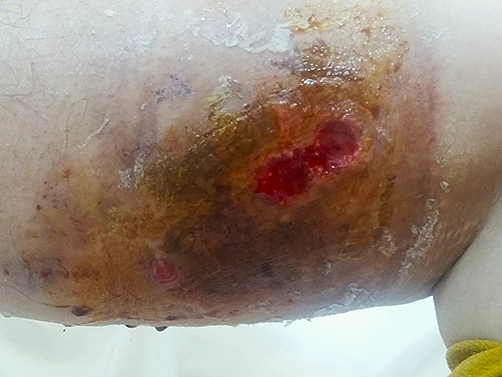 |
Figure 1 Chronic ulcers on the left calf following a snake bite, subsequently treated with raw goat skin as a traditional remedy. |
Laboratory investigations showed mild anemia (hemoglobin 10.6 g/dL) with otherwise unremarkable blood counts. Biochemical tests showed normal renal function (urea 35 mg/dL, creatinine 0.70 mg/dL). Brain magnetic resonance imaging (MRI), as advised by the neurologists, was unremarkable. Botulism-specific laboratory testing was not available due to resource constraints.
Differential diagnoses included Guillain–Barré syndrome, myasthenia gravis, stroke, sequelae of snake envenomation, Lambert–Eaton myasthenic syndrome, and tick paralysis. However, the descending pattern of weakness, preserved sensation, and absence of supportive findings for other conditions favored a clinical diagnosis of botulism.
Empiric intravenous metronidazole (500 mg every 8 hours) was initiated for anaerobic coverage, alongside supportive care including nasogastric feeding for severe dysphagia and surgical consultation for debridement of the ulcers. Botulinum antitoxin was initially unavailable throughout Kabul city despite exhaustive searches. The patient’s condition progressively deteriorated, with worsening ptosis, moderate respiratory distress, constipation, and increasing muscle weakness.
The World Health Organization (WHO) Kabul office was contacted on her third day of admission; their team evaluated the patient on the fourth day and provided equine heptavalent botulinum antitoxin on the fifth day free of charge. The antitoxin was administered without any hypersensitivity reaction.
Within 24 hours of administration, the patient showed mild improvement, including reduced ptosis, decreased respiratory distress, improved muscle strength, and reduced diplopia and blurred vision. Metronidazole therapy was completed over 10 days, and daily dressing of the ulcers was performed. While her neurological symptoms had markedly improved, she was discharged on day 11. Follow-up demonstrated near-complete neurological recovery and progressive wound healing. The final diagnosis was clinical wound botulism, supported by the patient’s response to antitoxin therapy, antimicrobial therapy with metronidazole, and appropriate wound care.
Discussion
This case describes an unusual mode of acquisition of wound botulism following traditional treatment of chronic ulcers due to snakebite. The lack of microbiological confirmation is a limitation of this study; however, the development of neurological symptoms consistent with botulism, after the application of raw goat skin to chronic snakebite ulcers, suggests a plausible causal link. Clostridium botulinum spores, commonly present in the environment and on soil-contaminated animal products such as hides, may have been introduced into the wound through this traditional practice.8 The occlusive nature of the raw skin likely created anaerobic conditions favorable for spore germination and in situ toxin production.
To our knowledge, this is the first reported human case of wound botulism associated with chronic non-healing ulcers following a snake bite and subsequent traditional wound care. A literature review found no previously reported cases of wound botulism linked to raw goat skin application on chronic ulcers.
Published reports of wound botulism in Afghanistan are lacking. WHO data from 2023 reported two suspected outbreaks of botulism, involving multiple cases and deaths in Balkh and Badghis provinces, though the specific type of botulism was not specified. This provides local epidemiological context and highlights the potential public health relevance of botulism, emphasizing the importance of clinician awareness and timely diagnosis.10
The incubation period of wound botulism is typically reported to range from 7 to 21 days, depending on factors such as inoculum size and local wound conditions.7,8 In this case, the onset of symptoms approximately two weeks after the traditional treatment falls within this expected range, supporting a temporal association. Although causation cannot be definitively established, the biological plausibility, temporal relationship, and absence of alternative exposure sources suggest that this practice was a likely contributing factor.
In this patient, initial tissue injury from a snake bite, progression to chronic non-healing ulcers, covering of the ulcers with raw goat skin, and delayed access to formal medical care were factors that increased the risk. Similar mechanisms have been described in wound botulism among injection drug users, in whom tissue necrosis and poor wound hygiene create an anaerobic environment.11,12
The delayed onset of neurological symptoms nine months after the snake bite makes direct neurotoxic envenomation unlikely.13 Instead, chronic non-healing ulcers and subsequent traditional wound care likely created anaerobic conditions conducive to toxin production, supporting wound botulism as the diagnosis. Clinically, the patient exhibited the characteristic features of botulism, including symmetrical cranial nerve palsies, descending flaccid weakness, preserved sensation, and intact consciousness. This pattern strongly favored the diagnosis and helped distinguish it from other potential conditions. Guillain–Barré syndrome was considered less likely due to the absence of ascending weakness, sensory involvement, autonomic instability, or a preceding infectious illness. Myasthenia gravis was unlikely because the weakness was steadily progressive rather than fatigable or fluctuating and was temporally associated with a high-risk contaminated wound. Central nervous system pathology, including stroke or demyelinating disease, was excluded by a normal brain MRI.8 Lambert–Eaton myasthenic syndrome was deemed unlikely given the acute onset, absence of proximal-predominant weakness, and early cranial nerve involvement. Tick paralysis was also considered unlikely due to the descending pattern of weakness and the absence of tick exposure.1,14,15
In resource-limited settings such as Afghanistan, where laboratory confirmation is often unavailable, the diagnosis of botulism relies on a detailed patient history, careful neurological examination, and recognition of characteristic clinical patterns. In this case, with otherwise unremarkable past medical history, the presence of a high-risk chronic wound which was applied raw goat skin, development of typical neurological findings after this traditional practice, systematic exclusion of alternative diagnoses, and improvement following administration of botulinum antitoxin and metronidazole all strongly support the clinical diagnosis.4,11
A critical challenge in this case was the delay in antitoxin administration, which was provided by the WHO five days after clinical suspicion. Despite this delay, the patient exhibited a remarkable response, particularly given that neuromuscular blockade in botulism is generally considered irreversible once established.16 This improvement is likely explained by antitoxin’s ability to halt further toxin binding, thereby allowing recovery of neuromuscular function as new synaptic terminals form.16,17 Early antitoxin administration is key to optimal recovery; however, these observations underscore that antitoxin should be given even in patients who present late, as it may still result in substantial functional improvement.18,19
Management of wound botulism also includes wound debridement and antimicrobial therapy to eradicate the source of toxin production. In this case, metronidazole was administered for anaerobic coverage, and wound care was optimized after hospital admission. Although penicillin is traditionally recommended, metronidazole is an acceptable alternative, particularly in patients with penicillin allergy. Ongoing toxin production from the wound was likely controlled by debridement and metronidazole therapy, contributing to the patient’s recovery. The patient’s favorable outcome reflects the combined effects of antitoxin therapy, wound debridement, antimicrobial treatment, and supportive care.1,4
Traditional wound treatments involving animal products often reflect limited healthcare access and cultural beliefs. While intended to promote healing, such practices may increase the risk of infection.20
Conclusion
This case underscores wound botulism as a complication of chronic wounds managed with unsafe traditional practice. Early clinical diagnosis, prompt antitoxin administration, and public education on wound care are vital to reduce morbidity and mortality. Public health education that emphasizes safe wound care practices and early medical evaluation of non-healing wounds may help reduce the risk of similar cases.
AI Statement
ChatGPT (OpenAI, GPT-5 mini) was used solely for language editing and improvement of clarity in this manuscript.
Ethical Statement
This report was approved by the ethics committee of the Infectious Diseases Department, Kabul University of Medical Sciences under protocol number 74-2025. Written informed consent was obtained from the patient for participation and publication of this case report.
Acknowledgment
We thank the World Health Organization Afghanistan for their assistance in providing botulinum antitoxin for the patient.
Disclosure
The authors declare no conflicts of interest in this work.
References
1. Jeffery IA, Nguyen AD, Karim S. Botulism. StatPearls; 2024. Available from: https://www.ncbi.nlm.nih.gov/books/NBK459273/.
2. Centers for Disease Control and Prevention. Overview. Botulism; 2024. Available from: https://www.cdc.gov/botulism/about/index.html.
3. Chimienti S, Di Spirito M, Molinari F, et al. Botulinum neurotoxins as two-faced janus proteins. Biomedicines. 2025;13(2):1–5. doi:10.3390/biomedicines13020411
4. Rao AK, Sobel J, Chatham-Stephens K, Luquez C. Clinical guidelines for diagnosis and treatment of botulism, 2021. MMWR Recommendations Rep. 2021;70(2):1–30. doi:10.15585/mmwr.rr7002a1
5. World Health Organization. Botulism; 2023. Available from: https://www.who.int/news-room/fact-sheets/detail/botulism.
6. Middaugh N, Edwards L, Chatham-Stephens K, Arguello DF. Wound botulism among persons who inject black tar heroin in New Mexico, 2016. Front Public Health. 2021;9:1–5.
7. Fenicia L. Wound botulism; 2011. Available from: https://www.orpha.net/en/disease/detail/178475.
8. Kobaidze K, Wiley Z. Botulism in the 21st century: a scoping review. J Brown Hosp Med. 2023;2(2):1–8. doi:10.56305/001c.72707
9. Sobel J. Botulism. Clin Infect Dis. 2005;41(8):1167–1173. doi:10.1086/444507
10. World Health Organization. Afghanistan infectious disease outbreaks situation report; 2023. Available from: www.emro.who.int/images/stories/afghanistan/Outbreak-Situation-Report-Week-18-5-august-2023.pdf.
11. Neeki MM, Dong F, Emond C, et al. Early diagnosis and critical management of wound botulism in the emergency department: a single center experience and literature review. Int J Emerg Med. 2021;14(1):1–5. doi:10.1186/s12245-021-00375-4
12. Kiyokawa M, Haning W. A case report of wound botulism — rare disease on the rise with the opioid crisis. Hawaii J Heal Soc Welf. 2021;80(4):88–91.
13. Waiddyanatha S, Silva A, Siribaddana S, Isbister GK. Long-term effects of snake envenoming. Toxins. 2019;11(4):1–13. doi:10.3390/toxins11040193
14. Centers for Disease Control and Prevention. Clinical overview of botulism; 2024. Available from: https://www.cdc.gov/botulism/hcp/clinical-overview/index.html.
15. Simon LV, West B, Mckinney WP. Tick paralysis. StatPearls Publishing; 2023. Available from: https://www.ncbi.nlm.nih.gov/books/NBK470478/.
16. Ni SA, Brady MF. Botulism antitoxin. StatPearls Publishing;. 2023. Available from: https://www.ncbi.nlm.nih.gov/books/NBK534807/.
17. Saravani K, Kamrava A, Poursamimi J. Familial cluster of foodborne botulism associated with homemade dairy products: a case series. Int Med Case Rep J. 2025;18:1295–1301. doi:10.2147/IMCRJ.S553444
18. Chang GY, Ganguly G. Early antitoxin treatment in wound botulism results in better outcome. Eur Neurol. 2003;49(3):2003. doi:10.1159/000069073
19. Offerman SR, Schaefer M, Thundiyil JG, Cook MD, Holmes JF. Wound botulism in injection drug users: time to antitoxin correlates with intensive care unit length of stay. West J Emerg Med. 2009;X(4):251.
20. Pereira RF, Bártolo PJ. Traditional therapies for skin wound healing. Adv Wound Care. 2016;5(5):208–229. doi:10.1089/wound.2013.0506
 © 2026 The Author(s). This work is published and licensed by Dove Medical Press Limited. The
full terms of this license are available at https://www.dovepress.com/terms
and incorporate the Creative Commons Attribution
- Non Commercial (unported, 4.0) License.
By accessing the work you hereby accept the Terms. Non-commercial uses of the work are permitted
without any further permission from Dove Medical Press Limited, provided the work is properly
attributed. For permission for commercial use of this work, please see paragraphs 4.2 and 5 of our Terms.
© 2026 The Author(s). This work is published and licensed by Dove Medical Press Limited. The
full terms of this license are available at https://www.dovepress.com/terms
and incorporate the Creative Commons Attribution
- Non Commercial (unported, 4.0) License.
By accessing the work you hereby accept the Terms. Non-commercial uses of the work are permitted
without any further permission from Dove Medical Press Limited, provided the work is properly
attributed. For permission for commercial use of this work, please see paragraphs 4.2 and 5 of our Terms.