
Back to Journals » International Journal of Women's Health » Volume 18
Why Low-Risk Primiparous Women Opt for Cesarean Section: A Social Media Perspective
Authors Wu L  , Hu X, Deng X , He L , Tu J , Feng S
Received 10 December 2025
Accepted for publication 30 March 2026
Published 9 April 2026 Volume 2026:18 587854
DOI https://doi.org/10.2147/IJWH.S587854
Checked for plagiarism Yes
Review by Single anonymous peer review
Peer reviewer comments 2
Editor who approved publication: Dr Vinay Kumar
Luping Wu,1,* Xiaoli Hu,1,* Xiaosa Deng,1 Liuyan He,1 Jiahong Tu,1 Suwen Feng2
1Department of Obstetrics, Women’s Hospital, Zhejiang University, School of Medicine, Hangzhou, People’s Republic of China; 2Department of Nursing, Women’s Hospital, Zhejiang University, School of Medicine, Hangzhou, People’s Republic of China
*These authors contributed equally to this work
Correspondence: Suwen Feng, Department of Nursing, Women’s Hospital, Zhejiang University, School of Medicine, No. 1 of Xueshi Road, Hangzhou, People’s Republic of China, Email [email protected]
Purpose: To identify the key factors influencing the decision of low-risk primiparous women to opt for cesarean section (CS), and to provide empirical evidence for optimizing maternal health interventions and reducing unnecessary CS intention.
Patients and Methods: A cross-sectional study was conducted among low-risk primiparous women who had no medical indications for CS. A total of 459 valid questionnaires were obtained through stratified sampling. SmartPLS software was used to conduct structural equation modeling (SEM) and multigroup analysis (MGA) to examine the relationship between social media exposure and cesarean section intention, the mediating effects of social norm and self-efficacy, and the model’s stability across demographic subgroups.
Results: Social media exposure directly and positively predicted cesarean section intention (β = 0.260, p < 0.001). Social media exposure also showed significant indirect associations with cesarean section intention mediated through social norm (β = 0.164, p < 0.001) and self-efficacy (β = 0.074, p < 0.001). Furthermore, multigroup analysis indicated that while the overall mediation framework remained stable, specific influence pathways exhibited significant variations across age and occupational groups.
Conclusion: This study clarifies the underlying mechanisms through which social media exposure shapes cesarean section intention. These findings provide empirical evidence to inform targeted maternal health interventions, optimize digital health communication, and support evidence-based childbirth decision-making.
Keywords: social media exposure, cesarean section intention, social norm, self-efficacy, low-risk primiparous women
Introduction
Cesarean section (CS) is a critical medical intervention for managing obstetric emergencies and ensuring maternal and infant safety.1,2 However, the global rise in non-medically indicated CS rates has become a major public health concern.3,4 The World Health Organization (WHO) recommends that the CS rate should be maintained between 10% and 15%, yet in China this rate has long exceeded 30%, with non-medical factors accounting for a significant proportion.5–8 For primiparous women, due to their lack of childbirth experience and high uncertainty regarding delivery methods, non-medically indicated CS may increase the risks of postpartum infection, placenta accreta in subsequent pregnancies, neonatal respiratory distress, and other complications, imposing long-term physical and psychological burdens on both mothers and infants.9,10
The decision-making regarding delivery mode among primiparous women is influenced by multiple factors, including medical advice, demographic characteristics, and sociocultural factors.11–13 With the popularization of digital media, social platforms such as Xiaohongshu, Douyin, and Weibo have become the primary channels for young women to obtain childbirth-related information, similar to the role played by other social media platforms in many countries14,15 Unlike evidence-based medical guidance, social media content is dominated by personal anecdotes and subjective sharing, often one-sidedly emphasizing the “advantages” of CS (eg painlessness, time controllability, avoidance of vaginal tearing) while downplaying its potential complications, a pattern that has also been observed in studies of birth- and parenting-related content on social media.16–18 This biased information dissemination may lead to cognitive biases among primiparous women—due to their lack of childbirth experience, they rely more heavily on social media information, thereby influencing their delivery decisions.19–21
Self-efficacy and social norm are key psychological factors influencing health behavior decisions.22–24 Based on Bandura’s social cognitive theory, self-efficacy refers to an individual’s belief in their ability to perform specific behaviors (eg successfully undergoing surgery and postoperative recovery), which directly affects the willingness to choose a delivery mode.25 If primiparous women are continuously exposed to positive narratives about CS on social media, they may enhance their confidence in coping with CS, thereby increasing their CS intention.17,26 Meanwhile, according to social norm theory, individual decisions are strongly influenced by the perception of “mainstream behaviors” (descriptive norms) and “social expectations” (injunctive norms).27–29 In the virtual communities constructed by social media, the widespread sharing and approval of CS-related content may form a perceived norm that “CS is the preferred choice,” further promoting conformist choices among primiparous women.16,18
Although non-medically indicated CS has attracted widespread attention, existing studies have mostly focused on clinical factors (eg maternal age, pelvic size) and demographic characteristics (eg educational level, family income), with insufficient exploration of the role of digital media in this process.5–8 Current research on delivery mode intention has primarily emphasized individual sociodemographic and obstetric characteristics, as well as general psychosocial factors, without fully incorporating digital media exposure into an integrated explanatory framework.11,12,26 Although a growing body of literature has begun to examine how pregnant women use social media to seek childbirth-related information, it has rarely unpacked the specific psychological mechanisms through which such exposure shapes delivery decisions.14,16–18 In particular, few studies have systematically analyzed how social media exposure influences primiparous women’s CS intention via psychological pathways such as self-efficacy and social norm, or clarified the synergistic effects of these psychological factors in the decision-making process, leaving a gap in understanding the non-medical driving mechanisms behind the rising CS intention.
Improving the rationality of childbirth decision-making is a critical issue in global public health, and clarifying the psychosocial mechanisms of non-medically indicated CS is key to formulating targeted interventions. Therefore, this study aims to construct and validate a hypothetical model from the perspective of digital media to explore the specific influence pathways among social media exposure, self-efficacy, social norm, and CS intention in primiparous women. The research hypotheses are as follows: (1) Social media exposure has a direct positive effect on CS intention; (2) Social media exposure indirectly influences CS intention through the mediating role of self-efficacy; (3) Social media exposure indirectly influences CS intention through the mediating role of social norm. This study is expected to provide empirical evidence for guiding rational childbirth decisions and reducing the rate of non-medically indicated CS.
Materials and Methods
Participants and Procedure
Primiparous women who underwent routine prenatal examinations at the obstetrics outpatient department of a tertiary grade A hospital in Zhejiang Province were recruited as participants via the convenience sampling method in October 2025.
Inclusion criteria were as follows: (i) primiparous women (first pregnancy leading to delivery) aged ≥20 years, covering the first trimester (<14 weeks of gestation), second trimester (14 to <28 weeks of gestation), and third trimester (28 to 42 weeks of gestation); (ii) normal mental and intellectual status, with basic social media literacy (able to independently browse and interact with maternal health-related content on social media platforms); (iii) willingness to participate and ability to complete the questionnaire cooperatively.
Exclusion criteria included: (i) having absolute indications for cesarean section, as well as being complicated with severe pregnancy complications or comorbidities.; (ii) non-use of social media or no exposure to maternal health-related social media content in the past 3 months; (iii) participation in other studies focused on cesarean section intention; (iv) cognitive or communication impairments that prevented independent questionnaire completion.
Prior to study initiation, ethical approval was obtained from the Institutional Review Board (IRB) of the hospital. After securing informed consent from participants, researchers individually explained the study objectives, questionnaire completion procedures, and key considerations to each participant. Anonymity was maintained to protect participants’ personal information.
Questionnaires were distributed and collected on-site. A total of 500 questionnaires were issued, and 459 valid responses were retrieved, resulting in an effective response rate of 91.8%.
Measures
The scales adopted in this study included those for measuring social media exposure, intention of cesarean section, social norms, and self-efficacy. These scales were originally in English. To ensure their applicability to Chinese participants as well as the accuracy of the semantic meaning of measurement items and cross-cultural equivalence, this study strictly followed the Brislin two-way translation model for Chinese localization.30 First, for forward translation, two independent bilingual translators were selected. They were both proficient in Chinese and English; one was a professional researcher in the medical/psychological field, and the other a language-specialized translator. Neither of them had prior knowledge of the original scales’ core research logic. The two translators independently translated the original English scales into Chinese, which produced two non-interfering initial Chinese versions.Subsequently, an expert review panel was established. It consisted of one senior expert in the scale field, one cross-cultural research scholar, and one bilingual linguist. The panel compared the two initial translations item by item and focused on verifying the appropriateness of professional terminology and culture-specific items. Combining the original scales’ measurement dimensions and core objectives, the panel then developed a unified “integrated Chinese version of the scales.”Next, for backward translation, another two bilingual translators were selected. They had not participated in forward translation. These translators independently back-translated the “integrated Chinese version” into English, which generated two backward-translated versions. The expert panel then compared these two versions with the original English scales item by item to verify semantic consistency. It also checked for semantic loss, connotative deviation, or unintended additional meanings. Items with deviations were sent back to the forward translation stage for revision. After three rounds of verification, it was confirmed that the backward-translated versions were fully consistent with the original scales’ core information.Finally, a pre-test was conducted with 10 participants. These participants matched the target population’s characteristics. The pre-test aimed to collect feedback on the comprehension difficulty of items and appropriateness of expressions. Based on this feedback, minor adjustments were made to the scales’ language for greater accessibility, without altering the core semantics. The Chinese versions suitable for this study were ultimately finalized, which laid a foundation for subsequent scale reliability and validity tests.
Social Media Exposure Scale.This scale was adapted from 4 items developed in prior studies,31,32 2 of which pertain to cesarean section-specific social media exposure. Social media exposure level was assessed via responses to the following questions: “About how many hours per day do you estimate you spend using social media platforms (egXiaohongshu, Douyin, Weibo?” Responses were scored on a 5-point scale: 1 = never use, 5 = more than 3 hours daily. “About how many days per week do you estimate you use the above social media platforms?” Responses were scored on a 5-point scale: 1 = never use, 5 = use every day. Additionally, social media exposure related to cesarean section intention was evaluated via two statements: “Cesarean section-related content on social media seems frequently associated with positive attributes (e.g safety, controllability, smooth recovery, favorable experience).” “Social media users (especially the maternal population) seem to pay close attention to cesarean section safety, postoperative recovery, or related decision-making suggestions.” Both statements used a 5-point scale (1 = strongly disagree, 5 = strongly agree). The scale’s total score ranges from 4 to 20 (higher scores = greater exposure), with a Cronbach’s alpha of 0.780.
Intention of Cesarean Section Scale. This scale was adapted from a 24-item instrument with 5 dimensions developed in previous research:26 Behavioral Beliefs (6 items): Assesses pregnant women’s perceptions of cesarean section itself. Examples include “In my opinion, women with conditions such as pelvic stenosis should choose cesarean section” and “I think vaginal delivery involves more problems than cesarean section.” Responses were scored on a 5-point Likert scale (1 = strongly disagree, 5 = strongly agree), with a Cronbach’s alpha of 0. 886.Outcome Evaluation of Behavior (7 items): Measures pregnant women’s value judgments on cesarean section outcomes. Examples include “Babies born via cesarean section are smarter than those born vaginally” and “Planned cesarean section helps me establish a good relationship with my spouse.” Scored 1 (strongly disagree) to 5 (strongly agree), with a Cronbach’s alpha of 0. 889.Injunctive Norm Beliefs (5 items): Evaluates pregnant women’s perceptions of others’ (spouse, family members) attitudes toward cesarean section. Examples include “My spouse believes planned cesarean section is risky for my baby” and “My family thinks planned cesarean section is harmful to my baby.” Scored 1–5 (1 = strongly disagree, 5 = strongly agree), with a Cronbach’s alpha of 0. 883.Motivation to Comply (3 items): Assesses pregnant women’s willingness to follow cesarean section-related expectations from others (family, doctors). Examples include “I think my family wants me to choose planned cesarean section” and “I believe my doctor prefers me to select planned cesarean section.” Scored 1 (strongly disagree) to 5 (strongly agree), with a Cronbach’s alpha of 0. 947.Behavioral Intention (3 items): Directly measures pregnant women’s inclination to choose cesarean section. Examples include “I intend to deliver via cesarean section” and “I plan to opt for planned cesarean section.” Responses were scored on a 5-point scale (1 = extremely unlikely, 5 = extremely likely), with a Cronbach’s alpha of 0. 949.The total score of the scale ranges from 24 to 120, with higher scores indicating stronger positive beliefs about cesarean section and greater willingness to choose it. The overall Cronbach’s alpha of the Intention of Cesarean Section Scale was 0.931.
Social Norm Scale. This scale was adapted from a 10-item, 2-dimensional instrument developed in prior studies:27–29 Descriptive Norms (5 items): Assesses individuals’ perceptions of “most people’s actual behaviors.” Examples include “Most people around me actively follow queuing order in public” and “In the social circle I engage with, many people send holiday greetings to relatives and friends.” Responses were scored on a 5-point scale (1 = strongly inconsistent, 5 = strongly consistent), with a Cronbach’s alpha of 0. 853.Injunctive Norms (5 items): Evaluates individuals’ perceptions of others’ approval or disapproval of specific behaviors. Examples include “My family thinks I should be more respectful when communicating with elders” and “People in my community generally consider loud talking in public areas inappropriate.” Scored 1 (strongly inconsistent) to 5 (strongly consistent), with a Cronbach’s alpha of 0. 909.The total score of the scale ranges from 10 to 50, where higher scores indicate a stronger perceived influence of social norms on one’s own behavior. The overall Cronbach’s alpha of the Social Norm Scale was 0.884.
Self-Efficacy Scale. Based on Bandura’s (1977) Self-Efficacy Scale, we adapted a 5-item cesarean section-specific self-efficacy scale, focusing on individuals’ confidence in their abilities related to cesarean section decision-making, intraoperative cooperation, and postoperative recovery.22 The specific items are as follows: “I am confident in making an appropriate decision for myself regarding whether to choose cesarean section.” “Even if people around me hold different opinions about cesarean section, I can stand firm in my choice.” “I believe I can stay calm during cesarean section surgery and cooperate with medical staff.” “I am confident in coping with the physical sensations brought by cesarean section surgery.” “I feel capable of handling the physical recovery after cesarean section.” The total score ranges from 5 to 25, with higher scores indicating stronger cesarean section-related self-efficacy. A total score ≥20 indicates high self-efficacy, 15–19 indicates moderate self-efficacy, and ≤14 indicates low self-efficacy. The Cronbach’s alpha for the scale was 0.822.
Data Analysis
To enhance data accuracy and validity, all datasets were cleaned and screened for errors following export, in line with recommended practices for SEM-based analyses.33,34 Prior to model evaluation, the adequacy of the sample size (N = 459) was assessed and justified. Based on the widely accepted “10-times rule” for PLS-SEM proposed by Hair et al,33 the minimum sample size should be at least 10 times the maximum number of inner model links pointing at any latent variable. The complexity of our model is well within this threshold. Furthermore, based on statistical power considerations, a sample of 459 is fully adequate to detect medium effect sizes with a statistical power exceeding 0.95 (alpha = 0.05), ensuring the statistical validity of both the primary path analysis and the subsequent multigroup comparisons.
SPSS 27.0 was applied to generate descriptive statistics for participant characteristics and to perform correlation analyses. Structural equation modeling (SEM) with path analysis was then used to test the hypothesized model, implemented in SmartPLS 4.0 in line with the study’s chosen analytical approach.34 The model included four core constructs: social media exposure, social norm, self-efficacy, and intention of cesarean section. A major strength of path analysis is its capacity to estimate direct and indirect effects between variables within a single analytic framework.35 All tests were two-tailed, with the alpha level set at 0.05. Standardized (β) regression coefficients, together with standard deviation (SD) and p-values for β, were reported to quantify the direct and indirect relationships among the observed variables. To obtain stable estimates, 5000 bootstrap samples were drawn, and 95% bias-corrected confidence intervals (BCIs) were calculated, following recommended bootstrap procedures for mediation and indirect-effect testing.35,36
Model goodness-of-fit (GOF) was assessed using multiple indices: a chi-square to degrees of freedom ratio (χ2/df) below 3, a non-significant chi-square statistic (χ2; p ≥ 0.05), a root mean square error of approximation (RMSEA) less than 0.080, a standardized root mean square residual (SRMR) below 0.080, and values of the comparative fit index (CFI) and Tucker–Lewis index (TLI) greater than 0.900, consistent with commonly accepted SEM fit criteria.33,34,37
Additionally, to assess the stability of the proposed model and examine potential differences across population subgroups, a multigroup analysis (PLS-MGA) was conducted using SmartPLS 4.0. Following recommended procedures for subgroup comparisons, the sample was stratified based on key sociodemographic variables, including age (≤30 years vs. >30 years), educational attainment (college/bachelor’s degree and below vs. master’s degree or above), and occupation. The non-parametric PLS-MGA approach was utilized to test the significance of differences in path coefficients across these predefined subgroups, thereby enhancing the robustness and generalizability of the findings.
Results
Description of Participants
Participants’ demographic characteristics are presented in Table 1. Our 459 participants were predominantly distributed across the 20–30 years (44.70%) and >30–35 years (50.70%) age groups, with merely 4.60% being older than 35 years.
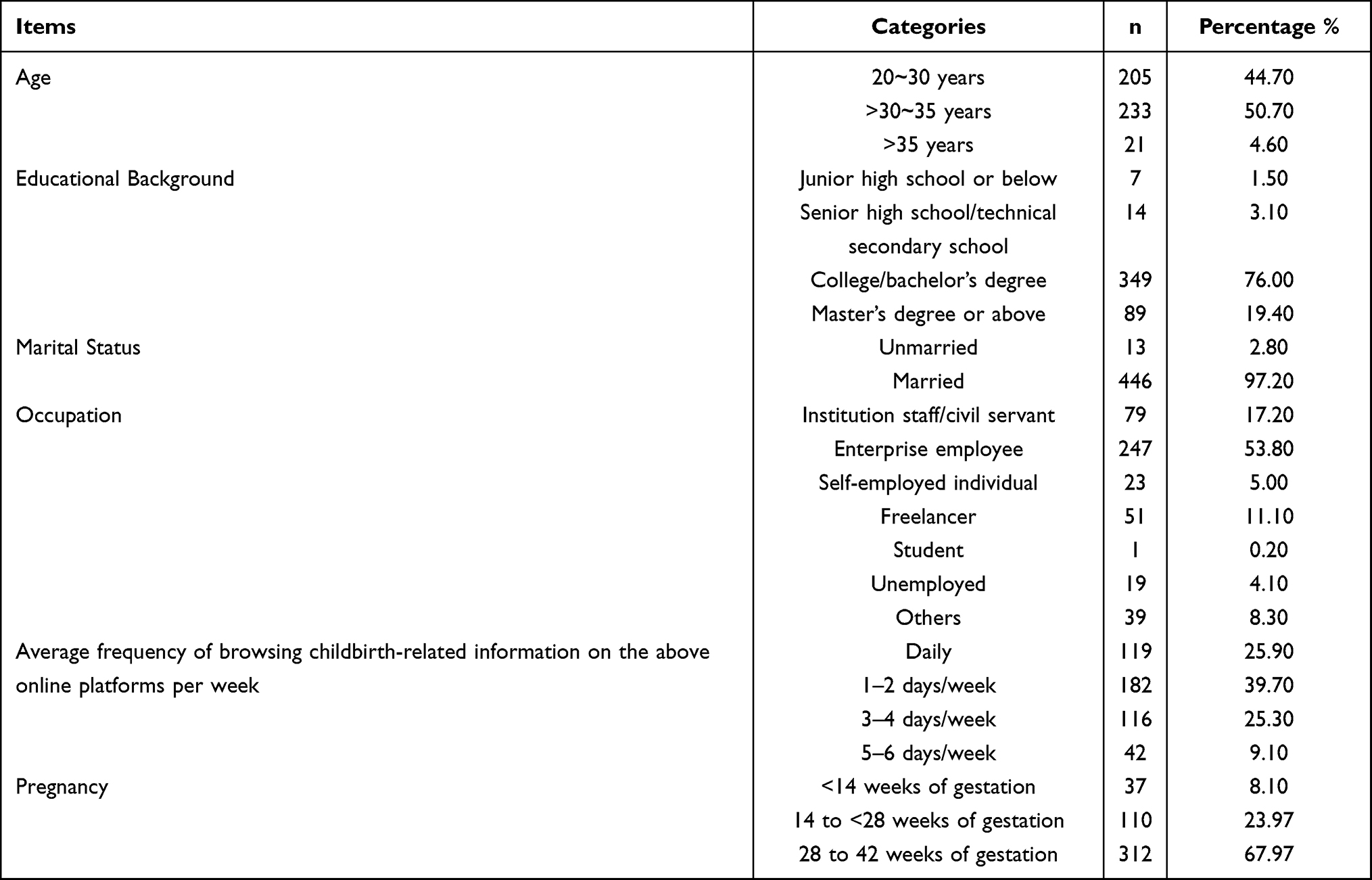 |
Table 1 Demographic Characteristics |
Regarding educational background, the majority (76.00%) held a college/bachelor’s degree, while 19.40% possessed a master’s degree or above; only 1.50% and 3.10% had educational attainment of junior high school or below and senior high school/technical secondary school, respectively. Nearly all participants (97.20%) were married, with just 2.80% being unmarried. In terms of occupation, over half (53.80%) were enterprise employees, followed by institution staff/civil servants (17.20%) and freelancers (11.10%); other occupations (including self-employed individuals, students, etc.) accounted for relatively small proportions (≤8.30%). When it came to the average weekly frequency of browsing childbirth-related information on the aforementioned online platforms, 39.70% did so 1–2 days per week, 25.90% browsed daily, 25.30% browsed 3–4 days per week, and 9.10% browsed 5–6 days per week. Additionally, most participants (67.97%) were in the third trimester of pregnancy (28 to 42 weeks of gestation), 23.97% were in the second trimester (14 to <28 weeks), and 8.10% were in the first trimester (<14 weeks).
Table 2 shows that social media exposure was positively correlated with social norm, intention of cesarean section and self-efficacy. Additionally, social norm was positively correlated with intention of cesarean section and self-efficacy. Finally, intention of cesarean section was positively correlated with self-efficacy.
 |
Table 2 Correlations, Scale Means and Standard Deviations |
Path Analysis Results
Figure 1 demonstrated a good fit to the data. The model fit indices were as follows: χ2/df = 1.921, RMSEA = 0.045, SRMR = 0.050, TLI = 0.936, and CFI = 0.942. Though the chi-square p-value was 0.000, the remaining indices met the recommended thresholds, confirming that the data adequately fitted the hypothetical path model.
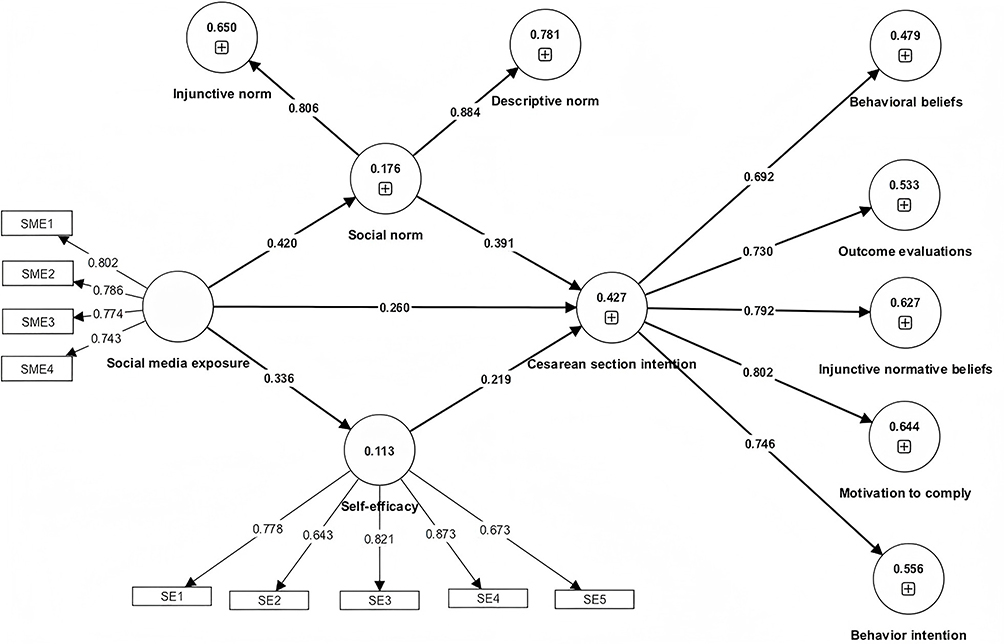 |
Figure 1 Structural equation with standardized coefficients. |
The standardized regression coefficients, standard deviations, confidence intervals, and p-values for all pathways in the model are presented in Table 3. The results indicated that social media exposure directly and positively predicted cesarean section intention (β = 0.260, SD = 0.042, 95% bias-corrected CI = 0.179, 0.342, p = 0.000). Additionally, social media exposure positively predicted self-efficacy (β = 0.336, SD = 0.038, 95% CI = 0.266, 0.413, p = 0.000) and social norm (β = 0.420, SD = 0.035, 95% CI = 0.351, 0.489, p = 0.000). Self-efficacy was positively associated with cesarean section intention (β = 0.219, SD = 0.036, 95% CI = 0.151, 0.292, p = 0.000), and social norm also exerted a positive predictive effect on cesarean section intention (β = 0.391, SD = 0.040, 95% CI = 0.311, 0.467, p = 0.000). Moreover, social norm significantly and positively predicted its two dimensions: descriptive norm (β = 0.884, p = 0.000) and injunctive norm (β = 0.806, p = 0.000).
 |
Table 3 Standardized Direct Effects of the Variables in the Structural Equation Model |
Mediation Effect Test
Overall, social media exposure exerted a significant total effect on cesarean section intention (β = 0.498, SD = 0.032, 95% CI = 0.435–0.560, p < 0.001).
As shown in Table 4, the indirect effect of social media exposure on cesarean section intention via social norm was significant (β = 0.164, SD = 0.022, 95% CI = 0.124–0.211, p = 0.000). Similarly, the indirect effect via self-efficacy was also significant (β = 0.074, SD = 0.015, 95% CI = 0.047–0.106, p = 0.000). After controlling for both mediator variables (self-efficacy and social norm), the direct effect of social media exposure on cesarean section intention remained significant, indicating that social norm and self-efficacy play partial mediating roles between social media exposure and cesarean section intention.
 |
Table 4 Standardized Indirect (Mediating) Effects of Social Media Exposure on Cesarean Section Intention |
Multigroup Analysis
To further assess the stability of the model across demographic subgroups, a multigroup analysis was conducted based on age, educational attainment, and occupation (Table 5).
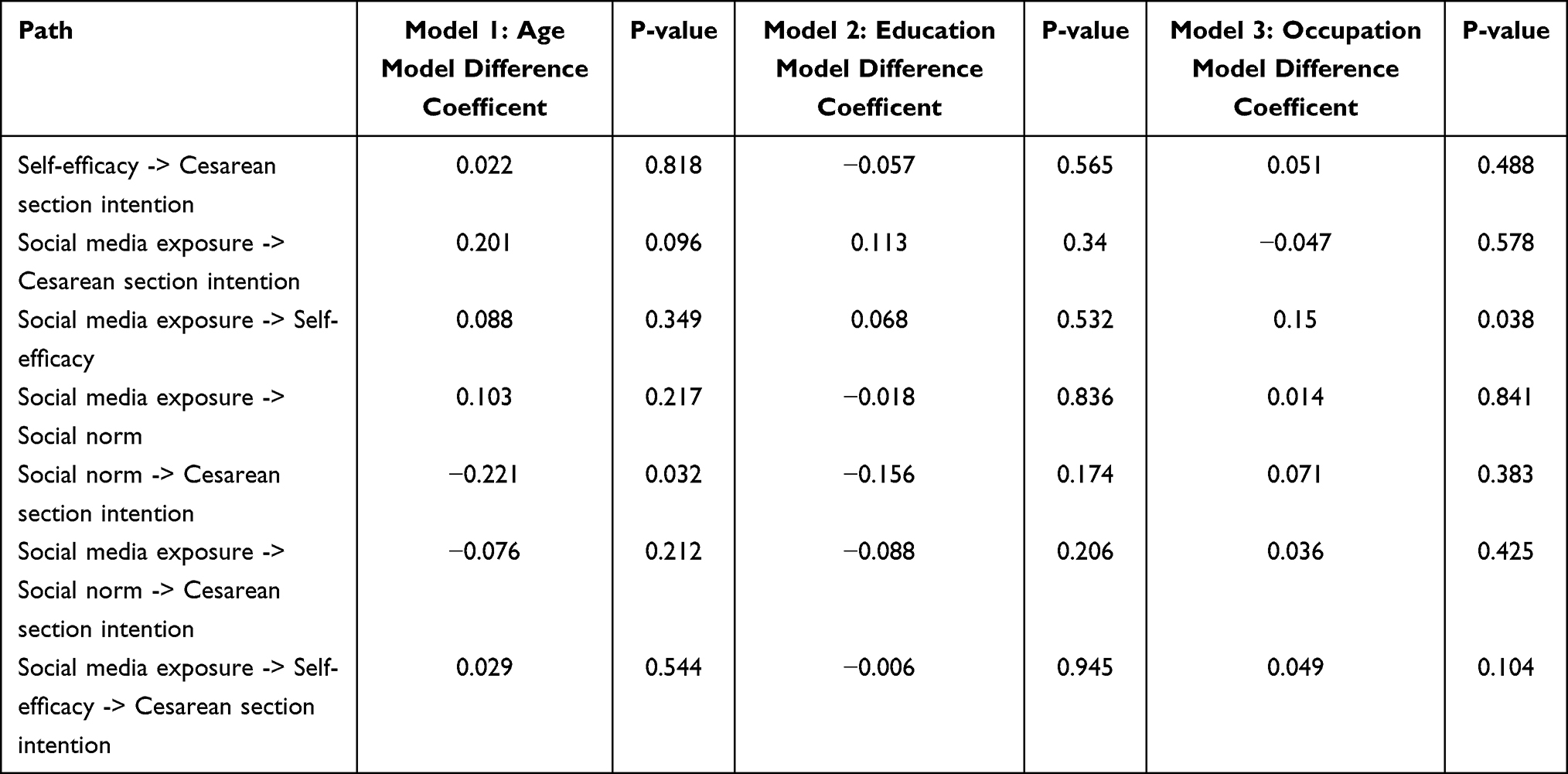 |
Table 5 Results of Multigroup Analysis Across Age, Education, and Occupation Subgroups |
In the age group comparison (Model 1), a significant difference was observed in the path from social norm to cesarean section intention (Difference Coefficient = −0.221, p = 0.032). In the occupation group comparison (Model 3), a significant difference emerged in the path from social media exposure to self-efficacy (Difference Coefficient = 0.150, p = 0.038). Conversely, in the educational background comparison (Model 2), no significant differences were found across any of the evaluated pathways (all p > 0.05). For the remaining pathways across all three models, the p-values exceeded 0.05, indicating a general cross-group consistency in the underlying mechanisms driving cesarean section intention.
Discussion
This study is the first to statistically explore the associations between social media exposure, self-efficacy, social norm, and cesarean section intention among primiparous women by using SEM with multigroup path analysis, thereby explaining how these variables interact to shape childbirth decision-making. Overall, the findings indicate that the hypothetical model fits well, providing empirical support for the proposed pathways and offering insights into the non-medical drivers of cesarean section preference.
The significant direct effect of social media exposure on cesarean section intention (β = 0.260, p < 0.001) aligns with the “information bias” phenomenon in digital health contexts. One might question why social media exposure increases cesarean section intention despite the widespread availability of professional, evidence-based medical information on these platforms. The fundamental reason lies in the nature of digital communication: algorithm-driven platforms prioritize emotionally engaging, user-generated anecdotal content over objective medical facts. Professional medical information often focuses on statistical risks, whereas subjective narratives directly address pregnant women’s deepest fears, such as labor pain and unpredictability. This phenomenon is particularly pronounced in the Chinese sociocultural and healthcare context. Research highlights that China’s historically high cesarean section rates are deeply intertwined with complex sociocultural factors, including extreme fear of labor pain, traditional cultural preferences for scheduling auspicious birth dates, and the observed inconsistency between women’s initial preferences and actual modes of delivery under shifting population policies.38–40 Consequently, dry evidence-based medical advice is frequently overshadowed by culturally resonant, emotionally appealing personal narratives that frame cesarean section as a controllable, painless, and “superior” choice.
A key theoretical finding of this study is that social norm exerts a substantially stronger mediating effect (β = 0.164) than self-efficacy (β = 0.074) in the relationship between social media exposure and cesarean section intention. This suggests that in childbirth decision-making, “digital peer pressure” and perceived social approval carry more weight than an individual’s confidence in handling the surgery. In the Chinese sociocultural environment, childbirth is often viewed not merely as an individual medical event, but as a family and social milestone. Primiparous women face immense expectations from their extended families and peer networks. Thus, the virtual communities on social platforms, which validate cesarean section as a “mainstream” and “safe” norm, exert a powerful conformist pressure that easily surpasses individual self-efficacy.
Social norm’s mediation highlights the “digital peer pressure” embedded in reproductive decision-making. Furthermore, our multigroup analysis identified a significant difference in the impact of social norms on cesarean section intention across age groups (p = 0.032). Younger primiparous women (eg., ≤30 years) may be more deeply embedded in digital communities and therefore more susceptible to online normative influences, making them more likely to conform to the “cesarean as norm” narrative compared to older, potentially more autonomous women. Mitigating this effect requires disrupting the one-sided narrative on social platforms and amplifying balanced, evidence-based depictions of both delivery modes.
Self-efficacy’s mediating effect reflects the cognitive mechanism through which social media content shapes behavioral intention. Exposure to positive cesarean portrayals enhances primiparous women’s confidence in their ability to undergo and recover from the procedure. Interestingly, the multigroup analysis revealed that the path from social media exposure to self-efficacy significantly differs by occupation (p = 0.038). Enterprise employees, who often face high workplace stress and tight maternity leave schedules, may rely more heavily on digital information to build “confidence” in a scheduled, predictable delivery mode like cesarean section, viewing it as a strategy to maintain control over their work-life balance compared to other occupational groups.
This study makes several theoretical and practical contributions. Theoretically, it enriches the literature on non-medically indicated cesarean section by explicitly incorporating the online information environment into the explanatory framework, and clarifies how this exposure translates into behavioral intention through distinct psychological processes. Practically, obstetricians and midwives should explicitly incorporate elements of digital health literacy into routine prenatal counseling. Rather than only discussing medical indications, consultation should guide primiparous women to critically evaluate childbirth-related content on social media. Additionally, the findings highlight the urgency of developing reproductive health content guidelines for major platforms to prioritize content produced by accredited medical institutions, while simultaneously conducting communication campaigns that re-normalize vaginal delivery in community health centers to reshape offline social norms.
This study has several limitations. First, the cross-sectional design precludes causal inference; future longitudinal studies could track social media use, cognitive changes, and actual childbirth choices over pregnancy. Second, the sample was drawn from a single tertiary hospital in Zhejiang, limiting generalizability. Third, we did not differentiate between social media content types (eg., short videos vs. blogs) or sources (eg., influencers vs. medical professionals), which may differentially impact outcomes.
Conclusion
In conclusion, this study demonstrates that social media exposure significantly increases cesarean section intention among primiparous women, both directly and indirectly through the mediating roles of social norm and self-efficacy. Furthermore, our multigroup analysis highlights that while the overall mechanisms driving cesarean section intention remain largely stable across sociodemographic subgroups, younger age and specific occupational pressures can significantly amplify these digital influences. These findings underscore the necessity for targeted maternal health interventions. Optimizing the quality of reproductive health content on digital platforms and integrating digital health literacy into routine prenatal counseling could effectively mitigate the biased influence of social media and support women in making evidence-based, rational delivery decisions. Future research employing longitudinal designs and more geographically diverse samples is recommended to further validate these findings and establish their broader generalizability.
Data Sharing Statement
The data that support the findings of this study are available from the corresponding author upon reasonable request.
Ethics Approval
Ethical approval for this research was granted by the Institutional Review Board of Women’s Hospital, Zhejiang University School of Medicine (reference number: IRB-20250385-R).The study was conducted in accordance with the principles of the Declaration of Helsinki and all participants provided informed consent before enrollment.
Acknowledgments
We express our gratitude to all participants for their time and cooperation in the survey.
Disclosure
The authors have no conflicts of interest that are directly relevant to the content of this article.
References
1. Molina G, Weiser TG, Lipsitz SR, et al. Relationship between cesarean delivery rate and maternal and neonatal mortality. JAMA. 2015;314(21):2263–11.
2. Sandall J, Tribe RM, Avery L, et al. Short-term and long-term effects of caesarean section on the health of women and children. The Lancet. 2018;392(10155):1349–1357. doi:10.1016/S0140-6736(18)31930-5
3. Roberts CL, Nippita TA. International caesarean section rates: the rising tide. The Lancet Global Health. 2015;3(5):e241–e242. doi:10.1016/S2214-109X(15)70111-7
4. Betran AP, Torloni MR, Zhang JJ, Gülmezoglu AM. WHO statement on caesarean section rates. BJOG. 2016;123(5):667–670. doi:10.1111/1471-0528.13526
5. Feng XL, Xu L, Guo Y, Ronsmans C. Factors influencing rising caesarean section rates in China between 1988 and 2008. Bullet World Health Organizat. 2012;90(1):30–39A. doi:10.2471/BLT.11.090399
6. Long Q, Klemetti R, Wang Y, Tao F, Yan H, Hemminki E. High caesarean section rate in rural China: is it related to health insurance (New co-operative medical scheme)? Soc Sci Med. 2012;75(4):733–737. doi:10.1016/j.socscimed.2012.03.054
7. Liang J, Mu Y, Li X, et al. Relaxation of the one child policy and trends in caesarean section rates and birth outcomes in China: an observational study. BMJ. 2018;360:k817. doi:10.1136/bmj.k817
8. Song C, Wu Q, He J, et al. The rates and medical necessity of cesarean delivery in China: an analysis of 2012 and 2016 data. BMC Med. 2021;19:81. doi:10.1186/s12916-021-01952-3
9. Souza JP, Gülmezoglu AM, Lumbiganon P, et al. Caesarean section without medical indications is associated with an increased risk of adverse short-term maternal outcomes: the 2004–2008 WHO global survey on maternal and perinatal health. BMC Med. 2010;8:71. doi:10.1186/1741-7015-8-71
10. Keag OE, Norman JE, Stock SJ. Long-term risks and benefits associated with cesarean delivery for mother, baby, and subsequent pregnancies: systematic review and meta-analysis. PLOS Med. 2018;15(1):e1002494. doi:10.1371/journal.pmed.1002494
11. He J, Chen Q, Tan X, et al. Intentions and influencing factors regarding natural childbirth among urban pregnant women in China: based on the theory of reasoned action and structural equation modeling. J Int Med Res. 2019;47(9):4356–4368. doi:10.1177/0300060519862089
12. Kanani S, Allahverdipour H, Asghari-Jafarabadi M, et al. Modeling intention to choose natural vaginal delivery using reasoned action and social cognitive theories. Health Promot Perspect. 2015;5(3):165–174. doi:10.15171/hpp.2015.004
13. Sun N, Yin X, Qiu L, et al. Factors associated with Chinese pregnant women’s preferences for delivery mode: a cross-sectional study. Tropic Med Int Health. 2020;25(9):1104–1112. doi:10.1111/tmi.13323
14. Zhu C, Zeng R, Zhang W, Evans R, He R. Pregnancy-related information seeking and sharing in the social media era among expectant mothers: qualitative study. J Med Inter Res. 2019;21(12):e13694. doi:10.2196/13694
15. López-López AF, Martínez-Ruiz V, Amezcua-Prieto C, Bueno-Cavanillas A, Marañón-Mederer S, Cano-Ibáñez N. Information sources used by pregnant women to make decisions about pregnancy and childbirth: a cross-sectional study. Public Health. 2025;226:172–180.
16. Wright EM, Matthai MT, Meyer EC. The influence of social media on intrapartum decision making: a scoping review. J Perinat Neonat Nurs. 2019;33(4):319–327. doi:10.1097/JPN.0000000000000377
17. Chee RM, Capper TS, Muurlink OT. The impact of social media influencers on pregnancy, birth, and early parenting experiences: a systematic review. Midwifery. 2023;120:103623. doi:10.1016/j.midw.2023.103623
18. George N, de Long R, Ahmed R, et al. Maternal health posts shared on Instagram: a content analysis of popular birthing and parenting accounts. Front Communicat. 2023;8:1190689. doi:10.3389/fcomm.2023.1190689
19. Nuampa S, Srisaeng P, Boriboonhirunsarn D, et al. “Because it eases my childbirth plan”: non-medical factors influencing women’s request for cesarean section. BMC Pregnancy Childbirth. 2023;23:295. doi:10.1186/s12884-023-05576-8
20. Li Y, Yuan C, Ran X, et al. What factors affect women’s preferences for the mode of birth? A mixed-method study in China. BMC Pregnancy Childbirth. 2025;25:8246. doi:10.1186/s12884-025-08246-z
21. Jamal ME, Al Abed A, El Haj Hassan M, et al. Internet-based pregnancy information-seeking in Lebanon: prevalence, patterns and correlates. BMC Pregnancy Childbirth. 2025;25:7810. doi:10.1186/s12884-025-07810-x
22. Bandura A. Self-efficacy: toward a unifying theory of behavioral change. Psychol Rev. 1977;84(2):191–215. doi:10.1037/0033-295X.84.2.191
23. Strecher VJ, DeVellis BM, Becker MH, Rosenstock IM. The role of self-efficacy in achieving health behavior change. Health Educat Quarter. 1986;13(1):73–92. doi:10.1177/109019818601300108
24. Ajzen I. The theory of planned behavior. Organizat Behav Human Decis Proc. 1991;50(2):179–211. doi:10.1016/0749-5978(91)90020-T
25. Schwarzer R, Fuchs R. Self-efficacy and health behaviours. In: Conner M, Norman P, editors. Predict Health Behav. Buckingham: Open University Press; 1996:163–196.
26. Naghibi SA, Khazaee-Pool M, Moosazadeh M. The Iranian version of theory-based intention for cesarean section (IR-TBICS) scale: development and first evaluation. BMC Pregnancy Childbirth. 2021;21(1):5. doi:10.1186/s12884-020-03498-3
27. Cialdini RB, Kallgren CA, Reno RR. A focus theory of normative conduct: recycling the concept of norms to reduce littering in public places. J Personal Soc Psychol. 1990;58(6):1015–1026. doi:10.1037/0022-3514.58.6.1015
28. Kallgren CA, Reno RR, Cialdini RB. A focus theory of normative conduct: when norms do and do not affect behavior. Personal Soc Psychol Bullet. 2000;26(8):1002–1012. doi:10.1177/01461672002610009
29. Lapinski MK, Rimal RN. An explication of social norms. Communicat Theor. 2005;15(2):127–147. doi:10.1111/j.1468-2885.2005.tb00329.x
30. Beaton DE, Bombardier C, Guillemin F, Ferraz MB. Guidelines for the process of cross-cultural adaptation of self-report measures. Spine. 2000;25(24):3186–3191. doi:10.1097/00007632-200012150-00014
31. Choi HC, Becker SL. Media use, issue/image discriminations, and voting. Communicat Res. 1987;14(3):267–291. doi:10.1177/009365087014003001
32. Herbozo S, Tantleff-Dunn S, Gokee-Larose J, Thompson JK. Beauty and thinness messages in children’s media: a content analysis. Eating Disord. 2004;12(1):21–34. doi:10.1080/10640260490267742
33. Hair JF, Hult GTM, Ringle CM, Sarstedt M. A Primer on Partial Least Squares Structural Equation Modeling (PLS-SEM).
34. Kline RB. Principles and Practice of Structural Equation Modeling.
35. Efron B, Tibshirani RJ. An Introduction to the Bootstrap. New York, NY: Chapman & Hall/CRC; 1993.
36. Hayes AF. Introduction to Mediation, Moderation, and Conditional Process Analysis: A Regression-Based Approach. New York, NY: Guilford Press; 2013.
37. Hu L, Bentler PM. Cutoff criteria for fit indexes in covariance structure analysis: conventional criteria versus new alternatives. Struct Equat Model. 1999;6(1):1–55. doi:10.1080/10705519909540118
38. Zhang H, Wu J, Norris J, Guo L, Hu Y. Predictors of preference for caesarean delivery among pregnant women in Beijing. J Int Med Res. 2017;45(2):798–807. doi:10.1177/0300060517696217
39. Wu J, Feng L, Zhang H, Guo L, Pérez-Escamilla R, Hu Y. The inconsistency between women’s preference and actual mode of delivery in China: findings from a prospective cohort study. Front Public Health. 2022;10:782784. doi:10.3389/fpubh.2022.782784
40. Long Q, Zhang Y, Zhang J, Tang X, Kingdon C. Changes in caesarean section rates in China during the period of transition from the one-child to two-child policy era: cross-sectional National Household Health Services Surveys. BMJ Open. 2022;12(4):e059208. doi:10.1136/bmjopen-2021-059208
 © 2026 The Author(s). This work is published and licensed by Dove Medical Press Limited. The
full terms of this license are available at https://www.dovepress.com/terms
and incorporate the Creative Commons Attribution
- Non Commercial (unported, 4.0) License.
By accessing the work you hereby accept the Terms. Non-commercial uses of the work are permitted
without any further permission from Dove Medical Press Limited, provided the work is properly
attributed. For permission for commercial use of this work, please see paragraphs 4.2 and 5 of our Terms.
© 2026 The Author(s). This work is published and licensed by Dove Medical Press Limited. The
full terms of this license are available at https://www.dovepress.com/terms
and incorporate the Creative Commons Attribution
- Non Commercial (unported, 4.0) License.
By accessing the work you hereby accept the Terms. Non-commercial uses of the work are permitted
without any further permission from Dove Medical Press Limited, provided the work is properly
attributed. For permission for commercial use of this work, please see paragraphs 4.2 and 5 of our Terms.