
Back to Journals » Clinical Optometry » Volume 17
Wear Experience with a Silicone Hydrogel 1-Week Replacement Lens in Current Wearers of a 2-Week Replacement Lens
Authors Fogt JS  , Roth M , Lu TC , Gardner HP
Received 24 April 2025
Accepted for publication 11 September 2025
Published 30 September 2025 Volume 2025:17 Pages 307—313
DOI https://doi.org/10.2147/OPTO.S536378
Checked for plagiarism Yes
Review by Single anonymous peer review
Peer reviewer comments 2
Editor who approved publication: Mr Simon Berry
Jennifer Swingle Fogt, Madison Roth, Tiffany C Lu, Hope Patterson Gardner
College of Optometry, The Ohio State University, Columbus, OH, USA
Correspondence: Jennifer Swingle Fogt, College of Optometry, The Ohio State University, 338 W 10th Avenue, Columbus, OH, 43210, USA, Tel +1 614 292 0882, Email [email protected]
Purpose: More frequent replacement of contact lenses may be beneficial for ocular health, but satisfied wearers often have prescriptions renewed in the same lens. This study sought to evaluate the wear experience of a newly released 1-week replacement lens among currently satisfied wearers of a 2-week replacement lens.
Methods: This open-label, non-comparative study of single vision lenses recruited satisfied wearers of senofilcon A and refit them in serafilcon A. Participants wore the study lenses for two weeks. Assessments included visual acuity and surveys regarding wear experience: the Contact Lens Dry Eye Questionnaire-8 (CLDEQ-8); visual analog scale (VAS) ratings of vision quality and comfort; VAS ratings of vision and comfort during a variety of activities; and ratings of convenience, satisfaction and ease of use on a 0 to 10 Likert scale.
Results: Sixty-two participants completed the study. Median (interquartile range) distance LogMAR acuity with the study lenses was − 0.15 (0.12) OD, − 0.16 (0.10) OS, and − 0.22 (0.08) OU. The median (IQR) CLDEQ-8 score was 10 (10). Median (IQR) VAS responses were 91 (22) for overall quality of vision and 83 (30), for overall comfort. Median VAS responses regarding specific activities ranged from 87 to 91 for vision and 81 to 90 for comfort. Median (IQR) ratings were 8 (2) for convenience, 10 (1) for ease of use, and 9 (2) for satisfaction.
Conclusion: In this study, satisfied wearers of a commonly prescribed 2-week replacement soft contact lens reported median wear experience VAS scores in the upper quartile for all assessments of vision and comfort and a median CLDEQ-8 score below that associated with dryness. Findings suggest that these lenses are a viable option for practitioners interested in the weekly replacement modality of soft lenses.
Keywords: contact lens, planned replacement, silicone hydrogel
Introduction
The advised replacement schedule of soft lenses has increased in frequency since their introduction in the 1970s.1,2 Soft lenses were initially replaced when lost or when damaged enough to cause discomfort or harm. The publication of the Gothenburg study in 1985 advocated that lenses be “more regularly replaced” to minimize effects on corneal physiology.3 Disposable soft lenses became available in the 1980s and have become standard.4 Currently, soft lenses are most often prescribed with replacement schedules of a month or less.5 Morgan reported that globally, soft lenses are prescribed for replacement daily (47%), monthly (42%), or after 1 to 2 weeks (9%). Only 2% of lenses were to be replaced at intervals of 3 months or longer.5
Discussion of contact lens replacement is complicated by patient compliance with the prescribed schedule, which varies widely.6 Compliance is best with single-use, or daily disposable, lenses with rates frequently reported between 74 and 88%.7–12 Adherence to prescribed two-week or monthly replacement schedules is lower, often reported at 31 to 59% and 62 to 78%, respectively.7,10–16 Failure to discard contact lenses as prescribed has been associated with more serious ocular complications than those in patients compliant with replacement schedules.15 Additionally, a greater number of complications are found per eye in wearers who keep lenses 3 times longer than the advised replacement interval.11
Difficulty remembering when to replace lenses is an excuse given by 18.5 to 53% of reusable lens wearers who do not replace lenses as prescribed.7,10,15,17 Although single-use lenses are simplest, patients may resist daily disposable lenses due to cost or environmental concerns.18 A one-week replacement lens would be the next most frequent interval for reusable soft lens replacement. A benefit to this modality could be incorporation of lens replacement into patients’ weekly routines, for example, replacing lenses on the same day of every week. Serafilcon A (Precision7®, Alcon, Fort Worth, TX, USA) is a newly approved one-week replacement soft contact lens material.
Regardless of replacement schedule, a soft contact lens must perform well over the course of wear. The Contact Lens Dry Eye Questionnaire-8 (CLDEQ-8) is a validated survey commonly used to assess the comfort of contact lenses19 and predict success with lens wear.20 In this study, satisfied habitual wearers of senofilcon A (ACUVUE® OASYS, Johnson & Johnson, Jacksonville, FL, USA), a two-week replacement lens, were recruited to be fit with serafilcon A lenses to assess their wear experience. The primary objective of the study was to assess CLDEQ-8 score of participants after wearing serafilcon A lenses for two weeks when replaced weekly.
Methods
This study was conducted under the tenants of the Declaration of Helsinki and was approved by the Institutional Review Board of The Ohio State University in Columbus, Ohio, USA, and was registered on ClinicalTrials.gov (NCT06382064). This open-label, non-comparative study enrolled satisfied habitual wearers of spherical senofilcon A lenses. Potential participants were required to be between the ages of 18 and 40 and have 20/25 or better acuity in each eye with their current contact lenses. Individuals with current ocular inflammation or infection, systemic inflammatory disease or diabetes, or who were pregnant or lactating, were excluded from participation.
All surveys completed in this study were created and deployed to participants on their smart phones using REDCap (Research Electronic Data Capture)21,22 housed at The Ohio State University. Visual Analog Scale (VAS) surveys were completed by participants by moving a slider with their finger along a line labeled with the anchor descriptors on either end of the lines, as described below. CLDEQ-8 questions and Likert-based survey questions were answered by selecting a number corresponding to a score selected by the participant.
A diagram of the study design can be found in Figure 1. After completing the informed consent process, vision and ocular health were assessed to confirm inclusion and exclusion criteria. Participants were asked if they were satisfied with their habitual senofilcon A lenses and whether they replaced their lenses bi-weekly or monthly. To ensure that wear experiences with the study lenses were not affected by normal changes in prescription or any defects in their current lenses, participants were over-refracted with a new set of senofilcon A lenses. A new pair of senofilcon A lenses with optimized power was dispensed to wear for two weeks. Participants were also given hydrogen peroxide contact lens cleaning solution (Clear Care, Alcon, Fort Worth, TX, USA) and instructed on proper use.
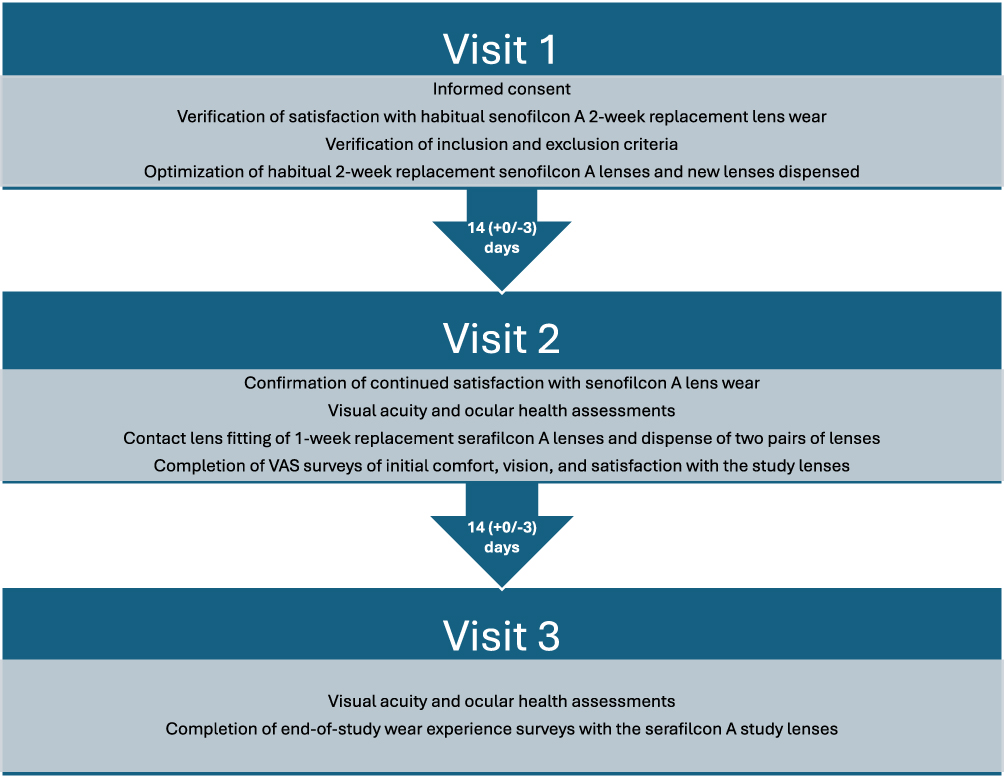 |
Figure 1 Study design. |
Participants returned within 11–14 days [14 (−3)] for Visit 2 to ensure they were still satisfied with their optimized habitual contact lenses. They were then refit in the study serafilcon A lenses, verifying proper fit and optimal power. After 10 or more minutes of lens settling, each participant completed a VAS survey regarding initial impressions of comfort, vision, and satisfaction with the study lenses. These surveys used a 0–100 scale, with 0 anchoring “Unacceptable” and 100 anchoring “Excellent.” At the end of Visit 2, participants were dispensed two pairs of the serafilcon A study lenses with instructions to discard the first pair after one week and replace it with the second pair.
After wearing the study lenses for 14 (−3) days, participants returned for a final visit (Visit 3) and completed visual acuity testing with the study lenses and a slit lamp examination. Participants completed the CLDEQ-8 survey. VAS surveys regarding vision and comfort were answered regarding overall wear and end-of-day wear. Additional VAS surveys were deployed to assess comfort and vision during various daily activities. Surveys of convenience, satisfaction, and ease of use with the serafilcon A lenses were assessed on a 0–10 Likert scale with 0 anchored as “Not convenient/easy/satisfied”, 5 as “Neutral”, and 10 as “Very convenient/easy/satisfied”.
Descriptive statistics are reported in this manuscript. Normality of data was assessed with Anderson-Darling analysis. Because results were not normally distributed for surveys and visual acuities, medians and interquartile range (IQR) are reported. Statistical analyses were completed using Minitab® Version 21.3.1 (Minitab LLC, State College, PA, USA).
Results
Sixty-four eligible participants were enrolled in the study; one relocated before the final study visit, and one voluntarily discontinued the study before trying the study lens. Sixty-two participants completed the study. These participants ranged in age from 18 to 40, with a mean ± standard deviation age of 28.9 ± 5.8 years. Forty-seven (76%) were female, and fifteen (24%) were male. Participants reported race as white (44, 71%), Asian (9, 15%), black/African American (5, 8%), or of more than one race (4, 7%). Six participants reported Hispanic ethnicity (10%). All participants were myopic, with contact lens powers ranging from −1.25 to −8.00 diopters. Forty-nine participants (79%) reported 2-week replacement of their senofilcon A habitual lenses, and thirteen participants (21%) reported monthly replacement.
Initial Impression Surveys
The initial impression VAS surveys completed after fitting participants with the study serafilcon A lenses at Visit 2 resulted in median (IQR) scores of 94 (20) for quality of vision, 99 (7) for comfort, and 96 (14) for satisfaction.
Final Study Visit Assessments
At the final study visit, participants reported a median (IQR) wear time of 14 (3) hours per day over 14 (1) days during the previous 2-week wear period. Biomicroscopy evaluation was significant for superficial punctate keratitis in one eye of a participant, corresponding to participant-reported irritation upon waking that morning when the lens was not worn.
Visual Acuity
Distance visual acuity was assessed both monocularly and binocularly using backlit LogMAR ETDRS charts at each visit. The acuity measured with the study lens at Visit 3 is recorded below in Table 1. The median (IQR) LogMAR binocular acuity of the 1-week replacement study lenses was −0.22 (0.08), which is equivalent to 20/12.5+1 Snellen visual acuity.
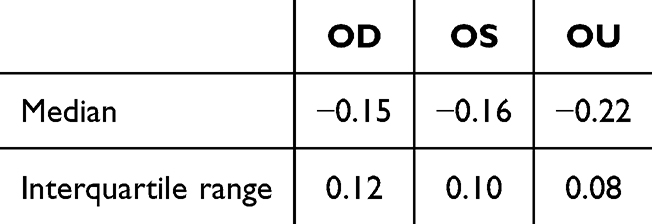 |
Table 1 LogMAR Visual Acuity with the 1-Week Replacement Study Lenses at the Final Study Visit |
Surveys After 2 Weeks of Wear
Sixty-two participants completed the CLDEQ-8 survey regarding the study serafilcon A lenses. The CLDEQ-8 survey yielded a median (IQR) score of 10 (10).
Visual Analog Scale surveys of overall and end-of-day quality of vision and comfort were collected for 58 of the participants (4 participants missed these specific questions when surveys were deployed). The median (IQR) overall scores were 91 (22) for quality of vision and 83 (30) for comfort. Median end-of-day scores were 81 (31) for quality of vision and 76 (52) for comfort.
Participants also answered VAS survey questions about their vision and comfort when wearing the 1-week replacement study lenses during various lifestyle activities. Participants were not required to respond to the questions if they did not have experience with the activity while wearing the study lenses. The median and interquartile range of the scores are reported in Table 2. The median comfort score was ≥81 on a 0–100 scale for all activities, and the median quality of vision score was ≥87 for all activities.
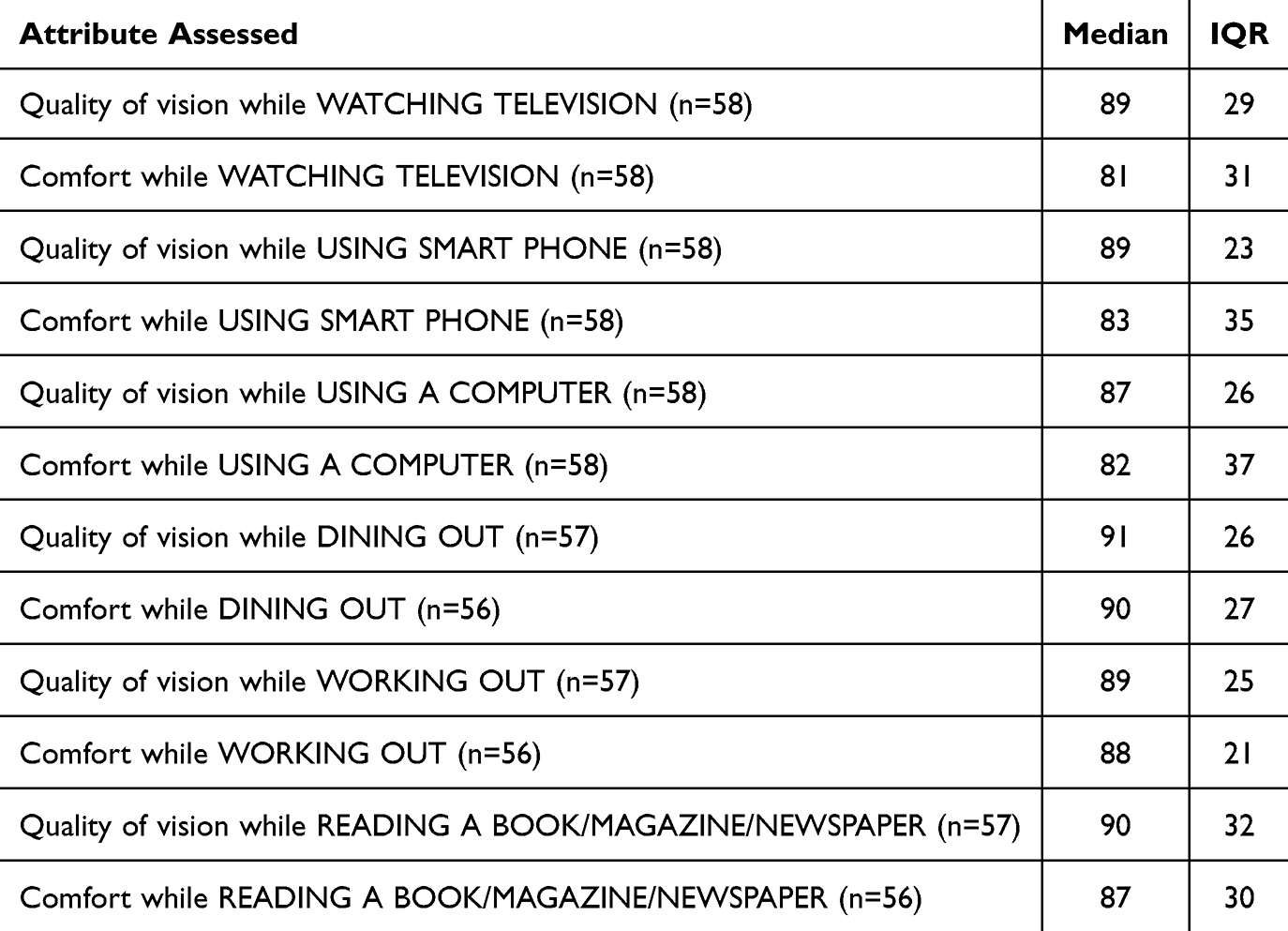 |
Table 2 Lifestyle Questions While Wearing the 1-Week Replacement Study Lenses |
Surveys on a scale from 0 to 10 that related to the participant opinions of their experience with the 1-week replacement study lens found a median (IQR) score of 8 (2) for convenience, 10 (1) for ease of use, and 9 (2) for satisfaction.
Discussion
Patients and practitioners are often resistant to refitting satisfied existing wearers with a new contact lens, particularly if they have no complaints with their habitual lenses.23 Although this was not a comparative study, the protocol was designed to enroll satisfied wearers and optimize their habitual lenses before the study lenses were introduced. This was an attempt to remove any potential bias of the wear experience of the study lenses due to a need for a change in prescription or the replacement of highly deposited habitual lenses. The results found in this study, therefore, were likely scored critically by these already-satisfied participants. Other possible biases held by study participants could have resulted from perceived lens cost, preference regarding lens replacement frequency, or enthusiasm for adopting newer products. Despite the familiarity and satisfaction with their habitual lenses, the VAS surveys scoring the vision and comfort with the study lenses were all greater than 75, even when assessing end-of-day comfort, which is known to decline in all contact lens wear.24 Perhaps, the most impressive finding was the median score of 9 (1) for satisfaction with the study lenses, in these already satisfied wearers of 2-week replacement lenses.
Study assessments were focused on evaluating vision and comfort, as both patients and practitioners agree that these are important factors in contact lens wear. Median VAS scores for quality of vision were 87 or higher for all activities and time periods surveyed, likely secondary to median visual acuity equivalent to 20/14 or better in each eye and binocularly. Subjective assessment in this study found VAS comfort and vision scores equal to or within 10 units of scores reported for a daily disposable lens evaluated in a similarly designed study that enrolled satisfied senofilcon A wearers.18 Dryness impedes comfort, so assessment of the serafilcon A lens included the CLDEQ-8.20 The median score of 10 is below the cutoff score determined to indicate dryness of contact lenses.25 This score also classifies as “very good” contact lens performance.20 This finding is supported further by median comfort scores of 81 or higher on a scale of 0–100 for all lifestyle activities that were scored in this study. Recent in vitro research suggests that the wettability of serafilcon A does not decline significantly over the 1-week advised replacement interval, which likely contributes to these subjective comfort assessments.26 An early clinical study of this lens found that over 78% of study participants found the lenses comfortable at 16 hours of wear.19
In this study, the median convenience score of 8 (2) for the 1-week replacement study lenses likely reflects the ease of remembering to replace lenses on a single day of the week. Thirty (48%) of the participants ranked the convenience as 10, which was not expected in this study given the need for storage and cleaning of reusable lenses. A previous study of 2-week lens wearers who evaluated their experiences with daily disposable lenses found a median convenience score of 10.18 Although not explicitly asked, it is expected that solution use plays a role when assessing the convenience of soft contact lens wear. It should be noted that the use of a hydrogen peroxide-based cleaner throughout the study, while simple to use, was new to 56 (90%) of the study participants, which likely played a role in convenience scoring. While some participants may have been enthusiastic about changing to a new solution, others may not have adjusted to a change in their daily habits, since changing processes in the daily lives of individuals is known to take time from a few weeks to even 8 or 9 months.27 Future studies may be able to better discern perceived convenience with contact lens replacement schedules by comparing solution use as a separate question, or by allowing participants to continue with their habitual contact lens solution, if verification of the expiration and proper use of solution can be assured during the study.
Although not examined in this study, compliance with lens replacement, whether intentional or accidental, is important for the ocular health of soft lens wearers. Previous studies have shown that compliance with lens replacement is better with daily disposable lenses compared to monthly or two-week replacement contact lenses.7,28 Poor compliance with lens replacement has been associated with greater rates of giant papillary conjunctivitis, infiltrates, and corneal adverse events including staining and ulceration.11 Because weekly replacement soft lenses are a relatively new modality, no studies have shown a comparative health benefit to this replacement schedule. Even so, the simplicity of replacing a lens on the same day of the week every week could enhance replacement compliance and lessen the risks associated with this type of wear noncompliance.
In this study, contact lens wearers who were already satisfied with a 2-week replacement contact lens scored their wear experiences with a new 1-week replacement study lens. Median monocular and binocular visual acuities were better than 20/15 Snellen equivalent, and median subjective vision and comfort scores were all in the upper quartile on a 0 to 100 point sliding scale. The results of this study can assure practitioners that performance with a weekly replacement lens can provide satisfaction in addition to a straightforward replacement schedule, providing an additional option for patients who wish to wear contact lenses.
Data Use Statement
The data that support the findings of this study are available from the corresponding author, JSF, upon reasonable request.
Acknowledgments
Funding for this investigator-initiated trial was provided by Alcon, Inc., Fort Worth, TX, USA. Study design and execution was completed by the investigators. The project described was supported in part by Award Number Grant UM1TR004548 from the National Center for Advancing Translational Sciences. The content is solely the responsibility of the authors and does not necessarily represent the official views of the National Center for Advancing Translational Sciences or the National Institutes of Health.
Disclosure
Dr Jennifer Fogt reports grants from the National Center for Advancing Translational Sciences and Alcon during the conduct of the study; grants from Alcon, CooperVision, Eyenovia, Myoptechs, Vyluma, VizionFocus; personal fees from TearOptix, Envision Biomedical, and Hoya, outside the submitted work. The authors report no other conflicts of interest in this work.
References
1. Efron N, Morgan PB, Nichols JJ, et al. All soft contact lenses are not created equal. Cont Lens Anterior Eye. 2022;45(2):101515. doi:10.1016/j.clae.2021.101515
2. Bennett E, Weissman B, ed.. Clinical Contact Lens Practice. Philadelphia, PA: Lippincott Williams & Wilkins; 2005.
3. Holden BA, Sweeney DF, Vannas A, Nilsson KT, Efron N. Effects of long-term extended contact lens wear on the human cornea. Invest Ophthalmol Vis Sci. 1985;26(11):1489–1501.
4. Lamb J, Bowden T. 1 - the history of contact lenses*. In: Phillips AJ, Speedwell L, editors. Contact Lenses.
5. Morgan PB, Efron N, Woods CA, Jones D, Jones L, Nichols JJ. International trends in daily disposable contact lens prescribing (2000-2023): an update. Cont Lens Anterior Eye. 2024;47(6):102259. doi:10.1016/j.clae.2024.102259
6. Fogt JS, Roth M, Gardner HP. How can we better inform patients of the importance of contact lens compliance?: current perspectives. Clin Optom. 2024;16:267–286. doi:10.2147/OPTO.S405204
7. Dumbleton K, Richter D, Bergenske P, Jones LW. Compliance with lens replacement and the interval between eye examinations. Optom Vis Sci. 2013;90(4):351–358. doi:10.1097/OPX.0b013e318288afcb
8. Lutmer KM, Wagner H, Richdale K, Zimmerman AB, Datta A, Dougherty BE. Examining daily disposable soft contact lens wearers’ attitudes and beliefs using the health belief model. Ophthalmic Physiol Opt. 2023;43(2):202–211. doi:10.1111/opo.13078
9. Livi S, Zeri F, Baroni R. Health beliefs affect the correct replacement of daily disposable contact lenses: predicting compliance with the health belief model and the theory of planned behaviour. Cont Lens Anterior Eye. 2017;40(1):25–32. doi:10.1016/j.clae.2016.09.003
10. Dumbleton K, Richter D, Woods C, Jones L, Fonn D. Compliance with contact lens replacement in Canada and the United States. Optom Vis Sci. 2010;87(2):131–139. doi:10.1097/OPX.0b013e3181ca32dc
11. Yeung KK, Forister JF, Forister EF, Chung MY, Han S, Weissman BA. Compliance with soft contact lens replacement schedules and associated contact lens-related ocular complications: the UCLA Contact Lens Study. Optometry. 2010;81(11):598–607. doi:10.1016/j.optm.2010.01.013
12. Rueff EM, Wolfe J, Bailey MD. A study of contact lens compliance in a non-clinical setting. Cont Lens Anterior Eye. 2019;42(5):557–561. doi:10.1016/j.clae.2019.03.001
13. Dumbleton K, Woods C, Jones L, Richter D, Fonn D. Comfort and vision with silicone hydrogel lenses: effect of compliance. Optom Vis Sci. 2010;87(6):421–425. doi:10.1097/OPX.0b013e3181d95aea
14. Dumbleton KA, Spafford MM, Sivak A, Jones LW. Exploring compliance: a mixed-methods study of contact lens wearer perspectives. Optom Vis Sci. 2013;90(8):898–908. doi:10.1097/OPX.0b013e3182956c46
15. Dumbleton KA, Woods CA, Jones LW, Fonn D. The relationship between compliance with lens replacement and contact lens-related problems in silicone hydrogel wearers. Cont Lens Anterior Eye. 2011;34(5):216–222. doi:10.1016/j.clae.2011.03.001
16. Hickson-Curran S, Chalmers RL, Riley C. Patient attitudes and behavior regarding hygiene and replacement of soft contact lenses and storage cases. Cont Lens Anterior Eye. 2011;34(5):207–215. doi:10.1016/j.clae.2010.12.005
17. Naaman NK, Alharbi SY, Khan MA, Alghamdi SA. Compliance with contact lens care and factors driving noncompliance in health-care students in Jeddah, Saudi Arabia. Saudi J Ophthalmol. 2022;36(1):75–82. doi:10.4103/SJOPT.SJOPT_202_21
18. Rutschilling R, Fogt JS. Wear experience of a water surface daily disposable contact lens in existing silicone hydrogel planned replacement lens wearers. Clin Optom. 2022;14:27–34. doi:10.2147/OPTO.S353666
19. Koh S, Chalmers R, Kabata D, Shintani A, Nishida K. Translation and Validation of the 8-Item Contact Lens Dry Eye Questionnaire (CLDEQ-8) among Japanese Soft Contact Lens Wearers: the J-CLDEQ-8. Invest Ophth Vis Sci. 2019;60(9):533–9
20. Chalmers RL, Begley CG, Moody K, Hickson-Curran SB. Contact Lens Dry Eye Questionnaire-8 (CLDEQ-8) and Opinion of Contact Lens Performance. Optometry Vision Sci. 2012;89(10):1435–1442. doi:10.1097/OPX.0b013e318269c90d
21. Harris PA, Taylor R, Minor BL, et al. The REDCap consortium: building an international community of software platform partners. J Biomed Inform. 2019;95:103208. doi:10.1016/j.jbi.2019.103208
22. Harris PA, Taylor R, Thielke R, Payne J, Gonzalez N, Conde JG. Research electronic data capture (REDCap)-A metadata-driven methodology and workflow process for providing translational research informatics support. J Biomed Inform. 2009;42(2):377–381. doi:10.1016/j.jbi.2008.08.010
23. Fogt JS, Menner A, Patton K. Evaluation of wear experience with water surface daily disposable lenses in satisfied reusable soft contact lens wearers. J Contact Lens Res Sci. 2022;6(1):e18–e24. doi:10.22374/jclrs.v6i1.53
24. McMonnies CW. An amplifying cascade of contact lens-related end-of-day hyperaemia and dryness symptoms. Curr Eye Res. 2018;43(7):839–847. doi:10.1080/02713683.2018.1457163
25. Chalmers RL, Keay L, Hickson-Curran SB, Gleason WJ. Cutoff score and responsiveness of the 8-item Contact Lens Dry Eye Questionnaire (CLDEQ-8) in a Large daily disposable contact lens registry. Contact Lens Anterio. 2016;39(5):342–352. doi:10.1016/j.clae.2016.04.005
26. Phan C-M, Wy Chan V, Drolle E, et al. Evaluating the in vitro wettability and coefficient of friction of a novel and contemporary reusable silicone hydrogel contact lens materials using an in vitro blink model. Contact Lens Anterior Eye. 2024;47(2):102129. doi:10.1016/j.clae.2024.102129
27. Lally P, van Jaarsveld CHM, Potts HWW, Wardle HWW, Van Jaarsveld CHM. How are habits formed: modelling habit formation in the real world. Eur J Soc Psychol. 2010;40(6):998–1009. doi:10.1002/ejsp.674
28. Mingo-Botín D, Zamora J, Arnalich-Montiel F, Muñoz-Negrete FJ. Characteristics, behaviors, and awareness of contact lens wearers purchasing lenses over the internet. Eye Contact Lens. 2020;46(4):208–213. doi:10.1097/ICL.0000000000000702
 © 2025 The Author(s). This work is published and licensed by Dove Medical Press Limited. The
full terms of this license are available at https://www.dovepress.com/terms
and incorporate the Creative Commons Attribution
- Non Commercial (unported, 4.0) License.
By accessing the work you hereby accept the Terms. Non-commercial uses of the work are permitted
without any further permission from Dove Medical Press Limited, provided the work is properly
attributed. For permission for commercial use of this work, please see paragraphs 4.2 and 5 of our Terms.
© 2025 The Author(s). This work is published and licensed by Dove Medical Press Limited. The
full terms of this license are available at https://www.dovepress.com/terms
and incorporate the Creative Commons Attribution
- Non Commercial (unported, 4.0) License.
By accessing the work you hereby accept the Terms. Non-commercial uses of the work are permitted
without any further permission from Dove Medical Press Limited, provided the work is properly
attributed. For permission for commercial use of this work, please see paragraphs 4.2 and 5 of our Terms.