
Back to Journals » Patient Preference and Adherence » Volume 19
Unraveling the Key Factors Behind Patient Decision Delay in Aortic Dissection Patients: A Cross-Sectional Study
Authors Zhang J, Song Y, Jin S, Zhang R, Li L, Zhuang S
Received 12 August 2025
Accepted for publication 6 December 2025
Published 15 December 2025 Volume 2025:19 Pages 4077—4090
DOI https://doi.org/10.2147/PPA.S560036
Checked for plagiarism Yes
Review by Single anonymous peer review
Peer reviewer comments 4
Editor who approved publication: Dr Johnny Chen
Jiaqi Zhang,1,* Yuelin Song,1,* Shimei Jin,1 Ruiying Zhang,2 Lehan Li,1 Shumei Zhuang1
1School of Nursing, Tianjin Medical University, Tianjin, People’s Republic of China; 2Clinical School of Thoracic, Tianjin Medical University, Tianjin, People’s Republic of China
*These authors contributed equally to this work
Correspondence: Shumei Zhuang, School of Nursing, Tianjin Medical University, No. 22 Qixiangtai Road, Heping District, Tianjin, People’s Republic of China, Tel +86-13001378987, Email [email protected]
Purpose: To determine the prevalence of patient decision delay in aortic dissection and identify its associated factors, representing the first application of the Self-Regulatory Model as a guiding theoretical framework.
Patients and Methods: A total of 386 patients with aortic dissection were enrolled in this single-center, cross-sectional study. Participants were recruited from the emergency department of a tertiary cardiovascular hospital in China, using a convenience sampling methodology. Data were collected using the Brief Illness Perception Questionnaire, the Perceived Barriers to Healthcare-Seeking Decision Scale, and the Social Support Rating Scale. Logistic regression analysis was performed to identify factors associated with patient decision delay.
Results: The prevalence of patient decision delay in this study was 67.88% (95% CI: 63.22% - 72.54%). Logistic regression analysis identified several potential factors associated with this delay, including education level, presence of bystanders at symptom onset, Stanford classification, and pain severity. Symptoms such as back pain, abdominal pain, profuse perspiration, and persistent unrelieved pain were also significant. Furthermore, perceived barriers and illness perception were found to be linked to decision delay.
Conclusion: Decision delay is a prevalent issue among aortic dissection patients, necessitating targeted interventions. The study confirms that patient decision delay is driven by clinical factors and, crucially, by modifiable factors within the Self-Regulatory Model, such as negative illness perceptions and heightened perceived barriers. Interventions targeting these cognitive and psychosocial barriers are imperative for improving outcomes.
Keywords: aortic dissection, patient decision delay, cardiovascular nursing, self-regulatory model
Introduction
Aortic dissection (AD) is a rare yet catastrophic cardiovascular disease, characterized by a tear in the intimal layer of the aorta, which leads to the separation of the aortic wall layers and disrupts blood flow to vital organs.1 In untreated cases, the initial mortality rate escalates by 1–2% per hour, reaching up to 50% by the third day, while patients undergoing timely surgical intervention experience a significant reduction in mortality, with rates dropping to as low as 12%.2
Despite this urgency, AD often presents with non-specific symptoms, complicating patient recognition of its severity and frequently resulting in delayed medical attention.3 This condition intensifies the already high risk, as timely treatment is crucial for improving patient outcomes.4 This delay is often dominated by Patient Decision Delay (PDD), which refers to the interval from symptom onset to the decision to seek medical care.5 Currently, there is no scientifically defined time window for PDD in AD patients. In this study, consistent with the American Heart Attack Alert Program Coordinating Committee guidelines, PDD was operationally defined as a decision-making interval exceeding 60 minutes.6 Research consistently demonstrates that PDD constitutes the largest portion of the total prehospital delay, and patient outcomes are inversely correlated with its duration.7,8 Therefore, understanding the determinants of PDD is critical for improving survival. However, the existing literature has predominantly focused on composite prehospital delays (symptom-to-treatment) rather than comprehensively isolating the unique drivers of PDD in AD patients.
Existing research on AD-related delays is often atheoretical, limited to identifying static demographic and clinical factors or general disease awareness,9 lacking a robust theoretical framework to support and explain the complex psychosocial processes underlying patient decision-making. To address this gap, this study adopted the Self-Regulation Model (SRM).10 The SRM is a widely applied health psychology framework that explains how individuals perceive and respond to health threats. In contrast to static belief models, the SRM focuses on the processes through which individuals manage health challenges, making it particularly suitable for investigating the uncertainty phase during the onset of AD symptoms. The model posits that individuals interpret ambiguous health threats (illness perception), appraise obstacles (perceived barriers), and mobilize resources (social support) to formulate a coping response.11 Previously, it has demonstrated significant clinical value, having been successfully applied to reduce prehospital delays in patients with acute myocardial infarction, stroke, and heart failure.12 Therefore, this study represents the first application of the SRM to AD patients. This application is innovative, as it not only fills a critical gap in the AD literature but also offers novel empirical insights into the SRM’s utility in a hyper-acute, low-awareness disease state.
Accordingly, this study aimed to determine the prevalence of PDD in AD patients and identify its associated factors utilizing the SRM as the guiding theoretical framework. It was hypothesized that the prevalence of PDD would be high, with psychosocial variables derived from SRM, such as illness perception, perceived barriers, and social support, emerging as significant predictors, independent of established demographic and clinical factors.
Materials and Methods
Survey Subjects
This study adopted a cross-sectional design. The Strengthening the Reporting of Observational studies in Epidemiology (STROBE) guidelines were followed.13
The sampling framework for this study comprised adult AD patients. During the study period, a total of 406 patients were invited to participate, of whom 395 consented and were enrolled, resulting in a convenience sample.
The recommended sample size for cross-sectional survey studies is typically 5 to 10 times the total number of study variables. In this study, 35 variables were included based on a literature review and clinical data. Considering a 20% rate of invalid questionnaires, the estimated sample size was between 210 and 420. Ultimately, 386 valid questionnaires were collected, meeting the required sample size.
Data Collection Process
The survey was conducted from January 2024 to December 2024 at the emergency department of a tertiary cardiovascular hospital in Tianjin, China. Potential participants were selected based on inclusion and exclusion criteria (Box 1). Eligible participants were provided with a brief study summary and invited to voluntarily express interest in participating in the study. Data collection primarily involved self-administered paper-based structured questionnaires, supplemented by medical records extracted from the hospital’s electronic health information system. The questionnaires were administered within 24 hours of patient stabilization to ensure timely collection of relevant data. All researchers were professionally trained on the study protocol. This training specifically covered procedures for ensuring patient safety during emergencies. To bolster data accuracy, two independent evaluators extracted supplementary clinical information. Initially, 395 questionnaires were distributed, with 9 responses removed due to incompleteness. This process yielded an effective response rate of 97.7%, resulting in 386 valid questionnaires for analysis. Item-level missing data across the sample was examined, revealing a low rate of missingness for key variables (0.5% to 4.6%). Data verification involved several steps. The raw data was reviewed by two professionals and double-entered into a secure database. Any discrepancies were resolved by cross-checking against the original hardcopies. To maintain confidentiality, all data were anonymized. The final dataset was stored with password protection and managed exclusively by designated researchers. Given the low level of missingness, efforts were made to preserve the dataset’s integrity and maximize statistical power, leading to the use of Multiple Imputation (MI).
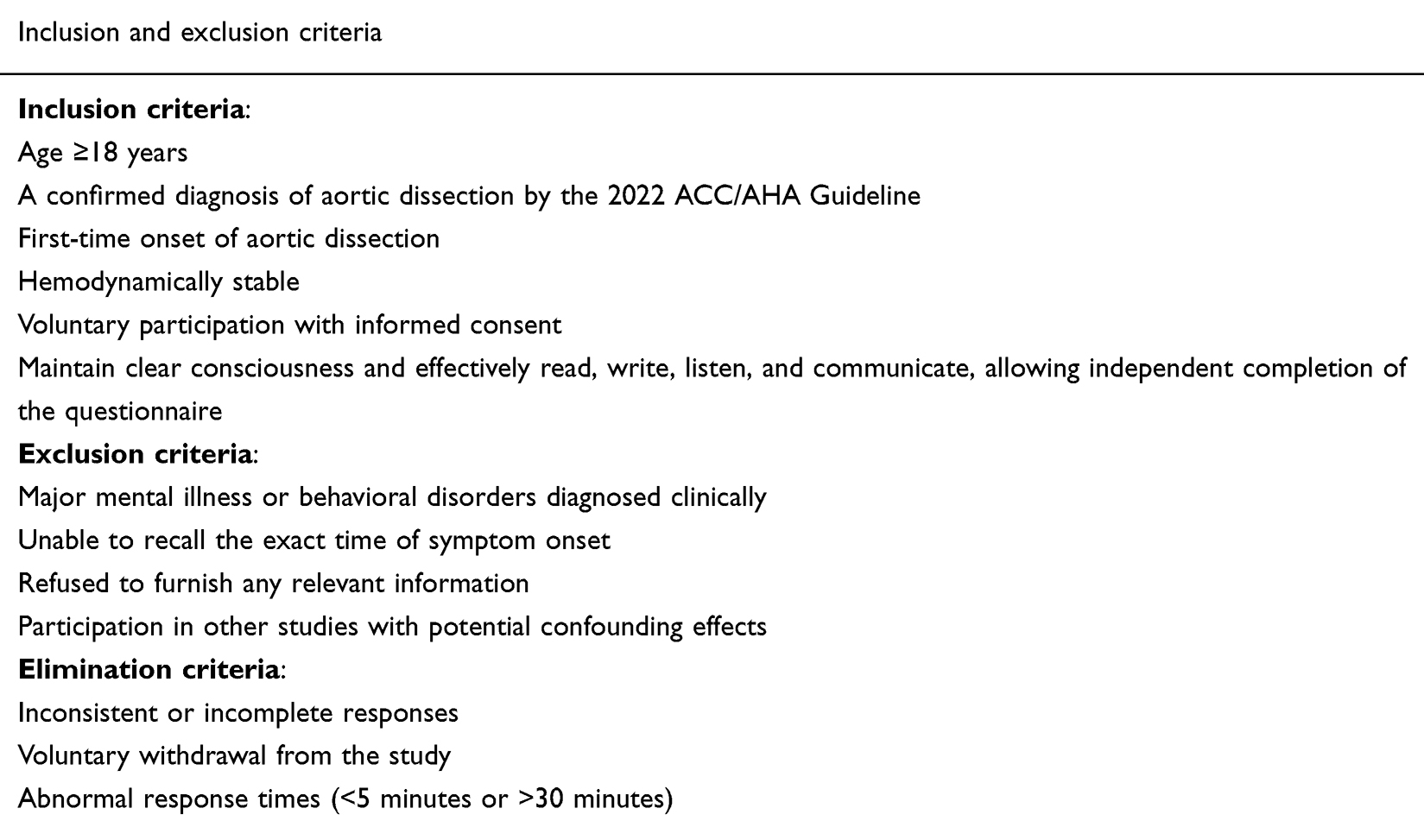 |
Box 1 Screening Criteria for Participants |
Questionnaire
General Information Questionnaire
The survey was designed by the researcher and comprised three sections: general demographic information (eg, gender, age, marital status, and other relevant factors); situational factors at symptom onset (eg, the location of occurrence, condition at onset, and the presence of bystanders); and disease-related information (eg, medical history, regular medication use, and cardiac function grading).
The Brief Illness Perception Questionnaire
The Brief Illness Perception Questionnaire (BIPQ) was designed to assess participants’ cognitive and emotional responses to their illness. It was developed by Broadbent et al,14 and the Chinese version was released simultaneously on the official website. The questionnaire includes nine items: perceived disease impact, duration, control, treatment effectiveness, symptoms, concern, knowledge, emotional impact, and open-ended questions. A 10-point Likert scale is used, with items 3, 4, and 7 reverse-scored. Excluding the open-ended question, the remaining eight items were scored on a 0–10 scale, yielding a total score range of 0–80. A higher total score indicates a greater level of disease awareness. The Cronbach’s α coefficient calculated for this study was 0.95, indicating high internal consistency.
The Perceived Barriers to Health Care - Seeking Decision Scale
The Perceived Barriers to Health Care-Seeking Decision Scale was used to assess participants’ perceived barriers to care. Developed by Al-Hassan and Omran,15 the scale was later translated into Chinese by Li et al,16 and applied in a study focusing on acute myocardial infarction (AMI) patients. The scale consists of 10 items, each measured on a 6-point Likert scale. The total score ranges from 10 to 60 with higher scores indicating greater perceived barriers. The Cronbach’s α coefficient calculated for this study was 0.80, indicating strong reliability.
The Social Support Rating Scale
The Social Support Rating Scale (SSRS) was used to assess participants’ level of social support. Based upon Cauce et al,17 and adapted into a Chinese version by Xiao,18 the scale is comprised of a total of 10 items in 3 dimensions: subjective support (4 items), objective support (3 items), and support utilization (3 items). Items 1–4 and 8–10 were single-choice items scored from 1 to 4 based on the option selected. Item 5 was scored by summing its five sub-items (A-E), each rated from 1 (“No support”) to 4 (“Full support”). Items 6 and 7 were scored as 0 for a “No source” response or by summing the total number of selected sources. The total score was the sum of all 10 items. Subscale scores were calculated as follows: subjective support (sum of Items 1, 3, 4, 5), objective support (sum of Items 2, 6, 7), and support utilization (sum of Items 8, 9, 10). The Cronbach’s α coefficient calculated for this study was 0.79, indicating strong reliability.
Measurement of PDD
While well-defined time windows for prehospital delay exist for AMI and acute ischemic stroke (AIS),19 the equivalent standards for acute aortic dissection (AAD) are notably ill-defined. This ambiguity extends to the critical component of patient decision-making, as specific research investigating an optimal or normative time window for PDD in AD is virtually non-existent.
Given this research gap, this study adopted a 60-minute threshold, referencing the guidelines for other acute cardiovascular emergencies (eg, the American Heart Attack Alert Program Coordination Committee).6 Accordingly, PDD was operationally defined as the time interval from the onset of AD symptoms to the patient’s decision to seek medical attention. Patients with an interval greater than 60 minutes were classified into the “PDD group” (delayed), while those with an interval of 60 minutes or less were classified into the “non-PDD group” (non-delayed). As both symptom onset and the cognitive decision to seek care are subjective experiences, this interval was measured via structured patient self-report. Data were collected using a dedicated section of the study questionnaire, administered within 24 hours of patient stabilization to mitigate recall bias. Patients were specifically asked to recall: (1) the time their most severe or definitive symptoms began, and (2) the time they concluded that they needed professional medical attention. The PDD interval was subsequently calculated from these two self-reported time points.
Ethical Considerations
Several ethical measures were implemented to protect participants’ rights throughout the study. Participants were first thoroughly informed about the study’s purpose, potential risks, and data handling procedures. All research assistants were specifically trained to sit with each potential participant, answer any questions, and ensure full comprehension before obtaining consent. Written informed consent was obtained prior to enrollment. Additionally, strict confidentiality protocols were followed, with personal data securely stored in encrypted databases and access restricted to authorized personnel only. All data used for the final analysis were fully anonymized. Furthermore, participation was entirely voluntary, and participants were informed of their right to withdraw at any time without penalty. Medical support was also made available if needed. Finally, this study adhered to the ethical principles outlined in the Declaration of Helsinki, and received ethical approval from the Ethics Committee of Tianjin Chest Hospital (2025KY-007-01).
Statistical Analyses
All data analysis was conducted using SPSS 27.0. Descriptive statistics were employed to analyze the general characteristics of the participants. For categorical variables, counts were presented as frequencies (percentages). Comparisons between these groups were subsequently made using the Pearson chi-square test. The normality of distribution for continuous measurement data was assessed using the Kolmogorov–Smirnov (K-S) test. Normally distributed data were expressed as the mean (M) ± standard deviation (SD), with comparisons between groups performed using either an independent sample t-test or one-way analysis of variance (ANOVA). For non-normally distributed measurement data, results were presented as the median (interquartile range), and the Mann–Whitney U-test was used for comparisons between groups. Spearman correlation analysis was used to assess the correlations between the BIPQ, the PBHSD-C, and the SSRS.
Variables identified as statistically significant (p < 0.05) in the univariate analysis were retained as candidate variables for the multivariate logistic regression model. Prior to the regression analysis, this set of candidate variables was assessed for multicollinearity by calculating the Variance Inflation Factor (VIF). All VIF values were found to be well below the conventional threshold of 5 (a maximum value of 2.240), indicating no significant multicollinearity. Key assumptions of the logistic regression model, including the linearity of the logit for continuous predictors (verified via the Box-Tidwell test), were also examined to ensure model validity.
To identify the independent predictors of PDD and obtain their corresponding adjusted odds ratios (ORs), a multivariate binary logistic regression analysis was conducted. A forward selection method based on the Likelihood Ratio test (Forward: LR) was utilized. All variables that demonstrated significance in the univariate analysis were entered as candidates for this procedure. The final model was applied to analyze the factors influencing PDD in AD patients. A p-value below 0.05 was considered statistically significant throughout all analyses.
Results
Sociodemographic and Clinical Characteristics
The final analytic sample consisted of 386 AD patients. This group was predominantly male, with 272 participants (70.47%) compared to 114 females (29.53%). The mean age of the participants was 59.88±13.37 years. Regarding the primary outcome, 262 participants were found to have experienced PDD. This figure corresponds to a prevalence rate of 67.88% (95% CI: 63.22% - 72.54%). A full summary of the demographic and clinical characteristics for this cohort is presented in Table 1.
 |
Table 1 Univariate Analysis of Sociodemographic and Clinical Characteristics |
Scale Score results
The PBHSD-C scores were significantly higher and the BIPQ scores were significantly lower in the delayed decision-making group compared to the timely group (p < 0.05). However, differences in SSRS scores between the two groups were generally small and not statistically significant, except for subjective support, which was slightly higher in the delayed group (p = 0.002). Further details are presented in Table 2.
 |
Table 2 Univariate Analysis of Illness Perception, Barriers, and Social Support Scores |
Univariate Analysis Results
The results in Table 1 revealed significant differences between the two groups in terms of age, work condition, education level, smoking, alcohol use, healthcare payment method, location of occurrence, condition at onset, bystanders at symptom onset, disease knowledge, Stanford classification, numerical rating scale (NRS), New York Heart Association (NYHA) classification, and symptoms including chest pain, back pain, abdominal pain, profuse perspiration, dizziness, and persistent unrelieved pain (p < 0.05). Furthermore, notable differences were observed in illness perception and perceived barriers (p < 0.05), as shown in Table 2.
Correlation Analysis Results
As the data were not normally distributed, Spearman correlation analysis was employed to investigate the relationships between the BIPQ, PBHSD-C, and the SSRS subscales (objective support, subjective support, and utilization of support) within the AD patient. The analysis revealed a significant negative correlation between patients’ illness perception and their perceived barriers (r = −0.165, p < 0.001). Conversely, illness perception showed a significant positive correlation with the utilization of support (r = 0.150, p < 0.01). This particular finding was notable, suggesting that the way patients perceive their illness may influence how they access help. Furthermore, utilization of support was strongly correlated with objective support (r = 0.244, p < 0.001). It was even more strongly correlated with subjective support (r = 0.385, p < 0.001). This pattern indicates a clear interrelation among the various dimensions of social support. The detailed correlation matrix is presented in Table 3, with key relationships visualized in Figure 1.
 |
Table 3 Correlation Analysis of Illness Perception, Perceived Barriers, and Social Support |
 |
Figure 1 Correlation matrix. Notes: The color intensity corresponds to the strength of the correlation.The values within each cell represent the correlation coefficients (r-values).Correlations marked with an “X” are statistically non-significant (p ≥ 0.05). |
Logistic Regression Analysis Results
To identify the independent predictors of PDD, a multivariate binary logistic regression analysis was conducted. This analysis utilized a forward selection (Likelihood Ratio) method, with all statistically significant variables from the univariate analysis entered as candidates (Entry criterion: p ≤ 0.05).
The final model demonstrated a good fit (Nagelkerke R² = 0.758). The results revealed that education attainment, bystanders at the onset, Stanford typing, NRS, symptoms including back pain, abdominal pain, profuse perspiration, and persistent unrelieved pain, the BIPQ, and the PBHSD-C were significant independent predictors of PDD (p < 0.05). A summary of the adjusted odds ratios (ORs) and 95% confidence intervals for these findings is presented in Table 4 and visualized in Figure 2.
 |
Table 4 Binary Logistic Regression Analysis Results |
 |
Figure 2 Binary logistic regression forest plot. Abbreviations: NRS, Numerical Rating Scale; BIPQ, Brief Illness Perception Questionnaire; PBHSD-C, Perceived Barriers to Healthcare Seeking Decision-Chinese version. Note: a for the reference group. |
Discussion
The high prevalence of PDD in this population (67.88%), comparable to rates reported in acute ischemic stroke, highlights a critical gap in timely care-seeking.20 This study, guided by the Self-Regulation Model, identified three primary pathways influencing PDD: (1) symptom-related factors (eg, atypical pain, Stanford classification), (2) situational factors at symptom onset (eg, education, bystander presence), and (3) cognitive characteristics (eg, illness perception, perceived barriers).
China’s distinct health-seeking behavior patterns may be critical social factors contributing to decision delay in AD patients. As the reference study confirms,21 rural residents exhibit a high dependency (65.61%) on primary care institutions. This “primary care first” habit is suboptimal for AD, as the lack of requisite diagnostic capabilities at this level likely leads to referral delays. Concurrently, the emphasis on “medical level” among urban residents (56.99%) choosing hospitals and those with higher education can manifest as a preference for perceived top-tier “authority” hospitals, rather than the nearest capable centers. Both tendencies, path dependency on primary care and a fixation on authority, are embedded in the Chinese socio-cultural context and may critically prolong the time-to-intervention for AD.
Our findings align with existing literature while offering context-specific interpretations. First, the role of symptom interpretation remains a major barrier. The non-specific nature of early AD symptoms often leads to misinterpretation.3 Our study confirmed that factors like atypical pain (back/abdominal) and pain intensity significantly impact PDD, as patients often confound these symptoms with benign gastrointestinal or musculoskeletal issues.22,23 This mismatch between subjective perception and objective risk impairs the activation of protective illness representations, leading to palliative coping rather than emergency action.24,25 Furthermore, social factors significantly mediate patient response. Consistent with prior research, lower educational attainment was linked to PDD, likely due to difficulties in appraising risk and navigating health systems.26,27 Similarly, the presence of bystanders was critical.28 Supportive bystanders facilitate timely action, whereas those with misconceptions or exhibiting the “bystander effect” can exacerbate delays.29,30
In addition, our findings substantiate the SRM by explicitly mapping the cognitive-emotional pathway leading to PDD. In the SRM’s Representation stage, where patients form a “common-sense” understanding of the health threat. The results confirm that negative outputs, namely inaccurate illness perceptions (eg, erroneous perceptions of the severity or controllability) and adverse emotional responses (eg, fear, denial), are critical impediments to timely decision-making.31,32 These representations, in turn, drive the Coping stage. PDD itself, the central focus of this study, manifests as a direct failure of this stage, specifically, maladaptive inaction. Crucially, our correlation analysis revealed a significant link between the Representation stage (inaccurate perceptions) and Perceived Barriers (eg, cost, distrust).33,34 This reinforces the SRM framework by demonstrating that cognitive,11 emotional, and practical factors do not operate in isolation. Instead, they interact, creating a synergistic impediment that hinders the initiation of an adaptive coping response (ie, timely care-seeking).
Translating these findings into practical strategies is essential. We propose a multi-level approach: (1) Policy & Public Health: National public health campaigns, similar to stroke (FAST) protocols,35 are recommended to educate the public on atypical AD symptoms (eg, sudden back or abdominal pain). (2) Targeted Education: “Acute Aortic Dissection Toolkits” should be simplified with clear infographics and plain language, specifically targeting communities with lower health literacy.36 (3) Bystander Intervention: Interventions should target the family unit of high-risk patients (eg, those with hypertension), training them as “first responders” to recognize warning signs and activate emergency services immediately. (4) Clinical Practice: Clinicians should be trained to rapidly assess and address perceived barriers and negative illness perceptions, leveraging digital health tools for personalized risk communication.
This study has certain limitations. (1) A cross-sectional design identifies associations but does not permit causal inferences. Longitudinal research is needed to better capture real-time decision-making trajectories; (2) although a range of relevant variables was considered, the absence of specialized evaluation tools may have limited the precision of some assessments; (3) while the study focused on sociodemographic, clinical, cognitive, and social factors, other potential influences may not have been fully captured; (4) this study mainly focuses on a single-country population (China), which may limit the generalizability of the results. Future research should use longitudinal designs, incorporate specialized evaluation tools, explore additional influencing factors, and include diverse populations to enhance the generalizability and causal understanding of patient decision-making.
Conclusion
This study’s findings establish that PDD in AD persists as a significant and easily overlooked public health concern. This delay is attributable to a complex interplay of symptomatic, social, and cognitive factors. Interpreted through the lens of the Self-Regulation Model and specific cultural contexts, ambiguous symptom interpretation, inaccurate illness perception, lower educational attainment, bystander dynamics, and perceived barriers were identified as principal drivers of this delay. These findings highlight the pressing need for multi-level, actionable interventions. Future efforts must transition from problem identification to solution implementation. The findings provide a foundation for healthcare providers to implement tailored interventions that facilitate earlier care-seeking behaviors in AD patients, with the potential to improve clinical outcomes and survival.
Acknowledgments
We sincerely appreciate the selfless dedication and support of all the medical staff, as well as the high level of cooperation and commitment from all participants.
Jiaqi Zhang and Yuelin Song contributed equally to the work and should be regarded as co-first authors.
Funding
This work was supported by the Tianjin Municipal Science and Technology Program [grant number: 23KPXMRC00110].
Disclosure
The authors declare that this study was conducted without any business or financial relationships that could be construed as potential conflicts of interest.
References
1. Levy D, Sharma S, Farcim F, Le JK. Aortic Dissection. In: StatPearls. StatPearls Publishing; 2024.
2. Yin J, Liu F, Wang J, Yuan P, Wang S, Guo W. Aortic dissection: global epidemiology. Cardiology Plus. 2022;7(4):151–161. doi:10.1097/CP9.0000000000000028
3. Vilacosta I, San Román JA, Di Bartolomeo R, et al. Acute aortic syndrome revisited: JACC state-of-the-art review. J Am Coll Cardiol. 2021;78(21):2106–2125. doi:10.1016/j.jacc.2021.09.022
4. Mazzolai L, Teixido-Tura G, Lanzi S, et al. ESC Guidelines for the management of peripheral arterial and aortic diseases. Eur Heart J. 2024;45(36):3538–3700. doi:10.1093/eurheartj/ehae179
5. Petrova D, Garrido D, Catena A, et al. Anticipated prehospital decision delay in response to different symptom clusters in acute coronary syndrome: results from the spanish cardiobarometer study. Soc Sci Med. 2024;359:117263. doi:10.1016/j.socscimed.2024.117263
6. National Heart Attack Alert Program Coordinating Committee. 60 Minutes to Treatment Working Group. Emergency department: rapid identification and treatment of patients with acute myocardial infarction. Ann Emerg Med. 1994;23(2):311–329. doi:10.1016/S0196-0644(94)70045-1
7. Wechkunanukul K, Grantham H, Clark RA. Global review of delay time in seeking medical care for chest pain: an integrative literature review. Aust Crit Care. 2017;30(1):13–20. doi:10.1016/j.aucc.2016.04.002
8. Staniszewska A, Gaba K, Patterson B, et al. Consensus statement on the interhospital transfer of patients with acute aortic syndrome: TRAVERSING Delphi study. Emerg Med J. 2024;41(3):153–161. doi:10.1016/S0196-0644(94)70045-1
9. Fang Y, Tao H, Li Y, et al. Analysis of countermeasure of pre-hospital delay of acute aortic dissection in China. Med Soc. 2022;35(09):138–144. doi:10.13723/j.yxysh.2022.09.026
10. Leventhal H, Safer MA, Panagis DM. The impact of communications on the self-regulation of health beliefs, decisions, and behavior. Health Educ Q. 1983;10(1):3–29. doi:10.1177/109019818301000101
11. Leventhal H, Brissette I, Leventhal EA. The Common-Sense Model of Self-Regulation of Health and Illness. Cameron LD, Leventhal H, eds.:The self-regulation of health and illness behaviour. Routledge: 2003. 42–65.
12. Ivynian SE, Ferguson C, Newton PJ, DiGiacomo M. The role of illness perceptions in delayed care-seeking in heart failure: a mixed-methods study. Int J Nurs Stud. 2024;150:104644. doi:10.1016/j.ijnurstu.2023.104644
13. Von Elm E, Altman DG, Egger M, Pocock SJ, Gøtzsche PC, Vandenbroucke JP. STROBE Initiative. The strengthening the reporting of observational studies in epidemiology (STROBE) statement: guidelines for reporting observational studies. Lancet. 2007;370(9596):1453–1457. doi:10.1016/S0140-6736(07)61602-X
14. Broadbent E, Petrie KJ, Main J, Weinman J. The brief illness perception questionnaire. J Psychosom Res. 2006;60(6):631–637. doi:10.1016/j.jpsychores.2005.10.020
15. Al-Hassan MA, Omran SM. The effects of health beliefs on health care-seeking decisions of Jordanian patients with myocardial infarction symptoms. Int J Nurs Pract. 2005;11(1):13–20. doi:10.1111/j.1440-172X.2005.00497.x
16. Li PW, Lee DT, Yu DS. Psychometric evaluation of the perceived barriers to health care-seeking decision in Chinese patients with acute coronary syndromes. Heart Lung. 2014;43(2):140–145. doi:10.1016/j.hrtlng.2014.01.001
17. Cauce AM, Felner RD, Primavera J. Social Support Rating Scale (SSRS) [Database record]. APA PsycTests. 1982. doi:10.1037/t59285-000
18. Xiao SY. The theoretical basis and research application of social support rating scale. J Clin Psychiatry. 1994;2:98–100.
19. Cui L, Li L. Research progress on influencing factors and prevention and control measures of delay in patients with acute ST-segment elevation myocardial infarction. Chin Nurs res. 2023;37(10):1792–1796. doi:10.12102/j.issn.1009-6493.2023.10.019
20. Zhang B, Sun Q, Lv Y, et al. Influencing factors for decision-making delay in seeking medical care among acute ischemic stroke patients in rural areas. Patient Educ Couns. 2023;108:107614. doi:10.1016/j.pec.2022.107614
21. Tang L, Wu YW, Gu HR, Liu Y. Differences of Chinese urban and rural residents’ health seeking behavior and its influencing factors. Mod Preventive Med. 2023;50(18):3341–3346. doi:10.20043/j.cnki.MPM.202302420
22. Guo ZR, Huang SF, Wang Q, et al. The relationship between the initial symptoms and pre-hospital delay in patients with acute aortic dissection. J Nurs. 2022;37(2):5–8. doi:10.3870/j.issn.1001-4152.2022.02.005
23. Lovatt S, Wong CW, Schwarz K, et al. Misdiagnosis of aortic dissection: a systematic review of the literature. Am J Emerg Med. 2022;53:16–22. doi:10.1016/j.ajem.2021.11.047
24. McAndrew LM, Crede M, Maestro K, Slotkin S, Kimber J, Phillips LA. Using the common-sense model to understand health outcomes for medically unexplained symptoms: a meta-analysis. Health Psychol Rev. 2019;13(4):427–446. doi:10.1080/17437199.2018.1521730
25. Hagger MS, Orbell S. The common sense model of illness self-regulation: a conceptual review and proposed extended model. Health Psychol Rev. 2022;16(3):347–377. doi:10.1080/17437199.2021.1878050
26. Zhao Y, Xu Y, Fang S, et al. Incidence and associated factors of prehospital care-seeking delay in people with acute ischemic stroke: a systematic review and meta-analysis. Neuroepidemiology. 2024:1–16. doi:10.1159/000542765
27. Sheng Z, Kuang J, Yang L, et al. Predictive models for delay in medical decision-making among older patients with acute ischemic stroke: a comparative study using logistic regression analysis and lightGBM algorithm. BMC Public Health. 2024;24(1):1413. doi:10.1186/s12889-024-18855-6
28. Huang S, Xiao Y, Wang H, et al. Multifactorial study of pre-hospital time in acute aortic dissection patients. Chin J Emerg Crit Care Nurs. 2020;1(1):17–23. doi:10.3761/j.issn.2096-7446.2020.01.003
29. Potisopha W, Vuckovic KM, DeVon HA, Park CG, Phutthikhamin N, Hershberger PE. Decision delay is a significant contributor to prehospital delay for stroke symptoms. West J Nurs Res. 2023;45(1):55–66. doi:10.1177/01939459221105827
30. Milling L, Kjær J, Binderup LG, et al. Non-medical factors in prehospital resuscitation decision-making: a mixed-methods systematic review. Scand J Trauma Resusc Emerg Med. 2022;30(1):24. doi:10.1186/s13049-022-01004-6
31. Hnatešen D, Radoš I, Dimitrijević I, et al. Influence of the cognitive and emotional status of patients with chronic pain on treatment success (reduction in pain intensity and adherence to pharmacotherapy): a prospective study. Int J Environ Res Public Health. 2022;19(23):15968. doi:10.3390/ijerph192315968
32. Alzahrani N. The effect of hospitalization on patients’ emotional and psychological well-being among adult patients: an integrative review. Appl Nurs Res. 2021;61:151488. doi:10.1016/j.apnr.2021.151488
33. Richmond J, Anderson A, Cunningham-Erves J, Ozawa S, Wilkins CH. Conceptualizing and measuring trust, mistrust, and distrust: implications for advancing health equity and building trustworthiness. Annu Rev Public Health. 2024;45(1):465–484. doi:10.1146/annurev-publhealth-061022-044737
34. Dawkins B, Renwick C, Ensor T, Shinkins B, Jayne D, Meads D. What factors affect patients’ access to healthcare? Protocol for an overview of systematic reviews. Syst Rev. 2020;9(1):18. doi:10.1186/s13643-020-1278-z
35. Chao BH, Yan F, Hua Y, et al. Stroke prevention and controsystem in China: cSPpC-Stroke Program. Int J Stroke. 2021;16(2):265–272. doi:10.1177/1747493020913557
36. Vascular Society. Acute aortic dissection pathway toolkit. 2022. Available from: https://vascularsociety.org.uk/_userfiles/pages/files/newsletters/acute-aortic-dissection-pathway-toolkit.pdf.
 © 2025 The Author(s). This work is published and licensed by Dove Medical Press Limited. The
full terms of this license are available at https://www.dovepress.com/terms
and incorporate the Creative Commons Attribution
- Non Commercial (unported, 4.0) License.
By accessing the work you hereby accept the Terms. Non-commercial uses of the work are permitted
without any further permission from Dove Medical Press Limited, provided the work is properly
attributed. For permission for commercial use of this work, please see paragraphs 4.2 and 5 of our Terms.
© 2025 The Author(s). This work is published and licensed by Dove Medical Press Limited. The
full terms of this license are available at https://www.dovepress.com/terms
and incorporate the Creative Commons Attribution
- Non Commercial (unported, 4.0) License.
By accessing the work you hereby accept the Terms. Non-commercial uses of the work are permitted
without any further permission from Dove Medical Press Limited, provided the work is properly
attributed. For permission for commercial use of this work, please see paragraphs 4.2 and 5 of our Terms.