
Back to Journals » Journal of Healthcare Leadership » Volume 17
Unleashing the Early Career Transition in Academic Medicine
Authors David DH
Received 25 January 2025
Accepted for publication 2 April 2025
Published 12 April 2025 Volume 2025:17 Pages 133—140
DOI https://doi.org/10.2147/JHL.S519433
Checked for plagiarism Yes
Review by Single anonymous peer review
Peer reviewer comments 2
Editor who approved publication: Professor Russell Taichman
Daryn H David
Yale Child Study Center & Offices of Academic & Professional Development (OAPD) and Diversity, Equity, & Inclusion (ODEI), Yale School of Medicine, New Haven, CT, USA
Correspondence: Daryn H David, Yale Child Study Center, Yale School of Medicine, 230 S. Frontage Road, New Haven, CT, 06520, USA, Email [email protected]
Abstract: In addition to advancing biomedical research and delivering cutting-edge clinical care, academic medical centers (AMCs) are tasked with training the next generation of physicians and scientists. This training is based on a competencies model, with emphasis given to the high-level acquisition of technical clinical and research skills. While this framework is appropriate for the learning years, once researchers and clinician-scientists transition from training to fuller career responsibilities, they are in need of an expanded psychological and psychosocial toolkit for holistic success. At present, academic medicine does not sufficiently support, address, or welcome the elements of this toolkit; in the early career phase, overemphasis is placed on the expression and expansion of independent technical competencies, to the neglect of the psychosocial facets necessary for academics’ successful career progression and fulfillment. Delineating the legacy of the current training model for the early career period, this paper explicates the tension that exists between the conventional markers of success and adult psychosocial needs, with special attention paid to the potential consequences of this mismatch. The paper concludes with a series of suggestions for how leaders in academic medicine may help their research and clinician-scientist faculty flourish more fully in early career.
Keywords: faculty, psychosocial well-being, career trajectory, coaching, institutional reform
Introduction
In journeying through life, what is evident to others is the outer path taken … The inner path is much less evident to the eye. Jean Shinoda Bolen, pg. 881
In academic medicine, we privilege tangible indices of proficiency and competence above almost everything else. The delivery of the highest-quality clinical care – and the outcome metrics to prove it. Generating cutting-edge translational research, supported by prestigious grants and published ideally in top journals. Membership in the elite professional societies, the bestowal of honorary doctorates and endowed chairs, setting a sterling model of accomplishment and success for the next generation of scientists and clinician-scientists; indices of proficiency and mastery are our bread and butter, and we have built an entire training and reward enterprise to sustain them.
On the one hand, such emphasis on signs of mastery makes perfect sense. Doctors hold the health of their patients in their hands; researchers harbor the techniques to uncover lifesaving treatments that these patients need; educators are responsible for ensuring the continuity of an excellent workforce. Across these areas, recognition of proficiency and the maintenance of extremely high standards of practice are a necessity, especially at a time of declining public trust of scientists and medical scientists.2
And yet. Inculcated through years of an “apprenticeship” system, in which they have been instructed on how to do things over and over, early career researchers and clinician-scientists enter their independent careers having been rewarded almost exclusively for demonstrating their capacity to deliver the tangible outcomes of their trade.3 Left out of this equation is explicit valuing of the joy of discovery – the “play” that can inform scientific exploration;4 the pleasures of supporting colleagues in their own pursuits; and the moral and spiritual dimensions of healing and care that may inform the quest for clinically relevant knowledge. In the face of the many ostensible metrics and milestones of early career, we have left underestimated, unrecognized, and unsupported many of the deeper reasons, motivations, and desires that may undergird academicians’ work.
In the following paper, I argue that the ideal time for reenchanting the efforts of researchers and clinician-scientists in academic medicine is during the transition from trainee to early career faculty member. Against the backdrop of the myriad stressors and strains of the early career period, I highlight how the range of softer competencies – agentic, committed perseverance to one’s craft; interpersonal, values-based decision-making; engagement in developing self and others – required for deeper professional fulfillment are themselves aligned with the hallmarks of healthy adult psychosocial development. I conclude by highlighting the ways that concrete steps toward a realignment of the early career phase with adult psychosocial needs could unleash the flourishing of researchers and clinician-scientists in academic medicine.
Training in Academic Medicine
A career in academic medicine can be broken down into five main stages. As highlighted in Table 1, these include foundational training, advanced training, early career, mid-career, and late career.
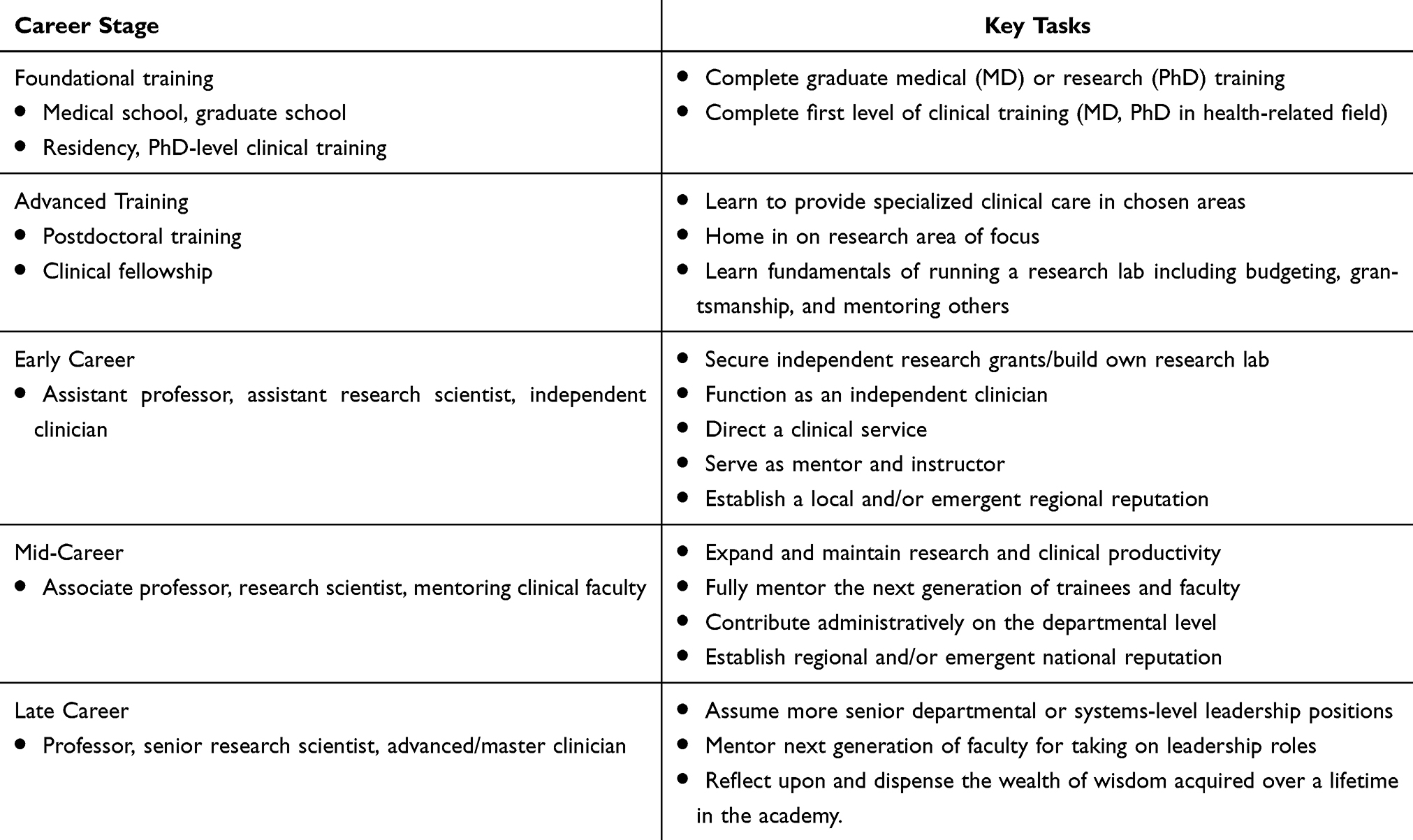 |
Table 1 Career Stages of Academic Medicine |
With their intensive focus on developing competencies related to the clinical and research domains, the two training stages rely heavily on an apprenticeship model, with individuals learning directly under the guidance and feedback of more senior-level physicians, instructors, and researchers.3,5 The first stage – foundational training – includes a near-decade of medical school, residency, and/or PhD-level graduate training, during which the essentials of providing clinical care and conducting research are rigorously taught and evaluated. Examples of activities during this period include residents’ performing clinical care under supervision of attendings and graduate students being mentored by senior scientists on how to run research protocols properly.
During the advanced training phase, individuals pursue more specialized clinical and/or research fellowships or postdoctoral positions, intended to help them further hone and tailor their interests, skills, and capacity to functioning within their chosen fields. Activities here include a clinical fellow learning a cutting-edge medical procedure under the direction of a more senior specialist or a postdoctoral fellow taking the lead on writing her co-PI’s NIH grant application.
Meeting milestones and displaying proof of competencies figure prominently in the two training stages. Individuals engaged in medical school, residency, or fellowship are beholden to show progressive levels of expertise on competencies related to patient care and procedural skills, medical knowledge, practice-based learning and improvement, interpersonal and communication skills, professionalism, and systems-based practice.6 The utilization of competencies to benchmark progress has also been proposed for doctoral-level scientists and trainees,7 where proposed milestones include obtaining breadth and depth of knowledge about one’s scientific field, honing well-developed research and analytical skills, and beginning to display resilience and leadership behaviors including collaborating with others, managing conflict, and setting career vision.8
As noted above, the importance of a competency-based approach to training cannot be overstated. Providing trainees and those who evaluate them with clear, transparent milestones of success can be empowering and instrumental for all involved; well-articulated competencies also help ensure that the organizations tasked with educating up-and-coming practitioners focus on the curricula and skills needed for successful future practice. At the same time, the competencies model also does not adequately take into account the increased importance of skills like self-regulation and reflectiveness, agility and interpersonal finesse, and courage and resilience in our changing and increasingly complex healthcare and research environment.9,10 The overemphasis on technical proficiency also downplays important facets of adult psychosocial maturity, including heightened self-awareness, the courage to engage with work in an inspired, creative fashion, and the commitment to self and others’ actualization. For early career faculty, this restriction of focus can prove particularly out of sync with their life stage.
Psychosocial Development and Academic Medicine
Proving that one has mastered the technical competencies gained during training and is capable of executing them independently is the main criterion by which early career success in academic medicine is evaluated. Activities including securing grants, writing papers, establishing a successful lab, making informed clinical decisions, and beginning to forge an accomplishment-based reputation at one’s institution and regionally constitute the near-exclusive set of proficiencies over which early career researchers must exhibit command in order to advance and achieve promotion.11
Mapping this career phase (and others) onto one established theory of adult psychosocial development draws particular attention to the degree to which the continued emphasis on technical competencies is out of step with the fuller interpersonal capacities, zest, and commitment that early career academicians could bring to their work.
According to the psychologist Erik Erikson, there are several stages of psychosocial development through which individuals (ideally) will pass over the course of their lifetime.12 The first three stages of development concern infancy through childhood, during which trust in others, lack of shame or guilt when asserting oneself and exploring the environment, and a sense of purpose and confidence in one’s capacities are ideally established. In the fourth (adolescent) stage, “fidelity” or establishing loyalty to something or someone beyond oneself is the core developmental task. The last three life stages pertain to adulthood, during which individuals exhibit established love or “mutual devotion” in early adulthood, pursue generativity in their work and by caring for others in middle adulthood, and ultimately reflect upon and dispense the wisdom that they have accrued over the course of their lifetime as they reach older age.
Table 2 provides a schema for mapping the career phases of academic medicine onto Erikson’s psychosocial stages; in so doing, the mismatch between the professional expectations of early career faculty and the larger, more holistic psychosocial potential of this cohort is cast into sharp relief. Simply put, continued overemphasis in early career on proving technical competency – to the downplay of establishing relationships, working courageously in line with values, and finding reward in the service of others – protracts a state of professional apprenticeship which most academics have, in their larger lives, squarely outgrown.
 |
Table 2 Career Stage of Academic Medicine Mapped Onto Erikson’s Theory of Psychosocial Development |
According to the AAMC, the average age of first appointment to the assistant professor rank is 39 years for those working in basic science departments and 38 years for those in clinical departments within academic medicine.13 The average age of securing a first R01 grant from the NIH is 41 years old for PhDs and 44 years old for MDs.14 Age-wise, early career faculty are adults actually on the cusp of middle adulthood; many are no doubt partnered, have children, and/or are enjoying the fruits of long-standing, committed friendships, confidences, and engagement with their larger communities.11 In Eriksonian terms, we would expect that these faculty members are demonstrating Fidelity (loyalty), Love (reciprocity of devotion), and Care to the core individuals in their broader lives, in part by expressing the broader, concomitant capacities of taking committed action, pursuing tasks in line with values and meaning, and standing behind interpersonal relationships as necessary.
Career-wise, we would expect early career faculty to be capable and drawn to demonstrating such affiliative and values-based behaviors in their work as well – perhaps by committing in a deeper, soulful way to their field of interest even when the going gets tough, working closely and collaboratively with others to move one another and their field along, and beginning to develop the next generation in line with the trainees’ needs. Aspects of this may occur on an individual basis, but the individualistic milestones and metrics of early career success in academic medicine – securing grants, bringing in clinical revenue, publishing research, reaching clinical productivity benchmarks – have scant overlap with these personal anchors and interpersonal behaviors. In fact, these competencies-based metrics may actually serve to arrest more holistic expression of self within academic medicine.
Unlike the shepherding of culture and climate written into the job descriptions of deans and department chairs, faculty who participate substantively in service and the development of others – often women and individuals from URiM backgrounds – can experience greater career disadvantage.15,16 This can be particularly true for early career faculty who must balance service requests with those activities that provide more directly for their own promotion and tenure. Further, the structure of academic medicine may prove particularly challenging for these faculty most primed to contribute interpersonally. For women in academic medicine, the overlap of the prime childbearing/childrearing years with early career is a distinct concern,11 whereas the lack of adequate mentorship and support and the presence of microaggressions, racism, and bias render a career in academic medicine particularly daunting for individuals from URiM backgrounds.17 Further, supports like coaching and related leadership development efforts that would validate the importance of working from a place of internal meaning and deeply-held values are growing in popularity at academic medical centers but are not yet adequately available.3
Compounding the lack of formal celebration of faculty members’ psychosocial capacities is the notable instability of early career for scientists and clinician-scientists. Unlike a generation or two ago, having a PhD neither expedites nor guarantees a research job within the academy. Instead, there are now many more science-based PhDs than available tenure-track jobs.11 This is especially true in the biomedical sciences, which have seen an explosion in earned doctorates, and has resulted in many individuals leaving the academy; getting trapped in low-paying, insecure, and lengthy postdoctoral positions; and/or voicing strong concern about their long-term job prospects.11
For those researchers who do progress, a climate of highly competitive funding in which established faculty are more successful in accruing NIH funding than those in early career (32.6% vs 29.6%, respectively) can also prove destabilizing.18 Perhaps not surprisingly, PhD-level scientists in academic medicine – including those who have secured grant funding and are further on in their assistant professorships (or even associate professorships) – report lower confidence in the possibility of career advancement than do their MD and MD/PhD-level colleagues.19
Of course, having an MD degree does not shield one from the stresses and strains of this career phase either. Some studies suggest that rates of burnout, which presents a significant risk to patient safety and practitioner well-being, are especially high amongst physicians working within academic medicine, due in part to the demands of balancing administrative, research, teaching, and clinical roles.20 Within academic medicine itself, early career physicians – as well as women and physicians from URiM backgrounds – report higher rates of burnout and desire to leave academic medicine than do their more established or male counterparts. Reasons include competing family responsibilities, inadequate institutional support, the “gender” and “minority” tax, and low levels of engagement/connection with their colleagues.20,21 The growing emphasis on RVU-generating clinical activities, at the expense of teaching, research, and other meaningful activities, may only serve to heighten the burnout and dissatisfaction of MDs – early career and otherwise – within academic medicine.22
Would addressing and supporting the holistic psychosocial needs of early career faculty (reinforcing their efforts to build community and invest in one another, creating space for professional experimentation and risk-taking, allowing for work practices that center values-based decision-making and tasks of meaning) help soften some of the stressors and strains described above? How might levels of career satisfaction, faculty retention, and productivity shift if early career became a time sanctioned for researchers and clinician-scientists to explore their deepening commitments, engage more fully and vibrantly with others, and build community without negative consequence? And how might leaders in academic medicine amend milestones and metrics to help early career become a moment of fuller humanistic growth and expression? These questions are both empirical and conceptual; below I take a first crack at engaging some possibilities for reform.
Addressing the Holistic Needs of Early Career Faculty
If early career faculty are to thrive in their careers, I believe that academic medicine must start encouraging, incentivizing, and rewarding signifiers of these individuals’ adult psychosocial capacities. This includes enhancing some of the activities that we know support early career struggles, while also – and this is key – actively reframing the incentive and reward structures of early career to include substantive indices of professional commitment, meaningful self-expression, creativity, and service.
One of the bedrock ingredients to a successful research career in academic medicine is effective mentorship, which can take the form of dyadic/hierarchical relationships and/or peer mentorship interactions that incorporate review of one another’s work and provide psychosocial and lifestage support.23–27 I believe that to truly empower early career faculty to bring a fuller presence, creativity, and values-based approach to their work, mentorship must also be peppered with elements of the coach approach.
In the coach approach to development, the person receiving coaching is assumed to be creative and whole, with innate wisdom and capacity for self-development. The coaching frame thus centers the “coachee” within their own agency, rendering them responsible for generating their own values-based solutions to problems; the coach serving as a curious, questioning partner – but not guide – to this process.3 Thus, rather than providing answers to every early career quandary, it would be helpful for mentors, sponsors, and other trusted guides to know how to listen openly and fully to what the coachee is expressing, and how to respond in a way that centers their mentees’ agency, wisdom, commitments, and values within the problem-solving process.
We already have evidence that coaching reduces burnout and emotional exhaustion while bolstering engagement and resilience for physicians working within academic medicine;28,29 coaching can likewise support those working in STEMM to hone their leadership capacity, articulate values-based objectives, and embrace enhanced problem-solving complexity at the team level.30 While time and other resource constraints would make it impossible to provide every early career faculty member with their own individual coach, it is feasible to teach faculty the fundamental mindsets and skills of the coaching stance, so that they may internalize these resources and utilize them with colleagues, trainees, and themselves. Along these lines, our own institution is currently designing, deploying, and evaluating a range of coaching skills trainings for faculty of all ranks.
Were academic medical centers to adopt a broader ethos of coaching, individuals at various levels of the academic medicine hierarchy would receive and/or be trained in coaching methods and mindsets; early career faculty would be encouraged to articulate their own solutions to emerging problems and to correct mistakes without blame; and leadership would utilize questioning, curiosity, and positive regard to support practitioners in doing so.31 To help defray the costs associated with such programming, institutions of academic medicine could consider hiring in-house leadership development experts to design and deliver these trainings, rather than hire consultants to provide these services à la carte.
On the research front, we know that interdisciplinary research teams marked by strong interpersonal relationships and diverse membership produce high-quality scientific findings.32,33 To try and capitalize on this inventiveness while also creating deliberate, sanctioned space for early career faculty members’ fuller expression of values and connectedness, institutions of academic medicine could consider adopting their own criteria for internal grants and lobby the NIH and other external funding agencies to expand their definition of team science to include an active/evaluative consideration of the interpersonal climate of a researcher’s lab.
More specifically, training grants (K and K-equivalents) could require early career applicants to explicitly delineate how they would privilege building psychological safety and healthy relationship practices into standard lab operating procedures. Proposed mentors could be asked to explicate how they would identify, tend to, and bolster the early career applicant’s psychosocial needs and capacity to build a psychologically healthy workspace. Such grant sections would be distinct from those asking about the applicant’s ongoing development of technical skills and focus instead on how they are building sound interpersonal skills and directly investing in those working for them. For accountability, grant progress reports and renewal applications could solicit feedback on lab culture and climate from current and former lab members.
On the systems level, utilizing new metrics that account for the broader range of meaningful activities could lessen the stress that early career faculty feel to demonstrate proficiency above all else. One option that has been floated is the “academic RVU”, by which teaching, service, and research could be accounted for alongside clinical RVUs.34 A related step might be reimagining service-based activities as a type of scholarship, thereby untethering early career faculty from concerns about how contributing generatively and interdependently with their colleagues may, ironically, harm their prospects for advancement and promotion.
Within the academy writ large, the notion of service as scholarship has been batted around by institutions with strong community-focused missions.35 Should we consider this within academic medicine, those clinical engagements, scientific collaborations, and teaching efforts most notable for their collegiality and enhancement of well-being could become prized as a distinct, promising form of scholarship, elevating collegiality and team building explicitly into an established metric of career growth.
Each of these proposed solutions dares to redefine the academic medical enterprise as inherently individualistic and relational, an endeavor in which scientists and clinician-scientists at all levels are rewarded for privileging affiliation and the embrace of values and meaning alongside traditional signifiers of success.36 Given data indicating that physicians in academic medicine who spend at least 20% of their time doing meaningful work have significantly lower burnout rate than their peers who are not doing so,37 creating space for the various activities, psychological stances, and practical approaches that could embolden early-career researchers and clinician-scientists to step more fully into their activities feels imperative.
Conclusion
This paper has argued that to curb dissatisfaction and unleash the multifaceted potential, zest, and vitality of early career faculty, institutions of academic medicine must privilege their fuller adult psychosocial capacities and gifts. In so doing, these institutions would not only proffer appropriate respect and support to their research and clinician-scientist workforce, but may very well strengthen the scaffolding necessary for their own survival as humanistically informed enterprises committed to the pursuit of scholarship, intergenerational transmission of the research and clinical crafts, and community service and healing.
I believe that the transition from training – with its years of socialized apprenticeship – to early career is a prime moment to elevate these humanistic values. By and large, individuals in early career are already full-fledged adults, with the capacity to instantiate relationally-focused and values-driven work. Ignoring this in favor of technical productivity not only limits the potential of these early-career academicians but, I believe, extinguishes the nascent sparks that can fuel the fires of generativity and mission-driven activity for the academy.
As stated beautifully by Viggiano and Strobel (2009, pg. 77),
… an institution’s culture can help individuals sustain vitality by connecting individuals to the meaning and purpose of their work, expressing appreciation for each individual’s contributions, and instilling a sense of community, or unity of purpose for accomplishing the institution’s mission.38
The time has arrived for AMCs to take this call to action seriously, from the very beginning of faculty members’ careers.
Acknowledgments
The author would like to thank Dr. Linda Mayes and Dr. Robert Rohrbaugh for their generous thought partnership and constructive reviews of paper drafts.
Disclosure
The author reports no conflicts of interest in this work.
References
1. Bolen JS. The Tao of Psychology. New York: Harper & Row, Publishers; 1979.
2. Research Center P. Confidence in scientists, medical scientists, and other groups and institutions in society. Pew Research Center Science & Society. Published. 2023. Available from: https://www.pewresearch.org/science/2023/11/14/confidence-in-scientists-medical-scientists-and-other-groups-and-institutions-in-society/.
3. David DH. A renaissance in academic medicine—using a coach approach to develop early-career faculty. JAMA. 2024;331(13):1087. doi:10.1001/jama.2024.2786
4. Lewis S. The Rise: Creativity, the Gift of Failure, and the Search for Mastery. New York: Simon & Schuster Paperbacks; 2014.
5. PhD training is no longer fit for purpose — it needs reform now. Nature. 2023;613(7944):414. doi:10.1038/d41586-023-00084-3
6. Eno C, Correa R, Stewart N, Lim J, Westerman M, Holmboe E. Milestones guidebook for residents and fellows; accreditation council for graduate medical education 2020. Available from: https://www.acgme.org/globalassets/PDFs/Milestones/MilestonesGuidebookforResidentsFellows.pdf.
7. Seivert NP, Werntz A, Hsueh L, Sain K, Washburn JJ, Cavell TA. Career-enhancing research competencies: student perceptions of research training in clinical psychology doctoral programs. Train Educ Prof Psychol. 2022. doi:10.1037/tep0000428
8. Verderame MF, Freedman VH, Kozlowski LM, McCormack WT. Competency-based assessment for the training of PhD students and early-career scientists. eLife. 2018;7. doi:10.7554/elife.34801.
9. Maini A, Saravanan Y, Singh TA, Fyfe M. Coaching skills for medical education in a VUCA world. Med Teach. 2020;42(11):1308–1309. doi:10.1080/0142159x.2020.1788713
10. Cernega A, Nicolescu DN, Meleșcanu Imre M, et al. Volatility, uncertainty, complexity, and ambiguity (VUCA) in healthcare. Healthcare. 2024;12(7):773. doi:10.3390/healthcare12070773
11. National Academies of Science. The Arc of the Academic Research Career: Summary of a Workshop. 2014. Available from: https://nap.nationalacademies.org/read/18627.
12. Erikson EH. Insight and Responsibility. New York, NY: W.W. Norton & Company; 1964.
13. Association of American Medical Colleges. Faculty Roster: U.S. Medical school faculty, 2023 report: supplemental table H. 2024. Available from: https://www.aamc.org/data-reports/faculty-institutions/data/us-medical-school-faculty-trends-percentages.
14. Lauer M. Age of principal investigators at the time of first R01-equivalent remains level with recent years in FY 2023 – NIH Extramural Nexus. Nih.gov 2024. Available from: https://nexus.od.nih.gov/all/2024/05/06/age-of-principal-investigators-at-the-time-of-first-r01-remains-level-with-recent-years-in-fy-2023/.
15. Guarino CM, Borden VMH. Faculty service loads and gender: are women taking care of the academic family? Res High Educ J. 2017;58(6):672–694. doi:10.1007/s11162-017-9454-2
16. Carson TL, Aguilera A, Brown SJ, et al. A seat at the table. Acad Med. 2019;94(8):1089–1093. doi:10.1097/acm.0000000000002603
17. Blackstock U. Why Black doctors like me are leaving faculty positions in academic medical centers. STAT. 2020. Available from: https://www.statnews.com/2020/01/16/black-doctors-leaving-faculty-positions-academic-medical-centers.
18. Lauer M. More early stage investigators supported in FY 2022 – NIH Extramural Nexus. Nih.gov. 2023. Available from: https://nexus.od.nih.gov/all/2023/06/05/more-early-stage-investigators-supported-in-fy-2022.
19. Pololi LH, Evans AT, Civian JT, et al. Are researchers in academic medicine flourishing? A survey of midcareer Ph.D. and physician investigators. J Clin Transl Sci. 2023;7(1). doi:10.1017/cts.2023.525
20. Banerjee G, Mitchell JD, Brzezinski M, DePorre A, Ballard HA. Burnout in academic physicians. Perm J. 2023;27(2):142–149. doi:10.7812/tpp/23.032
21. Pololi LH, Krupat E, Civian JT, Ash AS, Brennan RT. Why are a quarter of faculty considering leaving academic medicine? A study of their perceptions of institutional culture and intentions to leave at 26 representative U.S. medical schools. Acad Med. 2012;87(7):859–869. doi:10.1097/acm.0b013e3182582b18
22. Luong P, Bojansky AM, Kalra A. Academic physician compensation in the United States. Eur Heart J. 2018;39(40):3633–3634. doi:10.1093/eurheartj/ehy640
23. Sambunjak D, Straus SE, Marušić A. Mentoring in academic medicine: a systematic review. JAMA. 2006;296(9):1103–1115. doi:10.1001/jama.296.9.1103
24. Sandi G, Chubinskaya S. A faculty development model that promotes success of early career faculty in academic medicine. J Contin Educ Health Prof. 2020;40(1):69–72. doi:10.1097/ceh.0000000000000282
25. Viglianti EM, Admon AJ, Carlton EF, et al. Development and retention of early-career clinician–scientists through a novel peer mentorship program: multidisciplinary intensive care research workgroup. ATS Sch. 2022;3(4):588–597. doi:10.34197/ats-scholar.2022-0039in
26. Faloye AO, Bechtel AJ, Methangkool E. Peer mentorship: an often-overlooked tool in underresourced academic departments. Acad Med. 2020;96(1):16. doi:10.1097/acm.0000000000003776
27. Dickson KS, Glass JE, Barnett ML, Graham AK, Powell BJ, Stadnick NA. Value of peer mentoring for early career professional, research, and personal development: a case study of implementation scientists. J Clin Transl Sci. 2021;5(1):e112. doi:10.1017/cts.2021.776
28. Dyrbye LN, Shanafelt TD, Gill PR, Satele DV, West CP. Effect of a professional coaching intervention on the well-being and distress of physicians. JAMA Intern Med. 2019;179(10):1406. doi:10.1001/jamainternmed.2019.2425
29. Kiser SB, Sterns JD, Lai PY, Horick NK, Palamara K. Physician coaching by professionally trained peers for burnout and well-being: a randomized clinical trial. JAMA Network Open. 2024;7(4):e245645. doi:10.1001/jamanetworkopen.2024.5645
30. Campbell R. Helping STEMM leaders flourish with coaching | institute of coaching. Instituteofcoaching.org. 2020. Available from: https://instituteofcoaching.org/blogs/helping-stemm-leaders-flourish-coaching.
31. Wilson C. Developing a coaching culture. Ind Commer Train. 2011;43(7):407–414. doi:10.1108/00197851111171827
32. Love HB, Cross JE, Fosdick B, Crooks KR, VandeWoude S, Fisher ER. Interpersonal relationships drive successful team science: an exemplary case-based study. Humanit Soc Sci Commun. 2021;8(1). doi:10.1057/s41599-021-00789-8
33. Campbell LG, Mehtani S, Dozier ME, Rinehart J, Larivière V. Gender-heterogeneous working groups produce higher quality science Larivière V, ed. PLoS One. 2013;8(10):e79147. doi:10.1371/journal.pone.0079147
34. Mezrich R, Nagy PG. The academic RVU: a system for measuring academic productivity. J Am Coll Radiol. 2007;4(7):471–478. doi:10.1016/j.jacr.2007.02.009
35. O’Meara KA. Uncovering the values in faculty evaluation of service as scholarship. Rev High Educ. 2002;26(1):57–80. doi:10.1353/rhe.2002.0028
36. Sadler KC. The shifting culture of the scientific workforce – a change for women and girls in science. Dis Model Mech. 2023;16(2). doi:10.1242/dmm.050111
37. Shanafelt TD, West CP, Sloan JA, et al. Career fit and burnout among academic faculty. Arch Intern Med. 2009;169(10):990. doi:10.1001/archinternmed.2009.70
38. Viggiano TR, Strobel HW. The career management life cycle: a model for supporting and sustaining faculty vitality and wellness. In: Cole TB, Goodrich TJ, Gritz ER, editors. Faculty Health in Academic Medicine: Physicians, Scientists, and the Pressures of Success. Humana Press; 2009:73–81.
 © 2025 The Author(s). This work is published and licensed by Dove Medical Press Limited. The
full terms of this license are available at https://www.dovepress.com/terms
and incorporate the Creative Commons Attribution
- Non Commercial (unported, 4.0) License.
By accessing the work you hereby accept the Terms. Non-commercial uses of the work are permitted
without any further permission from Dove Medical Press Limited, provided the work is properly
attributed. For permission for commercial use of this work, please see paragraphs 4.2 and 5 of our Terms.
© 2025 The Author(s). This work is published and licensed by Dove Medical Press Limited. The
full terms of this license are available at https://www.dovepress.com/terms
and incorporate the Creative Commons Attribution
- Non Commercial (unported, 4.0) License.
By accessing the work you hereby accept the Terms. Non-commercial uses of the work are permitted
without any further permission from Dove Medical Press Limited, provided the work is properly
attributed. For permission for commercial use of this work, please see paragraphs 4.2 and 5 of our Terms.