
Back to Journals » International Journal of Women's Health » Volume 18
Treatment of HER2-Positive Brain Metastasis from Cervical Cancer Using Multimodal Therapy Including Pyrotinib: A Case Report
Authors Chen Y  , Wen T, Wen X, Lai Z
Received 6 March 2026
Accepted for publication 23 May 2026
Published 15 June 2026 Volume 2026:18 607409
DOI https://doi.org/10.2147/IJWH.S607409
Checked for plagiarism Yes
Review by Single anonymous peer review
Peer reviewer comments 2
Editor who approved publication: Dr Marta Barba
Yuanping Chen,1 Ting Wen,2 Xinglin Wen,3 Zhihua Lai4
1Department of Oncology, Ganzhou Hospital-Nanfang Hospital, Southern Medical University (Ganzhou People’s Hospital), Ganzhou, People’s Republic of China; 2Department of Oncology, Huichang County People’s Hospital, Ganzhou, People’s Republic of China; 3Department of Medical Image, Ganzhou Hospital-Nanfang Hospital, Southern Medical University (Gan-zhou People’s Hospital), Ganzhou, People’s Republic of China; 4Department of Thyroid Surgery, Ganzhou Hospital-Nanfang Hospital, Southern Medical University (Gan-zhou People’s Hospital), Ganzhou, People’s Republic of China
Correspondence: Zhihua Lai, Department of Thyroid Surgery, Ganzhou Hospital-Nanfang Hospital, Southern Medical University (Gan-zhou People’s Hospital), Ganzhou, People’s Republic of China, Tel +86-15970077866, Email [email protected]
Abstract: Cervical cancer with brain metastasis is uncommon and generally associated with poor prognosis. Overexpression of human epidermal growth factor receptor 2 (HER2) represents a promising therapeutic target in gynecological malignancies. We report a patient with International Federation of Gynaecology and Obstetrics (FIGO) stage IVb cervical adenosquamous carcinoma who developed a solitary brain metastasis following chemoradiotherapy. She underwent surgical resection, and immunohistochemistry of the postoperative specimen demonstrated HER2 overexpression (3+). Postoperatively, she received radiotherapy and systemic therapy with pyrotinib and capecitabine, achieving a complete response with manageable toxicity. Her progression-free survival was nearly 29 months (from brain metastasis resection to last follow-up). This case illustrates successful management of HER2-positive brain metastases from cervical cancer using a multimodal approach combining surgery, radiotherapy, and systemic therapy with pyrotinib and capecitabine. The durable complete response with manageable toxicity underscores the therapeutic potential of HER2-targeted therapy as part of a multimodal regimen; however, further studies are required to validate these findings and optimize personalized treatment strategies.
Keywords: HER2-positive, cervical cancer, brain metastasis, multimodal therapy, pyrotinib
Introduction
Cervical cancer is a prevalent and clinically significant malignancy affecting women worldwide.1 Despite advances in screening and therapeutic strategies, the development of metastases remains a major challenge in its management.2 Brain metastasis (BM) is rare in cervical cancer, with a reported incidence of 0.38–1.82% (Table 1). The pathogenesis of BM involves hematogenous dissemination, adhesion to brain microvascular endothelium, and subsequent crossing of the blood-brain barrier. When present, BM indicated advanced disease and is associated with a poor prognosis.3
 |
Table 1 Summary of Retrospective Studies on Brain Metastases from Cervical Cancer |
Human epidermal growth factor receptor 2 (HER2), also known as ERBB2, is a transmembrane protein that plays a key role in cell proliferation and is implicated in several solid tumors. HER2 positivity is a well established as a prognostic biomarker in breast and gastric cancers.12,13 In cervical cancer, however, HER2 expression is uncommon, reported in approximately 2–6% of cases.14,15 Pyrotinib is an oral, irreversible pan-HER/EGFR tyrosine kinase inhibitor that targets HER2 receptors. It can cross the blood-brain barrier and shows antitumor effects in the brain. Pyrotinib is effective for treating HER2-positive breast cancer, especially in patients with brain metastases and other solid tumors.16–18
Here, we report a case of HER2-positive cervical cancer with BM. The patient achieved a complete response (CR) following multimodal therapy, including pyrotinib with progression-free survival (PFS) of nearly 29 months.
Case Summary
A 55-year-old woman presented to our hospital on March 10, 2022, with postmenopausal irregular vaginal bleeding. Colposcopy-guided cervical biopsy confirmed adenosquamous carcinoma. Positron emission tomography/computed tomography (PET/CT) demonstrated cervical cancer with vaginal invasion and partial uterine involvement, as well as lymphatic metastases in the pelvic cavity, retroperitoneum, para-aortic region, and left cervical and supraclavicular nodes. Fine-needle aspiration of the left cervical lymph nodes confirmed metastatic poorly differentiated carcinoma. The patient was diagnosed with International Federation of Gynecology and Obstetrics (FIGO) stage IVb disease and initially received chemotherapy with albumin-bound paclitaxel (400 mg) and cisplatin (120 mg) on March 12, 2022. This was followed by 25 fractions of external irradiation and six sessions of three-dimensional intensity-modulated brachytherapy, achieving CR at the primary cervical tumor site. To address lymph node metastases, she underwent a second cycle of the same chemotherapy on June 8, 2022, and IMRT targeting the left cervical and supraclavicular nodes on June 27, 2022, resulting in CR in these regions. She remained under regular follow-up.
On June 25, 2023, the patient developed dizziness and headaches. Brain magnetic resonance imaging (MRI) revealed a cystic lesion measuring 32×28×30 mm at the junction of the right parietal and occipital lobes (arrows in Figure 1A–D). On June 28, 2023, she underwent resection of the right parieto-occipital lesion. Postoperative histopathology confirmed metastatic squamous cell carcinoma. Immunohistochemical (IHC) demonstrated CK5/6(+), p16(+), P40(+), P63(+), and HER2 (3+) (Figure 2). HER2 testing was performed using the Ventana 4B5 antibody clone, and staining intensity was scored as 3+ (uniform intense membrane staining in >10% of tumor cells) according to ASCO/CAP guidelines for breast/gastric cancer. HER2 status of the primary cervical tumor was not available for comparison, and no FISH or NGS confirmation was performed on the metastasis. The patient recovered well postoperatively. Contrast-enhanced MRI showed expected postoperative changes in the right parietal and occipital lobes, with enhancement at the surgical site (Figure 1E–H). She subsequently received IMRT to the tumor bed, with a total dose of 59.5 Gy delivered in 17 fractions. Systemic therapy included capecitabine (1.5g twice daily, days 1–14, every 21 days) and pyrotinib (400 mg once daily). She initially experienced grade 2 diarrhea, effectively managed with loperamide. After completing IMRT, capecitabine and pyrotinib were continued, with only mild, manageable toxicities, including grade 1 diarrhea and grade 1 leukopenia. At the last follow-up (November 25, 2025), the patient remained in good health. MRI and CT scans demonstrated no evidence of disease progression (Figure 1I–L). The patient achieved a PFS of nearly 29 months (from brain metastasis resection to last follow-up). Figure 3 summarizes her clinical course.
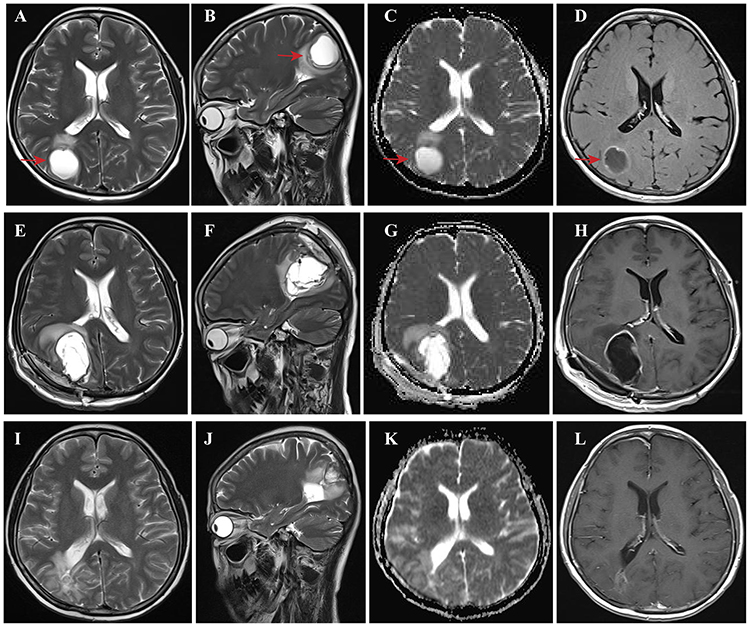 |
Figure 1 Magnetic resonance imaging (MRl) scans of the brain. Before surgery (June 25, 2023) (arrows indicate the metastatic lesion): (A) Axial T2-weighted image, (B) Sagittal T2-weighted image, (C) ADC map, and (D) Axial gadolinium-enhanced T1-weighted image. After surgery (July 5, 2023): (E) Axial T2-weighted image, (F) Sagittal T2-weighted image, (G) ADC map, and (H) Axial gadolinium-enhanced T1-weighted image. Latest follow-up (November 25, 2025): (I) Axial T2-weighted image, (J) Sagillal T2-weighted image, (K) ADC map, and (L) Axial gadolinium-enhanced T1-weighled image. Abbreviation: ADC, apparent diffusion coefficient. |
 |
Figure 2 Histopathological findings of the brain metastasis. H&E and IHC staining at x10 original magnification. (A) H&E staining; lHC staining revealed (B) CK5/6(+), (C) P16(+), (D) P40(+), (E) P63(+), and (F) HER2(3+). Abbreviations: H&E, hematoxyin and eosin; IHC, immunohistochemical; HER2, human epidermal growth factor receptor 2. |
 |
Figure 3 Timeline of the clinical course in this patient. Abbreviations: IMRT, intensity-modulated radiation therapy; CR, complete response; IHC, immunohistochemical; HER2, human epidermal growth factor receptor 2; PFS, progression-free survival. |
Discussion
BM in cervical cancer is uncommon, with reported incidences ranging from 0.38% to 1.82% (Table 1). Most BMs develop 12.5 – 42.5 months after the initial diagnosis of cervical cancer. Overall survival following BM is poor, ranging from 1.6 to 8.8 months. Given the low incidence of BM, routine brain imaging is not recommended in post-treatment surveillance guidelines from the National Comprehensive Cancer Network.1 Most BMs are detected on neuroimaging after neurological symptoms appear, often in conjunction with extracranial metastases. Prognosis is influenced by multiple factors, including patient age, Karnofsky Performance Status, histopathology, cancer stage, primary tumor control, the interval from initial diagnosis to BM detection, and the number and size of brain lesions.7,10,11 The presence of extracranial metastases and the chosen treatment modalities are also critical determinants of outcome.
No standardized treatment exists for BM in cervical cancer. Management strategies include surgical resection, whole-brain radiation therapy (WBRT), chemotherapy, and stereotactic radiosurgery.10,19 Treatment selection depends on tumor location, lesion number and size, extracranial disease status, and patient performance. In patients with a single lesion, no extracranial disease, and good performance status—as in our case, surgical resection followed by postoperative radiation may be appropriate.20,21 Conversely, patients with multiple lesions may benefit from Gamma Knife radiosurgery, which can precisely target multiple lesions simultaneously.22,23 For patients with advanced extracranial disease or poor performance, WBRT or palliative care may be the most suitable options.24
Molecular tumor characteristics also significantly influence survival in BM from cervical cancer. HER2, a member of the epidermal growth factor receptor family, is essential for cell proliferation and differentiation as both a prognostic biomarker and therapeutic target in multiple cancers, including cervical cancer, in which HER2 positivity is observed in approximately 2–6% of cases.1 Anti-HER2 therapies are crucial for managing HER2-positive malignancies; however, humanized monoclonal antibodies such as trastuzumab and pertuzumab have limited intracranial efficacy due to poor blood-brain barrier (BBB) penetration.25 Antibody-drug conjugates such as trastuzumab deruxtecan (T-DXd) have demonstrated promising intracranial responses and durable efficacy in HER2-positive breast cancer patients with BM.26,27 In the DESTINY-PanTumor02 Phase II trial, T-DXd showed clinical benefits in advanced or metastatic HER2-expressing cervical cancer, with an overall response rate of 50%, median duration of response of 14.2 months, and median overall survival of 13.6 months.28 Cost and lack of insurance, however, may limit patient access.
Small-molecule tyrosine kinase inhibitors, including tucatinib, lapatinib, neratinib, and pyrotinib, demonstrate improved BBB penetration and confirmed intracranial antitumor activity.25,29 Pyrotinib, an oral irreversible pan-HER2 receptor inhibitor developed in China, has shown superior PFS when combined with capecitabine compared with lapatinib plus capecitabine in previously treated HER2-positive metastatic breast cancer.16,17,30 This combination is the standard second-line therapy for HER2-positive metastatic breast cancer in China.31 Real-world evidence supports the effectiveness and safety of pyrotinib-based regimens in HER2-positive metastatic breast cancer and BM.32,33 Additionally, clinical studies have demonstrated activity of pyrotinib in other advanced HER2-positive malignancies, including non-small cell lung cancer and colorectal cancer.34,35 Notably, Liu et al reported a patient with metastatic cervical adenocarcinoma harboring the HER2 G292R mutation who achieved a CR to pyrotinib after disease progression on radiochemotherapy, maintaining PFS for over 25 months.36
Pyrotinib has demonstrated efficacy and safety in HER2-positive breast cancer and other solid tumors. Its accessibility and affordability for Chinese patients support the recommendation of systemic therapy combining pyrotinib with capecitabine. In the present case, this regimen was well tolerated after surgery, with only mild and manageable side effects. Follow-up assessments showed no disease recurrence, and the patient maintained a complete response for nearly 29 months. However, this sustained response likely resulted from the combined effects of surgery, radiotherapy, and systemic therapy, rather than pyrotinib alone.
Limitations
This is a single case report with limited generalizability. Significant limitations include HER2 testing on the primary tumor and the lack of FISH or NGS confirmation of HER2 amplification on the metastasis. Therefore, the patient’s outcome may not be replicable, and the independent impact of pyrotinib cannot be determined.
Conclusions
This case demonstrates the effective management of HER2-positive BM from cervical cancer using a multimodal approach, including surgery, radiotherapy, and systemic therapy with pyrotinib and capecitabine. The patient achieved a durable CR with manageable toxicity, highlighting the therapeutic potential of HER2-targeted treatments as part of a combined modality strategy. Further clinical studies are warranted to validate these findings and optimize individualized treatment strategies.
Abbreviations
AD, adenocarcinoma; AS, adenosquamous carcinoma; BBB, blood-brain barrier; BM, brain metastasis; CC, cervical cancer; CCC, clear cell carcinoma; CR, complete response; CS, carcinosarcoma; CT, chemotherapy; EAC, endocervical adenocarcinoma; FIGO, International Federation of Gynaecology and Obstetrics; HER2, human epidermal growth factor receptor 2; IHC, immunohistochemical; IMRT, intensity-modulated radiation therapy; MRI, magnetic resonance imaging; NA, not available; NC, neuroendocrine carcinoma; NSQ, non-squamous carcinoma; PC, palliative care; PET/CT, positron emission tomography/computed tomography; PFS, progression-free survival; RT, radiotherapy; S, surgery; SC, small cell carcinoma; SQ, squamous carcinoma; WBRT, whole-brain radiation therapy.
Data Sharing Statement
The original contributions presented in this study are included in the article/supplementary material. Further inquiries can be directed to the corresponding author(s).
Ethics Approval and Informed Consent
Institutional approval was required and obtained for the publication of this case report. The study was conducted in accordance with the Declaration of Helsinki, and approved by the Ethics Committee of Ganzhou People’s Hospital (Approval No. PJB2026-020-01; Review date: Jan 23, 2026). Written informed consent was obtained from the patient for participation and publication of this case.
Acknowledgments
The authors are deeply grateful to the patient and her family for their cooperation and for allowing us to share this clinical case.
Author Contributions
All authors made a significant contribution to the work reported, whether that is in the conception, study design, execution, acquisition of data, analysis and interpretation, or in all these areas; took part in drafting, revising or critically reviewing the article; gave final approval of the version to be published; have agreed on the journal to which the article has been submitted; and agree to be accountable for all aspects of the work.
Funding
The work was supported by the Ganzhou Municipal Health Commission’s Municipal Scientific Research Plan Project (No. GZWJW202402078), Science and Technology Program of Traditional Chinese Medicine Administration of Jiangxi Province (No. 2025022805), and Ganzhou Municipal Science and Technology Project (No. 2023LNS17451).
Disclosure
The authors declare no conflicts of interest in this work.
References
1. Abu-Rustum NR, Yashar CM, Arend R, et al. NCCN Guidelines® Insights: cervical cancer, version 1.2024. J Natl Compr Canc Netw. 2023;21(12):1224–7. doi:10.6004/jnccn.2023.0062
2. Sung H, Ferlay J, Siegel RL, et al. Global Cancer Statistics 2020: GLOBOCAN estimates of incidence and mortality worldwide for 36 cancers in 185 countries. CA Cancer J Clin. 2021;71(3):209–249. doi:10.3322/caac.21660
3. Kim H, Lee KK, Heo MH, Kim JY. The prognostic factors influencing overall survival in uterine cervical cancer with brain metastasis. Korean J Intern Med. 2019;34(6):1324–1332. doi:10.3904/kjim.2018.051
4. Ikeda S, Yamada T, Katsumata N, et al. Cerebral metastasis in patients with uterine cervical cancer. Jpn J Clin Oncol. 1998;28(1):27–29. doi:10.1093/jjco/28.1.27
5. Chura JC, Shukla K, Argenta PA. Brain metastasis from cervical carcinoma. Int J Gynecol Cancer. 2007;17(1):141–146. doi:10.1111/j.1525-1438.2007.00808.x
6. Hwang JH, Yoo HJ, Lim MC, et al. Brain metastasis in patients with uterine cervical cancer. J Obstet Gynaecol Res. 2013;39(1):287–291. doi:10.1111/j.1447-0756.2012.01927.x
7. Gressel GM, Lundsberg LS, Altwerger G, et al. Factors predictive of improved survival in patients with brain metastases from gynecologic cancer: a single institution retrospective study of 47 cases and review of the literature. Int J Gynecol Cancer. 2015;25(9):1711–1716. doi:10.1097/igc.0000000000000554
8. Kim YZ, Kwon JH, Lim S. A clinical analysis of brain metastasis in gynecologic cancer: a retrospective multi-institute analysis. J Korean Med Sci. 2015;30(1):66–73. doi:10.3346/jkms.2015.30.1.66
9. Teke F, Tunc SY, Teke M, et al. The impact of the stage and tumor size on rare brain metastasis of cervical cancer. Turk Neurosurg. 2016;26(6):818–823. doi:10.5137/1019-5149.Jtn.13973-15.1
10. Sun S, Lian X, Liu X, et al. Multimodal therapy is a better choice for patients with brain metastasis from cervical cancer. Cancer Manag Res. 2020;12:12395–12402. doi:10.2147/cmar.S283673
11. de Brito Rangel J, Giglio AG, Cardozo CL, Bergmann A, Thuler LCS. Prognostic factors for brain metastasis in women presenting cervical cancer. J Neurooncol. 2022;159(2):469–477. doi:10.1007/s11060-022-04082-9
12. Waks AG, Winer EP. Breast cancer treatment: a review. JAMA. 2019;321(3):288–300. doi:10.1001/jama.2018.19323
13. Zhu Y, Zhu X, Wei X, Tang C, Zhang W. HER2-targeted therapies in gastric cancer. Biochim Biophys Acta Rev Cancer. 2021;1876(1):188549. doi:10.1016/j.bbcan.2021.188549
14. Yan M, Schwaederle M, Arguello D, Millis SZ, Gatalica Z, Kurzrock R. HER2 expression status in diverse cancers: review of results from 37,992 patients. Cancer Metastasis Rev. 2015;34(1):157–164. doi:10.1007/s10555-015-9552-6
15. Itkin B, Garcia A, Straminsky S, et al. Prevalence of HER2 overexpression and amplification in cervical cancer: a systematic review and meta-analysis. PLoS One. 2021;16(9):e0257976. doi:10.1371/journal.pone.0257976
16. Yan M, Ouyang Q, Sun T, et al. Pyrotinib plus capecitabine for patients with human epidermal growth factor receptor 2-positive breast cancer and brain metastases (PERMEATE): a multicentre, single-arm, two-cohort, Phase 2 trial. Lancet Oncol. 2022;23(3):353–361. doi:10.1016/s1470-2045(21)00716-6
17. Xu B, Yan M, Ma F, et al. Pyrotinib plus capecitabine versus lapatinib plus capecitabine for the treatment of HER2-positive metastatic breast cancer (PHOEBE): a multicentre, open-label, randomised, controlled, Phase 3 trial. Lancet Oncol. 2021;22(3):351–360. doi:10.1016/s1470-2045(20)30702-6
18. Yang Z, Meng J, Mei X, et al. Brain radiotherapy with pyrotinib and capecitabine in patients with ERBB2-positive advanced breast cancer and brain metastases: a nonrandomized phase 2 trial. JAMA Oncol. 2024;10(3):335–341. doi:10.1001/jamaoncol.2023.5791
19. Kato MK, Tanase Y, Uno M, Ishikawa M, Kato T. Brain metastases from uterine cervical and endometrial cancer. Cancers. 2021;13(3):519. doi:10.3390/cancers13030519
20. Meixner E, Eichkorn T, Erdem S, et al. Stereotactic radiosurgery for brain metastases from pelvic gynecological malignancies: oncologic outcomes, validation of prognostic scores, and dosimetric evaluation. Int J Gynecol Cancer. 2022;32(2):172–180. doi:10.1136/ijgc-2021-002906
21. Onal C, Gultekin M, Oymak E, et al. Stereotactic radiotherapy in patients with oligometastatic or oligoprogressive gynecological malignancies: a multi-institutional analysis. Int J Gynecol Cancer. 2020;30(6):865–872. doi:10.1136/ijgc-2019-001115
22. Shin HK, Kim JH, Lee DH, Cho YH, Kwon DH, Roh SW. Clinical outcomes of gamma knife radiosurgery for metastatic brain tumors from gynecologic cancer: prognostic factors in local treatment failure and survival. J Korean Neurosurg Soc. 2016;59(4):392–399. doi:10.3340/jkns.2016.59.4.392
23. Wei Z, Luy DD, Tang LW, et al. Gamma Knife radiosurgery for gynecologic metastases to the brain: analysis of pathology, survival, and tumor control. Gynecol Oncol. 2023;172:21–28. doi:10.1016/j.ygyno.2023.03.006
24. Divine LM, Kizer NT, Hagemann AR, et al. Clinicopathologic characteristics and survival of patients with gynecologic malignancies metastatic to the brain. Gynecol Oncol. 2016;142(1):76–82. doi:10.1016/j.ygyno.2016.04.030
25. Sun H, Xu J, Dai S, Ma Y, Sun T. Breast cancer brain metastasis: current evidence and future directions. Cancer Med. 2023;12(2):1007–1024. doi:10.1002/cam4.5021
26. Bartsch R, Berghoff AS, Furtner J, et al. Trastuzumab deruxtecan in HER2-positive breast cancer with brain metastases: a single-arm, phase 2 trial. Nat Med. 2022;28(9):1840–1847. doi:10.1038/s41591-022-01935-8
27. Hurvitz SA, Hegg R, Chung WP, et al. Trastuzumab deruxtecan versus trastuzumab emtansine in patients with HER2-positive metastatic breast cancer: updated results from DESTINY-Breast03, a randomised, open-label, phase 3 trial. Lancet. 2023;401(10371):105–117. doi:10.1016/s0140-6736(22)02420-5
28. Meric-Bernstam F, Makker V, Oaknin A, et al. Efficacy and safety of trastuzumab deruxtecan in patients with HER2-expressing solid tumors: primary results from the DESTINY-PanTumor02 Phase II Trial. J Clin Oncol. 2024;42(1):47–58. doi:10.1200/jco.23.02005
29. Wynn CS, Tang SC. Anti-HER2 therapy in metastatic breast cancer: many choices and future directions. Cancer Metastasis Rev. 2022;41(1):193–209. doi:10.1007/s10555-022-10021-x
30. Ma F, Ouyang Q, Li W, et al. Pyrotinib or lapatinib combined with capecitabine in HER2-positive metastatic breast cancer with prior taxanes, anthracyclines, and/or trastuzumab: a randomized, Phase II Study. J Clin Oncol. 2019;37(29):2610–2619. doi:10.1200/jco.19.00108
31. Blair HA. Pyrotinib: first Global Approval. Drugs. 2018;78(16):1751–1755. doi:10.1007/s40265-018-0997-0
32. Anwar M, Chen Q, Ouyang D, et al. Pyrotinib treatment in patients with HER2-positive metastatic breast cancer and brain metastasis: exploratory final analysis of real-world, multicenter data. Clin Cancer Res. 2021;27(16):4634–4641. doi:10.1158/1078-0432.Ccr-21-0474
33. Lin Y, Lin M, Zhang J, et al. Real-world data of pyrotinib-based therapy in metastatic HER2-positive breast cancer: promising efficacy in lapatinib-treated patients and in brain metastasis. Cancer Res Treat. 2020;52(4):1059–1066. doi:10.4143/crt.2019.633
34. Song Z, Lv D, Chen SQ, et al. Pyrotinib in patients with HER2-amplified advanced non-small cell lung cancer: a prospective, multicenter, single-arm trial. Clin Cancer Res. 2022;28(3):461–467. doi:10.1158/1078-0432.Ccr-21-2936
35. Fu X, Ying J, Yang L, et al. Dual targeted therapy with pyrotinib and trastuzumab for HER2-positive advanced colorectal cancer: a phase 2 trial. Cancer Sci. 2023;114(3):1067–1074. doi:10.1111/cas.15660
36. Liu J, Zhuo Y, Wang F, et al. A metastatic cervical adenocarcinoma patient carrying HER2 G292R achieved complete response upon pyrotinib treatment. Onco Targets Ther. 2021;14:4833–4836. doi:10.2147/ott.S321655
 © 2026 The Author(s). This work is published and licensed by Dove Medical Press Limited. The
full terms of this license are available at https://www.dovepress.com/terms
and incorporate the Creative Commons Attribution
- Non Commercial (unported, 4.0) License.
By accessing the work you hereby accept the Terms. Non-commercial uses of the work are permitted
without any further permission from Dove Medical Press Limited, provided the work is properly
attributed. For permission for commercial use of this work, please see paragraphs 4.2 and 5 of our Terms.
© 2026 The Author(s). This work is published and licensed by Dove Medical Press Limited. The
full terms of this license are available at https://www.dovepress.com/terms
and incorporate the Creative Commons Attribution
- Non Commercial (unported, 4.0) License.
By accessing the work you hereby accept the Terms. Non-commercial uses of the work are permitted
without any further permission from Dove Medical Press Limited, provided the work is properly
attributed. For permission for commercial use of this work, please see paragraphs 4.2 and 5 of our Terms.
Recommended articles
Beyond the Pelvis: Brain Metastases in Cervical Cancer – A Case Series from a Low-Middle-Income Country
Sibarani CNR, Suardi D, Salima S, Nathania N, Adrianto N
International Journal of Women's Health 2025, 17:4745-4753
Published Date: 22 November 2025